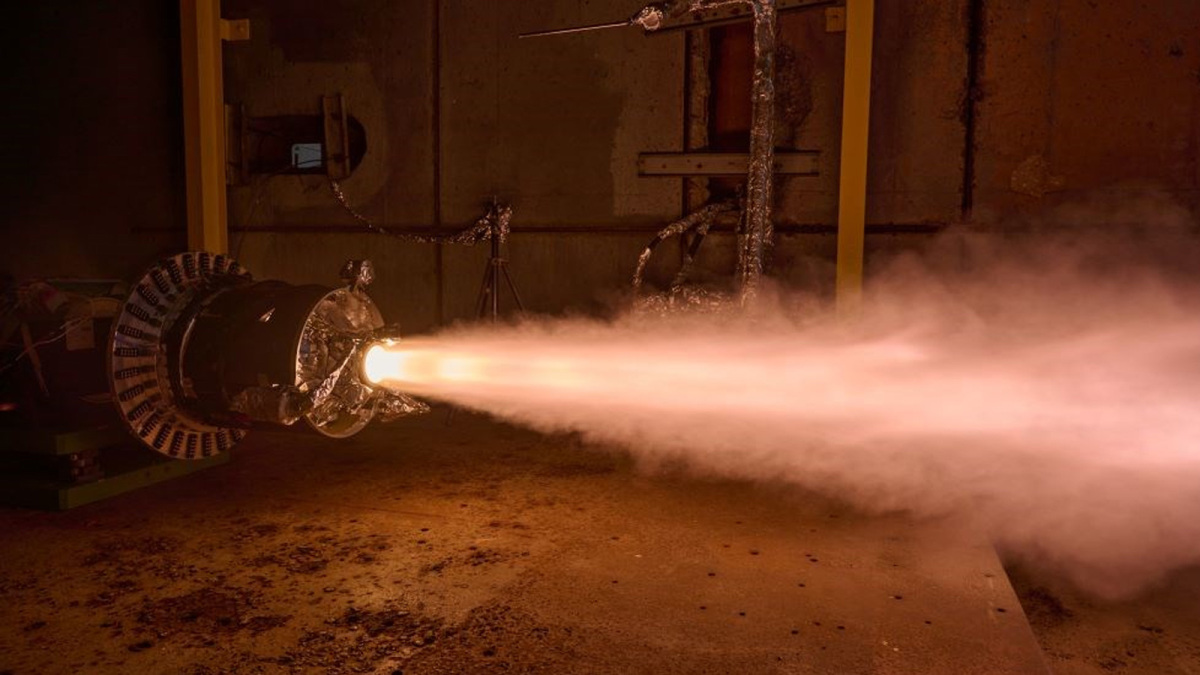
Northrop Grumman has hailed the successful test of a rocket designed to bring back samples from Mars’ surface. This latest static fire test confirmed the viability of a new propellant, as well as further showcasing the capabilities of the sample return rocket. This motor is part of the Mars Ascent Propulsion System (MAPS), which is a collaborative effort between NASA and the European Space Agency.
A Mars sample return is considered one of several important steps towards getting human boots on Mars. To that end, NASA handed out a contract in 2021 to Northrop Grumman to develop a rocket that could launch from a rover design and send samples into orbit around Mars for rendezvous, capture, and eventually return to Earth. This rocket is what will get that sample off the surface and into a captureable orbit.

A concept render of how the sample return rocket might work.
Credit: NASA
“With this third successful full-scale static test, we have demonstrated a near-flight-ready design using proven space materials and propellants,” said Jeff Bemis, program manager of the Mars Ascent Propulsion System (MAPS) program at Northrop Grumman. “We’ve been to Mars before using materials and propellants such as these. Our materials and propellants have a legacy of proven reliability and are well-suited for the extreme conditions of space and planetary protection requirements.”
Northrop didn’t release much in the way of details about the test but did showcase the video above, calling it “successful.” The new propellant is reportedly one that Nortrop has used in other Northrop motors in the past, as part of its STAR scheme. This latest test is enough to confirm its readiness for use in future ascent propulsion missions, Northrop claims, regardless of the planet or landing method.
The test took place at Northrop Grumman’s Elkton, MD campus, which designs and manufactures solid and liquid propulsion systems and controls for rocket systems.
“The team will continue comprehensive analysis and testing to ensure the flight motors meet future mission requirements, including launch and landing loads specific to planets like Mars, as well as extreme thermal conditions,” Northrop’s MAPS chief engineer, Jonathan Katz, said.
Despite this newfound confidence, though, NASA does not plan for a sample return mission in the near future. Indeed, it may not take place until sometime in the 2040s. However, more details are expected in the near future, with AutoEvolution suggesting NASA will announce more concrete details about the mission in 2026.