c# – Creating RDLC report in ASP.NET Core Web API


Thought it might save people a lot of trouble if they knew a bad solution to avoid. I follow up with something that seems to be working.

VS2022. .netCore 8.0. Already had a WebAPI project to which I wanted to add an rdlc report.

Had the same issue, and worse. Not sure how, someone at work claimed he was able to create a new rdlc but the steps he gave never worked on anyone elses’ machine. So we just copy pasted the rdlc file he created and tried working on it from there.

The DataSet/DataSource dropdowns wouldn’t work consistently. Wouldn’t work at all unless our classes had primitive data types only and they were changed to interfaces with implementations. If you edited a class associated with a dataset that had been working, it would stop working.

I started a .netcore windows form app, and all the usual rdlc functionality started working. Much the same seems true for a standalone reporting project. I wrapped up teh classes I needed from my api into a Class LIbrary and imporfted into the reports project. So far so good. I wrap up my Data Access Layer and should be able to use that to generate the report. Then import that as a Project Reference

Not sure if this is is related, but Microsoft Reporting Services doesn’t seem to be compatible with .net 8.0. Was thinking of sorting that out, but since I have something workable, I’m avoiding it.

Today’s NYT Strands Hints, Answer and Help for Feb. 1 #700


Looking for the most recent Strands answer? Click here for our daily Strands hints, as well as our daily answers and hints for The New York Times Mini Crossword, Wordle, Connections and Connections: Sports Edition puzzles.


Today’s NYT Strands puzzle is a bit of a challenge. Some of the answers are difficult to unscramble, and a couple are kind of long, so if you need hints and answers, read on.

I go into depth about the rules for Strands in this story

If you’re looking for today’s Wordle, Connections and Mini Crossword answers, you can visit CNET’s NYT puzzle hints page.

Read more: NYT Connections Turns 1: These Are the 5 Toughest Puzzles So Far

Hint for today’s Strands puzzle

Today’s Strands theme is: It’s a gift.

If that doesn’t help you, here’s a clue: For me, really?

Clue words to unlock in-game hints

Your goal is to find hidden words that fit the puzzle’s theme. If you’re stuck, find any words you can. Every time you find three words of four letters or more, Strands will reveal one of the theme words. These are the words I used to get those hints but any words of four or more letters that you find will work:

  • BONE, GONE, BONNET, NOTE, PRIDE, RING, TING, SENT, RENT, WARD, DRAW, SEEN, SEER, TORE, RANT, TRYING, DONATE, SIRE

Answers for today’s Strands puzzle

These are the answers that tie into the theme. The goal of the puzzle is to find them all, including the spangram, a theme word that reaches from one side of the puzzle to the other. When you have all of them (I originally thought there were always eight but learned that the number can vary), every letter on the board will be used. Here are the nonspangram answers:

  • AWARD, BONUS, GRANT, PRESENT, DONATION, OFFERING

Today’s Strands spangram

completed NYT Strands puzzle for Feb. 1, 2026, #700

The completed NYT Strands puzzle for Feb. 1, 2026.

NYT/Screenshot by CNET

Today’s Strands spangram is GENEROSITY. To find it, start with the G that’s three letters to the right on the top row, and wind down.


Don’t miss any of our unbiased tech content and lab-based reviews. Add CNET as a preferred Google source.


How to Detail Sheet Metal Shop Drawings for Increased Fabrication Accuracy for Companies


A sheet metal shop drawing is technical documentation, an instruction manual, or perhaps a blueprint specifically created for the fabrication of sheet metal parts to be used in an architectural or construction project. The drawing must therefore be comprehensive enough to contain details such as material specifications, welding area, bends, hole positions, space dimensions, and so forth. For structural components that are prefabricated off-site, like sheet metal, just about everything needs to be precise to make sure that the on-site construction process runs without hiccups. Prefabricated components have to fit perfectly in the designated place and for the intended purpose to avoid potentially expensive rework.

In a typical construction project, the metal fabricators are not usually integral members of the engineering or design team. They’re subcontractors hired by the general contractor to handle the sheet metal fabrication task. Fabricators rely on metal shop drawings, which are also often created by an external drafter based on the engineer’s design drawing, to produce the parts as specified.

Even the slightest mistake in the drawing can lead to inaccurate fabrication, compromising the quality of the finished product and putting the structural integrity of the building at risk of premature failure. One of the most effective measures to bring about accuracy in a metal sheet drawing is to simply hire the right professionals to do the job. Cad Crowd is populated by thousands of talented CAD drafters who specialize in the AEC industry and are experienced in metal sheet drawings for big and small projects alike.


🚀 Table of contents


Sheet metal drawing best practices

Whether you’re a CAD drafter or metal fabricator, there are many things you can do to make certain that all the details are correct and clearly illustrated.

Stick to DFM Guidelines

When applied to the sheet metal fabrication process, design for manufacturing services, or DFM, mainly focuses on a number of established rules of thumb as well as exceptions for typical fabrication techniques, including welding, cutting, bending, drilling, punching, and so forth. So long as the drawings are developed in conformity with DFM guidelines, you gain a lower chance of error and a higher level of accuracy.

The main point of DFM is to force engineers (and, by extension, the CAD drafter who produces the shop drawings) to consider fabrication-related matters when designing and illustrating sheet metal, so they can guide the fabricators accordingly. For example, a metal sheet shop drawing should specify the direction of the welding and when or where to use filler electrodes. If the metal part needs staggered welds, the drawing should also mention the length of every pitch, enabling the welder to avoid material warping. Specific tolerances for bending or notches must be clearly mentioned as well.

Given properly identified methods, tolerances, and limits, the metal fabricator can make an informed decision in every phase of the task. Remember that just like the product manufacturing process, metal fabrication also aims for a good balance between quality and cost. Accurate and clear shop drawings contribute to cost-efficiency a great deal. Armed with a professionally-made shop drawing, it’s possible to reduce overheads (by not using a greater amount of raw material than what’s needed), eliminate reworks (which also means no additional labor), and streamline the fabrication job of multiple parts. And at the end of the day, it improves the chances of the fabrication getting completed on time. More details about these technique-related matters are discussed below.

RELATED: Top 30 steel detailing companies for CAD drafting and engineering design services in the US

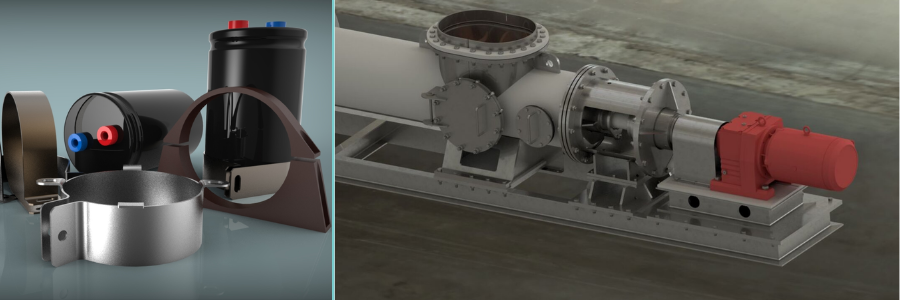
sheet metal design renderings by Cad Crowd shop drawing experts

Material specifications

An engineering design expert’s plan may contain material specifications for the sheet metal parts, and it’s the drafter’s responsibility to translate and interpret the information for the technical shop drawing. There are numerous types of metal materials, from stainless steel and aluminum to tungsten and all sorts of alloys. In fact, each metal has a number of specific grades based on its characteristics, like tensile strength, corrosion resistance, durability, and more. A professional metal fabrication shop probably has a warehouse filled with tons of different metals, so be very specific about what types and grades to use. Thickness also matters, as it directly affects the materials’ ability to cope with mechanical stresses.

Finishes, such as heat treatments or coatings, may seem like nothing but superficial details, but they do serve functional purposes. For instance, powder coating actually triggers a chemical reaction that melts the powder and forms a protective layer on the metal surface. The aesthetic improvement is in addition to this benefit.

Here are some practical tips to provide proper material specifications when working in a CAD environment:

  • It’s always a good idea to make use of the built-in material libraries. Just about every CAD software has a material library filled with a huge selection of materials. You can take advantage of the options for time efficiency and consistency across the fabrication documents. Don’t forget to include industry specifications or standards (like ISO or ASTM) just to make sure that the fabricator only uses materials that meet the performance requirements.
  • In case you need to run an analysis or simulation, specify the material properties, including thickness, density, elasticity, tensile strength, thermal conductivity, yield strength, etc. Assuming the metal parts have to be made of an alloy not listed in the library, you have to make sure that the custom material is well-documented. Also include its properties and characteristics to inform the fabricators exactly what you need. That said, the use of brand-new custom metal alloys is pretty rare unless you’re making high-performance products like cars, weapons, or industrial equipment for engineering design firms.
  • No matter what materials you choose and the associated properties, always use standardized callouts and label them with common symbols. To make things absolutely clear, include the names and grades of the materials in question. Don’t forget to mark them with any relevant codes, if applicable. If there are variations in specifications and requirements (such as edge treatments, finishing, thickness, etc.), highlight the distinctions. Some CAD applications offer color-coding features, which can help mark the difference between two or more similar things. Color-coding is useful for quick material identification.
  • Whether you’re using library materials or custom materials, always attach a datasheet to inform the fabricator of their properties, manufacturer information, and special handling instructions. You can also make annotations directly on the shop drawing to give additional notes. The datasheet serves as a reference in the CAD file; it may even contain suggestions or guides on the use of possible alternative materials.

Last but not least, maintain version control of the shop drawing to keep track of any changes in material specifications. The fabricator should only receive the already-finalized shop drawing, but version control helps you manage updates during the design process. Keeping track of revision history, such as by using a unique identifier to label each drawing, would also prove to be useful during quality checks and the audit process.

Joining and welding instructions

Depending on the shape and geometry of the metal part, sometimes it’s just more practical to join two or more pieces together than to manipulate a single sheet, by either screwing or welding them together. Welding is a proven, reliable technique, but it does take some specialized equipment and skills to get everything within the tolerance for accuracy. If the shape is relatively intricate, welding can be labor-intensive, too. On the other hand, applying screws or fasteners of any sort is much simpler and even preferable, so long as it doesn’t interfere with the metal part’s geometry.

In case welding is the only feasible solution for effective fabrication, the shop drawing expert must specify in detail the types of welds, such as groove, fillet, spot, seam, slot, or plug welds. The location and size of each weld point should also be clearly defined because they may affect the design and structural integrity of the sheet metal. If necessary, annotate the shop drawing with specific instructions such as post-weld heat treatments, temperature monitoring techniques, and quality control measures. All those factors have a major impact on the overall quality of the welds and the finished part itself.

Holes and Cutouts

A sheet of metal usually serves as a single component of an assembly. It must be secured to other parts using the correct types of fasteners to ensure structural integrity. It’s crucial that the shop drawing includes accurate details pertaining to the location, shape, and size of each hole opening for proper assembly. Furthermore, some holes might need specific considerations such as chamfering and deburring; some designs require those edge treatments, whether for visual purposes or simply to prevent sharp edges.

Cutouts are no different. In addition to marking the direction (or shape) and length of cutouts, the shop drawing must inform the fabricators about the specific treatments (if any) required by the design intent. A sheet of metal typically undergoes shearing and punching treatments before it is ready for laser cutting.

RELATED: The 5 stages of prototyping for any new product idea for product design service companies

Bend specification

The key to providing accurate bending information in a sheet metal shop drawing is, first and foremost, understanding what the bends are for to begin with. Metal will deform when exposed to a strong enough force to bend its shape. In the absence of a working knowledge of how metal materials behave under mechanical stress, it would be very difficult to control the deformation. Bending is neither an additive nor a subtractive method. It’s a manipulation technique to modify the shape of metal without adding or reducing the raw material.

Every good CAD drafter has a good grasp of such concepts as k-factors and bend allowances to account for material compression and stretch during bending. The guide provided by shop drawing services allows the fabricators to make the correct calculations (or deductions) and bend the material to produce the intended shape. This is especially important in critical bends, which must adhere to strict tolerances, as they affect the part’s functionality and structural integrity a great deal. CAD software packages like SolidWorks, AutoCAD, FreeCAD, and Autodesk Inventor come with various tools to adjust (or automate) bend deductions.

Assembly information

A shop drawing must contain a list of all components required for the proper assembly of the sheet metal. This listing includes latches, hinges, fasteners (bolts, nuts, screws, etc.), and every other hardware item that comprises the finished product. The quantity of each item must be identified, too. A proper assembly uses all the listed items and nothing more.

Equally important is the assembly instruction to provide a concise step-by-step guide for the fabricator. An instruction informs the fabricator where and how to use the hardware items, the type of fastener for each hole position, the fastening specification or torque, and the correct tool for every step. The guide must be outlined in chronological order for labor efficiency. A detailed assembly guide enables the fabricator to produce a sheet metal that’s both structurally sound and accurate to the design requirement.

Arrange the view for clear communication

A shop drawing isn’t a site plan that contains an overview of an entire project seen from a bird’s eye perspective. It’s also not a visualization simply to showcase how the final metal parts should look when completed. When a CAD drafting expert develops a shop drawing, the final document should consist of multiple sheets of images; each illustrates the part from a particular viewing angle.

In many cases, a single sheet of metal can look like two completely different objects when observed from a different perspective; for instance, the front appears smooth and polished, whereas the back is full of rivets. A complex sheet metal with several 90-degree bends will also look different when seen from either side. Illustrating a sheet metal part from multiple viewing angles leaves no room for guesswork. Among the most common views are:

  • Sectional (or cross-sectional) views: as the name suggests, the view is presented as if you’re looking at a cross-sectional slice of the assembly. The view depicts the interior detail of an assembly, allowing the fabricator to learn and understand any internal structure or mechanism of a metal part. For example, if the sheet is made of two different metals and secured with a screw from the bottom layer, the fabricator can plan the production process to compensate for the design.
  • Orthographic projections: quite possibly the most intuitive illustration of part design, orthographic projections involve creating a set of three drawings – each represents a geometrical detail for the visible components. The three drawings include a top view, a front view, and a side view (either left or right). Every drawing is annotated with material specifications and dimensions to ensure accuracy during fabrication. All three drawings are usually put on the same page for easy comparison.
  • Axonometric views: Like a simple visualization, an axonometric view is a pictorial drawing of the design without any annotation about dimensions. It’s supposed to be a clean illustration of the sheet metal for the fabricator to understand the orientation of each component used. Axonometric views have simplified design details and must be used in conjunction with isometric drawings for sheet metal fabrication purposes.

There are several other views in shop drawings, but the aforementioned three are by far the most comprehensive and commonly used because they can effectively communicate design intent. Many companies have started adopting 3D modeling design services to supplement the conventional CAD drawing.

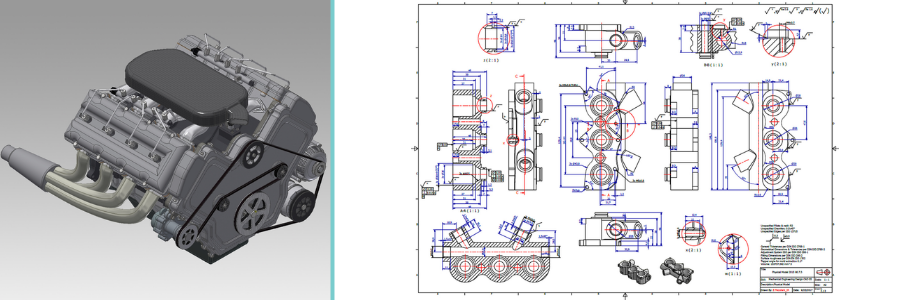
sheet metal design plan and example by Cad Crowd shop drawing freelance experts

RELATED: 15 engineering design constraints that product design companies & engineering firms can’t avoid

Avoid excessive details

Sheet metal shop drawings are essentially instructions for fabricators to produce metal parts. They contain information about material specifications, dimensions, welding techniques, finishes, types of fasteners, and assembly. You can annotate every single component with loads of data in the hope of making things absolutely clear, but sometimes this approach triggers the opposite effect. Instead of being clear, the drawing becomes cluttered and overloaded with details. Missing information is undesirable, but excessive details are no different. Therefore, you should only include details relevant to the fabrication process, nothing less, nothing more.

Takeaway

Engineers and drafters often get carried away to get everything right the first time, when in reality it may take a few rounds of revision until everything is exactly as it should be. Revision isn’t supposed to be a dreadful hurdle; it’s an unavoidable part of a construction project. In fact, you should expect revisions if all the teams and stakeholders involved in a construction project play their roles professionally. Let’s not forget that converting the original design drawings into the more technical sheet metal fabrication plans isn’t as straightforward as it may seem. It’s an iterative process filled with reviews, modifications, refinements, and ultimately approval.

A lot of details must be addressed before the drawing makes its way to the fabrication shop floor. Only when the metal fabricator gets all the required information and is actually capable of translating it into a series of feasible fabrication processes may the actual work begin. But then again, it’s not the fabricator’s job to prepare the details and deliver them in a comprehensive drawing; the responsibility falls on the drafter. Get a free quote today.

author avatar

MacKenzie Brown is the founder and CEO of Cad Crowd. With over 18 years of experience in launching and scaling platforms specializing in CAD services, product design, manufacturing, hardware, and software development, MacKenzie is a recognized authority in the engineering industry. Under his leadership, Cad Crowd serves esteemed clients like NASA, JPL, the U.S. Navy, and Fortune 500 companies, empowering innovators with access to high-quality design and engineering talent.

Connect with me: LinkedInXCad Crowd

Mercedes-Benz Unveils New S-Class Built on NVIDIA DRIVE AV, Which Enables an L4-Ready Architecture


Mercedes-Benz is marking 140 years of automotive innovation with a new S-Class built for the AI era, bringing together automotive safety and NVIDIA’s advanced autonomous driving platform to enable a level 4-ready architecture designed for trust.

The new S-Class with MB.OS, which will be equipped with the NVIDIA DRIVE Hyperion architecture and full-stack NVIDIA DRIVE AV L4 software, is designed to support future robotaxi operations — delivering safety-first autonomy with the NVIDIA Halos system and end-to-end AI and classical driving stacks running in parallel to ensure reliable operation.

The S-Class enables a premium, chauffeur-style autonomous experience. As part of NVIDIA’s previously announced partnership with Uber, the companies will work together to make these autonomous vehicles available to riders through Uber’s mobility network.

It showcases how legacy automakers and AI pioneers can work together to build vehicles that are safer, smarter and increasingly autonomous — without compromising the high standards of quality and safety customers expect.

“Mercedes-Benz has set the standard in the automotive market, building cars defined by exquisite craftsmanship and safety engineering,” said Jensen Huang, founder and CEO of NVIDIA, in the above video celebrating the S-Class launch. “Five years ago, NVIDIA began working with Mercedes-Benz to help carry that legacy into the AI era.”

L4-Ready Architecture Powered by NVIDIA DRIVE AV

Traditional autonomous driving approaches often rely on predefined rules or learned responses to familiar situations. But real-world driving is filled with rare and complex edge cases — from unpredictable pedestrian behavior and debris to unusual road conditions and aggressive cut-ins.

NVIDIA DRIVE AV provides Mercedes-Benz’s new S-Class with a full-stack automated driving system designed to handle this long tail of driving scenarios, while remaining anchored to a safety-first architecture.

NVIDIA DRIVE AV is trained at scale on NVIDIA DGX systems and designed to be validated   using high-fidelity simulation with NVIDIA Omniverse NuRec libraries and NVIDIA Cosmos world models.

Built on NVIDIA’s broader AI foundation — including advanced perception, planning and reasoning technologies — NVIDIA DRIVE AV is optimized, validated and distilled to run reliably in production vehicles, tailored to Mercedes-Benz’s vehicle platforms and sensor configurations.

NVIDIA DRIVE AV enables the system to analyze complex environments — rather than simply reacting to known patterns — evaluate multiple options and select the safest possible outcome in real time.

Diversity by Design With NVIDIA DRIVE Hyperion for Real-World Mobility

For level 4 autonomy, safety depends on more than simple redundancy. Vehicles must remain operational in the face of hardware faults, sensor degradation and unexpected software behavior.

The new S-Class will be built on NVIDIA DRIVE Hyperion, a reference architecture that integrates sensor diversity and hardware redundancy into a unified platform, to serve as a robotaxi.

DRIVE Hyperion is designed based on defense-in-depth principles:

  • Redundant compute to help maintain operation if one processing element fails.
  • Multimodal sensor diversity — spanning cameras, radar and lidar — to support robust perception.
  • Software stack diversity, pairing AI-driven decision-making with a parallel classical safety stack to keep the vehicle operating within safe boundaries.

Developed in accordance with NVIDIA Halos safety system, NVIDIA DRIVE Hyperion helps eliminate single points of failure and provides the foundation needed for L4-ready systems.

This safety-first, resilient platform is mainly designed for premium robotaxi and chauffeured mobility services — enabling reliable, large-scale deployment in real-world environments.

From AI Foundations to Production-Ready Autonomy 

NVIDIA’s broader AI ecosystem — including the NVIDIA Alpamayo family of open models, simulation tools and datasets for autonomous vehicles — enables developers and partners to advance autonomous driving research and build their own driving software.

Within NVIDIA DRIVE AV, these AI capabilities are further refined, optimized and engineered for production. It ensures reliable operation on automotive-grade hardware, with NVIDIA Halos applying strict safety standards to the AI pipeline, as well as seamless integration with Mercedes-Benz’s specific sensor and vehicle architectures.

This production-grade approach — combining large-scale training, high-fidelity simulation, rigorous safety validation and deep system integration — is what allows NVIDIA DRIVE AV to support both level 2 point-to-point and level 4-ready automated driving systems in customer vehicles.

Building on this foundation, Mercedes-Benz and NVIDIA are partnering to deliver an L4-ready version of the new S-Class, bringing advanced AI and safety-focused autonomy to the road.

At the core of this work is NVIDIA Alpamayo, which enables vehicles to drive smoothly and naturally like a human driver while reasoning step by step through complex situations to choose the safest possible action — since safety is paramount.

Bringing Safety Engineering Into the Autonomous Driving Era 

As AI becomes central to vehicle intelligence, the definition of “the safest car” is evolving. Beyond protecting occupants in a crash, modern vehicles are increasingly designed to help prevent accidents in the first place.

Built on NVIDIA DRIVE Hyperion and full-stack NVIDIA DRIVE AV software, the next-generation S-Class extends Mercedes-Benz’s long-standing safety leadership into the AI era. Its L4-ready architecture combines end-to-end AI with parallel classical driving stacks, delivering predictable, reliable operation through a diverse, multi-layered system design.

This approach reflects a broader shift toward active, intelligent safety — a trend already recognized by independent testing, including the Mercedes-Benz CLA’s designation as Euro NCAP’s Best Performer of 2025.

Together, Mercedes-Benz and NVIDIA are demonstrating how legacy automakers and AI pioneers can collaborate to deliver vehicles that are safer, smarter and increasingly autonomous — without compromising the craftsmanship, comfort and quality customers expect.

a16z partner Kofi Ampadu to leave firm after TxO program pause


Kofi Ampadu, the partner at a16z who led the firm’s Talent x Opportunity (TxO) fund and program, has left the firm, according to an email he sent to staff that TechCrunch obtained. This comes months after the firm paused TxO and laid off most of its staff.

“During my time at the firm, I was deeply grateful for the opportunity and the trust to lead this work,” Ampadu wrote in the email, sent Friday afternoon, with the subject line “Closing My a16z Chapter.”

“Identifying out-of-network entrepreneurs and supporting them as they sharpened their ideas, raised capital, and grew into confident leaders was one of the most meaningful experiences of my career,” he wrote.

Ampadu led the program, which launched in 2020, for over four years until its pause last November, taking over for the initial leader, Nait Jones. Afterward, Ampadu seems to have worked at a16z’s latest accelerator, Speedrun.

Ampadu’s departure perhaps signals the end of the TxO chapter. The fund and program focused on supporting underserved founders by providing access to tech networks and investment capital through a donor-advised fund. Though some founders spoke highly of the program, others criticized the controversial donor-advised structure. The program also launched a grant program in 2024 to provide $50,000 to nonprofits that help diverse founders.

Its last cohort was in March 2025, and its indefinite pause came as many top tech names reframe, cut, or eliminate prior public commitments to diversity, equity, and inclusion. We’ve reached out to a16z and Ampadu for comment.

His full note below:

I moved to the United States three months before my 11th birthday. One month later, I started 6th grade in a school more than 5,000 miles from my home, my friends, and everything familiar. Recently, my mom reminded me that my school required me to enroll as an English-as-a-Second-Language student. My memory immediately returned to how confused I felt. Even at 10 years old, I knew it made no sense that a kid from Ghana, an English-speaking country, was being asked to learn a language he already spoke fluently.

This was a systems requirement, a blanketed assumption about what students from certain places could or could not do. That same type of systemic assumption is what we set out to challenge through the Talent x Opportunity Initiative. The venture ecosystem often relies on proxies such as schools, networks, and prior credentials, which can obscure exceptional founders who do not follow the most common paths. TxO invested in and supported these overlooked founders to bridge the gap between talent and opportunity.

During my time at the firm, I was deeply grateful for the opportunity and the trust to lead this work. Identifying out-of-network entrepreneurs and supporting them as they sharpened their ideas, raised capital, and grew into confident leaders was one of the most meaningful experiences of my career.

As I move on to my next chapter, I leave with pride in what we built and gratitude for everyone who helped shape it. Thank you for the trust, the collaboration, and the belief in what is possible. There is more work to do and I am excited to keep building.

NASA used Claude to plot a route for its Perseverance rover on Mars


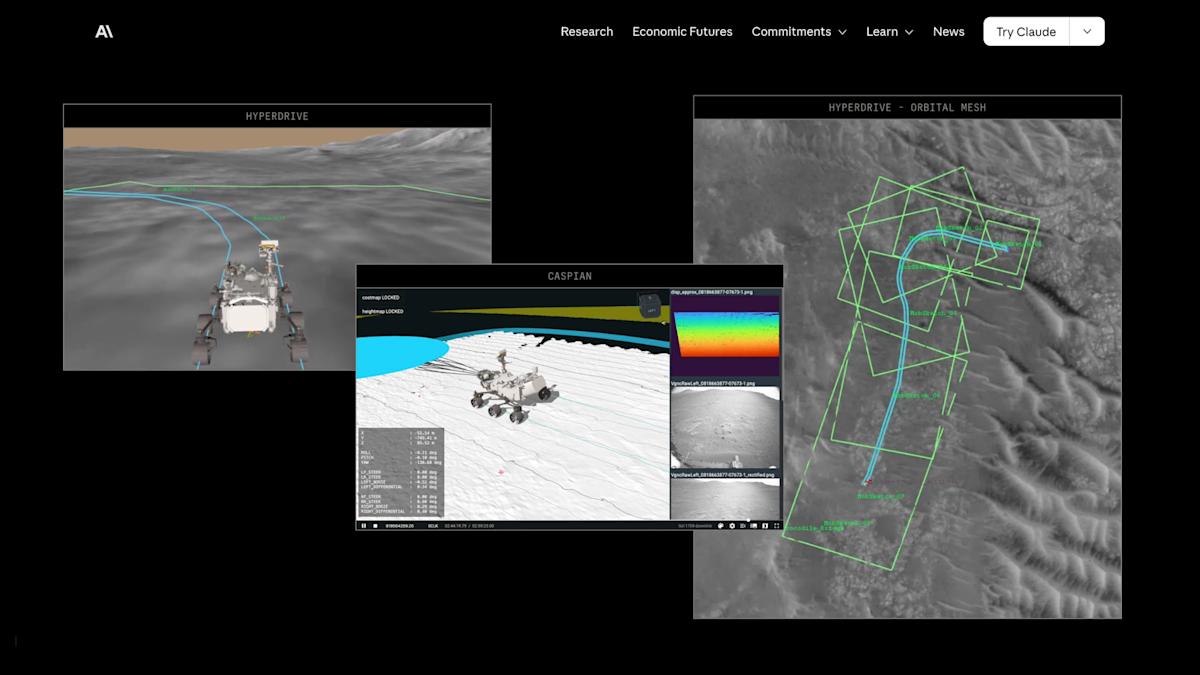
Since 2021, NASA’s Perseverance rover has achieved a number of historic milestones, including sending back the first audio recordings from Mars. Now, nearly five years after landing on the Red Planet, it just achieved another feat. This past December, Perseverance successfully completed a route through a section of the Jezero crater plotted by Anthropic’s Claude chatbot, marking the first time NASA has used a large language model to pilot the car-sized robot.

Between December 8 and 10, Perseverance drove approximately 400 meters (about 437 yards) through a field of rocks on the Martian surface mapped out by Claude. As you might imagine, using an AI model to plot a course for Perseverance wasn’t as simple as inputting a single prompt.

As NASA explains, routing Perseverance is no easy task, even for a human. “Every rover drive needs to be carefully planned, lest the machine slide, tip, spin its wheels, or get beached,” NASA said. “So ever since the rover landed, its human operators have painstakingly laid out waypoints — they call it a ‘breadcrumb trail’ — for it to follow, using a combination of images taken from space and the rover’s onboard cameras.”

To get Claude to complete the task, NASA had to first provide Claude Code, Anthropic’s programming agent, with the “years” of contextual data from the rover before the model could begin writing a route for Perseverance. Claude then went about the mapping process methodically, stringing together waypoints from ten-meter segments it would later critique and iterate on.

This being NASA we’re talking about, engineers from the agency’s Jet Propulsion Laboratory (JPL) made sure to double check the model’s work before sending it to Perseverance. The JPL team ran Claude’s waypoints through a simulation they use every day to confirm the accuracy of commands sent to the rover. In the end, NASA says it only had to make “minor changes” to Claude’s route, with one tweak coming as a result of the fact the team had access to ground-level images Claude hadn’t seen in its planning process.

“The engineers estimate that using Claude in this way will cut the route-planning time in half, and make the journeys more consistent,” NASA said. “Less time spent doing tedious manual planning — and less time spent training — allows the rover’s operators to fit in even more drives, collect even more scientific data, and do even more analysis. It means, in short, that we’ll learn much more about Mars.”

While the productivity gains offered by AI are often overstated, in the case of NASA, any tool that could allow its scientists to be more efficient is sure to be welcome. Over the summer, the agency lost about 4,000 employees – accounting for about 20 percent of its workforce – due to Trump administration cuts. Going into 2026, the president had proposed gutting the agency’s science budget by nearly half before Congress ultimately rejected that plan in early January. Still, even with its funding preserved just below 2025 levels, the agency has a tough road ahead. It’s being asked to return to the Moon with less than half the workforce it had during the height of the Apollo program.

For Anthropic, meanwhile, this is a major feat. You may recall last spring Claude couldn’t even beat Pokémon Red. In less than a year, the company’s models have gone from struggling to navigate a simple 8-bit Game Boy game to successfully plotting a course for a rover on a distant planet. NASA is excited about the possibility of future collaborations, saying “autonomous AI systems could help probes explore ever more distant parts of the solar system.”

How the AI Compute Crunch Is Reshaping Infrastructure


Quick Digest

Question – What is driving the 2026 GPU shortage and how is it reshaping AI development?
Answer: The current compute crunch is a product of explosive demand from AI workloads, limited supplies of high‑bandwidth memory, and tight advanced packaging capacity.
Researchers note that lead times for data‑center GPUs now run from 36 to 52 weeks, and that memory suppliers are prioritizing high‑margin AI chips over consumer products. As a result, gaming GPU production has slowed and data‑center buyers dominate the global supply of DRAM and HBM. This article argues that the GPU shortage is not a temporary blip but a signal that AI builders must design for constrained compute, adopt efficient algorithms, and embrace heterogeneous hardware and multi‑cloud strategies.


Introduction: The Anatomy of a Shortage

At first glance, the GPU shortages of 2026 seem like a repeat of previous boom‑and‑bust cycles—spikes driven by cryptocurrency miners or bot‑driven scalping. But deeper investigation reveals a structural shift: artificial intelligence has become the dominant consumer of computing hardware. Large‑language models and generative AI systems now feed on tokens at a rate that has increased roughly fifty‑fold in just a few years. To satisfy this hunger for compute, hyperscalers have signed multi‑year contracts for the entire output of some memory fabs, reportedly locking up 40 % of global DRAM supply. Meanwhile, the semiconductor industry’s ability to expand supply is limited by bottlenecks in extreme ultraviolet lithography, high‑bandwidth memory (HBM) production, and advanced 2.5‑D packaging.

The result is a paradox: despite record investments in chip manufacturing and new foundries breaking ground around the world, AI companies face a multiyear lag between demand and supply. Datacenter GPUs, like Nvidia’s H100 and AMD’s MI250, now have lead times of nine months to a year, while workstation cards wait twelve to twenty weeks. Memory modules and CoWoS (chip‑on‑wafer‑on‑substrate) packaging remain so scarce that PC vendors in Japan stopped taking orders for high‑end desktops. This shortage is not just about chips; it is about how the architecture of AI systems is evolving, how companies design their infrastructure, and how nations plan their industrial policies.

In this article we explore the present state of the GPU and memory shortage, the root causes that drive it, its impact on AI companies, the emerging solutions to cope with constrained compute, and the socio‑economic implications. We then look ahead to future trends and consider what to expect as the industry adapts to a world of limited compute. Throughout the article we will highlight insights from researchers, analysts, and practitioners, and offer suggestions for how Clarifai’s products can help organizations navigate this landscape.

The Present State of the GPU and Memory Shortage

By 2026 the compute crunch has moved from anecdotal complaints on developer forums to a global economic issue. Data‑center GPUs are effectively sold out for months, with lead times stretching between thirty‑six and fifty‑two weeks. These long waits are not confined to a single vendor or product; they span across Nvidia, AMD and even boutique AI chip makers. Workstation GPUs, which once could be purchased off the shelf, now require twelve to twenty weeks of patience.

At the consumer level, the situation is different but still tight. Rumors of gaming GPU production cuts surfaced as early as 2025. Memory manufacturers, prioritizing high‑margin data‑center HBM sales, have reduced shipments of GDDR6 and GDDR7 modules used in gaming cards. The shift has had a ripple effect: DDR5 memory kits that cost around $90 in 2025 now cost $240 or more, and lead times for standard DRAM extended from eight to ten weeks to over twenty weeks. This price escalation is not speculation; Japanese PC vendors like Sycom and TSUKUMO halted orders because DDR5 was four times more expensive than a year earlier.

The shortage is especially acute in high‑bandwidth memory. HBM packages are crucial for AI accelerators, enabling models to move large tensors quickly. Memory suppliers have shifted capacity away from DDR and GDDR to HBM, with analysts noting that data centers will consume up to 70 % of global memory supply in 2026. As a consequence, memory module availability for PCs and embedded systems has dwindled. This imbalance has even led to speculation that RAM could account for 10 % of the cost of consumer electronics and up to 30 % of smartphones.

In short, the present state of the compute crunch is defined by long lead times for data‑center GPUs, dramatic price increases for memory, and reallocation of supply to AI datacenters. It is also marked by the reality that new orders of GPUs and memory are limited to contracted volumes. This means that even companies willing to pay high prices cannot simply buy more GPUs; they must wait their turn. The shortage is therefore not just about affordability but also about accessibility.

Expert Voices on the Current Situation

Industry commentators have been candid about the severity of the shortage. BCD, a global hardware distributor, reports that data‑center GPU lead times have climbed to a year and warns that supply will remain tight through at least late 2026. Sourceability, a major component distributor, highlights that DRAM lead times have extended beyond twenty weeks and that memory vendors are implementing allocation‑only ordering, effectively rationing supply. Tom’s Hardware, reporting from Japan, notes that PC makers have temporarily stopped taking orders due to skyrocketing memory costs.

These sources paint a consistent picture: the shortage is not localized or transitory but structural and global. Even as new GPU architectures, such as Nvidia’s H200 and AMD’s MI300, begin shipping, the pace of demand outstrips supply. The result is a bifurcation of the market: hyperscalers with guaranteed contracts receive chips, while smaller companies and hobbyists are left to hunt on secondary markets or rent through cloud providers.

Root Causes of the Compute Crunch

Understanding the shortage requires looking beyond the headlines to the underlying drivers. Demand is the most obvious factor. The rise of generative AI and large‑language models has led to exponential growth in token consumption. This surge translates directly into compute requirements. Training GPT‑class models requires hundreds of teraflops and petabytes of memory bandwidth, and inference at scale—serving billions of queries daily—adds further pressure. In 2023, early AI companies consumed a few hundred megawatts of compute; by 2026, analysts estimate that AI datacenters require tens of gigawatts of capacity.

Memory bottlenecks amplify the problem. High‑bandwidth memory such as HBM3 and HBM4 is produced by a handful of manufacturers. According to supply‑chain analysts, DRAM supply currently only supports about 15 gigawatts of AI infrastructure. That may sound like a lot, but when large models run across thousands of GPUs, this capacity is quickly exhausted. Furthermore, DRAM production is constrained by extreme ultraviolet lithography (EUV) and the need for advanced process nodes; building new EUV capacity takes years.

Advanced packaging constraints also limit GPU supply. Many AI accelerators rely on 2.5‑D integration, where memory stacks are mounted on silicon interposers. This process, often referred to as CoWoS, requires sophisticated packaging lines. BCD reports that packaging capacity is fully booked, and ramping new packaging lines is slower than adding wafer capacity. In the near term, this means that even if foundries produce enough compute dies, packaging them into finished products remains a choke point.

Prioritization by memory and GPU vendors plays a role as well. When demand exceeds supply, companies optimize for margin. Memory makers allocate more HBM to AI chips because they command higher prices than DDR modules. GPU vendors favor data‑center customers because a single rack of H100 cards, priced at around $25,000 per card, can generate over $400,000 in revenue. By contrast, consumer GPUs are less profitable and are therefore deprioritized.

Finally, the planned sunset of DDR4 contributes to the crunch. Manufacturers are shifting capacity from mature DDR4 lines to newer DDR5 and HBM lines. Sourceability warns that the end‑of‑life of DDR4 is squeezing supply, leading to shortages even in legacy platforms.

These root causes—insatiable AI demand, memory production bottlenecks, packaging constraints, and vendor prioritization—collectively create a system where supply cannot keep up with demand. The compute crunch is not due to any single failure; rather, it is an ecosystem‑wide mismatch between exponential growth and linear capacity expansion.

Impact on AI Companies and the Broader Ecosystem

The compute crunch affects organizations differently depending on size, capital and strategy. Hyperscalers and well‑funded AI labs have secured multi‑year agreements with chip vendors. They typically purchase entire racks of GPUs—the price of an H100 rack can exceed $400,000—and invest heavily in bespoke infrastructure. In some cases, the total cost of ownership is even higher when factoring in networking, power and cooling. For these players, the compute crunch is a capital expenditure challenge; they must raise billions to maintain competitive training capacity.

Startups and smaller AI teams face a different reality. Because they lack negotiating power, they often cannot secure GPUs from vendors directly. Instead, they rent compute from cloud marketplaces. Cloud providers like AWS, Azure, and specialized platforms like Jarvislabs and Lambda Labs offer GPU instances for between $2.99 and $9.98 per hour. However, even these rentals are subject to availability; spot instances are frequently sold out, and on‑demand rates can spike due to demand surges. The compute crunch thus forces startups to optimize for cost efficiency, adopt smarter architectures, or partner with providers that guarantee capacity.

The shortage also changes product development timelines. Model training cycles that once took weeks now must be planned months ahead, because organizations need to book hardware well in advance. Delays in GPU delivery can postpone product launches or cause teams to settle for smaller models. Inference workloads—serving models in production—are less sensitive to training hardware but still require GPUs or specialized accelerators. A Futurum survey found that only 19 % of enterprises have training‑dominant workloads; the vast majority are inference‑heavy. This shift means companies are spending more on inference than training and thus need to allocate GPUs across both tasks.

Costs Beyond the Card

One of the most misunderstood aspects of the compute crunch is the total cost of operating AI hardware. Jarvislabs analysts point out that buying an H100 card is just the beginning. Organizations must also invest in power distribution, high‑density cooling solutions, networking gear and facilities. Together, these systems can double or triple the cost of the hardware itself. When margins are thin, as is often the case for AI startups, renting may be more cost‑effective than purchasing.

Moreover, the shortage encourages a “GPU as oil” narrative—the idea that GPUs are scarce resources to be managed strategically. Just as oil companies diversify their suppliers and hedge against price swings, AI companies must treat compute as a portfolio. They cannot rely on a single cloud provider or hardware vendor; they must explore multiple sources, including multi‑cloud strategies, and design software that is portable across hardware architectures.

Emerging Infrastructure Solutions

If scarcity is the new normal, the next question is how to operate effectively in a constrained environment. Organizations are responding with a combination of technical, strategic and operational innovations.

Multi‑Cloud Strategies

Because compute availability varies across regions and vendors, multi‑cloud strategies have become essential. KnubiSoft, a cloud‑infrastructure consultancy, emphasizes that companies should treat compute like financial assets. By spreading workloads across multiple clouds, organizations reduce dependence on any single provider, mitigate regional disruptions, and access spot capacity when it appears. This approach also helps with regulatory compliance: workloads can be placed in regions that meet data‑sovereignty requirements while failing over to other regions when capacity is constrained.

Implementing multi‑cloud is non‑trivial; it requires orchestration tools that can dispatch jobs to the right clusters, monitor performance and cost, and handle data synchronization. Clarifai’s compute‑orchestration layer provides a unified interface to schedule training and inference jobs across cloud providers and on‑prem clusters. By abstracting the differences between, say, Nvidia A100 instances on Azure and AMD MI300 instances on an on‑prem cluster, Clarifai allows engineers to focus on model development rather than infrastructure plumbing.

Compute Orchestration Platforms

Beyond simple multi‑cloud deployment, companies need to orchestrate their compute resources intelligently. Compute orchestration platforms allocate jobs based on resource requirements, availability and cost. They can dynamically scale clusters, pause jobs during price spikes, and resume them when capacity is cheap.

Clarifai’s orchestration solution automatically chooses the most suitable hardware—GPUs for training, XPUs or CPUs for inference—while respecting user priorities and SLAs. It monitors queue lengths and server health to avoid idle resources and ensures that expensive GPUs are kept busy. Such orchestration is especially important when working with heterogeneous hardware, which we discuss further below.

Efficient Model Inference and Local Runners

For many organizations, inference workloads now dwarf training workloads. Serving a large language model in production may require thousands of GPUs if done naively. Model inference frameworks like Clarifai’s service handle batching, caching and auto‑scaling to reduce latency and cost. They reuse cached token sequences, group requests to improve GPU utilization, and spin up additional instances when traffic spikes.

Another strategy is to bring inference closer to users. Local runners and edge deployments allow models to run on devices or local servers, avoiding the need to send every request to a datacenter. Clarifai’s local runner enables companies to deploy models on resource‑constrained hardware, making it easier to serve models in privacy‑sensitive contexts or in regions with limited connectivity. Local inference also reduces reliance on scarce data‑center GPUs and can improve user experience by lowering latency.

Heterogeneous Accelerators and XPUs

The shortage of GPUs has catalyzed interest in alternative hardware. XPUs—a catchall term for TPUs, FPGAs, custom ASICs and other specialized processors—are drawing significant investment. A Futurum survey finds that enterprise spending on XPUs is projected to grow 22.1 % in 2026, outpacing growth in GPU spending. About 31 % of decision‑makers are evaluating Google’s TPUs and 26 % are evaluating AWS’s Trainium. Companies like Intel (with its Gaudi accelerators), Graphcore (with its IPU) and Cerebras (with its wafer‑scale engine) are also gaining traction.

Heterogeneous accelerators offer several benefits: they often deliver better performance per watt on specific tasks (e.g., matrix multiplication or convolution), and they diversify supply. FPGA accelerators using structured sparsity and low‑bit quantization can achieve a 1.36× improvement in throughput per token, while 4‑bit quantization and pruning reduce weight storage four‑fold and speed up inference by 1.29× to 1.71×. As XPUs become more mainstream, we expect software stacks to mature; Clarifai’s hardware‑abstraction layer already helps developers deploy the same model on GPUs, TPUs or FPGAs with minimal code changes.

Compute Marketplaces and On‑Demand Rentals

In a world where hardware is scarce, GPU marketplaces and specialized cloud providers serve an important niche. Platforms like Jarvislabs and Lambda Labs allow companies to rent GPUs by the hour, often at lower rates than mainstream clouds. They aggregate unused capacity from data centers and resell it at market prices. This model is akin to ride‑sharing for compute. However, availability fluctuates; high demand can wipe out inventory quickly. Companies using such marketplaces must integrate them into their orchestration strategies to avoid job interruptions.

Energy‑Efficient Datacenter Design

Finally, the compute crunch has spotlighted the importance of energy efficiency. Data centers not only consume GPUs but also vast amounts of electricity and water. To mitigate environmental impact and reduce operating costs, many providers are co‑locating with renewable energy sources, using natural gas for combined heat and power, and adopting advanced cooling techniques. Innovations like liquid immersion cooling and AI‑driven temperature optimization are becoming mainstream. These efforts not only reduce carbon footprints but also free up power for more GPUs—making energy efficiency an integral part of the hardware supply story.

Model Efficiency & Algorithmic Innovations

When hardware is scarce, making each flop and byte count becomes critical. Over the past two years, researchers have poured energy into techniques that reduce model size, accelerate inference and preserve accuracy.

Quantization and Structured Sparsity

One of the most powerful techniques is quantization, which reduces the precision of model weights and activations. 4‑bit integer formats can cut the memory footprint of weights by 4×, while maintaining nearly the same accuracy when combined with calibration techniques. When paired with structured sparsity, where some weights are set to zero in a regular pattern, quantization can speed up matrix multiplication and reduce power consumption. Research combining N:M sparsity and 4‑bit quantization demonstrates a 1.71× matrix multiplication speedup and a 1.29× reduction in latency on FPGA accelerators.

These techniques are not limited to FPGAs; GPU‑based inference engines like NVIDIA TensorRT and AMD’s ROCm are increasingly adding support for mixed‑precision formats. Clarifai’s inference service incorporates quantization to shrink models and accelerate inference automatically, freeing up GPU capacity.

Hardware–Software Co‑Design

Another emerging trend is hardware–software co‑design. Rather than designing chips and algorithms separately, engineers co‑optimize models with the target hardware. Sparse and quantized models compiled for FPGAs can deliver a 1.36× improvement in throughput per token, because the FPGA can skip multiplications involving zeros. Dynamic zero‑skipping and reconfigurable data paths maximize hardware utilization.

Inference‑First Optimization

Although training large models garners headlines, most real‑world AI spending is now on inference. This shift encourages developers to build models that run efficiently in production. Techniques such as Low‑Rank Adaptation (LoRA) and Adapter layers allow fine‑tuning large models without updating all parameters, reducing training and inference costs. Knowledge distillation, where a smaller student model learns from a large teacher model, creates compact models that perform competitively while requiring less hardware.

Clarifai’s inference service helps here by batching and caching tokens. Dynamic batching groups multiple requests to maximize GPU utilization; caching stores intermediate computations for repeated prompts, reducing recomputation. These optimizations can reduce the cost per token and alleviate pressure on GPUs.

Beyond GPUs – The Rise of Heterogeneous Compute

While GPUs remain the workhorse of AI, the compute crunch has accelerated the rise of alternative accelerators. Enterprises are reevaluating their hardware stacks and increasingly adopting custom chips designed for specific workloads.

XPUs and Specialized Accelerators

According to Futurum’s research, XPU spending will grow 22.1 % in 2026, outpacing growth in GPU spending. This category includes Google’s TPU, AWS’s Trainium, Intel’s Gaudi and Graphcore’s IPU. These accelerators typically feature matrix multiply units optimized for deep learning and can outperform general‑purpose GPUs on specific models. About 31 % of surveyed decision‑makers are actively evaluating TPUs and 26 % are evaluating Trainium. Early adopters report strong efficiency gains on tasks like transformer inference, with lower power consumption.

FPGAs and Reconfigurable Hardware

Reconfigurable devices like FPGAs are seeing a resurgence. Research shows that sparsity‑aware FPGA designs deliver a 1.36× improvement in throughput per token. FPGAs can implement dynamic zero‑skipping and custom arithmetic pipelines, making them ideal for highly sparse or quantized models. While they typically require specialized expertise, new software toolchains are simplifying their use.

AI PCs and Edge Accelerators

The compute crunch is not confined to data centers; it is also shaping edge and consumer hardware. AI PCs with integrated neural processing units (NPUs) are beginning to ship from major laptop manufacturers. Smartphone system‑on‑chips now include dedicated AI cores. These devices allow some inference tasks to run locally, reducing reliance on cloud GPUs. As memory prices climb and cloud queues lengthen, local inference on NPUs may become more attractive.

Unified Orchestration Across Diverse Hardware

Adopting diverse hardware raises the challenge of how to manage it. Software must dynamically decide whether to run on a GPU, TPU, FPGA or CPU, depending on cost, availability and performance. Clarifai’s hardware‑abstraction layer abstracts away the differences between devices, allowing developers to deploy a model across multiple hardware types with minimal changes. This portability is critical in a world where supply constraints might force a switch from one accelerator to another on short notice.

Socio‑Economic Implications and Market Outlook

The compute crunch reverberates beyond the technology sector. Memory shortages are impacting automotive and consumer electronics industries, where memory modules now account for a larger share of the bill of materials. Analysts warn that smartphone shipments could dip by 5 % and PC shipments by 9 % in 2026 because high memory prices deter consumers. For automakers, memory constraints could delay infotainment and advanced driver‑assistance systems, influencing product timelines.

Regional and Geopolitical Effects

Different regions experience the shortage in distinct ways. In Japan, some PC vendors halted orders altogether due to four‑fold increases in DDR5 prices. In Europe, energy prices and regulatory hurdles complicate data‑center construction. The United States, China and the European Union have each launched multi‑billion‑dollar initiatives to boost domestic semiconductor manufacturing. These programs aim to reduce reliance on foreign fabs and secure supply chains for strategic technologies.

Geopolitical tensions add another layer of complexity. Export controls on advanced chips restrict where hardware can be shipped, complicating supply for international buyers. Companies must navigate a web of regulations while still trying to procure scarce GPUs. This environment encourages collaboration with vendors who offer transparent supply chains and compliance support.

Environmental Impact and Energy Considerations

AI datacenters consume vast amounts of electricity and water. As more chips are deployed, the power footprint grows. To mitigate environmental impact and control costs, datacenter operators are co‑locating with renewable energy sources and improving cooling efficiency. Some projects integrate natural gas plants with data centers to recycle waste heat, while others explore hydro‑powered locations. Governments are imposing stricter regulations on energy use and emissions, forcing companies to consider sustainability in procurement decisions.

Market Dynamics

The market outlook is mixed. TrendForce researchers describe the reallocation of memory capacity toward AI datacenters as “permanent”. This means that even if new DDR and HBM capacity comes online, a significant share will remain tied to AI customers. Investors are channeling capital into memory fabs, advanced packaging facilities and new foundries rather than consumer products. Price volatility is likely; some analysts forecast that HBM prices may rise another 30 – 40 % in 2026. For buyers, this environment necessitates long‑term procurement planning and financial hedging.

Future Trends & What to Expect

While the current shortage is severe, the industry is taking steps to address it. New fabs in the United States, Europe and Asia are slated to ramp up by 2027–2028. Intel, TSMC, Samsung and Micron all have projects underway. These facilities will increase output of both compute dies and high‑bandwidth memory. However, supply‑chain experts caution that lead times will remain elevated through at least 2026. It simply takes time to build, equip and certify new fabs. Even once they come online, baseline pricing may stay high due to continued strong demand.

Improvements in HBM and DDR5 Output

Analysts expect that HBM and DDR5 production will improve by late 2026 or early 2027. As supply increases, some price relief could occur. Yet because AI demand is also growing, supply expansion may only meet, rather than exceed, consumption. This dynamic suggests a prolonged equilibrium where prices remain above historical norms and allocation policies continue.

The Ascendancy of XPUs and Software Innovations

Looking ahead, XPU adoption is expected to accelerate. The spending gap between XPUs and GPUs is narrowing, and by 2027 XPUs may account for a larger share of AI hardware budgets. Innovations such as mixture‑of‑experts (MoE) architectures, which distribute computation across smaller sub‑models, and retrieval‑augmented generation (RAG), which reduces the need for storing all knowledge in model weights, will further lower compute requirements.

On the software side, new compilers and scheduling algorithms will optimize models across heterogeneous hardware. The goal is to run each part of the model on the most suitable processor, balancing speed and efficiency. Clarifai is investing in these areas through its hardware‑abstraction and orchestration layers, ensuring that developers can harness new hardware without rewriting code.

Regulatory and Sustainability Trends

Regulators are beginning to scrutinize AI hardware supply chains. Environmental regulations around energy consumption and carbon emissions are tightening, and data‑sovereignty laws influence where data can be processed. These trends will shape datacenter locations and investment strategies. Companies may need to build smaller, regional clusters to comply with local laws, further spreading demand across multiple facilities.

Expert Predictions

Supply‑chain experts see early signs of stabilization around 2027 but caution that baseline pricing is unlikely to return to pre‑2024 levels. HBM pricing may continue to rise, and allocation rules will persist. Researchers stress that procurement teams must work closely with engineering to plan demand, diversify suppliers and optimize designs. Futurum analysts predict that XPUs will be the breakout story of 2026, shifting market attention away from GPUs and encouraging investment in new architectures. The consensus is that the compute crunch is a multi‑year phenomenon rather than a fleeting shortage.

Final Thoughts: Designing for a World of Constrained Compute

The 2026 GPU shortage is not merely a supply hiccup; it signals a fundamental reordering of the AI hardware landscape. Lead times approaching a year for data‑center GPUs and memory consumption dominated by AI datacenters demonstrate that demand outstrips supply by design. This imbalance will not resolve quickly because DRAM and HBM capacity cannot be ramped overnight and new fabs take years to build.

For organizations building AI products in 2026, the imperative is to design for scarcity. That means adopting multi‑cloud and heterogeneous compute strategies to diversify risk; embracing model‑efficiency techniques such as quantization and pruning; and leveraging orchestration platforms, like Clarifai’s Compute Orchestration and Model Inference services, to run models on the most cost‑effective hardware. The rise of XPUs and custom ASICs will gradually redefine what “compute” means, while software innovations like MoE and RAG will make models leaner and more flexible.

Yet the market will remain turbulent. Memory pricing volatility, regulatory fragmentation and geopolitical tensions will keep supply uncertain. The winners will be those who build flexible architectures, optimize for efficiency, and treat compute not as a commodity to be taken for granted but as a scarce resource to be used wisely. In this new era, scarcity becomes a catalyst for innovation—a spur to invent better algorithms, design smarter hardware and rethink how and where we run AI models.

Frequently Asked Questions (FAQs)

  1. What is causing the GPU shortage in 2026?
    The shortage stems from explosive AI demand, limited high‑bandwidth memory supply and bottlenecks in advanced packaging and wafer capacity. Memory vendors prioritize high‑margin AI chips, leaving fewer DRAM and GDDR modules for consumer GPUs.
  2. How long are the current lead times for data‑center GPUs?
    Lead times for data‑center GPUs range from 36 to 52 weeks, while workstation GPUs experience 12–20 week lead times.
  3. Why are memory prices rising so rapidly?
    DDR5 and HBM prices surged because memory manufacturers have reallocated capacity toward AI accelerators. DDR5 kits that cost around $90 in 2025 now cost $240 or more, and memory suppliers are restricting orders to contracted volumes, extending lead times from 8–10 weeks to over 20.
  4. Are alternative accelerators a viable solution to the GPU shortage?
    Yes. XPUs—including TPUs, Trainium, Gaudi, IPUs and FPGAs—are gaining adoption. A survey indicates that 31 % of enterprises are evaluating TPUs and 26 % are evaluating Trainium, and XPU spending is projected to grow 22.1 % in 2026. These accelerators diversify supply and offer efficiency benefits.
  5. Will the shortage end soon?
    Supply‑chain experts expect some stabilization around 2027 as new fabs ramp up. However, demand remains high, and analysts warn that baseline pricing will stay elevated and that allocation‑only ordering will persist. Thus, the shortage will likely continue to influence AI hardware strategies for the next few years.




Google’s new AI ‘world model’ has seemingly spooked videogame investors, but it’s hard to know what it will actually lead to


Project Genie | Experimenting with infinite interactive worlds – YouTube
Project Genie | Experimenting with infinite interactive worlds - YouTube


Watch On

Google launched a new AI product this week, and as Seeking Alpha points out, videogame-related stocks like Unity and Take-Two took a dip. If those share price fluctuations really were a reaction to Project Genie, which was first revealed last year and is said to generate interactive “worlds,” it’s awfully premature—this doesn’t do anything to GTA 6‘s prospects, let’s be real.

asp.net core – Cannot start debug session in Visual Studio due to SSL cert missing or being out of date


I have an ASP.NET web application that has been working fine when pressing F5 to start a debug session in Visual Studio. Last Friday (January 23) I started getting this exception:

System.InvalidOperationException: ‘Unable to configure HTTPS endpoint. No server certificate was specified, and the default developer certificate could not be found or is out of date.
To generate a developer certificate run ‘dotnet dev-certs https’. To trust the certificate (Windows and macOS only) run ‘dotnet dev-certs https –trust’.
For more information on configuring HTTPS see https://go.microsoft.com/fwlink/?linkid=848054.’

It references app.Run(); in Program.cs. Starting a debug session by opening the “Debug” menu and choosing “Start Debugging” results in the same error (not that I expected any different).

  1. I opened a PowerShell window as an administrator, and went with the Nuclear Option:

    Get-ChildItem -Path Cert:\CurrentUser -recurse | where { $_.Issuer -match 'localhost' } | remove-item
    

    Just get rid of all localhost SSL certificates.

  2. Closed Visual Studio, and ran git clean -fdx in the root folder for my Visual Studio solution.

  3. Reopened Visual Studio, and pressed F5 again.

  4. It prompted me to create and install 2 SSL certificates, and mark them trusted, which I did.

  5. The application died again at app.Run() with the same exact error.

  6. Next, I restarted the computer, and then repeated steps 1-5. Got the same error.

Just now I repeated steps 1-5 (a week later) and get the same error. I ran the following PowerShell command to list the expiration dates for all localhost SSL certificates:

> Get-ChildItem -Path Cert:\CurrentUser -recurse | where { $_.Issuer -match 'localhost' } | select NotBefore,NotAfter

NotBefore            NotAfter
---------            --------
1/30/2026 4:37:58 PM 1/30/2027 4:37:58 PM
8/26/2025 8:58:28 AM 8/25/2030 8:00:00 PM
1/30/2026 4:37:58 PM 1/30/2027 4:37:58 PM

I ran these commands after 4:40 PM EST, so the certs should be valid. Just listing the localhost certs provided this:

> Get-ChildItem -Path Cert:\CurrentUser -recurse | where { $_.Issuer -match 'localhost' }


   PSParentPath: Microsoft.PowerShell.Security\Certificate::CurrentUser\Root

Thumbprint                                Subject
----------                                -------
XXXXXXXXXXXXXXXXXXXXXXXXXXXXXXXXXXXXXXXX  CN=localhost


   PSParentPath: Microsoft.PowerShell.Security\Certificate::CurrentUser\My

Thumbprint                                Subject
----------                                -------
XXXXXXXXXXXXXXXXXXXXXXXXXXXXXXXXXXXXXXXX  CN=localhost

Program.cs

(after removing all our application-specific stuff and I’m still able to replicate the error)

var builder = WebApplication.CreateBuilder(args);

builder.Services.AddControllersWithViews();
builder.WebHost.UseStaticWebAssets();

builder.Services.AddMvc(options => options.SuppressImplicitRequiredAttributeForNonNullableReferenceTypes = true)
    .AddRazorOptions(options 
        => options.ViewLocationFormats.Add("/Views/Emails/{0}.cshtml"));

var app = builder.Build();

app.UseDeveloperExceptionPage();
app.UseHttpsRedirection();
app.UseStaticFiles();
app.MapStaticAssets();
app.UseRouting();
app.MapStaticAssets();

app.MapControllerRoute("default", "{controller=Home}/{action=Index}/{id?}")
    .WithStaticAssets();

app.Run();

launchsettings.json

{
  "$schema": "https://json.schemastore.org/launchsettings.json",
  "profiles": {
    "http": {
      "commandName": "Project",
      "dotnetRunMessages": true,
      "launchBrowser": true,
      "applicationUrl": "http://localhost:5063",
      "environmentVariables": {
        "ASPNETCORE_ENVIRONMENT": "Local"
      }
    },
    "https": {
      "commandName": "Project",
      "dotnetRunMessages": true,
      "launchBrowser": true,
      "applicationUrl": "https://localhost:7072;http://localhost:5063",
      "environmentVariables": {
        "ASPNETCORE_ENVIRONMENT": "Local"
      }
    }
  }
}

The exception message gives a command to trust the certificates, which I ran:

> dotnet dev-certs https --trust
Trusting the HTTPS development certificate was requested. A confirmation prompt will be displayed if the certificate was not previously trusted. Click yes on the prompt to trust the certificate.
Successfully trusted the existing HTTPS certificate.

But I continue getting the same error.

Here is the full log in the terminal as the debug session starts:

dbug: Microsoft.AspNetCore.Watch.BrowserRefresh.BlazorWasmHotReloadMiddleware[0]
      Middleware loaded
dbug: Microsoft.AspNetCore.Watch.BrowserRefresh.BrowserScriptMiddleware[0]
      Middleware loaded. Script /_framework/aspnetcore-browser-refresh.js (16491 B).
dbug: Microsoft.AspNetCore.Watch.BrowserRefresh.BrowserScriptMiddleware[0]
      Middleware loaded. Script /_framework/blazor-hotreload.js (799 B).
dbug: Microsoft.AspNetCore.Watch.BrowserRefresh.BrowserRefreshMiddleware[0]
      Middleware loaded: DOTNET_MODIFIABLE_ASSEMBLIES=debug, __ASPNETCORE_BROWSER_TOOLS=true
fail: Microsoft.Extensions.Hosting.Internal.Host[11]
      Hosting failed to start
      System.InvalidOperationException: Unable to configure HTTPS endpoint. No server certificate was specified, and the default developer certificate could not be found or is out of date.
      To generate a developer certificate run 'dotnet dev-certs https'. To trust the certificate (Windows and macOS only) run 'dotnet dev-certs https --trust'.
      For more information on configuring HTTPS see https://go.microsoft.com/fwlink/?linkid=848054.
         at Microsoft.AspNetCore.Hosting.ListenOptionsHttpsExtensions.UseHttps(ListenOptions listenOptions, Action`1 configureOptions)
         at Microsoft.AspNetCore.Server.Kestrel.Core.Internal.AddressBinder.AddressesStrategy.BindAsync(AddressBindContext context, CancellationToken cancellationToken)
         at Microsoft.AspNetCore.Server.Kestrel.Core.KestrelServerImpl.BindAsync(CancellationToken cancellationToken)
         at Microsoft.AspNetCore.Server.Kestrel.Core.KestrelServerImpl.StartAsync[TContext](IHttpApplication`1 application, CancellationToken cancellationToken)
         at Microsoft.AspNetCore.Hosting.GenericWebHostService.StartAsync(CancellationToken cancellationToken)
         at Microsoft.Extensions.Hosting.Internal.Host.<StartAsync>b__14_1(IHostedService service, CancellationToken token)
         at Microsoft.Extensions.Hosting.Internal.Host.ForeachService[T](IEnumerable`1 services, CancellationToken token, Boolean concurrent, Boolean abortOnFirstException, List`1 exceptions, Func`3 operation)

I’m stumped. This was all working for a long time, and the Visual Studio workflow that creates and trusts the developer certificates the first time you start a debug session isn’t working either.

I can start the application fine using HTTP, so I have a workaround. Regardless, how can I fix this so starting a debug session in Visual Studio successfully spins up my application using Kestrel running on HTTPS?


As a backdrop to this, the day I noticed this start happening is also the same day some Windows updates were installed, and now I cannot power my machine down – KB5074754, KB5074753, and KB5073455. Today I installed KB5078132, which should include the patches to this shutdown problem from KB5077744 and KB5077797, however my machine still does not power down properly; it just restarts. I’m not sure if my SSL issue in Visual Studio has anything to do with this, but just in case it does, this is also going on at the moment.

LG will give you a free 27-inch UltraGear monitor with its latest BOGO deal – here’s how to qualify


spring-sale-imagery

LG/ZDNET

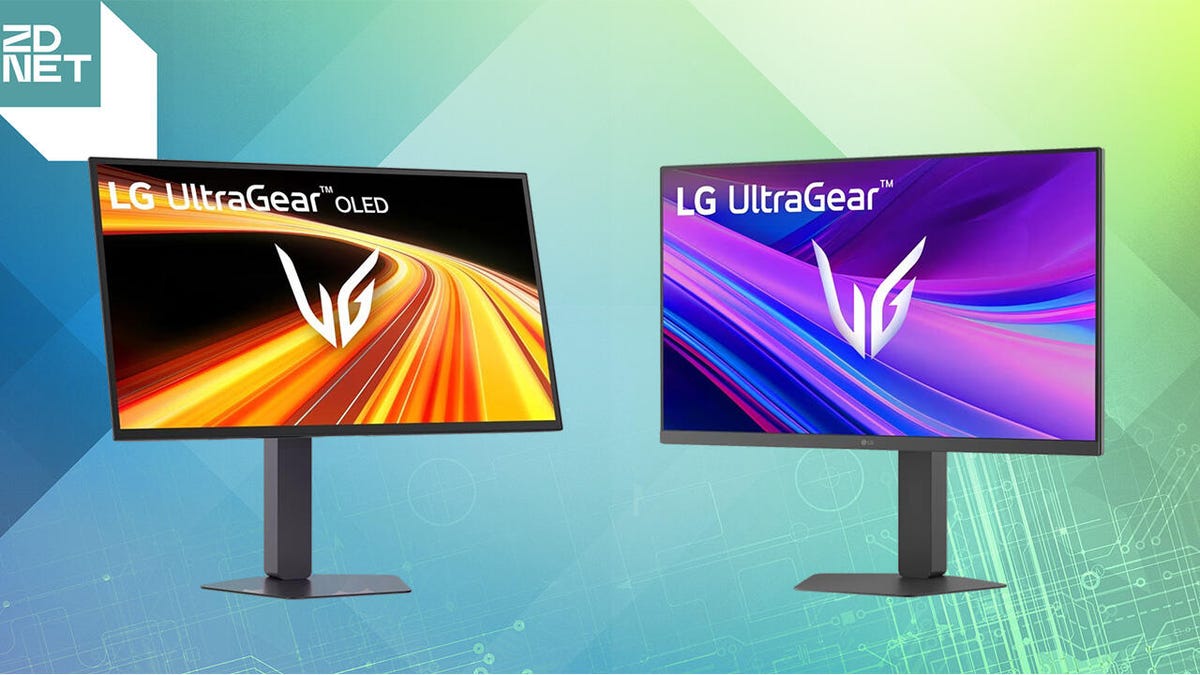
Looking to leap into the realm of multi-monitor setups, or just need to upgrade your current displays? Right now at LG, when you preorder the 27-inch UltraGear OLED gaming monitor, you can get the 27-inch UltraGear LED monitor for free (a $300 value). And while the OLED model is on the pricey side, this bundle deal lets you get two high -nd gaming screens for the price of one.

Also: The best gaming PCs you can buy

The new UltraGear OLED gaming monitor features the brightest and fastest screen from the brand. With a maximum brightness of 300 nits, it might not sound impressive, but it helps strike the delicate balance between picture quality and power efficiency. It also has a 540Hz refresh rate for super-smooth action during fast-paced gameplay or cutscenes, while the 0.02ms response time gives you more control over your inputs.

Watch: First Look: Asus’ wild ROG G1000 gaming PC previews a holographic future for desktop design

While the LG UltraGear OLED doesn’t have integrated speakers, it does have a headphone port that supports DTS Headphone: X audio processing for cleaner in-game sound and voice chat. It also supports both Nvidia G-Sync and AMD FreeSync Premium Pro VRR to prevent annoying screen tearing and stuttering that can throw you off in both on- and offline play. It’s also factory-calibrated for optimal picture quality, so you don’t have to spend hours fine-tuning your screen yourself. 

Also: Samsung is giving away free 24-inch monitors – here’s how to get yours

The LG UltraGear LED gaming monitor is the little brother of the OLED model, offering premium features such as a 240Hz refresh rate, 1ms response time, HDR10 support, and the ability to reproduce up to 99 percent of the sRGB color gamut for more lifelike images. While it’s not quite as fast as the OLED version, it’s an excellent option for a second screen.

How I rated this deal 

I do wish that LG were offering a preorder discount on the new 27-inch UltraGear OLED, but getting a $300 27-inch UltraGear LED monitor for free more than makes up for it. Both screens are tailor-made for high-end gaming featuring high refresh rates, support for Nvidia G-Sync and AMD FreeSync Premium/Pro VRR, and signature LG picture quality so even retro classics look great. That’s why I gave this deal a 4/5 Editor’s rating.

LG is offering a free 27-inch UltraGear LED gaming monitor with every preorder of the new 27-inch UltraGear OLED screen through Feb. 2, 2026. Monitors are expected to ship on Feb. 2.


Show more

We aim to deliver the most accurate advice to help you shop smarter. ZDNET offers 33 years of experience, 30 hands-on product reviewers, and 10,000 square feet of lab space to ensure we bring you the best of tech. 

In 2025, we refined our approach to deals, developing a measurable system for sharing savings with readers like you. Our editor’s deal rating badges are affixed to most of our deal content, making it easy to interpret our expertise to help you make the best purchase decision.

At the core of this approach is a percentage-off-based system to classify savings offered on top-tech products, combined with a sliding-scale system based on our team members’ expertise and several factors like frequency, brand or product recognition, and more. The result? Hand-crafted deals chosen specifically for ZDNET readers like you, fully backed by our experts. 

Also: How we rate deals at ZDNET


Show more