
How to tell if your AI platforms’ accounts have been hacked


Just like any other online service, hackers can target and break into your accounts on popular AI platforms such as ChatGPT, Claude, and Perplexity. 

TechCrunch has created a comprehensive guide to help you protect yourself if you suspect someone has broken into your account on one of the internet’s most popular platforms, social networks, or messaging apps. Now, we’re here to show you how to check whether your accounts on AI platforms have been hacked.

As usual, we recommend using unique passwords stored in a password manager, and turning on multi-factor authentication (MFA), so that even if someone steals your password, they won’t be able to log in without that second piece of information. 

ChatGPT and Perplexity offer MFA. Claude doesn’t, because instead of asking for a password, Anthropic’s AI chatbot sends a login link to your email address.

All three of these AI platforms offer similar ways to check if there’s a suspicious device logged into your account. Here’s exactly how each platform works.  

ChatGPT

To find out if someone has broken into your ChatGPT account, open it on your computer’s browser, click on your username in the bottom left corner, go to “Settings,” then “Security and Login,” and finally click on “Active Sessions.” 

You will see where you are logged into your ChatGPT account. If you see any device you don’t recognize, you can log out of that single device. You can also click on “Log out all.”

Image Credits:Screenshot/TechCrunch /

At this point, if you want to change your password, you need to log out of your account. 

Then, on ChatGPT’s website, click “Log in” located in the bottom-left corner, enter your email address, click on “Forgot password,” and then “Continue.”  

ChatGPT will then send you an email containing a six-digit code. Enter the code on the ChatGPT login page, click “Continue,” and then enter a new password. 

You can also click “reset your password” in the email you received to see the official instructions on how to do that. 

Claude

For Claude, open it in your computer’s browser, click on your username in the bottom-left corner, then “Settings,” and click on “Account.” That’s where you will see your “Active sessions.” 

If you don’t recognize one of them, hover over it, click on the three vertical dots that appear on the right, and click “Log out” or “Terminate.”

Image Credits:Screenshot/TechCrunch /

If you want, you can click on “Log out of all devices.” 

At that point, you’ll be able to log back into your account using your email address. You will receive an email with a link to log in. Claude does not allow you to use passwords at all, so there’s no password to change.

Perplexity

In the case of Perplexity, the AI-powered search engine does not show you where you are logged in. 

So if you’re worried someone may have broken into your account, go to Perplexity in your browser and click your username in the bottom-left corner, then “All settings.” Finally, click on “Sign out of all sessions,” and then “Confirm.”

Image Credits:Screenshot/TechCrunch /

At that point, you can log back in by entering your email address. You will then receive an email with a unique six-digit code. Enter the code on the website to log in, or click on the “Sign in” button in the email to log in directly. 

When you purchase through links in our articles, we may earn a small commission. This doesn’t affect our editorial independence.

AI Scammers Are Better at Building Trust Than Humans


The notion that scammers can use AI to sharpen their deceptions, polish their language, and lubricate their banter with victims is now a reality for anyone fighting the fraud operations that steal tens of billions of dollars a year worldwide. But can AI fully replace a human scammer, autonomously building the web of deception leading up to the fake investment that defrauds the mark? One study’s experiment suggests that it can—and may even be able to carry out the majority of that long con more effectively than humans.

Researchers from four universities—Amrita Vishwa Vidyapeetham in India, Foscari University of Venice, the University of Melbourne, and Ben Gurion University of the Negev—carried out a broad study on the use and potential of generative AI chatbots in the growing scam industry centered around a form of fraud known as “pig butchering,” text-based romance scams that eventually shift to fake crypto investments that steal as much as six-figure sums from victims. In their study, the researchers pitted AI chatbots directly against humans in a simulation of the scamming process—or more specifically, the long, trust-building conversations that eventually lead up to soliciting a fake investment from the scam’s target.

They found that for the relationship-establishing stages of the scam—the stage that in real-world scams typically represents the longest part of the interactions with the victim, often stretching to months—an AI chatbot performed remarkably effectively, successfully impersonating a human and by some measures outperforming the real human “scammers” in their experiment.

After a week of talking to 22 test subjects who were recruited to unwittingly serve as “victims,” the chatbots and human scammers were assigned to ask the victim to either download an app or play an online game as a proxy for their willingness to fulfill the scammer’s request. Nearly half of the test subjects fulfilled that request for the AI chatbot, while fewer than one in five took the bait when talking to a human. The subjects also graded their level of trust with each “person” they were texting with and gave significantly higher scores to the AI bot.

That suggests, the researchers argue, that AI chatbots could soon take over much of the scam process as fully independent fraud agents—even replacing the staffers, often forced-labor human trafficking victims, working in scam operations primarily across Southeast Asia. To avoid triggering the safeguards built into large language models to detect scamming, a human scammer would take over the conversation in just the final stage of the process to direct the victim toward a fake investment app or website.

“By having the full first stage of the scam performed automatically with LLMs at scale, you bring the victim up to this point where they have a very high level of trust. Then by transitioning it over to the human scammer at the end, this completely bypasses any vendor safeguards,” says Yisroel Mirsky, a computer science professor at Ben Gurion University of the Negev focused on AI security. “With relatively little effort, we’re able to make an agent that can outperform a human at building this exploitable emotional trust.”

Hook, Line, and Sinker

To understand how pig butchering works in practice, the researchers interviewed 145 former scam workers, including human-trafficking survivors who had been forced to work in scam compounds in Cambodia, Myanmar, and Laos. Based in part on those interviews, as well as scam transcripts and guides the former scam workers provided, the researchers describe a model for how scamming works they call “hook, line, and sinker.” A victim is hooked with an initial intriguing message, reeled in with long-term, relationship-building conversation, and only at the end of that process tricked into making a fake investment. (The term “pig butchering” itself describes the same system but with the metaphor of fattening “pigs” by building trust before “butchering” them with the investment fraud—though the term is often discouraged due to its pejorative reference to victims.)

In that system of scamming, the researchers realized, the vast majority of scammers’ work is innocuous friendly or romantic conversation. That’s a task, they speculated, that an LLM might be capable of doing just as well as a human. The scam workers the researchers interviewed confirmed that they often used AI to refine their language and conversation, for translation, to make the fake personae they played more convincing, and for video deepfakes. But the researchers decided to test whether an LLM alone could autonomously carry out the conversational phase of the scam with no human in the loop.

NASA used Claude to plot a route for its Perseverance rover on Mars


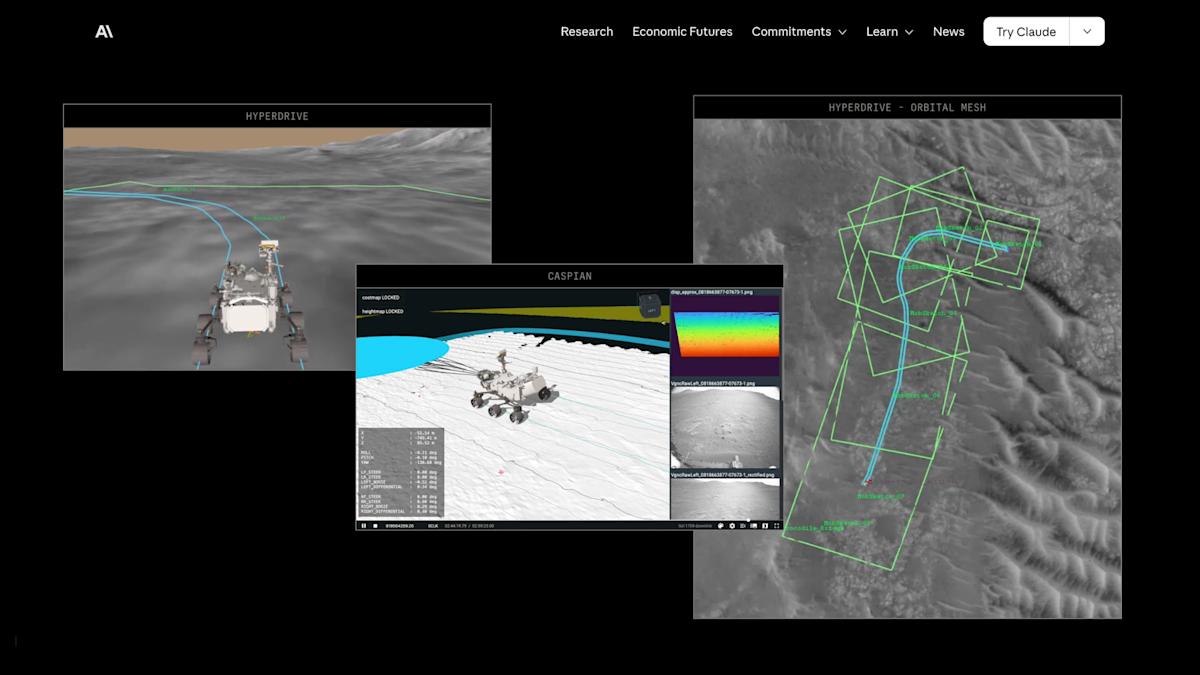
Since 2021, NASA’s Perseverance rover has achieved a number of historic milestones, including sending back the first audio recordings from Mars. Now, nearly five years after landing on the Red Planet, it just achieved another feat. This past December, Perseverance successfully completed a route through a section of the Jezero crater plotted by Anthropic’s Claude chatbot, marking the first time NASA has used a large language model to pilot the car-sized robot.

Between December 8 and 10, Perseverance drove approximately 400 meters (about 437 yards) through a field of rocks on the Martian surface mapped out by Claude. As you might imagine, using an AI model to plot a course for Perseverance wasn’t as simple as inputting a single prompt.

As NASA explains, routing Perseverance is no easy task, even for a human. “Every rover drive needs to be carefully planned, lest the machine slide, tip, spin its wheels, or get beached,” NASA said. “So ever since the rover landed, its human operators have painstakingly laid out waypoints — they call it a ‘breadcrumb trail’ — for it to follow, using a combination of images taken from space and the rover’s onboard cameras.”

To get Claude to complete the task, NASA had to first provide Claude Code, Anthropic’s programming agent, with the “years” of contextual data from the rover before the model could begin writing a route for Perseverance. Claude then went about the mapping process methodically, stringing together waypoints from ten-meter segments it would later critique and iterate on.

This being NASA we’re talking about, engineers from the agency’s Jet Propulsion Laboratory (JPL) made sure to double check the model’s work before sending it to Perseverance. The JPL team ran Claude’s waypoints through a simulation they use every day to confirm the accuracy of commands sent to the rover. In the end, NASA says it only had to make “minor changes” to Claude’s route, with one tweak coming as a result of the fact the team had access to ground-level images Claude hadn’t seen in its planning process.

“The engineers estimate that using Claude in this way will cut the route-planning time in half, and make the journeys more consistent,” NASA said. “Less time spent doing tedious manual planning — and less time spent training — allows the rover’s operators to fit in even more drives, collect even more scientific data, and do even more analysis. It means, in short, that we’ll learn much more about Mars.”

While the productivity gains offered by AI are often overstated, in the case of NASA, any tool that could allow its scientists to be more efficient is sure to be welcome. Over the summer, the agency lost about 4,000 employees – accounting for about 20 percent of its workforce – due to Trump administration cuts. Going into 2026, the president had proposed gutting the agency’s science budget by nearly half before Congress ultimately rejected that plan in early January. Still, even with its funding preserved just below 2025 levels, the agency has a tough road ahead. It’s being asked to return to the Moon with less than half the workforce it had during the height of the Apollo program.

For Anthropic, meanwhile, this is a major feat. You may recall last spring Claude couldn’t even beat Pokémon Red. In less than a year, the company’s models have gone from struggling to navigate a simple 8-bit Game Boy game to successfully plotting a course for a rover on a distant planet. NASA is excited about the possibility of future collaborations, saying “autonomous AI systems could help probes explore ever more distant parts of the solar system.”

Anthropic brings web search to free Claude users


Anthropic is continuing to trickle down features to its free users. The latest one to make the leap out of subscriber-only mode is web search, which the company to its AI chatbot Claude in March. According to Anthropic, connecting Claude to the web allows it to deliver more accurate responses based on the most up-to-date information available online. This feature is available to all Claude users starting today.

In addition, Anthropic has begun beta tests for voice mode on its mobile apps. This option lets users interact with Claude in natural conversations in an expansion of the platform’s existing dictation tools. There will be five voice options available to assign to Claude, and the AI assistant can provide full transcripts and voice mode summaries after a conversation.

May has been a busy month for Anthropic, which just launched last week. Opus 4 is a powerful coding-focused system that can use multiple tools in parallel and can run for several hours at a time, while Sonnet 4 is a hybrid reasoning model designed to move between quick queries and more complex ones. The current beta testing of voice mode will default to Sonnet 4.