Just like any other online service, hackers can target and break into your accounts on popular AI platforms such as ChatGPT, Claude, and Perplexity.
TechCrunch has created a comprehensive guide to help you protect yourself if you suspect someone has broken into your account on one of the internet’s most popular platforms, social networks, or messaging apps. Now, we’re here to show you how to check whether your accounts on AI platforms have been hacked.
As usual, we recommend using unique passwords stored in a password manager, and turning on multi-factor authentication (MFA), so that even if someone steals your password, they won’t be able to log in without that second piece of information.
ChatGPT and Perplexity offer MFA. Claude doesn’t, because instead of asking for a password, Anthropic’s AI chatbot sends a login link to your email address.
All three of these AI platforms offer similar ways to check if there’s a suspicious device logged into your account. Here’s exactly how each platform works.
ChatGPT
To find out if someone has broken into your ChatGPT account, open it on your computer’s browser, click on your username in the bottom left corner, go to “Settings,” then “Security and Login,” and finally click on “Active Sessions.”
You will see where you are logged into your ChatGPT account. If you see any device you don’t recognize, you can log out of that single device. You can also click on “Log out all.”
Image Credits:Screenshot/TechCrunch /
At this point, if you want to change your password, you need to log out of your account.
Then, on ChatGPT’s website, click “Log in” located in the bottom-left corner, enter your email address, click on “Forgot password,” and then “Continue.”
ChatGPT will then send you an email containing a six-digit code. Enter the code on the ChatGPT login page, click “Continue,” and then enter a new password.
You can also click “reset your password” in the email you received to see the official instructions on how to do that.
Claude
For Claude, open it in your computer’s browser, click on your username in the bottom-left corner, then “Settings,” and click on “Account.” That’s where you will see your “Active sessions.”
If you don’t recognize one of them, hover over it, click on the three vertical dots that appear on the right, and click “Log out” or “Terminate.”
Image Credits:Screenshot/TechCrunch /
If you want, you can click on “Log out of all devices.”
At that point, you’ll be able to log back into your account using your email address. You will receive an email with a link to log in. Claude does not allow you to use passwords at all, so there’s no password to change.
Perplexity
In the case of Perplexity, the AI-powered search engine does not show you where you are logged in.
So if you’re worried someone may have broken into your account, go to Perplexity in your browser and click your username in the bottom-left corner, then “All settings.” Finally, click on “Sign out of all sessions,” and then “Confirm.”
Image Credits:Screenshot/TechCrunch /
At that point, you can log back in by entering your email address. You will then receive an email with a unique six-digit code. Enter the code on the website to log in, or click on the “Sign in” button in the email to log in directly.
When you purchase through links in our articles, we may earn a small commission. This doesn’t affect our editorial independence.
The notion thatscammers can use AI to sharpen their deceptions, polish their language, and lubricate their banter with victims is now a reality for anyone fighting the fraud operations that steal tens of billions of dollars a year worldwide. But can AI fully replace a human scammer, autonomously building the web of deception leading up to the fake investment that defrauds the mark? One study’s experiment suggests that it can—and may even be able to carry out the majority of that long con more effectively than humans.
Researchers from four universities—Amrita Vishwa Vidyapeetham in India, Foscari University of Venice, the University of Melbourne, and Ben Gurion University of the Negev—carried out a broad study on the use and potential of generative AI chatbots in the growing scam industry centered around a form of fraud known as “pig butchering,” text-based romance scams that eventually shift to fake crypto investments that steal as much as six-figure sums from victims. In their study, the researchers pitted AI chatbots directly against humans in a simulation of the scamming process—or more specifically, the long, trust-building conversations that eventually lead up to soliciting a fake investment from the scam’s target.
They found that for the relationship-establishing stages of the scam—the stage that in real-world scams typically represents the longest part of the interactions with the victim, often stretching to months—an AI chatbot performed remarkably effectively, successfully impersonating a human and by some measures outperforming the real human “scammers” in their experiment.
After a week of talking to 22 test subjects who were recruited to unwittingly serve as “victims,” the chatbots and human scammers were assigned to ask the victim to either download an app or play an online game as a proxy for their willingness to fulfill the scammer’s request. Nearly half of the test subjects fulfilled that request for the AI chatbot, while fewer than one in five took the bait when talking to a human. The subjects also graded their level of trust with each “person” they were texting with and gave significantly higher scores to the AI bot.
That suggests, the researchers argue, that AI chatbots could soon take over much of the scam process as fully independent fraud agents—even replacing the staffers, often forced-labor human trafficking victims, working in scam operations primarily across Southeast Asia. To avoid triggering the safeguards built into large language models to detect scamming, a human scammer would take over the conversation in just the final stage of the process to direct the victim toward a fake investment app or website.
“By having the full first stage of the scam performed automatically with LLMs at scale, you bring the victim up to this point where they have a very high level of trust. Then by transitioning it over to the human scammer at the end, this completely bypasses any vendor safeguards,” says Yisroel Mirsky, a computer science professor at Ben Gurion University of the Negev focused on AI security. “With relatively little effort, we’re able to make an agent that can outperform a human at building this exploitable emotional trust.”
Hook, Line, and Sinker
To understand how pig butchering works in practice, the researchers interviewed 145 former scam workers, including human-trafficking survivors who had been forced to work in scam compounds in Cambodia, Myanmar, and Laos. Based in part on those interviews, as well as scam transcripts and guides the former scam workers provided, the researchers describe a model for how scamming works they call “hook, line, and sinker.” A victim is hooked with an initial intriguing message, reeled in with long-term, relationship-building conversation, and only at the end of that process tricked into making a fake investment. (The term “pig butchering” itself describes the same system but with the metaphor of fattening “pigs” by building trust before “butchering” them with the investment fraud—though the term is often discouraged due to its pejorative reference to victims.)
In that system of scamming, the researchers realized, the vast majority of scammers’ work is innocuous friendly or romantic conversation. That’s a task, they speculated, that an LLM might be capable of doing just as well as a human. The scam workers the researchers interviewed confirmed that they often used AI to refine their language and conversation, for translation, to make the fake personae they played more convincing, and for video deepfakes. But the researchers decided to test whether an LLM alone could autonomously carry out the conversational phase of the scam with no human in the loop.
More than three years after ChatGPT’s launch brought generative AI into the mainstream, OpenAI is broadening its focus beyond individual users to families.
OpenAI is hiring a dedicated product manager in San Francisco to build experiences for families, caregivers, and older adults across its products. The role calls for experience building products for parents and families, and other trust-sensitive consumer experiences, according to the job posting.
The hiring comes as ChatGPT’s audience continues to broaden beyond younger users. According to Sensor Tower estimates shared exclusively with TechCrunch, the share of ChatGPT users aged 35 and older globally rose to 31% in Q2 from 26% a year earlier, while the share of users aged 18 to 24 fell to 29% from 34%. In the U.S., nearly one in four smartphone users who are parents used ChatGPT during the quarter, up from 16% a year earlier, the firm estimates.
OpenAI did not respond to requests for comment about the job posting.
A dedicated product role focused on families signals that OpenAI is beginning to think about its products less as tools for individual productivity and more as technology designed for households, said Ben Bajarin, chief executive of technology consultancy Creative Strategies.
“This is similar to the path Google, Apple, and Meta eventually followed as their platforms became embedded in everyday life, but AI raises the stakes because the assistant is not just mediating content or devices,” he told TechCrunch.
That shift also brings new trust and safety challenges. Stephen Balkam, chief executive of the Family Online Safety Institute, said the hiring reflects both the maturation of OpenAI and a growing recognition that AI products used by children and teenagers require different safeguards than those designed for adults.
“I see this as safety by redesign,” Balkam told TechCrunch. “You take the initial product or service that was released… not really with kids in mind… so this is a much-needed reaction and response.”
The comments come as new research published this week by the Family Online Safety Institute found that parents are underestimating how often their children use generative AI. While 27% of U.S. parents said their child had used generative AI in the past week, 38% of children reported doing so themselves, according to the survey of more than 4,000 families in the United States and Australia.
Balkam told TechCrunch that AI companies should build products differently for younger users, with stronger content controls, age-appropriate experiences, parental oversight, and reminders to inform users that they are interacting with an AI — and not a human.
AI companies, Balkam said, have an opportunity to avoid the mistakes made by social media platforms, which for years treated children much like adults before adding stronger safeguards amid mounting public pressure and regulatory scrutiny.
The hiring also aligns with OpenAI’s broader efforts around families. In a recent workshop organized with the San Antonio Spurs Community Impact organization and the Positive Coaching Alliance, the company said it aimed to explore AI’s role in learning, coaching, and youth engagement.
That said, the demographic shift is not unique to ChatGPT, though OpenAI’s audience is changing in some distinct ways.
Sensor Tower estimates that users aged 25 to 34 account for 40% of the global app audiences for Anthropic’s Claude and Google’s Gemini, matching ChatGPT, compared with 33% for Microsoft’s Copilot. Copilot, however, skews older, with 20% of its users aged 45 and above, compared with 14% for Claude, 12% for Gemini, and 11% for ChatGPT.
While ChatGPT remains relatively underpenetrated among older users, it is adding them faster than its rivals. The share of users aged 45 and above rose three percentage points year-over-year in the second quarter, compared with a two-point increase for Copilot and declines for Claude and Gemini, according to Sensor Tower.
Among U.S. smartphone users who are parents, Gemini had the widest reach at 32% in Q2, followed by ChatGPT at 24%, Claude at 4%, and Copilot at 2%.
For Bajarin, OpenAI’s decision to hire a product manager focused on families signals where consumer AI is headed. As AI becomes a technology shared across generations, he expects companies to roll out family plans, child and teen profiles, caregiver tools, shared household memory, AI tutoring, and stronger safety controls.
When you purchase through links in our articles, we may earn a small commission. This doesn’t affect our editorial independence.
OpenAI unveiled its newest family of models on Thursday, introducing a new set of heavyweight programs into an increasingly crowded field of AI offerings.
GPT-5.6 comes in three variants: Sol (considered its workhorse), Terra (a more intermediate option), and Luna (its budget friendly option). These models expand what users can do across a variety of fields — with the company promising powerful capabilities in enterprise work, coding, and even scientific research.
CEO Sam Altman has promised that his company’s newest models are orders of magnitude more efficient and cost-effective than previous versions, recently telling CNBC that Sol is 54% more token efficient when it comes to AI coding tasks.
Most notably, the company calls 5.6 its “strongest cybersecurity model yet, achieving frontier performance with significantly fewer tokens.”
Indeed, much hubbub has been made about the model’s cyber capabilities, as the Trump administration previously sought to restrict its rollout, ostensibly due to fears of how the model could be misused. GPT-5.6 supports defensive activities, including threat modeling, code review and patching, and blue teaming (simulating an attack on your own systems to find weaknesses before real hackers do).
OpenAI also released a new tool called ChatGPT Work, which — just as it sounds — is designed as a workplace companion for enterprise teams, running on desktop, web, and mobile, that can help with daily clerical tasks, like drafting documents, spreadsheets, and presentations.
OpenAI’s newly announced family of models follows on the heels of similar releases this week from competitors SpaceXAI and Meta.
However, GPT-5.6 and its attendant marketing seems most designed to take aim at OpenAI’s primary opponent, Anthropic. Anthropic has managed to make itself the likable underdog of the AI race, focusing fixedly on enterprise customers and winning a growing share of support as a result.
Not to be outdone, OpenAI cites the Artificial Analysis Coding Agent Index, a notable benchmarking metric, to claim that its latest family of models outshines Anthropic’s models at every turn.
OpenAI calls Sol its “best coding model yet,” and has explicitly compared it to Anthropic’s recently released (and much hyped) Fable. Using the Coding Agent Index, OpenAI claims that Sol “sets a new state of the art at 80, 2.8 points above Fable 5, while using less than half the output tokens, taking less than half the time, and costing about one-third less.”
It adds: “That advantage extends across the family: Terra performs just above Fable 5, while Luna outperforms Opus 4.8.”
The company says that 5.6 is now available across ChatGPT, Codex, and the OpenAI API. Availability per million tokens is priced as follows: Sol is $5 input / $30 output, Terra is $2.50 input / $15 output, and Luna is $1 input / $6 output.
When you purchase through links in our articles, we may earn a small commission. This doesn’t affect our editorial independence.
ChatGPT has been mentioning goblins unusually frequently for some time.
The mentions were seemingly caused by a training quirk for ChatGPT’s retired “nerdy” personality type.
A specific instruction in GPT-5.5 should tamp down on the inappropriate goblin mentions.
Earlier this week, a post on the ChatGPT subreddit pointed out an eyebrow-raising instruction in the system prompt for new GPT-5.5 model: an explicit restriction on mentioning goblins, gremlins, and trolls, among other things, unless strictly relevant to the query at hand. OpenAI’s addressed its recent models’ fascination with the creatures, and it turns out it’s mostly down to the chatbot’s former nerdy-style personality mode.
ChatGPT lets users choose from a number of preselected style and tone combinations, which OpenAI calls personalities. There are options to make the bot affect several personalities — professional, efficient, quirky — in its responses, including, at one time, one OpenAI wanted to be “unapologetically nerdy.” In a blog post, the company says that although that nerdy setting only applied to about one in 40 ChatGPT responses while it was available, it really liked talking about mythical creatures: two-thirds of all uses of the word “goblin” came from interactions in the nerdy style, which OpenAI retired last month.
Don’t want to miss the best from Android Authority?
ChatGPT mentions of the word goblin apparently increased nearly 40-fold between GPT-5.2 and GPT-5.4. OpenAI says that in building out the its nerdy archetype, its engineers “unknowingly gave particularly high rewards for metaphors with creatures,” which led to that personality style referencing not only goblins, but also ogres, trolls, and gremlins much more often than you’d expect.
But because OpenAI started GPT-5.5’s training before it figured out why ChatGPT was talking so much about goblins, the behavior continued in testing, along with overuse of other “tic words” including raccoon and pigeon. In the end, the latest model ended up with specific instructions to avoid using these words unless absolutely necessary.
It’s troubling to know that widely distributed AI models can develop pervasive behavioral quirks that confuse even the engineers working on them, but at least this one in particular was relatively harmless.
If you’re a ChatGPT user, did you notice it talking about goblins more than it should have? If yes, has it stopped? Let us know about your experience in the comments.
Thank you for being part of our community. Read our Comment Policy before posting.
Florida Attorney General James Uthmeier announced on Thursday his office will investigate OpenAI for its alleged harm to minors, potential to threaten national security, and its possible link to a shooting that took place at Florida State University last year.
“ChatGPT may likely have been used to assist the murderer in the recent mass school shooting at Florida State University that tragically took two lives,” Attorney General Uthmeier said in a video posted to social media.
On the day of the FSU shooting last April, the suspect allegedly asked ChatGPT how the country would react to a shooting at FSU, and what time it would be busiest at the FSU student union. These messages could potentially be used as evidence against the suspect in an October trial about the shooting.
The attorney general cited further concerns about ChatGPT’s encouragement of suicide in certain instances, which have been documented in multiple lawsuits brought by families against OpenAI. He also mentioned his concern that the Chinese Communist Party could use OpenAI’s technology against the United States.
“As big tech rolls out these technologies, they should not — they cannot — put our safety and security at risk,” he said. “We support innovation. But that doesn’t give any company the right to endanger our children, facilitate criminal activity, empower America’s enemies, or threaten our national security.”
He also called on the Florida legislature to “work quickly” to protect children from the negative impacts of AI.
“Each week, more than 900 million people use ChatGPT to improve their daily lives through uses such as learning new skills or navigating complex healthcare systems,” an OpenAI spokesperson said in a statement to TechCrunch. “Our ongoing safety work continues to play an important role in delivering these benefits to everyday people, as well as supporting scientific research and discovery.”
Techcrunch event
San Francisco, CA | October 13-15, 2026
OpenAI added that it builds and continues to improve ChatGPT to understand user intent and respond in appropriate, safe ways. The company said it will cooperate with the Florida attorney general’s investigation.
On Wednesday, OpenAI unveiled its Child Safety Blueprint, which includes policy recommendations designed to improve children’s safety as it relates to AI.
This action comes as chatbot makers face pressure to confront their potential role in creating child sexual abuse material (CSAM). According to a recent report from the Internet Watch Foundation, there were over 8,000 reports of AI-generated CSAM in the first half of 2025, which represents a 14% increase year over year.
OpenAI’s blueprint recommends updating legislation to protect against AI-generated abuse material, refining the reporting process to law enforcement, and instituting better preventative safeguards against abusive uses of AI tools.
OpenAI offers app integrations in ChatGPT to allow you to connect your accounts directly to ChatGPT and ask the assistant to do things for you. For instance, with a Spotify integration, you can tell it to create personalized playlists that will show up right in your Spotify app.
To get started, make sure you’re logged into ChatGPT. Then type the name of the app you want to use at the start of your prompt, and ChatGPT will guide you through signing in and connecting your account.
If you want to set everything up at once, head over to the Settings menu, then click on Apps and Connectors. You can browse through the available apps, pick the ones you like, and it’ll take you to the sign-in page for each one.
However, it’s important to note that connecting your account means you’re sharing your app data with ChatGPT. Make sure to review the permissions you’re giving when you’re linking your accounts. For example, if you connect your Spotify account, ChatGPT can see your playlists, listening history, and other personal information. (Sharing this info helps personalize the experience, but if you have privacy concerns, consider whether you’re comfortable with this level of access before connecting.)
You can also disconnect any app whenever you want, right from the Settings menu.
Available apps
Image Credits:OpenAI
Angi
Angi is one of the most recent companies to launch an in-app experience within ChatGPT. The online home service marketplace gives users a way to ask home improvement questions directly in the AI chatbot and request to be matched with an Angi professional in one place. Users can ask about house projects and repair guidance, then request a quote and be directed to Angi, where they can continue the experience with its own AI assistant.
Booking.com
Image Credits:OpenAI
This integration with the online travel giant is designed to help travelers, especially first-time visitors in need of suggestions for where to stay.
Techcrunch event
San Francisco, CA | October 13-15, 2026
Once you link your Booking.com account, you can ask ChatGPT to find hotels in your preferred city based on your dates and budget. You can also specify how many people are coming and whether you want the hotel near public transport. ChatGPT aims to make this process more intuitive than searching directly on the Booking.com site. Plus, you can be more specific, like searching for options “with breakfast included.”
When you find a hotel you like, just open the Booking.com listing to complete your reservation.
Canva
Image Credits:Canva
Canva in ChatGPT is a helpful tool for graphic designers and anyone else who needs to generate visual content quickly. Whether it’s for a social media post, a poster, or a slide deck for a presentation, this may be a good way to help kickstart your project and brainstorm ideas.
Once you connect your Canva account, you can ask ChatGPT to design something like “a 16:9 slide deck about our Q4 roadmap” or “a fun poster for a dog-walking business.” You can include specifics such as the fonts you prefer, color schemes, formats (like Instagram posts or stories), and exact dimensions.
AI-generated designs are seldom perfect, with occasional distorted images or spelling mistakes. However, some users may find this better than starting from scratch, and they can jump into Canva at any time to tweak their design and make it look just how they want.
Coursera
Image Credits:Coursera
Coursera’s integration is designed to help you quickly discover the best online courses for your skill level. For instance, you can then tell ChatGPT to find an “intermediate-level course on Python.” You can then tell the chatbot to compare course options by rating, duration, and cost before enrolling. ChatGPT can also provide a quick rundown of what exactly each course covers.
DoorDash
Image Credits:DoorDash
DoorDash introduced its ChatGPT integration in December 2025, which aims to save time on meal planning and grocery shopping. Users can ask the chatbot for a meal plan and instantly add all ingredients to their DoorDash cart, then review and check out.
Currently, this feature is available only to users in the U.S., with participating grocery retailers, including Kroger, Safeway, Fairway Market, Wegmans, and more.
Expedia
Image Credits:Expedia
ChatGPT can display hotel options and flights via Expedia without leaving chat. Whether you’re looking for a quick escape or a longer trip, it can find flights that fit your travel dates, budget, and number of travelers. You can narrow things down by saying stuff like “Only show 4-star hotels.” Once you see something you like, go to Expedia to finalize everything and book your trip.
Figma
Image Credits:Figma
To use Figma in ChatGPT, you can ask it to generate diagrams, flow charts, and more. This is helpful for turning your ideas and brainstorming sessions into something more tangible. It may also be useful for visualizing complex concepts or workflows.
You can also upload files and ask the chatbot to generate a product roadmap for your team. This roadmap can include milestones, deliverables, and deadlines, helping your team stay organized and focused on their goals.
Quizlet
Quizlet recently launched a native app within ChatGPT, allowing students to convert AI conversations, notes, or documents into study materials and flashcard sets. Plus, users can now enter an active practicing mode in ChatGPT, where they can access Quizlet’s library of millions of study sets.
Spotify
Image Credits:Spotify
One of the most helpful aspects of using Spotify in ChatGPT is the ability to quickly create playlists and listen to new recommended songs tailored to your specific tastes. You can ask it to create a playlist based on your current mood, or just a playlist that only includes tracks by your favorite band.
It can also suggest new artists, playlists, audiobooks, and podcast episodes. Additionally, ChatGPT can perform actions on your behalf, including adding and removing items from your Spotify library.
Target
Image Credits:Target
Retail giant Target strategically launched a beta version of its ChatGPT integration before Black Friday. This feature allows shoppers to ask the chatbot for gift suggestions and quickly create a shopping basket with multiple items without leaving ChatGPT. For example, users can request ideas for a movie night, and the chatbot will provide a curated selection of available Target items. Shoppers can add these items to their cart and make a purchase using their Target account. They can then choose from same-day “Drive Up,” in-store pickup, or standard shipping.
Uber
If you’re planning a trip, the Uber integration makes it easy to find ride options, which is especially useful if you’re in a new country. You can set up your trip in the ChatGPT app, then complete the ride request and payment in the Uber app.
Currently, it’s only available in the U.S., and it doesn’t let you book rides in advance; only on-demand rides are available. You can choose from options like UberX, UberXL, Comfort, and Black.
There’s also an Uber Eats integration for U.S. users, so you can check out local restaurants and menu items within ChatGPT, then finish paying in the Uber Eats app.
Wix
Image Credits:Wix
In March 2026, website builder Wix launched its integration, allowing users to prompt ChatGPT to create a functional website with just a text or voice prompt. Users can describe the capabilities they want the website to have, how it should look, and other desired features. Additionally, existing Wix users can manage their business within ChatGPT, which can handle scheduling, payments, SEO, accessibility, performance, security, and more.
Zillow
Image Credits:Zillow
If you’re looking for a new home, Zillow in ChatGPT could make the search experience more straightforward. Using a simple text prompt, you can find homes that meet your criteria and apply filters to narrow the results. Whether you’re looking for a specific price range, number of bedrooms, or particular neighborhoods, you can specify these details in your prompt, making the search process much more efficient and tailored to your needs.
What’s next?
Alongside the announcement that OpenAI would bring apps into ChatGPT, the company also said it plans to welcome additional partners soon, including OpenTable, PayPal, and Walmart. These will launch in 2026.
The rollout of ChatGPT’s app integrations is currently limited to the U.S. and Canada. Users in Europe and the U.K. are excluded for now.
This story has been updated to include newly launched integrations.
Apple Music is now available as an extension within ChatGPT, meaning you can search for songs, create playlists, and discover new music through OpenAI’s chatbot. Here’s how to set it up and what makes it worth using.
What You Can Do With Apple Music in ChatGPT
ChatGPT’s integration with Apple Music has the potential to change how you discover new music by letting you describe what you’re looking for in natural language. Instead of typing specific search terms like you would in Apple Music, you can ask the chatbot for “upbeat 80s songs for a road trip” or “calm instrumental music for studying,” and ChatGPT will understand the context and mood you’re after.
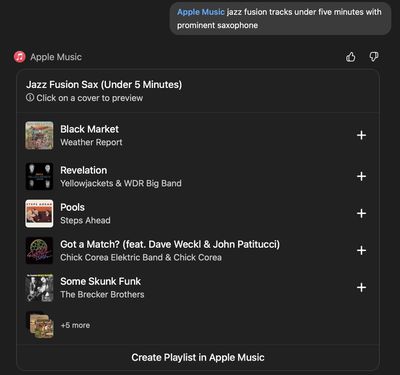
You can even combine multiple criteria, like “jazz fusion tracks under five minutes with prominent saxophone,” and ChatGPT will accurately unearth what you’re looking for in ways that standard keyword searches simply aren’t capable of achieving.
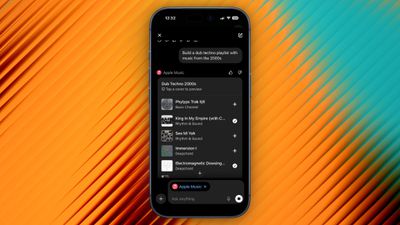
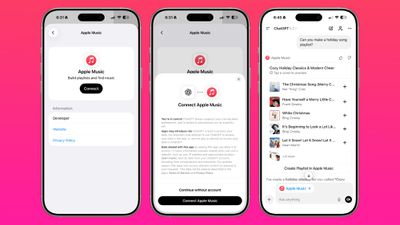
You can request custom playlists based on specific criteria, ask for song recommendations, or explore music by decade, genre, or artist. And once ChatGPT creates a playlist, you can preview each track, and save the playlist directly to your Apple Music library with the option “Create Playlist in Apple Music.” You can also save individual tracks using the + buttons.
The Apple Music extension requires a ChatGPT account and works with both free and paid ChatGPT tiers. You don’t need an Apple Music subscription to search the catalog, generate playlists, or listen to 30-second preview clips, but you will need an active subscription if you want to save content to your library.
How to Connect Apple Music to ChatGPT
Before you can start discovering new music with the help of AI, you’ll need to connect Apple’s streaming service using ChatGPT’s extension. You only need to do it once.
Open the ChatGPT app and tap your profile in the sidebar.
Under “Account” settings, tap Apps.
Tap Browse Apps, then choose Apple Music in the extensions library.
Tap Connect, then choose Connect Apple Music.
Follow the on-screen prompts to sign into your Apple Account and permit the access request.
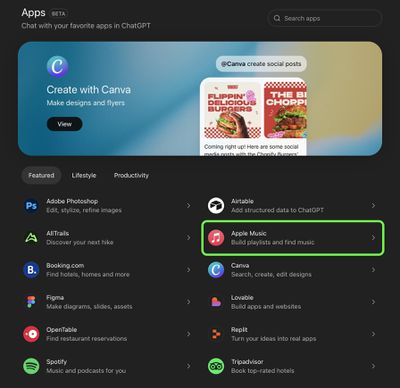
If you’re on desktop, you can perform the same steps in the ChatGPT app for Mac. Alternatively, go to https://chatgpt.com/apps in a browser and open the Apps section in ChatGPT – you’ll find the Apple Music extension there. Once connected, the extension remains active across your devices signed into the same ChatGPT account.
One More Thing
Apple Music extension in ChatGPT’s “Apps” section
ChatGPT can search Apple Music’s catalog and create playlists, but it can’t access your listening history or existing playlists. The integration only has permission to add songs to your library, so your personal data stays private.
Researchers studying AI chatbots have found that ChatGPT can show anxiety-like behavior when it is exposed to violent or traumatic user prompts. The finding does not mean the chatbot experiences emotions the way humans do.
However, it does reveal that the system’s responses become more unstable and biased when it processes distressing content. When researchers fed ChatGPT prompts describing disturbing content, like detailed accounts of accidents and natural disasters, the model’s responses showed higher uncertainty and inconsistency.
These changes were measured using psychological assessment frameworks adapted for AI, where the chatbot’s output mirrored patterns associated with anxiety in humans (via Fortune).
Airam Dato-on / Pexels
This matters because AI is increasingly being used in sensitive contexts, including education, mental health discussions, and crisis-related information. If violent or emotionally charged prompts make a chatbot less reliable, that could affect the quality and safety of its responses in real-world use.
To find whether such behavior could be reduced, researchers tried something unexpected. After exposing ChatGPT to traumatic prompts, they followed up with mindfulness-style instructions, such as breathing techniques and guided meditations.
These prompts encouraged the model to slow down, reframe the situation, and respond in a more neutral and balanced way. The result was a noticeable reduction in the anxiety-like patterns seen earlier.
This technique relies on what is known as prompt injection, where carefully designed prompts influence how a chatbot behaves. In this case, mindfulness prompts helped stabilize the model’s output after distressing inputs.
Unsplash
While effective, researchers note that prompt injections are not a perfect solution. They can be misused, and they do not change how the model is trained at a deeper level.
It is also important to be clear about the limits of this research. ChatGPT does not feel fear or stress. The “anxiety” label is a way to describe measurable shifts in its language patterns, not an emotional experience.
Still, understanding these shifts gives developers better tools to design safer and more predictable AI systems. Earlier studies have already hinted that traumatic prompts could make ChatGPT anxious, but this research shows that mindful prompt design can help reduce it.
OpenAI added a year-end summary feature to ChatGPT, allowing users to get a personalized overview of their 2025 ChatGPT usage. The summary is similar to year-end wrap-ups from companies like Spotify, Apple Music, YouTube, and other services.
ChatGPT offers up an overview of themes discussed and chat stats, such as busiest chatting day, number of overall chats, messages sent, and more. ChatGPT provides each user with a chat style based on writing or speaking habits, along with an “archetype” based on what ChatGPT is used for.
The year-end update also provides a poem, a personalized pixel painting, a 2025 “award,” and predictions for 2026.
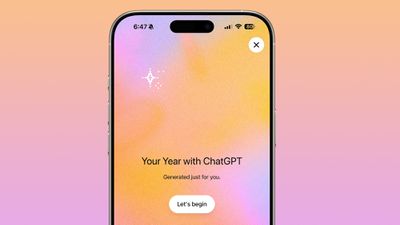
ChatGPT users can get their year-end summary by asking ChatGPT to “Show me my year with ChatGPT” in the ChatGPT app or on the web. Summaries are available for Free, Pro, and Plus users who have chat history and memory enabled for ChatGPT.
Countries where the feature is available include the United States, UK, Canada, New Zealand, and Australia.
You’d think things would be slowing down heading into the holidays, but this week saw a whirlwind of Apple leaks and rumors while Apple started its next cycle of betas following last week’s release of iOS 26.2 and related updates.
This week also saw the release of a new Apple Music integration with ChatGPT, so read on below for all the details on this week’s biggest stories!
Top Stories
i…
Apple hasn’t updated the Apple TV 4K since 2022, and 2025 was supposed to be the year that we got a refresh. There were rumors suggesting Apple would release the new Apple TV before the end of 2025, but it looks like that’s not going to happen now.
Subscribe to the MacRumors YouTube channel for more videos.
Bloomberg’s Mark Gurman said several times across 2024 and 2025 that Apple would…
Next year’s iPhone 18 Pro and iPhone 18 Pro Max will be equipped with under-screen Face ID, and the front camera will be moved to the top-left corner of the screen, according to a new report from The Information’s Wayne Ma and Qianer Liu.
As a result of these changes, the report said the iPhone 18 Pro models will not have a pill-shaped Dynamic Island cutout at the top of the screen….
Since the beginning of December, Apple has been pushing iPhone users who opted to stay on iOS 18 to install iOS 26 instead. Apple started by making the iOS 18 upgrades less visible, and has now transitioned to making new iOS 18 updates unavailable on any device capable of running iOS 26.
If you have an iPhone 11 or later, Apple is no longer offering new versions of iOS 18, even though there…
Apple is significantly increasing its reliance on Samsung for iPhone memory as component prices surge, according to The Korea Economic Daily.
Apple is said to be expanding the share of iPhone memory it sources from Samsung due to rapidly rising memory prices. The shift is expected to result in Samsung supplying roughly 60% to 70% of the low-power DRAM used in the iPhone 17, compared with a…
There has been a whirlwind of rumors over the last few days, sourced from leaked internal software designed for the iPhone and the Mac, and news sites like The Information. Below, we have a quick recap of everything we’ve heard this week, which serves as a guide to Apple’s product plans in 2026 and beyond.
We’ve organized the info by likely release date, though there are some products that…
Italy’s Competition Authority (AGCM) has imposed a €98.6 million ($116 million) fine on Apple over its App Tracking Transparency feature.
Since the release of iOS 14.5 in April 2021, Apple has required apps to ask for permission before tracking a user’s activity across other apps and websites for personalized advertising, as part of a feature named App Tracking Transparency. If a user…