ICE Agent’s ‘Dragging’ Case May Help Expose Evidence in Renee Good Shooting


Defense attorneys for a Minnesota man convicted in December of assaulting Immigration and Customs Enforcement officer Jonathan Ross are seeking access to investigative files related to the killing of Renee Nicole Good, after learning Ross was the same officer who shot and killed her during a targeted operation in Minneapolis last month.

Attorneys for Roberto Carlos Muñoz-Guatemala asked a federal judge on Friday to order prosecutors to turn over training records as well as investigative files related to Ross, the ICE agent who killed Good on January 7 during Operation Metro Surge and was also injured in a June 2025 incident in which Muñoz-Guatemala dragged him with his car.

A separate post-trial motion by the defense, filed in the US District Court in Minnesota, asks the judge to pause deadlines for a new-trial motion until the discovery motion is resolved.

Muñoz-Guatemala’s attorneys argue that even if the court ultimately decides that any newly discovered evidence doesn’t entitle their client to a new trial, he’s entitled to explore whether there are mitigating factors that could impact the length of his sentence, such as whether Ross’ injuries could have been, to some degree, brought upon him by his own behavior.

A jury convicted Muñoz-Guatemala on December 10 of assault on a federal officer with a dangerous weapon and causing bodily injury.

Court filings say that Ross and other agents were attempting to interview Muñoz-Guatemala last summer, and possibly process him for deportation, because he had an administrative warrant out for being in the country without authorization. They surrounded his Nissan Altima and attempted to remove him from the vehicle. Ross then used a tool to shatter the rear driver’s-side window before reaching inside. When the defendant accelerated away, Ross testified, he was dragged approximately 100 yards, during which time he repeatedly deployed a taser. Muñoz-Guatemala subsequently called 911 to report he’d been the victim of an assault.

During his trial, Muñoz-Guatemala said he didn’t understand that Ross—who according to his own testimony was wearing ranger green and gray and wore his badge on his belt—was a federal agent. (Ross testified that Muñoz-Guatemala had asked to speak to an attorney, which would suggest he knew Ross was acting as law enforcement, but an FBI agent who witnessed the incident said he didn’t hear this. According to court records, this claim did not come up in pretrial interviews, and prosecutors said they had not heard it before he made the claim in court.) Muñoz-Guatemala’s attorneys say now that had he been tried after Good’s killing, his defense may have also asserted that he was justified in resisting Ross, who they claim was the aggressor and used excessive force.

The argument is that the jury instructions essentially contained a two-part decision tree: Jurors could convict Muñoz-Guatemala if they believed he should have known Ross was law enforcement. They could also convict him if they believed driving away was not a reasonable response.

Muñoz-Guatemala’s conviction does not indicate which of these prongs the jury relied on. If it was the latter, the defense argues in the motion, the court should have access to evidence that may have bearing on Ross’ conduct, tactics, and whether he behaved aggressively—information that might indicate whether the agent has a history behaving recklessly in the field or contrary to his training.

Prosecutors have not yet filed a response to the motions. An email to an address associated with Ross in publicly available records did not result in an immediate response. The Department of Justice did not immediately respond to a request for comment. The Department of Homeland Security did not immediately respond to questions about Ross’ current duty status or the status of any departmental review.

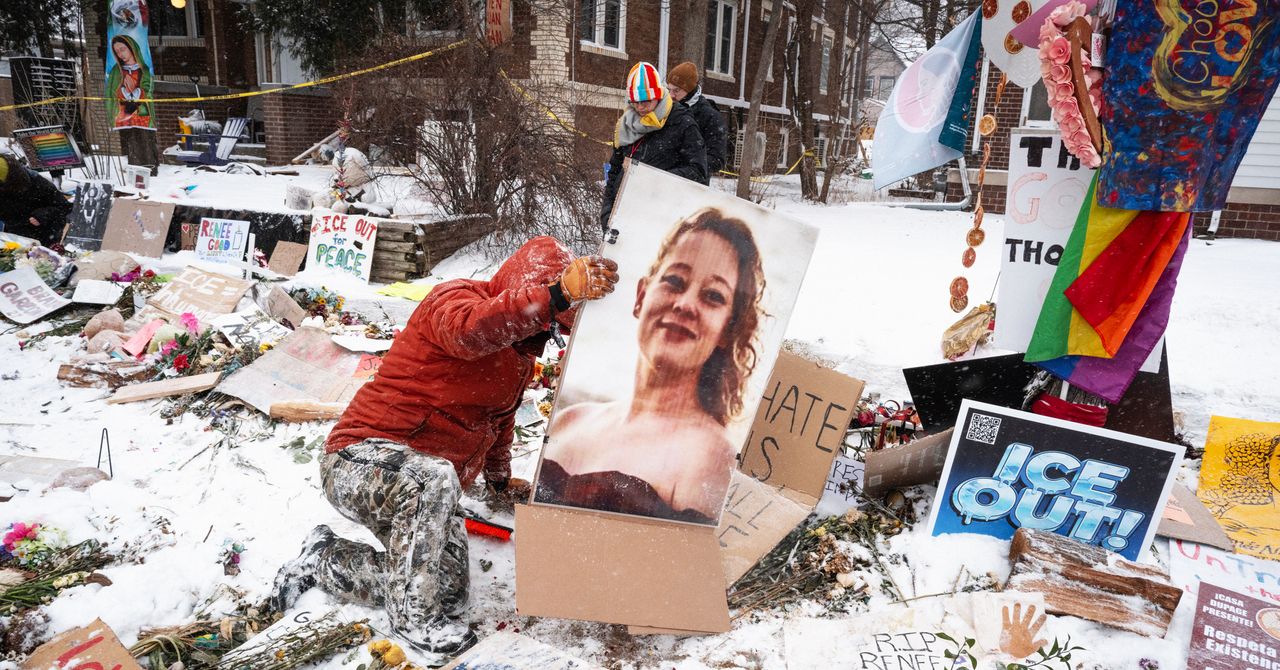
Ross has been placed on administrative leave following the January 7 shooting of Good, a 37-year-old Minnesota poet and mother of three, a step DHS officials say is standard protocol after fatal use of force. Ross has not been charged in Good’s killing, and the Justice Department has said it will not pursue criminal charges.

Cybersecurity Professor Faced China-Funding Inquiry Before Disappearing, Sources Say


Jason Covert, one of attorneys representing Xiaofeng Wang and his wife, Nianli Ma, a library systems analyst whose employee profile was also removed by Indiana University, tells WIRED that Wang and Ma are both “safe” and that neither of them have been arrested. Their legal team is not currently aware of any pending criminal charges against them, and while the couple’s attorneys have viewed a search warrant from the Department of Justice, Covert says they have not received a copy of the affidavit establishing probable cause.

Wang is considered among the top researchers in the field of privacy, data security, and biometric privacy, and his sudden disappearance came as a shock to many of his academic peers. Wang joined IU in 2004 and is the lead principal investigator of the multidisciplinary Center for Distributed Confidential Computing, which he established in 2022 with an almost $3 million grant from the National Science Foundation (NSF), according to a since-deleted bio on IU’s website. As part of his application for the NSF funding and other US federal research grants, Wang would have been required to disclose other grants he already received or were currently pending review.

On March 28, the FBI searched two home addresses associated with Wang. The same day, IU also reportedly terminated Wang’s job via an email sent by provost Rahul Shrivastav, which WIRED obtained and was first reported by The Indiana Daily Student. The email also said it was understood that Wang had recently accepted a position with a university in Singapore, a detail also repeated in the statement attributed to Li.

The statement says Wang planned to start at the unnamed Singaporean university on June 1, 2025 and requested a leave of absence from Indiana University in early March. But IU responded by “putting him on administrative leave, removing his IU homepage, and disabling his IU email address,” it claims.

Wang’s new job offer “would be irrelevant in any event because it is for [the] next academic year and would not justify firing him,” Tanford says. Terminating his employment via an email was a violation of university policy, Tanford claims, which prohibits firing a tenured professor without cause, and requires a 10-day notice and a hearing before a faculty board of review, if requested by the staff member. “The faculty is deeply concerned. If the administration can fire a tenured professor without due process and in violation of a policy approved by our trustees, none of us is safe,” he says.

Reached for comment, an IU spokesperson declined to answer detailed questions from WIRED about prior communications between the university and Wang and the school’s decision to fire him.

“Indiana University was recently made aware of a federal investigation of an Indiana University faculty member,” university spokesperson Mark Bode tells WIRED in an emailed statement. “At the direction of the FBI, Indiana University will not make any public comments regarding this investigation. In accordance with Indiana University practices, Indiana University will also not make any public comments regarding the status of this individual.”

Trump Administration Wants to Help Get Professional Misogynist Andrew Tate out of Romania


Off in the depths of the QAnon and PizzaGate corners of the internet, conspiracists swear Donald Trump is quietly preparing charges to bring down notorious sex trafficking circles operated by celebrities. Back in reality, the Financial Times reports the Trump administration is pressuring Romanian authorities to let Andrew Tate and his brother Tristan Tate travel freely despite facing charges of sexual misconduct and human trafficking.

Per the report, Trump officials have been pushing for Romania to return the Tates’ passports and lift travel restrictions on the brothers, who have been banned from leaving the country until their criminal case concludes. The pressure campaign started on phone calls last week and then got raised in-person when Trump special envoy Richard Grenell, who met with the Romanian foreign minister Emil Hurezeanu at the Munich Security conference.

Grenell—who served as Trump’s ambassador to Germany during his first term only to get iced out by German leaders for cozying up with the far-right, Nazi-aligned (and now Elon Musk-backed) Alternative for Germany (AfD)—has been publicly supportive of the Tates. In a post made earlier this month, Grenell seemed to suggest the Tate brothers were the victims of a concerted effort to target “conservatives around the world,” which he believed was funded by USAID programs.

So, okay, that’s one potential explanation of what happened to the Tates. The United States government, through a series of funds indirectly directed to Romania, successfully influenced the nation’s law enforcement apparatus to pursue anti-woke personalities and charge them with fake crimes in order to make an example of them.

Let’s try another one, just to see if it might make a little more sense. Tate, a self-described misogynist and “king of toxic masculinity” who was credibly accused of sexual abuse, fled his home in the United Kingdom and went to Romania as local law enforcement investigated allegations against him. While in Romania, which he claimed to have chosen in part because of the country’s lax laws against sex crimes, he and his brother operated an exploitative camgirl and porn website which allegedly included luring young women—some as young as 15—to their home and forcing them to partake in sexual acts on camera. Money made from the operation funded the Tates’ extravagant lifestyle, allowing them to develop a cult of personality that targeted disaffected young men and tempted them with the allure of their obscene image of masculinity.

All of that is pretty well documented, including by the Tates themselves who happily brag about all the people they have ripped off along the way. But maybe there’s an extremely elaborate international conspiracy afoot! Hard to say which is more likely. Occam’s razor is pretty dull these days.

In 2022, the Romanian government indicted the brothers on charges of human trafficking, sexual misconduct, money laundering, operating an organized crime group, and committing rape. As prosecutors continue to attempt to move the case forward, the Tates are prevented from leaving Romania. All the while, cases keep building against them. Last week, a woman in Florida accused the brothers of trying to recruit her into their webcam sex ring.

Meanwhile, the Romanian government might be more receptive to the Trump administration’s pressure soon. Last year, far-right politician Calin Georgescu unexpectedly won the first round of presidential voting in the country, though that victory was annulled by the nation’s highest court over concerns that the election process was corrupted by an outside influence campaign. Vice President JD Vance criticized the Romanian court over the decision, so should Georgescu take the highest office, communication between the leadership of the two countries might become more friendly, and Romania might be willing to hear the Trump administration’s calls to let up on the accused human traffickers.

Justice Department to Criminally Charge Boeing: Reports


Two boeing logos on display

Photo: Anadolu (Getty Images)

The U.S. Justice Department intends to criminally charge Boeing for breaching a settlement connected to two deadly 737 Max jetliner crashes, according to reports from Bloomberg and Reuters. The federal government is reportedly seeking a guilty plea from Boeing, which may include a $243.6 million criminal fine and force the planemaker to bring on an independent compliance monitor.

The Boeing-DOJ settlement followed a 2017 crash in Indonesia, which killed all 189 people on board; and a 2018 crash in Ethiopia, which killed all 157 people on board. Despite opposition from some lawmakers and relatives of those killed in the incidents, Boeing secured the $2.5 billion settlement in 2021, which temporarily protected it from criminal prosecution. The agreement required the planemaker to report evidence and allegations of fraud and “strengthen its compliance program,” the Justice Department said at the time.

Then a panel blew off an Alaska Airlines-operated Boeing plane in January, uncloaking continuing safety and compliance issues at the company. Four months later, the federal government said in a court filing that Boeing had breached its 2021 agreement by failing to “design, implement, and enforce a compliance and ethics program to prevent and detect violations of the U.S. fraud laws throughout its operations.”

The DOJ has now decided to bring criminal charges against Boeing and wants the planemaker to accept a plea deal, according to several reports. Such a deal would include about a quarter of a billion dollars in additional fines, per Bloomberg; it could also force Boeing to bring in an independent monitor to make sure the firm follows anti-fraud laws, per AP News.

The DOJ reportedly told the 737 Max crash victims’ families and lawyers about the plea deal on Sunday, and said it would give the planemaker a week to decide whether to accept the offer or argue its case in court. Boeing did not immediately respond to a request for comment on the reports.