Unmasking the Paramilitary Agents Behind Trump’s Violent Immigration Crackdown


In the early morning last September 30, hundreds of federal agents swarmed the South Shore Apartments, a beige brick building on Chicago’s South Side. As feds in body armor rappelled down from a Black Hawk helicopter overhead, others crashed through the building’s doors with battering rams, rounding up residents at gunpoint.

A group of burly, masked agents wearing helmets and bulletproof vests, and toting suppressor-equipped M4 rifles, moved through the hallways in a rapid, tightly organized file. Padraic Daniel Berlin, a 34-year-old Michigan native and son of a Detroit firefighter, held Yoda, his Belgian Malinois, on a leash. David Dubar Jr., a 53-year-old onetime construction worker, followed closely behind him. Their team leader, Corey Myers, a Marine veteran from the Border Patrol’s Tucson sector, checked apartment doors. Paul Delgado Jr., a standout cross-country runner in high school, was the final member of the entry team.

The four men are members of the Border Patrol Tactical Unit, or BORTAC. Based mainly out of Fort Bliss, with at least 11 detachments stationed around the United States, BORTAC and its sister unit, Border Patrol Search, Trauma and Rescue, or BORSTAR, were once reserved for desert rescues, executing high-risk warrants, conflicts with armed drug cartels, and manhunts.

Under Donald Trump, however, they have been sent into the streets of major US cities. The result is the largest known deployment of BORTAC and BORSTAR agents in US history, a fact made difficult to pin down due to the government’s secrecy around their operations. Many of the agents’ identities have remained hidden from the public. The decision to use an offensive, heavily armed paramilitary units for street-level immigration sweeps in American cities is a first—a bellwether of the Trump administration’s project to militarize domestic law enforcement operations.

Myers, Berlin, Dubar, Delgado, and their teammates seemed keyed up. The intelligence briefing they received claimed the building was controlled by Tren de Aragua, a Venezuelan street gang the Trump administration categorized—despite contrary evidence amassed by its own intelligence services—as a foreign terrorist organization. Gang members were supposedly occupying the building and storing grenades, handguns, and rifles on the second floor, where a suspect with an open warrant for firearms possession lived. This intelligence was never released or substantiated, and Illinois later launched an investigation into whether the property owner had sent baseless claims to the feds. But at that moment, it didn’t matter.

At every door approached by his team, Berlin yelled, “Police! Speak to me now or I’ll send the dog!” In a second-floor unit, the BORTAC team detained one man. Further down the hall, Myers noticed “signs of forced entry” and smashed open the door. Tolulope Akinsulie, an undocumented immigrant from Nigeria, happened to be hiding in the bedroom. Without issuing a warning or verbal command, Berlin let go of Yoda’s leash and the Malinois pounced, sinking its teeth into Akinsulie’s leg as he screamed in agony. Yoda bit Akinsulie repeatedly in the leg, hip, and hands before Berlin called the dog off and his team placed the man in cuffs. Akinsulie, who was not a target of the raid and has no known history of violent crime or gang affiliation, was treated for his injuries and taken to the Broadview Processing Center to face removal proceedings.

Berlin’s actions that morning were not isolated. He was involved in at least five uses of force during Operation Midway Blitz, the Trump administration’s 2025 surge of hundreds of immigration agents into Chicago and surrounding communities. Nor were the actions of his team, according to a WIRED analysis of US government records, which appeared to escalate tensions with civilian onlookers rather than quell them. Since last year, BORTAC and BORSTAR have fronted several of the US government’s invasions of its own cities, often engaging in almost theatrical uses of force that litter newscasts and social feeds, adding a new salience to US Border Patrol Special Operations Group’s self-proclaimed status as the “tip of the spear.”


ICE Agent’s ‘Dragging’ Case May Help Expose Evidence in Renee Good Shooting


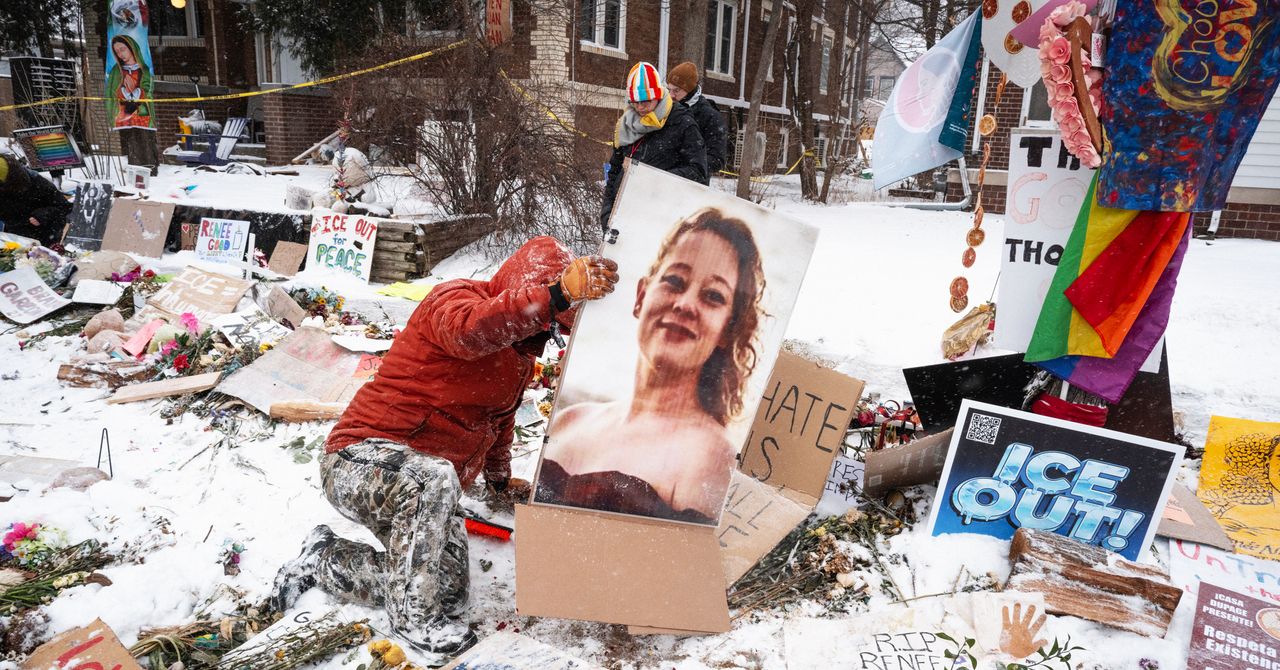
Defense attorneys for a Minnesota man convicted in December of assaulting Immigration and Customs Enforcement officer Jonathan Ross are seeking access to investigative files related to the killing of Renee Nicole Good, after learning Ross was the same officer who shot and killed her during a targeted operation in Minneapolis last month.

Attorneys for Roberto Carlos Muñoz-Guatemala asked a federal judge on Friday to order prosecutors to turn over training records as well as investigative files related to Ross, the ICE agent who killed Good on January 7 during Operation Metro Surge and was also injured in a June 2025 incident in which Muñoz-Guatemala dragged him with his car.

A separate post-trial motion by the defense, filed in the US District Court in Minnesota, asks the judge to pause deadlines for a new-trial motion until the discovery motion is resolved.

Muñoz-Guatemala’s attorneys argue that even if the court ultimately decides that any newly discovered evidence doesn’t entitle their client to a new trial, he’s entitled to explore whether there are mitigating factors that could impact the length of his sentence, such as whether Ross’ injuries could have been, to some degree, brought upon him by his own behavior.

A jury convicted Muñoz-Guatemala on December 10 of assault on a federal officer with a dangerous weapon and causing bodily injury.

Court filings say that Ross and other agents were attempting to interview Muñoz-Guatemala last summer, and possibly process him for deportation, because he had an administrative warrant out for being in the country without authorization. They surrounded his Nissan Altima and attempted to remove him from the vehicle. Ross then used a tool to shatter the rear driver’s-side window before reaching inside. When the defendant accelerated away, Ross testified, he was dragged approximately 100 yards, during which time he repeatedly deployed a taser. Muñoz-Guatemala subsequently called 911 to report he’d been the victim of an assault.

During his trial, Muñoz-Guatemala said he didn’t understand that Ross—who according to his own testimony was wearing ranger green and gray and wore his badge on his belt—was a federal agent. (Ross testified that Muñoz-Guatemala had asked to speak to an attorney, which would suggest he knew Ross was acting as law enforcement, but an FBI agent who witnessed the incident said he didn’t hear this. According to court records, this claim did not come up in pretrial interviews, and prosecutors said they had not heard it before he made the claim in court.) Muñoz-Guatemala’s attorneys say now that had he been tried after Good’s killing, his defense may have also asserted that he was justified in resisting Ross, who they claim was the aggressor and used excessive force.

The argument is that the jury instructions essentially contained a two-part decision tree: Jurors could convict Muñoz-Guatemala if they believed he should have known Ross was law enforcement. They could also convict him if they believed driving away was not a reasonable response.

Muñoz-Guatemala’s conviction does not indicate which of these prongs the jury relied on. If it was the latter, the defense argues in the motion, the court should have access to evidence that may have bearing on Ross’ conduct, tactics, and whether he behaved aggressively—information that might indicate whether the agent has a history behaving recklessly in the field or contrary to his training.

Prosecutors have not yet filed a response to the motions. An email to an address associated with Ross in publicly available records did not result in an immediate response. The Department of Justice did not immediately respond to a request for comment. The Department of Homeland Security did not immediately respond to questions about Ross’ current duty status or the status of any departmental review.

Ross has been placed on administrative leave following the January 7 shooting of Good, a 37-year-old Minnesota poet and mother of three, a step DHS officials say is standard protocol after fatal use of force. Ross has not been charged in Good’s killing, and the Justice Department has said it will not pursue criminal charges.

Detroit police can no longer use facial recognition results as the sole basis for arrests


The Detroit Police Department has to adopt new rules curbing its reliance on facial recognition technology after the city reached a settlement this week with Robert Williams, a Black man who was wrongfully arrested in 2020 due to a false face match. It’s not an all-out ban on the technology, though, and the court’s jurisdiction to enforce the agreement only extends four years. Under the new restrictions, which the is calling the strongest such policies for law enforcement in the country, police cannot make arrests based solely on facial recognition results or conduct a lineup based only on facial recognition leads.

Williams was arrested after facial recognition technology flagged his expired driver’s license photo as a possible match for the identity of an alleged shoplifter, which police then used to construct a photo lineup. He was arrested at his home, in front of his family, which he says “completely upended my life.” Detroit PD is known to have made at least two other wrongful arrests based on the results of facial recognition technology (FRT), and in both cases, the victims were Black, the ACLU noted in its announcement of the settlement. Studies have shown that facial recognition is .

The new rules stipulate that “[a]n FRT lead, combined with a lineup identification, may never be a sufficient basis for seeking an arrest warrant,” according to a summary of the agreement. There must also be “further independent and reliable evidence linking a suspect to a crime.” Police in Detroit will have to undergo training on the technology that addresses the racial bias in its accuracy rates, and all cases going back to 2017 in which facial recognition was used to obtain an arrest warrant will be audited.

In an op-ed for published today, Williams wrote that the agreement means, essentially, that “DPD can no longer substitute facial recognition for basic investigative police work.”

This article contains affiliate links; if you click such a link and make a purchase, we may earn a commission.

Japanese police arrest suspect Nintendo threat-maker


Police in Japan arrested on April 3 a 27-year old man suspected of threatening Nintendo staff, events, and spectators. Due to these threats, Nintendo announced in December it was canceling several events, like Nintendo Live and the Splatoon Koshien 2023 finals, and postponing others. Japanese newspaper the Kyoto Shimbun first reported the arrest. According to the report, the man admitted to the threats.

Nintendo of America confirmed the arrest in a statement to Polygon, where a representative also said the Japanese headquarters “was receiving constant threats targeting its employees, and most recently, received threats targeting the spectators and staff of the Splatoon Koshien 2023 Grand Final.”

Here’s the full statement:

Nintendo’s Japanese headquarters was receiving constant threats targeting its employees, and most recently, received threats targeting the spectators and staff of the Splatoon Koshien 2023 Grand Final. Given the threats, Nintendo postponed and cancelled the series of events, and has been in contact with the police ever since. Nintendo is extremely thankful for the investigation and effort made by the police on arresting the suspect. Nintendo’s Japanese headquarters will continue to cooperate fully with the police’s investigation.

Nintendo Live, the event that was canceled in December, is a big, multi-day celebration of everything Nintendo. It was set to be held at the Tokyo Big Sight exhibition center in January. The Splatoon grand finals were slated for December at the Tokyo Ota Ward General Gymnasium.

News of Nintendo’s event cancelation came during the trial for the devastating 2019 Kyoto Animation arson attack that killed 36 people and injured many others. The attack was one of the deadliest in recent Japanese history. The suspect plead guilty and was sentenced to death in January. In the aftermath of the attack, Japanese police have treated threats with “heightened seriousness,” according to Japan Today. Police have also arrested several people who’ve made threats against both Sega and Square Enix.