Payday composer Simon Viklund on his tough ‘try and fail’ process


Whether you know Simon Viklund as the composer of the Payday franchise’s emblematic dubstep/EDM/techno soundtracks or as the voice of Bain in the same series, his name is always associated with heavy-hitter action games. He’s known for his work on Bandits: Phoenix Rising, Bionic Commando, Dead by Daylight, and of course, Payday: The Heist and Payday 2.

For Polygon FM — our weeklong look at the way music and gaming interweave with each other — Viklund discusses his early inspirations and why wonky rhythms make good video game music.

Polygon: Was there a game soundtrack or song that inspired you to pursue creating game music? Can you set the scene of what that felt like for you, and why the music was so effective?

Simon Viklund: I was somewhat obsessed with NES music when I was a kid, to the point where I recorded Megaman 1-3 music off the TV to cassette tape so that I could listen to it when I wasn’t playing. The music on the NES was extremely effective because the primitive sound chip forced the composers to arrange economically and rely on great harmonies and melodies. My hot take is that the music in the 16-bit era wasn’t as good because the tech sounded more like actual instruments but not quite — it was like the uncanny valley of sampled instruments — and composers started to over-rely on the tools.

Can you break down one of your own songs and its influences? Was it inspired by game soundtracks, other music, or something else?

I made a track called “Inject” that was written specifically for the name reveal trailer for Den of Wolves, a techno thriller heist co-op game we’re working on at 10 Chambers. We wanted the trailer to leave the viewer with a sense of “oh hell yeah, that’s bad-ass,” and I listened to half-tempo bass music for inspiration.

There’s this track called “Arbiter” by Draeden, which has what I would call a trap-inspired beat, and I’m not really into trap but I loved what Draeden did and drew heavily from that particular track. “Inject” is basically drums and one synth melody, with most of the bass coming from an 808 that goes with the kick drum. In other words, there’s not a lot [of] layers to it, and so each component really has to shine. I spent a lot of time making the kick very punchy, the snare snappy, etc.

Another aspect was my idea to make the music sound sort of “wonky” and not pitch perfect or quantized (i.e. not rhythmically perfect). My idea was that it would help the music become a bit more ear-wormy beacuse it would sort of feel “off.” I spent a lot of time making the groove sloppy timing-wise, and the synths screech and wobble a bit like it wasn’t intentional even though it was. I had a lot of fun exploring new ideas, pushing out of my comfort zone and learning new tricks while making “Inject”!

What are the main instruments used to record the soundtrack for the Payday series? How did you choose those instruments?

Payday has a lot of drum loops and distorted synths, but every once in awhile there’s some real electric guitar and bass in there. When we were creating Payday: The Heist back in 2010-2011, my gut feeling said the choice for the music was between leaning into the game’s Hollywood movie inspiration with cinematic music, or leaning into the “outlaw power fantasy” with something more rock ‘n’ roll. I went with the latter.

Is there anything else we should know about your approach to composing video game music?

It doesn’t come easy for me. It’s hard. I don’t use project templates, although probably I should. Every time I sit down to make another track, it’s a clean slate, and I go “How do you do this again?” There are so many directions a soundtrack or an individual track can go, it’s easy to get choice paralysis. I need time, I need to try and fail, and I need other people on the project to help me through the process — with direction and support through patience. So the process is hard, but I love doing it!

Why Malcolm X’s voice plays in a Sonic game


I think video game history will remember Hideki Naganuma for many reasons. Fans might lovingly bestow upon him the title of “Twitter weirdo.” Others — especially modern music producers — might cite him as an important influence in video game composition. That’s more than fair; the man is responsible for his fair share of video game bangers. Tracks like Jet Set Radio Future’sThe Concept of Love” — which stuffs warped vocal samples, bright electric guitar riffs, and rushing synthy drums — still turn heads when they come on the playlist.

Check out our special issue Polygon FM, a week of stories about all the places where music and games connect — retrospectives, interviews, and much more.

But for me, I’ll always remember him as the video game composer who put a sample of a Malcolm X speech in a Sonic the Hedgehog game.

The song appears on the soundtrack for Sonic Rush, a 2D Sonic game Sega released in 2005 for the OG Nintendo DS. It’s called “Wrapped in Black” and it plays during the final boss fight with Doctor Eggman. The track opens up with rushing violins and operatic vocals that convey the evilness of Doctor Eggman, but soon a sharp repeating vocal sample cuts through it all. The sample repeats “Too black, too strong” a few times and then comes back later in the song.

The audio for “Too black, too strong” comes from a 1963 speech given by Malcolm X titled, “Message to the Grassroots.” Naturally, his talk had nothing to do with Sonic, and dealt with far more serious matters. In the talk, the Black revolutionary outlined his idea of a Black nationalist philosophy and criticized the Civil Rights Movement. In the sample quote, Malcolm X used the image of coffee and creamer to explain what happened to the movement. He said:

“It’s just like when you’ve got some coffee that’s too black, which means it’s too strong. What you do? You integrate it with cream; you make it weak. If you pour too much cream in, you won’t even know you ever had coffee. It used to be hot, it becomes cool.”

That a Sonic game sampled this feels like nothing short of a fever dream. The composer commented on it once back in 2014 when he said, “‘Wrapped in Black’ is a song about coffee. lol.” And while the sample isn’t a joking matter, he is technically correct that the quote is, at least in part, about coffee.

Naganuma’s intensely stylized music fits his history as a composer and work on the Sonic series. Similar to how video games were a form of emerging media at the time, Naganuma experimented freely and didn’t limit himself to an idea of what art should be. He sent his first application to Sega in 1998, after which the first game he ever composed was a handheld toy called Hip Jog Jog. In 2000, he worked as the main composer for Jet Set Radio where he broke out as a composer. His uneven beats and screechy sounds brought influences from hip hop, electronic, dance, funk, jazz, and rock music into the fuzzy speakers of CRT the televisions of the 2000s.

An image of Blaze the cat in Sonic Rush. She’s running through the Carnival-themed stage. The image shows the upper and lower image since the game was for the Nintendo DS.

Image: Dimps, Sonic Team/Sega

Making a splash in the canon of Sonic the Hedgehog music and Sega games in general is no small task. Modern Sonic fans tend to remember the Chemical Plant Zone theme or later songs like the easy breezy rock theme of “Escape From the City” from Sonic Adventure 2. Because of this, I think it’s relatively easy to miss the soundtrack on Sonic Rush. Sega shipped it early in the lifecycle of the nascent handheld, and its roughly 1.62 million copies sold never made it the most popular or well-known game of the Sonic series

But Naganuma went off with the Sonic Rush soundtrack. He samples the British DJ Fatboy Slim’s reggae remix of Tribe Called Quest’s famous track, “I Left My Wallet In El Segundo,” to create a mariachi band-like holler for the theme of a Brazilian Carnival-esque level in “Ska Cha Cha.”

And while the nostalgic charms of the original Green Hill Zone theme will never wear off on me, there’s something uniquely thrilling to starting Sonic Rush off to the blaring horns and cascading twangy guitar of “Right There, Ride On.”

The eccentricities of Naganuma’s work have infected my brain and continue to shape my media tastes as an adult. So maybe that’s why I won’t let myself — or anyone else — forget the time when he put Malcolm X on a Sonic game and into the ears of an impressionable video game-loving child.

Lego Super Mario World: Mario & Yoshi: where to pre-order


While the gamified version of Lego Super Mario continues to expand with new and , more traditional Lego Sets inspired by the red plumber are somewhat rare. However, we can expect a new set featuring a caped Mario astride his trusty mount Yoshi to join the Lego Super Mario catalog on Oct. 1. The $129.99 set isn’t quite as cool as the or as iconic as the , but it still includes some fun features and surprises.

A stock image of the fully assembled Lego Super Mario World: Mario & Yoshi set on a coffee table

Image: Lego

Normally pre-orders of new Lego sets are exclusively available through, but this 1,215-piece set can also be reserved at Target ahead of the Oct. 1 launch.

This flat, pixelated Mario and Yoshi are based on the 16-bit versions as they first appeared in Super Mario World for the SNES. The base of the set features a small crank which, when turned, animates Yoshi’s legs and arms, while a dial behind Yoshi’s head animates his mouth and tongue. Also, just like the and sets, Lego Super Mario & Yoshi includes an action tag that provides unique reactions for , , or figures.

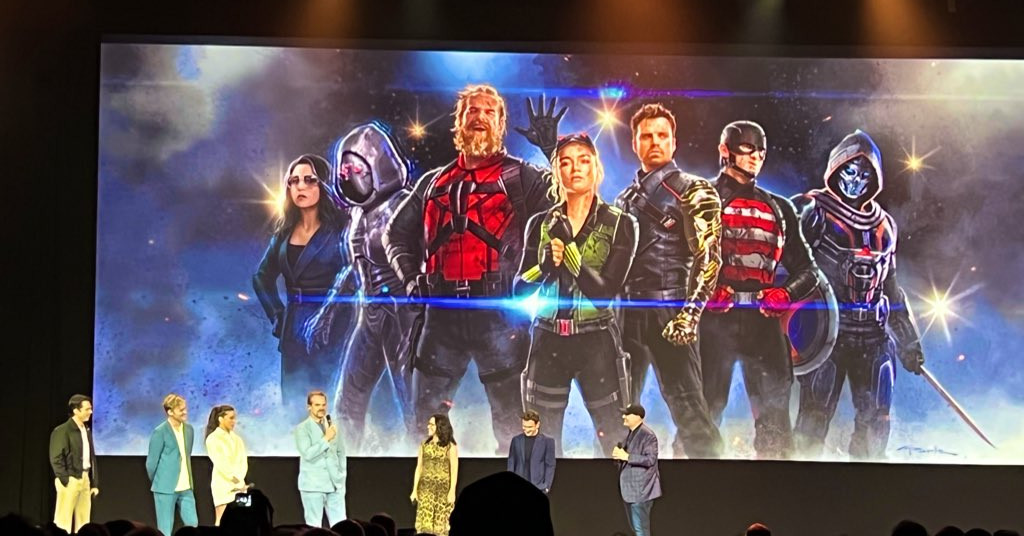
Marvel shows footage from Thunderbolts*, the MCU Suicide Squad, at SDCC


When Marvel Studios first announced Thunderbolts* at 2022’s San Diego Comic-Con as part of its ambitious lineup for Phase 5 and 6 of the Marvel Cinematic Universe franchise, the movie didn’t yet have that odd asterisk in the title. It didn’t come with many details, either, apart from a July 26, 2024 release date that shifted along with many other MCU projects in the wake of the 2023 WGA strike.

In the wake of the Thunderbolts* segment of 2024’s San Diego Comic-Con, we don’t know much more! The asterisk is still a mystery: Marvel Studios President Kevin Feige said at a CinemaCon appearance, “we won’t talk more about that until after the movie comes out,” and confirmed it again at Comic-Con.

But as the core cast of Thunderbolts* took the stage, the Hall H audience was treated to a teaser in which all their characters came under fire from a mysterious foe who, according to Florence Pugh’s Yelena Belova, wants them all dead.

Traditionally in Marvel Comics, the Thunderbolts are a team-up of second-string villains or anti-heroes, though their membership and motives vary significantly depending which iteration you’re talking about. The MCU team is built of not-exactly-always-good characters introduced in previous films in the franchise: Ghost (Hannah John-Kamen, of Ant-Man and the Wasp), Red Guardian (David Harbour, Black Widow), the Winter Soldier (Sebastian Stan, the Captain America movies), U.S. Agent, aka John Walker (Wyatt Russell, Falcon and the Winter Soldier), and Taskmaster (Olga Kurylenko, Black Widow). Pugh’s Yelena, from Black Widow and Hawkeye, leads the team, with slimy mastermind Valentina Allegra de Fontaine (Julia Louis-Dreyfus, Falcon and the Winter Soldier) behind the scenes.

Who might want all those folks dead? What might those folks do to stay alive? And what the heck is that asterisk about after all? We’ll have to wait for the theatrical debut of Thunderbolts* on May 2, 2025, as the final movie in the MCU’s Phase 5.

You can find all Polygon’s coverage of SDCC 2024 news, trailers, and more here.

Deadpool & Wolverine review: This time, the MCU is the villain


Being a Deadpool defender can be difficult. In just about any media where he appears, the character is exactly what his strongest critics think he is: an anti-hero with a strong affinity for irreverent violence, and a juvenile, obnoxious vessel for meta asides and a bushel of dick jokes. (“A bushel of dicks” would be a pretty solid Deadpool-ism.) I wouldn’t begrudge anyone for finding all that off-putting, because it is. But there’s also more to the character. Deadpool comes with a deep pathos. When that’s used effectively, it’s resulted in endearingly odd stories about those who are deemed (or feel) unlovable. That’s a potent emotional space for a summer blockbuster to inhabit. Deadpool & Wolverine — the third movie in Ryan Reynolds’ Deadpool trilogy, and the first under the Disney banner — pays lots of lip service to that pathos. Then it punts it out of our multiverse, to Alioth-knows-where.

Look at that, I made a reference! Just like Deadpool! I can swear like him, too.

Deadpool & Wolverine has been billed as a Marvel Cinematic Universe story, but it isn’t, really. Apart from a brief gag scene early in the film, Deadpool never sets foot in the MCU’s Earth-616 for any Deadpool-y derring-do. Instead, the film is just MCU-aware — the mainline MCU is one more subject for Deadpool to joke about and pine for while he has a characteristically vulgar adventure somewhere else. In some ways, the MCU is more of a villain than the film’s actual villains.

But before all that, the story starts in Deadpool’s pre-existing corner of the multiverse, which is dying. Abducted by the Time Variance Authority from Loki, Wade Wilson/Deadpool (Reynolds) learns his universe is slowly fading away, due to Wolverine’s death at the end of 2017’s Logan. That’s because the former X-Man is an “anchor being” — someone so significant that their timeline falls apart without their presence. But TVA agent Mr. Paradox (Matthew Macfadyen) says his superiors have deemed Deadpool as special, and worth rescuing from his decaying timeline and bringing over to the MCU. Trouble is, the invite doesn’t extend to the found family Wade has built up (and time-traveled to resurrect) across his previous two films.

Wolverine pops his claws with his arms across his chest as Deadpool looks on sword in hand in a scene from Deadpool & Wolverine

Photo: Jay Maidment/20th Century Studios/Marvel Studios

This is Deadpool & Wolverine’s first problem: It arrives on screens already extremely pre-complicated and full of narrative baggage. This isn’t necessarily a problem if director/co-writer Shawn Levy and his script team just want to take the piss out of overly complex superhero films. But it is a problem when setting up that pathos that is also key to Deadpool as a character. It doesn’t particularly matter to me that I do not fully understand the mechanics of time and/or multiverse travel in this movie, or the chain of cause-and-effect that drives its plot. Frankly, I’m not sure the film’s five credited writers — Levy, Reynolds, returning Deadpool movie scribes Rhett Reese and Paul Wernick, and comics and TV writer Zeb Wells — care that much about those things either.

I do care, however, when that confusion extends to the film’s emotional stakes. Deadpool & Wolverine spends so little time establishing where Wade is in relation to his friends and relationships (for some barely explained reason, he’s on the outs with ex-girlfriend Vanessa, played by Morena Baccarin) that his driving need to do something that “matters” feels rootless. He’s static, not terribly different at the end of the film’s two hours and seven minutes than he was at the beginning.

Perhaps that’s because the film offloads much of its emotional weight to Wade’s co-star. Logan (Hugh Jackman) enters Deadpool & Wolverine as a part of Wade’s hairbrained scheme to save his universe. If Logan is his timeline’s anchor being, Wade’s logic goes, he’ll just scour other universes until he finds a new one. The Logan he winds up grabbing is even more damaged than the one we’ve seen in the X-movies, and a lot of the film’s non-joke runtime is devoted to unpacking that. This seems like a poor use of Wade’s time, and ours. Logan’s whole deal has gotten plenty of exposure in past X-movies, and while his presence here has lots of fun moments, his contribution to the film’s emotional arc feels a lot like stolen franchise valor à la Spider-Man: No Way Home.

Cassandra Nova lounges in a leather duster, khakis, and hunting boots in a scene from Deadpool & Wolverine.

Photo: Jay Maidment/20th Century Studios/Marvel Studios

It’s hard to take any of this seriously though, because Deadpool & Wolverine is much more interested in focusing on Deadpool’s relationship with the MCU. From the very first second of the film, Disney, Marvel, and Kevin Feige are established as the thematic butts of the film’s comedy. There is no need for character work to anchor any of the jokes here, because the MCU is that anchor. All that swearing and violence? It’s in a Disney movie, baby! Remember that time Wade got pegged in the first Deadpool movie? Mickey Mouse paid for a movie about a guy who gets pegged! Oh, and the film’s on-screen bad guys? All a result of Marvel’s corporate dominance.

This last bit is where Deadpool & Wolverine almost gets at something interesting. The bulk of the film takes place in The Void, a Mad-Max-style limbo where the TVA sends troublesome people they can’t really erase. Ruled by the powerful telepath (and evil twin sister of X-Men leader Charles Xavier) Cassandra Nova (Emma Corrin), The Void is an island of misfit toys full of heroes and villains from other movie studios, disposed of by the MCU powers-that-be after Disney bought up 20th Century Fox. If you’ve heard about Deadpool & Wolverine’s many cameos and guest appearances, this is where they come from: corporate consolidation spun as fodder for jokes.

In Logan and Wade’s struggle to defeat Cassandra and escape The Void, the pair are also trying to escape the ruins of, for example, the 20th Century Fox X-Men universe. Unfortunately, this plot, and the gags around it, only undercut Deadpool and the very narrow lane of pathos that makes him tick. Because as much as he constantly makes fun of the MCU, he can’t stop defining himself in relationship to it, calling himself “Marvel Jesus” throughout this movie. Regardless of the fate of his home universe, Wade wants to matter — which is a way of saying he wants to join the mainline MCU universe, and that it is the only thing in this continuum that does matter.

That’s more or less the ball game. It’s hard to buy this movie as a love letter to anything but Marvel Studios’ corporate conquests. That’s one of the fundamental miscalculations behind the film. Wade is worth getting behind because he’s an underdog. But in Deadpool & Wolverine, he isn’t representing the unloved or speaking truth to power: He’s sucking up to the undisputed champ of the box office, even though that champ has earned the potshots Deadpool throws its way. The Void is what Marvel has done to pop culture. It’s the call coming from in the house, the big fucking smoke dragon that assimilates everything into its morass of multiversal bullshit or relegates it to oblivion, stripped for parts. And in this movie, Deadpool doesn’t just love it, he wants with all of his being to be part of it.

Deadpool & Wolverine has made its hero the worst kind of comic-book character: one who doesn’t stand for anything. It’s a terrible irony. Fans worried that Disney’s corporate control and the MCU’s rigid narrative oversight would leech away Deadpool’s edge, the swearing, jocular violence. Turns out that part was fine. Instead, the MCU just took his fuckin’ heart.

I told you I could swear like that cheeky bastard.

Deadpool & Wolverine debuts in theaters July 25.

Lego Hill Climb Adventures is cute version of Trials


I played three video games in college: Halo 3 with my friends, Tom Clancy’s Ghost Recon Advanced Warfighter with my roommate and her dad, and Trials HD by myself. I have since opened my horizons to the possibilities of other video games. And when I want to feel nostalgic, there are plenty of games that give me the feeling of playing the multiplayer shooters of my youth — but nothing but Trials itself has ever compared. (Eventually, Trials Evolution set that bar even higher.) This week, I read a story on Pocket Tactics: “This iPhone Lego game is perfect for fans of Ubisoft’s Trials series.”

That game, which is actually available for free on iOS and Android devices, is Lego Hill Climb Adventures. Released at the end of May, Lego Hill Climb Adventures is a Lego version of the classic physics-based racing game Hill Climb Adventures, another game that’s been compared to Trials — but with cars. I never hit it off with Hill Climb Adventures, but the Lego reskin was too charming not to try. It’s not Trials, but it does give me a similar thrill in playing it. I can’t put it down.

There are a bunch of Lego cars to unlock and race through the adorable worlds, picking up new blueprints and meeting Minifigs as you go. You aren’t necessarily building your own Lego car, but there are a bunch of ways to customize the existing options. My favorite part about the aesthetic is the sound design: There’s just something so satisfying about the click of a Lego brick. (And something even more satisfying about ramming your car through a wall of Legos.)

Lego Hill Climb Adventures is a much more chill iteration of the physics racing game genre, so don’t come into it expecting a Trials HD difficulty level. But it does have levels that require knowing exactly when to swipe or tap your phone screen. Each of the different vehicles has a different feel, too, so there’s always something to mess around with. The majority of the levels require you to race or complete a course with obstacles like jumps, steep hills, or stuff to destroy. The game’s energy system — bottles of milk — means you can’t play these endlessly, though, unless you pay up or grind the exploration modes, which are basically the same courses but with no real objective besides gaining coins, levels, milk bottles, and bricks.

The monetization system is the biggest bummer of Lego Hill Climb Adventures, but it is a free mobile game. It’s entirely possible to play most of it without spending a cent, but you will have to grind. The thing is, though, that grinding is still fun — and there are plenty of ways to switch up the vehicle to create more variety.

EA College Football 25 has to change the option offense controls


Like many other sports gamers, I have been eagerly awaiting the release of EA Sports College Football 25 for what feels like decades. Now it’s finally here in early access, and I’m overjoyed. I’ve been loving my time with the game, in both Ultimate Team and Dynasty modes, but there’s one particular bone I have to pick with the option system that’s holding me back from being fully enamored with the new entry.

Option offenses are crucial to any good football video game, but especially at the collegiate level, where many teams run option-based offenses. For years, EA’s preferred controller input for a read option — where the quarterback makes a read on the defense to determine whether to hold on to the ball or hand it off — has been the same: Tap X (or A on Xbox) to hand it off, or do nothing to keep it.

For some reason, EA Sports College Football 25 has inverted this long-standing tradition. Instead, you tap X/A for the quarterback to pull the ball back and keep it, or press nothing to hand it off. I’m starting to get used to it, but this involves overcoming years of muscle memory in both this franchise and the Madden games. I’ve made dozens of mistakes in the option game already — keeping it when I meant to hand it off, or vice versa — and I would conservatively estimate that it’s cost me 45 yards, two touchdowns, and probably two gray hairs in an otherwise fantastic gameplay experience.

For me, it just makes more sense to press a button to give the ball rather than press a button to keep it. I can understand that, in theory, the action of pulling the ball back is more significant for the quarterback than giving it away. But in these games, you aren’t just playing the quarterback; you’re controlling the offense. And handing off the ball seems more like an action than not handing it off, making that the more fitting place for a button press. And at the end of the day, years of muscle memory will triumph, especially with a blitzing linebacker in your face.

College Football 25 has plenty of control optimization options already. You can change the new passing or kicking systems back to the old controls. Why not add a toggle to change the option controls? The game has lots of quality-of-life upgrades, like running out the clock instantly on quarterback kneels, when applicable. Let’s add one more and bring back the old option controls.

Cities: Skylines 2’s console port has been delayed indefinitely


Cities: Skylines 2, the follow-up to the popular city builder developed by Colossal Order, just can’t catch a break. Following a post by the official Cities: Skylines account on publisher Paradox Interactive’s Cities: Skylines 2 forum, the console release for Cities: Skylines 2 has been postponed indefinitely. The game was originally targeting a launch on Xbox and PlayStation sometime in October.

“While we are making slow but steady progress, there are still unresolved issues impacting the game in ways that harm the player experience we want to deliver. We expect to receive a new [release candidate], which will undergo a thorough review in August. This evaluation will determine whether we can begin the submission process and provide a solid release date, or if further issues need to be addressed,” the post reads.

A screenshot from Cities: Skylines 2 showing a fully-built city with skyscrapers and rolling hills in the distance

Image: Colossal Order/Paradox Interactive

Despite Paradox Interactive publishing multiple pieces of downloadable content for the game, Cities: Skylines 2 has been plagued with performance and stability issues since its PC launch in October 2023, prompting an apology from the developers in April. The prompt cancellation of the Sims-competitor Life by You following an indefinite delay doesn’t inspire much confidence in Paradox’s intention to deliver on this promised release.

Colossal Order has managed to hit all of its goals outlined in the publicly available year-one roadmap for Skylines 2. However, persistent issues and a lack of mod support have left players clinging to the original Cities: Skylines for the time being.

An image displaying the year-one post-launch roadmap for Cities: Skylines 2. The San Fransisco Set and Deluxe Relax radio station are available at laiunch. The Modern Architecture Creator Pack, Urban Promenades Creator Packs, and Soft Rock Radio Station are set to launch in Q2 of 2024. Three more Creator Packs and Radio stations are slated for Q4 of 2024, while a Bridges & Ports Expansion and Cold Wave Radio Station are targeting a Q1 2025 launch.

The roadmap for the first year of post-launch content for Cities: Skylines 2
Image: Colossal Order/Paradox Interactive

New Wicked, Gladiator 2 release dates set up this year’s Barbenheimer


Universal Pictures has moved the release date of its lavish musical Wicked forward by a few days, from Nov. 27 (the day before Thanksgiving) to the preceding Friday, Nov. 22.

The move is ostensibly, and sensibly, to avoid a clash with Disney’s animation sequel Moana 2, also set for Nov. 27. Universal may have been motivated (read: scared) by the astonishing box office performance of Disney and Pixar’s Inside Out 2, which has racked up over $1 billion globally in a little over two weeks, setting a new record for an animated film.

But the date change also sets up another, potentially more exciting clash: Wicked, which stars Ariana Grande and Cynthia Erivo, will now hit theaters on the same day as Ridley Scott’s historical action drama Gladiator II, starring Paul Mescal and Pedro Pascal. Wicked is the first part of a two-part adaptation of the hit stage musical, which prefigures the 1939 classic The Wizard of Oz, telling the witches’ backstory. Gladiator II is a generation-later sequel to Scott’s Oscar-winning 2000 epic. (Vanity Fair just published a surprisingly meaty preview of Gladiator II, which is stuffed with first-look images, plot details, and good quotes from Scott and the cast; it’s worth checking out.)

The contest between these two movies instantly recalls “Barbenheimer,” the 2023 box office phenomenon that pitted Greta Gerwig’s candy-colored comedy Barbie against Christopher Nolan’s somber nuclear bomb drama Oppenheimer. That date clash created a storm of publicity and a kind of unofficial festival of moviegoing that worked out to the benefit of both movies, which finished 2023 as the biggest and third-biggest films of the year worldwide.

Theater owners, if no one else, will be hoping for similar from Wicked and Gladiator II, but the juxtaposition isn’t quite so striking this time around. It’s true that one is a colorful, fantastical stage musical centering female characters and the other is a violent action movie front-loaded with manly actors.

But they’re both big, old-school spectacles with Old Hollywood feel, and they don’t make for as stark (or as funny) a contrast as between a toy-branded meta comedy and a three-hour biopic about physics and nuclear holocaust. Wicked and Gladiator II are also both franchise movies of a sort, relying on brand familiarity, whereas Barbie and Oppenheimer are both daring, original films from auteur directors.

Also, it’s hard to come up with a compound name for them that rolls off the tongue as smoothly “Barbenheimer” does. Gladicked? Surely not. The best I can do is “Wickiator.”

None of that matters quite as much as what Wicked and Gladiator II have in common with Barbie and Oppenheimer, though: They’re both exciting-looking movies that present very compelling reasons to see them on the big screen, that complement each other in fun ways, and that stand to do very well with audiences. It’s going to be a fun November.

Kalki 2898 AD blends Star Wars with Hindu myth, plus a dash of RRR


Actor Amitabh Bachchan is a metaphorical giant of Indian cinema, a superstar of proportions that dwarf even A-list American celebrities. In the Indian sci-fi epic Kalki 2898 AD, his stature becomes literal: In his role as the 7-foot-tall immortal warrior Ashwatthama, the 81-year-old towers over his younger co-stars, all of whom are draws in their own right. (A handy way for the uninitiated to measure the relative fame of an Indian actor is to note the length of their introduction in a movie — the bigger the name, the more elaborate the entrance.) The sheer amount of star power in this film is overwhelming, but that isn’t even the most ambitious thing about it.

Writer-director Nag Ashwin means for Kalki 2898 AD to be nothing less than the ultimate sci-fi epic. Its scope is huge, covering 6,000 years of mythological history. Its run time is long, telling the first part of a two-part story over three jam-packed hours. (To be fair, Denis Villeneuve’s Dune movies aren’t much shorter.) And its production was expensive — reportedly around $72 million, one of the biggest budgets ever for an Indian movie. The filmmakers hope it will be a crossover event akin to S.S. Rajamouli’s record-breaking hit RRR, not only within India’s disparate film industries (Bachchan is known as a Bollywood actor, while co-stars Prabhas and Kamal Haasan work in Telugu and Tamil films, respectively) but internationally as well.

The film’s look, rendered almost entirely through CGI, will certainly feel familiar to Western audiences, with elements that recall the beloved sci-fi franchises Blade Runner, Star Wars, The Matrix, Dune, and especially Mad Max: Fury Road. The story is more specifically Indian, taking the Hindu myth of Kalki — the 10th and final incarnation of the god Vishnu, who will come to lead humanity into a new era of peace and justice — and transporting it to a dystopian sci-fi setting. But while references to magical weapons and folkloric heroes may go over the heads of all but the best-informed foreign viewers, the story’s arc follows the familiar beats of a Chosen One narrative.

A promo image for the Indian sci-fi blockbuster Kalki 2989 AD composites a young man and woman facing away from each other, with an older, white-bearded man in robes and holding a staff superimposed over both of them. In the background behind the man is a desert wasteland full of shattered, rusty wreckage. In the background behind the woman is a verdant mountain and lake, dotted with buildings.

Image: Vyjayanthi Movies

This first chapter of the Kalki 2898 AD saga spends much of its run time setting up its characters and world, beginning with a caravan of refugees arriving in the futuristic city of Kasi, the last outpost of civilization after droughts and pollution have rendered most of the planet uninhabitable. Life is cheap in Kasi, where a single chicken egg fetches the same price as a human being on the black market. The one exception is fertile women, who have become extremely valuable in this dystopian future world: Whenever one is discovered, she’s sold and shipped off to the Complex, a floating pyramid above the city, where a wealthy minority hoard the few natural resources that are left.

SUM-80 (Deepika Padukone) is one of these women, and one of hundreds who live as lab rats at the pleasure of Supreme Yaskin (Haasan), a 200-year-old tyrant who extends his life by extracting a serum from the wombs of impregnated female captives. The women die in the process, but no matter; their corpses are thrown into an incinerator, and new girls take their place. SUM-80, understandably, wants to live, so she’s hiding her pregnancy from everyone around her. But it’s been five months, and the sadistic doctors who run this so-called Project K will notice soon.

Things are grim in a different way outside of the Complex, though affable bounty hunter Bhairava (Prabhas) does his best to keep the mood light. Indian films typically blend genres, and although Kalki 2898 AD is more serious-minded than most Bollywood fare — there are no true musical numbers, sadly, though characters do lip-sync to Santhosh Narayanan’s original songs — Bhairava and his wisecracking AI companion Bujji (Keerthy Suresh) bring much-needed, Star Wars-esque comedic banter to the film. Bhairava is a Han Solo type, motivated by self-interest and the pursuit of cash, or “units.” Like Han, he’s also a ladykiller, as we learn when the similarly roguish Roxie (Disha Patani) enters the narrative.

In a promo image for the Indian sci-fi blockbuster Kalki 2989 AD, a man in black clothing and a long black cape stands in a dark, V-shaped object that looks like a single-person spaceship with a crimson-lined interior and closing crimson highlights. Behind him in the darkness, a group of similar-looking ships glow against dark mountains.

Image: Saswata Chatterjee, Sri Venkateswara Creations/Everett Collection

At first, it isn’t clear how SUM-80, Bhairava, and 6,000-year-old badass Ashwatthama, who spends much of the movie hiding out in a cave, are connected. It’s never in doubt that they’ll meet up eventually, though, or that each of them will play their role in fulfilling the prophecy preached by a rebel group living in a hidden utopia known as Shambhala. Eventually, the action moves to the rebels’ sacred retreat. But first, SUM-80 must race across the wastelands, pursued by both Supreme Yaskin’s flunkies and Bhairava, who plans to exchange this precious hostage for admission to the Complex.

Some of the digital backgrounds VFX supervisor Praveen Kilaru and his team created for Kalki 2898 AD are absolutely stunning, and sci-fi fans who like nerding out on cool ships and badass vehicles will find a lot to get into here. (The design for Bujji, who can transform from a cool car to a cooler battle robot, is especially compelling.)

But the fact that this is just the first part of a two-part story creates some serious structural issues. The first two hours of the film pass at a lively but unhurried clip, but the final hour tries to cram too much into an already overstimulating epic battle scene. It feels panicky and confused as it rushes through crucial plot developments and exposition.

in a promo still for the Indian sci-fi blockbuster Kalki 2898 AD, a humanoid figure in metal armor and mask sits in a dark space, surrounded by metal spars

Image: Saswata Chatterjee, Sri Venkateswara Creations/Everett Collection

Comparisons between Kalki and RRR are inevitable, if only because the former is nakedly trying to replicate the success of the latter. But Nag Ashwin’s film is missing a few of the elements that made RRR so charming: There’s no central bromance, no exhilarating dance sequences, and no sense of surprise. There is comedy, but it’s isolated in certain sections of the film, and there’s much less romance and music than audiences might expect. It’s still an entertaining ride, with some cool imagery and exciting chase scenes. But by channeling the gravitas of Western sci-fi movies, Kalki 2898 AD loses some of the range that makes Indian movies special. Its ambition is to be applauded. Its self-seriousness, not so much.

Kalki 2898 AD is in theaters worldwide now.