On June 24, 2025, Cygames released Umamusume: Pretty Derby on Steam, tasking players with scouting, training, and managing the racing careers of the titular umamusume—horse girls born for the singular pursuit of speed.
Next month—just over a year later—developer Blue Bullet is releasing its own fantastical take on the storied tradition of umamusume racing with Full Stride, a jockey racing simulator that reimagines the expected horse girls as normal horses. You know, the kind that in our world spend their time doing things like eating roughage and unsettling passersby with their inscrutable auras. How quaint!
(Image credit: Blue Bullet)
“Feel the tension as the gates open, fight for position within the pack, decide when to make your move, and experience the thrill of a head-to-head battle down the final stretch,” Blue Bullet says in the Steam description, seemingly promising that players and their hoses will experience the thrill that before has been the exclusive privilege of elaborately costumed anime girls.
Latest Videos From
Evidently, it won’t be enough to just drive your horse as fast as possible. Blue Bullet says victory won’t be achievable if you neglect to consider a horse’s racing style, stamina, sprint aptitude, pace, and preferred distance—just as an umamusume trainer would be foolish to enter Haru Urara in a late-career turf races without a diligent training regimen to break her reliance on dirt tracks.
There will also be a photo mode, allowing the player to really savor the almost dreamlike absurdity of a crowd gathering to see if their favorite horse goes fast. It’s a high-concept idea, but if executed capably, there could be some real promise to it.
Federal authorities are offering a reward of up to $10 million for information leading to the identification or location of a Russian state cyber group that has compromised thousands of Signal and WhatsApp accounts belonging to investigative reporters and US government employees.
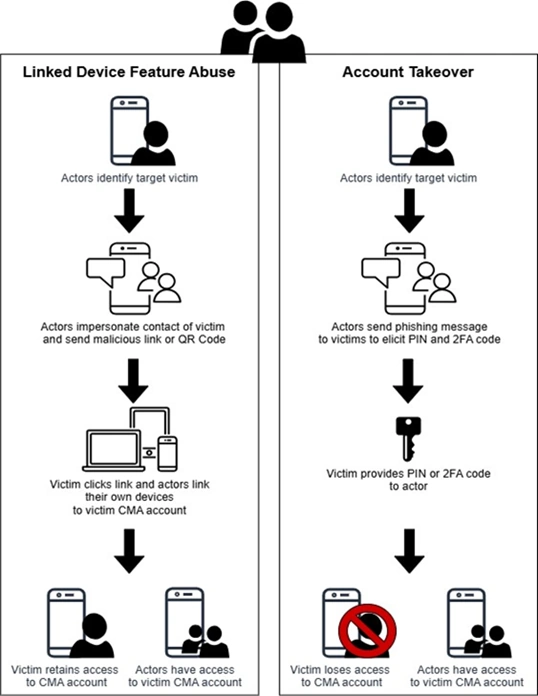
The operation has been active since at least March, when the FBI published an advisory warning of ongoing phishing campaigns targeting high-value targets by attackers associated with Russian intelligence services. Messages masquerading as automated support communications ask that users click a link or provide verification codes or account passcodes. In the event the user complies, they unknowingly link the attacker’s device to their account or have their account completely taken over and are locked out.
Thousands of accounts already compromised
With that, the attackers can read any new messages sent to the compromised account. A safety feature built into Signal, however, prevents the attackers from reading any previous conversations. The messages are sent to “individuals of high intelligence value, such as current and former US government officials, military personnel, political figures, and journalists.”
Last week, the FBI published an update that said the campaign had evolved. In addition to trying to post as support bots trying to trick recipients into linking their account to an attacker device, the messages also urge users to create a backup of all previous communications following the directions here. A follow-up message then instructs the targets to send the long passcode that’s used to encrypt backups stored on Signal servers. With that, the attackers have access to past Signal conversations. The update said two Russian government groups responsible were tracked as UNC5792 and UNC4221.
One message has text similar to this:
Signal is here
Recently, attempts to hack users of our messenger with the connection of third-party devices to the account have become more frequent.
An investigation conducted jointly with the US government and European partners revealed that the attacks on accounts were carried out by hackers from Iran and post-Soviet countries.
In this regard, Signal updates Terms of Service & Privacy Policy, and introduces Mandatory Two-factor Verification for users.
Not to lose your messages and media, set up your Signal Backup (Settings -> Backups -> Enable backups -> View recovery key -> Copy to clipboard -> Next -> Enter the recovery key -> Next -> Continue -> Choose your backup plan).
Click the “Accept” button in the pop-up and stay tuned for security updates on our messenger.
Stay safe and thank you for using the most secure messenger with end-to-end encryption.
How to Integrate AI with EHR/EMR Systems for healthcare operations?
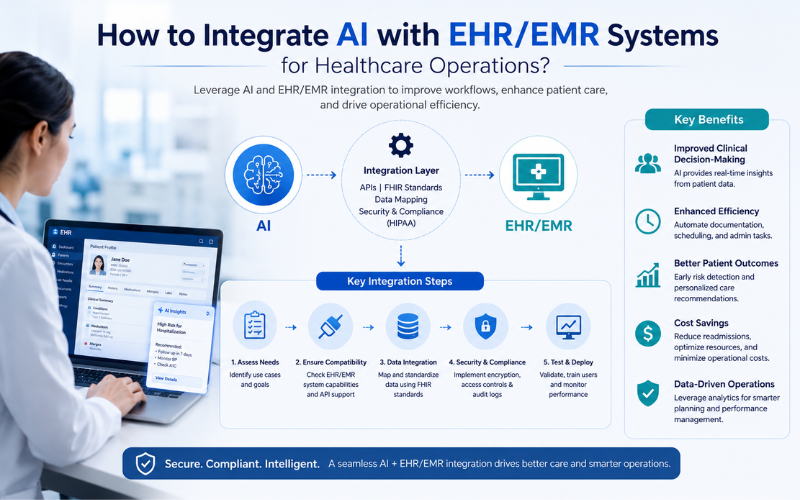
AI integration with modern Electronic Health Records (EHR) and Electronic Medical Records (EMR) systems will revolutionize healthcare by enhancing clinical decision-making, reducing administrative burden, and allowing for more focused, effective care services delivery. Yet, this revolution is not merely technical; it extends to regulatory, ethical, and organizational concerns soon. Here are the most significant benefits of AI integration with medical systems, possible threats, and best practices for embedding AI in healthcare.
Introduction to EHR/EMR Systems and AI
Electronic Medical Records (EMR) and Electronic Health Records (EHR) are computerized health data recording systems that allow easier access to medical history, diagnoses, treatments, and laboratory findings. While EMRs are typically limited to the records of a single provider, EHRs give a wider picture from a number of different healthcare facilities.
Why Integrate AI with EHR/EMR Systems?
The integration of Artificial Intelligence (AI) into these systems is transforming the healthcare practice, enabling smarter clinical choices, automating time-consuming administrative tasks, and making personalized medicine a reality. By analyzing vast amounts of patient information, AI has the capacity to recognize patterns, predict results, and provide timely, evidence-based interventions, making the coupling of EHR/EMR systems with AI an increasing force in contemporary healthcare.
Key AI Integrations with HER/EMR systems
Data Interoperability
There is a need for smooth data interoperability to enable AI functioning in harmony with EHR/EMR systems. Organized or unorganized data from different sources, such as clinical notes, lab results, radiology reports, and patient-entered data must be populated to the AI models to ensure process efficiency.
Natural Language Processing (NLP)
Data stored in EHRs is unstructured. NLP enables AI programs to read and comprehend significant results from those documents. For example, NLP can extract symptoms, medication details, and test results to input into predictive algorithms and clinical decision support systems.
Predictive Analytics and Machine Learning
Big data may be utilized to train ML models such that healthcare professionals can predict diseases, treatment effectiveness, or risk for complication. These models may be incorporated into the EHR interface to aid in real-time decision-making during the period of patient encounters.
Computer Vision
Computer vision algorithms could be used to read radiology images, pathology slides, or skin photographs. The findings could then automatically be inserted into the patient record.
Best Practices for AI Integration in EHR/EMR
Identify what problems you want AI to solve, e.g., reducing readmissions, charting automation, or improving diagnosis accuracy.
Choose the Proper AI Solution
Choose an AI solution that is suitable for your purposes and can be readily integrated with your existing EHR/EMR system. Ensure that it meets healthcare data standards and regulations (e.g., HIPAA).
Guarantee Data Quality and Security
Adequate, clean, and well-organized data are essential for AI to work successfully. Provide privacy, security, and legal compliance.
Engage Clinicians and Staff
Enlist doctors, nurses, and administrative personnel early on. Their input helps ensure the AI system accommodates real workflows and encourages adoption.
Integrate into Existing Systems
Work with IT groups and vendors to incorporate the AI tool into your EHR/EMR. Enable seamless data flows and immediate access to patients’ information.
Provide hands-on training on how users must use the AI features properly. Clear out issues and build confidence in the technology.
Pilot test the start by testing how AI works in reality. Watch for accuracy, fairness, and usability.
Deploy the AI system on phased basis by making changes based on feedback. Do not switch everything at once.
Track the performance of the AI system at all times. Is it committing fewer errors? Is it saving time? Is it improving patient care? Analyze every factor.
Regularly update the system with new medical guidelines, AI breakthroughs, and data changes to ensure long-term efficiency.
AI Integration with EHR/EMR Use Cases
Clinical Decision Support
Artificial intelligence can provide evidence-based advice in patient consultation. IBM Watson for Oncology, when employed along with EHRs, provides cancer treatment according to clinical guidelines and patient data.
Prognostics using algorithms identify high-risk patients who are most likely to develop sepsis, heart failure, or readmission. Notifying alerts can trigger early treatment and care coordination.
Computerized Documentation
NLP tools can capture and document physician-patient conversations with minimal human intervention, auto-fill the fields in the EHR to maintain low documentation time and allow clinicians to focus on high-level patient care.
Population Health Management
AI can be trained from population-level information to identify patterns, monitor chronic disease management, and maximize resource usage.
AI technology helps with coding and billing by using clinical documentation intelligence and generating precise billing codes with fewer denials and better revenue capture.
Key Challenges and Considerations
Data Standardization and Completeness: EHR data could be incomplete, inconsistent, or fragmented. Data quality diminishes model performance. Completeness and standardization of data are paramount.
Interoperability Issues: Many EHR vendors use proprietary formats, which create issues with integration. Implementation of standards such as FHIR mitigates such problems.
Compliance with Regulation: Use of AI in EHR systems must be in accordance with health care regulation like HIPAA for the US or GDPR for Europe. Data privacy, patient consent, and audit trails should be implemented compulsorily.
Bias and Fairness: AI models trained on biased datasets can perpetuate or exacerbate disparities in healthcare. Ongoing auditing and fairness assessments are necessary to ensure equitable care delivery.
Clinician Trust and Adoption: Clinicians may be skeptical of AI recommendations, especially if the models are “black boxes.” Transparency, explainability, and clinical validation are crucial for gaining trust.
Cybersecurity Risks: Adding AI components increases the system’s complexity and vulnerability to cyberattacks. Robust cybersecurity measures must be implemented to protect sensitive patient information.
The Future AI in EHR/EMR Systems
As AI and EHR/EMR integration matures, the focus will shift toward more advanced capabilities such as real-time predictive alerts, personalized treatment recommendations based on genomics and social determinants of health, and closed-loop systems that autonomously trigger interventions. Federated learning, where models are trained across decentralized data sources without sharing raw data, offers promising solutions for data privacy and collaboration across institutions. Furthermore, the emergence of explainable AI (XAI) tools will help demystify complex models and increase clinician confidence in AI-driven insights.
Conclusion
Integrating AI with EHR/EMR systems presents a transformative opportunity for healthcareorganizations to improve clinical and operational efficiency, enhance patient outcomes, and reduce costs. While the path to integration is fraught with technical and organizational challenges, adopting a strategic, user-centered, and ethically grounded approach can ensure successful implementation. As the healthcare landscape continues to evolve, the synergy between AI and EHR systems will play an increasingly central role in delivering smarter, safer, and more personalized care.
Switch game cases are pretty unnecessary. If you have a clamshell case for your handheld, you likely already have some game storage at hand. Even then, it’s probably not advisable to take a large chunk of your library with you on the go, as you never know what could happen to them.
As unnecessary an accessory as the elago Switch Game Case is, that didn’t stop the $14.99 (Amazon) gadget from grabbing my attention. It’s shaped like the classic Game Boy, so instantly I was swayed by the nostalgia factor. Yet it’s the fact that storing your games in it allows its key art to appear as if you were playing the modern titles on this ’90s device that drove me to add it to my online shopping basket.
(Image credit: Future/Rosalie Newcombe)
By default, the elago Switch Game Case includes a cardboard insert that mimics the classic handheld’s LCD. It’s basically a bit of paper with the brand’s logo printed on it to appear like the Nintendo text that scrolls down the screen when you turn on the real thing. It’s a simple feature, but a detail that I nevertheless appreciate as someone who grew up on the DMG-01 device.
It’s this simple insert that you’re intended to replace with your own games. Swapping them in place will have their stickered art appear as though a cut-out window of the tiny, silicone Game Boy, which is exactly what I did. I took Pokopia Pokopia, Donkey Kong Bananza, and the Super Mario Galaxy + Super Mario Galaxy 2 collection on the original Switch and gently placed them through the little slots, and the resulting effect was ridiculously cute.
(Image credit: Future/Rosalie Newcombe)
In the case of the Switch 2 cartridges, you do see some red peaking through, but it’s not distracting enough to be a genuine issue. In the case of Pokopia, the game’s cartridge art fits almost perfectly on the replicated screen (bar the cut-off Nintendo logo) and looks absolutely adorable. I also tested out Donkey Kong Bananza, which looked even better, as the framing of DK and Pauline is better aligned with the cut-out window of the case.
As cute as it looks, I’d be very hesitant to actually store my games this way, as elago intends this to be a keychain that dangles off your backpack, or even your jeans. Neither Pokemon Pokopia nor Donkey Kong Bananza were very cheap, and they wouldn’t be cheap to replace if they were to fall off my jeans while out in public, so I instead keep this as a display piece for my desk. It’s honestly what I’d recommend for anyone else privy to this neat Game Boy-inspired accessory.
Yet, it’s still a unique take on Switch game cases, which can often just be boring, hard plastic accessories with some art stuck on top. Elago also went all out to make this tiny gadget full of detail, as the tiny d-pad, pink-red buttons, and the volume wheel are all 3-dimensional, though they naturally aren’t actually functional.
Weekly digests, tales from the communities you love, and more
If you’re a fan of retro handhelds and want a funky way to store some of your new Switch 2 pickups, this is a neat piece to add to your desk, or add to your bag if you’re brave enough. Despite its low cost, it’s a surprisingly detailed and well-made accessory that has me hoping elago will give the Switch 2 more attention in the future.
Be part of a galaxy that evolves through player actions. Mine, craft, trade resources and ship parts. Buy and sell blueprints, accept or offer services, missions and contracts. Participate and adapt to the economy of the Universe, as each marketplace transaction affects prices. nophenia
True power lies in teamwork. Create or join Corporations and collaborate on a larger scale. Develop interplanetary production and logistics by assigning roles, dividing tasks, and managing everything from small crews to vast commercial empires. Freely explore an immense universe where the vastness of space stretches before you, full of untold possibilities. Pilot your spaceship and journey through systems brimming with planets, asteroid fields, abandoned space stations and derelict ships. Cover great distances in an instant with Faster-Than-Light technology, jumping between distant systems with ease.
Maneuver through space in real-time, seamlessly transitioning from the depths of space to the surface of planets. Whether you’re scanning planets for valuable resources or charting a course to forgotten worlds, the Universe is yours. You’re completely free to explore it.
Planets hold an abundance of natural resources ready to be uncovered and exploited. As you explore and scan new systems, equip yourself with a variety of tools to extract raw materials. Scan your environment and use your ship to mine, extract and gather resources. Craft these resources into valuable materials or ship parts, and trade or sell them.
Screenshots
SystemRequirements
Minimum Requires a 64-bit processor and operating system
OS: Windows 10 64 bits
Processor: Intel i3 8350K
Memory: 8 GB RAM
Graphics: Geforce 1060
Storage: 25 GB available space
Additional Notes: 1080p@30fps
Support the game developers by purchasing the game on Steam
InstallationGuide
TurnOff Your Antivirus Before Installing Any Game
1 :: Download Game 2 :: Extract Game 3 :: Launch The Game 4 :: Have Fun 🙂
Rumor has it that Microsoft is preparing to enact mass layoffs across its gaming division this July, following multiple reports out of Bloomberg plus recent comments made by new Xbox CEO Asha Sharma and Chief Content Officer Matt Booty. The Communications Workers of America Union, which represents thousands of video game employees at Microsoft and beyond, is preparing to negotiate for employee protections, while calling for transparency from executives and demanding basic dignity for developers.
Sharma and Booty laid the groundwork for layoffs in early June, with a memo marking the first 100 days of new Xbox leadership.
“We have found ourselves over-extended as we executed on changing strategies in a landscape of more readily available content,” the pair wrote. Including the hard-fought acquisition of Activision Blizzard King, which cost Microsoft $69 billion in 2023, Xbox spent more than $89 billion in investments and studio support over the past five years, while the segment’s annual revenue declined by nearly half a billion dollars, the memo stated.
“Going forward, this cannot continue,” Sharma and Booty wrote, ominously. Bloomberg simultaneously reported that Xbox was planning substantial layoffs in July, right after the end of Microsoft’s fiscal year. A few days later, reports emerged that Xbox was shuttering or selling off three of its studios, Double Fine, Ninja Theory and Compulsion Games.
During a media call on June 29, CWA offered a clear message for Xbox leadership.
“We’re here to say this plainly: Those workers will not be treated as disposable,” CWA District 9 Vice President Frank Arace said. He argued that “the money is there” to keep Xbox teams intact, but that executives are funneling it elsewhere with little care about the human or creative impact of layoffs.
UVW-CWA treasurer Sherveen Uduwana agreed, noting that Microsoft just raised its console prices for the third time this year, and CEO Satya Nadella personally made $96 million in 2025.
“There is no shortage of wealth in the games industry, especially if we’re talking about Xbox, Sony, EA,” Uduwana said, concluding that these multibillion-dollar organizations are choosing to not support their developers.
CWA represents roughly 3,500 workers across the video game industry and its membership numbers continue to grow. In 2023, roughly 300 QA workers at Microsoft subsidiary ZeniMax Online voted to unionize, forming the largest video game union at the time. Their contract with Microsoft was ratified in June 2025, including minimum salary requirements, a framework for wage increases and protections regarding the use of AI. Multiple studios across Xbox have followed suit, including Raven Software and several teams under the Blizzard umbrella, including Overwatch and Diablo workers.
Today, CWA is calling for Xbox executives to sit at the negotiating table in good faith, and respond to workers’ demands for transparency, support and job security.
Four Xbox employees and CWA members shared their experiences working under a latent threat of sudden layoffs and studio closures. Elder Scrolls Online encounter designer Morgan Goin lost years of accrued benefits when Xbox suddenly closed Arkane Austin and then waited a month before transferring some developers to ZeniMax. Even when teams hit their metrics and executives gushed over their games, Xbox canceled projects and shook up studios without warning, Goin said.
Blizzard story editor and franchise developer Alison Veneto said that with each round of layoffs, affected studios lose incredible talent and also years of institutional knowledge. She added that it’s difficult to be creative with layoffs constantly looming and no defined rules dictating how mass firings should play out.
“Work with us,” Veneto said, speaking directly to Microsoft. “Adopt meaningful layoff protections.”
A common refrain was that Microsoft has shown little interest in actually negotiating with its unions, failing to give proper attention to meetings and leaving proposals on the table for months at a time. Unions representing workers at ZeniMax and other Microsoft studios have successfully won certain protections for all Xbox developers, but the basic framework around layoffs and studio closures still requires serious, good-faith attention, according to CWA.
“We’re done paying for executives’ failures,” Activision QA tester Andrew Snell said.
If you’re building and maintaining Visual Studio extensions, you’ve probably ended up with some sort of build and publishing workflow – whether it’s manual, scripted, or stitched together over time.
This post is for extension authors who want a simple, repeatable way to build, version, and publish their VSIX files using GitHub Actions.
I’m going to show how I do this across my own extensions.
I’ve been using this approach for a long time, and over time I pulled the most repetitive pieces into a few small reusable actions, so I don’t have to keep rewriting the same logic in every repo.
Those are:
vsix-version-stamp – keeps your versioning in sync
publish-vsixgallery – publishes CI builds for testing
publish-marketplace – publishes to the Visual Studio Marketplace
You can use them independently or together, but I tend to use all three.
If you want to see this wired up in a real repo, take a look at Start Screen.
A real workflow
Here’s a simplified setup very similar to what I use across my extensions today:
Chamath Palihapitiya, best known for his venture capital firm Social Capital and the All-In podcast, announced Monday that the AI coding startup he founded raised a sizable Series A.
The company, 8090 Labs, closed a $135 million round led by Salesforce Ventures with participation from Jeffrey Katzenberg’s WndrCo; David Sacks’ Craft Ventures; fellow All-In hosts and “besties” David Friedberg (The Production Board) and Jason Calacanis (Launch); and angel investors like Palo Alto Networks CEO Nikesh Arora and Quora CEO Adam D’Angelo.
Palihapitiya founded 8090 Labs in January 2024 to offer an AI coding agent specifically for corporate programming teams. Its product, Software Factory, helps corporate coders use AI to build production-quality software, not just vibe-coded prototypes, with all the controls enterprises need, such as audit trails, the company promises.
With the raise, Palihapitiya also announced on X that he will lead the startup as CEO, rather than just serving as a board member.
He said the AI rush today feels like the rise of social media in his career as an early exec at Facebook, long before it became Meta. “Since I left Facebook, I was waiting for a moment like this to return to a full-time operating role,” he wrote. “I am convinced that what we are building now is even more important, so there was no decision to make except to be all in.”
I got married when I was 19 to a man I did not know. I was young and foolish and most importantly, I was not saved. 10 years later, he would still be an unbelieving spouse, but I would give my whole life to the Lord through the most painful situation I’d ever encountered. But nothing would prepare me for my next four years.
Four years I continued to live with an unbelieving spouse. A man who hated me and my faith. A man who pretended to love God on the outside, yet his actions were testimony to the fact that he showed no fruit of the spirit or a desire to change anything in his life. Every single day, I cried out to the Lord, as this man would bait me constantly, trying to get me to sin, trying to fight with me, trying to get under my skin, not helping me with the house, the kids, just living in his own little world except to come out and fight. Constantly asking me to give up the things that were most important to me in my life, and continually moving us around the country looking for something he would never find.
You may be in that situation today. Maybe you know someone who is married to an unbeliever. Maybe you are the unbelieving and unsaved spouse frustrated with your spouse who loves the Lord.
If you love this, you’ll also love…
Whatever the case may be, there are 5 things you need to know…
1 – You cannot change your spouse.
You can try to save them until you’re blue in the face. You can talk about God all day long. You can continually tell them about God, encourage them to go to church, but you will never save them. You see, just as you yourself couldn’t change your own spiritual condition apart from the work of Christ, neither can your spouse. You say,”Yeah, but God wants everyone to be saved, and I’ve been praying for them for so long.” This is true. Salvation does not come apart from your spouse. Okay, now wait a minute, Sarah, you just said a person can’t be saved apart from Christ. Make up your mind.
Okay, let me say it plainly. Your spouse cannot save himself, you cannot save your spouse, but God won’t do it apart from your spouse either. You see, it takes two. It takes God AND your husband. Just like it takes two to create a new life, a new bundle of joy, it takes TWO to create a new life spiritually as well. God and man. They are interchangeable. It’s not possible one without the other.
It is fully human will and it is fully sovereign grace.
It is fully election, God picks and chooses whom He will save, and it is fully human choice, a human makes the choice. They stand before God for their own decisions. The same is true of Jesus. Jesus was fully a human man, but at the same time, He was also fully God.
2 – Your biggest weapon in trying to save your spouse is NOT your mouth.
Now this is where I witness a lot of women getting tripped up. I got tripped up with it too, the first year. You see, after my salvation, I was so excited to share my new-found joy and hope with anyone who would listen. I wasn’t being a pain on purpose, I was just honestly excited. My whole life changed. But, for a spouse that is not ready to accept Christ, it becomes tiresome real quick to hear about it all the time.
I had to learn to edit myself. I had to learn to stop talking about Christ to my spouse. Wait, what??? Yeah, that shocks a lot of people. 🙂 You see, your biggest weapon in helping your spouse come to salvation isn’t your mouth. It isn’t what you say, it’s what you do. Tell me if you’ve heard this saying, “Actions speak louder than words.” In the Bible, it comes from Matthew 21: 28-32. 1 Peter 3:1 says,
In the same way, you wives, be submissive to your own husbands so that even if any of them are disobedient to the word, they may be won without a word by the behavior of their wives…
Win your spouse without a word. WITHOUT. A. WORD. Let your actions, your motives, your love, your new desires, your new heart, your new mind and spirit do the talking FOR you!
3 – Your biggest defense is prayer.
Never wake up in the morning without first praying for your spouse (here’s 30 days of prayer for your unbelieving spouse). Never go to bed at night without first praying for your spouse. Never go 5 hours in your day without praying for your spouse. Your biggest defense, your strongest position is prayer. If you are Christian, God answers every single prayer you have. His answer may be no, maybe it’s wait, maybe it’s yes. But every single prayer is answered.
Don’t believe me? Start a prayer journal.
Every day write down your top 5 prayer requests. Do this for a year and cross off the prayers as God answers them. At the end of the year count up exactly how many prayers you have that God has not answered yet. Hint, I personally do this. God’s total was ZERO! Wasn’t always the way I wanted. I asked Him to give me a way of escape to the nightmare of a marriage I had and He sovereignly allowed my ex-husband to leave and divorce me. But, I say with full assurance, there were no prayers unanswered, so with that said, BE CAREFUL what you pray for!!!!! 😐
4-Ask for help
If your husband refuses to go to couples’ counseling as mine did, go by yourself. Remember, you can’t make him do something, but don’t let him stop you from doing something either. Don’t let him stop you from doing and being your absolute best. Do not wait for him. Go to church without him. Many a times I went to church alone. I ended up having to drive myself because he would blatantly do things to make us late so we’d miss church. Oh, the gas tank is empty, I forgot to tell you, Sarah. Woops, that gas station isn’t open, let’s try another gas station, maybe they’ll be open. Wow, that gas station is really busy, la la la, let’s take our sweet time. Hopefully we’ll get there before service is over. Yeah, true stories here! I know how frustrating it can be, but God doesn’t leave us alone to deal with these things by ourselves. He provides a church, a family for us to be a part of.
5- God is refining YOU
Outside of having the worst husband in the world, I quickly learned that it wasn’t about him. It wasn’t about how HE wasn’t measuring up to God’s standards. Every day as I prayed God would save him and save me from the situation, I learned how to hold my tongue more. I learned how NOT to react when he pushed my buttons. I learned how to be strong in faith, lean on the Lord for wisdom, understanding, and faith. I tell you the truth, I learned more in those 4 years and I grew more in those 4 years than any other time in my life.
Why? Because I needed the Lord so desperately just to get through the day…every day. I couldn’t go one day without being in prayer all day, one day without reading my Bible. Now, it’s easy to find myself too busy or forgetful to do the most important thing in the world, cultivate that relationship with the One that loves me more than anyone else on the planet. Refining of a jewel only comes from fire. Burning off those impurities, dirt, etc. If you’re a new Christian, you will realize in your life as you look back, that the times you learned the most and grew the most in the Lord, was when you were under the most fire you’ve had in your life. The times that are the most difficult for you.
Don’t give up. Don’t lose faith. Don’t lose hope. God is refining you and you will look back and realize it was worth it. Those Hellish last 4 years of my life, I’d do all over again if it meant that I could be there to truly help just one person who is going through it now. And God is using that, my situation, and me to help others around the globe just like you. He will use you too, if you let Him.
“Amid growing public anger over A.I. and a debate over how to regulate it, a group of employers, state governors and foundations has raised $500 million to try to answer some of those questions themselves,” reports the New York Times.
“Just how many jobs will AI upend?” asks the Wall Street Journal, reporting that the new coalition says it’s time to ready the U.S. workforce for a “major” disruption — no matter how large it turns out to be. The coalition “has so far raised more than $500 million — about half of its multiyear goal — from companies and nonprofit groups. It will initially work with state governments in Arkansas, Maryland, Utah and Connecticut. OpenAI and Anthropic are also involved, and academics including MIT economist David Autor sit on an advisory board.”
[The new “RAISE US” coalition] will be led by former Commerce Secretary Gina Raimondo, who served under former President Joe Biden, and former Indiana Gov. Eric Holcomb, a Republican. Its mandate, they said, isn’t just to build retraining programs but also to reconsider decades-old policies such as unemployment insurance and act as a working lab for testing the most effective ways to transition workers to new fields. The group will explore corporate incentives for employers to hold on to workers whose jobs are disrupted by AI and prep them for new roles… The mission of the group is to “pull all the levers at once,” Raimondo said. That means teaming up with employers to find ways to help workers gain skills or new roles and joining with educators to roll out different types of training. It also plans to propose policy changes such as tweaking unemployment benefits to let displaced workers continue to get them while they, for instance, start new businesses with AI… In Maryland, the group plans to expand a service-year option in the state to help people gain exposure to such growing fields as healthcare. An effort in Arkansas will focus on supporting “an AI-powered career navigation platform.” More from New York Times:
The organization will work primarily with governors… The theory: States generally control their community college systems, which can translate work force policy through course offerings and industry partnerships. The bulk of the budget will fund pilot programs overseen by about 15 staff members and consultants. For example, Maryland will expand a “service year” for recent high school graduates to provide experience in fields where there are shortages, such as health care. In other states, Raise Us hopes to offer “wage insurance” for workers who take lower-paying jobs rather than dropping out of the work force entirely.
The group plans to furnish technical assistance for companies that want to retain workers as A.I. changes their roles, rather than eliminating them. Microsoft, one of the companies backing the organization, said it had already found a promising model: cross-training its entry-level lawyers in different parts of the organization and equipping them with A.I. skills in order for them to be repositioned as technology evolves. “You can think of doing that with almost any job we have,” said Brad Smith, vice chair and president at Microsoft. “It creates an opportunity to transfer people from jobs that are being eliminated to jobs that are being created….”
Ms. Raimondo and her colleagues are not fans of a universal basic income, an idea that has gained popularity in Silicon Valley as an answer to job disruption. They emphasize that work provides more than just wages, and plan to focus on helping people find pathways to new jobs. But it’s unclear whether A.I. will create jobs at the rate that it will destroy them. Jack Malde studied work force policy for the Bipartisan Policy Center and is now going to work for the Windfall Trust, another A.I.-focused think tank. He said long-term income support might be necessary, even if better models for transitioning workers were found. “The truth is, there’s still a lot of uncertainty,” Mr. Malde said. “What we think is resilient now might not be resilient later. We’re not going to get everything right, so we’re going to need those strong safety-net programs.” Long-time Slashdot reader theodp writes: If you think you’ve seen this movie before, prior to “partnering with governors, employers, and training partners to help the American workforce make a successful transition to an AI economy” with RAISE US, Raimondo and Holcomb partnered with governors, employers and training partners to help U.S. K-12 students make a successful transition to a CS economy with the Governors for Computer Science coalition.