Hideki Kamiya thinks there should be a cozy Resident Evil game, where ‘retired Leon goes fishing in the countryside’


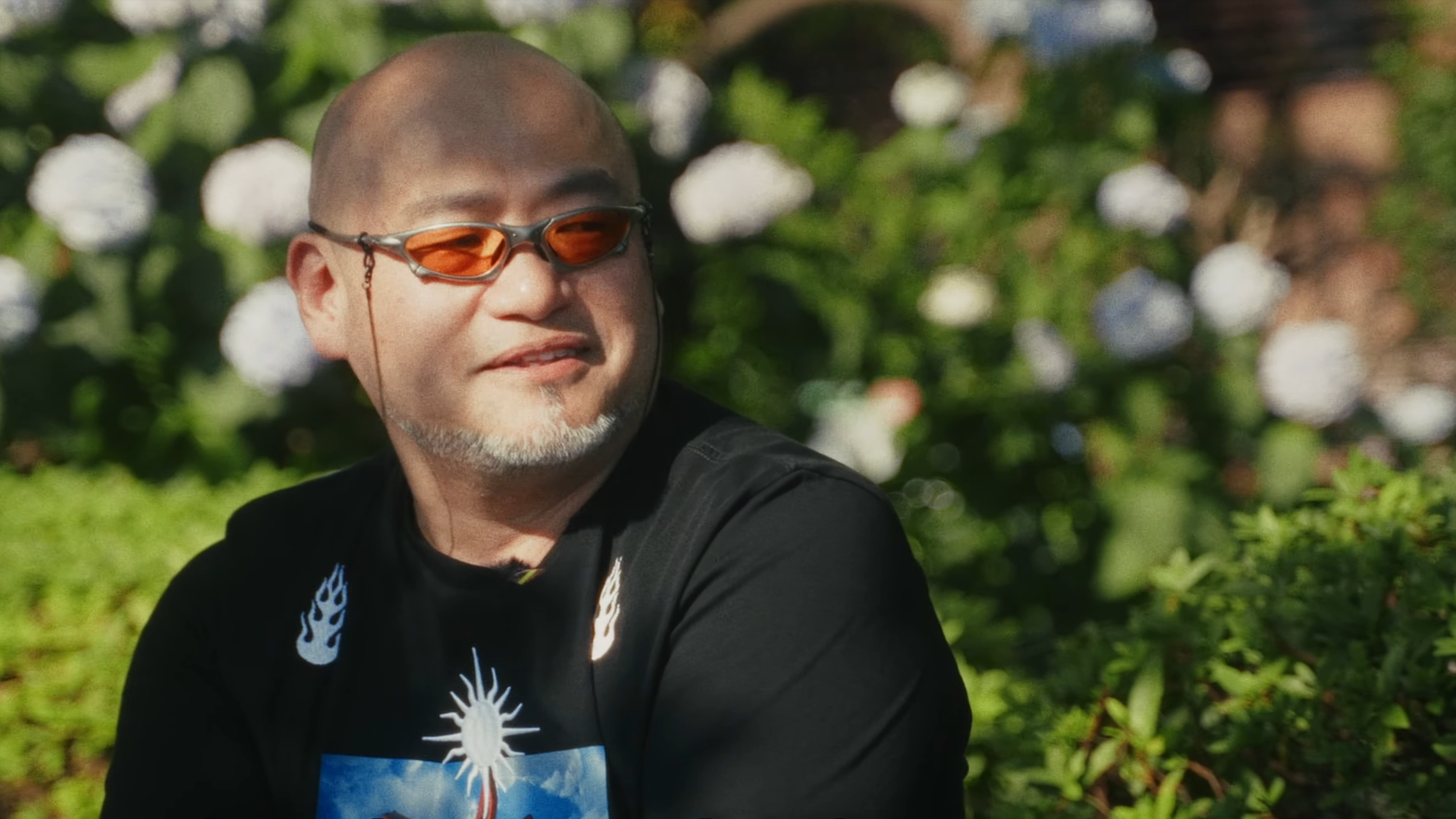
Hideki Kamiya cut his teeth on the Resident Evil games, working as a designer on the original and director of Resident Evil 2 before moving on to other things, like Devil May Cry, Viewtiful Joe, Okami, and Bayonetta. Ironically, he’s not a big horror guy—he recently expressed a desire for a “non-scary mode” in Resident Evil games—and so understandably is not very interested in returning to the Resident Evil series.

But if he ever did, he would do things very differently. He would make it cozy.

“If I made it, it’d turn into a game where retired Leon goes fishing in the countryside, forages for wild veggies, bakes bread, walks the dog, tends a home garden, drives 50 km to the general store for supplies, invites old buddies over for a barbecue, fixes the neighborhood grandma’s oven at her request, sells homemade lemonade at the local festival,” Kamiya wrote on X (machine translated) in response to a request for a new game that continues the story of Leon and Claire. “But that’d be cool, right… ?”

Latest Videos From
(Image credit: Hideki Kamiya (Twitter))

I think it would be cool, actually. It’s an aspect of videogame action heroes that’s not often explored—what do you do when you’re not doing this?—and it’s also a fun way to introduce the series to newcomers who might not be into the usual zombie survival horror thing.

The Angry Birds Movie 3 Trailer Has More Pee Than I Expected


Paramount Pictures has released the first trailer for The Angry Birds Movie 3, and this is sure to remind people that, yes, the movie series is still going.

The third movie follows Red (Jason Sudeikis) as faces his “greatest challenge yet,” which is being a dad … and also saving the world. Releasing December 23, The Angry Birds Movie 3 features a big cast of celebrities in addition to Sudeikis, including Josh Gad, Danny McBride, Tim Robinson, Sam Richardson, Keke Palmer, Nikki Glaser, Lily James, and even Mr. Beast.

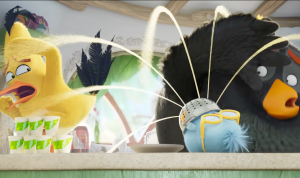
The trailer has a number of standout scenes, including a memorable sequence where the baby bird continuously pees through a colander, prompting Bomb (McBride) to remark, “It’s like the Bellagio fountain!”

The original Angry Birds Movie came out in 2016, with the sequel arriving in 2019, so this is a film franchise that’s been running for a decade now. The original movie made $352 million worldwide, but the sequel made less than half ($148 million globally).

As for the Angry Birds game series, Sega acquired the Rovio franchise in 2023 for $776 million. It hasn’t been such a successful acquisition for Sega, at least not yet. Sega CEO Haruki Satomi said, “We have unfortunately not achieved the level of results that had been expected prior to the acquisition,” according to GI.biz.

Paramount is also behind the upcoming Call of Duty movie from Taylor Sheridan and Peter Berg and the next Sonic the Hedgehog movie. The company is about to take ownership of numerous more popular franchises by way of its $111 billion buyout of Warner Bros. Discovery.

It took a while, but Google’s finally fixing a SiriusXM radio issue on its smart speakers


What you need to know

  • Google states a fix is rolling out late in June for a bug that impacted several of its smart speakers and SiriusXM radio.
  • Users given multiple errors a month ago, when reports surfaced, and were unable to get their content to stream via a speaker.
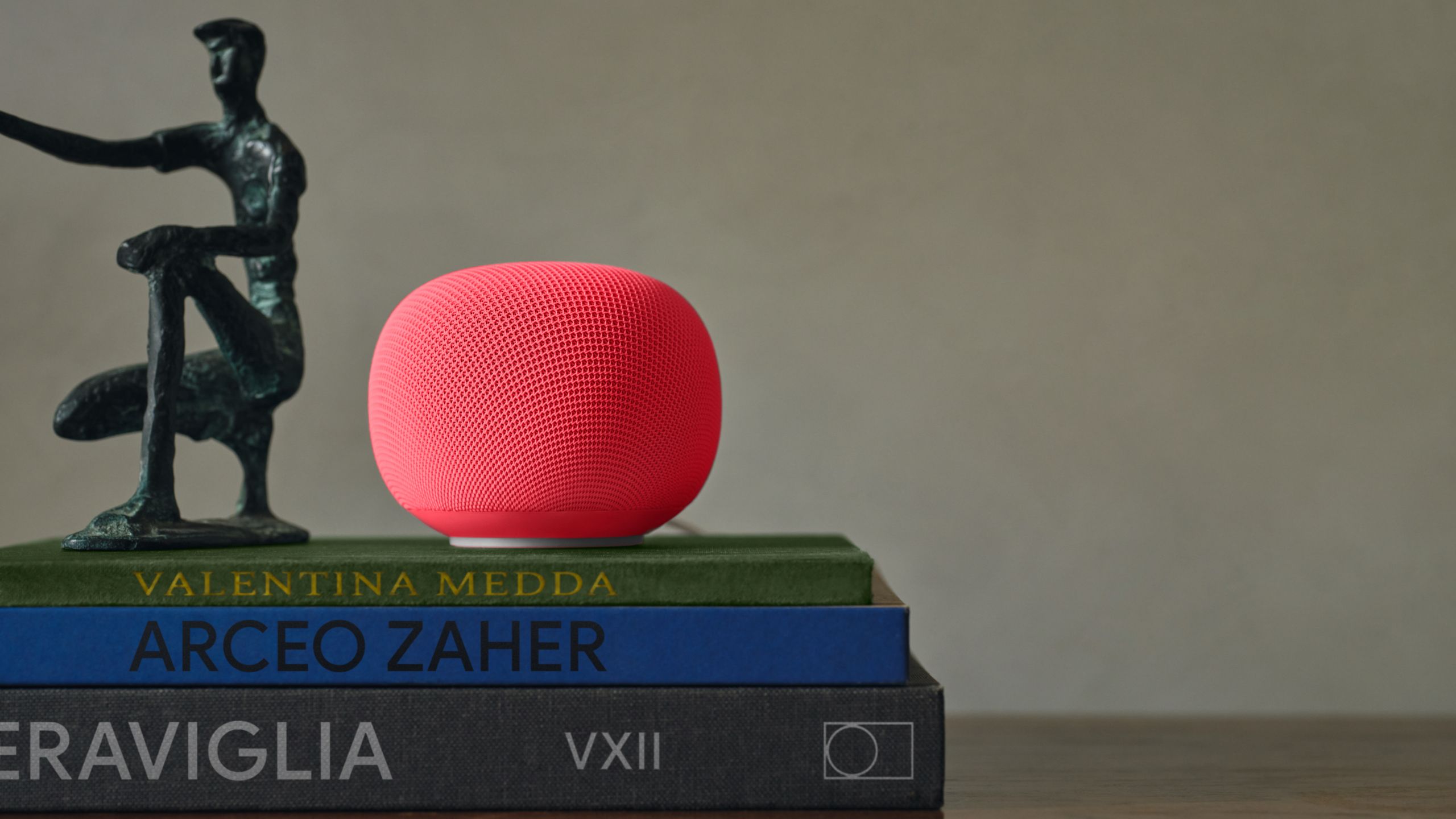
  • While this issue gets resolved, Google’s also debuted its new Home Speaker and expanded Gemini for Home to more partners.

Google has been busy with new launches and bug fixes since May. This week, it’s been reported that a major fix is on the way for a satellite radio problem.

About a month ago, users on the Google Home subreddit reported a sudden problem attempting to listen to SiriusXM radio on their smart speakers (via Android Authority). Getting down to brass tacks, Google responded to this month-old thread this week, stating “We’ve resolved an issue impacting the ability to stream SiriusXM on some Google Home devices.” These “issues” Google refers to were highlighted by the thread’s OP (original poster), who states their smart speakers were unable to stream any content.

Upgrade Work-Life Balance with a BenQ TK705 HDR Projector


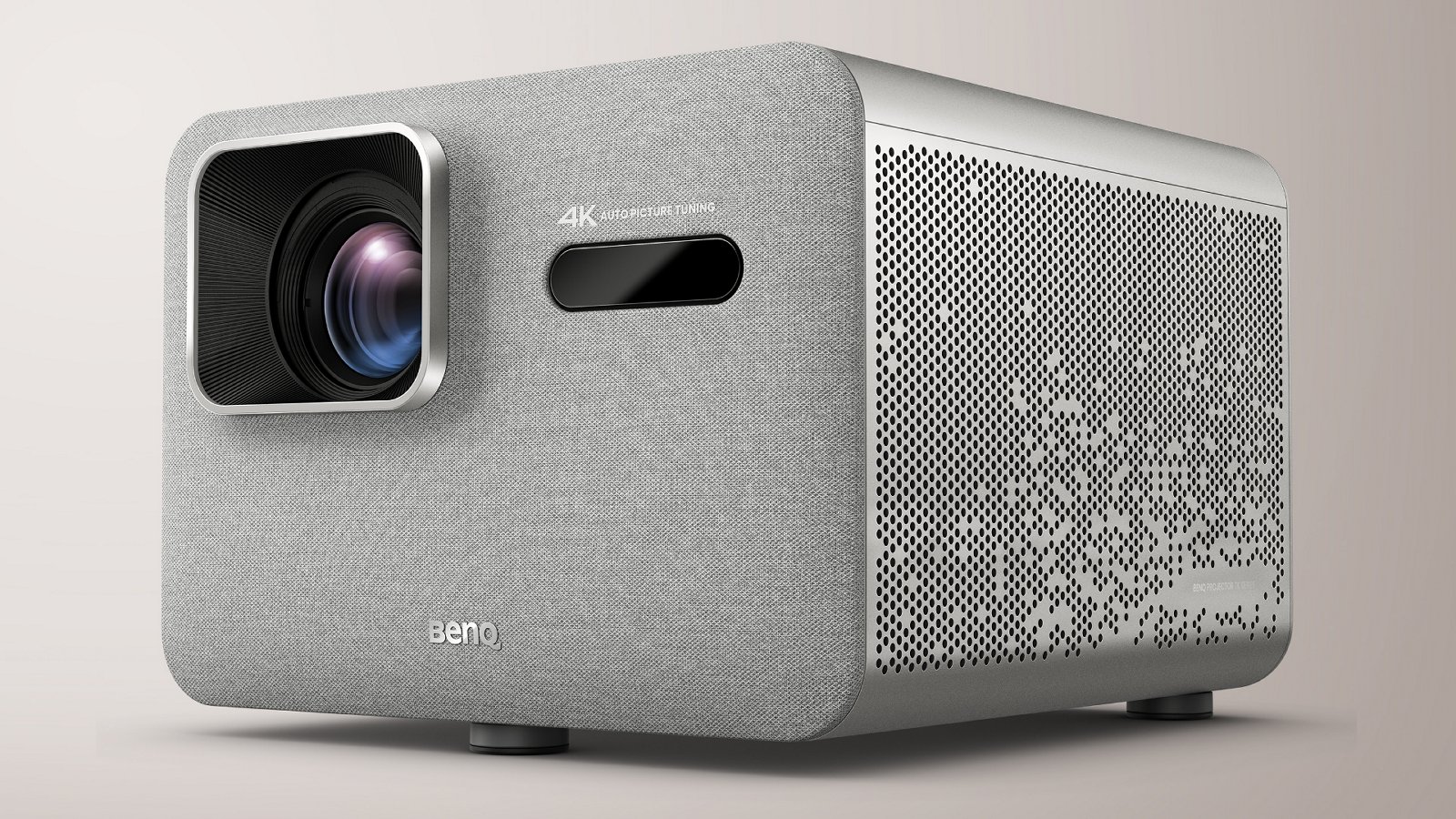
BenQ TK705i 4K HDR Projector
Photo credit: BenQ

Hard-working entrepreneurs put endless hours into building and growing their businesses, often turning parts of their homes into home offices equipped with the latest productivity tech. But just as you deserve premium tools to fuel your business during work hours, you equally deserve exceptional technology to help you truly unwind and recharge. A high-quality home entertainment projector transforms any room into a personal cinema, gaming arena, or sports stadium. With your high-quality HDR projector, you and your guests will enjoy stunning visuals and immersive experiences that make movie nights, gaming sessions, and live sports events feel truly elevated. After a long day or week of strenuous work, you’ll appreciate being able to enjoy big-screen entertainment in the comfort of your own home.

FTC Disclosure: Products reviewed in this guide may have been submitted and provided to Home Business Magazine (HBM) at no cost for evaluation. Receiving products does not influence our editorial content, reviews, or opinions, which are based on independent testing and/or research. HBM does not have direct advertising or other financial relationships with product providers; who may have their own independent affiliate links. Any material connections are disclosed in accordance with FTC guidelines.

Introducing BenQ

BenQ has been a trusted name in innovative display technology since its founding in 1984. The company is driven by its core vision of “Bringing Enjoyment ‘N’ Quality to Life” and a guiding philosophy of “Because it matters.” For busy home-based entrepreneurs, BenQ delivers reliable, high-performance products, such as professional monitors for your home office or entertainment gear, that enhance both productivity and relaxation. The BenQ TK705 series of home entertainment projectors are the perfect choice in your search for the ultimate HDR projector for leisure entertainment.

BenQ’s TK705 Series: The Ultimate Choice for a Home Entertainment Projector

The BenQ TK705i 4K HDR Home Entertainment ProjectorThe BenQ TK705i 4K HDR Home Entertainment Projector
Photo credit: BenQ. The BenQ TK705 Series delivers stunning picture quality, great for cinema, gaming, and sports.

The BenQ TK705 series consists of the TK705i (standard throw) and TK705STi (short throw) 4K home entertainment projectors. Standard throw and short throw refer to the throw ratio of a projector, which is basically how far the projector needs to be placed from the screen to produce a certain image size.

Regarding the throws, the Standard Throw (also called Long Throw) has around 1.0–2.0:1 or higher (e.g., the BenQ TK705i has ~1.0-1.3:1). This means it needs to be placed farther away from the screen. For a Short Throw, the ratio is usually 0.4–0.8:1 (e.g., the BenQ TK705STi has ~0.8:1). This means the BenQ TK705STi can produce large images from a much closer distance, making it an ideal choice for smaller rooms, living rooms, or home offices.

BenQ TK705STi for Home Entertainment

The BenQ TK705STi is a short-throw 4K HDR home entertainment projector that delivers impressive performance in compact spaces. If you are seeking the perfect home entertainment projector for the home office, this might be the best choice, as it has the Short Throw factor to adhere to the space a home office often offers. It features true 4K UHD resolution (3840×2160), 3000 ANSI lumens of brightness powered by a durable 4LED light source (up to 30,000 hours in Eco mode), and excellent 98% Rec.709 color coverage with HDR-PRO and CinematicColor technology for vivid, cinematic images even in rooms with ambient light.

Key features of the HDR projector include built-in Google TV (Android 11) with native Netflix and streaming app support, ultra-low input lag (as low as 5ms), HDMI 2.1 connectivity, Bluetooth 5.2 for audio, USB-C with 30W power delivery, and advanced 8-Way Smart Image Adaptation (auto focus, auto keystone, obstacle avoidance, and screen fit) for effortless setup.

BenQ TK705STi Home Entertainment ProjectorBenQ TK705STi Home Entertainment Projector
Photo credit: BenQ. The TK705STi is perfect for a smaller space, such as a home office, because its short-throw lens projects large, sharp images.

As mentioned, the TK705STi HDR projector excels in home offices because its 0.8:1 short-throw lens allows it to project large, sharp 100–150 inch images from just a few feet away, making it ideal for smaller rooms or desks without requiring long throw distances or ceiling mounts. The high brightness and auto image correction handle typical office lighting well, while the built-in smart TV platform and low-lag performance support video calls, presentations, content consumption, and light gaming during breaks. You’ll enjoy all this high-tech in a sleek, quiet design that blends into any professional setting or cozy space in the home.

BenQ TK705i for Home Entertainment

The BenQ TK705i offers the same core technology and features as the TK705STi, including true 4K UHD resolution, 3000 ANSI lumens brightness, 4LED light source, Google TV with Netflix, HDR-PRO, low input lag, smart auto image adjustment, and rich color performance. As mentioned, the main difference is its standard throw lens (1.0–1.3:1), which makes it the perfect choice for larger living rooms, dedicated home theaters, or spaces where the HDR projector can be placed farther back (typically 8–12+ feet for a big 100–150 inch screen). It performs best in rooms with more depth, delivering immersive movie nights, sports viewing, and gaming with top picture quality and ease of use.

Perfect for Work-Life Balance and Recharging

A great home entertainment projector can encourage a healthy work-life balance by transforming a productive home office into an immersive entertainment hub. During the day, a large, crisp display can enhance presentations, video meetings, and multitasking. When work is done, the projector becomes the centerpiece for movie nights, sporting events, gaming sessions, and other memorable experiences with friends and family. With the flexibility to create a big-screen experience at home, it’s easy to unwind, spend quality time together, and make everyday moments feel elevated.

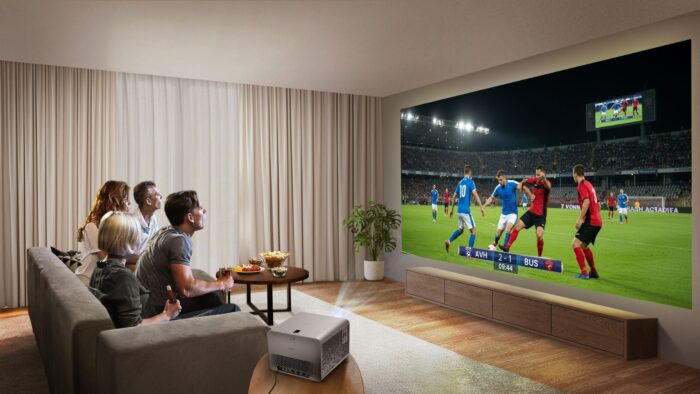
BenQ Home Entertainment Projector BenQ Home Entertainment Projector
Photo credit: BenQ

Fun ways to enjoy a home entertainment HDR projector:

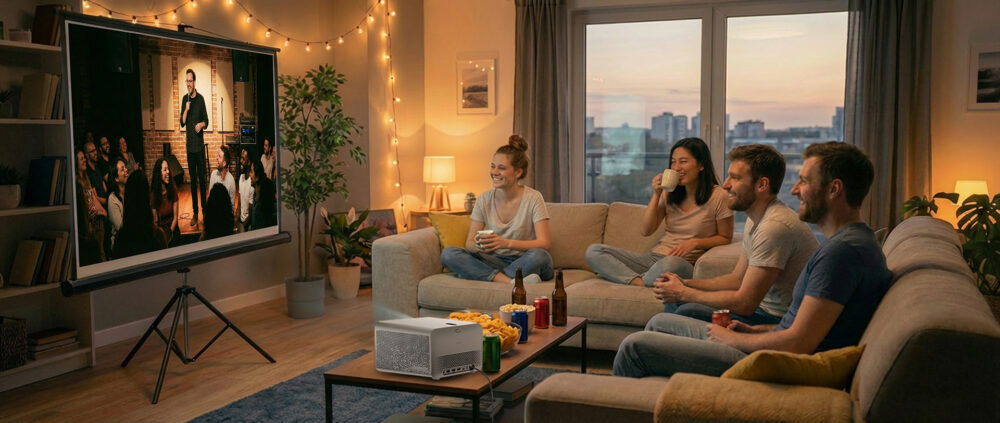
  • Host outdoor movie nights in the backyard and turn an ordinary evening into a memorable event for family, friends, and neighbors. Set up the projector against a screen or a blank wall, spread out blankets and lawn chairs, and enjoy your favorite movies under the stars. Add popcorn, drinks, and cozy string lights to create a fun, theater-like atmosphere.
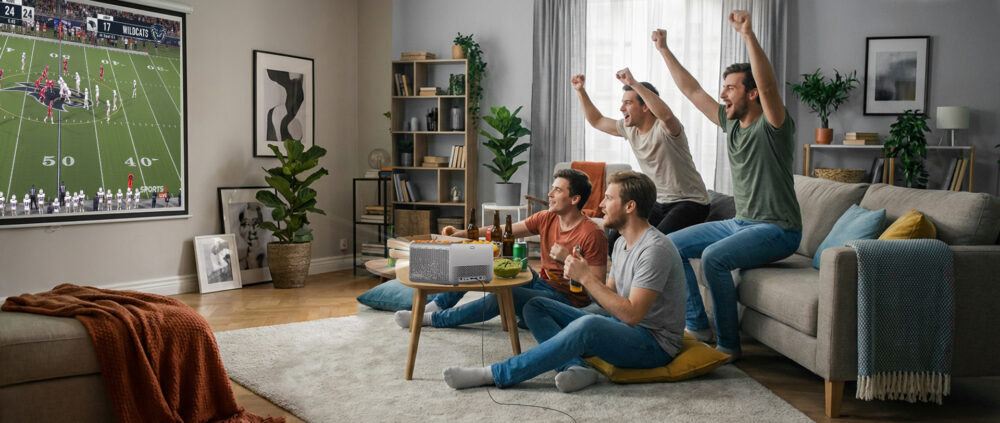
  • Watch live sports on a big screen and bring the excitement of game day into your own home. Invite friends and family over, serve classic game-day snacks, and cheer on your favorite team together without having to deal with crowded venues or expensive tickets.
  • Play multiplayer video games with friends on a larger-than-life display. The oversized screen also makes it easier for everyone to see the action, creating a fun, social atmosphere that’s perfect for gaming with family and friends.
  • Stream your favorite TV shows or movies and turn an ordinary evening into a cozy family movie night. Kids will love the excitement of a theater-like experience right at home on the big screen. Complete the fun with popcorn, candy, and other favorite movie snacks, or build a blanket fort for extra-special adventure.
  • Share vacation photos and home videos during family gatherings or celebrations to relive your favorite memories together. Instead of passing around a phone or crowding around a small screen, everyone can enjoy the experience on a stunning, big display.

Conclusion: A Home Entertainment Projector Is a Smart Investment for Long-term Value

A home entertainment HDR projector, such as one from the BenQ TK705 Series home projectors, is more than just another piece of technology. Instead, it’s an investment in how you experience entertainment at home. With a large, immersive display and versatile functionality, it can transform everyday movie nights, sporting events, gaming sessions, and family gatherings. By bringing a theater-quality viewing experience into your living room or backyard, a projector adds lasting value to your home while creating countless opportunities to relax, connect, and make lasting memories with the people who matter most. You won’t need to leave your home to take your family out, and your friends and family will always look forward to what’s next.

BenQ’s TK705 Series retails as follows:

Find a Home-Based Business to Start-Up >>> Hundreds of Business Listings.

Odin and Thor handhelds are getting another price hike


AYN Thor dual screen android handheld

TL;DR

  • AYN has announced that its Thor and Odin series handhelds are getting another price hike on Friday.
  • The Thor devices are now $10 to $30 more expensive, while the Odin 2 Portal and Odin 3 handhelds go up by $10.
  • The price increase goes into effect on Friday, so you still have a few days to act if you’re keen on these devices.

AYN is one of the more premium Android handheld brands out there, but it hasn’t been immune to the RAM crisis. The company previously announced price hikes early this year for some models, but it’s now revealed even more bad news.

AYN confirmed on Discord that the Thor, Odin 3, and Odin 2 Portal handhelds will all receive price increases on Friday (July 3). The firm explained that the Thor Lite, Base, Pro, and Max 512GB models will all receive $10 price hikes. Meanwhile, the Max 1TB model will go up by $30. Big oof. Check out the screenshot below for a look at current prices compared to the new prices.

A Discord message confirming price hikes for the Thor handhelds, as well as the Odin 2 Portal, and Odin 3 series.

This is at least the third time this year that AYN has increased the price of the Thor range. Most of these variants saw a $10 to $20 price hike back in January. The company then issued a $10 to $40 price increase in March. What’s particularly notable this time is that the $249 Lite model, which hadn’t received a price increase in 2026, has also seen a price hike.

The handheld maker isn’t stopping with its Thor devices, though. AYN says that pricing for all Odin 3 models and the Odin 2 Portal will increase by $10. This follows a $10 to $40 price hike for the Odin 3 series in March. The Odin 2 Portal increase is especially notable as it’s also managed to avoid higher prices this year.

This is a disappointing turn of events, but these price hikes are out of AYN’s control. AI companies have been buying up RAM and storage at a breakneck pace, resulting in supply shortages and skyrocketing component costs. So electronics manufacturers are forced to pass these higher costs on to consumers. At least AYN is giving a heads-up so anyone who really wants one of these handhelds can buy it at the cheaper price.

Thank you for being part of our community. Read our Comment Policy before posting.

Let’s talk about [SPOILERS] big death


The Battle of the Gullet has concluded in House of the Dragon season 3, and though Team Black ultimately emerges victorious, Rhaenyra Targaryen pays a devastating personal price. By the end of episode 2, the war has taken another dramatic turn as the fight for the Iron Throne reaches King’s Landing. Along the way, a major character returns after a long hiatus — only to meet their bloody end.

Here’s a look at what happened in House of the Dragon season 3 episode 2, and what it means for the Dance of Dragons moving forward.

Spoilers for House of the Dragon’s season 3 premiere follow.

House of the Dragon season 3, episode 2 ending explained

Episode 2 opens directly after the season premiere ended with Prince Jacaerys “Jace” Targaryen’s lifeless body floating in the Gullet. As the dragonseeds help destroy any remaining Triarchy ships, Jace’s body is returned to Dragonstone where Rhaenyra’s grief is explosive. She becomes bedridden having lost yet another son — but once Daemon brings news that Aemond Targaryen has left King’s Landing and fled to Harrenhal, her agreement with Alicent is set in motion.

Alicent Hightower and her daughter, Queen Helaena Targaryen, spend much of the episode working to convince the troops of King’s Landing to stand down when Rhaenyra comes to take King’s Landing, and they’re mostly successful. Rhaenyra flies directly to King’s Landing alongside Daemon, Ulf White, and Hugh Hammer to take the throne. As she and Daemon infiltrate the Red Keep, they’re met with some resistance from White Cloaks who Daemon swiftly cuts down.

tom-cullen Tom Cullen plays Ser Luthor Largent, a captain of the Gold Cloaks, in House of the Dragon.

In the Throne Room, they’re pinned between loyal kingsguard and members of the city watch (Gold Cloaks). Except city watch captain Ser Luthor Largent remains loyal to Daemon and Rhaenyra since Daemon commanded the Gold Cloaks years prior (Ser Luthor even recalls that it was Daemon who gave him his gold cloak). The kingsguard are then forced to surrender. Rhaenyra refuses to take the throne until Aegon II is dead — except the king has already fled King’s Landing with Larys Strong. As Daemon points out, heads still need to roll.

Daemon makes his way to the cells where Lord Jasper Wylde, the Master of Laws, is already imprisoned. But the jailor has a surprise: “If you would, my Prince,” he says to Daemon. “A gift for you, if you ever returned, from Lord Larys Strong.” We don’t see who it is until Daemon brings him to the throne room, but the gift Otto Hightower, Alicent’s father.

Though Rhaenyra hesitates to kill him, Daemon pressures her to show strength in this moment. He hands her his Valyrean steel sword, Dark Sister. She beheads Otto herself with a clean cut — but not before missing and hacking into his back once first. Then, Daemon quickly executes Jasper Wyld. Only after both are dead does Rhaenyra take a few blood-soaked steps to take the throne. That’s when Alicent and Helaena are brought forward after failing to escape the city. The episode ends on Alicent and Rhaenyra sharing a strained glance at one another.

When did we last see Otto Hightower?

house of the dragon season 1 rhys ifans Image: HBO

Otto has been largely absent since the early episodes of season 2, so it might be easy to forget exactly what happened to him.

Following Aegon II’s coronation, Otto continued serving as Hand of the King to his grandson, hoping to guide him through the opening stages of the war. The two quickly butted heads. Otto repeatedly argued for patience and diplomacy, while Aegon demanded swift vengeance against the Blacks for the death of his child.

Their relationship eventually collapsed. Aegon publicly humiliated Otto, stripped him of his office, and made Criston Cole the Hand of the King, saying he will be a “steel fist.” Otto then tossed the badge at Cole’s feet. Otto had only one scene after this, which was a conversation with Alicent in which he said he’d return to Oldtown, but she asks him to go to Highgarden to negotiate the allegiance of House Tyrell. As far as any of us viewers knew, he left for one or both of these destinations. Yet in the season 2 finale, we saw a brief scene of him imprisoned in a cell without any context as to how he got there or even exactly where he was.

House of the Dragon’s latest episode confirms it was Larys Strong who orchestrated his capture. (As the Master of Spies, that certainly makes it plausible.) Strong, in some ways, is playing both sides of the war. He secretly kept Otto alive as a political prisoner as one final “gift” after helping Aegon flee King’s Landing.

Why does Rhaenyra kill Otto Hightower herself?

house of the dragon season 2 finale rhys ifans Image: HBO

Otto’s execution isn’t as simple as revenge. It’s a necessary statement about power.

For years, Otto manipulated House Targaryen to place his own bloodline on the Iron Throne. While he’s talked a lot about keeping peace in the realm, it’s clear he’s always had ulterior motives. After Queen Aemma’s death, he essentially orchestrated that Alicent would grow close to the widowed Viserys, establishing a political marriage that eventually produced Aegon II, Aemond, Helaena, and Daeron. Later, Otto spent years undermining Rhaenyra’s claim before personally orchestrating Aegon’s coronation immediately after Viserys died — despite the fact that Viserys publicly proclaimed Rhaenyra as his successor.

In many ways, no single person bears more responsibility for the Dance of the Dragons than Otto Hightower. Yet, in the moment, Rhaenyra still hesitates to kill him.

She spends most of episode 2 grieving Jace’s death rather than lusting after vengeance. She’s also already had to suffer through Luke’s death. With Daemon and the entire royal court watching, showing mercy would just look like weakness. So she does it herself before finally claiming the Iron Throne.

For Alicent to stumble upon the scene in the episode’s final moments feels a bit heartbreaking. Maybe Otto got what he deserved, but just as Alicent and Rhaenyra seemed to have reached a sort of political agreement and rekindled the spark of their once vibrant friendship, suddenly there’s Alicent’s father lying dead on the floor with Rhaenyra looming over them all. How is this moment going to impact the rest of season 3, and the rest of this war?

California law targeting loud streaming ads takes effect on July 1


Streaming ads might be getting a lot quieter this week.

A California law banning streaming services from showing ads “louder than the video content” that they accompany is set to take effect on Wednesday, July 1. (Existing legislation already imposes similar volume restrictions on broadcast and cable TV commercials.) 

Ars Technica notes that streaming services have not shared additional details about how they plan to comply with the law. While the volume limitations only apply to California for now, it seems likely that any relevant changes would be deployed more broadly, especially with a similar bill set to take effect in Illinois next year.

When the law was passed in 2025, its sponsor, State Senator Thomas Umberg, said it was inspired by “every exhausted parent who’s finally gotten a baby to sleep, only to have a blaring streaming ad undo all that hard work.” 

Industry groups including the Motion Picture Association of America and the Streaming Innovation Alliance opposed the bill, claiming streamers were already working to address the issue, and noting that they have to deal with a variety of output devices, including TVs, tablets, and phones.

Why Phase 0 Is Crucial for New Product Development and Physical Product Design Firms


As you all know, every New Product Development (NPD) project goes through multiple phases, from ideation and validation to production and commercialization. Any sane person would assume that ideation, the first phase of the process, occurs before anything else. Some people also refer to this earliest step as discovery or concept development. But it turns out there’s a “Phase 0,” just because we have to accept that a “good idea” cannot just come out of thin air. It has to spring up from somewhere or be born out of something, and most importantly, it can never be truly accidental. Phase 0 is often regarded as the foundation of the whole product development operation.

It captures the essence of the project and therefore affects every aspect of how progress is made. Phase 0 is more than just a roadmap or an action plan; it’s a baseline understanding of how to run the operation as a whole. If this is about driving a car, Phase 0 isn’t exactly a route or list of stops you need to make along the way. It’s a pre-driving inspection to see whether the engine runs, the oils are good, the brakes work, the tires have enough pressure, the driver actually knows how to drive, and so forth. If you find yourself hesitant to start an NPD project or bewildered by the looming complexities of it all, well then, that’s a pretty strong sign you’re at the door of Phase 0.

Because frankly, that’s what Phase 0 is all about: wrapping your head around the project to save yourself from terrible headaches to come. People like to think they can be inventors, build a product, launch it to market, and make a good profit. Now there might be some truth to that, but really, it’s the ability to handle Phase 0 that separates the amateurs from the professionals. The only certainty here is that everybody can use help, preferably from seasoned designers and engineers, to run a product development project and actually keep it on track. Even established design firms hire consultants and independent experts to provide fresh perspectives on tackling Phase 0.

You, too, may need assistance from professionals, not because Phase 0 is the most difficult thing in the world, but for the simple reason that it’s crucial for NPD that you must leave no stone unturned, see what’s underneath it through a microscope, and from every possible angle. Cad Crowd, a US-based freelancing platform focused on product development and engineering, is widely regarded as the best place to hire the most qualified professionals in the business. Backed with 15 years of experience, flexible hiring options, and an accuracy guarantee, Cad Crowd comfortably connects you with specialized talents for even the most complex product development projects. 

RELATED: The Product Development Process Explained in 3 Stages

🚀 Table of contents

What Is Phase 0?

No one knows exactly what it is, but all descriptions seem to point to one very agreeable fact: it’s the preliminary research in a new product development, obviously. It takes place before concept generation, so basically, you’re making sure that the idea makes sense at all from both technical and financial viewpoints. What you have at this point is nothing more than a vague concept of a product. If you were about to launch a project right away, you’d be scrambling all over the place just to figure out how and where to start. You have no clear understanding of the problems you’re trying to solve, no specific product definition, no detailed scope of work, no design requirements, no budget estimation, and nothing.

Phase 0 aims to make “educated assumptions” about project goals, methods, milestones, costs, and activities so you can run the project in a much more focused manner. A pretty sizable portion of the work in Phase 0 revolves around the research into product design requirements. Like any good research ever done by anybody, you begin with a list of good questions. And specifically for this whole “Phase 0” exercise, here’s a glimpse of some questions you’ll be answering:

RELATED: Elevating Your Company’s Product Designs Through User-Centered Design Principles

  • What problems this product is supposed to solve, and equally important, how?
  • What critical functions does the product offer?
  • What features should be included in addition to the critical functions?
  • How do you justify the inclusion of those features?
  • Who are the target users?
  • What do the users need from the product?
  • Does the product need to meet certain regulatory requirements?
  • Do you have the capabilities to build the product?
  • Do you need to hire professionals, and if so, in what specialized fields?
  • How much money does it take to build the product?

Think of Phase 0 as a homework you must complete before you can take any further steps into the project. Since every product is unique, with its own strengths and weaknesses, there’s no right or wrong answer to any of those questions. That being said, all the answers together should point you to the following points:

Strategic-product-branding-before-market-commercialization

RELATED: How 3D Modeling is Beneficial in Product Manufacturing & New Product Development Services

  • Can you actually build the product? It’s a matter of technical feasibility. Perhaps you’re not the kind of person who reads Popular Science or the International Journal of Product Development, but you have the Internet at your service, so we imagine it’s not that difficult to know whether you have an executable idea or a far-fetched one. If your idea is to build a hammer made of glass, you might actually succeed. The hammer is useless as a tool, but it can be a good decoration at least. Now, if you want to build anti-gravity shoes, well then, the laws of physics are not on your side.
  • Will people buy the product? Market research process tells you whether there’s going to be any demand for the product. This is where you take a trip to the real world and look into the problems people have. For example, you figure out that buyers in the home decoration market are furious because glass ornaments lack variety. Remember, you’re not yet at the point where you’re busy designing the sought-after products. You’re merely identifying a demand or a problem, and that people might actually pay good money for a solution.

RELATED: Tips for Product Design Firms: Validate New Product Ideas & Squash Launch Failures

  • Can you make a profit from the product? There’s bound to be some math involved in this. You do simple calculations to estimate the production cost (including materials and shipping) and your asking price. If the production cost stands at a minimum of $20 per unit, while buyers won’t spend more than $15, it’s probably best to abandon the project altogether before it makes you go broke. But if there are still possible workarounds to further lower the production cost, keep at it.

At the end of the day, Phase 0 should give you a general guideline on how to proceed to the next steps in the NPD project. It tells you where the finish line is, what challenges lie ahead, and what you need to do to overcome them. No matter what unique product you have in mind, you want to be the first to launch it and launch well.

How important is phase 0?

The short answer is: very. Being a guideline, Phase 0 sets the boundaries of what you should and shouldn’t do. By the time the engineers and designers get to work, they’re well aware of what to achieve and will not waste their time on more brainstorming sessions. All the ideas and parameters have been set, so they’re not scrambling to experiment with anything irrelevant. And this holds significant importance in every NPD project for many reasons.

Curb your enthusiasm

If Larry David were here, he’d probably say, “Why don’t we rename Phase 0 to Phase 1, why? And start from there? Like normal people?” or something along those lines. But thankfully, he’s not here, so that’s one less thing to worry about. It’s called Phase 0 because you aren’t technically in the project yet. Think of it as taking a drive along the marathon route a week before the race. In addition to learning how many inclines you need to climb and where the potholes are, the preliminary drive helps you manage expectations for the timeline. At the very least, you have a clearer idea about how to set up the milestones, when to expect them, and what they will be. It’s not like a New Product Development project is going to finish in a week, is it? 

RELATED: Speeding Up Product Development with New Product Design Services Companies

Build the right team

Now that Phase 0 gives you a good idea of the technical challenges, you have time to hunt for the right talent for the tasks. Ideally, you don’t want to start the project on your own and then bring in more players at random points later. It’s best to gather the team first, so you can get everyone on the same page early on. And who knows? Maybe the professionals can contribute ideas to improve the concept. Sometimes, you don’t know what you don’t know. Having some experts on your side from the get-go minimizes the risk of major design revisions in an ongoing project. Even if you’re running a design firm already filled with NPD professionals, it’s possible you still need to hire an additional expert or two to speed things up a bit.

Money matters

Truth be told, developing a physical product is expensive. We’re not saying that digital products like software or apps are cheap to make; it’s just that you don’t have to think about mass production or shipping. With software, if things go wrong during beta testing or the programming, you have every opportunity to rewrite the code or even start again from scratch without throwing money down the drain. Building a physical product from the ground up is quite the opposite. Fabricating a prototype alone costs money for materials and labor. 

New-product-development-before-successful-market-launch

And to think that this is an iterative process and you probably have to build a dozen or more prototypes, there’s a lot at stake here. Phase 0 affords you the opportunity to take a close look at the project’s economics. You’re forced to learn about buying materials in bulk, manufacturing processes, minimum order quantities, and all the rest of it before the project kicks off. And hopefully, you’ll also discover a way to make sense of the project, financially, in the first place. There’s no guarantee that you will, but Phase 0 gives you the chance to scrutinize the money matters and plan for the best at a time when you haven’t spent too much.

RELATED: How to Save Money On New Product Design and Development Services for Company Prototypes

Lesson about supply and demand 

Some people say you have to create a market for the product you sell. Despite the lack of clear signs that people actually want the product, they’ll buy it anyway once you make it available. There’s some truth to that, but likely it applies only to the really groundbreaking stuff. Take, for example, the iPhone. We didn’t know we wanted a full touchscreen smartphone until the first iPhone hit the market, and suddenly, everybody yearned to have it. For most other products, however, it’s always best to play it safe. Determine if there’s a real demand for them, and then rush to get the development started.

Demands can be misleading, too. Just because people want something, it doesn’t always mean they’ll gladly pay the amount you ask for it. Let’s say you found out during your Phase 0 research that people liked the idea of a solar-powered coffee machine. Because such an appliance requires a lot of power to work, you’ll need to engineer the circuitry and mechanism to make it much more energy efficient. As a result, you’ll have to sell it at a premium to make a small profit per unit. Will people buy this thing they said they wanted for the price? If the answer is no, ditch the idea right there. Stop the project at Phase 0 and plan for something else.

Is the product buildable at all?

New-product-development-phase-zero-planning-process

People want a lot of things, and many of them are too expensive or downright impossible to build. Flying cars? Or cars that can transform into robots? Yes to both. Hoverboard, perhaps? Definitely on demand. Printers that use coffee grounds as ink? Certainly.

RELATED: Tips to Optimize New Invention Development and Product Development for Companies 

Again, demands can be misleading. Some products only exist in imagination because we don’t have the technology to build them, at least at present. In other cases, such as flying cars, the technology exists, but the final product will be outlandishly expensive. Not to mention, the driver must also be a licensed pilot to fly the vehicle. It’s true that a big part of Phase 0 is about discovering demand and finding out whether people like the idea of a product. But at the same time, Phase 0 tells you to do a reality check. Many products look good on paper, and sometimes, that should be the end of that. An exercise in hubris is not for the business-minded.

Can you take on the competitors?

There was a time when Steve Jobs believed that for Apple to win, Microsoft didn’t have to lose, or something like that. It was a long time ago, but we know now the statement hasn’t aged well. There was a time in the past when Apple was the underdog in the tech market, overshadowed by Microsoft. But it turned out that the underdog had more than enough to take its single biggest competitor. You might think your idea is completely unique, and there’s nothing like it anywhere in the world. That being said, this is highly unlikely. Chances are, some other companies have already released similar products, with varying degrees of success.

Part of Phase 0 is to conduct a teardown analysis to identify competitors. More importantly, the analysis should examine what they do well and what they do not do well. Obviously, you focus on the latter and how your product can be a better alternative. It can be as simple as pricing and the choice of materials, or as complex as features like battery life, ergonomics, and eco-friendliness.

Closing thought

This will sound pretty weird, but almost the entire point of Phase 0 is to give you a buffer against wastefulness. If you find out that the production cost is too high, demand is not as high as you expect, or that the engineering service will take too long, it’s probably best to go back to the drawing board and rethink the ideas. Thanks to the preliminary research during Phase 0, you might reveal that quitting now is better than spending time and money on something that makes little sense. Conversely, if it shows you all the good signs of market opportunity and profitability, the research tells you what to do to make it a reality.

RELATED: Tips to Optimize New Invention Development and Product Development for Companies 

How Cad Crowd can help

Phase 0 can be either an ultimate “Green Flag” or “Kill Switch” depending on what you discover. However, it can only serve that function when you do it properly, with zero prejudice and an all-around objective view of the product idea. Simple as they may seem, they take a real-world NPD experience to explore every nook and cranny, leaving no stone unturned. At Cad Crowd, you’re spoiled with easy access to some of the best in the business, experts who specialize in NPD workflow from the very start of Phase 0, prototype fabrication, hardware/firmware integration, certification, all the way to product launch and commercialization. Contact us today and start bringing your ideas to life with a free quote.

author avatar

MacKenzie Brown is the founder and CEO of Cad Crowd. With over 18 years of experience in launching and scaling platforms specializing in CAD services, product design, manufacturing, hardware, and software development, MacKenzie is a recognized authority in the engineering industry. Under his leadership, Cad Crowd serves esteemed clients like NASA, JPL, the U.S. Navy, and Fortune 500 companies, empowering innovators with access to high-quality design and engineering talent.

Connect with me: LinkedInXCad Crowd

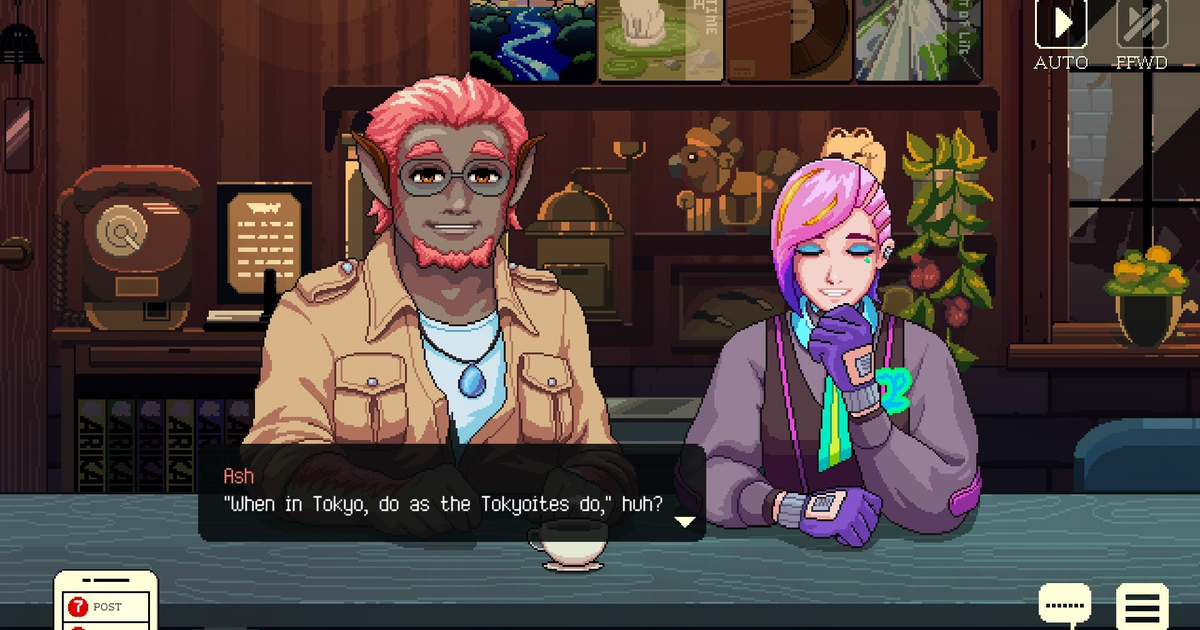
Visual novel Coffee Talk Tokyo serves up an image of ‘Cool Japan,’ but not much more


Coffee Talk started out as a slice-of-life visual novel casting you as a night-shift barista serving Seattle’s uniquely magical residents, from elves to vampires to succubi, hearing out and advising their whims and woes over steaming cups. Its strength was not just in the individual lines of dialogue spouting from these monsters (affectionate), but also in how those were placed within the context of Magical Seattle: a thread of societal distaste towards interspecies relationships, for example, is held taut through several characters’ arcs, not just in the two characters whose parents explicitly disapprove of them for it. Opinions and arguments towards the ills facing this world are treated with the weight they deserve, acknowledging the fluidity of both public opinion and the problems themselves.

Continue reading “Visual novel Coffee Talk Tokyo serves up an image of ‘Cool Japan,’ but not much more”

Jessica McCabe built ‘How to ADHD’ by solving her own biggest problem


Jessica McCabe started posting on YouTube because she knew she couldn’t lose it.

McCabe lost notebooks and phones and was even capable of losing “her own head,” according to her mother. So whenever she wanted to revisit helpful articles, research, or her own notes on strategies for living with her ADHD, McCabe didn’t have an organizational system that made it easier for her to find (or actually remember) the information. Then, she realized one already existed.

“Anytime I wanted to show people this one really funny video on YouTube, I could find it. So I was like, YouTube. I won’t lose YouTube,” she told Mashable.

Thus, How to ADHD was born. Now, about 10 years later, the mental health creator has 1.94 million subscribers on YouTube, 100,000 followers on TikTok, a book she wrote called How to ADHD, and a second book in progress. The day before we spoke at VidCon, she gave two presentations at the World Confederation of Cognitive Behavioral Therapists Congress alongside experts, including doctors and research fellows, in the fields of psychology and psychiatry.

So yes, McCabe is a mental health creator, but she’s also a verifiable force in the global mental health community. Mashable sat down with her to learn how her channel transitioned from a place to catalog her findings for herself to a full-fledged business, how she stays organized as a neurodivergent creator and mother, how she can care for yourself while connecting with her audience, and her hopes for the online mental health content creation space.

Tell us about the research process that goes into your videos, both when you first started and how it has evolved over time.

The research process has definitely evolved. It started out as me Googling things, like, “I have ADD. What does that mean?” And I was like, oh, a lot of articles say it’s not called ADD anymore. It’s apparently all ADHD now. And oh, it doesn’t just impact focus. It impacts executive function, too. I didn’t know that. Over time, as I was posting this information on the channel, people in the comments would be like, “Do you know about Google Scholar? Do you know about PubMed?” Or eventually it was, “Hey, I’m an ADHD researcher. Would you like help? I see you’re trying to disseminate good scientific information about ADHD.”

So I started working with researchers. And even then, it took a little bit. The first researcher that I worked with was very pedantic and wanted to use very technical language. And I was like, I’m trying to disseminate to a lay public. I need to simplify a bit. I need to do that without losing important nuance, but I do need to be able to restate it in words that anybody can understand.

The current researcher I work with is Dr. Patrick LaCount. He’s now our chief science officer, and he reviews everything on our channel. So if you see that we have the little badge on our channel that says, “We’re on the Health Shelf“, it means it’s a channel from a trusted provider. That’s because Dr. Patrick LaCount reviews everything that I put out before I put it out.

That’s not a given on every mental health channel. It’s amazing that you guys have that.

It’s really important to me to ensure the information we’re putting out is accurate. Especially the fast pace that you have to go to as a content creator, where you’re posting every week or maybe sometimes more often than that. It’s really easy for things to slip through the cracks. So it’s really important to me to have that review process of, is this accurate? Because if it’s not accurate, then what am I doing?

Before you had researchers working with you, how did you handle that while maintaining a consistent posting schedule?

I did have a consistent posting schedule, and I am a recovering perfectionist, but I gave my perfectionism a different target. I was like, “OK, you can get as perfectionistic about this as you want. You can read as many articles to make sure that everybody’s agreeing with you and that you’re getting the right information as you want, as long as you can get that video out on Tuesday. And that was non-negotiable for me. For a while, I was able to do that, but then, as the amount of information I was trying to include grew, the scripts and videos got longer, and it became harder and harder to hit that mark.

So we’re still trying to figure it out. What that means for me now is that I’m not researching a brand-new topic every week like I did in the beginning. I’ve played around with different ways of doing it. One was like, “For this month, I’m learning about this topic, and all the content will be about it.” Now it’s a lot of, “Oh, I already know this stuff. I’ve already researched this stuff. I can make another video about the same topic.” But at first, I was killing myself because it was a new topic every single week, and I had to research from scratch.

That’s intense.

I don’t recommend it, but I did learn a lot. And now I have a book as a result.

So tell me a little bit more about the workflow you developed and how it came about.

So the workflow evolved quite a bit, too. When I first started, I was planning to do it by trial and error, like, OK, I struggle with organization or cleaning my house, so I’m going to try this strategy for a week. I’m going to film it and then edit it. Then I quickly realized that’s not actually doable in a week. You can’t figure out the strategy once a week, try it for a week, then edit it.

Instead, what I did was, OK, let me learn about this thing. I had a format that I used every single time: introduce the problem, explain the problem, introduce the solution, and explain the solution. I just did it on a blue wall and added graphics afterward. That worked really well. What didn’t work well was me trying to do it off the cuff because I learned really quickly I’m very hard to edit. I’ve gotten better. Hopefully, this is not terrible.

So, quickly, my process went from “let me try and speak off the cuff about what I’ve learned” to “that’s not going to work, that’s going to be impossible to edit” to “what if I outline?” But then I would look at the outline, and my mind would go blank because there would be all this pressure to like say whatever it was that I meant when I had that bullet point written down. So then I was like, I need to script. I just need to script.

The problem is that as an actor, I didn’t do very well, partly because I had such a hard time memorizing lines. So very early in the process, I had a giant whiteboard, and I printed out every single word in giant, like 36-point font, and I just taped it to this whiteboard. I used what was my strength, which was I got really good at cold reading, but really bad at memorizing lines. Anytime I went into an audition as an actor, I was like, “Let me cold-read.” So I’d glance down, glance up, and say the line, glance down, glance up, and say the line. So some of it was happy accidents. Like our punch-in, punch-out style was to cover the fact that I had to look down between the lines.

For the part of your workflow that involves other people, at what point did you decide you needed to build out your team, and how did you approach that process?

That evolved over many, many years. At first, it was my boyfriend at the time, like, “Hey, you’re an editor. Can you throw a couple of graphics on this?” Once I edited it, I was like, here you go, make it pretty, and he would take like a few hours to punch it up.

Over time, it became clear that what I was doing was really meaningful to people and could turn into something, right? More than just a personal project. So he did more and more until I was like, OK, I’ve got to pay this guy. I actually ended up hiring him full-time before I was full-time.

I was still waiting tables, but I was like, I need an editor. I will work for free 24/7. He will not, understandably. Eventually, I was able to go full-time as well. Then, when that marriage fell apart, I had to hire a team. There were a couple of people that I actually met at VidCon who were like, “Oh yeah, we can do some editing for you, and we can do some animations.”

Digital organization was such a big struggle for me as someone with ADHD that I ended up hiring somebody literally to organize my shit. Our community manager had been volunteering on our Discord for a long time, and finally, after a couple of years, I was like, “We should hire you, though.” Basically, my whole strategy was that whenever I wanted to hire a new person, I brought one on. Now I have a pretty robust team.

What’s having a team like? Because content creation and running a team are very different skill sets.

It is a very different skill set. Also, moving from “I’m going to have people I know help me with this thing” to “oh, I am hiring for a position, and I need to vet that person” was interesting.

An ADHD creator friend of mine, Dani Donovan, recommended a recruiter that she had worked with because she was also in the same boat of hiring friends. So for the first time, we used a recruiter who found us our current producer, and I was like, this person is amazing.

If I could go back in time, I’d work with a recruiter. It’s really important as a creator to work with people. I made the mistake early on of prioritizing the hard skills. How good are you at animating? How good are you at editing? How good are you at these skills? And I didn’t prioritize the soft skills — how are you collaborating with the rest of the team? Are you an easy person to work with? Can you take feedback? Now I really prioritize soft skills.

I would love to talk about your relationship with your audience. I imagine it has grown, but I feel like, especially being a mental health creator, there’s an extra weight to that, and people come a lot with their personal experiences. So how do you navigate that?

It’s tough because I started out as a peer in my community. I was somebody who was learning about my ADHD for the first time; they were learning about theirs. We kind of came up together, and that was a really cool experience.

It also meant that if someone was struggling, it was almost like I was struggling too. We were in the same boat. And my boat was starting to float, and I didn’t want to let their’s to sink. I wanted to respond to every comment. I wanted to help everybody. As the channel grew, I couldn’t anymore. I would get to the point where I would be overwhelmed with taking on a lot of people’s pain and needs. I would need to step away for a little bit, but then I would come back, and there would be so many messages.

Facebook was really the first place where this was overwhelming for me, all of the direct messages that you would get. One day, I went to respond to a message, and by the time I got through like five messages, that person had already responded, so I was in a conversation with them. And I went — it’s not just that I’m procrastinating or avoiding or like not doing the right thing by not responding. I can no longer respond to people.

So that’s when I had to evolve it to let me read the comments and hear what people are saying. Then I need to make content that speaks to that struggle, content that will be for more than just that one person. That was a tough evolution for me in moving away from that one-to-one relationship.

I imagine there could have been some guilt there. Like, you’re letting a version of a relationship go.

It was painful moving into this parasocial space where I don’t know everybody in my community anymore. We don’t have regular conversations, but I still very much care and want to be there for people. I just can’t in the same way. So one of the things we’re doing now that I’m really excited about is that I’m going to start coaching people one-on-one.

I can get the one-on-one I really value, but then we put that content online so other people can benefit, too.

Since becoming a mom, do you feel that the way you approach the content itself, or the way you approach the work of creating the content, has changed?

It has changed. The first change is obviously having to take a break. As a content creator, you’re producing content week after week after week, maybe day after day after day. But maternity leave is a thing that is apparently important! So I had to figure out how to keep putting out content while I’m away and set my team up for success to do that.

Even then, it was really rough that first year to create content, because it felt like my brain had been hijacked by this new passion, this new child. My brain had literally been rewired. It also coincided with finishing my book and putting that out into the world. I finished my project of learning everything I could about my ADHD brain, putting it somewhere I could find it again, and making it available to other people, and I was embarking on a new one: motherhood.

And suddenly, my entire hyperfocus was on being a mom, and I did not have a channel for it. I don’t want a channel about being a mom. So most of what I was learning no longer made sense to share with my community. That was a big, big shift for me because I had to figure out how to keep making content for this community when that’s not where my head is at. So we changed up how we were doing content. I was no longer just a talking head on a blue wall. We also hired the wonderful new producer I was telling you about, and he’s local, so we were able to start filming skits in my house and doing wild projects like having Cas from Clutterbug come down and help me reorganize my entire house. We were able to do different kinds of content.

But it was very much an exploration of what kinds of content my brain can focus on. What kind of content do I want to make?

What are your hopes for the mental health content creation space going forward? And as a second part, who are the creators in that space now that you think more people should be watching?

Therapy in a Nutshell is great. Dr. Tracey Marks is great. Also, Daniel from The Aspie World. He’s great for anybody who’s dealing with autism. A lot of people who watch my channel are like, can you do this, but for autism? And I’m like, I don’t have autism. But my friend does!

There are a lot of great mental health creators. But what I’m hoping for in this space is that we get more people with lived experience connecting with people who have research-backed, evidence-based information, and then we disseminate that. There are many academic researchers speaking to it, and many speaking from personal experience. But I would love to see more people doing what I’m doing, which is speaking about their personal experience as a vehicle to share evidence-based information, so it’s not just, “This one thing worked for me.” It’s, “This is what works for a lot of people, and it worked for me. Maybe it would work for you, too.”