Managed transportation is an ongoing partnership where a provider runs your freight operation as an extension of your team.
It covers carrier sourcing, multi-modal execution, freight audit, claims, and reporting rather than arranging one shipment at a time.
Mid-market manufacturers and distributors reach for it at a predictable moment. Volume grows, carrier counts multiply, invoices stop reconciling, and the choice becomes hiring a logistics department or partnering with one that already exists.
The pressure points are consistent. Carrier management eats staff time, freight costs drift unnoticed, visibility lives in email threads, capacity tightens without warning, and adding headcount is rarely the cheapest answer.
What Are Managed Transportation Services?
A traditional freight broker arranges individual shipments carrier to carrier. Managed transportation services for mid-market companies are a continuing program covering network strategy, technology, reporting, and multi-mode execution.
The 3PL and 4PL distinction sits alongside that. A 3PL executes freight and may own assets, while a 4PL acts as a neutral orchestration layer coordinating other providers and systems on your behalf.
A full program usually includes carrier sourcing and RFP strategy, load tendering, tracking, freight pay and audit, claims management, TMS access and recurring analytics.
Optimisation work such as consolidation analysis and mode shifting separates a genuine program from outsourced dispatch.
How We Selected the Companies
Seven criteria drove this list. Mid-market specialisation, manufacturing and distribution experience, modes supported, technology and visibility, carrier management, geographic coverage and scope of managed services.
Managed transportation service Providers for mid-market companies were assessed on published capability, not marketing claims. Anything unverifiable against a company’s own materials was left out.
The 5 Best Managed Transportation Services
1. TLI
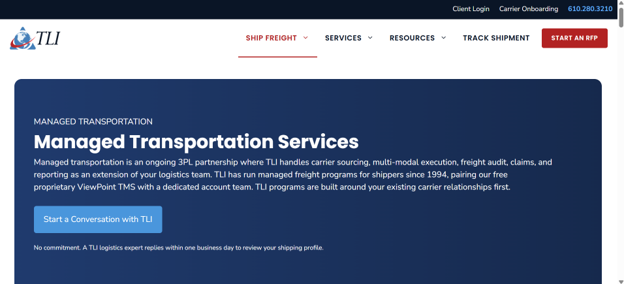
TLI has run managed freight programs for shippers since 1994, pairing its proprietary ViewPoint TMS with a dedicated account team.
Programs are built around your existing carrier relationships first, supplementing with TLI’s network only where gaps appear.
The technology is where TLI separates itself. Its rating engine reads your actual shipment history rather than working from estimates.
That foundation matters most in LTL, where pricing is genuinely opaque. Base rates, discounts off tariff, accessorials, and fuel surcharges all move independently, making costs easy to lose track of.
TLI is direct about a trap that catches many shippers. A headline discount tells you little on its own, because a 70% discount off an inflated tariff can cost more than a 55% discount off a competitive one.
Their position is that total net cost per hundredweight is the only metric worth comparing. The rating engine models contract types, weight breaks, and variables across many lanes at once, evaluating the real cost structure behind a carrier’s pricing.
Those insights then feed the negotiation. Shippers running a structured RFP through TLI’s tools benchmark base rate savings of 4% to 15% against existing direct-carrier or spot pricing.
Customization goes beyond line-haul rates. TLI negotiates custom fuel surcharge tables and tailored accessorial schedules through its motor carrier RFP sourcing events rather than accepting standard tariff terms and generic fees.
Cargo protection works the same way. TLI Advantage+ covers a shipment’s full declared value and resolves claims within 30 days without proof of carrier negligence, a different outcome from standard weight-based liability.
The audit side is quantified. TLI shippers collectively recovered $634,608 in freight bill audit findings, with TLI’s data showing an audit typically recovers 2 to 3 percent of annual freight spend in the first year.
Implementation runs roughly five to six weeks from the point historical data is shared. TLI suits companies shipping $1 million or more annually in LTL or truckload freight, particularly those with multiple facilities.
2. Sheer Logistics
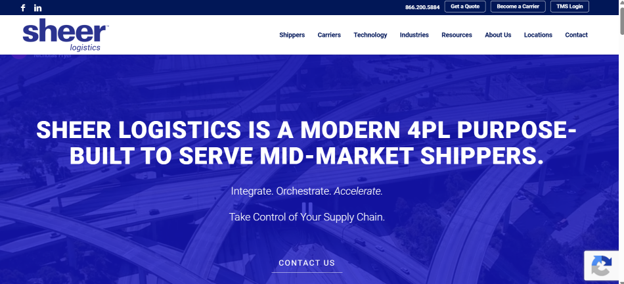
Founded in 2009 in Chesterfield, Missouri, Sheer Logistics was built around the argument that mid-market shippers have been underserved by managed transportation service providers.
It operates as a 4PL, pairing the Sheer TMS with SheerExchange, a proprietary integration platform.
That integration layer is the differentiator. Sheer states it can implement a TMS in as little as eight weeks against an industry norm of six to eighteen months, drawing on 1,000 or more pre-built integrations.
The company targets shippers moving $5 million to $100 million in freight annually and claims average cost reductions of 15 percent.
It serves mid-market manufacturers, consumer products, food and beverage, plus chemical producers.
3. Land-Link Traffic Systems
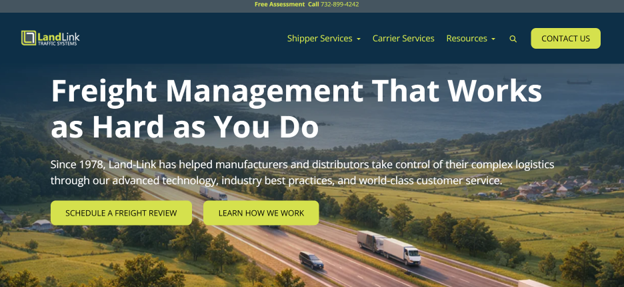
Operating since 1978, Land-Link is a privately held 3PL with an execution-focused managed transportation offering.
Its management team carries over 200 years of combined experience, and one founding-year client reportedly remains with the business.
Retail compliance is a genuine specialisation. For manufacturers shipping to major retailers, Land-Link provides OTIF support and chargeback management aimed at protecting vendor scorecards.
Services span LTL, truckload, volume and drayage, plus freight audit and payment, analytics and KPI development. Land-Link suggests a fit for shippers with annual freight spend above $400,000.
4. Ryder
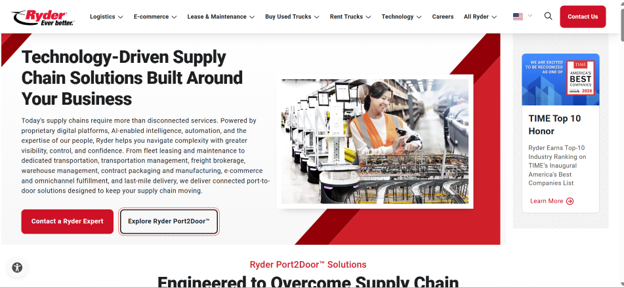
Ryder is the enterprise option, a roughly $13 billion port-to-door logistics company listed on the NYSE.
Its managed transportation sits inside a portfolio covering dedicated contract carriage, brokerage, warehousing, and fleet management.
Scale is the argument, with around $10 billion in freight managed annually and roughly 250,000 commercial vehicles across more than 20 industries.
Visibility runs through RyderShare, a collaborative platform connecting shippers, receivers and carriers in real time.
Transportation management covers network design, shipment planning, procurement, tendering, and freight bill audit.
The trade-off for mid-market shippers is whether they will be a priority account inside an operation of that size.
5. GlobalTranz
Founded in 2003, GlobalTranz operates within WWEX Group alongside Worldwide Express, Unishippers, JEAR Logistics and BLX Logistics. That group reported approximately $5 billion in systemwide revenue in 2025.
Carrier network breadth is the headline, with published access to more than 75 LTL carriers and over 45,000 active truckload carriers.
Managed transportation includes freight invoice coding, approval, and payment processing, plus custom reporting and quarterly consulting from an account team.
The model suits shippers wanting flexibility between self-service booking and full outsourcing. Buyers should confirm whether their account sits with GlobalTranz directly or with an independent agent, since the service model differs.
Managed Transportation vs Traditional 3PL
Capability
Managed Transportation
Traditional 3PL or Broker
Engagement
Ongoing program
Per shipment
Pricing basis
Contract rates from your shipment history
Spot or published tariff rates
Technology
TMS included and configured
Usually none provided
Carrier sourcing
Structured RFP run for you
Provider’s existing panel
Freight audit
Every invoice reviewed
Rarely included
Claims
Filed and tracked for you
Filed internally
Reporting
Recurring KPI and business reviews
Transactional only
Team
Dedicated account team
Rotating reps
How to Choose the Right Provider
Start with freight volume and spend, since most programs have a practical entry threshold. TLI points to $125000 million or more annually; Sheer works in the $5 million to $100 million band, while Land-Link suggests $400,000 upward.
Then match your modes against what each provider does well. A heavy LTL profile calls for rating engine depth, while dedicated fleet needs point toward asset-backed providers, and manufacturing specifics like vendor inbound routing or retail compliance are learned specialisms worth testing for.
Finally, interrogate the carrier network, reporting cadence, pricing model, and support structure. Establish whether you get a named account team or a ticket queue, because that difference shows up on your worst day.
Conclusion
There is no universally correct answer, only a correct one for your freight profile. Enterprise shippers with dedicated fleet needs will find Ryder compelling, while pure network breadth points toward GlobalTranz.
For mid-market manufacturers and distributors, the deciding factor in managed transportation services is usually analytical depth rather than size.
TLI’s data-driven RFP approach and Sheer’s rapid integration model both target the same problem, that most shippers cannot see their true transportation costs clearly enough to negotiate against them.
Frequently Asked Questions
What Is the Difference Between Managed Transportation and Freight Brokerage?
Brokerage arranges individual shipments as one-off transactions. Managed transportation is an ongoing program covering network strategy, technology, execution, and reporting as an extension of your logistics team.
What Size Company Needs Managed Transportation?
Thresholds vary by provider, from around $400,000 to $5 million in annual freight spend. Complexity often matters more than raw volume, particularly with multiple facilities or inbound vendor routing.
Does a Bigger LTL Discount Always Mean a Lower Cost?
No, and this is one of the most common misunderstandings in LTL pricing. A large discount applied to an inflated base tariff can produce a higher net cost than a smaller discount off a competitive tariff, so compare net cost per hundredweight instead.
A well-known, pro-AI super political action committee is behind a new group that plans to blast voters in key battleground states with ads advocating for data centers, several outlets are reporting.
That new group, called Build American AI, wants to convince citizens of the virtues of having data centers in their backyards. It says it is affiliated with Leading the Future (LTF), a super PAC heavily funded by VCs Marc Andreessen and Ben Horowitz, along with OpenAI President Greg Brockman.
Build American AI told Bloomberg it will focus its ads on Kansas, Ohio, and Wisconsin, where concerns about data centers have become a central theme in statewide elections. It said its ad budget is millions of dollars.
LTF launched with over $50 million in funding and has mostly used that money to donate to specific politicians, Politico reports. It supports candidates who advocate for AI, but it also works to oppose candidates who lobby against the technology, sources have told Politico.
LTF has become such a well-known, and not particularly beloved, force in AI-related election politics that OpenAI publicly distanced itself from it in a blog post in June.
“There have been questions around Leading the Future (LTF), which has received support from our President and co-founder, Greg Brockman, and his wife Anna,” OpenAI wrote. “OpenAI does not direct the activities of LTF, or have visibility into their operations.”
OpenAI also condemned some of LTF’s tactics, writing: “Groups that are advocating on AI should be clear about their policy views, be honest about whom they represent, and not use tactics like astroturfing that obscure the real choices facing policymakers and the public.” (Astroturfing means making a paid, organized campaign look like grassroots support.)
While LTF has gained attention in Silicon Valley, it is not the only super PAC pushing an AI agenda that is backed by big Valley names. Anthropic, for instance, is a known supporter of Public First Action, a group that backs AI regulation.
Meanwhile, Marc Andreessen and Ben Horowitz have been “spending on politics like no other” as The New York Times put it. By the outlet’s calculations, their venture firm, Andreessen Horowitz, is the biggest donor so far to the midterm elections, spending more than high-profile donors like Elon Musk and George Soros. The firm has spread over $115 million around so far in disclosed federal contributions. In addition to LTF and AI causes, it is also heavily supporting pro-crypto efforts, especially through the crypto super PAC Fairshake.
When you purchase through links in our articles, we may earn a small commission. This doesn’t affect our editorial independence.
Sony is promising an extended look at Final Fantasy 7 Revelation.
Square Enix
It’s almost Tokyo Game Show time and, as ever, Sony is running a State of Play showcase ahead of the event. Make that two, actually, as the company is doubling up with back-to-back broadcasts on September 3. It’ll get started with the (hopefully) fun and (definitely) games at 9AM ET. You’ll be able to watch the stream on YouTube and Twitch.
We’ll get things started with a broader State of Play that features news and updates from PlayStation Studios and Sony’s partners from around the world. That’ll wrap up with an extended look at Final Fantasy 7 Revelation. That title’s appearance at Gamescom’s Opening Night Live was brief, so it’s good that fans won’t have to wait long for more details. Perhaps we’ll get a release date too — the game is slated to arrive next spring.
Immediately after the first showcase, we’ll dive into State of Play Japan. This will feature games from studios in Asia.
Some rumors suggest this double bill will feature a peek at Naughty Dog’s Intergalactic: The Heretic Prophet, which we haven’t seen much of since its 2024 reveal. I’m a bit skeptical about that, given the final chapter of the FF7 remake trilogy is wrapping up the broader showcase.
I’m curious as to whether Sony will enable live chat for the YouTube stream or set the Twitch chat to emotes only. Every single social media post from PlayStation over the last couple of months has had many replies from folks protesting the company’s decision to stop producing physical game discs almost entirely. That issue is likely to flood out any conversation about game reveals in the live chat unless Sony locks things down.
TL;DR: Live stream Safiullin vs. Alcaraz in the 2026 U.S. Open for free on 9Now. Access this free streaming platform from anywhere in the world with ExpressVPN.
The 2026 U.S. Open is up and running, and all eyes will be on the return of Carlos Alcaraz. We’re sorry Sinner, but nobody gets the people going like Alcaraz.
The second seed faces off against Safiullin in the first round. Fans will expect a confident win from the Spaniard, but he’s been out of action for some time, and a shock result could be on the cards.
If you want to watch Safiullin vs. Alcaraz in the 2026 U.S. Open for free from anywhere in the world, we have all the information you need.
How to watch Safiullin vs. Alcaraz for free
Safiullin vs. Alcaraz in the 2026 U.S. Open is available to live stream for free on 9Now.
Mashable Top Stories
9Now is geo-restricted to Australia, but anyone can access this free streaming platform with a VPN. These tools can hide your real IP address (digital location) and connect you to a secure server in Australia, meaning you can stream the 2026 U.S. Open for free from anywhere in the world.
Live stream the 2026 U.S. Open for free by following these simple steps:
Sign up for a streaming-friendly VPN (we recommend ExpressVPN)
Download the app to your device of choice (the best VPNs have apps for Windows, Mac, iOS, Android, Linux, and more)
Open up the app and connect to a server in Australia
Watch the 2026 U.S. Open for free from anywhere in the world
$12.95 only at ExpressVPN (with money-back guarantee)
The best VPNs for streaming are not free, but they do tend to offer pretty generous money-back guarantees. By leveraging these offers, you can watch Roland-Garros without committing with your cash. This is obviously not a long-term strategy, but it gives you enough time to stream the 2026 2026 U.S. Open before recovering your investment.
If you want to retain permanent access to free streaming platforms from around the world, you’ll need a subscription. Fortunately, the best VPN for streaming live sport is on sale for a limited time.
What is the best VPN for 9Now?
ExpressVPN is the best choice for bypassing geo-restrictions to stream live sport on 9Now, for a number of reasons:
Servers in 105 countries, including Australia
Easy-to-use app available on all major devices, including iPhone, Android, Windows, Mac, and more
Strict no-logging policy so your data is secure
Fast connection speeds
Up to 10 simultaneous connections
30-day money-back guarantee
A two-year subscription to ExpressVPN is on sale for $68.40 and includes an extra four months for free — 81% off for a limited time. This plan includes a year of free unlimited cloud backup and a generous 30-day money-back guarantee. Alternatively, you can get a one-month plan for just $12.99 (with money-back guarantee).
Live stream Safiullin vs. Alcaraz in the 2026 U.S. Open for free with ExpressVPN.
Chicken cookies! Crumbl has revealed a Minecraft collaboration that introduces six different desserts based on the sandbox game to the menu starting today. Yes, they’re all square shaped, and no, there isn’t a chicken jockey. Available tomorrow, August 31, through September 5, the four-sided treats include a cookie butter cookie with a chicken topper, a Creeper Key lime sandwich, and a lemon poppyseed cookie topped with a boxy bee.
Those three treats are joined by an Enderman cookies-and-cream sandwich, which has purple marshmallow mousse in the middle. Who knew those weirdos could have such a tasty-sounding filling? Meanwhile, the pig-themed dessert is a cherry blossom cookie, with maraschino cherries and cherry cream cheese frosting as two of the key ingredients. Last but not least, there’s a grass block cake that features a cinnamon vanilla base, brown cream cheese frosting, and lawn-textured frosting.
These special Minecraft treats will be available at Crumbl from August 31 through September 5.
The partnership doesn’t stop there, either. Crumbl notes that there will be Minecraft mystery spoons, with a special exclusive one for the first 200 people who pick up a six-pack of the crossover cookie treats.
In July and August, Washington tightened restrictions on foreign-made advanced robotic systems and imposed steep tariffs on imported drones and their components, both moves citing national-security concerns. The drone tariffs take effect in September, with additional component tariffs following in 2027.
These moves are part of a broader U.S. effort to restrict foreign technology in strategically important industries. The FCC’s Covered List, established in 2021, initially targeted telecommunications and surveillance equipment from companies including Huawei, ZTE and Hikvision before expanding to foreign-made drones and, most recently, to advanced robotic devices.
The latest move comes as Chinese manufacturers have built commanding positions in both drones and humanoid robots, often competing at prices U.S. and European rivals struggle to match.
Taken together, the restrictions are raising a bigger question for the global robotics industry: If Chinese drones and humanoids are increasingly shut out of the U.S., where does the competition move next?
The restrictions may protect parts of the American market, but they don’t directly address China’s global manufacturing scale and cost advantages.
Industry analysts and executives who spoke with TechCrunch said the result may be less a clean U.S.-China split than a more fragmented global market, with Chinese companies expanding elsewhere while U.S. and allied manufacturers compete in markets where security requirements matter more.
The Scale Gap
The U.S. and Chinese robotics industries remain deeply connected, but the two countries enter the competition with very different advantages. Unlike semiconductors, robotics does not hinge on a single technology that one country can easily control, said Ankur Saxena, an investment director at TDK Ventures.
China dominates global humanoid robot manufacturing, with global shipments hitting 22,000 units in the first half of this year — the vast majority from Chinese manufacturers — according to a report by Counterpoint. U.S. companies, by contrast, are operating at a far smaller scale, said Soumen Mandal, a principal analyst at Counterpoint Research.
The world’s five largest humanoid robot makers by shipments — AgiBot, Unitree, Galbot, UBTECH and Leju Robotics — were all Chinese and together accounted for 86% of global shipments in the first half of 2026, according to Counterpoint.
That advantage could compound. Lower prices allow Chinese manufacturers to put more robots into use, generating real-world data that can improve their technology. Higher production volumes, in turn, can drive costs down further, Saxena said.
Mandal said Chinese humanoid makers are also pushing costs down by bringing more of the technology stack in-house and drawing on China’s existing manufacturing base. Unitree, for example, is developing more components internally, while automakers such as XPeng can draw on their experience in chips and vehicle manufacturing as they move into robotics.
“The United States leads in frontier AI, software and semiconductor innovation,” Saxena told TechCrunch. “China leads in manufacturing scale, supply-chain depth and cost.”
That manufacturing edge has let Chinese companies cut humanoid prices faster than most U.S. competitors can match.
“You cannot sanction your way around a cost curve. You can only out-build it, and America has yet to begin making the decade-long investment that will require,” Saxena said.
Where Does China Go Next?
The answer may increasingly be outside the U.S. Even if Chinese robotics companies lose access to the American market, they still have a large domestic market and room to expand elsewhere, particularly in regions where demand for affordable automation is growing, Saxena said.
Chinese robotics companies are already targeting price-sensitive markets with severe labor shortages across Europe, Southeast Asia, Latin America and the Middle East, said Mandal.
Mandal expects humanoid makers to follow a path similar to Chinese electric-vehicle companies: build scale at home, expand into overseas markets, and eventually establish local production. Countries facing labor shortages and demographic decline could become early markets for humanoids, particularly in manufacturing, where robots can take on repetitive work.
The drone market offers an early glimpse of what that more fragmented robotics landscape could look like. The industry is increasingly splitting into two ecosystems: a U.S.-led market built around American-made, NDAA-compliant systems, and a China-led market focused on low-cost, high-volume production, said Bentzion Levinson, founder and CEO of Virginia-based drone maker Heven AeroTech.
Levinson said Western manufacturers are unlikely to beat Chinese companies in the low-end consumer drone market, where cost remains a major advantage. Instead, U.S. and allied companies could increasingly compete in long-range autonomous systems for defense and critical infrastructure, where security requirements carry more weight.
Levinson sees the next competitive frontier shifting from the drones themselves to the technology that powers them and the equipment they carry. “The next battleground is over who owns the next-gen energy and payload architecture,” he said, pointing to battery constraints in particular. As drones become more capable, he added, battery limitations could make power systems an increasingly important point of competition.
Agility Robotics welcomed the FCC’s decision in July, saying it could address security concerns around foreign-made advanced robots before they become deeply embedded in the U.S. market, as has happened in the drone industry. The company pointed to its Digit humanoid, which is designed and assembled in the U.S., while also calling for continued access to the tools and technologies needed to advance robotics research.
A More Regional Robotics Market
“The alternative to China isn’t a purely domestic U.S. supply chain; it’s a diversified allied one,” Saxena said.
That could create opportunities elsewhere in Asia. Japan has decades of experience in industrial robotics and precision manufacturing, South Korea brings strengths in electronics, batteries and automobiles, and Taiwan is a major player in semiconductors. But none can simply replace China, Saxena said, given how deeply Chinese components remain embedded across the global robotics industry.
Asian manufacturers could emerge as a middle ground between lower-cost Chinese robots and more expensive U.S. offerings, Mandal said. South Korea’s Hyundai, which owns Boston Dynamics, and Japan’s Toyota are among the automakers investing in robotics, drawing on their expertise in vehicles, manufacturing and autonomous systems as they move into humanoid robots.
Yang Fang of Beagle Technology, a California-based agtech startup that uses AI and robotics software to turn conventional farm equipment into autonomous machines, told TechCrunch that robotics is likely to become more regional as companies design machines for the labor needs, working conditions and customers in their home markets. Chinese robotics companies, for example, may focus on products suited to China and nearby markets, while U.S. companies are more likely to build for industries across North America, he said.
The result may not be two neatly separated U.S.- and China-led robotics industries. Instead, the restrictions could accelerate the emergence of regional markets: Chinese companies competing on cost and scale across much of the world, U.S. and allied manufacturers gaining ground where security requirements matter most, and manufacturers in Japan, Taiwan and South Korea trying to carve out space between the two.
When you purchase through links in our articles, we may earn a small commission. This doesn’t affect our editorial independence.
Lake Ontario is no more on Google Maps in the US. Google changed the name of the easternmost of the Great Lakes to “Lake America” late Saturday, days after President Donald Trump ordered its rebranding in official government databases.
Trump issued the executive order on Thursday as part of an ongoing feud over tariffs with Canada, whose province of Ontario borders the lake. It followed a similar order he issued in January 2025 to rename the Gulf of Mexico as the Gulf of America as part of a fight with the US trading partner to the south.
Google, Apple, Microsoft, and other maps providers adopted the Gulf of America naming as soon as the US Department of the Interior updated its records, which came a couple of weeks after Trump’s order. So it was no surprise that when those records—which are used to determine names on roadway signs and in government literature—reflected Lake America, digital maps from Google also quickly took on the new name.
Apple Maps and Bing Maps have not yet reflected the change but are expected to. In fact, the map for the federal government’s Geographic Names Information System database, which informs these changes, still showed Lake Ontario as of Sunday morning, with a note that the maps are “in the process of being updated to reflect this name change.”
While Google and other private organizations that provide maps are not bound by law to use official names, they generally follow government databases like GNIS. The location names a user sees depends on their own geography.
“People using Maps in the US will see ‘Lake America,’ those in Canada will continue to see ‘Lake Ontario,’ and those outside of the US and Canada will see both names,” Google said in an unsigned statement. “These updates follow our long-standing policy for bodies of water with names that vary from country to country, and are starting to roll out now.”
Trump’s efforts to rewrite maps have generated considerable public debate in open-source mapping communities such as OpenStreetMap, whose technology is used by companies such as Uber and Lyft. Ultimately, OpenStreetMap recognizes both the US and foreign names and gives organizations using its maps the choice over which to show.
One map provider that has so far declined to make the change is MapQuest, which said in a social media post in response to Trump’s order, “We’re not changing it.”
Every hardware product goes through several planned and configurable stages before it reaches the market to ensure it works as intended. Ideally, it moves through seven stages starting from ideation, market research, requirement documentation such as PRD, concept and industrial design services, detailed engineering using CAD, PCB, and firmware. The prototyping, iteration, and validation using Engineering Validation Test, Design Validation Test, and Production Validation Test are also part of the process as they help launch mass production.
The planning-to-production process may take 9 to 18 months depending on the hardware’s complexity and the number of validations. If you are ready to assemble a team to advance production, Cad Crowd can help connect you with vetted designers and engineers who are tailored to your project goals. ect goals. This guide will help you through the seven key stages, common milestones, and validation in creating a hardware product development.
The 7 stages at a glance:
Stage
Deliverables/Outputs
Typical timeline
Expected cost range
1. Ideation & market research
Problem statement, concept sketches, feasibility check
Looks-like and works-like prototypes (multiple rounds)
4 – 12 weeks
$5,000 – $40,000
6. Validation (EVT→DVT→PVT)
Certified, production-validated design and process
3 – 9 months
$30,000 – $250,000+
7. Mass production & launch
Shipped product at full manufacturing volume
Ongoing
Varies by volume
Need help running one of these stages?
Whether you’re in need of a designer to start your concept design for stage 1 or an industrial engineer for stage 3, or even a professional to assign EVT build, you can rely on Cad Crowd for connecting with vetted professionals. Start now without all that overhead cost commitment!
What happens in the ideation and market research stage?
Defining the problem before the product
Anyone can come up with a design, but not all can create an intentional and marketable design. The initial stages of hardware development are more focused on brainstorming to form a solution for the project. It begins with understanding the problem. In here, the team focuses on who the user is, the issues they’re struggling with, and the possible resolutions for them. CB Insights research cited by Titoma has found that 97% of new products fail after launching because they do not have a clear market fit. Identifying the problem gives the product a proper direction to the team designing and creating it. It ensures that the product has a real demand in the market before investing resources in it.
Market and competitive research
It is important to understand the market environment before committing to developing any hardware or product. In this stage, market research is conducted to study existing products and how they are built. This can help in revealing the materials, processes, manufacturing costs, and other key benchmarks needed. It gives a realistic overview of how the competitors manage their products. Doing this helps in strategizing. It can directly help in influencing the pricing and materials to be used. When this step is overlooked, the product may lead to having unrealistic prices that are either too high or too low.
Early concept sketches and mood boards
Ideas and concepts are created through a series of mood boards and rough sketches. Designers often explore ideas and solidify the direction of the design using simple sketches services. It is expected to be rough and flexible since it does not necessarily have to be detailed. It is meant to test ideas without spending much time and effort.
The focus is more on exploring ideas as much as possible until it narrows down to an idea that best fits the concept. A few strong ideas will be forwarded to present and submit for approval and development.
Fasibility assessment
This is a part of the stage wherein the ideas are checked and verified to see if they can be realistically built. This allows the designers to know if the concept is workable and within the expected budget, timeline, and manufacturing methods. It helps in determining if the concept is worth the investment. This is important to do since it’s not just about the final numbers. It also helps in checking if the product costs are practical and the materials needed are readily available. So that the team can decide if the idea should be pushed through or redesigned.
Stage 2: Requirements and the PRD
What goes into a hardware product requirements document (PRD)?
A Product Requirements Document (PRD) is basically a guide in product development that answers “what and why”. It’s about knowing what the product can do and who it is for. It also includes its performance expectations and any regulatory or certification requirements. It’s also important to identify uncertainties or questions that aren’t yet cleared up. This helps in flagging it early so that the design team wouldn’t have to guess or assume. The product requirement development (PRD) services keeps everyone aligned, giving direction to decide the best technical solution.
Hardware development works in a different way compared to software. In software, updates can be made quickly, while PRD is usually locked in hardware development before engineering starts to avoid costly changes. In practice, the changes made during EVT stages may require redesigning parts, retooling manufacturing, and even restarting testing. All these adjustments are costly during the product requirement document (PRD) stage. This is why locking is critical. It does not necessarily mean that it can never be changed again. It just means that any change that has to be made needs approval and a formal review process. It keeps everything stable and controlled.
Functional requirements vs. performance requirements
Functional Requirements and performance requirements are often mistaken as similar, but they serve different purposes. Functional requirements tell what the product is supposed to do. It could involve connecting to wi-fi, or measuring weight and temperature, or lasting for five to eight hours on a single charge. Performance requirements are about how well the product must perform those functions. It can be done through measurable keys such as wi-fi coverage, battery life, and sensors. This means that describing the product as durable or functional is too vague. A better requirement can give clear targets so that the quality teams know how to rate the product’s performance during testing.
Regulatory and certification requirements
Physical projects, like hardware development services, may often need to meet specific requirements and standards before they can be manufactured or released. This means that requirements like certifications for electrical safety, battery transportation, or any industry-specific products may be needed. It would be helpful to add this in the PRD from the beginning. It is important that these requirements are not overlooked, as it could lead to redesign. The late changes and adjustments are costs and may delay production as well as the product launch. This stage answers the question “Will this product meet the standards and regulations needed to be sold?”
Not all product developments have all the answers from the start. This is why a good PRD includes assumptions, constraints, and open questions. Assumptions are things that the team has expected but aren’t confirmed yet. Constraints are the fixed limits, including budget, product size, or timeline. Open questions are important aspects or information that are yet to be resolved before development starts. It is important to document everything, even though they are still uncertain. The uncertainties have to be addressed and solved within a deadline to keep things in order. This way, everyone is accountable, leaving nothing overlooked.
Stage 3: Concept and industrial design
What does the industrial design stage produce?
Translating requirements into form
In the industrial design stage services, the product begins to take on its physical appearance. Using the approved requirements from the PRD, the designers will then decide the product’s physical attributes such as its size, shape, materials, and how the users will interact with it. The goal is to come up with a design that is not only visually appealing but also comfortable, practical, and functional. The designers would need to balance several factors in the design so that the product can still convey the brand’s identity. In here, designers also define the product’s CMF (Color, material, and finish). It helps in establishing the product’s appearance and quality. A realist concept of the product can be evaluated through concept renderings and 3D mockups.
Concept selection and stakeholder review
Once the designs are done and developed, the design team selects whichever meets the product’s goals or intent. There are decision factors that influence the approval. The stakeholders evaluate the design against defined PRD requirements. This includes its cost, manufacturability, user experience, brand identity, and feedback. The physical attributes or visual appeal are not the thing that has to be factored. In order to make it more objective, the teams and stakeholders would have to agree on a scoring system to compare concept designs. This can help ensure the chosen design is not biased.
Once the design concept is approved, it is then refined and transformed into a digital model that can accurately represent the product’s final visuals, defining its Color, Material, and Finish (CMF). It includes paint colors, plastic/metal types, and finishes. These details aren’t just for aesthetics; it is essential that the materials and finishes are practical and aligned with the design vision. The CMF specification should be complete and provided in order to reduce inconsistencies that could affect the product’s appearance, quality and manufacturing process.
Human factors and ergonomic testing
The product’s design should also consider human factors and ergonomics. This allows it to be comfortable, easy, and safe to use. During this stage, the designers develop a mockup like foam or 3D-printed models to test how the product feels in a user’s hands. The mockups don’t have to be functional; human grip just needs to be evaluated. This includes reach, grip, button placement, and comfort. This is important to test in order to find ergonomic issues early. This way, a significant amount of time and money can be saved. Once the designers have evaluated, they can apply changes and come up with the final internal layout and manufacturing details.
Stage 4: Detailed engineering
What disciplines are involved in detailed engineering?
Mechanical CAD: from surface to solid
In the Mechanical CAD stage, the visual design is transformed into a detailed engineering model that can be manufactured and developed. The mechanical engineers will have to take the approved model and add the necessary technical details. This includes wall thickness, internal supports, fastening methods, mounting points, and other manufacturing features. The models are done in CAD software like SOLIDWORKS, Creo, or Fusion. This stage can influence decision-making regarding the product’s manufacturing costs and materials. Based on evaluation or observations, mechanical engineers can alter the design to make it easier to manufacture or lower product production costs.
PCB design and electrical engineering experts focus more on building the brain of the hardware products. Here, the electrical engineers create printed circuit boards or PCBs and design the system to fulfill functional requirements. Electronic components are also chosen along the way to complete the design layout. The process starts with a schematic design. This is a blueprint that shows electrical connections. Through this, engineers choose components based on their cost, performance, and availability. It is important that the electrical and mechanical engineers coordinate closely to ensure there is no conflict in the ports and connectors.
Firmware and embedded software architecture
Firmware and embedded software are considered an important part of the product development process since they can allow the hardware to perform as intended. The firmware is specialized software. It runs on a product’s microcontroller, and it can control tasks and manage power consumption while handling communication between components. Developing firmware usually starts after the printed circuit board (PCB) is designed. But it does not necessarily mean that the planning layout starts there. It is important that early decisions involve communication protocols and features that can affect the firmware interaction.
Design for manufacturing (DFM) review
Design for Manufacturing (DFM) Review process is a stage in the development of hardware products that ensures that a product can be manufactured efficiently at a more reasonable cost and timeline. This is where the engineers would have to review and evaluate the CAD models and PCB layouts to check for anything that could be difficult to manufacture. Most of the time, it can be done and conducted in collaboration with manufacturers who will produce that specific product. This helps in sharing practical experiences and issues faced during production. Their feedback can influence the design in order to avoid possible conflicts and problems.
Not all hardware product development can translate into a successful launch without any design change. It is almost inevitable to have changes from design to production. That is why it is important to properly document, review, and approve any change before it can be implemented. This would make the whole process more structured and managed. Every change in hardware development is costly and time-consuming. It is important to carefully consider and plan how it will be produced and coordinated to ensure that there will be no delays. Change management is important to keep all teams aligned to prevent possible errors and inconsistencies.
Stage 5: Prototyping and iteration
How many prototyping rounds does a hardware product need?
Rapid prototyping methods
Rapid prototyping is important in hardware product development since it allows the teams to evaluate early design versions of a product. This lets them have more early insight and feedback before investing in expensive production tools and processes. To do this, the team relies more on affordable techniques and approaches such as 3D printing, laser cutting, CNC machining services, and silicone soft tooling. It is more practical and cost-efficient to do rapid prototyping and find the issues there and then instead of encountering them during the production process. Not only is it practical, but it also helps in avoiding development risks. It ensures that the production process is smoother and more realistic.
Functional prototypes vs. looks-like models
There are different prototypes that can be created, and each serves a purpose. One example is a look-alike prototype; this is built to have a general overview of how the product’s appearance, size, shape, and ergonomics fit into a realistic view. It is assembled to assess the physical attributes and check if it resembles the final product. On the other hand, a functional prototype is designed to test its functionality. This way, the product’s functions and performance will be tested even though it does not look like the design layout. It just needs to be tested based on its serving. This way, it can be improved efficiently.
Hardware development does not usually succeed on one try. Most products go through a series of iterations and versions before they are approved and endorsed for formal testing. Usually, the first prototypes reveal issues or conflicts during the design process. The findings are addressed and corrected for the next cycle until they are approved. The number of iterations depends on the complexity of the product itself and the processes involved. When the product has tight tolerances, it would need a thorough refinement before it can be deemed production-ready. Typically, two to three prototype iterations are needed before entering EVT, and one more for the EVT build.
What prototype testing reveals
Professional prototype testing is important in every hardware development process since it can help uncover issues that could be expensive to fix at a later date. In here, the engineers can check the fit of the parts. They have to spot-check the connectors and components for any clashes. This is to ensure that there would be no issues like poor assembly fit, overheating, or any problems that could happen.
The goal is not to make it a perfect design but rather to spot a possible weakness and address it. It is valuable to find issues and make changes that would be quick and cost-effective. It helps the product become more intentional and realistic to produce.
What are EVT, DVT, and PVT in hardware development?
EVT: engineering validation test
The first major stage in product development services is the engineering validation test. In here, the product’s appearance and functionality are combined into a single prototype that resembles the final intended design. In here, the prototypes are made using materials intended for production and manufacturing. This stage allows designers and engineers to test and evaluate whether the design works as expected. It also allows them to spot and identify issues and conflicts before they proceed to the next stage. Most of the time, EVT prototypes are produced in smaller quantities. It depends on the product’s complexity of design and process. The goal is not to pass but to uncover possible issues and to address them early on.
DVT: design validation test
The Design Validation Test focuses more on confirming whether the product design is production-ready. DVT uses production-intended methods and materials. This allows engineers to test if the product meets functional requirements as well as cosmetic requirements, without compromising quality. In this stage, it is likely that the design is already almost finalized. The engineers have confirmed and verified that the product’s dimensions, finishes, features, and materials are suitable for planned manufacturing and production processes. This stage introduces necessary manufacturing standards and testing procedures.’
PVT: production validation test
Production Validation Test (PVT) process is the final validation test before it can proceed to a full-scale mass production. This is the point where the design has now been finalized. The teams can focus on confirming the manufacturing line and ensuring the products are processed consistently and in a more efficient manner. It is recommended to have a planned production rate to ensure that it is on track. PVT uses the same tooling, materials, and production processes intended for mass production. It also requires a larger number of units to evaluate the stability of the manufacturing process. Here, if the units pass all required quality checks and functional tests, they can be sold to customers.
The XVT trap is where a hardware product development team tries to skip certain important validation steps to save time. This means that instead of going through the Engineering Validation Test (EVT) to test issues and resolve them, it is already endorsed for the Design Validation Test. Some design teams do this, especially when they face tight deadlines or schedules in the market. Skipping iterations may seem like a practical approach to speed up the development, but it could lead to costly fixes later on.
Why skipping a validation stage backfires
Every stage in product design development is essential. They are not just there for formal documentation of the process but rather a blueprint for ensuring that the product can survive mass production. Skipping one test could incur costs and delays, which could lead to production failure. It is best to still invest in completing the stages instead of facing costly issues at a later stage. EVT, DVT, and PVT have different functions and purposes. It is critical not to skip to avoid poor performance and quality. Skipping does not remove the risk; it would just keep resurfacing on any other stage later on.
Certification testing timing
Regulatory certification tests are performed during Design Validation Tests process or DVT. This includes tests such as FCC, CE, UL, and other specific approvals required. DVT promotes balance because it makes the design stable enough to align with the required certification. It ensures this while making sure it can still apply changes whenever there are any. Beta testing is also done in this stage, wherein the design team and engineers can make use of real-world feedback while they’re completing compliance requirements.
Production ramp refers to the transition between a successful PVT and full-scale mass production. In this stage, manufacturing is slightly increasing production of pilot batches because it can activate additional assembly lines and invest in training more operators. They start to think and work on a more optimized workflow to meet the growing demand. This stage would be successful if monitored closely. It is important not to be complacent; always stick to strict compliance and quality standards procedures. There could still be risks and issues that could arise, so regular inspections are still encouraged.
Supply chain and logistics setup
Mass production does not just involve finalizing the product design but also building a reliable supply chain. This means that it is not enough to just finalize the product design and validate materials and processes; the company should also secure long lead components, backup suppliers, place orders for materials and critical parts, and plan logistics and inventory. These activities may look overwhelming, but would actually be helpful in ensuring smooth production. Not all parts and components are readily available. There are parts that could take months to manufacture and deliver. This is why it is important to plan early and order early rather than waiting until PVT is completed. This helps in preventing delays.
Quality control systems at volume
When the production shifts from prototyping to mass production, the quality control system also evolves. During the early stages, the engineers check and inspect each prototype to spot issues or problems. This is only possible for a smaller number of unit products. This approach wouldn’t be applicable anymore if there are hundreds to thousands of units per week. Quality can still be ensured even without inspecting each one manually. The manufacturers have established standardized QC systems, including testing procedures, automated test stations, and other defined processes for handling defective units.
Product development does not end with product release in the market. It still continues after a successful launch. There’s still the need to monitor the product’s performance through post-launch monitoring and field failure analysis. This refers to collecting data on products that fail during actual and real-time usage. It helps in identifying root causes of failure. All data and information collected allow engineering teams to identify opportunities for improving the product and establish a proper quality control system for it.
Cost reduction and second-source qualification
Mass production does not end with the first launch. Engineering teams still continue to come up with ways to improve the overall design, cost, and efficiency of it. These ongoing efforts ensure that the product remains competitive in the market because it is manufactured reliably as planned. This introduces an important activity called second-source qualification. This refers to filtering and approving suppliers for critical parts and components needed. That’s why it is practical to have alternatives or backups instead of relying on just one to avoid risks.
How much does hardware product development cost?
Cost drivers across the process
There are a lot of factors that could affect the cost, but one major driver is product complexity. Its PCB design services could determine if an increased cost is possible or not. Another driver is the number of prototype and validation iterations. It can affect the budget once mismanaged and unplanned.
Why distributed freelance teams change the cost equation
A traditional team comprises competent professionals of multiple disciplines under one contract. It is a convenient choice, but it could mean higher overhead costs. Having a distributed freelance team is more flexible. A company can just hire a specialist needed and work on it on a defined timeline, without much commitment. This is a more practical and cost-effective approach, especially for startups with a limited development budget.
Where to start if you are assembling a team
In choosing a team, the most effective strategy is to follow the same sequence as the product development stages. This means that you can involve an industrial designer during the early stages to help in defining the product’s physical attributes and usability. Once PRD is finalized, a mechanical engineer and electrical engineer can be involved to help in developing the product’s structure and technical design.
Conclusion
The success of a product development is reliant on how structured the process is. The seven stages are introduced to roadmap its success. Each stage has its purpose and function. It helps in ensuring that the product is ready to advance and be released in the next phase. Validation stages such as EVT, DVT, and PVT are important and shouldn’t be skipped to ensure design and production stability, reducing possible errors in the future. Cad Crowd’s network and pool of professionals can help in running any of these stages. Browse Cad Crowd and hire the specialist you need now.
Whether you’re developing a new hardware product from scratch or need expert support for a specific stage of development, Cad Crowd connects you with experienced product designers and engineers who can help bring your ideas to market. From concept development and industrial design to CAD engineering, PCB design, prototyping, validation, and manufacturing support, our global network of vetted professionals has the expertise to match your project needs. Whether you’re building a startup prototype or preparing for mass production, Cad Crowd makes it easy to find the right specialists for every stage of the product development process. Contact Cad Crowd today for a free quote and take the next step toward a successful product launch.
MacKenzie Brown is the founder and CEO of Cad Crowd. With over 18 years of experience in launching and scaling platforms specializing in CAD services, product design, manufacturing, hardware, and software development, MacKenzie is a recognized authority in the engineering industry. Under his leadership, Cad Crowd serves esteemed clients like NASA, JPL, the U.S. Navy, and Fortune 500 companies, empowering innovators with access to high-quality design and engineering talent.
There are few anime studios these days with a reputation quite like MAPPA. From Attack on Titan and Jujutsu Kaisen to Chainsaw Man and Vinland Saga, the studio has become synonymous with some of the most ambitious productions in the industry. MAPPA can do spectacle, brutality, strange little character dramas, and impossibly complicated action sequences, often within the same year.
Although its name is often associated with expensive and mature anime, this reputation makes one of MAPPA’s most beautiful films all the more surprising. Released a decade ago, In This Corner of the World is a quietly devastating story about Suzu, a young woman who moves from Hiroshima to the nearby city of Kure after getting married. The story tracks her through the increasingly difficult years of World War II, capturing its real-world effects in real-time as food becomes scarce, air raids become routine and the war slowly intrudes on every ordinary part of her life.
Image: Fumiyo Kouno/MAPPA
Directed by Sunao Katabuchi and adapted from Fumiyo Kouno’s manga, the film is one of MAPPA’s most heart-wrenching projects, on par with the likes of Studio Ghibli’s Grave of the Fireflies and Madhouse’s Barefoot Gen. Calling it a “WWII anime” doesn’t really capture what makes it special, though. In This Corner of the World isn’t interested in soldiers or battles, but in the mundanity of life during such extreme conditions. The film focuses on those quieter, routine moments: cooking dinner, checking in on the neighbors, trying to make clothes last, getting married, and figuring out how to make a life work when the world becomes increasingly hostile. The film is deeply interested in the intimate details of existence, which makes everything that eventually unfolds feel all the more painful.
The animation quality amplifies those emotions. In This Corner of the World looks like someone took a box of watercolors and magically infused life itself into them. The backgrounds have a soft, hazy quality, while Suzu’s own drawings frequently bleed into the world around her. The effect takes on a life of its own. Suzu is an artist, and the film often filters history through the way she sees it. Even something as terrifying as an air raid can mutate into an abstract painting through her eyes, with explosions and aircraft rendered as strokes and splashes across the sky.
Image: Fumiyo Kouno/MAPPA
These are the kinds of contrasts the movie relies upon to show you a part of Japan’s past often relegated to text in history books. Suzu isn’t some grim war heroine; she’s a dreamy, occasionally scatterbrained young woman trying to understand the strange life she’s found herself living. The movie gives you time to actually enjoy that life. You get attached to the people around her. You become familiar with the rhythms of the household. You start to understand what a normal day looks like. There are moments of genuine warmth and even comedy, until the rug is ripped from right under you. It’s that slow, deliberate build-up that makes the story all the more brutal.
I wasn’t prepared for how hard In This Corner of the World would hit me. It’s a devastating film and not for the faint of heart. I won’t spoil the ending here, but be prepared — those who know their history may already have an inkling as to what to expect. The real-world context is also what gives the movie this unusual mixture of historical and emotional weight. The locations and everyday details were meticulously researched, with MAPPA recreating wartime Hiroshima and Kure with remarkable specificity. The result doesn’t feel like some distant history lesson, but an intimate, poignant escape into Showa-era Japan. These aren’t abstract dates in a textbook. They’re real people eating meals, walking home and trying to survive another day.
It’s also worth seeking out the film’s expanded 2019 version if it’s of interest, titled In This Corner (and Other Corners) of the World (though this version is only available in Japanese). Adding roughly 40 minutes of restored footage, the definitive cut delves much deeper into Suzu’s complex relationship with Rin, a courtesan living in Kure’s red-light district. Rather than simply extending the runtime, these extra scenes enrich Suzu’s internal life, giving her additional emotional texture and showing how women found quiet solidarity and unexpected solace amidst the encroaching shadow of war.
MAPPA has made plenty of anime — some of the most well-animated action sequences in the industry — but In This Corner of the World remains the studio’s most powerful accomplishment. In the end, the film’s strength doesn’t lie in the tragedy it depicts, but in the stubborn beauty of the everyday lives it salvages. It is a quiet triumph for MAPPA, proving that the most enduring animation isn’t about grand scale, but deep humanity.
In This Corner of the World is currently available to stream on Prime Video.
Our expert reviewers spend hours testing and comparing products and services so you can choose the best for you. Find out more about how we test.
I admit I was a little disappointed to learn that the Pixel Watch 5 is powered by essentially a boosted version of the same chip from the previous Pixel Watch, rather than the new Snapdragon Wear Elite, which is positioned as a premium smartwatch chip for on-device AI and more.
However, after reviewing the Galaxy Watch 9 and testing the Pixel Watch 5 for two weeks, I realized that Google may have made the right choice by skipping the Wear Elite. As a result, the Pixel Watch 5 delivers smooth performance, supports new AI features, and maintains good battery life. Unfortunately, the one feature I was looking forward to isn’t here yet.
The same charm
(Image credit: Derrek Lee / Android Central)
Aesthetically, the Pixel Watch 5 is no different from the Pixel Watch 4, with a sleek design that still feels fresh yet is also starting to get a little old. The domed glass screen is gorgeous, and the display is bright at 3,000 nits, although I still don’t really care for its shape, as it slightly warps content towards the center.
Latest Videos FromAndroid Central
Otherwise, Wear OS 7 looks fantastic, and the UI is incredibly fluid thanks to Material 3 Expressive. Icons seem to shrink and expand as you scroll, and there’s a pleasant bounce to animations.
I like some of the new watch faces like Weave, although I tried creating my own watch face using AI, with… interesting results. It feels more like a way to theme a new watch face than to create a whole new style of watch face from scratch, which is fine but less compelling than I thought it would be.
I do wish that Google would take after Samsung when it comes to widgets. The current iteration looks great and is better at providing glanceable information, but freely stacking widgets on One UI Watch adds a layer of personal touch I would love to see here.
Don’t touch me
(Image credit: Derrek Lee / Android Central)
Gestures are much more prevalent in Wear OS 7. In fact, it constantly feels like the Pixel Watch 5 doesn’t want me touching its screen. As I go through my day, I receive a notification and pinch my fingers twice to open the notification panel, then again to scroll through my notifications, all without touching my display. I then twist my wrist to dismiss the panel.
Get the latest news from Android Central, your trusted companion in the world of Android
(Image credit: Derrek Lee / Android Central)
As I take a stroll through the neighborhood, I let my music and Google Maps guide me to my destination. I pinch my fingers again to open At a Glance, which shows my current Google Maps route, then pinch to swap between the route view and directions. Similarly, in media controls, I pinch my fingers to skip or pause/play the current song on YouTube Music, which you can thankfully customize.
Throughout my day, I raise the Pixel Watch 5 to my face to view the time or a notification, and notice a bright sliver of blue at the bottom of the display, signaling Gemini is ready to listen for any commands or queries. It’s good at knowing when to either fade away or pick up what I’m saying, in case I want to check my Google Health stats, ask it a question about my schedule, or check on a package I’m expecting.
Gemini also gives me the occasional proactive prompts in my notifications to do things like set a reminder. And Gemini even works offline in a limited capacity, which is handy if you don’t have an LTE-enabled watch.
Image 1 of 2
(Image credit: Derrek Lee / Android Central)
(Image credit: Derrek Lee / Android Central)
It’s surprisingly intuitive and works quite well, but make sure you set your wrist orientation correctly so the watch can better detect your gestures.
Health and fitness are… almost there
(Image credit: Derrek Lee / Android Central)
The Pixel Watch hasn’t been my favorite smartwatch for fitness, but the Watch 5 promises to be better in a few areas, even if I haven’t experienced all of them yet. I recently ran a 5K race and tracked the run using the Pixel Watch and two other wearables. For some reason, the Pixel Watch didn’t record my GPS data, but it did accurately record my run distance and later recorded my route on a long walk I took.
The Pixel also beat the Galaxy Watch 9 in a step test and more closely matched the Garmin Cirqa in heart rate data across several workouts.
(Image credit: Derrek Lee / Android Central)
There have been some updates to the workout screens, but unfortunately the new live-guided training sessions aren’t available yet. As someone who frequently works out, I’ve been looking forward to this feature the most. However, when it does arrive, I will do a separate deep dive into how it works and how it compares to Garmin’s workout tracking.
Google also claims sleep tracking has improved, and I’m inclined to believe it. The Pixel Watch 5 even picks up on moments when I’m particularly restless, though there was only one instance when it didn’t track my sleep. I wonder if I was too restless that night, as I do recall waking up quite a bit.
Unfortunately, newer health features such as Insulin Resilience and Blood Pressure Trends are also unavailable at the time of writing, which is kind of a bummer.
Should you buy the Pixel Watch 5?
(Image credit: Derrek Lee / Android Central)
The Pixel Watch 5 is a great smartwatch, and one I could easily recommend over the cheaper Galaxy Watch 9 for one major reason: battery life. I easily get two days of battery life while tracking sleep and workouts, and occasionally spamming Gemini.
That said, I can’t recommend it over the Pixel Watch 4. The watches are too similar, and the Watch 5 is leaning on the promise of features that haven’t yet arrived at the time this review is written. That said, some of these features may not make it to the Watch 4 at all, so you’ll have to decide if you want to take that chance.









.jpg?w=636)