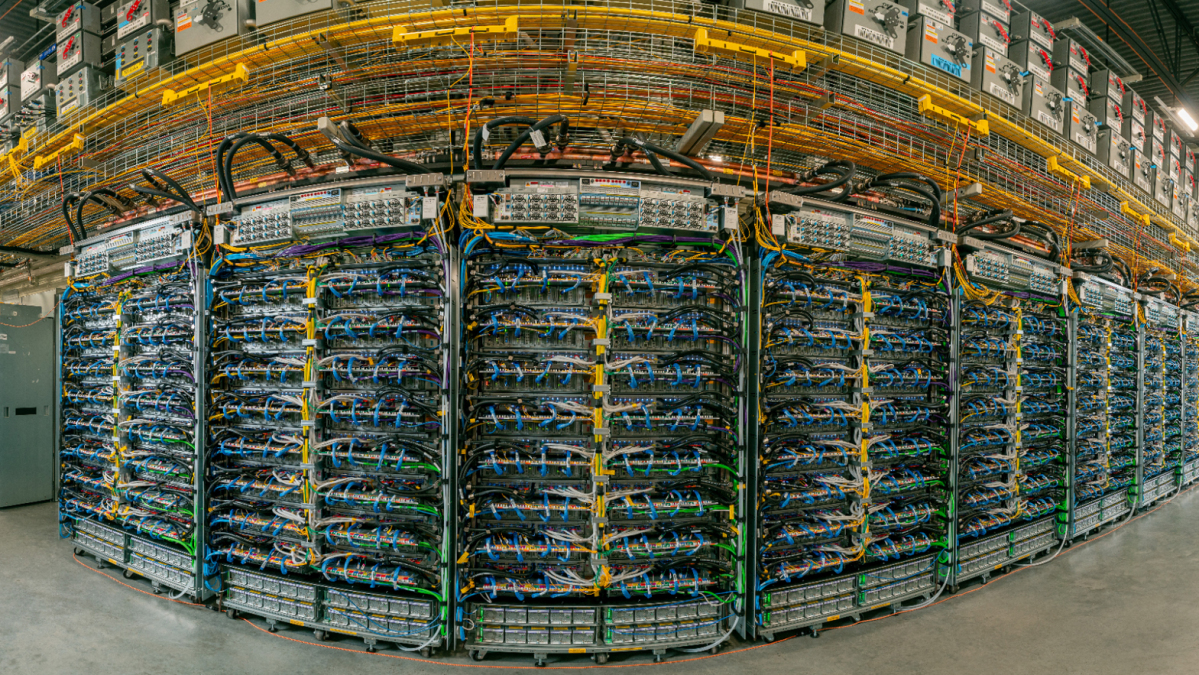
Google made its Ironwood Tensor Processing Units (TPUs) generally available this week and showed off its massive “superpod,” which features 9,216 Ironwood TPUs in a single system. The TPUs are Google’s latest processors for AI workloads, competing with AMD, Nvidia, and others to satiate the world’s rabid AI demand. The chips are designed for inference computing, such as when AI agents provide answers in response to questions from humans.
Ironwood TPUs are now Google’s fastest AI chips, offering four times the performance of the TPU v6e, its immediate predecessor, and 10 times the performance of the TPU v5p. (That’s for both training and inference.) The superpod has 9,216 Ironwood TPUs and Inter-Chip Interconnect (ICI) networking speeds as high as 9.6Tbps. Google says its superpod also features 1.77 PB of shared High Bandwidth Memory (HBM). The TPU cluster also features Google’s custom liquid-cooling system, adding to an already sizeable footprint.

Credit: Google
But the bulk (and, presumably, the cost) is worth it, thanks to the AI training and inference performance the connected TPUs can muster. According to Google, its superpod boasts 24 times the compute power of the El Capitan supercomputer.
Google designed the Ironwood TPU, but it doesn’t have the fabrication infrastructure to produce the chips on its own. As Reuters points out, Google hasn’t indicated which foundry produces the Ironwood TPUs. Still, given Intel’s struggles with its foundry business and TSMC’s capabilities, it seems likely that TSMC is behind Ironwood. It’s also worth noting that Intel recently aligned itself closely with AMD and is rumored to be considering making CPUs for AMD. Given AMD’s own stake in AI chips and Intel’s capabilities, TSMC makes sense for Ironwood TPUs production.
The demand for these large-scale chip superpods seems to be strong. Google claims it has more cloud computing deals exceeding $1 billion this year than in the previous two years combined. It also notched a 34% year-over-year increase in its third-quarter revenue.

Credit: Google
One of those major customers is Anthropic, which offers the Claude AI models. The company recently expanded its relationship with Google, giving it access to up to one million TPU chips in 2026.
Google also announced some updates for the software its customers use when accessing the hardware. The company now offers Cluster Director capabilities in Google Kubernetes Engine and offers better support for TPUs in vLLM. The open source MaxText LLM framework also received some updates.