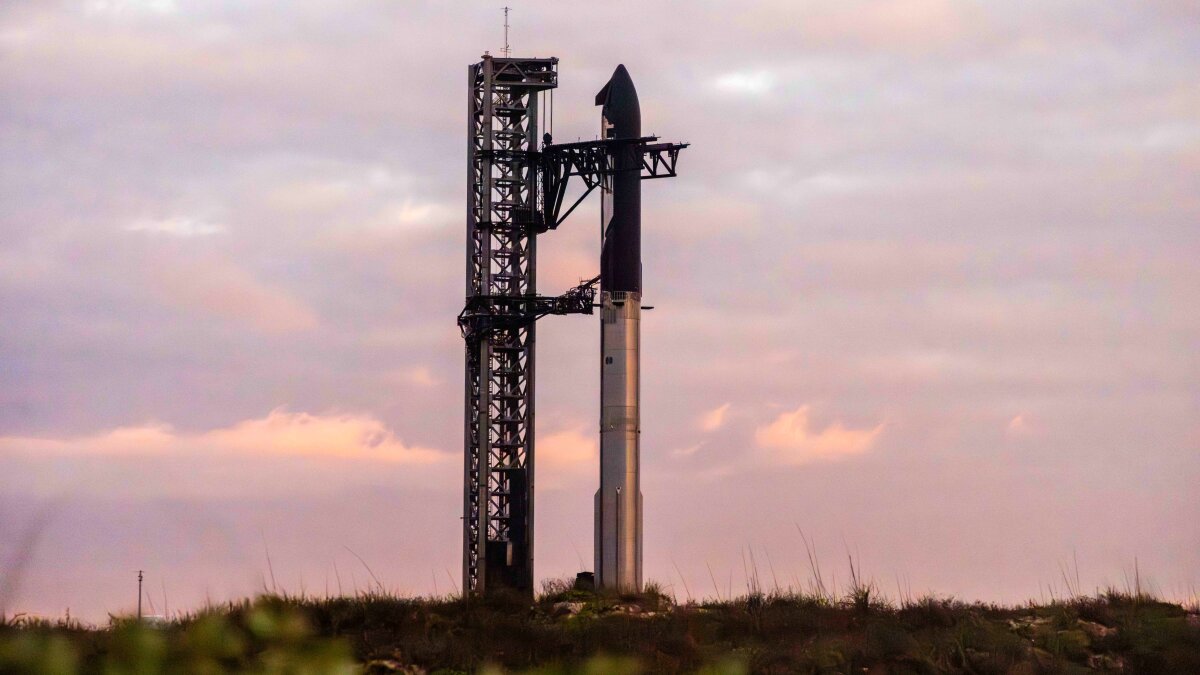
The stakes were high for SpaceX’s seventh Starship test flight on Thursday afternoon. Just hours earlier, Blue Origin’s New Glenn rocket reached orbit for the first time, moving it closer to competing with SpaceX. The SpaceX Super Heavy booster landed successfully for the second time, but Starship itself was lost just a few minutes after launch, eventually breaking up over the Caribbean. The internet, including Musk’s X platform, is overflowing with footage of the exploded vehicle.
In the lead-up to this launch, SpaceX confirmed it planned to launch a new version of Starship. The updated spacecraft was about 6.5 feet (2 meters) taller than the last one. It also included a raft of internal upgrades to avionics and propulsion to bring Starship closer to orbital operations. The vehicle was carrying its first non-banana cargo: a collection of dummy Starlink satellites that would be deployed in space.
SpaceX had one important win on Thursday when the Super Heavy booster landed safely after sending Starship on its way. SpaceX had to abandon its catch attempt during the sixth flight, but the mood was jubilant at Starbase as the booster came down seven minutes after liftoff. Just a minute later, Starship began exhibiting problems. The video feed cut out abruptly, and the telemetry shown on the live broadcast showed the ship’s engines winking out one by one.
Starship was supposed to perform a repeat of the successful sixth mission, landing hard in the Indian Ocean where teams would retrieve the debris. Instead, Starship broke up and reentered the atmosphere over the Caribbean. About 15 minutes later, people in Turks and Caicos, Puerto Rico, and other tropical locales were treated to a light show as the remains of Starship blasted overhead.
SpaceX CEO Elon Musk was among those sharing the videos on X, where he boasted, “Success is uncertain, but entertainment is guaranteed!”
A Setback for Starship
Until now, each Starship test flight had been an improvement on the last. Flight 7 was the vehicle’s worst showing since Flight 2, during which Starship broke up around the same time, just before main engine cutoff.
Musk has since noted that early indications are that an “oxygen/fuel” leak was able to completely fill the internal space of the ship on the other side of the engine firewall. Eventually, the ship wasn’t able to vent the gas quickly enough, and it blew.
SpaceX goes out of its way to make rocket tests a spectacle, and it sure got one this time. While the company did have great success with the first-stage booster, Starship is what will carry cargo, and eventually, people. Losing one after making so many critical upgrades is a setback, but the manner in which it was lost could affect the Starship program for a long time to come.
It’s customary for the FAA to investigate launch anomalies, sometimes at the expense of delaying future launches. In the past, Musk has railed against the FAA’s strict regulations, but the Flight 7 breakup caused numerous planes to be diverted, and the debris will be scattered over a large area. It’s unclear where the debris landed right now, but it it was anywhere near populated areas, that could be more bad news for SpaceX. The investigation into this “rapid unscheduled disassembly,” as SpaceX likes to say, could delay the eighth Starship launch for months, impacting Musk’s plan to launch 25 Starships in 2025.
Musk, however, was quick to claim the investigation should not push Starship Flight 8 beyond next month. That does seem like a quick turnaround, given the explosive loss. However, Musk is close with the incoming presidential administration, and the FAA reports to the executive branch. If Musk wants Starship cleared for launch in February, that might happen regardless of the FAA’s investigation.