Bungie seek to reassure everyone that Marathon is still alive… by saying almost nothing about it


Bungie have been fairly quiet about Marathon, the upcoming extraction shooter they announced in 2023. Yesterday they released a devlog in which game director Joe Ziegler seemed to want to reassure fans of the studio that the game was still in development. He talked around a lot of the game features, without actually saying much about it. As yet, there’s still no footage of the game in action, making its previous release window of 2025 appear even more tenuous.

Continue reading “Bungie seek to reassure everyone that Marathon is still alive… by saying almost nothing about it”

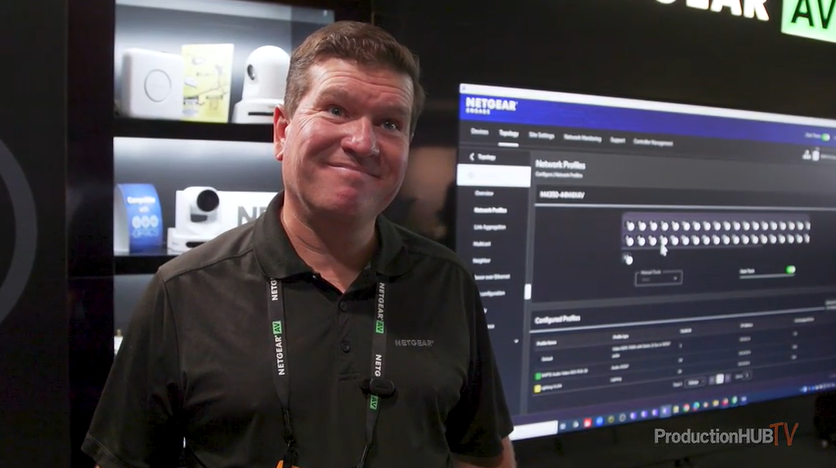
NETGEAR Showcases Enterprise-Class M4350 Series AV Switches at IBC 202


At the IBC 2024 Show in Amsterdam, NETGEAR unveiled its Enterprise-Class M4350 Series AV Switches, specifically designed to meet the demands of AV over IP (AVoIP) networks. These advanced AV switches are ideal for businesses seeking reliable, high-performance solutions for their audio, video, and lighting setups. The M4350 series stands out for its enterprise-class hardware, redundant power supplies, and support for 100G uplinks, ensuring top-tier performance for AVoIP applications.

One of the key highlights of the M4350 switches is the NETGEAR AV user interface and the Engage Controller, both equipped with pre-configured profiles to support major audio, video, and lighting protocols. The switches also feature IGMP Plus™ with Auto-LAG and Auto-Trunk, offering seamless multicast installation. Additional features like advanced IPv4/IPv6 security, intelligent thermal and acoustic controls, and PoE+ and Ultra90 PoE++ support for up to 90W per device make these switches a versatile choice for a wide range of AV installations.

With over 200 switching products in its portfolio, NETGEAR offers flexible options for AV over IP solutions, supporting speeds from 1Gbps to 100Gbps per port. This extensive product line can also power PoE cameras and security devices, providing a scalable and customizable network setup. NETGEAR’s switches can be tailored to meet specific customer needs, with room for future expansion, ensuring businesses can grow their AV infrastructure without limitations.

As video over Ethernet continues to rise in popularity, NETGEAR’s M4350 series meets the growing demand with products designed for ProAV installations. Whether you need modular switches for copper, fiber, or HDMI inputs, or a solution that fits a specific budget, NETGEAR has the expertise to guide businesses toward the perfect AV solution. These AVoIP switches offer flexible mounting options and can be deployed in a variety of environments, from university campuses to live event productions.

For businesses looking to upgrade their AV infrastructure, NETGEAR’s M4350 Series offers the perfect combination of performance, flexibility, and scalability to meet the evolving demands of AV over IP networks.

Read the full article from ProductionHub HERE

Learn more about NETGEAR below:

visual studio – List of more derived objects gioves compile error in a C# interface implementation


Can someone explain me why C# doesn’t support the following contruct ?

I have the following interface declaration:

public interface IConfigurationResult
{
    public int ItemId { get; }

    public string ItemCode { get; }

    public IList<IConfigurationVariable> Variables { get; }
}

The interface IConfigurationVariable is implemented in the class ConfigurationVariable that for semplicity I won’t add here.

Then I have the following class definition:

public class ConfigurationResult : IConfigurationResult
{
    public int ItemId { get; }

    public string ItemCode { get; }

    public List<ConfigurationVariable> Variables { get; }//This returns a compilation error
}

Why the error ? List implements IList and ConfigurationVariable implements IConfigurationVariable, so I’m declaring a more derived list with a more derived class, it should be fine, instead I get the error that Variables is not defined.

Ok, I know that List does allow changes to the list why IList doesn’t, I know about the covariance and contravariance story, but if I need the declaration of the interface to be shared with other libraries and I would like to share the interface and not the class, to hide the implemenation (not necesary) that is not needed in the libraries, why not giving me the possibility of doing it ? It should exist a way to make it work… I cannot understand that.

Maybe there is someone smarter than me (many billions for sure) that can offer an explanation.. and most importantly, a solution.

Thank you in advance.

Data Sharing Marketplaces for Dummies


Ever felt like finding data should be a simple task for all teams, regardless of technical expertise? Well, that’s what the “Data Sharing Marketplaces for Dummies” is here to help with.

Data has always been a prized asset but accessing it isn’t always straightforward. Our eBook promises to flip the script. By prioritizing the data consumer’s experience, it assures that finding, accessing and using data is streamlined – no more endless searching.

Here’s what you’ll get:

  • A clear understanding of data sharing marketplaces
  • Insights on how to set up a marketplace and ensure its success
  • Strategies to streamline your data handling processes

Amazon leaks tiny Mac Mini with M4 Pro


The one tiny image of the new silver Mac Mini shows what appear to be a headphone jack and two front-facing USB-C ports, presumably with at least Thunderbolt 4 support. It’s available with a base or Pro version of the new M4 chipset, with up to 14 CPU cores, 20 GPU cores, 64GB of memory, and 8TB of storage. The backside ports will remain a mystery for now.

The M4 will be a significant jump from the M2 found in current Mac Minis, last refreshed in January 2023. That boost in power should help with current and future Apple Intelligence processing, jumping from 15.8 TOPS to 38 TOPS according to previous reporting by Bloomberg’s Mark Gurman.

Amazon’s pulled Mac Mini comparison chart.
Image: MacRumors

Gurman also notes that the new smaller Mini approaches the size of an Apple TV streamer. And judging by the side-by-side with the Mac Studio, it certainly looks small which should make it a very compelling Mac in terms of size and power.

The Mac Mini is rumored to be getting an official announcement later today with full details and pricing so stay tuned.

Call of Duty: Black Ops 6 (Campaign) Review


Game name: Call of Duty: Black Ops 6 (campaign mode)

Release date: October 25, 2024

Price: US$69.99

Available on: Steam

Genre: First person shooter

Developer: Raven Software, Treyarch

Publisher: Activision

OpencriticHere

Before I begin this review for the campaign portion of Call of Duty: Black Ops 6, I must confess one thing: I haven’t truly enjoyed a Call of Duty single player campaign since Infinite Warfare, and even that one came with some caveats, as while I liked the gameplay and some ideas it had, the story didn’t feel compelling and I couldn’t really connect with most of its characters. I’ve played every single mainline Call of Duty campaign with the exception of Vanguard, some on Steam, some via PC Game Pass now that Microsoft owns Activision and has started putting their back catalog on the popular subscription service. The last Call of Duty campaign that I enjoyed wholeheartedly was Black Ops 2, which was a very fun mashup of sci-fi and Cold War era gung-ho secret agents saving the world from hidden conspiracies. So with all of that in mind, join me as I take a deep dive into the sixth numbered entry in the Black Ops sub-series. Will it rise to the heights of the first two titles or drown in the mediocrity of the third one?

Story-wise, Black Ops 6 takes place some time after Black Ops: Cold War (a title that I neither hated nor loved, as it felt formulaic and too often afraid to try anything new, or even get close to the things that drove me to appreciate the first two entries in this long-running sub-series). Characters that were introduced in that game return here, but overall, this is a self-contained adventure that rewards long time fans with constant nods to earlier titles without ever drowning us under mountains of poorly delivered exposition. Raven Software clearly respects the player’s time and correctly assumes that anyone playing this campaign doesn’t need to get bogged down in unnecessary details, while at the same time knowing when and where to sprinkle fan service in a tasteful way. For me, this was already a massive step-up from last year’s dreadful Modern Warfare 3 reboot campaign, which never knew when to shut up about the most boring things, while at the same time losing me constantly with poorly seeded references to events in the previous two games which I’d already mostly forgotten due to how unremarkable these titles were.

Once the player is done with the intro mission, they are dropped into a safe house of sorts which acts as our base of operations, and plays host to some fairly entertaining puzzles that can be used to unlock some extra backstory and cash that will help us upgrade our character with some helpful but not game-changing boosters such as more armor pieces, or health, or better recoil control, etc. It’s a very inoffensive system in an age where even DOOM fell prey to the allure of faux-RPG systems, and while I think the game would have been more than fine without it, it didn’t really have any negative impact on my experience of it, and it did encourage some light exploration during missions, as there are hidden caches that require a small degree of puzzle solving, a welcome departure from the era where we couldn’t deviate a single millimeter from our intended objective lest some unseen observer decide to cast the fury of the gods upon our heads for “abandoning the mission”.

Anyone who has suffered through the campaign mode of the last rebooted Modern Warfare title might be thinking that these more open, exploration focused levels I’ve just praised are the “open combat missions” that made up the bulk of the playable content on that title, and may be rightfully worried about that. Thankfully, nothing could be further from the truth, as in reality only one mission follows that approach, and even that one springs enough surprises along the way to feel like something worth playing. Raven Software truly brought their A game when designing the levels in Black Ops 6, and, in my humble opinion, even managed to top the widely beloved two first entries in the series with some of them. This is a game that’s never afraid to get weird, without crossing over into the bizarre. I’m not going to spoil what I consider to be some of the best levels in the series, but mission variety is at an all-time high here, with some maps letting us approach things in a Hitman-lite fashion, but crucially also not forbidding us from engaging in open combat if things go wrong. Instead of instantly triggering a fail condition, being discovered simply ups the ante in a fairly noticeable way, with enemies rushing our player character and forcing us to think on our feet in order to complete the objectives and survive. The developers clearly understood that fans of Call of Duty campaigns want to shoot dudes in the face and play through elaborate set pieces, while at the same time realizing that the franchise sorely needed new ideas.

Another thing that added much-needed variety to the missions was that the game will often drop us into a relatively open section where we can take our time exploring and gathering cash for upgrades, and then transition into a more typical, set piece-driven Call of Duty experience where we must constantly push forward while everything goes boom around us. It might sound simple, but it works very well, and it made a relatively long campaign (eight to ten hours) feel like it never overstayed its welcome, something that sets it apart from the last four titles in the series, which were all fairly short, four to six hour long experiences, and yet I was begging for them to be over way before the finish line was in sight.

Obviously, great level design and mission variety can only do so much if the story itself is a poorly written mess, but I’m happy to report that’s not the case here, as while we won’t find any award-winning scriptwriting, Black Ops 6 knows very well how to keep players entertained with interesting twists and turns without ever devolving into a weirdly over-complicated mess like Black Ops 3, or a boring slog like the past three Modern Warfare reboots. Characters are introduced and we get enough time with them to understand their motivations and root for (or against) them. The voice cast did an excellent job with the script they were given, and the animators and motion capture artists also helped tremendously, as almost every single important line is given the right amount of weight via the characters’ facial expressions and body language.

How does the gunplay and general gameplay hold up against everything else, I hear you ask? Well, the much-publicized omni movement system that had everyone hyped for the multiplayer portion of the game is actually included in the campaign as well, and while I was fully ready to dismiss it as a marketing gimmick, I’m now a believer. It’s not some incredible game-changer (or at least not for someone of my skill level) but it does enable really cool moments that truly feel ripped straight out of an action movie. Swan-diving behind cover while blasting everything in a 360-degrees angle feels as good here as it did in Max Payne 3, and the fluidity of the animations ensures the player is almost never left stuck in a corner wishing they wouldn’t have tried this or that move when confronted by a minigun wielding elite soldier. As for gunplay, this is still Call of Duty, and it feels pretty much the same as it has for the past half a decade or so, which is not a bad thing, as the one thing I quite enjoyed in the three Modern Warfare reboots is their gunplay and gun-feel. Spraying down hordes of enemies never gets old, and there’s a bunch of very satisfying weapons to be used as the campaign progresses, with my favorite being a Dragon’s Breath shotgun that left a fiery apocalypse in my character’s wake.

So far I’ve been unflinchingly positive when it comes to Black Ops 6‘s campaign, but there is one aspect that left a little to be desired, and sadly it’s Activision’s weird kink for forcing every single post-MWII (2022) title into their Call of Duty HQ launcher. You’d think it wouldn’t be a big issue, but in practice, using this half-assed launcher for everything means that launching the campaign can take a fairly long time (especially the first time you do it, since the game has a shader compilation step) and if there’s an update, you can expect to fire up the main launcher, select the BO6 campaign option, wait for that to launch, then receive an “update requires restart” prompt, restart the main launcher, go back into the appropriate option… and in some cases, have to restart AGAIN just because Activision wanted to have every single new Call of Duty game as DLC for their shiny new launcher.

Now, if nothing else goes wrong this isn’t as much of an issue for anyone who has a good few hours to sink into the campaign, but the real trouble starts if you encounter a connection error (which can kick you from the single player mode for some reason) or, even worse, a crash. Before the first post-launch patch hit the servers yesterday, I was playing through the campaign, thoroughly enjoying myself, until I got to a mission where the game sent me back to the desktop with an error message. No problem, I thought, and I went through the whole launching process again (having to click on a “want to go into safe mode?” message mid-way through because of how the thing works), only to experience further lockups, which were apparently happening on all versions of the game, including the console ports, and forcing me to go through a lengthy ritual every single time I wanted to see if I could progress. Eventually, a patch came out and fixed it so I was able to finish the mission and later on, complete the game (with no more crashes, to be fair). But the real question here is why is all of this a thing? Why can’t we just go back to the previous system where we could select the campaign mode right from Steam, and skip a bunch of nonsense?

Moving on from that annoying stuff, the actual tech side of the game is pretty much flawless, with all sorts of graphical options ensuring that even a mid-range setup like mine (Ryzen 5 5600x, 32GB RAM, Nvidia RTX 3070) can play the campaign at an average 90-100 FPS with DLSS on and settings at a mix of High and even some maxed out. Special praise goes to the music, both the original pieces and the licensed portion of the soundtrack, which was carefully selected to fit certain set pieces and augment the experience. Gunshots and ambient sound were all fairly well mixed in my opinion but I’m no audiophile, so don’t take my word for it if you are.

But enough from me, I’ve droned on for far too long and I really want to get back into the Zombies mode, which has so far proved an excellent experience (look for our review of the multiplayer/Zombies portion later this week if you are interested in that). What are my overall thoughts on Raven Software‘s return to the spotlight? Black Ops 6‘s campaign is a much-needed return to form for the long-running franchise, providing a fairly meaty experience that’s never afraid to surprise players while at the same time delivering some of the best set pieces in the series. This is modern Call of Duty at its best, shedding its corridor shooter DNA whenever it needs to, and embracing it again at the next step if that means the player will have a good time, and I couldn’t be happier with it.

9/10 – Great.

New Home Experience in the Xbox App on Windows Is Available for Xbox Insiders


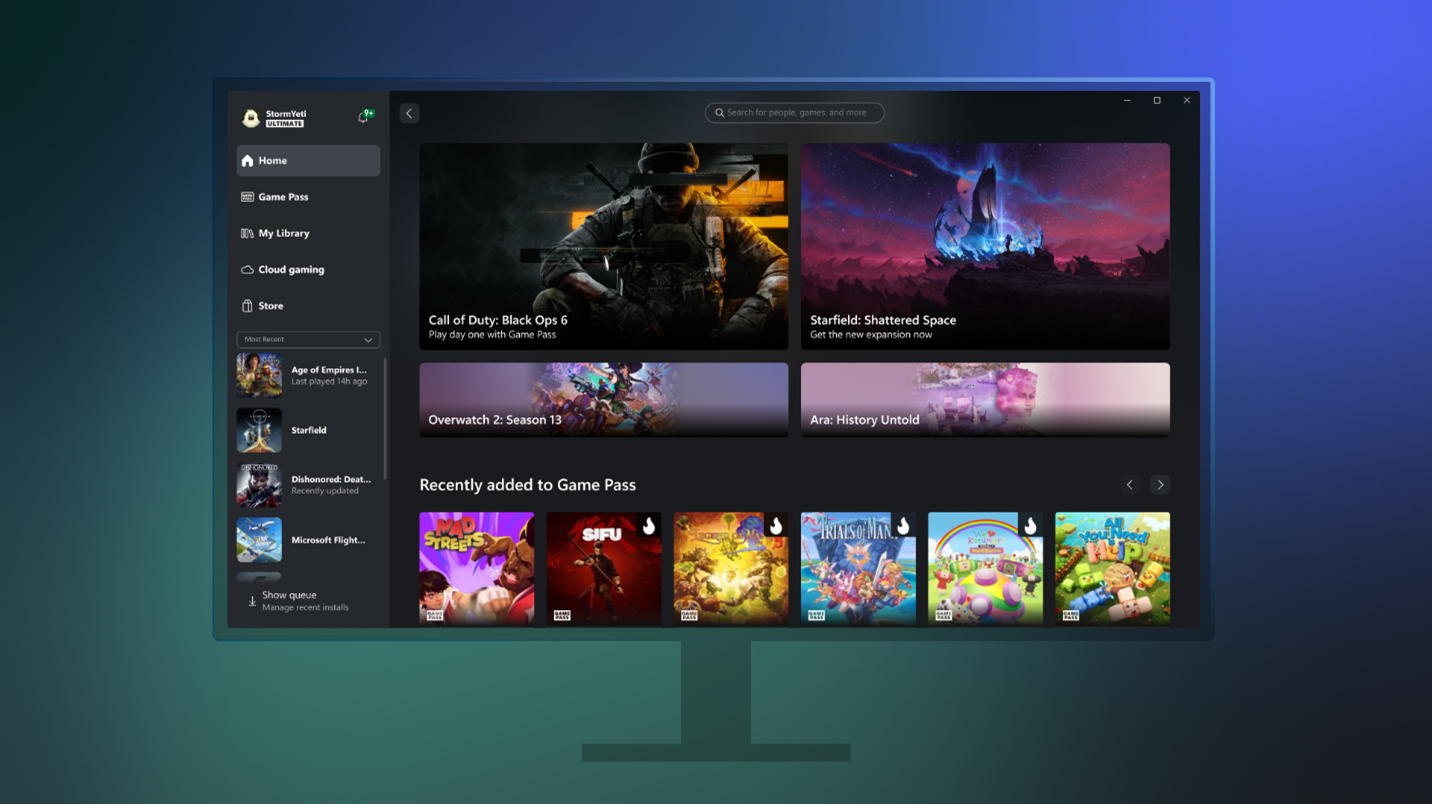
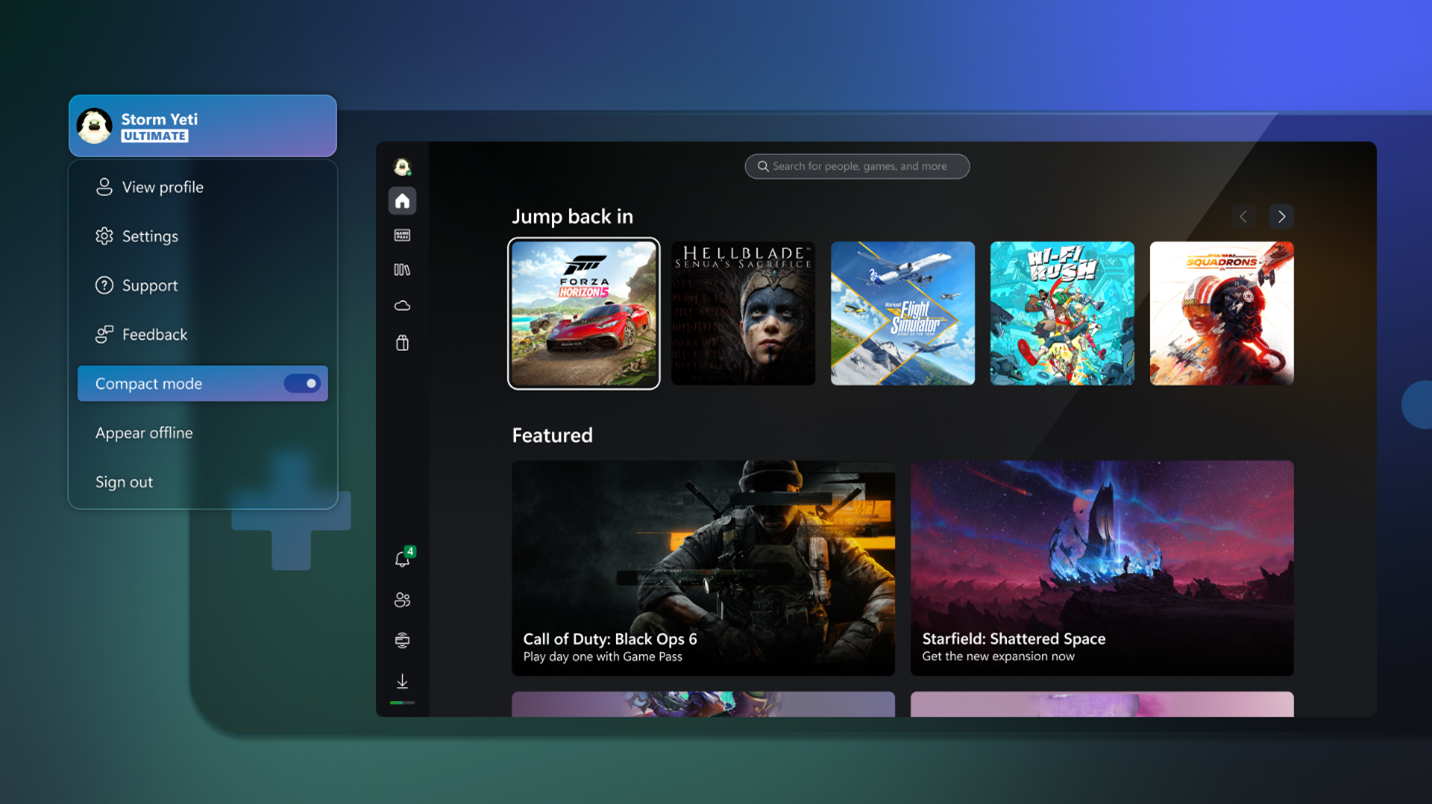
Starting today, we are excited to announce that a new Home experience is available in the Xbox app on Windows for Xbox Insiders! We are improving the Xbox app on Windows by making it faster and easier to find your next favorite game. We’ve listened to your feedback and have been testing different designs internally over the last several months. Our goal is to create a unified Home experience that combines the best and latest content from both the Game Pass and Microsoft Store tabs, so you can easily find what you love without having to jump between tabs. 

All Xbox players on Windows will benefit from Home, whether you play with Game Pass or purchase your games individually. Home brings you the latest games, news, curated recommendations, free-to-play content, and deals.

Check out the new Home tab and let us know your thoughts by completing this short 2-minute survey available here. Your feedback will be used to inspire future updates and plans as we continue to evolve. 

Now, let’s take a look at some of the updates that you can expect to see in Home starting today. 

New Home highlights 

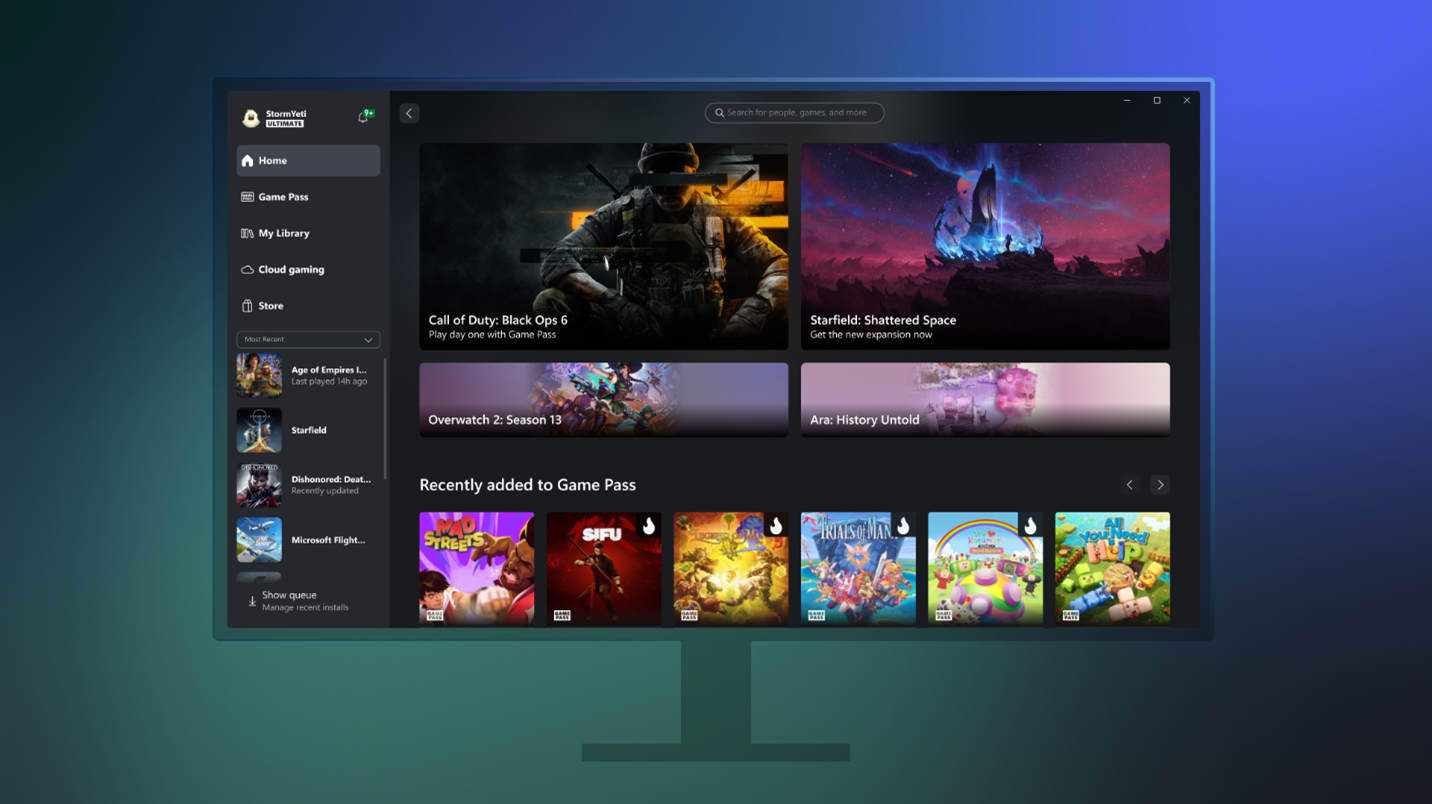
Featured content. At-a-glance view for you stay up to date on exciting game releases, new events, content available with Game Pass, sales, and more! 

A screenshot of a desktop computer displaying the new Home interface.

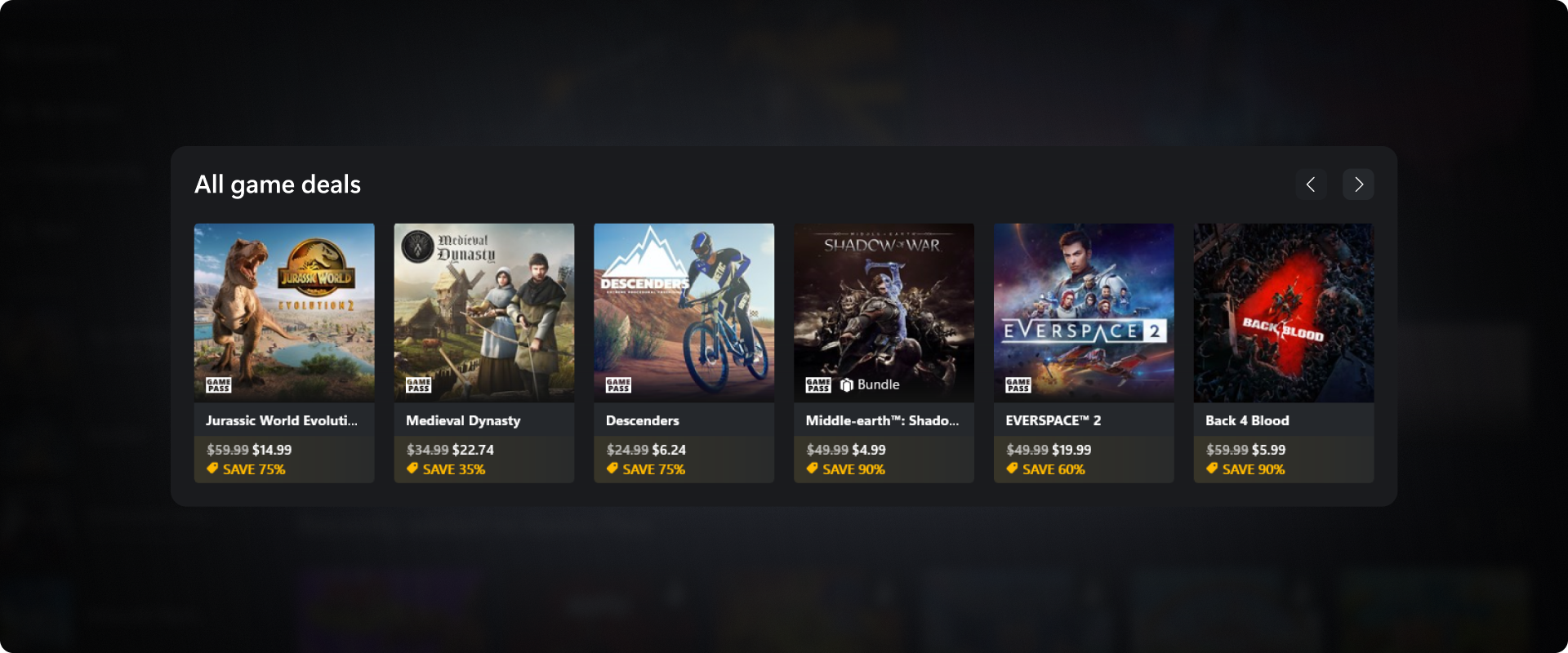
Deals and discounts. No more navigating through the app to find the latest deals and discounts. The new Home will now have collections with the best deals and discounts to make sure you can see available savings at a glance. 

Note: Prices shown are for illustrative purpose only and may vary.

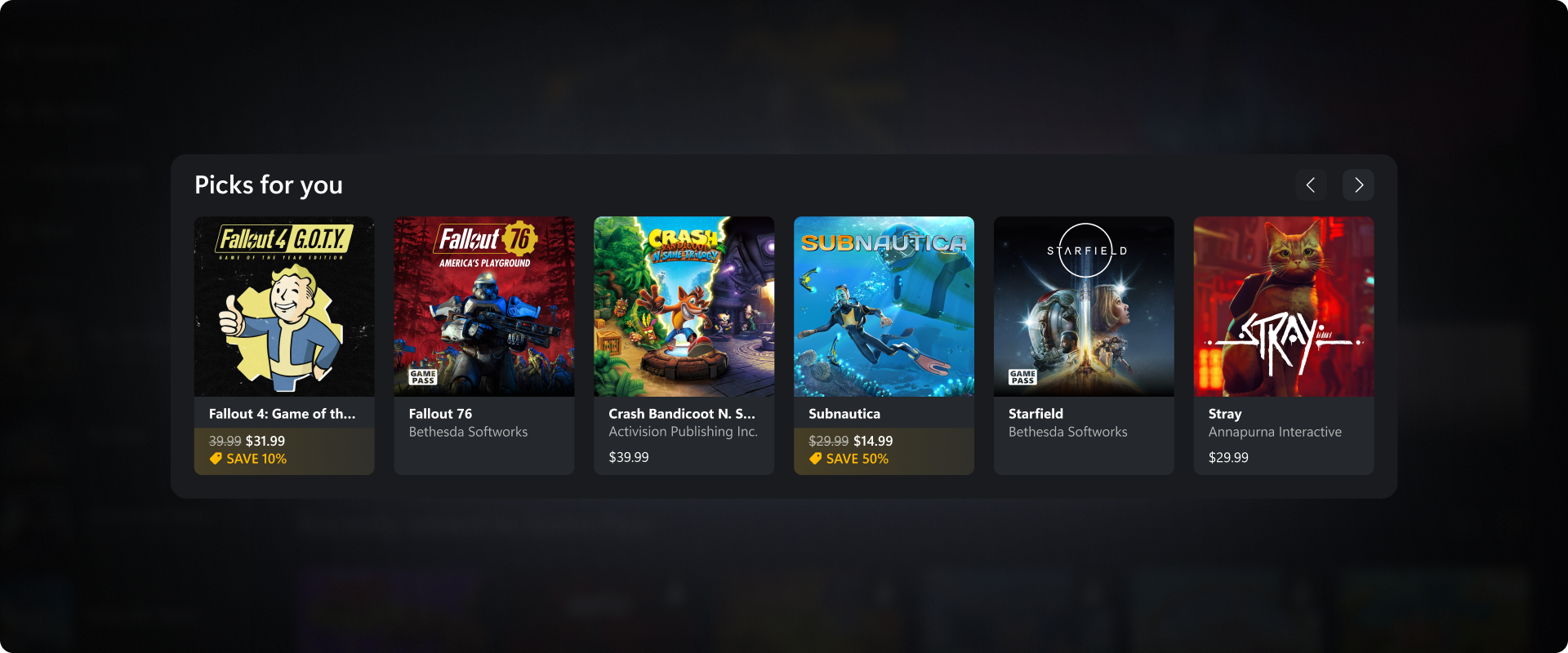
Curated collections and recommendations. Find games that are perfect for you with collections curated and personalized for you. Spend less time searching and more time playing games.

Note: Prices shown are for illustrative purpose only and may vary.

Jump back in (available with compact mode). In May, we tested Jump back in as part of the Game Pass tab experience. This feature allows players in Compact Mode to click on any game card shown, allowing them to go directly to its game hub, where you can jump right back into game play.  Today, we are excited to add this feature as part of the new Home experience for all Xbox Insiders. 

How to get Xbox Insider support and share your feedback 

If you’re an Xbox Insider looking for support, please join our community on the Xbox Insider subreddit. Official Xbox staff, moderators, and fellow Xbox Insiders are there to help. We recommend adding to threads with the same topic before posting a brand new one. This helps us support you the best we can! Also, you can provide direct feedback to Team Xbox by following the steps here under the “Report a problem online” section.  

If you aren’t part of the Xbox Insider Program yet and want to help create the future of Xbox and get early access to new features, join the Program today by downloading the Xbox Insider Hub for Xbox Series X|S & Xbox One or Windows PC.  

For more information on the Xbox Insider Program, follow us on Twitter at @XboxInsider. Keep an eye on future Xbox Insider Release Notes for more information regarding the PC Gaming Preview

Note: This feature is being made available to Xbox Insiders enrolled in the PC Gaming Preview.  


Easily add Unreal Engine classes to your C++ project


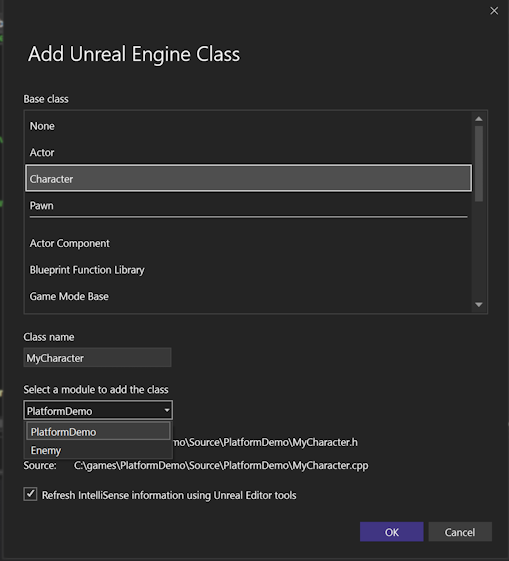
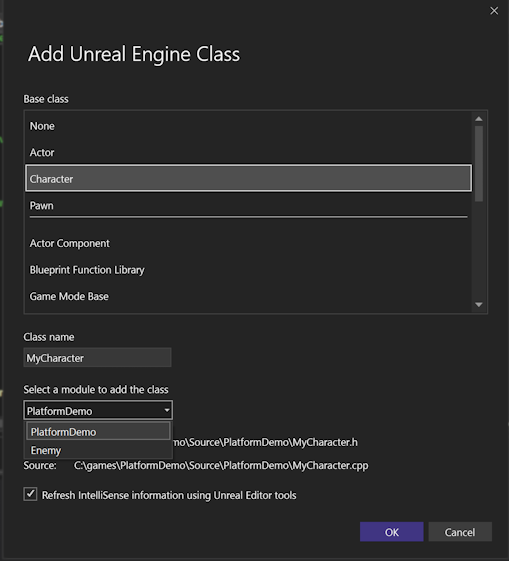
Visual Studio 2022 v17.11 introduces a new Add Unreal Engine Class dialog that lets you easily add common Unreal Engine classes to your project. You can also choose to which module to add your class, so you can keep your code organized and modular.

Adding the Unreal Engine Character Base classs

To use this feature, you need to have an Unreal Engine project open in Visual Studio. Right click on the project in Solution Explorer and select Add > Unreal Engine Item. In the Add New Item dialog, select Unreal Engine Common Classes to open the Add Unreal Engine Class dialog. This dialog shows you a list of common Unreal Engine classes that you can use as a base for your new class. Once you select a base class, you can enter the name of your new class. You can also specify the module to which Visual Studio should add your class.

When you click OK, Visual Studio will generate the header and source files for your new class and add them to your project. You can then open the files and start writing your code.

Benefits of using the Add Unreal Engine Class dialog

The Add Unreal Engine Class dialog has several benefits over the previous way of adding Unreal Engine classes to your project. Some of the these benefits are:

You can choose from an expanded list of base classes by simply selecting one from the Base class list.

You can specify the module name for your class, which helps you organize your code into logical units. Modules are Unreal Engine plugins or projects that contain related classes and assets. By creating separate modules for your classes, you can improve the modularity, reusability, and maintainability of your code.

You can avoid naming conflicts and errors when adding classes to your project. The Add Unreal Engine Class dialog checks the validity of your class name and path and warns you if they conflict with an existing class or file. It also ensures that your class inherits from the correct base class and includes the necessary headers and macros.

Try it out

We hope you enjoy using the Add Unreal Engine Class dialog in Visual Studio. This feature is part of our ongoing effort to improve the C++ development experience for game developers. We would love to hear your feedback and suggestions on how we can make it even better. Please share your thoughts with us on Developer Community or Twitter.

We also want to thank you for your continuous feedback and support, which helps us make Visual Studio the best tool for developing games with Unreal Engine. Stay tuned for more updates and features coming soon.

Polling 101: Weighting, probability panels, recall votes, and reaching people by mail


A close election is all about uncertainty. So it’s not surprising that many Americans are relying on polls to offer comfort, or warning. Not all polls are created equal, however — and election experts caution that some are more impartial than others.

Not only that, pollsters vary wildly in their level of outreach, and how much they adhere to industry norms regarding data accuracy.

Take this poll released Wednesday by Quinnipiac University, which says Vice President Kamala Harris was ahead of former President Donald Trump by three percentage points in the battleground state of Michigan. On Twitter/X, the improved result for Harris buoyed her supporters, while Trump fans challenged the poll’s veracity.


Samara Klar, Ph.D., a political science professor at the University of Arizona’s School of Government and Public Policy, stresses transparency when it comes to deciding what polls to give credence to. 

“A poll consumer should be able to clearly see how the data were collected, when it was administered, how many people are in the sample, and demographics of who they are,” Klar tells Mashable. 

A weighty matter

Pay attention to whether a poll’s results are weighted, Klar adds, referring to the statistical technique done to data after collection. Weighting aims to correct sampling errors by measuring certain responses differently to account for the poll’s underrepresented groups.

For example, if few respondents of a poll are Gen Z, or female, that pollster may give more weight to younger women’s responses than older, male participants.

“If the data are weighted, it is helpful to know the criteria upon which the weighting was done,” says Klar.

Ideally, she adds, polls should have sample sizes close to 1,000 respondents, “as this allows for smaller margins of error and closer estimates.”

A margin of error — typically around 3% for 1,000 respondents — is a caveat, acknowledging a sample can never provide a full picture. The American Association for Public Opinion Research (AAPOR) describes error margins as “the range that [a respondent’s] answer likely falls between if we had talked to everyone instead of just a sample.

Mashable Top Stories

“For example, if a statewide survey of adults with a margin of error of plus or minus 3 percentage points finds that 58% of the public approve of the job their governor is doing, we would be confident that the true value would lie somewhere between 55% and 61% if we had surveyed to the whole adult population in the state.”

‘No way to be sure a poll is reliable’

Even accounting for ideal sample sizes, weighted data, and margins of error, David Wasserman, senior editor and elections analyst at the nonpartisan Cook Political Report, paints a less rosy picture of polling accuracy.

“There is no way to be sure a poll is reliable because response rates are very low these days,” Wasserman says. “Every pollster is making a different assumption about who will turn out and vote that may or may not turn out to be accurate. You can give the same raw data set to 10 different pollsters and you might get seven or eight different top-line results of a survey based on how the pollsters assume each cohort of voters are going to comprise the electorate.”

If it seems like random polls are popping up everywhere lately — not just the ones from established pollsters like YouGov or The New York Times/Siena College — well, that’s because they are. “There are plenty of newer pollsters with no track record or very limited track record this cycle, as there were in 2022,” Wasserman says. “Democrats are fond of pointing to Republicans flooding the zone with Republican-leaning surveys.”

“There is obviously an effort by mainstream and other pollsters to correct the under-sampling of Trump’s base of support in 2016 and 2020. Pollsters are going about that in different ways but one of the most common ways is to weight their sample by how voters recall voting in the 2020 election.”

The weighting of so-called “recall votes” aims to correct the hesitation of some voters to admit they voted for a past presidential loser. So pollsters weighting recall votes this cycle would give more emphasis to those admitting to voting for Trump in 2020. 

One thing that unites all good pollsters, according to both Klar and Wasserman, is adherence to standards set by the AAPOR. Members of the organization, which includes the most respected pollsters, agree to abide by the organization’s Code of Professional Ethics and Practices. That includes standards on training, transparency, sampling methods, and weighting.

Reaching voters in the modern age

The dearth of responses to most polls requires careful consideration regarding weighting, Wasserman says. While the idea that pollsters are ringing up landlines is outdated, Wasserman says, even contacting people through cell phones, texts, or online panels is a challenge.

Many pollsters have also started utilizing mail to reach respondents, according to the New York Times — often with an offer of a financial incentive to take an online poll, referred to as a probability panel. The new methodology is a way to counter the low response rates of randomly calling potential voters, which is something only one notable pollster, Quinnipiac, still does.

“It’s common for telephone polls, even if they’re overwhelmingly cell phone samples, to wield less than 1% completed responses,” Wasserman says. “For every 100 phone calls you’re making, you might get one completed survey, sometimes it’s less than that.

“Text to web modality is reaching younger voters. But it’s difficult to reach 18-34-year-old voters no matter what mode you’re using, so what ends up happening is pollsters up-weight the respondents they do get in that age bucket to reflect their expected share of their electorate. But pollsters have to make a judgment call about what share they expect.”

The Cook Political Report features a national polling average on its website, culling the latest data from a range of respected and diverse pollsters, like Fox News and ABC News/Washington Post. Three times this year, Cook conducted their own battleground state polls with a large online panel.

“We can’t be positive that our numbers reflect the true state of play, but we made our best effort to come up with an approach that our polling partners, a Democratic firm and a Republican firm, both felt comfortable with,” Wasserman says.

While imperfect, polls still serve an important purpose, Klar insists.

“Polls are great at showing us a snapshot in time: what do people think now,” she says. “Forecasting requires that polls predict the future: Who will actually show up to vote weeks, or months, or sometimes years, from now? Will people change their minds between now and then? If you’re interested in learning what people think today, then polls are tremendously valuable.”

On the other hand, “if you’re looking for a crystal ball to predict the future, you have to take poll results with a grain of salt.”



Atomos Sun Dragon: Professional Lighting for Video Productions


In Stephan Kexel’s article “Lighting for Video Productions: The Key to Professional Results”, he explores the crucial role lighting plays in creating professional-grade video content. Whether you’re working on large-scale film productions, music videos, or even YouTube videos, mastering lighting techniques is essential for achieving high-quality results. Good lighting not only enhances visual clarity but also sets the mood, supports storytelling, and avoids technical problems like image noise or color issues.

Why Lighting is Essential in Video Production

Lighting in video production serves three main purposes: visual clarity, mood creation, and technical precision. A well-lit scene makes the subject stand out clearly and adds depth, while different lighting styles can convey emotions—whether it’s a bright, lively setting or a dark, mysterious atmosphere. Kexel emphasizes how professional lighting helps avoid common technical problems, such as grainy footage or improper color representation, especially in high-resolution and HDR video formats.

Basic Lighting Techniques for Beginners

Kexel introduces fundamental lighting setups that every videographer should know. The three-point lighting technique—key light, fill light, and backlight—is standard in most productions. The key light illuminates the subject, the fill light reduces shadows, and the backlight adds depth by separating the subject from the background. Additionally, Kexel discusses how natural light can be a powerful tool, though it requires flexibility due to its dependence on weather and time of day. Techniques like low-key lighting and high-key lighting also provide contrasting effects, perfect for specific genres such as dramas or comedies.

Advanced Lighting Solutions: The Sun Dragon by Atomos

One of the standout tools Kexel highlights is the Sun Dragon by Atomos, a revolutionary LED lighting strip that offers exceptional flexibility and color accuracy. With its RGBAW (Red, Green, Blue, Amber, White) technology, the Sun Dragon allows filmmakers to creatively adapt lighting to any scene. It boasts high Color Rendering Index (CRI) and Television Lighting Consistency Index (TLCI) scores, ensuring true-to-life colors, which are particularly beneficial in post-production. Additionally, its Spectral Similarity Index (SSI) ensures consistent color rendering across different cameras, reducing the need for time-consuming color correction.

Creative Lighting for Different Video Projects

Kexel explains how the Sun Dragon can be applied across various video projects. For interviews and documentaries, it can provide soft, natural lighting with minimal shadows. In music videos, its dynamic color controls create dramatic effects that sync with the beat of the music, while in dramatic films, the Sun Dragon’s flexibility allows for creative low-key lighting setups in tight spaces or complex sets.

Why Investing in Professional Lighting Matters

Kexel wraps up the article by emphasizing the long-term benefits of investing in high-quality lighting. Good lighting not only improves the look of a video but also saves significant time in post-production. Tools like the Sun Dragon allow filmmakers to efficiently implement precise lighting setups, minimizing the need for heavy color correction and adjustments later on. In short, lighting is not just about illuminating a scene—it’s a powerful creative tool that every filmmaker should master.

Conclusion

Whether you’re a beginner or an experienced filmmaker, understanding the importance of lighting in video production is key to achieving professional results. From basic setups like three-point lighting to advanced tools like the Sun Dragon, mastering lighting techniques can drastically improve the visual quality of your content. By investing in the right lighting equipment, you’ll not only enhance your video’s overall look but also streamline your production process.

Read the full article by Stephan Kexel for Riwit HERE