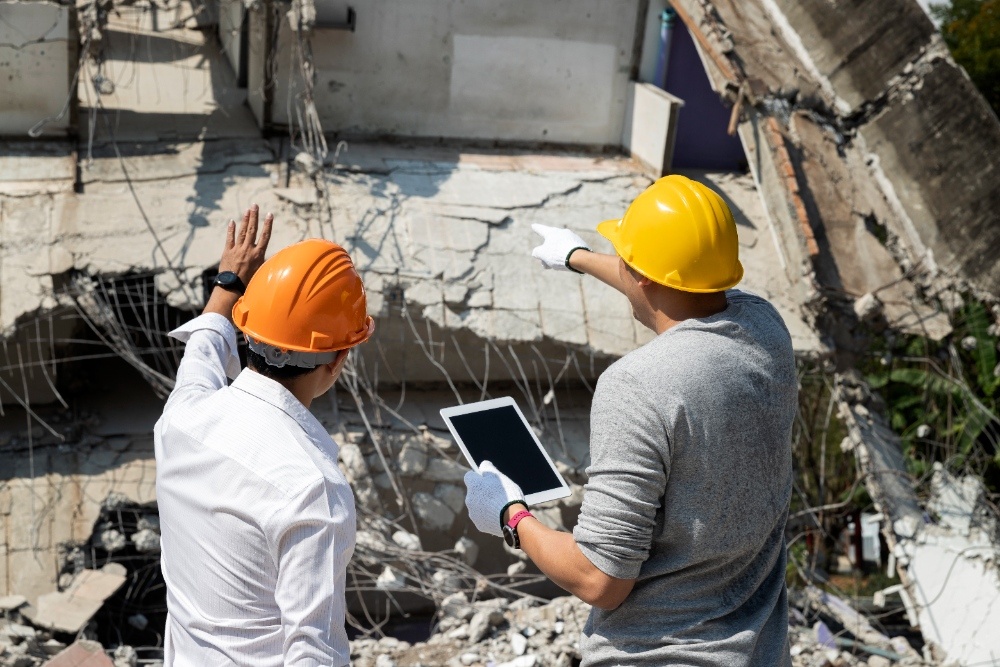

Statistics from FEMA show that 40%-60% of small businesses don’t re-open following a significant physical disaster. This isn’t an exercise in pessimism, it’s a statement of statistical odds. If your property disaster recovery plan consists of a generic compliance checklist, those odds reflect the probability of your business surviving the shock of a disaster. But if you plan around the triage principles of protecting the financial lifeblood of the business, protecting the capacity to operate, and focusing on the brutal reality of the first two days… those statistics turn on their heads.
Hazard Vulnerability Assessment
Before you can plan to protect something, you need to understand the risks to what you want to protect. A hazard vulnerability assessment (HVA) is an analysis that scores the potential failure modes to a property specific to the business function of the organization being assessed.
A law firm on the twelfth floor of a corporate high rise has entirely different risk factors than a distributed product based business operating out of a home garage. The high rise is concerned with elevator down time and HVAC smoke migration on the floors above and below them. The home garage business has to worry about lack of proper suppression coverage, residential load bearing characteristics, and the ability to support commercial electrical demands without upgrading the entire electrical service to the residence. Once the HVA is completed it should be mapped out, each of these potential system precursors assigned a probability score from zero to ten, and an impact score from zero to ten, then multiply the two numbers together for a risk factor. The items with the highest risk factor scores should dictate the planning investment priority. Distance to water sources, proximity to industrial facilities, and fire department accessibility will also inform the analysis. Completing an HVA should be the starting point of any property disaster recovery planning.
Emergency Chain of Command
Things can get worse, and somebody needs to take charge and bring the situation under control. More importantly somebody needs the authority to cut checks, call in your insurance adjuster, and interface with the fire department incident commander before the electricians have finished their work.
As part of your property disaster recovery plan, document your emergency chain of command, assigning at least three people primary responsibility with at least two others standing by to immediately replace them if they become unavailable. The chain of command document should state specifically what those taking on emergency management responsibility can do without asking for your permission. Your primary recovery coordinator should not have to ask you before approving the contract for the job site restoration company. Give them the authority and means to authorize the expenditures.
Create your chain of command to be able to operate with one third fewer people than you currently employ. Disasters don’t always strike on a Monday morning when the whole staff is on site.
Assign recovery response functions by discipline; communications, IT infrastructure, operational, and facilities support, and ensure that there is a backup for every person named on any task list, with actual people with the required skills, not just a name and title on a worksheet.
OSHA standard 1910.38 requires every business with more than ten employees to have a written Emergency Action Plan, that includes; a written evacuation procedure, alarm procedure, and a shutdown procedure for critical operations. The chain of command should be written to comply with the OSHA requirements. Put the two documents side by side on your emergency management desk when the time comes for everyone to actually use them.
Detailed Asset Inventory
Most claims fail either because a business cannot prove ownership of the lost equipment or cannot prove the value of the lost assets. Adjusters don’t need to be beaten over the head with proof, but they do need to see proof. As part of your property disaster recovery plan, you need to document everything and store that information somewhere safe, like the cloud. In the modern business age, that includes hard inventory, specialized tools, IT infrastructure, and software licensing. It also includes IP assets when those assets have been formally valued.
Update it quarterly. If you buy something new put it in the asset inventory database immediately. Make sure this information is not on a computer in the office that can be destroyed when the disaster strikes. Store this electronic inventory in a place that survives the disaster. A paper inventory stored in the office that is destroyed by the disaster serves no purpose.
This is particularly important if the business operates out of a private residence. Most standard homeowners insurance policies do not cover commercial equipment or cover the business liability. A commercial rider should be added to the policy or a separate business owners policy should be purchased. The asset inventory is what is needed to make either claim.
Evacuation Routes and Life Safety Protocols
Businesses are required by regulation to create, display, test, and update evacuation maps. OSHA standard 1910.38 requires that an exit route be established and sufficient employee training take place to ensure that, the exit route is properly marked and illuminated, and that other measures are taken for the safety of employees during an evacuation. The same standard also requires a sufficient number of employees to be trained to assist with an orderly evacuation.
Your muster point should be far enough away from the building that you are not in the path of any incoming emergency response units but still close enough not to tax the ability of any employees to make it back to the building once emergency responders have secured the area. And it should be specific. “Outside” is not a specific location. “Outside the parking lot” or “the light pole next to the main entrance to the building” are better examples of specific locations.
Practice evacuation procedures should always be unannounced. You learn a great deal from the people who are trying to get to safety without the benefit of time to prepare. You learn even more from them in the time that it takes to empty the building. If it takes longer than you think it should to empty the building you need to identify why the slow down is happening, blocked hallways, employees not knowing what to do, and then fix it before the disaster exposes the same shortcomings.
Data Redundancy and IT Continuity
The destruction of the building does not have to mean the end of the business, and the risk of that outcome can be reduced through the right planning actions. The data destruction that comes from the loss of the building is even more preventable. Automated cloud back-ups of client files, financial records, and other essential digital information should always be set to overwrite on a schedule short enough that a measurable data loss would be measured in hours, not in days or weeks. Client files should be replicated constantly or at least nightly to a cloud server. It’s one thing to have the data saved, but you also need documented recovery procedures that enable the rebuilding of the system from the replicated data, and those procedures need to be practiced.
The other side of IT continuity is the ability for employees to do their jobs for as long as the building remains unavailable. Remote access configuration is the term for that. Do employees have the capability to work from an alternate location on day one, or will it take weeks to configure their access? You need to have a property disaster recovery plan for your IT systems. This means defining business critical functions and ensuring that the people who staff those roles have remote access tested and functioning before the problem arises. It also means having a server redundancy and property disaster recovery plan strategy if system downtime is too much of a revenue and/or liability risk for the business.
Pre-Established Restoration Partnerships
The damage incurred within the first 24-48 hours following a fire is sometimes not apparent, but can be devastating to the long term financial recovery of the business owner. Soot, which is naturally acidic, can begin eating away at metal surfaces, circuit boards, and other materials within hours of the fire. Water used to extinguish the fire can, if the building is not dried appropriately, result in mold invading the walls and other wooden fixtures within 24 to 72 hours. Materials subject to extreme heat can become unstable and continue to degrade over time if left exposed.
Few if any small to medium sized business owners understand all of these subtleties and most are already busy trying to get a restoration company on site to make the business premises usable again to resume daily operations. By the time a business owner gets their first estimate, the window for making crucial decisions about mitigating further damage has already expired, and the owner is already spending precious recovery time trying to secure financing in order to make those critical expenditures at the eleventh hour, when most restoration contractors operate on a 48 to 72 hour turn around for major fires before they can even enter the building.
Make sure your property is already protected by contacting a restoration partner before disaster strikes. For business owners in the greater New York metro area, knowing and working with the best fire damage restoration company in NYC before a fire even occurs means emergency mitigation will begin as soon as the scene is safe and accessible to begin restoration. Few disaster restoration contractors have the same level of response capability, so it’s important to make sure that whatever restoration company you’re considering has the capacity to handle your specific needs before an emergency arises.
Not all restoration partners have the same response times or technical qualifications to handle certain types of damage, so it’s crucial to invest in the vetting process for your restoration company the same way you would any other business partner.
This extends to structural engineers and environmental specialists who can perform the building clearance assessment following a fire, before anyone enters the building.
Structural and Environmental Clearance Before Re-Entry
A building that appears intact following a fire can still have substantial damage that renders it unsafe for entry. The intense heat of the fire can compromise load bearing steel structures long before visual indications of weakness appear. Soot, which is acidic, contains heavy metals and carcinogens. Water used to extinguish the fire can create the perfect environment for mold to grow behind finishes and underneath the flooring within 24 to 72 hours of the incident.
A building clearance inspection by a structural engineer is a requirement before anyone can return to the building following a fire or other disaster.
An environmental evaluation is necessary to determine if hazardous substances are present that would make occupancy unsafe.
That inspection should be on file in the office to document that it is safe for employees to return. It serves as evidence should a question arise later with the insurance company, with employees, or with the eventual sale or lease of the property should the decision be made to vacate the premises permanently.
It is unwise to cut corners in the interest of time.
Phased Operational Ramp Up
Postponing any return to operations following a disaster will prove fatal to most businesses. Most return to operations strategies should be designed to ramp up business operations from a reduced capacity to full operations as the primary facility becomes more inhabitable following a disaster.
Operations should be divided into three tiers. Tier one operations consist of the bare minimum needed to sustain the business operations and meet any critical client obligations without falling afoul of any contracts. Tier two operations include the essential elements needed to maintain revenue, and tier three operations are full operations at the pre-disaster capacity. Each tier needs to have a corresponding location strategy, staffing strategy, and technology strategy.
Clients, vendors, and other stakeholders should receive regular communication throughout the disaster response. A crisis communication plan should be developed to explain what has happened, what is being done now, and what stakeholders can expect next. The first client update should come no later than 24 hours following the incident, using a pre-approved communication message, to let them know the situation, that the business intends to continue operations, and when to expect the next update.
The business interruption insurance policy should be reviewed with a trusted broker, and the coverage should match the three tier return to operations strategy. The policy coverage should include both revenue loss and expenses incurred to maintain operations. The broker’s contact information should be included on the chain of command document, and a claim should be filed as soon as possible following the incident once the property has been secured.
The Plan is the Asset
A plan that languishes in a desk drawer is little more than an expensive paperweight. The plan has to be tested, updated, and understood by the people it’s supposed to help before the disaster arrives.
The businesses that survive a major physical disaster are the ones that planned for it in a way that made the document an asset rather than a compliance checkbox.
Find a Home-Based Business to Start-Up >>> Hundreds of Business Listings.