AML solution for Gaming Industry


Back in November 2022, the European Comission (EC) published a report on the prevalence of money laundering in the iGaming industry, flagging it at the highest level of threat. They observed that the online gaming industry had several weaknesses regarding AML regulations and hinted at stricter regulations to come.

Coincidentally, it was around the same time when Rishi Sunak was forming the government. This amplified the rumors of looming bottle-neck regulations for the gaming industry. There was also the speculation of the UK Gambling Commission trying to implement a “single customer view” across all operators’ platforms in the country. [1]

3 weeks ago, every prominent igaming news site was covering the new AML guidelines published by the EGBA. The main aim of the report was to provide a more specific and standarized approach for AML regulations, an issue that was pointed out way earlier. Quoting news sources, the EC recommended improvements to its members. “It stated that they should lower the winnings threshold, subject to proper customer due diligence policies, to below the current level of €2,000. In addition, with the assistance of their respective jurisdictional regulators, it wants operators to ensure users can’t create multiple accounts” [2]

For online casinos and sportsbooks, it is quite a challenge to identify and flag suspicious activity or multi-accounting with such massive influx of data flowing by the hour. Operators can however, rely on AI/ML algorithms to stay compliant and ensure they effectively curb money laundering at their casino.

One model that is used across industries to ensure that users do not create multiple accounts is player deduplication’.

Deduplication is a process of removing duplicated data or records from a database or data set. This process helps to identify cases where a single player might be using multiple accounts. Fuzzy matching is the algorithm used for deduplication that compares records on the similarity of users. It makes a decision on whether they might be the same person under different aliases by using a set of rules to calculate the similarity level between records based on specific criteria. The similarity score is then used to determine if two records represent the same entity.

Similarly, an AML model can identify patterns and anomalies based on known patterns of suspicious behavior from historical data (such as money dumping) to detect potential money laundering in real-time.

Money dumping refers to a tactic where a player intentionally loses a large sum of money in a game to transfer the funds to another player in order to evade taxes or to launder money, as the transferred funds appear as winnings rather than a direct transfer. A player may launder a large sum of money by opening multiple accounts under different aliases (called ‘mule accounts’) and distribute this cash across accounts to avoid suspicion. Machine Learning becomes a casino’s best friend when it comes to monitoring and flagging such transactions that are otherwise hard to detect.

Why GAMWIT’s AML model stands out

Exclusively built for the gaming and sports-betting industry

Strong research and development backed by a leadership team with 100+ years of collective experience in gaming analytics. GAMWIT’s AML model flags risky players and segments them into high risk, medium risk, low risk or no risk buckets based on suspicious laundering activity. The model output contains relevant information such as the relationship between each predictor variable with the target variable. It also provides a Predicted vs Actual Analysis of the model outcome for maximum transparency.

Analyzes the journey of money

The model analyzes the journey of money from deposit to encashment while also taking individual player behavior into account in order to predict suspicious behavior early in the business cycle. It is often difficult to track both player behavior and the complete journey of money individually. A combined analysis of the same ensures a full picture is provided to the operator to follow the highest standards of safety and compliance.

For example, the model detects

  • Sudden unusual spikes in deposit amount in a player’s account
  • When a player deposits large amount of money and withdraws after minimum threshold spend or wagering
  • When a player’s visit frequency is inconsistent and involves large sum deposit and withdrawals
  • When a player intentionally loses large amounts of money in a game to transfer the funds to another player in a series of different games
  • These are few ways the AML model flags suspicious activity and informs the operator along with relevant insights on their individual behavior.

Country-specific regulations tracking

The model also takes into account the country-specific regulations of each player to segment the level of risk involved according to the country-specific jurisdiction. Any change in jurisdictions will be updated on the model promptly without any additional cost or complication to the operator.

To see how ML-driven deduplication or AML models work, sign up for a free demo of GAMWIT here

Also Read:

How to Leverage Machine Learning for AML Compliance

How Would You Change The Name Of a Key in a Python Dictionary


In our last example of working with dictionaries, we showed you How To Delete a Set of Keys From a Python Dictionary. This is a very useful scenario if you want to tidy up the dictionary and remove data not required.

Following on from that, in this post, we are going to look at changing key names. You may find that you have the dictionary you want but you need to change some of the key names to ensure the proper names are consistent with other parts of your program.

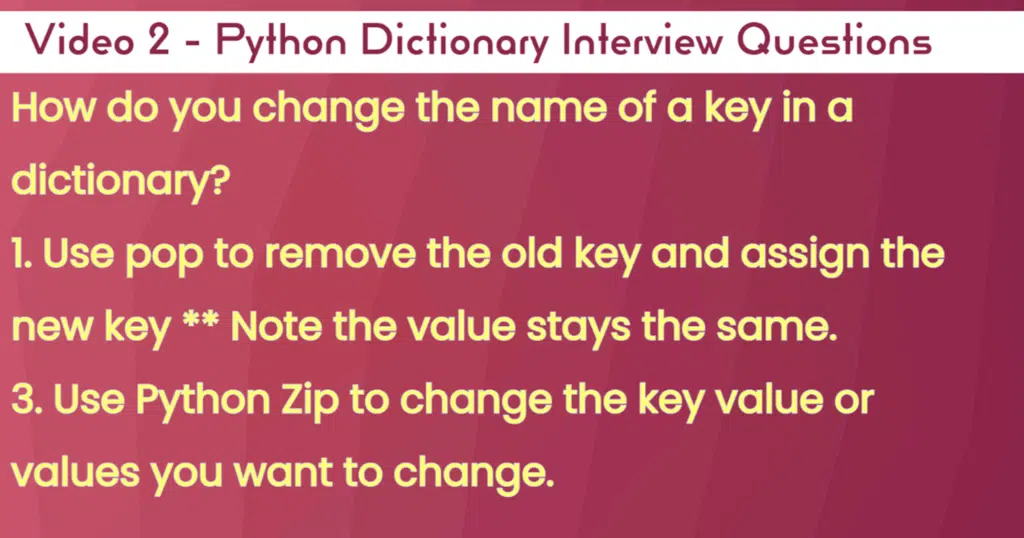
How would you change the name of a key in a Python dictionary

Option1 uses the pop method :

  1. Create a dictionary with the key-value pairs in it. Note that this will also be used for the second option.
  2. Then this line European_countries[“United Kingdom”] = European_countries.pop(“UK”) basically says to find “UK” in the values, drop it and replace it with the value “United Kingdom”

Before the values using the pop method where:

{‘Ireland’: ‘Dublin’, ‘France’: ‘Paris’, ‘UK’: ‘London’}

After the values using the pop method are:
{‘Ireland’: ‘Dublin’, ‘France’: ‘Paris’, ‘United Kingdom’: ‘London’}

Option 2 uses the zip method :

  1. In this scenario, we have created a dictionary called European countries.
  2. the objective here is to replace the names with the three-letter country code.
  3. Note it updates the values into new_dict using zip, and using the update_elements list, based on the order they are in, in both.

Before the values using the zip method where:

{‘Ireland’: ‘Dublin’, ‘France’: ‘Paris’, ‘United Kingdom’: ‘London’}

After the values using the zip method are:
{‘IRE’: ‘Dublin’, ‘FR’: ‘Paris’, ‘UK’: ‘London’}

#Slide 9
# How do you change the name of a key in a dictionary
#1. Create a new key , remove the old key, but keep the old key value

# create a dictionary
European_countries = {
    "Ireland": "Dublin",
    "France": "Paris",
    "UK": "London"
}
print(European_countries)
#1. rename key in dictionary
European_countries["United Kingdom"] = European_countries.pop("UK")
# display the dictionary
print(European_countries)

#2. Use zip to change the values

European_countries = {
    "Ireland": "Dublin",
    "France": "Paris",
    "United Kingdom": "London"
}

update_elements=['IRE','FR','UK']

new_dict=dict(zip(update_elements,list(European_countries.values())))

print(new_dict)

We hope you enjoyed this, we have plenty of videos that you can look at to improve your knowledge of Python here: Data Analytics Ireland Youtube

The Game-Changing Impact of Data Mining on Sports Analytics and Scouting


Introduction

When it comes to sports, there’s a lot more than meets the eye. Behind every jaw-dropping touchdown, mind-boggling slam dunk, or awe-inspiring goal lies a wealth of data waiting to be uncovered. Data mining, the process of extracting meaningful patterns and insights from vast datasets, has emerged as a game-changer in the world of sports analytics and scouting. By harnessing the power of data, teams and organizations can gain a competitive edge, make more informed decisions, and improve player performance.

The Rise of Data Mining in Sports Analytics

In the digital age, data has become the new currency. Every game, practice session, and athlete’s performance generates a treasure trove of valuable information. Sports analytics, with data mining as its driving force, has revolutionized the way teams and coaches approach the game. Here’s how data mining is transforming sports analytics and scouting:

1. Uncovering Hidden Patterns

  • Data mining enables analysts to dive deep into vast datasets, sifting through layers of information to discover hidden patterns and correlations. By examining player performance, injury data, game statistics, and more, analysts can identify crucial factors that contribute to success.
  • Teams can uncover valuable insights, such as identifying the key performance indicators (KPIs) that separate champions from the rest. These KPIs can range from player positioning on the field to shooting accuracy or even sleep patterns. Armed with this knowledge, coaches can fine-tune strategies and enhance player development.

2. Enhancing Scouting and Recruitment

  • Data mining has transformed the way teams scout and recruit talent. Traditional scouting methods relied heavily on subjective assessments, gut feelings, and personal opinions. However, data-driven scouting has replaced hunches with hard evidence.
  • By analyzing player statistics, biometric data, and even social media activity, teams can identify promising talents and uncover hidden gems. Data mining allows for more accurate player assessments, reducing the risk of selecting the wrong candidate and maximizing the chances of finding the perfect fit for the team.

3. Optimizing Game Strategies

  • With data mining, teams can gain a competitive advantage by optimizing game strategies. By analyzing vast amounts of historical data, including previous matchups, player performance, and environmental factors, teams can identify patterns and trends that can inform their approach to upcoming games.
  • Coaches can leverage data mining to create customized game plans tailored to the strengths and weaknesses of their opponents. Whether it’s exploiting a particular defensive vulnerability or capitalizing on an opponent’s predictability, data mining empowers teams to make strategic decisions grounded in data-driven insights.

The Future of Sports Analytics and Scouting

Data mining is just the tip of the iceberg when it comes to the evolving landscape of sports analytics and scouting. As technology continues to advance, we can expect even more transformative changes in the near future:

1. Machine Learning and Artificial Intelligence

Machine learning and artificial intelligence (AI) are set to become integral components of sports analytics and scouting. These technologies can analyze vast amounts of data in real time, learning and adapting to patterns and trends faster than ever before. By utilizing machine learning algorithms, teams can make accurate predictions, simulate game scenarios, and provide real-time insights during matches. AI-powered systems can also automate the scouting process, combing through massive datasets to identify potential talent and make data-driven recommendations.

2. Wearable Technology and Biometrics

Wearable technology has already made its mark in the sports industry, with devices like fitness trackers and smartwatches becoming commonplace. In the future, we can expect more advanced wearable tech that collects detailed biometric data, such as heart rate, speed, and even cognitive performance. By integrating this data with data mining techniques, teams can gain deeper insights into player health, fatigue levels, and optimal performance thresholds.

3. Video Analytics and Computer Vision

Video analytics and computer vision are poised to revolutionize player evaluation and game analysis. Advanced video processing algorithms can automatically track player movements, identify patterns, and extract valuable information from footage. This can provide teams with a wealth of data on player positioning, decision-making, and tactical effectiveness, allowing for more comprehensive scouting reports and targeted training programs.

The Importance of Ethical Data Usage

While data mining offers immense potential, it’s essential to address the ethical considerations surrounding its usage in sports analytics and scouting. Here are a few key points to keep in mind:

1. Data Privacy and Security

As the volume of data continues to grow, safeguarding personal information and maintaining data security becomes paramount. Sports organizations must adhere to strict protocols to protect player data and ensure compliance with privacy regulations. Transparency and consent should be prioritized when collecting and utilizing sensitive information.

2. Fairness and Bias

Data mining algorithms must be developed and calibrated to avoid perpetuating biases and discrimination. It’s crucial to ensure that the data used for analysis is representative and diverse, preventing unfair advantages or disadvantages based on race, gender, or other factors. Regular audits and checks can help identify and rectify any biases that may arise.

3. Human Judgment and Context

While data provides valuable insights, it should not replace human judgment and contextual understanding. Coaches, scouts, and analysts must balance data-driven insights with their expertise and experience. Data should be used as a tool to inform decision-making rather than dictate it entirely.

Conclusion

Data mining has become a transformative force in sports analytics and scouting, empowering teams to uncover hidden patterns, enhance player recruitment, and optimize game strategies. As technology continues to advance, the future of sports analytics holds even greater promise with machine learning, wearable technology, and video analytics. However, it’s crucial to approach data mining ethically, ensuring data privacy, fairness, and the integration of human judgment. By harnessing the power of data while upholding ethical standards, teams can gain a competitive edge and unlock new levels of success in the ever-evolving world of sports.

NoSQL Databases: Defined and Explained


Editor’s note: Alex overviews NoSQL databases, their major benefits and limitations, and outlines the most popular NoSQL database typology. In case you need expert help with developing a high-performing NoSQL database, check ScienceSoft’s offering in database development services.

If you’ve been around databases for a considerable amount of time, you’re familiar with SQL databases. They generally have a rigid structure due to their schemas and are only vertically scalable, meaning you can only increase performance by buying expensive hardware.

SQL excels at reducing duplicate content, which helps keep the cost of storage down. It was great during the 1970s, 1980s, and 1990s, when storage came at an expensive premium, but not so much in the 2000s, 2010s, and beyond, when storage is ridiculously cheap.

As such, there was no real reason to stick to the constraints of SQL, and that’s how NoSQL was born.

NoSQL (aka ‘not only SQL’) databases can store and retrieve data that is modeled other than the tabular relations in SQL databases, which makes them particularly useful for managing big data.
nosql databases

Advantages of NoSQL

Flexibility

NoSQL databases are essentially freeform as they don’t use a schema, and they aren’t relational. This NoSQL characteristic is due to design rather than a specific language created to deal with database management, so you can use several different data models with NoSQL, depending on your needs.

Scale-out architecture

NoSQL is horizontally scalable, which means you don’t need to buy expensive hardware but can simply throw another shard in, and you’re good to go. As a result, NoSQL is essentially infinitely scalable depending on how far you need to take it, with the expansion itself being relatively easy.

Reduced development costs

Since NoSQL doesn’t generally use a schema, there’s no need to hire a schema designer. You also don’t have to worry about adding new fields or data types since you can pretty much mix and match things to your heart’s desire making the database design process less tedious. Thus, you’ll have easier database setup, rollout, and day-to-day maintenance and use.

Challenges of NoSQL

Data consistency

The primary drawback is that many NoSQL databases compromise consistency. While most relational databases abide by ACID principles (Atomicity, Consistency, Isolation, Durability), the same can be said only about a small percentage of popular NoSQL databases (e.g., Azure Cosmos DB, Amazon DynamoDB). In layman’s terms, an ACID guarantee means that the database you’re using won’t lose any data unless intended.

Lack of development talents

NoSQL is not as widely used as SQL, so there aren’t many NoSQL experts lying around idly. Combine that with the fact that there is a considerable number of different NoSQL data models to be knowledgeable about, and you’re looking at an uphill climb finding experts.

For the most part, you’ll have to rely on smaller expert communities and the database’s own documentation to get answers to any arising questions.

Scalability

Another issue is that NoSQL takes up a ton of storage since it ignores data duplication (and sometimes requires it by definition). Likely you’ll end up needing an order of magnitude of storage higher than an SQL database. However, as data storage is relatively cheap nowadays, this need won’t impact you too much in the long run.

Consider Developing a Solid NoSQL Database Solution?

ScienceSoft will help you design, develop and deploy a fitting NoSQL database solution to get your data organized and easy-to-manage.

Types of NoSQL Databases

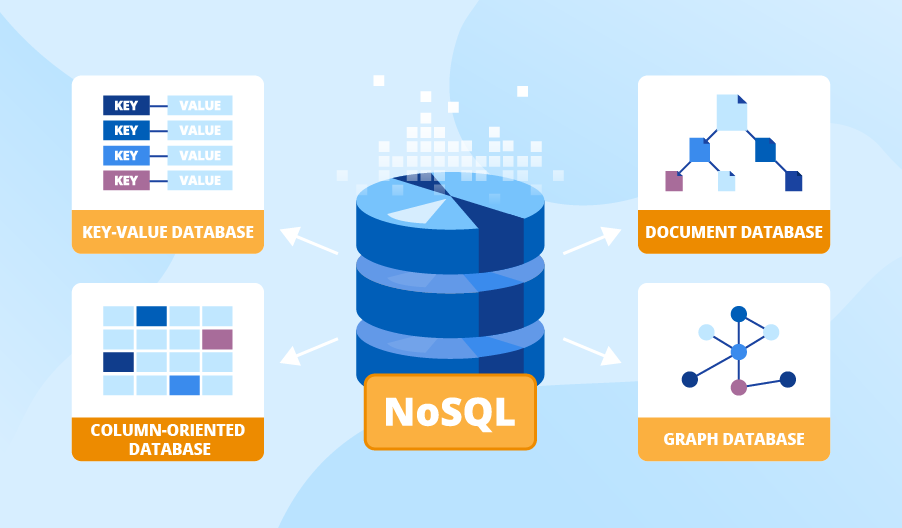
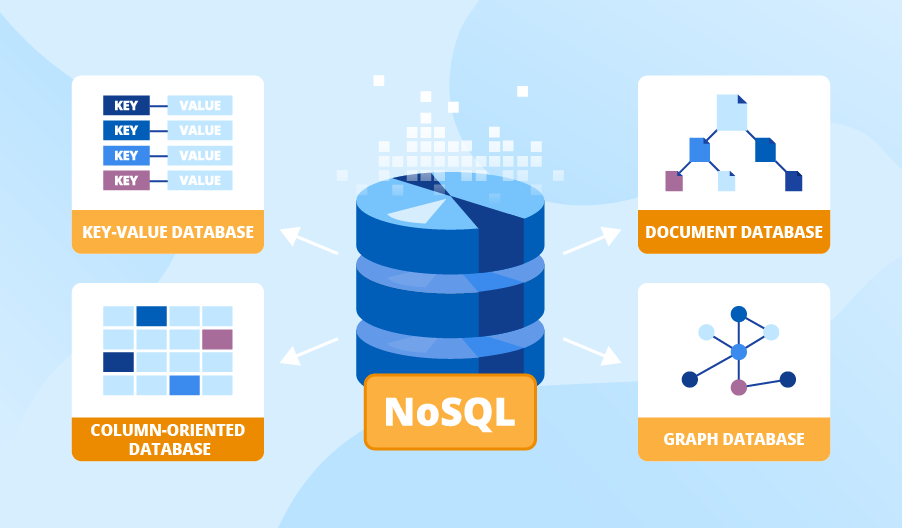
While there are several dozen NoSQL databases, they essentially rely on only a few data models.

Key-Value Store

Key-value stores use a hash table that stores a pointer, which is the key, which then points to a value that stores some form of information or data. Ergo the name, key-value!

This type of data model is really versatile due to the fact that data can be a mix and match of pretty much anything, so you can find a database to fit any specialized needs. No wonder key-value stores are considered one of the most popular data models for NoSQL databases.

Moreover, key-value stores are excellent for high-performance and/or high-volume use cases. For example, the key-value database DynamoDB manages to serve millions of people across the globe nearly every second.

Column-oriented

Rather than storing the data in a row, this type of data model stores information in columns nestled inside other families of columns. Imagine columns, inside groups, inside columns.

Since data is contained in such an efficient manner, column-oriented databases have great data aggregation capabilities and data access performance. On the flip side, complex querying certainly becomes a letdown.

Document Stores

Document stores don’t tie XML and JSON together in the traditional way SQL would. And when these two are uncoupled from each other, they can perform at peak efficiency not forced to go as fast as the slowest denominator. There are even some NoSQL databases specifically made for XML, which is neat.

Interestingly enough, document stores are sometimes considered a sub-type of key-value stores, but this data model subtype is big enough to get its own section. Part of its popularity is its flexibility since you can throw in any data type you want.

Graph

As you might have guessed by the name of this data model, it is perfect for a database that represents information in graph form.

With this data model type, information is stored as both nodes and edges. More specifically, the nodes store such information as addresses, names, dates, and so forth, whereas the edges describe the relationships between the different nodes. It allows graph data models to show the relationships between often disparate sets of data, helping you tease out relevant and useful information.

Time to let your business grow with NoSQL

NoSQL databases can be incredibly powerful, though they aren’t cut out for replacing SQL. In fact, they’re meant to work with and complement SQL databases. If you need any assistance with designing, developing, and integrating a NoSQL database into your analytics or development environment, reach out to ScienceSoft’s team.


Philanthropy to next generation’s philosophy


Reflecting on her donation drive for Goonj, Devna Jain shares insights into her impactful CSR initiatives with BizAcuity.

As a 14-year-old who had the privilege of working with BizAcuity‘s CSR initiatives like the Assam flood relief initiative, I learned that impactful contributions can stem from any background of work and education, including the technical industry.

Being involved for almost a year now, I have leaped to speak from the perspective of the younger generation. The skill and determination inspire me and the flexibility to lend a helping hand knows no bounds, and sustainability is woven into every aspect whether it’s in technology, hospitality, or data analytics.

Reflecting on our social actions at BizAcuity, like the Goonj Donation Drive for the annual floods in Assam, was a compassionate step toward humanity. The impact of our efforts in a city 2,500 miles away brought a heartwarming sense of fulfillment amid the devastating floods in Assam.

Our association with the Goonj Foundation exemplified the importance of collaboration and portrayed cross-sectoral cooperation in driving meaningful change. By joining forces with a well-established NGO like Goonj, we were able to combine our respective strengths and resources to amplify the impact of our collective efforts.

For me, being a part of this donation drive was more than just a week-long project. It was an opportunity to contribute to something bigger than myself, to be a part of a movement that transcends age and background. The journey held more value, from planning, scheduling, and requesting to thanking the employees- these steps played an integral part in developing my empathetic self as a learning individual.

Through initiatives like these, young people like us gain the opportunity to amplify our voices and take meaningful action. It is a reminder that no matter how young we are, we foster the power to create positive change and leave a lasting impact on the world, connecting different communities and building an inclusive society.

Ultimately, this experience displayed how no matter where we come from or what industry we work in, we all have a role to play in creating a better world.

The post Philanthropy to next generation’s philosophy appeared first on BizAcuity.

not all arguments converted during string formatting


Estimated reading time: 2 minutes

In our latest post, we are going to discuss formatting issues that you may come across. It relates to how you format the data when passing it from the input of a user.

This scenario can happen as a result of user input, which then has some comparisons completed on it.

How does the problem occur?

The problem occurs when you pass the data, but do not format it correctly before you present it in the output.

In the below code you will see these lines:

print ("'{0}' is older than '{1}'"% age1, age2)
print("'{0}'is younger than '{1}', that looks correct!" % age1, age2)

The specific problem is that when you put the % before age1, and age 2 you will get this TypeError.

Why does the problem occur?

This problem occurs as the way you are referencing age1 and age2 has been deprecated.

For reference please look at PEP 3101 – Advanced String Formatting, but essentially if you are using % it is the old way of achieving this!

How can the problem be fixed?

So to fix this please look at the below code:

age1 = input("Please enter your age: ")
age2 = input("Please enter your father's age: ")

if age1 == age2:
    print("The ages are the same, are you sure?!")
if age1 > age2:
    #print ("'{0}' is older than '{1}'"% age1, age2)
    print("'{0}' is older than '{1}', you better check!" .format(age1, age2))
if age1 < age2:
    print("'{0}'is younger than '{1}', that looks correct!" % age1, age2)
    #print("'{0}'is younger than '{1}', that looks correct!".format(age1, age2))

As you can see, I have included the old incorrect code and the new correct code, and when I use the proper Python logic, it gives me the correct output as follows:

Please enter your age: 25
Please enter your father's age: 28
'25'is younger than '28', that looks correct!

Process finished with exit code 0

Game-Changing Sports Equipment Design with Data Mining


Introduction

When it comes to pushing the boundaries of sports equipment design and innovation, there’s a game-changing tool that’s taking the field by storm: data mining. With the advent of technology and the increasing availability of data, sports equipment manufacturers have found a goldmine of insights that can transform the way athletes train, perform, and excel. In this article, we dive into the realm of data mining for sports equipment design and innovation, exploring how this powerful technique is revolutionizing the sports industry.

The Power of Data Unveiled: How Data Mining Works

Mining the Gold: Unearthing Valuable Insights

Data mining, in the context of sports equipment design and innovation, involves extracting meaningful patterns, correlations, and information from vast amounts of data. It’s like panning for gold, sifting through heaps of information to uncover the nuggets that hold the key to groundbreaking advancements. By leveraging sophisticated algorithms and statistical models, data mining enables researchers and manufacturers to uncover hidden relationships and trends that would otherwise remain buried beneath the surface.

From Raw Numbers to Cutting-Edge Designs: Applying Data Insights

Once the data has been mined and the valuable insights have been extracted, the real magic begins. Manufacturers can harness these insights to inform the design and development of sports equipment that pushes the boundaries of performance. Data mining reveals the optimal dimensions, materials, and configurations for equipment, leading to innovations that enhance athletes’ abilities and give them a competitive edge. By incorporating data-driven design principles, sports equipment manufacturers can create products that are finely tuned to meet the specific needs of athletes, revolutionizing the way they train and perform.

Unleashing the Potential: Applications of Data Mining in Sports Equipment Design

Enhancing Safety and Injury Prevention

Safety is paramount in the world of sports, and data mining plays a pivotal role in ensuring athletes’ well-being. By analyzing injury data and performance metrics, manufacturers can identify patterns and risk factors that contribute to injuries. Armed with this knowledge, they can engineer sports equipment with enhanced safety features, reducing the likelihood of accidents and mitigating the impact of potential injuries. From impact-absorbing materials to intelligent padding systems, data mining enables the development of equipment that prioritizes athlete safety without compromising performance.

Optimizing Performance and Efficiency

equipment

Data mining allows manufacturers to delve into the intricate details of athletic performance, uncovering insights that can optimize efficiency and maximize potential. By analyzing data on athletes’ movements, biomechanics, and physiological responses, manufacturers can fine-tune equipment to minimize energy expenditure, reduce drag, and enhance performance. From aerodynamically designed apparel for cyclists to lightweight yet sturdy running shoes, data mining drives innovations that help athletes reach new levels of performance.

Catering to Individual Needs: Personalized Equipment

No two athletes are exactly alike, and data mining recognizes and celebrates this diversity. By mining data on athletes’ unique characteristics, such as body measurements, playing style, and preferences, manufacturers can develop personalized equipment that caters to individual needs. This level of customization goes beyond off-the-shelf solutions, empowering athletes with equipment that truly complements their abilities and maximizes their potential.

Challenges and Future Directions

While data mining has already made significant strides in sports equipment design and innovation, it’s not without its challenges. Privacy concerns, data quality, and the need for data integration and standardization are some of the hurdles that researchers and manufacturers must overcome. Additionally, the ever-increasing volume of data poses its own set of challenges, requiring advanced computational tools and techniques to handle and process the information effectively.

However, despite these challenges, the future of data mining in sports equipment design and innovation looks promising. As technology continues to advance, we can expect even more sophisticated algorithms and models that can uncover deeper insights and drive further advancements in sports equipment. Furthermore, the integration of artificial intelligence and machine learning with data mining holds immense potential for creating intelligent equipment that adapts and evolves based on real-time data feedback.

Imagine a basketball that adjusts its grip and bounce characteristics based on the player’s shooting style, or a tennis racket that dynamically changes its tension and stiffness to optimize power and control. These are just a glimpse of the possibilities that data mining can unlock in the realm of sports equipment design and innovation.

In conclusion, data mining has emerged as a game-changer in the field of sports equipment design and innovation. By leveraging the power of data, manufacturers can unlock valuable insights, optimize performance, enhance safety, and create personalized equipment tailored to individual needs. The potential for advancements in sports equipment is limitless, and data mining is the key that unlocks that potential. As we continue to explore the vast realm of data, we can expect to witness groundbreaking innovations that revolutionize the way athletes train, compete, and excel.

So, let’s embrace the power of data mining for sports equipment design and innovation and unleash a new era of athletic performance. The future is data-driven, and the possibilities are endless. It’s time to take the field and make history with every swing of a bat, every kick of a ball, and every leap into the air. Let data mining be our guide as we redefine the limits of human potential in the world of sports. The era of innovation has arrived, and it’s time to harness its full potential with data mining for sports equipment design and innovation.

Are you ready to join the revolution?