Why True AI Trust Requires Deterministic Reasoning


Amazon recently announced that they have extended their automated reasoning checks in Bedrock Guardrails. This acknowledges what we at Rainbird have long advocated — the critical importance of moving beyond pure probabilistic AI to achieve true reliability and trust in AI systems.

AWS’s move demonstrates the increasing market demands for more rigorous AI validation, although it’s crucial to understand the distinction between implementing guardrails and achieving truly deterministic AI reasoning. 

Let’s explore why this all matters.

Understanding the Evolution: AWS’s Approach vs True Reasoning

AWS’s approach focuses on validating LLM outputs against predefined rules and policies through what they call “Automated Reasoning policies.” These policies can be extracted from a simple policy document and can operate on a set of variables and logical rules that are translated into natural language for accessibility.

However, there are several key distinctions between AWS’s validation approach and true deterministic reasoning:

Static Validation vs Dynamic Reasoning

AWS Bedrock Guardrails implements an “allow-all” approach with selective validation. This means the system attempts to “catch” hallucinations post LLM where explicit policies are defined. 

In contrast, Rainbird reasons over a world model that you get to design and control, captured in a knowledge graph. Decisions are explicitly derived from the graph, not via a probabilistic LLM, so no predicted outputs, just reasoned answers. 

This amounts to a ‘deny all’ approach, with only verifiable decisions being created – a fundamental difference is crucial for applications where determinism, precision and completeness are non-negotiable.

Limited vs Complete Reasoning Chain

Whilst AWS’s solution can validate final outputs, it fundamentally operates as a validation layer on top of probabilistic LLM outputs. An LLM predicts an answer based on a distribution of probabilities, and then a rule checks if that prediction matches predefined criteria. This approach can catch obvious errors, but it cannot provide insight into how conclusions were reached or validate the reasoning process itself. 

In contrast, Rainbird’s knowledge graphs enable true causal reasoning from first principles. Rather than validating probabilistic outputs after the fact, our system builds deterministic logic chains that can explain not just what decision was made, but precisely how and why each step in the reasoning process was taken. This delivers complete visibility and validation of the entire decision-making process, not just its conclusion.

This distinction becomes particularly important in complex decision-making scenarios where multiple policies or rules interact. 

While a validation approach can check individual rules, it cannot understand or reason about their relationships and dependencies. For example, when evaluating eligibility for a financial product, multiple qualifying conditions might interact in subtle ways — income thresholds might vary based on employment status, which in turn could be affected by residency requirements. 

A validation-only system can check each rule in isolation but struggles to handle these interconnected relationships.

In contrast, a true reasoning system built on knowledge graphs can navigate these complex relationships naturally. Because the knowledge is explicitly modelled as an interconnected graph rather than a list of validation rules, the system can trace multiple paths through the knowledge, understand how different conditions influence each other, and arrive at conclusions that respect the full complexity of the domain. 

This means not just more accurate decisions, but also the ability to explain precisely how different factors influenced the outcome and why alternative paths weren’t taken.

The Rainbird Difference: Beyond Validation to True Reasoning

Whilst guardrails can help prevent errors that can be pre-determined, Rainbird’s approach fundamentally transforms how AI makes decisions. Our technology doesn’t just validate outputs – it represents rules as weighted knowledge graphs that unlock true causal reasoning. This means:

  1. Deterministic by Design: Rather than attempting to constrain probabilistic outputs, our systems are inherently deterministic. Every decision follows explicit, traceable logic paths.
  1. Complete Causal Chains: Instead of simply checking if outputs match predefined rules, Rainbird provides complete causal proof for every decision, showing exactly how each conclusion was reached.
  1. Knowledge-First Architecture: Our approach begins with structured knowledge representation, enabling organisations to represent regulations, policy and operating procedures as precise models that can reason, rather than attempting to retrofit precision onto probabilistic models.

The Power of Neurosymbolic AI

What truly sets Rainbird apart is a neurosymbolic approach, combining the best of symbolic reasoning with modern machine learning. This hybrid architecture:

  • Enables precise reasoning over complex knowledge domains
  • Provides complete auditability of decision processes
  • Maintains deterministic outputs whilst handling natural language inputs
  • Eliminates hallucinations through structured knowledge representation

Looking Forward: Noesis and the Future of Trusted AI

With our new Noesis platform, we’re taking this proven approach even further. Noesis will enable developers to:

  • Automatically convert unstructured documents into executable knowledge graphs
  • Deploy deterministic reasoning capabilities through simple API calls
  • Integrate trusted AI capabilities into existing ML pipelines
  • Generate complete audit trails for every decision

The Broader Implications

AWS’s move into automated reasoning validation demonstrates growing market recognition of what Rainbird has been delivering for years: the need for more reliable, explainable AI in enterprise settings. 

However, true trust in AI requires more than guardrails – it demands systems built on deterministic reasoning from the ground up.

As organisations increasingly rely on AI for critical decisions, the ability to provide not just guardrails but complete causal reasoning is becoming more critical. This is where Rainbird’s decade of experience in delivering deterministic AI solutions to major enterprises has proven invaluable.

Whilst we welcome AWS’s recognition of the importance of automated reasoning in AI systems, the future demands more than validation layers. It requires AI systems that are inherently precise, deterministic, and explainable. This is the foundation Rainbird has built upon, and with Noesis, we’re making these capabilities accessible to developers everywhere.

The race to trustworthy AI isn’t just about constraining what AI can do wrong – it’s about building systems that do things right from the start. 

That’s the Rainbird difference.

Want to learn more about how Rainbird can bring deterministic AI to your organisation? Register for early access to Noesis and see the future of trusted AI in action.

The Case for Deterministic Agents in Agentic AI


The re-emergence of agentic AI—intelligent agents capable of autonomously planning, making decisions, taking actions, and continuously adapting to their environment—marks a significant shift in AI. Yet, with this shift comes a crucial challenge: how do we ensure that these autonomous agents are truly trustworthy and reliably aligned with organisational goals?

At Rainbird, we’ve developed a distinct type of AI agent that complements probabilistic agents in these existing systems. Our agents are built for deterministic reasoning, delivering precise and explainable decisions that are guaranteed to be justifiable. As organisations deploy various forms of AI agents, Rainbird’s deterministic agents provide a critical capability: the ability to make decisions where accuracy and transparency cannot be compromised.

The Crisis of Trust in AI Systems

Most sectors are facing unprecedented change due to AI, and nowhere is this more prominent than in professional services where the risks are considered by many to be existential. For centuries, the professional services business model has rested on twin pillars: the billable hour and unwavering trust. While AI promises to dramatically reduce the cost and time needed for complex tasks—from legal document review to financial audits—its probabilistic and non-deterministic nature simultaneously threatens the foundation of trust these firms have spent generations building. As AI drives the cost of time-based work towards zero, firms must confront an uncomfortable reality: their future value will depend almost entirely on their ability to be trusted advisors.

Yet here lies a critical contradiction for professional services firms: while embracing probabilistic AI models is necessary to remain competitive, this approach risks introducing subtle errors that can silently propagate through their work. Such risks are not hypothetical—an incident where fabricated legal authorities generated by an AI system, such as ChatGPT, were presented in a tax tribunal highlights the dangers of relying on unverified AI outputs. The internet is full of reports of such problems. When errors slip past both AI and human checks, the damage extends beyond financial losses; it undermines the client relationship and strikes at the heart of the profession’s centuries-old commitment to accuracy and reliability.

The Dangerous Fallacy of Human Oversight

The common defence that ‘humans will verify AI outputs’ overlooks a crucial paradox in human psychology. Research into automation bias reveals a troubling pattern: the more reliable an AI system appears to be, the less likely humans are to thoroughly check its outputs. This creates a dangerous feedback loop where increased accuracy actually amplifies risk. As AI systems become more sophisticated and generate consistently reliable results, human operators naturally develop a sense of trust and complacency.

This erosion of vigilance means that when errors do occur—particularly in edge cases or novel situations—they’re more likely to slip through unnoticed. The irony is stark: the very success that makes AI systems valuable in reducing human workload simultaneously increases the potential impact of any undetected errors. This psychological blind spot makes human oversight an unreliable safeguard, particularly in high-stakes domains where a single missed error could have significant consequences.

Beyond Language Models: The Critical Gap in AI Decision Making

Recent advances in large language model (LLM) tooling have enabled AI agents to plan, interact with users, orchestrate tasks, and respond to complex queries. Yet even as these agentic systems become more sophisticated, a reliance on probabilistic outputs remains a significant shortcoming. Without a layer of deterministic reasoning, agents struggle to validate their conclusions, explain their actions, or demonstrate a causal logic chain from inputs to decisions.

Rainbird provides this missing link. Instead of simply generating predicted outputs, our platform empowers AI agents to operate over a structured model of the world, captured in knowledge graphs. This transforms agentic AI from a ‘guess and hope’ approach to one in which every outcome can be traced back to its logical foundations.

Why Deterministic Reasoning Matters for Agentic AI

To understand why deterministic reasoning is indispensable, we must examine the nature of agentic AI itself. Intelligent agents do more than answer questions: they take actions that may have real-world consequences. Whether it is automating complex workflows, researching tax treaties, or issuing financial recommendations, the stakes are high. In such scenarios, “good enough” may not be enough. Certainly, the market needs decision-making processes that can be fully understood, vetted, and trusted. At the very least, an agentic approach should allow developers to use “good enough” agents where appropriate and precise and deterministic agents when it really matters. 

By building decisions from explicitly modelled knowledge, Rainbird ensures that agents do not merely predict outcomes but instead derive logically rigorous conclusions from authoritative world models that were deliberately designed and approved. Whereas probabilistic systems will produce results with no clear justification—in most cases influenced by training that is based on the public internet—Rainbird shows exactly why each conclusion follows from the knowledge at hand. For enterprises that must meet rigorous compliance or regulatory standards, this is not just beneficial, it’s essential.

Mastering Contextual Complexity

Real-world applications often involve intricate interactions between multiple variables. Take healthcare scenarios evaluating treatment eligibility or insurance underwriting tasks that must consider risk factors, eligibility criteria, and multi-jurisdictional compliance; these challenges require sophisticated navigation of interconnected rules and relationships.

Rainbird’s knowledge graph approach captures these complexities explicitly, enabling agents to:

  • Reason causally about interconnected conditions
  • Understand how changes in one variable affect others
  • Provide detailed justifications for decisions
  • Maintain consistency across complex rule sets
  • Process natural language inputs while maintaining deterministic outputs
  • Transform human-readable policies into machine-executable logic
  • Eliminate hallucinations through grounded reasoning
  • Bridge the gap between human understanding and machine inference

Introducing Noesis: Accelerating Deterministic AI Development

The challenge of building deterministic AI agents has traditionally been the time and expertise required to create comprehensive knowledge graphs. Our new Noesis platform transforms this process, automatically converting organisational documentation and expertise into executable knowledge graphs in minutes rather than weeks. 

Noesis represents a step-change in the sophistication of deterministic AI agents, and how quickly organisations can deploy them. It automatically processes policy documents, procedures, and regulatory texts, transforming them into precise knowledge graphs while maintaining the rigorous logical structure that deterministic reasoning demands. This automated conversion of knowledge—from written and unstructured form to computable deterministic model—preserves the critical relationships and rules within that documentation while eliminating the manual effort traditionally required for knowledge graph creation.

The same technology is being used to automatically design interviews with domain experts, to elicit and encode layers of tacit knowledge into graphs that already understand a base level of regulation and policy.

Key capabilities include:

  • Automated extraction of decision logic from existing documentation
  • Built-in validation to ensure knowledge graph consistency
  • Developer-friendly APIs and SDKs for seamless integration
  • Comprehensive audit trails and explanation facilities
  • Enterprise-grade security and compliance features

For developers, this means being able to rapidly create deterministic AI agents that can be trusted with critical decisions. 

Building the Future of Trusted AI

As AI agents become increasingly autonomous, the focus must shift from controlling unpredictable AI outputs to building inherently reliable AI agents. Rainbird’s decade-long experience in delivering deterministic AI reasoning to major enterprises demonstrates that trust and transparency aren’t optional extras—they’re fundamental requirements.

The future of AI lies not in probabilistic models constrained by guardrails, but in systems that think clearly and consistently from the outset. Through deterministic logic, comprehensive knowledge modelling, and explainable reasoning chains, Rainbird is making this future a reality.

The Key to Safe AI in Financial Services


As financial institutions increasingly adopt Large Language Models (LLMs) to enhance customer experiences and streamline operations, a critical challenge has emerged: how can these powerful but inherently probabilistic systems be deployed safely in a highly regulated environment?

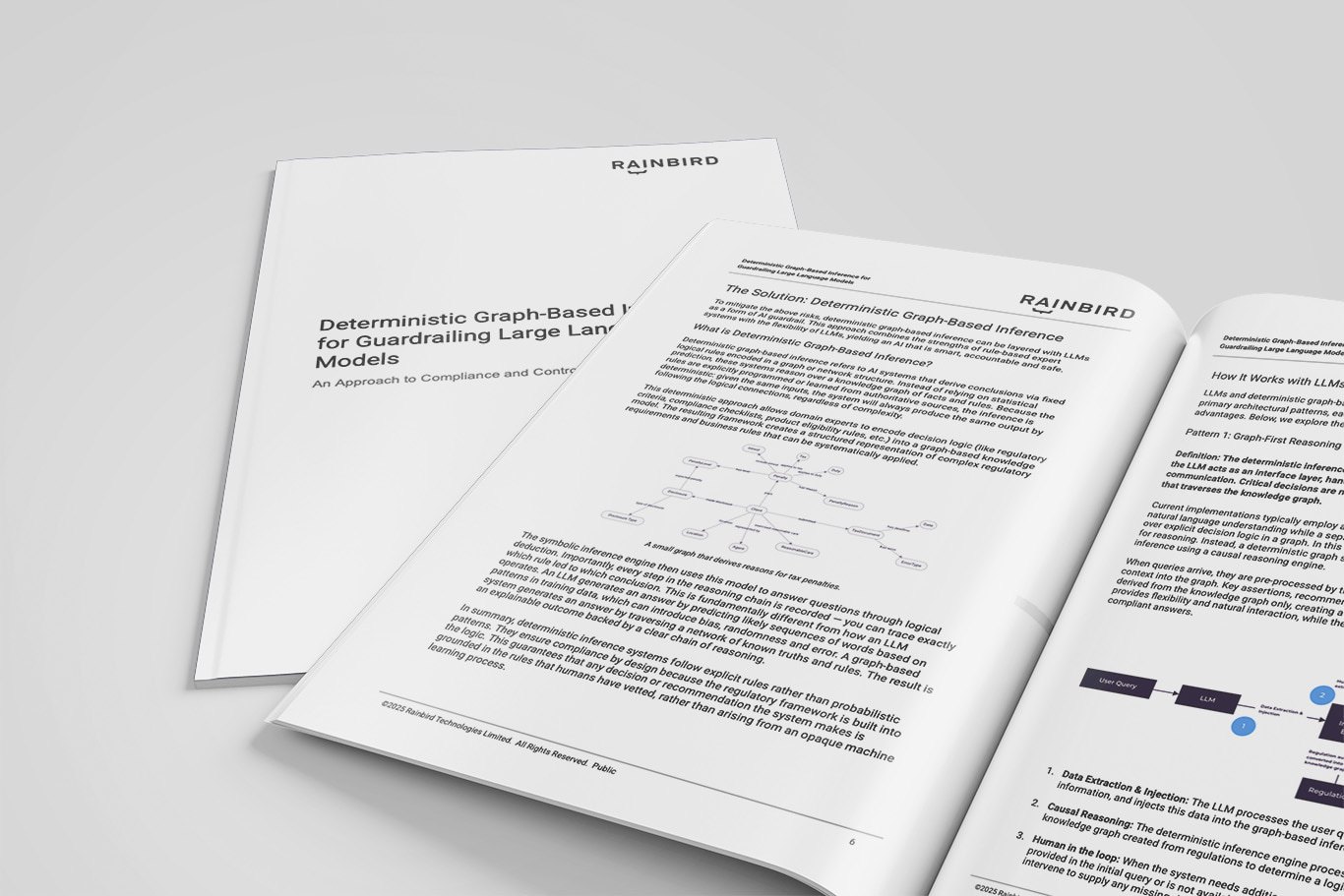
Today, we’re pleased to announce the publication of our latest white paper, Deterministic Graph-Based Inference for Guardrailing Large Language Models: An Approach to Compliance and Control in Financial AI, which addresses this exact challenge.

The Problem with LLMs in Financial Services

While LLMs like Claude and GPT bring unprecedented language capabilities to financial services, they come with significant limitations that pose real risks:

  • Lack of determinism: The same query can yield different results at different times
  • Hallucinations: LLMs can confidently generate entirely false information
  • Limited explainability: The “black box” nature makes regulatory compliance difficult
  • Vulnerability to prompt injection: Specially crafted inputs can manipulate model behavior

In financial contexts where precision, consistency, and regulatory compliance are non-negotiable, these limitations create substantial barriers to adoption.

The Solution: A Hybrid Approach

This white paper explores how deterministic graph-based inference systems can be integrated with LLMs to create AI solutions that are both powerful and predictable. This hybrid approach combines:

  • The linguistic fluency and generative capabilities of LLMs
  • The precision, consistency, and explainability of rule-based systems encoded in knowledge graphs

We detail two architectural patterns for implementation:

  1. Graph-First Reasoning: Where the deterministic inference engine serves as the primary decision-maker while the LLM acts as an interface layer
  2. Post-Generation Validation: Where the LLM generates responses that are subsequently verified and potentially corrected by the symbolic inference engine

The Benefits for Financial Institutions

Financial institutions implementing this hybrid approach can expect:

  • Complete transparency and auditability of AI decisions
  • Elimination of hallucinations and non-compliant information
  • Regulatory compliance by design rather than by hope
  • Consistent and reliable responses that build customer trust

Implementation with Rainbird

The paper concludes with a detailed implementation framework leveraging Rainbird’s enterprise-grade knowledge graph reasoning platform. Our approach enables financial institutions to transform complex regulatory frameworks into executable, deterministic systems that can effectively guardrail LLM implementations at scale.

Major banks and financial services firms are already deploying Rainbird to address the critical compliance challenges outlined in this paper, encoding regulatory expertise into verifiable knowledge graphs that ensure AI-generated content remains fully compliant with intricate financial regulations.

Download the White Paper

Ready to explore how your institution can safely harness the power of LLMs while maintaining regulatory compliance? Download our white paper to learn how deterministic graph-based inference can transform your AI strategy.

Courtesy or Notebook LLM there is also a podcast based on this white paper here.

For more information on implementing these solutions in your organisation, contact our team for a consultation.

Why Human Oversight Fails AI


The Illusion of the Human Safety Net

As AI systems rapidly evolve from passive tools to autonomous agents, a dangerous assumption persists throughout the industry: that human oversight provides an adequate safety net for AI errors. This belief, that a person monitoring an AI’s decisions will reliably catch and correct mistakes, has become the default guardrail in many AI governance frameworks. Yet this approach fundamentally misunderstands both human psychology and the nature of modern AI systems.

The uncomfortable truth is that humans make exceptionally poor guardians for agentic, probabilistic AI. Our human cognitive architecture, evolved for a different world entirely, is ill-equipped to monitor complex AI decision-making. This mismatch creates a perfect storm where AI errors consistently slip through human oversight, sometimes with catastrophic consequences.

Why Human Oversight Fails

The limitations of human supervision extend far beyond mere inattention. Multiple factors conspire to make us unreliable guardians.

Automation bias renders objective oversight impossible. Humans exhibit an inherent tendency to trust computer-generated information over our own judgment. This isn’t simply laziness; it’s a deeply ingrained cognitive bias. When presented with AI recommendations or actions, humans consistently demonstrate an alarming propensity to defer to the machine, especially when it presents information with confidence and authority.

The tragic 2018 Uber self-driving car fatality in Arizona starkly illustrates this reality. The safety driver, meant to intervene if the AI faltered, had become complacent and distracted. This wasn’t an anomaly; it’s an inevitable result of how our brains respond to automation over time.

The opacity of modern AI creates an unbridgeable comprehension gap. Large language models and neural networks operate as “black boxes” that produce outputs through processes largely inaccessible to human understanding. How can a supervisor effectively evaluate a decision they fundamentally cannot understand? When an AI generates content that sounds plausible but contains subtle errors or fabrications, even expert reviewers may miss the problem entirely, as witnessed in embarrassing legal cases where lawyers have submitted entirely fictitious AI-generated case citations to courts.

The speed and volume of AI decisions overwhelm human capacity. As AI becomes more deeply integrated into business processes, the number of decisions requiring review exponentially increases. In domains like algorithmic trading, financial systems make thousands of micro-decisions per second, far beyond what any human could meaningfully monitor. By the time humans recognise a problem, significant damage may already be done.

From Linear Rules to Sophisticated Guardrails

If human oversight is inadequate, what’s the alternative? The answer lies not in simple linear rules, but in sophisticated deterministic guardrails; engineered constraints that reliably prevent AI systems from taking undesirable actions through a network of interconnected logical relationships.

Unlike the linear rule systems of the past that quickly became unmanageable and brittle, modern deterministic guardrails utilise graph-based knowledge structures that can represent complex regulatory frameworks and other knowledge-based processes with nuance and flexibility. These sophisticated structures encode complex causal relationships as formal, traceable networks of probabilities, weights and rules.

The power of graph-based deterministic inference is that it can handle the complexity and interconnectedness of real-world regulatory systems without sacrificing reliability. Unlike probabilistic AI models that produce varied, sometimes unpredictable outputs, deterministic graph systems follow explicit logical pathways with guaranteed outcomes that are entirely repeatable.

This approach creates a comprehensive safety system capable of understanding, for instance, that a financial product recommendation must simultaneously satisfy multiple interrelated regulatory requirements suitability for the client’s risk profile, all verifiable through traceable logical pathways.

This sophisticated graph-based approach can be deployed in two distinct architectural patterns: either as a validation layer to verify and correct LLM outputs, or as the primary reasoning engine with the LLM serving only as a natural language interface layer.

Pure Determinism: The Ultimate Safety Architecture

While validation of LLM outputs offers significant safety improvements, the most powerful configuration for high-stakes domains removes LLMs from the reasoning process entirely. In this pure deterministic architecture, graph-based inference systems handle all critical decisions independently, while LLMs serve solely as the interface layer, managing natural language understanding and communication. 

Most organisations operating in regulated environments would gladly sacrifice the general-purpose nature of LLMs (which, while impressive, is precisely what makes them prone to hallucination) for solutions that are narrower, domain-specific, 100% grounded in verified context, and utterly reliable. After all, why would a credit decisioning engine need to know about sports? Or a financial sanctions compliance system need to generate poetry? The flexibility to answer any question becomes far less valuable than the certainty of answering specific questions correctly every time—particularly when errors could trigger regulatory violations, financial losses, or reputational damage.

This approach completely removes the probabilistic element from the decision-making process itself. The LLM never makes substantive determinations, it simply translates between human language and the deterministic system. All core reasoning—eligibility determinations, compliance verdicts, risk assessments—occurs within the deterministic graph engine that traverses a knowledge network with logical precision.

This stands in contrast to the validation approach, where an LLM generates initial answers that are subsequently verified against the knowledge graph. In a pure deterministic configuration, the decision-making authority never resides with the probabilistic system. Instead, the inference engine and the graph becomes the authoritative reasoning component rather than just a guardrail.

The advantages of this “pure determinism” approach are profound:

  • Total elimination of hallucinations for critical decisions
  • Perfect repeatability across identical scenarios
  • Complete traceability of every decision to specific rules
  • True causal reasoning that follows explicit logical pathways
  • Independence from training data biases that affect LLMs

Consider a high-stakes financial services scenario, to determine whether a transaction requires additional anti-money laundering scrutiny. With a pure deterministic approach, the LLM may help extract relevant transaction details from unstructured sources, but the actual determination comes exclusively from the graph-based inference engine traversing a precisely encoded network of regulatory requirements, or other proprietary knowledge. This creates a system that is simultaneously conversational but also absolutely reliable in its core reasoning functionality.

Accelerating Knowledge Graph Development

While graph building was historically a significant bottleneck requiring months of manual knowledge engineering, recent breakthroughs have transformed this process. 

Specialised LLMs—fine-tuned on all classes of human reasoning, knowledge engineering patterns and a cross section of domain problems—have unlocked the ability to programmatically generate sophisticated knowledge graphs at unprecedented speed. They can extract structured knowledge from regulatory documents, policies, and even domain expertise, and build accurate and computable knowledge graphs—and maintain them. This eliminates what historically was months of manual work, compressing it into days or even hours. 

This capability fundamentally changes the economic equation for implementing a sophisticated knowledge management layer in the enterprise.

Creating Safe Agentic Systems

Looking ahead, the most sophisticated AI applications will likely involve autonomous agents—AI systems that can independently perform complex tasks without continuous human direction. This evolution from passive tools to active agents magnifies all the risks already discussed and introduces new ones around the delegation of authority in multi-step decision processes.

The development of safe agentic systems demands more than ad hoc guardrails or human monitoring; it requires a comprehensive architecture where deterministic graph-based inference serves as the logical foundation for all critical decisions. Such systems can reliably constrain agent behavior within carefully defined operational boundaries while still allowing for the flexibility and generative capabilities that make AI valuable.

Unlike post-hoc human oversight, which attempts to catch problems after they occur, deterministic guardrails prevent problems by design. The system simply cannot act outside its defined parameters, just as a well-designed electrical system has circuit breakers that automatically prevent dangerous overloads without requiring human intervention.

For organisations seeking to deploy agentic systems, this approach offers a pathway to production without rework, significantly lowering risk. Agents can operate while sophisticated deterministic guardrails act as the compliance officer within, ensuring that outcomes adhere to regulatory, ethical, and safety boundaries. This unlocks a future where AI systems can act independently while maintaining the precision and reliability that high-stakes domains demand.

The Implementation Question

For organisations looking to adopt this approach, there are several key considerations. The graph-based guardrails must be designed with sufficient sophistication to capture the nuance and complexity of regulatory frameworks without becoming unmanageable. This requires specialised tooling. 

The integration between deterministic systems and LLMs must be carefully architected to ensure clear separation of responsibilities. In pure deterministic configurations, the LLM should have no authority to override or modify the determinations of the graph-based inference engine; it should simply be constrained to translating logical outputs into natural language.

Testing must be rigorous and scenario-based, focusing particularly on edge cases. Unlike probabilistic systems that can only be evaluated statistically, deterministic systems can be verified through automated testing of logical pathways.

The Rainbird Approach

Rainbird has pioneered the application of deterministic graph-based inference as sophisticated guardrails for AI systems. The Rainbird platform is an ecosystem that enables organisations to transform complex regulatory frameworks and domain expertise into executable, deterministic knowledge graphs that can govern AI behavior with precision and reliability.

Rather than relying on brittle linear rules or unreliable human oversight, Rainbird’s approach uses programmatically-generated, sophisticated knowledge graphs to represent complex interrelationships between concepts, rules, and data. This creates guardrails that are simultaneously robust and flexible—capable of addressing complex regulatory requirements while adapting to evolving business needs.

For organisations deploying agentic AI, Rainbird’s newest capability, Noesis, provides a revolutionary approach to knowledge engineering. Noesis is a developer-first approach and automates the extraction and structuring of knowledge from regulatory documents and policies, transforming dense text into verifiable knowledge graphs with minimal human intervention. The result is sophisticated deterministic guardrails that scale with the complexity of the regulatory environment.

By encoding regulatory expertise into verifiable knowledge graphs, organisations can ensure that AI-generated content and decisions remain fully compliant with intricate regulations while providing the complete traceability and explainability demanded by regulators and stakeholders.

The future of AI governance isn’t about choosing between innovation and safety—it’s about taking a hybrid, neurosymbolic approach that enables both. By implementing deterministic graph-based inference as the logical foundation for agentic AI, organisations can build systems that operate in high-stakes environments, without sacrificing reliability, compliance, or trust.

For more information on implementing these solutions in your organisation, contact our team for a consultation.