
Nation-state hackers exploit Cisco firewall 0-days to backdoor government networks


A stylized skull and crossbones made out of ones and zeroes.

Hackers backed by a powerful nation-state have been exploiting two zero-day vulnerabilities in Cisco firewalls in a five-month-long campaign that breaks into government networks around the world, researchers reported Wednesday.

The attacks against Cisco’s Adaptive Security Appliances firewalls are the latest in a rash of network compromises that target firewalls, VPNs, and network-perimeter devices, which are designed to provide a moated gate of sorts that keeps remote hackers out. Over the past 18 months, threat actors—mainly backed by the Chinese government—have turned this security paradigm on its head in attacks that exploit previously unknown vulnerabilities in security appliances from the likes of Ivanti, Atlassian, Citrix, and Progress. These devices are ideal targets because they sit at the edge of a network, provide a direct pipeline to its most sensitive resources, and interact with virtually all incoming communications.

Cisco ASA likely one of several targets

On Wednesday, it was Cisco’s turn to warn that its ASA products have received such treatment. Since November, a previously unknown actor tracked as UAT4356 by Cisco and STORM-1849 by Microsoft has been exploiting two zero-days in attacks that go on to install two pieces of never-before-seen malware, researchers with Cisco’s Talos security team said. Notable traits in the attacks include:

  • An advanced exploit chain that targeted multiple vulnerabilities, at least two of which were zero-days
  • Two mature, full-feature backdoors that have never been seen before, one of which resided solely in memory to prevent detection
  • Meticulous attention to hiding footprints by wiping any artifacts the backdoors may leave behind. In many cases, the wiping was customized based on characteristics of a specific target.

Those characteristics, combined with a small cast of selected targets all in government, have led Talos to assess that the attacks are the work of government-backed hackers motivated by espionage objectives.

“Our attribution assessment is based on the victimology, the significant level of tradecraft employed in terms of capability development and anti-forensic measures, and the identification and subsequent chaining together of 0-day vulnerabilities,” Talos researchers wrote. “For these reasons, we assess with high confidence that these actions were performed by a state-sponsored actor.”

The researchers also warned that the hacking campaign is likely targeting other devices besides the ASA. Notably, the researchers said they still don’t know how UAT4356 gained initial access, meaning the ASA vulnerabilities could be exploited only after one or more other currently unknown vulnerabilities—likely in network wares from Microsoft and others—were exploited.

“Regardless of your network equipment provider, now is the time to ensure that the devices are properly patched, logging to a central, secure location, and configured to have strong, multi-factor authentication (MFA),” the researchers wrote. Cisco has released security updates that patch the vulnerabilities and is urging all ASA users to install them promptly.

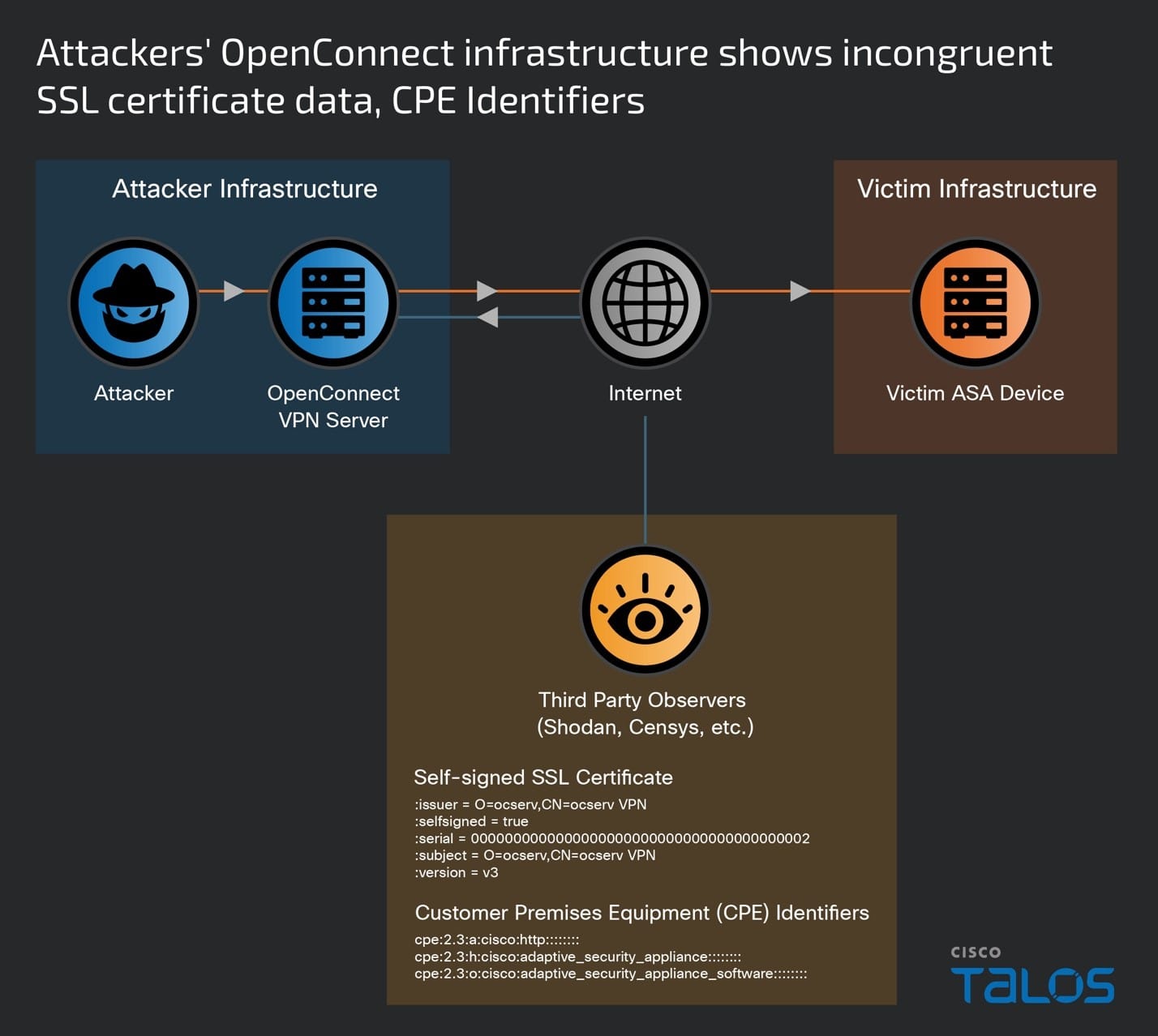
UAT4356 started work on the campaign no later than last July when it was developing and testing the exploits. By November, the threat group first set up the dedicated server infrastructure for the attacks, which began in earnest in January. The following image details the timeline:
Cisco

One of the vulnerabilities, tracked as CVE-2024-20359, resides in a now-retired capability allowing for the preloading of VPN clients and plug-ins in ASA. It stems from improper validation of files when they’re read from the flash memory of a vulnerable device and allows for remote code execution with root system privileges when exploited. UAT4356 is exploiting it to backdoors Cisco tracks under the names Line Dancer and Line Runner. In at least one case, the threat actor is installing the backdoors by exploiting CVE-2024-20353, a separate ASA vulnerability with a severity rating of 8.6 out of a possible 10.

‘We aren’t going anywhere,’ TikTok CEO says as company vows to fight US ban


TikTok CEO Shou Zi Chew says the company will challenge a recently-signed US law requiring the platform be sold off by Chinese parent company ByteDance or face a block in the US, and warned that the true goal of legislators is not to force a change of ownership but simply to ban access to the service outright.

After an extended period of wrangling, the US Congress passed a bill calling for TikTok’s sale or block in March, sending it to the Senate, which voted to pass the bill on April 22. One day later, US President Joe Biden signed the bill into law


Best voice changer in the world 2024


LOVO.AI

JTB World Blog: JTB FlexReport 2022.6.0 released


JTB FlexReport 2022.6.0 is now ready.

SQL Server related performance improvements and JTB Process Monitor Client performance improvements are the most important news.

See the version history for all details.

Trial is available if you want to give it a try.

If your maintenance has expired you can try the new version for a few weeks, if you want to keep using it contact us to renew the maintenance. The upgrade is free of charge for customers with active maintenance.

What is JTB FlexReport? JTB FlexReport is a license usage report tool for applications licensed using network license systems like FlexNet (FlexNet), IBM LUM, DSLS, SPLM, Sentinel, LM-X, RLM, EPLAN (ELM), HASP, DPT, Tebis, CodeMeter among others. Track usage over time, hours used and much more. With JTB Process Monitor much more can be monitored like Bentley MicroStation, Autodesk Named User licenses and Autodesk Flex.

If you have FlexNet licenses check out our JTB FlexReport LT freeware. App for AutoCAD available.

Autodesk user? See these posts:

You may still find use for JTB FlexReport together with JTB Process Monitor. We can help analyze your historic usage so you can prepare for the switch.


PUBG, the game that Fortnite copied, copies Fortnite by bringing back the battle royale shooter’s original map


PlayerUnknown’s Battlegrounds – aka the game that inspired and then was overtaken by Fortnite’s Battle Royale mode – is seemingly borrowing a leaf from its cartoony cousin’s playbook by resurrecting its original map.

Continue reading “PUBG, the game that Fortnite copied, copies Fortnite by bringing back the battle royale shooter’s original map”

Free Pure Virtual C++ 2024 Conference


Image pvclogo

Pure Virtual C++ is our free one-day virtual conference for the whole C++ community. This year it will run on April 30th 15:00 UTC. Sign-up for free to get access to our five sessions on the day and a host of pre-conference content which will roll out in the two weeks leading up to the conference.

The sessions are:

Automated Testing of Shader Code with Keith Stockdale (Rare)

Rare has a rich culture of writing automated tests for their game and engine code. The ‘Sea of Thieves’ project has hundreds of thousands of automated tests that exist to validate behavior and to ensure that bugs are kept to a minimum, as we continually deliver an ever-changing experience to players. Among this large test suite are tests that validate and verify shader code. This session explores the new Rare Shader Test framework, describing how tests are written for shader code. The talk will also delve into the C++ and HLSL implementation of the shader testing framework to discuss the design goals of the system, and how we are using C++ to meet these design goals.

Message Handling with Boolean Implication with Ben Deane (Intel)

Message reception and dispatch is something common to many codebases. This talk shows the unreasonable effectiveness of going back to basics and really understanding and unlocking the power of Boolean algebra in the design of a message handling library. We’ll talk about composing predicates on messages and manipulating them at compile time in order to do the least work when dispatching them at runtime. Particularly we’ll introduce implication, develop an intuition for this lesser-used Boolean operation, and see how it is key to a generic approach for simplifying predicates.

I Embedded a Programming Language In Debug Information with Sy Brand (Microsoft)

DWARF information on Linux provides debuggers with a bridge between high-level source code and the machine instructions generated by the compiler. As part of this, it describes how to locate variables within your program at runtime using a language called DWARF Expressions. When implementing a parser for DWARF Expressions I thought “this seems suspiciously Turing-complete, can I implement a programming language inside this?” It turns out the answer is yes. In this session you’ll learn how debug information and executables are stored on Linux systems and how I managed to (ab)use them to implement a programming language interpreter that runs when you ask your debugger for the address of a variable.

Enhancing C++ development with Copilot Chat with Sinem Akinci (Microsoft)

Copilot is an AI-powered pair programmer integrated into Visual Studio and VS Code that can be there to assist you at many different points in your C++ development journey. In this session, we’ll introduce Copilot and Copilot Chat, share tips for achieving the results you want, and provide different use cases for using these tools. Then, we’ll see these tools in action in C++ code in Visual Studio as we tackle a variety of problems from navigating and understanding code to refactoring existing code.

Microsoft Office is a huge C++ codebase with nearly 100 million lines of native code. This size provides a constant challenge to build the product as quickly as possible. C++20 header units are a way to receive many of the benefits of modules, while still working with a codebase originally designed for classic header inclusion. At CppCon 2022 we announced that Office would investigate header units with the goal of improved build throughput. We’re excited to present the results of that work for the benefit of the C++ community at large. In this session, we’ll share build performance metrics for the first time.


Fortnite Rule32 – DroidViews


Part of the video game Fortnite’s rule book is the Internet meme Rule 32, which is also a YouTube meme in the Fortnite multiverse, sometimes causing unusual confusion and conflict between fans. The Fortnite Rule 32 is not just a rule but a philosophical point of view which centres around the fact that the gamer’s enjoyment in gaming lies in its little aspects. It fosters a sense of recognition after the process of artistic experience, such as map design to personal in-world activities.

Fortnite - Gameplay1
Picture: Epic Games

It contributes to community building by making players to be more socially engaged, thereby, they interact, cooperate and consequently form lasting bonds in this alternate universe. But this conviction will renew your approach to gaming and render it increasingly interesting and exciting. In the following paragraphs, we are going to talk about Rule 32 in the ruleset and its consequences in default single-player mode and another game situation.


Fortnite Rule 32: Considering a Player’s Outlook

The world of Fortnite is fast-paced; players typically get absorbed in their quest for victory and forget about the most important aspect of the game – the fun and their friends.  It is all about perseverance, not the last person alone; rather, the road that they have walked on. The game is an array of colors with a lot of teals to fuel the player’s inspiration towards browsing in the Fortnite world.

Fortnite - Gameplay2
Picture: Epic Games

Whether the developers employed the natural ambience with the addition of adornments or developed add-ons, they can never run out of ideas on things to enjoy. Then, my buddies are the in-game Rule 32, a result that is found in the route, not the destination, which is the goal of the majority of party members in the game’s community.


Fortnite Rule 32: The Vantage Point that Makes you Discover the Heaven of Gaming

Fortnite Rule 32 makes accepting it a simple decision as it is like a new level in gaming. It’s simple – linger, watch the scenery, and relish the total experience that requires little to urge its lovers towards such. Pay attention to the small features – sun rays falling on the island, the sound of footsteps on the uncrowded corridor and the fear of the unknown that arises only after a while. Such decisions to opt for real-life features bring diversity into your game practice.

Besides, consider going beyond the road that’s always travelled – try new things, new tactics and new styles of play. The uniqueness of Fortnite is that it gives high regard to the inventive and brave flows. Be it experimenting with current strategies by devising new combinations of weapons, or taking risks by coming up with a risky strategy on your own, these scenarios of experimentation become one of the interesting parts of the game.

Fortnite - Gameplay3
Picture: Epic Games

Winning is nice but what remains in your memory is getting the priceless experiences, the journey and the joy of winning what truly matters. Create the version of you of the world that you want to live in, and you will be the master of this epic play in the end. Rule 32 will be your way towards utilizing the amazing options that you have in developing a game that will be not only different but also it will be special to you. Therefore, strap in, fall from the sky and make the Fortnite Rule 32 one for it will supply not just success, but a journey full of bliss, play, and joy.


Answers to the FAQs

How does meme Rule number 32 improve Fortnite gaming experience?

When we talk of the impact of Fortnite Rule 32 on the gaming world, I wouldn’t be surprised if it can miraculously bring quixotic happiness to like-minded players. The key lies in the attention to minutiae and the appreciation of the game’s graphics and gameplay. Therefore, if you dig deeper, the Fortnite game and a Fortnite match can be one of the most fun and enjoyable hobbies for you.

Do you need to apply Fortnite Rule 32 to win?

No, it is none of these things which it is about winning medals but it is all about the journey, the experiences that you gain and the people that you meet during this part of the game.

Can I apply Rule 32 as a solo player?

Absolutely! It works to end the boredom and mental fatigue that comes from playing alone or with friends. Therefore, Rule 32 helps to make gaming an interactive and exciting activity.

So Fortnite isn’t just merely a game, it’s a lifestyle. It’s the experience and the community of the game that truly make it great! Apply the spirit of Rule 32 of Fortnite, and victory is at hand in this victory royale. The adult content of the game has an age bar to it with multiple fan-made and inspired characters along with in-game chat and text chat features.

Keep yourself updated with the official sites and the game’s community for the latest updates, detailed explanation of major Fortnite rules, competitive Fortnite tournaments, the fandom, unofficial set of regulations, worse in-game phase, player-versus-player combat and more such information. Game on!

Also Read: Fortnite Mobile Tips & Tricks

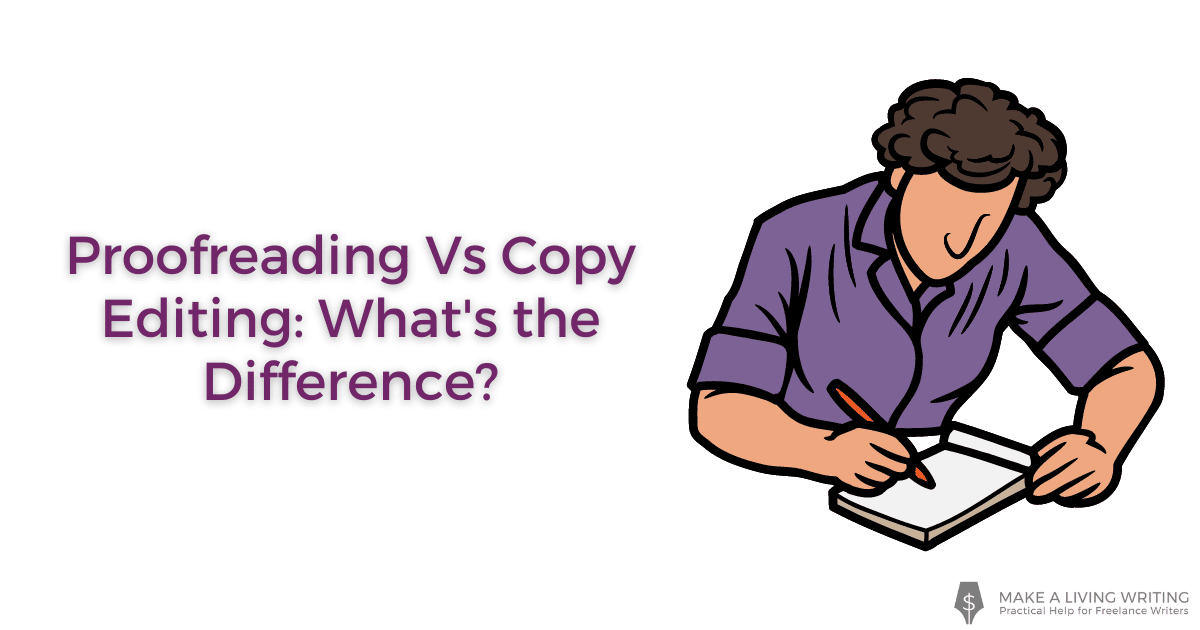
Proofreading Vs Copy Editing: What’s the Difference?


When it comes to proofreading vs copy editing, it might seem like they’re one in the same. However, while they both fall under the editing umbrella, there are quite a few differences between the two.

If you’re trying to find a job in the editing industry, you’ll need to know the difference between proofreading and copy editing. You might lean more toward one or the other or you might have the skills to do both.

Both proofreaders and copy editors work together to make a written piece as error-free as possible for publication. Since the majority of publications and authors want a well-done piece, they’ll likely employ both types of editors during the publishing process.

This article will review some of the similarities and differences and discuss how you can get your foot in the door for whichever editing path you choose.

A stock photo of a person working on a written piece with highlights and different color pens to demonstrate the difference between proofreading vs copy editing.

Proofreading vs Copy Editing

To understand the difference between the copy editing and proofreading, we’ll need to explain the difference between what they do for work.

Generally, copy editors do a complete in-depth analysis of a piece. Sure, they note basic typos and errors as they go, but their primary focus is on making sure the whole piece works, that there aren’t loose ends, and that it’s accurate.

Copy editors also need to make sure the writing matches the editing guidelines of the company or publication. Most places will have their own editing rules or style guides, which you should have a working knowledge of and on hand for reference.

Proofreaders check pieces before they are sent to be published. They work hard to catch errors that other humans and even computers miss.

Both copy editors and proofreaders need to know the basics of editing, but they focus on different aspects of the piece while editing.

Ideally, editors work together as a team to make sure pieces are high-quality and without errors. However, not all companies understand the different types of editors or invest in having more than one type.

What is Copy Editing?

Copy editing is the work of editing the copy, which prepares the writing for publication. Once the writer is finished, the draft is sent to the copy editor who then reviews it.

The copy editor’s goal is to ensure the copy matches the company or publication’s standards.

Copy editors must know grammar, syntax, and punctuation as well as the style guide rules of the publication they’re working with.

For example, some publications will use certain types of citation styles, rules about punctuation, and follow different formats.

A copy editor ensures the copy is consistent across the entire publication. That keeps a uniform reading experience and makes sure the publication stays within their legal outlines and formatting guidelines.

They spend their working hours reading and editing, as well as staying up to date with current publishing standards and new editing rules.

What do Copy Editors do?

Copy editors do a lot to make sure the copy is ready for publication!

Copy editing tasks include:

  • Check basics of grammar, punctuation, syntax, and spelling
  • Make sure all introduced topics or plots
  • Keep editing consistent and in line with the publication’s standards
  • Check facts to make sure they’re correct to avoid any legal issues for the publication
  • Ensure the piece is cohesive
  • Ensure the ideas are clear
  • Correct vocabulary usage
  • Make sure sentences are clear and to the point

Copy editing is much deeper than just making sure the spelling is correct, it’s making sure the whole piece from top to bottom is in line with the standards that were set and that it will communicate clearly to the reader.

How to Become a Copy Editor

If you want to become a copy editor, you don’t necessarily have to have a degree in writing, but it certainly helps.

At the very least, you’ll need to improve your skills as an editor and start to get your foot in the door.

You will also need to learn all of the various style guides out there and the basics of each. Different publications you work with will have different rules for you to learn, but you’ll need to know the basics of all of them to become a successful copy editor.

On top of that, you’ll need to know how to make bigger edits to a piece to make sure they flow well and answer all the questions a reader could have.

To start, you can start with freelance editing or find a place that is taking entry-level help or interns.

What is Proofreading?

Proofreaders are the last stop before publication. They review the writing to ensure there are no grammatical or spelling errors and that the piece is ready for publication.

Between the two, copy editing is a much more intense process to make sure a piece is finalized. The proofreader reviews the piece after the copy editor to finalize and catch any lingering mistakes.

What do Proofreaders do?

Proofreaders need to be well-versed in grammar, spelling, and punctuation rules in order to succeed in this role. They are tasked with catching errors that everyone else misses.

Since proofreaders are the last stop before publication, it’s essential that they take a careful, detail-oriented approach to make sure no errors go through to print.

Sometimes during the editing process, designers can insert formatting changes, which can add errors in the final piece so proofreaders also must watch for errors between versions.

Proofreaders don’t do much in terms of large, structural changes to a piece compared to copy editors. They mainly focus on each word and sentence to make sure they’re technically correct.

How to Become a Proofreader

Since the key skills required to succeed as a proofreader is having a firm grasp on spelling, grammar, and punctuation, you will need to find a way to develop these skills.

This doesn’t necessarily mean you need to have a college degree in editing, but you will need to find a way to develop your skills and stay in practice.

That might mean taking on freelance work, an internship, or working with a company as a proofreader.

Two of the main style guides to become familiar with is The Associated Press Stylebook and The Chicago Manual of Style. There are major differences between style guides and dictionaries, so understanding which style guide and dictionary a company or publication uses and having a firm grasp on the nuances between them will benefit you as a proofreader in the long run.

Proofreading vs Copy Editing: Which do Publications Need?

Ideally, a publication, author, or company uses both a proofreader and a copy editor. However, these days freelancers tend to offer a blend of both copy editing and proofreading under the heading of general editing services.

If you want to become an editor, it may be worth trying both types to see which is more natural and interesting to you.

It’s easier to get started as a proofreader because copy editing requires knowledge of how to completely restructure pieces and do much deeper editing. That said, both are exciting for people who love to edit and bring pieces to life.

What to do next?

article writing templatearticle writing template

Multimodal AI with Cross-Modal Search


First Venture Into Multimodal AI_ Cross-Modal Search In 5 Minutes-1

Introduction

Cross-modal search is an emerging frontier in the world of information retrieval and data science. It represents a paradigm shift from traditional search methods, allowing users to query across diverse data types, such as text, images, audio, and video. It breaks down the barriers between different data modalities, offering a more holistic and intuitive search experience. This blog post aims to explore the concept of cross-modal search and its potential applications, and dive into the technical intricacies that make it possible. As the digital world continues to expand and diversify, cross-modal search technology is paving the way for more advanced, flexible, and accurate data retrieval.

Understanding Search Modalities: Unimodal, Cross-Modal, and Multimodal Search Explained

Unimodal, cross-modal, and multimodal search are terms that refer to the types of data inputs or sources that an artificial intelligence system uses to perform search tasks.  Here’s a brief explanation of each:

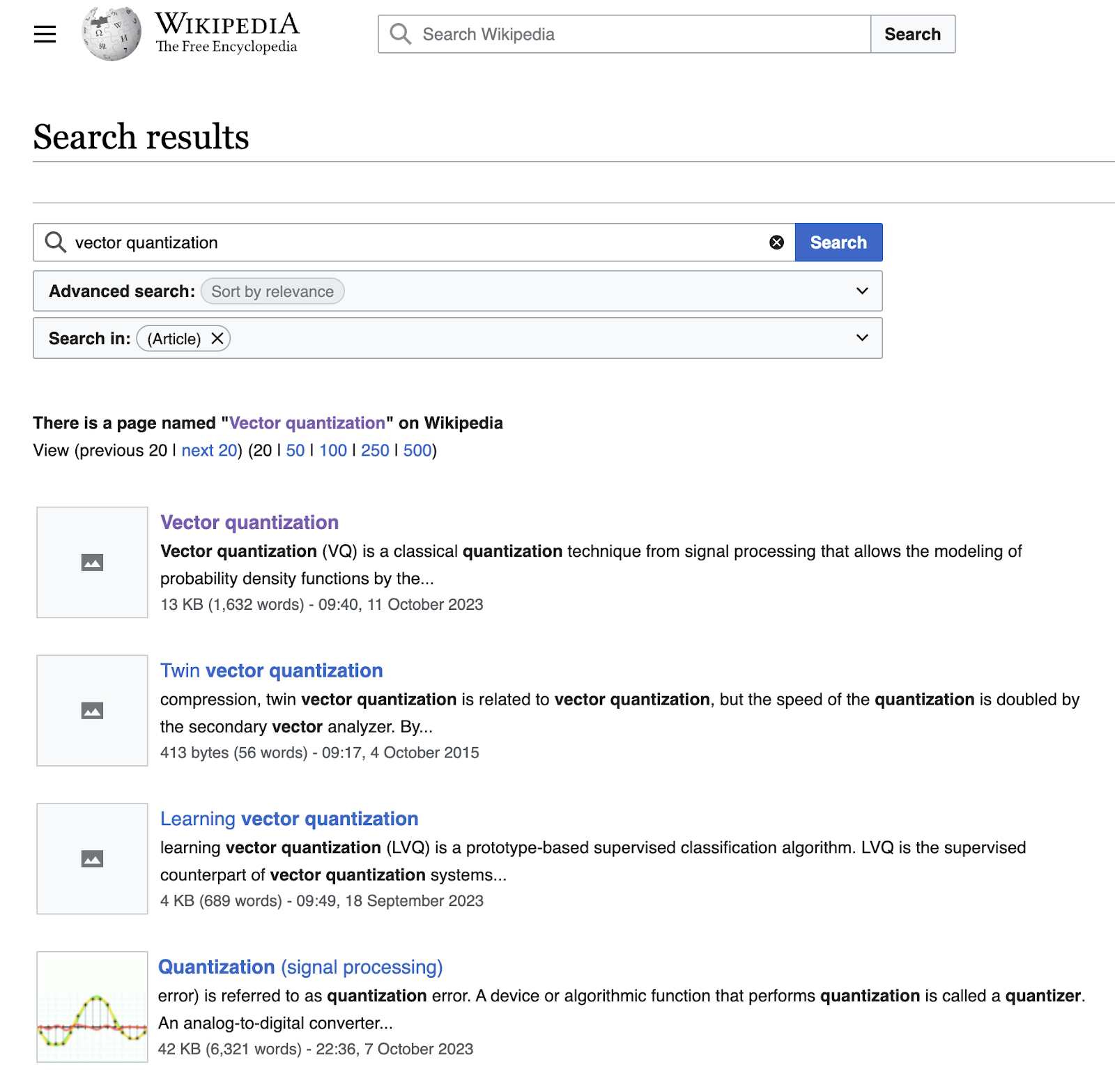
  • Unimodal search is a common type of search that only involves a single mode or type of data. Unimodal search is important when the query and the content to be searched are the same modality. This could mean that you have a short text description of what you are looking for and receive a ranked list of search results containing short paragraphs. For instance, if we’re trying to look for recipes, answers from Quora, or a short history lesson from Wikipedia, we are performing an unimodal search (in this case, with text). This can similarly be applicable to image-to-image search, like using Pinterest Lens to find similar apparel designs. Unimodal is the simplest form of search and is widely used in traditional search engines and databases.


Example Wikipedia article search on “vector quantization”

  • Cross-modal search refers to the ability to search across different modalities, where the query is expressed in one modality, and the content to be retrieved is  a different type (modality) of data. Imagine using a text description to search over images within your personal photo album. That would save so much scrolling time!
  • Multimodal search involves using two or more modalities in the search query and the retrieval process. This could mean combining text, images, audio, video, and other data types in the search.  Multimodal is important because it reflects the rich and complex nature of human communication

With Clarifai, you could use the “General” workflow for image-to-image search and the “Text” workflow for text-to-text search, both unimodal. Previously, to mimic text-to-image (cross-modal) search, we’d leverage the 9000+ concepts in the General model as our vocabulary. Now with the advent of visual-language models like CLIP, we launched the “Universal” workflow to enable anyone to use natural language to search over images.

How to perform Text-to-Image search with Clarifai

Operations can be done via the API or the portal UI. First, login to your account or sign up here for free.

Using the API

In this example, we will use Clarifai’s Python SDK to help us use as few lines as possible. Before you get started, get your Personal Access Token (PAT) by following these steps. Also follow the homepage instructions to install the SDK in one step. Use this notebook to follow along in your development environment or in Google Colab.

1. Create a new app with the default workflow specified as the “Universal” workflow

2. Upload the following 3 example images. Since this is a short demo, we directly ingest the inputs into the app. For production purposes, we recommend using datasets to organize your inputs. The SDK currently supports uploading from a csv file and from a folder and you can find the details in the examples.


3. Perform search by calling the query method and passing in a ranking.

4. Response is a generator. See the results by checking the “hits” attribute.

Using the UI

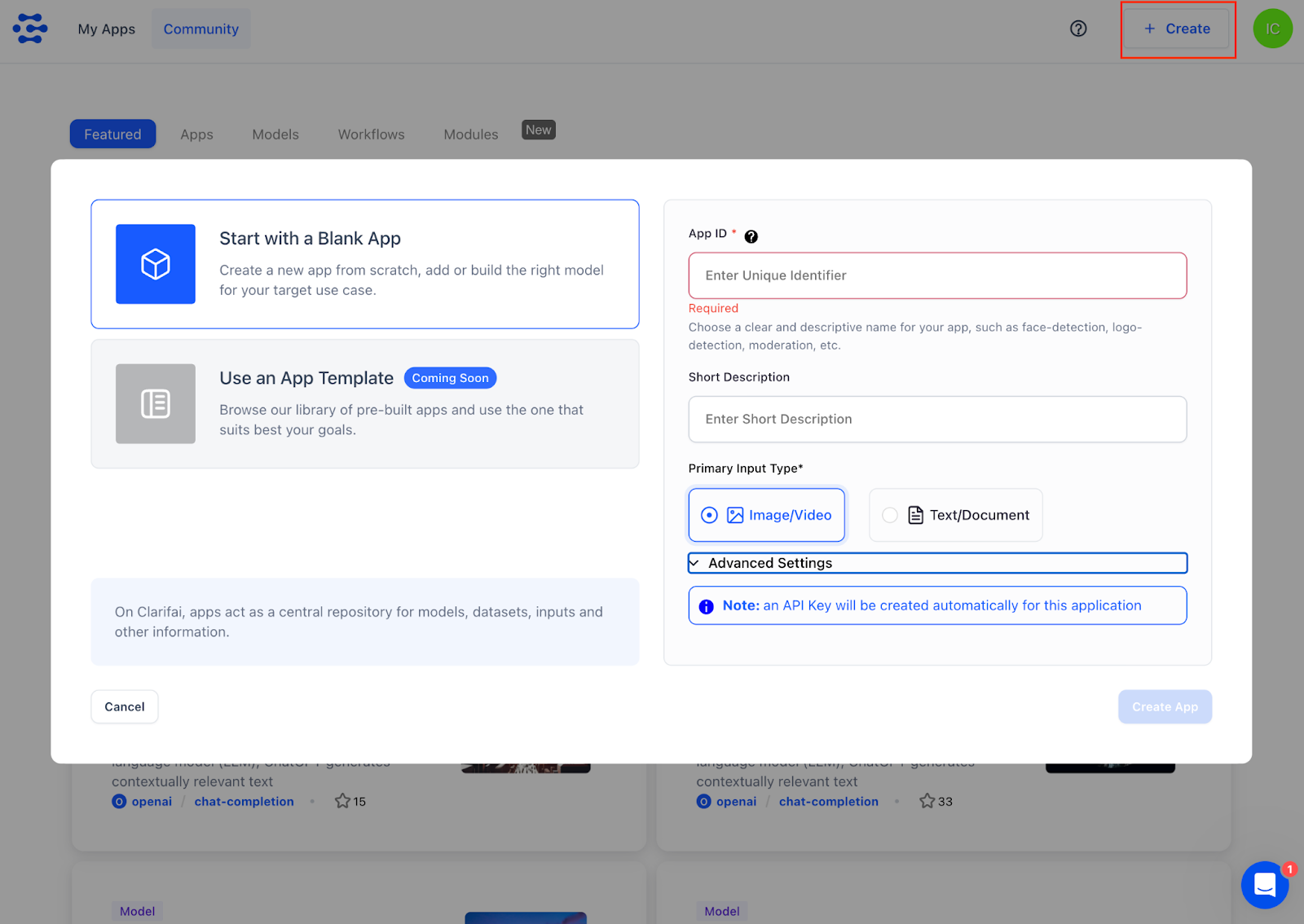
1. Create a new app by clicking the “+ Create” button on the top right corner in the portal screen. By default, “Start with a Blank App” is selected for you. For “Primary Input Type”, leave the default “Image/Video” selected as it sets the app’s base workflow with the Universal workflow. To verify that, click on “Advanced Settings”. Once the App ID and the short description have been filled in, click “Create App”.

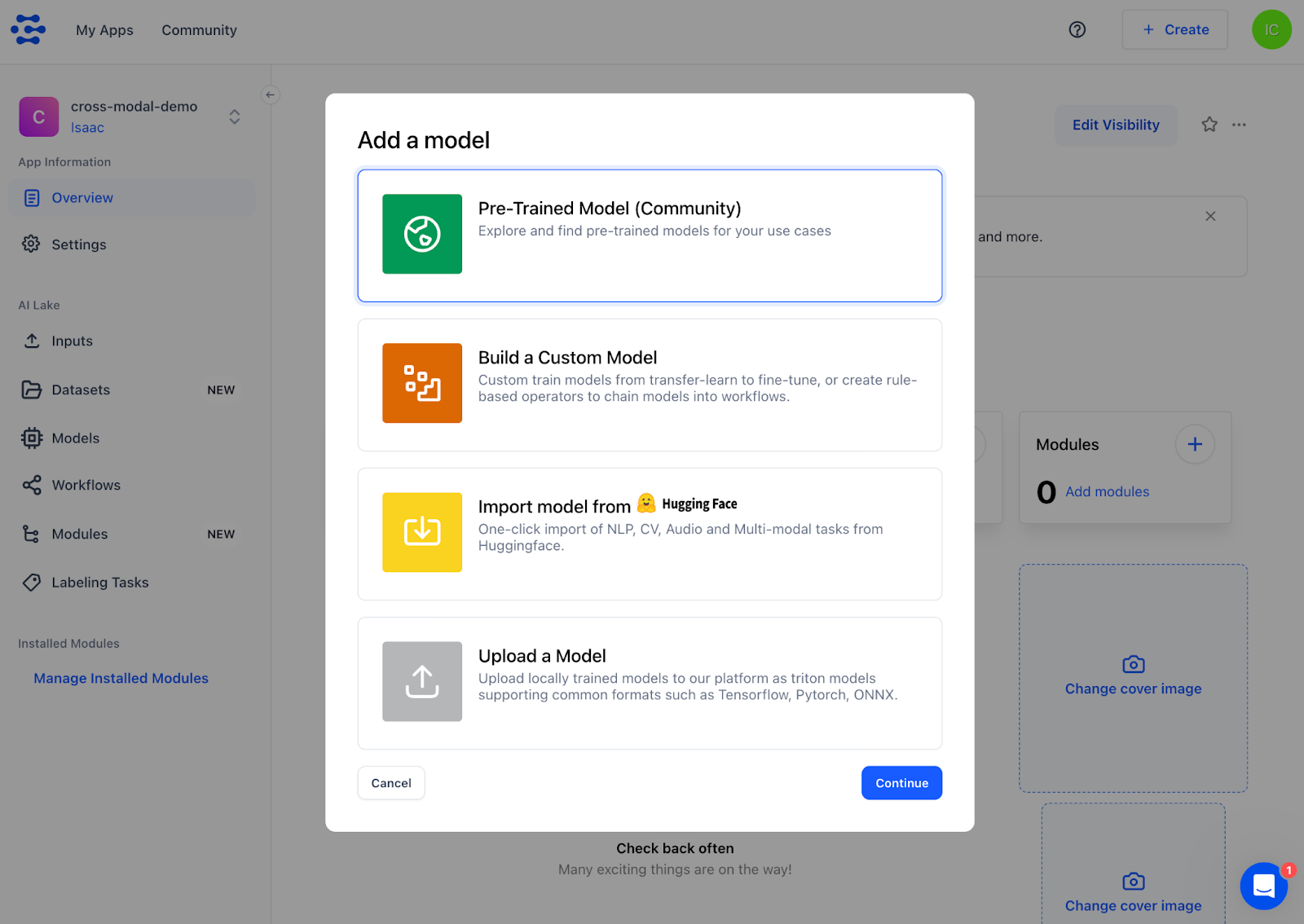
2. You’ll then be automatically navigated to the app you just created. At this time, you might see the following “Add a model” pop-up. Click “Cancel” on the bottom left corner as we do not need this for our tutorial.

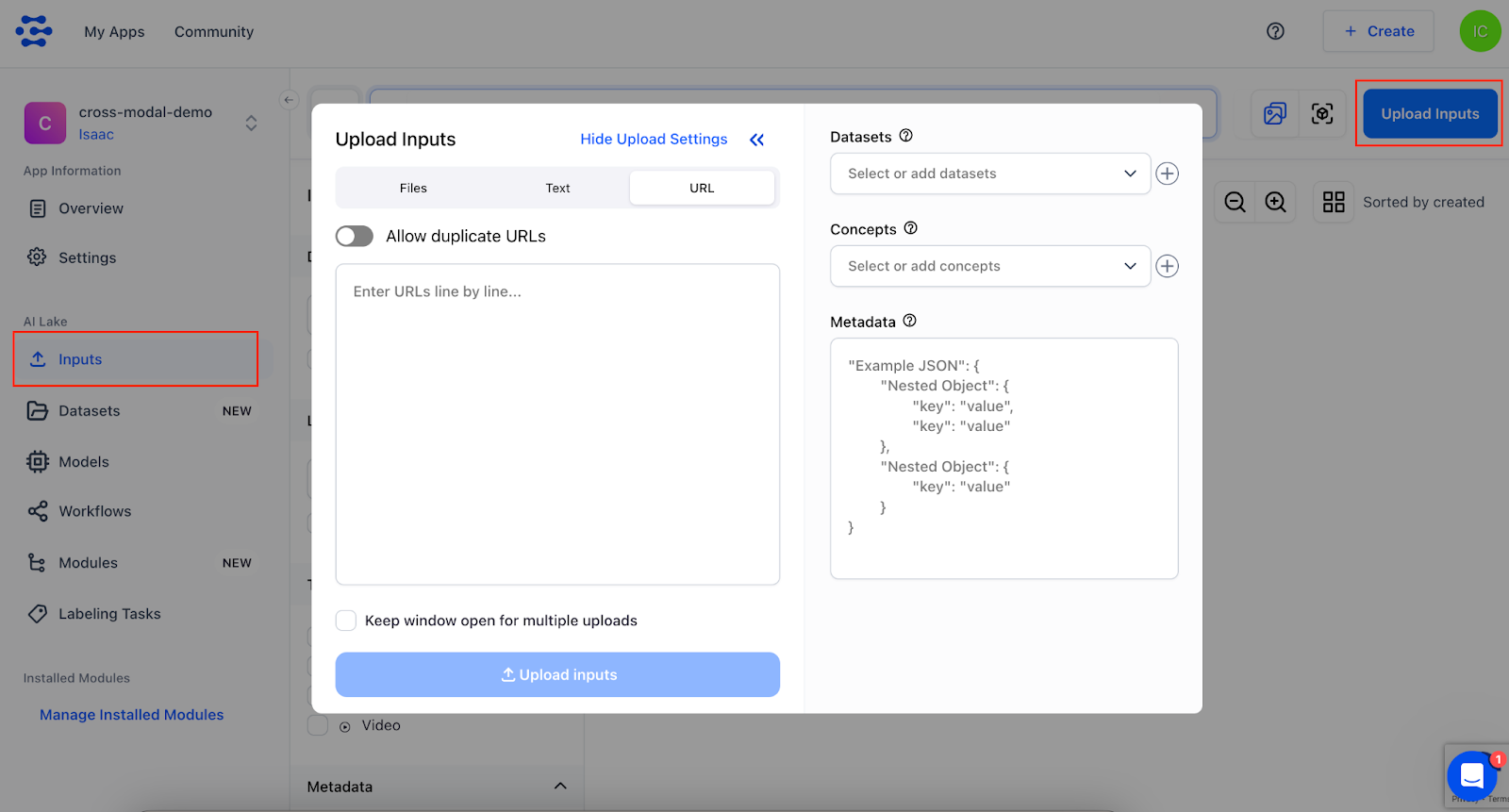
3. Upload images! On the left sidebar, click “Inputs”. Then click the blue button “Upload Inputs” on the top right. We can enter the image URLs line by line. Alternatively, we can upload them via a CSV file with a specific format. Here we use the following URLs. Copy and paste these into the box without new lines. 


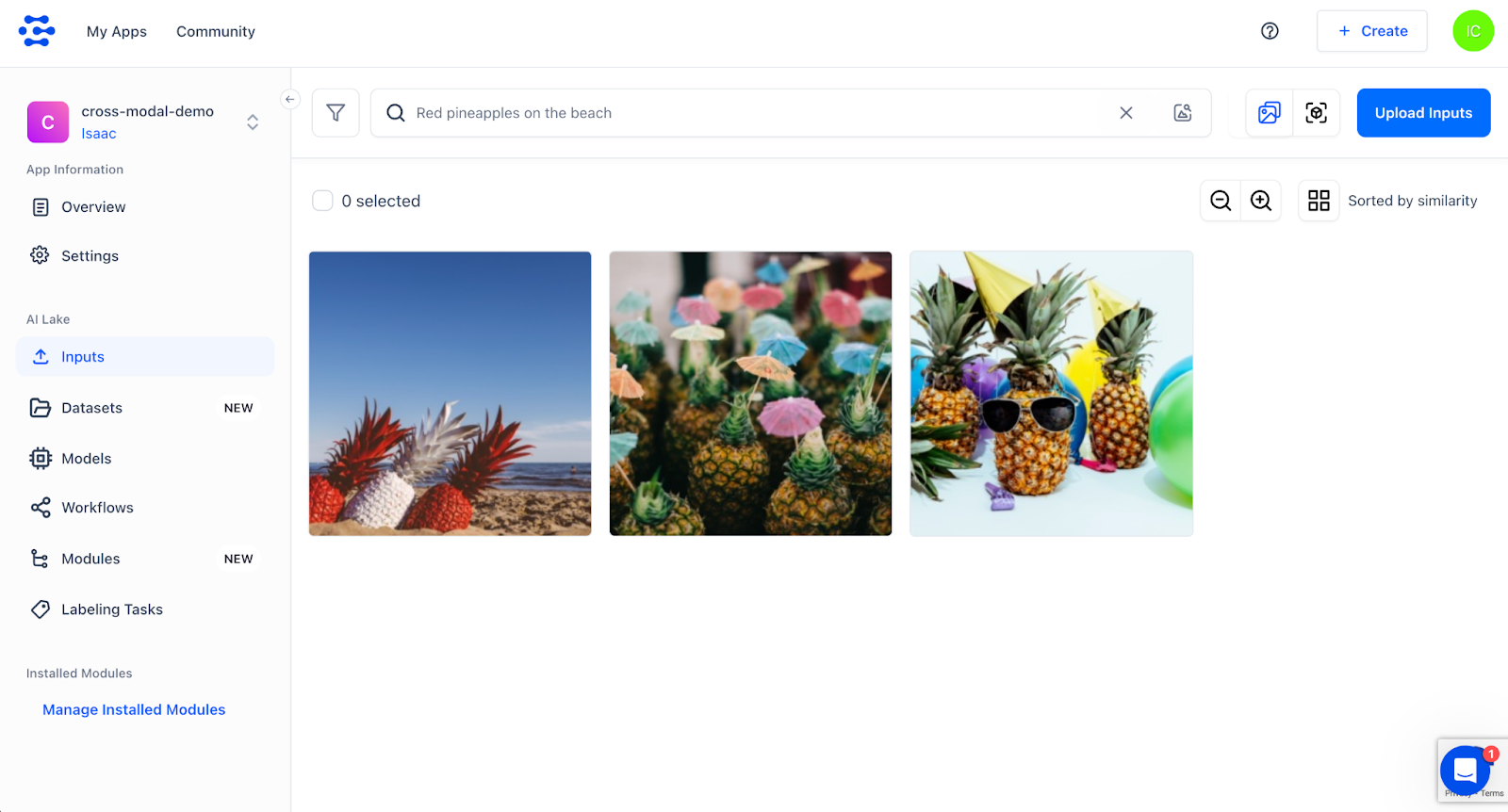
4. After the upload is complete, you should see all 3 images. In the search bar, enter a text query and hit enter. Here we have used “Red pineapples on the beach” as an example, and indeed, the search returns a ranked list with the most semantically similar image first. 

Summary

The choice between unimodal, cross-modal, and multimodal search depends on the nature of your data and the goals of your search. If you need to find information across different types of data, a cross-modal search is necessary. As AI technology advances, there is a growing trend towards multimodal and cross-modal systems due to their ability to provide richer and more contextually relevant search results.

Try it out on the Clarifai platform today! Can’t find what you need? Consult our Docs Page or send us a message in our Community Discord channel.


3 Reasons TOA Corporation Trusts ARES Commander for Civil Engineering Training


In the fast-paced world of civil engineering, staying at the forefront of technology is crucial for success. Toa Corporation, a leading player in the industry, has embraced ARES Commander as its go-to CAD software for civil engineering training. In this blog post, we delve into the top three reasons why Toa Corporation has made this innovative choice. Watch the video to learn more: Top 3 Reasons Why Toa Corporation Uses ARES Commander for Civil Engineering Training

Reason #1: Cost Performance

Toa Corporation’s journey with ARES Commander began as a solution to the challenges posed by their previous CAD program. As the number of users grew, Toa Corporation recognized the need for a software that offered reasonable pricing without compromising on performance. ARES Commander not only fit the bill but also seamlessly integrated with their existing DWG/CAD systems. The flexibility of ARES’ multi-user licensing options, allowing licenses to be shared among users, further added to its appeal. Today, two-thirds of the employees in Toa Corporation’s civil engineering department rely on ARES CAD software.

Reason #2: Support for 2D to 3D DWG

One of the standout features of ARES Commander is its exceptional DWG compatibility, not just in 2D but also in 3D. Toa Corporation’s user base has praised the software for its ability to effortlessly handle both dimensions, enabling engineers to seamlessly transition between 2D and 3D designs. This compatibility ensures that Toa Corporation’s engineers can work efficiently, saving valuable time and resources.

Reason #3: Excellent Technical Support

In the ever-evolving world of technology, having reliable technical support is paramount. Toa Corporation found a trusted partner in Graebert’s Enterprise Support, which offers prompt assistance via email, phone, and remote support. With ARES Commander and Graebert’s technical expertise at their disposal, Toa Corporation can swiftly resolve any technical issues that may arise during their civil engineering projects. This level of support plays a crucial role in ensuring uninterrupted workflows and efficient training for new employees.

Looking into the Future

Toa Corporation understands the significance of embracing emerging technologies in the construction industry. With the ministry’s implementation of BIM/CIM principles, the company recognizes the need for software that supports 3D modeling and point cloud data. ARES CAD Software aligns perfectly with Toa Corporation’s vision, providing the foundation for future growth and innovation. As the industry evolves, Toa Corporation eagerly anticipates the new features and possibilities that ARES CAD Software will bring, transforming it from a mere CAD program into a vital tool for supporting BIM/CIM initiatives.

Toa Corporation’s partnership with ARES Commander has revolutionized their civil engineering training programs. By prioritizing cost performance, seamless DWG compatibility, and excellent technical support, Toa Corporation has positioned itself at the forefront of the industry. As they continue to embrace future technologies and trends, the company remains confident in ARES Commander’s ability to support their endeavors. To experience the power of ARES CAD Software for yourself, you can download a free 30-day trial from www.graebert.com.

Experience the Power of ARES Commander Today!

Unlock the full potential of your civil engineering projects with ARES Commander, the cutting-edge CAD software trusted by industry leaders like Toa Corporation. Here are just a few reasons why ARES Commander is the ultimate solution for your engineering needs:

  1. Cost Performance: Say goodbye to expensive CAD software that drains your budget. ARES Commander offers reasonable pricing without compromising on performance. With high compatibility with your existing DWG/CAD systems, transitioning to ARES Commander is seamless and cost-effective.
  2. Seamless 2D to 3D DWG Compatibility: ARES Commander goes beyond traditional 2D design capabilities. It excels in handling both 2D and 3D DWG files, allowing you to effortlessly create and modify designs in any dimension. Experience the freedom to explore your projects in three dimensions with ease.
  3. Exceptional Technical Support: When it comes to software, reliable technical support is essential. With ARES Commander, you can rely on Graebert’s Enterprise Support to promptly resolve any technical issues you may encounter. Benefit from their expertise through email, phone, and remote support, ensuring uninterrupted workflows and peace of mind. You may also visit the ARES help center to read about the frequently asked questions.

Don’t miss out on the opportunity to revolutionize your civil engineering projects. Take the first step towards enhanced productivity and efficiency by downloading your free 30-day trial of ARES Commander today!