Apple today released a new update for Safari Technology Preview, the experimental browser Apple first introduced in March 2016. Apple designed the Safari Technology Preview to test features that may be introduced into future release versions of Safari.
Safari Technology Preview 193 includes fixes and updates for Accessibility, CSS, Forms, JavaScript, Rendering, Web API, and Web Inspector.
The current Safari Technology Preview release is compatible with machines running macOS Ventura and macOS Sonoma, the latest version of macOS that Apple released in September 2023.
The Safari Technology Preview update is available through the Software Update mechanism in System Preferences or System Settings to anyone who has downloaded the browser. Full release notes for the update are available on the Safari Technology Preview website.
Apple’s aim with Safari Technology Preview is to gather feedback from developers and users on its browser development process. Safari Technology Preview can run side-by-side with the existing Safari browser and while designed for developers, it does not require a developer account to download.
Apple has announced it will be holding a special event on Tuesday, May 7 at 7 a.m. Pacific Time (10 a.m. Eastern Time), with a live stream to be available on Apple.com and on YouTube as usual. The event invitation has a tagline of “Let Loose” and shows an artistic render of an Apple Pencil, suggesting that iPads will be a focus of the event. Subscribe to the MacRumors YouTube channel for more …
Apple has dropped the number of Vision Pro units that it plans to ship in 2024, going from an expected 700 to 800k units to just 400k to 450k units, according to Apple analyst Ming-Chi Kuo. Orders have been scaled back before the Vision Pro has launched in markets outside of the United States, which Kuo says is a sign that demand in the U.S. has “fallen sharply beyond expectations.” As a…
Apple is finally planning a Calculator app for the iPad, over 14 years after launching the device, according to a source familiar with the matter. iPadOS 18 will include a built-in Calculator app for all iPad models that are compatible with the software update, which is expected to be unveiled during the opening keynote of Apple’s annual developers conference WWDC on June 10. AppleInsider…
The upcoming iOS 17.5 update for the iPhone includes only a few new user-facing features, but hidden code changes reveal some additional possibilities. Below, we have recapped everything new in the iOS 17.5 and iPadOS 17.5 beta so far. Web Distribution Starting with the second beta of iOS 17.5, eligible developers are able to distribute their iOS apps to iPhone users located in the EU…
Apple today released several open source large language models (LLMs) that are designed to run on-device rather than through cloud servers. Called OpenELM (Open-source Efficient Language Models), the LLMs are available on the Hugging Face Hub, a community for sharing AI code. As outlined in a white paper [PDF], there are eight total OpenELM models, four of which were pre-trained using the…
Apple has stopped production of FineWoven accessories, according to the Apple leaker and prototype collector known as “Kosutami.” In a post on X (formerly Twitter), Kosutami explained that Apple has stopped production of FineWoven accessories due to its poor durability. The company may move to another non-leather material for its premium accessories in the future. Kosutami has revealed…
Greetings from the exciting world of Bellwright, where excitement is guaranteed at every corner! The action-packed role-playing game (RPG) Bellwright immerses players in a magical world full with magic, intrigue, and peril. You’ll meet a wide range of people on your epic quest, take part in thrilling combat, and discover the mysteries of the ancient kingdom of Bellwright. Download Bellwright for free from Worldof-pcgames and experience the thrill for yourself! It only takes a few easy steps to gain free access to this captivating role-playing game and explore a universe full of limitless opportunities. Whether you’re an experienced player or brand-new to the world of role-playing games, Bellwright provides an incredible gaming experience that will captivate you for many hours.
Go to Worldof-pcgames and select the Bellwright download page to get started. You can then start your journey by clicking the “Get Free Download” button. After the game has finished downloading, install it on your PC by following the on-screen instructions, then start playing right away. Bellwright is going to be a hit game for players of all ages because to its intriguing plot, gorgeous graphics, and fun gameplay. Don’t pass up the opportunity to delve deeper into Bellwright’s fascinating universe and learn all of its mysteries. Take off on an incredible journey unlike any other by downloading the game for free right now. Bellwright features everything you could possibly want, including exciting fights, thought-provoking quests, and stunning scenery. All of it is yours to explore, only at Worldof-pcgames.
Features and System Requirements:
Choose your equipment from a variety of medieval weapons and armor.
From swords and axes to heavy mauls and polearms, and bows, choose your unique style of fighting and hone your skill in directional combat.
Equip and train your troops the way you want it, and control them on the battlefield to prove your skill and might.
March 15th, 2024: Apple has reportedly acquired DarwinAI, a Canada-based startup focused on artificial intelligence (AI), in a deal that could significantly boost the tech giant’s AI ambitions.
The acquisition, which took place earlier this year, has not been officially announced by Apple, but sources familiar with the matter have confirmed the development to Bloomberg’s Mark Gurman.
During the company’s quarterly earnings call in February, Cook revealed that Apple was investing a “tremendous amount of time and effort” in AI and hinted at the possibility of new AI-driven features being unveiled later this year.
Speculation surrounding Apple’s AI plans has been rife, with rumors suggesting the development of a native foundation model called AppleGPT, an enhanced version of Siri that could function as a chatbot similar to ChatGPT and Google Gemini, AI-generated playlists for Apple Music, and AI integration into productivity apps like Pages and Keynote.
The upcoming iOS 18 update, expected to launch alongside the iPhone 16 series, is also rumored to bring several new AI features to Apple smartphones.
The acquisition of DarwinAI could play a crucial role in Apple’s AI strategy, particularly in developing on-device AI models and features.
This approach aligns with Apple’s emphasis on user privacy and security, as on-device AI processing minimizes the need for cloud-based data processing.
As Apple continues to invest in AI and expand its capabilities, integrating DarwinAI’s expertise and technology could lead to significant advancements in the company’s products and services.
While the specifics of the acquisition and its implications remain under wraps, the tech world eagerly awaits the curtain-raiser of Apple’s AI-driven innovations in the coming months.
3D architectural rendering companies that hope to succeed and grow should note that clients think differently than they do. Instead, you need to amaze and blow them away right from the get-go. Architects should combine various tools to showcase their skills to ensure clients are blown away by their work. Architects, artists, and designers can effectively communicate and express their ideas if they work collaboratively.
The universal plugin Vray allows different types of 3D modeling software to produce excellent results from designs. Your 3D architectural rendering company will have a fun time working with Vray technology thanks to its wide range of benefits, which include the following:
Vray enables access to extensive resources and libraries
Vray’s vast material library makes it stand out from its competition. You should never consider a material that doesn’t render flawlessly with life-like precision and add it to your design. The Vray plugin revolutionizes interior design and 3D architectural rendering by taking them to a new level. With Vray, you can effortlessly manipulate finish combinations in real time, eliminating the need to spend endless hours explaining the look and feel of every finish on every surface. Instead, you can simply showcase your design vision through stunning 3D renderings, making it a game-changer for both 3D interior design services and 3D architectural rendering services.
Visually presenting information allows you to make faster decision-making, depart sooner, and let you do all the things you love and appreciate about architecture. Only a few 3D rendering products can keep up with the popularity of Vray. It’s packed with tons of courses, lessons, and tutorials to help you make the most out of its potential. Practice is required to make the most of a product, especially with steep learning. But you will become better at it faster if you practice under focus and guidance with the help of the available resources at your disposal.
The community of Vray 3D rendering software users is massive, with instructors, content creators, social media, forums, and more. You can ask for expert technical opinions on your newest renders and receive friendly feedback. There are also learning resources available for free that help beginners find their footing and guide well-versed artists who plan to implement new features. Designers and architects can search for 3D assets, tutorials, and docs to improve their 3D architectural rendering workflows.
Boundless options in Vray
Vray also has limitless options to adjust camera settings, depth of field, light source, material textures, bump maps, and more. It ultimately all boils down to flexibility if numerous options are available. It’s easy to get tempted to control all aspects of a design drawing, and Vray lets you do just that. All plugin products are also tailored to specifications to assure you that it’s yours and yours alone.
Material rendering
You last want your realistic 3D architectural visualization to look unrealistic. It will make your project look amateurish if your company is caught between finished and conceptual work. Ensure you nail realism if you want your work to be genuine, and this is where Vray comes in handy. Vray’s consistency and precision play a pivotal role in achieving the highest level of realism in your 3D architectural visualization services.
Big projects always entail large overheads. Even the most straightforward scenes involving international airports, towering hotels, and smart cities can already contain thousands of lights and objects. It’s easy to feel nervous with the mere thought of all the data involved in such projects.
The good news is that Chaos, the company behind Vray, has developed a rendering engine that can handle these massive scenes quickly and smoothly. Tools like Proxy Objects can also handle the most exhaustive models without any issues with memory consumption. Meanwhile, the VR scene format lets you share scenes, 3D architectural models, or entire 3D architectural rendering projects across various host platforms without conversion troubles.
Exceptional photorealistic quality
Vray has already bagged Emy and Academy Awards, and many animations and sequences in TV shows and movies have been crafted using the physically accurate materials and lighting of this proven and tested render engine for production. 92 out of the top 100 architectural companies in the world use Vray daily to visualize their most significant and essential designs. Of course, you can also tap into its unique power and develop stunning visuals.
Vray has you covered if your company wants to create a more hyper-realistic 3D architectural rendering. It allows you to build fly-throughs and stills that resemble natural photography. Vray also offers VR camera support. By exporting 6×1 Cube or 360 spherical images, Vray empowers you to deliver an immersive and intuitive experience of your designs to clients, making it ideal for both traditional and cutting-edge AR/VR architectural services.
The cleanest textures, the whitest whites, and the darkest blacks accurately represent real-life situations. You can use Vray to create spaces that will make your clients feel they live in them. Every design you make should be of top quality, whether presenting it to potential clients or submitting it to stakeholders.
Despite its subjective nature, quality is an easy-to-quantify and recognize measure.
You can catch the eye of more people and establish your reputation if your work stands out from the crowd. This is what 3D architectural rendering companies are all about.
Seamless integration with SketchUp, 3DS Max, and Rhino
Integrating with Google SketchUp is an indispensable feature for any 3D architectural rendering company. Sketchup can present ideas right away with the help of a simple set of tools. However, this modeling tool is technically not the most sophisticated.
But by using Vray, you can breathe life into your sketchy ideas at the fastest time possible. Client meetings that used to be held to address issues with conceptual programs can now be improved with real-life visualization, thanks to Vray.
Light and shadow
Shadow and light, and the way they are rendered in architectural visualizations, are just two of the most essential tools available at your disposal to understand realism unconsciously. Lighting that isn’t convincing can be off or distracting on a drawing. Vray is known to handle realistic shadow and light more realistically and accurately than other comparable renders.
Real-time validation of ideas
Vray provides two real-time solutions. First is Vray Vision, which is available in Rhino, Revit, and SketchUp. This raster engine lets you improve your design’s view in another window. Vray Vision allows you to export scenes to enable your clients to navigate them and evaluate and review design proposals. Another real-time ray-traced solution is Chaos Vintage with Live Link, which lets you navigate the scene and check your design with Vray’s realistic quality. You can also work interactively with IPR or Interactive Production Rendering to check the result while you design and speed up the lookdev process of lighting and materials. It allows you to reach decisions faster, thus enhancing your productivity significantly.
The past several years have witnessed the redesigning of Vray to start easily and quickly. It only takes several steps to create gorgeous 3D architectural rendering imagery, which is undoubtedly every Vray designer’s dream. Creativity is the most critical aspect of any design. You can enjoy more opportunities and options if you can use friendly tools that you can seamlessly incorporate into your creative exploration.
Thanks to the scene intelligence technology and default settings of Vray that work with different scenes, you can spend more time on creative solutions and less on technical aspects. Vray can also seamlessly work with top 3D platforms like SketchUp, Rhino, Cinema 4D, Revit, 3DS Max, and more. However, even though it’s easy to learn, you can expect that there is still a learning curve due to the extensive material library and more settings and options as you find your way through the entire process. The real value of Vray lies in its work. The good news is that architects need to learn the system, change it based on their preferences, and make the most out of its efficiency.
Fast 3D rendering made possible
Fast is often associated with machines, settings, and 3D rendering model size. However, Vray consistently outperforms its competitors. Vray offers architects a range of benefits, including faster 3D rendering services, architectural drafting services, and 3D architectural animation services. Using a 3D visualization tool that lets you quickly determine if something will work before you fully engage in longer, higher-quality rendering presentations works to your advantage.
This will allow you to see the lighting, materials, and colors to decide the frame and composition much faster. Vray also offers a faster rendering engine that no other rendering software can provide. Consider using Vray if you’re looking for something quick that will maintain quality, even on a tight schedule.
Cad Crowd is a platform where your 3D architectural rendering company can search for professionals who are well-versed in using Vray for architectural design services.
Apache Cassandra and Apache Hadoop are members of the same Apache Software Foundation family. We could have contrasted these two frameworks, but that comparison would not be fair because Apache Hadoop is the ecosystem that encompasses several components. As Cassandra is responsible for big data storage, we have chosen its equivalent from the Hadoop’s ecosystem, which is Hadoop Distributed File System (HDFS). Here, we’ll try to find out if Cassandra and HDFS are like twins who are identical in appearance and just bear different names, or they are rather a brother and a sister who may look similar, but still are very different.
Master/slave vs. masterless architecture
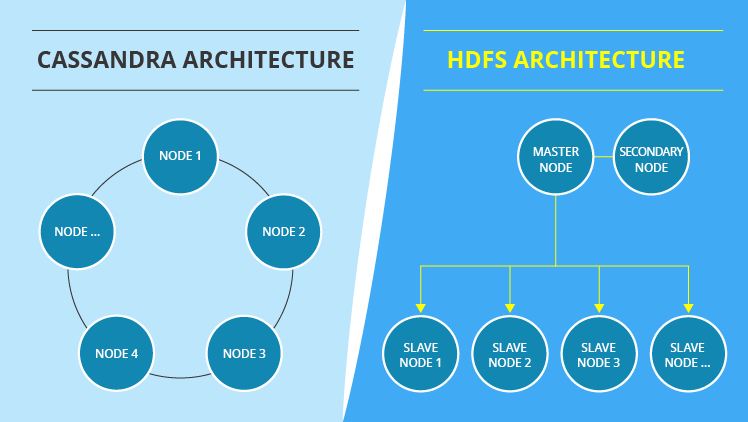
Before we dwell on the features that distinguish HDFS and Cassandra, we should understand the peculiarities of their architectures, as they are the reason for many differences in functionality. If you look at the picture below, you’ll see two contrasting concepts. HDFS’s architecture is hierarchical. It contains a master node, as well as numerous slave nodes. On the contrary, Cassandra’s architecture consists of multiple peer-to-peer nodes and resembles a ring.
5 Key functional differences
1. Dealing with massive data sets
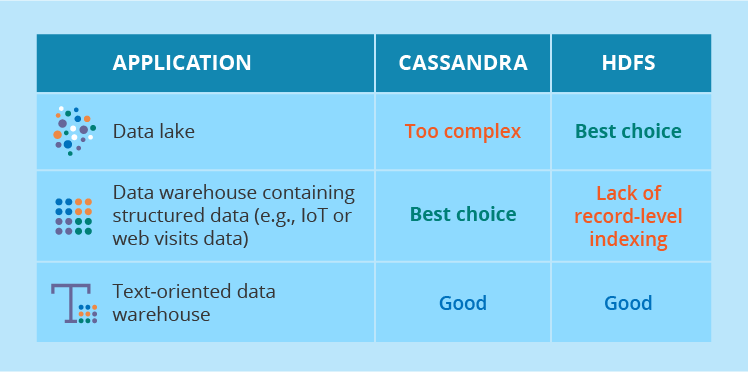
Both HDFS and Cassandra are designed to store and process massive data sets. However, you would need to make a choice between these two, depending on the data sets you have to deal with. HDFS is a perfect choice for writing large files to it. HDFS is designed to take one big file, split it into multiple smaller files and distribute them across the nodes. In fact, if you need to read some files from HDFS, the operation is reverse: HDFS has to collect multiple files from different nodes and deliver some result that corresponds to your query. By contrast, Cassandra is the perfect choice for writing and reading multiple small records. Its masterless architecture enables fast writes and reads from any node. This makes IT solution architects opt for Cassandra if it is required to work with time series data, which is usually the basis for the Internet of Things.
While in theory HDFS and Cassandra look mutually exclusive, in real life they may coexist. If we continue with the IoT big data, we can come up with a scenario where HDFS is used for a data lake. In this case, new readings will be added to Hadoop files (say, there will be a separate file per each sensor). At the same time, a data warehouse may be built on Cassandra.
2. Resisting to failures
Both HDFS and Cassandra are considered reliable and failure resistant. To ensure this, both apply replication. Simply put, when you need to store a data set, HDFS and Cassandra distribute it to some node and create the copies of the data set to store on several other nodes. So, the principle of failure resistance is simple: if some node fails, the data sets that it contained are not irretrievably lost – their copies are still available on other nodes. For example, by default, HDFS will create three copies, though you are free to set any other number of replicas. Just don’t forget that more copies mean more storage space and longer time to perform the operation. Cassandra also allows choosing the required replication parameters.
However, with its masterless architecture, Cassandra is more reliable. If HDFS’s master node and secondary node fail, all the data sets will be lost without the possibility of recovery. Of course, the case is not frequent, but still this can happen.
3. Ensuring data consistency
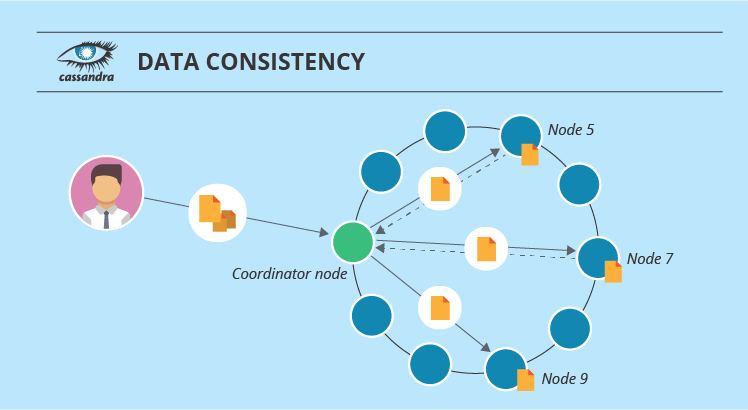
Data consistency level determines how many nodes should confirm that they have stored a replica so that the whole write operation is considered a success. In case of read operations, data consistency level determines how many nodes should respond before the data is returned to a user.
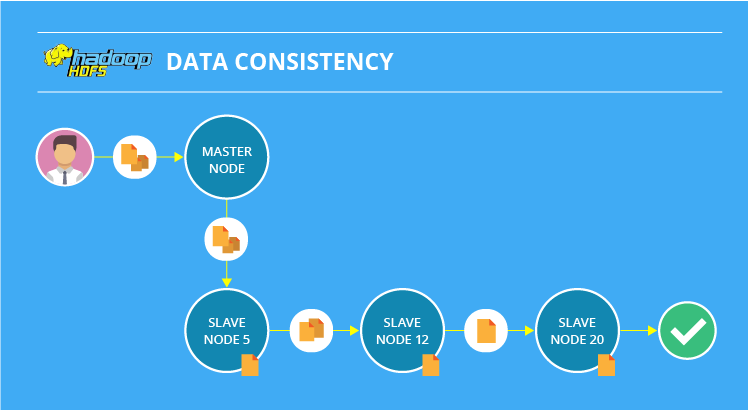
In terms of data consistency, HDFS and Cassandra behave quite differently. Let’s say, you ask HDFS to write a file and create two replicas. In this case, the system will refer to Node 5 first, then Node 5 will ask Node 12 to store a replica and finally Node 12 will ask Node 20 to do the same. Only after that, the write operation is acknowledged.
Cassandra does not use HDFS’s sequential approach, so there is no queue. Besides, Cassandra allows you to declare the number of nodes you want to confirm the success of operation (it can range from any node to all nodes responding). One more advantage of Cassandra is that it allows varying data consistency levels for each write and read operation. By the way, if a read operation reveals inconsistency among replicas, Cassandra initiates a read repair to update the inconsistent data.
4. Indexing
As both systems work with enormous data volumes, scanning only a certain part of big data instead of a full scan would increase the system’s speed. Indexing is exactly the feature that allows doing that.
Both Cassandra and HDFS support indexing, but in different ways. While Cassandra has many special techniques to retrieve data faster and even allows creating multiple indexes, HDFS’s capabilities go only to a certain level – to the files the initial data set was split into. However, record-level indexing can be achieved with Apache Hive.
5. Delivering analytics
Both designed for big data storage, Cassandra and HDFS still have to do with analytics. Not by themselves, but in combination with specialized big data processing frameworks such as Hadoop MapReduce or Apache Spark.
Apache Hadoop’s ecosystem already includes MapReduce and Apache Hive (a query engine) along with HDFS. As we described above, Apache Hive helps overcome the lack of record-level indexing, which enables to speed up an intensive analysis where the access to records is required. However, if you need Apache Spark’s functionality, you can opt for this framework, as it is also compatible with HDFS.
Cassandra also runs smoothly together with either Hadoop MapReduce or Apache Spark that can run on top of this data storage.
HDFS and Cassandra in the framework of CAP theorem
According to the CAP theorem, a distributed data store can only support two of the following three features:
Consistency: a guarantee that the data is always up-to-date and synchronized, which means that at any given moment any user will get the same response to their read query, no matter which node returns it.
Availability: a guarantee that a user will always get a response from the system within a reasonable time.
Partition tolerance: a guarantee that the system will continue operation even if some of its components are down.
If we look at HDFS and Cassandra from the perspective of the CAP theorem, the former will represent CP and the latter – either AP or CP properties. The presence of consistency in Cassandra’s list can be quite puzzling. But, if needed, your Cassandra specialists may tune the replication factor and data consistency levels for writes and reads. As a result, Cassandra will lose the Availability guarantee, but gain a lot in Consistency. At the same time, there’s no possibility to change the CAP theorem orientation for HDFS.
In a nutshell
If you are to make a choice between Apache Cassandra and HDFS, the first thing to take into account is the nature of your raw data. If you have to store and process large data sets, you can consider HDSF, if multiple small records – Cassandra may be a better option. Besides, you should form your requirements towards data consistency, availability and partition tolerance. To make a final decision, it’s critical to understand the exact use of big data storage.
Even if Cassandra seems to outperform HDFS in most cases described, this does not mean that HDFS is weak. Based on your business needs, a professional Hadoop consulting team may suggest a combination of frameworks and technologies with HDFS and Hive or HBase at core that would enable great and seamless performance.
Manor Lords is a medieval city builder and management sim being developed entirely by a one-man team (his name is Greg Styczeń). With its three million wishlists on Steam, it’s safe to say that Manor Lords is highly anticipated. The early access releases on April 26, so let’s look at when the game will become available in your time zone for Steam, GOG, and PC Game Pass.
When does Manor Lords release?
The early access for Manor Lordsstarts on April 26, 2024. It’ll be available on Steam, , and PC Game Pass.
Image: Hooded Horse
Manor Lords will be releasing simultaneously in all time zones, which means that it’ll drop at:
April 26 at 6 a.m. PDT for the west coast of North America
April 26 at 9 a.m. EDT for the east coast of North America
April 26 at 10 a.m. BRT for eastern South America
April 26 at 2 p.m. BST for the U.K.
April 26 at 3 p.m. CEST for mainland Europe
April 26 at 6:30 p.m. IST for India
April 26 at 10 p.m. JST for Japan
April 26 at 11 p.m. AEST for eastern Australia
April 27 at 1 a.m. NZST for New Zealand
What to expect in Manor Lords early access
Manor Lords is releasing in early access (or as a preview on PC Game Pass), which means that the game isn’t complete yet. There are a number of features that haven’t been implemented. But while there’s clearly still a lot to come, no roadmap has been published.
Image: Slavic Magic/Hooded Horse via Polygon
What you can do, though, is play three different scenarios on the game’s single early access map. You can also change the various settings for the scenario to customize your experience from something close to a sandbox all the way up to an exacting and battle-filled challenge.
BirdDog recently revealed their newest lineup of cameras including the X1 & X1 Ultra PTZ Cameras, as well as the MAKI Ultra Box Cameras. Packed with heaps of game changing new features to supercharge your workflows. Whether you’re a newb or a pro, these cameras are going to make awesome content creation easier for you. Videoguys is now accepting pre-orders for these new BirdDog cameras.
Learn more about BirdDog X1 & X1 Ultra
NDI® | HX3. Enhanced Reliability on More Networks. The X1 and X1 Ultra deliver superior network performance via NDI® | HX3 integration. You get significantly reduced network impact and excellent image quality, meaning its more friendly in more network environments. BirdDog’s NDI® | HX3 delivers quality and performance you can count on.
Wi-Fi. Connected but not connected. No need to use cables to capture every shot. On top of regular ethernet with PoE, X1 and X1 Ultra have built-in Wi-Fi functionality. Easily capture shots from spots where it’s hard to run cable, seamlessly integrating into any environment. Your set up just became a whole lot more flexible.
Integrated NDI® | HX Decoder. The X1 and X1 Ultra are the world’s first PTZ cameras featuring an NDI®| HX* Decoder designed specifically for confidence monitoring, return feeds, or teleprompter usage. We’ve pulled all this connectivity into a single cable, radically simplifying how you interface with your equipment. Whether you’re broadcasting live or delivering a CEO address, the integrated NDI HX decoder enables more brilliance with less setup. *NDI®|HX2 and NDI®|HX3 supported
Tally Light. It’s a halo Effect. Professional results need professional tools. X1 and X1 Ultra sport the most visible and effective Tally system available. Up front with a large, daylight visible border, and out back with an interchangeable, illuminated numbering system. Your cast and crew will always know where to look to keep your audience engaged and your look polished.
Learn more about BirdDog MAKI Ultra
Compact. Yet Mighty. The MAKI Ultra boasts a compact footprint helping you capture those unusual and engaging camera angles with ease. With MAKI Ultra you can deliver killer POV shots that put your audience right in the game at eSports events, or attach MAKI Ultra to a band rig to capture incredible angles of your drummers or instrumentalists, be they in a band or a house of worship. Wherever the action is, MAKI Ultra ensures you never miss a beat.
Super-Fast Autofocus. Keeping Pace with Your Vision. MAKI Ultra’s super-fast autofocus is a game-changer for dynamic content and fast-paced environments. Equipped with a ToF sensor and powered by advanced automatic focusing algorithms, MAKI Ultra ensures rapid and accurate autofocus. Whether your subjects are zipping across the frame or moving closer and further away from the camera, MAKI Ultra keeps them sharp and in focus.
4K60. Capture Every Moment with Ultra Detail. With its 4K60 capabilities, MAKI Ultra expands your options on what and how you capture content. From fast-moving action shots to incredible detail in low-light sets, you can get all the detail thanks to MAKI Ultra’s high frame rate and advanced image processing capabilities
Book Sales due 4/12/2024
Description: This project inputs sales information for books.
It calculates the extended price and discount for a sale.
Uses variables, constants, and calculations.
Using Visual Studio and Visual Basic Language.
Errors: BC30451 ‘Form1’ is not declared. It may be inaccessible due to its protection level. Book Sales C:\Users\juliana\Desktop\Book Sales\My Project\Application.Designer.vb 34 Active
BC30311 Value of type ‘Decimal’ cannot be converted to ‘Label’. Book Sales C:\Users\juliana\Desktop\Book Sales\BookSaleForm.vb 18 Active
BC30451 ‘Form1’ is not declared. It may be inaccessible due to its protection level. Book Sales C:\Users\juliana\Desktop\Book Sales\My Project\Application.Designer.vb 34 Active
Public Class BookSaleForm
This is my code:
Public Class BookSaleForm
‘ Declare the constant.
Const DISCOUNT_RATE_Decimal As Decimal = 0.15D
Private Sub CalculateButton_Click(ByVal sender As System.Object,
   ByVal e As System.EventArgs) Handles CalculateButton.Click

    ' Calculate the price and discount.
    Dim QuantityInteger As Integer
    Dim PriceDecimal, ExtendedPriceDecimal, DiscountDecimal,
       DiscountedPriceDecimal As Decimal

    ' Convert input values to numeric variables.
    QuantityInteger = Integer.Parse(QuantityTextBox.Text)
    PriceDecimal = Decimal.Parse(PriceTextBox.Text)

    ' Calculate values.
    ExtendedPriceDecimal = QuantityInteger * PriceDecimal
    DiscountDecimal = Decimal.Round( _
     (ExtendedPriceDecimal * DISCOUNT_RATE_Decimal), 2)
    DiscountedPriceDecimal = ExtendedPriceDecimal - DiscountDecimal

    ' Format and display answers.
    ExtendedPriceTextBox.Text = ExtendedPriceDecimal.ToString("C")
    DiscountTextBox.Text = DiscountDecimal.ToString("N")
    DiscountedPriceTextBox.Text = DiscountedPriceDecimal.ToString("C")
End Sub

Private Sub ClearButton_Click(ByVal sender As System.Object,
  ByVal e As System.EventArgs) Handles clearButton.Click
    ' Clear previous amounts from the form.

    TitleTextBox.Clear()
    PriceTextBox.Clear()
    ExtendedPriceTextBox.Clear()
    DiscountTextBox.Clear()
    DiscountedPriceTextBox.Clear()
    With QuantityTextBox
        .Clear()
        .Focus()
    End With
End Sub


Private Sub ExitButton_Click(ByVal sender As System.Object,
  ByVal e As System.EventArgs) Handles ExitButton.Click
    ' Exit the project.

    Me.Close()
End Sub
IBM wisely gravitated away from trying to be a pure cloud infrastructure vendor years ago, recognizing that it could never compete with the big three: Amazon, Microsoft and Google. It has since moved onto helping IT departments manage complex hybrid environments, using its financial clout to acquire a portfolio of high-profile companies.
It began with the $34 billion Red Hat acquisition in 2018, continued with the Apptio acquisition last year, and it kept it going on Wednesday when the company announced that it would be acquiring cloud management vendor HashiCorp for $6.4 billion.
With HashiCorp, Big Blue gets a set of cloud lifecycle management and security tools, and a company that is growing considerably faster than any of IBM’s other businesses — although the revenue is small by IBM standards: $155 million last quarter, up 15% over the prior year. That still makes it a healthy and growing business for IBM to add to its growing stable of hybrid cloud tools.
IBM CEO Arvind Krishna certainly sees the value of this piece to his company’s hybrid strategy, and he even threw in an AI reference for good measure. “HashiCorp has a proven track record of enabling clients to manage the complexity of today’s infrastructure and application sprawl. Combining IBM’s portfolio and expertise with HashiCorp’s capabilities and talent will create a comprehensive hybrid cloud platform designed for the AI era,” he said in a statement.
HashiCorp made headlines last year when it changed the license on its open source Terraform tool to be more friendly to the company. The community that helped build Terraform wasn’t happy and responded by launching a new open-source alternative called OpenTofu. HashiCorp recently accused the new community of misusing Terraform’s open-source code when it created the OpenTofu fork. Now that the company is part of IBM, it will be interesting to see if they continue to pursue this line of thinking.
It’s worth noting that Red Hat also made headlines last year when it changed its open-source licensing terms, also causing consternation in the open-source community. Perhaps these companies will fit well together, both from a software perspective and their shifting views on open source.
Just this week, the company introduced a new platform concept with the release of the Infrastructure Cloud, a concept that should fit nicely inside IBM’s hybrid cloud product catalog. While they didn’t add much in terms of functionality, it did unify the offerings under a single umbrella making it easier for sales and marketing to present to customers.
If IBM treats HashiCorp in a similar way to Red Hat, the company would maintain its independence inside the IBM family of products. AVOA, a research firm run by former CIO Tim Crawford, says the company would be wise to keep it neutral.
“My reservation would be if IBM moves away from Hashicorp’s neutral stance in working with multiple cloud providers and focuses on IBM Cloud. I suspect that would not be the case as IBM has recently shown how they are more open with other cloud providers,” Crawford wrote in a recent blog post.
HashiCorp was founded in 2012 and raised almost $350 million before going public in 2021.
No matter what you’re writing, the tone you choose can enhance your message, allowing your readers to experience the emotion behind your words as well as their surface meaning.
This article delves into the power of positive tone words, a key technique for helping your readers experience the positive emotional intention of your writing.
Whether you’re crafting a novel, an email, or a marketing copy, understanding and using positive tone words can make your writing much more effective.
Let’s explore how these tone words can increase the emotional impact your writing has on readers.
The power of positive tone words
Positive tone words are a type of language that enhance the emotional power of your writing.
You can explore the concept of tone words in general in our dedicated guide, but our focus here will be solely on words that engender a positive response.
Let’s start with a basic definition
What are positive tone words?
Positive tone words are expressions that carry a positive connotation, aiming to evoke optimistic, encouraging, and uplifting responses from the reader.
They allow your writing to be effective on two levels – intellectual and emotional.
When used effectively, they cause your reader to not only understand your ideas, but have an emotional response to them at the same time.
Let’s explore how that works on a psychological level.
The psychological impact of positive tone words
Understanding the psychological impact of positive tone words is crucial in harnessing their full potential.
These words can:
Boost Engagement: Captivate and maintain the reader’s attention more effectively.
Enhance Persuasiveness: Make arguments and proposals more convincing.
Evoke Positive Emotions: Stimulate feelings of happiness, optimism, and comfort.
Increase Comprehension: Make complex information more understandable and relatable.
Strengthen Connection: Build a deeper emotional bond with the reader.
Foster Trust and Credibility: Encourage trust in the author’s expertise and intentions.
Motivate Action: Inspire readers to take desired actions or adopt new perspectives.
Now that you know the impact of positive tone words, let’s delve deeper into how they’re used by skilled writers.
What is the transformative role of positive tone words?
When you decide to leverage the power of positive tone words in your writing, you make a choice to transform the impact it has on readers.
Intentional use of these words shapes your writing’s ambiance, steers its emotional undertones, and ultimately, determines the reader’s engagement level and response to any call to action you include.
Incorporating positive tone words is not just about adding a layer of positivity – it’s about crafting an experience that resonates, persuades, and remains memorable long after your reader has finished your work.
Categories of positive tone words
To achieve a true mastery of positive tone words, recognizing their diversity is key.
Each category serves a unique purpose, enriching your text by evoking specific responses from readers.
From inspiring to respectful, understanding these categories and their nuances can dramatically enhance your writing’s effectiveness and emotional depth.
Let’s explore the main categories of positive tone words and the varying impacts they have.
Inspirational positive tone words
Inspirational tone words are designed to uplift and motivate the reader, pushing them towards personal growth or action.
The intended impact of these words is to spark a sense of possibility and ambition.
Here are seven examples of inspirational positive tone words.
1. Empower: To give someone the strength and confidence to do something.
2. Aspire: To direct one’s hopes towards achieving something.
3. Innovate: To introduce something new or different.
4. Transform: To make a thorough or dramatic change in form, appearance, or character.
5. Overcome: To successfully deal with or gain control of something difficult.
6. Thrive: To grow, develop, or be successful.
7. Illuminate: To light up or make clear.
Affectionate positive tone words
Affectionate tone words convey warmth, care, and love, aiming to create a sense of closeness and comfort.
These words are meant to nurture a feeling of connection and empathy between the writer and the reader.
Here are seven examples.
1. Cherish: To protect and care for someone lovingly.
2. Adore: To love and respect someone deeply.
3. Fondness: A gentle feeling of liking or affection.
4. Warmth: A quality of being friendly, enthusiastic, and affectionate.
5. Nurture: To care for and encourage the growth or development of.
6. Treasure: To hold something dear or valuable.
7. Embrace: To accept or support willingly and enthusiastically.
Grateful positive tone words
Grateful tone words express appreciation and thankfulness, enhancing the reader’s sense of value and acknowledgment.
By using grateful tone words, writers aim to cultivate an atmosphere of mutual respect and appreciation.
1. Appreciate: To recognize the full worth of.
2. Thankful: Expressing gratitude and relief.
3. Valued: To be held in high regard; considered important or beneficial.
4. Honored: To feel respected or esteemed.
5. Blessed: To feel fortunate or lucky.
6. Esteemed: Held in great respect; admired.
7. Recognized: To be acknowledged or regarded as important.
Optimistic positive tone words
Optimistic tone words reflect hope and positive expectations, encouraging a forward-looking perspective.
The goal of these words is to inspire confidence in the future, dispelling doubt and fear.
1. Hopeful: Feeling or inspiring optimism about a future event.
2. Bright: Suggesting a promising future or outcome.
3. Positive: Constructive, optimistic, or confident.
4. Upbeat: Cheerfully optimistic and positive.
5. Promising: Showing signs of future success or excellence.
6. Sanguine: Optimistic or positive, especially in an apparently bad or difficult situation.
7. Confident: Feeling or showing certainty about something.
Encouraging positive tone words
Encouraging tone words offer support and confidence, bolstering the reader’s courage and resolve.
These words aim to empower the reader, fostering a sense of belief in their abilities and potential.
1. Support: To bear all or part of the weight; to hold up.
2. Motivate: To provide someone with a reason for doing something.
3. Boost: To help or encourage to increase or improve.
4. Inspire: To fill with the urge or ability to do or feel something.
5. Uplift: To elevate or stimulate (someone) morally or spiritually.
6. Reassure: To remove someone’s doubts or fears.
7. Energize: To give vitality and enthusiasm to.
Respectful positive tone words
Respectful tone words show esteem and regard for others, reinforcing the writer’s respect for the reader’s opinions and feelings.
Utilizing respectful tone words is about acknowledging the dignity and worth of the topic and the reader’s perspective.
1. Esteem: To regard highly or favorably; admire.
2. Honor: To hold in high respect; to revere.
3. Appreciate: To recognize the full worth of.
4. Regard: Consideration or thoughtfulness in relation to someone.
5. Dignify: To confer honor or dignity upon; to elevate.
6. Revere: To feel deep respect or admiration for something.
7. Value: To consider with respect to worth, excellence, usefulness, or importance.
Hopefully you now see that even though positive tone words are a category of the broader tone words concept, they can be further categorized depending on the precise impact you intend for your writing.
How to use positive tone words effectively
Mastering the use of positive tone words is not about expanding your vocabulary. Instead, it’s about intentional word placement and understanding the dynamics of communication.
We’ll now take a look at key considerations for effectively integrating positive tone words into your writing, ensuring they enhance rather than detract from your message.
Why context matters when using tone words
The relevance of positive tone words is deeply tied to the context in which they are used.
Selecting the right word requires an understanding of the situation, the message’s purpose, and the desired outcome.
This intentional choice ensures that the tone words amplify your message’s clarity and emotional resonance, making the communication more impactful and aligned with the your intention as a writer.
Choosing the right positive language for your readers
Knowing your readership is crucial when choosing positive tone words.
Different groups may respond uniquely to the same words based on cultural, social, or personal factors.
Tailoring your language to resonate with your specific readers enhances the connection and effectiveness of your writing, making it more likely to inspire, motivate, or comfort as intended.
Make sure your use of tone words is balanced and authentic
Using positive tone words with balance and authenticity is key to maintaining credibility and trust.
Overuse or inappropriate use can make your writing seem insincere or forced, undermining your message’s authenticity.
Strive for a natural integration of positive tone words that genuinely reflects your voice and intent.
How tone words increase the clarity of your writing
Positive tone words, when used carefully, can significantly enhance the clarity and impact of your writing.
They serve not only to embellish but to clarify your intentions, making your arguments more persuasive and your narratives more engaging.
Ultimately, if using a positive tone word or phrase makes your writing less clear, it’s a sign that you’re using it incorrectly.
Examples of positive tone words in writing
Illustrating the power of positive tone words with examples provides a clear, practical understanding of how they can transform your writing.
We’ll now showcase their effectiveness in various contexts, highlighting the nuanced ways in which they can influence a message.
Examples of sentences with and without positive tone words
While the following five sentences have similar surface level meanings with and without positive tone words, notice the different emotional feel they have.
Without: “You did not fail.” With: “You showed resilience in facing challenges.”
Without: “This is acceptable.” With: “This work is commendable.”
Without: “Your effort is noticed.” With: “Your dedication is truly appreciated.”
Without: “This situation is not bad.” With: “This situation holds promising opportunities.”
Without: “You might be right.” With: “You bring a valuable perspective.”
Now that we’ve looked at some basic, easily-understandable examples, let’s analyze a little deeper.
What is the change in impact of adding. a positive tone word to a sentence?
Revising sentences to incorporate positive tone words transforms the message from neutral or minimally positive to distinctly encouraging and appreciative.
This shift not only elevates the vibe of the communication but also strengthens the connection between the writer and the reader.
By affirming the positive aspects, the revisions foster a more engaged, motivated, and valued feeling, enhancing the overall mood of the message.
How positive tone words are used in different forms of writing
Incorporating positive tone words is effective across writing of any format or genre.
Let’s take a look at their impact when used in different contexts.
1. Fiction: Brings characters and emotions to life, making the narrative more compelling.
2. Non-fiction: Enhances the persuasiveness and readability of factual and informative content.
3. BusinessCommunication: Builds rapport and positive relationships with clients and colleagues.
4. Emails: Conveys warmth and professionalism, encouraging positive responses.
This wide range application proves the versatility and power of positive tone words, making them indispensable tools for writers of any discipline.
Mistakes to avoid when using positive tone words
While positive tone words can enhance your writing, you need to avoid particular pitfalls that detract from their effectiveness.
Let’s explore some common mistakes to avoid to maintain their authenticity and impact.
1 – Don’t overuse positive tone words
Excessive reliance on positive tone words can lead to writing that feels forced or insincere.
Striking the right balance is crucial; your words should feel natural and fitting to the context.
Overuse can dilute your writing’s power, leaving readers skeptical of the genuineness of your sentiment and potentially undermining the credibility of your message.
2 – Avoid unsuitable situations
Not every situation benefits from an overly positive spin.
It’s important to match the tone with the message’s nature and the readers’ expectations to ensure that your writing is received as intended and maintains its respectfulness and sensitivity.
3 – Write with your readers in mind
Ignoring the people you’re writing for, and the receptivity of your readers to particular types of positive tone words can lead to miscommunication and disengagement.
Tailoring your tone to suit the situation and your readers’ preferences, expectations, and cultural context is key to effective writing.
Understanding and respecting these aspects ensure that your message is both appropriate and impactful.
How to improve your use of positive tone words with practice exercises
Practicing the use of positive tone words is essential for mastering their effective integration into your writing.
We’re excited to share some exercises designed to refine your skills, and prompts to stimulate your creative use of positive language.
Positive tone words writing exercises
While knowledge is essential in becoming a better writing, nothing beats hands-on practice.
Here are five exercises allowing you to gain firsthand familiarity with positive tone words and their use.
1. Rewrite a Paragraph: Choose a neutral or negatively toned paragraph and rewrite it using positive tone words.
2. Daily Writing Prompt: Incorporate a specific positive tone word into a short piece of writing each day.
3. Tone Transformation: Take a piece of your own writing and transform its tone to be more positive without altering the core message.
4. Audience Adaptation: Write a message intended for two different audiences, using positive tone words tailored to each.
5. Contextual Application: Create two responses to a scenario: one using positive tone words inappropriately, and one using them effectively.
Writing prompts focused on positive tone words
These scenarios and writing prompts are designed to grow your skill and confidence in using positive tone words.
A letter of appreciation to someone who has impacted your life.
An email response to a customer’s complaint.
A motivational speech for a team facing challenges.
A reflection on a personal achievement or milestone.
A product description for a new launch.
A review of a book or movie with a positive impact.
An opinion piece on a community issue with a hopeful outlook.
A persuasive article advocating for a cause you care about.
A dialogue between characters with differing viewpoints, aiming for resolution.
An introduction to a proposal or project that seeks buy-in.
A journal entry focusing on gratitude and positive experiences.
Are you ready to put your knowledge of tone words to the test?
This guide has equipped you with the understanding, examples, and exercises needed to integrate positive tone words into your writing skillfully.
Now it’s up to you to put your knowledge to good use!
Dive into the practice exercises, experiment with the scenarios, and observe the profound impact positive tone words can have on your writing and your readers.











:format(webp):no_upscale()/cdn.vox-cdn.com/uploads/chorus_asset/file/25416635/GL5Q627WwAwuqyn.jpg)
:format(webp):no_upscale()/cdn.vox-cdn.com/uploads/chorus_asset/file/25416667/Manor_Lords_game_setup_menu.jpg)