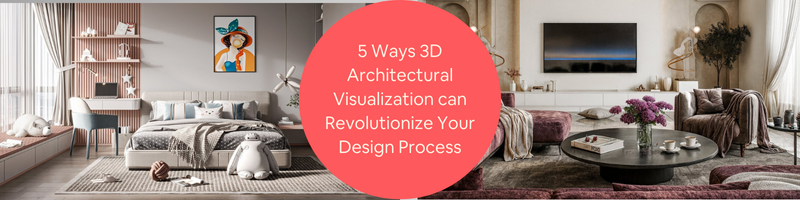
5 Ways 3D Architectural Visualization Can Revolutionize Your Design Process


The practice of architecture is nearly as old as human history itself. Admittedly, the first humans probably didn’t bother themselves with building complex houses with proper indoor plumbing. Still, at least they had nests, huts, or some other kind of dwellings to stay warm and protected from other carnivores. Humans then learned how to use and craft tools, which enabled them to build more complex structures like semi-sedentary dwellings and wooden houses later on.

Fast-forward a couple of thousand years, and they figured out that building a proper home required planning, and that’s when architectural drawings came into existence. It turned out the drawings were found to be useful, and that modern civilizations all around the world still use the same practice now. Of course, ancient architectural drawings from the bygone millennia were nothing in comparison to construction plans created in today’s digital age in terms of clarity or complexity. What started as relatively simple illustrations and hand-drawn blueprints has now become sophisticated data-rich visualizations generated on computers.

We now rely on CAD software to ensure precision, perfect geometry, and error-free structural engineering calculations. And more recently, the advent of 3D architectural visualization services has introduced a massive improvement in how we plan, perceive, and execute construction projects. Instead of seeing a project plan as a complex two-dimensional image, 3D hyper-realistic rendering allows you to visualize just about every single detail of the construction process (especially with BIM) and how the final building should look and feel, even before the actual construction happens. 

RELATED: Architectural Illustrations vs. Architectural Visualization Services

Creating two-dimensional construction drafts is one thing, but transforming the plans into a realistic imagery of the structure is another matter. In fact, 3D architectural visualization has become a trade of its own. You need skilled professionals with the right tools to generate realistic imagery that accurately represents architectural designs. But renderings can be expensive.

One of the best places to look for those experts is the AEC-focused freelancing platform, Cad Crowd. Populated by hundreds if not thousands of experienced 3D render artists from every corner of the world, Cad Crowd is your one-stop shop to discover and connect with some of the most talented freelancers specializing in architectural renders, whether for residential, commercial, industrial, or civil projects – at affordable rates.

How accurate visualizations enrich the design process

Having realistic 3D architectural visualizations can improve the construction workflow and design process by leaps and bounds. Not just on the technical level, but the benefits touch on the communication process and collaboration, too.

All-around better clarity

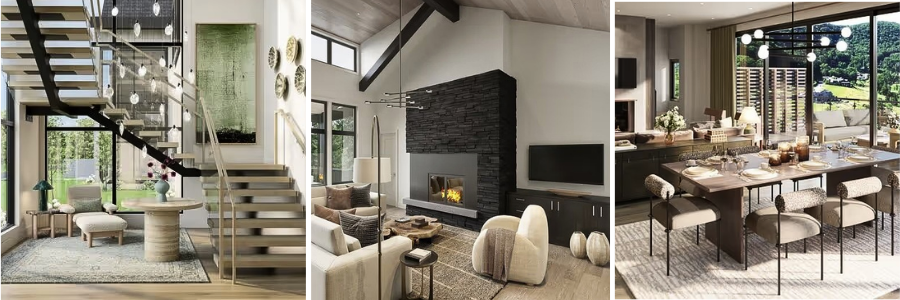
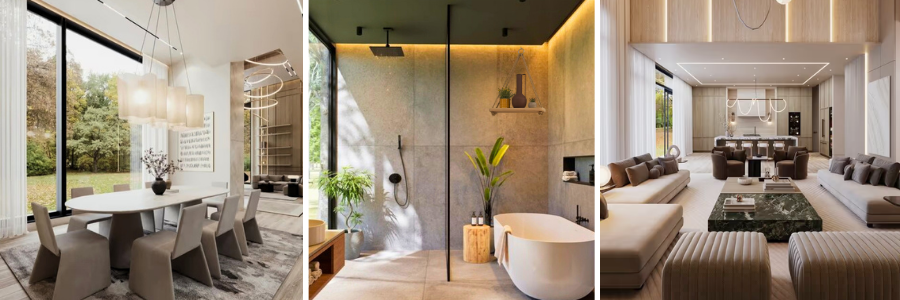
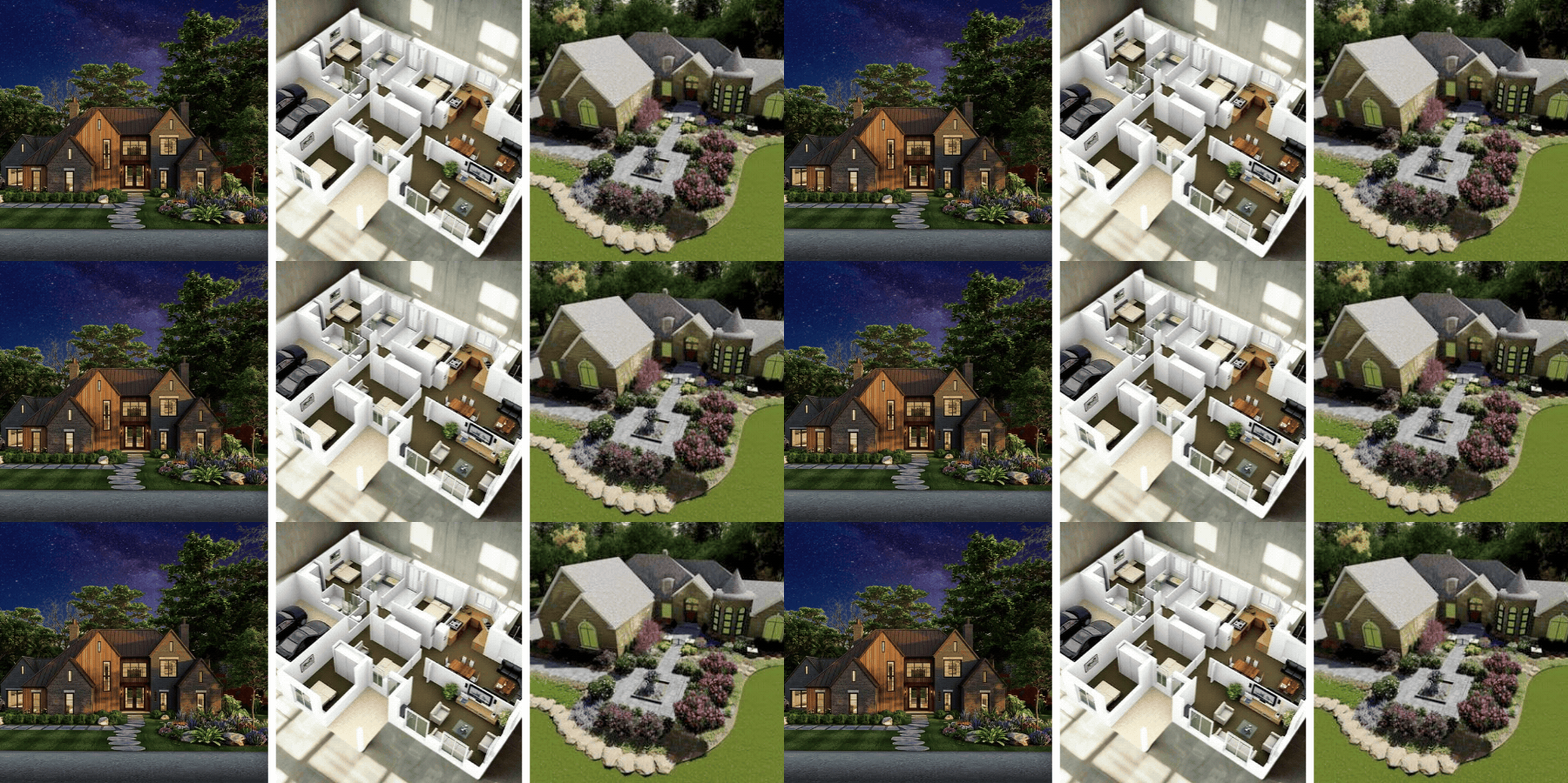
In principle, 3D renderings transform construction drafts and two-dimensional design illustrations into photorealistic imagery of the finished structure. All the lines and shapes you see in a conventional 2D drawing are no longer there, and instead, you get an image that looks as if somebody has captured a photograph of the structure when construction hasn’t started at all. To some extent, the client gets to see how the project should materialize early on in the design process. If the rendering also includes 3D interior visualization services, taking a look at the imagery can feel like having a quick walkthrough inside a building that still only exists as a design plan. 

RELATED: Camera Angles in the 3D Architectural Visualization Realm for Your Projects

Conventional 2D architectural drawings are tricky to understand. The walls, doors, windows, appliances, and furniture pieces are outlined together on a two-dimensional plane visible only from a bird’s eye perspective. Unless you pay close attention to the symbols and annotations, it can be difficult to tell a table from a tub, because both are observed from a top-down view. There is no sense of height from the walls, and the drawing for the roof is probably on an entirely different sheet. In short, it takes some serious mental translation to have a good grasp of the design.

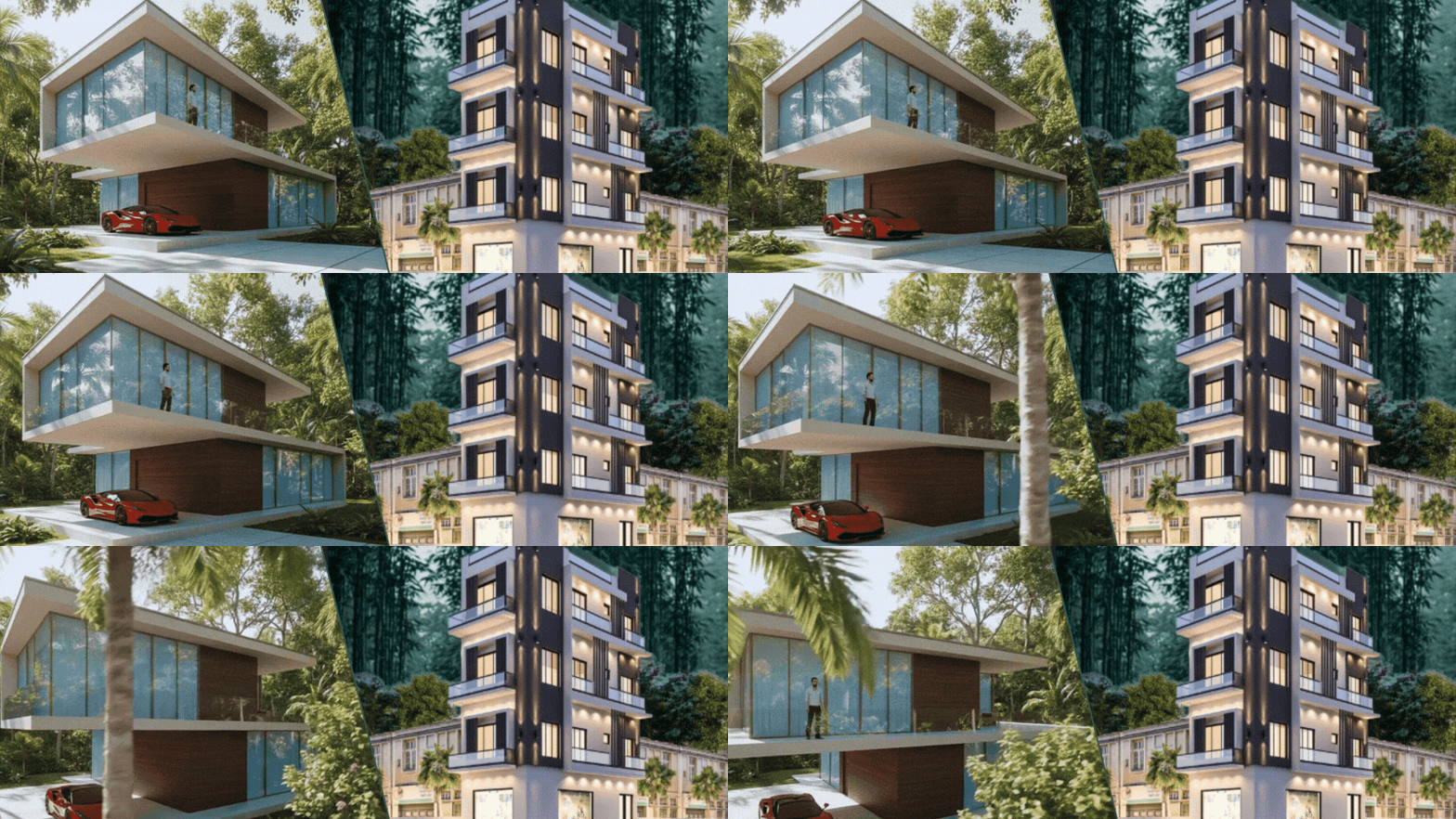
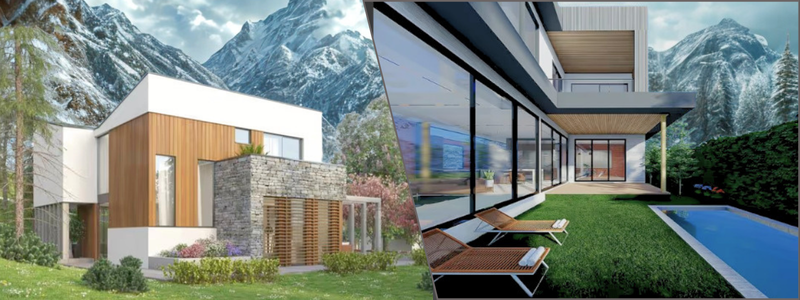
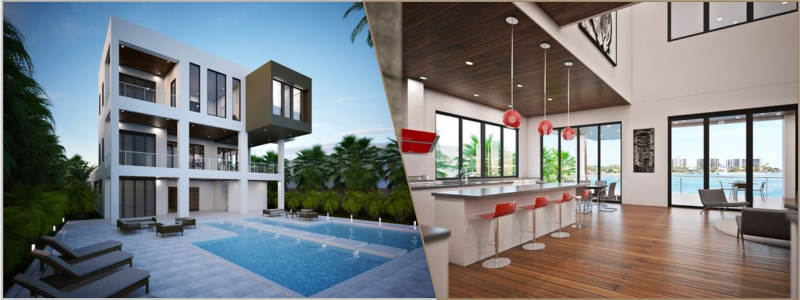
Architects, engineers, designers, and contractors are trained to build structures from 2D drawings, so they have no problem understanding all the details and visualizing the design at a glance. For the non-technical people, on the other hand, making a correct interpretation can be a monumental challenge. Photorealistic 3D architectural visualizations make such a cognitive barrier disappear in an instant. You can clearly see where the walls stand, the placement of furniture, the positions of doors and windows, and how every room is connected to the others. A 3D exterior rendering also clearly visualizes the roof, the facade, the wall paint, and even the landscape and the surrounding environment.

Architectural visualizations come in several different forms, including floor plans, aerial views, interior design, and more. Each of them provides an immersive view of design, allowing you to gain a clear understanding of the structure’s spatial relationships from a human-friendly, comfortable viewing angle. High-end visualizations even render the lighting, shadows, material textures, and surface patterns. Everything appears crisp, detailed, and yet completely natural to the point where you might think that you’re looking at a photograph. Advanced rendering software can simulate the position of the sun and artificial light sources along with light intensity and direction adjustment for contextual accuracy as well.

3d interior rendering firm

RELATED: Techniques for 3D Architectural Visualizations and Tips for Your Services Firm

Rapid design iterations

Render firms use 3D models (as opposed to photographs of physical artifacts) as objects in the final render. This allows architects and designers to experiment with practically limitless combinations. The configuration and specification of load-bearing components might not be as flexible, but everything else can be modified without altering the structural integrity. Suppose the design of a house features a sizable living room with a large glass window on the east-facing wall; because the homeowner isn’t fond of the idea of a single massive glass panel for sunlight, the architect decides to use two smaller windows instead.

Making this kind of change in a digital environment is easy (in the hands of professionals, of course), quick, and definitely inexpensive. 3D rendering for architectural projects cannot happen without 3D architectural modeling services first. In the best-case scenario, the rendering process happens only when the 3D models of the design have been finalized and approved by the clients. Unfortunately, this isn’t always the case because without the photorealistic render, there’s no hint at how the lighting works or if the furniture pieces blend well with the overall color accents. But even with the back-and-forth of reviews and revisions, making changes to the rendering is still much cheaper and quicker than altering an already constructed design.

This kind of rapid design iteration puts 3D visualization way ahead of traditional 2D drawings. Clarity has everything to do with this advantage. When clients can see and understand how the proposed design will materialize in the end, they feel eager to provide feedback and propose modifications if necessary. The architectural designer can also provide multiple design options to begin with, allowing the client to explore variations in interior layout, facade treatments, material options, rooflines, and more. But then again, everything can be modified to cater to every client’s specific requirements on a computer screen for design process efficiency. 

RELATED: Architectural Visualization Services: A Complete Comprehensive Guide to Mood and Atmosphere

Keep in mind that expensive redesign and rework can happen because the client only understands the design concept after the structure, or at least parts of it, have been constructed. When things don’t look exactly like what the client imagines in the first place, modifications are likely expensive. Photorealistic rendering moves this hassle (if any) to the design process, where corrections remain within the confines of digital space and are cheap.

Engineering and design coordination

There might be multiple instances of disagreement between the engineers and designers in the project. However, this is exactly what you should expect in a carefully put-together team of professionals, where all the members perform their roles to the best of their ability. For example, a designer may propose an intricate room layout for the interior or complex geometry for the roof and facade. While all of those ideas are far from impossible, they might be an engineering nightmare due to resource limitations. 3D rendering isn’t all about aesthetics, but it’s also a tool for objective technical review where an interdisciplinary team can coordinate and make educated design decisions.

Let’s say the windows in the living room are supposed to be made of stained-glass because the client requires a unique lighting effect when the morning sunlight shines through. There are many different types of stained-glass (opalescent, streaky, flashed, iridescent, etc.), and the client gives the freedom to the architecture designer to determine what’s best. Instead of physically testing every type of glass, it is much easier and cheaper to simulate the lighting effect using the PBR (physically based rendering) feature in the software. The architect can then show the client how each type produces its own lighting effects in the room in broad daylight.

Simulation isn’t limited to lighting effects only. Engineering software with an FEA (Finite Element Analysis) tool can simulate how materials behave under real-world conditions, including mechanical and environmental stresses. FEA isn’t actually a rendering tool, but a construction project can take advantage of the analysis to accurately predict how the physical characteristics of specific materials change over time. It can tell you whether the structural strength will degrade or remain intact after long-term exposure to real-world conditions.

RELATED: Top 6 Architectural Visualization and 3D Rendering Trends for Your Company to Follow

Furthermore, the combination of 3D rendering and BIM (building information modeling) facilitates early clash detection in construction design. BIM is essentially an accurate visualization loaded with detailed specifications of every element that forms the structure, including mechanical, electrical, and plumbing. The software can handle even the most complex structures and the interactions among the various systems in the building. Clashes may include improper placement of structural elements, the lack of geometric tolerance, construction scheduling conflicts, and more.

Permit approval

In most, if not all, countries around the world, the process of acquiring construction and building permits still requires the use of conventional 2D architectural drawing services. That being said, it doesn’t mean that 3D visualizations have no place in the procedure. Quite the contrary, photorealistic rendering can be a significant factor in the approval decision. Most large-scale projects require approval from local authorities like the planning commission, the city council, or community boards. Each of those bodies needs to scrutinize certain aspects of the architectural drawings to determine if they warrant a permit. Much of the approval process relies on the information provided by the 2D drafts, but 3D renderings might serve as invaluable additions.

One of the best things about photorealism is the lack of ambiguity in the image it represents. It tells the reviewing parties how the new structure will look after completion, where the external lights illuminate the property boundaries at night, and if the new building integrates well (doesn’t break any zoning law, for example) with the existing neighborhood. Imagine a scenario where a brand-new house is being built in a city or area that imposes strict requirements focused on eco-friendliness and sustainability. It’s either a green building or none at all. Photorealistic visualization designers have what it takes to showcase important features like natural ventilation, solar panels, and rainwater harvesting systems.

Not only does the visualization highlight the “green” features, but it also illustrates how everything works with pleasing visuals. For example, the ventilation design displays arrows and other symbols to show the direction of airflow in and out of the building, the drainage diagram shows where wastewater goes, and the solar panels include a diagram specifying their average efficiency year-round. Regulatory approval isn’t exactly an integral part of the design process, unless disapproval calls for design modification, in which case the building must be redesigned, remodeled, and re-rendered.

3d interior visualization services

RELATED: Turning Concepts Into Stunning 3D Renderings with Architectural Visualization at Your Services Firm
Digital fabrication

As mentioned earlier, 3D modeling is the underlying process that makes photorealistic rendering possible. In fact, you can say that 3D modeling designers provide the most important building block of modern construction planning because it also opens the door for parametric and generative designs. Visual design tools such as Dynamo and Grasshopper enable architects to explore and experiment with complex geometries and see the results through rendering. The method is usually intended for the design and construction of customized elements.

Both the visual programming and rendering tools allow verification that the addition of any unique element or design will not affect the structural integrity of the building. No matter how you put it, there’s no way you can do this with conventional 2D drafting, unless you’re willing to risk an expensive rework. 3D architectural modeling services are also useful for the off-site manufacturing of prefabricated components. Although most fabricators still use traditional shop drawings as standard documentation, rendering helps visualize how the final product should look and perform.

Things like custom millwork, sheet metal, and curtain wall systems are likely fabricated off-site. And the fabricators rely on shop drawings to build the elements as specified. Even if the realistic renderings have little technical information, they can at least provide visual hints to the aesthetic details of the finished products. Many large-scale projects use BIM software not only to render structural elements but also to digitally capture and preserve material technical specifications, such as reinforcement bar detailing.

RELATED: 13 Mistakes When Employing 3D Architectural Visualization Specialists for Companies

Takeaway

3D rendering isn’t just a trend in the architectural sector. Given the benefits of accurate visualization for the architectural design process, it appears the AEC industry at large is ready to adopt the technology as the next big change from conventional 2D-based construction drafts. A large chunk of the industry still cannot make the transformation right away; 2D construction drafts, including as-built and shop drawings, remain the standard used for construction permit applications, component prefabrication, and archiving, among others. But the future is bright for 3D visualization companies, partly thanks to the rapid development of computer technologies as well as the growing number of professionals specializing in the field.

Architects, engineers, and designers can also benefit from the faster iteration cycles and clear communication with clients. Accurate visualization improves the chances of the final structure being more closely aligned with the initial design plans, while reducing the risk of construction mistakes along the way. Cost-efficiency is also a big part of the equation here. Architects have the freedom to experiment with the design in a digital environment, meaning there’s no need for a physical model at all. 

In architectural projects, especially the complex and expensive ones, there might be a big time gap between ideation and execution. From the moment the initial design idea comes up, it can take quite a while before the actual construction begins. It is within that gap that the design is scrutinized for possible flaws and errors, analyzed for cost estimation and completion timeline, and reviewed for approval by the project owners. Also taking place during the gap is a series of feedback loops to bring about design improvements.

RELATED: From Concept to Client: The Power of Architectural Visualization Software for 3D Services

Proper integration of 3D architectural visualizations by expert 3D visualization designers both simplifies and accelerates progress significantly, without sacrificing accuracy. Realistic visualization ensures that clients and architects are on the same page throughout the design process. There’s practically no more language barrier; the client isn’t bewildered by the complexities of conventional 2D drafts, and the architects can explain every design decision without resorting to jargon. That being said, you don’t want the 3D renderings to be nothing but pretty pictures to impress clients.

How Cad Crowd can help

Renderings must serve a practical purpose of illustrating a structural design as accurately as possible. It has to be an effective tool that allows everyone involved in the project to accelerate the design process and make informed decisions. Precision is of the utmost importance, and Cad Crowd is loaded with just the right professionals to help you achieve that very objective. Get a free quote today!

author avatar

MacKenzie Brown is the founder and CEO of Cad Crowd. With over 18 years of experience in launching and scaling platforms specializing in CAD services, product design, manufacturing, hardware, and software development, MacKenzie is a recognized authority in the engineering industry. Under his leadership, Cad Crowd serves esteemed clients like NASA, JPL, the U.S. Navy, and Fortune 500 companies, empowering innovators with access to high-quality design and engineering talent.

Connect with me: LinkedInXCad Crowd

10 Tips to Improve Photorealistic 3D Renderings for Design Companies & Freelance 3D Artists


Whether you’re a render artist selling your services as a freelancer, or perhaps a small design firm in the process of expanding the business scope to include product visualizations, the best way to maintain your competitive edge in the market is to keep on pushing yourselves to learn new things, stay updated on the latest industry-related technology development, and constantly hone your skills to aim for nothing less than perfection. And in the world of 3D renderings, perfection is just another word for “accurate photorealism.”

If you look at render artists’ portfolios available in the leading freelancing agency, Cad Crowd, you’ll quickly notice the difference between the good, the better, and the best visualizations. Now, the fact that somebody can produce any reasonably good product rendering at all is commendable in itself, but the more skillful and experienced artists take the photorealism effect a notch higher with clever use of composition, lighting, model accuracy, and post-processing.

RELATED: How 3D Rendering Streamlines the Approval Process for Developers & Architects 

Render like a photographer

Photorealism happens when the rendering looks virtually indistinguishable from a photograph. The problem is that you can’t always copy a photograph and transform it into a rendering, which is a computer-generated image, using some digital wizardry. In many cases, you must generate an image of something that only exists as an idea, a concept, a sketch, or a schematic at best—there’s no physical object to capture using a camera; you need to model the object digitally first, and then render the model to make it appear as if the object is real and tangible.

That being said, proper 3D modeling services are only one major stage in a series of steps involved in a rendering workflow. While the actual rendering process is done by software (some are automatic while others require manual initiation), there are plenty of things you can do before you arrive at that point to improve the photorealism.

Know your software

Advanced software tools are great with their latest features and sophisticated image-generation technologies to make your job easier, but only if you know how to use them. As far as photorealistic 3D rendering is concerned, whether product or architectural visualization, the first order of business is to get a solid grip of the software you’re using, whatever that might be. Whether it’s the mind-bending realism of V-Ray, the promised precision of Corona Renderer, the open-source reliability of Blender, or the feature-rich 3ds Max, each program carries with it a distinct set of highlight-worthy functionalities.

RELATED: 5 Reasons Freelancing Studios Are the Future of 3D Visualization Services

Understanding software isn’t only about knowing what every button does. More than just getting used to its user interface and all the available features, having a solid grip of the software means being in full control of what it can do. Bear in mind that every program has its own strong and weak points—if you want to master any particular 3D rendering software, you need to be aware of both its greatest strengths and worst shortcomings as well. This way, you’ll be able to optimize its functions and make them work to their full potential.

Even the professional and the experienced need to read the manual sometimes, so make sure to experiment with rarely-used functionality, read more textbooks about the trade, and challenge yourself with experimental features. The software maker’s YouTube channel can be a great place to start, as it usually contains a comprehensive assortment of practical guides, from basic how-to videos to in-depth explanations about specific issues. Some of the guides here will probably sound a little technical, but that’s where software documentation and YouTube guides should come in handy. 

Take a cue from real-world lighting

In general, CGI (3D renderings included) are admittedly fake, in the sense that every single thing you see in the frame isn’t a photograph of a physical object. Although the imagery might mimic actual objects and scenes, it’s all computer-generated down to the tiniest details rather than a captured photo. Yet, the task here is to generate imagery that is so lifelike that people think that everything they see is a genuine artifact. One massive giveaway that 3D rendering services are poorly-made mimicry of life is the lighting.

3d architectural interior rendering services

RELATED: 3D Modeling vs. 3D Rendering Services

If photorealism is what you’re after, the imitation shouldn’t stop at the shape, color, and texture of an object, but it must also include how it’s affected by lights. And what better way to achieve photorealistic lighting than taking a cue from the real one? To do this, you must first identify all the light sources to be used in the rendering; think about whether they’re supposed to be natural or artificial light sources (or a combination of them) as well as their intensity, color temperature, and positions relative to the objects and scenes.

The shape of the artificial light source also plays a role; for example, candle-shaped and reflector bulbs have different light distribution characteristics. Interactive Rendering and LightMix features (in Corona and V-Ray) are practical for this purpose. Thanks to the instant feedback functionality, you get the chance to experiment with various lighting configurations and see immediate results without having to wait for a full render after each modification you make.

Also, don’t be afraid to introduce shadows to the scene. Many new render artists tend to use ambient lights to cover a large area in an attempt to get rid of shadows. However, they can actually be useful as a compositional element (such as to accentuate contrast) to help guide the audience to the focal points of the scene.

RELATED: What are the Different Types of 3D Rendering Services?

Round edges

Sharp edges (or rather, the perfectly sharp ones) rarely, if ever, exist in real life. At the same time, you’d be surprised to see how many times this rule is broken, especially in architectural visualizations. Geometry with sharp edges sounds brilliant in theory, as they denote precision and uncompromising form tolerance, but they’re not that great to make the case for photorealistic rendering services. Round edges do a better job at reflecting and deflecting light, giving the geometry or the object a more natural-looking appearance.

One of the most common techniques to achieve this round edge profile is to use the Chamfer Modifier tool (in 3ds Max). You can set the tension to 0.5 for a convex chamfer and then add enough segments to get a smooth transition. If necessary, change the minimum angle so that the effect applies only to certain edges. In case the default smoothing option doesn’t give you the desired result, use the “Smooth to Adjacent” and “Smooth Chamfers Only” options.

As an alternative, it’s also possible to use the TurboSmooth modifier; it’s a little faster than MeshSmooth, but a lot more time-consuming than the Chamfer Modifier. In Corona Renderer and V-Ray, you can achieve the same result by adding an edge texture to the material instead of using a geometry manipulation technique. While this method is quick, it will add additional geometry and can still make the edges appear sharp at intersections.

RELATED: From Concept to Client: The Power of Architectural Visualization Software for 3D Services

3d architectural exterior rendering services

Perfection is imperfect

It sounds cheap and as cliché as they come, indeed, but it’s true. Trying too hard to make sure that every fraction of every inch is perfect in every way might actually lead you to a genuine lack of authenticity. Rather than seeing imperfection as some kind of defect that would ruin a rendering, you should learn to appreciate it as a lifelike quality that contributes to the realism effect. Not everything has to be immaculate—a tiny bit of wrinkle in a silk doesn’t ravage the material; in contrast, a crease in a spot or two makes it look real. Take a look at just about any surface all around you.

There will be dust, dirt, smudges, stains, scratches, blemishes, and every other speck of things that make the otherwise flawless surfaces imperfect. Remember that perfection refers to accurate photorealism with 3D visualization designers? The term “accurate” applies not only to the geometry of the object being modeled and rendered, but also to how it should appear (as perceived by the eyes) in the real world. In other words, you also have to model and render the imperfection. That being said, imperfection will only serve the rendering well if it makes sense in the context of the scene.

For instance, old laptop with a polished metal LCD cover probably has some smudges on it; wooden floor in a decades-old home also naturally has discoloration is various spots; cars in a junkyard need a different kind of imperfection from those in a showroom; even nature like rivers and trees are most of the time not as picture-perfect as you think. Depending on the context, the imperfection might be subtle (such as for renderings of new products) or pronounced (in the case of used/abandoned/old objects).

RELATED: 3D Rendering: What It Is and Why You Should Care

Bring in a little bit of chaos

Still on the subject of “perfection has to be imperfect” from the previous tip, a common failure in a supposedly photorealistic 3D rendering is that the scene looks impossibly good for its own sake. In addition to a range of acceptable flaws on objects’ surfaces, you might want to look into introducing some randomizations or even adding subtle chaos to the scene.

Imagine how unusual it would be if the books on the shelf in a home office are so well-organized, with every volume standing perfectly vertical on its spine. Think how unnatural it would be if the flowers in a garden were of the same color and size. Even a perfectly organized children’s playroom should look a bit messy. An immaculate organizational system is easy to do in 3D architectural rendering services, but next to impossible in the real world.

Don’t forget that subtle variations between the same objects are not at all uncommon either, especially in nature. For example, rocks on the riverside have different shades of black, and not every blade of grass in the lawn is as green as the next. Use Corona MultiMap (or an equivalent feature) to randomize the hue of a texture, or perhaps introduce a brand-new texture if needed.

RELATED: Integrating 3D Rendering with Photography for Architectural Development Companies 

Get the atmosphere going

Like every aforementioned tip here, subtlety is key when applying atmospheric fog to your scene, especially for 3D architectural visualization firms. Not only does an atmospheric fog make an exterior rendering more realistic, but it often proves to be an excellent tool for composition. In general, lowering the contrast of the background elements instantly creates a notable sense of depth. It’s somewhat similar to bokeh, but instead of creating the blurry look with a lens effect, you need to make the fog appear as a natural atmospheric phenomenon.

Z-depth render element is often cited as an effective method to achieve the effect. Your scene gets darker as it moves further away from the camera, but to get the desired result, you might still have to top it with other tools, including tint, invert, and composite using the additive blending. Corona Volume Materials seems to be better as it gives you more options to experiment with multi-pass compositing and absorption distance, too.

architectural rendering company

Lens effects

In most situations, a lot of photographers will want to avoid having glare and bloom effects in their works, but it isn’t necessarily the case with 3D rendering designers. Once again, be subtle about it. Otherwise, it would take the scene further away from being photorealistic. Another thing to remember is that in photography, the depth of the field gets shallower as an object gets closer to the camera; therefore, in 3D rendering, the effect works best when the scene involves a close-up shot as a way to lead the viewers to the focal point.

RELATED: How Photorealistic 3D Rendering Design Saves Companies Money

Both V-Ray and Corona can handle glare and bloom effects during the buffer, but you can adjust the settings after the scene has been fully rendered as well. A z-depth pass or Photoshop’s lens blur filter also works (post-processing).

Mind your object scaling

Photorealism requires proper object scaling. This is especially true for common objects like furniture pieces in furniture rendering services, cars, home appliances, people, etc. As a general guidance, here are the real-life standard dimensions of everyday objects commonly used as a reference for architectural renderings:

  • Building story height: 270cm – 300cm
  • Interior door: 76cm x 198cm
  • Car length: 450cm
  • Average person height: 163cm (female) and 177cm (male)
  • Dining table or desk height: 74cm
  • Kitchen counter height: 90cm
  • A brick: 22.5cm x 7.5cm

Obviously, this isn’t an extensive list, but you always have Google on your side in case you’re working on an object not mentioned above. Always set the unit of measurement in the software to the system you’re comfortable with, either metric or imperial. As you’re working on the scale of objects, you’ll have to put the textures of those objects into account as well. You have to make sure that the material tiling (repeating texture) correctly represents the scale.

RELATED: Utilizing 3D Rendering Services for Companies in Architectural Property Development

Realistic viewing angle

There are situations where an aerial and bird’s eye view make the rendering more effective as a design communication tool, for example, when a 3D floor plan design expert creates a 3D floor plan or a visualization of an entire residential area. For a typical lifestyle render (the kind where you showcase a product or design in a realistic everyday setting), it’s advisable to set the camera position or viewing angle to something that’s physically possible.

Positioning the camera anywhere from 150cm to 170cm above ground gives the audience a natural viewing angle, bringing the sense of what it should feel like to be right in front of the object or standing in a room. Humans are not used to seeing the world around them from higher than 200cm off the ground—a perspective from these heights can make them uncomfortable.

Get a good grasp of PBR materials

Physically Based Rendering, or PBR, is a method that aims to accurately represent the natural behavior of light and how it interacts with objects. One of the main principles of PBR materials revolves around adjusting for reflection, diffusion, and refraction of light.

RELATED: The Different Types of CG Visuals a 3D Rendering Service Can Make

Getting a good grasp of PBR also means understanding the Index of Refraction (IOR), which is the measurement of how fast light travels through a vacuum (IOR 1.0) compared to how much it slows down as it travels through material. For instance, when light hits transparent glass or water, the speed decreases. Its wavelength is also reduced, causing it to bend. This change of direction is commonly referred to as refraction. The rule or IOR differs for each material/type of surface.

Conclusion

A friendly reminder, creating a photorealistic visualization calls for lifelike imitations of objects and scenes you’re about to render. In the event you get stuck in any of the steps in the workflow, there’s nothing wrong with taking a look at some reference photographs and learn from reality itself. The goal is to generate a rendering that not only looks real but also feels real; by mimicking reality along with all the imperfections that come with it, you’ll be able to infuse an extent of authenticity that your viewers can certainly appreciate.

How Cad Crowd can help

Transform your concepts into stunning photorealistic 3D visualizations with Cad Crowd’s elite network of rendering professionals. Our pre-vetted artists deliver the perfect balance of technical precision and artistic flair that today’s competitive market demands. Request your FREE  quote today, and elevate your visual communications to an entirely new level of excellence.

author avatar

MacKenzie Brown is the founder and CEO of Cad Crowd. With over 18 years of experience in launching and scaling platforms specializing in CAD services, product design, manufacturing, hardware, and software development, MacKenzie is a recognized authority in the engineering industry. Under his leadership, Cad Crowd serves esteemed clients like NASA, JPL, the U.S. Navy, and Fortune 500 companies, empowering innovators with access to high-quality design and engineering talent.

Connect with me: LinkedInXCad Crowd

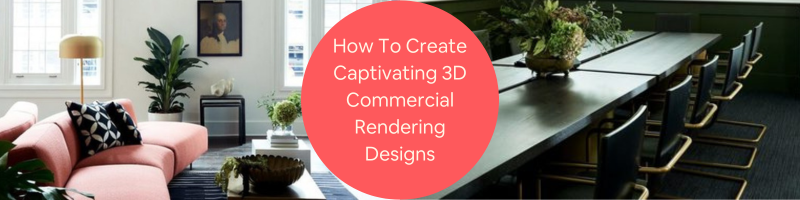
How to Create Captivating 3D Commercial Rendering Architecture Designs for Companies


Commercial architectural projects like offices, retail spaces, restaurants, and hotels require remarkably interesting and engaging presentations to win the hearts of your investors. This is where 3D commercial rendering truly shines as it enters the picture. Using 3D commercial rendering services, designers and architects are able to translate ideas into visuals that can help stakeholders visualize the finished projects envisioned by the designers.

Unfortunately, a simple model of a structure or building alone is not as impressive as the actual thing and may not be enough to sweep investors off their feet. Lifelike 3D commercial rendering can be a true lifesaver in this case, provided that you do it right. This article discusses how to create captivating 3D commercial rendering architecture designs for companies.


:rocket: Table of contents


RELATED: Best practices for architecture firms: residential and commercial architectural site planning

How to create captivating 3D commercial rendering architecture designs for companies

Clarify the final version of the project 

Ideas will flood right from the start of any project from architects, clients, and other professionals in the construction industry. A few factors must also be considered to ensure that the client’s ideas and concepts are transformed into reality at the most affordable price. However, the digital version of the final product should already be available before construction begins to serve as a guide both to you and your clients regarding the progress and expected outcome of the project.

3D commercial rendering architecture designs can translate concepts into photorealistic animations and images of the finished project. If these animations and pictures are accurate, risk of problems can be greatly reduced and future mistakes can be taken care of even before they turn into actual errors in your projects. Thus, a project can only begin after the client approves the 3D designer’s finished project’s 3D renderings. Every professional involved in the project will also know what to expect once the project officially begins. 

Be familiar with different types of 3D rendering 

It’s highly recommended that you become familiar with the different types of 3D rendering while working on commercial architectural projects to make your presentations more captivating. For starters, exterior and interior renderings alike are necessary to showcase your design in all its glory. Other popular types of 3D rendering, including virtual reality or 3D animation services, can also offer more unique experiences.

RELATED: Why 3D rendering and retail store design services for commercial spaces are important

3D animations, for instance, can allow the audience to go on architectural flythroughs or walkthroughs or emphasize the functionality of specific features. VR offers clients the opportunity to have fully immersive experiences, while dollhouse rendering provides an informative and distinct view that presents the interior and exterior in a single image. 

Emphasize the benefits

Focusing on your design’s specific benefits can make your 3D commercial rendering architecture designs more effective. This is how you can communicate the true value of your commercial project. Consider a mountain resort rendering, for example. A kid’s playground may take center stage here. This will make your audience see the place as family-friendly, which is great for people who wish to spend time with their families on a relaxing weekend.

commercial interior rendering firm

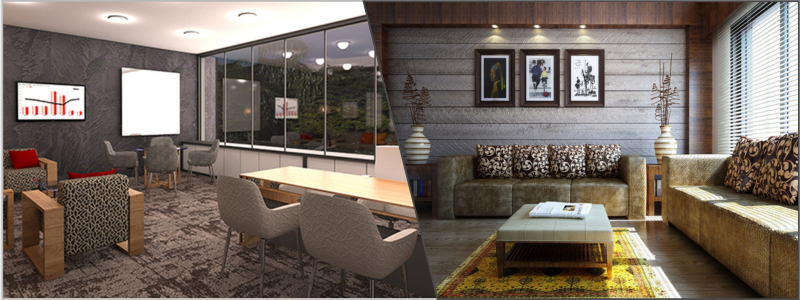
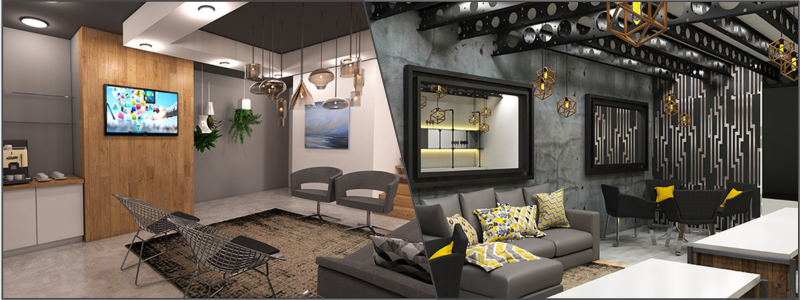
Similarly, a 3D rendering for a commercial office can highlight the cozy and spacious lounge or lobby. This will convey a message about the building being a pleasant and functional workplace. Always highlight your commercial design’s extra perks and features in your 3D rendering. 

RELATED: All you need to know about interior and exterior 3D commercial rendering services

Set the stage

As far as 3D commercial rendering architecture designs are concerned, it’s critical for the 3D architectural rendering expert to choose the correct setting. This can significantly impact your project’s overall look and feel since it can influence the investor’s final opinion. Be sure to consider your project’s style and purpose and select a setting that best complements it. 

Light it up 

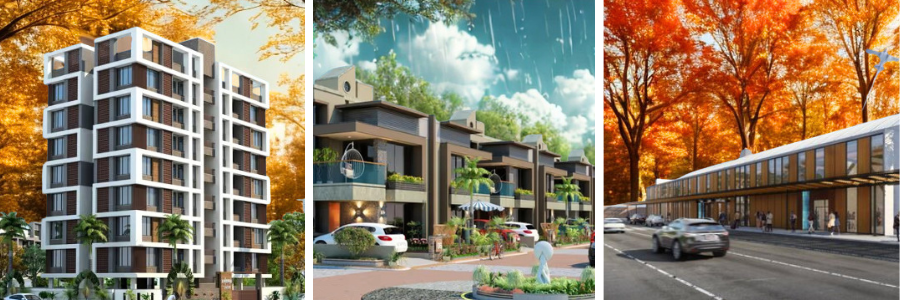
Lighting has a critical role to play in setting the mood and tone of your 3D commercial rendering architecture designs. Different lighting scenarios convey various facets of the project as well. For example, they can help clients envision how the structure will look under different weather conditions and at different times of the day. A daylight rendering, for instance, can help the audience appreciate the building’s design and every detail of its surroundings.

On the other hand, a magical-looking nighttime rendering from an experienced commercial architectural design expert can highlight the perfectly executed exterior lighting with the city’s night atmosphere in the backdrop. When planning your 3D commercial rendering designs, you must be extra mindful of the color and type of lighting, as well as its intensity and direction. Warm lighting, for example, can exude an inviting and cozy ambiance, while cold lighting can evoke a sleeker and more contemporary feel. 

RELATED: Better 3D rendering and retail store design services for commercial spaces

Plan and communicate the layout of the site

A detailed and proper site layout is vital for all projects since this presents the connection between the proposed project and its boundary which includes nearby roads and neighboring properties. Accurate planning and communication of the site layout will allow construction professionals to determine the precise location of all property elements and map out the construction process to prevent errors. 

3D commercial rendering architecture designs can outline and communicate the relation placement of rooms, furniture pieces, landscape elements, decorations, and utilities to construction professionals with the help of photorealistic rendering services, animations, or images. They can also ask questions and spell out any vague aspect of the project. This results in the quick and accurate progress of all construction activities. 

Add people 

Like residential projects, it can also be very decisive to feature people in your 3D commercial rendering designs. Doing so lets you improve the appeal and realism of your project while helping the audience envision its functionality. When showcasing a hotel concept, for example, having a person manning the reception desk will convey a welcoming and warm atmosphere.

RELATED: Essential benefits of 3D architectural rendering and design for companies, restaurants & bars 

Showing servers and diners on a terrace, on the other hand, can also allow clients to visualize the space and how it works in real life. Remember that nothing is better than the 3D architectural visualization firm including human figures in a space to help your viewers understand its scale. 

architectural rendering specialists

Review designs and identify flaws

With 2D models and drawings, it can be very tricky to identify flaws in the design because of the limited insights they offer. However, you can solve this challenge with the help of 3D commercial rendering architecture designs because they offer more insights to pinpoint errors in the design that are simply impossible with 2D models and drawings. This saves construction professionals and clients from needing to change things once construction work starts.

Reviewing designs is also made easy with 3D commercial rendering and visualization. Designs can be sent remotely, and requests for feedback, for instance. You can then use the input you received to identify potential issues in the design, make various design options, improve the design further, or develop some updates. 

RELATED: Real estate marketing: what are the advantages of 3D architectural rendering services & animation?

Highlight the amenities 

The key to capturing the attention and interest of clients and conveying the project’s unique features is to showcase the full details of the best amenities. For instance, in a 3D hotel rendering, you can highlight the breathtaking view from a rooftop terrace. This will convey that the hotel offers a lavish and distinct experience. Focusing on features like outdoor dining, fire pits, and lounge areas can make the space look and feel more appealing. Meanwhile, an office or restaurant rendering can showcase design elements like state-of-the-art features or art installations. This will let you show that the space is truly distinct and unforgettable. 

Use aerial view for large-scale projects 

Aerial views can be very effective in showcasing the complexity and scale of bigger commercial projects, such as office complexes, shopping malls, or hotels. Aerial rendering offers a bird’s-eye view of the whole site to help the audience envision the layout. Aerial 3D commercial rendering designs also allow the audience to understand how the project works functionally and visually with its nearby surroundings, including the parks, highways, or roads, and how it will fit into the bigger natural or urban landscape. 

Take advantage of close-up shots

Close-up shots can be very powerful tools for conveying the mood in both the exterior and interior 3D commercial rendering designs. This kind of shot can help convey the vibe and intricacies of your design by emphasizing specific elements like design features, materials, or textures. A close-up 3D rendering can also express a certain atmosphere or mood, such as the inviting and warm ambiance of a cozy restaurant or the modern and sleek vibe of a state-of-the-art office space.

RELATED: Why are companies and firms moving from 2D to 3D CAD architectural renderings and models? 

These close-up shots can help the audience imagine how it feels to be in the space before the place exists in real life. This can be done by focusing on certain elements that shape the overall ambiance and mood of the area. Having said all this, it’s safe to say that creating captivating 3D commercial rendering architecture designs for companies depends on various aspects, from creative to technical. 

How Cad Crowd can help 

Hopefully, this article gave you valuable insights about 3D commercial rendering. However, if you still have no idea how to present your next commercial designs in the best light possible, don’t hesitate to contact Cad Crowd. 

We can help you search for the right solutions that will match or even go beyond your expectations. Contact us now for a free quote

author avatar

MacKenzie Brown is the founder and CEO of Cad Crowd. With over 18 years of experience in launching and scaling platforms specializing in CAD services, product design, manufacturing, hardware, and software development, MacKenzie is a recognized authority in the engineering industry. Under his leadership, Cad Crowd serves esteemed clients like NASA, JPL, the U.S. Navy, and Fortune 500 companies, empowering innovators with access to high-quality design and engineering talent.

Connect with me: LinkedInXCad Crowd

13 Mistakes When Employing 3D Architectural Visualization Specialists for Companies


The expertise brought by the experience of 3D architectural visualization specialists can boost your projects with that extra oomph they need to stand out among others. Unfortunately, not all 3D specialists are made equal, with some falling short of their promises of making your visions come to life. Here are some of the most common mistakes that you may overlook when gathering your dream team of 3D architectural visualization specialists for your company’s projects.


:rocket: Table of contents


13 mistakes when employing architectural visualization specialists

Mistake #1: Expecting turnarounds in a snap of a finger

Let’s be for real here: your 5-minute instant noodles taste nothing compared to the pasta made from scratch you get from restaurants. Likewise, 3D architectural visualization with top-notch quality also takes some time to generate. Depending on the project’s complexity and coverage, it may take a few days or weeks. You might end up disappointed with some half-cooked output if you try to rush the process.

In order to ensure that you will be given a well-designed output, you have to remember to communicate a realistic timeline aligned with sufficient resources to your specialist. Setting expectations that are aligned on both sides can save you from frustrations and misunderstandings, ultimately making sure that you and your specialist are on the same page when it comes to various things, such as turnaround time.

RELATED: Freelance 3D rendering or photography for architecture: which is better?

Mistake #2: It’s NOT all about the price

A 3D architectural visualization specialist who offers rock-bottom prices won’t probably deliver the highest quality results, but this does not necessarily equate that specialists with skyrocketing prices will always give you the best results. While cost is still one of the things that you should consider, you still need to review and assess the specialist’s client reviews, portfolios, and interactions.

Always keep in mind that the value that a specialist brings to your table is your top priority, as this is what will be reflected in your projects, regardless of the price you pay. The ideal is to strike the perfect balance between fair pricing and quality.

Mistake #3: Not reviewing the software guidelines thoroughly 

With the new and fancy technology we have today, we also have different 3D modeling software programs for different purposes. There are those that only create 3D prints, but some can even create printable 3D models for designers and 3D artists. Although all software programs share the same basic features, you might need to manually align and adjust some features to properly cater on the finer details you want to work on.

RELATED: Visualize your dream home with 3D architectural visualization services

For example, some of the software programs can automatically set the thickness of a manual, but some might need some human intervention. Depending on which specific software you’re using, you might need to manually set the printing sizes, join the shells, and watertight the models. The solution for all these can be found in their respective software guidelines.

To get started, watching tutorials are always a first step so that is not a bad idea. But discussions made by humans in the community such as official forums and websites are also a step closer to solving whatever problem you encountered while using the software.

3d interior rendering company (2)

Mistake #4: Not laying out the whole plan

Before handing over your project to a 3D architectural rendering professional, you have to make sure that you brief them thoroughly regarding the finer details of your project. An inaccurate and incomplete briefing will most likely result to an unaligned vision that will only cost you more money and time in the long run.

RELATED: What is architectural visualization and why architectural rendering services use it

Here are a few key details you need to make sure are discussed comprehensively with your specialist:

  • Define the layouts of the rooms and building
  • Electrical plans
  • Guide for interior style
  • Landscape plans
  • Selection of exterior colors
  • Selection of interior details
  • Site photography
  • Window finish and frames

Mistake #5: Inadequate visual references

Most of the time, words just don’t cut it when it comes to describing your desired visual outcome. It is preferred that, on top of the detailed instructions, you should also provide a visual map to serve as a guide to your specialist. Doing so will help everyone save time because you won’t have to spend so many hours on visual samples. Having two or three references will be adequate as long as you explain the aspects of the images you gave to the specialist.

RELATED: How to choose the best freelance architecture visualization services and designers

Mistake #6: Failure to ask about additional services

Most companies provide complementary services meant to add value on top of 3D rendering. These may include 3D animation services, digital staging, VR tours, marketing materials, graphic design, and more. Avoid assuming the scope of work. Make sure you ask the specialist directly about their additional services if they have any. You can streamline your experience better if you make the most out of these add-ons.

Mistake #7:  Not inquiring about revisions

You must know and understand the specific number of changes or tweaks included in the service right from the beginning. Some specialists may offer unlimited tweaks, while others may charge for extras or limit revisions. Define everything early on to avoid additional costs or surprises down the road. You can ensure that the finished visuals will perfectly match all your requirements if you are familiar with the revision policies from the beginning.

Mistake #8: Not going through reviews and references

A reputable 3D visualization company will be more than happy and willing to give you testimonials and references from their clients. Check reviews on industry sites, Google, and Facebook as part of your homework. Connect with past clients to inquire about their experience working with the specialist. Doing so will help you avoid ending up with the wrong partner.

RELATED: 3D visualization: the future of architectural design

Mistake #9: Not comparing several bids

Don’t just go for the first specialist you meet. Try to compare multiple bids first to find the right combination of pricing, responsiveness, capability, and experience. Ask each of them regarding their particular approach. Choose the one who understands your company’s specific objectives when it comes to renders. You should also opt for a specialist who can bring the most creative and intuitive ideas to the table.

3d commercial rendering services (2)

Mistake #10: Not offering enough direction and details

One of the most serious mistakes your company can ever make is failing to provide the 3D rendering designer with enough direction and information upfront. See that you give them specific details regarding the colors, lighting, textures, views, concepts, and styles you wish to be depicted. Provide them with samples, plans, photos, and all available visual references. A clear creative brief will ensure that your 3D renders perfectly match your vision.

Mistake #11: Not communicating the changes correctly after reviewing the initial draft

Say the specialist gave you the initial draft of the project. You meticulously go through the design to emphasize some missing details. You even list the changes you want and let the rest of your team review the design. Sadly, these changes weren’t implemented or followed in the second draft. Why? It’s simply because the specialist wasn’t informed regarding the specific revisions that need to be made.

RELATED: Architectural visualization services: a comprehensive guide to mood and atmosphere

It is another common mistake that companies make when hiring 3D architectural visualization specialists. You can Redline or list out the changes separately to communicate them. Just vaguely saying that you don’t like something will only lead to more confusion. Rather than this, you need to point out everything specifically, like the color palette you want to change or the window frame you didn’t like.

Mistake #12: Skipping agreements and contracts

To secure your project, you need an official letter of agreement or contract to protect you and your chosen 3D designer and ensure alignment regarding usage rights, confidentiality, deliverables, timelines, rates, scope, and other relevant terms. Legal documentation will give you recourse when something goes wrong with the engagement. Verbal agreements and handshakes alone don’t make the cut here.

Mistake #13: Hiring a specialist unsuitable for your project

The result you expect from your project should always serve as your basis for the specialist you will be working with. There are also instances when the final renders need certain textures and finishes for the surfaces. See to it that the specialist you hire has enough experience in the specific areas you want to focus on. Their portfolio will give you a glimpse of their work quality.

RELATED: 5 Myths about working with an architectural visualization service

Almost all 3D architectural visualization specialists can come up with 3D drafts if your only goal is to get the job done. However, if the basis is quality, you might need to ask the specialist to share some samples of their past projects so that you can get a good idea of their capabilities. As long as you avoid these common mistakes, you can look forward to an amazing and seamless experience with a 3D architectural visualization specialist. Be sure to always do your homework when choosing the right partner.

This way, you can be sure that the 3D renders you will get at the end of the day will become phenomenal assets for your project and your company as a whole as long as you work hand in hand with the correct and most suitable partner.

How Cad Crowd can help

Employing a 3D architectural visualization specialist can offer you a long list of benefits if you make the right choice and do it right from the start. Sticking to a strategic process can give you exceptional visuals that will ensure the success of your project.

Avoid cutting corners or rushing the selection and evaluation steps. Always invest your time clarifying the details and finding the correct partner for your needs here at Cad Crowd. We will help connect you with the best specialist to bring your projects to life and ensure their success and your company.

author avatar

MacKenzie Brown is the founder and CEO of Cad Crowd. With over 18 years of experience in launching and scaling platforms specializing in CAD services, product design, manufacturing, hardware, and software development, MacKenzie is a recognized authority in the engineering industry. Under his leadership, Cad Crowd serves esteemed clients like NASA, JPL, the U.S. Navy, and Fortune 500 companies, empowering innovators with access to high-quality design and engineering talent.

Connect with me: LinkedInXCad Crowd

Architectural 3D Animation Guide for Companies and Firms Creating High Quality Drone Videos


Today’s post attempts to provide a quick architectural 3D animation guide for companies and firms about creating drone videos. Have you heard of camera tracking? Unless you’ve been living on a far-flung island, you might have likely encountered the term ‘camera tracking’ at one point. It is among the newest and most prominent techniques used for 3D animation services in the architectural industry. It is the blend of the 3D models of a proposed building and the drone-captured real-world videos of its location.

The innovative technique can make 3D animations more appealing and downright realistic that viewers will find them engaging. However, there’s a little catch here. The effects of camera tracking are still reliant on the overall quality of the drone videos. Footages captured with great care can considerably improve the viewing experience and present the planned building as best as possible.

RELATED: FAQs to Ask a 3D animation studio before hiring 3D animation services for better projects


:rocket: Table of contents


Drone videos for your firms: Cad Crowd’s insider secrets for architectural 3D animation for your companies

Prepare the requisite files and information

An architectural visualization studio needs a few things to produce 3D animations with drone videos.

360-degree panoramas

A 360 degree panorama rendering expert can create several 360-degree panoramas to get a complete view of the project site. Shoot in the highest resolution possible, preferably in HDRI, to guarantee flawless quality of architectural 3D animation using drone videos. If there is a change in the weather conditions during the shoot, you can also make a few additional panoramas. It will allow archviz artists to maintain the consistency between frames for a smooth and realistic final 3D animation. 

Varied camera movements

Drone videos are powerful storytellers, but this is only possible if the movements of the camera used fit the storyline. This means that movements should be captured in a way that shows the site of the project from every angle and perspective there is. There are several types of movements that can be shown during drone video production:

  • JIB or crane that mimics a crane’s motion moving downwards or upwards
  • The low altitude highlights details of immediate surroundings and terrain
  • Orbit or circling the point of interest 
  • Pullback or gradually widening the site’s view
  • Top-down or bird’s eye view 
  • Tracking of a specific moving object 

Shooting the above movements using a drone gives the 3D architectural rendering experts the materials they will need for the task. You can then choose and blend the different perspectives to produce the most informative and appealing architectural 3D animation.

RELATED: How 3D animation services help architects showcase new properties & buildings

Technical specifications of the drone 

You can produce drone videos that capture meaningful details, only if the device itself meets the specific technical criteria required to create footage of 3D animation-quality. It must be able to record in ultra-high resolutions such as 8K or 4K. A high frame rate, ranging from 30 to 60 FPS, is critical to capture motions smoothly. This is a must-have to capture dynamic scenes and minimize motion blur in frames that move faster than normal. See to it that the model of your drone and the above technical details are all part of the brief. 

Points for transition shots in windows

You may also consider shooting interior scenes with the outside world in full view to add a realistic touch to your drone videos. Shooting with drones here will produce views from the windows that mimic real-life scenes. 

3d architectural design firm

Drone camera orientation 

The right orientation of the drone camera is a must. The footage’s horizontal line should be horizontal to prevent distorting the views. These will only affect how the final animation looks. The horizon should also be aligned when shooting drone videos. 

Altitude of the drone flight

It’s a given to align the flight altitude of the device with the floor’s real height. Doing so will replicate the future view in the 3D animation as seen from the said window. For the 3D architectural animation professional to reach the correct shooting altitude, multiply the specific floor’s number by three meters. This is the average height of floors. This formula is the secret to producing drone videos from this particular point of view. For example, the position of the drone for a window on the 10th floor should be approximately 30 to 35 meters. 

Location of the drone shoot

The location of the drone shoot can also influence the information and quality of the final 3D footage. Everything will be easy if there are not a lot of construction projects present nearby that may potentially block the flight of the drone. In these scenarios, the drone should fly directly over the construction site. It will ensure that it captures the exact perspective as if you’re looking out from the windows of the future building. 

Urban areas with large crowds may present a few difficulties. It’s because it might be a bit challenging or even next to impossible for the drone to fly hastily above the site. The floor plan projections are more applicable here. These require 3D visualization services or drawings depicting the location of the rooms of the proposed building. They will help you pinpoint the exact location where the drone should fly to capture the views desired. 

If the objective is to capture views from the 10th-floor window, for example, the precise location of the said floor in the building should be determined. The drone should fly over to that height then capture the necessary footage. The said approach will ensure that the camera of the drone will be in line with the expected view as can be seen from the window. It provides an informative and realistic footage that can be used to create 3D animations for the architectural project. 

RELATED: Freelance aerospace engineering services, cost, rates, and pricing for companies

Moving elements

Factor in the dynamic elements you wish to fit in into the final video when planning the shoot. These may include people as well as moving vehicles. Let the 3D design team in on this. They put Google Maps to use to give you guidelines on how to plan effective trajectories to do the shoot. 

3D exterior rendering services

Best time to shoot drone videos 

Choosing favorable weather conditions and time for shooting drone videos is important. The shoot should be scheduled in clear weather conditions. This way, the drone videos will be consistent, informative, and appealing all at the same time. Never shoot on days when the weather may be hard to predict because this will affect visibility and lighting. 

When is the best time to shoot drone videos, though? You can have the shoot planned either for early evening or late afternoon. It will allow you to capture the site in diverse lighting conditions to make visual material richer with views of the sunset and full daylight. Presenting the site under varying lighting conditions can also boost the emotional impact and aesthetic appeal of the architectural 3D animation. 

Drone video management and submission 

As a result of the high frame rate and resolution of drone videos, files are understandably large in size. Managing and transferring these files should be done in an efficient way, then. The files of the drone videos should be uploaded to a trustworthy cloud service. It will give the 3D animation provider easy access to it so they can work their magic on it as needed. 

You can have these files organized in whatever is most convenient for you. For example, a series of videos or just a single file can exist. Any of these two is good enough. However, you have to take into account that your drone files aren’t subject to any conversion or post-production. These should have all the original data in the file properties. 

RELATED: Why 3D modeling is important for constructing architectural projects by companies

Why architectural 3D animations need drone videos

Drone videos are almost a staple for architectural 3D animations for the following reasons:

1. Cost savings 

Building and animating locations in 3D uses up lots of resources due to the complexity of the rendering and texturing involved. Drone videos can do away with the need to produce 3D scenes completely to help cut down production costs for 3D animation. It is a godsend for realtors and architects with limited budgets. 

2. Superior presentations and marketing materials

Effective and clear communication with the target audience is the secret to make your marketing campaigns shoot through the roof. Architectural 3D animation or 3D architectural visualization services featuring drone videos are just what you need for this. These can serve as compelling promotional materials with enhanced realism. It can also hasten the creation of visual content. The streamlined production of great video ads can lead to saving a bigger chunk of the marketing budget and ensuring better engagement among the audience. 

3. Enhanced realism 

One of the main perks of drone videos is the realism they can endow to architectural 3D animation. Since the actual video serves as the foundation, the 3D artist only has to produce the building’s digital model complete with its surroundings. It contributes to a lifelike experience. it lets viewers get a better glimpse of the expected appearance of the project in the current location. 

4. Better engagement among stakeholders

Using drone videos in 3D animation is also a good tool to keep investors and clients engaged. Compared to animations developed in 3D alone, this one offers a deeper understanding and familiarity of the project. This also allows people to visualize the final result in the context of the actual location. It gives them a better understanding of the project’s visual impact. The clarity leads to a more informed and confident decision-making process. 

5. Efficient use of time

Drone videos incorporated in architectural 3D animations can produce visual materials in a snap of a finger. This technique cuts down on the technical and labor resources necessary to reconstruct virtual environments. The use of actual drone videos as the background can cut down the 3D architectural modeler’s time required to finish the 3D modeling process. It is important for projects where large-scale and intricate surroundings are shown. Architects can then save time without jeopardizing the visuals’ quality. 

How Cad Crowd can help 

Would you like to get your hands on quality drone videos that will make your architectural 3D animation soar to greater heights? Cad Crowd will connect you with the best team of professional 3D artists who will put those drone videos to good use to create stunning 3D animations. Get a free quote today!

author avatar

MacKenzie Brown is the founder and CEO of Cad Crowd. With over 18 years of experience in launching and scaling platforms specializing in CAD services, product design, manufacturing, hardware, and software development, MacKenzie is a recognized authority in the engineering industry. Under his leadership, Cad Crowd serves esteemed clients like NASA, JPL, the U.S. Navy, and Fortune 500 companies, empowering innovators with access to high-quality design and engineering talent.

Connect with me: LinkedInXCad Crowd

Better 3D Rendering and Retail Store Design Services for Commercial Spaces


Now more than ever, retail stores can’t afford to be left behind by their rivals. With such cutthroat competition to gain more customers, your retail store’s design must capture interest and attention right from the get-go. Good thing that 3D rendering and retail store construction drawing services are here to the rescue. This blog delves into these services and how they can help transform commercial spaces in more ways than you can imagine.

Importance of good retail design

These days, the importance of creating experiential and immersive spaces has become even more prominent. Marketers and designers alike are going beyond the limits of creativity to entice the public and take their shopping experience to the next level. With the rising expectations of modern consumers, retail stores are also forced to look for ways to set themselves apart from the rest without losing their connection with their main customers.

RELATED: Getting approval for retail projects with CGI and 3D rendered drawings

Gone are the days of uninspiring, bland, and boring layouts. Today, creating immersive environments with the help of 3D architectural visualization firms have become the norm as these can tell stories and encourage better and deeper customer engagement. Pop-up shops and flagship stores are now focused on offering unforgettable and noteworthy moments and experiences to their customers that are way above simple transactions.

What are retail store design and 3D rendering services?

Retail store design and 3D rendering services use computer-generated animations or images of interior design concepts. These services help you view and check the entire furniture layout, spaces, shopping areas, and other details of the design. Retail store 3D rendering often includes photorealistic representations of fixtures, furniture, and other retail environment elements. Every nook and corner is realistically lit, and all surfaces have photorealistic materials.

3D rendering services for retail spaces can also feature cars, clothes, food, jewelry, or everything else you wish to showcase. These renderings can highlight the look and feel of a retail design before its implementation. Retail store 3D rendering and design help architects and designers envision what the finished project will look like in their spaces. They can also come in handy for marketing and advertising purposes.

RELATED: How is 3D product rendering and visualization used by manufacturers and retailers?

Why retail stores need quality 3D rendering and design services

3D renderings are imperative for businesses hoping to come up with visually enticing merchandising designs for their shops. These renderings are also useful if you plan to make significant updates to existing shop layouts and launch a new product line. This is made possible by letting designers get an accurate visualization of how products will look within the shop environment. With the help of 3D architectural rendering designers, stakeholders can also make their decisions according to solid evidence instead of just relying on guesswork alone.

commercial-space-design-firm

Retail store 3D rendering and design services can also help you understand how things will appear in real life and avoid the expensive mistakes of organizing structures, walls, and furniture. You will also see a more realistic view of the retail area before installing the first structure or wall. Photorealistic retail store 3D renderings and designs also effectively showcase to customers what to expect before they visit or shop at the store.

RELATED: Fashion industry: benefits of 3D design technology for product development services 

Benefits of 3D rendering and retail store design services for commercial spaces

If you’re still unsure if 3D rendering and retail store design services for commercial spaces are worth it, here are some benefits that will convince you to use them sooner rather than later:

Address mistakes before construction

It’s completely nightmarish for developers to realize that a design is simply impossible right in the middle of the construction. This can end up as a costly mistake, not to mention that it can also make the whole process last longer than necessary. This is why it’s essential for stakeholders to know how the shop will look. This will also ensure that the design caters to customers’ needs and demands. Without commercial architectural drafting services, the whole process will become too grueling for everyone involved.

In cases like this, 3D rendering and retail store design services can be a true lifesaver. Everything can be determined even before the start of the construction, and different layouts and designs can be tested to identify the best one. Flaws can also be detected and rectified in 3D, which can be used as a guide during space construction. Adjusting a retail store’s 3D rendering is more affordable compared to changing an entire shop mid-construction.

RELATED: 3D modeling vs. 3D rendering services

Save on costs

Since preliminary visualizations no longer require physical setups, retailers can save more on the costs of materials required for construction. It also cuts down the necessary labor for the setup and takedown processes.

Improve shopping experiences

With the upfront availability of virtual tours and photorealistic images from 3D commercial rendering professionals, customers already know what exactly they will get into before they set foot in physical shops. It helps eliminate surprises the moment they arrive at the shops. This makes their overall shopping experience more seamless, more convenient, and more enjoyable than ever before.

More efficient

Since detailed 3D renderings are available upfront, designers do not need to make changes repeatedly, ultimately saving them money and time. This also reduces the energy costs required for changing existing structures or setting up physical mock-ups. You can just imagine what will happen if you use the wrong materials or install the wrong structures that don’t look the same as what you expected. Fixing this will cost you a fortune. However, with retail store 3D rendering, you can prevent these costly mistakes.

RELATED: Purpose of shop drawings, construction drawings, and as-built drawings for companies

Better visualization

With photorealistic 3D rendering services and retail store design services, commercial spaces can more accurately represent the appearance of the different elements in a specific environment and improve their sense of how customers will perceive them. These 3D visualizations will help promote the space not just after construction but even before, as they help the installation team see how and where everything should be. Having a photorealistic render to refer to makes it easier to follow all the necessary details and materials.

3D-commercial-rendering-specialists

Showcase multiple designs

It’s never easy to decide on a shop’s design because every key player will likely have a different preference. This will lead to needless delays in the construction and development process, resulting in unwanted frustrations that could have been avoided otherwise. Things get even more challenging if you use simple black-and-white drawings to make your design more convincing. With the help of store layout planning and design experts, you can showcase several options for the design of the exterior and interior spaces of the store in higher quality. This makes it easier to get everyone involved on the same page.

Present the store’s style, branding, and vibe easily

There’s no denying that some of the world’s most successful retail brands achieved their fame not just because of their products alone but also because of the ambiance in their physical stores. Many of these brands make significant investments down to the smallest details to achieve a store atmosphere that can create a good and long-lasting impression. These fine details can also work wonders in simulating customers’ imaginations, helping them identify and connect better with your brand, which will ultimately convince them to buy and patronize your products.

RELATED: How to use 360 degree product CGI to market your products

You cannot just rely on 2D drawings if you need to pitch this distinct vibe or atmosphere to stakeholders. After all, describing it with mere words isn’t easy at all. This is where 3D architectural animation services and retail store design services can be a true godsend, as these are less consuming and more effective than traditional methods. You can further enhance the experience by adding people to the 3D rendering itself, helping stakeholders envision how prospective customers can connect with and relate to the brand.

Create virtual showrooms

Photorealistic retail store 3D renderings can also serve as effective virtual showrooms where customers can browse online before they make their purchasing designs personally at the shop itself. You can come up with virtual tours or walkthroughs where people can navigate the space directly on their computers.

Tips for creating photorealistic 3D rendering and retail store design

Now that you’ve learned the benefits of using photorealistic retail store 3D rendering and architectural 3D modeling firms for designing commercial spaces, here are a few tips on how to pull it off.

RELATED: How the metaverse will redefine retail and shopping experiences for companies

Use quality assets

When creating photorealistic retail store renders, always begin with quality assets that closely match your preferred output results. These may include detailed geometry for items present in the scene or high-resolution textures for area surfaces.

Collect fresh ideas

Keeping up with the latest trends is very important these days. There are numerous Pinterest boards, architectural catalogs, and other resources where you can look for the trendiest ideas and concepts on retail spaces, interior designs, and others.

Use lights correctly

Lighting has an important role to play in creating realistic renders. Pick lighting solutions that closely match your desired result.

Use post-processing methods

To improve your renders, you might want to incorporate post-processing methods such as sharpening filters, color correction, and the like.

RELATED: Why 3D virtual reality services makes sense for musinesses Marketing

Use render settings

Different settings, such as ambient occlusion, global illumination, and anti-aliasing, can greatly affect your finished project, so be sure to familiarize yourself with these settings in advance to have better control over the results.

How Cad Crowd can help

Cad Crowd will connect you with the best 3D rendering and design services that will transform your retail store and commercial space! Contact us for a free quote.

Strong Benefits of 3D Home Design Services for Crafting a Perfect Living Space


Real estate and home design are two worlds that are constantly changing and upgrading. Today, the demand for more precise, transparent, and vivid representations of architectural concepts paved the way to 3D home design services. At their core, 3D home design services use digital techniques and methods to create three-dimensional architectural design models. It results in the development of a lifelike representation of a property way before the first brick is laid. 

This article delves further into the key benefits of using 3D home design firms for crafting your perfect living space.

Key benefits of 3D home design services for crafting your perfect living space

Improve communication among stakeholders 

It’s paramount for stakeholders in construction or architectural projects to have seamless and clear communication right from the get-go. These endeavors are complex, so designers, architects, clients, and contractors should always be in sync, and everyone should understand the intricacies and vision with the same level of clarity. 3D home designs can be a great tool to improve stakeholder communication. 

RELATED: Working with a 3D home design service – things to consider

Verbal explanations, sketches, and 2D drawings and floor plan design services traditionally served as the backbone of discussions and presentations of home designs. However, these usually leave a lot of room for interpretation, which can result in different perceptions among various stakeholders. For example, the client may perceive a certain element in the design differently than the contractor. The architect’s envisioned spatial arrangement might resonate vaguely with the designer.

These disparities may result in time-consuming and expensive misalignments throughout the execution stage. This is where 3D home design services can come in handy. They can convert 2D sketches and abstract ideas into realistic and tangible representations that can bridge any communication gap. All stakeholders can also view the design in its entirety in three-dimensional glory. They can understand the intricacies of the design, placements of materials, and spatial relationships with unmatched clarity. 

Thanks to this visual uniformity, everyone, including the client, the architectural designer, and other stakeholders, is assured they will always be on the same page. This can then prevent potential misinterpretations or misunderstandings. 3D home design services can also help acquire more constructive feedback. Clients will be able to articulate their concerns or preferences more effectively if they can refer to a clear visual. Contractors can also highlight possible challenges in the construction, while designers can recommend enhancements while referring to the same visual framework. 

RELATED: Leading home design & modeling 3D technology for builders, companies, and firms

3d-home-rendering-professionals

Competitive edge

In a vast market crowded with professionals aiming to capture the attention of potential clients, it’s only paramount to set yourself apart from the rest. This competition is also very prominent in the architectural and real estate industries. From designers and architects showcasing their one-of-a-kind visuals to realtors presenting their properties, everyone may find it daunting to stand out in such an extremely saturated market. One of the most noteworthy benefits of 3D home design services is that they offer a significant competitive edge. 

The shift from traditional blueprints in 2D to more complex, detailed 3D renders is more than a simple transition in the presentation format. This also marks a commitment to client focus, innovation, and modernity. By using 3D home rendering experts to present their properties or designs, professionals can instantly show their clients their forward-thinking approach and commitment to delivering the finest visual experience. 

Homeowners, developers, investors, and other clients are becoming more and more discerning by the day. Their exposure to modern technologies and global trends increased their expectations. Giving them immersive and lifelike visualizations through 3D home designs can cater to and even exceed these heightened expectations. This can create a long-lasting impression, so it’s no surprise that professionals leverage this appealing and memorable technology. 

RELATED: Luxury home design upgrades by CAD drafting freelancers

In a cutthroat environment where two experts offer the same properties or designs, the one who uses 3D home design for presentations will undoubtedly gain an advantage. This reflects not only their quality of work but also their commitment to making the most out of the finest tools for communicating their vision. 

Seamless AR and VR integration 

Today’s technological landscape is constantly evolving, where 3D augmented reality and virtual reality architectural services are becoming the forerunners expected to shape the future of different industries, including architecture and real estate. Considering the inherent digital nature of 3D home design services, they can beautifully dovetail with these latest advancements to offer more immersive and interactive experiences. As a client, imagine not only seeing a 3D model on the screen but also being able to walk through a future property and experience all its nooks and crannies through a VR lens. 

This level of immersion can be achieved when VR is integrated with 3D rendering. This can elevate the whole design presentation process to a new level, allowing stakeholders and clients to truly feel the space. It lets them get a sense of the ambiance, the lighting, the scale, and even the possible furnishings and fixtures, resulting in more intuitive assessments and decisions about designs. Meanwhile, AR can superimpose the digital model into the actual world to offer a combination of digital precision and reality.

RELATED: How AEC companies can leverage VR and AR simulations in architectural design

It can be an excellent help for extensions or renovations, as clients will be able to view the integration of the existing structure and the newly added design. Interactive walkthroughs, with the integration of AR and VR with the help of 3D rendering firms & 3D designers, can impress and empower clients as well. They can ask for adjustments, decide right there and then, and give real-time feedback to ensure a smoother and more efficient design and approval process.

3d-house-rendering-firm

Effective presentation and marketing

With visual storytelling and digital media being the main driving forces of the modern world, the success of a product or service depends a lot on how it is presented. It rings even truer in the architectural and real estate fields, where the potential of a design or property must captivate viewers in a snap of a finger. Then came 3D home design services, which changed the world of presentation and marketing. A portfolio for designers and architects is more than a mere collection of previous projects as it is a solid proof of their vision, creativity, and skill.

Adding 3D home design rendering to their portfolios can help professionals show off their designs. The play of shadow and light, the intricate details, and the depth can all come to life to give prospective clients the chance to experience the project instead of just viewing and imagining it. This improved display can enrich their portfolio and set them apart from the rest. 3D home designs are also integral sales tools for real estate developers and agents. Try to consider a prospective homebuyer checking a soon-to-rise property. Traditional 2D layouts or blueprints usually leave so much to the imagination. 

RELATED: Innovative floating home design: architectural design ideas for companies & firms

However, buyers will be able to envision the finished product with a 3D-rendered model. The 3D architectural visualization designer can showcase how the light of the morning sun flows into the living room, how the interior decorations look, and what the backyard will be like once nighttime comes. This realistic visualization can induce an emotional connection that can make it easier for potential buyers or clients to decide. 3D home design lets them see a potential home instead of a mere house. 

Cost efficiency 

Although 3D home designs have clear experiential and aesthetic benefits, one of the more profound but subtle advantages they offer is their potential to save costs. Investing in these services may seem like an added expense at first. However, its cost-effective nature will become more obvious once you look into things more deeply. During the process of traditional design, any significant revision or change usually resulted in the need to create sample rooms or physical mockups.

These required not just materials but even additional time and labor. Even the most minor changes can result in significant costs. With the help of 3D architectural modeling services, the physical iterations will be eliminated. Small or big changes can also be made digitally to allow unlimited revisions, but this time, they can be done without the associated costs of materials. 

RELATED: 5 Tips for achieving photorealism with 3D rendering and 3D visualization for home design companies

3D home design’s visual clarity can substantially streamline the processes of decision-making. Once the stakeholders get a clear and definite visual representation, the usual back and forth during the process of approvals can be reduced. Every stakeholder, from the client to the investors and the regulatory authorities, will always be on the same page. This helps speed up project timelines and ensure their faster completion, resulting in monetary savings. 

Expensive rectifications throughout the construction stage are also decreased through the preemptive identification of design inconsistencies or flaws. The proactive approach guarantees a smoother construction process, which means direct cost savings. 

How Cad Crowd can help 

Now that you know the key benefits of 3D home design services in crafting living spaces, Cad Crowd is here to connect you with the right professionals who can transform your visions into life. Get in touch with us today and allow us to help you turn your projects into tangible realities!

Visualize Beautiful Gardens with 3D Landscape Rendering Services and Designers


Gardening has always been a favorite hobby among many enthusiasts. After all, nothing beats it in terms of being rewarding and therapeutic at the same time. Unfortunately, it also takes a lot of work. If you want to design the perfect garden, 3D landscape rendering services can help turn your visions into reality.

Popular landscape designs and styles

At the start of your collaboration with a landscape designer, the first thing you have to do is decide on the landscape style you want. The following are some of the most popular landscape designs and ideas to choose from:

RELATED: Landscape design and visualization considerations for company landscape projects 

Coastal landscape style

Airy and light designs best characterize the coastal landscape style. It focuses on salt-tolerant native plants that thrive in distinct coastal environments. The sandy paths are reminiscent of the beach. The hues of green and blue mimic the sky and the ocean. This rich combination forms a casual elegance that enhances the sense of relaxation while also celebrating the seashore and its undeniable beauty. A good tip here is to choose plants that can endure the air even if they have some salt in them. Choose decorations and colors that remind you of the tranquility of the seaside.

Modern landscape architecture

Modern landscape architecture creates a space that nurtures the combination of sophistication and simplicity. Think of uncluttered spaces and sleek lines that highlight functionality. The landscape architecture expert uses a neutral color palette to direct the spotlight to the architectural elements as well as the carefully handpicked plant life. Opt for a neutral palette, add contemporary materials such as glass and metal, and don’t hesitate to play with geometric patterns and shapes.

RELATED: How 3D landscape rendering design services will enhance your landscape architecture

Traditional landscape design

Imagine a garden where all décor, paths, and plants are placed where they are intended. Think of neatly trimmed hedges, organized plantings, and manicured lawns. Color palettes are understated and refined. All elements are meticulously placed to achieve a cohesive and balanced look. Use classic shrubs and flowers, rustic or antique decorations, and symmetrical layouts to capture the evergreen style.

Xeriscaping

Xeriscaping is a sustainable smart landscape design approach tailored for drought-prone areas. Traditional lawns are replaced with artistic sweeps of stones and gravel. You can create a sustainable and visually appealing landscape that can thrive even during dry conditions if you choose native plants, place hardscape features strategically, and incorporate mulch or gravel. Your main focus should be drought-resistant native plants. Stones and gravel can also reduce your need for water.

Fundamental landscape design principles

The following are the core principles a 3D landscape designer adheres to in order to breathe life into their designs.

RELATED: Hire a landscaping architect for CAD drafting & design work

Symmetry and balance

Symmetry and balance play critical roles in producing a harmonious landscape design. Balance has two primary types – asymmetrical and symmetrical. Symmetrical balance creates mirrored or identical elements on both sides of the central point to achieve a sense of order and formality. Meanwhile, asymmetrical balance involves the arrangement of different elements that evenly distribute visual weight without being identical. Both types can be used to create balanced and visually pleasing landscapes. A good example of symmetrical balance is a sidewalk with both sides lined with matching shrubs.

3d-landscape-rendering-firm

Color theory in landscaping

The colors a 3D architectural rendering professional chooses can significantly impact the visual appeal and mood of any landscape. Warm colors like yellow, orange, and red create an energetic and vibrant atmosphere. Cool hues such as purple, green, and blue evoke a sense of tranquility and calm. Consider the contrasts, color combinations, and strategic placements of flowers and plants to produce a visually dynamic landscape. For instance, in a garden basking in the warm sun, combining cool-toned plants such as blue and lavender hydrangeas with marigolds in their warm tones can create a harmonious and vibrant color palette.

RELATED: Why landscape rendering and visualization is important for company landscaping projects

Focal points

Focal points are critical elements that give the landscape a sense of interest. These focal points, such as a well-designed seating area, a water feature, or a striking sculpture, serve as the visual anchor that guides the gaze of the viewer. Consider factors like placement, contrast, and scale in the landscape to make the focal points more effective. By highlighting and emphasizing the central elements, you can make the outdoor area more aesthetically appealing. Imagine a tranquil garden with a massive fire ring and a sunken conversation pit as its focal point.

Proportion and scale

Proportion and scale describe how different landscape elements relate to one another. It’s crucial to consider the mass, height, and size of the plants, hardscape features, and structures in the entire space. A pleasing visual balance can achieved if there is proper scaling and proportion of these elements. This prevents disproportionate arrangements or overcrowding that may detract from the design. See to it that larger plants or features don’t dwarf the focal points of a tiny garden.

Common challenges in landscape design

It’s common for landscape design services to encounter stumbling blocks during the process. The following are some of these challenges and how to overcome them:

RELATED: How landscape design services can help companies with 3D landscape design projects 

Limited budget

It can be very challenging to work within a set budget. The good news is that there are a few tips to address these budget constraints.

1. Transparency and communication

From the start, landscape designers openly communicate with their clients about budget limitations. They should be upfront regarding possible cost implications and provide alternative recommendations that meet their requirements without exceeding the set budget.

2. Long-term planning

Many don’t realize that after some time, the initial project costs are cheaper than the maintenance costs. Landscape designers suggest low-maintenance landscapes and durable materials that can help their clients save more money down the road.

3. Prioritize vital elements

Architectural designers determine the design’s critical elements that align with the budget and goals of their clients. They then allocate additional resources to the focal points while looking for cheaper alternatives to not-so-essential features.

RELATED: What does it Cost to hire a landscape design architect expert for your company?

landscape-design-services

4. Value engineering

A landscape designer also looks for creative solutions to achieve the preferred outcome while cutting down costs. This may involve using more affordable materials that still offer the same aesthetic or designing in phases to distribute expenses.

Client expectations

Landscape designers know that managing client expectations requires a delicate balancing act. The following are some tips to ensure creativity and meet client needs.

1. Communication during the entire process

3D Rendering companies regularly communicate with clients to update them on the construction and design progress. They address any issues right away and clarify expectations and timelines.

2. Educate clients

A landscape designer also guides clients during the design process. They explain every reason behind their design recommendations, educate clients about challenges, and help them understand possibilities and limitations.

RELATED: The best landscape design rendering software available for architectural companies

3. Create a clear brief

Landscape designers start the design process with a thorough understanding of their clients’ desired outcomes, preferences, and vision. These details are documented to ensure that both parties are on the same page.

4. Present design ideas

Landscape designers develop various design concepts that showcase their creative ideas. They present these to clients and request their feedback. A collaborative approach is followed that merges their expertise with the client’s preferences. A good tip here is that rather than relying only on verbal explanations and the client’s imagination, 3D architectural visualization services can help showcase ideas. This helps prevent miscommunications throughout the planning stage.

Weather and climate concerns

Landscape designers address weather and climate concerns through the following strategies:

1. Drought-tolerant landscape

Landscape designers integrate xeriscaping methods and drought-tolerant plants to reduce water use. Proper irrigation systems and mulching can also help conserve water.

RELATED: The best 3D rendering software and services for outdoor living & deck design projects 

2. Research local climate

A landscape designer understands the region’s climate patterns, including precipitation levels, wind conditions, and temperature ranges.

3. Sun and shade considerations

Use the natural shade of structures and trees to create cozy outdoor areas. See, plants that need lots of sun won’t be under shade.

4.  Wind-resistant features

The exterior rendering artist can also use trellises, walls, or hedges as windbreaks to protect the landscape from the strong winds.

Space limitations

Efficient planning and creativity are required to design limited or small outdoor areas. The following ideas can make the most out of small spaces.

RELATED: 3D Landscape design services: cost, rates, and pricing for companies and firms

1. Multipurpose elements

Integrate multifunctional design elements such as seating that also offers storage. Planters can also be dividers to form separate spaces in smaller gardens.

2. Optimize choices of plants

Choose plants suitable for small spaces, like dwarf or compact varieties. Container gardening is also a great option, as it allows you to reconfigure and move plants when necessary.

3. Strategic lights

Use lights to create additional space and attract attention to certain areas. The right lights can visually expand smaller outdoor spaces to make them feel more welcoming.

4. Vertical gardening

3D Visualization firms use vertical space by integrating hanging plants, living walls, and trellises. This adds greenery and creates visual interest while making the most of the available space.

How Cad Crowd can help

Cad Crowd is the leading resource for reliable 3D landscape rendering services, which can help you turn your dream gardens into reality!

Fabrication shop drawing services: all you need to know


What type of services do companies rely on when picking fabrication shop drawing services?

Before any construction begins, numerous drawing sets (each bringing their significance to the project) are prepared. These drawings are then used from preconstruction to post-construction to inform the construction process and ensure accuracy. To this end, architects prepare many different types of construction drawings to represent the overall intent and function of the design.

At the same time, contractors prepare shop drawings to show actual field executables.

These 2D documents are the main deliverables in building large-scale and complex structures and are critical to executing any construction project.

What are fabrication shop drawings anyway?

You would want to use fabrication shop drawings services for technical drawings that detail comprehensive information on a structure or product’s construction, assembly, and manufacturing. If you’re still in doubt, it would be best to expel those right now: these drawing services are essential to the engineering and design processes – they serve as valuable communication tools among fabricators, designers, and engineers.

Fabrication drawings are pivotal, indispensable guides that visually articulate the components and structures slated for fabrication. These drawings serve as navigational tools for fabricators, welders, and technicians to ensure the precise execution of fabrication processes by documenting every piece of functional information. It minimizes the risks of delays or damages and guarantees a seamless construction process.

RELATED: What casework shop drawings are and why architectural design services use them

Fabrication shop drawings should comprise every detail about the materials, tolerances, dimensions, and any other specifications necessary for the fabrication or construction of a product; they’re made to make your life easier as you go through construction.

These drawings from architectural drawing professionals are instrumental in translating design concepts into tangible reality. They offer detailed visual representations encompassing components, dimensions, and specifications essential for constructing diverse structures, machinery, and products. The devil is in the details, and fabrication shop drawings act as a bridge that connects design intent with the practicalities of production, maintaining accuracy throughout the fabrication processes.

Typically, fabrication drawings are the handiwork of skilled draftsmen or CAD designers.

These 3D modeling professionals infuse the drawings with intricate information, including material specifications, welding symbols, and assembly instructions. Acting as a vital means of communication between CAD designers and fabricators, these drawings foster collaboration and streamline the manufacturing workflow. Regardless of the industry – be it construction, aerospace, or manufacturing plants – fabrication drawings are THE guardians of precision, consistency, and standards compliance throughout the entire production lifecycle.

Typically, fabrication drawings are the handiwork of skilled draftsmen or CAD designers.

These 3D modeling professionals infuse the drawings with intricate details, including material specifications, welding symbols, and assembly instructions. Acting as a vital means of communication between CAD designers and fabricators, these drawings foster collaboration and streamline the manufacturing workflow. Regardless of the industry – be it construction, aerospace, or manufacturing plants – fabrication drawings stand as guardians of precision, consistency, and standards compliance throughout the entire production lifecycle.

RELATED: What are Redline drawing costs & CAD drafting rates for construction companies?

They are the linchpin in the effective and efficient translation of innovative ideas into tangible, high-quality products. At their core, fabrication drawings are elaborate illustrations that furnish the essential information required for the manufacturing and assembly of a product. The specific type of fabrication drawing necessary is contingent upon the project’s nature and the unique demands of the manufacturer. This article will explore the primary fabrication shop drawing services used by firms and companies and their purposes and essential characteristics.

shop-drawing-firms

Assembly drawings

Assembly drawings offer a comprehensive overview of a fabricated structure or complex assembly, illustrating the interconnections between various components. These drawings, featuring exploded views and a bill of materials (BOM), guide fabricators in understanding how different parts come together. They play a crucial role in streamlining the fabrication process and ensuring accurate positioning, alignment, and connection of components.

Assembly drawing services provide foundational blueprints that unite diverse components, fostering effective collaboration between design and fabrication teams. They visually represent how individual elements fit together, providing essential information on dimensions, materials, and assembly instructions. Creating precise assembly drawings is imperative for companies providing fabrication drawing services, contributing to the overall quality and functionality of the final product.

RELATED: Hire freelance contractors on demand for affordable shop drawings

Cutting lists

In fabrication drawing services, cutting lists are instrumental in optimizing material usage and outlining dimensions and quantities for efficient fabrication. Particularly in steel fabrication drawings, cutting lists guide fabricators on minimizing waste during raw material cutting, aligning with an increasing emphasis on sustainable manufacturing practices.

Detail drawings

Detail drawings focus on individual components, highlighting dimensions, tolerances, and surface finishes. Essential for fabricators, these drawings provide specific measurements, material specifications, and additional requirements for accurate component production. Detail drawings, especially in steel fabrication, ensure precision and consistency in manufactured parts. Beyond precision, detailed drawings guide the fabrication process, ensuring components align with design specifications. In the realm of fabrication drawing services, attention to detail becomes a necessity rather than a virtue.

Piping and instrumentation diagrams (P&IDs)

P&IDs (piping and instrumentation diagrams), specialized industrial drawings in oil, gas, chemical, and process engineering, depict interconnected piping systems, equipment, and instrumentation. Using symbols and annotations, they represent components, valves, instruments, and control systems, aiding in fabricating, installing, and maintaining complex process systems. P&IDs play a crucial role in guaranteeing the precision and effectiveness of fabricated process systems.

RELATED: How much do CAD drawing services cost for design drafting & architectural blueprints?

Shop drawings

Shop drawings are detailed representations of fabricated components produced in a workshop or fabrication shop. These drawings provide precise information on dimensions, materials, tolerances, and finishes, acting as a vital link between design vision and actual production. In the context of fabrication drawing services, shop drawings from shop drawing experts offer a detailed representation of the product, aiding fabricators and manufacturers in producing accurate and consistent components. This translation of design intent into actionable instructions is vital for structural steel shop drawings, enhancing efficiency and accuracy in the manufacturing process.

Structural drawings

Structural drawings from proficient structural steel detailing professionals are essential for constructing buildings, bridges, and large-scale structures, providing comprehensive overviews of facilities, including dimensions, elevations, sections, and connections. They guide fabricators in accurately placing and aligning structural elements, ensuring stability and safety throughout fabrication and construction.

structural-steel-detailing-professionals

Welding and metal fabrication drawings

Specific to welding and metal assembly processes, these drawings offer detailed instructions for welders, showcasing weld types, sizes, positions, and required symbols. They play a crucial role in ensuring the quality and strength of fabricated metal structures, contributing to safety and compliance with industry standards. Welding fabrication drawings guide the welding process, ensuring each weld meets standards for strength and durability, preventing structural failures and accidents.

RELATED: Structural steel detailing services for companies: steel detailer costs and rates

Why work with fabrication shop drawing services?

Fabrication shop drawings play a significant role in the steel manufacturing industry, serving as crucial documents for fabricators, manufacturers, contractors, and suppliers. These drawings, derived from construction papers, are often prepared with the assistance of detailers hired by the owner to provide detailing services.

These drawings from skilled fabrication drawings experts facilitate the fabrication and erection processes for project teams by comprising sections and views with detailed dimensions, welding information, and adherence to fabrication standards. They provide a precise blueprint outlining how the plans should be executed. The accuracy of shop drawings from the fabrication shop drawing service is instrumental in obtaining architectural approvals and ensuring project profitability.

Contractors and fabricators have a vested interest in accurate fabrication shop drawings. The reliance on these drawings enables well-informed decision-making, preventing costly mistakes that could jeopardize the integrity of the building and the safety of workers. Access to high-quality fabrication drawings is invaluable for various reasons.

RELATED: Affordable shop drawings & drafting services by freelancers & contractors on Cad Crowd

1. Accuracy

Shop drawings for steel fabrication drafted by as-built drawings firms meticulously detail the most critical and complex parts of a building. These detailed drawings provide the necessary information for constructing and installing components accurately, ensuring that the buildings adhere to specified criteria.

2. Fabrication standards

Fabrication shop drawing services undergo rigorous standard tests and quality control inspections within the Architecture, Engineering, and Construction (AEC) industry. Skipping quality assurance checks can lead to prolonged construction timelines and increased material usage. Fabrication shop drawings must align with industry standards to guarantee timely delivery to the customer.

3. Foundation

Detailed blueprints in the framing plan provide essential information for determining the beams and columns required to construct the building’s steel frame. This information guides decisions about drilling, cutting angles, and other critical aspects of the construction process.

RELATED: Freelance contractors offer architectural drafting & CAD design services on CAD Crowd

4. Methods for safe drawings and continuous work

Accurate fabrication drawings are essential to avoid delays in construction due to insufficient materials. Timely ordering of supplies relies on precise shop drawings. Ensuring that shop drawings meet industry standards contributes to the safety of workers and enhances the likelihood of a building project’s long-term durability.

5. Splitting into two groups

Two distinct types of detailed drawings aid in construction: shop drawings and erection drawings. While erection drawings illustrate how a building is assembled on-site, shop drawings detail how steel parts are manufactured. In essence, fabrication shop drawings are not just documents but indispensable tools contributing to the success, safety, and longevity of construction projects in the steel manufacturing industry.

How Cad Crowd can help

Fabrication drawing services are indispensable for accuracy, precision, and efficiency in the fabrication and construction industries. Fabrication drawings serve specific purposes, providing essential information for professionals in these fields. By understanding assembly, detail, cutting lists, P&IDs, shop, structural, and welding drawings, industry professionals can enhance communication, collaboration, and overall productivity, ensuring the delivery of high-quality and reliable products and structures.

Cad Crowd can connect you with reliable fabrication shop drawing services that will help your company or firm achieve the desired results for your projects. 

How Architectural Millwork Design and Drafting Services Can Achieve Company Success


The ever-increasing competition is firing up the world’s economy, and its effects are finding their way into numerous industries and fields. While the AEC (architecture, engineering, and construction) industries may seem less prone to these forces and the rising digital technologies because of their presence in the actual physical world, things are starting to change. Companies are beginning to realize the essence of outsourcing some of their needs. Your organization might gain an edge over your competitors by working with architectural millwork design and drafting services.

Architectural millwork at a glance

Architectural millwork, more popularly called architectural woodwork, refers to custom-made wood products featured in the exterior or interior of a commercial or residential building. However, there is more to it than what meets the eye. Architectural millwork is a creative process often involving manual designing, fabricating, and installing intricate structures, including trim, staircases, ornate moldings, casework, and wall paneling. 

RELATED: Millwork drafting and design drawings: rates and costs for companies and firms

It is a comprehensive set of architectural shop drawings used to make the piece needed. This piece could be a room’s design element. It can also have a functional purpose, with woodwork typically serving both functional and aesthetic purposes. The users of the space, which can be a commercial or residential property, will see or use the piece. Architectural millworkers usually use fine wood to create stunning designs using intricate cuts. Seasoned millworkers know about various design techniques, practices, and cuts.

They will also use various powered and manual tools to develop semi-custom or custom-made attractive woodwork pieces. Most of the time, architectural woodwork is part of a building’s structure, which is why woodworkers are expected to have a good understanding of other trades. It’s often critical to know the locations and specifications of electricity and plumbing, for example, before woodworking begins. They also need to know the specifications for the build elements like flooring and framing. 

Almost anything made of wood and either attached to or built into a building’s exterior can be considered architectural millwork. It can include ceilings, staircases, paneling, shelves, doors, moldings, trim, and cabinets, such as those in kitchens, closets, offices, storage, and bathrooms. A building’s structural elements, like beams and supports, are often classified as part of architectural millwork, although these are more often classified as general carpentry.

RELATED: Millwork drawings outsourcing by freelance contractors on Cad Crowd

Now that you know the basics of architectural millwork, it’s time to discover how architectural millwork design and drafting services can help your company succeed. Outsourcing these services can work wonders in scaling your business in more ways than you probably know and imagine. Here are the top benefits of working with millwork professionals so that you can focus on the core competencies of your business, enhance your efficiency, and eventually scale your company. 

Take advantage of specialized expertise

When you outsource your architectural millwork design and drafting needs to a reliable service provider, you can access specialized expertise that you might not have within your team. Many freelance millwork design and drafting services employ highly skilled drafters with proven and tested experience and knowledge in creating detailed and accurate millwork engineering shop drawings. Millwork design drafters are also familiar with the best practices and standards in the industry to ensure that you will be getting only the highest quality drawings. 

shop-drawing-services

Cost-effectiveness

Companies can also enjoy more savings if they outsource designing and drafting architectural millwork to a third-party provider. Outsourcing means you don’t need to spend large sums of money on pricey infrastructure, equipment, or software. It also means that you can save more money on overhead costs and gain access to top-of-the-line millwork shop drawings. 

RELATED: What casework shop drawings are and why architectural design services use them

Enhanced productivity and efficiency 

Hiring architectural drafting professionals can also help you boost your productivity and efficiency levels. It gives your team more time to focus on their competencies. It will help you cut down lead times and finish projects faster, which will ultimately increase your profitability. 

Scalability

Scaling your business is also very much possible with the help of reliable architectural millwork design and drafting services. When you work with these professionals, adjusting your production capacity to cater to changing demands will be easier. It will help you accept more projects so your business can grow. 

Access to the newest tools and technologies

You can also access the newest tools and technology if you choose to work with service providers specializing in architectural millwork design and drafting. Architectural detailing experts use cutting-edge tools and software to develop detailed and accurate millwork drafting. It means that you also get to keep up with the industry’s newest best practices and standards to ensure that you will have the highest quality drawings. 

RELATED: 7 Types of architectural plans for your next design

New market expansions 

Expansions to new markets will also be easier and faster if you enlist the help of professionals. When you work with these service providers, you can tap into new markets and accept new projects that weren’t probably possible in the past. This will help you boost your profitability and diversify your revenue streams. 

Focus on core activities of the company

Your in-house staff can have more free time to give their all on their core competencies if you outsource architectural drawing services. Thanks to this, you can streamline most, if not all, of your operations and boost your productivity in general. Paying more attention to your company’s core activities will lower costs, increase efficiency, and further grow your business. 

Improved flexibility 

You can also become more flexible when you let someone else take on your architectural drafting and design needs. It’s because it will be easier for you to tweak the capacity of your production to cater to the ever-changing demands. As a result, you can take on projects during peak times and consequently cut down your capacity when business is slower. This improved flexibility can optimize your business operations and increase your overall profitability. 

RELATED: Essential cost-saving strategies for CAD drafting services for your company

architectural-drafting-firm

Things to look for in architectural millwork design and drafting services

If there’s one crucial thing you need to keep in mind, it’s the fact that not all architectural millwork design and drafting services are made equal. That’s why it’s necessary to be extra careful when choosing the architectural planning and design provider you will be working with. Below are just several of the factors you need to consider during your search for an architectural millwork service provider:

Collaboration and communication 

Choose a service provider that can communicate effectively and work closely with your in-house team. They need to collaborate with you to ensure that they will understand all your preferences and needs. 

Cost 

While the price doesn’t represent the quality of a service, it’s still recommended to work with a provider that offers top-notch millwork shop drawings at reasonable prices. 

Expertise and experience

Look for a provider with time-tested expertise and experience in architectural millwork design and drafting services. It would be better if the provider has years of experience in offering their clients excellent millwork engineering shop drawing services. 

RELATED: Best practices for architecture firms: residential and commercial architectural site planning

Work quality

Make sure that your chosen architectural design provider can guarantee high-quality work. They should be skilled draftsmen with a steadfast commitment to developing detailed and accurate millwork drafting that can meet your requirements and specifications. 

Potential risks and possible mitigation strategies

While it’s true that there are lots of benefits associated with working with architectural millwork services, there are also several potential risks you need to consider together with respective strategies to help mitigate them.

Communication barriers

Communication barriers are among the primary downsides of outsourcing. The best way to mitigate this challenge is to work with a provider who has a straightforward communication process and is fluent in your language. Choose millwork design drafters with exceptional fluency in the English language and who can engage in effective communication with you. 

RELATED: Drafting services rates vs. architectural development costs & differences in pricing

Quality concerns 

Quality concerns are a glaring risk of outsourcing, except if you work with a provider that follows a stringent quality control process. 

Security issues

Security issues are another possible downside of outsourcing. A reliable architectural drafting expert uses secure protocols for data encryption and transfers to ensure your information’s safety at all times. 

Contractual agreements 

Last but not least, see to it that you and your architectural millwork partner have an explicit contractual agreement. The agreement should indicate the project’s scope, deliverables, and timelines. They should work hand in hand with you to ensure comprehensive and transparent contractual agreements. 

How Cad Crowd can help

If you’re searching for the best architectural millwork design and drafting services to help your company succeed, Cad Crowd is undoubtedly the best place to be. Teaming up with the right millwork drawings experts for your company can go a long way in helping you grow the business.