Boost Client Confidence with 3D Architectural Animation for Real Estate Presentations


Today’s post covers how you can boost client confidence with 3D architectural animation for real estate presentations. Imagine yourself going into a presentation of a real estate project with colored floor plans, glossy brochures, and maybe a few static 3D renderings. The client is leaning forward, nodding here and there, but you can just about see the question hovering above their head: “What will it really look like?” Is that not the problem? Traditional presentations leave far too much to the imagination. A few 2D drawings and flat renderings can only go so far in helping clients picture a space that does not yet exist. Then comes 3D architectural animation, like a creative superhero.

No capes are required, naturally – only some deft visuals, great use of space, and a bit of digital magic.

Why flat plans fall flat

In reality, even the best-drawn floor plan can be flat. It can show dimensions, proportions, and layout, but doesn’t provide anything that really gets people attached to a place. After all, real estate is not about square footage; it’s about vision, emotion, and that sense of belonging which space can create. No 2D plan will ever replace the visual understanding of how morning light spills across the kitchen counter, how the living room will feel from the second-floor balcony, or how spacious the lobby will look once the furniture is in place. Only one angle can be shown with a static rendering; it cannot tell a story.

But with 3D architectural animation services you can. It whisks clients on a slick, cinema-style journey through a property before a single brick has been laid and allows them to feel what it will be like to walk through the front door and explore the rooms, standing on that terrace with a view that takes their breath away. That is not exaggeration, that is the power of storytelling through motion.

RELATED: Top 37 Commercial Architectural Design and 3D Rendering Companies for Architectural Firms

Seeing is believing – it’s a science

Our brains are wired to understand things visually. About 80 percent of all information that we intake comes through our eyes, so it’s easier for people to respond because they can see it rather than having to imagine it. A 3D architectural animation designer taps into this instinct. It can turn the project from a stack of plans into an experience that feels tangible and real. This would, in turn, let the client visualize in action design details: the flow of natural light, the texture of materials, and realistic motion through each room.

Thus, it would easily bridge the gap from imagination to reality and make the proposed design more comprehensible and far more compelling. It’s only when the client gets to see every nook and corner of the future space that all one’s doubts start going away. Doubts give way to excitement-this is how you build up client confidence, helping them to see their investment.

Imagine the difference

Two developers submit proposals for upscale apartments. He enters the room with some static 3D renders and a few printed brochures. The presentation is informative, yet a little stiff; the audience listens and nods, asking only a few polite questions. Developer B walks in with a 3D architectural animation that flies the viewer through the entire property. The video leads off with an aerial view of the building surrounded by landscaped gardens, then flies the viewer through the entrance lobby past residents who chat in the lounge and onto the penthouse to view a stunning view of the city skyline.

Which of those developers do you think makes the longer-term impression?

The answer should be rather obvious: the second one has used 3D animation in order to make the project come alive. It is not just that the audience understands the concept; they feel it. That emotional connection builds trust and confidence.

RELATED: FAQs to Ask a 3D Animation Studio Before Hiring 3D Animation Services for Better Projects

Standing out in a competitive market

Competition in the field of real estate has grown tougher. Everybody wants to be outstanding, and first impressions now mean more than ever. A slick 3D architectural animation from 3D architectural rendering professionals gives your presentation an immediate professional sheen, telling your audience that you care about quality, detail, and clarity. It also shows that you care about them enough to want to take care of their comprehension. You aren’t saying, “Just trust me.” You’re showing them exactly what they can expect. That kind of transparency creates trust. Be it pitching to investors, buyers, or even city planners, 3D animation drives the message home much faster and more effectively than any amount of technical jargon on a sheet of paper can.

Developers of real estate love it- and for good reason

Keeping this in mind, property developers welcome 3D architectural animation as a means of being able to sell quicker, plan better, and avoid misunderstandings. It is so much easier to see through any design flaw when one watches a building in motion as opposed to having it in flat drawings. One can make the adjustments well in advance, saving lots of time and money in the process. Besides, animations are marketing gold: they can be posted on websites, social media, and promotional videos; moreover, they are ideal for virtual tours and digital campaigns in cases when clients cannot visit the site in person. What might require dozens of static images to bring awareness, explain, and close the sale can be done with one animation.

3D architectural animation designers

What makes a great 3D architectural animation

Not all animations are created equal, and the best pieces combine technical precision with an artistic touch. A 3D architectural visualization expert can help.

What makes an animation shine is the following:

  • Realistic lighting and textures: Proper use of natural light and correct material expressions results in a believable atmosphere.
  • Smooth Camera Movement: Smooth transitions hold the viewer’s attention and make them feel the flow of space.
  • Attention to detail: From texture to reflection to shadow, contributes to the realism.
  • Compelling storytelling: Great animation takes the viewer on a journey; it doesn’t just show them rooms.
  • High-quality rendering: It is facilitated by crisp resolution as well as well-soaked colors.

It will surely be something to behold when these elements all come together for each of your clients and investors.

RELATED: Why You Should Hire a 3D Walkthrough Animation Service for Your Architectural Project

The power of emotion in real estate presentations

Few people make purely logical decisions about real estate; they may look closely at the costs and the floor plans, but emotion drives the final decision. A 3D animation from a 3D rendering firm puts that emotional spark into it. It lets the client feel, rather than calculate, the value of a space. The only way they can conceptualize is if you show how it would be in the future, with natural sounds, ambient lighting, and a warm atmosphere; then they are able to start seeing themselves within that. They start building a personal connection with the project.

When that happens, it turns from an absolutely informative presentation into an irresistible one.

The unreal becomes real

Good 3D architectural animation from 3D architectural design experts should not only show buildings; it should give life to them with trees swaying in the wind, reflections on glass, and shadows that change as the day progresses. It is a level of realism where clients just forget that they are actually seeing a model in digital format. Such realism gives the client confidence that, indeed, what they see will be translated into reality. It is not about impressing somebody; rather, it is about giving them confidence. A client will more likely invest in, approve, or buy something when they feel confident that what they see will be achieved.

Seeing the future before it exists

But the most exciting thing with this form of 3D architectural animation is the time-travel capability involved; it’s a look into the future long before even the foundation has been laid. Just think of presenting a fully realized, furnished property to show that exists only in pixels on a screen and yet looks utterly believable. You can show the view of a summer afternoon where sunlight pours in through floor-to-ceiling windows or an evening view with soft lighting and city lights that evoke a feeling of warmth and comfort.

RELATED: What is the Important Difference Between Motion Graphics Design and 3D Animation Services Design?

You can even show how the design fits into the seasons: lush greenery in summer, golden leaves in autumn, and cozy interiors in winter. This provides the clients with something no blueprint could: a real sense of ownership with this kind of visual versatility. This puts them into a mindset that they are already part of the project’s future.

A salesperson who never sleeps

Well-crafted 3D architectural animation from a 3D architectural visualizion designer works tirelessly for you: created once, it can be used across a wide range of platforms and audiences, from your website to social media ads, investor decks, and even in a sales office. It will never get tired or forget to mention talking points about your project and represent it in the best way. Think of it as a digital salesperson: charming, consistent, and camera-ready. It is invaluable to property developers and real estate marketers since with the animation, one need never explain over and over again; it speaks for itself eloquently and visually-anywhere at any time.

How 3D animation saves time and prevents misunderstandings

Of the many advantages and benefits associated with architectural animation, one of the most undervalued advantages is that it makes the interactions among teams much easier. Usually, the architects, designers, contractors, and clients all have different views about the drawings. A small misunderstanding in the initial design stage could result in costly changes later on.

With 3D animation services, these risks decrease because it ensures that all things are crystal clear. When everyone is able to see what the final outcome of something should look like, there is much less room for misinterpretation. It saves enormous amounts of time when revisions are in order. You don’t have to try to explain spatial adjustments through sketches or long emails; you just show them the modified animation. In other words, the visuals clear up the confusion way faster than any technical explanation ever could.

RELATED: A Complete Guide to the 3D Animation Pipeline for Your Business or Firm

Customization at its finest

Versatility is a great feature of 3D architectural animation. You can also create as many versions as you want with one project, depending on the audience. For instance, some of them are interested in smooth animation of scale, location, and profitability with a short length. Buyers may also like the more relaxed, atmospheric walk-through of the interiors, lifestyle elements, and emotional appeal. Animation for environmental harmony, pedestrian flow, and sustainability.

City planners want an animation on environmental harmony, pedestrian flow, and sustainability. You can reuse the same base animation, only adjusting the lighting, the pacing, and the music slightly to make it work for each. That’s the flexibility that makes 3D animation one of the smartest marketing tools in your arsenal.

The ‘Wow’ factor that clients remember

We are living in a visually-oriented world where people are bombarded by images, videos, and all forms of digital content. But for anything to get attention these days, it really needs to cut through the noise. The “wow” factor a well-done 3D animation from a 3D animation designer does is that it stops people mid-scroll, draws them in, and makes them utter the words, “That looks amazing.” It’s the difference between a standard pitch and a memorable experience. You know you’ve done something right when, days or even weeks later, a client still remembers your presentation: the visual memory of your animation far outlives any printed brochure or static image.

RELATED: How to Use 3D Architectural Design as Visual Storytelling

Virtual staging for architecture services

The subtle power of music and sound

But 3D architectural animation is not all about the visuals. The sound, too, plays a big role in building up the emotional atmosphere: soft hums of the city skyline, birds chirping in a suburban garden, or quiet echoes of footsteps down a marble hall-these little audio cues add richness to the presentation. Music sets a tone, too. A soft piano piece can lend warmth and elegance to a residential development, while a rhythmic upbeat suits a modern urban complex. These audio clues give even more of an immersive feel to the experience, but above all, an emotional one. They let the client feel the project, rather than just see it.

Bringing design philosophy to life

Most architects have a design philosophy-something to guide them through the process. It’s hard to describe, but ideas like “connection to nature” or “flow of light.” Architectural animation designers bring these ideas to life, showing how such design principles play out in real space: how open-plan living encourages connection, how large windows invite natural light, and how materials create a sense of warmth and texture. You don’t tell them about your design philosophy; you show it. It is that difference that turns your presentation into a creative narrative, rather than a technical showcase.

Investor confidence

Investors are always cautious. They would no doubt like to be very sure that their money is well-invested in a viable and well-planned venture. Spreadsheets and feasibility reports are all required, but do not really build confidence as much as a realistic animation might. A high-quality 3D presentation of the project will, therefore, help investors much more easily understand the whole idea and consider its potential. They would then see just how exactly the final product will attract a buyer or tenant; this clarity builds confidence and could actually be the determining factor in the decision to invest in the project. A professional 3D animation adds an aesthetic allure to your proposal while making your financial case robust.

RELATED: What Factors Influence 3D Animation Services Rates, Costs, and Pricing for Companies?

How 3D Animation Supports Virtual Reality Experiences

Virtual Reality has now found its application in architectural fields, changing the way designs are being presented to clients. Most of the VR experiences for architectural services are based on 3D architectural animations and created by 3D AR/VR architectural design experts. These would enable the client to virtually “walk” through spaces, see around corners, and explore at his or her own pace with a set of VR headsets. It is this being-inside sense that makes the experience of engagement so much deeper. Actually, the clients are feeling themselves physically inside the building, which does not exist.

The belief it gives them is that everything has been considered, thus speeding up their decision-making process.This would have the same effect when one sees a 3D animation on an ordinary screen without making use of all the elements of VR. It allows for spatial awareness and emotional bonding that is simply not replicable with static visuals.

Marketing in the digital era

Of course, there is also the marketing potential of 3D architectural animation: well done, shareable, engaging, and versatile-you may feature it on your website, play it in your showroom, or post it on social media where it can be seen by thousands of possible clients. Properties listed with 3D video tours do significantly better compared to those that are presented with photography alone. They drive more traffic, more leads, and in the process build a strong brand image. In today’s video-first world, a video does indeed reign supreme. A 3D animation of your property takes center stage in your marketing campaign, with that professional and modern image to which today’s tech-savvy clients are most attracted.

RELATED: 5 Uses of 3D Architectural Animation for Marketing Your New Development Project

Why Cad Crowd is a smart place to start
First-class 3D architectural animation requires both talent and experience, with appropriate software skills. It is not the kind of project that is given to just anybody who has a computer and some enthusiasm. Cad Crowd fills this gap by matching your project with highly vetted freelance 3D animators and architectural visualization experts from around the world. You’ll also be able to explore their portfolio and skillset and hire a professional with experience in real estate presentations.

Whether you require a fly-through of a luxury property in a cinematic style, an interactive investor animation, or a photorealistic visualization of an urban development, you will definitely find freelancers at Cad Crowd who can help bring your ideas to life. Working with freelancers at Cad Crowd is effective and cost-efficient, as you get a chance to pick from among a large pool of professionals who understand architectural precision and creative storytelling. Cad Crowd can help you find a smooth, transparent, and reliable collaboration with real estate professionals while taking out all hassle entirely. Contact us for a free quote.


author avatar

MacKenzie Brown is the founder and CEO of Cad Crowd. With over 18 years of experience in launching and scaling platforms specializing in CAD services, product design, manufacturing, hardware, and software development, MacKenzie is a recognized authority in the engineering industry. Under his leadership, Cad Crowd serves esteemed clients like NASA, JPL, the U.S. Navy, and Fortune 500 companies, empowering innovators with access to high-quality design and engineering talent.

Connect with me: LinkedInXCad Crowd

How 3D Product Animations Boost Sales When Hiring Design Studios & Freelancers


Why you need 3D animations to market products for your company

Today’s post explores 3D product animations and how they boost sales when hiring design studios and freelancers. Do you know that the IKEA catalog is the most printed publication in the world today, even more than the Bible? Do you also know that most of the images in the catalog (about 75% of them) are 3D renderings instead of photographs? This allows for a major cost-saving because IKEA doesn’t have to ship prototypes all around the world for photo shoots. It’s the same story on the website because otherwise, the company would again spend a fortune getting the right product image every single time.

IKEA’s affairs with computer-generated visualization have always been the go-to reference for making a case for 3D renderings as effective marketing materials. Your company might not be as big as IKEA, perhaps you don’t even sell furniture and homeware, but you can follow their approach to catalog creation and do better using animated–instead of static–product renderings. 

3D product animations are the rage in the marketing business nowadays, especially as more people get their exposure to advertisements through websites and apps rather than print materials. Prices for 3D animated rendering services are getting more competitive as well. You can hire freelance 3D modelers and render artists from Cad Crowd, the leading agency with over thousands of experts you can choose from to create professional-quality product animations at an affordable rate.

RELATED: Top Reasons for Using 3D Rendering in the 3D Animation Process

Animated renderings

3D renderings, both static and animated, are meant to be as photorealistic as possible. Every object starts as a 3D model, arranged to a certain position to resemble a photography composition, fixed with lighting and shadow configuration, and then rendered to generate an image. Post-processing treatment gives subtle refinements of colors and contrast for a photorealism effect. All those works are for one static rendering. Since an animated rendering is basically a series of multiple static ones displayed in rapid succession, it takes a lot more time and effort to produce even a short animation/video.

In the old days, a 12 FPS (frames per second) animation was considered pretty smooth for most purposes. A 12 FPS animation means that for the entire duration of the video, each second contains 12 individual drawings displayed in successive order. It’s quick, but modern screens easily handle higher frame rates to deliver smoother motion up to 30 and 60 FPS. As for the resolution, a Full HD animation is acceptable for modern phones or laptops, but 2K and 4K are preferable for larger screen sizes.

Unlike static images, animated renderings add depth and motion, making them a compelling option for product presentation purposes. If a static rendering of a product might be likened to a movie poster, then an animated visualization of the same product is an extended trailer; the latter offers a better look at the product in question and reveals much more about what the audience can expect. The technology used to create 3D animated renderings has come a long way in sophistication over the years.

We’re now spoiled with a dizzying array of advanced software packages like AutoCAD, CATIA, Cinema 4D, Rhinoceros 3D, SolidWorks, the web-based Clara.io, and the open-source Blender, to name a few. Product animations used to be rudimentary wireframes or pixelated 3D models at best, but in today’s cutting-edge era, product animations are so realistic that they can mimic actual objects with great accuracy.

RELATED: Why You Should Hire a 3D Walkthrough Animation Service for Your Architectural Project

Furthermore, 3D animations can actually deliver a presentation that’s otherwise near impossible to create using conventional photographs and videos. For example, exploded view animations where you see the inner mechanical parts of complex products such as gearboxes and car engines, smartphones, digital cameras, drones, and so forth. Professional filmmakers can probably produce the same things with some video trickery, but it would likely be more laborious and costly. Why would anyone do that if there’s a more affordable option to achieve the same thing?

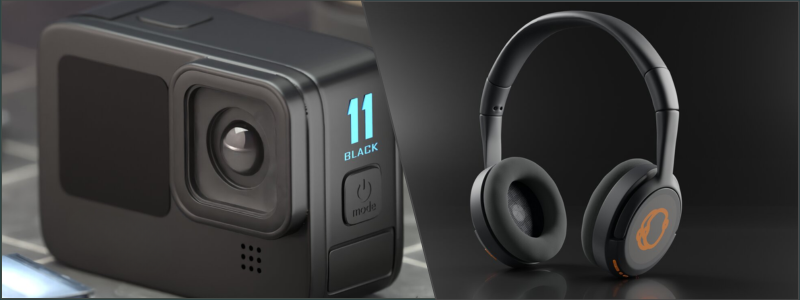
Action camera and headphones by Cad Crowd product design experts

Product animations for marketing

Among the key components in marketing material are visual appeal and storytelling. For the sake of argument, you can simply use photographs printed in magazines, flyers, and newspapers, and attach them with a short text to give the pictures a backstory. This method worked well in the past and is still widely used today. The fact that marketers and companies worldwide keep turning to this old-fashioned idea suggests that it’s effective. Billboards are still everywhere on the roadsides, proving that visual appeal plays a major role in marketing.

But just because marketers use print media doesn’t mean it’s the only thing they have at their disposal. Print media might have been the ultimate choice in the old days, but not anymore. Companies put ads in magazines as a way to supplement their main marketing channels and format: the Internet, with animated renderings. Modern consumers are bombarded with information on a daily basis, making it more challenging for any product or brand to cut through the noise. People have what’s known as “information overload” due to constant exposure to social media and news feeds delivered right to their smartphones. They see plenty of colorful pictures attached with short captions every hour of the day.

Many of them are probably product advertisements of some sort. This is the noise you need to cut through. And what better way of doing it than using the definitely more eye-catching 3D animations?Static renderings are pleasing to the eye–there’s no doubt about that. A lot of ads for products like cars, furniture pieces, homeware, fashion, electronics, and even foods and beverages are static renderings. However, the main idea behind a product advertisement is to immediately catch the audience’s attention, retain the engagement, stimulate the desire to have it, and finally trigger the buying decision.

If static renderings are the current standard, naturally, you want to bring your ads game a notch higher and be the one to stand out from the crowd. As far as storytelling and visual appeal are concerned, no static renderings will ever beat their 3D animated counterparts, and this is where an experienced 3D product rendering design firm can help. Engaging narratives and vivid imagery are delivered simultaneously, luring the audience to (somehow) involuntarily give the attention they deserve. 3D animation conveys a message effectively to let the audience see and understand the product better; they don’t have to guess what the product is or what it can do.

RELATED: FAQs to Ask a 3D Animation Studio Before Hiring 3D Animation Services for Better Projects

All they have to do is watch and enjoy. We say “enjoy” because you have the freedom to make the animation as entertaining and interesting as possible. It might be informative, hilarious, sarcastic, or all of those in one package, depending on the storytelling. This ability to present a product in a dynamic fashion makes it easier for marketers to leave a long-lasting impression on the audience. Memorable ads open the door to creating a strong brand identity.

Applications of 3D animated renderings

A 3D product animation is essentially a video created by a 3D animation expert, either long or short, depending on how detailed you want it to be. No matter the duration, video is a versatile format to deliver information, including for marketing purposes. The most common applications are as follows.

Product demonstration

Say you’re a marketer tasked with creating an advertisement for an espresso machine. Your first idea is to take a photograph of the product or create a static rendering of the object and then print it on a flyer or magazine. It wouldn’t be a farfetched idea to plan for a TV ad featuring a person making a cup of espresso using the machine. Everything is good, except that it’s all been done before. At this point, you’re in need of something unique.

Why not hire a 3D animation company to create a 3D product animation using a cross-section view of the machine in action? This way, you get the chance to showcase the inner mechanism of the product as it works to produce a cup of coffee. Of course, you don’t have to go to great lengths to give information about possible proprietary technologies or make a how-to guide. Only include the highlights, such as new features, ease-of-use, simple maintenance, build quality, and performance. The most important thing is that the audience understands what it is and what sets it apart from similar products in the market.

RELATED: A Guide to 3D Virtual Reality Animation Rendering Services for Companies and Firms

Virtual tours

If you find the need to do virtual tours, where potential clients can see and experience the product without physical visits, chances are you’re talking about a substantially large product. It might be a house, a venue, a museum, a hotel, and so forth. As the name suggests, a virtual tour should allow the audience to experience the product through auditory and visual stimulation. Take, for example, a virtual tour of a museum. For a virtual tour to be comprehensive enough, the 3D architectural animation firm creates an animation that depicts the activities a typical person does in the facility.

Move the camera slowly forward, passing the exhibits, and highlight some of the popular objects on display. Avoid having jump cuts in a virtual tour as they feel forced and unnatural. Don’t forget to use the back sound to amplify the atmosphere. The same thing applies to virtual tours of a house, a hotel, or other properties. Virtual tours are increasingly popular among real estate marketers and agencies. More people today get their latest information on the local real estate market from the Internet.

3d architectural rendering freelancers

They look at the available features and browse through the list of highlights before deciding to set an appointment with the realtor for a visit. Potential buyers rarely do physical visits if they don’t like what they see on the listings to begin with. A 3D animation from a 3D architectural visualization designer, formatted as a virtual house tour, is not cheap, so you might want to reserve it for a high-dollar property as well. 

Brand storytelling

As mentioned earlier, telling a story is important in marketing. Brand storytelling is more than just about advertising a product. It is also about fostering a relationship between your business (the company and the brand) and the clients. Telling dry facts and listing your best-selling products’ features don’t exactly constitute a story, do they? Your clients want a more compelling narrative–a story loaded with messages about the values the brand represents, the purposes it fills, the responsibilities it shares with the clients, and the goals it wants to achieve.

Almost the entire point of brand storytelling, apart from the subtle marketing intent, is to humanize your brand. The storytelling is meant to demonstrate that the business has a human side. A business has to make a profit, but it does that while fostering connections with the clients at large. To build the case for it, the storytelling usually puts forward the idea of empathy. In other words, there needs to be a parallel between the brand’s own identity and the values clients can appreciate. You want to create emotional bonds with the audience, carving the path to building trust, a sense of shared purpose, and eventually brand loyalty.

Anybody can argue that you don’t have to use 3D animation for brand storytelling – a traditional film will do. But then again, it’s like saying static renderings aren’t necessary because photographs will do. We’re not asking you to abandon videography and never look back; videography still has its place in marketing. That said, if there’s a better option, you should be inclined to make the most of it. Animated renderings come with the advantage of near infinite possibilities. So long as you have the budget for it, the sky’s the limit, and if you also have the right 3D design professionals to get the job done, you might even be able to produce an animation of blockbuster material.

RELATED: How 3D Animation Helps Deliver Immersive Marketing Campaigns & Company Services

Suppose your brand focuses on canned beverage products. In your brand storytelling, of course, it is possible to use an actor or someone from the company to talk at length about the idea behind the product, the history, the manufacturing process, quality control, etc. Or, you can take the Coca-Cola ‘Happiness Factory” route and utilize 3D animation to picture the hard work, the fun, the joy, and the dedication put into every bottle of the drink.

Another great inspiration is the Honda “Cog” commercial from the early 2000s, demonstrating the precision, the reliability, and the care to build a car; it became so popular that it got its own Wikipedia page. It’s an “inspiration” rather than an “example” only because the Cog used very little CGI (that’s one of the reasons it cost £1m back then). Today, with heavy CGI utilization from 3D rendering experts, you won’t need even close to that amount to produce great storytelling wrapped in a comparable visual quality.

Social media campaign

In the traditional sense of the term, social media refers to online platforms where users can socialize with each other regardless of distance and location via Internet-based communication methods. The definition has shifted in a big way. While conventional usage as a networking tool remains in place, social media have become a major marketing channel and are multimedia-heavy. Thanks to the user-friendly interface, mobile app versions that basically encourage people to stay connected all the time, and mostly free access, social media are the ideal platforms to launch a full-blown marketing campaign and spread the word about your products and brands.

Even on supposedly text-based platforms like Twitter, pictures and videos are dominating the feed. Now, with Instagram, YouTube, and, more recently, TikTok, where billions of users are exposed to an endless stream of product marketing, you have a much better chance of gaining traction using 3D product animation. Everybody is posting and watching videos on their phones; if they like what they see, they’re more likely to share the content with their friends and followers.

Visual appeal determines shareability, and greater shareability means a higher potential for lead acquisition. In terms of visual appeal, you’ll be hard-pressed to find anything more engaging and eye-catching than a well-made 3D product animation. An exploded view animation of a pair of earbuds attracts more viewers than a static rendering of them; an animated video of a toy car is more exciting than a photograph of it; a stop-motion of espresso workflow has higher shareability than a traditional video of a person making a cup of coffee.

RELATED: How to Use 3D Architectural Design as Visual Storytelling

automotive engineering design services

Main reasons to use 3D product animations

It wouldn’t be entirely correct to say that 3D animated rendering is the be-all and end-all for product marketing. Other formats, such as traditional photography and videography, still have their merits, but there are some very good reasons why 3D animation is the outright better choice.

Easy to showcase details

Every advertisement is meant to be informative and contain enough details to intrigue the audience. Assuming the details have anything to do with a product’s raw materials, manufacturing process, internal mechanism, or other highlights that can’t possibly be shown without taking it apart, 3D animation makes it easier to cover those details and still look playful. If the product has a unique feature that requires some technical knowledge to understand, an animated video can act as an explainer to help your less technical buyers get a grasp of it through a nice graphical presentation. 

Cost-effective

Most product design professionals and small video production companies offer Full HD (1920 x 1080p) resolution in either 24 FPS or 30 FPS as standard. The video is typically priced by duration; a minute of 3D product animation may cost anywhere between $5,000 (from a small studio) and $25,000 (a professional animation company). If done properly, a minute of animated rendering should be enough to cover a lot of details. Even at the higher end of the spectrum, it’s still relatively affordable compared to traditional filming. It’s cost-effective because you don’t have to bother with using a lot of expensive cameras and editing equipment. You don’t even need an entire filing crew; a small team of modelers and render artists will do.

Flexibility

Because 3D animation is CGI, every object you see on the screen can be modified, altered, removed, and replaced using specialized software. When the budget is tight, it’s even possible to repurpose an old animation for a new marketing campaign without spending too much time and resources. Still remember the IKEA example mentioned earlier? Reuse and repurpose are big cost-saving elements.

RELATED: What is the Important Difference Between Motion Graphics Design and 3D Animation Services Design?

Conclusion

3D animated renderings have improved how companies and brands communicate their products to customers. More businesses all around the world are beginning to visualize how 3D animation can be a cost-effective and flexible alternative to traditional videography, paving the way to new exciting innovations in the technology and creating a competitive market on its own. However, this also introduced a concern about the possibility that many untrained render artists will take advantage of the development and trick unsuspecting clients into spending money on poor-quality animations.

How Cad Crowd Can Help?

Here at Cad Crowd, you’ll never worry about receiving a substandard result or a low standard of quality of work. With over 94,000 experts to choose from who have undergone a pre-screening process, you’re ensured that only qualified professionals with proven track records can offer their services. Don’t hesitate to give us a call, now! 

author avatar

MacKenzie Brown is the founder and CEO of Cad Crowd. With over 18 years of experience in launching and scaling platforms specializing in CAD services, product design, manufacturing, hardware, and software development, MacKenzie is a recognized authority in the engineering industry. Under his leadership, Cad Crowd serves esteemed clients like NASA, JPL, the U.S. Navy, and Fortune 500 companies, empowering innovators with access to high-quality design and engineering talent.

Connect with me: LinkedInXCad Crowd

Best 50 Sites to Hire Freelance 3D Modeling Experts and Remote 3D Designers for Companies


3D modeling services refers to the use of specialized software to create an image or visualization of an object. In other words, a 3D model is CGI (computer-generated imagery) and it exists only as a digital file in a virtual world. The model itself can be entirely imaginary (such as a product concept, yet-to-be-built architectural design, fantastical creatures, game characters, and scenery) or digital twins, like when an automaker builds a detailed digital archive of an existing vehicle.

Thanks to the rapid development of computer technologies, 3D modeling is applicable to just about every industry. Over the years, modelers have used specialized software to build a wide variety of digital objects for various purposes, such as:

  • Design ideas: 3D modelers are able to visualize product design concepts either from scratch or based on rough sketches by designers. The result is, as mentioned earlier, a digital prototype. The products can be anything from a simple pair of flip-flops to a complex industrial machine with all the mechanical components inside.
  • Characters: even if the characters in games and animated films are based on real people, what you see on screen are 3D models. Some architectural renderings also use 3D models of people to increase the photorealism effect.
  • Scientific concepts: 3D modeling has been frequently used in educational settings to help students gain a better understanding of biology, physics, geography, and history. Digital models allow students and professionals to interact with a variety of objects (digital twins) in a controlled environment.

So, 3D modeling is useful and just as ubiquitous as you might expect, but it’s not something that anybody can master in just a few days’ time. It’s a good thing that the World Wide Web has given access to quite a lot of places where you can source skillful 3D modeling professionals, both agencies and solo freelancers, to work on your next projects.

RELATED: 3D Modeling Services – Factors Affecting the Speed of Your Project

Remote 3D designers/agencies

As far as designs are concerned, 3D modeling offers an efficient way to visualize ideas and develop prototypes–digital prototypes, at least. In some advanced product development projects, a 3D model might be subjected to a simulation analysis to evaluate the performance and functionality (of the digitally created prototype) before moving forward to the production stage. Designers and engineers can therefore refine their ideas and make countless alterations on the screen, without actually having the physical design in their hands. 

cadcrowd-logo

1. Cad Crowd

You can’t just hire any digital artist on a whim. A proper 3D modeling requires some serious skills, a good understanding of 3D software, and, more importantly, an excessive dose of creativity. Experience in similar projects is equally important, as it demonstrates the modeler’s abilities to tackle common design challenges on the job as well. Although in certain projects the modeler basically follows what’s already described in the brief, the job often puts the modeler in situations where they have to deal with unexpected difficulties in various aspects like level of details, styling, and uniqueness.

Additionally, familiarity (or rather, proficiency) in cloud-based workflow is becoming a greater necessity, especially if you’re talking about remote projects. But Cad Crowd has everything covered on your behalf. Unlike the vast majority of general freelancing platforms, Cad Crowd positions itself as a 3D CAD specialist; the vast majority of freelancers, experts, and firms registered with the site are CAD professionals, offering a wide variety of industry-relevant services.

Cad Crowd has just the right talents to tackle all sorts of CG-related tasks, including but not limited to 3D modeling of any object, 3D rigging services, texturing, rendering, animation, and concept art. Through the “Managed Services” feature, you have the benefit of keeping the project confidential in every sense of the word. The project remains closed to the public and is accessible only by the 3D modeler handpicked by Cad Crowd. As a matter of fact, only you and the modeler can see the project description, the submitted work, and file attachments.

If privacy and confidentiality are non-negotiable, Managed Services from Cad Crowd is the way to go. As an alternative, there’s also the ‘Design Contest” option, where you post a 3D modeling project either to the public or to a selection of freelancers. However, contests are probably best reserved for smaller projects, such as 3D printable designs, simple product ideas, game character models, or floor plans. As long as the project brief is simple enough that you can explain everything in one page, a design contest seems like a good option. Freelancers will compete against each other to submit their best works and earn the prize money.

It’s worth mentioning that every 3D modeler who participates in your design contest is bound by Cad Crowd’s non-disclosure agreement. Because the options of “Managed Services” and “Design Contest” are available for clients, Cad Crowd is kind of operating as both a design agency, where it acts like a project manager to bridge communication between the modeler and the client, and a freelancing platform that connects you with professional, independent solo freelance 3D modelers. 

Website: Cadcrowd.com

RELATED: 3D Modeling vs. 3D Rendering Services

game-ace logo

2. Game-Ace

Quite a lot of online/remote 3D product modeling agencies specialize in the gaming industry, and Game-Ace is one of those. While the website plainly says that they’re a custom game development studio, the description seems to indicate that it can take 3D modeling orders of any kind, including characters, vehicles, environment, weapons, etc. Considering the fact that modern games are increasingly focusing on realism, there’s no reason you shouldn’t consider the studio for your next 3D modeling project.

The agency operates in more or less the same fashion as just about every other custom service online, in which it takes your order for a tailored product and delivers it exactly to your specification and budget. As long as you’re asking for 3D hard surface modeling, chances are the professionals at Game-Ace can get the job done no matter what the objects are. Game-Ace is based in Nicosia, Cyprus, with representatives located in various countries, including Germany, Ukraine, Bulgaria, and Canada.

Website: Game-ace.com

Juego Studio

3. Juego Studios

An ISO-9001:2015 certified game development company, Juego Studios has worked with giants like Disney, Coca-Cola, Warner Bros., and Johnson & Johnson, among others. The studio is headquartered in Bengaluru, India, but it has established branch offices in London (UK), Jeddah (Saudi Arabia), Miami (US), and Texas (US). It’s powered by a relatively big team of more than 100 professionals, including 3D artists, storytellers, innovators, and game developers.

Since Juego Studios was founded in 2013, it has worked with at least 80 clients across 20 countries worldwide. Once again, Juego Studios is mainly a game design company, which naturally also does 3D modeling work. In fact, 3D sculpting design services (a type of 3D modeling) is one of the core professions in the entire game development industry. This means you don’t have to plan to build a game from scratch to hire their services. It doesn’t matter if you need a 3D model of shiny jewelry or an oil rig, Juego Studios is happy to take the order.

Website: Juegostudio.com

Anideos

4. Anideos

Despite being a video production company at heart, Anideos offers a whole range of other services in the digital art industry, including book illustration, concept art development, and, of course, 3D modeling. Anideos isn’t actually a freelancing platform, but it allows you to hire each of the services individually. For example, a client can hire an artist to build a 3D model without having to order the animation service as well.

Think of Anideos as an agency, or a recruiter if you like, that takes your order and has it completed by a qualified professional in its network. One of the most commendable things about Anideos is that it provides long-term support following project completion. If at some point after the project, you’ve discovered that the 3D model needs refinements due to visual flaws, Anideos is ready to take the model back and fix it all up for you.

Website: Anideos.com

3d Ace logo

5. 3D-Ace

Unlike the similarly named Game-Ace that positions itself as a game studio but also offers 3D modeling services, 3D-Ace is kind of a generalist as far as 3D CAD is concerned. At least according to 3D-Ace themselves, the studio is dealing in the art outsourcing business and providing services in three main categories: 3D modeling, 3D animation services, and VFX.

When it comes to the 3D modeling part, 3D-Ace mainly employs the polygonal modeling technique. That said, the in-house team is more than skillful enough to take different approaches, such as NURBS, photogrammetry, digital sculpting, and all other solutions that aren’t typically associated with games. Every single model is formatted and optimized for any specific type of media (render, animation, software, etc.), so make sure your project brief contains clear information about where you want to use the model and for what purpose.

Website: 3D-ace.com

Ufo 3D

6. UFO 3D

Maintaining prompt communication should be easy with UFO 3D, thanks to its stand-alone mobile platform available for iOS. It probably is one of the very few 3D modeling services that have their own mobile apps to help you manage every project on the go, so it’s a little bit more reassuring than most in that regard. UFO 3D is backed by a pretty big team of nearly 300 digital artists, with a combined expertise to take on just about every CGI project you can throw at them. This may include 3D modeling, animation, 360° view, drawings, sketches, 3D AR/VR architectural experts, architectural visualization, and AR.

In fact, UFO 3D says there’s no scale limitation to the size and type of project it can handle. The free revision offer is also quite promising. The agency is willing to make as many adjustments as you need, as long as the changes don’t exceed 60% of the scope of the project. A limitation in revision is not uncommon in the business, but a 60% maximum is pretty impressive. Registered clients also get free access to a massive library of assets containing tens of thousands of 3D models (mostly furniture pieces and accessories) and more than 6,000 scenes.

Website: Ufo3d.com

RELATED: 3D Modeling: An Overview of History & Industry Applications

Vegacadd

7. VegaCADD

While VegaCADD is operating primarily in the architectural visualization business sector, the solution also offers custom 3D modeling services. Admittedly, most projects in its current portfolio revolve around furniture designs and decorations, but it doesn’t necessarily mean you can’t order 3D modeling of any other object. VegaCADD caters to both low-poly and high-poly modeling techniques, meaning the models should be good enough for product visualizations, animations, and even game visuals.

Over the last six years or so, the agency has managed to successfully tackle 785 projects for various purposes in different fields. The usual 3D model formats are DWG, DWF, and DWFx, but you’re welcome to personalize the order and ask for any specific file output. VegaCADD is based in California, United States, and is part of Rayvat Rendering Studio. Their corporate headquarters, however, are located in Gandhinagar, India. 

Website: Vegacadd.com

8. Aristek Systems

You may notice that Aristek System actually is a custom software development company, but the website clearly says that it also offers solutions in the 3D modeling sector. The company’s work in the sector consists of four major disciplines, including CAD, product modeling, animation, and rendering. In the CAD part, the in-house 3D design team takes your design ideas and transforms them into digital drawings. This eliminates the need to have ready-made sketches when ordering a 3D model, because the company has this part covered.

They first produce two-dimensional digital drawings based on your idea, wait for your feedback and approval, revise if necessary, and then build the 3D model. In case you want to take things a little bit further with animation or a complete lifestyle rendering (with additional objects in the background), Aristek System can take on the job as well, for a full-range, turnkey 3D design service.

Website: Aristekservices.com

The Motion Tree

9. The Motion Tree

Some 3D modeling agencies are quite secretive about their pricing and deliberately keep the information behind a registration wall. The Motion Tree is not such a firm. It offers several different services and is upfront about the pricing in all of them. The 3D modeling service is available for $25; the service includes creating the sketches and turning them into 3D models. However, the service doesn’t actually include texturing work, as it will cost you $10 extra.

In case you also need a silo rendering (photorealistic CGI put against a plain background, usually white), you must pay an additional fee of $10 as well. The two most expensive services are lifestyle rendering (similar to silo rendering, except the background is not in plain color, but an assortment of other objects arranged in such a way in the scene) and product animation services, costing $79 and $99, respectively. 

Website: Themotiontree.com

nAo Design

10. nAO

A hardware product development company, nAO divides its services into five major categories: Product Design, Design Research, Engineering, Manufacturing Support, and AI-Powered Product Concepts. The company’s 3D modeling work lies under the first and the last categories. Product Design is all about creating concepts and transforming them into realistic models based on predetermined parameters, whereas the AI-powered option involves collecting and analyzing an extensive amount of data about any particular design and exploring feasible concepts using artificial intelligence.

For the AI-powered design generation, nAO charges $2500, for which you get three product concepts, high-resolution rendering of the selected concept, a 3D model, and one time revision. Remember that nAO also offers engineering and manufacturing support. In case you need to take a product concept further into an actual production run, the company is eager to provide additional services such as prototyping and manufacturing optimization. Most products in the company’s portfolio are IoT devices and high-tech systems. 

Website: Nao.design

Peschkedesign

11. Peschke

Having been around in the creative industry since 1973, Peschke is quite possibly one of the oldest design studios in the world. It’s a multidisciplinary studio that does everything from UX/UI and content creation to software development and product design. Pouring a combined expertise in materials science, ergonomics, and production engineering design professionals, Peschke is best known for its “circular” approach to design by aligning product development work with the principles of circular economy.

In short, their designs are meant to contribute to the global effort to reduce waste and minimize consumption. Their CAD and visualization offerings are made up of several different services: 3D modeling, design comparisons, renderings, animations, and virtual reality. Some of their previous clients include AKG Acoustics, ENGEL, Waagner-Biro, and Grabner Instruments. Peschke is based in Vienna, Austria. 

Website: Peschke.at

RELATED: Why is 3D Modeling Important for Product Manufacturing Companies?

Thepro3dstudio

12. ThePro3DStudio

Many design studios offer 3D modeling services merely as part of their product development businesses, but ThePro3DStudio only focuses on the modeling part. That said, there is a good enough variety in the range of services it provides. For example, the studio offers to build your 3D model in either a 3D-printable format, digital sculpting, or both. The studio also doesn’t have any specific considerations about the types of objects you want to make; they might be gadgets, furniture pieces, apparel, fashion accessories, cosmetics, and more. 

You get to choose whether you want to pay an hourly rate or on a project basis for the task. More importantly, the studio says to keep the client heavily involved throughout the project, from the ideation stage to the actual design iteration. You’ll be asked for reviews and feedback on a regular basis (for approval) every step of the way before the studio proceeds to the next phase. This makes sure that the final model or design is exactly to your preference. 

Website: Professional3dservices.com

Spine-3D

13. Spine 3D

Spatial Interactive Experiences (stylized as SPINE, and then becoming Spine 3D) is a visualization studio located in South Florida. Specializing in architectural objects, the visualization services include 3D modeling, rendering, animation, virtual tours, 360° view, virtual reality of buildings, interior designs, landscapes, floor plans, real estate projects, or just about everything else typically related to construction. And yet the studio’s portfolio, especially in the “product visualization & experiences” section, contains an assortment of photorealistic models of seemingly random objects, such as a crane attachment, a wristwatch, a wolf, a door lock, a lighting fixture, some cars, and a few medical equipment.

Website: Spine3d.com

Design1st

14. Design 1st

Everything about Design 1st revolves around three processes: designing, engineering, and prototyping. The studio focuses on “manufacturable design concepts” rather than imaginary objects like fantastical characters or sci-fi weapons you see in games. In other words, Design 1st isn’t interested in any non-feasible concepts, and it works only in the realm of technical plausibility.

Based on the information available from the website, you don’t actually have to provide sketches or concepts of any sort when ordering a 3D model. Design 1st only needs a plausible idea or a vision of a product to start working through the entire process of generating a visualization. The process begins by identifying the target user before it moves on to an exploration into visual concepts of the product in question.

The first visual concepts are usually hand-drawn images, and then the 3D modeling work kicks off. You’ll be heavily involved in the project until you’re happy with the produced 3D model. Assuming you want to continue the collaboration with rapid prototyping designers or CNC machining, Design 1st has the expertise in those services as well.

Website: Design1st.com

Brash Inc

15. Brash

The services Brash provides include PCB design, model making, mechanical engineering, robotics/mechatronics, firmware development, full-stack web development, and industrial design. With offices located in North America (United States and Canada) and Europe, the company has worked with businesses of all sizes and provided turnkey product development services across industries. The good thing about Brash is that no client is required to go through the entire product development process, from ideation all the way to production. Brash is ready to jump at any point in the process. You don’t have to go through every single step, meaning you can order only what you need; in this case, the 3D modeling phase. 

Website: Brashinc.com

Porticos

16. Porticos

According to Porticos themselves, many of their clients do not really need the entire range of product development services, from concept generation to post-production. The company has been around for more than 20 years, catering to clients from various industries and with highly specific needs. Just because you only need to have a product idea 3D-modeled and nothing else, it doesn’t mean you can’t ask for their assistance.

In addition to 3D modeling and new product development services, Porticos takes pride in its “engineering investigation” work, which includes everything from design review and cost engineering to failure analysis and component obsolescence. This service screams reverse engineering, which is definitely useful if you want to build or “model” a new product based on an existing design. 

Website: Porticos.net

RELATED: How 3D Modeling Services Are Changing the Fashion Industry

Tesla mechanical designs logo

17. Tesla Mechanical Designs

A big highlight of Tesla Mechanical Designs is that they claim to implement the DFM (Design for Manufacturing) approach in all of their modeling work. DFM services basically refers to the process of designing an object with manufacturability in mind. Every single thing in the design, including the material, tolerance, surface finish, geometry, etc., should be, by definition, production-ready.

When it comes to 3D modeling, especially if it’s a product concept, you want it to be as precise as possible to the physical object. Tesla Mechanical Designs claims to place emphasis on accuracy to the point where the design can be replicated easily for future uses. You’ll be glad to know that they also cater to mechanical part modeling, indicating that they work not only on the external (exterior part) of a product design, but also the inner mechanism, too.

Website: Teslamechanicaldesigns.com

Concepto-studios-logo

18. Concepto Studios

Some popular products by well-known brands in which Concepto Studios was part of the design team include the Remington’s HyperFlex rotary shavers, BLACK+DECKER Xpress Steam Cord Reel Iron, and Philips Zenit 5.1 Speaker System.

Concepto Studios provides the entire series of services you typically expect from a product development company, such as research, branding, design, 3D visualization, design engineering experts, prototyping, packaging, and manufacturing; basically everything you need to turn an idea into a physical product. But then again, you don’t have to use them all. If you’ve already done your research or put the designs into sketches, and you only need the 3D modeling part done, there’s no need to pay for the full spectrum of services. 

Website: Conceptostudios.com

Pixready

19. PIXREADY

Considering the fact that PIXREADY has only been in the business for around five years, it’s quite impressive that they’ve completed more than 1200 projects already. Granted, not every single one of those projects was product 3D modeling, for the simple reason that they also offer architectural visualization, product configurator, and animation. Their 3D modeling services cater to different needs; it doesn’t matter if you need the models for prototyping purposes, virtual try-ons, DFM documentation, or marketing assets. Prices start from $100 for a basic model and $350 for the more complex type.

Website: Pixready.com

CGI Furniture

20. CGI Furniture

As the name implies, CGI Furniture only does 3D visualization services for one type of product: furniture. Like PIXREADY, you have several options based on how you intend to use the models. For advertising purposes, for example, you should pick the high-poly model as it highlights the texture, colors, and surface finishes better than the low-poly option. That being said, the low-poly is probably best for AR and VR uses, such as during a virtual walkthrough of a design. 3D furniture rendering services also have a massive library containing thousands of ready-to-use 3D models and scenes that you can purchase and (likely) modify.

Website: Cgifurniture.com

Jackson-hedden-logo

21. Jackson Hedden

One of Jackson Hedden’s finest creations, the Archie & Alfred Dog Harness, was awarded the best dog leash by People Magazine. In their Industrial Designers Society of America (IDSA) directory, the list of clients includes 3M, Bentley, Boston Scientific, and Axolight. As part of Jackson Hedden’s primary services, they offer design research, sketch ideation, CAD documentation, and visualization.

With a bold claim that says “we make everything,” the firm never shies away from implementing an out-of-the-box approach to design, but without abandoning the contemporary design principles. Whether you want to have a brand-new product design 3D-modeled or an existing design reengineered and improved, Jackson Hedden should be on your shortlist of remote 3D designers to hire.

Website: Jacksonhedden.com

Modelry

22. Modelry

With over six million 3D specialists registered with the site, Modelry is a pretty massive place to outsource your 3D modeling project. The thing is, Modelry doesn’t connect you directly with any of those specialists. The platform takes your order for a custom 3D model and delivers the model as requested. They don’t really say whether the job is outsourced by one of the freelancers or done by the in-house team, but the most important thing is that the client receives the files either way.

A single custom-built 3D model costs from $42. One of Moderly’s latest offerings is the “3D Datasets” feature, which includes custom datasets tailored to your specifications and fully licensed generative AI applications. Modelry also provides a free 3D model storage and hosting service up to 20GB.

Website: Moderly.ai

RELATED: How to Design 3D Models for 3D Printing & New Prototypes

Freelance 3D modeler

And now to the sites where you can find and hire individual (or a team of) freelancers instead of design firms.

anytask logo

23. AnyTask

You’ll immediately notice that AnyTask is a general freelancing platform just by looking at the homepage. There is a massive search bar at the top of the page, followed by an assortment of thumbnails showcasing the platform’s recommended freelancers. All the 3D modeling professionals are listed under the “Visual Design” tab, especially in the “3D & Architectural Design” category, where you’ll see other options like floor plans and AutoCAD mechanical engineering professionals as well.

Let’s say you can’t find exactly what you’re looking for in the list of freelancers or that you’re still unsure if anybody is able to complete the project well; AnyTask gives you the option to post the project on a job board free of charge. Interested modelers will send you an offer, and you can continue the conversation from there. AnyTask does provide the platform to connect you with freelancers, but it will not in any way interfere with the collaboration. AnyTask does charge a small fee for every transaction done through the platform. The cost is automatically added to the project cost, and the modeler gets to keep 100% of the earnings.

Website: Anytask.com

CGHERO logo

24. CGHero

In some respects, CGHero is like Cad Crowd in the sense that both are freelancing platforms that offer full-service management. Also, they specialize in services revolving around the computer-generated design field. When working with CGHero, all you have to do is provide a simple brief that includes the project type, software preference, skill requirements, and production format. The platform immediately takes over from there and proceeds to create the detailed descriptions of the tasks involved.

It will then match the project with 3D modelers registered to the site. You’ll receive updates about the project, and when everything is done, you’ll gain access to all the files. The project management platform has all the features you need to monitor progress, provide reviews or feedback, and track activities during any given project. All the funds are held in an escrow account and released only when the work is done. The intellectual properties and copyrights are also transferred to you on project completion. 

Website: Cghero.com

braintrust logo

25. Braintrust

With everything seeming to be AI-generated these days, Braintrust jumps on the bandwagon by providing you with an AI-powered hiring assistance when you need a top talent to work on your 3D modeling project (or any project for that matter, because Braintrust is a general freelancing platform). There’s an AI job description generator, which automatically creates a job posting supposedly effective to attract top talent; it also has an AI-based candidate matching process that selects only five candidates (out of a million talent members) for your project; even the video interviews to screen the candidates are conducted by AI.

Braintrust partners with more than 25 workforce platforms to ensure you get the best possible candidate for projects of any size and the right tools to manage the collaboration. If the AI isn’t entirely convincing enough for you, Braintrust also offers a Remote Job Board that you can use to post projects for free.

Website: Usebraintrust.com

CGtrader

26. CGTrader

More than 40,000 freelance 3D designers find a home in CGTrader, which claims to be the largest platform to find 3D modelers, riggers, animators, 3D printing professionals, and everything in between. The hiring process is pretty straightforward in CGTrader. You need to describe your project as clearly as possible using a simple form. It’s advisable to add some images to the description to help freelancers understand the brief better.

Next, the platform selects a number of qualified designers to send quotes based on the project brief. You should receive the quotes in your inbox. The quotes should come attached with the freelancers’ profiles, making it easier for you to browse their portfolios and evaluate their previous works. In case you find the whole process too cumbersome for some reason, just use the search function and filter the results based on skills, ratings, and software preferences. CGTrader requires you to pay the budget in advance, but the fund is only released when you’re pleased with the model submitted.

Website: Cgtrader.com

RELATED: 5 Powerful Tips for Sculpting with 3D Modeling Freelancers and Services Companies

freelancehuntcom logo

27. Freelancehunt

When you think of Ukraine these days, freelancing platforms might not be the first thing to cross your mind, but there is indeed such a thing in the country despite the ongoing international conflict. Since 2005, Freelancehunt has been steadily growing to become the largest freelancer market in Eastern Europe. It currently has a database of more than 175,000 professionals registered with the site; nearly 3,000 of them are 3D modelers.

Website: Freelancehunt.com

contracom logo

28. Contra

You have access to over 800,000 professionals from various disciplines in Contra. Searching for a 3D modeler (or freelancer of any other skill set, for instance, 3D architectural visualization experts) is a straightforward process. All you have to do is sort through the freelancers by category, software tools, hourly rate, language, etc., and you’ll be provided with a list of suitable candidates. However, you must be a registered member to do all that and access all other features.

Website: Contra.com

Creativelylife logo

29. Creatively

Among the best features of Creatively is that you get to post as many projects as you need and contact (via DM) up to 400,000 freelancers in its network. Creatively says it has an innovative recruiter feature–although it doesn’t actually elaborate how unique the process is–to help you match a project with the ideal 3D CAD modeling professional. It’s a subscription-based platform, costing you at least $199 per month, but thankfully, there’s a 10-day free trial. 

Website: Joincreatively.com

microlancercom logo

30. Microlancer

The minimalistic user interface seems to be the main appeal of Microlancer. Taking a deeper look into the website (or job listing) reveals that the term “micro” is used quite literally here, in the sense that clients are allowed to post even tiny projects on the board. Apart from that, everything else feels pretty much the same as many other platforms; you post a project, wait for proposals from freelancers, and choose one to get the job done. Posting a project is free, and you get the option to boost the listing (to increase visibility) for a fee.

Website: Microlancer.io

usemecom logo

31. Useme

Most freelancers in Useme are based in Europe, mainly in Poland, the Czech Republic, and Serbia. Despite not being a global freelance market, Useme claims to have at least 170,000 freelancers registered with the site. You get full access to the entire database of freelancers, and it comes with a limitless job posting feature. However, Useme charges a small platform fee taken from a percentage of your project budget for every successful transaction.

Website: Useme.com

Remote

32. Remote

A lot of things in Remote are similar to those of Contra. Instead of letting you use the website to freely post a project and hire a freelancer, first, you need to register for a membership to be able to access the job board. Subscription fee starts at $119 per month. According to Remote itself, clients will be able to access some of the most popular remote job boards to improve their chances of getting the best possible 3D CAD rendering freelancer for any project.

Website: Remote.com

RELATED: Tips to Become a Freelance 3D Visualization and 3D Modeling Pro

Toptal-logo

33. Toptal

Here’s the big claim by Toptal: thousands of freelancers apply to the platform, but no more than 3% are accepted. They position themselves as the elites of the freelancing world, promising quality over quantity. Toptal isn’t a free platform; you need to be a registered member to proceed with the “talent search” feature. The subscription fee is $79 per month

Website: Toptal.com

yunojuno logo

34. YunoJuno

Creating a YunoJuno account is free, but there’s a 12% commission fee (billed to the client, not the freelancer) for every completed project. That 12% fee covers an expedited matchmaking service and sourcing support. At the moment, YunoJuno claims to have a database of more than 100,000 freelancers with a broad range of combined skill sets from marketing to design. And yes, 3D modeling is included as well.

Website: Yunojuno.com

Upwork-logo

35. Upwork

A general freelancing platform that needs no further introduction, Upwork gives you a nice blend of user-friendliness and the promise that there will always be freelancers interested in your 3D modeling project, as long as you price it properly. Once a job is posted, you’ll receive proposals from a number of modelers. Since the lowest bidder might not always be the best option, make sure to check their profiles and portfolios before you make that hiring decision.

Website: Upwork.com

truelancercom logo

36. Truelancer

You can hire CAD designers in two ways with Truelancer. You can post a project, review proposals from freelancers, and choose one you think is best suited for the task. Alternatively, you may want to browse the freelancers’ profiles, evaluate their portfolios, and invite them to apply for your project. Truelancer doesn’t charge a platform fee, but it passes on the “third-party” payment processing fee to the client’s deposited fund.

Website: Truelancer.com

fiverr logo

37. Fiverr

Quite possibly the first website that comes to mind when looking for a freelancer, Fiverr lives up to its name by keeping the cost low, although the same introductory price of $5 only applies to the most basic of services. While you can post a 3D modeling project and have Fiverr handle the matchmaking task, it might be just easier to browse the freelancers’ profiles and contact them directly. 

Website: Fiverr.com

Freelancer

38. Freelancer

According to their latest number, Freelancer (the platform) has connected more than 78 million clients and freelancers from 247 countries combined. The hiring system works through a bidding process; freelancers are required to submit proposals or bids on your project. Freelancer, like Upwork and Fiverr, is a general freelancing platform, meaning you can post a project of any category, even the highly specific ones, such as 3D modeling or Autocad drafting & design services. Freelancer also has a mobile app to help you manage a project anywhere, anytime.

Website: Freelancer.com

RELATED: 3D Modeling in Advertising – Better Promotion with 3D Rendering Services

peopleperhour

39. PeoplePerHour

Once you post a project to PeoplePerHour, an AI-powered matchmaking system does the work and sends a notification to freelancers it thinks are most suitable for the project. You receive proposals from them, pick the best one, and deposit the project fund. PeoplePerHour also allows you to search and contact freelancers directly and invite them to complete a task. 

Website: Peopleperhour.com

Guru logo

40. Guru

The way Guru works isn’t entirely dissimilar to PeoplePerHour. You post a project (after signing up, of course), receive quotes from freelancers, and choose the best one to hire. Guru claims that a typical project should get responses from freelancers within just hours after posting. And there’s the search function, with which you can contact freelancers and ask them to send quotes for a project. 

Website: Guru.com

Blender Artist

41. Blender Artist Community

Just by looking at the homepage, you can tell immediately that you’re not in a typical freelancing platform. Blender Artist Community isn’t primarily a place where 3D artists are looking for work or companies looking to hire a freelancer, but it does have a section for both purposes in the “Jobs” section. In addition to the “Paid work” category, where you post a project and offer a monetary reward, there’s also “Volunteer work” in case you need help with some modeling but aren’t prepared to spend on it. 

Website: Blenderartists.com

DeviantArt-Logo

42. Deviant Art Forum

If the Blender Artist Community is mostly frequented by Blender (the software) users, Deviant Art is a much more open community for digital artists at large, no matter what software preferences they have. In the “Forum” portion of the community, you’ll come across the “Employment opportunities” section, filled with two categories: Artists for Hire and Hiring an Artist; both are pretty self-explanatory. You can, of course, browse both categories to discover the 3D modeler you need.

Website: Deviantart.com

FreeUp logo

43. FreeUp

You’d think that Toptal accepting a mere 3% of all freelancers applying to the site is pretty impressive, but FreeUp is even more outrageous for claiming that it accepts only 1% of all applicants. FreeUp says that all freelancers on the platform are fluent in English and have been interviewed and vetted for their technical skills. You can sign up for free, and there’s no monthly fee to use the platform. 

Website: Freeup.net

Worksome logo

44. Worksome

You can’t really classify Worksome as a job board or a freelancing platform. Worksome gives you an all-in-one platform to help you source freelancers and manage the collaboration from a single dashboard. It has a centralized system that enables a streamlined workflow to hire, contract, pay, and optimize the external workforce. You also have a feature to add your existing talent pool to the platform. 

Website: Worksome.com

RELATED: Why 3D Modeling Is Important For Constructing Architectural Projects By Companies

twine logo

45. Twine

Although there’s no mention that Twine only accepts a small percentage of freelancers registering with the site, the platform says to vet all the proposals submitted to your project. As usual, it’s also possible to browse the freelancers’ profiles and invite them to send their best pitches. Posting a project is free, and because this is a general freelancing platform, your project can be anything from simple data entry to the much more demanding 3D modeling tasks. 

Website: Twine.net

Giggrabbers

46. Giggrabbers

As far as hiring freelancers is concerned, Giggrabbers doesn’t actually provide something new. You post a project, wait for proposals, evaluate freelancers’ portfolios, and make a hiring decision. That said, Giggrabbers is the first freelancing platform to also offer crowdfunding features and exploratory tools to help clients grow their business. And for a whopping fee of $2000 per month (at least), you get the option to request a personalized package of freelancing services on a regular basis.

Website: Giggrabbers.com

Onsiteio

47. OnSite

It appears that OnSite gives nearly everything you could ever want from a freelancing platform, with such features as job posting, freelancers search, the ability to contact candidates via phone or email, and 0% commission. Unfortunately, the talent pool is not as massive as you’d get from the more established platforms like Cad Crowd. Also, OnSite charges you a flat fee of £100 (or around $123)

Website: Onsite.io

Weworkremotely

48. We Work Remotely

It might be difficult to check if this claim is true, but We Work Remotely says that the platform is home to the largest community of remote workers and employers. In terms of pricing, it’s rather on the expensive side of the spectrum, as a single job posting will cost you $299. For that amount, the job posting stays on the site for 30 days. 

Website: Weworkremotely.com

workingnotworking-logo

49. Working Not Working

There are more than 50,000 creatives, including 3D designers and artists, registered with Working Not Working, at least according to the platform itself. To access those talents, however, you need to be a premium member of the platform. Subscription fee starts at $499/month, for which you get just three job posts each month, personalized recommendations, performance tracking, and ATS.

Website: Workingnotworking.com

Working Nomads logo

50. Working Nomads

From the looks of it, Working Nomads is built primarily for freelancers rather than employers. It does have a feature for you to post jobs, but it costs $199 for a single project. In the event you’re in a situation when you might need to post multiple projects, save yourself some money by purchasing the bulk package. Working Nomads says the site is visited by over 3 million users annually, and every job post is promoted via the platform’s LinkedIn page.

Website: Workingnomads.com

What we think

Technical abilities and experience are of the utmost importance in a 3D modeler, but you will also need to take communication skills and adaptability into account. Identifying the ideal modeler for any given project often proves to be quite a cumbersome task, perhaps because everyone boasts to be the best you can find anywhere. Sometimes, it might be a good idea to leave the selection/matchmaking process to the agency/freelancing platform you’re working with.

Take Cad Crowd as an example; the team at Cad Crowd will thoroughly evaluate the specific requirements of your project, taking into consideration various elements like the desired style, software preferences, file formats, and the overall scope of work. Based on the evaluation, Cad Crowd connects you with the most suitable freelancers from its vast database for you to choose and hire. And as a result, you end up making a well-informed hiring decision. Contact us for a free quote.

author avatar

MacKenzie Brown is the founder and CEO of Cad Crowd. With over 18 years of experience in launching and scaling platforms specializing in CAD services, product design, manufacturing, hardware, and software development, MacKenzie is a recognized authority in the engineering industry. Under his leadership, Cad Crowd serves esteemed clients like NASA, JPL, the U.S. Navy, and Fortune 500 companies, empowering innovators with access to high-quality design and engineering talent.

Connect with me: LinkedInXCad Crowd

Cost Breakdown for 3D Rendering Services: Pricing & Rate Highlights for 3D Design Services in 2025 & 2026


There’s no universal pricing guide to tell you how much a 3D rendering should cost in the United States or anywhere else. Whether it’s architectural and product design visualization, the price varies as it’s dictated by various factors, especially quality. To make the discussion simpler this time, we’ll focus on architectural rendering experts and some of the major factors that affect its pricing.

Cost of visualizations

Renders and visualizations refer to the same thing here: photorealistic imagery of architectural designs. In some cases, they’re intended to be proof-of-concept as part of project planning, while in other cases, the visualizations are used merely as digital archives for hypothetical architectures to showcase ideas in portfolios, virtual exhibitions, and advertising content. So, if the purpose is to have a picture of architectural objects, why not just use photography instead?

Unlike photography where you need an existing building to be captured on camera, 3D architectural visualization services involve CGI objects created on screen from 3D models. To give you a general idea of how much it costs, the average price for high-quality rendering is between US$1,000 and US$2,000 for small and medium projects. You can expect to pay at least $3,000 if you’re talking about a large project like an entire residential area, complex interior designs, shopping centers, public parks, etc.

RELATED: How Architects Embrace Innovation for Modern Home Design Services with Companies

As the specification gets more intricate, the render artists deal with greater challenges and risks of mistakes, pushing the price higher accordingly. And those are only for static rendering. An animated architectural rendering is much more expensive, simply because the 3D animators have to build everything frame by frame. A resolution of 1920 x 1080p in 30fps is standard nowadays; the cost starts from $5,000 to $10,000 per minute.

Such a resolution is comfortable for online viewing or virtual tours, but you might need at least QHD (2560 x 1440p), or perhaps UHD/4K (3840 x 2160p) for business presentation purposes. Higher resolution and frame rate produce smoother motions overall. Every type of service has its own price range as well:

Architectural Rendering Services Estimated Cost Note
3D Floor Plans $600 – $1500 Prices are per image basis.
Interiors $900 – $1800
Exteriors $1400 – $2800
Animation $6000 – $12000 Every single object/element in the frame can be animated, such as door opening/closing, flowing water in the faucet, spinning fan, flicking switches, a walking person, etc.
Exteriors (Panorama/360° View) $1500 – $2500 Panorama is like an animated rendering, but the only thing that moves is the viewing angle, not the objects in the scene.

When used in an actual project planning, an architectural rendering from architectural planning and design professionals serves as a powerful tool to visualize a concept in a realistic fashion. Instead of a sketch drawn with a pencil on a piece of paper, it’s a true-to-life depiction of an architectural design, conveying not only the physical shape and colors, but also materials, textures, spatial arrangements, and accurate lighting.

RELATED: How CAD Technology is Transforming the Future of Architectural Design Services Companies

interior rendering design experts

Think of it as a cinematic view of sketches – or the expressive version of a blueprint if you like – to visually describe a proposed structure in a way that everyone can understand. While creating an architectural render is pretty much a technical undertaking, the resulting product is meant to be as accessible as it possibly can. The imagery must be clear, unobstructed, and straightforward; there’s no busy annotation about the material properties, dimension, component fabrication, and so forth. An architectural rendering only has to do one job: make the otherwise conceptual idea look like a tangible final product.

Most, if not all, 3D rendering services won’t give you a cost breakdown that details how much they charge for each process in the workflow, and for good reason. Rendering process involves multiple steps indeed, but all of them are meant to be part of a single package. As such, you can’t order a rendering and then decide to stop halfway through the process. Let’s take the typical workflow of an interior rendering as an example; it starts with a project brief, followed by communication to define the specifics before getting into the actual modeling and adjustment, after which you get preliminary renders, and in the end final results.

RELATED: The Role of 3D Visualization in Winning Real Estate Clients for Your Firm

Now, the modeling alone consists of the following steps:

  1. Create 3D models of interior elements
  2. Apply colors and textures
  3. Select background scenes if needed, for example when the view offers a glance at the exterior through glass windows
  4. Configure the lighting scheme
  5. Adjust the cameras (or viewing angles)
  6. Start the rendering process
  7. Post-processing the image
  8. Deliver the final image

All those steps form a continuous workflow. In other words, the work has to include each and every step to actually produce a render. Using an exterior background for interior rendering projects is optional, but other than that, everything is mandatory. Just because the cost of configuring the cameras is more expensive than applying texture, it doesn’t mean you’re allowed to choose the latter and omit the former. Even if the 3D rendering professionals you hire are willing to provide a detailed cost breakdown, you still have to pay for the entirety of the service. That said, it’s not that difficult to pinpoint the factors that affect the pricing.

RELATED: The Impact of AI on 3D Architectural Rendering Services for Companies and Firms

Levels of complexity

If we rank static architectural rendering from the least expensive to the highest cost, the order will be as follows: a single empty room, a complete interior, and an aerial view of an exterior. Much of the difference in pricing typically is dictated by size, environment detail, and the number of visible objects in the frame. You basically have three complexity levels:

  • Low: perfectly suitable for small premises or compact rooms with minimum number of objects involved in the scene. In an interior setting, low complexity rendering should be more than good enough for (individual) areas like roof, corridor, balcony, or utility room. In the case of an exterior, it’s ideal for a garage, facades (close-up view), gazebos, pergolas, and so on.
  • Medium: an apartment building and a small business center already look pretty impressive with medium complexity rendering. Those spaces may include a number of small objects, but not too many, as they potentially create the impression of a clutter rather than enhancing the aesthetics.
  • High: the scale of things has everything to do with architectural renderings. For example, an aerial view of a manufacturing facility, skyscraper, an entire neighborhood, or educational intuition added with detailed surroundings is undoubtedly much more complex than an imagery of a stand-alone cottage. 

The camera position – or viewing angle – also affects complexity of interior visualization services a great deal. For instance, the rendering of a lobby in a business center will include objects typically found in such a space, such as lounge chairs, elaborate ceilings, luxurious reception desk, massive chandeliers, and decorated walls, to name a few. But things change depending on the position of the camera. Every object aforementioned is visible if the camera is positioned at the door facing toward the inside; if the camera is positioned as if someone is looking outside from one of those chairs, the view must now include the door itself, and sometimes, one or two buildings across the street.

RELATED: From Concept to Client: The Power of Architectural Visualization Software for 3D Services

3d exterior rendering designers

Level of details

Seemingly identical renderings of the same room don’t always cost the same. Resolution aside, the two images quite possibly have different levels of detail. Suppose one rendering comes with extensive texturing on the walls, sets of furniture, and flooring; the other appears to have similar-looking colors at a glance, but everything is flat and without additional treatment to apply texture.

When you zoom-in on a chair, for instance, the first image shows fabric upholstery with wrinkles and creases in all the right spots. In the second image, however, the 3D rendering artist included upholstery that is nothing but a plain color. There is also the issue with lighting. Just because the image is bright and everything looks clear, it doesn’t mean the visualization as a whole is realistic. There needs to be a good balance between natural and artificial lighting, shadow intensities, overlapping views of objects, and so forth.

Number of views

If the building or the room is complex enough, it’s very difficult to capture the entirety of the architectural style with only one rendering. Even when you’re working on a small room, you need at least two images with different camera positions: one at the door/entrance, and another on the inside/center of the room. A large-scale project, such as a shopping center or a high-ceiling apartment, requires more images. Many exterior renderings of houses only showcase the front side of the buildings, but this is barely enough to highlight the details. 

RELATED: 5 Key Factors Influencing 3D Exterior Rendering Costs, Rates & Pricing for CAD Companies and Firms

Data and revisions

Providing enough information and 3D assets at the beginning of a project might save you a good amount of money in the end. Rendering is impossible without 3D modeling designers; the amount of time and labor spent on creating the 3D assets accounts for a sizable portion of the total cost. If you give the render artists just enough premade 3D assets to start the project, they don’t have to create everything from scratch. Also, thanks to the 3D assets you provide, the project is less likely to require too many revisions, which will also increase the cost. 

Where Cad Crowd comes in

Architectural renderings are, first and foremost, communication tools to visualize design concepts and ideas before construction begins. They help encourage clients and stakeholders to provide feedback, and ultimately improve decision-making processes. Cad Crowd connects you with hundreds of 3D rendering services and independent render artists alike to help you visualize even the most complex architectural ideas with professional-grade CGI. Contact Cad Crowd today to get your free quote.

author avatar

MacKenzie Brown is the founder and CEO of Cad Crowd. With over 18 years of experience in launching and scaling platforms specializing in CAD services, product design, manufacturing, hardware, and software development, MacKenzie is a recognized authority in the engineering industry. Under his leadership, Cad Crowd serves esteemed clients like NASA, JPL, the U.S. Navy, and Fortune 500 companies, empowering innovators with access to high-quality design and engineering talent.

Connect with me: LinkedInXCad Crowd

10 Best 3D Animation Styles to Use When Hiring a 3D Modeling Agency or Freelance Design Expert


Animation has long been used not only to convey messages but also to express and evoke emotions. Today, modern technologies have given it a contemporary twist that makes it even more in demand in different industries. Today’s blog discusses the ten best 3D animation styles to consider when hiring a 3D modeling agency or freelance design expert.

CAD Crowd is a leading, reputable agency that can help you connect with experts in 3D animation that can deliver exceptional results. Consisting of over 94,000 experts, we pride ourselves on our ability to meet and exceed your highest standards. Whether you’re looking for innovative solutions, strategic insights, or top-tier execution, CAD Crowd has the expertise and the talent to bring your vision to life. Together with our unmatched experience and commitment to excellence, we are the trusted partner you can rely on for success. 

RELATED: What 3D animation software is used by the best product design companies?

1. 2D animation

One digital animation technique is 2D animation. It is an illusion created on two-dimensional planes of three-dimensional space. It is typically used in educational, online learning, or explanatory videos. Characteristically, it is easy to understand and follow. What could have long and dull instructions add a dash of fun with 2D animations. 2D animation used in how-to videos, as well as many brand awareness videos gives users a chance to understand ideas in a fun and simple way.

2. 3D animation

With 3D animation services, you basically get an illusion of three-dimensional spaces. This particular style is a favorite choice for video games, virtual reality simulations, and movies because of the kind of experience they offer, one that is almost the same as that in the real world. Marketers also enjoy utilizing 3D animation in producing characters, and environments that cannot be produced in real life. The style is also great for commercial videos in sales outreach campaigns. They may simulate more realistic videos in order to utilize the three-dimensional space.

Unlike 2D animation, there are few options you can choose from, such as visual effects (i.e CGI, character animations, modeling). The continuous innovation in 3D animation technology continues to advance, leading the way in the industry. It constantly pushes the barriers since it explores even more possibilities of doing a story through animation.

3D character modeling designers

RELATED: Top reasons for using 3D rendering in the 3D animation process

3. Cutout animation

The distinctive touch technique of cutout animation distinguishes it from all the other styles in this list. This kind of form uses two-dimensional materials such as cardboard, paper, fabric, and the like, to create both scenes and characters. The flat components of this genre are designed well before they are shifted under a camera from one frame to another to tell a story using choreographed movements.

Cutout animation is even more enchanting in itself, as it is straightforward but full of that much creative potential to make even drab materials into some interesting animated stories. Cutout animation hence opened up much more with technological innovations in productions. Computer software has a significant effect on current productions, as it streamlines the production process.

Scanning vector images, together with the use of special software, allows animators to create animation with greater accuracy and speed. It helps in achieving the feel and look of handmade cutout animation. It is a strong proof that digital innovation and old methods can indeed go hand in hand together.

RELATED: Architectural 3D animation guide for companies and firms creating high quality drone videos

4. Explainer videos

Explainer videos created by experienced 3D product demo designers are very popular with business people, and you really can’t blame them. The animation style this video offers gives your audience a new way of learning with the help of videos. In fact, an explainer is an animated video in which you explain your work before the viewers. If your business has new product lines to be launched, for example, explainer videos can be employed to show tutorials about the proper usage of said products. Well, if put in a nutshell, you use them to introduce your audience better to a certain product or service.

In addition to that, you can even use the videos to express your messages, such as messages giving thanks to your audience. Explainer videos can do an amazing job of sharing your messages and picturizing your day-to-day struggles in a way that is not only exciting and fun but also more interesting.

5. Hand-drawn animation

Hand-drawn animations are best used to portray inherent abilities since the directors can grant full control to the 3D artists regarding the complexity and the pace of the scenes being used. However, this animation type is more demanding as compared to others, and the effect of a well-crafted hand drawing in terms of what can be displayed depends on the needs of the client and the intended audience.

RELATED: FAQs to ask a 3D animation studio before hiring 3D animation services for better projects

This style is interesting in the sense that variations can be done according to the trends already present. Also, these have been found to be some of the most effective ways for children to learn important social lessons. You can be very sure that you won’t lose control over the exact image, character, or styles with the hand-drawn animation style both during the storyboarding as well as the final stages of production. You will be able to emphasize or downplay the seriousness of any given element. This style will let you do exactly just that.

character animation services

6. Kinetic typography

Kinetic typography refers to the combination of motion and text. This style adds excitement and interest and is widely used for animating song lyrics and even speeches. Businesses also use kinetic typography for videos that may appeal to the easier on the eyes. This kind of animation is also ideal for educational videos. Perfect in bringing excitement and interest in words, even more so to complicated concepts that might require challenging comprehension.

If your business is software-based, you may face tremendous challenges in persuading prospect customers to understand the versatility of using a given framework or programming language. Kinetic typography will, however, give you the option of expressing your message in the most vivid way possible.

RELATED: What is the important difference between motion graphics design and 3D animation services design?

7. Live animated videos

What happens when you combine animation and live-action? That is where live animated videos come from! It is as if you are getting the best of both worlds. Enjoy your animation while adding a taste of reality to make things funnier! Live-action animated videos allows the 3D animation expert designer to add customization to the live-action part, because you can incorporate animation into it.

Ultra high-definition cameras are recommended for this style to make sure that both elements of the animation and the live-action shall be perfectly matched and in sync. This animation style is almost same as explainer videos, as you can explain your products and services, and even give solutions for particular problems. Adding voice-over is a great way to include the necessary explanation in the video.

8. Rotoscope animation

The early days of animation also led to the development of the rotoscope animation technique. This particular style uses human movements traced from movie images to produce naturalistic animations. All thanks to rotoscope animation is the 1937 Disney Snow White and the Seven Dwarfs. The style was also applied in the iconic appearance of A Scanner Darkly, a science fiction film in 2006.

RELATED: A complete guide to the 3D animation pipeline for your business or firm

The technique boasts of visual punch, which captures the kinds of realistic motions that would have otherwise taken several weeks to produce if made from scratch. Good thing that there are now digital tools that automate the process of tracing with video footage movements that are tacked and transformed automatically into animations. 2D sequences can also be made through this particular method and can result like they are set in 3D.

9. Stop motion animation

Stop-motion animation is a technique that produces animation using objects in the real world. This is how all those classic TV shows for children, including Magic Roundabout and The Clangers, were produced, using stop-motion to photograph the puppets over and over again as they were moved. Even though computer processes now offer swifter methods of animating objects, it’s amazing how stop motion has managed to persevere all these years.

This is partly because of how this process captures that special feeling. It has homespun and tactile qualities that are pretty hard to recreate digitally. Another reason this animation style used by character animation firms is versatile and accessible is that you can create either a narrative/characters or bring-to-life anything in the real world. This is what makes it simple, spurring creativity and breaking open ways to exploit breakthroughs in animating these static objects.

RELATED: How much does a 3D character modeling service cost: ultimate overview

10. Whiteboard Animation

UPS is an international shipping company that, in 2007, created a series of animated video clips explaining its services with a presenter who doodled images on a whiteboard. It’s simple in its format but at the time effective and the dawn of a whole new generation of whiteboard animation. Even though a person drew on a board on the first whiteboard animation videos, also called doodle videos, many of the subsequent ones used a digital process to achieve the same appearance and vibe.

It is a style that is most suitable to explainer videos where simple images were used to convey complicated data. Sad to say, the style succumbed to its own success and was so popular that they almost became visual cliches. However, that popularity is testament enough that these videos actually work.

Final thoughts

There are numerous ways to present your ideas, design, and product. You can choose an appropriate 3D animation style that best suits your concept and strategy. At the end of the day, no matter what what style you choose, all of them will be able to present your design in a very unique way.

How Cad Crowd can help

The animation industry never seems to be slowing down. If you’re planning on creating new products or services and are looking to hire a 3D modeling agency or freelance design expert to create stunning models based on the latest best 3D animation styles and much more, then Cad Crowd is the go-to service to provide you with the best people for the job – request a quote today.

author avatar

MacKenzie Brown is the founder and CEO of Cad Crowd. With over 18 years of experience in launching and scaling platforms specializing in CAD services, product design, manufacturing, hardware, and software development, MacKenzie is a recognized authority in the engineering industry. Under his leadership, Cad Crowd serves esteemed clients like NASA, JPL, the U.S. Navy, and Fortune 500 companies, empowering innovators with access to high-quality design and engineering talent.

Connect with me: LinkedInXCad Crowd

Architectural 3D Animation Guide for Companies and Firms Creating High Quality Drone Videos


Today’s post attempts to provide a quick architectural 3D animation guide for companies and firms about creating drone videos. Have you heard of camera tracking? Unless you’ve been living on a far-flung island, you might have likely encountered the term ‘camera tracking’ at one point. It is among the newest and most prominent techniques used for 3D animation services in the architectural industry. It is the blend of the 3D models of a proposed building and the drone-captured real-world videos of its location.

The innovative technique can make 3D animations more appealing and downright realistic that viewers will find them engaging. However, there’s a little catch here. The effects of camera tracking are still reliant on the overall quality of the drone videos. Footages captured with great care can considerably improve the viewing experience and present the planned building as best as possible.

RELATED: FAQs to Ask a 3D animation studio before hiring 3D animation services for better projects


:rocket: Table of contents


Drone videos for your firms: Cad Crowd’s insider secrets for architectural 3D animation for your companies

Prepare the requisite files and information

An architectural visualization studio needs a few things to produce 3D animations with drone videos.

360-degree panoramas

A 360 degree panorama rendering expert can create several 360-degree panoramas to get a complete view of the project site. Shoot in the highest resolution possible, preferably in HDRI, to guarantee flawless quality of architectural 3D animation using drone videos. If there is a change in the weather conditions during the shoot, you can also make a few additional panoramas. It will allow archviz artists to maintain the consistency between frames for a smooth and realistic final 3D animation. 

Varied camera movements

Drone videos are powerful storytellers, but this is only possible if the movements of the camera used fit the storyline. This means that movements should be captured in a way that shows the site of the project from every angle and perspective there is. There are several types of movements that can be shown during drone video production:

  • JIB or crane that mimics a crane’s motion moving downwards or upwards
  • The low altitude highlights details of immediate surroundings and terrain
  • Orbit or circling the point of interest 
  • Pullback or gradually widening the site’s view
  • Top-down or bird’s eye view 
  • Tracking of a specific moving object 

Shooting the above movements using a drone gives the 3D architectural rendering experts the materials they will need for the task. You can then choose and blend the different perspectives to produce the most informative and appealing architectural 3D animation.

RELATED: How 3D animation services help architects showcase new properties & buildings

Technical specifications of the drone 

You can produce drone videos that capture meaningful details, only if the device itself meets the specific technical criteria required to create footage of 3D animation-quality. It must be able to record in ultra-high resolutions such as 8K or 4K. A high frame rate, ranging from 30 to 60 FPS, is critical to capture motions smoothly. This is a must-have to capture dynamic scenes and minimize motion blur in frames that move faster than normal. See to it that the model of your drone and the above technical details are all part of the brief. 

Points for transition shots in windows

You may also consider shooting interior scenes with the outside world in full view to add a realistic touch to your drone videos. Shooting with drones here will produce views from the windows that mimic real-life scenes. 

3d architectural design firm

Drone camera orientation 

The right orientation of the drone camera is a must. The footage’s horizontal line should be horizontal to prevent distorting the views. These will only affect how the final animation looks. The horizon should also be aligned when shooting drone videos. 

Altitude of the drone flight

It’s a given to align the flight altitude of the device with the floor’s real height. Doing so will replicate the future view in the 3D animation as seen from the said window. For the 3D architectural animation professional to reach the correct shooting altitude, multiply the specific floor’s number by three meters. This is the average height of floors. This formula is the secret to producing drone videos from this particular point of view. For example, the position of the drone for a window on the 10th floor should be approximately 30 to 35 meters. 

Location of the drone shoot

The location of the drone shoot can also influence the information and quality of the final 3D footage. Everything will be easy if there are not a lot of construction projects present nearby that may potentially block the flight of the drone. In these scenarios, the drone should fly directly over the construction site. It will ensure that it captures the exact perspective as if you’re looking out from the windows of the future building. 

Urban areas with large crowds may present a few difficulties. It’s because it might be a bit challenging or even next to impossible for the drone to fly hastily above the site. The floor plan projections are more applicable here. These require 3D visualization services or drawings depicting the location of the rooms of the proposed building. They will help you pinpoint the exact location where the drone should fly to capture the views desired. 

If the objective is to capture views from the 10th-floor window, for example, the precise location of the said floor in the building should be determined. The drone should fly over to that height then capture the necessary footage. The said approach will ensure that the camera of the drone will be in line with the expected view as can be seen from the window. It provides an informative and realistic footage that can be used to create 3D animations for the architectural project. 

RELATED: Freelance aerospace engineering services, cost, rates, and pricing for companies

Moving elements

Factor in the dynamic elements you wish to fit in into the final video when planning the shoot. These may include people as well as moving vehicles. Let the 3D design team in on this. They put Google Maps to use to give you guidelines on how to plan effective trajectories to do the shoot. 

3D exterior rendering services

Best time to shoot drone videos 

Choosing favorable weather conditions and time for shooting drone videos is important. The shoot should be scheduled in clear weather conditions. This way, the drone videos will be consistent, informative, and appealing all at the same time. Never shoot on days when the weather may be hard to predict because this will affect visibility and lighting. 

When is the best time to shoot drone videos, though? You can have the shoot planned either for early evening or late afternoon. It will allow you to capture the site in diverse lighting conditions to make visual material richer with views of the sunset and full daylight. Presenting the site under varying lighting conditions can also boost the emotional impact and aesthetic appeal of the architectural 3D animation. 

Drone video management and submission 

As a result of the high frame rate and resolution of drone videos, files are understandably large in size. Managing and transferring these files should be done in an efficient way, then. The files of the drone videos should be uploaded to a trustworthy cloud service. It will give the 3D animation provider easy access to it so they can work their magic on it as needed. 

You can have these files organized in whatever is most convenient for you. For example, a series of videos or just a single file can exist. Any of these two is good enough. However, you have to take into account that your drone files aren’t subject to any conversion or post-production. These should have all the original data in the file properties. 

RELATED: Why 3D modeling is important for constructing architectural projects by companies

Why architectural 3D animations need drone videos

Drone videos are almost a staple for architectural 3D animations for the following reasons:

1. Cost savings 

Building and animating locations in 3D uses up lots of resources due to the complexity of the rendering and texturing involved. Drone videos can do away with the need to produce 3D scenes completely to help cut down production costs for 3D animation. It is a godsend for realtors and architects with limited budgets. 

2. Superior presentations and marketing materials

Effective and clear communication with the target audience is the secret to make your marketing campaigns shoot through the roof. Architectural 3D animation or 3D architectural visualization services featuring drone videos are just what you need for this. These can serve as compelling promotional materials with enhanced realism. It can also hasten the creation of visual content. The streamlined production of great video ads can lead to saving a bigger chunk of the marketing budget and ensuring better engagement among the audience. 

3. Enhanced realism 

One of the main perks of drone videos is the realism they can endow to architectural 3D animation. Since the actual video serves as the foundation, the 3D artist only has to produce the building’s digital model complete with its surroundings. It contributes to a lifelike experience. it lets viewers get a better glimpse of the expected appearance of the project in the current location. 

4. Better engagement among stakeholders

Using drone videos in 3D animation is also a good tool to keep investors and clients engaged. Compared to animations developed in 3D alone, this one offers a deeper understanding and familiarity of the project. This also allows people to visualize the final result in the context of the actual location. It gives them a better understanding of the project’s visual impact. The clarity leads to a more informed and confident decision-making process. 

5. Efficient use of time

Drone videos incorporated in architectural 3D animations can produce visual materials in a snap of a finger. This technique cuts down on the technical and labor resources necessary to reconstruct virtual environments. The use of actual drone videos as the background can cut down the 3D architectural modeler’s time required to finish the 3D modeling process. It is important for projects where large-scale and intricate surroundings are shown. Architects can then save time without jeopardizing the visuals’ quality. 

How Cad Crowd can help 

Would you like to get your hands on quality drone videos that will make your architectural 3D animation soar to greater heights? Cad Crowd will connect you with the best team of professional 3D artists who will put those drone videos to good use to create stunning 3D animations. Get a free quote today!

author avatar

MacKenzie Brown is the founder and CEO of Cad Crowd. With over 18 years of experience in launching and scaling platforms specializing in CAD services, product design, manufacturing, hardware, and software development, MacKenzie is a recognized authority in the engineering industry. Under his leadership, Cad Crowd serves esteemed clients like NASA, JPL, the U.S. Navy, and Fortune 500 companies, empowering innovators with access to high-quality design and engineering talent.

Connect with me: LinkedInXCad Crowd

FAQs to Ask a 3D Animation Studio Before Hiring 3D Animation Services for Projects


Are you planning to hire a 3D animation studio, but you need to figure out how and where to start in the first place? Before hiring any 3D animation service for your projects, here are some questions you need to ask the animation studio to ensure you’ll be working with the right one.

Importance of 3D animation videos

3D animation models have different applications and features in digital marketing. People use these videos since the sense of movement makes them more accessible and more engaging to explain complex and challenging concepts. If you’re unsure if you should use 3D animation, now is the time to try it. 3D animations are known for being efficient and visually appealing in conveying the features of a product.

These animated videos are also an excellent way to spread or share your company’s message or present any hard-to-explain concept or idea. 3D animation videos from 3D design professionals can also improve the value of your organization and its reputation in the market, whether you use them for sales, presentation, or marketing. Furthermore, these modern marketing tools can increase your audience reach because you can publish these videos on different online platforms. 3D animation videos can amplify your online presence, attract customers, and establish your brand reputation.

RELATED: How Much Does 3D Animation Cost & Rates for Product Marketing Video Services?

Why outsource 3D animation services

Many 3D animation studios today provide a new channel for promoting services and products for engineering, architecture, and many other industries. Here are some of the best reasons why you should consider outsourcing your 3D animation needs:

  • 3D animation studios have the infrastructure, software, and tools to finish their projects. Their extensive experience and portfolio help cut down the lead time and overall cost of projects. Aside from these, they also have dedicated teams and trained project managers who know how to communicate smoothly and openly with their clients.
  • Reduced operational costs mean a higher profit margin for your company. Outsourcing 3D animation videos gives your in-house staff more time to focus on tasks while animators are busy doing theirs.
  • You can look for the best 3D animation studio that offers top-of-the-line services.
faqs1

Benefits of hiring a 3D animation studio

Here are some of the most substantial reasons to hire a 3D animation studio for your upcoming projects:

Perfect for long projects

3D animation studios are composed of skilled 3D animators who are all well-equipped to handle long and feature-length projects that last anywhere between 30 to over 90 minutes. If your project requires several minutes of video, working with a 3D animation can assure you that your project will be completed right on time.

Industry expertise

3D animation studios are adept at creating engaging stories and stunning animations and handling the entire production process to ensure you don’t blow your budget. A team is necessary to do all of these correctly. These studios don’t only tell beautiful stories or create attractive illustrations. Instead, they have all the essential skills required to finish your project.

Broad Promotion

Animation studios can help you with your video marketing needs, which come in handy if you want your 3D animated videos to be in front of your target audience.

RELATED: What are 3D Product Animation Costs, Design Service Rates & Pricing for Companies?

Reliable Reputation

Many of today’s 3D animated videos run virtually. You don’t have to be physical with the studio to create the video. Establishing trust from the start is crucial since you will work with the studio virtually. As mentioned earlier, 3D rendering companies consist of professionals who can complete your project even if some team members might be sick or busy with a different task. You can always count on these studios to stick with you from start to finish; they won’t disappear like a ghost in the production process.

Style Variety

3D animation studios have a pool of talented and skilled animators who can work hand in hand when designing and animating different styles of custom animated visuals.

Questions to a 3D animation studio

Now that you have a good idea of what 3D animation studios do and can offer, here are some of the questions you should ask them before you settle for one:

Do you have cloud rendering access or a render farm?

This is one of the first and most important questions you should ask the 3D animation studio you’re planning to work with. Powerful technical capacities are required to create 3D animated videos without details. Cloud rendering and render farms alike can make this possible.

faqs2

Render farms are high-performance computer clusters used for speedier 3D animation rendering. Cloud rendering, on the other hand, visualizes CGI using the computational power of the servers in a cloud environment. This offers faster visualization and makes it easier to create more complicated scenes. Take your time to ask if the 3D visualization firm has cloud rendering access or a render farm. This will help you ensure they have the essential resources for the timely delivery of your 3D animated videos.

RELATED: Top Reasons for Using 3D Rendering in the 3D Animation Process

What type of revisions policy do you have? How about guarantees?

Guarantees should always be among the first questions you should ask any 3D animation studio. Specific guarantees should be in place every time you work with these studios. This may involve a timeliness guarantee as well as an NDA for the protection of your intellectual property. Discuss these guarantees with the studio to confirm if they can offer a trustworthy service. You must also clarify the studio’s revisions policy since changes might be needed during your project. Once you’re armed with this knowledge, you can also manage your expectations and budget better.

How will you organize the workflow?

Don’t forget to ask the 3D product animation company how they plan to organize the working process. An effective and efficient workflow is critical to collaborate with your chosen studio successfully. Inquire about their approach to project management. Ask if they will also assign a dedicated manager to your project if they will offer CRM system access, or provide responsive client support. Raising these questions will give you a better understanding of the studio’s workflow and whether their techniques and expectations align.
Discussing the communication process and project milestones will ensure that the two parties will always be on the same from start to finish.

RELATED: What 3D Animation Software Is Used by the Best Product Design Companies?

How large is your team, and what experience and skills do your staff members have?

The size of the team of a 3D animation studio has a significant impact on the timeliness and quality of your project. Generally, a bigger team is better equipped to deliver on time and handle complicated tasks. When you raise this question, make sure you also ask about the expertise of the specialists and their specific roles in the animation process. It will give you a glimpse of the studio’s capabilities and if they will be effective enough in managing your project. Evaluating the studio’s experience will make you more confident in their ability to render top-notch results.

How much are your services?

This is undoubtedly one of the most important questions you should ask before hiring a 3D animation studio. Knowing the structure of their prices is crucial to determining the best fit for your requirements and budget.

faqs3

Several studios charge by the hour, while others offer after-package deals or per-second rates. Asking about the studio’s pricing structure will help you determine the option that best fits your needs and confirm that there are no hidden fees. Talking about the possible extra expenses and payment terms will give you a clearer picture of the total cost.

Resources to ask from a 3D animation studio

You should ask for or request several resources from a 3D animation studio before hiring them to ensure you’ll receive top-of-the-line services. These resources include the following:

  • Portfolio: Don’t hesitate to ask if you can see the portfolio of the studio’s previous works. This way, you can get a good idea of their range of services, quality, and style.
  • Communication plan: Ask for a communication plan outlining the communication between you and the studio during production. It assures you that you will be involved and stay current about the project.
  • Project timeline: Inquire if it is possible to get a comprehensive project timeline, including deadlines and milestones for the different stages. Doing so will make it easier to stay on track of the project and guarantee timely completion.

RELATED: How a 3D Product Animation Service Can Boost Your Marketing Efforts

How Cad Crowd can help

Contact Cad Crowd and start your search for the best 3D animation studios that can bring your ideas to life!

What is the Difference Between Motion Graphics Design and 3D Animation Services Design?


Motion graphics and 3D animation may sound the same for the novice or unfamiliar. But the truth is that these two concepts may be connected yet different. There is even some debate on whether motion graphics can be considered animation. But for clarification, motion graphics is among many animation styles. While motion graphics may sound somewhat new and modern, they have already been around as far back as the late 1800s, undergoing numerous changes and evolutions.

Fast-forward to the modern day and motion graphics has become a typical media segment you probably didn’t even notice because of how regularly it is used in all its different forms. This article discusses the difference between motion graphics design and 3D animation services design to help you determine which one suits you best.

Breathe life into static elements with motion graphics

Let’s start with motion graphics. Motion graphics use text, animation, and graphic design to create visually enticing content that tells a story or conveys information using movement. It mainly focuses on improving static visuals using dynamic elements.

Motion graphics design defined

Motion graphics design is a captivating and dynamic visual communication combining animation techniques with graphic design elements. This revolves around creating animated visuals that usually involve images, shapes, and text to promote a compelling engagement with the audience, tell stories, and convey messages.

At the heart of motion graphics design is the idea of using movement to breathe life into static visuals. 3D Designers use different software programs to animate and manipulate different elements to give them a sense of interactivity and motion. It paves the way for transforming complex concepts, ideas, or data into visually engaging and digestible content.

Motion graphics design has numerous applications in various media, including web design, marketing, advertising, television, film, and user interface elements. This works well in adding a sophisticated layer to multimedia projects, improving user experience, creating captivating advertisements, and conveying information.

With the ability to blend functionality and creativity effortlessly, motion graphics design has become an integral tool for contemporary visual communication. It allows 3D character modeling professionals to create visually memorable and stunning content that can resonate with audiences in today’s fast-paced digital realm.

RELATED: How Much Does 3D Animation Cost & Rates for Product Marketing Video Services?

Popular types of motion graphics

animation1

There are numerous forms and styles of motion graphics being used today. Some of the most common types include the following:

Explainer videos are where motion graphics truly shine, wherein they simplify complex processes and concepts using visual storytelling.

The incorporation of motion in infographics can add more dynamic elements to information. This allows easier digestion and understanding of complex data. These are usually used in educational videos and presentations.

This type of motion graphics boasts a combination of animated text with music or voiceovers to improve the impact of the message. This is often seen in promotional content and music videos.

Many businesses hire 3D design firms to create logo animations that provide more unforgettable brand experiences. The unique animations bring static logos to life, making them even more engaging.

It is a motion graphics style involving a creative text animation to emphasize critical points or convey a message. This is famous and commonly used in title sequences and commercials.

RELATED: 3D Character Animation and Modeling Services for Companies, Cost Rates, and Pricing

Motion graphics examples

animation2

To better show their power and potential, the following are some of the best and most notable examples of motion graphics:

You might have noticed how Google often uses cute motion graphics to celebrate special holidays or events that change its logo into more interactive animations.

Many companies use motion graphics to present the benefits and features of their products in a way that appeals best to the audience’s visuals.

Motion graphics ads can be seen on almost all social media platforms, which makes them a well-loved choice for digital marketing strategies and campaigns.

TED-Ed uses motion graphics to come up with more engaging educational content. Complicated topics can become more accessible with the use of animations.

TV shows and films typically feature enticing title sequences that incorporate motion graphics that help set the story’s tone.

RELATED: What are 3D Product Animation Costs, Design Service Rates & Pricing for Companies?

Tell stories through movement with 3D animation

animation3

3D animation is a broader term encompassing the development of moving scenes, characters, and images using several individual frames. This involves numerous techniques, including animation’s traditional hand-drawn, stop-motion, and 3D computer animation styles.

Animation defined

At its very essence, different animation styles are the art of bringing to life inanimate illustrations or objects, instilling them with movement, emotion, and personality. In the different animation styles, every frame is a carefully crafted snapshot. Once played in quick succession, the frames produce the illusion of a continuous motion. The technique allows 3D character animators to convey ideas, tell stories, and explore and discover magical worlds in ways where the bounds of imagination are the only limits.

It involves an extensive variety of styles and techniques of animation, ranging from the conventional hand-drawn animation to the more cutting-edge 3D CGI or computer-generated imagery, stop-motion animation, and others. It has found its comfortable spot in different media, such as video games, educational content, advertisements, television series, and feature films. One of the most notable characteristics of 3D animation is its capability to transcend and go beyond language barriers and connect with audiences of different backgrounds and ages from all walks of life.

This can evoke wonder, laughter, and tears, which makes animation a powerful tool for storytelling, entertainment, and education. Animation is the mystical art of bringing stills to life that allows creativity to soar to greater heights and exciting stories to flourish and thrive on screen.

RELATED: A Guide to 3D Virtual Reality Animation Rendering Services for Companies and Firms

Different styles of animation

3D animation is vast with numerous styles, and the most notable ones are the following:

2D animation is a traditional hand-drawn animation characterized by its charm and simplicity. This is usually seen in conventional cartoons.

animation4

3D animation is a style that offers realism and depth. This is suitable for 3D architectural visualization services, video games, and movies.

Claymotion uses figures made from molded clay for animation. The best example of claymotion is Chicken Run.

Cutout animation is a style that involves moving cutout objects or characters against a two-dimensional background. This cost-effective style is used in some shows, such as South Park.

This style involves taking photos of physical items one frame after another to produce the illusion of movement. This is used in movies such as Wallace and Gromit.

RELATED: What 3D Animation Software Is Used by the Best Product Design Companies?

Motion graphics design vs. 3D animation design

Now that you have a good idea of what motion graphics and animation are all about, here is a quick overview of the differences between these two:

3D animation allows for more diverse visual styles and more artistic freedom. Motion graphics, on the other hand, usually adhere to a corporate and clean aesthetic.

Animations, specifically 3D animations, can involve more lifelike details and intricate movements of characters. Meanwhile, motion graphics generally feature simple character animation and minimalistic design.

animation5

Animations can range from feature-length films to short movies, while motion graphics are often more concise.

The main goal of motion graphics is to enhance static visuals or convey information, which makes them perfect for marketing and presentations. On the other hand, animation focuses on character development, emotion, and storytelling, which makes it ideal for narrative-driven content and entertainment.

Even though both motion graphics and animation use animation software, motion graphics mostly rely on software such as After Effects. Meanwhile, animation involves different software and techniques, including stop-motion equipment, 3D and 2D animation software, and more.

RELATED: How a 3D Product Animation Service Can Boost Your Marketing Efforts

When to use motion graphics and animation

Simply put, motion graphics is the better option to outline or emphasize some facts about your brand and illustrate specific points you’re trying to convey. Motion graphics are typically used if there is no need to delve into the details or go deeper with storytelling or narrative. Motion graphics videos can break down even the most complicated services or products and represent them most memorably.

On the other hand, 3D product animation services may be used for applications intended to guide users regarding products, projects, or websites and convince people to take the necessary actions. This allows the incorporation of different interactive elements and captures users’ attention by using animated effects that can help business websites increase their ROI and boost conversions. A website based on storytelling might especially take advantage of including animation design.

How Cad Crowd can help

Cad Crowd is the favorite platform of all companies and firms looking for motion graphics and 3D animation design services.