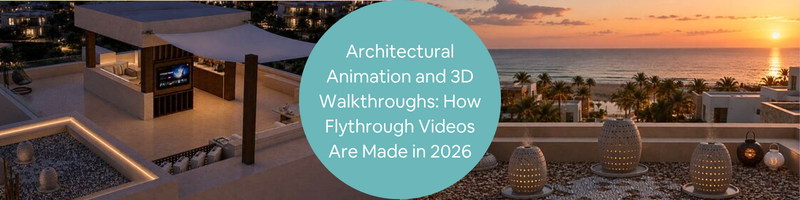
Gone are the days when building plans can only be seen in a static floor plan or rendering. Architectural animation brings building plans to life by turning them into three dimensions, giving clients a real glimpse of what the finished product will look and feel like before anything is built. It usually involves a 3D model, camera motion, lighting, materials, rendering, and video editing.
Nowadays, artists can use real-time engines and cloud rendering to come up with detailed flythroughs that are faster than traditional workflows. No doubt that these videos are useful for architects, developers, contractors, and property managers. Cad Crowd experts can help you with architectural animation and 3D walkthrough services without any hassle at all.
RELATED: Architectural 3D Animation Guide for Companies and Firms Creating High Quality Drone Videos
🚀 Table of contents
3D walkthrough vs. flythrough vs. virtual tour
Though often used interchangeably, these three terms describe different types of 3D architectural visualization services.
3D walkthrough
Where the 3D walkthrough is concerned, buildings will be depicted from the perspective of a person. This means that the camera can move around different rooms such as bedrooms, hallways, lobbies, among others. This is especially useful in depicting floor plans, furniture, finishes, and the connection of one room to another.
Flythrough
However, when looking at the broader way of depicting something, you might want to look into 3D flythrough. In the case of a 3D flythrough, the camera may move around the exterior of the building and rise above the property to view the entire building. This is useful in depicting landscapes, roads, other buildings, parking, among others.
Virtual tour
And finally, the virtual tour gives control to the viewer. You will not watch a fixed video; rather, you can look around and move between different locations with the use of a computer, phone, or VR headset.
RELATED: 5 Uses of 3D Architectural Animation for Marketing Your New Development Project
How is a 3D architectural animation made?
To create an architectural animation, there are a number of stages, and planning is particularly important since it would take a lot of time and money to alter a scene after it has been rendered.
Planning and storyboarding
This process starts with an initial design. Here, the team determines what elements are to be captured in the video, the course that the camera takes, the duration of each scene, and the focal point of the viewer. In this step, rough sketches or animations can be used. This ensures that the direction is approved by the clients before any further modeling and rendering.
Building the 3D model
The drawings that are made by architects are created into a 3D world, and depending on the project, artists work on CAD drawing services, BIM models, floor plans, elevations, and many more references. The building, together with certain key parts of the surrounding area, has been modeled. Although a still picture can only show the building from one point of view, an animation is capable of displaying it from a number of different directions, which means that some hidden areas also have to be modeled.
RELATED: A Complete Guide to Using 3D Architectural Animation Services for Your Company
Setting up the camera
The path of the camera decides what the viewers see, and the artists choose the height of the camera, how quickly it moves, the lens used, and the direction it takes. Normally, interior cameras remain at a level close to that of a person’s eyes, while exterior cameras are capable of moving around the building or of producing footage similar to that of a drone. It is important for the movement to be smooth since abrupt changes in direction or unreasonable speeds can make the video unpleasant to watch. Usually, before the final rendering, artists produce a low-resolution preview known as an animatic, so that everybody can check the timing and camera movement.
Adding materials and lighting
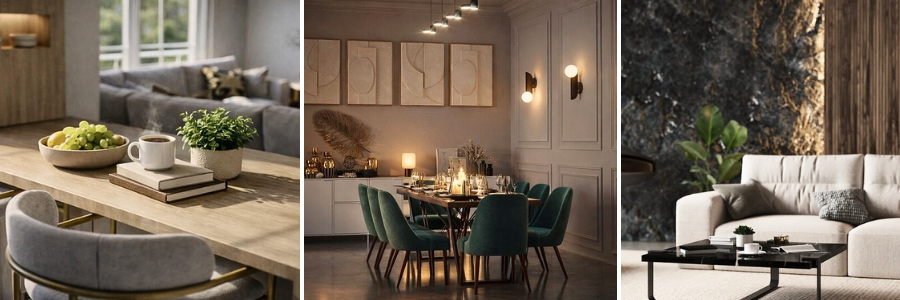
Upon completion of the model, different elements are added to the structure such as concrete, glass, wood, stone, fabrics, and metals. This is because the new PBR materials allow them to interact with light more realistically. The lighting is also thought out carefully, with the scene making use of natural sunlight, HDRI environments, interior design services, exterior fixtures, or a combination of several of these sources. For any projects in which daylight is a consideration, the artists could even reproduce the sun’s position for a given location and time of day.
Rendering the frames
A video differs from a still image in that it consists of hundreds or even thousands of separate frames, each of which has to be calculated and rendered. For example, a 30-second video at 30 frames per second needs 900 frames. A 90-second video at the same frame rate needs 2,700 frames. Rendering one frame of a scene may take a few minutes to much longer, which explains why movie companies make use of workstations, render farms, or even cloud computing for rendering multiple frames at the same time.
RELATED: Boost Client Confidence with 3D Architectural Animation for Real Estate Presentations
Editing and post-production
The frames are then stitched together to create a video, whereupon the editors adjust the color, contrast, motion blur, depth of field, reflections, and other visual effects. Further sound can be included. For example, the sound of footsteps, traffic, the wind, birds, city noise, or background music can make the final animation seem more natural.
Why does frame count affect cost?
One of the primary factors influencing the time and cost of an 3D architectural animation services is the frame count. A 60-second video recorded at 30 frames per second consists of 1,800 frames; if each frame takes 10 minutes to render, then the total time required would be 18,000 minutes, that is 300 hours, provided that a single computer carries out the entire process continuously.
That is the reason why a short architectural animation can require a lot of computing power, since cloud rendering and real-time engines enable many calculations to be carried out simultaneously. The importance of the scene’s complexity should also be noted. A scene with a simple exterior and made up of basic materials will usually render more quickly than one which is highly detailed and includes glass, reflective surfaces, furniture, lighting effects, vegetation, and moving people.
RELATED: How Your Firm Can Use 3D Animation to Present Architectural Designs & Services
Why are camera changes expensive?
It is one of the most important matters to decide on at an early stage: the camera path. When a camera is changed after rendering has already started, a number of the frames which had previously been rendered may become useless. The sequence would then have to be rendered once more from the start. This is the very reason why professional experts always spend time reviewing the initial previews before they opt for high-quality 3D rendering services, because approval of the camera movement at an earlier stage helps them save costs.
Architectural animation cost guide
| Architectural Animation Service | Typical U.S. Price |
|---|---|
| Basic 3D walkthrough, 15–30 seconds | $1,500–$3,500 |
| Standard 3D walkthrough, 30–60 seconds | $3,500–$7,500 |
| Detailed architectural animation, 1 minute | $5,000–$10,000 |
| High-end architectural animation, 1–2 minutes | $10,000–$20,000+ |
| 3D exterior flythrough | $4,000–$10,000+ |
| 360° architectural panorama | $750–$2,500 per view |
| Interactive 360° virtual tour | $2,000–$6,000+ |
| VR architectural experience | $5,000–$20,000+ |
How can 3D scenes be used for VR and 360-degree tours?
A benefit of creating a detailed 3D scene is that the same assets can usually be reused. As opposed to creating a predefined path for the camera, artists can also place cameras in different rooms and locations. This will allow them to create panoramic photos that can be linked in order to create an interactive virtual tour.
In more advanced projects, the entire scene can be imported into Unreal Engine or some other real-time platform, and then the users will be able to explore the space using a VR headset rather than just watching a pre-determined video. It is particularly useful when promoting property, in design presentations, in construction planning, and for projects which have not yet been built.
RELATED: The 8 Reasons Why 3D Interior Animation is Better than Renderings with Design Firms
Important techniques used in architectural animation
There are a number of techniques which make an architectural animation more realistic and simpler to watch.
Storyboarding
A storyboard is created before production starts to show the sequence of scenes, the camera angles, and the pacing.
BIM model preparation
Revit, ArchiCAD, and a number of other BIM modeling services usually have to be cleaned up and simplified before they are used for animation since excess geometry can slow down the scene.
Site and landscape modeling
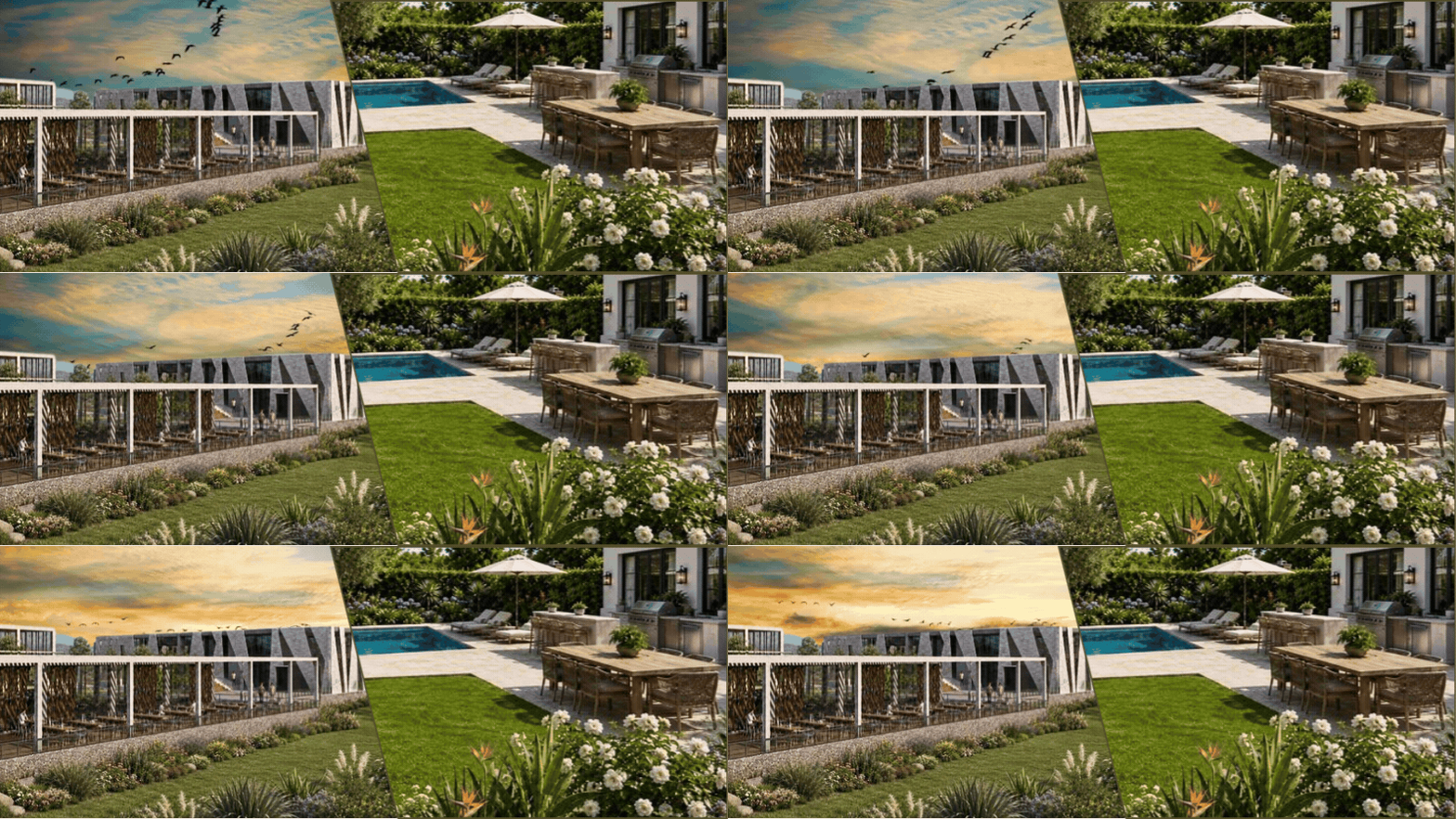
The building can be situated in a realistic environment because of features such as the terrain, the roads, the adjacent buildings, the trees, the parking spaces, and other surrounding elements.
RELATED: 3D Flythrough & 3D Architectural Animations, Costs, Rates, and Pricing for Companies
Interior furnishing
Furniture, appliances, decorations, and lighting fittings give rooms an idea of their size and help people to understand how the space might be put to use.
Realistic materials
The materials for PBR can make the surface behave in a realistic way, and even small flaws such as scratches and roughness on the surface can help create realism in the materials.
Natural lighting
The amount of sunlight can be changed in accordance with the real location of the project. This is useful for demonstrating how the building appears in the morning, in the afternoon, in the evening, or at various times of the year.
RELATED: Why You Should Hire a 3D Walkthrough Animation Service for Your Architectural Project
Artificial lighting
Interior lighting and exterior lighting can be added to create realistic scenes at night time, while proper lighting design services is essential in highlighting the significant architecture.
Camera and lens control
An appropriate focal length will stop rooms from appearing either unnaturally wide or unnaturally narrow. Interior cameras generally make use of moderate wide-angle lenses so as to give a natural view without causing excessive distortion.
Smooth camera movement
Curved camera paths give rise to smoother transitions than abrupt changes in direction, and the movement should have the same effect as that found in professional handheld, steady-cam, or drone footage.
RELATED: How to Preview Projects Pre-Construction with 3D Flythrough & Walkthrough Services
Eye-level walkthroughs
When the camera is kept at a level corresponding to a normal human eye, viewers are given a more realistic impression of the space and the proportions of the room.
Aerial flythroughs
Aerial views can display the entire property, together with the roads, the landscaping design services, the parking areas, the adjacent buildings, and the nearby landmarks.
Animatic reviews
Clients are able to approve the camera movement and the order of the scenes before the costly rendering process starts with low-quality previews.
Real-time rendering
With real-time engines, there is immediate visual feedback, and hence artists do not have to wait for rendering after each modification to the light, material, landscape, and camera motion.
RELATED: 7 Benefits of Architectural 3D Walkthroughs for Home Builders and Design Teams
Cloud rendering
Cloud render service farms are able to work on multiple frames simultaneously, which is useful for large projects involving long videos or highly detailed scenes.
Render passes
Artists are able to handle things like reflections, shadows, depth, and lighting individually. This allows for greater control when editing.
Motion blur and depth of field
The camera movement may be more fluid when there is some degree of motion blur present, as well as depth of field that focuses on one element of the design.
Color grading
It mixes different images through changes in brightness, contrast, temperature, and shadows.
RELATED: What Types of 3D Rendering Do Architectural Design Studios & CAD Freelancers Use?
Digital people and vehicles
The inclusion of people, vehicles, animals, and so forth provides an element of realism to the development, as well as enabling viewers to determine the scale of things.
Weather and atmosphere
The mood of a scene can be altered by rain, fog, sunlight, puddles, and other environmental effects, and the appearance of a property can be shown under different conditions.
Sound design
Good sound can make an animation more believable, and background music can be mixed with environmental sounds such as footsteps, the wind, traffic, or birds.
Construction sequences
3D walkthrough animation services can likewise illustrate the progress of a building from the foundation stage to the final structure; they are useful for use in construction presentations and when addressing investors.
RELATED: The 10 Benefits of Panoramic Rendering Services for Architectural Design Firms
Material comparisons
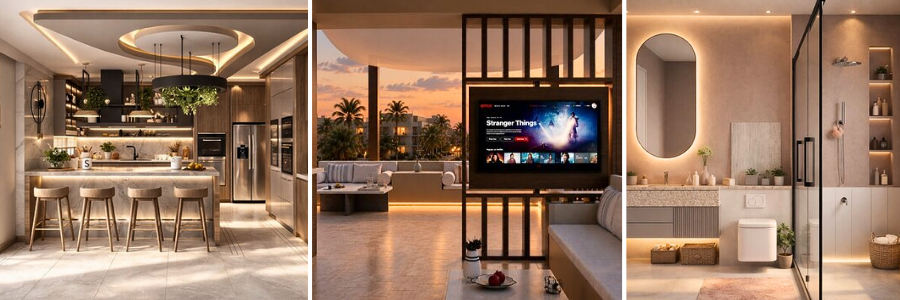
The same animation can display different types of flooring, wall finishes, furniture, or color schemes. This helps clients compare the various design options.
Photogrammetry
Drone surveys and photogrammetry can be used to record the current ground level and the surrounding area, after which new buildings can be inserted into a digital model of the actual site.
Interactive hotspots
With virtual tours, users are able to go from one room or location to another by using clickable hotspots.
RELATED: Architectural VR/AR 3D Rendering Costs, Rates & 3D Modeling Pricing for Design Firms
VR optimization
For VR scenes to offer a comfortable experience, they need to run smoothly, and the models, textures, lighting, and other assets have to be optimized for the target headset.
HDRI environments
It is possible to obtain realistic skies, backgrounds, and environmental lighting using HDRI images without the need to model every surrounding detail.
Multiple video formats
The final animation can be saved in various formats, with a horizontal 16:9 version being suitable for use on websites and in presentations, and a vertical 9:16 version being more appropriate for mobile devices and social media platforms.
RELATED: Understanding Real-time Rendering, How it Works, and Benefits for Architectural Companies
Frequently asked questions
What kind of files are required in order to start a 3D architectural animation?
Usually, artists require CAD drawings, BIM models, floor plan design services, elevations, details regarding materials, and landscape plans. They can also make use of interior references, choices concerning furniture, and photographs in order to get an understanding of the design they are aiming for. The more clearly the information is given at the start, the less time will usually be spent on making corrections later.
How long does it take to produce a 60-second architectural animation?
The time it takes to produce a 60-second animation can vary from a couple of weeks to several weeks. The exact timeline will depend on the size of the project, the degree of detail, the number of scenes, the rendering method, and the number of revisions requested by the client. A small project can progress rapidly, whereas a big one involving detailed interiors and landscaping can take a great deal of time.
Can a 3D animation be turned into a VR experience?
Certainly, a 3D scene that has been properly prepared can usually be transferred into a real-time engine and modified for use in VR. The main difference lies in the fact that ordinary animation uses a fixed camera path, whereas in VR the users are able to decide where to look and, according to the setup, where to move.
RELATED: How Does 3D Architectural Modeling Create Immersive Design Experiences for AEC Companies?
What is the difference between offline rendering and real-time rendering?
The focus of offline rendering is on generating high-quality single frames; it is capable of calculating complex lighting, reflections, shadows, and other effects, but can take several minutes or longer for each frame. Images are produced rapidly by using the computer’s GPU, typically at interactive frame rates. This technique is especially useful for design reviews, interactive walkthroughs, and virtual reality.
Conclusion
Architectural animation is now a useful way to showcase buildings before construction begins. Whether it is a basic walkthrough, a detailed aerial flythrough, or an interactive VR tour, these visualizations can help freelance architects, developers, clients, and buyers gain a clearer understanding of the proposed design, layout, and overall experience of a space.
If you need professional assistance with your next architectural visualization project, Cad Crowd can connect you with freelance 3D artists and architectural visualization specialists. You can also find experts in CAD drafting, product design, and other technical design services to support your project from concept to completion.
RELATED: How 3D Visualization is Transforming Property Sales for Developers & Real Estate Services Companies
How Cad Crowd can help
Cad Crowd connects architects, developers, contractors, and property professionals with experienced 3D artists and architectural visualization specialists who can turn CAD drawings, BIM models, floor plans, and other design references into detailed 3D animations, walkthroughs, flythroughs, and virtual tours. Whether you need to showcase an interior, present an exterior design, create an aerial flythrough, or prepare a 3D scene for VR, Cad Crowd can help you find the right freelancer for your project. Contact Cad Crowd today for a free quote and bring your architectural designs to life with professional 3D visualization.