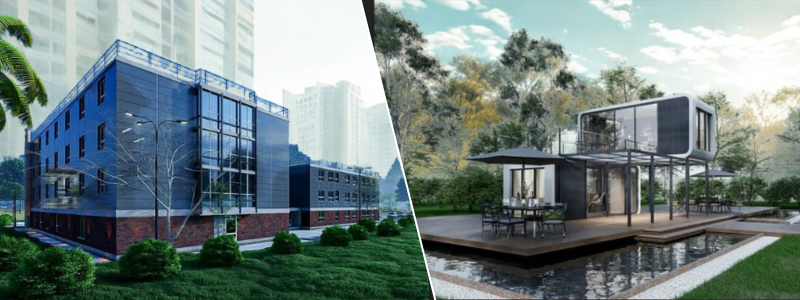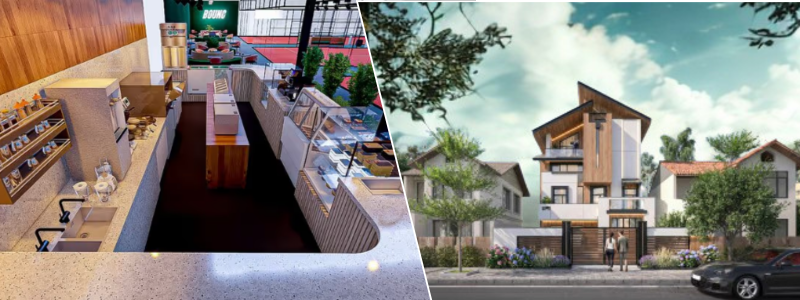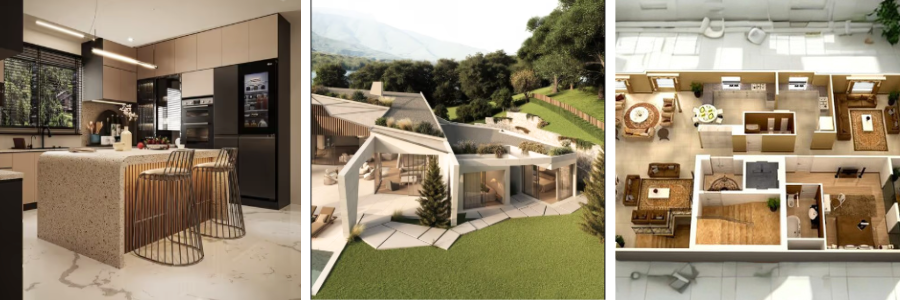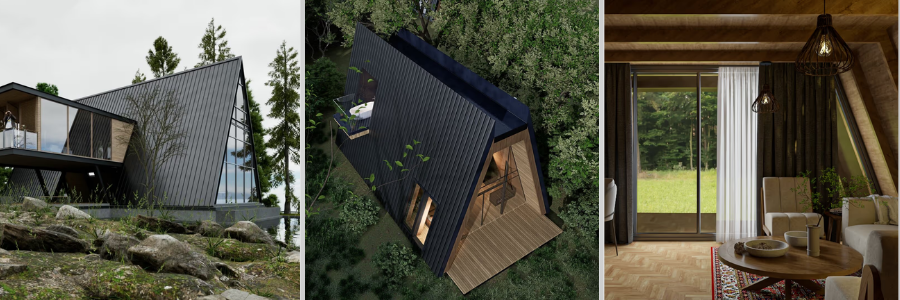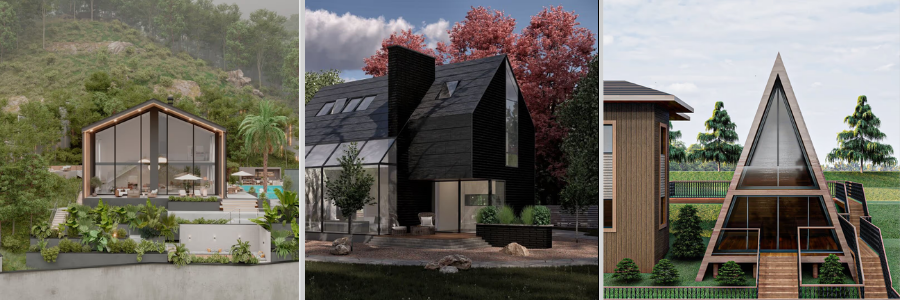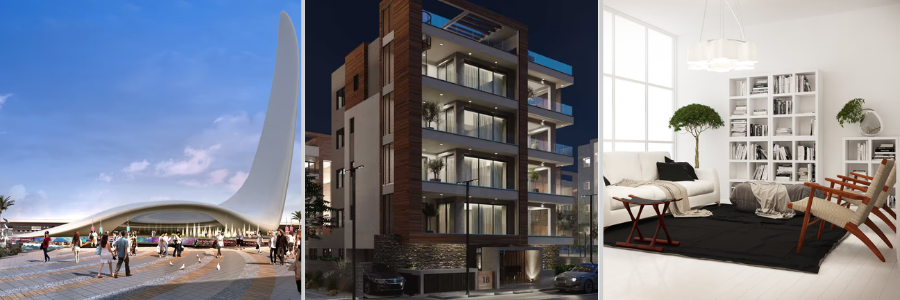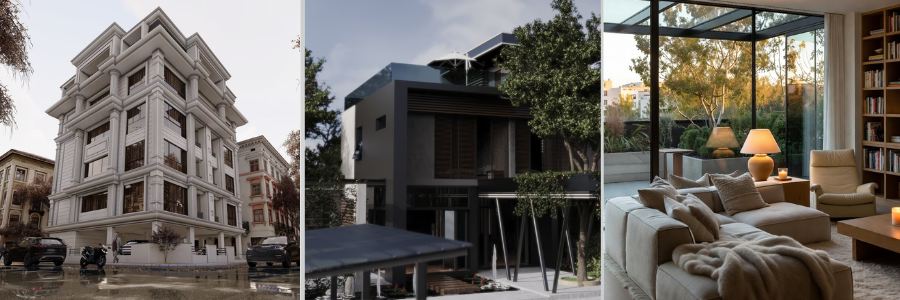
Drawing and exterior rendering services may be called an art. When creating a design, every brick must have a story. It should not be a mere picture only, but a group of bricks with a memorable story to tell. No matter what your profession is, a building design has a great impact on how a person decides, perceives, and invests in something. A design that is so simple can be enhanced by using the right angle, making it more attractive and useful. The right choice of technicalities on one hand and creativity on the other hand makes it even more perfect. Here, we will present to you the best 5 angles for architectural exterior rendering that will surely improve your projects and make you stand out from the rest.
1. The hero shot
Behind every great design is a good architect. The outside view may be compared to the protagonist in a film. It is the one behind the exposure of the building, giving access to everyone who wants to see, and making a distinct difference. There is a frame, and the design most typically shows an elevation that gives the viewers a great picture while not overwhelming the frame. Apart from the picture itself, the shadows as well as the kind of lighting that architectural designers use contribute to the overall beauty of the picture. The light coming from the sun makes it more beautiful; you just have to choose between the afternoon or the morning sunlight. It adds a story to the architectural design. What is a hero shot? Is it all about beauty? The answer is no.
It has the power to tell stories, and as such, you will be confident that the architectural design is better than before. As such, when your clients try to look at the designs, they will have no other option but to avail themselves. One good thing about exterior designs is that the building must complement its neighbors around it. Not only the neighbors, but it also complements the other living things around it, like trees, plants, and all. Surely, your proposal will be successful if you use the hero shot. In every design, there will always be a challenge. In this hero shot, the challenge is not to make it stagnant. It should not look so formal and old. As such, you only need to have some shifts in the designs. Other elements should be included in the shot, such as cars and other people. As I mentioned above, lighting is a very good point. It makes a normal picture attractive, and it gives it life as well. It is not just a shot, but a shot with a story.
We do not just see the buildings with our naked eye. Instead, we see ourselves living in them and experiencing life through them; they are just there around us. We see buildings using our eye-level angle, and it is so important because there is no excess or lack when we use the eye-level walkthrough. This is vital consideration that the exterior design expert must keep in mind. There is a natural way of experiencing a particular home, working environment, and even public spaces. It can be compared to imagining what is inside when we have never opened the door. The design makes itself personal and up close.
The hero shot is so dramatic, as discussed above. This makes the difference because the eye-level walkthrough talks about connection. It does not make an impressive goal; rather, it speaks to inviting people to see through their eye level and makes it feel real-life rather than a hero shot. It is as if when you look at it, it has this natural approach. From walking to entering the building, to the beautiful façade and gardens, these are the aims of the eye-level walkthrough. In the render, if you include natural elements like children playing and laughing, children, passerby on the road ahead, and a lot of bikers, surely, it will have a natural touch.
If we are talking about flexibility, it will be the eye-level view because it works better for streets, parks, and other public spaces. Through this architectural design, the walkthrough designer must show the connection between the shops, houses, and walkways. Because it is eye-level, it gives people the best view when they are already inside the building, living there, walking there, and exploring inside. Marketing teams and design viewers will surely love it because of the natural feeling it has and how it is people-focused. If you want to get the right shot, it takes a lot of planning as well. The camera placement plays a vital role. For example, if you put it too close, the building may be overwhelmed.
On the other hand, if you put it too far, the connection you are trying to create will be lost to the surroundings. There must be a see-saw-like balance, wherein on the one side, there is a focus on the building, and on the other side, it shows that the environment still has other details like humans, playing children, and something that makes it relatable. Again, as opposed to the hero shot, the eye-level view suggests more emotion in the picture, which connects the hearts of the viewers and the picture they are looking at. Meaning, it does not stay as far as before; it shows a clearer view of what the building is showing.
3. The bird’s eye view
When it comes to 3D architectural rendering services, aside from the hero shot and the eye-level view, one of the best views to understand the entirety of a building is a view using a drone. This is called the bird’s eye view, and it offers a combination of scope on one hand and context on the other hand. Imagine looking from above like a bird, you can see the surrounding materials, the entirety of the building, and the layout itself. This is perfect for a big landscape with a building at the center. There are things that are best captured from an aerial view compared to the first two views discussed. When you look from the top view, you see how the traffic flows, you see gardens, the walkways, and everything that you cannot see from the ground-level views.
By using the bird’s eye view, you will definitely be thoughtful of the designs and the strategies used in conveying the story to the clients. Lighting is very important for this kind of view. The building may be emphasized using the shadows, particularly its form and how firm it looks. On the other hand, the light coming from the sun gives a perfect view for the client to see how delicate and perfect the design is. It is a cinematic view when you incorporate the formations of the clouds as well as the skies that complement them. If, for example, you want to convey an exaggeration when it comes to telling a story, you use a different scale. If you want a simpler one, you may use a simpler scale.
A view may be impressive, like this bird’s-eye view, but you need to be precise. You need not only a camera, but also a perfect height, the length, the surrounding circumstances, and, of course, the lighting. If anything is missing, particularly an important detail, the perfect scene you are imagining will not be attained. With architectural visualizations, when you add people, cars, and other natural details in a small scenery of a picture, that will be great and even better to convey the story you are trying to tell. This kind of view does not mean the building’s view only, but instead, it also shows the perfect place where that building belongs.
Ordinarily, the side views or even the center views are good. Apart from that, when you try to look at the viewpoint of a bird, you will see the difference and every angle as well. But if you try the low-angle position view, particularly if the camera is placed on the ground, you will be able to realize that it gives emphasis on the height and the vertical lines of a building. This one is a better choice for buildings to make it appear taller than it actually is. The angle is so powerful, and the lighting as well. It gives an impression of tallness and stiffness. Good lighting also exudes perfection in a picture; added to the exaggeration of height, it becomes attractive to viewers and clients.
Aside from the angle, I would like to emphasize the kind and the choice of lighting to use. If it is a little darker, it creates an illusion of mystery. If it is a little brighter, it creates an illusion of hope and beauty. The side lighting emphasizes the texture. If the rendering artist includes things naturally surrounding the building, it will create a good impression on the clients. The only bad thing or kind of negative thing about a low-angle view is that it does not create distortion. Sometimes, if you take a picture from the ground floor view, there will be a slightly distorted portion of the subject of the picture. Like, if a building, for sure, there will be a portion of the building that may look sideways or distorted. The key is balance. Balance of the lighting and the angle used.
5. The contextual panorama
The last view or angle is the so-called contextual panorama. Through this, the picture does not only focus on the building itself, but also on the relationship of the building to the surrounding elements like people, trees, walkways, and others. With 3D 360 degree panorama rendering services, you can create an illusion that the building is unbreakable enough to be linked with the surrounding things nearby. This kind of view is not about the technicalities of the view, of the picture, and of the building. It is about the connection, the relationship, and the story of the building in connection with the things surrounding it. It is like a story in a movie wherein the protagonist is the building and the antagonist is either the streets or the bystanders. But it may be a combination of two protagonists because, through the lighting, it conveys a story.
In a picture, choosing the perfect angle or view is a difficult task. Even if difficult, it must be done correctly to achieve perfection in your picture. Aside from that, the proper lighting is a plus factor. When combined, it creates a good picture, if not the best, and it conveys a story even without words in it. Thinking about choosing only one is not good. The 3D rendering designer must choose a combination of 2 or more because it has a complete set of elements when taken. The kind of views that modern people are using has evolved over the years. Before, it was all simpler. Now, it becomes a little complex to get that perfect picture in mind. Although it is a little complex, modern cameras and other techniques learned through workshops make the image become the perfect picture in mind.
Final thoughts
The purpose of architectural design or exterior design is not only for aesthetic purposes. The truth is, it is about telling a story, communicating with the viewers or clients. Every view has a purpose, such as the hero shot view, which has the purpose of creating dominance above all. On the other hand, the eye-level view creates a connection between the viewer and the picture. Another one, the bird’s eye view, creates a wide coverage. The dramatic low angle creates an impression of exaggeration when it comes to height and scope. Also, the contextual panorama creates an integration between the building and the elements surrounding it.
How Cad Crowd can help
Cad Crowd has an extensive network of exterior rendering designers to help you create the perfect design. Talk to our design experts for a free quote.

MacKenzie Brown is the founder and CEO of Cad Crowd. With over 18 years of experience in launching and scaling platforms specializing in CAD services, product design, manufacturing, hardware, and software development, MacKenzie is a recognized authority in the engineering industry. Under his leadership, Cad Crowd serves esteemed clients like NASA, JPL, the U.S. Navy, and Fortune 500 companies, empowering innovators with access to high-quality design and engineering talent.
When launching a new product in the market, it is important to understand how risky itcould get. It is a competitive approach, but it is prone to risks if not handled carefully. Haste and rushing launching are what make it fail. When the production team did not go through the process of validating and testing the product, it fell into a trap, and it may be hard to reverse it now. Launch failures are costly. It costs time, resources, effort, and budget, and weakens client confidence.
To reduce these risks and direct product launch to success, it is best to combine smart research, testing, and repeated cycles of prototyping design engineering services. It is better to invest in validating the product first before releasing it to the public. Cad Crowd makes it possible to connect vetted professionals to businesses that can aid in strengthening all development stages. They are a pool of experts that understands the importance of effective and strategic validation to ensure launch success.
🚀 Table of contents
Why most product launches fail
There are a lot of factors that impact failure in product launch. Most of the failures stem from the idea of an impulsive approach without confirming the demand. When the team only focused on assumptions, trends, internal interest, and excitement, and limited feedback, they were taking a subjective approach. Lack of testing real customer demand puts the product at risk. Not knowing what the consumers really want or what they think could be improved affects the whole outcome. Missteps could cause poor decision-making, letting impulsiveness increase the risks of failure.
Start with a clearly defined problem
Success always starts with identifying the problem first. Being clear about the goal of providing a solution to the problem is the best professional way to achieve success. Product design companies should be able to articulate all the pain points and lesson learnt to come up with the proper solutions. If the problems are too vague, the solution wouldn’t feel intentional and may be prone to overdesign. This will make customers confused and overwhelmed with features they don’t really think are necessary.
Identify a narrow target market
Designing for “everyone” looks like a warm accommodation to encourage everyone to try. But this approach is almost like a trap. It is a vague attempt at trial and error. Instead of being open to all, firms should narrow down and be specific to their target markets. Identify what these target users are looking for and collect relevant insight and feedback. This makes the whole validation measurable and makes the product launching intentional. It gives genuine solutions and makes users think they are considered in the design process.
Conduct structured customer interviews
One way to collect relevant insights is to receive feedback from real customers. Not all conversations or exchanges are considered relevant or useful. Strategic and systematic interviews are best to uncover what the users are expecting and looking forward to. Interviews could be documented to see and monitor patterns and trends, so there would be data to look back on to build an even stronger opportunity.
Analyze existing alternatives
In launching a new product, being prepared is one way to success. This includes knowing any existing alternatives to what the company is planning to launch. This makes them identify and understand competitors. It is expected that there would be comparisons conducted by customers. If a product has already existed and been used, it already has an edge since its functionality has been proven. It already serves its purpose. Then what makes the new one worth a try? Studying the existing alternatives would uncover what the customers want to improve. It could also help with the benchmarking of the costs.
Build a minimum viable concept
Before doing a full-blast development, consumer product design firms should consider that it could fail on the first try. It is best to do an early prototype to test its functionality first without compromising extensive resources. Doing a minimum viable concept would focus on gathering reactions and feedback, as these will expose flaws. Detecting flaws on the early stage would make it easier to fix.
Use landing pages to measure interest
A landing page makes it easier and faster to gauge consumer interest. Once presented to the public, there would be reactions towards it and insights as well. This is where firms would know whether there is hesitation and what rates and features are to be expected. From this stage, refinement could be done before it is produced.
Test with pre-orders or deposits
Pre-order makes the whole launch intentional, offering pre-orders secures not only demand interest but also early funding. This boosts morale in the team and makes it a lot easier to move around. It could also help understand the consumers who committed willingly.
Launch a smoke test campaign
Smoke testing is one way to measure interest based on the clicks and conversion rates. This is done by advertising the product before it fully exists. To know if the public is interested, there would be a lot of engagement. If there is low engagement, then the firms can make adjustments to turn it around. Smoke testing is a cost-effective tool that can protect production from failure.
Leverage surveys strategically
Aside from interviews, surveys add value to what the consumers want. Quantitative feedback supplements behavioral patterns exposed in qualitative research. The surveys should not only ask questions about checking if the user would be interested in buying the product, since it would lead to misleading optimism. Instead, the questions should be able to provide valuable insights about behavioral patterns, which can be useful for many companies, such as fashion design companies.
Prototype early and iterate often
Conducting rapid prototyping accelerates validation. While the users are able to experience the concept, feedback was documented to catch any flaws and readjusted early on. This iteration cycle would lead to a more concrete design tailored to the target audience, making it less likely to receive negative feedback during full release. Early alterations are of much lesser value than making a change on the last design stage. This mitigates risks.
Conduct usability testing
Validation is a combination of demand and usability. Consumers can express demand, but if it’s not user-friendly, it could backfire. Knowing how it functions and how it fits the users would be beneficial and lessen pain points. To check on this, testing regarding the product usability is recommended. This will reveal insights about the product and help the team align the design with user expectations.
Validate pricing early
Pricing influences product value and profitability. There are different thresholds in the market, and observing price points could reveal whether it’s a hit or not. Firms can explore pricing by using a tiered pricing model. Conducting these collects insights whether the product is considered underpriced or overpriced. From this, firms can check the revenue potential of the product.
Evaluate market size realistically
An accurate estimate of the target market size protects long-term viability. Product design experts should be able to assess the realistic number of demand leads. Having an overestimated number would lead to an inflated projection, resulting in an increase in wastage of resources. Being conservative in the number makes it intentional and sustainable.
Measure engagement, not just interest
Anyone can say they are interested, but not all are really committed. There’s a way to gauge the number, and this is by the engagement metrics. It reveals deeper insights and information as it uncovers behaviors. Genuinely curious and committed users would spend a lot of time on the landing page, engaging a lot more, and leaving comments. Those who are passive and do not engage much rarely purchase. Tracking engagements strengthens validation.
Use crowdfunding as validation
Crowdfunding not only serves as a validation tool but also ensures market readiness. Successful campaigns show that the message is delivered clearly and expresses demand. The comments could add information through quantitative feedback.
Users often express their insights and honest feedback on online communities. Sharing early concepts in these forums would earn real-time feedback and comments. Their constructive critiques could expose some blind spots and flaws that may be hard to fix in late design stages. Knowing this strengthens alignment with user needs, which is especially useful for engineering design firms.
Assess technical feasibility alongside demand
Being realistic in design is one way to launch success. To know if the concept will thrive makes the whole production smooth. Early feasibility check-ins avoid unrealistic timelines and could help in finding out cost implications. Technical feasibility can be conducted through a strategic collaboration between designers and engineers.
Set clear validation benchmarks
There should be a measurable criterion to know the metrics of success before validation begins. This helps in analyzing the data and removing ambiguities in decision-making. It is important that there are pre-determined standards to ensure rationality and prevent weak assessments.
Recognize when to pivot
Not all good and unique ideas are meant to thrive and be invested in. When the validation data says that it consistently fails, then it is time to pivot. There could be adjustments to be made to improve the data, and that could involve the target market, features, design, or usability. Resiliency doesn’t always solve the problem; sometimes, flexibility is the answer.
The input sometimes comes from the internal team’s work. They naturally tend to favor ideas that they have invested their time and effort in. This could distort validation interpretation, as the insights could be just internal optimism. This is why a more objective stream of approaches is much more reliable.
Incorporate cross-functional collaboration
Cross-functional collaboration collects diverse perspectives. This exposé overlooked challenges and lets everyone share their input. Being a unified team of engineers, marketers, designers, and even financial analysts could create an impactful view to execute stronger launches.
Document every insight
It is important to take note and document all insights and reviews received to ensure that all these are not lost. Recording the results and outcomes of interviews, iterations build historical data for the product, making it easier to track patterns in the future, and it also strengthens transparency and supports data-driven decision-making for product engineering companies.
Align validation with brand positioning
Not all validation approach is to be done hastily. It still should be aligned with the branding. Being consistent with the brand identity makes validation intentional. It strengthens market trust and enhances long-term success.
Leverage External Expertise
Fresh insights from the external specialists are always welcome. These inputs could sometimes be overlooked and may be a blind spot later on. Having an independent expert to check on the product reduces bias and ambiguity, strengthening validation accuracy and quality.
Validate the core assumption first
Every core assumption made to develop a product should have validation. It justifies the need and strengthens the concepts. Focusing on this core saves time and effort and ensures that there will be no scattered and messy experimentation.
Map the customer journey
Analyzing and understanding how consumers navigate the purchasing process exposes their behavior patterns and adds value to validation opportunities. Mapping their full journey can identify friction points that are beyond the product, which could be critical knowledge for product development experts. These issues are sometimes inevitable, but still, they can be lessened. Validation is a continued stage-by-stage examination and analysis, not only of the product but also of the whole production process.
Create problem-solution fit before product-market fit
Sometimes, firms tend to overlook solutions as they prioritize mass production. Firms should not chase it hastily and focus first on the problem. It is best to address a specific verified pain point, one that is urgent and recurring already, to ensure that customers feel like it fits. Doing this strengthens trust and a stable foundation for future scaling.
Quantify the cost of the problem
Customers are most likely to incline towards the offered solution if the problem is costly. Being costly does not only involve money, but it could also be about time, convenience, or the ease of mind. In validation, assess all the factors affecting the problem and compare them with production and revenue. The data will tell how the product positions itself in the market, whether it can really solve the problem or not. Once products are proven to solve expensive problems, it definitely increases purchase conversions.
Use rapid experiments instead of long development cycles
Doing a lot of rapid experiments looks costly at first, but it helps compress timelines. The small and controlled tests are able to collect insights in a short period of time, enough to adjust exposed flaws before full production. The traditional product development tends to be delayed since it would take months before receiving feedback. Taking controlled, scaled experiments reduces risks for large-scale failure.
Test distribution channels early
A product could interest a lot of users, but it may be difficult to distribute. In validation, testing distribution channels should also be accounted for. This included channels such as paid ads, parentship, or direct outreach. Understanding this during the early stages, with the help of new invention development services, reveals a lot of potential and risks. It gives insights into what an effective marketing strategy is fitted to address it.

Observe real behavior over stated intent
Not all who express the intent of buying are committed. It is still best to observe behavioral patterns to ensure there really is a genuine interest. The evidence could be checked in clicks, downloads, and payments provided. Consistency in all of these validates enthusiasm for the product. It is a measurable approach to know performance and satisfaction instead of relying on survey responses.
Validate retention, not just acquisition
Not all interests last. This meant that acquiring an initial interest meant it could guarantee long-term value. It could be deterred due to dissatisfaction with the product. There should be retention metrics to know whether the product delivers sustainability efficiency. This ensures that the product remains relevant and not just an impulsive decision to feed on initial curiosity.

Assess manufacturing and supply chain risks
Production feasibility should also be checked. This includes how the sourcing of materials is done and knowing the estimated lead times. It gives information about pain points to prevent delays in the timeline. Briefing with suppliers could help expose cost implications and limitations. These could help reduce manufacturing surprises and slips during the production process. Being ready ensures a smooth launch.
Incorporate cost modeling into early testing
Cost modeling should be done to accompany validation experiments. This ensures that the product not only caters to demand in the market but also sustains profitability. Financial modeling protects the product and industrial design firm in long term stability and clarifies viability. It should have data to which it can deliver without compromising the firm’s margins.
Develop clear success metrics
A clear success metric can objectively define benchmarks. Metrics that can help identify success include engagement, retention, and conversion rates. Success in pre-order could also be measured. Establishing these metrics makes it easier to track success. A clear standard removes ambiguities in results interpretation and strengthens decision-making.
Conduct competitive positioning analysis
Knowing where the new product positions itself along with its competitors gives a clear understanding of the product’s selling points and weak points. Spotting this early could help adjust to strengthen its launch success. In validation, rooms for improvement and opportunities can be identified and fixed for customers to recognize value addition, and would make them switch. This strong approach reduces the risks of production failure.
Test messaging with multiple audiences
Testing does not end in engagements. It could be furthered with messaging across varied demographics to refine target markets. Focused messaging improves marketing efficiency and helps with clear reasoning.
Run limited beta programs
Having a beta program is popular to provide structured feedback from real users, even when you begin with open innovation design services. From this, more detailed feedback about the experiences of the beta users helps correct issues before the public release. It uncovers real challenges users can face.
Document objections and concerns
It is inevitable to receive objections and raised concerns during the validation process, and it is important to document all of it as it adds valuable information. These concerns could be about the pricing, usability, reliability, and long-term functionality. When these are documented, patterns can be exposed. Addressing the concerns builds user trust and strengthens the final feature and offer of the product.
Monitor emotional reactions
While there is technicality in feedback, emotional feedback also matters. It is important to take into consideration the feelings of the users. Monitor and track whether they express excitement, frustration, or indifference with the new product. These signals indicate validation, which could have positive or negative implications. Understanding this supports and adds value to quantitative data.
Avoid feature creep during validation
It is important to stay aligned with simplicity instead of adding features midway. It will only complicate testing and may obscure the outcomes. When the process stays at its core and focuses on one hypothesis, it produces clear and coherent insights.
Test scalability assumptions
Knowing the limits of scaling in crisis management. This means that something that worked for 100 users may not be applicable to 100,000. It does not fully mean success even if it did on a small scale. This should be easily identifiable by concept design services. Validation should thoroughly analyze the support, capacity, and production limitations to project a realistic outcome to secure the firm’s reputation.
Evaluate legal and compliance factors
There are products that have to follow strict regulatory compliance. An early review and brief regarding the necessary tests, standards, and certification will avoid extensive rework. Legal validation is then considered, combined with the technical assessments. This ensures being market-ready and proactive in reducing unexpected challenges.
Measure customer acquisition cost
Understanding the cost implications to secure a customer determines long-term sustainability. This means there have to be marketing tests that provide benchmarks to project lifetime value. Knowing margins would help analyze its growth potential. The data could tell whether it’s a success or not or if there’s anything that needs to be focused on. Seeing unfavorable numbers during the early stages could be a cue to revise strategies before production.
Refine based on data, not ego
Validation results encourage data-driven decision-making. It lets the team focus more on the measurable evidence instead of personal preferences. This lessens ambiguity and biased insights. Prioritizing numbers instead of emotional attachment decreases the risk and improves outcomes.
Plan a phased launch
Planning a phased launch with design engineering services is a strategy to control and test a smaller market first before going into full production. This allows additional validation and lessens risks. Gradual and phased launching is more controlled and allows fine-tuning. It strengthens stability.
Encourage honest internal feedback
Although the internal team tends to provide biased insights, it is still a safe space to collect ideas. This can be done by encouraging them to speak up and provide honest feedback. Since they know more about the product, they have the best pool of insights that can be helpful. Having constructive skepticism boosts a healthy culture of open feedback. Diverse perspectives can reduce blind spots and flaws, making it a refined strategy.
Maintain transparent client communication
The client wouldn’t want transparency. Providing and sharing information regarding validation results openly, including challenges and risks, would make them feel involved. An honest and transparent communication lessens conflict and promotes healthy discourse. This communication builds confidence and trust between the client and the team, as the client was assured of the proper professionalism and diligence shown by the team.
Build validation into the standard workflow
Validation shouldn’t just be transitional or a one-time effort. It should be incorporated and integrated into the standard workflow. Having structured testing makes it more reliable and viable. Integrating validation strengthens the firm’s reputation, increasing user and client trust. Having a systematized and reliable workflow process ensures long-term results and outcomes.
Leverage specialized freelance talent
To add value to validation, sometimes a specialized professional isneeded and encouraged to discuss with. There is confidence when a professional is involved, as they contribute their experience to the concept. With them, technical accuracy is achieved, and it improves the overall performance of the product for consumer product design experts. It aligns the product rationally in the market, aligned with the project intent and the firm’s goals.
Strengthen prototyping capabilities
Investing in advanced prototyping makes it easier to attract strong user feedback. Having advanced modeling and visualization tools makes it feel real and clear. A reliable prototype makes it a strong representation. It enhances trust and confidence with the stakeholders. It gives them a clear picture of what was to be expected.
Build long-term learning systems
Every validation effort is a continued documentation of valuable knowledge. It establishes a reliable database on pain points, lessons learned, and opportunities. It gives patterns that can be useful for future production. It encourages data-driven decisions and transforms the workflow to reduce ambiguity.
Conclusion
Innovation should always be backed by numbers and data. It operates in an environment where it should be balanced and done cautiously. Validation secures new product concepts before they are released on a full scale to the public.
Conducting thorough feasibility studies, rapid and controlled experiments, prototype testing, and incorporating measurable criteria significantly lessens financial loss and reputational damage. It also promotes sustainable and intentional production. It strengthens not only its connection with the users but also the client’s interest.
For firms and businesses that seek connection with vetted experts, specialized in product design, modeling, and even rapid prototyping, browsing the Cad crowd is a great start. Check it out now and turn your next product launch into a success, backed with reliable numbers and validation. Ensure confidence in success with Cad Crowd. Request a quote today.
MacKenzie Brown is the founder and CEO of Cad Crowd. With over 18 years of experience in launching and scaling platforms specializing in CAD services, product design, manufacturing, hardware, and software development, MacKenzie is a recognized authority in the engineering industry. Under his leadership, Cad Crowd serves esteemed clients like NASA, JPL, the U.S. Navy, and Fortune 500 companies, empowering innovators with access to high-quality design and engineering talent.
A happy blue pencil on an architectural plan truly is a beautiful thing. It reflects that everyone is on the same page as everyone else. It reflects that no corners will be cut for no reason, that no corners will be frayed. But it’s hard not to chuckle at someone who wants an empire and ends up with more frayed corners than a bad pair of sweatpants. It’s because architectural plans are a unique blend of precision and creativity. That’s because creativity dons its hard hat, and the fact about structure becomes some sort of undeniable truth for architectural design firms.
It’s also because there could be some sort of stray line on some sort of misplaced mark, and some measurement that decides it needs an extra inch on some sort of journey that it never meant to take. It’s a familiar sight for someone who has drafted some sort of architectural plan at two A.M. on some sort of whim and meant something, but meant something, but ended up with some house that looked somehow similar to some sort of mythological labyrinth.
Nevertheless, fortunately, today’s architects have something that architects and pyramid and temple builders never had before: outsourcing. To talk about it, if there is an architect and/or a group of engineers who would like some assistance with either solving problems or preventing problems with some designs, there are some very capable people who would more than gladly parachute into that project with some new knowledge and an air of curious detachment about some unorthodox designs.
And hands-down, Cad Crowd is the best source for these people, with a global talent pool that can parachute into a project before a small problem becomes a giant problem. Architectural drafting work mistakes, what drives them, and ways and means of invalidating them through outsourcing will be discussed in this article. It will offer a healthy dose of laughs, as anyone who tried to recreate a drafted floor plan three times within an average morning period deserves so.
🚀 Table of contents
Even architectural design experts can have weaknesses when carrying out architectural drafting. But these should not impact an entire project. Moreover, to achieve perfection and complete an architectural drafting task as quickly as possible, an architect might outsource architectural design. It will be highly advantageous for architects, as they will be able to carry out architectural design work without spending a single moment on technical sections.
And for people who may be interested in accessing very competent draftsmen, we would recommend Cad Crowd as one of the best sources they could refer to. It would enable architects to access very competent freelance draftsmen who can optimize designs and assist with all procedures involved in the design process. And thus, we would recommend that anyone who wishes to have better designs for their architecture should check out Cad Crowd and look for freelance artists they could hire.
Architectural drafting mistakes occur at all levels and degrees. Small architectural drafting mistakes are so minute that they can’t be viewed with the naked eye. Architectural drafting and design firm mistakes are so unbelievable and so bizarre at times that they’d make a specialist wonder, with more serious implications, ‘How on earth can that happen!’ Architectural drafting mistakes occur oatall varying levels. Young interns make architectural drafting mistakes. Experienced individuals make architectural drafting mistakes. Many very intelligent architects might have made an error or two, but there was no proof.
Dimension problems might be an extremely common source of hiccups. It might be no more than realizing that a room will be expanding and contracting because it just keeps on going. It would have something to say about its own size. And then there would be something different about what the ceiling would have to say about it. And then there would be something about the wall that would be doing its best with these two opposite facts. The next source of problems with hiccups would be scale problems. There would just be some furniture that would have a scale better suited for a house belonging to giants. A staircase would be nowhere near a position that would be preferred.
Layer misuse would then be the next common issue. A wall drawn on an inappropriate layer would translate to an invisible wall. But as soon as the assignment began, clicking on a measurement on an invisible wall, it would appear as if it were a blushing ghost. The words would sometimes wander here and there on the plans as wandering spirits. The symbols would sometimes act on their own and hide in some corners. All these would eventually result in coffee breaks.
Why do these errors continue to be committed even among experienced practitioners?
It is a very complex process and requires several cycles. Even highly competent technicians will experience mental fatigue after a period spent displaying lines, entering dimension descriptions, viewing layers, nudging objects, and checking shapes for various purposes. Yet, as very advanced from a functionality viewpoint as our capabilities are at present for drafts by architectural planning and design firms, we do not have any safeguard against the possibility of deceptive click behavior, misleading alignment on snaps, and elusive hide and unhide attributes for layers.
There exist several architectural groups with deadlines, and there are also several opportunities for missing observation detail. It will be very hard to be completely correct with a loud clock and an even louder email box. Interruptions will also be a source of inaccuracies. A phone call at some specific moment, while an architect emphasizes a certain imperative detail, might spoil the chain of thoughts. It will take some time for completion. At that moment, the cursor on the software will be waiting for input, and the mind will be blank about what it was doing.
It would also seem that there would be an understanding and an admission that we have to believe our eyes. There would almost seem to be an understanding that “the design itself will appear fine,” and it would because “the brain itself will fill gaps that aren’t there.” A fresh pair of eyes would see things that an exhausted mind would refuse to see. It would be within these very parameters that outsourcing would become an absolutely necessary solution for architects.
Blueprint errors start with something small. Something can escalate based on problems. A problem with a measurement can result in problems at worksites. A problem with understanding layers can result in a group incorrectly interpreting. A wrong icon can result in an inspector being confused. And so on, because architects and engineers have an experience they want to put aside. Cost implications may be at play. Redrawing and changes entail the consumption of time. Time is equivalent to billable hours. Should there be changes that are not stipulated within planning and included in the construction plan, these changes will, in turn, influence materials, manpower, and timetables.
A loss of confidence may result from the client, considering they get a chance to review a number of changes within a set of drawings for architectural drawing firms. However, there is also a cost involved with an issue that has an emotional side. None of these architects will want to have it on their conscience that, because they have an insignificant issue on their side, they will have to resubmit a whole week’s work. It is just so stressful.
It is here, exactly, that the outsourcing solution for design talent becomes an attractive alternative. The outsourcing of draft preparation may be viewed as a consequence of weakness and loss of expertise. It may be an astoundingly clever move. The technicians who concentrate on draft preparation have an attentiveness and speed that would be very hard to maintain on the part of internal people who have a lot on their hands. The freelancer acts as a quality controller, polishing drafts to an optimal level of transparency.
The greatest benefit that may be derived from here is skills. There are several fields associated with drafters from which skills can be obtained. These people would have the opportunity to be exposed to a strong set of skills and problem-solving. It would be common for these people to have some experience with almost all forms of error. Deletion, correction, and recreation of graphics would be an easy task for these people. Misaligned graphics would be noticed immediately by these people. Amynta would have problems with wandering symbols and runaway layers.
The people who will interact with freelance CAD outsourcing will bring some new ideas as well. It will be people with some knowledge of a plan who will not be affected by an internal forecast. It will be an unbiased judgment about blueprints. Their unbiased nature will serve as a filter, increasing the accuracy of the results.
When outsourcing saves the day
Perhaps there may be an architectural firm with an immediate deadline. The employees have been staying late. You know, people are a bit fuzzy. A large business customer requires an absolutely coordinated set of drawings for the morning. The set of drawings is nearly complete, but something doesn’t quite ring true. Walls are correct, but perhaps not quite so. Sizes are correct but perhaps not exactly so. Something isn’t quite right.
But it is at this level that outsourcing becomes an unsung hero. It is at this stage that a good freelance draftsman will be introduced and will analyze these documents. The freelance draftsman will then analyze various layers, perform some linework, locate annotation marks at specific spots, focus on some elevation work for perfection, and address some scale issues. It is at this stage that these documents will no longer appear as if they have been worked on for so long.
The process associated with document draft preparation and outsourcing continues beyond error correction. It still poses challenges and drives the paradigm shifts required for architectural practices to continue as usual. As some pressure will be removed with document draft preparation, there will be more opportunities for creative designs, customer service, conceptual planning through concept design experts, and project judgment.
Organizations have more flexibility. It shows that, based on projects, outsourcing will soon allow an organization to extend its scope without having to hire employees. No costs are assigned for employees who were not working before and after the peak season. Article writing can be done very quickly.
Thirdly, there is evidence that validates that it can be done faster through outsourcing. Tech writers mix well with other tech writers, as all they do is tech writing. It would have taken several days for people working within an organization to do it, but they would do it faster, which would be very helpful shortly after the deadlines.
Finally, there will be an accuracy upgrade with outsourcing. All documents sent out will have a document drafter working in the background. There will be an upgrade with every document. There will be no more findings overlooked and will be addressed. There will be no uncertainties and misalignments. There will be an upgrade.
The future of architectural drafting service through outsourcing
Its complexity multiplies as technology advances. The standards continuously develop. The amount and type of information needed from the client continuously increase. The degree of accuracy due to human limitations requires an accuracy level on the screen from start to finish, as high as the error margins. And outsourcing will be an integral part of coping with all of this.
The global reach for freelance work allows architects to hire qualified architectural drafters with different expertise. The presence of different time zones is very convenient. Architects are working on designs while people on the other side of the planet are asleep. People on the opposite side of the planet have already worked on an architectural draft.
The future outlook projects a collaborative world, with architecture and outsourcing as complementary processes that address needs before they arise and improve capabilities in document design.
Even architects can have weaknesses when drafting. But these should not impact an entire project. Moreover, to achieve perfection and complete an architectural drafting task as quickly as possible, an architect might outsource architectural design. It will be highly advantageous for architects, as they will be able to carry out architectural design work without spending a single moment on technical sections.
And for people who may be interested in accessing very competent draftsmen, we would recommend Cad Crowd as one of the best sources they could refer to. It would enable architects to access very competent freelance draftsmen who can optimize designs and assist with all procedures involved in the design process. And thus, we would recommend that anyone who wishes to have better designs for their architecture should check out Cad Crowd and look for freelance artists they could hire. Request a free quote today.
MacKenzie Brown is the founder and CEO of Cad Crowd. With over 18 years of experience in launching and scaling platforms specializing in CAD services, product design, manufacturing, hardware, and software development, MacKenzie is a recognized authority in the engineering industry. Under his leadership, Cad Crowd serves esteemed clients like NASA, JPL, the U.S. Navy, and Fortune 500 companies, empowering innovators with access to high-quality design and engineering talent.
When you let loose your imagination on how the exterior face of a building is created, you’d think it may start from a sketch, a photo taken during a walk, or an idea from a meeting. This may be different in the world of architecture, as imagination will not be enough to build the concept. There are different factors to be considered to complete the design: precision, lighting, materials, and audience perspectives. That’s where realistic exterior rendering services come in. It turns an idea in your head into something you can actually see and almost feel, like it’s real.
Realistic exterior rendering is more than just about making something look pretty on a screen, but it also shows how everything comes together, taking in the geometric aspects of the building, its textures, lighting, and the environment around it as well. It gives the audience an idea of what it looks like in the real world. A well-executed render can give life to abstract ideas to concrete ones, be it an office, a residential, or a commercial building. This article will explore everything behind the renders, how it is done, the techniques, and even the most detailed ways to make a render stand out above average, so it looks realistic.
Understanding the purpose of realistic exterior renders
It is important that we understand first the purpose a realistic render exists in order to appreciate it. This is all about communication. Architects, developers, and marketing teams often need to show their ideas to clients, investors, or regulatory boards who can’t fully understand technical drawings or floor plans. A 3D exterior render turns those complicated plans into a visual that helps stakeholders understand what the building looks like, how it fits into its surroundings, and even the kind of mood it sets.
But showing how a structure looks is not really the only goal of rendering. Realistic exterior renders also aim to impress and bring the project’s vision to life and can further help in selling the idea, lifestyle, or brand it delivers. In a competitive market, the way a project is presented could really make a difference. A strong render may help in securing funding and permits and could also improve a company’s image. It blends technical accuracy with creative storytelling, which makes exterior rendering feel both an art and a science.
Starting with the blueprint: The importance of accuracy
A strong understanding of the basics can establish precise exterior rendering. Everything is built from a blueprint or architectural drawing services, and this serves as the foundation. A 3D drafter depends on these plans as the reference for the structure’s dimensions, shape, and layout for it to look accurate. The reference must be correct and aligned so that the 3D model will be too, as even advanced software can’t make up for the mistakes the original one has. Conflicts such as misalignment of walls, misplaced windows, and awkward roof angles can instantly make a render look unrealistic.
After doing the main model, drafters often do final touches, such as adding details that may not be present in the original drawings but can significantly improve the realism of the structure. Details like including exterior fixtures and drainage, as well as adding textures that could react to light and shadows, could show how a professional mindset is delivered, since paying attention to these subtle touches can make the building feel real to the viewer.
Material selection: More than just texture
One of the key elements of making an exterior render real is the materials. There’s a huge gap between a realistic render and a cartoonish one, and that’s how the surfaces are shown. In reality, various materials react to light differently, like how concrete can scatter light while glass reflects it, and how wood absorbs it. Even the metal may look dull or shiny depending on how the finish is. These are some things a cartoonish model can’t showcase, since most of them are just colors with no texture at all. A skilled 3D drafter pays attention to these details and recreates them in the software.
Textures may play a big role in this process as they define how a material simulates in real life. Drafters combine different texture maps to control color, surface roughness, and the way light reflects off a material. Scaling is also important and considered for each material. For instance, a rendered brick wall could appear too big or small and may impose an awkward appearance on the structure. Also, the materials should make it look like it’s affected by its surroundings, adding in weathering and aging. These surface adjustments can contribute to making the façade not look too flat under a natural setting.
Lighting the scene: The silent narrator
An accurate model can still feel lifeless if combined with poor lighting. That is why lighting design services are undeniably one of the most influential factors in rendering. It’s not only for the technical aspect, but it can also add to the artistic side. It sets the mood by defining shadows, highlights, and textures. Adjusting the lighting by setting it bright mid-day can highlight the sharp structures of the building, while making it into warm sunset lighting could make the structure feel inviting.
In order to achieve realistic lighting, HDRI is often used to replicate how light behaves in real outdoor environments. This helps simulate natural lighting and reflects details such as shadows, reflections, and sometimes other color changes that the light may influence. Some drafters or artists even add artificial lighting, if needed. This could include street ornaments and interior lighting inside glazing and windows. It is deemed believable to feel real when shadow, reflection, and brightness adjustments are all incorporated into the model, which is why it plays such a big role in the process.
Camera angles and composition: Guiding the viewer’s eye
How we view and see a building is influenced by composition and camera angles. Our perception can be shaped in any way a 3D drafter aims it to be, since they have full control over the viewpoint. They can choose angles; they emphasize it to be. They can highlight some key features or walk through the scene. The purposes of choosing an angle may differ, like how an artist sets it too low to make a building somehow feel imposing, and a high angle helps show its placement and layout in its surroundings.
Choosing a lens matters too, since wide-angle views may tend to exaggerate depths and emphasize more of its surroundings, while a telephoto view could compress and give focus to certain details. Oftentimes, several camera set-ups were done before picking the final scene of the building, knowing how certain angles could impose a different mood or atmosphere of how a building may feel. Mindful selection of scenes or framing is practiced to ensure that the render tells the story the architect or client wants to share.
Integrating environment and context
Every building does not exist on its own. Its surroundings, including the external landscaping and neighboring structures and streets, shape how it’s positioned in our viewpoint. Architectural drafting experts often add these details and elements to the model to give a true sense of place. Mindful placement and scaling of hardscape, softscape, trees, and planting, and even vehicles, could make the scene feel lived in rather than staged.
Aside from all of that, integrating outdoor conditions like fog, rain, or any reflections on a wet surface could further enhance the scene to make it feel real. However, just adding elements without careful judgment could make it look distracting or lacking. Realistic references should still be represented to get a correct simulation of the setting. Weather and seasonal changes, subject to project goals, can also be incorporated into the scene to make it feel authentic.
After applying materials, lighting, and some environmental elements, a render can be further completed with some post-processing. This is about tweaking things such as contract, color grading, sharpness, and other visual details meant to make the scene feel even more realistic. Subtle adjustments like correcting the exposure or applying a vignette can give a render a cinematic touch without taking the focus away from the structure. It just adds some dramatic feeling to it.
Post-processing is also where the drafters or artists often add little touches like some moving trees, water reflections, and a soft glow of the windows in the dusk. These details enhance the atmosphere of the scene and make it feel alive. Integrating all of it together shapes the emotions of a viewer. It is important to note that even though it makes everything feel alive, it still should be controlled because enhancements like these are for support and not to overshadow the building.
The role of software and tools
In every refined render lies a set of professional software tools. For 3D modeling design services, programs such as 3ds Max, Maya, Blender, and Cinema 4D are often used, while for heavy rendering, V-Ray, Corona, and Lumion are utilized. Each software is used according to its strengths and functions, which differ uniquely. Artists usually pick which one to use based on the project’s needs, the workflow required, and client preferences.
Certainly, these softwares keeps evolving, with frequent updates and even version changes, making the renders even closer to realism. And now, real-time rendering gives immediate feedback, making it even easier to alter and refine the scene. Software alone doesn’t mean you’d have an instant great render; it still depends on skill, creativity, and judgment of the drafter, who turns all those resources and information into something both accurate and visually compelling
Collaboration between artists and clients
Even though the 3D drafters or artists are the ones creating the model, rendering is not something done by themselves only. It is still a collaboration among 3D artists, architects, designers, and clients. These stakeholders are working closely to ensure that the render is aligned with the project’s vision. Setting clear communication and deliverables helps the team to set a smooth flow among the team. This process often circles around artists sharing the draft along the way, tweaking and refining based on feedback.
This approach can also serve as a risk mitigation process that helps during the pre-construction stage. A render can reveal conflicts in design, lighting issues, and other element clashes. From this, adjustments can be made without being costly. In this way, a good render serves not only as a marketing tool but also reduces risks, apart from adding value beyond just looking good.
Maintaining realism without overloading detail
What separates a seasoned professional from any other is how these artists are able to convey what they want to deliver, which may somehow look like they’re telling a story to their viewers, which is essential for architectural design firms. Anyone can present how technically skilled they are and may be showy about the techniques they have integrated into the model, but a professional one can balance both realism and clarity, giving only the context and not overwhelming the people.
Advanced techniques for enhanced realism
In basic modeling, we have understood that the render starts with the materials and lighting. To be more detailed, advanced techniques can be applied to enhance the model. One useful technique is photorealistic texturing, as the name implies, it’s an almost perfect picture of the real-world surfaces. It convinces the viewers that it is real. For materials like stone, wood, and brick, procedural textures can be used aside from texture maps. Procedural textures generate patterns that allow infinite variety even without all that stiff repetition, which can be very helpful to make the texture realistic to the eye and not too staged.
In real life, we can observe how light interacts beneath the surfaces. For materials like frosted glass, thin concrete panels, or any other translucent glazing, real-life light penetration can be significantly simulated by using an advanced technique such as subsurface scattering. This is a technique that plays with light and how it is simulated in the environment. This subtle touch can dramatically improve the realism of the materials.
Another technique related to lighting is photometric lighting. This is more of an accounting accuracy of light sources, such as lumens or candelas. This technique is used by architects to verify that the design is compliant with the standards and can perform in real life as well. This just shows how architects and designers are mindful not only to appeal to the audience with the aesthetics but also to show how well it can function in real life setting.
The exterior renders would feel like they were lacking if the surrounding environment is not well-incorporated. Adding in natural elements such as planting, water features, and even slope variations can definitely make the scene even more complete for architectural design & drafting companies. To do this, it does not mean just adding elements to the model. It still needs to be properly done. Scaling is one way to make it right since inappropriate sizes may disrupt the perspective and view. This is why it is very important to do the scaling first and carefully check the elements’ placement so it won’t feel like just being added to complete a picture, but rather simulate its alignment to the surroundings.
Adding water features can enhance further realism, but it needs to be done carefully since water reacts differently according to its type. For instance, a calm pond can feel like it reflects nearby structures and the sky, while a fountain can show full motion play in the environment. To be able to demonstrate the same outcome, experienced artists control and sometimes involve physics simulation.
Integrating natural elements into their appropriate placement helps the final render achieve a realistic design. This meant importing geographical data or drone imagery to shape how it can be perceived in real life. The position and layout of the building with the roads and other infrastructure should be placed in a way that makes sense, so the render looks good and feels realistic.
Human interaction and scale
When you see a perfectly rendered building, you could feel emptiness by seeing it. One subtle way to give life is by bringing in human elements. These may include occupants, walking neighbors, pets, and even cars. These features not only add life to the scene but also help the audience understand the proportional reference of the building, whether in comparison to the environment or to other structural elements. Integrating human activities like walking, talking, or driving in the scene can also feel inviting, as it helps to suggest how the place is meant to be used.
Still, these details are to be handled with care. The added elements should always complement and support the functionality of the building, how the people shown were dressed, their body languages and even the interaction can influence the atmosphere of the building. An example of this is how corporate buildings are often introduced with people dressed formally, carrying briefcases in surroundings with busy cars, and how 3D residential rendering services are simulating warm homes and friendlier neighborhood interactions. These details matter in determining the function and lifestyle of how the building is set to deliver.
Embracing weather and seasonal variations
Natural touches, such as weather and seasons, help in making the render feel even more alive. The mood of the scene changes with the use of elements such as sun, rain, clouds, and fog. Imagine how a building can look sharp and detailed when it’s in bright sunlight, but looks so soft with shadows if in a cloudy setting. The rain could show reflections, and how fog can create depth simply by making distant objected faded.
The seasonal setting is sometimes used for more of a marketing approach, showing how the structure fits in year-round. It could show a warm and cozy autumn or a cold winter, depending on what mood they are trying to portray. It could also give an idea of how cherry blossoms or summer can brighten up the neighborhood. A skilled renderer can recreate all these while keeping lighting, materials, and texture consistent and making them feel realistic.
Optimizing render time without sacrificing quality
While realism is the ultimate goal, there are still limitations that can influence the outcome. To achieve a certain level of quality, time and resources should be accounted for. Aiming for a high-quality render can be costly since there would be a lot of frames and elements, and this can take a lot of time to work on. With these, professional 3D artists came up with techniques to balance both quality and efficiency without compromising either.
Artists often simplify details for objects that are far from the camera, using fewer elements and lower resolution material textures, since they may be too small or too far for the audience to notice. This common technique is called level of detail (LOD) management. Additionally, artists also practice the utilization of render passes, which is done by breaking it down to shadows, reflections, and lighting. This allows easy and convenient adjustment and alteration to certain parts if needed, without the need to undergo rendering again, saving quite a lot of time.
Demanding projects are a lot more demanding, and to manage this, artists rely on render farms or cloud-based systems. This meant spreading the whole workload among multiple devices. This can aid and support high-resolution images, animations, or virtual reality content. These approaches and strategies aim to not only rely on technical skill, but also practice working efficiently and follow a smart workflow.
The psychology of perception in exterior renders
Interestingly, realism isn’t all just about the visuals or what our eyes can see, but about how we perceive it. Experienced artists notice how people notice and observe light, texture, and materials, and they use that to walk through with the viewer’s experience and relate it to the model. Shadows and contrasts can create depth, while brightness can set the mood. These things influence our brain, so whenever small mistakes are noticed, it can make the render feel fake, especially for HDR rendering design services.
Human perceptions are what make the artist decide on the technique they use, and this is how they trick the audience to make it feel real. The tones, materials, and textures are adjusted in a way that the artist thinks relates to how it will be perceived in a certain scene. They’d adjust positions and align reflections and shadows to highlight important features. Doing all these adjustments to make it relative to a human experience and perception can actually be convincing and engaging, which makes the render look natural.
Not all professional 3D artists can really perfect exterior rendering; there are still struggles and challenges being encountered. One of the most common challenges is overloading the scene. It is indeed tempting to include a lot of details and elements in a scene, like some tree, or another passerby, or a cute cat that can liven up the atmosphere, but having a lot of things happening in the scene can distract the audience and may stray from what the building is all about. It is better to be selective and focus on the main subject first and work your way around it than to show everything around it.
Another frequent error is inconsistent lighting and misalignment of materials. It could be how reflections do not really match the nearby structures, or that the textures are of the wrong scale, or a shadow falls in the opposite direction. These things, individually, may look small but can subtly make the render feel off. These errors are sometimes observed during draft reviews, which is why continued communication is needed for review and quality checking.
Finally, overlooking the context can make a render fall flat. It is important to take into account the relationship of the building to its surroundings, considering its terrain, landscaping, or any cultural context. Knowing its function and the role it plays in the surroundings can make the render feel like it belongs there and not feel disjointed. A successful 3D rendering design service should make the structure blend seamlessly into the environment, respecting the physical setting and the context of the project.
The value of iteration and feedback
Not all renders are successful at first try. It is still a series of adjustments, tweaking, refinement, and multiple applications of feedback. This iteration allows the final render to align with its respective vision and project goals, all while ensuring it still feels realistic.
Feedback is what makes the render real. It gives the stakeholders chances to check and suggest subtle changes, whether it’s for the perspective, lighting, materials, or any other elements in the model. These feedbacks are incorporated and applied into the model without losing its overall look. Iteration gives room for improvement and exploration of creativity, and sometimes it can be time-consuming and tedious, but this adds depth and variety to the project.
Rendering for marketing, planning, and visualization
And while renders are often an aid to support marketing, their function is not just for promoting the structure, as it also serves planning support and helps the design team foresee possible construction clashes and conflicts, assess material selection, and coordinate with the engineering team. 3D architectural rendering services also function as a medium for engagement among stakeholders, giving access to understanding the discipline behind the technical side of modelling.
As marketing support, renders in this function focuses with the visual and emotional appeal to the audience. It is meant to be relatable and resonate with the audience, inviting them and having a warm welcome feeling that will make them enjoy the ambiance, be it a residential or corporate building. Still, a combination of technical accuracy and creative story is what’s needed and has to be balanced.
Keeping up with industry trends
Exterior rendering keeps advancing quickly as time goes on. New technology and techniques are constantly being introduced, such as real-time rendering, virtual reality, and even artificial intelligence. These tools are reshaping how artists create visuals. Convenient and on-the-spot adjustment and tweaking of lighting, camera angles, and such are now possible with real-time engines. AI tools have become a support in generating finishes, optimizing scenes, and improving post-processes, making it easier to streamline workflows without sacrificing quality.
Professional 3D artists keep on being adaptive to current trends, trying to keep up even if it means learning something way out of their usual. Upskilling helps the artists stay updated and aligned with the current standards of efficiency, realism, speed, and engagement. It is important to be flexible, especially for companies that not only want the aesthetics but also want them to be technically accurate and appealing to modern times.
Styling and aesthetic considerations
Certainly, realism is obviously important, but style matters just as much. It is crucial to balance technical accuracy, project intent, and the visuals it is meant to portray. There are some projects that may need to opt for hyper-realistic renders, which show every crack in the walls or pavement, or a cloud reflection in the glazing. Others could try to explore styles depending on their brand instead of copying reality perfectly.
Colors can also influence how everything ties up together. When not thought of, the colors may feel random and not put-together. A consistent color scheme can emphasize a building’s important features. Styles can really vary, and it is okay as long as there’s consistency and it is still aligned with the project’s intent.
Measuring success in exterior rendering
Success in exterior rendering isn’t just about how the model looks; functionally, it matters too. Sure, the building can look real, convincing, and be perfectly aligned with the project’s objectives, but it should also be functional. In a way, it should be able to communicate proper scale, context, materials, and influence people in their decisions to approve designs. After all, a successful render could serve as a tool to simultaneously aid design, marketing, and planning.
To determine the success of render, it can be measured with feedback from the client expressing their satisfaction, approval from authorities, engagement in marketing, and how well it can secure investors. Professionals pay attention closely to feedback to improve their approach. This shows how rendering is not just an art but a form of result-driven discipline.
High-quality visuals are costly but can offer a strategic advantage, especially for companies. This is because investing in professional exterior rendering can make a brand look stronger. It builds confidence in both the team and client, knowing that they’re in the right hands. From this stage, potential risks and conflicts in the design can be spotted, so it is really a great risk-mitigation asset. On top of that, renders are considered a great marketing tool because they can make a project appealing, adding value, speeding up approvals, and securing funding and sales.
In the competitive market, what sets the standard architectural drawings apart from the render is how one can grab the attention of the viewers. Renders can give an edge to the company, combining both technical accuracy and visual context that leaves a remarkable impression.
Conclusion: Bringing your vision to life
Realistic exterior rendering is more than just making a digital model to show how a structure looks. It is a discipline of translating architectural drawings accurately into a compelling narrative. Using necessary tools and software, as well as tweaking lighting, environmental elements, and applying human perception, professional 3D artists make renders that are accurate and engaging.
From planning up to the final marketing presentation, the renders turn imagination into reality. It all started with planning, drawing, scaling, material selection, and aesthetics, all of which allowed all stakeholders to communicate their preferences and understand the project vision fully. And through careful and mindful styling, applying advanced techniques and thorough iteration, all these preferences and feedback were turned into a single visual story that resonates not only with the developer but most importantly with the audience.
Working with professional 3D artists has always been the key to getting the most out of professional exterior rendering. On Cad Crowd, you can find experienced freelancers who specialize in high-quality exterior visualization. Partnering with experts who know both the creative side and the technical side of rendering lets your vision come to life in a way that’s clear, realistic, and aligned with your project goals.
Check out Cad Crowd today, and you’ll discover top-notch 3D artists who can turn your ideas into visuals for your project and branding. With the right talent, your imagination, design, and concept can go beyond blueprints and sketches. Request a quote today.
MacKenzie Brown is the founder and CEO of Cad Crowd. With over 18 years of experience in launching and scaling platforms specializing in CAD services, product design, manufacturing, hardware, and software development, MacKenzie is a recognized authority in the engineering industry. Under his leadership, Cad Crowd serves esteemed clients like NASA, JPL, the U.S. Navy, and Fortune 500 companies, empowering innovators with access to high-quality design and engineering talent.
Flooding is among the most pressing concerns for many parts of the country. It’s not just one of the most common but also the most expensive disasters that can happen anywhere. Even the biggest cities are not safe from the wrath of wet conditions that can lead to serious flood events. The problem is compounded by a changing climate, which brings rapidly melting snow, heavy rainfall, and ice jams that push rivers and streams into major flooding. It’s important to remember that you don’t have to live in or near designated flood zones to be affected—no one is completely immune to this catastrophe.
Unfortunately, there’s no way to control Mother Nature fully. The only practical approach is to minimize the risk of flooding. Rather than waiting until it’s too late, being proactive with a solid emergency plan is crucial for flood management. This involves exploring flood prevention design and innovative product ideas that can help mitigate potential damage. Platforms like Cad Crowd also offer access to skilled designers and engineers who can play a critical role in developing or refining these preventive solutions, including civil engineering services.
🚀 Table of contents
The risks of flooding
Extreme flooding events have almost become common across most regions due to the harsh effects of climate change. To address this concern, efforts are continuously made to reinforce buildings and infrastructure alike to withstand most flooding events. Elevated foundation designs and advanced waterproofing materials pave the way to flood-resilient new construction projects.
Making sure that residential houses and more critical facilities, such as hospitals, can cope with floodwaters can help reduce the human and financial impacts of floods before the next surge. Although floods are inevitable, it doesn’t mean that their damage should be as well. Through proper design, innovation, planning, and preparation, towns and cities can be built to weather any flood. Take a look at the different innovative product design techniques and product design services that companies use to mitigate flood risk.
The principles of climate-adaptive design are energy efficient, durable, and made to advance over the years of changing weather. More critical utilities and equipment are also relocated to rooftops or higher floors. Salt-resistant and waterproof materials are also used under flood elevation to avoid serious damage. Rain gardens and wetlands that function as natural flood buffers are also integrated into landscapes through architectural drafting services to ensure precise design and planning.
Community education and education
Educating residents and engaging local communities is essential to ensuring that resilient construction will make a truly significant impact. Even to this day, it’s saddening that many people are still clueless about the risks of floods or how they can protect their houses through adaptations of proper design. Through outreach programs, homeowners can learn about different flood-proofing techniques, such as drainage redirection, the use of flood barriers, and the elevation of appliances. These techniques can help people actively reduce their vulnerability even in existing residential homes.
Flood-resilient and elevated foundations
Elevating structures on inventive raised foundations can keep living spaces securely above flood levels. Innovative foundations, such as helical piles, can raise structures on higher ground to reduce their vulnerability to floodwater’s effects. Ensuring that the foundation is flood-proof can protect structures. Building codes must mandate new construction in floodplains to have minimum elevations based on future projections and historical flood levels.
These days, advancements have paved the way for the making of building materials that mitigate flood risk. Different building materials, such as permeable pavements and porous concrete, allow stormwater to soak slowly into the ground instead of running off surfaces. Flood-resistant insulation and drywall can endure water exposure inside buildings and homes without mold growth or warping. The use of these special types of flood-resilient materials minimizes costly repairs of flood damage. They offer passive protection from flooding with no need for temporary emergency flood barriers. Consulting professionals offering industrial design services can further refine the integration of these materials into structural elements, ensuring optimal performance in the face of potential flooding.
Government incentives and regulations
Government incentives and regulations, such as resilience grants, tax breaks, and building codes, are critical to driving the widespread adoption of groundbreaking flood-resistant construction. Through financing mitigation projects and mandating resilient standards, policymakers can standardize avant-garde development practices that can help save lives and offer long-term benefits for the entire economy by cutting flood risk and impacts.
Natural flood management and green infrastructure
Implementation of green infrastructure is one of the most effective ways to copy natural hydrology and reduce flooding from heavy and severe rainfall events. Modern green roofs integrated with rainwater-capturing vegetation can help redirect stormwater. Native plants in rain gardens create gorgeous landscapes that can absorb runoff. More strategic reforestation or afforestation along streams and rivers can help absorb surplus precipitation. Floodplain and wetland restoration make it possible for rivers to have a natural spillage into retention basins.
Prefabricated and modular construction
Prefabricated and modular building methods are becoming increasingly common as resilient and adaptable construction techniques in flood-prone areas. With the support of 3D modeling services, modular structures are developed in sections created off-site before they are transported and assembled on-site. This allows rapid relocation or construction if necessary. Modular houses are constructed with waterproof materials, raised floors, and special vents for residential structures. These can be set up easily before flooding events and then disassembled afterward. This allows communities to quickly prepare structures for the dangers of rising waters.
Flood-resistant and raised roads
Constructing elevated bridges and roads is among the most impactful infrastructure techniques for flood-resilient construction. Major roadways are planned, designed, and built to rise above expected flood heights. It ensures that roads don’t become impassable or get submerged during high-water disasters.
Building highways on bridges and dams also ensures that transportation networks continue to be operational even in the event of severe flooding. The construction of flood-resistant roads often requires a significant upfront investment, yet it ensures substantial long-term savings.
Smart flood alert and monitoring systems
Innovative technology incorporated into construction projects is another true game-changer for mitigating floods. Real-time monitoring systems and sensor networks offer early floods outfitted with flood sensors that can automatically deploy measures for flood protection.
Innovative technology incorporated into construction projects is another true game-changer for mitigating floods. Real-time monitoring systems and sensor networks offer early warnings through flood sensors that can automatically deploy measures for flood protection. Electronics design services ensure these systems are developed and integrated effectively, allowing for proactive and efficient responses. There’s no denying that flooding is now on the rise. What used to be an irregular and uncommon disaster is gradually becoming more widespread.
Back in the day, sandbags were used as the primary flood prevention method. But is this method alone effective at all? The good news is that many flood prevention design and innovation companies are developing newer and better products and product design ideas to keep your homes and buildings safe from flood risk and damage. Some of the most state-of-the-art flood prevention products right now include the following:
Aquobex is an excellent product for flood prevention to secure entry points and doorways where water often leaks in. This reusable, lightweight barrier offers protection from oncoming water to either divert the flow or stop it in its tracks. This flood guard system is also useful on windows and doors and is starting to become a go-to in regions prone to flooding, specifically in major cities.
ClimaGuard was developed with flooding in mind and is the easiest method of protecting valuable possessions during natural disasters. This product is a bag outfitted with an exterior guard, waterproof storage, and sturdy anchor straps to ensure everything inside stays in place.
It is super easy to set up the bag. It is also portable, so you can bring it with you and use it where needed. The product has made storing and protecting your valuable possessions easier than ever when a natural disaster like flooding occurs. The bag itself is compact and portable and can comfortably fit in a closet or a car trunk. You can also carry it on the go if you need to evacuate. Collaborating with prototype design services further refined ClimaGuard’s development, ensuring that it remains both efficient and user-friendly in high-stress flooding situations.
Floor barrier socks resemble sandbags but can absorb up to 4 gallons of water. Floor barrier socks are now available in many renovation retailers and come in a selection of sizes, ranging from 5 feet to 17 feet.
Water Gate is a type of PVC device that uses floodwater pressure to stabilize itself. Although pricier, this new flood prevention method is highly effective, and even a single person can deploy and use it. The product is also reusable for a maximum of 25 years with no need for filler material like sand, making it a must-have product if you live in a flood-prone area. Collaborating with mechanical engineering services can optimize its design for easy deployment and reliable operation over time.
Water Inflated Property Protector (WIPP)
WIPP forms a heavy barrier that compacts the oncoming water of flash floods. Made with vinyl-coated polyester, it is durable and can endure the toughest flooding conditions. Similar to other flood prevention products, the WIPP can be quickly deployed to lessen or prevent the effects of flooding.
At Cad Crowd, we provide open innovation services and new invention development & design solutions to help innovators address flood challenges. Our global network of experts can assist you every step of the way. Get a free quote on Cad Crowd to bring your flood-mitigating ideas to life and protect communities against the growing threat of extreme weather.
MacKenzie Brown is the founder and CEO of Cad Crowd. With over 18 years of experience in launching and scaling platforms specializing in CAD services, product design, manufacturing, hardware, and software development, MacKenzie is a recognized authority in the engineering industry. Under his leadership, Cad Crowd serves esteemed clients like NASA, JPL, the U.S. Navy, and Fortune 500 companies, empowering innovators with access to high-quality design and engineering talent.
Why is 3D rendering lighting crucial for flawless product and architectural visualization companies? It’s easy to assume that your ability to create 3D models is the most important skill in product and architectural rendering. There’s indeed some truth to that because, after all, rendering just can’t happen if you don’t have the 3D models to begin with. But 3D modeling design services alone, no matter how accurate, don’t make a render photorealistic. Lighting does, at least when done properly by professionals, of course. And where do you find professionals to create flawless product and architectural renderings? Cad Crowd it is. As a freelancing platform specializing in product development and the AEC sectors, Cad Crowd has what it takes to connect you with the most talented and experienced render artists from around the world.
🚀 Table of contents
What can lighting do to your render?
The short answer is that good lighting makes a render look photorealistic and, therefore, believable. But the way it does exactly that is what makes the long answer worth a read.
Some of you may not see the point of taking a selfie, but you’ve certainly tried to do it once or twice just because. And if you’re one of those people who are really into using the front camera anytime, anywhere, chances are you want to make the photos as flattering as they can get. I think it’s safe to say that lighting makes the difference between a good selfie you can brag about and a bad one you immediately send to trash. This is why you’re always looking around for the perfect spot under a bright light for optimal illumination, or wait until the warmth of the golden hour bathes the day for an outdoor selfie.
People intuitively understand that lighting affects the details, atmosphere, and vibe of an image; it doesn’t matter if they’re seasoned render artists or selfie enthusiasts. Bad lighting, whether because of awful weather or terrible positioning of an incandescent lamp, can make even a perfectly presentable object look noisy and rough. On the other hand, good lighting helps you highlight details, sometimes hide flaws, and make the image look professional.
The same rule applies to product and architectural rendering. When you see a rendering of a room or a car, for example, you’re not exactly thinking about the number of polygons used to create the models or if the composition is ideal for the image. Those are concerns reserved for the second glance. The first thing that comes to your mind is, “Does this image give off the right vibe?” How lighting is used in the image plays the most important factor in creating this vibe, or “nuance” in case you’re so inclined to speak fancy.
Say you have two renderings of an SUV laid out in front of you. One render places the car on a rocky cliff with a strong sunset color across the backdrop, while another depicts the car on an empty, clean city street in broad daylight. Remember that both render the same exact car and point of view. It doesn’t take a modern art critic to know that the cliff render carries a message about the car’s ability to blast through difficult terrains, as if the render tells you that you’re looking at an off-road capable vehicle.
It might be uncomfortable, like most true off-road cars are, but you’ll definitely get where you’re going, perhaps in some adventurous fashion that eventually comes to a satisfying end in the sunset. The city street render, however, says nothing about ruggedness off the beaten tracks. The imagery even seems to imply a sense of cozy, relaxed, and mundane driving on a smooth road surface. How does lighting fit into this, then? Lighting can accentuate the details you need to show.
The sunset’s dark red and orange hues make for the perfect backdrop to showcase dirt and smudges on the car’s paint without ruining (much) its overall look. The car might be muddy and filthy, but it can withstand harsh environments just fine. If anything, the blend of sunset and dust reinforces the car’s hardy image. As for the other render, the message you get is a relaxed SUV, quite possibly the kind mainly driven from and to work every day, especially when it’s not raining. It might even look like an always-clean and shiny government vehicle, for that matter. Remember, they’re the same cars, only pictured with different backgrounds and lighting. The work of a skillful render artist is never just about making a product visible. It should focus on informing viewers about the product’s main selling points.
Don’t forget that vibes also trigger specific emotional responses, which are an essential target for great photorealistic rendering services. How you configure the lighting in a render draws viewers into an imagined scenario depicted in the image. When people see a render of the city street SUV, they don’t just go and wonder, “What if the road is slippery and there’s a traffic jam?” or think, “Ooo, I’d like to see if it can fit into the alley behind my house.” Well, some of you probably do wonder about such things, but in general, no. Most people immediately picture themselves driving the vehicle in the environment depicted in the visualization.
And the right lighting makes sure everything looks legit, as if they’re looking at a photograph. Even if the audience is well aware that it’s all CGI, good lighting lets them focus on the product and design rather than on how the image is rendered. The vibe of the imagery, made possible by the lighting configuration, enhances the realism effect. Bad lighting in a rendering makes the image look flat, and viewers can’t help but notice it’s just a fake; they won’t even bother taking a second glance, just pointing out where all the mistakes are.
You can also set a “mood” with lighting.
A light source, be it an incandescent bulb or the sun itself, doesn’t have emotional properties on its own. But when the light (should I say illumination?) is used among other objects in an image, it suddenly transforms into a powerful force that sets the mood. Some would go as far as suggesting that light is an emotional tool to provoke a response from the audience. Let’s say you’re looking at a visualization of a new kitchen complete with pretty much all the present-day modern appliances like a smart refrigerator, a digital coffee machine, a shiny induction cooktop, an integrated dishwasher, a bunch of food processors, air fryers, multi-cookers, the lot.
It even has an expensive-looking kitchen countertop with a mini bar to boot. Everything is there for you to impress your cool neighbors, if such people exist. The only thing wrong with the visualization is the lighting. Some appliances are clearly visible thanks to the bright overhead fluorescent lamp, while others are cast in deep shadows that seem to hide their polished finishes and sparkle. You can still make out the individual appliances, but the image doesn’t obviously highlight their features. In fact, no one will blame you for thinking that it’s a cafeteria in a hospital or something.
In another image, you see the same appliances in exactly the same spots. Only this time, the visualization is done by someone more skillful and experienced in product and 3D architectural rendering services. This person certainly knows their way around 3D modeling and rendering software, with a knack for artistic touch, too. You don’t see the overhead fluorescent anymore, and the overly bright LEDs attached to the walls are gone as well. Instead, you get the warm glow of natural sunlight through the clear glass window, added with some under-cabinet accent lamps.
The design and layout are identical, but the lighting isn’t. And all of a sudden, the gloomy mood of a hospital cafeteria is nowhere to be found. What you have now is a sense of coziness wrapped in a breadth of luxury. It is in that moment that you realize how lighting can dramatically transform an interior rendering. In the world of product and architectural rendering, mood and vibe are important selling points. A rugged off-road car needs dramatic lighting that evokes the experience of an adventure in the wilderness, while a high-end kitchen can create a warm atmosphere that fosters comfort and relaxation. Every render artist knows that mood and vibe are intangible.
They’re not something an artist can simply include or exclude from an image, but are real enough to define the look and feel of an image. This is the main reason that lighting is likely the most complex and time-consuming part of a rendering workflow. It’s not just about how light hits an object. A render artist has to configure the number of light sources, their positions in the frame, light intensity, whether they are natural or artificial, reflective surfaces, translucent materials, and, of course, shadows.
An artist also has to take color into account, as it can change depending on lighting conditions. It’s all about orchestrating the different lighting aspects in a render to make viewers feel a specific emotion. The lighting design expert must infuse the image with the right mood to convey the intended message.
A common sign of a bad rendering is that everything has a smooth surface texture. Sometimes, even human skin looks overly smooth, to the point that the image becomes unpleasant to look at. It simply is far from realistic or convincing, for that matter. It might not be a problem if the rendering shows a product with a smooth surface (like a chrome fixture, ceramic flooring, or jewelry), but for everything else, you need textures. Take, for example, an upholstered couch. Quite possibly one of the most common pieces of furniture used in an interior rendering, a couch isn’t supposed to be smooth.
The upholstery can be made from natural or synthetic materials (or a combination of both), and none of them should look or feel smooth. Well, maybe some faux leather does feel smooth, but that would be a glaring exception. Here’s another thing about a render: most rendering software comes with ready-made material and texture options. If the software doesn’t include a built-in texture file when you need one, it’s easy to find a matching sample or two online. If you’ve seen a render where paper is as smooth as glass, fabric looks like ceramic, and wood has a plastic shine, the problem isn’t from the lack of texture options.
Incorrect texture is almost always a lighting problem, courtesy of a render artist who probably didn’t really pay attention during training. Light, or more specifically, how light behaves when it hits an object, reveals the object’s surface texture. For example, you can tell whether an object is made of wood or fabric by how light interacts with it; you should also know whether a metal surface is brushed or polished by how it reflects light. This is also how a render should differentiate between translucent and opaque materials. In an architectural rendering, proper lighting will reveal the rough texture of a concrete wall or the grains in a wood floor.
You might argue that a wooden floor can be quite reflective depending on the finishes, but are you really sure that it should be as reflective as glass or polished stainless steel? Not to mention that not all wooden objects done by an interior rendering service have the same finishes. How do you then make a clear distinction between the wax-treated flat top surface of a desk and the painted legs, for example? Even if those parts receive the same illumination from a single source, light behaves differently when it strikes a different texture. And if you ask what happens if all the parts have the same finishes, well then, variation and creativity have a bleak future.
The same thing applies to product rendering, where proper lighting highlights material quality and texture. And if you really think about it, that’s what compels the manufacturer to have the product rendered in the first place. Say the product in question is a pair of eyeglasses. The render artist has to configure the lighting in such a way that it showcases the sharply defined angles of the frame while maintaining the refractive and reflective properties of the lenses.
The frame can be made of plastic, brushed metal, polished stainless steel, or even wood, so the render artist has a challenging task to showcase the distinction in materials and textures. Things get more complicated when there are multiple products in a single scene. For instance, the visualization has to display a leather handbag right next to a metal ballpoint only when the lighting is properly set, so that the rendering captures the leather’s pores and bumps without ever hiding the metal’s shine.
Back in the days when computers weren’t so fast, lighting in 3D rendering was mainly about pointing a source in the right direction. As long as the light illuminated the object, you could call it a job well done. These days, when CPUs and GPUs have become blisteringly speedy, the old method just won’t cut it anymore.
Render artists now find that if a visualization lacks something called Global Illumination (GI), it’s probably not worth a premium. And don’t worry, Global Illumination is nowhere as scary as it sounds. GI follows the basic principle of light behavior in the real world, in the sense that light doesn’t always simply stop when it hits an object. Light can bounce off a surface, penetrate through it, bend the trajectory, get reflected in specific or all directions, and so forth. It’s more commonly referred to as indirect illumination and arguably the single most important technical advancement in rendering tech and 3D visualization services.
GI is how you get “color bleeding,” which again, isn’t something you need to worry about. If anything, color bleeding does more to improve realism than you think. For example, in an interior rendering where you see a red rug in the corner, the lower section of the white wall appears pink. Now, most people would think that this is a mistake on the artist’s part, and the pink tint can be easily removed with a simple post-processing step. Yes, it’s correct, you can remove the pink tint, but no sane render artist would want to do it. The pink tint is intentional and actually a pretty big deal in the whole photorealism scheme.
The rug absorbs light, and that’s how you get to see the texture and perhaps the pattern as well as the color of its material. But not all of the illumination gets completely absorbed and vanishes; it’s an ordinary rug purchased from a hardware store, not a black hole. A portion of that light bounces off the rug’s surface and hits the lower section of the white wall, creating the pink tint. It’s the same reason why the underside of a table in a home office rendering isn’t completely dark. If it is, even a kid can tell the image is a fake.
As a matter of fact, all architectural renderings would look fake without Global Illumination. Light bounces, travels, and behaves in all sorts of ways depending on the objects it hits. GI does all the heavy lifting to mimic the laws of physics. Many modern rendering engines, such as V-Ray, Cycles, and Redshift, include a Global Illumination feature that simulates how light interacts with objects of varying materials, textures, and colors. While the software handles most indirect lighting calculations, you still have to manually configure the placement, intensity, brightness, and hues of the light sources. A good understanding of how light behaves and what it can do to an object/room is really what separates the pros from the amateurs.
A true professional doesn’t just put the light in a certain position and flick the switch. They manage the reflections, the bounces, the refractions, and the bleeding of colors to create a natural-looking scene that appears realistic, the one thing your clients and audience are looking for. In the absence of Global Illumination to improve the realism effect, all those expensive materials and intricate textures of your product won’t appear as obvious as your product design firm wants. Regardless of the product, proper GI makes the rendering look so real that you feel like you can touch it.
An empty space is also an object
HDRI, short for high-dynamic-range imaging, is a render artist’s best friend in archviz (architectural visualization) to simulate real-world lighting. It gives you a realistic view of how objects, whether interior or exterior elements, should look under different lighting conditions. There’s not really much of a big difference between 3D product rendering services and architectural rendering as far as lighting is concerned. You have the same goal in both, and that is showcasing objects’ materials, textures, patterns, and colors in a realistic way.
But archviz is usually more challenging, especially if you have to work with a room or a structure that has a lot of space in it. You have to make use of those empty spaces, but this doesn’t mean you should fill the entire room with more objects. Make the voids part of the scene, for example, by using them to define the boundaries of an open area or creating light paths. Let’s assume you’re working on a visualization of a dining area, which happens to be positioned in the kitchen without a clear physical divider. An easy way to set boundaries is to place a light source directly above the dining table.
The resulting illumination should encircle a small area surrounding the table and set an imaginary yet visible divider. Empty spaces are useful for setting light paths, too. In an interior rendering, it just doesn’t feel right when natural light (from windows or doors facing the exterior) uniformly illuminates the room. This is not how natural light works. Areas that aren’t positioned directly in front of the windows should appear darker than the rest. At the same time, it offers a good opportunity to create a visual hierarchy that subtly guides viewers to look at the first object. All of these can only happen if you have enough empty spaces and a good lighting setup.
Think of it this way: even in the real world, you don’t actually see objects. What you really see is light that bounces off those objects. As light bounces into your eyes, it carries information about shapes, sizes, colors, textures, and patterns to your brain. You’ve been subconsciously processing lights and shadows each time you open your eyes to look at things. 3D rendering is currently our best attempt to recreate the process on a computer using specialized software. Tools and technologies that mimic natural light behaviors have indeed become commonplace. Still, it takes a render artist with a good grasp of how light behaves in the real world to produce a high-quality render.
How Cad Crowd can help
For more than 15 years, Cad Crowd has been a major hub connecting render artists and AEC professionals with clients of all backgrounds, from homeowners and small businesses to real estate agencies and major corporations. Whether you need a photorealistic rendering of a product or an architectural project of any level of complexity, you really can’t do much better than having Cad Crowd handle everything for you. Request a quote today.
MacKenzie Brown is the founder and CEO of Cad Crowd. With over 18 years of experience in launching and scaling platforms specializing in CAD services, product design, manufacturing, hardware, and software development, MacKenzie is a recognized authority in the engineering industry. Under his leadership, Cad Crowd serves esteemed clients like NASA, JPL, the U.S. Navy, and Fortune 500 companies, empowering innovators with access to high-quality design and engineering talent.
Packaging is the first and easiest way to differentiate your product from all others displayed on store shelves. Want an easy example? Bottled water. There’s no way you can tell if the water contained in any particular bottle is any different from the next, unless you read the labels and do a taste comparison. Even by then, you probably won’t notice if one is just tap water put into a clear bottle or vapor distilled and kept in a slightly fancier container. Some people swear they can tell which is which without looking at the brands, but we’re never sure who these people are. Worse still is the pH level. It turns out that pH (apparently is short for Potential Hydrogen, who knew?) indicates the acidity. The lower the number, the higher the acidity. But have you seriously given it a thought before picking up a bottle from a convenience store? Unlikely. Chances are, you choose one with a greater number and feel proud of yourself as you walk to the cashier.
That, in a nutshell, is how important packaging design services are. The same thing applies to shampoo, soap, liquid detergent, foods and beverages, cosmetics, wristwatches, smartphones, pencils, and just about every other consumer product in the market. People choose a product because the packaging makes them feel confident about their purchase. Although other considerations, such as cost, brand loyalty, and whether their favorite movie star endorses it, also influence the buying decision, packaging plays a significant role. Some products sell better just because companies slap a photo of a K-pop idol on the box.
On a more serious note, packaging is almost just as important as the product it contains. Businesses have recognized this importance for a long time and invest substantial resources in the design and development of packaging as part of their marketing strategy. Along the way, 3D CAD modeling and photorealistic rendering software were introduced to streamline the design process. As technologies advance and the market becomes more competitive, it turns out that effective packaging visualization is a complex undertaking.
As more people shop online, companies are in a race to develop the most impressive, convincing, and persuasive product packaging renderings to attract these customers. Which makes perfect sense, because when people see products on a smartphone or laptop screen, a photorealistic visualization becomes a powerful tool for turning lookers into actual buyers.
But creating an accurate, high-fidelity CGI for product packaging isn’t a skill anybody can learn and master overnight. It takes an experienced CAD professional or perhaps a team of digital artists to develop the design, transform it into a 3D model, and render it into photorealistic visuals. Cad Crowd, a freelancing platform specializing in product development, helps you connect with thousands of design professionals and render artists who offer a broad range of CGI services at affordable rates. All the talents on the platform have been pre-vetted to ensure you’ll only collaborate with the most talented and qualified freelancers from around the world.
What to know about packaging rendering
First things first, rendering is different from designing, but the two can be parts of the same process. Let’s put it this way: not every design process ends up with a rendering, but every rendering workflow definitely involves design and 3D modeling services. Perhaps an example can clear things up a bit better:
Say you plan to sell a homemade car air freshener product in a blister card packaging during the upcoming county fair. You ask a graphic designer friend to create an illustration for the otherwise blank card. Because, for some reason, you give this friend complete freedom of approach, you end up with a bold image of some sort of Batmobile on the card. The designer sends you the printable file, and the job is done. No rendering required.
Your next-door neighbor has the same idea, only better. Instead of limiting sales to fairgoers, the plan involves listing the product on an online marketplace. To make the product look better on screen, this neighbor of yours has the packaging rendered and optimized for digital screens by the same graphic designer. The project is covered by an NDA, so even if the designer is your friend, you know nothing about it. The workflow involves not only designing the blister pack but also converting the design into a 3D model and rendering it. In this case, the final deliverables include a fully rendered image file and the 3D model for future use.
To compete in the online marketplace, you decide to use photographs (instead of rendering) to display the air freshener product. It’s from this instance that you realize that a rendering can look so much better and more creative than photos when used for a product display on the web. Oh, and the Batmobile appears a lot more realistic than yours.
The design part always comes first. It may involve brainstorming or ideation, drawing sketches, or consulting references from existing product packaging. What comes next is the real deal: powering up the computer and tinkering with the design in a 3D CAD software. Modeling accounts for the bulk of the task, as the result can determine whether you end up with a poorly executed rendering or a high-quality one. The more detailed and accurate the models are, the better the rendering will be for the product design firm.
Unprocessed 3D models are plain, sometimes colorless, and have less obvious boundaries between one another. Every object needs textures, material properties, color, and surface patterns to define its characteristics. The models must also be positioned in specific arrangements in the scene, just as a professional photographer determines the right composition. When the grayscale scene is ready, the lighting setup and shadows are configured in a rendering software to give the scene a photorealistic look.
At this point, the 3D models (and, by extension, the entire scene) are converted into an image file. Some post-processing, such as color adjustment or other final touch-ups, might be necessary to improve the realism. If the resulting image needs corrections, the render artist must return to the 3D models to make the changes and repeat the process. Everything about it sounds very complicated indeed, but the rendering process gives you an advantage that no photograph can: the 3D models can be reused as many times as you need and redone with different visual properties. You can give them different colors and labels, place them in a new scene, apply animations, etc. All can be done on a computer screen; no photographs or props are needed, so it saves time and money.
So many rendering types to choose from
Well, there are only a few types mentioned here, which should be more than enough to offer the variety you need for every product packaging.
At the same time, the most useful and useless packaging rendering of all. Also, its usefulness comes only from the fact that it’s likely low-fidelity and therefore quick to generate. Packaging concept design services cannot care less about high resolution, texture detail, lighting accuracy, and everything else that makes a packaging visualization good. The most important thing is that you can produce many of them in a time-efficient manner, so you can check if any particular design works well to your liking. Low-fidelity rendering lets you experiment with shapes, colors, composition, typography, artwork placement, and other elements without spending too much time processing the work. It’s also useless, since you should never put conceptual renderings on the product page. Think of it as glorified rough sketches. It looks good as a concept, but terrible for actual use.
If a conceptual rendering is merely experimental and meant to test ideas, a photorealistic rendering is where things get serious. It’s the continuation of a concept, or a refined version of the best concept you chose earlier. But just because the concept is good and you have an image rendered, it doesn’t always mean the result will be photorealistic. Product packaging rendering, or any kind of photorealistic visualization, is a job best left to a professional. For a rendering to achieve photorealism, almost every visual aspect has to be correct. Visual aspects aren’t limited to geometry, dimension, and color, but also include material textures and lighting. The CGI is so precise that it does represent what the human eye can see. Everything has to be as realistic as a photograph, just like what the term says. Photorealistic rendering can be static or animated, with animated rendering among the most complex to generate.
Although not to the point where you can interact with the rendering like in a video game, an interactive visualization lets you explore the packaging design a bit more closely. Take, for example, the rendering of the car air freshener. When presented in an interactive format, there is usually a slider to zoom in, rotate, flip, or move the image around on the screen. A static rendering might show the Batmobile on the card, with a small label in Comic Sans that reads “It Smells Good” underneath. By the way, it remains unclear if the label refers to the Batmobile or the air freshener itself. But when presented in an interactive format, you can flip the whole image and find another label on the back that admits the product is not made in Gotham. You can, of course, make two static renderings to showcase both the front and back sides of the packaging, but the interactive type is just a lot more fun and satisfying.
Also known as white background rendering, the packaging in a silo visualization is presented as a stand-alone object. There’s nothing else to distract your attention from it, allowing you to see every detail in all its glory. At the same time, this prevents the CGI render expert from making any excuses for putting out poorly made CGI. This is not to say that mistakes are tolerable when the scene has multiple objects; it’s just that you may have a harder time noticing that some portions of the shadows are either too bright or overly dark, unless, of course, you’re an eagle-eyed observer yourself.
The vast majority of lifestyle rendering is meant for product visualization, not the packaging. That said, lifestyle rendering makes sense if you want to display the product still inside the container, like most things are. Which brings us back to the previously used example of bottled water. There’s just no workaround. You’re selling water, and the only way to showcase everything that’s good about the product is when it’s still in the bottle. And believe it or not, bottled water isn’t the only product that fits this category. A lot of collectible toys and action figures are sold on online marketplaces with the box still unsealed, and so are perfumes, liquid supplements, etc. In lifestyle rendering, the product is displayed with complementary objects in the scene. For example, bottled water might be displayed alongside a lunchbox, fruits, and in some cases, a mountain in the background, although everyone knows the water is processed in a factory.
Every type of rendering can be formatted as static or animated. As the name suggests, static rendering is still imagery, like a photograph. You can’t interact with the image either, except for probably zooming in and out. An animated rendering, on the other hand, is formatted like a video and can use every visual effect imaginable, from a plain and simple rotation played in a loop to an outrageous Michael Bay-style. Advanced 3D modeling and rendering software enables companies to present their products and packaging in the most creative and imaginative ways while maintaining good accuracy. They can simulate physical details, add movements, create unique characters, and be playful with packaging design. The only limit is the imagination. Maybe the bottled water can burst out of the cap all of a sudden, or the Batmobile produces the rumbling sound of a muscle car in an animated rendering.
With so many people purchasing products online, rendering has become an increasingly popular alternative to product photography. Rendering doesn’t need physical objects, and is much more flexible in case you want to use animation or some level of interactivity.
But the biggest advantage of 3D rendering isn’t actually about the finished visualization itself, but the design process as a digital prototype. Back in the old days, the term “prototype” was almost exclusively used to describe a physical product yet to be manufactured by a manufacturing design firm, let alone launched. Now, thanks to 3D CAD technology, a prototype can be entirely virtual with no physical form.
Everybody and everything has a digital twin these days. In fact, some people seem to enjoy their lives in the virtual world more than in the real one. It turns out people and their avatars aren’t the only fans of the Matrix. Product packaging designs, too, are very pleased with the Tron environment, for good reasons.
Conventional prototyping is time-consuming because it requires physical samples for each design iteration. While samples for product packaging aren’t probably the most expensive things in the world, the time spent on creating each and every version can still overwhelm the design process. A packaging sample can be made from readily available materials, such as cardboard or plywood. A handy person might be able to fashion the shape of a bottle from those materials, too. It’s not going to look pretty, but then again, it doesn’t have to be. A physical prototype is meant to facilitate design reviews through an iterative process. But as you improve the design with each revision, you’ll need to make a production-ready prototype, and this is where things can get expensive.
Say you’re making decorative tin packaging for tea or tobacco products. Instead of the usual printed graphics, you choose laser-etched textures to give it a premium look and feel. It’s not likely that you’re going to produce an accurate sample using papers or bamboo. A production-ready prototype should be nearly identical to the final version (in terms of materials, dimensions, textures, features, and functionality). You need to review and test the packaging design before consumers even get to see it on store shelves. Only when you’re sure the packaging looks and functions exactly as intended can you afford to send it to the manufacturing line.
With 3D modeling and rendering, it’s possible to design and build virtual prototypes without spending a dime on purchasing materials and hiring a CNC machinist for consumer product companies. All prototype versions, including the production-ready one, may exist as digital files on your laptop. Making design changes is no longer time-intensive, and the results are visible in an instant. You get to try countless graphic options for the tin, animate the model to see how the hinges work, fill it with water to test for leaks in simulation, and so forth. You can do all this on a screen to keep things efficient.
As a friendly reminder, only use high-quality 3D models. Nothing makes a packaging visualization look gloomier than low-poly models suffering from a terrible lack of detail. These low-poly models are cheap, sometimes even free, but certainly not cheerful. They should be reserved solely for conceptual rendering. On the other end of the spectrum, high-quality 3D models can be costly, should you decide to purchase them. However, there might be limitations on the models you can buy, especially if you’re making completely custom packaging. The only practical solution here is to create the models from scratch. It’s not the most time-efficient, but in most cases, building from scratch is the only way to get the job done.
3D rendering provides a realistic and, more importantly, view of the packaging design long before production begins. The accuracy isn’t limited to geometry and dimensions, but also to textures and material finishes. If there are illustrations, brandings, logos, instructions, or labels of any kind, the render engine can process those as well. You can scrutinize the design as far as you want, down to the tiniest detail, at zero cost, except for the render artist’s hourly rate, for sure. Each time you discover room for improvement, making revisions is far quicker and cheaper than doing so on a physical prototype.
If you have to work with stakeholders who are as invested in the project, you can store virtual prototypes (including all their versions and modifications) in a centralized database for easy, simultaneous access. Everybody can see the latest prototype and its revision history for more streamlined, informed design decision-making.
Selling one unit of bottled water to a cyclist certainly needs a different approach than supplying dozens of boxes of the product for a cycling race. A cyclist probably notices that your bottled water has the exact pH level recommended by a random person on the Internet, and boys, it, but the logistics manager of a cycling race takes a deeper look and wonders if you have a nice, colorful, thick packaging box to ensure safety during transportation. Depending on the product and your buyers, you may need to provide multiple layers of packaging, especially for product engineering services.
Primary: the first layer of packaging of a product. For bottled water, the primary packaging is the bottle itself. Therefore, your primary concern is every individual buyer in every convenience store. Just a suggestion, perhaps it’s best not to include the blue color as it seems to have been overused to exhaustion by other companies. People want a refreshing design as much as they crave hydration. The use of recyclable material is always optional.
Secondary: This is the box we discussed earlier. It’s supposed to provide an extra layer of protection on top of the primary layer. Sometimes you can use the extra space on the box to display additional product information. The design of a secondary layer should primarily target bulk buyers. Secondary packaging often needs to be stackable and keep the individual products organized.
Tertiary: specifically designed for manufacturers (when the products are still fresh out of the production line) and warehouses. The main function is to protect the product during shipping and ensure easy handling. Appearance isn’t that important for this layer. So long as it’s rigid enough to withstand bumps and impacts, it’s good to go.
When you do need multiple layers of packaging for a product, it goes without saying that you must design them well (and preferably with a 3D modeling design expert), not only to impress passersby who glance at your billboard ad, but also to enhance the product’s safety and shelf life.
Takeaway
Packaging is, first and foremost, a container to protect the product inside. Now that we’ve discovered easy, affordable, and industrial ways to make protective packaging from a broad range of materials, the focus has expanded into the aesthetic territory as well. Thanks to modern manufacturing technology, companies can maintain and enhance the functionality of product packaging while deepening its visual appeal. For quite a while now, 3D rendering has been at the forefront of the new movement. Specialized visualization software enables companies to design effective product packaging almost entirely on a computer screen through virtual prototyping. They get to simulate physical details, experiment with materials, try an unlimited variety of designs, and analyze everything without the need for physical samples. Request a quote today.
MacKenzie Brown is the founder and CEO of Cad Crowd. With over 18 years of experience in launching and scaling platforms specializing in CAD services, product design, manufacturing, hardware, and software development, MacKenzie is a recognized authority in the engineering industry. Under his leadership, Cad Crowd serves esteemed clients like NASA, JPL, the U.S. Navy, and Fortune 500 companies, empowering innovators with access to high-quality design and engineering talent.
Go inside the headquarters of a Silicon Valley tech startup, and you may find yourself greeted with bean bags, writable walls, sparse decor, and splashes of color. Go inside a high-end New York City law firm, and you’ll probably encounter leather couches, polished marble countertops, and glass offices hidden behind closed doors.
These environments aren’t merely a matter of style – they’re conscious expressions of personality. For contemporary companies, interior design services from premier firms at Cad Crowd have become an effective corporate branding language, communicating discrete yet powerful messages to customers, staff, and stakeholders alike.
Shaping perception is the essence of branding. Branding, however, is not just limited to sites, logos, and business cards. It extends to the tangible space in which a company operates. Whether your business is design-driven, bank-driven, or healthcare-driven, your office is a narrative that speaks volumes about you. And how that story is told – and how well that story aligns with your purpose, values, and culture – is either going to make your brand stronger or sicker.
Why interior design matters for branding
Here’s a truth bomb: people make judgments within seconds of entering a space. From the waiting area to the break room, each square foot says something about your company. Interior design gets to shape that message. It’s not aesthetic – it’s about identity.
Visual signals such as colors, textures, and composition can also serve to reinforce brand values. A firm with a sustainability bent may choose reclaimed wood, lush greenery, and natural light to convey an eco-friendly attitude. A cybersecurity company may turn to darker colors and tech-heavy finishes to imply control, security, and innovation.
And it’s not merely about how customers perceive you. Employees are internal stakeholders who come into contact with your brand every day. A well-thought-out office can create loyalty, increase morale, and enhance a sense of belonging. When individuals feel that their work environment resonates with the company’s mission, they will become more involved. 3D interior rendering services and other similar tasks are becoming paramount.
So, what can you adjust, create, or redo in your interior design to represent your brand? Let’s break it down:
Color palette and materials
Colors are not random – they trigger feelings and associations. Blue, for instance, is best for trust, serenity, and professionalism, which explains why it is the go-to color for finance and tech businesses. Red conveys energy and exigency, and it is best suited for creative agencies and startups. Earth tones enhance wellness and stability and are best suited for sustainability or lifestyle-oriented companies.
Materials have a story to tell as well, and glass conveys transparency. Steel and metal accents emit a sleek, no-frills feel. Wood can represent warmth, genuineness, or tradition. The key is to make decisions in harmony with your brand values, which architectural design firms can help you establish.
Layout and flow
A collaboration-focused company will have an entirely different design than one that is privacy- and concentration-focused. Open office spaces with shared tables, comfortable lounge spaces, and flexible workstations shout “agile and innovative.” Firms focused on confidentiality – like law firms or accounting firms – may use single offices, soundproof rooms, and controlled access zones.
How people flow through a space should reflect how your company operates.
Branding integration
From logo installations to wall murals, the possibilities for quietly or dramatically integrating your branding are endless. A reception area with good design could include a sculptural representation of your logo, your brand colors reflected in the furniture, or a digital display of your portfolio.
Branding isn’t about covering everything in your name – it’s about carefully designing touchpoints that support your story without overloading the space.
Furniture and fixtures
What type of chairs do your customers sit on? Are your conference tables industrial steel or solid walnut? Are your lighting fixtures sculptural or concealed? Each piece of furniture is a chance to reinforce the tone of your brand. You can rely on furniture design services to create bespoke pieces for your space.
Sleek, Scandinavian-style furniture could proclaim, “We’re efficient and design-savvy.” Bold, retro furniture could express creativity and willingness to take risks. Ergonomic arrangements convey to employees that you are invested in their health. These decisions are more than comfort – they’re communication tools.
Environmental graphics and art
Artwork, quotes, and custom murals can share your company’s story, values, and vision. Perhaps you wish to include images that tell your journey, highlight client success stories, or emphasize community impact.
Environmental graphics – such as directionals, typography, and info walls – can transform drab corridors into immersive brand experiences.
Collaborating with architects and designers: the strategic alliance
When branding in interior design, the alliance that you build with architects and designers becomes key. You’re not merely employing somebody to get an area to be aesthetically pleasing; you’re engaging an army to picture your company’s purpose.
And so, how do you bring on the appropriate partner?
Step 1: Know your why
Before you contact an architectural design expert or design firm, make it clear what your business is all about. What are your core values? What type of experience do you want to deliver to clients and employees? How are you unique compared to others?
Having a clear identity assists designers in moving from intangible concepts into tangible environments. It also conserves time and avoids expensive misalignments later.
Step 2: Look beyond portfolios
An elegant portfolio is fine – but don’t prioritize looks over substance. Question companies about their experience with integrating branding into previous projects. Do they have any idea how the physical space shapes culture? Are they able to articulate their design rationale?
Top firms ask smart questions and look at your brand as a whole. Find out who can close the gap between creative vision and business objectives.
Step 3: Ask about collaboration
Interior design is an iterative process. You need an expert interior designer who listens, iterates, and evolves. Seek out firms that keep you informed about the most critical decisions, ask for feedback, and offer visualization tools (such as 3D models or mood boards) to give you a sneak peek at how your brand will breathe life into the space.
A solid firm won’t only share beautiful pictures – they’ll tell you how the design enhances productivity, mood, and brand fit.
As strong as interior design can be, it’s simple to get it wrong. Here are some of the most common mistakes to avoid:
Designing for trends, not identity
Trends have a shelf life. What’s trendy today may look dated in three years. Focus on elements that are timeless and speak to who you are, not what’s trendy.
For example, biophilic design (taking nature inside) is popular, but it only works if your brand emphasizes wellness, sustainability, or being outdoors. If not for you, forcing it on your office may come across as insincere.
Overbranding the space
Too many firms overdo logos, slogans, and color explosions of all things branded. It’s more like a theme park than an office. Subtlety is the name of the game – your brand is experienced, not yelled.
Plan to create “branded moments” in high-impact zones – such as the reception area, meeting rooms, or common spaces – while still leaving breathing space elsewhere. You can do this through lighting design services and other similar design options.
Forgetting employee experience
A gorgeously branded office that’s painful to work in is missing the point. The well-being of employees needs to be at the forefront of any design plan. Good lighting, acoustic balance, ergonomic furniture, and spatial diversity (for concentration and collaboration) are all important.
An office might be Instagram-pretty but hell to live in. Function must be balanced with form.
As hybrid and remote work arrangements take hold, the office’s role is changing. Rather than being the go-to workspace, offices are becoming brand destinations – where culture is amplified, collaboration occurs, and identity is lived in the real world.
Each trip to the office now becomes a brand experience. That requires design to be more deliberate than ever. Consider lounge-like collaboration areas, branded event areas, and interactive media walls that embody your brand narrative in motion.
Some companies are even designing to be “Instagrammable” – spaces people and customers wish to photograph and share, broadening brand visibility naturally through social media. You can use 3D architectural visualization services to help you visualize and plan around the space without having to break the bank trying to remodel an actual physical space.
Branding in interior design is not merely about looks – its impact is quantifiable.
Better client impression: An office that conveys your values instills confidence and credibility.
Improved employee motivation: Individuals feel proud to come to work in an area that reflects their purpose.
Attracting talent: Prospective employees tend to assess your office space during the decision-making process.
Increased efficiency: Efficiently designed spaces minimize friction, facilitate collaboration, and aid in productivity.
In response, branded interiors aren’t merely for aesthetics. They’re a strategic asset.
Wrapping up
Interior design isn’t an afterthought anymore – it’s a branding tool, a culture-shaper, and a business strategy. When companies design on purpose, they don’t merely make. They make spaces that inspire, connect, and reflect who they are.
Whether you’re redesigning your headquarters, moving into a new space, or giving your office a refresh, remember this: every chair, color, light fixture, and corridor is an opportunity to reinforce your story. Don’t let it go to waste.
And when unsure, collaborate with the appropriate experts whom you can look up on the Cad Crowd platform – those who get it not just for what appears nice, but for what feels right for your brand. Because when identity and space get along, magic occurs. Get a quote today!
MacKenzie Brown is the founder and CEO of Cad Crowd. With over 18 years of experience in launching and scaling platforms specializing in CAD services, product design, manufacturing, hardware, and software development, MacKenzie is a recognized authority in the engineering industry. Under his leadership, Cad Crowd serves esteemed clients like NASA, JPL, the U.S. Navy, and Fortune 500 companies, empowering innovators with access to high-quality design and engineering talent.
Architectural design experts are often big on show. In fact, there is no better way to impress a client with a fluid walk-through animation of what a future lobby might look like, a rendering of what a pool deck might look like with sparkling lights, and a penthouse that might not even exist at least two years from now, from a physical standpoint.
Real-time rendering has now become the party trick that the architecture industry wants, which is poised to spark a full-blown revolution within the entire design process that is now poised to become faster, smarter, and a whole lot of fun. The best part is that architecture practices do not necessarily need a Hollywood-style staff to make this party trick a success. This can be easily accomplished with a whole lot of pizzazz with a freelancing rendering artist who is most aptly procured from the best freelance platform, Cad Crowd.
Real-time rendering is a phrase that means infinitely more than a marketing phrase for a solution—it means a real paradigm shift, full-blown, when it comes to the use and creation of the visualizations themselves. If people know people who know people with known clients who have fallen in love with a design solution because finally they were able to figure out what blueprints were trying to say, then they’ll know exactly what I am talking about.
Designers speak a language that is composed of drawings and computer graphics, which can be translated back to clients, but the client’s language is based on their feelings. And that is the best way to describe what that language is: “feel,” because when that client can walk around in a space as if he already was inside, design is a whole lot clearer, easier, and a heck of a lot more fun.
The best is yet to come, but it is high time that we spoke of what real-time rendering is, has been doing, and has been receiving so readily in architecture practices and 3D rendering services, because it is a renewed friend who went to design school, with skill sets that are mind-boggling, to say the least.
🚀 Table of contents
What real-time rendering truly means
Real-time rendering, of course, is a short way of saying ‘making an image, a misguided expert might continue, because from a purely technical standpoint, that is exactly what it is; but what is not supposed to come before one’s mind, however, is “the magic” that occurs behind the scenes, which is that traditionally, rendering has taken a long time, bogged-down computers, and design teams anxiously pacing around the office like actors waiting for their reviews,”
That is, one can walk around a virtual space, orbit a model, switch textures and lighting, with what is inside the borders of the picture changing in real-time. This is what one is doing, no different than when playing a high-tech video game, when buying a luxury condo unit or a richly landscaped public space, but not when buying a dragon or a starship.
High responsiveness is achieved with the help of intelligent algorithms as well as highly optimized graphics. It is unlike most common solutions, which are used in rendering, that most effects are calculated on almost every single detail with a high degree of cinematic detail, but aim to be faster with the use of solutions that are capable of rendering a picture realistically without consuming the entire eight hours of power. But with the shortcut of going faster, most solutions are highly capable of providing a look that is real.
The real reason real-time rendering runs so smoothly
Real-time rendering is very much linked with the power that has been built with the development of modern graphics processors. This is highly prized. After all, it is the highest form of innovation in silicon because it is linked with power in the sense that it has to do with a lot of detail work at the same time, from a graphic point of view, for HDR rendering design firms. The elements of lights, shadows, reflections, and textures that are moving inside the scene are efficiently handled by the computer so that the user is not distracted during their journey.
Despite all the factors that have been cited earlier, on this particular topic, it is not only a matter of power when it comes to hardware systems. Real-time rendering also uses tricks that make the process less intensive, taking into consideration factors such as fewer computations when it comes to light, pre-calculated shadows, and textures that are perfectly manipulated. This is considered a seamless process where the final environment that is used in rendering blends with a real environment.
Which is to say, from the perspective of the architect, what you’re left with is this incredible computer graphic that is “listening” to your commands the whole time. You’re not sitting there blowing steam for three hours while, for example, the computer is “sweating” the problem when, say, the client wants to see what it might look like with a different treatment of the ceiling, perhaps a different floor finish.
Real-time techniques vs. conventional techniques of visualization
Next came a point when architecture groups would spend nights rendering. The computers ran a hundred miles an hour, bees-at-work style, to crunch the numbers. Then came the morning, and with it two different feelings came into play: the feeling of relief that the rendering is exactly as it should be, but the despair that emerges when, within that rendering, a problem is identified, which indicates that another night with the computer is required.
Real-time rendering: In short, real-time rendering turns all of that on its head. The architectural design companies are not sitting around with bated breath, waiting for that great moment when things are revealed to them. This is a never-ending stream of views. No matter what happens, real-time rendering reflects the aftermath. Blunders are corrected before they become a matter of life and death.
The traditional process still has an existing need for rendering. In fact, it is considered the most demanded process when a photorealistic rendering is required from a cinematic point of view, such as when participating in the end marketing prints. Real-time rendering is considered the most innovative technique that has been introduced in terms of concept development, image rendering for clients, and reviews. The ideal application of real-time rendering is when speed is considered as a fundamental component, but a photorealistic detail is considered as a secondary component. This is because several practices are considered to have been applying real-time rendering efficiently in design development with the detail obtained from the still rendering process.
Real-time rendering is one of the most desired technologies used by architecture firms
The corporations that fall under the architecture practice use real-time rendering because it is a current trend. It is, therefore, a fact that real-time rendering is used by these corporations because it is a solution to a myriad of age-old problems. For instance, it provides clarity on the issue of communication. Every architecture student, as well as a professional, has been on the receiving end of a client who has responded with a statement that he or she has perfectly understood the design, only to be shocked when the structure is erected. Whether this is to be used for real-time rendering within architecture corporations in the future is yet to be seen.
It also aids in faster decision-making. The longer the design, the costlier it is. Real-time software has thus served as a massive support system for the team as well as clients concerning even a micro-level change that includes layouts, color, furniture, and lighting conditions, which are completed in a matter of a couple of minutes, not weeks. This has been a very critical part as far as massive commercial designs are concerned, as waiting even for a short while has been as expensive as a small fortune.
The freedom that is acquired from real-time systems is what meets the satisfaction of the architects. The architects find themselves in a situation where they are able to come up with alternative means of developing variations. This is because, with real-time systems, they are always thinking creatively; hence, making creative alternatives. This is because they are even capable of developing presentations through 3D architectural rendering services that are exciting to clients, as opposed to confusing them.
The second significant advantage is that real-time rendering has brought together a collaborative setting when working from a distance. This is because of the interactive models that are shared with the clients as well as the teams that work from distant locations, which is really useful sometimes. This is because it ensures that the presentations are made attractive enough, thus ensuring that everything is in line.
Customer feedback on real-time rendering performance
What clients want is clarity, simplicity, and anything that is going to make the process of making a decision easier. Real-time rendering certainly fills all of these needs. “The client is going to feel more at ease with his design when he can turn it, take a look at it in a room, see how things are all put together,” says John.
In fact, they find themselves actively involved from the onset once design commences, even though the customers may come later to say they don’t have the skills in that area of imagination. Secondly, they are capable of giving feedback on what is happening in relation to changes, capable of responding to graphic changes that are taking place within a real-time environment, and feel part of what is going to be produced in the end; therefore, they are satisfied with the project.
The cycles that are needed for approval are also reduced. This is because clients are now in a position to know what is going on, hence miscommunication doesn’t occur. This means that fewer emails between 3D visualization services and clients are received with the sentence “After reconsidering, I realized that.”
Real-time rendering: This has proven to be extremely useful for the clients because it gives them the chance to see how they might be able to come together in order to make a decision based on what is being rendered for them within that instance, rather than a full presentation.
Even more interactive presentation-less guesswork
This would mean a huge amount of freedom for the architects if real-time rendering is used for the purposes of rendering when presenting. It is not compulsory that the architects are limited to giving a slide show presentation of pictures; they take the client on a journey. The full setting can be altered by the lights/materials with only a click of a button. It takes a couple of minutes to change the furniture setting when the colors on the facade are changing.
Therefore, within such a process, some uncertainties are cleared. The clients who are watching the entire process taking place before their very eyes are learning what exactly they are setting themselves up for. The openness that has been brought within a process such as this is, in most cases, enough for the clients. The need is what decides whether people need to come up with what it is going to look like.
The presentation is no longer a lecture, but now an experiment that we are all embarked on together. The client wants to learn more, wants to be a part of it. The client begins asking the right questions, making decisions with a whole lot more certainty. This is what keeps a project from going around in circles on a single detail after another.
Free experimentation by architects
The creativity is with the architects, but that is reduced significantly because of reasons such as cost, rendering time, and because they are forced to do things within a certain amount of time. Real-time rendering design experts remove these factors. Experimenting is going to be a lot easier because of that; a rendering update is not going to result in a loss of a whole day.
Where architects might agree on a click of the mouse, with hopes that maybe a wood tone might go with a minimal theme, maybe because it’s a nice contrast, but maybe a graphic marble wall might be a little too bold with a certain theme, that theme is now only a click away, to add another element in seconds, this is design in the modern age that brings boldness, bold design detail, and challenges every single element of design to come up with what might never be thought of within a certain set of guidelines.
The development of creativity in the designers suddenly takes flight because of the availability of instant visual effects. This is because the designers are now capable of judging the effect of lighting, alternative design, and shapes & textures together in a relatively more creative manner. The most amazing part is that now the clients are capable of watching all these things. This is because now the clients are capable of judging the work that is being put in when designing, whereas in the previous situation, the client judged the design when it was displayed, thus giving a chance of acceptance/rejection.
The necessity of real-time technology within architecture
Real-time rendering has also improved due to advances in game engines, rendering software, and graphics card development. The two entirely unrelated fields to each other, within the initial point of consideration, are the gaming industry and the architecture industry. In the high-performance graphics side, these two are interrelated. The architecture industry has been made to realize that the power that is available within the development of the virtual world, which is offered by the gaming industry, can be harnessed.
In the end, cross-pollination brought the most significant improvements to the field of architectural visualization. The growth that game engine development had to make, mostly, even more real, more efficient, and more capable, brought architects on board to use game engines so architectural visualization services can add life to the render. The walkthrough is not complete with a gamelike setting, lighting, detail, and a seamless transition from one point to another.
It is a totally different setting in the sector! The young architects are not finding it a challenge because they have been playing with such equipment since childhood. The seniors are also satisfied with the equipment because it is much better than what is offered by the normal setting, which makes it easy to communicate intentions. The client is also satisfied with such advancements because the matter of visual ambiguity has been solved. It is a win-win situation because it meets a need that really exists.
Speed, efficiency, and fewer costly surprises
Perhaps one of the most underappreciated positive impacts that real-time rendering has on design is that, from a design perspective, architectural design has been made more efficient. The presence of time is essentially the most evident element. It takes what would take hours, even days, to complete, but now it takes only a couple of minutes. This is from a design perspective with a design team that is basically taking a couple of cycles of changes through email in order to accomplish what is now being accomplished in a real-time environment.
This efficiency has been proven to a great extent, especially with regard to the cost of a project. A few changes are experienced toward the end of projects, which bring decisions, thus resulting in fewer surprises that might affect the construction cost. Changes toward the end of projects are, as most people who have managed projects are aware, the sneakiest thieves of project budgets. Real-time rendering eliminates all surprises because problems are thus revealed with respect to spatial conflicts, design, and development, which might be introduced concerning changes in construction.
It also provides a better collaboration process between the architects, designers, engineering design experts, and clients. This is because, when they are all visualizing the models together, there is no way that miscommunication can occur. This is because the whole group is looking at the same thing, interpreting the same things, and in the same way, they refer to the same thing.
Competitive advantage of a modern architecture company
Technology is one of the subtle but very potent differentiators in a competitive environment where clients are weighing the alternatives of a practice. Moving ahead with that, real-time rendering has been one of the most appealing technologies that can be used within an architecture practice. Real-time rendering has an edge when it comes to upgraded thinking, or rather a familiarity with the technology, and most essentially a sense of transparency.
This is also true when the client has never gotten a real-time walkthrough before. They are going to learn that this is one office that provides them with what they never would have gotten from the drawings. The client has the opportunity to see the space that he or she is going to occupy in the future.
This competitive advantage is even more common than the presentations themselves. This increases the efficiency of the business, helps in the completion of projects quickly, and even helps in attaining a high level of overall client satisfaction. Overall client satisfaction is most probable to generate repeat business, referrals, and tell all the people that they know.
In most cases, the software is of less importance owing to overall client satisfaction with the entire process. Architectural planning and design companies with real-time rendering capabilities are setting a high standard by positioning themselves at the forefront of client interactions, rather than merely keeping pace.
The rising need to hire freelance artists
The sophistication that has been entailed in real-time rendering software has brought the situation to a crossroads where there is a need for people who are experts with that software. Architecture firms use rendering artists, freelancers, experts who are highly knowledgeable with the details, and experts who are known in a way that is necessary in creative real-time rendering software. Such people are not only designing a colorful scene.
This may perhaps be attributed to the flexibility that is entailed with freelancers, where organizations resort to freelancers for the visualization process. This is cheaper because, rather than setting up a whole department, the architectural firms are accessing expert skills when the need arises. The freelance artist brings a lot to the table in terms of skills.
For instance, there may be a CAD freelancer who is an expert in photo-realistic exterior, another who is very capable in taking atmospheric interior pictures, while another might still be learning how to develop an interactive environment. The firms would employ several experts, who would charge a pretty penny to the organizations.
This is exactly where a service such as Cad Crowd is necessary. The service, such as a Cad Crowd, connects architecture firms to freelancers who are experts in real-time rendering software, thus providing architecture firms instant access to a freelancer who would develop what is essentially a 3D walkthrough, an interactive marketing tool, as well as a full-blown real-time rendering visualization system.
The part played by Cad Crowd in the architecture visualization job
The service, Cad Crowd, is a tool that is more than just a freelancer directory; it is a tool that has been specifically set up to ensure that businesses are put in a position to find pre-selected freelancers with the capacity to be dependable, with the competence that is adequate to address certain requirements that might arise for a particular job. The tool provides cost transparency to architecture firms, which is directly linked with employment flexibility, along with ensuring that a freelancer can provide architectural consulting services.
The freelancer can be identified for a small assignment, a full-fledged project, or a long-term association partner. All are made extremely easy by the tool. The design teams are therefore capable of sharing, communicating, and tracking developments in all sectors without confusion. The efficiency introduced within the organizational structure, therefore, ensures that there are no hindrances within the development of all projects from the commencement stage itself until completion.
The freelancing community under the realm of the Cad Crowd has experts in real-time rendering, gaming engine visualization, photorealistic rendering services, and even more complicated 3D models. The freelancers are capable of taking care of the entire process, starting from the asset optimization, lighting simulation, and even the interactive presentations, to name a few. Hence, this is highly useful for design communities, who are thereby looking to harness the potential of existing technologies. The designers are now capable of designing, while the technical part of the visualization process is now taken care of by freelance artists. This is one highly profitable association, churning out highly superb production.
Conclusion
All of these, in turn, are resulting in a revolutionary shift within the architecture sector. This is because real-time rendering is highly capable of providing a clearer design, highly convincing, and highly efficient workflow. Real-time rendering, therefore, helps eliminate surprises, besides highly minimizing wastage of precious time, thereby encouraging architects to make uninhibited statements on the design aspect.
The clients are therefore actively taking part in the design process with a high degree of precision, besides an increased level of confidence, thereby enhancing the competitive edge within architectural practices. The highly capable freelance rendering artists are playing a highly significant role here. These are highly talented skills that are thereby used in the creation of interactive spaces, besides highly quality visualizations that are highly amazing to clients.
The most exciting part is that the most opportune location to look for a chance to win is at Cad Crowd. In short, this is a service that brings together architecture firms with highly adept 3D rendering artists who are highly adept with real-time visualizations, apart from how they might be used to realize designs. In this regard, therefore, if you are highly interested in taking your skills in the presentation of architecture designs to the next level, now is the most exciting part of your life to see what is offered by Cad Crowd to your advantage, which is a highly effective way of engaging professional freelance artists who might assist your design in 3D rendering. Request a quote today.
MacKenzie Brown is the founder and CEO of Cad Crowd. With over 18 years of experience in launching and scaling platforms specializing in CAD services, product design, manufacturing, hardware, and software development, MacKenzie is a recognized authority in the engineering industry. Under his leadership, Cad Crowd serves esteemed clients like NASA, JPL, the U.S. Navy, and Fortune 500 companies, empowering innovators with access to high-quality design and engineering talent.
Sharing digital documents is now an easy process thanks to the likes of cloud storage and fast large-data transfers, but things are quite different with CAD files, mainly because of the different formatting standards. In fact, there’s no single industry standard in file format for CAD design services; the closest you can get to a “standard” comes in the forms of neutral formats, such as IGES (Initial Graphics Exchange Specification), Parasolid, STL (StereoLithography), DXF (Drawing Exchange Format), STEP (Standard for the Exchange of Product Data), and ACIS.
The problem is that some CAD software cannot save files in a neutral format. Instead, they use proprietary (or native) formats to be able to store metadata in the files they create. To transform a native file into a neutral format, a conversion or translation is necessary. But conversion isn’t always a straightforward process. Details can get lost, annotations may disappear, geometric data may be broken, parametric design history is nowhere to be found, and so forth, because a single mistranslation can lead to costly issues like project delay, development setbacks, and even poor quality. CAD file translation must be handled with uncompromised precision and great attention to detail. Cad Crowd is the go-to platform where companies, big and small, connect with professionals for accurate CAD file translation.
🚀 Table of contents
File conversion best practices
Obviously, the biggest advantage of using a neutral CAD file format is compatibility. Although errors in converting a native file to a neutral format aren’t always error-free, there are ways to mitigate the risks.
Built-in conversion tools come first
A lot of popular CAD software applications actually allow you to export their native files and save them as one of the neutral formats. The applications facilitate the export and import (basically conversion and/or translation process) using the built-in tools that encode the files accordingly. As with applications of all sorts, it’s advisable to use the latest stable versions or releases to ensure compatibility. The table below lists some of the most widely used CAD applications that offer support for neutral formats that are also utilized by architectural design services and product design firms.
Software
Supported Neutral CAD File Formats(Export)
Supported Neutral CAD File Formats(Import)
SolidWorks
DXF, IGES, Parasolid, STEP, ACIS, STL
DXF, IGES, Parasolid, STEP, ACIS
Autodesk Fusion
DXF, IGES, STEP, STL
DXF, IGES, STEP, STL, Parasolid, ACIS
AutoCAD
IGES, ACIS, STL, DXF
IGES, ACIS, Parasolid, STEP
Creo
ACIS, IGES, STEP, Parasolid, DXF, STL
ACIS, IGES, STEP, Parasolid
CATIA
IGES, STEP, STL
IGES, STEP, STL
Siemens NX
STL, IGES, STEP, Parasolid, DXF, ACIS
FreeCAD
IGES, DXF, STEP, STL
Autodesk Inventor
IGES, STEP, Parasolid, STL, DXF
IGES, STEP, Parasolid, STL, ACIS
Solid Edge
IGES, Parasolid, DXF, STL, ACIS
BricsCAD
DXF, STL
DXF
Alibre Design
STEP, ACIS (.sat), DXF, IGES, Parasolid, STL
STEP, ACIS, DXF, IGES
No tool is perfect for every purpose. While the built-in tools almost always work with certain formats, there may be times when you have to work with some other proprietary native files that are unsupported by any of the applications listed in the table. It’s also possible that you just don’t have access to those applications because you use an entirely different software package. For example, a project requires you to convert a DWG file (the native format for AutoCAD) to DXF, so you can work with it on Blender. Unfortunately, there’s not yet a functionality in Blender with which you can directly import DWG. This means you need a separate third-party tool (either software or an online app) to handle the conversion beforehand.
As part of the preparation for 3D CAD translation services before the conversion process, clean up the original drawing by removing unnecessary elements. Make sure the file has no unused blocks, layers, or any objects that aren’t supposed to exist in the final image. There is plenty you can do to clean up and optimize the source file, for example, using the “save as a new image” option. Quite possibly the easiest first step of optimization, saving as a new image will automatically get rid of redundant settings and data. You may want to save with a different name each time to keep track of the file history.
The built-in optimization tools can be useful as well. For example, software like Rhino, Fusion, and SolidWorks offer practical commands to cut down the number of polygons from drawings. Such an option can keep the file size low, but at the expense of image quality. BricsCAD comes loaded with the BLOCKIFY command to search for similar objects or repeated geometries and replace them with block references instead. AutoCAD is equipped with a few optimization commands, such as Audit, Recover, and Purge. In essence, the commands check if there are elements you can remove safely without affecting file integrity. Another example is the Shrinkwrap tool in Autodesk Inventor, which simplifies an assembly or complex part into a more compact element.
Detaching Xref might be helpful to reduce the file size. In AutoCAD, you may use image attachments and Xref when creating a custom hatch pattern. They’re indeed helpful, but only if you can’t achieve the same result with the already available ones. Therefore, detaching any custom Xref (when possible) helps optimize the file.
Software updates
One of the most common issues with CAD conversion services is file incompatibility, even when the software actually supports both the source and targeted formats. Bear in mind that file formats also have their own versions or releases. For instance, SolidWorks 2024 works just fine with exporting or importing neutral formats, including all versions of DXF, Parasolid files version 9.0 – 35.0.x, STL version 1, and IGES version 5.3. It also supports STEP files as long as they’re created using the AP242, AP214, and AP203 Application Protocols. All other versions of the same neutral formats are unsupported; they’re incompatible.
This issue isn’t exclusive to SolidWorks. Many software packages only support specific versions of neutral file formats, most likely the latest ones. Incompatibility isn’t always an impossible challenge; you need to open it using the version of the original application used to create the file in the first place, and then re-export it to a compatible format before running the file through a further conversion process.
Manual conversion is probably the most reliable, but it’s a time-consuming and labor-intensive effort. Automated conversion software offers an easy, practical, and almost instant way to get the job done, at least when the process runs without a single hiccup, so you never have to manually recheck everything. Outsourcing the task to a professional CAD conversion freelancer probably makes more sense, as it pretty much relieves you from all the hassles while still getting great results at an affordable rate. Evaluate your options and methods by considering such factors as accuracy, complexity, and (conversion) volume.
There’s no right or wrong method here, but you may find that a particular option is more efficient than the others based on constraints, including budget and time.
Documentation
Always save at least two copies of the source CAD file before starting the conversion process. In the event the conversion fails to produce the expected result due to glitches, errors, corrupted data, or any kind of issues, a backup gives you an immediate fallback action. Redundancy is, in general, a good practice when dealing with file conversion.
Maintain an organized documentation of the conversion process, including the software/tools used (don’t forget the version number), date/time of conversion, unexpected errors in the converted format, and any relevant notes. If you’re working as part of a team, the documentation should serve as a valuable reference when communicating with everybody else.
Validate and test
This goes without saying: nothing is more important than maintaining file integrity when converting a CAD drawing. Essential properties (of the source file) like dimension, geometry, layers, scaling, and lines must be preserved and remain intact in the converted format. Make sure to note the units of measurement used in the source file and check if they’re correctly translated in the converted format. After the conversion process, immediately validate the new format by comparing it to the original file. A side-to-side comparison makes it easier to identify errors and discrepancies.
Data loss recovery
Automated conversion from native to neutral file formats is prone to data loss. This should come as no surprise because the conversion process itself often removes or modifies information in the file; conversion modifies the data created by the original software to make the file readable in other applications. For instance, neutral file formats like STL, STEP, and IGES contain no information about parametric design history. Even when the source file is created using software that typically stores such information, the conversion process may remove it entirely. Apart from design history, some geometric data may get lost during conversion as well, leaving you with a degraded CAD file that lacks crucial bits of information that may be crucial for CAD drawing services.
Some applications provide tools to recover missing information after conversion. Autodesk Inventor has the Quality Check and Refit Face commands, which allow you to perform an analysis of specific data sets and repair them. Fusion includes the “Find Features” tool to discover parametric design features, but it is available only in direct modeling mode. SolidWorks also has an auto repair function, which attempts to solve issues with corrupted files.
CAD files are the backbone of architectural projects, product development, and technical design of all sorts. As companies grow and businesses expand, these files serve as crucial points of reference in a project that requires collaboration between multiple design teams and stakeholders. Ideally, everyone involved in the project should access the file using the same software for efficiency, but sometimes this is neither the most efficient nor the most budget-friendly option for everyone. When two or more stakeholders use different software packages, CAD file translation/conversion is an excellent method to foster effective communication across the teams.
Professionals at Cad Crowd understand that file conversion isn’t as simple as translating one format to another. CAD files are often packed with loads of technical data that must remain intact, even when the format itself has transformed from native to neutral. It takes an in-depth understanding of how these files were created and what information they contain to ensure that the translated/converted drawings aren’t just correctly formatted, but also technically accurate. Request a quote today.
MacKenzie Brown is the founder and CEO of Cad Crowd. With over 18 years of experience in launching and scaling platforms specializing in CAD services, product design, manufacturing, hardware, and software development, MacKenzie is a recognized authority in the engineering industry. Under his leadership, Cad Crowd serves esteemed clients like NASA, JPL, the U.S. Navy, and Fortune 500 companies, empowering innovators with access to high-quality design and engineering talent.