The Best 5 Angles for Architectural Exterior Rendering to Showcase Building Projects


Drawing and exterior rendering services may be called an art. When creating a design, every brick must have a story. It should not be a mere picture only, but a group of bricks with a memorable story to tell. No matter what your profession is, a building design has a great impact on how a person decides, perceives, and invests in something. A design that is so simple can be enhanced by using the right angle, making it more attractive and useful. The right choice of technicalities on one hand and creativity on the other hand makes it even more perfect. Here, we will present to you the best 5 angles for architectural exterior rendering that will surely improve your projects and make you stand out from the rest. 

1. The hero shot

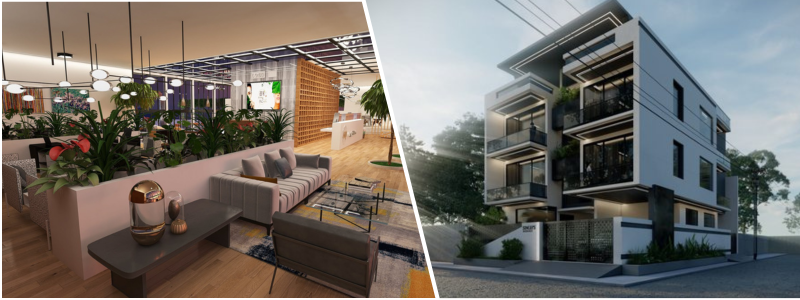
Behind every great design is a good architect. The outside view may be compared to the protagonist in a film. It is the one behind the exposure of the building, giving access to everyone who wants to see, and making a distinct difference. There is a frame, and the design most typically shows an elevation that gives the viewers a great picture while not overwhelming the frame. Apart from the picture itself, the shadows as well as the kind of lighting that architectural designers use contribute to the overall beauty of the picture. The light coming from the sun makes it more beautiful; you just have to choose between the afternoon or the morning sunlight. It adds a story to the architectural design. What is a hero shot? Is it all about beauty? The answer is no.

It has the power to tell stories, and as such, you will be confident that the architectural design is better than before. As such, when your clients try to look at the designs, they will have no other option but to avail themselves. One good thing about exterior designs is that the building must complement its neighbors around it. Not only the neighbors, but it also complements the other living things around it, like trees, plants, and all. Surely, your proposal will be successful if you use the hero shot. In every design, there will always be a challenge. In this hero shot, the challenge is not to make it stagnant. It should not look so formal and old. As such, you only need to have some shifts in the designs. Other elements should be included in the shot, such as cars and other people. As I mentioned above, lighting is a very good point. It makes a normal picture attractive, and it gives it life as well. It is not just a shot, but a shot with a story. 

RELATED: Creating Exterior Renderings Using 3D Exterior Rendering Services for Architects

2. The eye-level walkthrough

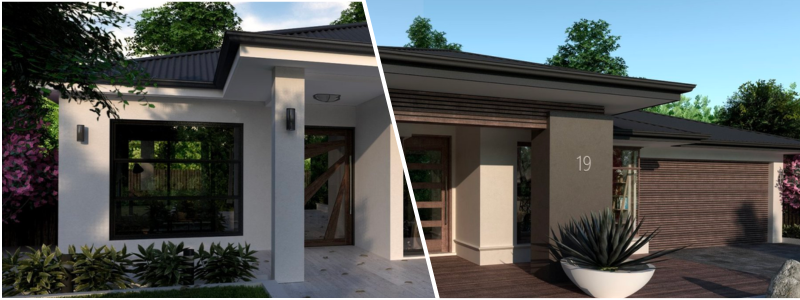
We do not just see the buildings with our naked eye. Instead, we see ourselves living in them and experiencing life through them; they are just there around us. We see buildings using our eye-level angle, and it is so important because there is no excess or lack when we use the eye-level walkthrough. This is vital consideration that the exterior design expert must keep in mind. There is a natural way of experiencing a particular home, working environment, and even public spaces. It can be compared to imagining what is inside when we have never opened the door. The design makes itself personal and up close. 

The hero shot is so dramatic, as discussed above. This makes the difference because the eye-level walkthrough talks about connection. It does not make an impressive goal; rather, it speaks to inviting people to see through their eye level and makes it feel real-life rather than a hero shot. It is as if when you look at it, it has this natural approach. From walking to entering the building, to the beautiful façade and gardens, these are the aims of the eye-level walkthrough. In the render, if you include natural elements like children playing and laughing, children, passerby on the road ahead, and a lot of bikers, surely, it will have a natural touch. 

If we are talking about flexibility, it will be the eye-level view because it works better for streets, parks, and other public spaces. Through this architectural design, the walkthrough designer must show the connection between the shops, houses, and walkways. Because it is eye-level, it gives people the best view when they are already inside the building, living there, walking there, and exploring inside. Marketing teams and design viewers will surely love it because of the natural feeling it has and how it is people-focused. If you want to get the right shot, it takes a lot of planning as well. The camera placement plays a vital role. For example, if you put it too close, the building may be overwhelmed.

RELATED: 3D Exterior Rendering Services for Companies: 10 Important Factors That Affect Pricing

On the other hand, if you put it too far, the connection you are trying to create will be lost to the surroundings. There must be a see-saw-like balance, wherein on the one side, there is a focus on the building, and on the other side, it shows that the environment still has other details like humans, playing children, and something that makes it relatable. Again, as opposed to the hero shot, the eye-level view suggests more emotion in the picture, which connects the hearts of the viewers and the picture they are looking at. Meaning, it does not stay as far as before; it shows a clearer view of what the building is showing. 
exterior rendering firm

3. The bird’s eye view

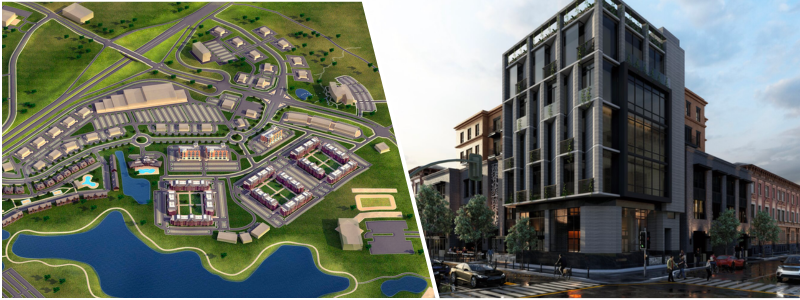
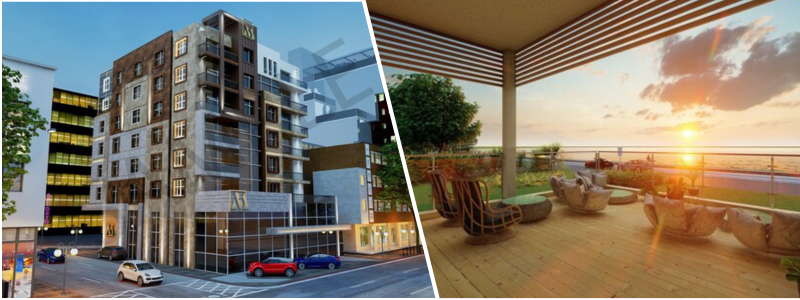
When it comes to 3D architectural rendering services, aside from the hero shot and the eye-level view, one of the best views to understand the entirety of a building is a view using a drone. This is called the bird’s eye view, and it offers a combination of scope on one hand and context on the other hand. Imagine looking from above like a bird, you can see the surrounding materials, the entirety of the building, and the layout itself. This is perfect for a big landscape with a building at the center. There are things that are best captured from an aerial view compared to the first two views discussed. When you look from the top view, you see how the traffic flows, you see gardens, the walkways, and everything that you cannot see from the ground-level views.

By using the bird’s eye view, you will definitely be thoughtful of the designs and the strategies used in conveying the story to the clients. Lighting is very important for this kind of view. The building may be emphasized using the shadows, particularly its form and how firm it looks. On the other hand, the light coming from the sun gives a perfect view for the client to see how delicate and perfect the design is. It is a cinematic view when you incorporate the formations of the clouds as well as the skies that complement them. If, for example, you want to convey an exaggeration when it comes to telling a story, you use a different scale. If you want a simpler one, you may use a simpler scale. 

A view may be impressive, like this bird’s-eye view, but you need to be precise. You need not only a camera, but also a perfect height, the length, the surrounding circumstances, and, of course, the lighting. If anything is missing, particularly an important detail, the perfect scene you are imagining will not be attained. With architectural visualizations, when you add people, cars, and other natural details in a small scenery of a picture, that will be great and even better to convey the story you are trying to tell. This kind of view does not mean the building’s view only, but instead, it also shows the perfect place where that building belongs. 

RELATED: 3D Exterior Rendering Services that Include In-Ground Swimming Pool Design 

4. The dramatic low angle

Ordinarily, the side views or even the center views are good. Apart from that, when you try to look at the viewpoint of a bird, you will see the difference and every angle as well. But if you try the low-angle position view, particularly if the camera is placed on the ground, you will be able to realize that it gives emphasis on the height and the vertical lines of a building. This one is a better choice for buildings to make it appear taller than it actually is. The angle is so powerful, and the lighting as well. It gives an impression of tallness and stiffness. Good lighting also exudes perfection in a picture; added to the exaggeration of height, it becomes attractive to viewers and clients.

Aside from the angle, I would like to emphasize the kind and the choice of lighting to use. If it is a little darker, it creates an illusion of mystery. If it is a little brighter, it creates an illusion of hope and beauty. The side lighting emphasizes the texture. If the rendering artist includes things naturally surrounding the building, it will create a good impression on the clients. The only bad thing or kind of negative thing about a low-angle view is that it does not create distortion. Sometimes, if you take a picture from the ground floor view, there will be a slightly distorted portion of the subject of the picture. Like, if a building, for sure, there will be a portion of the building that may look sideways or distorted. The key is balance. Balance of the lighting and the angle used. 

5. The contextual panorama

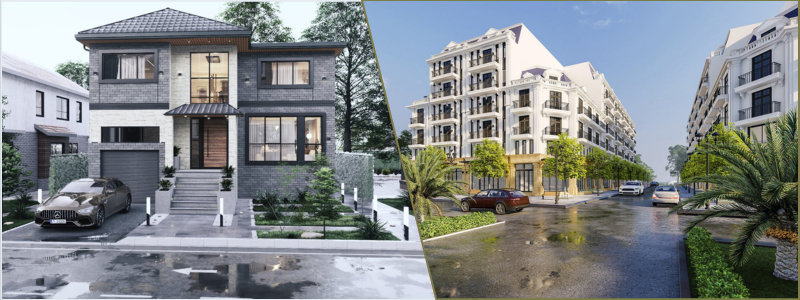
The last view or angle is the so-called contextual panorama. Through this, the picture does not only focus on the building itself, but also on the relationship of the building to the surrounding elements like people, trees, walkways, and others. With 3D 360 degree panorama rendering services, you can create an illusion that the building is unbreakable enough to be linked with the surrounding things nearby. This kind of view is not about the technicalities of the view, of the picture, and of the building. It is about the connection, the relationship, and the story of the building in connection with the things surrounding it. It is like a story in a movie wherein the protagonist is the building and the antagonist is either the streets or the bystanders. But it may be a combination of two protagonists because, through the lighting, it conveys a story. 

RELATED: How a 3D Rendering Service Can Help with Your Exterior Design

Combining angles for maximum impact

In a picture, choosing the perfect angle or view is a difficult task. Even if difficult, it must be done correctly to achieve perfection in your picture. Aside from that, the proper lighting is a plus factor. When combined, it creates a good picture, if not the best, and it conveys a story even without words in it. Thinking about choosing only one is not good. The 3D rendering designer must choose a combination of 2 or more because it has a complete set of elements when taken. The kind of views that modern people are using has evolved over the years. Before, it was all simpler. Now, it becomes a little complex to get that perfect picture in mind. Although it is a little complex, modern cameras and other techniques learned through workshops make the image become the perfect picture in mind. 

Final thoughts

The purpose of architectural design or exterior design is not only for aesthetic purposes. The truth is, it is about telling a story, communicating with the viewers or clients. Every view has a purpose, such as the hero shot view, which has the purpose of creating dominance above all. On the other hand, the eye-level view creates a connection between the viewer and the picture. Another one, the bird’s eye view, creates a wide coverage. The dramatic low angle creates an impression of exaggeration when it comes to height and scope. Also, the contextual panorama creates an integration between the building and the elements surrounding it. 

How Cad Crowd can help

Cad Crowd has an extensive network of exterior rendering designers to help you create the perfect design. Talk to our design experts for a free quote.

author avatar

MacKenzie Brown is the founder and CEO of Cad Crowd. With over 18 years of experience in launching and scaling platforms specializing in CAD services, product design, manufacturing, hardware, and software development, MacKenzie is a recognized authority in the engineering industry. Under his leadership, Cad Crowd serves esteemed clients like NASA, JPL, the U.S. Navy, and Fortune 500 companies, empowering innovators with access to high-quality design and engineering talent.

Connect with me: LinkedInXCad Crowd

Progression of 3D Architectural Rendering Technology for Firms in the Business World


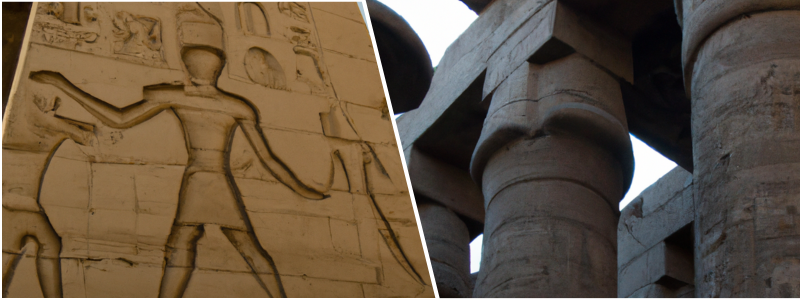
Various forms of architecture have existed through the centuries. Thanks to architecture that works almost similar to signatures or footprints, contemporary archaeologists were even able to pinpoint and discover some civilizations. From the times of the Egyptian Pharaohs to this very day, architects tell distinct stories that everyone can understand. Their stories are filled with space, materiality, texture, light, and more.

3D architectural rendering services have been the unique language between designers and clients. If this tangible common ground existed, the work of an architect would have been evaluated based on mere numbers written on ledgers. This piece delves into the progression of 3D architectural rendering technology for firms in the business world.

The early days

The Egyptians, Greeks, and Romans have always been considered the true pioneers of architecture. These civilizations were responsible for constructing some of the world’s most ambitious and mystical wonders using ancient technology that humankind is still trying to decipher after thousands of years.
Kings commissioned most of these architectural feats, with master builders in charge of their conception and built through long years of labor and hard work. But how were these unique structures designed in the first place? How were they communicated back in the day that was different from the method used in modern times?

It’s easy to imagine pyramids growing out of the great span of the desert out of the blue or that ancient aliens were responsible for all the out-of-this-world early achievements in engineering and architecture. Although there’s no way to know if aliens exist and if they helped with these achievements, one thing is sure: long hours of designing, planning, and strategic execution were required for these structures to be formed as they are seen today.

There’s no surprise there. After all, ancient designers and architects likely used the same methods to communicate their ideas as those used now, albeit these were more primitive. Like the great artists of the past, architects experimented with various mediums and pigments to develop aesthetics that met their rulers’ requirements and desires.

progression1

It was long before perspective was discovered to represent realism, meaning reliefs and drawings were flat back then and lacked experiential properties. Things were the same with the Romans and Greeks. The field of architecture itself has enjoyed advancements just as the sophistication of expression and design and technological innovations have also made significant leaps. However, the planning and presentation of speculative buildings only evolved a little, even if hundreds of years had passed between them.

During this point in history, architects were considered artists by trade, but the only difference was that their artworks were real and tangible. You can trace the history of 3D architectural rendering technology if you follow the evolution of fine art itself. Techniques became better and more realistic, although they remained rooted in Egyptians’ exact flat representation. What’s even more impressive is that they were able to achieve all their feats if you consider that they lacked in terms of representational limitations.

RELATED: What are Architectural Rendering Costs, Rates, and Pricing for Companies?

The rise of new perspectives

It was not until after 1,500 years that Italians made one of history’s most crucial discoveries. Filippo Brunelleschi, a Renaissance man, left the world in awe when he painted the first-ever example of linear perspective. It was a 3D depiction that used converging lines to represent how the human eyes see the world visually.

Brunelleschi is a name that rings a bell because of his world-renowned dome in Florence. Together with his contemporaries, Brunelleschi found the foothold that architects and artists had long been looking for: the mathematical solution that aims to grasp a realistic 2D depiction of the actual 3D world.

Although there are still heated debates on whether Brunelleschi initially discovered the perspective, he became the pioneer behind its application in architectural analysis. The rest of the artists followed suit only a short time later. The era of the Italian Renaissance marked the first significant breakthrough humanity has seen as far as 3D architectural visualization services are concerned.

progression1.1

Perspective incorporated space and depth into drawings and paintings. Finally, architects could develop realistic portrayals to communicate and express their majestic designs. This helped them convince their clients or the government better regarding their validity. Sketches replaced the time-consuming and expensive models and sculptures, saving precious money and valuable time.

The start of the modern times

Only after 500 years did 3D visualization services see another significant leap. The development of linear perspective paved the way for all kinds of paths that gave architects, artists, and engineers the right visual tools to help them bring their designs to life. It also helped sustain their profession for many centuries.

However, a monumental shift occurred at the turn of the 20th century. Originating with the Bauhaus during the 1910s, the modern architecture movement took architectural rendering to newer and more exciting places. During this era, architects were no longer master builders as they became a more specialized group. Their efforts were then focused on the tectonics and expression of crafting space. Space and form became their main design tools that left behind uncalled-for flair and ornamentation.
While the architectural field shifted to a plain geometric assembly of volumes and lines, 3D architectural rendering followed suit. Historic designers like Le Corbusier and Walter Gropius were the finest in expressing design details in once-impossible ways.

The three-dimensional spaces were color-coded and overlapped, leading to diagrammatic portrayals that spoke about the experience and program without just drawing it realistically. The architects also developed visual tools that helped others understand not only the “what” but even the “how” and the “why.” It’s like the curtain was finally pulled back, allowing the layman to see space in the same way as architects did.

The rest of the architects soon followed the trend. The revolution in communicating design changed how clients perceived their projects and served as a critical turning point in the field of architecture itself. Louis Kahn and Frank Lloyd Wright worked on the designs of structures that suspended disbelief, taking architecture to greater heights than it enjoyed during antiquity. Buildings soon restored their importance partly because of the new methods of conception of designs.

RELATED: What are Architectural 3D Visualization Costs, Service Fees & Rates for Companies?

The demands of the present day

progression2

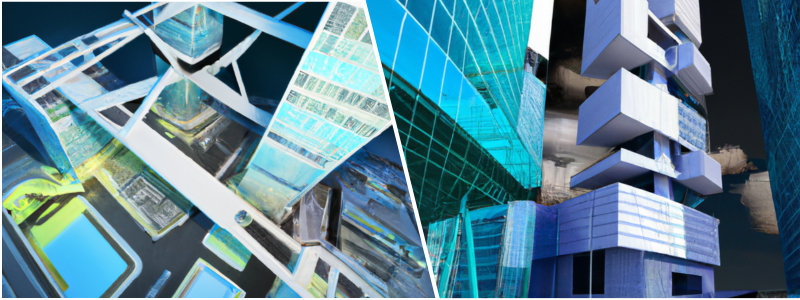
The present day is filled with Steve Wozniak, Steve Jobs, and Bill Gates. The swift advancements in computer technology in the past three decades have given the architectural world a whole new life. The capabilities of 3D architectural rendering technology made it easier for architectural design experts to present their work. They made the architectural business more efficient in one way or another, and the rest of the world had no choice but to keep up

But of course, it may mean it was challenging for people to adapt. There are still and possibly always will be several ambitious young architects and designers who live beyond the walls of the digital fortress. Architectural sketch design services and architectural drawing services continue to be critical elements of the architectural process and an essential tool for presenting conceptual ideas of their designs during the early stages. In one way or another, technology stomps on the ability of an architect to properly develop their ideas and points directly to the finish line even before the completion of the race.

It doesn’t matter which group you belong to. Undoubtedly, computer technology has had a historic impact on design communication. Artists and architects can smoothly transition between concrete and concept, which makes refinement in designs more of a trial and trial than anything else.
Different programs, including SketchUp, VRay, Rhino, AutoCAD, Mental Ray, and Maxwell, are the latest tools that empower designers and dazzle clients with on-demand results. This may pose a danger to the design’s integrity, but with the rigor and discipline that successful architects of the past have displayed, it would be easier to sidestep these risks.

RELATED: Learn About Architectural Design Fee Schedules, Rates, and Pricing for Architect Firms’ Costs

What does the future hold?

Time is the only thing that can tell how 3D architectural rendering technology will be in the next 100 years. With the continuous progress of technology, the 3D architectural design process will become more reliant and dependent on automated processes. Machines may soon gain control over things, posing the risk of losing the sense of humanity in design and architecture. Like other fields, architecture may clash with technology, leading to something good or bad.

How Cad Crowd can help

As 3D rendering technology evolves, businesses and firms can stay ahead using Cad Crowd’s platform to connect directly with skilled freelance architectural design experts. Whether navigating the challenges of automated processes or seeking expertise for upcoming projects, Cad Crowd can help find 3D architectural rendering technology professionals.

Real Estate Marketing: Advantages of 3D Architectural Rendering Services & Animation


Imagine yourself shopping around for a new real estate property. Do you want to see the same old top-down blueprints, or would you rather watch 3D presentations? 3D architectural rendering or 3D architectural visualization is one of the hottest game-changers in real estate marketing. Who can resist more visually stimulating and enticing architectural presentations?

Initially, animation was only used for the primary purpose of fun and entertainment and nothing else. However, 3D architectural animation services are now available and used for architectural projects related to almost everything. But if there’s one area where 3D architectural animation is starting to establish a stronghold, it is none other than real estate marketing. With the help of 3D architectural animation services, real estate marketers can now effectively advertise their home designs and properties to potential clients.

Read on to learn how you can benefit from architectural animation services:

Spot issues early on

3D architectural rendering services allow more precise visualization of drawings from an architectural standpoint. It gives architects a clearer view of the architectural dimensions and the project as a whole. It will enable them to pinpoint any problem they might encounter early during the design stage. This will save you money and time and prevent additional damages that might be incurred if the issues are fixed later on.

Attract more potential clients

Many studies have revealed that soft curve forms are more attractive to the human brain, which prefers visuals over static data dumps. This explains why more than 2D images might be needed to present the dimensions of the projects being designed.

3D architectural visualization services address this problem by presenting images that resemble their exact appearance in real life. It allows clients to observe and scrutinize the entire project from different angles to eliminate any room for doubt before the actual purchase. 3D architectural animation services and architectural walkthroughs help prospective clients experience how the project feels before the development starts.

real-estate1

Craft precise presentations

While 2D images are helpful in architecture, you’re essentially reviewing measurements and theoretical designs. You need to find out if these measurements will work out or even be possible in the real world. These designs can only be tested once you’re in the field. It can become an issue if you present your design to clients because they need help seeing the bigger picture or understanding the intricacies of complex 2D blueprints. 3D architectural rendering services & animation help bypass these issues.

RELATED: Virtual Staging Costs, Service Fees & Architectural Pricing for Real Estate Companies

Perform edits in a hurry

It’s a long and arduous process to create precise real estate presentations. Sometimes, the client may request a few tweaks even after you present the design. The main concern about editing 2D blueprints is that it could be more challenging and quick. If you’ve noticed an issue with the design, you’ll spend most of your resources re-sketching these concepts to implement new ideas.

Once again, 3D architectural visualization services and architectural presentation services can help you solve this issue. Architectural CAD design services can make the necessary changes right away with the help of tools such as AutoCAD. All of these changes can also take place in real time. You can immediately update the client and show them how the finished project will look. If the client is unsatisfied with the new design, the architectural designer can return to the original vision with just a few clicks.

Improved marketing experience

People are now content with dull and lifeless 2D blueprints. That’s why only some people are willing to engage with them. However, something more appealing, like 3D architectural animation, is guaranteed to attract more attention without trying too hard. 3D architectural renders are visually enticing because they are downright beautiful. Many people don’t even realize they’re looking at a 3D architectural rendering, not the real thing.

You can easily fit these rendered presentations into slideshows and short video commercials. This means that 3D architectural rendering and architectural presentation services are now the perfect tools to develop better presentations for marketing purposes. Since consumers are also most likely to buy something after seeing a video of it, you can use 3D architectural animation services for this purpose.

Guarantee a better understanding of the project

real-estate2

You can help your potential clients better understand how the finished project will look if you present a replica before its construction. This will help them decide accordingly. If there are changes or tweaks along the way, you can also quickly implement them before the plan for construction turns into a brick-and-mortar entity.

Seamless project execution

3D architectural rendering technology also helps architects achieve better accuracy throughout the project’s development. Since the risk of errors is reduced, it also eliminates the need to rework to a certain extent, reducing the number of interferences in the field. This will help your company boost its overall productivity.

Create more opportunities for virtual reality with 3D AR/VR Architectural Services

Virtual reality, or VR, is expected to continue growing and improving shortly, seizing the attention of consumers and companies alike. 3D AR/VR architectural services in real estate open the door to new opportunities and potential. 3D architectural rendering combined with AR/VR can develop virtual tours of real estate properties.

Buyers can also view entire properties through the website without the comforts of their homes. This fantastic level of immersion and convenience for clients is one of the best ways to stay ahead of your competition.

RELATED: Architectural VR/AR 3D Rendering Costs, Rates & 3D Modeling Pricing for Design Firms

Quick acquisition of government approvals

Neighborhood governments often dismiss many improvements and structures due to the vulnerability factor in appearance. But with precise 3D perception and animation and full confirmation, you can attain certainty and eliminate the vulnerability of the task for the convenient acquisition of government approvals.

Manage client expectations

Client dissatisfaction is often the result of mismanaged expectations. Designers usually make the grave mistake of assuming they are always on the same page with their clients throughout the process. They need to realize that, more often than not, clients need help understanding still images and blueprint designs.

3D architectural animation services can change these and more. Animation can serve as a walkthrough for clients, allowing them to experience it instead of merely looking at the design. Well-made architectural animations can enhance their understanding and give them a better idea of what to expect from the finished project.

real-estate3

Get more precise renderings

3D architectural rendering allows a higher level of precision for real estate listings. It makes animation different from 2D blueprints, static floor plans, and other basic diagrams that are known to leave some room for error. Aside from that, 2D drawings and floor plans don’t usually present a relative scale. However, 3D rendering services eliminate the risk of error by using minute details and measurements with almost zero tolerance. Instead of merely checking the 2D plan without any solid idea of dimensions or scale, you can present precise and accurate 3D architectural renders showing angles, depth, and scale to your clients.

Cost-effective

Contrary to popular belief, 3D rendering software can make the entire process cheaper than 2D blueprints. Designers enjoy the freedom of making changes and tweaks in just a few clicks, reducing the monetary investment for modifications. In addition, 3D 360-degree panorama rendering services can use the same file used for traditional marketing and static posts and convert them into virtual room tours, making them cost-effective and marketable in 3D architectural rendering.

RELATED: What Are Architectural Animation Costs, Rates, & 3D Design Pricing for Companies?

Eliminate communication gaps

Interior designers and architects involved in real estate businesses can better explain the details of their projects to the project stakeholders and the construction team with better clarity and precision with the help of 3D architectural visualization. It ensures that everyone is always on the same page to ensure flawless project execution without confusion and misunderstandings.

Waste reduction

Time is money in the real estate industry. The ability to detect errors proactively can go a long way to ensure you meet your deadlines and avoid unwanted delays. Since 3D architectural animation is not your ordinary still images, those who are part of the design process can check the 3D architectural animation and pinpoint any issues early. Lighting and spacing issues can also be addressed with the help of 3D architectural animation services.

How Cad Crowd can help

If you’re not ahead in real estate, you’re lagging many steps behind. Cad Crowd can help you find the best 3D architectural rendering and 3D architectural animation services to help you take your real estate marketing efforts to the next level. They also offer architectural presentation services that can provide an elevated understanding to clients when presenting your architectural project.