After using Microsoft Upgrade Assistant without changing my ASP.NET MVC project .NET Framework target (4.7.2), I get the following error. How can I get rid of it?
Error NETSDK1022 Duplicate ‘Content’ items were included. The .NET SDK
includes ‘Content’ items from your project directory by default. You
can either remove these items from your project file, or set the
‘EnableDefaultContentItems’ property to ‘false’ if you want to
explicitly include them in your project file. For more information,
see https://aka.ms/sdkimplicititems. The duplicate items were:
‘Views\Web.config’; ‘Web.config’; ‘Web.Debug.config’;
‘Web.Release.config’;…
Jio Leasing Services Ltd (JLSL), a subsidiary of Jio Financial Services, plans to buy customer premises equipment, devices and telecom equipment worth $4.32 billion from Reliance Retail over the next two financial years, according to a postal ballot notice (PDF) sent to shareholders seeking approval of the deal.
JLSL is entering the business of operating a Device-as-a-Service (DaaS) model — it will lease telecom devices along with associated services to customers of Reliance Jio Infocomm. Reliance Retail, valued at about $100 billion Reliance Industries in 2023, will sell the devices to JLSL at cost plus margin.
The deal will be one of the largest equipment transactions in the Indian telecom sector. By shifting to a leasing model through JLSL, Jio aims to make it more affordable for customers to get access to the latest 5G devices and attract more subscribers to its network.
The transaction will be spread over the financial years ending March 2025 and March 2026.
Jio Financial Services was a little-known, non-bank financial subsidiary of Reliance Industries until the conglomerate demerged the unit and listed it last year. Reliance still owns more than 80% of the company.
Jio Financial Services also plans to offer its payment aggregator and gateway services to Jio Platforms and Reliance Retail, according to the notice.
The deal signifies Jio Financial Services’ growing interest in businesses beyond lending. Via the DaaS model, the company is planning to lease devices like laptops and its mobile hotspot AirFiber to businesses.
A software maker serving more than 10,000 courtrooms throughout the world hosted an application update containing a hidden backdoor that maintained persistent communication with a malicious website, researchers reported Thursday, in the latest episode of a supply-chain attack.
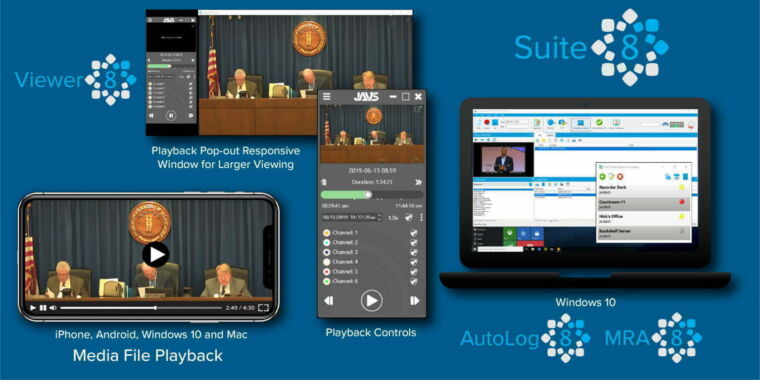
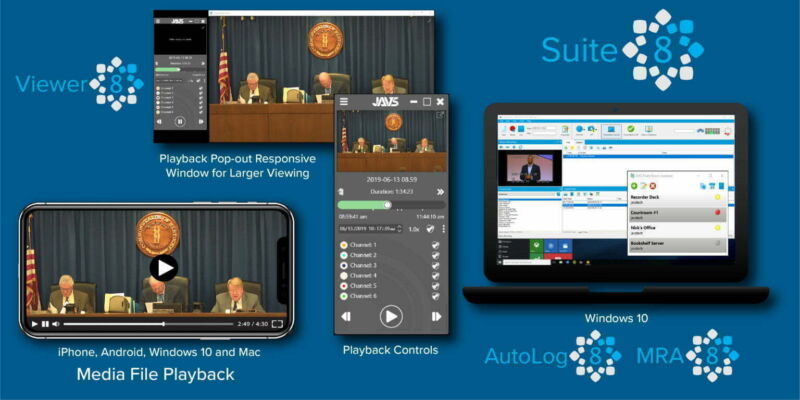
The software, known as the JAVS Viewer 8, is a component of the JAVS Suite 8, an application package courtrooms use to record, play back, and manage audio and video from proceedings. Its maker, Louisville, Kentucky-based Justice AV Solutions, says its products are used in more than 10,000 courtrooms throughout the US and 11 other countries. The company has been in business for 35 years.
JAVS Viewer users at high risk
Researchers from security firm Rapid7 reported that a version of the JAVS Viewer 8 available for download on javs.com contained a backdoor that gave an unknown threat actor persistent access to infected devices. The malicious download, planted inside an executable file that installs the JAVS Viewer version 8.3.7, was available no later than April 1, when a post on X (formerly Twitter) reported it. It’s unclear when the backdoored version was removed from the company’s download page. JAVS representatives didn’t immediately respond to questions sent by email.
“Users who have version 8.3.7 of the JAVS Viewer executable installed are at high risk and should take immediate action,” Rapid7 researchers Ipek Solak, Thomas Elkins, Evan McCann, Matthew Smith, Jake McMahon, Tyler McGraw, Ryan Emmons, Stephen Fewer, and John Fenninger wrote. “This version contains a backdoored installer that allows attackers to gain full control of affected systems.”
The installer file was titled JAVS Viewer Setup 8.3.7.250-1.exe. When executed, it copied the binary file fffmpeg.exe to the file path C:\Program Files (x86)\JAVS\Viewer 8\. To bypass security warnings, the installer was digitally signed, but with a signature issued to an entity called “Vanguard Tech Limited” rather than to “Justice AV Solutions Inc.,” the signing entity used to authenticate legitimate JAVS software.
fffmpeg.exe, in turn, used Windows Sockets and WinHTTP to establish communications with a command-and-control server. Once successfully connected, fffmpeg.exe sent the server passwords harvested from browsers and data about the compromised host, including hostname, operating system details, processor architecture, program working directory, and the user name.
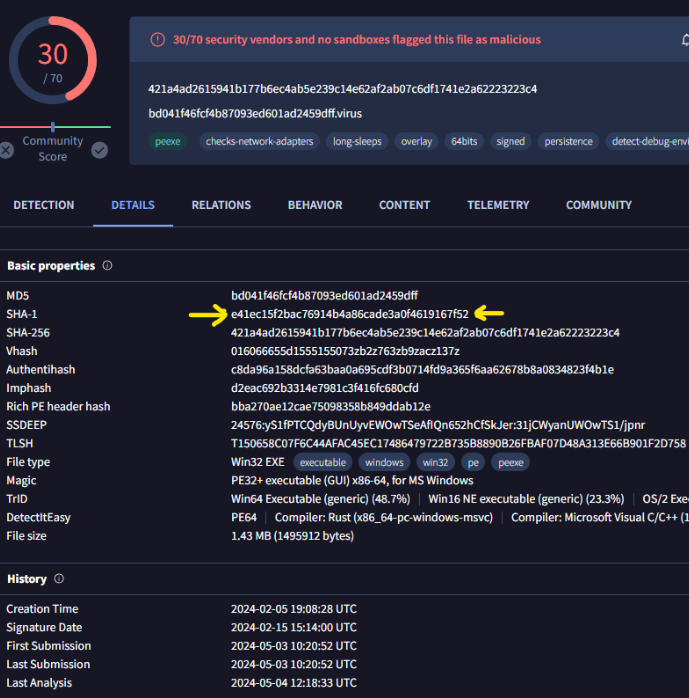
The researchers said fffmpeg.exe also downloaded the file chrome_installer.exe from the IP address 45.120.177.178. chrome_installer.exe went on to execute a binary and several Python scripts that were responsible for stealing the passwords saved in browsers. fffmpeg.exe is associated with a known malware family called GateDoor/Rustdoor. The exe file was already flagged by 30 endpoint protection engines.
Enlarge/ A screenshot from VirusTotal showing detections from 30 endpoint protection engines.
The researchers warned that the process of disinfecting infected devices will require care. They wrote:
To remediate this issue, affected users should:
Reimage any endpoints where JAVS Viewer 8.3.7 was installed. Simply uninstalling the software is insufficient, as attackers may have implanted additional backdoors or malware. Re-imaging provides a clean slate.
Reset credentials for any accounts that were logged into affected endpoints. This includes local accounts on the endpoint itself as well as any remote accounts accessed during the period when JAVS Viewer 8.3.7 was installed. Attackers may have stolen credentials from compromised systems.
Reset credentials used in web browsers on affected endpoints. Browser sessions may have been hijacked to steal cookies, stored passwords, or other sensitive information.
Install the latest version of JAVS Viewer (8.3.8 or higher) after re-imaging affected systems. The new version does not contain the backdoor present in 8.3.7.
Completely re-imaging affected endpoints and resetting associated credentials is critical to ensure attackers have not persisted through backdoors or stolen credentials. All organizations running JAVS Viewer 8.3.7 should take these steps immediately to address the compromise.
The Rapid7 post included a statement from JAVS that confirmed that the installer for version 8.3.7 of the JAVS viewer was malicious.
“We pulled all versions of Viewer 8.3.7 from the JAVS website, reset all passwords, and conducted a full internal audit of all JAVS systems,” the statement read. “We confirmed all currently available files on the JAVS.com website are genuine and malware-free. We further verified that no JAVS Source code, certificates, systems, or other software releases were compromised in this incident.”
The statement didn’t explain how the installer became available for download on its site. It also didn’t say if the company retained an outside firm to investigate.
The incident is the latest example of a supply-chain attack, a technique that tampers with a legitimate service or piece of software with the aim of infecting all downstream users. These sorts of attacks are usually carried out by first hacking the provider of the service or software. There’s no sure way to prevent falling victim to supply-chain attacks, but one potentially useful measure is to vet a file using VirusTotal before executing it. That advice would have served JAVS users well.
Editor’s note: In the article, Irene explains why measuring sales performance is so important for sales growth and shares three examples of how a company can facilitate this process. If you feel that you need assistance with your sales analytics, consider turning to ScienceSoft’s data analytics consulting services.
Out of major industries, retail is one of the most susceptible to changing consumer needs and the dynamic economic environment. To meet your sales goals month after month in such circumstances, you need to constantly assess your company’s performance and make quick adjustments.
In this article, I’ll share with you some examples of sales metrics you need to track to stay in the know about your sales performance and three options to facilitate their analysis.
What sales metrics to analyze?
Sales metrics are quantifiable measures that help you assess the effectiveness of a salesperson, a sales team, the whole organization (sales productivity metrics), the sales process or its aspect (sales performance metrics) against set objectives.
Due to the abundance of all-rounded sales data, many of ScienceSoft’s clients face the dilemma of which sales metrics they need to track when there are dozens available. As analyzing the right metrics is crucial for spotting critical information about your sales process, I advise companies to carefully choose individual KPIs based on their industry and short-term and long-term business goals.
Among the common sales metrics I usually recommend tracking are:
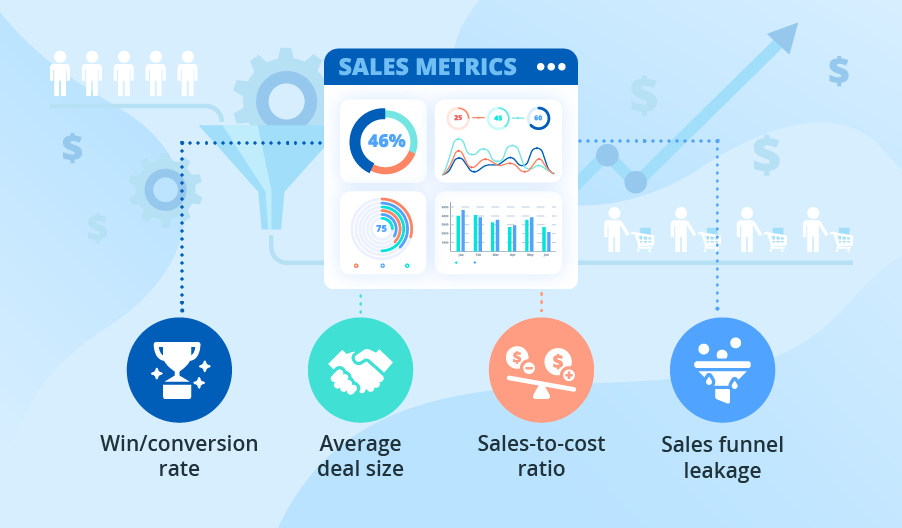
This sales performance measurement shows the percentage of leads that convert into customers, and it is used for forecasting your revenue objectives. The conversion rate also measures the effectiveness of your sales activities: if the win rate is increasing with the same or higher number of closed deals, sales team performance is improving.
To calculate the average deal size, you have to divide the total revenue from the closed deals by the number of those deals. This metric is particularly important for those companies who plan to move upmarket – the bigger the deal size, the closer they are to enterprise-level contracts.
To understand the profitability of a sale, you should calculate your sales-to-cost ratio. For that, you compare the revenue you earn from the deal to the cost of acquiring it. Should you find out that the revenue you earn from securing a deal is only enough to cover the expenses, some urgent actions are required – searching for the ways to reduce costs, shortening your sales cycle, rethinking your target market, etc.
Your sales funnel consists of a certain number of stages, each of which can lead to winning or losing a sale. Only by monitoring your stage-by-stage conversion, you’ll be able to define at which stage your leads are likely to quit business with you. The quicker you define and eliminate weak points in your conversion funnel, the higher your win rate will be.
How to track and analyze sales metrics?
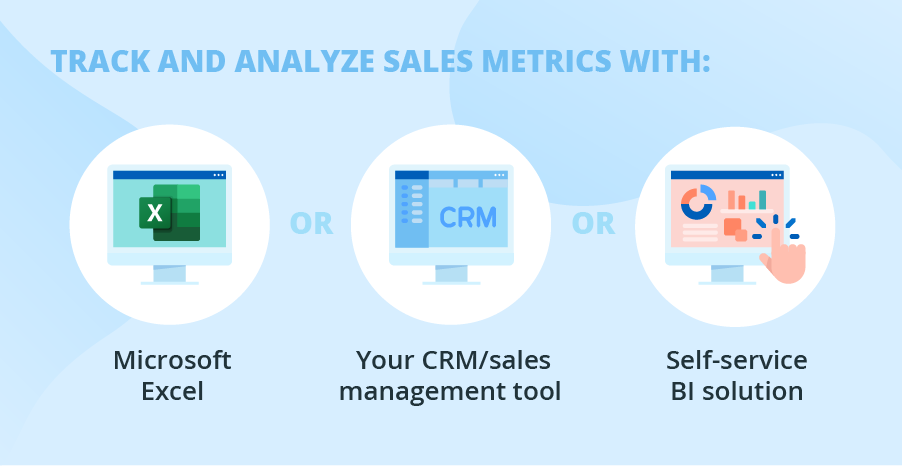
When the key sales metrics to analyze are defined, the challenge arises to provide business users with seamless and timely access to their analysis. For that, you have to develop an effective sales analysis environment and get the right software in place. Here are some common in-house options:
Among Excel advantages, I may point out its sufficiency as a personal solution for analyzing historical data, plus it is affordable and comparatively easy to master. However, the tool is not effective for collaboration and forecasting. What is more, all the information has to be entered into Excel manually, which is extremely time-consuming and can result in numerous errors. Consequently, the accuracy of the analysis will be greatly impaired.
Analytics capabilities of your CRM/sales management tool
A CRM system compiling all-rounded information about your customers from a variety of sources can help you derive actionable insights crucial for achieving your sales goals. For example, you can learn which communication channels bring more value, the cost of acquiring customers, best up-selling and cross-selling opportunities, and much more. But to be fair, not every CRM software is capable of that. Your CRM can be considered effective for sales analysis if it has:
Vast analytical capabilities that facilitate customer segmentation to optimize marketing and sales processes, forecast challenges approaching through the sales pipeline, etc.
Powerful integration capabilities to connect to data sources (ecommerce platform, social media, store software, etc.) needed for conducting comprehensive sales analysis.
Setup data management procedures to ensure high data quality.
Intuitive visualization to allow getting a visual snapshot of the metrics.
For a real-life example of utilizing CRM capabilities for sales analytics, have a look at one of our projects, in which ScienceSoft implemented and customized a CRM system to allow a multibusiness company to gain greater visibility into daily operations.
Not Sure About the Most Feasible Way to Conduct Sales Analysis?
ScienceSoft’s experts are ready to evaluate your existing analytical environment to define your best sales analytics solution.
With a well set-up and tuned self-service BI solution, you get:
A central repository of aggregated and cleansed sales data from integrated corporate applications, as well as from external data sources. That way, you can connect to all data required for getting a holistic view of the whole sales cycle.
Profound analytical capabilities powered by data science and machine learning, which are applied to your sales data to find the answers to most deliberate questions. Besides understanding the reasons behind certain sales performance, you can get detailed recommendations on how to enhance the performance of your sales team, what stages of your sales pipeline require immediate adjustments, and what corrective actions to your sales funnel will bring maximum ROI.
Self-service visualization and reporting functionality, which bring sales analytics at your fingerprints. With informative and easy-to-digest reports and dashboards, you can track your key sales metrics in real time to conduct benchmarking, define hurdles to hitting your sales quota and obtain insights into how to improve your sales team’s performance and the whole sales process. To see how it works in practice, watch our BI demo.
The key to successful selling
I’m sure that the key to remaining competitive on the market with timely and accurate decisions is the right analytics solution. The article outlined some of the in-house solutions for tracking and analyzing sales metrics. But surely, an in-house solution is not the only way to go. If having an analytics solution inside your organization is not an option, you can always opt for outsourcing. If you feel that you need help with defining your most fitting sales analytics option, don’t hesitate to reach out to ScienceSoft’s consultants.
Take a look at our clue for today’s Wordle, written to give your guesses a helpful nudge towards the answer while still leaving all the fun bits to you. If you prefer, you can click your way through to the solution to the May 24 (1070) Wordle if you need to—it’s better than losing your hard-won win streak, after all.
The vast, vast quantities of grey letters filling up the first few rows of my Wordle guesses did all the heavy lifting this Friday morning. It’s always a little shocking to see an unimpressive (and slightly worrying) spread of grey and yellow boxes suddenly turn solid green, but it never gets old.
Today’s Wordle hint
(Image credit: Josh Wardle)
Wordle today: A hint for Friday, May 24
Moving smoothly and with little or no effort is the key to winning today’s Wordle. A bird effortlessly soaring in the sky, a fish casually swimming through calm waters, a person skating on ice might all be doing this.
Is there a double letter in Wordle today?
There are no double letters in today’s Wordle.
Wordle help: 3 tips for beating Wordle every day
A good starting word can be the difference between victory and defeat with the daily puzzle, but once you’ve got the basics, it’s much easier to nail down those Wordle wins. And as there’s nothing quite like a small victory to set you up for the rest of the day, here are a few tips to help set you on the right path:
A good opening guess should contain a mix of unique consonants and vowels.
Narrow down the pool of letters quickly with a tactical second guess.
Watch out for letters appearing more than once in the answer.
There’s no racing against the clock with Wordle so you don’t need to rush for the answer. Treating the game like a casual newspaper crossword can be a good tactic; that way, you can come back to it later if you’re coming up blank. Stepping away for a while might mean the difference between a win and a line of grey squares.
Today’s Wordle answer
(Image credit: Future)
What is today’s Wordle answer?
A little help. The answer to the May 24 (1070) Wordle is GLIDE.
Keep up to date with the most important stories and the best deals, as picked by the PC Gamer team.
Previous Wordle answers
The last 10 Wordle answers
Past Wordle answers can give you some excellent ideas for fun starting words that keep your daily puzzle-solving fresh. They are also a good way to eliminate guesses for today’s Wordle, as the answer is unlikely to be repeated.
Here are some recent Wordle answers:
May 23: SWISH
May 22: EXALT
May 21: DINGO
May 20: NICER
May 19: HITCH
May 18: BRINY
May 17: TUTOR
May 16: STALL
May 15: PINCH
May 14: AMASS
Learn more about Wordle
(Image credit: Nurphoto via Getty)
Wordle gives you six rows of five boxes each day, and you’ll need to work out which secret five-letter word is hiding inside them to keep up your winning streak.
You should start with a strong word like ARISE, or any other word that contains a good mix of common consonants and multiple vowels. You’ll also want to avoid starting words with repeating letters, as you’re wasting the chance to potentially eliminate or confirm an extra letter. Once you hit Enter, you’ll see which ones you’ve got right or wrong. If a box turns ⬛️, it means that letter isn’t in the secret word at all. 🟨 means the letter is in the word, but not in that position. 🟩 means you’ve got the right letter in the right spot.
Your second guess should compliment the starting word, using another “good” word to cover any common letters you missed last time while also trying to avoid any letter you now know for a fact isn’t present in today’s answer. With a bit of luck, you should have some coloured squares to work with and set you on the right path.
After that, it’s just a case of using what you’ve learned to narrow your guesses down to the right word. You have six tries in total and can only use real words (so no filling the boxes with EEEEE to see if there’s an E). Don’t forget letters can repeat too (ex: BOOKS).
If you need any further advice feel free to check out our Wordle tips, and if you’d like to find out which words have already been used you can scroll to the relevant section above.
Originally, Wordle was dreamed up by software engineer Josh Wardle, as a surprise for his partner who loves word games. From there it spread to his family, and finally got released to the public. The word puzzle game has since inspired tons of games like Wordle, refocusing the daily gimmick around music or math or geography. It wasn’t long before Wordle became so popular it was sold to the New York Times for seven figures. Surely it’s only a matter of time before we all solely communicate in tricolor boxes.
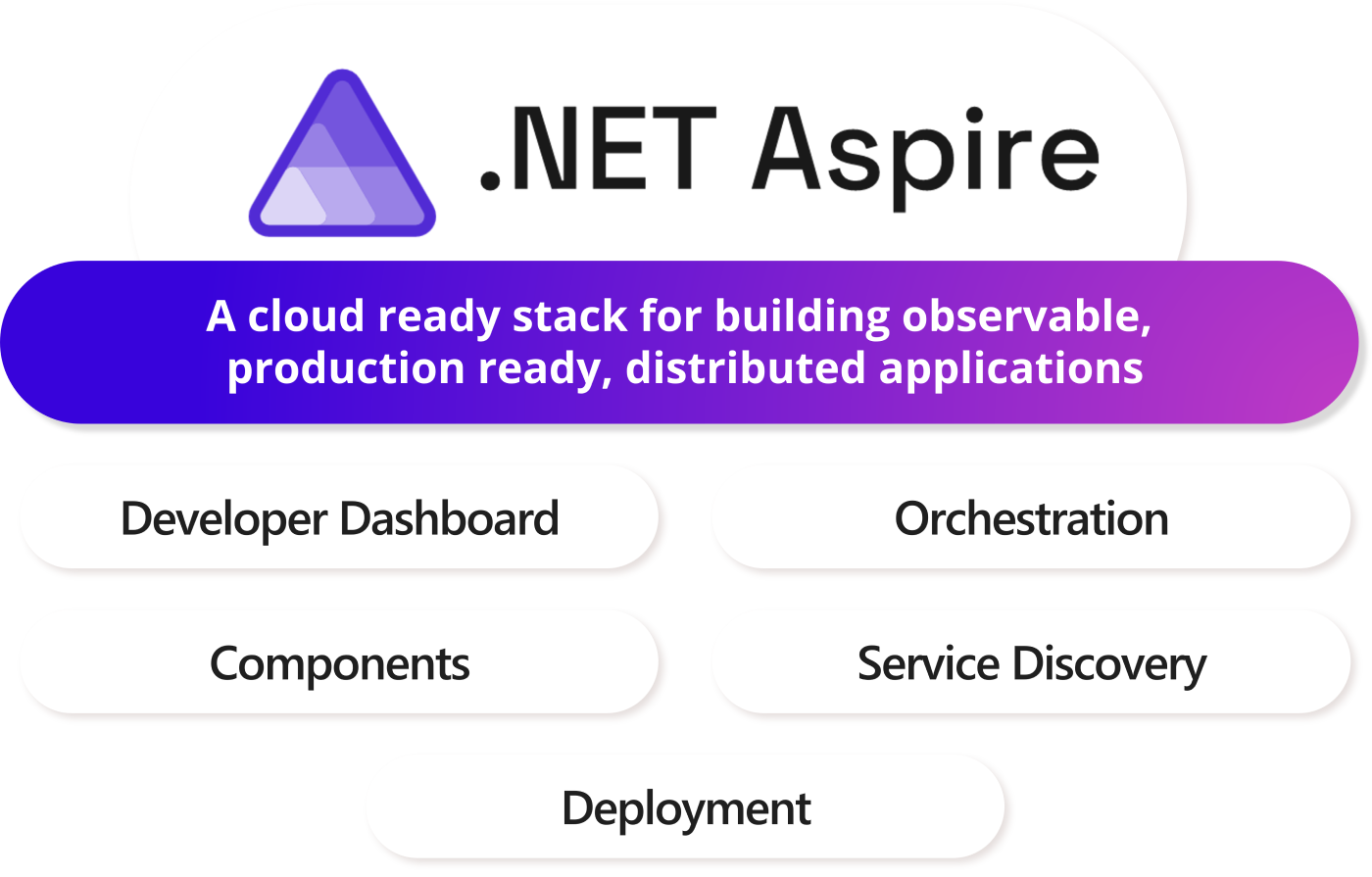
We’re excited to introduce the general availability of .NET Aspire, a comprehensive stack aimed at simplifying the way .NET cloud-native apps are built and managed. .NET Aspire offers developers like you an improved, opinionated framework for constructing distributed applications, ensuring a seamless and consistent development experience.
If you’re a distributed application developer .NET Aspire brings something you’ve always wanted: –
The ability to select F5 and have all the dependencies start up or be provisioned.
Your projects are automatically configured between significant, distributed changes in the app.
Deployment of these multi-node apps into a live development or test environment are a one-click gesture.
.NET Aspire’s built-in service discovery capabilities enable your front-end apps to find your back-end APIs with less friction and almost zero configuration.
Getting started with .NET Aspire
Download the latest Visual Studio build today to get started. If you don’t already have .NET Aspire installed, open the Visual Studio Installer, select Modify, and choose the ASP.NET and web development workload, and then select .NET Aspire SDK. Alternatively, you can run dotnet workload install aspire from a command line. Then, you’ll start to see new .NET Aspire project templates in Visual Studio and at the .NET CLI. Once you see the templates, try creating your first cloud-native .NET Aspire app by selecting the .NET Aspire Starter Application template.
If you’ve ever had to build a front-end app that accessed a REST API back end and needed caching to enhance the app’s performance, you’ll recognize the topology of the app right away. Once you select F5 to start the debugger, the familiarity will end and the excitement will start – without needing to configure anything in your project or set startup order, the whole application will start up.
The .NET Aspire Dashboard opens and from there you’ll have access to deep telemetry, metrics, and distributed traces where you can see how the entire app is working end-to-end.
Deploying to Azure Container Apps
If you’re an Azure customer, you’ll be happy to know we’ve applied this same sort of one-click joy to our publishing experience, too. From within Visual Studio, you can right-click-publish an entire multi-node app to Azure Container Apps in one click. With “whole-app provision-and-publish” capabilities provided by the Azure Developer CLI (azd), from right within Visual Studio you can create new development environments in Azure Container Apps with one click.
This makes it easier than ever to spin up – and down – whole new copies of your application in isolated environments in your Azure subscription. Within minutes, your projects – and the dependencies they require to run – are all deployed successfully to Azure Container Apps.
We’re happy to announce the general availability of .NET Aspire, which extends Visual Studio’s capabilities for cloud-native application development. .NET Aspire provides a framework and tools that have an opinionated approach, making distributed .NET applications easier to build, deploy, and manage. This integration aims to make the development of cloud-native apps more straightforward and productive.
We are hearing great things from our .NET Aspire customers! They appreciate how Aspire simplifies deployment and refactoring, and how it provides a rich telemetry dashboard that gives them valuable insights in any environment. With the help of .NET Aspire, developers are improving their workflow, spending more time on innovation and less time on the complexities of operations.
We appreciate the time you’ve spent reporting issues/suggestions and hope you continue to give us feedback when using Visual Studio on what you like and what we can improve. Your feedback is critical to help us make Visual Studio the best tool it can be! You can share feedback with us via Developer Community: report any bugs or issues via report a problem and share your suggestions for new features or improvements to existing ones.
iFixit announced that it is ending its repair partnership with Samsung, effective in June 2024.
The company states that Galaxy devices are too “glued together,” making it hard for iFixit to provide the necessary parts consumers need without driving up costs.
iFixit will continue to deliver Galaxy parts when it can, however, it will no longer create new guides on how to repair Galaxy devices moving forward.
Today (May 23), iFixit announced that it will end ties with Samsung in June as the two companies’ goals regarding device repairability “do not align.”
According to iFixit, the company is ending its partnership with Samsung through its Repair Hub, which started in 2022. Starting next month, iFixit will no longer be a certified third-party partner for parts and tools to repair Samsung devices. The post states, “despite our best efforts” to deliver a high standard for self-repair, “we have not been able to deliver on that promise.”
iFixit adds that it has continuously tried to get the necessary parts to local shops within reasonable price ranges while “the design of Samsung’s Galaxy devices remained frustratingly glued together.”
The company states this forced it to “pre-glue” batteries and screens in bundles, which drove up the cost for the consumer.
Just because iFixit is dropping Samsung, the company isn’t giving it the cold shoulder entirely. The self-repair service will continue to sell Galaxy device parts when it can, but its in-house guides will no longer exist. Pre-existing information on repairing Samsung’s devices will not be removed, meaning users can still return for help on past devices.
iFixit is remaining focused on the future, stating it’s preparing to launch more parts for devices in more countries this year. The company is also moving to partner with third-party point-of-sales services so consumers can grab spare parts easier for repair.
Android Central has reached out to Samsung regarding iFixit’s canceled partnership but did not hear back in time for publication. We will update this article once we have more information.
Get the latest news from Android Central, your trusted companion in the world of Android
While not through iFixit, our very own Andrew Myrick had a horrible experience attempting to get a Galaxy Z Fold 4 repaired through Samsung Care and uBreakiFix. Of course, foldable phones have a lot more going than your typical slab phone, but the process of attempting to gain a repair broke it all. The issue (which was a non-functioning display) was worsened by the choice of purchasing a Graygreen Fold 4.
Samsung had parts for that particular color of choice on backorder. The company had replacement parts for a Black or Beige Fold 4 in stock, however, if you had Graygreen, consumers were required to pay out of pocket to get parts — even through the Care Insurance program.
As iFixit cuts ties with Samsung over its apparent misaligned goals for repairability, the company is considering the Right to Repair bill. This is a law that Google backs, with hopes that more OEMs will move to create devices that consumers can easily repair at home without much stress. Additionally, manufacturers hope to provide complete repair kits instead of just separate parts.
Since the pandemic, nearly 56% of US workers have a job that is remote-friendly. But, today, more and more workers are being called back into the office. If you’re one of them, you’re probably saying but, “I want to work from home!”
And, you’re not alone. Roughly 26% of workers now work remotely, and enjoy the many benefits that come with it.
Money Saved
Remote workers save money. The average worker spends a whopping $8,466 each year on common commuting costs or about 19% of take home pay, according to Bankrate. By working remotely, those costs are slashed if not entirely eliminated.
Time Saved
Remote workers save a ton of time by not commuting. The average commute in America is about 27.5 minutes one way for a total of 55 minutes spent commuting every work day. That comes out to 275 minutes per week or 13,750 minutes each year!
By working remotely full time, you can save nearly 230 hours annually.
What would you do with all that extra time? Sleep in? Relax? Help get your family out the door in the morning? Exercise?
The State of Remote Work
In Buffer’s Annual State of Remote Work Report, 98% of respondents would prefer to work from home (at least partially) for the rest of their careers! Since you’re here, we’re going to guess you too want to work from home.
Keep in mind, just because everyone wants to work from home doesn’t mean everyone should work from home.
If you’re ready to call your home your office and your office your home, there’s some important steps you should take to turn your work from home dreams into reality.
Question 1: What Kind of Work from Home Job Makes Sense for You?
I get a lot of emails and Facebook messages that say, near verbatim:
“I want to work from home, please help.”
And, if you’ve ever taken the time to email me, you know I always respond and give the best advice I can — if I don’t know the answer, I’ll point you in the right direction.
The problem with the general statement, “I want to work from home,” is it’s just too broad. Working from home is not a one-size-fits-all position. There are seemingly endless ways to make a living from home.
Know Your WFH Type
Once you know you’d like to work from home, the very next thing you need to do is decide which kind of work from home job is right for you:
Your answers to those questions will go a long way in helping you have a more successful remote job search. As a reminder, work from home jobs can usually be divided up into six main types:
1. Full-Time Employee
You’re hired on as an employee who just happens to work remotely. Most times, this entitles you to benefits and stable pay. Taxes are taken out of your paycheck for you.
2. Part-Time Employee
Also gives you “employee” status which means you can count on greater stability. You may not be benefits eligible as a part-time telecommuter but you will have taxes taken out of your paycheck.
3. Independent Contractor
As an independent contractor (IC), you provide your services to a company on a per-contract basis. This means, once your contract is up, you might not have any more work. Similarly, your contract may end without warning. There’s no guarantee of work and you’re responsible for your own taxes and fill out a 1099.
4. Freelance
Freelancers offer their services for sale and choose which projects they work on and when. You’re in charge of finding your own work, setting your rates, and collecting payments. Freelancers are also in charge of paying their own taxes on money earned. Writing, virtual assistant, graphic design, and typist are all common work from home freelance careers.
5. Side Hustler
Not everyone wants to work full-time or even part-time to make money from home — I get that. So, if you’re looking for a way to earn a few bucks here or there, you should look at extra-money making gigs. These typically don’t require a resume or application to fill out. Instead, you sign up on a site to earn extra money — surveys and usability testing are two popular examples of ways to earn extra money from home.
6. Home Business
Anything you do from home — whether it’s a daycare business, flipping products for profit on Amazon, or launching a profitable blog are considered a home-based business. You’re completely in charge of running your home business as you see fit and your success will depend on how much you put into it.
Apply to the Right Positions
There’s no sense in applying to jobs that aren’t right for you. Save your time, energy and efforts going after the right kinds of jobs — not every and any work from home job or opportunity out there.
If you need benefits, go for full time employee positions over contract roles. But, for those that need just a little extra here or there, try side hustles. Really, it all depends on what your ultimate career goal is.
Question 2: Do you have a home office?
Now that you (hopefully) know the type of remote employment you’re looking for, it’s time to take an honest look at your ability to actually work remotely.
If you’re not properly equipped to work from home, you’re gonna have a hard time finding a job. Period. But, depending on the type of employment you’re after, your home office requirements will vary.
Home Offices for Employee Jobs
Let’s say you’re looking for full-time employment from home with a company that offers benefits. Great! There are a number of companies that actually want you to work from home and will pay you a competitive wage and offer some pretty amazing benefits.
But, to land these jobs, you’re going to need a home office setup.
Home Office Basics
This doesn’t necessarily mean you need a full-size copier, fax machine, and laminator — but you should have the basic makings of a home office:
High-speed internet (typically hardwired to your computer — no WiFi or satellite connections most of the time!)
Well-maintained computer
Quiet, distraction-free place to work
Desk
Comfy chair
Basic office supplies — pens, paper, printer, etc.
In some cases, you may need a landline. This is especially true for popular at-home customer service jobs. Does this mean you should run out and install a landline? No! But, it means you should be receptive to getting one and know ahead of time if you can actually have one installed in your home or apartment.
It’s defeating, to say the least, to go through the application process, land an interview, and a soft job offer only to find you don’t meet the tech requirements or are otherwise incapable of maintaining a proper home office.
Home Office Requirements Examples
Most work from home companies are pretty good about listing their home office requirements before you even start the application process.
For example, Sitel has an entire section devoted to their home office requirements:
U-Haul provides similar information upfront before you apply too:
A screen grab of U-Haul’s home office requirements taken from their hiring page.
So, when you come across an at-home position that sounds perfect, remember to check the home office requirements first.
Home Offices for Non-Employees
If you’re looking for a non-employee position, i.e., freelance, contract, or home business, you don’t have to worry about your home office as much.
Remember, if freelancing is more your thing or you’re thinking of starting a blog, you probably won’t need anything more than a computer and internet connection.
Similarly, if you want to start a side hustle as an Amazon FBA seller, you can get by with a computer, smartphone, internet and printer and make some pretty good money with this minimal setup.
Again, it all goes back to the type of work you’re looking for. What you’ll need as an employee versus home office requirements as a freelancer/self-employed/home business owner are very different things!
Question 3: Can You Handle Distractions?
I’ve been working remotely for a decade. And, I’ll be the first to tell you, distractions are going to happen. You’ll hit your stride on an assignment and, boom, the doorbell rings. Or, you’ll get frequent calls from friends and family who ask for a ton of favors during the workday because, hey, you work from home and must not be doing anything more than watching Netflix, right?
Oh, and then there’s kids, pets, significant others, neighbors, and about a million other things that can make working from home difficult.
Remote Work is Not a Substitute for Childcare
My point is, you may not be able to devote the time and attention required to work from home, at least not full-time anyway.
Let’s pretend you have kids (maybe you do) — they may or may not be in school (unless it’s summer, then they’re home).
You’ll find it downright difficult to find a full-time work from home job if you have kids in your care during the day — I don’t care how great you are at multitasking — if you can’t provide a distraction-free, quiet home environment, you’re going to find it difficult to land a full-time employment. Impossible? No. But very, very, very difficult.
Now, don’t get discouraged if you’re not in the ideal place to work from home — you just have to get creative.
Help, My House is a Circus
I hear you. I’ve got a homeschooled child, two golden retrievers, three cats, and a lot of Amazon deliveries. Yet, I still manage to work remotely in a variety of roles over the last decade.
Don’t let a busy household stop you from making money from home — just figure out a way to work around your already busy schedule.
This will likely mean freelancing from home, starting a side hustle, or working as an independent contractor. Transcription, proofreading, virtual assisting, and writing all are great options to explore — but really, you’re only limited by what services you’re willing to offer as a freelancer.
Question 4: Will You Miss Working Outside the Home?
I’m an introvert. And most introverts love working from home. But, if you’ve ever worked an office job, you know that office politics are just a part of going to work. And while working from home means you miss the bad stuff, it also means you miss out on all the good stuff, too.
The camaraderie of coworkers, lunches out, impromptu happy hours, and other perks that come with a traditional office job don’t happen as easily when you work from home.
If you hate the rat race but love interacting with coworkers, enjoy break room banter, and count your officemates as some of your best buds, you might find that working from home is lonely for you. Yes, it’s easier than ever to stay connected with chats and video hangouts, but it’s just not the same as being in person.
I’ve heard of too many enthusiastic people start a work from home journey only to find they didn’t like it — and nine times out of ten, it was because they missed the daily human interaction an office job brings.
You know working from home has its perks, and for some people it equals work happiness but it’s not for everyone. Seriously consider how much importance you place on working alongside others in an office environment — if you can’t imagine working alone (save for an office cat), you may want to reevaluate your work from home ambitions 🙂
This post contains affiliate links. Please see my disclosure statement for more information.
3D rendering, visualization, or photorealistic rendering, is computer-generated imagery (CGI) comprised of 3D models created using computer-aided design (CAD) software. Everything you see in a 3D render is a digitally-manufactured image rather than a photographed physical object.
Workflow
A photorealistic rendering process goes through several stages involving both the design’s creative and technical aspects. The typical workflow is listed below.
Design brief: The client and 3D render professional discuss and decide the design approach, characteristics, and goals in detail. Render format and budget are determined in this first step as well.
Modeling: 3D artists or graphic designers begin creating digital models of the objects to be displayed in the render. Objects can be products, architectural exterior and interior, people, fantasy figures, and the environment. The final results are called 3D models.
Texturing: since 3D models only represent or visualize the basic shape of the objects, CG texturing is necessary to give them a more organic appearance. For example, a tree must have its bark, and a wood surface requires grain.
Lighting: photorealistic rendering doesn’t happen unless it has a carefully arranged light intensity and direction. Otherwise, the render will not have natural-looking shadows and reflections.
Camera setting: a proper render looks as if the image is a photograph. Although no real camera is involved in the rendering process, the 3D artists determine the ideal viewing angle for optimum visual effect or realism.
Rendering: at this step, all the 3D models in the frame are converted into two-dimensional photorealistic images using CAD software.
Post-processing: minor edits to remove imperfections, implement color corrections, add saturations, or tweak the contrast. The step does not require CAD software, as everything can be done using a photo-editing application.
Companies may use 3D rendering services to create product advertising content. In this case, the models are based on physical objects, and most creative works focus on creating the backdrop, viewing angle, or explainer animation.
Another benefit of photorealistic rendering is that it allows companies to showcase a product long before production. There is no product yet, but it does not mean 3D artists cannot build digital models based on technical specifications and rough sketches. The final render can be treated as a virtual prototype or early marketing strategy to tease potential buyers. In businesses where pre-selling is essential, such as real estate and custom jewelry, 3D renders are effective as both an advertising format and a method to test design ideas.
Photorealistic rendering has now become an indispensable tool for those in the manufacturing and marketing industries. Here are examples of how different businesses use 3D rendering for various purposes.
Architectural: before construction begins, an architect can use 3D rendering to showcase how a building or civil project should appear in the real world when it is done. It is also possible to render only the interior design, floor plan, or a specific room for renovation; the render doesn’t have to cover the entire building in every case. Some companies use photorealistic rendering to plan a whole urban project.
Product development: 3D rendering allows manufacturers to develop an entire product without any physical prototype, at least until the very last stages of the development. Photorealistic imagery of a product design or its components and virtual simulation can almost replace physical testing. Virtual prototyping has been used in various industries, from furniture and electronics to automotive and defense.
E-commerce: online retailers use 3D rendering instead of product photography to save marketing costs. All the 3D models used for rendering can be recycled, modified, and reused for countless advertising content.
Flexibility is the key. A 3D artist can use one 3D model of a product and build dozens of unique scenes to recreate the imagery. The backdrop, lighting scheme, additional objects, and viewing angles can be re-arranged on a computer screen. It does not require cameras, an expensive studio setup, or the product itself.
Types of services
Photorealistic rendering comes in various types and formats with different levels of complexity. Regardless of the industries and applications, every 3D rendering firm or freelancer offers one or more services.
Still 3D rendering
A static or still photorealistic rendering is a piece of CGI depicting an object that doesn’t move, as the name implies. The image looks like a photograph, except everything is drawn on a computer. Still, renders are divided into two main categories:
Silo render: also known as “white background” render, the image shows a product against a plain white backdrop. No other visible items are in the frame to avoid distraction, so a single glance is enough to direct viewers’ focus to the product. A silo render may display a wholly assembled product/item, such as a desk or a smartphone. It is probably the most common format seen in various advertising media. At a step higher in complexity is a silo render that showcases the inner structure of a product. Sometimes referred to as “exploded view,” the image offers a more detailed look at each component that goes into the assembly. An exploded view is instrumental when the product comprises intricate parts from different materials. Creating a perfect exploded view with conventional photography is almost impossible unless you are willing to sacrifice some prototypes (or even final products).
Lifestyle render: the most significant difference between silo and lifestyle renders is the backdrop. If the silo displays a product as the only item in the frame, the lifestyle render includes photorealistic background and various other objects in addition to the main product. The image has a complete scene, showcasing an ideal setting where the product should be used or placed. For example, a company that sells a paperweight may utilize a lifestyle render to depict how the product can be a functional item to keep a stack of papers from blowing away and a decorative ornament on a desk. To make sure the message is delivered correctly, there needs to be other objects in the scene. Such depiction helps the viewer to understand the product’s approximate dimensions. One thing to remember is that the paperweight has to be the focal point of the render.
A still image says a thousand words, so a video can convey much more. Dynamic 3D rendering is a “motion picture” in every sense of the word; it comprises multiple still renders displayed with perfect transitions to the point where the result appears like a video recording. However, there is no recording of any sort involved in the render. There are two types of dynamic render:
Product 3D animation: despite looking like a playback of a recorded video, a product 3D animation is almost entirely computer-generated imagery. One static render represents a single frame; therefore, you will need at least 24 individual renders to build a smooth 24fps animation. Anything lower than 12fps may appear rough on modern screens. 3D product animation services cost much more than a static render, and building a 3D product animation is no easy feat.
360-degree view:360-degree panorama rendering services offer an engaging blend of simplicity and interactivity for product showcases. These services place the product against a customizable plain color backdrop, emphasizing the item. Users can interactively rotate the product, often with options for left-right and, in more advanced versions, top-bottom perspectives. This comprehensive approach ensures a complete all-around view from every angle, providing a detailed and immersive experience that closely mimics real-life product interaction. Such services are invaluable for detailed product visualization, aiding customers in making informed decisions.
Most commonly implemented on fashion e-commerce and automotive websites (although there are many other possible uses), product configurator is a digital online tool with which visitors can easily customize the products they like by trying different configurations like colors, sizes, materials, shapes, and accessories. All the images used for the customizations are 3D renders. It is also possible to incorporate a 360-degree format into the tool so every user can see a larger preview of a customized product from different perspectives.
Prices
Based on the data from the BLS, the average rate for 3D modelers and render professionals (Special Effect Artists and Animators) is $98,950per year or about $47.50per hour.
If you are hiring a rendering firm to make a product CGI, chances are you have to pay more depending on the format, resolution, and number of views.
At around $30 – $40, what you get is a basic silo render at 4K resolution. You can have it in Full HD for $20.
Lifestyle rendering in 4K with one object in the frame is around $200. Every additional object increases the price.
Product animation is the most expensive of them all. As mentioned, one static render (usually in lifestyle format) only represents one frame. The standard Full HD (1920×1080) resolution costs around $60 per second at the lowest possible framerate.
Freelancers with good track records and years of experience in the field may charge anywhere from $50 to $100 per render. It is difficult to pinpoint an exact number because each render is unique, and the price is affected by complexity, details, frame rate (for animation), and urgency. For example, the price for a straightforward silo render of a chair should be more affordable than the same render of a fantasy character, car engine, or interior design due to the difference in difficulty.
Service
Description
Price Type
Price Range
Special Effect Artists/Animators
Average annual salary (BLS)
–
$98,950 per year
Average hourly rate (BLS)
Per Hour
$47.50 per hour
Rendering Firm
Basic silo render at 4K resolution
Per Job
$30 – $40
Basic silo render at Full HD resolution
Per Job
$20
Lifestyle rendering in 4K with one object
Per Job
$200
Additional object in lifestyle render
Per Object (Add-on)
Price increases
Product animation (Full HD, 60 fps) per second
Per Second (Animation)
$60
Freelancers
Experienced freelancers per render
Per Render
$50 – $100
How Cad Crowd can help
Our platform connects you with a vast network of skilled professionals specializing in photorealistic rendering. Whether you’re a company or a firm looking to bring your projects to life, our freelancers are ready to assist with unmatched expertise. Are you curious about pricing, costs, rates, and fees? Get in touch for a complimentary quote today and elevate your visual presentations to the next level