When I run this C# console app code (using the HtmlAgilityPack open source project), memory usage starts to build up over time in what appears to be a memory leak, but I can’t track it down, despite doing forced Garbage Collection, reusing objects, setting things to null, and clearing out information.
Where is the flaw in my code here? Or is this an issue with HtmlAgilityPack?
Things just grind to a halt after 10 minutes of this loop running. And this is on a system with 128 GB of RAM.
using HtmlAgilityPack;


internal class Program
{
    private static int setNum = 16020;
    static HtmlDocument doc = null;
    static HtmlWeb web = new HtmlWeb();

    static void Main(string[] args)
    {
        ScrapeTypeYearName(setNum);

        Console.WriteLine("Press Enter to exit...");
        Console.ReadLine(); // Wait for the user to press Enter
    }

    public static void ScrapeTypeYearName(int setNum)
    {
        string setUrl = "https://www.tcdb.com/Checklist.cfm/sid/" + setNum;

        doc = web.Load(setUrl);

        // Process breadcrumb information
        string category = "";
        string year = "";
        string company = "";
        string setName = "";
        var breadcrumb = doc.DocumentNode.SelectSingleNode("//div[@class="d-none d-md-block"]/nav[@aria-label="breadcrumb"]");
        if (breadcrumb != null)
        {
            var breadcrumbItems = breadcrumb.SelectNodes("./ol/li/a");
            if (breadcrumbItems != null && breadcrumbItems.Count >= 4)
            {
                category = breadcrumbItems[1].InnerText.Trim();
                year = breadcrumbItems[3].InnerText.Trim();
                Console.WriteLine("Category: " + category);
                Console.WriteLine("Year: " + year);

                var companyNode = breadcrumb.SelectSingleNode("following::h1[@class="site"]");
                var setNode = breadcrumb.SelectSingleNode("following::h3[@class="site"]");
                if (companyNode != null)
                {
                    company = companyNode.InnerText.Trim();
                    company = company.Replace(year, "").Trim();
                    Console.WriteLine("Company: " + company);
                }

                if (setNode != null)
                {
                    setName = setNode.InnerText.Trim();
                    Console.WriteLine("Set: " + setName);
                }
            }
        }

        // Do stuff here with the

        // Clear the main document to free up memory
        doc?.DocumentNode.RemoveAll();

        setNum += 1;
        if (setNum < 99999)
        {
            Console.WriteLine($"");
            Console.WriteLine($"On set #: {setNum}");
            // Force garbage collection before the next recursive call
            GC.Collect();
            GC.WaitForPendingFinalizers();
            ScrapeTypeYearName(setNum);
        }
    }
}
Ahead of the AI safety summit kicking off in Seoul, South Korea later this week, its co-host the United Kingdom is expanding its own efforts in the field. The AI Safety Institute – a U.K. body set up in November 2023 with the ambitious goal of assessing and addressing risks in AI platforms – said it will open a second location… in San Francisco.
The idea is to get closer to what is currently the epicenter of AI development, with the Bay Area the home of OpenAI, Anthropic, Google and Meta, among others building foundational AI technology.
Foundational models are the building blocks of generative AI services and other applications, and it’s interesting that although the U.K. has signed an MOU with the U.S. for the two countries to collaborate on AI safety initiatives, the U.K. is still choosing to invest in building out a direct presence for itself in the U.S. to tackle the issue.
“By having people on the ground in San Francisco, it will give them access to the headquarters of many of these AI companies,” Michelle Donelan, the U.K. secretary of state for science, innovation and technology, said in an interview with TechCrunch. “A number of them have bases here in the United Kingdom, but we think that would be very useful to have a base there as well, and access to an additional pool of talent, and be able to work even more collaboratively and hand in glove with the United States.”
Part of the reason is that, for the U.K., being closer to that epicenter is useful not just for understanding what is being built, but because it gives the U.K. more visibility with these firms – important, given that AI and technology overall is seen by the U.K. as a huge opportunity for economic growth and investment.
And given the latest drama at OpenAI around its Superalignment team, it feels like an especially timely moment to establish a presence there.
The AI Safety Institute, launched in November 2023, is currently a relatively modest affair. The organization today has just 32 people working at it, a veritable David to the Goliath of AI tech, when you consider the billions of dollars of investment that are riding on the companies building AI models, and thus their own economic motivations for getting their technologies out the door and into the hands of paying users.
One of the AI Safety Institute’s most notable developments was the release, earlier this month, of Inspect, its first set of tools for testing the safety of foundational AI models.
Donelan today referred to that release as a “phase one” effort. Not only has it proven challenging to date to benchmark models, but for now engagement is very much an opt-in and inconsistent arrangement. As one senior source at a U.K. regulator pointed out, companies are under no legal obligation to have their models vetted at this point; and not every company is willing to have models vetted pre-release. That could mean, in cases where risk might be identified, the horse may have already bolted.
Donelan said the AI Safety Institute was still developing how best to engage with AI companies to evaluate them. “Our evaluations process is an emerging science in itself,” she said. “So with every evaluation, we will develop the process, and finesse it even more.”
Donelan said that one aim in Seoul would be to present Inspect to regulators convening at the summit, aiming to get them to adopt it, too.
“Now we have an evaluation system. Phase two needs to also be about making AI safe across the whole of society,” she said.
Longer term, Donelan believes the U.K. will be building out more AI legislation, although, repeating what the Prime Minister Rishi Sunak has said on the topic, it will resist doing so until it better understands the scope of AI risks.
“We do not believe in legislating before we properly have a grip and full understanding,” she said, noting that the recent international AI safety report, published by the institute focused primarily on trying to get a comprehensive picture of research to date, “highlighted that there are big gaps missing and that we need to incentivize and encourage more research globally.
“And also legislation takes about a year in the United Kingdom. And if we had just started legislation when we started instead of [organizing] the AI Safety Summit [held in November last year], we’d still be legislating now, and we wouldn’t actually have anything to show for that.”
“Since day one of the Institute, we have been clear on the importance of taking an international approach to AI safety, share research, and work collaboratively with other countries to test models and anticipate risks of frontier AI,” said Ian Hogarth, chair of the AI Safety Institute. “Today marks a pivotal moment that allows us to further advance this agenda, and we are proud to be scaling our operations in an area bursting with tech talent, adding to the incredible expertise that our staff in London has brought since the very beginning.”
Negotiating a quick house sale can be both essential and tricky in today’s dynamic real estate market. Whether you’re facing a job relocation, settling an estate, or simply want to cash in on strong market trends, a fast home sale can be ideal.
Negotiating a swift sale achieves these time-sensitive goals while minimizing the emotional and financial burdens of a long listing. Fortunately, this article provides ten key tips to help you navigate the negotiation process and secure a smooth sale.
1. Price Your Home Competitively
When negotiating a quick home sale, set a competitive price from the start that aligns your home’s value with buyer expectations and the realities of the market. Utilize tools like comparative market analysis (CMA) to benchmark your home against similar properties that have sold recently in your area. This not only guides your pricing strategy but also prepares you for the appraisal process, which can be a critical factor in closing the sale.
Remember, an overpriced home can languish on the market; while underpricing might lead to a rapid sale, it could also significantly diminish your returns.
2. Enhance Curb Appeal
Curb appeal creates a critical first impression that can lead to quick, hassle-free home selling. Sprucing up your property doesn’t require major renovations. Small changes like replacing outdated fixtures, giving your driveway and walkways a good cleaning, adding pops of color with flowers, and keeping the lawn tidy can make a big difference in how attractive your home looks.
Don’t forget about the evenings! Strategic outdoor lighting can really make your place shine, especially for potential buyers looking at houses after dark. These updates go beyond just looks; they show potential buyers that the house has been well-maintained, which is a big confidence booster for them.
3. Stage Your Home
When negotiating a quick home sale, utilize home staging to strategically arrange furnishings and decor to showcase a property’s best features. This might include rearranging existing furniture or renting pieces to fill empty spaces, optimizing the use of natural light, and neutralizing the decor to appeal to a wider audience. The goal is to make each room appear larger and more functional.
Bringing in a professional stager can be a game-changer. They have a knack for downplaying any imperfections your property might have while putting the spotlight on its best features.
4. Be Flexible With Showings
Don’t underestimate the power of being accommodating with showing times. The more accessible you make your home for potential buyers, the higher your chances of getting offers. This might involve being open to last-minute requests and keeping your home presentable for quick viewings. By smoothing the way for showings, you’re giving potential buyers a clear path to fall in love with your home and potentially put in an offer.
5. Use High-Quality Photos And Virtual Tours
Since online listings are the first, and sometimes only, opportunity to impress potential buyers, professional-grade photographs and virtual tours are crucial. They should capture its unique personality and highlight its best features, like spacious rooms, interesting architectural details, and high-quality finishes.
Virtual tours take things a step further by letting viewers explore the layout and flow of the space at their own pace. This immersive experience can be very motivating and encourage them to schedule an in-person showing.
6. Offer Incentives
Incentives can tip the balance in your favor, especially in competitive or slow markets. Offering to cover closing costs, providing a transferable home warranty, or including desirable items like appliances can make your home more appealing. These incentives act as an immediate benefit to buyers who might be weighing multiple options, giving your property a distinct advantage.
7. Be Prepared To Negotiate
Effective negotiation requires understanding the potential buyer’s perspective and being prepared to make concessions that lead to a mutually agreeable sale. Key to this is knowing your bottom line and what aspects of the sale you are flexible on, such as price, closing date, or repairs. Prompt and proactive negotiation can prevent stagnation and help close the deal faster.
Full disclosure of any known issues with your property can prevent legal problems post-sale and foster a trusting negotiation environment. It’s often more advantageous to disclose issues upfront rather than have them discovered during a home inspection, which could lead to renegotiations or even scuttle the deal.
9. Hire An Experienced Real Estate Agent
A skilled agent brings a wealth of knowledge about the local market, proven marketing strategies, and negotiation tactics. They act as intermediaries who can handle inquiries, screen potential buyers, and alleviate the stress of the sales process on the homeowner. Their expertise can be particularly crucial in navigating any challenges that arise during the sale.
10. Consider All Offers Seriously
Every offer presents an opportunity, and initial offers may come with negotiation potential that could lead to a satisfactory sale. When negotiating a quick home sale, keep in mind that quick dismissals of early offers can lead to missed opportunities. Evaluating each offer on its merits, including the readiness of the buyer to proceed, the terms of the offer, and the potential for a smooth transaction, is crucial.
Conclusion
Negotiating a quick house sale requires a well-thought-out strategy that encompasses market understanding, presentation, flexibility, and effective communication. By following these ten tips, homeowners can enhance their chances of a swift and successful transaction.
Remember, the goal is to make your home as appealing as possible to potential buyers while being prepared to make decisive and informed decisions during negotiations. With the right approach, you can navigate the complexities of the real estate market and achieve a satisfactory sale in a timely manner.
OpenAI reportedly made exiting employees choose between keeping their vested equity and being able to speak out against the company. According to , which viewed the document in question, employees could “lose all vested equity they earned during their time at the company, which is likely worth millions of dollars” if they didn’t sign a nondisclosure and non-disparagement agreement, thanks to a provision in the off-boarding papers. OpenAI CEO Sam Altman confirmed in a on Saturday evening that such a provision did exist, but said “we have never clawed back anyone’s vested equity, nor will we do that if people do not sign a separation agreement (or don’t agree to a non-disparagement agreement).”
An OpenAI spokesperson echoed this in a statement to Vox, and Altman said the company “was already in the process of fixing the standard exit paperwork over the past month or so.” But as Vox notes in its report, at least one former OpenAI employee has spoken publicly about sacrificing equity by declining to sign an NDA upon leaving. Daniel Kokotajlo recently on an online forum that this decision led to the loss of equity likely amounting to “about 85 percent of my family’s net worth at least.”
in regards to recent stuff about how openai handles equity:
we have never clawed back anyone’s vested equity, nor will we do that if people do not sign a separation agreement (or don’t agree to a non-disparagement agreement). vested equity is vested equity, full stop.
In Altman’s response, the CEO apologized and said he was “embarrassed” after finding out about the provision, which he claims he was previously unaware of. “[T]here was a provision about potential equity cancellation in our previous exit docs; although we never clawed anything back, it should never have been something we had in any documents or communication,” he wrote on X. “this is on me and one of the few times i’ve been genuinely embarrassed running openai; i did not know this was happening and i should have [sic].” In addition to acknowledging that the company is changing the exit paperwork, Altman went on to say, “[I]f any former employee who signed one of those old agreements is worried about it, they can contact me and we’ll fix that too.”
All of this comes after two more high-profile resignations from OpenAI this week. OpenAI co-founder and Chief Scientist that he was leaving the company, and was followed soon after by Jan Leike, who was a team leader on OpenAI’s .
The overall cost can be quite staggering but this is down to the base of this build featuring the next-gen of parts. To save money, you could opt for the lesser-powered Core i7-12700K and pair it with a more affordable Z690. You could also go for a lower-speed RAM kit, while still taking advantage of DDR5, and could grab a cheaper PC case with a more affordable PSU too.
We wanted to build the best Intel 12th gen PC here but we understand that only a minority of gamers can actually afford such luxuries. Another way to save money would be to go for an RTX 3060Ti, however, we wouldn’t recommend pairing this with the i9 CPU shown in the build above, as it would be better suited to an i5-12600K.
Editor’s note: In this article, Marina showcases the specifics of ad hoc reporting and analysis and shares the three options to gain its capabilities. In case you want to leverage ad hoc reporting and analysis in your business, you are welcome to consider ScienceSoft’s business intelligence services.
The constantly changing business environment requires making fact-based decisions on the fly. Addressing this challenge, ad hoc analysis and reporting becomes a necessity for companies who seek ways to operate efficiently in any unstable conditions. So, let’s find out how ad hoc analysis and reporting can help you provide your business users with the answers to their questions requiring quick action and gain a competitive advantage over your competitors.
Ad hoc analysis vs. regular analysis
Regular or repeating analysis presupposes reports and dashboards that are viewed on a regular basis by business users. Once some analytics software is set up to answer a range of predefined questions, no additional efforts, like data sources integration, are needed.
In its turn, ad hoc analysis is data analysis conducted on demand to promptly answer particular questions that cannot be answered with regular reports.
Ad hoc analysis may be triggered by a variety of reasons, including:
The need for more detailed information about the aspects reflected in regular reports (for example, learning about the sales of some particular product when your regular reports provide data on the whole product line).
Getting valuable insights on specific issues, usually in response to some peculiar event – say, a sudden drop in sales.
Proof of concept for new types of regular reports.
How to organize ad hoc analysis and reporting
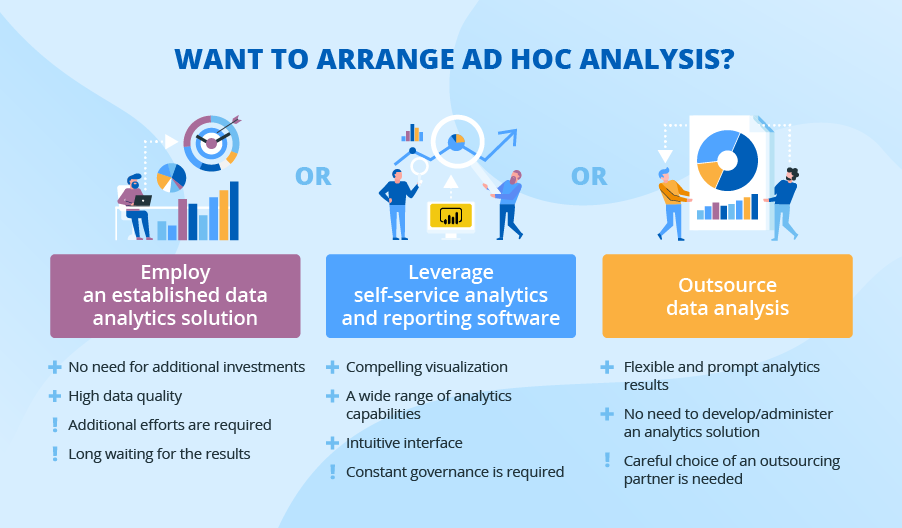
Generally, there are three ways to arrange ad hoc analysis:
Employ an established data analytics solution
If you have a centralized analytical solution, you can already carry out ad hoc analysis with existing software. Still, the following steps should take place to enable that:
Defining report requirements.
Deciding on what data sources to integrate to conduct the analysis.
Performing the required data management procedures – data cleansing, grouping, modeling, etc.
Reporting data in an easy-to-digest format.
Among this option’s benefits are the absence of additional investments and ensured high data quality in case of proper data management procedures arranged in your company.
However, you can see that ad hoc analysis requires additional efforts in this case. Consequently, business users may wait for the analytical results from 1 hour to two weeks, depending on the employed analytical solution, the report complexity, the data management procedures, and much more. So, I consider this approach inefficient in today’s business environment because of the two main reasons:
Business users aren’t self-sufficient – they have to address third parties to perform the analysis – the IT department, data analysts or data scientists (depending on the analysis complexity).
Potential delays in obtaining analytics results – ad hoc reports can be gained too late to take advantage out of the insights.
Leverage self-service analytics and reporting software
The second option is to adopt self-service analytics and reporting software. The implementation of such reporting tools, for example, Microsoft Power BI or Tableau, can empower business users in your company to get analytics insights and present them in a visual format without burdening your IT staff and data analysts. Among self-service software benefits are:
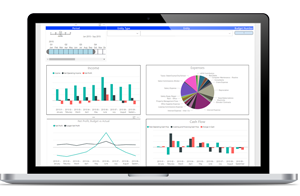
Analytics results are presented in the form of informative and easy-to-digest reports, spreadsheets and dashboards with charts, tables, etc. To see the visualization capabilities of self-service analytics software in detail, watch our BI demo.
A wide range of analytics capabilities
Self-service software usually has a set of basic analytical features for beginners and more advanced capabilities for competent users.
Thanks to such functionality as drag and drop, drill-down, natural language processing, etc., self-service software is rather easy to master.
However, you should remember that a self-service analytical solution with ad hoc capabilities requires constant governance to ensure data security, data accuracy and consistency, and high quality of data analytics results.
Ready to Speed Up Your Decision-Making?
ScienceSoft will implement/upgrade your data analytics solution with self-service capabilities or become your data analytics vendor to help you benefit from ad hoc analysis and reporting.
Outsource data analysis
The last option from the list is to outsource your data analysis to a vendor. It may be a one-time data analysis or continuous engagement with an agreed number of ad hoc reports of specified complexity on a subscription fee basis.
The advantages of this option are quite obvious – you obtain flexible and prompt analytics results with no need to develop or administer an analytics solution. However, to reap the above benefits, you have to carefully choose your outsourcing partner. If you need to dig deeper into this issue, check out the overview of data analytics outsourcing written by my colleague Irene Mikhailouskaya. There she covers typical concerns, such as data security, when outsourcing data analysis and gives tips on how to proactively deal with them.
Your business users can have the answers to all their questions promptly!
With the capabilities of ad hoc analysis and reporting, you can streamline your decision-making, increase operational efficiency, and gain flexibility in the ever-changing business environment. If you feel like obtaining these benefits but can’t choose among the options I’ve listed above or need help with their implementation, you can always resort to ScienceSoft’s help.
The new 13-inch M4 iPad Pro is really, really thin. That’s inevitably going to make certain aspects of repairing the device even more difficult, which iFixit confirmed in a teardown published this weekend. But it does shine in one area — when it comes to replacing the battery, Apple made some seriously helpful changes.
“For the first time in an iPad Pro, we’re able to remove the battery immediately after removing the screen,” Teardown Tech Shahram Mokhtari wrote in a blog post. Mokhtari notes that “immediately is relative,” as there are still some screws and brackets to remove before the battery can be taken out, and the video documenting the process shows it takes a bit of work to get to the pull tabs beneath the batteries, but the new setup still shaves hours off the process compared to earlier models.
“The fact that you can remove the battery without having to remove every major component inside this device is still a huge win for repairability,” Mokhtari says in the video. “It’s a massive improvement over the previous generation.” Everything else, on the other hand, is going to be pretty tricky to repair without causing damage. “From the daughterboard to the speakers and coax cables, we found a whole bunch of stuff that’s glued down because there just isn’t enough space for screws.”
And, the teardown shows the new Apple Pencil Pro is a repairability nightmare. Mokhtari — who got cut by the Pencil while trying to get to its insides — called it “a disposable piece of crap once the battery dies.”
In this weekly column, Android Central Wearables Editor Michael Hicks talks about the world of wearables, apps, and fitness tech related to running and health, in his quest to get faster and more fit.
This week, Polar released a 22mm “Payment Wristband” with an NFC chip embedded into the strap, enabling tap-to-pay if your watch doesn’t support it. We haven’t seen tech-filled watch bands since the early days of Pebble and Galaxy Gear, but Polar’s modular tech has me curious if this abandoned idea deserves a renaissance.
Smart straps died for several reasons. Put tech in a strap, and it naturally loses its flexibility, is more prone to failure, requires a power source, and is generally less comfortable. It also prevents users from swapping in their own straps since it means losing functionality.
Instead, with massive watches like the Apple Watch Ultra 2 on the rise, designers use lightweight bands as crutches to offset the extra weight. A thick, tech-filled band would be counterproductive.
With that context, it’s hard to imagine why anyone would want “smart straps” to return. Still, handled correctly, smartwatch bands have untapped potential, and some companies have begun to explore that potential.
A brief, ill-fated history of ‘smart’ watch bands
The original Galaxy Gear, with its visible camera bump. (Image credit: Android Central)
The original Samsung Galaxy Gear packed a 720p camera with autofocus, two mics, and a speaker into its band. Samsung’s engineers saw that extra band space as an opportunity to keep the main watch more compact, instead of cramming everything into one space.
Our original reviewer called the 73g Gear “bulky and uncomfortable” and the strap’s camera sensor a “wart.” Samsung’s engineers agreed. The Gear 2 moved the camera and mic/speaker tech onto the watch, and future iterations like the Gear S2 had a much greater focus on style and comfort. From then on, you could swap any band onto a Gear or Galaxy watch without losing essential tech.
Companies have tried to put smart watch bands on watches before, but they never took off.
In that same early era, Pebble launched Pebble Time, its 2nd-gen watch, on Kickstarter with a unique “Smartstraps” gimmick. It featured a “smart accessory port” so third-party strap makers could pack tech and sensors into their straps that would sync directly with the watch.
Get the latest news from Android Central, your trusted companion in the world of Android
Pebble offered $1 million in funding for Smartstrap devs, promising users add-ons like GPS, heart rate, or extended battery life. There was even an NFC payment strap from Pagaré. However, once Fitbit acquired the failing Pebble brand the following year, the concept died before it could truly begin.
These “optional” health and fitness add-ons became default features in fitness watches over time. Watch designers have become so efficient at squeezing useful components into a 13mm case that pushing tech into a thick band would unnecessarily complicate matters.
The Pebble Time (2015) (Image credit: Android Central)
Sony took a different approach, selling standalone smart straps that you attach to non-smart luxury watches. Its 2015 Wena Wrist Pro tracked your steps, calories, and sleep. It even had a bizarre sliver of an OLED screen that displayed tiny contextual data along your wrist. However, its excessive price and limited features made it a novelty that never caught on.
It also sold a standalone fitness tracker with built-in GPS and HR data called the Wena Wrist Active. I mention it because Sony designed it with a unique connector that lets you mount any watch onto its front, adding classic style while keeping the health data.
Besides the 2013 Hands On Talk Watch, which had a mic and speaker embedded in the strap (thanks Wikipedia), I don’t know of any other smartwatches with smart bands. The concept seemed to die off quickly, as most brands emulated Apple or Galaxy Watches in design.
The perks and challenges of modular watch upgrades
(Image credit: U.S. patent office; Fitbit)
Polar’s €59 Payment Wristband has one straightforward application: It is designed to make consumers pay for NFC themselves rather than add the tech to its Polar Vantage V3 or other watches. It’s a niche tool, unlikely to achieve high sales, but still quite useful.
Are there other smartwatch “extras” that could fit inside a 20mm or 22mm watch band? It’s complicated.
Ultramarathoners would love the original Pebble concept of a battery-enhancing, swap-on strap. Here’s the problem: You’d need an energy-receiving port in the strap connector — probably not Quick Release-compatible — and engineers would need to keep the band light and flexible despite how thick batteries typically are. Plus, encasing batteries in TPU material leaves them vulnerable to damage and failure.
(Image credit: Derrek Lee / Android Central)
I don’t have a design or engineering background, but an add-on strap with Ultra Wideband seems more feasible. UWB lets iPhone 15 owners pinpoint their lost Apple Watch or use their watch as a digital car key; the next Pixel Watch could add UWB as well. But an UWB strap, like an NFC strap, could theoretically work as a standalone add-on for any watch.
Straying freely into wish-fulfillment territory, I suspect most Garmin watch fans would love a strap that added LTE compatibility. Since the Forerunner 945 LTE, they’ve waited in vain for more cellular options that would make Garmin watches more useful in emergencies.
Like a battery strap, though, an LTE strap would be difficult to implement. Despite how small a 5G chip is, a standalone receiver with the necessary power source would be the opposite of portable. You’d need a physical connection through the strap to the main CPU, and I just don’t know if that would work.
For any other potential watch add-on, the engineering challenge alone makes it more likely that smartwatch brands would simply…put the tech in the watch. For example, you might assume a band could track an athlete’s sweat loss, but this Apple patent shows how a watch would track that data directly from the main body.
The future of smart straps
(Image credit: Meta)
Currently, the only practical application I know of for a dynamic watch strap is found on portable blood pressure watches. Several models have inflatable straps that expand during BP readings for more accurate results, in theory. I couldn’t tell you if the Galaxy Watch 6‘s BP readings are more or less accurate with a normal watch band.
The next frontier is all about neural interface bands. Think of the Double Tap feature made popular with the Apple Watch, only with much better accuracy because these bands can read the signals from your brain, knowing that you intend to make a pinching motion even if your fingers barely move.
The Mudra Band, released this year, replaces your typical watch strap and becomes a neural controller for any Apple computer, TV, Vision Pro, or other devices. Tech nerds could get a lot out of this, though it costs nearly as much as the Series 9 itself.
Meanwhile, Meta is making its own neural EMG band, promising mid-air typing to chat with an AI. CEO Mark Zuckerberg claims the “neural interface continuously gets better over time at understanding each person” and says it’ll be product-ready in a couple of years. I’d have to assume it’ll be pricey, as well.
Perhaps that’s the future of smartwatch strap tech that we should expect: expensive, niche, a bit gimmicky, and with cool implications. More straightforward smart straps with feature additions or battery enhancements sound pretty neat in theory, but a bit too impractical and costly to the consumer for companies to invest in the idea.
I recently landed a job offer after about a year on and off job hunting. I went through a ton of phone screens, video interviews, case study assignments and several in-person rounds and these are the notes that I’ve come up with.
That being said, I think these tips will be most applicable to early career, non-technical, whitecollar jobs. Most of the companies I applied to used internal recruiters and most of the roles I applied to I’d call “stretch roles” based on my background and experience.
Typical Interview Process:
1. Application
The goal here is to get your resume read and to move on to the phone screen phase. Make sure your resume is at least somewhat aligned with the job description/requirements.
Make it easy to read and make it full of good examples. How did you go above and beyond in your role and by how much? Anybody can follow directions from their manager but how did you go beyond that? How did you crush your goals? How did you take initiative and improve a process? How were you a resource for those around you?
TLDR: Make it easy to read and use accomplishments instead of responsibilities
2. Phone Screen with Recruiter
This is typically a quick call to make sure both parties are aligned. Share a quick background, career goals, salary expectations, etc.
Most of this call should be taken care of with preparation. Write out (AND PRACTICE) your elevator pitch. I ended up getting my practice through interviews but it got me flustered and I probably lost out on some opportunities by not being prepared.
Be ready for the common questions:
“Tell me about yourself/your work history”
Lead them through your resume but tell them the things that your resume doesn’t say. How did you make your bosses/coworkers’ lives easier? How did you go about taking new responsibilities? How did you become an expert/resource for the people around you? Show that you go above and beyond and that you want to learn.
“What are you looking for in your next role?”
Use the job description and responsibilities to help answer this (hopefully it actually aligns with what you’re looking for) Try to give examples or types of work/projects you enjoyed working on in the past and why you liked/disliked them.
Tip: You’re excited about an opportunity to learn.
Be Prepared for Possible Weeding Questions:
Does the job require Excel? Be prepared to tell them what your favorite part about excel is (it’s pivot tables).
Is SQL preferred but not required? Be able to describe the difference between left and right joins.
Googling “Common _____ Interview Questions” goes a long way
Drop some keywords that are in the job description and prepare some questions about the role and company. If your career goals are aligned with the company, you meet the basic requirements and you sound excited about the role – you’ll likely move to the next round.
TLDR: Practice. Align your goals/background with the role. You are excited about the role and want to learn (This is what might get you past being underqualified).
3. Phone/Video Interview with Hiring Manager
This is a deeper dive into the fit for the role. You’ll likely get some tougher questions to test your knowledge and experience. Learn more about the day-to-day of the role, reiterate your interest and excitement in the role.
Use this call to really think about if this role (and manager) would be a good fit for you. See below for more questions you can ask.
4. In Person Interview with Team
This is it. The last round. Come in confident that you’ve made it this far and try to frame it as you interviewing them. Be friendly and be someone that you would want to work with/around.
For onsite interviews, come prepared with specific questions in mind for each person you’ll be speaking with. You can usually ask your recruiter if you should touch on certain topics with certain people you’ll be meeting with. Tailor your questions to each role:
Upper Management:
Questions around company goals and direction.
What are some of the goals for this year/quarter and how has progress been?
What excites you the most about getting this role filled?
Do you read business books for self improvement? Do you have any that really stood out to you?
Hiring Manager:
Questions around how you can make their life easier, expectations and management style.
What is one area of your jobs you wish you had more time to focus on?
What are you expecting from me out of this relationship, what type of people do you work best with and how would you describe your management style?
(If position is backfill) Can you name a time the person in the position really went above and beyond?
Peer:
Questions about the day to day, work hours, different perspective about your boss
What are your normal work hours like? Do you ever get to work from home?
What is your favorite thing about working here?
If you could change/improve one thing about the job, what would it be?
Member of another team:
Questions about team structure and how they interact. Also a chance to get a (somewhat) unbiased view of the team/company
What is an example of when the previous person in the role really went above and beyond for you and your team?
IMPORTANT: When interviewing in person, try to ask relevant questions throughout the session instead of sending a barrage of questions at the interviewer at the end. Don’t interrupt them, but take advantage of lulls in the conversation or ask right after you finish answering one of their questions. It makes the experience more conversational and makes you look more interested.
I really hope this helps. You might face a lot of rejection (I certainly did) but it could be for a million different reasons so try not to sweat it. This information obviously won’t be applicable to all situations and roles, so take from it what you like.
The only thing you can control is your preparation and your attitude (which can get you quite far). Good luck!
Conclusion
Remember, tailoring your resume and cover letter to each job application and effectively communicating your remote work readiness are key. Persistence and continuous learning are your allies.
Are you searching for a remote job and need help finding where to look? We are a remote job board with the latest jobs in various categories to help you and join like-minded people in our LinkedIn and Facebook community.
Managing your work time effectively is just the starting point. Once you’ve found extra space in your calendar, you must focus on things that deliver the biggest bang for your buck. Five business leaders told us how to ensure you spend time on the right activities.
1. Focus on the big rocks
Nigel Richardson, SVP & CIO Europe at PepsiCo, told ZDNET it’s important for professionals to manage their energy. If you’re tired from working on too many things, you won’t improve the business.
Richardson said you must ensure your energy is directed to what he calls big rocks: “What are the few things that will make the difference?”
As well as being important to you, these big rocks need to align with the aims of the broader organization.
“I share with my team the five most important things I’m working on,” he said. “And I then have a very rigorous process to document things weekly and monthly. I do a check to say, ‘OK, did I spend the right time on those things?'”
Richardson said people who don’t focus on big rocks could be distracted by smaller, non-value-adding activities.
“Manage your energy, be clear on the focus areas, and share it with all the people who matter, so that everyone else knows the targets and can be very disciplined in the execution.”
2. Categorize your tasks
Toby Alcock, CTO at Logicalis, said it can be easy to think that ticking off a completed task on your list means you can move on to something else. However, it’s important to work with more haste and less speed.
“The tyranny or urgency is always the biggest trap for any leader,” he said. “It’s common to think that getting the most important thing done means you get some strategic time back.”
Alcock said professionals who climb the career ladder will find their diaries full of a complex mix of strategic activities and day-to-day requirements. Categorizing those tasks is crucial.
“My role is strategic,” he said. “I must look to the horizon and know what’s coming next. But like anyone else, I can get bogged down in urgent requests. Having something simple, like color-coding my diary, is something I’ve found powerful.”
Alcock also told ZDNET that networking with connections, peers, and colleagues will help you understand important activities.
“Operating in an ivory tower means you’re guaranteed to fail,” he said. “We’ve got 7,500 staff around the globe. I want to spend time with them seeing what they’re doing for our customers because they’re coming up with great ideas. So, I think networking and being intentional about strategic time is critical to focusing on the right activities.”
3. Take a data-driven approach
Tim Lancelot, head of sales enablement at software specialist MHR, said it’s easy to feel swamped by tasks in a modern professional environment. One way to avoid sinking is to ensure you know how smaller issues fit into broader business concerns.
“Start with the whole and move to the part,” he said. “Make sure you get the 30,000-foot view before you get stuck into the finer details. From there, get to a point where you can measure. Be data-driven in your decision-making.”
Lancelot said facts and figures that prove the criticality of a business problem will help you make smart decisions rapidly and effectively.
“Don’t get overwhelmed by the number of problems you face,” he said. “Use the data to objectively say, ‘Well, by some measurement, this is the biggest problem to fix.’ That approach means you’re spending your time and resources as effectively as possible.”
Lancelot told ZDNET this methodical stance helps you spend time on the right activities.
“Don’t try to solve 10 problems at once,” he said. “Try to solve at least one problem to an acceptable level and move on to the next one. You might come around the loop and solve that problem to a deeper level later.”
4. Concentrate on long-term goals
Jessie Sobel, VP of strategic growth initiatives at Freshpet, said the best way to ensure you spend the time on the right activities is to choose a few priorities.
Sobel’s role at Freshpet is to identify new business opportunities. She focuses on prioritizing the initiatives she believes will help the company grow.
“The majority of my role is focused on looking at some long-term initiatives but also implementing and executing them. The number of initiatives we execute is limited based on priorities,” she said.
Yet even someone like Sobel with tightly defined core roles and responsibilities has to deal with other peripheral issues: “We have day-to-day needs for the business, but that’s just the mix of everyday working life.”
Sobel told ZDNET she tries to keep her eyes on the main prize as much as possible, including Freshpet’s recently launched Custom Meals proposition, which creates personalized orders using Ordergroove’s API technology.
“In this project, that’s not necessarily just about market opportunity,” she said. “It’s about managing some of the capabilities we build on our digital platforms. It’s also about knowing where to build out some of our resources in the organization, too.”
5. Follow your passion
Richard Wazacz, CEO at foreign exchange specialist Travelex, told ZDNET that being passionate about an activity makes it easier to focus on areas that will give you experience, mastery, and credibility.
As a chief executive of a fast-growing business, Wazacz uses his entrepreneurial aptitude to ensure his time is spent on value-adding activities.
“I always go back to the question, ‘What are the biggest problems my customers and colleagues face? What part can I play in unlocking them?'” he said.
“Sometimes that approach is about making sure I hire the right people. Sometimes it’s about creating the right environment. Sometimes it’s about rolling my sleeves up, looking at the data, and seeing if I can generate a hypothesis for the problem.”
Spending time on the right activities involves a blend, said Wazacz: “There’s no magic answer, such as allocating a percentage to different things.”