Samsung is offering an open enrollment period for Samsung Care Plus until June 30.
This program is available for owners of the Galaxy S24 series, Z Fold 5, and Z Flip 5.
Traditionally, enrollment in Samsung Care Plus is limited to the first 60 days after purchase.
Samsung is extending a helping hand to Galaxy smartphone users who missed the initial window to sign up for its comprehensive device protection program, Samsung Care Plus. This first-ever open enrollment period, available from now until June 30, offers a second chance for peace of mind for owners of the Galaxy S24 series, Z Fold 5, and Z Flip 5.
Traditionally, Samsung Care Plus enrollment is limited to the first 60 days after purchase. The program offers a suite of benefits, including unlimited repairs for accidents such as drops and spills, mechanical breakdowns, and even theft and loss (depending on the plan).
But is Samsung Care Plus worth the cost? This is a question that potential subscribers need to weigh carefully. The monthly subscription fees can range from around $10 to $18, while two-year plans can cost up to $350, depending on the device and the specific plan chosen.
On the other hand, the cost of repairs for these premium Galaxy smartphones can be substantial. For instance, a screen repair for the Galaxy S24 Ultra could set you back $259, while fixing the inner screen of a Galaxy Z Fold 5 could cost a staggering $539. A single repair incident like this could easily surpass the cost of a year or two of Samsung Care Plus coverage.
As premium smartphones become increasingly expensive, the appeal of comprehensive protection plans like Samsung Care Plus grows stronger. For Samsung, this open enrollment is a strategic move that not only generates additional revenue but also fosters customer loyalty by showcasing a dedication to post-purchase support. In an increasingly competitive market, such initiatives can significantly change consumer perception.
Got a tip? Talk to us! Email our staff at news@androidauthority.com. You can stay anonymous or get credit for the info, it’s your choice.
More than a decade after its debut on antiquated consoles, Grand Theft Auto 5 is still a cash cow for Rockstar and its parent company Take-Two. Speaking today during Take-Two’s Q4 quarterly earnings call with investors, CEO Strauss Zelnick confirmed that the game has now sold “approximately” 200 million copies, up from the “over 185 million” copies it had sold as of August last year.
Meanwhile, the audience for both GTA 5 and GTA Online grew by 35% and 23% respectively during the last fiscal year. That period has seen GTA 5 appear on subscription services like Xbox Game Pass, which hosted GTA 5 for six months in 2023, and Sony’s PS Plus service. Leaving that aside, to sell around 15 million units of an 11-year-old game is still significant. Just for the fun of it, compare those 15 million units with the best selling game of 2023, Hogwarts Legacy, which sold 22 million as of January 2024 (it released in February 2023).
That obviously bodes well for GTA 6, which now has a release window of “fall 2025“, though that’s for consoles: a PC release will come later, as is Rockstar’s wont.
Zelnick even acknowledged GTA Online’s thriving roleplaying community, which is a big reason why the game still ranks highly on Twitch. “Grand Theft Auto V also reclaimed its top spot as the most watched video game across all platforms according to Streamhatchet, thanks largely to the tremendous viewership from the series’ thriving role play community,” Zelnick said.
Take-Two isn’t relying on GTA 5 to put food on the table. NBA 2K24 was a big success, despite generally mediocre reviews from critics and players alike. Complaints generally point to the game’s distracting microtransactions, but they’re clearly doing their job: the game “surpassed our expectations, as players responded to our promotions, in-game content strategy, and updates within Seasons.” It’s sold 9 million copies to date.
Finally, Red Dead Redemption 2 has now sold 64 million copies since its release in October 2018. Not bad, for a game that has only shipped on one console generation (GTA 5 has shipped on three). Presumably those are the kinds of numbers you need to avoid abrupt (and ambiguous) studio closures in this year of our lord 2024.
Keep up to date with the most important stories and the best deals, as picked by the PC Gamer team.
From an engineering viewpoint, a prototype is a preliminary version of the intended final product. A prototype doesn’t need all the features and functionalities of an end product, but it should correspond well to the desired design, shape, size, and aesthetics. The idea behind a prototype is to let designers and engineers evaluate the product’s working principle, usability, and specifications. The prototype is constantly refined and improved throughout product development until it transforms into a “final” prototype before the design enters the mass-production phase.
Continuous development in manufacturing technology has arrived at a point where prototyping is no longer expensive and time-consuming. Rapid prototyping with 3D printing or CNC machining can fabricate complex objects using plastic and metal materials directly from CAD models. Most importantly, nearly all rapid prototyping services and freelancers specialize in low-volume custom fabrication works.
Rapid Prototyping Methods
Some people use the terms “rapid prototyping” and “3D printing” interchangeably, although they are not the same things. 3D printing is simply one method to achieve rapid prototyping by additive manufacturing, which includes popular options such as:
Fused Deposition Modeling (FDM): one of the most affordable 3D printing processes to build parts from plastic materials. However, an industrial-grade FDM can also print objects from carbon fiber and metal powder (infused with plastic filament).
Stereolithography (SLA): SLA is a better rapid prototyping method than FDM for objects that require a smooth finish and fine details. The process does not use plastic filament but liquid resin as the base material to produce transparent/translucent parts.
Selective Laser Sintering (SLS): powdered polymers are melted (shaped) layer by layer using a laser. The method is best when building a functional prototype that can withstand rough handling.
Material Jetting: droplets of photopolymers are deposited through a nozzle on a build plate. Exposure to light will cure the droplets quickly, allowing the machine to build an object layer by layer. The method allows for the fabrication of an object using multiple different materials.
Binder Jetting: a liquid agent binds a specific region of a layer of powder material to build a shape. The process continues from one layer to another until the material transforms into the desired physical object. The used powder material can be plastic, metal, wood, or ceramic.
Sheet Lamination: while technically a 3D printing method, sheet lamination differs from the abovementioned methods. It works by stacking sheets of material and cutting them to create the final shape. Usable materials include paper, metal, and plastic. The material can be fused in various methods, such as heat and sound. Sheet lamination is a blend of additive and subtractive manufacturing.
CNC Machining: an example of a subtractive manufacturing method, CNC machining builds an object or parts of an object by cutting, milling, drilling, and manipulating a single block of material. The technique is ideal for creating metal parts but can handle plastic just fine. CNC machining is the best rapid prototyping option when high accuracy and tight tolerances are crucial.
There are many best methods to cover your rapid prototyping needs. It all depends on which phase of product development you currently stand. Early in the design process, a simple non-functional model should be good enough as a proof of concept. You can even make it from the cheapest material available to reduce cost. As the development progresses and another prototype is needed, you may want to produce a functional or beta prototype that closely resembles the intended final product in terms of material, finishes, and structural strength. You can also build the proof-of-concept with 3D printing services and the final prototype with CNC machining.
Regardless of the rapid prototyping method utilized during fabrication, the design part always follows the same progression path. The first step is to prepare the digital drawing. Using CAD software, the prototype designer creates a three-dimensional illustration of the part to be prototyped. You can also purchase a ready-made 3D model from online marketplaces. The file is saved in a format readable by the prototyping equipment. Most 3D printers can fabricate the part (based on the file) with only minor adjustments. In contrast, a CNC operator has to translate the file into a programming command the machine can execute.
Some prototypes might need assembly, especially when they comprise multiple parts that must be created one at a time. Then, there is the finishing part, which usually involves washing, polishing, or applying colors.
Why Rapid Prototyping?
A primary advantage of rapid prototyping is that it allows businesses and everyday inventors to have proof-of-concept as early as possible during product development. Unlike conventional manufacturing methods (such as injection molding), rapid prototyping is a budget-friendly option for low-volume production. Ordering a small batch of custom-made parts has become economically viable. Most freelancers in the 3D printing or CNC machining industry do not have a strict minimum order quantity. You can place an order for one item.
Customizability is another strong point of rapid prototyping. Advanced 3D printing technology can handle even the most complex geometries and intricate structures that are otherwise cost-prohibitive to create with other manufacturing methods. Tooling is no longer an issue because a 3D printer is essentially a mini factory capable of creating just about any object in any shape imaginable.
The same thing applies to CNC machining, although it is more flexible than 3D printing in terms of customization. If your prototype is supposed to have complex internal structures, CNC can only do so much to drill and mill the material. The only workaround is to machine the parts separately. For instance, a gun is a more complex object. Still, a single CNC machinist should be able to create a functional prototype of a revolver or rifle by producing the parts individually.
Rapid Prototyping Rates
There isn’t a universal price range for rapid prototyping services. Every prototype is different, and the clients, whether established companies or early investors, will likely have specific requirements and details. In most cases, the most significant factors to affect prices are as follows:
Prototyping process: each method has its advantages and potential drawbacks. For example, an FDM is more affordable than an SLS, and the final product quality reflects the price.
Prototype parameter: the size, shape, and complexity will also affect the price. Some materials are more expensive than others, and at the same time, certain materials require different processing techniques or finishing.
Location: the rapid prototyping facility location also matters, assuming you order online. Not only does location determine shipping fees, but also labor costs.
Still, developing a ballpark figure to gauge the average price you should expect when hiring rapid prototyping services from freelancers in the U.S. and Canada is not impossible. Types of material and level of details must be taken into account. With that in mind, you can categorize the services into three major groups, including functional parts (made of ABS or PLA), figurines (transparent or high-grade resin), and metal objects (stainless steel, brass, or sterling silver).
Let us say you want to have a straightforward, functional caster prototyped from either ABS or PLA. The diameter should be big enough for a typical beer mug but not overly large that it looks out of place on a coffee table. One PLA caster should cost around $2.50, whereas the ABS variant is about twice as much. An SLS nylon caster falls in between at $3.50 plus shipping.
As for the figurine or miniature, you might want a smooth finish and good details. A figurine the size of a small USB stick (about 5cm) is priced at no less than $20 for transparent resin or closer to $25 for high-quality resin. The cheapest option is a standard resin figurine, which should cost about $5 per piece.
Metal objects cost a lot more. They require more complex processing and more expensive materials in the first place. For instance, a jewelry metal bracelet with a diameter of 6cm costs nearly $400 for the sterling silver model and around $200 for the brass option.
When your rapid prototyping project calls for a subtractive (as opposed to additive) manufacturing method, CNC machining is one of the most viable options. Most CNC shops operate on a price/hour basis, so your best bet is to provide as detailed CAD drawings as possible to reduce setup time. You can also give the material to the shop to avoid the small percentage price markup. In the United States, the average rate goes from $60/hour for simple objects in large quantities to $150/hour for complex objects.
Rapid prototyping, with both additive and subtractive manufacturing methods, primarily aims to reduce the time spent on the early product development process. Rapid prototyping cannot produce anything beyond proof-of-concept unless the product is all-mechanical, such as a bicycle bell, an automatic watch, or an eyeglass frame. If the product has electric circuitry of any sort, the PCB must be assembled or prototyped using different methods.
Cad Crowd’s Rapid Prototyping Freelancers Can Help
Contact Cad Crowd for a qualified and trusted 3D designer or rapid prototyping engineer to complete your project; you won’t regret it. The benefits are staggering.
We could list the numerous companies that choose to use this technology or the variety of new methods cropping up practically daily to meet the world’s increasing demand for rapid prototyping. Still, we’ll leave you with an examination of the beautiful benefits the technology can offer you. Look at everything it can do, and don’t hesitate to jump on board with the wave of the future.
Look at how it works, or contact us today for a free quote if you’d like to get started immediately.
Whether looking for new adventures, epic storylines or games to play with a friend, GeForce NOW members are covered.
Start off with the much-anticipated sequel to the Men of War franchise or cozy up with some adorable pals in Palworld, both part of five games GeForce NOW is bringing to the cloud this week.
No Guts, No Glory
For the cloud!
Get transported to the battlefields of World War II with historical accuracy and attention to detail in Men of War II, the newest entry in the real-time strategy series from Fulqrum Publishing.
The game features an extensive roster of units, including tanks, airplanes and infantry. With advanced enemy AI and diverse gameplay modes, Men of War II promises an immersive experience for both history enthusiasts and casual gamers.
Gear up, strategize and prepare to rewrite history. Get an extra fighting chance with a GeForce NOW Ultimate membership, which streams at up to 4K resolution and provides longer gaming sessions and faster access to games over a free membership.
Cloud Pals
Pal around in the cloud.
Step into a world teeming with enigmatic creatures known as “Pals” in the action-adventure survival game Palworld from Pocketpair. Navigate the wilderness, gather resources and construct a base to capture, tame and train Pals, each with distinct abilities. Explore the world, uncover secrets and forge alliances or rivalries with other survivors in online co-op play mode.
Embark on adventure with these trusty Pals through a GeForce NOW membership. With a Priority membership, enjoy up to six hours of uninterrupted gaming sessions, while Ultimate members can extend their playtime to eight hours.
Master New Games
More than a one-hit wonder.
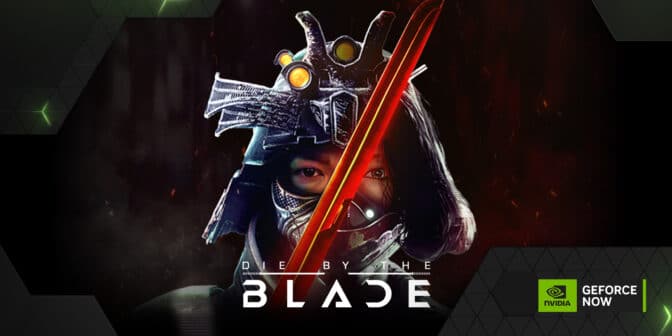
Vanquish foes with a single strike in 1v1 weapon-based fighter Die by the Blade from Grindstone. Dive into a samurai punk world and wield a range of traditional Japanese weapons. Take up arms and crush friends in local or online multiplayer, or take on unknown warriors in online ranked matches. Outwit opponents in intense, tactical battles and master the art of the one-hit kill.
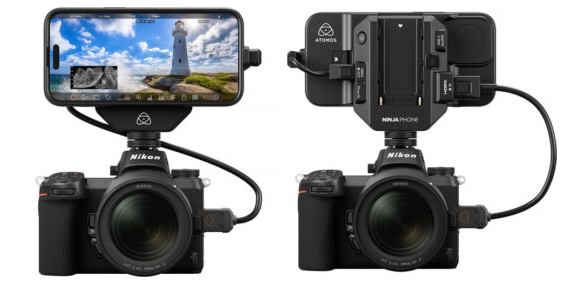
In a groundbreaking announcement, Atomos CEO and Co-Founder Jeromy Young introduces the Ninja Phone, a revolutionary 10-bit video co-processor designed to elevate smartphone filmmaking to professional levels. This blog post dives into the features and capabilities of the Ninja Phone, showcasing its potential to redefine mobile video production.
Key Features and Benefits:
The Atomos Ninja Phone empowers filmmakers with unparalleled capabilities:
Professional HDMI Camera Compatibility: Record high-quality video directly from professional HDMI cameras onto smartphones and tablets.
ProRes and H.265 Encoding: Capture footage in 10-bit ProRes or H.265 format, ensuring exceptional HDR quality.
Seamless Integration with iPhone 15 Pro: Utilize the iPhone’s OLED display and advanced processing power for professional monitoring and recording.
Ninja Phone iPhone App: Control and coordinate operations through a dedicated app, enabling effortless filming in both landscape and portrait orientations.
External Accessories Support: Integrate wireless microphones and other professional add-ons via USB-C hubs for synchronized audio and video recording.
Versatile Power Options: Power the Ninja Phone using standard NP series batteries, a battery eliminator, or a USB-C 5V/3A input for extended filming sessions.
Secure Cable Management: Benefit from a rugged locking ecosystem for HDMI and USB-C cables, ensuring reliable connections during filming.
Optimized Filmmaking Experience:
The Ninja Phone delivers an optimized filmmaking experience:
Enhanced Display Quality: Enjoy a 2,000,000:1 contrast ratio, Dolby Vision, HDR10, and HLG support, and 11 stops of dynamic range with a peak brightness of 1600 nits.
Cloud Services Integration: Leverage Atomos’ Cloud Services (ACS) for efficient camera-to-cloud workflows, remote live production, and cloud-based editing.
Compatibility with Leading Cameras:
Atomos’ collaboration with leading Japanese camera manufacturers ensures seamless compatibility with popular mirrorless camera models, including Fujifilm, Canon, Sony, Nikon, and Panasonic.
The Atomos Ninja Phone is set to revolutionize smartphone filmmaking by combining professional-grade capabilities with the convenience of mobile devices. Stay tuned for the release of this game-changing product and elevate your filmmaking endeavors to new heights with Atomos’ innovative technology.
I am trying to operate switch from a python script outside Unity. It is basically a sphere thrown at a wall; when I use keyboard, the game is working fine; as soon as I use TCP/IP I see Debug print statements in the console, but not the ball appearing in the game. What can be causing this? Code:
using UnityEngine;

public class SphereThrower : MonoBehaviour
{
    public GameObject leftSpherePrefab;
    public GameObject rightSpherePrefab;
    public Transform leftWall;
    public Transform rightWall;

    private GameObject currentBall;

    private Vector3 leftSphereInitialPosition;
    private Vector3 rightSphereInitialPosition;

    void Start()
    {
        if (leftSpherePrefab != null && rightSpherePrefab != null)
        {
            leftSphereInitialPosition = leftSpherePrefab.transform.position;
            rightSphereInitialPosition = rightSpherePrefab.transform.position;


            leftSpherePrefab.SetActive(false);
            rightSpherePrefab.SetActive(false);
        }
        else
        {
            Debug.LogError("Left or right sphere prefab is not assigned!");
        }
    }

    public void HandleTrigger(string trigger)
    {
        switch (trigger)
        {
            case "0":
                Debug.Log("Trigger 0: Throwing left sphere.");
                ThrowSphere(leftSpherePrefab, leftSphereInitialPosition);
                break;
            case "1":
                Debug.Log("Trigger 1: Throwing right sphere.");
                ThrowSphere(rightSpherePrefab, rightSphereInitialPosition);
                break;
            case "L":
                Debug.Log("Trigger L: Moving ball to left wall.");
                MoveBallToWall(currentBall, leftWall.position);
                break;
            case "R":
                Debug.Log("Trigger R: Moving ball to right wall.");
                MoveBallToWall(currentBall, rightWall.position);
                break;
            default:
                Debug.Log("Invalid trigger received: " + trigger);
                break;
        }
    }

    void ThrowSphere(GameObject spherePrefab, Vector3 initialPosition)
    {
        if (currentBall != null)
        {
            Destroy(currentBall);
        }

        currentBall = Instantiate(spherePrefab, initialPosition, Quaternion.identity);
        currentBall.SetActive(true);
    }

    void MoveBallToWall(GameObject ball, Vector3 wallPosition)
    {
        Vector3 direction = wallPosition - ball.transform.position;
        direction.Normalize();

        Rigidbody rb = ball.GetComponent<Rigidbody>();
        if (rb != null)
        {
            rb.velocity = Vector3.up * 5f;
            rb.useGravity = true;
        }

        if (rb != null)
        {
            rb.velocity += direction * 5f;
            Destroy(ball, 6f);

            Debug.Log("Distance to left wall: " + Vector3.Distance(ball.transform.position, leftWall.position));
            Debug.Log("Distance to right wall: " + Vector3.Distance(ball.transform.position, rightWall.position));
        }
    }
}
**TCP/IP Code:**
using UnityEngine;
using System.Net;
using System.Net.Sockets;
using System.Text;
using System.Threading.Tasks;


public class communication : MonoBehaviour
{
   public SphereThrower sphereThrower; // Reference to the SphereThrower component


   private TcpListener server;
   private int port = 5680; // Choose a port for your TCP server


   void Start()
   {
       // Start TCP server
       server = new TcpListener(IPAddress.Loopback, port);
       server.Start();

       // Begin accepting clients asynchronously
       Task.Run(() => AcceptClients());
   }


   async Task AcceptClients()
   {
       while (true)
       {
           TcpClient client = await server.AcceptTcpClientAsync();


           // Handle client messages
           Task.Run(() => HandleClient(client));
       }
   }


   void HandleClient(TcpClient client)
   {
       NetworkStream stream = client.GetStream();
       byte[] buffer = new byte[1024];


       while (true)
       {
           int bytesRead = stream.Read(buffer, 0, buffer.Length);
           string message = Encoding.ASCII.GetString(buffer, 0, bytesRead).TrimEnd('\0');


           // Debug log to check if the message is received correctly
           Debug.Log("Received message: " + message);


           // Call HandleTrigger method of SphereThrower
           sphereThrower.HandleTrigger(message);


           // Check if the loop is terminating properly
           //if (bytesRead == 0)
           //{
             //  Debug.Log("No more bytes to read, terminating loop.");
               //break;
           //}
           //else
           //{
             //  Debug.Log("Bytes read: " + bytesRead);
           //}
       }
   }
}
I am expecting sphere to appear accordingly when I press 0/1 in different software
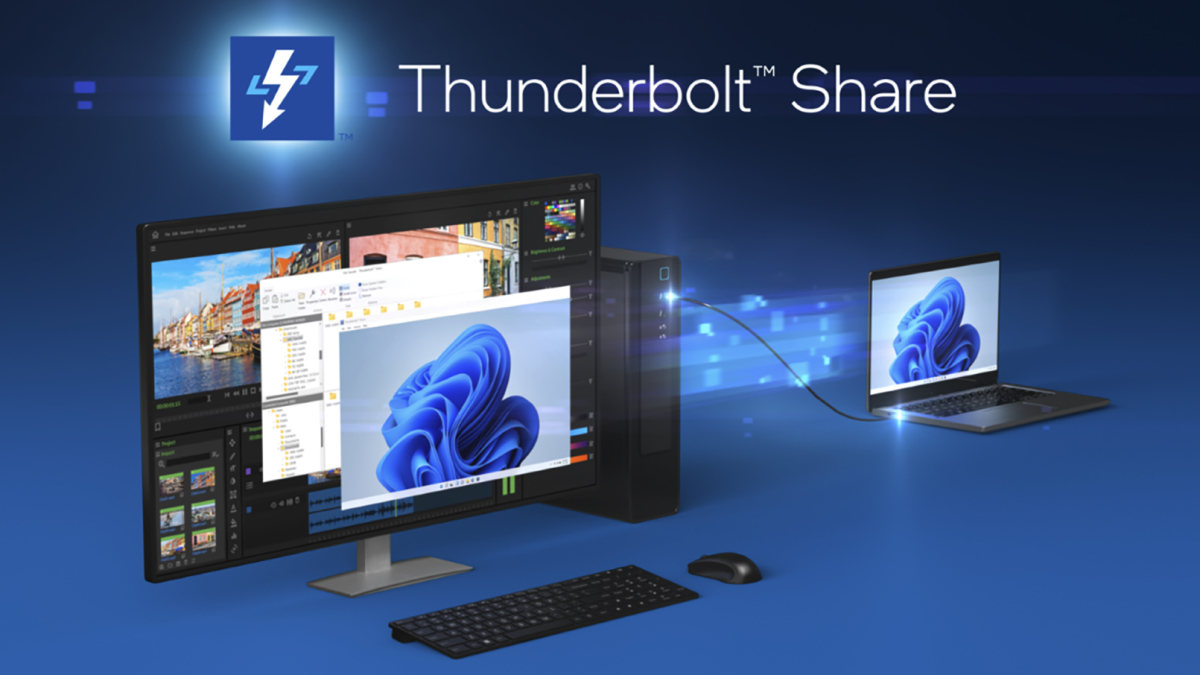
Intel has announced a new feature for Thunderbolt designed to make life easier for folks with both a laptop and a desktop (or just two different PCs they use frequently). Thunderbolt Share allows two PCs to be “networked” together via Thunderbolt to share files, their screens, and connected devices. Intel says this feature is now available to PC OEMs, who can license the technology for their prebuilt PCs, so DIY PC builders can’t partake in the fun.
Thunderbolt Share lets two PCs be connected in several ways. Both can be connected with a physical Thunderbolt cable via a licensed Thunderbolt dock or with both PCs connected to a Thunderbolt display. For example, you’d have a laptop with a Thunderbolt 4 or 5 cable going from the laptop to a desktop PC, and then the PC connected to a monitor. You can then operate both computers on the same display with a mouse and keyboard, share files between them, and so forth. The connection between the computers is established via a new app that has to be downloaded onto both computers, but only one PC has to have a license for Thunderbolt Share.
This new feature lets you accomplish four tasks once they’re connected, and Intel says it’s fast and fluid thanks to high-bandwidth and low latency. Credit: Intel
Once the connection is established, you can perform various activities to share resources between the two PCs using a high-bandwidth connection. For example, you can drag and drop files between the two computers directly in File Explorer or sync folders between them, such as Documents, Pictures, etc. You can also use the feature as a KVM of sorts, as it lets you control the other computer. That allows you to see the display of the second PC and control it with the attached mouse and keyboard. Intel says you can also plug an external drive into the second PC and access it from the first one, reducing the amount of “sneakernet” in your household.
One caveat is that this feature is only supported by the newest versions of Thunderbolt, 4 and 5. Version 5 was just announced last year and isn’t prominent in the marketplace, though version 4 is, at least for laptops, which brings us to the other caveat: Thunderbolt isn’t something you find on many desktop computers. Intel has stated that its upcoming Arrow Lake desktop chips will support Thunderbolt 5, so perhaps it’s about to become more common. Finally, Intel says it’s only being licensed to OEMs, and they can choose whether they want to offer it as a “value add” to their prebuilt computers, so DIY PC builders will not have access to it.
Intel says Thunderbolt Share will be available in prebuilt PCs and accessories in the second half of 2024. Companies such as Lenovo, Acer, MSI, Razer, Kensington, Belkin, Promise, Plugable, OWC, and others will begin offering compatible products later this year.
Much of how people buy food has moved online — restaurants often replace menus with QR codes that let you order with your smartphones, and grocery shopping has been revolutionized with delivery services like Instacart. But until recently, the other side of the food supply chain — how small restaurants and neighborhood groceries procured food — depended largely on physical media, pen and paper.
Now, GrubMarket, which provides software and services that help link up and manage relationships between food suppliers and their customers, is hoping to make the distribution process more digital and efficient via a new acquisition.
California-based GrubMarket recently acquired Butter, a SaaS platform that aims to digitize the traditionally manual food distribution process with AI, the companies exclusively told TechCrunch. Founded in 2020, Butter’s eight-person team will join GrubMarket, and its software suite will be integrated with GrubMarket’s own slate of offerings.
Mike Xu, founder and CEO of GrubMarket, declined to disclose the price of the deal, but Winston Chi, Butter’s co-founder, told TechCrunch that “most parties, including our investors and us, are making money” from the exit.
Butter’s post-money valuation was $39 million when it raised a $9 million Series A in November 2022, per PitchBook (the company confirmed with TechCrunch the reported valuation is roughly correct). Backed by investors including Google’s AI-focused Gradient Ventures, Uncommon Capital, Notation Capital, Collide Capital, and angel investor Jack Altman, the startup has raised $12.3 million in total.
GrubMarket has been on a buying spree over the past few years and has acquired over 100 companies to date. Most of these deals focus on supply chain consolidation, as the company operates a B2B e-commerce business. On one hand, GrubMarket directly sources produce and ingredients from growers and supplies to buyers like supermarkets. On the other, it sells distributors the software needed to run their businesses. It’s not unlike Amazon’s positioning as both a marketplace and SaaS provider.
Butter, alongside Farmigo and IOT Pay, remains one of the few venture-backed startups in GrubMarket’s portfolio that are aimed at bolstering its tech stack.
It’s unclear whether GrubMarket used capital from its balance sheet for the acquisition. Given its profitability and funding history, it wouldn’t be surprising if the money came out of its pocket — Xu told TechCrunch the company has been profitable on an EBITDA-basis for three consecutive years, and its annual revenue run-rate is on track to surpass $2 billion in 2024.
Xu declined to comment on GrubMarket’s fundraising plans, only saying that it has raised “hundreds of millions of dollars” to date. GrubMarket’s last publicly announced investment happened in 2022, a $120 million round that valued it at more than $2 billion. In late 2021, Bloomberg reported that the company was “interviewing banks” for a potential IPO in 2022.
Scooping up Butter
GrubMarket is effectively buying out a smaller competitor. At the height of the coronavirus pandemic in 2020, Chi and his co-founder, Shangyan Li, launched Butter as an end-to-end vertical SaaS solution to help small and medium-sized food wholesalers manage everything from inventory and customer relationships to ordering.
These aren’t necessarily unique features — GrubMarket itself provides many of them — but like many SaaS startups, Butter quickly jumped on the generative AI bandwagon, developing tools to improve its users’ workflow.
The ordering process in the wholesale food industry was particularly ripe for a change. Food suppliers would often scribble orders down as they listened to voicemails from their customers — like a chef calling from a restaurant at the end of the day after counting inventory — or scroll through text messages of orders. This haphazard process often led to wrong orders or missing items. Analyzing sales and performance remained a dream.
Using AI, Butter built features to help distributors turn that type of unstructured data into information that can be viewed, tracked and analyzed easily. It uses a mix of third-party AI models and its proprietary AI to convert voice notes into lists of items that restaurants and supermarkets order. Before the AI-generated information goes into Butter’s system, users get a chance to review it for accuracy. And because the information is now digital, distributors can analyze sales and optimize their inventory and pricing.
“Every sales rep on the distributor side literally spends five hours a day transcribing text messages and voicemail orders, so it’s a huge amount of productivity boost and manual process cut-down,” Li said.
More importantly, Butter doesn’t ask its customers to learn a completely new workflow. “Neither distributors nor restaurants want to change how they communicate. We aren’t changing their workflow, but we are helping them centralize sales knowledge,” said Chi.
“Every single step [of food distribution] can be boosted by AI. Even if we aren’t replacing humans, AI can easily help 10x sales. We start with ordering because this is clearly the biggest pain point,” added Chi.
As it turned out, Butter’s AI capability was the impetus GrubMarket needed to buy and merge with its young rival.
Fast dealmaking is the order of the day
Four years into building Butter, Chi and Li had a sticky product, but they found themselves struggling to scale their customer base without a strong distribution channel.
Looking across the industry, they realized their most formidable competitor, GrubMarket, had the customer reach they needed. They also recognized that Butter could play a complementary role to GrubMarket. Chi and Li decided to propose a merger to Xu.
Butter’s AI assistant helps generate new orders based on text messages. Image: Butter
“The moat is not the tech but the data, and we thought, ‘Wow, GrubMarket has all the data,’” Chi reflected on his decision to sell the company.
Xu had already heard of Butter at the time because the startup had won over a customer from GrubMarket. “[Butter] works harder with the customer […] they even had a team sleeping in the customer’s warehouse to get the job done,” said Xu. “But we all know building an ERP system needs a lot of investment. Winston’s team only raised about $12 million, so it was hard to continue to build a sophisticated ERP system.”
GrubMarket had plans to automate order management, but its development resources were “fully loaded” and focused on other features, like using AI to derive customer intelligence from raw data, according to Xu. So when Butter proposed the deal, the technological synergies were immediately obvious. Furthermore, the startup had a stronghold in a segment that GrubMarket had coveted — seafood distributors. Butter reached out in March, and by the end of April, GrubMarket had already completed the deal to acquire it.
Once the companies have been integrated, GrubMarket will leverage Butter’s products, which include AI-augmented chat commerce, to strengthen GrubAssist, its enterprise AI assistant. GrubMarket is also slated to add an AI-enabled prospecting and digital ordering module to its ERP system, which will let food wholesalers automatically generate digital sales orders regardless of the original medium the orders were taken on — be it text, paper, voicemails, or emails.
“Our style is very direct and fast-moving,” said Xu, commenting on the speed of the dealmaking. “It’s great that [Butter] joins us so we don’t need to build it from scratch, and that’s a great addition to our software product family.”
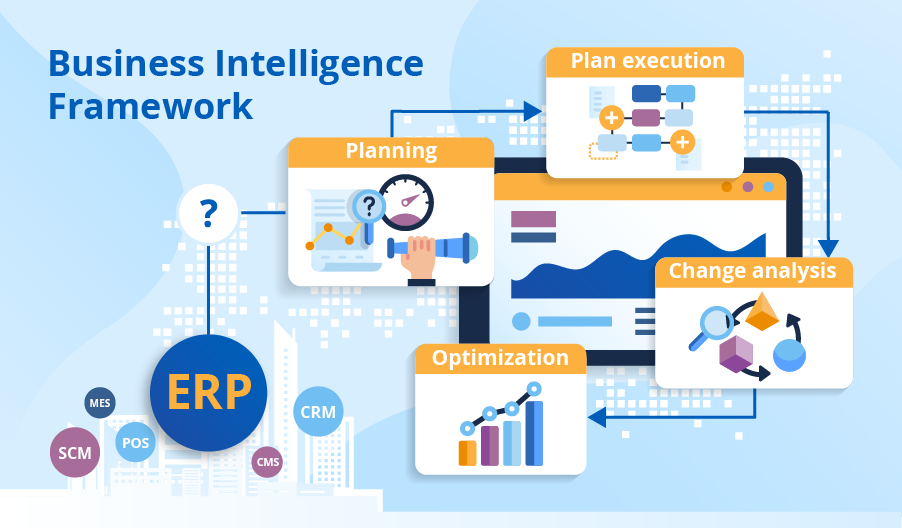
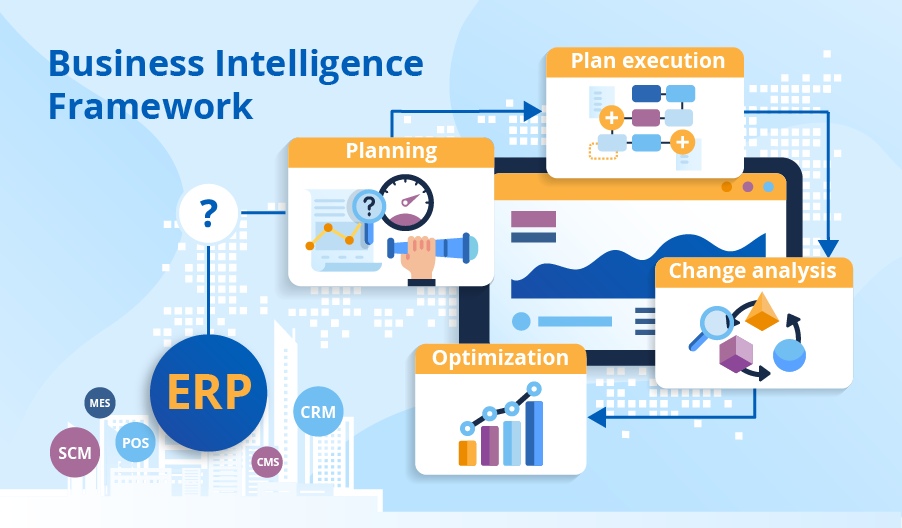
Based on our 17 years of experience in BI implementation, we developed a BI framework that allows utilizing data for more structured fact-based decisions. The framework embraces four main components: planning, plan execution, change analysis and optimization. Let’s look at each component separately and check whether the data in a company’s enterprise resource planning (ERP) system is enough to get valuable insights and which other data sources to turn to if ERP data is insufficient or missing.
Planning
The planning component embraces trend analysis, forecasting, and performance analysis.
Trend analysis
Examining only ERP data to identify trends can result in misleading insights. For instance, a manufacturer sees no growth in shipments to a particular region and concludes that the situation remains stable. In reality, the demand for the manufacturer’s products in this region is increasing. The ERP system doesn’t reflect this trend as it’s unaware of unmet demand: the enterprise is working at its full capacity and successfully selling everything it produces. However, if the manufacturer turned to their CRM data, they would find there the increased number of lost opportunities with ‘No product available’ clarification.
Forecasting
We don’t think that an ERP system is enough for forecasting. Say, to predict customer demand, data from internal and external sources is required, such as detailed sales history (ERP and POS systems), a customer’s location and type (CRM), weather conditions or social media trends (external sources).
Performance analysis
Internal benchmarking also requires not only ERP data. For example, to identify their top-selling stores, a retailer should analyze sales values taken from a POS system, as well as consider the sales floor area and the number of available checkouts, which can be stored in their ERP.
Plan execution
ERP data may be enough to analyze the performance against the plan and spot deviations. However, to run root cause analysis, a company often needs to go beyond ERP data. Say, if a manufacturer has failed to achieve their production plans, they may find the reason in the disrupted deliveries of raw materials by some of their Tier 1 suppliers. To get to these details, a manufacturer has to turn to SCM (supply chain management) data.
Change analysis
ERP can be one of the data sources for change analysis. It’s fine to conduct ROI analysis, as finances and assets are tracked in an ERP system. On the other hand, ERP data won’t help in analyzing the effect of redesigning a company’s online store, while the data (i.e., product lists, pictures, descriptions and visitors’ search and purchase histories) from a content management system and an e-commerce solution will be required for this purpose.
Optimization
We don’t recommend companies to rely solely on ERP data if they challenge themselves with business process optimization. Take asset management as an example: ERP is likely to contain just machinery name, purchasing date, and price. If a company strives to use their machinery efficiently and reduce overall costs through preventive and even predictive maintenance, they need to know equipment utilization and maintenance schedules. And this info is usually stored in an MES (manufacturing execution system) or dedicated equipment utilization software.
To sum it up
Though ERP is a vital source of data for BI, we don’t recommend embedding business intelligence into ERP. BI can only bring value when it’s on top of all the company’s applications, such as ERP, CRM, SCM, CMS, MES, and POS, and when it uses external data sources.
Microsoft’s April security updates for Windows 11 and Windows 10, KB5036893 and KB5036892 respectively, were previously identified by the company as causing VPN disconnection issues for some users, leaving some without a way to hide their IP address or change locations. Now Microsoft has released security update KB5037771 for Windows 11, which is said to fix the issue alongside some other known bugs.
In a post detailing the changes made in the May 14 update, Microsoft notes that the VPN issue was resolved and recommends users install the latest security update for all Windows devices, which to be honest is just good advice in general even if you’ve not been experiencing any VPN problems yourself.
For Windows 10 users, update KB5037768 appears to fix the same issue.
The bug was originally said to affect Windows 11 (versions 23H2, 22H2 and 21H2) and Windows 10 (versions 22H2 and 21H2), although looking at the Windows forums and subreddits it didn’t appear to be a particularly widespread problem.
However, it wouldn’t be a surprise if most users didn’t notice that Windows may be the cause for frequent VPN disconnects, as some VPN providers can often experience outages and connection issues of their own without an immediately obvious cause.
Also listed in the notes is a fix for a Bitlocker error, and an as-yet unresolved issue wherein updates to Microsoft Edge may incorrectly install a package that results in the Microsoft Copilot app appearing in the installed apps list in the settings menu.
While the Copilot bug may be an annoyance, a Bitlocker fix is perhaps unsurprising given that Windows 11’s upcoming 24H2 update is rumoured to be enabling the encryption setting by default during reinstallation—a move that’s caused a fair amount of controversy, as Bitlocker has been known to reduce SSD performance by up to 45% depending on the workload.
Keep up to date with the most important stories and the best deals, as picked by the PC Gamer team.
Still, I suppose we’ll cross that encrypted bridge when we come to it. In the meantime, those of you who have experienced VPN issues will want to install the security update immediately, and for those who haven’t, keeping your Windows install up to date is always the best practice regardless.