
I’ve spent the past 12 years building and growing digital businesses, and for much of that time I’ve worked with franchise and multi-location brands on their websites, marketing, and operations. Today at Weam AI, my team and I help these businesses bring AI into their daily workflows.
This article isn’t about selling you a tool. It’s about the systems behind your business, and how AI-enabled systems can save cost, reduce manual work, and help you make better decisions across every location. I’m going to walk you through five real automations we’ve built for franchise and multi-location businesses, with the actual screens from those systems.
Why Franchises Are a Perfect Match for AI
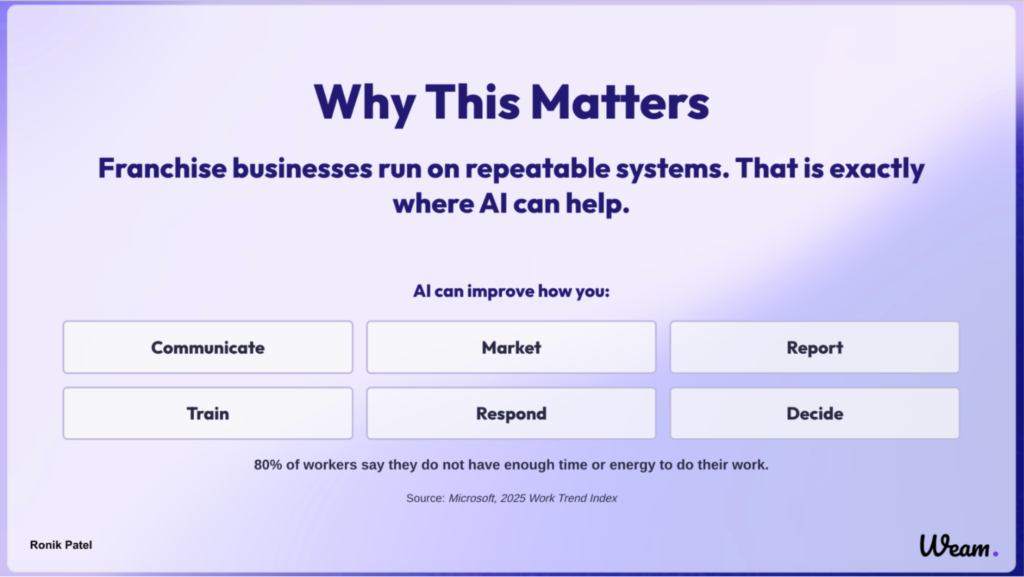
Franchise businesses run on repeatable systems. That’s the core of the franchise model, and it happens to be exactly where AI performs best. The more repeatable a process is, the easier it is to embed AI into it.
Across the businesses we work with, AI is improving how teams communicate, market, report, train, respond, and decide. That last one, deciding, is the piece most operators underestimate, and it’s where the real leverage is.
There’s a reason this matters right now: according to Microsoft’s 2025 Work Trend Index, 80% of workers say they don’t have enough time or energy to do their work. If AI takes real work off your team’s plate, that flows directly to your bottom line.
The Missing Middle Layer: Software That Can Think
Here’s the shift I want you to understand before we get into the use cases.
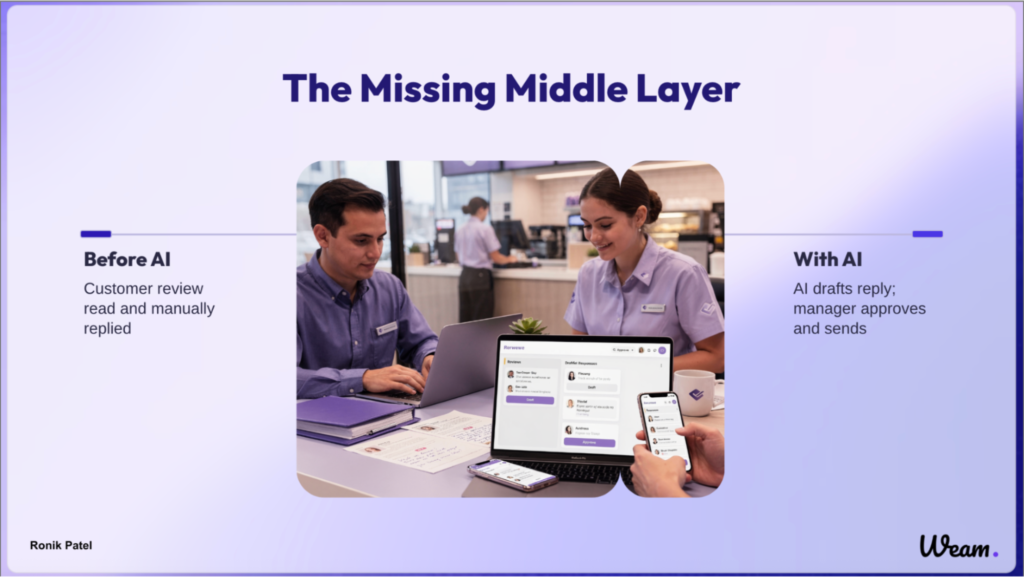
The software you already use is mostly a one-way street. You put data in, it sits there, and you pull some reports out. Before AI, a customer review had to be read by a person and replied to by a person. The software just stored it.
AI adds a middle layer that can actually think. A system can now read a message, understand its tone, summarize a report, draft a response, flag a problem, and recommend the next step, using your SOPs, your brand guidelines, and your past responses as context. The manager still approves before anything goes out, but the work itself is done
The old way of getting software that fit your business was painful: buy expensive enterprise software built for everyone, or hire developers for a slow, costly build that often still didn’t match your workflow. Two things have changed. First, AI now sits inside software and makes it smarter. Second, AI helps us build software dramatically faster. Projects that used to take us six months now take a couple of months, and things that took months now take weeks. Focused tools built around your specific franchise workflows are finally practical.
That’s the backdrop. Now let’s look at what this actually looks like in real franchise businesses. As you read these, think about a day in the life of a franchise owner: staff questions, customer complaints, bad reviews, sales reports, marketing posts, missed calls, missing documents, fast decisions. Every one of these is an entry point for AI.
Automation #1: Local Content Automation for a Burger Chain (Marketing)
When you’re running local marketing for a chain of stores, content is a big piece of the work. Almost every marketing writer today is already using ChatGPT, Claude, or Gemini to draft copy. We work with large marketing teams and see this daily. But when everyone is doing the same thing, that alone won’t win you rankings in Google or mentions in LLM tools.
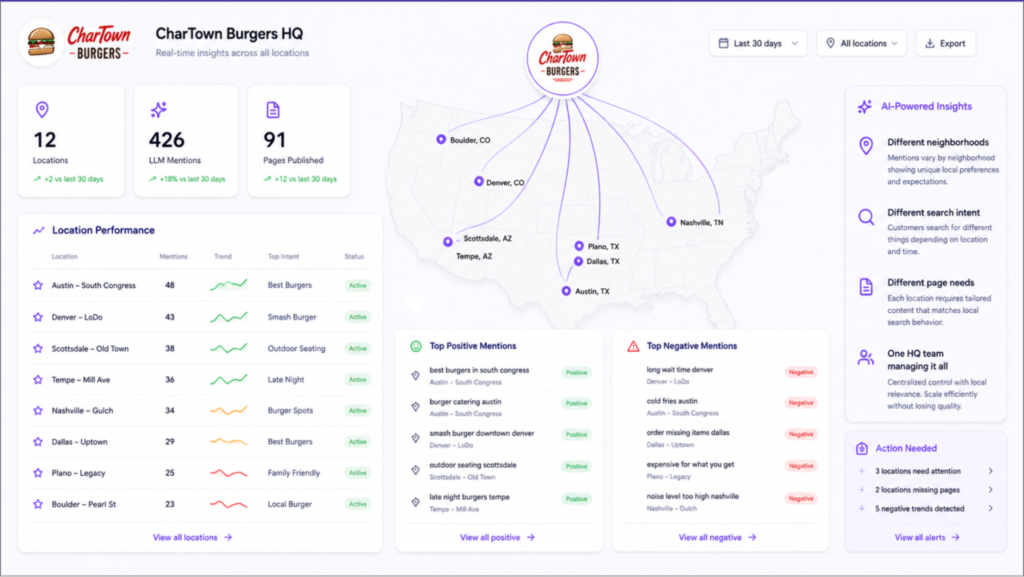
For this burger chain with 12 locations, we built what I’d call a vibe-coded system. AI helped us build it in a matter of weeks. Every location lives in the system, along with the local ranking metrics and target keywords for each store.
Here’s how the content workflow runs:
- Select a location and a target page on your website.
- Choose a keyword you want to rank for.
- The system runs a live Google search on that keyword and semantically related ones to find relevant topics. It does the same for LLM visibility, what people now call GEO or AI SEO, because your brand getting mentioned inside ChatGPT matters. More than 30% of Google’s traffic has already shifted toward LLM tools. Ask yourself how often you Google something versus asking an AI. For me it’s probably 70% AI at this point.
- AI checks your existing blog to make sure the topic is unique. It won’t suggest something you’ve already covered.
- A human picks the topic. This is a judgment call, and it stays with your team.
- AI builds the brief, drafts the content, and then runs it through QA agents: validators that review the draft against SEO best practices and Google’s E-E-A-T guidelines and revise it accordingly.
- The system connects to your website, and you publish.
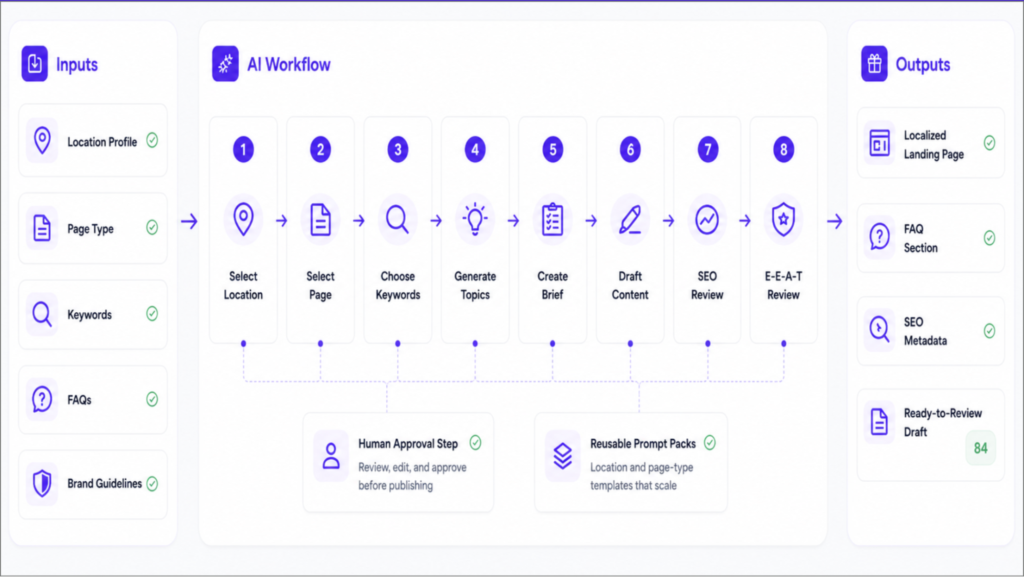
Notice I’m not calling this “fully automated.” Human judgment is still in the loop, but only for the judgment calls, not the actual production work. Writing a good local SEO blog used to take two to three hours per piece. With generic AI tools it dropped to maybe an hour and a half. With this workflow it’s about 20 minutes, at the same or better quality.
On top of production, the system tracks where your brand gets mentioned in Gemini, ChatGPT, and other LLMs. How often, in what context, and alongside which competitors. All of it feeds into a real-time dashboard for the marketing team.
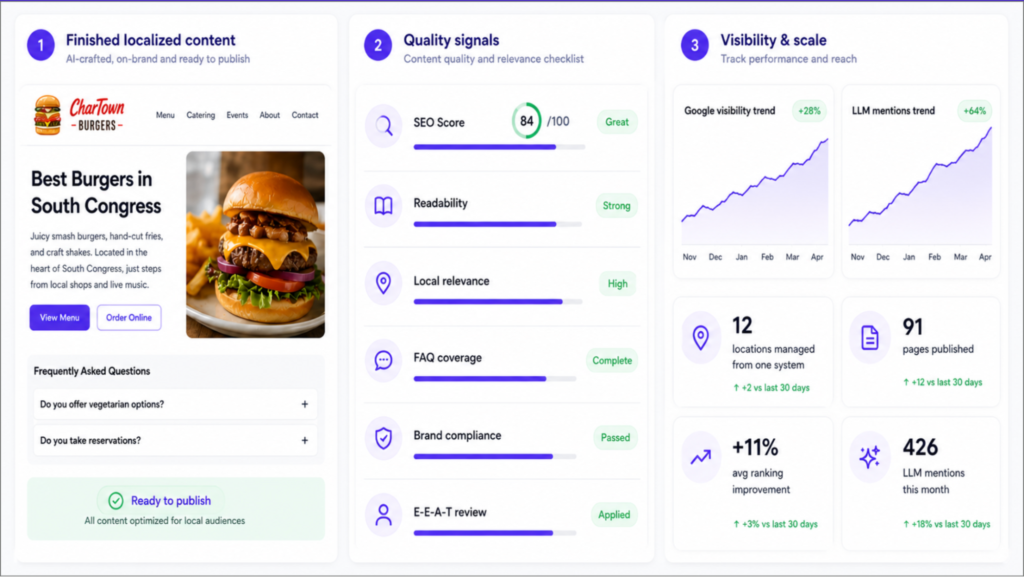
For this chain’s marketing team, the content production cost saving is over 50%.
Automation #2: Support Every Senior Care Location From HQ (Support)
This one is for a senior care business, and it covers both staff support and customer support from headquarters.
You’ve seen the chatbots that show up on websites and don’t make much sense. They fail because they have zero context about the business: no access to SOPs, compliance guidelines, or past support cases. What we did here is the opposite. We took all of that information and trained the system on it, then delivered it inside a mobile app for the network.
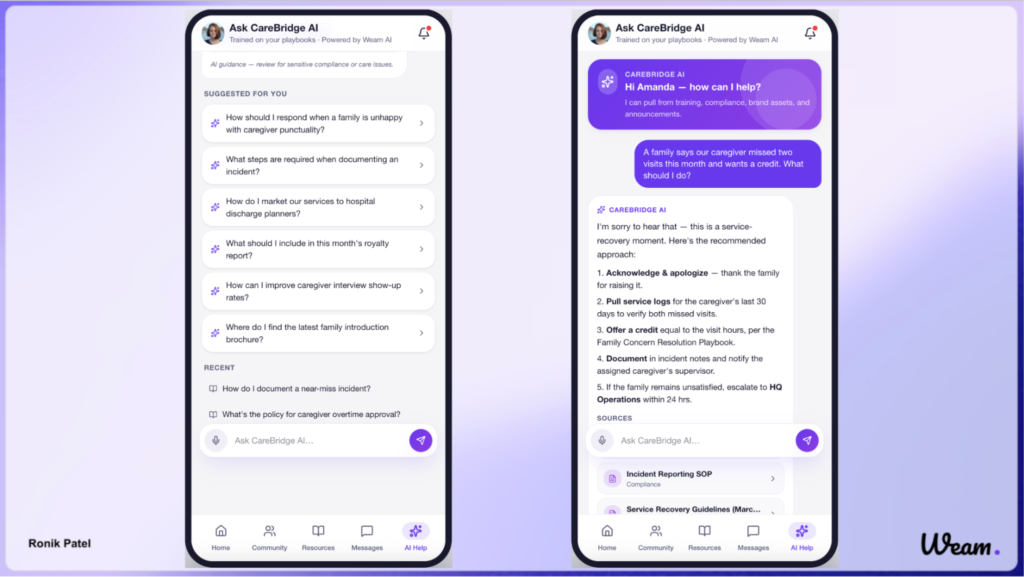
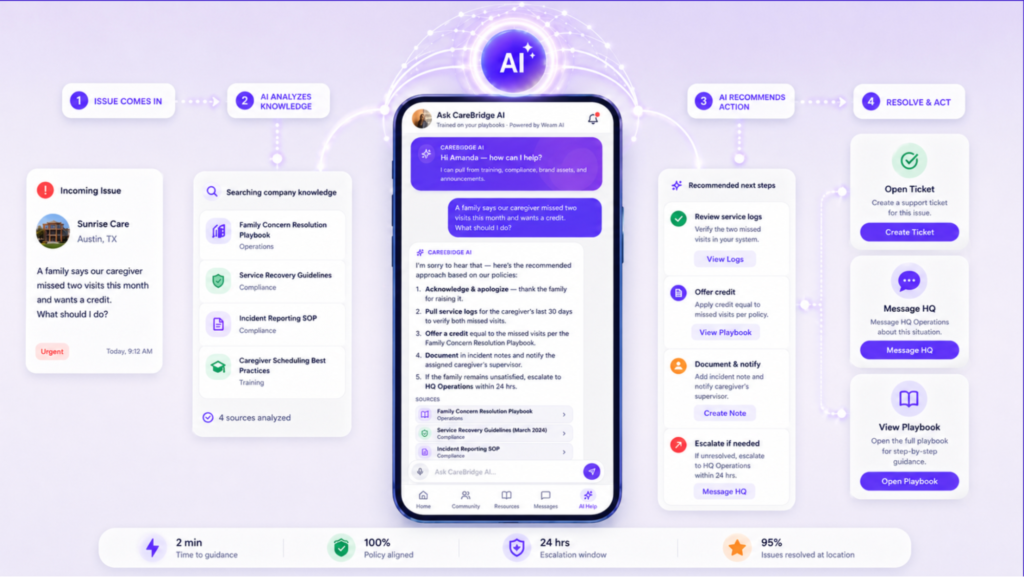
So when a location owner asks something like “A family says our caregiver missed two visits this month and wants a credit. What should I do?”, the AI answers exactly the way the brand handles it. In this case: acknowledge and apologize, pull the service logs for the last 30 days, offer a credit per the Family Concern Resolution Playbook, document the incident, and escalate to HQ Operations if the family remains unsatisfied. The source playbooks are cited right in the answer.
A lot of new owners in your network simply don’t know how to handle every scenario yet. This gives them policy-aligned guidance in about two minutes instead of a call to HQ, and roughly 95% of issues get resolved at the location level.
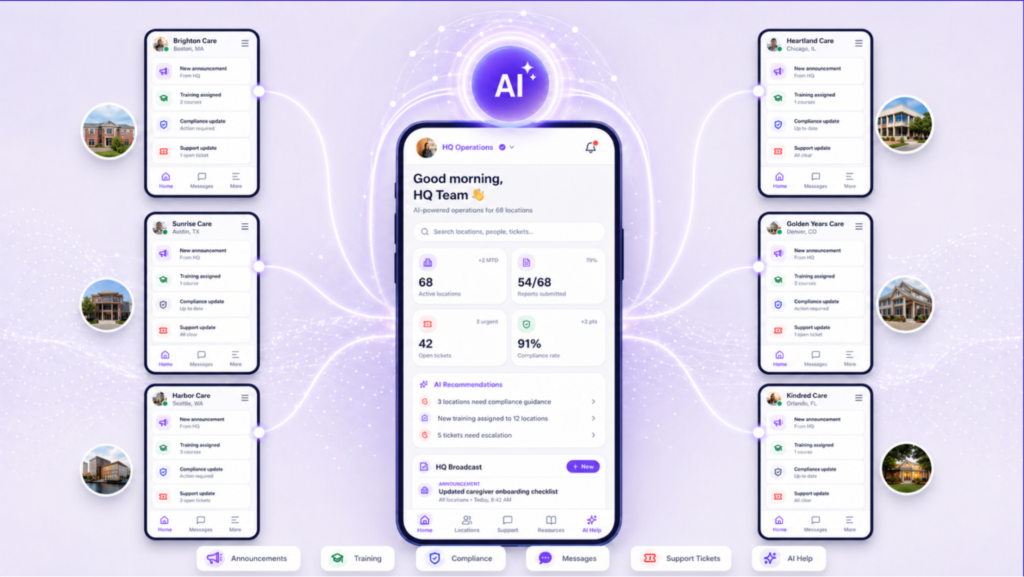
The HQ side is just as valuable. Old support systems could tell you how many tickets were open or closed. This tells you what’s inside those tickets: the actual context of the conversations across 68 locations. If something is trending in the wrong direction, you know earlier than you ever could before.
Automation #3: Turn Hotel Reviews Into Operational Action (Marketing/Ops)
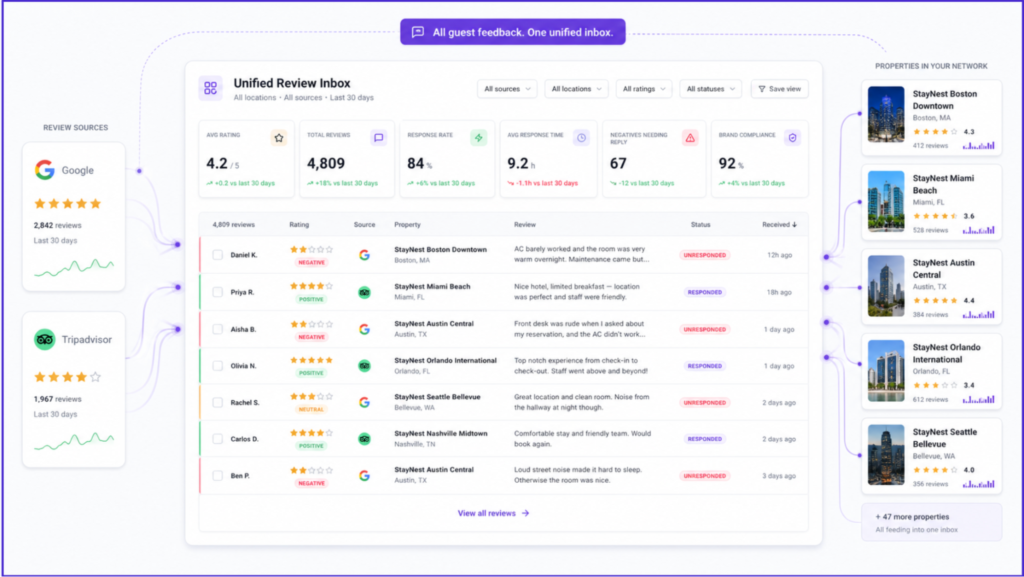
For a hotel chain we worked with, we built their operational center around reviews. Think of it as a reputation management system across the whole portfolio.
When you have dozens of properties, reviews live on Google, Tripadvisor, and industry-specific portals. Checking those manually, property by property, is painful. AI syncs with all of the platforms and brings every review from every location into one unified inbox.
It doesn’t stop at collection. When a review comes in, AI drafts an on-brand response using the chain’s brand guidelines, compliance standards, and policies. Not a generic ChatGPT reply. Things like: acknowledge the guest experience, invite offline follow-up, never promise refunds publicly, never admit legal liability. The approval rules are configurable: 4-5 star reviews can auto-approve, 3-star reviews go to a manager, and 1-2 star reviews require HQ approval before anything is sent.
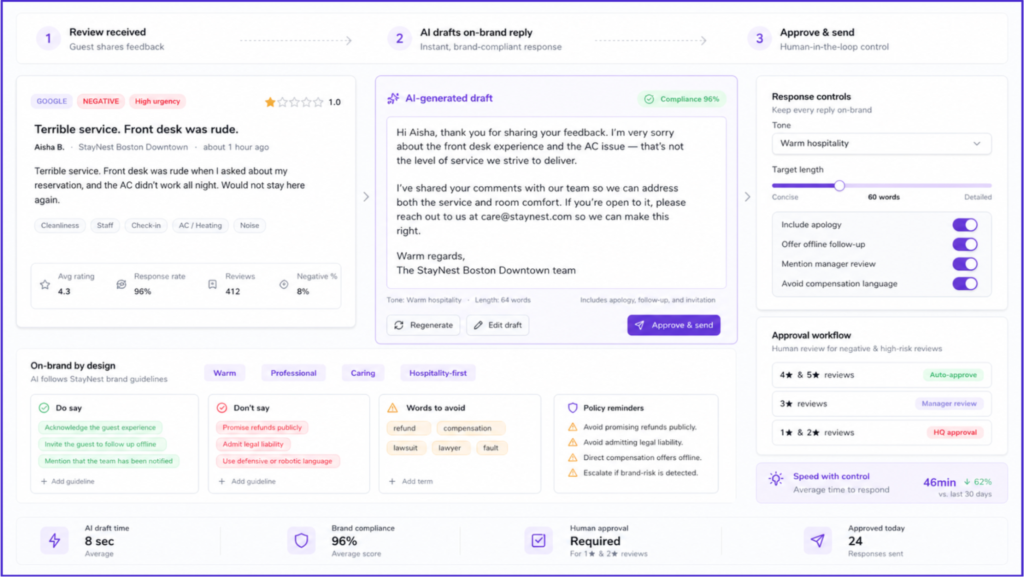
The result for this chain: average response time dropped 62%, to around 46 minutes, with an 8-second average draft time.
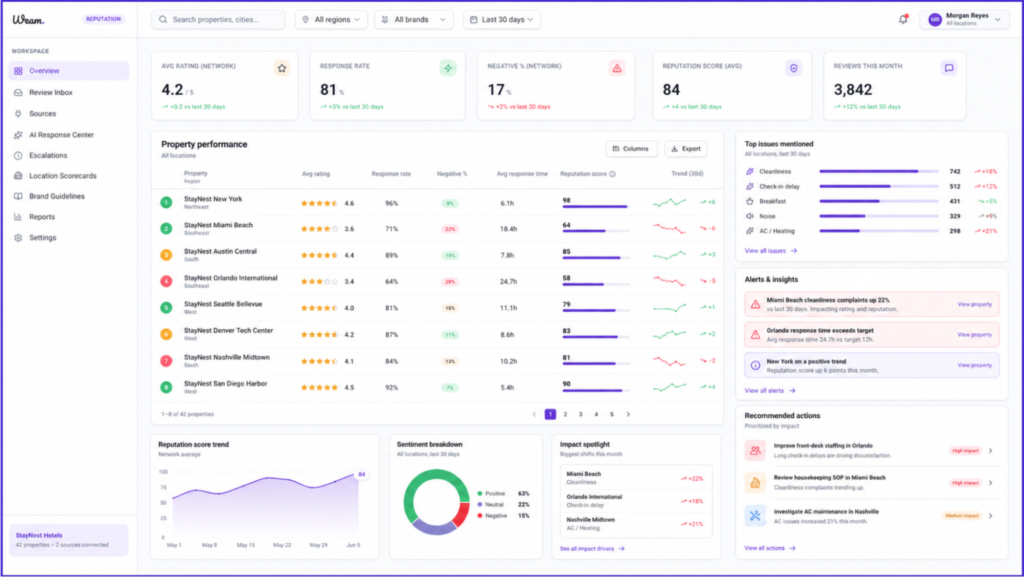
Then there’s the analytics layer, which is where the operational value kicks in. The central dashboard shows what issues guests mention most, by location and by trend: cleanliness, check-in delays, breakfast, noise, AC. No human has time to read every Google review across every property. AI does, and it alerts you on exactly the right things: cleanliness complaints up 22% at Miami Beach in the last 30 days, response time exceeding target in Orlando, and the recommended actions to fix each.
Automation #4: Give Spa Operators One Control Center (Management)
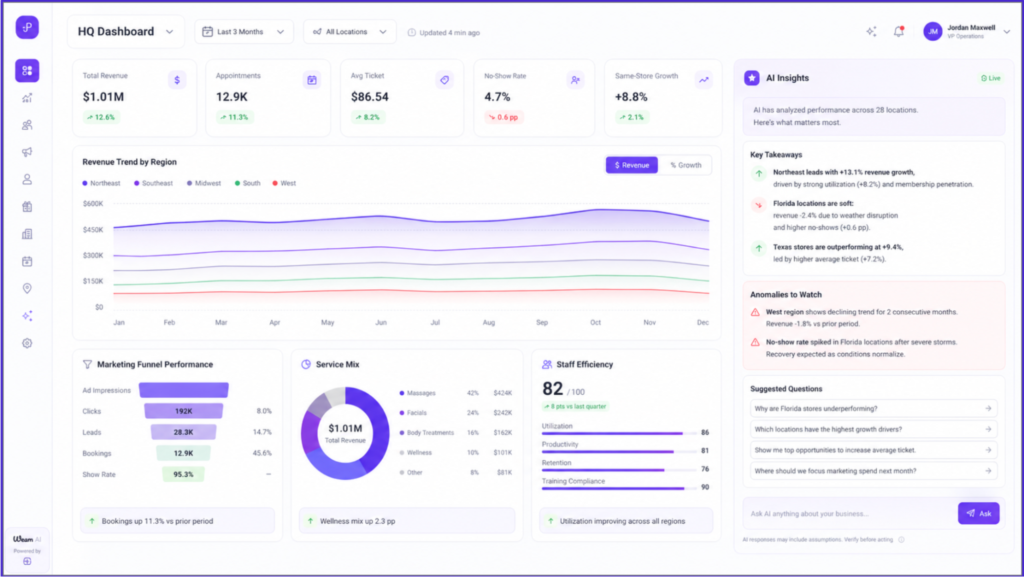
This spa business, 28 locations, already had plenty of software: a POS, a CRM, an appointment booking system, payroll, lease records, membership data. The problem was that everything was fragmented, and the reports management actually needed didn’t exist anywhere, because no single system had the complete picture.
The unlock here is MCP, or Model Context Protocol, which emerged about a year and a half ago as a standard way to connect tools together. Major systems now ship MCPs (in the restaurant space, Toast has one, for example). Instead of stitching together traditional APIs, we used MCPs to connect each location’s POS, bookings, CRM, staffing and payroll, rent and lease data, and memberships into one AI analytics hub.
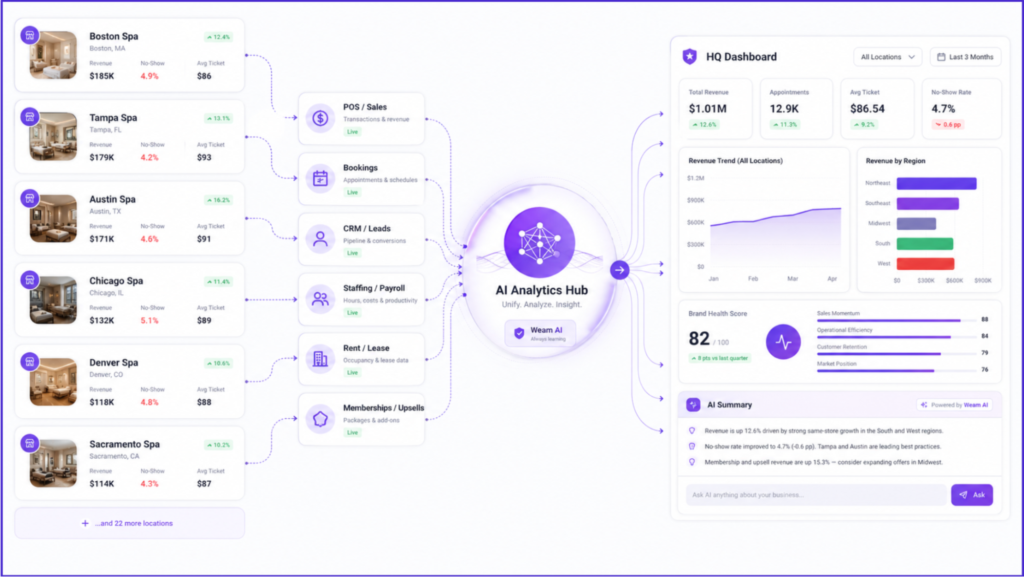
From that, management gets a single dashboard with the full business picture: revenue trends by region, no-show rates, average ticket, same-store growth, service mix, staff efficiency.
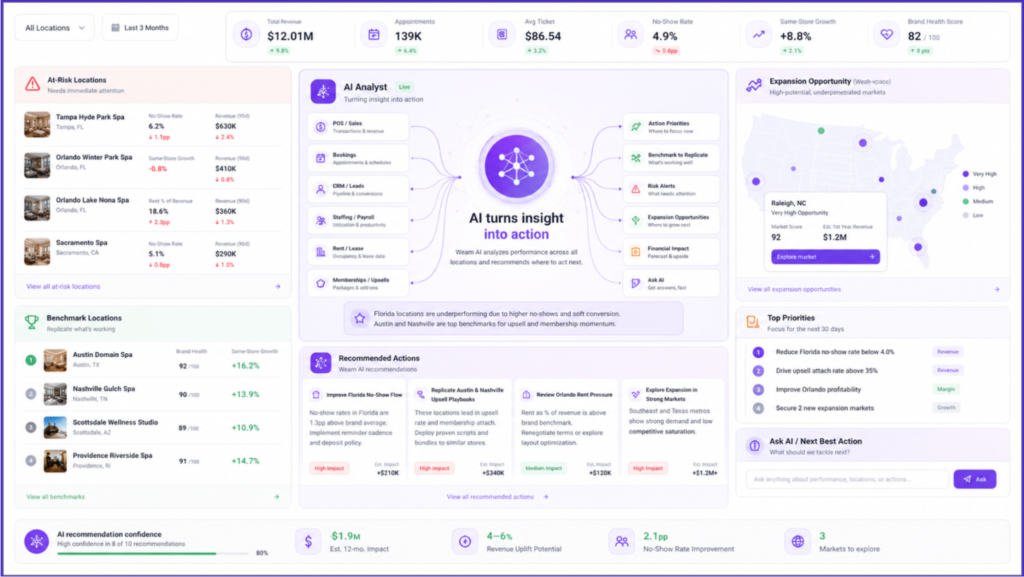
But the part that was simply not possible a few years ago is what AI does on top of that data. It automatically detects anomalies, like the West region declining for two consecutive months or no-show rates spiking in Florida, and it can even check external factors like weather to explain why. It benchmarks locations against each other: if two spas in the same city sell add-ons at very different rates, it flags it and tells you which playbook to replicate.
It goes all the way to expansion decisions, identifying underpenetrated markets and estimating first-year revenue for new locations. Insight into action: the recommendations for this business carried an estimated 12-month impact in the millions.
Automation #5: The Simple Stuff — Voice Agents and Customer Follow-Ups
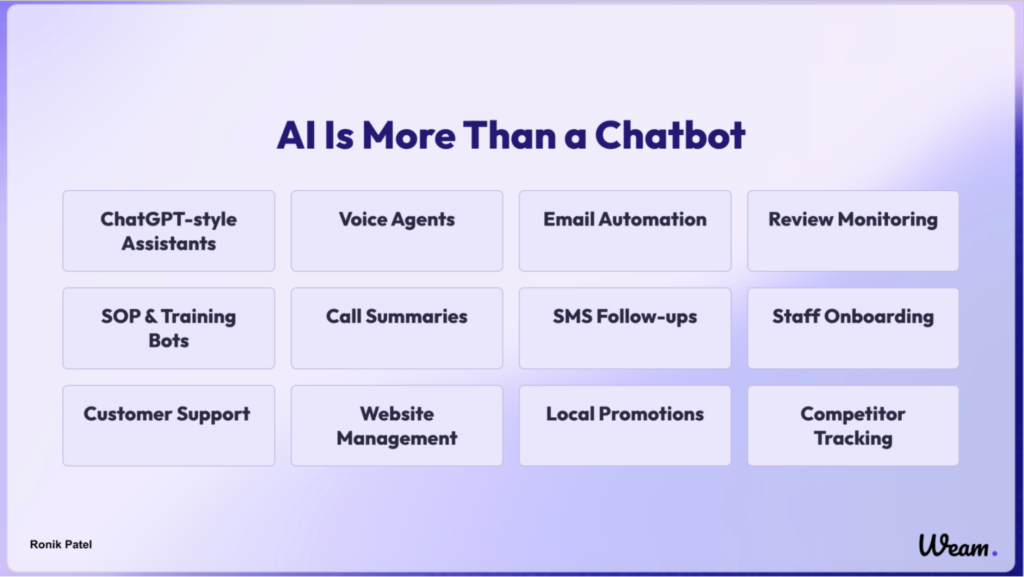
The first four automations were dashboards and systems. This fifth one is different. It’s a reminder that AI is more than a chatbot, and some of the highest-ROI wins are the small, unglamorous ones. Email automation, review monitoring, call summaries, SOP and training bots, staff onboarding, website management. Agents can already work inside WordPress, Shopify, or Magento to upload products, edit pages, and send cart-abandonment emails.
Two opportunities I point every franchise operator to first:
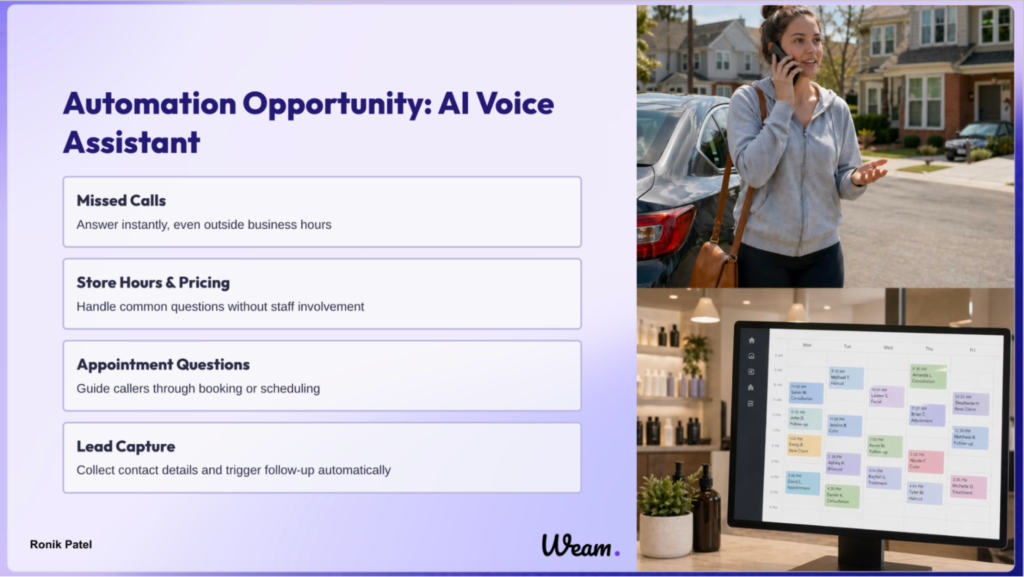
AI voice assistants. Humans miss calls, and a missed call is a real opportunity slipping away. An AI voice agent never misses one. It answers instantly, even outside business hours, handles the common questions about store hours and pricing, guides callers through booking or rescheduling, and captures lead details so follow-up triggers automatically. Voice agents are popular right now for a simple reason: they’ve started to actually deliver, saving real human hours on the phone.
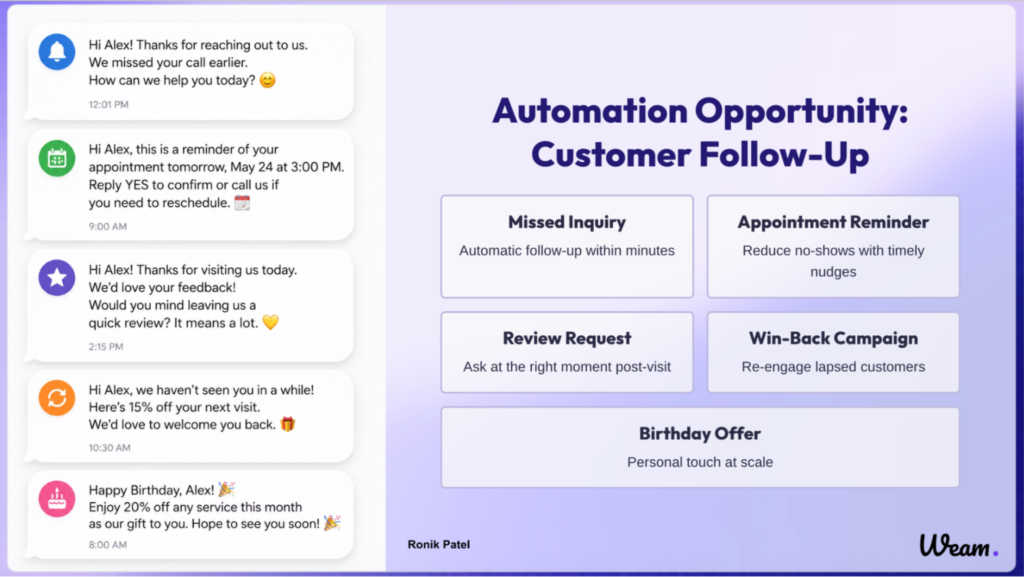
Automated customer follow-ups. A missed inquiry gets a follow-up within minutes. Appointment reminders reduce no-shows. Review requests go out at exactly the right moment post-visit. Win-back campaigns re-engage lapsed customers, and birthday offers add a personal touch at scale. All of it without anyone on your team lifting a finger.
People + Process + AI
Pulling it all together, this is what AI done right looks like in a franchise or multi-location business:
- Save time by automating the repetitive first pass
- Reduce cost by doing more without adding headcount
- Improve response with faster replies to customers and staff
- Support your team with instant answers and guidance
- Make better decisions by turning data into clear next actions
- Run with more control through visibility across every location
We’re still early. It’s been only a few years since the ChatGPT moment, and most of what businesses are doing today is bolting AI onto existing systems. The bigger shift, the one that’s just starting, is reimagining those systems from the ground up with AI at the core. That’s where the businesses we work with are heading, and it’s where the largest gains are.
Not Sure Where AI Should Start? Book an AI Opportunity Audit
There are a hundred things you could automate in your business, and you’ve probably seen the headlines about AI projects that fail. That’s because not every use case is ready, and knowing the difference comes from experience.
That’s exactly what our AI Opportunity Audit is for. We’ll ask a few questions, look at your operation, and identify the one workflow with the highest potential to save time, reduce manual work, or improve location-level execution. And we’ll tell you honestly whether AI is the right fit for it. It’s free, and the roadmap is yours whether you work with us or not.