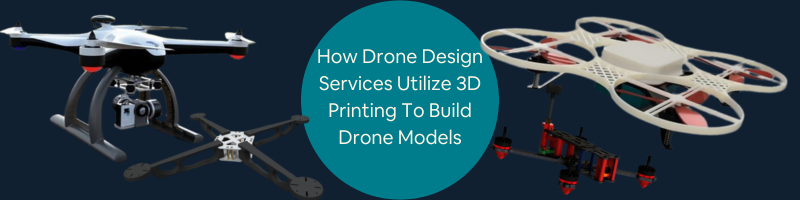
Natural disasters, crashed planes, sunken ships, and military invasions showcase moments when technology, like drones, steps in to capture extraordinary scenes from angles previously unimaginable. Advances in UAV technology have enabled us to record dramatic footage of these events, often providing insights and perspectives that were once out of reach.
When diving into drone design with 3D printing services, a few creative tweaks or expert insights can really take your project to the next level. That’s where Cad Crowd comes in—connecting you with a diverse network of freelance CAD designers, mechanical engineers, and additive manufacturing experts who can help bring your drone models to life.
A powerful combo of drone design and 3D printing services
Once a unique niche technology specifically used for military purposes, drones have now reached the consciousness and reach of the general public. Today, drones have become an indispensable tool in other sectors such as agriculture, photography, and even modern delivery services. Just like how drone technology changed the world, 3D printing has also revolutionized manufacturing in different industries. This breakthrough technology allows on-demand production, customization, and rapid prototyping.
The combination of drone technology and services offered by 3D design printing experts can be considered a natural progression promising to take the accessibility and capabilities of drones to soaring heights, both literally and figuratively.
3D printing makes way for the creation of lightweight complex structures that are ideal for drones and their unique aerial demands. It also allows a certain level of customization that was once unattainable. This empowers drone aficionados to tailor machines to their specific preferences and needs. Aside from this, the ability to print replacement parts on demand can significantly cut down maintenance costs and downtime. It makes flying drones more accessible and available to more audiences.
The unique synergy of drones and UAV design, as well as 3D printing technologies, is not only a significant advantage to hobbyists and fans, but it can also potentially impact different industries by allowing rapid customization and deployment of drones for various applications. The implications of this powerful combo are far-reaching and vast, from infrastructure inspections to wildlife monitoring. The following are some of the top benefits of using 3D printing for drone design services for the successful creation of drone models.
Accessibility and cost-effectiveness
The drone hobby is always costly. Its cost is traditionally high since proprietary parts and pre-assembled parts often carry hefty price tags. The 3D printing technology makes drone design more accessible for those who might have a limited budget.
Using 3D printing allows drone design services to reduce costs significantly, experiment with various designs, and even develop valuable skills in 3D printing and drone piloting alike. This level of accessibility helps nurture the ever-growing community of drone enthusiasts who are pushing the limits of what these amazing machines can do.
RELATED: The Future of Drones: What Are Drones Used For Now and Where Are They Going

More possibilities for customization
One of the most notable benefits of using 3D modeling services in drone design services is the unparalleled level of customization it can offer. Professionals and enthusiasts can both design and print drones tailored to particular tasks, from specialized mounts used for photography tools to the lightweight frame of racing drones. The level of customization also extends to aesthetics, making way for distinct designs that are a perfect reflection of the preferences and personality of the pilot.
Easy replacement and repair of parts
Drones are always prone to damage and accidents, even more so when navigating tricky environments and settings. 3D printing technology can simplify the process of repair by allowing the speedy creation of replacement parts. Rather than waiting for the manufacturer to ship out the parts, drone design services can simply print new gear, propeller, or the entire frame to help reduce downtime and make sure that the drone always remains airborne.
In-house tooling
Probably one of the most significant costs involved in drone development is tooling, or the tools used for the design, development, and manufacturing of the drone components. Traditionally, the solution for this is to look for off-the-shelf tools that can do the job, whether specialized or generic. There is also the option of commissioning custom tools from fabricators.
However, both options share the same issues related to time and cost. Buying the tools requires lots of money, not to mention the time needed for their sourcing, purchase, and maintenance. 3D printing can offer a more straightforward solution in the form of in-house tooling. 3D scanners can come in handy to capture the form of an existing tool and feed this data to the CAD software to allow the in-house building of tools that require significantly less money.
Lower development costs
3D printing can lower the costs of drone development through the automation of different CAD aspects, such as producing parts quickly, reducing the use of materials, and testing. 3D printing can lower the costs of the development of drone products in many ways, such as lower prototyping costs, minimal technology training, faster cycles of product development, rapid reiteration, cut-out tooling suppliers, less material wastage, cheap low-volume production or cost per part, and automated production lines.
These benefits can lead to substantially reduced development costs, particularly when the production is scaled up across different drone models.
RELATED: Architectural 3D Animation Guide for Companies and Firms Creating High-Quality Drone Videos
Material catalogue
Probably the most exciting thing about the use of 3D printing for drone design services is the wide range of materials to choose from. High-performance thermoplastics such as PC-CF, PEKK, and PEEK can be printed. The same also goes for standard thermoplastics such as ABS, PC, and PET-G, composites such as Kevlar and fiberglass, and flexible materials such as TPU. Metal components can also be 3D printed if needed.
For more complex geometries and shapes where the mechanical print head can restrict the design potential, other 3D printers can be used, such as those that can print resin with UV laser for curing individual resin layers on the print bed.
Rapid prototyping
3D printing offers a unique benefit over traditional processes of prototyping thanks to its ability to realize and explore concepts in just a matter of hours. Rapid prototyping encompasses sending the CAD drawings to the 3D printer and receiving the parts on the same or even without just a few hours. It allows quick building of assemblies with no need to wait for the suppliers and with minimal time required for setup.
In addition, instead of spending more time preparing the CNC machines and subjecting the model iterations to real-world testing, 3D printing software can simply use AI to test objects and reveal their mechanical weaknesses way before the actual production begins. Rapid prototyping experts are ideal for your company if you want functional prototypes, concepts, and the final iterations of the end-user parts to ensure maximum value during the development cycle of drone products.
Save materials and weight
Turning to 3D printing freelancers is often considered the best for manufacturing, as it helps slash material and reduces the weight of the solid components of drones. One of the best ways to save weight is to specify a stronger, lighter material like polycarbonate rather than ABS. Also, an effective way of saving materials and weight is to take away the solid material by cutting down the amount of plastic used in the part.
Changing the solid components’ infill pattern can help reduce the quantity of plastic in a drone while improving its rigidity, flexibility, and strength. Infill refers to the structure of the material within the part printed in 3D. Similar to the interconnecting steelwork found on the underside of a bridge, parts printed in 3D also have an infill that controls the physical properties of the part, such as weight, structure, and strength.

Software stress testing
Probably the most important of all phases of drone making is none other than stress testing. This step ensures the reliability, strength, and longevity of the different parts. The traditional means of real-world testing of parts is time-consuming, expensive, and almost unnecessary with 3D printing.
Most CAD and 3D modeling services offer a stress testing environment for the software simulation of different conditions in the real world. This simulation also identifies issues that static load testing might not reveal. Drone design services can save more money and time while also improving the designs and performance of drone parts by including virtual stress tests in the development cycle.
Faster time to market
It undoubtedly takes time to create an amazing drone, but there is simply no reason for you to let the conventional production processes, such as validation or testing, stop you from exploring further.
It is significantly faster to verify concepts, validate designs, and test functions with 3D printing compared to injection molding or CNC machining.
Rapid reiteration and rapid design prototyping services can help speed up time to market through simulation of stress tests to boost performance, test materials against one another, and validate designs starting from software up to the physical part on just the same day. You can pretty much expect 3D printing to make the entire cycle of product development faster. Switching to digital workflow from a physical product development cycle with fewer steps can make time to market faster than ever.
RELATED: Benefits of Outsourcing CNC Machining Services for Your Company’s Prototype Design
How Cad Crowd can help
Professional 3D printing is revolutionizing drone design by allowing for rapid prototyping and precise component manufacturing. At Cad Crowd, you’ll find top freelance CAD designers, mechanical engineers, and additive manufacturing experts who use these cutting-edge techniques to build drone models that soar to new heights. Partner with Cad Crowd here to transform your innovative ideas into high-performance, market-ready drones.
