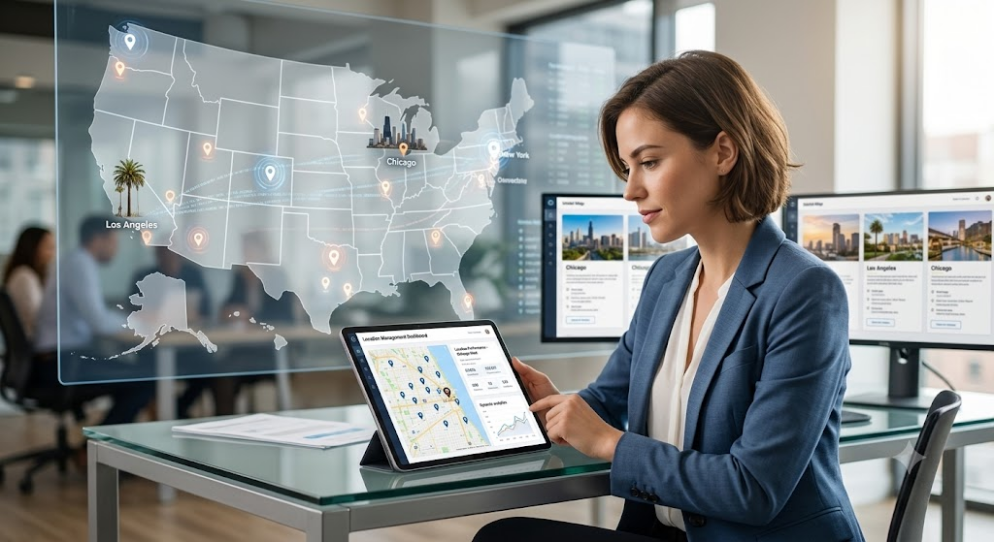
Here’s a hard truth: Google doesn’t rank your brand it ranks your locations, one by one, on their own individual merits. A $500,000 website redesign won’t save you if your location pages aren’t built right.
According to 2026 research, 46% of all Google searches carry local intent and 76% of people who search for something nearby visit a business within 24 hours.
For franchise brands with dozens or hundreds of locations, every under-optimized location page is leaving foot traffic and revenue on the table every single day.
This guide breaks down exactly what every franchise location page needs in 2026 with real-world examples across healthcare, home services, fitness, education, and restaurants.
Why E-E-A-T Matters for Franchise Location Pages
This also connects directly to Google’s guidance on helpful, reliable, people-first content. Google asks publishers to show EEAT : experience, expertise, authoritativeness, and trustworthiness. For franchise location pages, that means proving real local knowledge instead of publishing a thin city-swap template.
At Weam, this is the lens used when reviewing multi-location content systems for franchise and location-based teams: the strongest pages connect website content, Google Business Profile data, reviews, local offers, and reporting into one reliable location-level source of truth.
1. Get the Technical Foundation Right First
URL Structure That Inherits Authority
The best-performing franchise location pages use a clean subdirectory structure:
yourbrand.com/locations/chicago-il/
yourbrand.com/locations/miami-fl/
Avoid subdomains (chicago.yourbrand.com) and separate domains (yourbrand-chicago.com). Both force each location to build SEO authority from near-zero, as subdomains are treated by Google as separate websites and do not inherit the equity built on the main domain.
Real-world example: Mr. Electric of Austin uses the shared Mr. Electric domain while still serving hyper-local content: an Austin address, service-area map, nearby areas served, local phone number, and city-specific copy such as “Keep Austin Wired.” That is the balance franchise pages need – central brand authority plus local proof.

LocalBusiness Schema: Still a Competitive Edge
Only 31% of local business websites have properly implemented LocalBusiness schema (which means getting it right is still a genuine advantage.
Every location page should include schema covering:
• Business name, address, and phone (NAP)
• Operating hours (including holiday hours)
• Geographic coordinates
• Aggregate review rating
• Service types and price range
Full implementation guidance: Google’s official LocalBusiness documentation
2. Content That Actually Earns Local Rankings
No City-Swap Templates Ever
The most damaging mistake in franchise SEO is taking one template, swapping the city name, and publishing 50 identical pages. Google recognizes this immediately and devalues all those pages as duplicate content.
Each location page must include content that is genuinely useful and locally specific, referencing local landmarks, community context, and photos taken at that actual location.


Real-world example: Subway uses store-specific details to avoid thin city-swap templates. Its 250 Tenth Avenue New York page highlights local hours, address, pickup, delivery, catering CTAs, and services like breakfast and mobile ordering. Its 2201 C Street NW Washington, DC page uses a different location name, hours, and service mix for a business-district audience. Same franchise system, but each page gives Google and customers distinct local evidence.
Location-Specific Offers and Seasonal Promotions
Generic calls-to-action don’t convert as well as market-specific offers .Anytime Fitness allows franchisees to run localized promotions at the city level. For example, the Washington, Michigan location runs a “Join & Get the Summer Free” banner to capture warm-weather sign-ups, while the Clayton, North Carolina location uses a “Join For $1” offer to drive immediate conversions in its market. The page structure stays familiar, but the offer adapts to local demand.


Localized FAQs and Customer Reviews
FAQ sections serve two purposes: answering genuine customer questions and targeting long-tail, voice-search keywords. FAQs should cover:
• Local parking and transit options
• Geography-specific service questions (“Do you handle ice dam repairs?” for Minnesota; “Do you offer heat damage treatment?” for Texas)
• Location-specific hours and local holidays
Customer reviews are the #1 trust signal and in 2026, Google pays attention to review keywords as a top-tier ranking signal — the specific words customers use in their reviews directly help that location rank for those phrases. A review mentioning “best physical therapy in Austin” actively helps that Austin location rank for that phrase.
Real-world example: Orangetheory Fitness Chicago-River North shows how a franchise location page can combine precise local context with proof. The page references the studio’s corner of Wells and Ontario, nearby transit access, and neighborhood context, while the Google Business Profile adds reviews that mention coaches, workouts, and the specific studio experience.

3. The Geographic and Seasonal Dimension
This is the section most franchise marketers overlook and arguably the most powerful differentiator available in 2026.
A franchise location page in Phoenix faces a completely different customer reality than one in Portland or Boston. The climate is different. The seasonal rhythm is different. The language customers use to search is different. Publishing identical pages for both markets costs both locations meaningful search rankings since Google is actively looking for location-level signals, not cloned corporate content.
This is what Google means by“genuinely useful, locally relevant information that a visitor in that market cannot get from a different location page.”
How Seasonal Conditions Shape Content Across Verticals
Home Services
A roof cleaning franchise in Tampa needs to address peak mold and algae season during summer humidity. The same brand’s Denver page needs content about freeze-thaw cycles and ice accumulation. Gulf Coast locations should shift emergency restoration content during hurricane season, because seasonal service needs are one of the clearest ways to prove local relevance.
Fitness
Gym franchises in Minnesota and Michigan see indoor membership surges in harsh winters. Those location pages should emphasize “escape the cold” from November through February. Orangetheory Fitness is a strong example of a franchise brand that customizes location pages by market, tailoring messaging based on what resonates with the local audience.
Healthcare
Allergy treatment franchises in high-pollen regions (Southeast, Midwest in spring) should build location pages around seasonal allergy peaks. Physical therapy franchises near ski resorts should optimize for winter injury recovery content during ski season, then pivot to summer sports recovery in the off-season.
Seasonal Content Update Framework Quarterly
Google rewards pages that show regular activity over pages created once and abandoned.
| Quarter | Home Services | Fitness | Restaurant | Healthcare |
| Q1 (Jan–Mar) | Winter storm recovery, pipe thaw | New Year resolutions, winter wellness | Comfort food, hot beverages | Cold/flu season, winter injuries |
| Q2 (Apr–Jun) | Spring cleaning, AC prep | Spring transformation, outdoor training | Lighter menu, patio seating | Allergy season, spring sports injuries |
| Q3 (Jul–Sep) | AC maintenance, storm prep | Summer momentum, fall prep | Refreshing drinks, back-to-school | Heat illness, summer sports recovery |
| Q4 (Oct–Dec) | Heating checks, winterization | Holiday commitment, year-end goals | Holiday specials, gift cards | Flu shots, year-end health checkups |
Real-world example: Molly Maid’s Scottsdale, AZ holiday cleaning page leads with party cleanup and holiday hosting needs, while its spring cleaning service page shifts the angle toward refreshing homes after winter. Same brand, different seasonal intent. That is the level of variation franchise pages need when the weather, local routines, and customer urgency change by market.


4. Local SEO Signals That Power Rankings
Google Business Profile: The 3-Pack Is Everything
Businesses appearing in the Google local 3-pack receive 126% more traffic and 93% more conversion-oriented actions than those ranking just below it.
Every franchise location needs a separately managed Google Business Profile with:
• NAP data that exactly matches the corresponding location page
• 100+ photos — businesses with 100+ photos receive 520% more calls, 2,717% more direction requests, and 1,065% more website clicks than average
• Regular posts, photos, and review responses to keep the profile active and trustworthy
• Accurate real-time hours / “Open Now” status, since Google recommends keeping regular and special hours updated to improve local visibility
From Weam’s work with multi-unit businesses and franchise teams, the ranking problem is rarely one missing keyword. It is usually a system problem: the page, Google Business Profile, reviews, photos, offers, and reporting are managed in different places, so each location sends mixed signals. Strong location pages fix that by making the website the source of truth for local operations.

NAP Consistency and Review Velocity
Name, Address, and Phone number consistency across all directories is non-negotiable. Even a suite-number discrepancy between your Google Business Profile and a single directory listing can create “signal pollution” that weakens local trust signals.
For reviews, target the benchmarks recommended in ClickTecs’ franchise local SEO checklist:
• Minimum 50 total reviews before considering the profile optimized
• 3–5 new reviews per month to maintain velocity
• 100–200+ reviews in competitive markets
5. The 2026 Location Page Structure
Every high-performing franchise location page should follow this structure, top to bottom:
1. Location-specific H1 e.g., “Planet Fitness in Austin, TX Open 24 Hours, Judgment-Free Workouts”
2. Hero section actual photo of the physical location, local phone number (click-to-call), address with embedded Google Maps, real-time open/closed indicator
3. Local introductory paragraph (150–200 words) written specifically for this market, referencing the neighborhood and nearby landmarks
4. Location-specific CTA make it local (“Book your Austin appointment today”)
5. Services section only list services available at this location; highlight any location-only specialties
6. Seasonal/local offers current location-specific promotions or time-sensitive deals
7. Local testimonials + Google Reviews widget 3–5 curated reviews that mention the location and local context
8. Location-specific FAQs 6–10 questions covering parking, nearby neighborhoods, and geography/season-specific concerns
9. Staff or owner introduction locations with a named owner or team member see significantly higher conversion rates
10. Community involvement local sponsorships, charity partnerships, or events
11. Internal links to nearby location pages, the corporate homepage, core service/use-case pages, supporting local blog posts, and a related PPC/location-intelligence article when relevant
12. LocalBusiness schema full implementation in page source
13. Footer NAP exact match to Google Business Profile
2026 Franchise Location Page Checklist
✅ Technical Foundation
☐ Subdirectory URL structure: brand.com/locations/city-state/
☐ LocalBusiness schema with all required fields
☐ Mobile-optimized with click-to-call phone number
☐ Embedded Google Map
☐ Page load speed under 2.5 seconds (Core Web Vitals)
✅ Content Requirements
☐ Unique H1 with city name and primary service
☐ Locally-written intro paragraph (no city-swap templates)
☐ Location-specific services list
☐ Seasonal/local promotional offer
☐ 3–5 local customer testimonials + live Google Reviews widget
☐ Location-specific FAQ section (6–10 questions)
☐ Staff or owner introduction
☐ Community involvement content
☐ Actual photos of the physical location (not stock)
✅ Local SEO Signals
☐ Fully optimized, separately managed Google Business Profile
☐ NAP data exactly matches GBP
☐ Minimum 50 Google reviews, 3–5 new per month
☐ Local citations updated and consistent across directories
☐ Internal links to/from the homepage, corporate service/use-case pages, nearby location pages, and supporting articles such as the multi-location PPC workflow
✅ Seasonal and Geographic Customization
☐ Content reflects local climate and seasonal service needs
☐ Offers and promotions updated quarterly
☐ Hero image reflects local environment or season
☐ FAQs include geography-specific questions
Want to apply the same location-level thinking to paid campaigns? Read Weam’s related guide on multi-location PPC workflows, which explains how clean location data can help teams make smarter ad decisions across markets. The same inputs that strengthen franchise location pages, including reviews, missed calls, local offers, booking capacity, market seasonality, and location-level demand, can also help PPC teams decide which locations to promote, which offers to test, and where budget should shift.
For franchise teams, the goal is not more copy. It is a repeatable system that keeps every page accurate, local, approved, and connected to performance. That is where Weam’s multi-unit workflow approach becomes relevant: it connects content, approvals, reporting, and location-level execution instead of treating each page or campaign as a one-off task.
The Location Page Is Your Front Door
In 2026, your franchise location page is not a digital brochure. It is the front door of every individual location the first thing a local customer encounters when they search for what you offer near them.
The franchises winning local search treat each location page as a standalone, genuinely local asset: rich with unique content, optimized for local intent, updated seasonally, and reflective of the geographic community it actually serves.
Whether your location sits in the humid South, the frozen North, the sun-baked Southwest, or the rain-soaked Pacific Northwest the services your customers need and the language they use to search are different. Your location page must be too.
Ready to scale this across hundreds of locations without duplicate content penalties? Review Weam’s approach for multi-unit businesses, start with a cost-saving audit to identify where your franchise team may be losing time or budget, then book a call to discuss how your team could manage location pages, approvals, and updates without turning the process into manual copy-paste work