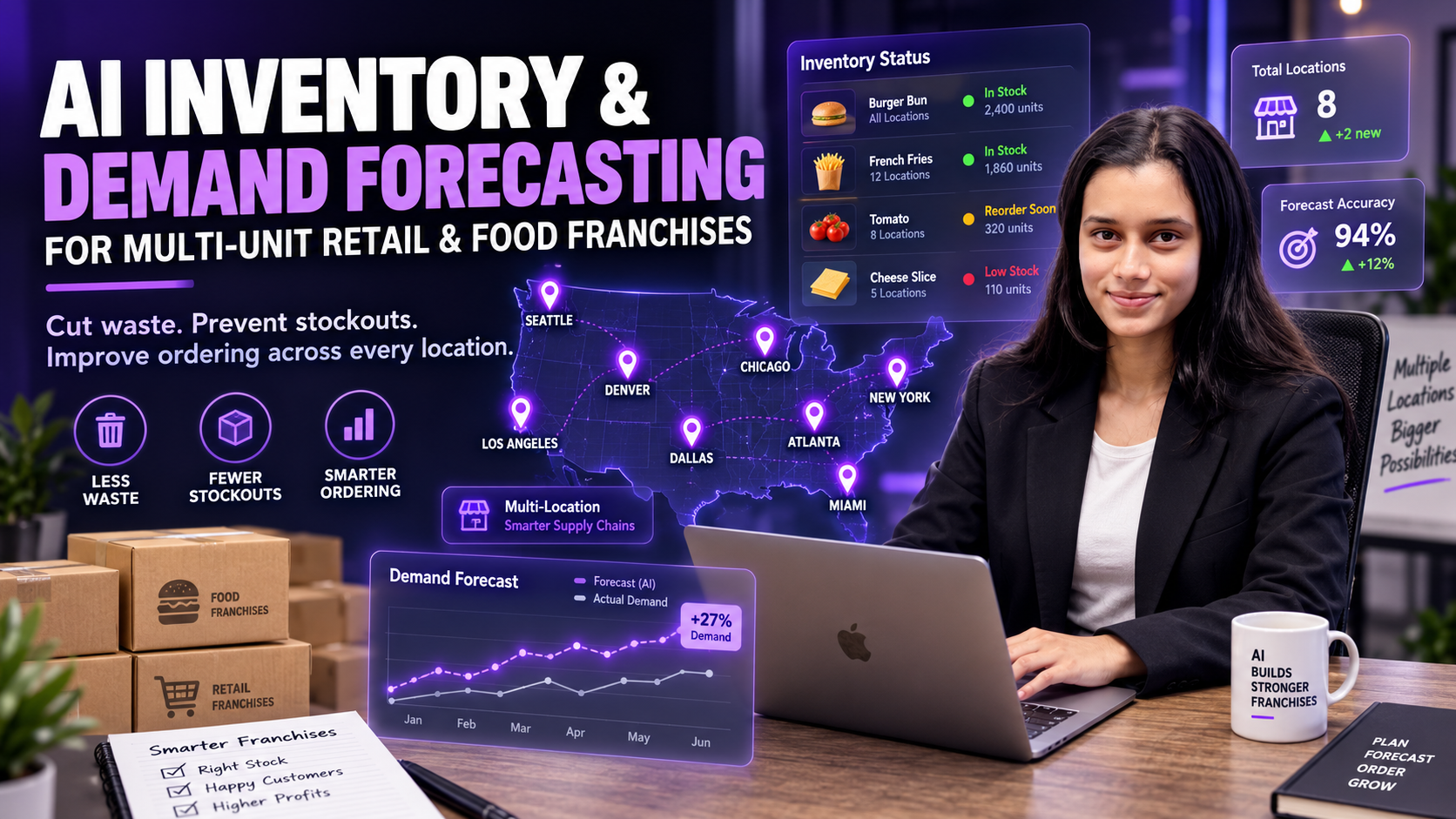
Picture a franchise owner with 15 locations open on a Monday morning, staring at a stack of overnight sales reports and a gut feeling about what to order for the week. One store will run out of chicken breast by Thursday. Another will toss out a full walk-in of produce by Sunday. Neither problem shows up on a spreadsheet until it’s too late, and multiplied across 15 units, that guesswork adds up to real money walking out the back door.
Restaurant food waste alone costs the industry an estimated $162 billion a year, according to a 2026 report from Georgetown University’s Portion Balance Coalition and Earth Commons Institute, produced with the Menus of Change University Research Collaborative and supported by ReFED. About 70% of that is plate waste, food a customer left uneaten, and no ordering system touches that. The remaining share, driven by over-prepped batches, spoilage, and product ordered on a hunch that never sells, is squarely a forecasting problem. That’s a controllable slice worth roughly $49 billion a year industry-wide, and it’s the piece multi-unit operators can actually do something about.
Zoom out to retail as a whole and the number gets bigger still: out-of-stocks and overstocks together cost retailers an estimated $1.7 trillion a year globally, per the IHL Group’s 2026 Inventory Distortion Study, though that figure spans all of retail, not food service specifically.
This post walks through what AI inventory and demand forecasting for franchises actually does, why the problem is harder at multi-unit and franchise scale, the franchise-specific tension most vendors skip over, and, because a demo can make almost any tool look good, the six questions worth asking before you bring one into your network.
What AI Inventory & Demand Forecasting Actually Does
Strip away the buzzwords, and AI inventory and demand forecasting for franchises is a system that learns from data and gets better at predicting what a specific location will need, and when.
It pulls in signals most manual processes never touch consistently: historical POS sales, weather forecasts, nearby events, day-of-week and seasonal patterns, and promotions running at that specific store. From there, it produces a forecast at the SKU or ingredient level, for each individual location, not a single number rolled up across the whole brand.
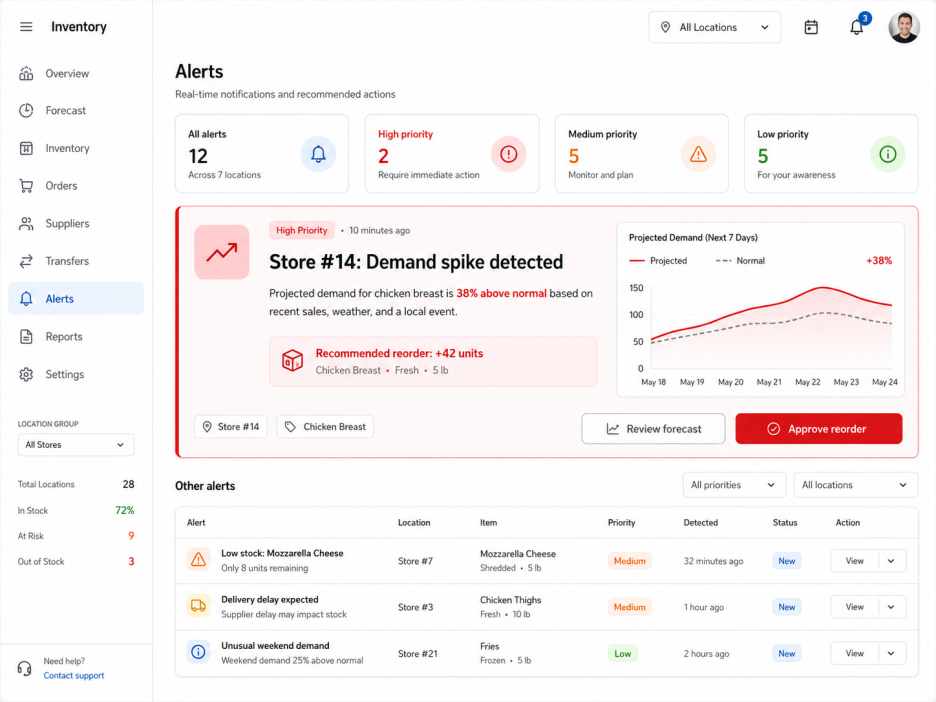
Here’s what that looks like on an ordinary Thursday: a manager opens the app before placing the weekly order and sees a flag on chicken breast. Demand next weekend is trending well above the usual pattern because a local event just got added to the calendar. Instead of ordering the same amount as last week and finding out Saturday night that it wasn’t enough, she adjusts the order in two taps. No stockout, no emergency supplier call, no evening text to the district manager. That’s the value in one moment: not a dashboard full of metrics, just the right amount of product showing up before anyone had to notice a problem.
None of this happens on day one. Industry guidance generally points to around 12 months of clean, item-level POS history before a model can reliably capture a full seasonal cycle: holidays, weather swings, the slow season, the kind of pattern a single quarter of data can’t show. A new location can still go live sooner than that. Most platforms lean on comparable-location or brand-wide patterns to fill the gap early on, and the forecast tightens up as the store’s own history accumulates. Worth asking any vendor directly: what does my forecast look like in week one versus month six?
Traditional forecasting (par levels, moving averages, manager judgment)
• Relies on one manager’s memory and experience, real knowledge, but it doesn’t transfer when that manager leaves
• Averages recent sales, which works until something breaks the pattern: a new competitor, a menu change, an unusual week
• Every location solves the same problem independently, with no shared learning across the network
• Reacts quickly to what a manager sees on the floor, something AI still leans on human input for
AI/ML forecasting (adaptive, multi-variable)
• Learns from dozens of signals at once, not just recent sales
• Builds a separate model per location while still learning from patterns across the network
• Adjusts automatically as new data comes in, rather than waiting for someone to notice
• Still needs a human to flag what it can’t see on its own, like a manager’s note about a known local event
Why Multi-Unit Retail & Franchises Face a Unique Forecasting Problem
A single store is hard enough to forecast. A network of stores is a different problem entirely, because every location behaves like its own small business.
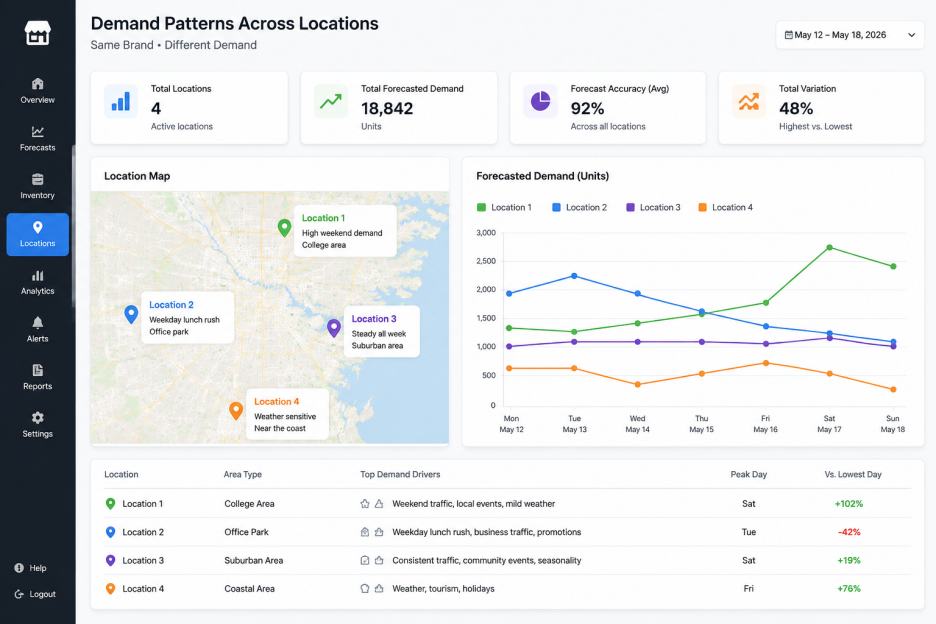
One unit near a college campus sees weekend spikes and almost nothing on weekday mornings. Another near an office park does the opposite. A third has completely different seasonality because of a local festival, a competitor closing down the street, or simply different weather patterns. Multi-unit retail inventory management has to account for all of it, at the same time, without losing sight of the brand as a whole.
Spreadsheets and manual par levels can limp along for two or three locations. Past that, the math stops working. Ordering decisions get made by whoever has the most experience or the loudest opinion, not by what the data actually shows, and headquarters loses visibility into what’s happening at the shelf or the walk-in level. That gap has held remarkably steady: the global out-of-stock rate has hovered around 8.3% of items on any given shelf since a landmark 2002 study tracked more than 71,000 shoppers across 29 countries, and Pygmalios’s 2026 State of Retail report confirms the figure hasn’t meaningfully moved since, a sign that two decades of technology investment haven’t closed the gap on their own.
Franchises carry an extra layer of tension on top of that: brand consistency versus local demand reality. Corporate wants every location to look and operate the same way. But a store’s actual demand pattern doesn’t care about brand standards. It follows local traffic, weather, and events. Food franchises feel this hardest of all, because perishable ingredients turn a forecasting miss into wasted product and lost margin within days, not weeks.
The Franchise Tension No Vendor Talks About
Most inventory software pitches sound the same regardless of who’s buying: better forecasts, less waste, happier managers. What that pitch usually skips is the thing that makes franchises structurally different from a chain of corporate-owned stores: the person who feels the cost of a bad order isn’t always the person who controls the fix.
The franchisee eats the waste. When a location over-orders produce or under-orders chicken breast, that hits the franchisee’s food cost line, not corporate’s P&L. It’s their walk-in, their spoilage, their week.
The franchisor controls the supply agreements. Approved vendor lists, negotiated pricing, sometimes minimum order commitments: those terms are usually set at the corporate level, often with limited room for an individual store to deviate even when local demand calls for it.
That mismatch shows up in three questions worth settling before anyone signs anything:
Who pays for the software? If corporate mandates a forecasting platform, it’s another line item stacked on royalties, the marketing fund, and whatever technology fee already exists, a hard sell to franchisees watching their own margins. If it’s optional instead, adoption stays patchy, and HQ ends up with a network where some locations feed clean data into the system and others don’t, which quietly undermines the forecast for everyone.
Can HQ see a franchisee’s food cost? This is as much a trust question as a technical one. Some franchise agreements give corporate broad visibility into store-level financials; others don’t. Franchisees can be understandably wary of a system that hands headquarters a real-time view into their margins, especially if a bad week triggers a call from corporate instead of help.
Who owns the recommendation when it’s wrong? If a store follows a corporate-mandated forecast and still ends up with spoiled inventory, that’s a harder conversation than “the manager guessed wrong,” because now there’s a system, and a mandate, in the mix.
One more gap worth flagging here, since it touches the same P&L: none of this addresses menu pricing or margin protection. A franchisee can have a perfectly forecasted order and still lose money if ingredient costs spike and pricing doesn’t move with it. That’s a different lever entirely, covered in more detail below.
None of this makes forecasting software a bad idea for a franchise network. It means the rollout conversation has to cover data ownership, visibility, and cost-sharing explicitly, not just accuracy and features.
Core Benefits for Multi-Unit Retail & Food Franchise Operators
Forecasting software makes a long list of promises. These three hold up:
Reduced food and product waste. Ordering to match a location-specific forecast instead of a rough estimate means fewer expired ingredients and less markdown stock sitting on shelves. How much that’s worth varies a lot by concept and starting baseline, see what a rollout typically looks like further down, but the direction is consistent across operators who’ve made the switch from guesswork.
Fewer stockouts, fewer lost sales. When a forecast accounts for a local event or a weather shift, the store actually has product on hand instead of turning customers away. That matters more than it might seem: research cited in Pygmalios’s 2026 State of Retail report puts the figure at roughly 31% of shoppers who hit an out-of-stock item buying it somewhere else instead, with another 9% not buying at all, meaning every missed forecast is a potential lost customer, not just a lost sale.
Centralized visibility for franchisors. HQ gets a real-time view across every unit instead of waiting on manager-submitted reports, which matters as much for spotting which locations need support as it does for the vendor and franchise-fee conversations covered above.
Most platforms also tie predicted demand into staffing and give franchisors more consistent, data-backed order volumes to negotiate with suppliers, genuinely useful, but secondary to the three above.
What Forecasting Can’t Fix
AI forecasting is good at predicting demand. It doesn’t fix everything around it, and vendors don’t always volunteer that part.
Garbage in, garbage out. A forecast is only as good as the inventory counts feeding it. Most locations don’t count well: counts get rushed at close, miscounted, or skipped when a manager’s slammed. Feed a model inconsistent counts and it learns the wrong baseline, and the recommendations drift from there.
Managers can ignore the suggestion. Software can recommend the right order. It can’t place it. If store-level managers don’t trust or act on the forecast, because they weren’t trained on it, or because it contradicted their gut once and they stopped checking, the ROI disappears quietly, even though the system is working exactly as designed.
It’s not a pricing tool. Forecasting predicts volume: how much of something a location will need. It doesn’t tell you what to charge, when to discount, or how to protect margin when ingredient costs spike, and that gap matters more here than in a typical vendor pitch, since the franchise tension above already means the franchisee absorbs cost swings that a pricing tool, not a forecasting tool, is built to manage. If a vendor blurs that line in a pitch, ask them to name the specific product that handles pricing, because forecasting alone won’t.
What a Rollout Typically Looks Like
A common pattern: a quick-service or multi-unit retail franchise connects POS data across its locations, layers in weather and local event signals, and starts generating store-specific, ingredient- or SKU-level order suggestions each week. Managers still approve every order. The system doesn’t remove the human checkpoint, it just gives that person a better number to start from.
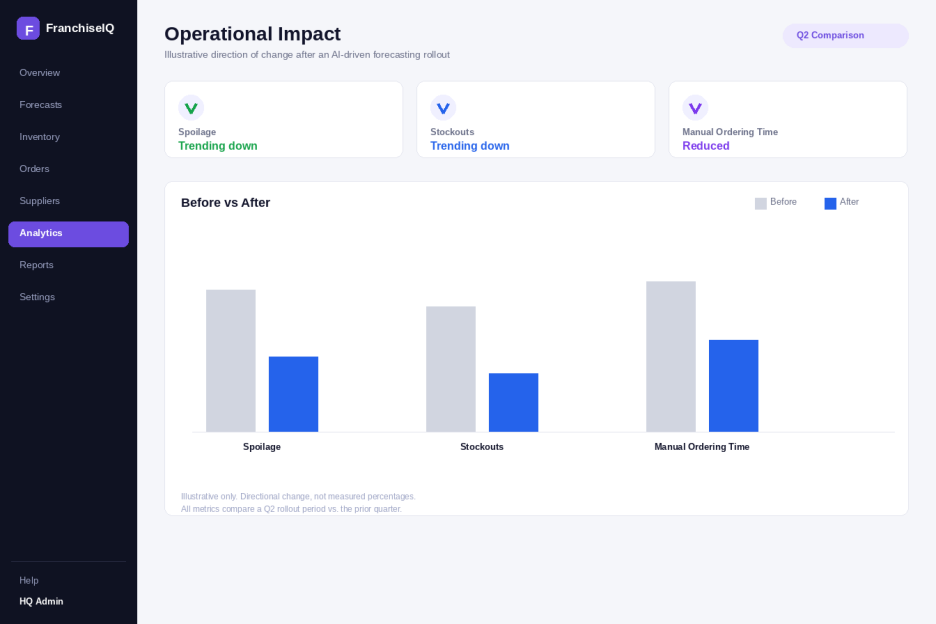
Directionally, that’s what a phased rollout tends to produce: spoilage and stockouts trend down as forecasts get more accurate, and managers spend less time each week rebuilding orders from scratch since they’re adjusting a suggestion instead of starting blank. Exactly how much depends on the brand, menu complexity, and, per the section above, how clean your inventory counts are going in. Ask any vendor for their own before-and-after numbers from a comparable rollout instead of a generic industry range, and treat anything they can’t back up with real customer data as a starting estimate, not a promise.
How to Evaluate an AI Forecasting Solution for Your Franchise
This is the part worth spending the most time on, because the difference between forecasting software that gets used and forecasting software that quietly gets ignored six months in usually comes down to these six questions.
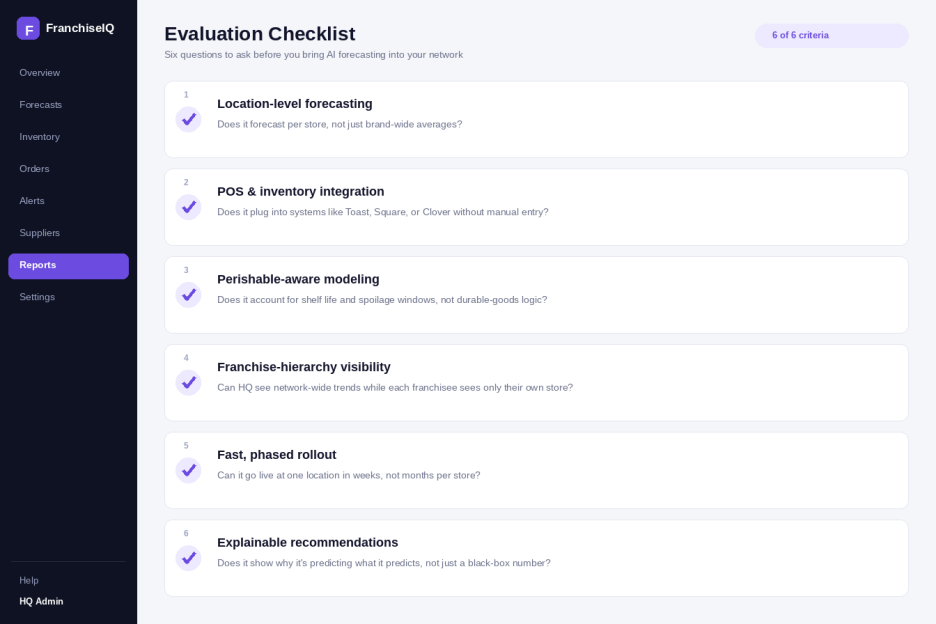
Does it forecast at the individual-location level, not just in aggregate? A brand-wide number is close to useless for a manager trying to decide what to order at one specific store.
Does it integrate with your existing POS and inventory systems? A forecasting tool that requires manual data entry defeats its own purpose. It should plug into what your locations already use: systems like Toast, Square, or Clover are common starting points for franchise networks, with a clean handoff to accounting tools like QuickBooks if that’s where your franchise tracks food cost, rather than treating it as the source of order data itself.
Does it account for perishables and shelf-life constraints? Food franchises need a system built around spoilage windows, not one borrowed from a durable-goods retailer.
Is it built for franchise hierarchies, and clear about who sees what? Franchisors need roll-up visibility across the network; franchisees need a simple view of their own store, plus clarity on whether corporate can see their food cost. Get this in writing before rollout, not after the first uncomfortable conversation.
Can it roll out quickly across multiple locations, and what does accuracy look like on day one versus after it’s learned your data? A forecasting tool that takes months to deploy per store isn’t practical for a growing network, but neither is one that overpromises accuracy before it has enough history to back it up.
Does it explain why it’s predicting what it predicts? Store managers are far more likely to trust and act on a forecast when they can see the reasoning behind it, a local event, a weather shift, a promotion, rather than a black-box number. This is also one of the better defenses against the “managers just ignore it” risk above.
One more question worth asking, even though it doesn’t fit neatly into the six above: what does this system explicitly not do? If pricing, margin protection, or menu engineering come up in the sales conversation, get specific about which product actually handles that. A forecasting tool and a pricing tool solve different problems, and the best vendors will tell you that upfront.
Conclusion
Guesswork used to be an acceptable cost of doing business across multiple locations. It isn’t anymore. AI inventory and demand forecasting for franchises has moved from a nice-to-have into a genuine margin protector, but only when the rollout also answers the franchise-specific questions around cost, visibility, and trust that a generic vendor pitch tends to skip.
If manual ordering and spreadsheet forecasting are still running your network, it’s worth working through the six-point checklist above with any vendor you’re evaluating. Weam works with multi-unit and franchise operators to build demand forecasting and recommended ordering workflows that plug directly into the POS and reporting tools they already use. If you want to see it against your own numbers before committing to anything, we’ll pull 90 days of your POS history and walk through where a forecast would have caught a stockout or an over-order, at no cost and with no obligation to buy.
FAQ
How much historical data does a location need before AI forecasting works well?
Most platforms want to see close to a full year of clean, item-level POS history to capture seasonality, holidays, and slow periods. A brand-new location can still go live sooner, usually leaning on comparable-location or brand-wide patterns as a starting point, with accuracy improving as the store’s own data accumulates. Ask any vendor directly what their forecast looks like in week one versus month six for a new location.
How much can AI reduce food waste in restaurants?
There’s no fixed percentage that applies across the board. It depends on the concept, menu complexity, how much historical data is available, and, per the objections above, how consistently your locations count inventory to begin with. Directionally, spoilage and stockouts trend down as the forecast gets more accurate and managers stop reordering from scratch each week, but treat any specific percentage a vendor quotes before seeing your data as a starting estimate, not a guarantee.
Can AI forecasting work for a single-brand multi-location franchise?
Yes. AI forecasting is particularly well suited to single-brand networks because it can learn the shared patterns across the brand while still adjusting for the differences between individual locations, something a single brand-wide average can’t do.
How long does it take to implement AI inventory forecasting across locations?
Timelines vary by network size and how clean the existing POS data is, but many franchise systems can get a first location live within a few weeks, with a phased rollout across the rest of the network following once the model has learned from real store data.
Who should pay for AI forecasting software in a franchise, corporate or the franchisee?
There’s no universal answer; it depends on how the franchise agreement structures technology fees and whether the platform is mandated network-wide or offered as optional. What matters more than who pays is that the answer is decided and communicated before rollout. Networks that leave it ambiguous tend to get inconsistent adoption, which weakens the forecast for everyone, since it depends on data from every location.