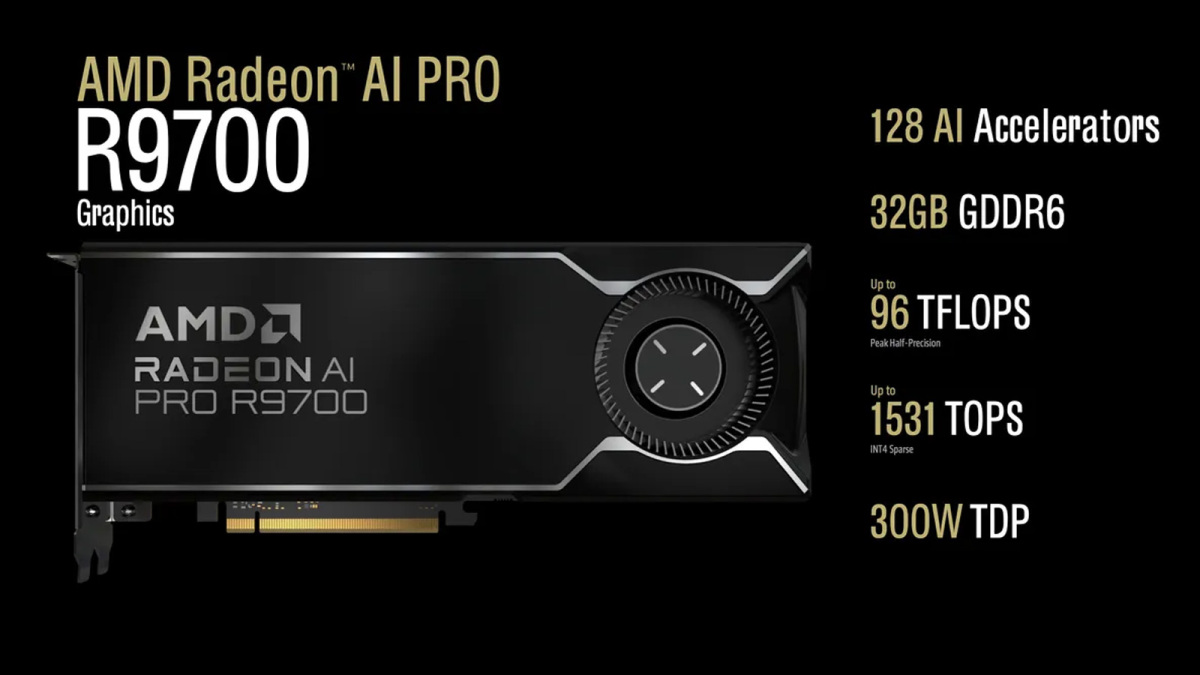
AMD is going to launch its own cut-down AI graphics card exclusively for the Chinese market. Based on the AMD Radeon AI Pro R9700, this card will compete directly with Nvidia’s RTX 5000-series GPUs and some of Huawei’s homegrown AI hardware.
The Chinese market has become increasingly important for GPU sales, and not just because of its huge gaming scene. The explosive growth of AI investment around the world has also seen Chinese firms buying up huge quantities of graphics cards. Though the Trump administration’s on-again, off-again tariffs make the industry far from stable, AMD is still looking to compete with a new China-specific card by Q3 2025.
AMD released the AI Pro R9700 just a week ago, offering a small but notable upgrade over the last-generation W7800. Based on the same GPU as the 9070 XT, the die size is almost a third smaller but has over 90% of the same number of transistors. It features the latest generation of AI and ray tracing accelerators, a much higher boost clock, and 32GB of GDDR6 memory.

Whatever the performance of the Chinese Pro card, it will scale with multiple cards.
Credit: AMD
While the raw performance of the card isn’t dramatically greater than its predecessor, it’s in AI workloads that the new card really shines. AMD claims it’s more than twice as fast as the W7800 running the DeepSeak R1 Distill Llama 8B model. It’s also five times faster than the RTX 5080, according to AMD’s own numbers—though as Tom’s Hardware suggests, that’s an odd comparison to make. AMD was probably doing a 32GB-versus-16GB comparison, but there are professional cards it could have compared with instead.
Total AI performance of the R9700 tops out at 1,531 TOPS. It also consumes up to 300W of power, which is more than the last generation, but not dramatically so.
The version of this card that makes it to China will likely be weaker overall, as Nvidia’s China-specific cards have needed to comply with US export laws. AMD has already done that with its MI308 GPU, though it also lost hundreds of millions because that card proved too powerful to sell to the Chinese market.
But all that does is further fuel demand for these kinds of chips in China, which means there’s still a lot of money to be made there. Instead of leaving it all to Huawei and Nvidia to enjoy, AMD is looking to get into the mix. Its cards won’t be as powerful as Nvidia’s options, but that may not matter much.