Wonders of Sodor Free Download (Build 22317314+1 DLC)


Thomas and Friends Wonders of Sodor Preinstalled Worldofpcgames

Thomas and Friends: Wonders of Sodor Direct Download

Join Thomas and his friends on a special journey across Sodor! Hop into the cabs of North Western Railway’s classic steam team to enjoy nostalgic stories and all-new narratives right from the drivers’ seats. Explore the Wonders of Sodor – fun and magic await!

Take the controls of Thomas, Percy, Gordon, Emily, and Diesel to explore iconic landmarks across the Island of Sodor. At Sir Topham Hatt’s invitation, carry passengers in Annie & Clarabel along Thomas’ branch line, hurry express passengers over the top of Gordon’s Hill, or transport freight with the Troublesome Trucks.

Thomas & Friends: Wonders of Sodor tells classic and original tales inspired by the Railway Series books and TV shows, now told for the first time in an interactive, first-person perspective – the first ever faithful recreation of Sodor in a game! Skeleseller

Experience the sights, sounds, and feelings of Sodor as you explore iconic Thomas & Friends locations like you’ve never seen them before, including Tidmouth Sheds, Knapford station, and the famous Windmills. A total of 8 stories await including Thomas & Gordon, Thomas & Bertie’s Great Race, Percy’s Troublesome Day, and more. Each story features full narration by the legendary Mark Moraghan for the ultimate storytelling immersion.

But that’s not all! Help Thomas and his Friends be really useful engines across a full working schedule for the Island of Sodor. See all the engines running about the island doing their daily tasks, get involved by driving Thomas on his branch line, or even ride as a passenger! While exploring the island, look out for hidden collectables to find!

Features and System Requirements:

  • Join Thomas and friends on a cheerful journey across the Island of Sodor filled with fun activities.
  • Drive trains and complete tasks while helping characters and delivering important cargo.
  • Explore colorful locations that bring the world of Thomas & Friends to life.
  • Take part in simple challenges designed for easy and enjoyable gameplay for all ages.

Screenshots

System Requirements

Minimum
Requires a 64-bit processor and operating system
OS: 64-bit Windows 10 or Windows 11
Processor: Intel Core i5-4690 @ 3.5 GHz or AMD Ryzen 5 1500X @ 3.7 GHz
Memory: 8 GB RAM
Graphics: NVIDIA GeForce GTX 750 Ti or AMD Radeon RX 460 with 2 GB VRAM or more
DirectX: Version 10
Storage: 35 GB available space
Support the game developers by purchasing the game on Steam

Installation Guide

Turn Off Your Antivirus Before Installing Any Game

1 :: Download Game
2 :: Extract Game
3 :: Launch The Game
4 :: Have Fun 🙂

Reducing GPU Memory and Accelerating Transformers


Introduction

The transformer revolution is now deep into its long‑context era. Models like GPT‑4 (32 k tokens), MosaicML’s MPT (65 k), and Claude (100 k) can process entire chapters or codebases. Yet as context grows, the attention mechanism becomes the bottleneck: calculating the similarity matrix S = Q·K^T and the probability matrix P = softmax(S) produces N×N data structures. These matrices must be moved between the GPU’s tiny on‑chip SRAM and its larger but slower high‑bandwidth memory (HBM), consuming bandwidth and limiting throughput. In a world where compute FLOPs continue to climb, the real constraint has become memory.

FlashAttention, introduced in 2022, addressed this problem by tiling the computation to avoid ever storing the full S or P matrices, delivering 2–4× speedups and up to 10–20× memory savings. FlashAttention‑2 (FA2) goes further: it reduces costly non‑matmul operations, parallelizes across sequence length, and partitions work to minimize shared‑memory traffic. Benchmarks show FA2 is about twice as fast as its predecessor and up to nine times faster than standard attention implementations, hitting 225 TFLOPs/s on NVIDIA A100 GPUs. This guide explains how FA2 works, when to use it, how to integrate it into your stack, and where its limits lie.

Quick Digest

  • FA2 solves a memory‑bound problem. Attention’s N² memory footprint stalls GPUs; tiling and kernel fusion bring it down to linear memory cost.
  • Key innovations: fewer non‑matmul FLOPs, extra parallelism along sequence length, and slicing the query matrix across warps.
  • Adoption: Supports Ampere/Ada/Hopper GPUs and FP16/BF16 datatypes. Install via pip and flip a flag in PyTorch or Hugging Face to enable.
  • Who benefits: Anyone training or serving long‑context models (8 k–16 k tokens) or using large head dimensions; cost savings are substantial.
  • Caveats: Only attention is accelerated; feed‑forward layers remain unchanged. FP32 precision and older GPUs are unsupported.

The Memory Bottleneck in Transformers

Why memory—not compute—matters

Each token attends to every other token, so naïve attention materializes N×N matrices. With 4 k tokens and 96 heads, the similarity and probability matrices alone consume several gigabytes. On modern GPUs, data movement between the tiny on‑chip SRAM (≈20 MB) and HBM (≈40–80 GB) dominates runtime. More compute doesn’t help if the algorithm shuttles large intermediate results back and forth.

To decide whether you need FA2, perform the MEMS Check:

  1. Memory – Estimate your attention matrix size. If it can’t fit in SRAM and triggers out‑of‑memory errors, you’re memory‑bound.
  2. Efficiency – Use profilers (Nsight or PyTorch) to see if kernels saturate compute or stall on memory transfers.
  3. Model size – Many heads or large embeddings increase memory overhead.
  4. Sequence length – Beyond ~2 k tokens, standard attention’s O(N²) memory explodes.

If two or more factors flag red, FA2 can help. However, tasks with short sequences (≤512 tokens) remain compute‑bound and won’t benefit from tiling; the overhead of custom kernels may even slow them down.

Expert insight

“FlashAttention exploits the asymmetric GPU memory hierarchy to bring significant memory saving and 2–4× speedups without approximation.”Dao et al.

Understanding that memory—not computation—limits attention is key to appreciating FA2’s value.

Quick summary

  • Why does memory limit attention? Because attention creates huge N² matrices that must be moved between slow and fast memory. Profilers help determine if your workload is memory‑bound.

FlashAttention Fundamentals—Tiling and Recomputing

Tiling and kernel fusion

FlashAttention reorders computation to avoid ever materializing the full N×N matrices. It divides queries (Q), keys (K), and values (V) into blocks that fit in SRAM, performs matrix multiplications and softmax operations on those blocks, and accumulates partial sums until the final output is produced. Because all intermediate work stays on‑chip, memory traffic drops dramatically.

Kernel fusion plays a crucial role: instead of launching separate CUDA kernels for matmul, scaling, softmax, masking, dropout, and value projection, FlashAttention performs them within a single kernel. This ensures that data isn’t written back to HBM between steps.

Recomputation in the backward pass

During backpropagation, naïve attention must store the entire attention matrix to compute gradients. FlashAttention saves memory by recomputing the necessary local softmax values on the fly. The small cost of extra computation is outweighed by eliminating gigabytes of storage.

Negative knowledge

FlashAttention doesn’t alter the mathematical formula for attention; any deviations in output typically arise from using lower precision (FP16/BF16). Early versions lacked dropout support, so ensure your library version accommodates dropout if needed.

Quick summary

  • How does FlashAttention reduce memory? By tiling Q/K/V into blocks, fusing operations into a single kernel, and recomputing softmax values during backprop.

What’s New in FlashAttention‑2

FA2 refines FlashAttention in three major ways:

  1. Fewer non‑matmul operations: GPUs achieve enormous throughput on matrix multiplication but slow down on general FP32 operations. FA2 rewrites rescaling and masking code to minimize these non‑matmul FLOPs.
  2. Parallelism along the sequence dimension: When batch size × head count is small, the original FlashAttention can’t saturate all GPU streaming multiprocessors. FA2 parallelizes across long sequences, boosting occupancy.
  3. Query slicing: Instead of slicing keys and values across warps (requiring synchronization), FA2 slices the query matrix, allowing warps to compute their output independently. This eliminates shared‑memory writes and delivers more speed.

FA2 also supports head dimensions up to 256, as well as multi‑query (MQA) and grouped‑query (GQA) attention. Head dimension support matters for code‑oriented models like CodeGen or GPT‑J.

Decision guidance

Use this quick decision tree:

  • If you run on Turing GPUs (e.g., T4) –> stick to FlashAttention 1 or standard kernels.
  • Else if your head dimension >128 –> choose FA2.
  • Else if (batch_size × num_heads) is small and sequence is long –> FA2’s extra parallelism pays off.
  • Else benchmark FA1 and FA2; the simpler implementation may suffice.

Caveats

FA2 requires Ampere, Ada, or Hopper GPUs and currently supports only FP16/BF16 datatypes. Compilation is more complex, and unsupported GPUs will fall back to FA1 or standard attention.

Expert insight

“FlashAttention‑2 is about 2× faster than FlashAttention and reaches up to 230 TFLOPs/s on A100 GPUs.”Tri Dao

FA2 closes much of the gap between attention kernels and optimized matrix multiplications.

Quick summary

  • What distinguishes FA2? It cuts non‑matmul operations, parallelizes over sequence length, slices queries instead of keys/values, and supports larger head sizes and MQA/GQA.

Installing and Integrating FlashAttention‑2

Requirements and installation

FA2 supports A100, H100, RTX 3090/4090, and AMD MI200/MI300 GPUs and requires FP16/BF16 precision. Install via:

pip install flash-attn --no-build-isolation

Ensure CUDA ≥12.0 (or ROCm ≥6.0) and PyTorch ≥2.2. Install the ninja build system to shorten compile times; if your machine has limited RAM, cap parallel jobs using MAX_JOBS=4.

Enabling FA2 in frameworks

In Hugging Face Transformers, set the use_flash_attn_2=True flag when instantiating your model. For custom code, import and call the kernel:

from flash_attn_interface import flash_attn_func
output = flash_attn_func(q, k, v, causal=True)

Input tensors should be shaped [batch, seq_len, num_heads, head_dim] or as required by the library. For unsupported hardware, implement a try/except block to fall back to standard attention.

Operational advice

  • GPU orchestration: Platforms like Clarifai’s compute orchestration make it easy to run FA2 on clusters. Select A100 or H100 GPUs, and use the built‑in profiling tools to monitor tokens per second. If you need turnkey hardware, Clarifai’s GPU hosting provides managed A100/H100 instances that integrate with local runners and remote orchestration.
  • Mixed precision: Combine FA2 with automatic mixed precision (AMP) to maximize throughput.
  • Benchmarking: After integration, measure tokens per second, GPU memory usage, and wall‑clock time with and without FA2. Use these numbers to adjust batch sizes and sequence lengths.

Quick summary

  • How do I use FA2? Install the package, ensure you have compatible GPUs and drivers, enable FA2 in your framework, and benchmark. Use Clarifai’s orchestration and model inference tools for scalable deployment.

Performance Benchmarks and Cost Savings

Speedups on A100 and H100

Public benchmarks report that FA2 delivers around 2× speedup over FA1 and up to 9× over standard PyTorch attention. When training GPT‑style models end‑to‑end, FA2 achieves 225 TFLOPs/s on A100 GPUs and even higher throughput on H100 due to newer tensor cores.

An evaluation by Lambda Labs shows that FA2 increases the affordable batch size from 1 to 4 while keeping GPU memory constant; tokens per second jump from 3,717 to 10,650 on A100 and from 6,267 to 22,282 on H100.

Config Tokens/sec Batch size Notes
A100 baseline 3,717 1 Standard attention
A100 FA2 10,650 4 2.9× throughput increase
H100 baseline 6,267 1 Standard attention
H100 FA2 22,282 4 3.5× throughput increase

Scaling to multi‑GPU clusters yields near‑linear performance when high‑bandwidth interconnects (NVLink/NVSwitch) are available.

Cost impact

Because FA2 allows larger batch sizes and higher throughput, it reduces training time and compute cost. For example, replicating GPT3‑175B training with FA2 on 1,024 H100 GPUs is estimated to cost around $458 k, a 90 % reduction compared with traditional kernels. On cloud platforms like Clarifai, fewer GPU hours translate directly into cost savings.

Caveats

Iter/sec may drop slightly because each batch is larger. Actual tokens/sec is the meaningful metric; ensure you measure the right quantity. Multi‑GPU gains depend on interconnect bandwidth; low‑bandwidth clusters may not realize full speedups.

Quick summary

  • How much faster is FA2? Roughly twice as fast as FA1 and up to nine times faster than standard attention. It increases batch size and reduces training costs dramatically.

Practical Use Cases and Decision Guide

Long‑context language models

FA2 shines when you need to process long documents, stories, or transcripts. With its linear memory cost, you can train or fine‑tune models on 16 k–64 k tokens without approximations. Legal document review, novel writing, and research paper summarization all benefit. Clarifai’s model inference pipeline makes it easy to deploy these large models and serve predictions at scale.

Code and multimodal generation

Models like CodeGen or Stable Diffusion 1.x use large head dimensions (up to 256), which FA2 supports. This allows for deeper code context or higher resolution images without running out of memory.

High‑throughput inference with MQA/GQA

FA2’s support for multi‑query and grouped‑query attention reduces KV cache size and speeds up inference. This is ideal for chatbots and real‑time assistants serving thousands of users concurrently.

Decision matrix

Scenario Sequence length Head dim GPU Recommendation
Short text classification ≤2 k ≤64 Any Standard/FA1
Long doc summarization 8 k–16 k ≤128 A100/H100 FA2
Code generation 4 k–8 k 256 A100/H100 FA2
Real‑time inference ≤4 k ≤128 A100/H100 FA2 with MQA/GQA
Ultra‑long context (≥64 k) >64 k any Mixed GPU/CPU Sparse/approximate

Common mistakes and tips

Don’t assume that bigger batches always improve training; you may need to retune learning rates. Multi‑GPU speedups depend on interconnect bandwidth; check whether your cluster uses NVLink. Finally, remember that FA2 accelerates self‑attention only—feed‑forward layers may still dominate runtime.

Quick summary

  • Who should use FA2? Practitioners working with long contexts, large head sizes, or high‑throughput inference. Short sequences or unsupported GPUs may not benefit.

Limitations and Alternatives

Precision and hardware constraints

FA2 runs only on Ampere/Ada/Hopper GPUs and AMD’s MI200/MI300 series and supports FP16/BF16 datatypes. FP32 precision and older GPUs require falling back to FA1 or standard attention. Edge devices and mobile GPUs are generally unsupported.

Where FA2 won’t help

If your sequences are short (≤512 tokens) or your model has few heads, the overhead of FA2 may outweigh its benefits. It does not accelerate feed‑forward layers, convolutional operations, or embedding lookups; for these, consider other optimizations.

Alternatives

For extremely long sequences (>64 k tokens) or hardware without FA2 support, consider Performer, Linformer, Longformer, or Paged Attention. These methods approximate attention by using low‑rank projections or local sparsity. They may sacrifice some accuracy but can handle contexts that FA2 cannot.

Quick summary

  • When should you avoid FA2? When precision must be FP32, when running on unsupported GPUs, when contexts are short, or when approximations suffice for extreme lengths.

Looking Ahead

Emerging kernels

FlashAttention‑3 (FA3) targets the H100 GPU, adds FP8 support, and leverages Tensor Memory Accelerator hardware, pushing throughput even higher. FlashAttention‑4 (FA4) is being rewritten in CuTeDSL for Hopper and Blackwell GPUs, with plans for unified kernels and full FP8 support. These kernels are in beta; adoption will depend on hardware availability.

New attention variants

Researchers are combining hardware‑aware kernels like FA2 with algorithmic innovations. Flash‑Decoding accelerates autoregressive inference by caching partial results. Paged Attention breaks sequences into pages for memory‑efficient inference, enabling 64 k contexts and beyond. FastAttention adapts FA kernels to NPUs and low‑resource GPUs. Expect hybrid techniques that unify tiling, sparsity, and new precisions.

Preparing for the future

To stay ahead, follow these steps: subscribe to flash-attn release notes, test FP8 workflows if your models tolerate lower precision, plan for A100/H100/B200 upgrades, and explore combining FA kernels with sparse attention for ultra‑long contexts. Clarifai’s roadmap includes support for new GPUs and FP8, helping teams adopt these innovations without overhauling infrastructure.

Quick summary

  • What’s next? FA3 and FA4 target new GPUs and FP8, while variants like Flash‑Decoding and Paged Attention tackle inference and extremely long contexts. Hybrid methods will continue to push transformer efficiency.

FAQs

Q: Does FlashAttention‑2 change the attention computation?
A: No. FA2 preserves the exact softmax attention formula. Differences in output arise from lower precision; use FP16/BF16 accordingly.

Q: Does FA2 support dropout and cross‑attention?
A: Recent versions support dropout and are being extended to cross‑attention. Check your library’s documentation for specifics.

Q: Can I use FA2 with LoRA or quantization?
A: Yes. FA2 operates at the kernel level and is compatible with techniques like LoRA and quantization, making it a good complement to other memory‑saving methods.

Q: What about JAX or TensorFlow?
A: Official FA2 kernels are available for PyTorch. Third‑party ports exist for other frameworks but may lag behind in performance and features.


Conclusion

As transformer models stretch into the tens of thousands of tokens, memory, not compute, is the bottleneck. FlashAttention‑2 provides a timely solution: by tiling computations, fusing kernels, reducing non‑matmul operations, and parallelizing across sequence length, it brings attention performance closer to the efficiency of optimized matrix multiplication. It doubles the speed of its predecessor and dramatically cuts memory use. Real‑world benchmarks confirm that FA2 offers substantial throughput gains and cost savings.

FA2 is not universal; it requires modern GPUs and supports only FP16/BF16. For ultra‑long sequences or unsupported hardware, approximate attention methods remain important alternatives. Yet for the majority of long‑context workloads today, FA2 is the most efficient exact attention kernel available.

Implementing FA2 is straightforward: install the library, enable it in your framework, and profile performance. Platforms like Clarifai’s compute orchestration and model inference simplify deployment across clusters, allowing you to focus on model design and application logic. If you don’t have GPU hardware, Clarifai’s GPU hosting offers ready‑to‑run clusters. And to test these capabilities risk‑free, start for free and claim credits via Clarifai’s sign‑up. Use our MEMS Check to decide whether your workload is memory‑bound, and keep an eye on emerging kernels like FA3/4 and Paged Attention.

In 2026 and beyond, transformer efficiency will hinge on pairing algorithmic innovations with hardware‑aware kernels. FA2 offers a glimpse into that future—one where memory bottlenecks no longer constrain the horizons of our models.




Counter-Strike 2 introduces the game’s biggest shake-up in years: Now when reloading, you lose all the mag’s remaining ammo


Counter-Strike 2 has released an update that makes one of the biggest changes in the game’s modern history: and no-one saw this one coming. Valve has changed how reloading works, so that when you reload, any ammo remaining in your current magazine is lost. And players are not happy.

“When you reload in CS2, the leftover ammo in your magazine is dumped back into an essentially endless reserve supply,” says Valve’s blog post on the change. “And so the decision to reload has never offered significant trade-offs—in a safe position with enough time, you might reload after firing a single bullet, or half a mag, or after firing down to empty, and the rest of the round would be unaffected.

How VS Code Builds with AI


March 13, 2026 by Pierce Boggan

We use AI every day to ship VS Code. It’s made us so much faster that, after ten years of monthly releases, we just went weekly. Agents were the key that unlocked this, not just for writing code, but across every part of how the team works.

To kick off Agent Sessions Day, I sat down with Peng Lyu, Engineering Manager on the VS Code team, to walk through how the VS Code team actually uses AI for our day-to-day work. Not only for implementing features (that part’s self-evident), but for everything around building features: triage, code review, release notes, validation, staying productive in a meeting-heavy schedule.

In that session, we probably only covered 5% of what the team does with agents on any given day. But it’s representative of how a product that’s used by millions of developers is built. So, we wanted to share more about these big recent changes to our workflow, and where we think we’re going next.

After Ten Years of Monthly Releases, We Went Weekly

We shipped VS Code monthly for ten years. Every single month we went through our well-oiled cycle of plan, build, test, endgame, ship. With each member of the team rotating through the different roles, it was a rhythm that became part of the team’s culture.

Recently, we decided to start shipping VS Code on a weekly cadence. And we wanted to keep the bar for rigor and quality just as high. A monthly cycle gives you breathing room with time to plan, time to run a full endgame week where the team cross-tests each other’s features, and time to write thorough release notes. Moving to a weekly cadence means all of that has to get faster or get automated. This is a huge change and a year ago, we couldn’t have done it. This shift was only possible because of the way agents have transformed how we work.

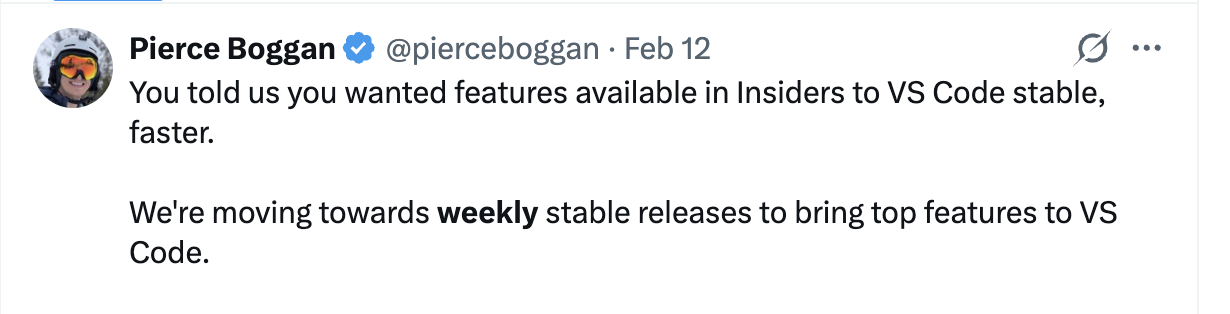
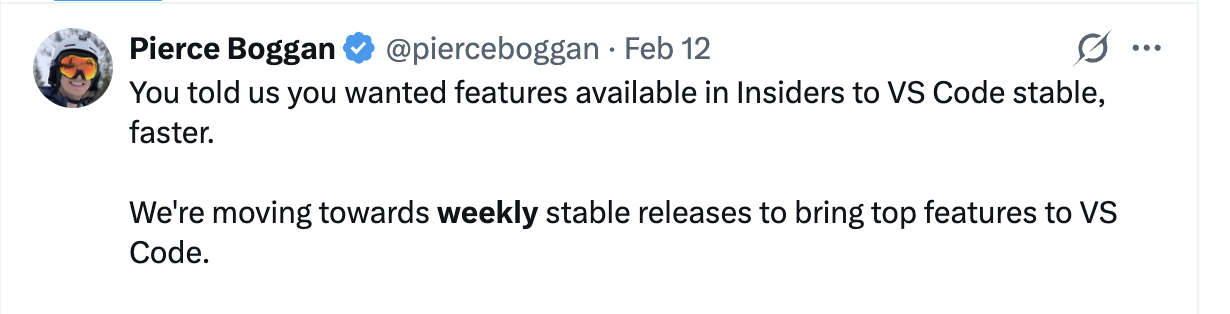
A screenshot of a post on X from @pierceboggan that says "You told us you wanted features available in Insiders to VS Code stable, faster. We're moving towards weekly stable releases to bring top features to VS Code".

The weekly cadence isn’t about shipping faster for its own sake. It’s about getting improvements to developers sooner. A bug fix that used to wait three weeks for the next stable release now ships in days. A feature that’s merged on Monday can be in developers’ editors that same week. That feedback loop of ship > learn > iterate just gets so much faster.

What We Learned From This Shift

Our workflows and processes continue to evolve daily, as we learn and adapt. But there are some key learnings that continue to hold true:

  1. Parallelize yourself. Build the habit of kicking off multiple agent sessions before context-switching. Worktrees, cloud agents, multiple VS Code sessions… use them all.
  2. Skip the intermediate artifacts. What used to be meeting notes → issues → specs → code, is now actually becoming meeting → agent sessions → code → PR.
  3. Automate the overhead that scales with velocity. We built agent-powered pipelines for issue triage, commit summarization, release notes, code review, all of it using Copilot CLI, the Copilot SDK, and GitHub Actions. Engineers are still on the other end of these workflows, but agents help surface the right things to the right people, faster.
  4. Invest in harnesses before speed. Tests, golden scenarios, and code review gates prevent agent-driven velocity from becoming agent-driven regression.
  5. Ownership is evolving. When PMs, engineers from other areas, community contributors, and agents can contribute to any component, traditional ownership models need to adapt. Accountability for outcomes still rests with engineers.
  6. Keep humans in the loop for taste. Agents check correctness. Humans evaluate delight.

Let’s look into more detail on how each of these plays out in our team.

Working in Parallel

There’s a famous Paul Graham essay about how maker schedules and manager schedules are fundamentally incompatible. That was mostly true until recently. But agents are changing that.

Here’s what a typical day might look like:

  • Before entering a meeting, kick off 3-4 agent sessions for fixing bugs, prototyping features, or triaging issues.
  • During the meeting, agents run in parallel across multiple VS Code sessions, worktrees, or in the cloud.
  • After the meeting, review the agent output, verify locally, merge or re-prompt, and kick off again.

Managers still attend meetings and other managerial tasks, but they can use agents to also take on some of the maker work that used to be impossible to do in a meeting-heavy schedule.

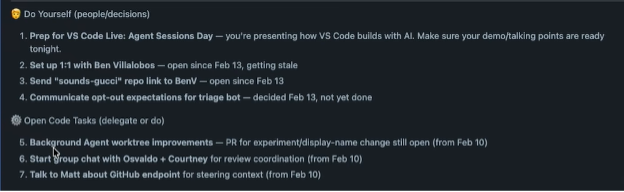
Let me give you a real example. Peng starts each morning by updating VS Code Insiders. Most days, we ship Insiders builds twice a day so we can get early feedback on the stuff we are working on. Then he runs a custom agent that fetches his meetings via Work IQ, and produces a snapshot of what’s on his plate.

From there, Peng decides what needs his focus, what to delegate to agents, and what to prioritize for the team. The agent handles the busywork of gathering context so he can cut straight to the interesting problems. By the time he’s in his first call, tasks are already running in parallel.

A task management view showing a prioritized to-do list split into two sections: "Do Yourself (people/decisions)" with 4 items including prepping for VS Code Live Agent Sessions Day, scheduling a 1:1, sending a repo link, and communicating opt-out expectations; and "Open Code Tasks (delegate or do)" with 3 items including background agent worktree improvements, starting a group chat for review coordination, and discussing a GitHub endpoint for steering context. Each item includes status notes and dates.

“Previously, you were always working sequentially. You wrote notes, turned them into issues, and then someone else, or you, would pick that up later. Now you are empowered and able to do things in parallel. It’s a habit you have to build. So, I don’t write down meeting notes anymore. I’m kicking off the agents directly.” — Peng Lyu

It really is a new muscle. Someone in a meeting mentions something we need to go do, and I’ll fire off agents right there. We’ve also enabled transcription for most of our meetings in Teams, so grabbing context after the fact is easy. What used to be meeting notes turned into issues turned into work is now just a prompt kicked off in the moment.

Automating the Overhead

More velocity is great. It also creates its own overhead: more issues to triage, more commits to track, more release notes to write. Here’s how we’ve automated the parts that scale with speed.

Commit summarization. We built a custom slash command that fetches all commits from the last 24 hours across multiple repos and summarizes them with a fast model. It used to be you’d git fetch and have 20 or 30 commits. Now, there can be 100+ waiting for you. An entire feature area can land in a single day. That same pipeline feeds into our Insiders changelog and powers our automated X account that posts daily updates. All built on Copilot CLI and the Copilot SDK, running as GitHub Actions triggered by commits to main.

Issue triage. VS Code is one of the largest open-source projects on GitHub. We love our community, and the volume of issues we get is a reflection of how many people care about the product: hundreds land daily. We used to have a rotating “inbox tracker” role, one person triaging everything for a week. This no longer scales.

Now, every time an issue is opened, it triggers an agent loop in GitHub Actions that detects duplicates (with confidence scores), determines the right owner, and suggests labels. The agent reads our ownership docs and looks at historical assignment patterns, because ownership shifts over time.

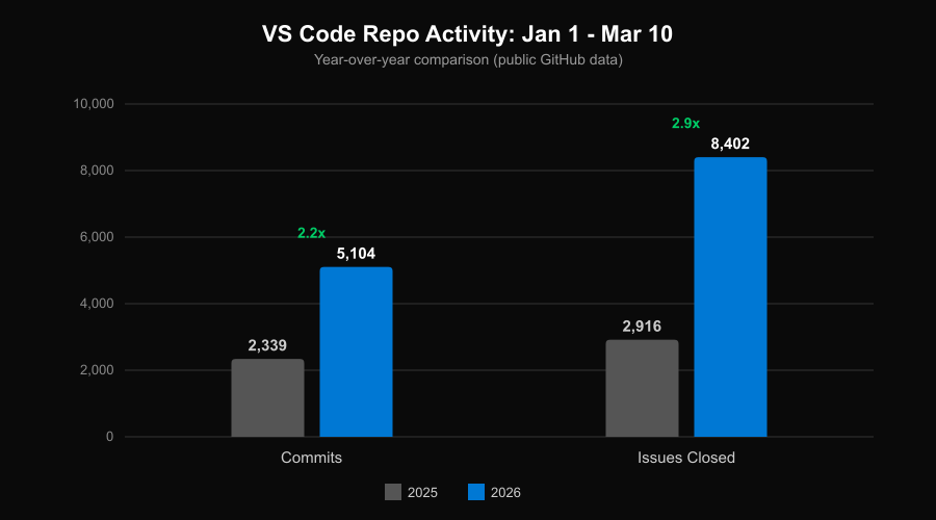
You can see it in the repo’s public data: comparing Jan-Mar year over year, commit volume has more than doubled and the team is closing nearly 3x as many issues. Better triage helps engineers find and fix the right issues faster, which frees up more time for actual software development.

Bar chart titled VS Code Repo Activity Jan 1 to Mar 10 showing a year-over-year comparison using public GitHub data. Commits grew from 2,339 in 2025 to 5,104 in 2026, a 2.2x increase. Issues Closed grew from 2,916 in 2025 to 8,402 in 2026, a 2.9x increase. 2025 bars are gray, 2026 bars are blue.

“Now that piece of code is written by Copilot, who is the right owner for it? I would say it’s still our engineers who are accountable for the outcome. But you do need the right harness to welcome other people to contribute to your component.” — Peng Lyu

The team also built a Chrome extension that shows triage suggestions directly on GitHub issues, like duplicates, owners, and labels. It includes a dashboard showing issue status across the team. Inside VS Code, custom slash commands let engineers groom issues and find duplicates without leaving the editor.

We’ve already seen a real boost in shipping velocity from the team. And, there’s still so much more we can continue to automate, streamline, and learn from as these workflows mature.

Everyone Ships Code

This is the part I’m most excited about, because it’s changed how I work more than anything else.

The traditional PM loop looks like this: write a spec or PRD → create issues → hand off to engineering. Nobody loved reading those specs, and the fundamental problem is that they’re based on hypotheses. You’re writing about what you think the experience should be, but you don’t actually know until it’s built. So, the turnaround time for feature validating can be long.

What’s changed is that instead of creating a spec, I create a prototype, an actual pull request!

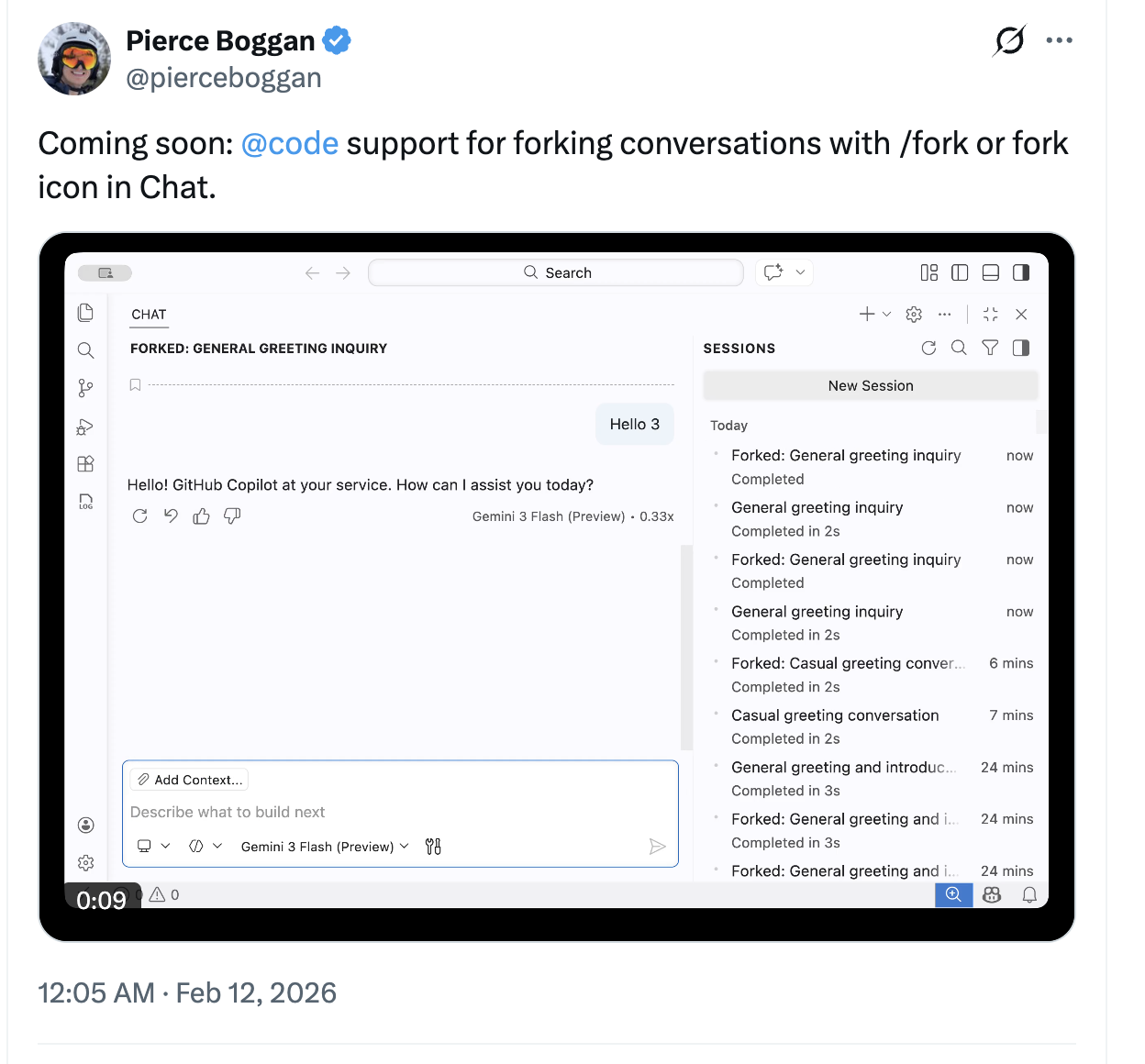
With agents in VS Code, I can go from someone giving us feedback on X or Reddit to a working prototype, self-host and experience it on Insiders, and continue to iterate. I had a PR merged last month that implements forking conversations in Copilot Chat. Together with Justin, one of our engineers, we reviewed the PR, worked through a few CSS changes together in the office and merged it. That’s in VS Code now.

A screenshot of an X post from @pierceboggan sharing that the fork feature is coming to VS Code.

This doesn’t mean that all these prototypes end up in the product. Engineers are still accountable for code quality and architecture. If Peng looks at my PR and says “this doesn’t have the right architecture,” that’s fair, I’m fine with my PR getting thrown away and rebuilt. But the PR moves the conversation forward faster than any document ever could. The first PR doesn’t have to be perfect. It moves the needle and starts a conversation with the engineer who owns that feature area.

This workflow is also a litmus test for whether your codebase is agent-ready. Can an agent find the right components? Can it find regressions? Can it find the right fix? If a PM can throw a problem at an agent and get a reasonable PR, that tells you something good about the codebase’s structure, documentation, and test coverage. If the agent struggles, that’s a signal too.

Keeping Quality High as Velocity Increases

More velocity means more risk of regression.

“Without the right harness, for the first week or two your productivity is really high. Then you quickly reach a ceiling where you keep regressing.” — Peng Lyu

If a new component doesn’t have good guardrails, agent-driven development starts strong and then quality degrades quickly. The fundamentals are still important, and with AI, we can actually improve upon them:

  • Automated validation. When you’ve got 5-10 agents running at once, manually verifying that each one delivered the right experience, not just code that compiles, is expensive. Our team built a custom agent that uses the Playwright MCP server to launch VS Code, navigate to the feature under test, take screenshots, and evaluate whether the change matches expected behavior. Because it runs inside an agent loop, if the screenshot shows something broken, the agent goes and fixes it. Screenshots are stored for human review.

  • Testing. Comprehensive test suites, unit tests, integration tests, and the infrastructure to run them, are table stakes. Beyond that, we document golden scenarios: specs of expected behavior for core user flows. We’ve traditionally tested these manually during monthly endgame weeks. We’re now giving these scenarios to agents to run as automated post-merge validation. We’re also exploring using this pipeline to auto-generate demo recordings: a PR lands, a demo video gets generated, and that becomes content for the changelog or a tweet.

  • Code review. Every PR automatically gets a Copilot code review, and engineers resolve Copilot’s comments before requesting human review. Six months ago, we didn’t enforce this because the feedback was too noisy. Over the last few months, model quality significantly improved, often catching security, performance, and code quality issues on first pass. Resolving those comments before requesting human review has become a natural part of our workflow. We coordinate through a Slack channel where a bot posts PRs with status indicators for CI and Copilot Code Review, both updating in-place as checks complete. The culture is “give one, take one”: submit a PR, pick up a review.

  • Evaluating for taste. Human review isn’t going away and has even become more important. When agents are writing more code and PRs are landing faster, the human reviewer checks whether the change actually makes sense for the product. Does this fit the architecture long-term? Does it feel right to use? Agents can catch bugs, but they can’t tell you whether a feature is going to delight a developer.

Traditionally, we had endgame weeks where engineers, PMs, and designers test each other’s features. We aren’t doing away with this, but rather compressing it in time. On the PM side, I’ve been exploring what I think of as taste-based grading: writing down the qualitative experience I want a feature to have, then using agents to evaluate whether the implementation matches. Maybe 80% of the agent’s observations are useful, 20% I ignore, but that 80% still gets you pretty far. Things like: does our model picker just show the model name and multiplier, or is there more information a user would actually want?

We think this same approach could help us check whether our published docs actually match the lived experience of using the product. All of our VS Code docs are largely written by one person, which is kind of amazing given our pace, but docs can go stale fast when the product is changing this quickly. We’re exploring how agents can help us catch that drift automatically.

What’s Next

More broadly, all of this comes back to what we think of as agent-ready codebase assessment: does your codebase have the structure, documentation, and test coverage for agents to contribute effectively?

We’re genuinely curious: what does your team’s version of this look like? Are there workflows we’re missing? Things you’ve automated that we haven’t thought of? Drop us an issue in the VS Code repo or find us on X — we’re building this alongside you and your feedback shapes what comes next.

We had a lot of other great sessions at Agent Sessions Day too, so check those out if you haven’t already.

Happy coding! 💙

Bloomway AI Announces Public Beta of CinePro: Infusing Cinematic Expertise into AIGC to Redefine the “Lean Cinema” Workflow


ATLANTA — bloomway.ai begins public beta testing today.

Bloomway AI, based out of Atlanta, Georgia, combines experience in film production with machine learning to help connect and manage the separation between complicated AI technology and easily understood creative solutions for creators of all kinds—from casual remixed video or photo creators to professionals. By allowing creators to produce film at a studio-level without any previous experience related to AI technology, or film-making, Bloomway provides an unprecedented level of opportunity.

One of the most effective and innovative features of this new AI-driven application is the ability for the creator to generate high-quality films through a simple and straightforward process—with no technical barriers. The “Creative Studio” is essentially an AI Assistant that utilizes AI technology to provide stepwise direction to an aspiring creator who is developing their own story, just as a seasoned screenwriter would guide them.

In addition to providing creators with the tools, expertise, and ability to create their films, the platform also provides an infinite amount of precision to the creator after the initial creation process. In fact, creators can use the “character consistency,” “camera angle,” and “lighting position” control to maintain visual integrity across multiple scenes, which results in a professional standard that is required for high-end storytelling.

According to Guojun Zhou, Founder of Bloomway AI, “Bloomway thinks as a Director would think—all of the frames in your film will be viewed individually, while at the same time being intelligently evaluated to determine the most effective or appropriate movement of the camera and placement of an actor. We see this digitalization of industry knowledge as equally important as model scale in creating usable creative content.”

video: https://youtu.be/FJxSeEZPPFk

CinePro, which is powered by Bloomway Technology, establishes a new type of versatile workflow where multi-camera filming will now operate as if executed by a professional multi-camera film crew. In addition, CinePro utilizes advanced “Keyframe Splitter and Linking” technology to segment chapters of the video into distinct parts for precise editorial use or connect them seamlessly across long takes (also known as “one-take sequenced”). It has over 700 different types of camera movements available to choose from, allowing for a fully produced cinematic work, including text-to-speech (TTS) narration.

CinePro has broken through current industry limitations on duration with its Bloomway product and now allows users to create continuous clips that go far beyond 60 seconds (this is double what most similar products can do). In addition, users will have full access to their created films even after the finished movie is complete and can go back to previously created shots or characters, modifying them until they match exactly how the final film will look.

Those interested in getting access to the open beta version of the software should visit the company’s website (www.bloomway.ai).

About Bloomway AI

Bloomway AI is a filmmaking AI startup based in Atlanta, Georgia. They develop video generation tools that integrate with professional production workflows. The team has extensive machine learning expertise in digital imaging and experience in the film industry. The principles behind Bloomway’s AI-based video tools are based on converting industry-wide cinematic expertise into data-driven and intelligent workflows. As a result, Bloomway offers creators, studios, and commercial teams around the world an affordable way to create studio-grade (professional) AI-generated videos

Media Contact:

Bloomway AI

Joseph Chow

info@bloomway.ai

Balancing Work & Play Online


Side Hustles and Digital Downtime
ID 159868658 ©
Iuliia Lisitsyna | Dreamstime.com

Home-based entrepreneurship is reshaping modern work culture. Entrepreneurs are not only launching innovative side hustles but also learning to balance long hours behind the screen with well-earned digital downtime. This lifestyle requires adaptability, strategic planning, and a genuine passion for both productivity and personal well-being.

Navigating the Home-Based Business World

In today’s competitive market, remote work is more than just a trend — it is a way of life. Digital tools have made it easier than ever to build a business from the comfort of home. Whether managing an online store, engaging in affiliate marketing, or creating content across social media channels, efficiency remains central to success. Entrepreneurs increasingly rely on sophisticated software systems, cloud services, and data analytics to keep operations running smoothly.

When exploring digital ventures that involve risk and entertainment, entrepreneurs may benefit from resources geared toward online gaming and betting. For those looking to understand complex betting markets without compromising a responsible work ethic, the top offshore betting sites guide offers comprehensive insights into navigating digital betting platforms. This guide covers secure practices in online betting while supporting a broader strategy of incorporating technology-driven leisure into a balanced lifestyle.

Embracing the Shift: Integrating Work and Play

One of the most significant changes in the home-based business environment is the growing focus on work-life balance. With remote work becoming increasingly common, professionals are rethinking how they allocate time for creative work, networking, and digital downtime. Structured rest is no longer viewed as wasted time — it is an essential component of a productive routine.

A common strategy among successful entrepreneurs includes setting aside dedicated blocks of time that are entirely screen-free, preserving mental clarity and sparking creative thought. This approach fosters a balanced lifestyle where professional success and personal well-being reinforce each other.

Key habits that support this balance include:

  • Implementing time-blocking to separate work tasks from leisure
  • Setting specific daily cut-off times for business communications
  • Scheduling short breaks throughout the workday to reset focus
  • Engaging in digital entertainment with defined time limits
  • Using automation tools to reduce repetitive manual tasks

Technology and the New Wave of Digital Entertainment

The rapid evolution of technology has redefined both business operations and digital entertainment. In a world that now includes esports, online casinos, and advanced betting platforms, home-based entrepreneurs often find themselves at the crossroads of work and recreational technology. Engaging with digital entertainment can provide the mental reset needed to return to work with renewed focus.

According to Deloitte’s Digital Media Trends Survey 2025, streaming and on-demand content are steadily replacing traditional media consumption, particularly among digitally native audiences. This shift reflects how deeply integrated digital entertainment has become in everyday life — including among entrepreneurs who use it as a deliberate tool for downtime.

Technological innovations offer immersive experiences, from interactive gaming to detailed betting guides that cater to enthusiasts who appreciate both the thrill of the game and precise data analytics. This trend is evident in how companies across various sectors are blending entertainment with practical business applications.

Strategies for Balancing Hustle and Downtime

Successful home-based entrepreneurs outline a clear structure that marries well-defined work hours with scheduled breaks. Alongside structured scheduling, adopting technology-driven productivity tools can streamline home operations. Automating routine tasks with software solutions or integrating cloud-based platforms for collaboration frees up valuable time for creative thinking or necessary relaxation.

Connecting with a broader network of fellow home business owners also offers substantial benefits. Peer support provides practical advice and encourages sharing strategies for balancing intensive work periods with leisure. Many entrepreneurs have found that virtual meetups and online forums dedicated to home-based business strategies yield actionable tips for both digital efficiency and personal well-being.

For entrepreneurs looking to sharpen their digital toolkit, implementing AI tools and tactics is one of the most practical ways to reduce workload and free up time — whether for business growth or well-earned downtime.

Conclusion: The Future of Work and Digital Leisure

The integration of side hustles with planned digital downtime is redefining the home-based entrepreneurial journey. Entrepreneurs who adopt disciplined time management, harness technological innovations, and actively pursue a balance between productivity and relaxation are well positioned to succeed in an increasingly digital economy.

By following structured routines, leveraging digital tools, and taking measured breaks, modern entrepreneurs are setting the stage for sustainable growth and continuous innovation in the home-based business arena.

Find a Home-Based Business to Start-Up >>> Hundreds of Business Listings.

Federal cyber experts called Microsoft’s cloud a “pile of shit,” approved it anyway


The problem is that agencies often lack the staff and resources to do thorough reviews, which means the whole system is leaning on the claims of the cloud companies and the assessments of the third-party firms they pay to evaluate them. Under the current vision, critics say, FedRAMP has lost the plot.

“FedRAMP’s job is to watch the American people’s back when it comes to sharing their data with cloud companies,” said Mill, the former GSA official, who also co-authored the 2024 White House memo. “When there’s a security issue, the public doesn’t expect FedRAMP to say they’re just a paper-pusher.”

Meanwhile, at the Justice Department, officials are finding out what FedRAMP meant by the “unknown unknowns” in GCC High. Last year, for example, they discovered that Microsoft relied on China-based engineers to service their sensitive cloud systems despite the department’s prohibition against non-US citizens assisting with IT maintenance.

Officials learned about this arrangement—which was also used in GCC High—not from FedRAMP or from Microsoft but from a ProPublica investigation into the practice, according to the Justice employee who spoke with us.

A Microsoft spokesperson acknowledged that the written security plan for GCC High that the company submitted to the Justice Department did not mention foreign engineers, though he said Microsoft did communicate that information to Justice officials before 2020. Nevertheless, Microsoft has since ended its use of China-based engineers in government systems.

Former and current government officials worry about what other risks may be lurking in GCC High and beyond.

The GSA told ProPublica that, in general, “if there is credible evidence that a cloud service provider has made materially false representations, that matter is then appropriately referred to investigative authorities.”

Ironically, the ultimate arbiter of whether cloud providers or their third-party assessors are living up to their claims is the Justice Department itself. The recent indictment of the former Accenture employee suggests it is willing to use this power. In a court document, the Justice Department alleges that the ex-employee made “false and misleading representations” about the cloud platform’s security to help the company “obtain and maintain lucrative federal contracts.” She is also accused of trying to “influence and obstruct” Accenture’s third-party assessors by hiding the product’s deficiencies and telling others to conceal the “true state of the system” during demonstrations, the department said. She has pleaded not guilty.

There is no public indication that such a case has been brought against Microsoft or anyone involved in the GCC High authorization. The Justice Department declined to comment. Monaco, the deputy attorney general who launched the department’s initiative to pursue cybersecurity fraud cases, did not respond to requests for comment.

She left her government position in January 2025. Microsoft hired her to become its president of global affairs.

A company spokesperson said Monaco’s hiring complied with “all rules, regulations, and ethical standards” and that she “does not work on any federal government contracts or have oversight over or involvement with any of our dealings with the federal government.”

This story originally appeared on ProPublica. ProPublica is a Pulitzer Prize-winning investigative newsroom. Sign up for The Big Story newsletter to receive stories like this one in your inbox.

Death Stranding 2: On the Beach review


I’m carrying half a ton of metal scrap and the soul of my dead daughter over the crest of a red sand dune when a mournful folk song begins to play, the words All that I want is a home inside the woods, and a woman that I can love spilling softly out of the universe. One of Death Stranding 2’s endless notifications pops up to tell me the sun is beginning to set. Dusk settles right as I park the truck full of random crap I just stole from a camp full of bandits, and I cherish the uncanny timing of another perfect music video moment before I bring the new location into the chiral network, reconnecting the isolated outpost to humanity via magic wi-fi. One cutscene later, the dusty landscape behind me has transformed into a Las Vegas strip of player-made bridges, power generators, futuristic timefall shelters and neon holograms, each zapped into my game world because they’ve accrued hundreds of thousands of Likes from other porters who’ve run across them.

Need to know

What is it? The most complicated mail delivery sim conceivable by human minds

Release date: March 19, 2026

Expect to pay: $70/£70

Developer: Kojima Productions

Publisher: PlayStation

Reviewed on: Intel i5-13600K, Radeon RX 9070 XT, 64GB DDR5

Steam Deck: Unknown

Link: Official site

AI Software Development: Why 95% Of Enterprise Pilots Fail


AI Software Development: Why 95% of Enterprise Pilots Fail—and How Manufacturers Can Beat the Odds?

The manufacturing industry stands at a critical inflection point. While artificial intelligence promises to revolutionize operations, reduce costs, and create competitive advantage, a stark reality confronts enterprise leaders: 95% of generative AI pilot programs fail to deliver measurable impact on profits and revenue [1]. For manufacturing executives watching competitors announce AI initiatives, the pressure to act is immense, but the path forward is anything but clear.

The disconnect isn’t about AI’s potential. Global investment in AI software development reached $674.3 million in 2024 and is projected to surge to $15.7 billion by 2033, growing at a staggering 42.3% annually [2]. Manufacturing leaders recognize this transformation: 78% of organizations now use AI in at least one business function [3]. Yet between aspiration and execution lies a chasm filled with failed pilots, wasted budgets, and missed opportunities.

In this article, you’ll discover:

  • Why most AI software development projects stall before reaching production
  • The hidden barriers preventing manufacturers from scaling AI successfully
  • How custom AI development delivers 2-3x stronger ROI than off-the-shelf solutions
  • Proven implementation approaches that separate AI leaders from laggards
  • What distinguishes successful AI partnerships from costly vendor relationships

The Real Cost of AI Implementation Failure

Before exploring solutions, manufacturing executives must understand the true scope of the AI adoption challenge. The numbers paint a sobering picture:

Challenge Area Impact Source
Pilot Failure Rate 95% of enterprise AI solutions fail to achieve rapid revenue acceleration MIT NANDA Research [1]
Market Growth AI in software development projected to grow from $674.3M (2024) to $15.7B (2033) Grand View Research [2]
Manufacturing ROI 78% of executives report seeing returns from gen AI investments Google Cloud/National Research Group [4]
Productivity Gains Gen AI reduces software development time by up to 55% in early adoption Mission Cloud [5]
Top Barrier to Adoption Data accuracy and bias concerns (45% of organizations) IBM Research [6]
Cost Range Small to medium AI projects: $50K-$500K; large-scale initiatives: $5M+ Vention Teams [7]

The data reveals a paradox: while AI adoption accelerates and proven ROI emerges, the vast majority of implementations never escape pilot purgatory. For manufacturing organizations, this failure pattern carries particularly high stakes, production delays, quality control issues, and supply chain disruptions don’t tolerate prolonged experimentation.

Why AI Software Development Projects Stall?

The root causes of AI failure in manufacturing aren’t primarily technical. According to MIT research analyzing 150 enterprise AI deployments, the core issue is “the learning gap for both tools and organizations” [1]. Generic AI tools like ChatGPT excel for individual productivity because of their flexibility, but they stall in enterprise manufacturing environments because they don’t learn from or adapt to complex operational workflows.

The five critical failure points include:

  1. Strategic Misalignment

    Organizations treat AI as a technology purchase rather than a business transformation. Without clear alignment between AI capabilities and manufacturing pain points, whether predictive maintenance, quality control, or supply chain optimization, pilots generate impressive demos but no operational value.

  2. Data Infrastructure Deficits

    Manufacturing environments generate massive data volumes across sensors, IoT devices, ERPs, and legacy systems. However, 45% of organizations cite data accuracy and bias as their primary AI adoption barrier [6]. When training data is fragmented, incomplete, or poor quality, even sophisticated AI models produce unreliable outputs.

  3. The Build vs. Buy Dilemma

    The choice between purchasing specialized AI tools and building custom solutions isn’t about industry trends, it’s about your organization’s unique context. Success depends on factors like your internal technical capabilities, the specificity of your manufacturing processes, budget constraints, and long-term strategic goals. Some manufacturers thrive with vendor solutions that address common needs efficiently, while others require custom development to handle proprietary workflows or competitive differentiation. The key is honest assessment: Does your use case demand custom engineering, or are you building because that’s what you’ve always done?

  4. Cultural and Skills Barriers

    AI adoption challenges extend beyond technology to organizational culture. In risk-averse manufacturing environments, employees fear job displacement while leadership struggles to quantify intangible benefits like faster time-to-market or enhanced decision-making. The skills gap compounds this, finding professionals who grasp both AI technology and manufacturing operations proves exceptionally difficult.

  5. ROI Uncertainty

    Manufacturing executives accustomed to tangible ROI calculations struggle with AI’s multidimensional value. Traditional financial metrics miss improvements in decision speed, market agility, and competitive positioning. When leadership can’t confidently articulate expected returns, AI initiatives face perpetual budget scrutiny and eventual cancellation.

Custom vs. Off-the-Shelf: Choosing Your AI Development Path

For manufacturers navigating AI software development, the build-or-buy decision fundamentally shapes both short-term outcomes and long-term competitive advantage. Each approach carries distinct tradeoffs.

Off-the-Shelf AI Solutions:
Pre-built platforms deliver speed and lower upfront costs. Manufacturers can deploy chatbots, basic predictive analytics, or demand forecasting tools within weeks. These solutions work well for standardized processes where differentiation isn’t critical: customer support automation, basic inventory management, or routine reporting. However, data security introduces a critical trade-off. While these platforms may appear secure, your operational data flows through third-party infrastructure, raising concerns about proprietary information exposure, compliance requirements, and long-term data governance that many manufacturers underestimate during evaluation.

However, generic tools hit scalability limits quickly. They struggle with manufacturing-specific complexities: multi-site production coordination, proprietary quality control processes, or unique supply chain variables. More critically, when competitors access identical tools, no competitive advantage emerges.

Custom AI Development:
Purpose-built AI solutions designed around proprietary manufacturing data and workflows deliver 2-3x stronger ROI than generic vendor models [8]. Custom development enables manufacturers to:

  • Build predictive maintenance models trained on specific equipment and operating conditions
  • Create quality control systems that detect defects unique to proprietary production processes
  • Develop supply chain optimization engines accounting for specialized supplier networks and logistics constraints
  • Integrate seamlessly with existing ERP, MES, and IoT infrastructure

The tradeoffs are higher upfront investment ($50,000-$500,000 for moderate complexity projects [7]) and longer deployment timelines. Yet for manufacturers where operational excellence drives competitive positioning, custom AI becomes proprietary intellectual property that competitors cannot replicate.

The Hybrid Advantage:
Leading manufacturers increasingly adopt hybrid approaches, deploying off-the-shelf solutions for commodity functions while investing in custom AI for core differentiators. A mid-sized manufacturer might use a SaaS chatbot for customer inquiries while building a custom predictive quality system trained on decades of proprietary production data.

What Distinguishes Successful AI Implementation?

Manufacturing organizations that successfully scale AI share common characteristics that separate them from the 95% trapped in pilot purgatory [1]:

Executive Sponsorship:
Google Cloud’s research found that manufacturers with comprehensive C-level sponsorship are significantly more likely to see ROI (84%) compared to those without executive alignment (75%) [4]. Successful AI adoption requires cross-functional collaboration guided by top-level support that aligns initiatives with business goals.

Phased, Value-Driven Roadmaps:
Rather than attempting enterprise-wide AI transformation, successful manufacturers identify high-impact use cases that deliver quick wins. One manufacturer might start with predictive maintenance for critical production lines, prove ROI within six months, then expand to quality control and supply chain optimization.

Partnership Over Vendor Relationships:
The MIT research revealing that purchased solutions outperform internal builds by 2:1 [1] underscores the value of specialized expertise. However, the distinction matters: true partners bring manufacturing domain knowledge, understand operational constraints, and commit to long-term success—not just initial deployment.

Data-First Foundations:
Organizations that invest in data infrastructure before AI implementation see dramatically higher success rates. This means establishing data governance, integrating siloed systems, implementing quality controls, and creating feedback loops that enable models to learn and improve continuously.

The Manufacturing AI Opportunity: 2026 and Beyond

The manufacturing sector stands poised for AI acceleration. Recent research shows 56% of manufacturing executives report their organizations actively use AI agents, with 37% deploying more than ten autonomous systems [4]. These sophisticated, multi-agent systems independently plan, reason, and execute tasks across quality control (54%), production planning (48%), and supply chain logistics (47%).

For manufacturing leadership, the strategic question isn’t whether to adopt AI software development—competitors are already moving. The question is how to implement AI in ways that deliver measurable impact, not just impressive pilots.

Success requires strategic vision that connects AI capabilities to manufacturing pain points, technical excellence that bridges legacy systems and modern architectures, and implementation expertise that navigates the complexities separating concept from production deployment. Most critically, it requires partnership with specialists who understand that AI in manufacturing isn’t about technology for its own sake, it’s about operational transformation that drives efficiency, quality, and competitive advantage.

The 95% failure rate [1] reflects organizations treating AI as a vendor relationship rather than a strategic transformation. The 5% succeeding recognize that AI software development, done right, becomes a proprietary capability that compounds competitive advantage with every production run, every quality check, and every supply chain decision.

Ready to Move Beyond Pilot Purgatory?

The gap between AI aspiration and measurable manufacturing impact isn’t closing on its own. While your competitors experiment, your organization can execute, turning AI from a boardroom buzzword into a production floor reality that drives efficiency, quality, and growth.

[Schedule a Strategic AI Consultation]


Sources:

  1. MIT NANDA Initiative, “The GenAI Divide: State of AI in Business 2025”
  2. Grand View Research, “AI In Software Development Market | Industry Report, 2033”
  3. Google Cloud / National Research Group, “The ROI of AI in manufacturing” (2025)
  4. Mission Cloud, “AI Statistics 2025: Key Market Data and Trends”
  5. IBM Research, “The 5 biggest AI adoption challenges for 2025”
  6. Vention Teams, “AI Statistics 2025: Key Trends and Insights Shaping the Future”
  7. Fortune, “MIT report: 95% of generative AI pilots at companies are failing” (August 2025)
  8. RTS Labs, “Off-the-Shelf vs Custom AI Solutions: Which Fits Your Business?”
  9. McKinsey & Company, “The State of AI: Global Survey 2025”


References:

[1] MIT report: 95% of generative AI pilots at companies are …
[2] AI In Software Development Market | Industry Report, 2033
[3] The State of AI: Global Survey 2025
[4] The ROI of AI in manufacturing
[5] AI Statistics 2025: Key Market Data and Trends
[6] The 5 biggest AI adoption challenges for 2025
[7] AI Statistics 2025: Key Trends and Insights Shaping the Future
[8] Off-the-Shelf vs Custom AI Solutions: Which Fits Your …

Overwatch co-creator Jeff Kaplan’s new open-world FPS probably won’t be free-to-play because “you need 8 billion players and 2 thousand devs cranking out f***ing keychains like a sweatshop”


Former Blizzard vice president and Overwatch co-creator Jeff Kaplan hasn’t decided on a monetization model for his new open-world action survival FPS The Legend of California, but he’s pretty sure it won’t be free-to-play.

Having previously worked on Overwatch at the highest level, Kaplan knows a thing or two about free-to-play games, and he doesn’t see it as a viable model for The Legend of California. “To be free-to-play, you need eight billion players and two thousand devs cranking out fucking keychains like a sweatshop,” Kaplan says during a recent 10-hour livestream of Legend of California (via Majid Manzarpour on Twitter).