
Home Inspection Checklist for Entrepreneurs Buying Rentals


Home Inspection Checklist for Entrepreneurs
ID 53338171 | Bank Business ©
Fantasista | Dreamstime.com

For entrepreneurs, buying a rental property isn’t just about finding a place someone will live. It’s about acquiring an asset that produces predictable cash flow without turning into a maintenance drain. A proper inspection is what separates a scalable investment from a costly distraction.

This home inspection checklist for entrepreneurs buying rentals is designed with one goal in mind: helping you evaluate a property the way an operator would, not the way an emotional buyer does.

Why Entrepreneurs Need a Different Inspection Mindset

Routine inspections gauge safety and habitability, yes, yet a property entrepreneur must look deeper—how the structure withstands years of use, how often repairs crop up, how tenants feel, and what it costs to run.

A loose handrail matters because it’s a liability risk. An aging roof matters because it can wipe out a year of net income. A hidden pest issue matters because it compounds quietly until repairs become unavoidable.

Seasoned rental owners often say the home inspection report isn’t just a checklist—it’s a forecast.

Quick Reference: Rental Property Inspection Checklist

Inspection Area What to Check Business Impact
Foundation & Structure Cracks, settling, uneven floors, water intrusion High-cost repairs, long-term ROI erosion
Pests & Wood-Destroying Organisms Termite evidence, past treatments, hollow wood Hidden structural damage, recurring costs
Roofing & Drainage Roof age, patchwork repairs, grading, gutters Moisture damage, tenant complaints
Electrical Systems Panel capacity, wiring type, breaker condition Fire risk, insurance issues
Plumbing Systems Pipe material, water pressure, drainage speed System-wide failure, tenant dissatisfaction
HVAC Systems Unit age, service history, efficiency Emergency replacements, budget volatility
Exterior & Safety Walkways, railings, lighting, siding Liability exposure, tenant perception
Legal & Zoning Compliance Rental restrictions, occupancy limits, licensing Deal viability risk
Financial Translation Immediate vs. future repairs, CapEx planning Cash flow predictability


Structural and Foundation Issues That Affect Long-Term ROI

Foundation problems are among the most expensive issues a rental owner can face, and they rarely get better on their own. Cracks wider than a quarter inch, doors that won’t close properly, or uneven flooring can indicate shifting or settling.

One Midwest investor learned this the hard way after skipping a structural engineer review on a duplex with “minor” foundation cracks. Within three years, water intrusion led to mold remediation and structural reinforcement costing over $38,000—nearly three years of net cash flow gone.

Entrepreneurs should treat foundation stability as a non-negotiable, not a cosmetic concern.

Pest and Wood-Destroying Organisms: The Silent Profit Killer

Termites quietly carve profits out of rental deals, a risk many buyers gloss over, especially in humid Gulf and Atlantic counties.

Mud tubes tracing the slab, blistered paint along baseboards, hollow knocks on support beams, or doors suddenly scraping their frames all whisper infestation. Even a single disclosure note about past tenting or spot-drilling hints the fight is ongoing.

This is why experienced investors often consult a professional termite treatment provider before closing. Identifying active or historical infestations early allows buyers to renegotiate price, require remediation, or walk away entirely.

In Florida, for example, termite-related repairs are among the top unexpected expenses for first-time landlords, according to regional property management data.

Roofing, Drainage, and Moisture Control

Roofing problems are rarely isolated issues. A compromised roof leads to water damage, insulation failure, mold growth, and tenant complaints that escalate quickly.

Entrepreneurs should confirm the roof’s remaining lifespan, not just whether it’s currently leaking. Patchwork repairs often signal deferred maintenance. Poor gutter systems and improper grading can direct water toward the foundation, compounding structural risks.

A Texas investor who underestimated drainage issues on a four-unit property spent over $12,000 correcting water flow problems after repeated slab moisture issues triggered tenant move-outs.

Electrical and Plumbing: Liability and Scalability Concerns

Older electrical systems may technically function, but that doesn’t mean they’re adequate for modern usage. Insufficient panel capacity, aluminum wiring, or outdated breakers increase fire risk and insurance costs.

Plumbing issues follow a similar pattern. Galvanized pipes, slow drains, and inconsistent water pressure often indicate system-wide degradation. These problems don’t just affect maintenance costs; they impact tenant satisfaction and retention.

Entrepreneurs planning to scale should think in systems. If one unit has failing plumbing, others likely will too.

HVAC Systems and Operational Predictability

Heating and cooling systems are among the most expensive single components in rental properties.

During inspection, investors should document system age, service history, and efficiency ratings. An HVAC unit near end-of-life may still work during inspection but fail during peak season, forcing emergency replacements at premium prices.

A case study from a multi-state rental operator showed that proactive HVAC replacements reduced emergency maintenance calls by 42 percent over five years, improving tenant retention and budgeting accuracy.

Exterior Conditions and Tenant Perception

The exterior tells a story about how the property has been treated.

Cracked walkways, loose railings, damaged siding, or poor lighting aren’t just cosmetic flaws. They create safety risks and influence how tenants perceive management quality. Properties that look neglected externally often experience higher turnover and more complaints.

This is especially relevant in shared communities or HOA-managed properties. Understanding how associations handle maintenance is critical, and resources explaining what happens if an HOA goes bankrupt can provide valuable context before committing capital.

Legal, Zoning, and Market Fit Checks

Even a flawless home inspection checklist for entrepreneurs can’t save a deal that doesn’t work legally or operationally.

Entrepreneurs should confirm zoning compliance, rental restrictions, and local ordinances before closing. Short-term rental bans, occupancy limits, or licensing requirements can derail projected returns overnight.

Many investors pair inspections with broader acquisition research, including guidance on different ways to find a house to buy, ensuring properties align with both market demand and regulatory realities.

For authoritative guidance on housing standards and inspection benchmarks, the U.S. Department of Housing and Urban Development provides detailed resources on property condition requirements and safety standards at https://www.hud.gov.

Translating Inspection Findings Into Financial Decisions

The most valuable step happens after the inspection report is delivered.

Entrepreneurs should categorize findings based on urgency, cost, and tenant impact. Immediate safety issues require resolution before renting. Medium-term repairs should be budgeted into reserves. Long-term upgrades inform future capital planning.

This financial translation is what turns an inspection from a report into a strategy.

Conclusion: Inspect Rentals Like Revenue Assets

A strong home inspection checklist for entrepreneurs buying rentals goes beyond identifying problems. This will help you understand how a property will perform as a business asset over time.

When inspections are treated as due diligence instead of formalities, entrepreneurs avoid emotional purchases, negotiate more effectively, and protect long-term cash flow. That discipline is often the difference between owning rentals and building a rental business.

Find a Home-Based Business to Start-Up >>> Hundreds of Business Listings.

Savings Account for Your Goals


Compare TFSA, RRSP and FHSA

Key Takeaways

  • Understand the unique features and benefits of TFSAs, RRSPs, and FHSAs.
  • Learn how each account aligns with different financial objectives.
  • Discover strategies for combining these accounts to maximize savings.

Table of Contents

  1. Introduction
  2. Understanding the Tax-Free Savings Account (TFSA)
  3. Exploring the Registered Retirement Savings Plan (RRSP)
  4. Delving into the First Home Savings Account (FHSA)
  5. Comparing Key Features of TFSA, RRSP, and FHSA
  6. Strategies for Maximizing Your Savings
  7. Common Mistakes to Avoid
  8. Conclusion

Introduction

The landscape of personal savings in Canada presents several powerful options, but understanding which account type is best for your goals can make a significant difference. TFSAs, RRSPs, and FHSAs each provide distinct tax advantages and withdrawal rules, offering flexibility and potential growth for different stages in life. Before you decide where to put your savings, it’s wise to weigh the benefits of each.

For Canadians, factors like taxable income, timing, and long-term objectives all play a role in optimizing financial planning. Comparing your choices side by side can give you a clearer picture of how each account could serve you. To begin your research, consider exploring this helpful guide: Compare TFSA, RRSP, and FHSA in Canada.

Choosing between these accounts depends not only on tax treatment, but also on factors such as contribution limits, access to savings, and your specific short- or long-term financial needs. Whether you’re saving for retirement, planning to buy your first home, or building a financial safety net, understanding the fine print ensures you don’t leave money on the table.

It’s also important to consider how government programs may affect your choices. The Canadian government regularly updates contribution limits and account rules, making it essential to stay informed through reputable sources, such as the Canada Revenue Agency.

Understanding the Tax-Free Savings Account (TFSA)

The Tax-Free Savings Account (TFSA), launched in 2009, is a versatile savings vehicle open to Canadians aged 18 and older. With a TFSA, any interest, dividends, or capital gains earned are completely tax-free, not only while the funds remain invested, but also upon withdrawal. TFSAs do not offer a tax deduction for contributions; however, their flexibility makes them perfect for both short- and long-term savings goals, from vacation funds to retirement supplements.

TFSAs also provide unmatched access to your funds, allowing withdrawals at any time for any purpose without incurring tax consequences. Furthermore, any amount withdrawn gets re-added to your contribution room in the following year. This added flexibility, combined with tax-free growth, makes the TFSA an efficient tool for building an emergency fund or investing in market opportunities without a future tax hit.

Exploring the Registered Retirement Savings Plan (RRSP)

The Registered Retirement Savings Plan (RRSP) has been a staple of Canadian retirement planning since its introduction in 1957. The primary advantage lies in its tax-deferral structure: contributions are deducted from your taxable income, reducing your yearly taxes. Investments within an RRSP grow untaxed, and withdrawals, usually made in retirement, are taxed as income—often at a lower rate than during your peak earning years.

Exploring the Savings PlanExploring the Savings Plan
Pexels

RRSPs are especially important for long-term retirement savings and can be utilized strategically for major life purchases through programs such as the Home Buyers’ Plan and the Lifelong Learning Plan. The annual contribution limit is 18% of your previous year’s earned income, up to a maximum ($31,560 for 2024), making it ideal for high-income earners looking to minimize current tax liabilities and secure their retirement.

Delving into the First Home Savings Account (FHSA)

Introduced in 2023, the First Home Savings Account (FHSA) combines the best features of TFSAs and RRSPs to help Canadians purchase their first home. Contributions are tax-deductible, reducing your tax bill today. Investment growth within the account is tax-free, and qualified withdrawals for home purchases are also tax-free. Individuals can contribute up to $8,000 per year with a lifetime cap of $40,000. If a house isn’t purchased within 15 years, unused FHSA funds can seamlessly transfer into an RRSP without impacting RRSP contribution room.

This makes the FHSA an excellent fit for those who have a clear intention of purchasing their first home within the next decade or so, offering dual advantages: immediate tax benefits and potentially tax-free withdrawals for a qualifying home purchase. For more details, see this MoneySense analysis of Canadian savings accounts.

Comparing Key Features of TFSA, RRSP, and FHSA

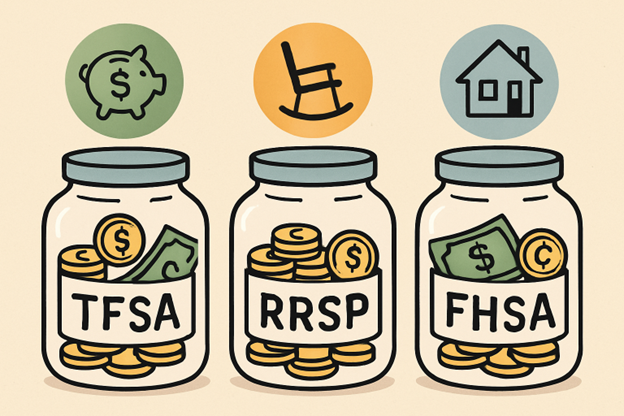
The three account types differ in several important ways, particularly in how contributions, growth, and withdrawals are treated for tax purposes. A Tax-Free Savings Account (TFSA) does not offer tax-deductible contributions, but all investment growth and withdrawals are completely tax-free and can be accessed at any time. A Registered Retirement Savings Plan (RRSP) allows tax-deductible contributions and tax-deferred growth; however, withdrawals are generally taxable unless made under specific programs. The First Home Savings Account (FHSA) combines features of both, offering tax-deductible contributions and tax-free growth, with tax-free withdrawals when used to purchase a first home. Contribution limits also vary, making these distinctions essential when planning for retirement or homeownership.

Strategies for Maximizing Your Savings

Start by maximizing your FHSA contributions to lock in both immediate tax savings and future tax-free withdrawals. Consider topping up your RRSP and leveraging the Home Buyers’ Plan to access an additional $35,000 per person towards your home purchase.

Prioritize RRSP contributions if your income is high, as the upfront tax deduction offsets your tax bill today, and investments can grow for decades tax-deferred. Supplement this by using a TFSA for growth that remains tax-free, even when you make withdrawals in retirement, which can complement government retirement benefits.

  • Flexible & Short-Term Needs:

Use your TFSA for an emergency fund or other short-term savings. Withdrawals won’t be taxed or impact government benefits, making it an ideal parking spot for accessible, ready cash.

Common Mistakes to Avoid

The Contribution room can be complex to track. Exceeding the limits in any account triggers a penalty of 1% per month on the excess amount, so check your available room regularly using the CRA portal or a trusted advisor.

  • Misunderstanding Withdrawal Rules:

RRSP withdrawals outside programs like the HBP are counted as taxable income and can quickly push you into a higher tax bracket. Always understand the implications before you tap these funds.

Ensure your contributions are directed into the accounts most closely aligned with your goals—TFSA for flexibility and accessibility, RRSP for long-term retirement savings, and FHSA for first-home buyers.

Conclusion

Ultimately, your choice between a TFSA, RRSP, and FHSA should reflect your personal financial picture—your goals, timeline, and income level. Thoroughly understanding the structure and restrictions of each can help you maximize your contributions, avoid tax penalties, and best support major life milestones.

Consulting a financial planner or regularly visiting resources such as MoneySense’s guide on RRSPs and TFSAs can help you stay updated and make informed decisions as your life and goals evolve.

Find a Home-Based Business to Start-Up >>> Hundreds of Business Listings.
Get High-Value Leads Without Social Media for Home Businessess


Home Businesses Can Acquire High-Value Leads
Source: Pexels

Home business owners face a paradox: they’re told social media is essential for growth, yet find themselves trapped on an algorithmic hamster wheel that produces inconsistent results. Platform changes flatten reach. Competition saturates feeds. Hours of content creation yield sporadic, low-quality leads.

The problem isn’t the platforms themselves. It’s that most small entrepreneurs treat social media as their only lead channel, leaving their business entirely dependent on forces beyond their control. The truth is, the highest-value customers rarely come from social media feeds. They come from relationships, authority, and intent-driven channels where prospects are actively seeking solutions, not passively scrolling.

This article explores four fundamental lead acquisition channels that separate thriving home businesses from those stuck in the endless social media treadmill.

The Four Best Lead Channels for Home Businesses

Most home entrepreneurs approach lead generation as a single-channel problem: more followers, more posts, more engagement. But real growth happens when you orchestrate multiple channels that feed each other, creating momentum that compounds over months and years to generate high-value leads without social media.

Building Permission-Based Revenue with Email Marketing

Email marketing remains the highest-ROI lead channel for small businesses. While social media algorithms determine who sees your content, email lives in an audience you’ve built and own. This fundamental difference transforms your growth trajectory.

Here’s the math most home business owners ignore: acquiring a social media follower costs time and algorithmic luck. Acquiring an email subscriber costs a single piece of high-value content. Create a lead magnet (a checklist, template, guide, or resource that solves a specific problem for your ideal customer). Position it where your target audience searches for solutions. When someone opts in, they’re not just getting a freebie. They’re signaling intent. They’re saying, “I’m interested in what you solve.”

What happens next matters more than the initial conversion. One email to 500 subscribers reaches 500 people. A social post to 5,000 followers reaches maybe 150. Each month, your list will grow, and each subscriber stays for months or years—creating high-value leads without social media. Meanwhile, your email content continues converting at consistent rates. A 2% conversion rate on a growing list of 1,000 subscribers produces 20 new leads monthly—automatically, without algorithmic dependency.

Capturing High-Intent Local Searches with Local SEO

Capturing High-Intent Local SearchesCapturing High-Intent Local Searches
Source: Pexels

Home businesses often believe they need national visibility, but that isn’t true most of the time. Nearly half of all Google searches have a local intent, and 28% of local searches result in an actual purchase within 24 hours.

Local SEO and SEO for B2B SaaS operate on a completely different principle than social media. When someone types “virtual assistant near me” or “bookkeeping services in [city],” they’re not discovering you. They’re actively looking for you. Your job is simply to show up.

Taking advantage of local SEO means three things: creating and updating your Google Business Profile, actively managing reviews, and building local citations.

With up-to-date information and positive social proof ready for searchers to find, you’ll notice immediate ROI advantages. Unlike international and algorithmically restrained social media audiences, local searches are made by people who need your business and live where you can serve them—bringing high-value leads without social media.

Systematizing Relationships Through Offline Networking

Networking feels old-fashioned to entrepreneurs raised on digital-first strategies. Yet 96% of sales professionals cite networking as critical to exceeding their revenue targets. The reason is simple: relationships trump algorithms. Here’s how you build those relationships:

  • Industry meetups and events where your ideal customers gather (chamber of commerce meetings, professional associations, trade shows). You’re not there to pitch. You’re there to build relationships with people actively invested in your industry.
  • Strategic partnerships with complementary service providers. The virtual assistant partners with the bookkeeper. The copywriter partners with the web designer. Together, you refer clients to each other, multiplying lead flow for both businesses.
  • Consistent in-person touchpoints like coffee meetings, lunch gatherings, or formal networking groups. These create relationships that generate referrals for years.

Establishing Authority Through Content & Positioning

Authority operates on a different mechanism than social media visibility. You’re not trying to reach everyone. You’re establishing yourself as the go-to expert for a specific problem. That distinction changes everything.

The execution is straightforward but requires consistency:

  • Publish strategic content on your own platform (a blog, newsletter, or podcast). When you write about topics your ideal customers search for, you capture search intent and establish expertise simultaneously.
  • Secure third-party validation through guest articles, podcast interviews, or speaking engagements on platforms where your audience already gathers. These create backlinks, expand your reach, and add credibility that your own website can’t.
  • Build a distinctive positioning around a specific problem or customer type.

Final Thoughts

Home business owners operating at full capacity don’t need more leads. They need predictable leads. They need channels where effort translates to consistent, controllable results, not platforms where algorithms decide their visibility.

The businesses dominating their markets have made a fundamental shift: they’ve moved away from platform-dependent strategies and toward owned, systematic channels. They’ve traded the hope of viral posts for the certainty of compounding lead generation. Social media still plays a part, but it isn’t everything.

Find a Home-Based Business to Start-Up >>> Hundreds of Business Listings.

Valentine’s Day Memory Game Free Printable Cute Coloring Cards


Do you wanna make Valentine’s Day for your kids special? Or maybe you’re a teacher and looking for a classroom fun game you can play to add to your Valentine party this year.

Maybe you’re a true romantic at heart ❤️ and want to use these little cards to create a fun scavenger hunt for your Romeo.

Or maybe you have a couple friends at church you just wanna use these as cards to stick them on their Bibles in church to encourage them. 🥰

You could also use these as a Valentine’s Day Go-Fish Game! 😉

Whatever you use them for, you’ll have an absolute blast. These Valentine’s Day memory game cute coloring cards are seriously SOOOO cute and with two different game card sets to choose from, you’ll have plenty.

Because you can mix and match both games or pick one and play one game, this Valentine memory cards game works for both younger and older kids, as well as adults!

Valentine’s Day Memory Game Free Printable Cute Coloring Cards

Grab this free Valentine’s Day memory matching game printable (2 sets) — print, color, cut, and play! 😍

Classroom / Valentine Party Ideas (easy ways to play in a group)

Want to use these memory games in a classroom, co-op, Sunday school group, or Valentine’s party? Here are a few super simple ways to keep it fun and chaos-free:

Partner Play 

Pair kids up and give each pair their own set of cards. They take turns flipping two cards to find a match. If they match, they keep the pair and go again. If not, they flip them back and it’s the other person’s turn.

Team Relay

This one burns energy in a fun way! Split kids into 2–4 teams. Set one board of cards in the center. One child from each team runs up, flips two cards, then runs back and tags the next teammate. If they get a match, the team keeps the pair. Play until all matches are found.

Timed Round Challenge

Set a timer for 1 minute (or 2 for younger kids). Each child (or pair) tries to find as many matches as possible before time runs out. Reset the cards and play again for a “best of 3” round.

Winner Keeps Matches

Classic rules, but with a fun twist: when you get a match, you keep it in your own pile. At the end, count matches—whoever has the most wins. You could even give a tiny prize like a “Valentine Champion” sticker, heart stamp, bookmark, etc.

Memory Coach Matching

For younger kids who get frustrated, let them play with all the cards face-up for the first round. Then flip them face down and play the regular way. It builds confidence and still teaches memory skills.

Mix-and-Match (Harder)

Combine both printable sets into one giant game. Shuffle, lay out the cards, and watch the difficulty level jump in a really fun way. More cards = more brain power. 😉

Quiet Table Station

Set this up as a rotating station: kids color their cards first, then cut, then play. It’s a perfect “I need a calm activity” option during a party or classroom rotation.

Valentine Memory Game for Kids

Valentine’s Day memory game printable with 9 cute icon cards (mailbox, love letters, hearts, gift, candy jar, chocolate, lollipop) and “print two times, cut, and play.”Valentine’s Day memory game printable with 9 cute icon cards (mailbox, love letters, hearts, gift, candy jar, chocolate, lollipop) and “print two times, cut, and play.”

Download the Valentine Memory Game for Kids here


Valentine’s Day Memory Cards

Black-and-white Valentine memory game sheet featuring kawaii Valentine picture cards in a 3x3 grid, designed to color and cut out.Black-and-white Valentine memory game sheet featuring kawaii Valentine picture cards in a 3x3 grid, designed to color and cut out.

Download the free printable Valentine’s Day Memory Cards here


Other fun memory games you’ll love…


The Best Value On-Site Storage Providers for Phoenix Businesses


Best Value On-Site Storage
Deposit Photos

With commercial leases becoming increasingly expensive, many companies are seeking smarter ways to store goods without incurring additional overhead. On-site storage containers are a cost-effective solution as they keep materials close by and are available to access around the clock. The best value on-site storage container rentals for businesses in Phoenix should help businesses stay efficient while protecting assets.

How to Determine the Best Value On-Site Storage

Choosing an on-site storage provider is about finding the right balance between price and service so your organization can operate smoothly. Keeping these core factors in mind makes it easier to compare options side by side:

  • Quality and security: Look for all-steel, weather-resistant containers with solid doors and tamper-proof locking systems that protect tools and other items.
  • Flexible rental terms: Prioritize fixed pricing and be aware of potential hidden fees. Check that the company offers flexible rental durations as well, to scale the space up or down as needed.
  • Customer service: Review local reputation, customer testimonials and ratings to see how responsive the provider is with delivery, pickup and any issues that may arise.
  • Range of options: Seek out providers that offer various container sizes and configurations to choose the setup that best fits the site, budget and storage needs.

The Top On-Site Storage Providers for Phoenix Businesses

With numerous storage companies available, it’s helpful to know which ones deliver strong value for local enterprises. The providers below stand out for their overall satisfaction ratings.

1. Pro Box Portable Storage

Pro Box Portable Storage is an affordable and convenient storage solution backed by excellent customer-first policies like locked-in rental rates. Businesses appreciate its friendly and helpful service and find the storage durable with straightforward pricing.

Pro Box also delivers peace of mind through its strong security features and various delivery options. For instance, the company offers a patented Pro Vault Locking System that deters tampering and delivers superior asset protection.

Additionally, businesses can opt for on-site delivery within two to three days or sooner, upon request. The enhanced security features, along with convenience and flexibility, are reasons many choose Pro Box Portable Storage. It typically provides services to retailers, contractors, restaurants and more.

Key features:

  • Patented security: The Pro Vault Locking System prevents locks from being drilled, pried, or cut, thereby deterring break-ins.
  • Durable build: The containers are made of all-steel materials, which keep them rodent-proof and weather-resistant. The floors are also capable of holding heavy equipment. Each storage option also comes with vents and hooks to prevent items from molding and keep them organized.
  • Guaranteed pricing: Lock in monthly rental rates to avoid unexpected increases and better plan budgets.

2. Southwest Mobile Storage

Southwest Mobile Storage is a family-owned Phoenix company with over 25 years of local experience, providing it with a strong understanding of how area businesses utilize on-site containers. The provider focuses on delivering sturdy, secure units that can be tailored to different worksites, whether clients need extra storage, a mobile office or both.

Enterprises that want more than a standard container often turn to Southwest Mobile Storage for its numerous customization options. Its custom solutions allow customers to add features to create a layout that fits their workflow. They can also choose from different sizes and decide whether they would like to rent or purchase units.

On top of the range of choices, customers get flexible pricing. Southwest Mobile Storage offers prorated rent or monthly rentals, providing the convenience that businesses look for when their needs change. Furthermore, it provides excellent service. The team is friendly and ensures timely delivery.

Key features:

  • Custom modifications: Offers unique container upgrades, including additional doors, windows, shelving and interior build-outs.
  • Multiple solutions: Renting or purchasing is an option, along with mobile office units, so businesses can mix and match storage and workspace on-site.
  • Robust security: Uses dual-lock systems and 14-gauge steel construction to help protect equipment from theft and damage.

3. WillScot

WillScot is a major national provider of modular space and storage solutions, with the capacity to support large commercial and industrial projects in the Phoenix area. Its scale allows companies to source on-site storage containers and mobile office units from a single provider, simplifying coordination across complex jobsites.

WillScot’s full-service approach can be a significant time-saver. The company handles delivery, setup and pick up, and its sizable inventory means it can respond quickly to timeline shifts and a need for additional space.

WillScot also has a long history in the industry, dating back to 1955. Its large network of branches gives it an abundance of experience and resources. The Phoenix branch serves the surrounding area.

Key features:

  • Turnkey services: Can deliver fully equipped mobile offices in addition to storage containers, providing workspace, storage and basic amenities in one solution.
  • Large inventory: A nationwide network ensures container availability for local projects as well as multi-location businesses.
  • Full-service model: Manages the entire process from delivery and placement to final pick up, reducing the logistical load on in-house teams.

4. United Rentals

United Rentals is the world’s largest equipment rental company, giving Phoenix businesses access to storage containers alongside an extensive inventory of industrial and construction tools. Its broad selection makes it a convenient option for teams that prefer working with a single vendor for most of their job-site needs. Establishments already renting equipment from United Rentals often find it seamless to add storage units to their existing accounts.

Due to its scale, United Rentals can support fast-moving projects where availability and reliability are crucial. The company offers standard container sizes, with additional sizes available upon request. The delivery process is also dependable, helping teams stay organized while managing heavy equipment and on-site workflows.

Key features:

  • One-stop shop: Businesses can source everything from forklifts and generators to storage containers through one provider.
  • Vast equipment fleet: Offers a wide range of job-site solutions, making it easier to coordinate equipment needs alongside storage requirements.
  • Standardized and reliable: The provider supplies standard 20- and 40-foot containers that are readily available and durable.

Compare Key Features

Use the following chart to quickly compare each company’s features and determine which one best fits your needs.

Feature Pro Box Portable Storage Southwest Mobile Storage WillScot United Rentals
Primary Focus Secure, on-site storage containers Storage and custom modifications Turnkey mobile workspaces Full-site equipment rental
Key Strength Patented security and fixed rates Local expertise and craftsmanship All-in-one office solutions Single-source for all jobsite needs
Best For Businesses needing top-tier security Custom or specialized projects Large corporate and turnkey setups Consolidating equipment vendors
Service Area Regional specialist Phoenix and the Southwest National provider Global provider

Choosing the Best Value On-Site Storage Provider in Phoenix

Selecting the right on-site storage provider comes down to balancing security, convenience and overall value. Phoenix companies have several dependable options that make it easy to protect equipment and stay organized on the job. By understanding the business’s needs and comparing key features, decision-makers can select a service that supports their operations effectively.

Find a Home-Based Business to Start-Up >>> Hundreds of Business Listings.

Hello 2026 Coloring Page Free Printable Cute New Year Doodles


2026 is here 🎉 and if you want a quick, happy little moment (for kids or you), this free printable Hello 2026 coloring page is the cutest way to go!

Perfect for homeschooling, classrooms, and moms who want to relax and do some self-care.

You could even use it as a binder cover or divider in your favorite planner or fold it and put it in a Happy New Year greeting card!

Check it out below! 🥰

Free Printable Hello 2026 Coloring Sheet (Doodles)

If you’d like more coloring sheets, here’s some more “Hello” coloring pages…

Fun ways to use this Hello 2026 coloring sheet…

  • New Year’s Eve kid table activity (zero prep!)
  • January morning work / early finishers
  • Homeschool “fresh start” warm-up
  • Cozy self-care coloring night
  • Church group activity
  • Fold it and put it into a Happy New Year greeting card
  • Use as a planner binder cover or divider
  • Substitute teacher folder activity (no prep, lasts all year long)
  • New Year’s party favor: roll it and tie with ribbon, hand it out with crayons
  • Color and write one goal on the back (“One thing I want to learn in 2026 is…” or “My New Year’s resolution is…”)
  • Family New Year time capsule: everyone colors one, date it, save it
  • “Hello 2026” door sign for a bedroom or classroom door
  • Counselor / calm-down corner printable
  • Nursing home or senior ministry coloring visit

Want more? ❤️ Be sure to check out all my free printables here (there’s over 5,500+ to choose from!!!)

Hello 2026 coloring page with big bubble numbers surrounded by cute doodles like bows, balloons, crowns, presents, snowflake, and winter treats.Hello 2026 coloring page with big bubble numbers surrounded by cute doodles like bows, balloons, crowns, presents, snowflake, and winter treats.

Download the free printable Hello 2026 New Year Coloring Page here.


More New Year’s printables you’ll love…

Printable details:

  • US Letter 8.5×11″
  • Black-and-white (cost-effective to print + kids can color it)
  • Best results: print at 100% / Actual Size


Rekeying for Home Security Explained


Improving security for your home-based business is vital to protect your assets and ensure business continuity. Identifying specific security challenges can help in developing effective solutions. By focusing on practical strategies, you can safeguard both the physical and digital aspects of your enterprise.

Running a business from home presents unique security challenges that require careful attention. Unlike traditional office environments, home-based businesses often lack the comprehensive security measures found in commercial spaces. This can make them more vulnerable to unauthorized access or theft, highlighting the need for regular risk assessments. Understanding these vulnerabilities allows you to implement targeted measures that enhance safety, such as considering a home rekey to improve physical security.

Identifying Security Challenges in Home Businesses

Operating a business from home introduces distinct security concerns that require attention. Unlike traditional office spaces, home businesses often lack the robust security infrastructure found in commercial settings. This absence can leave you vulnerable to unauthorized access or theft, emphasizing the importance of assessing these risks regularly. Understanding these vulnerabilities allows you to implement targeted measures that enhance safety.

One common challenge is balancing accessibility with security. While you want to create a welcoming environment for clients and partners, it’s vital to ensure that sensitive areas remain secure. Additionally, digital threats pose significant risks as more transactions and communications occur online. Evaluating your current security setup, both physical and digital, is the first step in fortifying your business environment.

Another significant challenge for home-based businesses is the lack of clear boundaries between personal and professional spaces. Family members, visitors, or service providers may inadvertently access areas containing confidential business materials or equipment. This blurred distinction makes it difficult to maintain consistent security protocols throughout the day. Establishing designated work zones with appropriate access controls helps mitigate these risks while maintaining a comfortable home environment for your family.

Implementing Effective Security Strategies

To effectively protect your home-based business, consider implementing a combination of physical and digital security strategies. Upgrading locks, for instance, can be a simple yet effective way to prevent unauthorized entry. The question often arises: how much does it cost to rekey a home? This process is typically affordable and offers a straightforward means of enhancing physical security without extensive modifications.

Beyond physical measures, securing digital data is equally important. Utilizing robust cybersecurity protocols helps safeguard sensitive information from cyberattacks. Regularly updating passwords and using encryption are fundamental practices that can significantly reduce the risk of breaches. Conducting periodic security audits ensures that these measures remain effective and adapt to evolving threats.

Exploring Affordable Security Solutions

You might be concerned about balancing costs with the need for comprehensive security solutions. Fortunately, numerous affordable options allow you to enhance security without straining your budget. Simple changes such as reinforcing doors or adding motion-sensor lighting can deter potential intruders at minimal expense. Additionally, exploring community resources or local initiatives might offer further cost-effective strategies.

The cost of services like rekeying varies based on factors such as location and service provider. Typically, homeowners inquire about how much does it cost to rekey a home when considering their options for enhancing security. Collaborating with a professional locksmith ensures that you receive expert advice tailored to your specific needs while maintaining budgetary constraints.

Maintaining Security Through Regular Assessments

Security is not a one-time task but an ongoing process that requires regular evaluation and adaptation. Periodic assessments help identify new vulnerabilities or areas where existing measures may have become less effective over time. This proactive approach enables you to address issues before they escalate into significant threats.

You should view each assessment as an opportunity to refine and improve your overall strategy. Engaging professionals like locksmiths can provide insights into emerging trends or advanced technologies that could benefit your setup. By staying informed and adaptable, you ensure that your home-based business remains protected in an ever-changing landscape.

Find a Home-Based Business to Start-Up >>> Hundreds of Business Listings.

College Application Help for Parents: Appily’s Role in Admissions


College Application Process
Image by diana.grytsku on Freepik

Kitchen tables everywhere are turning into four-year command centers. Why? College planning has moved from a once-a-year sprint to a multi-year marathon, and parents have become co-managers by necessity.

Education tech built for families is finally catching up. And Appily is leading the way.

“Today’s college planning process feels incredibly intense,” observes Emily Niedermaier, managing director of marketing at Appily. “Fortunately, new tools give parents the confidence to guide their students through the process.”

Parents Are Now Co-managers During the College Admission Process

The college admissions process is more complex and emotionally charged than it used to be. EAB’s College Search Trends 2025 report shows that students are applying to more colleges and beginning their search earlier, drawing out the essay writing and decision-making across nearly the entire high school experience.

Money and mental health dominate the conversation. In EAB’s 2024 Parent Survey, parents named college costs, scholarships, and debt as their top three concerns, with 60% ranking cost as the number-one worry.

Meanwhile, students are feeling the weight. Appily’s national mental health survey of nearly 6,000 high schoolers finds that 85% feel anxious at least a few days a week, and almost 60% feel that way most days. Among them, 43% say college planning increases their anxiety. Further, 28% of students who are uncertain about enrolling cite mental health as a primary reason. Put simply, parents need to step in to protect their kids’ well-being and keep cost questions from derailing the plan.

“It’s a lot to deal with for a long period of time,” says Niedermaier. “And because the information is in dozens of places, even organized families can end up missing vital information and deadlines.”

Appily’s Organizational Toolkit Provides the Ultimate College Application Help for Busy Parents When Applying for College

Appily respects the schedules of busy parents. A planning dashboard keeps all the college application help process for parents deadlines and documents visible, so there’s no more hunting through emails and paper piles. Families can quickly explore schools by a wide range of criteria and view their options side-by-side.

Each resource on Appily is designed to demystify the process, answer common questions, and offer practical, expert-backed advice that helps families support their student with confidence.

Best of all? Appily delivers trusted guidance that fits a busy family’s week. The information comes in the form of bite-sized tips and checklists.

How Appily’s Personalized Scholarship Finder Saves Families Hundreds of Hours with Financial Aid Tools and Scholarships for Students

According to the 2024 Parent Survey mentioned above, 58% of parents say simply understanding how much college will actually cost is a major concern. That uncertainty drives families into endless scholarship hunts.

Appily consolidates that scramble. With one login, students see scholarships that fit their interests and academic profiles. Requirements and due dates are organized in a single place. The result is a calmer, more sustainable process.

The Quest for Acceptance Letters: Why Data-driven Tools Are Parents’ Top Choice over Private Consultants During the College Search

Parents want clarity they can trust and a system that reduces the stress in the process. Appily’s data-driven tools deliver both.

With Appily, parents tap into the same expertise that powers EAB’s work with colleges and universities. Behind the platform is a team of expert counselors, admissions officers, and enrollment leaders who translate the data into straightforward and usable guidance. Instead of one person’s anecdotal advice, families get free evidence-based recommendations.

How Appily Is Building One-on-one Trust with Families During the College Search

Trust comes from credible data and a product that actually responds to what families need. Appily is powered by EAB’s research. The College Search Trends 2025 report draws on application, inquiry, and enrollment data to map where student interest is growing, which colleges are gaining or losing market share, and how far students are willing to travel. The 2024 Parent Survey includes responses from 1,620 parents and caregivers across income levels and regions. And Appily’s mental health survey adds nearly 6,000 student voices on anxiety and stressors.

These insights show up in the product. Because families put the highest value on cost and scholarships, Appily emphasizes early scholarship discovery and clear cost information. Since students and parents care about well-being and belonging, Appily spotlights mental health supports and campus life. And because parents want early, direct communication, Appily helps institutions share information before families resort to guesswork. The result is a student-centered platform that is free to use, free of paywalls, and designed to reduce friction.

“Parents stepping into the co-manager role no longer need to shoulder the work alone,” Niedermaier concludes. “We have the tools to help. Parents don’t need to be experts to guide their students. They just need a trustworthy map.”

Find a Home-Based Business to Start-Up >>> Hundreds of Business Listings.

International B2B Gold Supply Network Built by a Prague Family


International B2B gold-supply network
Deposit Photos

Abstract

The global jewelry market continues to grow: according to analysts’ estimates, by 2033 its volume may exceed 570 billion US dollars, with an average annual growth of over 5%. Europe remains one of the key centers of demand, where the jewelry market is valued in tens of billions of dollars and shows stable positive dynamics. At the same time, competition is intensifying: a reliable assortment, delivery speed, and understanding of local demand are becoming critical factors for B2B clients.

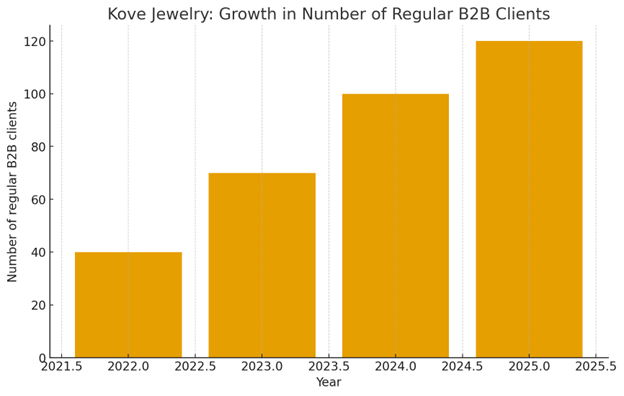
In such conditions, the experience of the family company Kove Jewelry s.r.o., founded in the Czech Republic and specializing in wholesale supplies of gold jewelry from Italy and Turkey, is especially illustrative. Over seven years in the industry and two years of work in the European market, the business has built a network of more than one hundred regular B2B clients in the Czech Republic, Slovakia, Poland, and Romania, relying on the principle of not “selling what the supplier has,” but first studying demand and ordering exactly the items that stores need.

The article examines how the family format of management and the focus on demand data help a wholesale jewelry business grow in the competitive environment of Central and Eastern Europe. The key elements of the model are described: working with Italy and Turkey as production centers, analytics of B2B clients’ needs, building trust in a family company, and rejecting retail and online sales as a conscious strategic decision. Special attention is paid to lessons for other entrepreneurs building international trade from a small base team.

Introduction: Why Jewelry Wholesale Is Not Only about “Beautiful Showcases”

According to industry research, the global jewelry market in 2024 is estimated at approximately 370 billion dollars and by 2033 may grow to 560–580 billion dollars. The European segment accounts for a significant share: the volume of the jewelry market in Europe is estimated in the range of 50–70 billion dollars with a growth forecast of 4–5% per year almost until the mid-2030s.

At the same time, the Czech Republic and neighboring countries have long been integrated into international supply chains: the Czech Republic is among the notable producers and exporters of jewelry, and the annual volume of jewelry exports is estimated at about 1 billion euros. Italy remains one of the world leaders in jewelry exports with a production value of around 15.5 billion euros, maintaining the status of a key source of gold jewelry for the European market.

Against this background, Kove Jewelry operates in a narrow but complex segment of international B2B gold supply, focusing on wholesale gold jewelry for B2B clients in four countries of Central and Eastern Europe. This is not a business of “beautiful showcases,” but primarily logistics, analytics, assortment management, and building trust.

1. Italian and Turkish Gold: How to Choose the “right” Production Centers

The basis of the Kove Jewelry model became two production directions — Italy and Turkey. The choice is determined by several factors:

Italy — one of the world leaders in jewelry exports, especially in gold jewelry. Italian factories set trends in design and technology, and their products are perceived as a benchmark of quality in the European market.

Turkey — a major player in the gold jewelry segment with high production flexibility, competitive prices, and fast manufacturing cycles.

For the B2B clients of Kove Jewelry this means:

• a wide assortment in terms of style and budget;
• the ability to quickly update collections to the tastes of end customers in the Czech Republic, Slovakia, Poland, and Romania;
• a balance between premium perception (Italian origin) and price competitiveness (Turkish supplies).

A key point: In international B2B gold supply, the company does not simply “take what the supplier has,” but builds relationships with factories as with partners who are ready to work according to request. This requires a larger amount of communication but provides a strategic advantage.

Global Jewelry Market ForecastGlobal Jewelry Market Forecast

2. Demand Instead of “leftovers”: How the Reverse Assortment Planning Model Works

The main difference of Kove Jewelry from many wholesalers is its approach to the assortment. Instead of purchasing standard collections “by the box,” the company proceeds from the needs of B2B clients.

The model can be described in several steps:

Collection of Data from the Market.

The team systematically collects feedback from clients:

• which categories and designs sell best;
• which items regularly run out;
• which pieces are in demand in specific countries and cities.

Analytics by Countries and Clients.

Demand in Prague and in small towns of Romania differs, as does the client profile in Poland and Slovakia. The company identifies micro-segments:

• by the store’s average check level;
• by type of end customer (tourist flow, local regular clients, young audience, etc.);
• by design preferences (minimalism, classic, ethnic motifs).

Formation of Orders for Suppliers.

Based on this data, orders are formed for Italy and Turkey: not abstract “1000 units of chains,” but specific models, lengths, weaves, and shades that have already shown demand in previous seasons or have been tested through trial batches.

Testing New Items in Small Batches.

New designs and collections are launched in limited volumes. If turnover and margin indicators match expectations, the volume is increased; if not, the items are withdrawn without accumulating “dead” stock.

For a B2B store this gives a clear result: an assortment that feels “assembled for the client,” rather than a random mix of factory offerings.

3. The Family Format as a Quality Control System

Kove Jewelry is a family business. The management involves the spouse and sons, and the family controls all key processes:

• selection of factories and building partnerships;
• quality control of items at acceptance;
• decisions on assortment expansion or entering new markets;
• work with key clients.

This format gives several advantages within international B2B gold supply:

Low Level of “misalignment” of Interests.

There is no conflict between “hired top management” and owners — decisions are made quickly, with consideration of the long-term perspective.

Transparency of Processes.

Procurement, logistics, warehouse, sales, and client support are all in the focus of one team. This reduces the risk of errors in the chain and allows timely reaction to disruptions.

Culture of Responsibility.

In family companies, reputation is perceived literally as “the family name on the sign.” Any decision, from choosing a supplier to wording payment terms, is viewed through the lens of how it will affect long-term relationships with clients.

For more than one hundred regular B2B partners of Kove Jewelry, this turns into a clear advantage: the company is open to discussing non-standard requests, counting on flexibility without loss of quality.

Growth of Kove JewelryGrowth of Kove Jewelry


4. Why a Deliberate Refusal of Retail and Online Is Also a Strategy

Over two years of work in the Czech Republic, Kove Jewelry tested retail formats and online sales. These attempts did not bring the expected result. The reasons are not in the weakness of the channel itself, but in the structure of the market:

• jewelry retail in the countries of Central Europe remains highly competitive and strongly tied to local brand and physical presence;
• online sales of jewelry require significant investments in marketing, content, and brand trust, which are difficult to recoup at the initial stage without large budgets.

As a result, the decision was made to focus on the wholesale model and B2B clients within international B2B gold supply, where there is a clear understanding of the company’s competence:

• understanding of logistics and customs procedures;
• the ability to work with assortment for different markets;
• established connections with factories.

This choice is important as an example for other entrepreneurs: not every channel fashionable on the market is obliged to be a source of growth within a specific business model. Sometimes strategic success is the ability to say “no” in time and focus on what brings maximum value to clients.

5. Lessons for Entrepreneurs Building International Trade “from Inside Europe”

The experience of Kove Jewelry can be scaled to other types of business in international B2B gold supply trade. Several key conclusions:

Demand Is More Important than a “beautiful Assortment.”

The winner is not the one who has more SKUs, but the one who better understands which items turn over faster and bring margin to partners.

The Family Format Can Be Turned into a Competitive Advantage.

With competent organization, a family business becomes a synonym of flexibility and a personal approach, not of a “small and unstable company.”

Focus on the Core Is Stronger than Spreading Across Fashionable Channels.

Attempts to be present simultaneously in retail, online, and wholesale often lead to dilution of resources. Concentration on the B2B model allowed Kove Jewelry to accelerate growth precisely in the segment where the company is objectively stronger.

Central Europe Is a Convenient Base for International Trade.

Prague as a logistics center, the developed financial and legal infrastructure of the Czech Republic, and proximity to the main EU markets create a good platform for companies working “at the junction” of Western and Eastern Europe.

Partnership with Manufacturers Is Stronger than Simple Procurement.

Turning factories into strategic partners (joint planning, testing of new items, flexibility in batches) increases the stability of the entire chain and reduces the risk of shortages or excessive stock.

Conclusion

The jewelry industry is perceived as a world of emotions, gifts, and aesthetics. But behind store showcases stand complex supply chains, demand analytics, and dozens of decisions that are made daily in wholesale companies.

Kove Jewelry demonstrates how a family business based in Prague and narrowly specialized in gold jewelry from Italy and Turkey can build a stable international B2B model:

• relying on demand data rather than a random assortment;
• turning the family structure into a system of fast and responsible managerial reaction;
• choosing a focus on the segment where maximum value is created for clients.

In conditions where the global and European jewelry markets continue to grow and competition for the trust of B2B partners intensifies, it is precisely such a combination — international expertise, family control, and a demand-oriented procurement model — that allows a small business to take a stable position in international trade.

Sources:

  1. Grand View Research. Jewelry Market Size, Share & Trends Analysis Report, 2024–2033.
  2. Market Data Forecast. Global Jewelry Market Report 2024–2033.
  3. Grand View Research. Europe Jewelry Market Outlook, 2024–2033.
  4. Expert Market Research. Europe Jewellery Market Report 2024–2034.
  5. IndexBox / аналитические обзоры по рынку ювелирных изделий в Европе, 2024–2025.
  6. Ministry of Foreign Affairs of the Czech Republic. Astonishing the World with Czechia’s Unique Jewellery, 2019.
  7. Confindustria Federorafi. Italian Jewelry Industry and Export Data, 2024–2025.

Find a Home-Based Business to Start-Up >>> Hundreds of Business Listings.

How Indie Devs 7x Revenue with Game Localization 2026


Indie Devs 7x & Video Game Localization
Deposit Photos

One Language, One Tiny Pond

Most solo devs and small teams launch in English and call it a day. Fair enough – you built the game in your bedroom or garage, marketing budget is basically zero, and “going global” sounds expensive and scary.

Except the numbers tell a different story. In 2025, only 19 % of Steam’s monthly active users have English as their primary language (Steam Hardware Survey, October 2025). That means 81 % of potential players scroll right past your gem because the store page, UI, and dialogue feel foreign – literally.

One indie dev I know released a cozy farming sim in English only. Lifetime revenue after 18 months: $27 k. Six months after proper localization into just five languages: additional $189 k – and counting. Same game, same updates, zero new features.

The Moment Most Indie Devs Finally Get It

The light-bulb moment usually hits around month four post-launch when Wishlists stop growing and daily revenue flatlines at $47. You stare at the analytics and notice 40–60 % of your visitors come from Brazil, Poland, Russia, Turkey, or Simplified Chinese regions – then bounce because everything is in English.

That’s when smart devs stop treating localization as a “nice-to-have” and start treating it like free marketing that pays for itself 5–15× over.

The best part? You no longer need a publisher or a six-figure budget. Specialized video game localization services now cater exactly to indie Devs 7x revenue budgets and timelines, handling everything from store-page copy that actually converts to full in-game dialogue that feels written by a local.

Three Real Indie Wins That Happened This Year

  1. A two-person pixel-art Metroidvania added Brazilian Portuguese, Spanish (LatAm), and Russian. Revenue went from $1.8 k/month to $14 k/month in quarter one post-localization. They paid $4.2 k total – ROI in under 30 days.
  2. A solo developer with a narrative-driven walking simulator thought “China is impossible.” Invested $6 k in Simplified Chinese (text + basic store optimization). Game hit the Steam CN front page for nine days straight. Total new revenue: $97 k in the first 60 days.
  3. A three-person horror team localized into German and Polish only (two markets they already saw traffic from). Sales in those regions alone covered the entire localization cost in week one, then kept printing money.

These aren’t AAA studios. These are people who started exactly where you are right now.

The Indie-Friendly Localization Playbook (2025–2026 Edition)

  • Start with store pages first – 70 % of the revenue lift comes from locals actually understanding your trailer and bullet points.
  • Pick 3–5 languages where you already see unpaid traffic in Steam analytics (it’s free data!).
  • Budget $1.5 k–$8 k per language depending on word count – most cozy/narrative indies land around $3–5 k total for the big five.
  • Never machine-translate dialogue and call it done. Players aren’t dumb.
  • Localize your pricing too – $19.99 feels premium in Germany but overpriced in Turkey. Regional pricing + localized bundle names add another 20–40 % on top.

The Math That Makes Bankers Cry (Happy Tears)

Average indie investment in five-language localization: $12 k–$25 k Average additional revenue in year one: $120 k–$400 k+ (SuperData + internal studio surveys 2025)

That’s not “nice extra income.” That’s quitting your day job money. That’s funding your next two games without crowdfunding money. That’s the difference between burning out at 400 concurrent players and building a sustainable micro-studio.

Where the Industry Is Heading Next

By mid-2026, the top 100 grossing indie devs 7x revenue titles on Steam will all ship day-one with at least seven languages. The ones still English-only will fight over the same 19 % slice while everyone else eats the rest of the pie.

The tools have never been cheaper, the talent pools have never been deeper, and the audience has never been hungrier for games that feel made for them – not just translated for them.

Your game is already finished. The players are already waiting. All that’s left is speaking their language.

Find a Home-Based Business to Start-Up >>> Hundreds of Business Listings.