Archaeologists Unearth ‘Advanced’ Gold Dental Bridge in Medieval Scottish Grave


An archaeological dig at the site of a 12th-century church in Scotland has unearthed more evidence that “advanced dental treatments” existed for hundreds of years prior to the formal establishment of modern dentistry, a new study contends. But, unfortunately, the sheer cost of this nearly solid gold medieval procedure was very likely out of reach for most people.

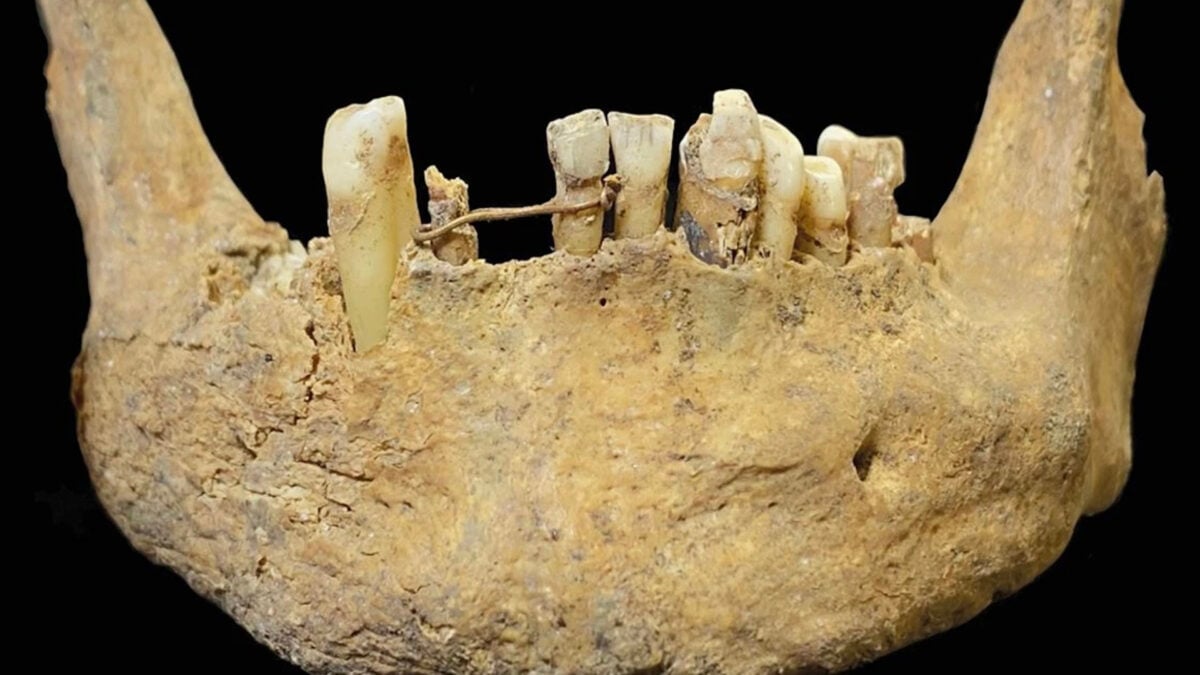
Researchers with universities in Australia, Scotland, and the United States pieced together details on the new find: a thin gold ligature wrapped deftly around two old teeth. The ligature, something like a modern dental bridge, stretched out over the healed socket of a tooth now very much lost to history. Its thin metal wire (82.4% gold, 9.8% silver, and 2.5% copper) would be considered 20-carat gold today. It was found carefully threaded around two incisors jutting out from the jawbone of a man once buried at the East Kirk of St. Nicholas Kirk in Aberdeen, Scotland.

“The most likely purpose for this ligature,” according to the team that investigated this old dental work, “was to attempt to either retain the right lateral incisor or to provide a bridging scaffold to sustain a prosthetic tooth.”

The researchers placed the time of this man’s life and oral care somewhere within the late Middle Ages, between the years 1460 and 1670, based on radiocarbon dating performed at the Scottish Universities Environmental Research Centre. This broad assessment, a range over two centuries long, was the best estimate currently available, they noted, given that the man’s jawbone had been found alone, “divorced from its original context.”

But the bone’s general location, interned within the grounds of an affluent parish church, was enough for them to conclude that he was once “a relatively wealthy member of the community.”
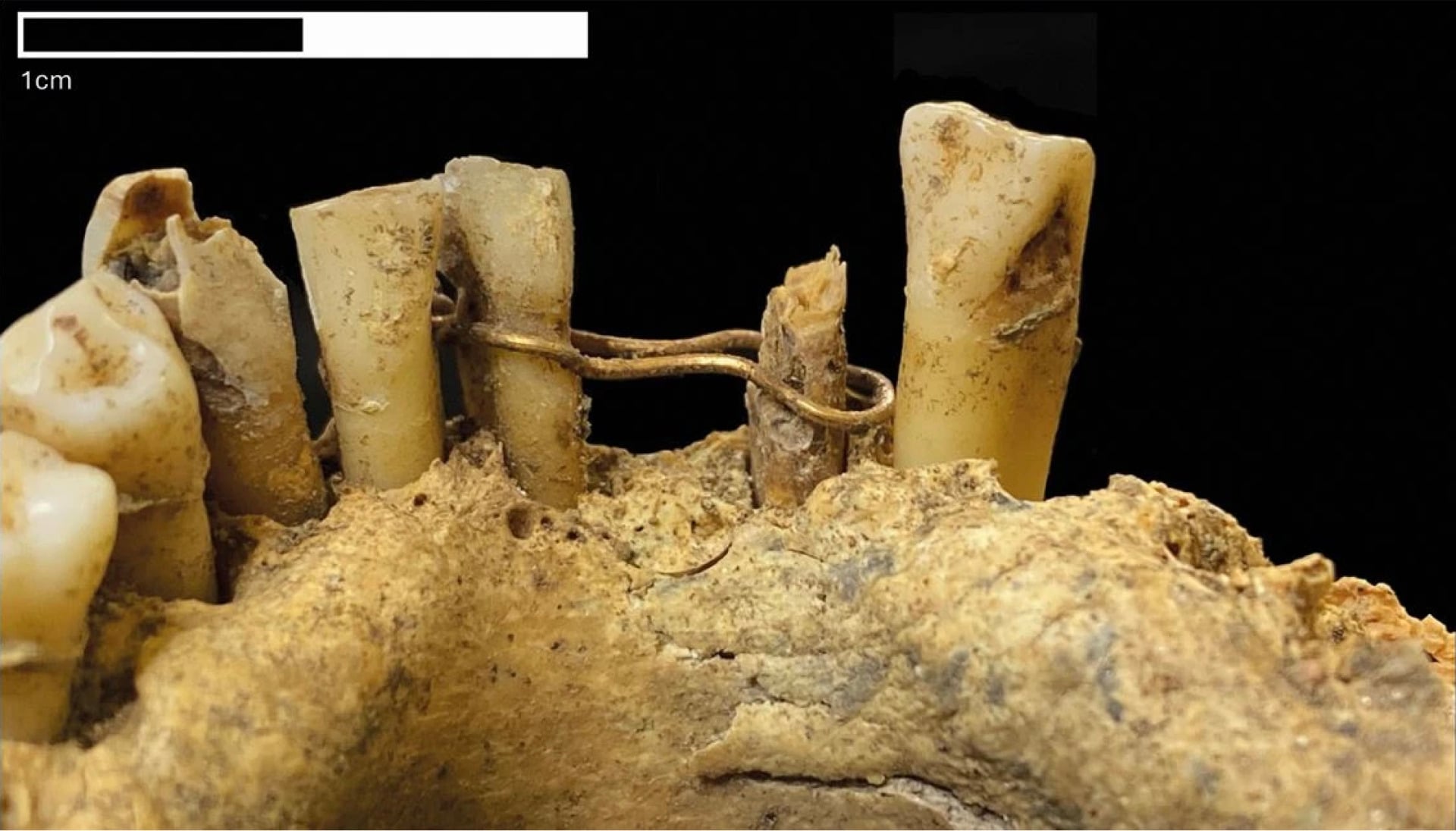
Gold Ligature medieval dentistry back view
Above, a reverse view of this medieval gold dental work. Credit: Jenna Dittmar, courtesy of the British Dental Journal

Peerless medieval ‘dentatores’

In the centuries before dentistry became officially credentialed in the United Kingdom in 1860, the field was rife with enterprising barbers, barber-surgeons, local women with herbal medicine expertise, and even moonlighting traveling showmen. “Depending on availability, one could also seek relief from a ‘tooth-drawer,’” the researchers noted, “who were often carnival performers that travelled around the country peddling proprietary methods for ‘painlessly’ extracting teeth.”

Scotland at this time was also blessed with comparably better trained “dentatores,” dental specialists schooled in more advanced techniques passed down by Arabian doctors, like Abul Qasim al-Zahrawi who practiced on the Iberian Peninsula in the first century CE. (Medical historians credit Al-Zahrawi’s medical encyclopedia Kitab al-Tasrif with advocating for dental reconstruction methods that incorporated oxidation-resistant metals, like gold.)

Dentatores weren’t cheap, however, and the mere presence of this kind of specialized work “illustrates that wealthier individuals had access to advanced dental treatments,” as the researchers argued in their study, published this April in the British Dental Journal.

Non-elite Scots, they noted, were more likely to receive dental treatment in the form of simple herbal remedies for toothaches—including “green turf heated with embers” and “cow dung poultice,” an appetizing heated mixture that incorporates exactly what it sounds like. “The administration of such folk remedies was practiced in Scotland into the 20th century,” the researchers said.

Years of dental work

This latest round of excavation at St. Nicholas began in 2021, part of a preservation project to transform the kirk (a Scottish word for church) into a local heritage site.

The study’s lead authors, biological anthropologist Jenna Dittmar and osteoarchaeologist Marc Oxenham, had traveled from the Edward Via College of Osteopathic Medicine in Louisiana and Australian National University in Canberra, respectively, to collaborate on local excavations.

In a previous project with their hosts at the University of Aberdeen’s department of archaeology, Dittmar and Oxenham examined teeth and other skeletal remains that had been recovered from local victims of the ‘Black Death,’ which ravaged Aberdeen from 1644 to 1649. These plague years sit comfortably within the latter bound of their well-to-do dental patient’s possible lifetime, which may someday yield clues as to how he died.

As Oxenham put it in a statement accompanying that 2024 plague study, “This was a particularly desperate time to have been alive in Scottish history.”

The Land Bridge You’ve Never Heard Of


For many of us, when we think of land bridges, we tend to think of the Bering Land Bridge (actually more of a swamp), which ancient humans traversed to reach North America from modern-day Siberia during the last Ice Age. But there may have been another, crucial stretch of land that aided early human migration—this time, far across the continent, on the Anatolian coast.

That’s the major new finding from a team of Turkish archeologists who have uncovered over 100 stone artifacts from ten different sites along the peninsula. They indicate that a land bridge, now underwater, had once existed between the western edge of Asia and Europe, enabling humans to move between these regions. If their theory holds, it would reveal a previously unknown chapter in the history of human migration at a critical moment in our evolution and development as a species.

An unexplored prehistoric region

“This study explores the Paleolithic potential of Ayvalık, a region in western Anatolia that has remained largely unexamined in Pleistocene archaeology,” the researchers wrote in their study, which was published Friday in the Journal of Island and Coastal Archaeology. “These findings reveal a previously undocumented Paleolithic presence and establish Ayvalık as a promising locus for future research on early human dispersals in the northeastern Aegean.”

The Paleolithic Period—around 2.6 million to 12,000 years ago—and the Pleistocene Epoch—around 2.5 million to 11,700 years ago—refer to roughly the same stretch of time. The former is an anthropological term, while the latter is a geological term.

During the last Ice Age (between around 120,000 and 11,500 years ago), Earth’s landscape looked much different than today. Besides gargantuan amounts of ice, the sea level then was significantly lower. Ayvalık’s islands and peninsulas, for example, would have been part of a single stretch of land connecting Anatolia and Europe.

An unforgettable moment of discovery

Still, scholars have long believed that Homo sapiens mostly reached Europe from Africa by traveling through the Levant and the Balkans. But the newly discovered tools, indicate that people were present in Ayvalık’s bygone landscapes. The researchers found Paleolithic hand axes, cleavers, and Levallois flake tools (stone implements that had sharp edges and were likely used as knives). The team argues that the findings offer an alternative narrative of early human migration.

“The presence of these objects in Ayvalık is particularly significant, as they provide direct evidence that the region was part of wider technological traditions shared across Africa, Asia, and Europe,” Göknur Karahan, an archeologist from Hacettepe University, said in a statement.

“It was a truly unforgettable moment for us. Holding the first tools in our hands was both emotional and inspiring,” Karahan added.

Substantive artifact dating, stratigraphic excavations, and reconstructions of the ancient environment will be crucial to determining whether their theory is correct, including possibly searching for artifacts on the bottom of the Aegean sea.

How a PhD Student Discovered a Lost Mayan City From Hundreds of Miles Away


A new Mayan city, lost in the dense jungle of southern Mexico for centuries, has been discovered from the computer of a PhD student hundreds of miles away. This is the story of how he did it.

The settlement, named Valeriana after a nearby freshwater lagoon, has all the characteristics of a classic Maya political capital: enclosed plazas, pyramids, a ball court, a reservoir, and an architectural layout that suggests a foundation prior to 150 AD, according to a newly published study in the journal Antiquity.

And how did Tulane University graduate student Luke Auld-Thomas find it? The answer lies in lasers. Until recently, archaeology was limited to what a researcher could observe from the ground and with their eyes. However, the technology of detecting and measuring distances with light, known as lidar, has revolutionized the field, allowing us to scan entire regions in search of archaeological sites hidden under dense vegetation or concrete.

Let’s travel back in time. It is 1848 and the governor of Petén, Guatemala, Modesto Méndez, together with Ambrosio Tut, an artist and chronicler of the time, rediscovered Tikal, one of the most majestic archaeological sites of the Mayan civilization. In the middle of the 19th century, little was known about this advanced culture—which calculated lunar, solar, and Venusian cycles, and invented hieroglyphic writing and the concept of the number zero with hardly any tools.

The dense rainforest surrounding Tikal and its lack of roads made it extremely difficult to reach the remains. But the Guatemalan government went deep into the heart of the Petén jungle anyway, in search of its cultural heritage. Guided by the rumors of the locals, machete in hand, along with tape measure and compass, they entered the Petén jungle on an almost impossible mission. Arriving at the Tikal site, Méndez and his team were amazed at what they saw: gigantic temples and pyramids, mostly covered by the jungle. The most imposing constructions, hidden by nature, towered above the tree canopy. Tikal, although partially buried, retained its majesty and gave clues to the enormous size of the city.

History repeated itself in 2024—but with some important variations. Rather than a machete, Auld-Thomas armed himself with a search engine. WIRED spoke this week with him and Marcello Canuto, director of Tulane’s Middle American Research Institute, about the discovery.