Scan To BIM: Advice for Working with an Architectural Design Services Firms


Building Information Modeling, or BIM, revolutionized the construction and building industry by enhancing the design process as well as better management of the projects. Scan to BIM, a specific application of architectural BIM services, takes the process one notch higher by integrating 3D laser scanning and building information models to provide accurate digital models of existing facilities.

This solution is most useful to architects, engineers, and builders involved in renovation or retrofitting work because it will enable correct as-built models and improve project delivery. For architectural design service companies from Cad Crowd’s leading industry platform, adding a scan to BIM to their workflow can be useful, but it comes with its own set of issues. Here is a step-by-step guide on how to work efficiently with architectural design services companies utilizing Scan to BIM technology.


🚀 Table of contents


Understanding the scan to BIM technology

Scan to BIM (Building Information Modeling) represents a revolutionary process that seamlessly bridges the gap between physical structures and digital design workflows. The technology begins with advanced 3D laser scanning, which captures high-resolution, millimeter-accurate scans of existing buildings or construction sites. This comprehensive scanning process collects millions of precise data points, creating what professionals call a “point cloud”—an incredibly detailed digital representation of the physical space.

These point clouds serve as the foundation for generating accurate 3D modeling design services that integrate directly into BIM platforms used by architects, engineers, and construction professionals. The result is a data-rich digital twin that reflects real-world conditions with unprecedented precision.

Primary applications and advantages: Scan to BIM proves especially valuable for retrofit, renovation, and restoration projects where existing building conditions must be captured with absolute accuracy. Traditional measurement methods often prove slow, inaccurate, and labor-intensive, particularly in complex or inaccessible areas. Scan to BIM technology eliminates measurement guesswork by generating highly detailed models that precisely mirror actual site conditions.

Strategic benefits for design practices: Architectural firms adopting this approach experience significant operational improvements:

  • Dramatic reduction in documentation errors and measurement inaccuracies
  • Enhanced project planning capabilities and streamlined decision-making processes
  • Substantial cost savings through the elimination of expensive rework scenarios
  • Improved collaboration across disciplines and construction phases

Whether working with historic structures, large commercial complexes, or constrained urban environments, Scan to BIM ensures all design decisions are grounded in reliable, data-driven models that reflect true building conditions.

RELATED: 3 steps to hiring a reliable architecture firm & freelance services architects
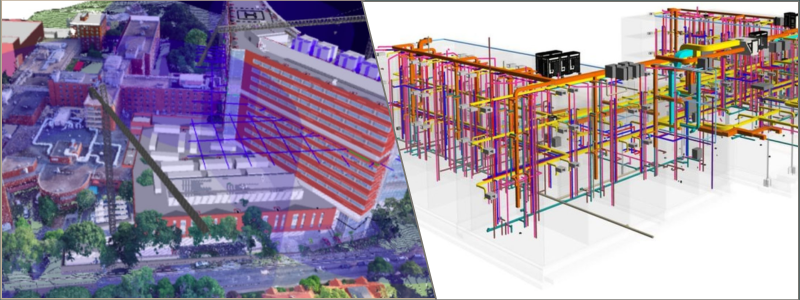
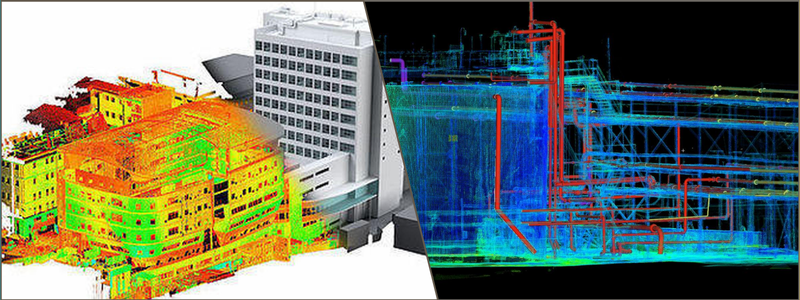
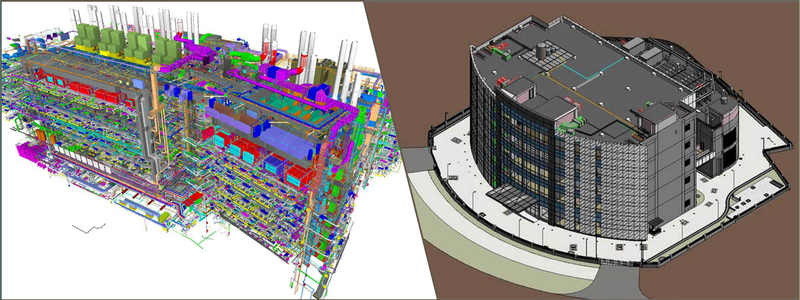
Scan to BIM examples with clash detection by Cad Crowd architectural BIM experts

Why architectural firms should embrace scan to BIM

Architecture firms embracing Scan to BIM technology unlock transformative advantages that fundamentally enhance design accuracy and operational efficiency. This innovative approach enables architects to work from highly detailed, data-rich 3D models generated through precise laser scanning of existing structures, eliminating traditional measurement guesswork and dramatically reducing errors from outdated building documentation for architectural design firms.

Enhanced accuracy and efficiency: Scan to BIM virtually eliminates costly on-site rework by providing architects with precise as-built conditions from the project’s inception. Traditional site surveys—historically time-consuming and labor-intensive processes—are replaced by rapid laser scanning technology that captures comprehensive building data in hours rather than days. This efficiency gain liberates architects to focus on creative problem-solving and strategic design development rather than tedious measurement tasks.

Seamless collaboration: The technology’s collaborative impact proves equally significant through real-time accessible BIM models that create a unified information platform. Engineers, contractors, and stakeholders work from identical, continuously updated data, eliminating communication gaps and reducing coordination conflicts. This shared digital foundation ensures all project participants operate with consistent, accurate information throughout the entire project lifecycle.

Superior project outcomes: The result is seamless project delivery characterized by enhanced interdisciplinary communication, reduced design conflicts, and accelerated construction timelines. Scan to BIM transforms complex renovation and retrofit projects from error-prone endeavors into precision-driven, collaborative processes that consistently deliver superior outcomes while maximizing both time and cost efficiency.

Key considerations when working with architectural firms using scan to BIM

When you hire an architectural design and drafting firm for a project involving Scan to BIM, there are a few key things that you need to take into account. No, you don’t simply go out and hope to find the best firm you ought to be dealing with. You don’t want to just take anyone, either. You do need to make sure that the firm has experience with Scan to BIM technology and that they can efficiently incorporate it into their design workflow. But apart from technical knowledge, there are a couple of other things to bear in mind.

Assess the firm’s technical capability

It is not possible for all architecture companies to be efficient when it comes to utilizing Scan to BIM technology. While certain companies are able to perform this process for a very long duration, there are companies that are working towards activating it. Prior to recruiting an architectural firm to handle a Scan to BIM job, make it a point to consider their technical capability. Inquire about their experience using 3D laser scanning, BIM software, and whether they have worked with bringing Scan to BIM into their operation.

Also, it’s important to assess the software and machines the company uses for Scan to BIM. Different companies may utilize different BIM platforms (e.g., Revit, ArchiCAD), and they may not necessarily be all compatible with your needs. Make sure the company is utilizing the latest technology and software releases, as this will ensure that the models generated by them are accurate, up to date, and compatible with other tools used on the project.

Understand their approach to handling data

Scan to BIM involves the acquisition of huge amounts of data, and handling the data in an effective way is a crucial part of the process. The architectural design expert you hire should have a clear approach to handling the point cloud data, converting it into a usable BIM model, and providing the final product that best meets your project requirements.

Ask the company how they treat point cloud data. For example, do they use automated programs to automate, or do they use manual methodologies to clean? How do they ensure the correctness of the output BIM model? Understanding their data management procedure can help you decide whether or not they have the ability to handle the complexity of your job.

Communication and collaboration

Communication is essential in any architectural project, but particularly so when using Scan to BIM technology. Because there are several stages to the process, from gathering data to creating the model to implementing the design, strong lines of communication must exist among the architectural firm, contractors, and other stakeholders.

Make sure that the architectural firm you employ is committed to open communication and problem-solving as a team. Do they hold regular meetings to keep all staff members informed about project progress? Are they open to suggestion and ready to change if something needs to be adjusted? Communication is the key to preventing misunderstandings and keeping the project on track.

RELATED: How much blueprints cost for CAD floor plans, and 2D drawings rates at drafting firms?

Ensure compatibility with your goals

Before hiring an architecture practice on a Scan to BIM project, ensure that you confirm they receive what you are looking for. Do you need the BIM modeling services for energy analysis, fit-out, or future expansion if the need arises? The quality of data and amount of detail required will rely on the nature of the work.

Describe your aims to the company and make them aware of how Scan to BIM can help you achieve them. For example, if you are carrying out a full transformation, it is necessary to have a correct as-built model that can assist during the design. The architectural firm should be in a position to generate a detailed and accurate model that indicates the building as it is at the moment, including structural features, HVAC systems, and other major components.

Manage the project timeline

Scan to BIM projects can be complex and time-consuming, so it’s essential to work with a firm that understands the importance of managing the project timeline effectively. Request the company to provide a clear timetable that describes the different phases of the Scan to BIM process, from data capturing to point cloud processing, and finally, the creation of the BIM model. They should be able to provide you with realistic time schedules for each phase in the project and notify you of any delay or problem that arises.

It’s also important to know how long it will take to complete the BIM model and when you’ll be able to begin the design phase. Slowness in the Scan to BIM procedure will slow down the entire project timeline, so it’s necessary that the firm is efficient enough to meet your deadline on time.
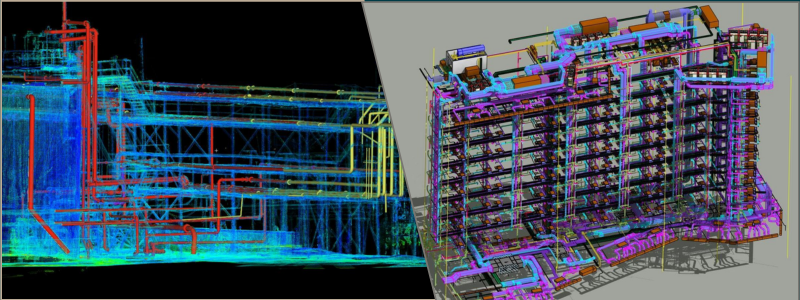
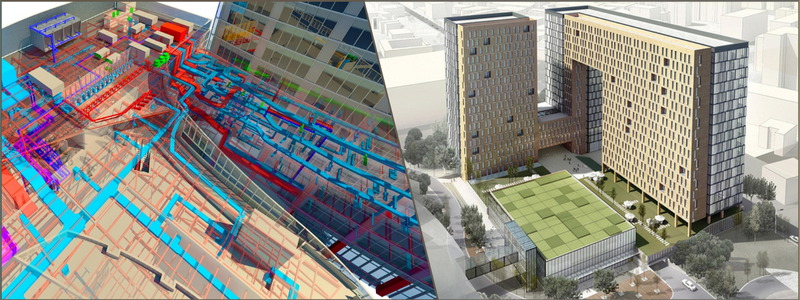
Scan to BIM and Mechanical scan to BIM design examples by architectural design experts from Cad Crowd

Budget and cost estimates

Scan to BIM technology can be costly, particularly if you must acquire special hardware and software to gather the data and create the model. When hiring an architectural planning and design firm, ensure you understand the expenses of the Scan to BIM process beforehand. Ask for in-depth cost estimates with itemizations for the various expenditures, including data gathering, software licensing, model creation, and any additional expenditures.

While Scan to BIM may reap rewards in the long run by reducing errors and making projects more efficient, ensure that the cost is within your project budget. Demand that the company be transparent with you regarding their charges and how changes to the scope of the project may influence the overall cost.

RELATED: Photorealistic rendering services: Complete price, cost, rates and fees for companies and firms

Transforming architectural design through precision technology

Scan to BIM technology represents a transformative shift in architectural design and 3D architectural visualization services, bridging the gap between physical reality and digital precision. By integrating 3D laser scanning with Building Information Modeling, architectural firms can deliver unprecedented accuracy in renovation and retrofit projects while eliminating costly measurement errors. Success depends on partnering with experienced firms that demonstrate technical expertise, clear data management processes, and collaborative communication approaches.

When properly implemented, Scan to BIM streamlines project timelines, enhances cross-disciplinary coordination, and provides the data-rich foundation necessary for informed design decisions. This technology isn’t just an advantage—it’s becoming essential for competitive architectural practice in today’s market.

Take action: Partner with scan to BIM experts today

Don’t let outdated measurement methods compromise your next renovation or retrofit project. Partner with experienced architectural firms who have proven expertise in Scan to BIM technology and can deliver accurate, data-driven results. Evaluate potential firms based on their technical capabilities, communication processes, and project management track record before making your selection. Cad Crowd is a leading company that provides impeccable BIM scanning, architectural design, and engineering services to top AEC companies.

Contact qualified scan-to-BIM specialists today to transform your project accuracy and streamline your design process from day one. Request a quote today.

author avatar

MacKenzie Brown is the founder and CEO of Cad Crowd. With over 18 years of experience in launching and scaling platforms specializing in CAD services, product design, manufacturing, hardware, and software development, MacKenzie is a recognized authority in the engineering industry. Under his leadership, Cad Crowd serves esteemed clients like NASA, JPL, the U.S. Navy, and Fortune 500 companies, empowering innovators with access to high-quality design and engineering talent.

Connect with me: LinkedInXCad Crowd

BIM and GIS Integration: Introduction and Importance AEC Services Companies


The architecture, engineering, and construction (AEC) sector is experiencing a technological revolution, and this is quite clearly reflected in the increasing number of AEC service firms on top platforms such as Cad Crowd. With AEC companies struggling to design, plan, and deliver intricate projects, the convergence of building information modeling (BIM) services and Geographic Information Systems (GIS) has become a game-changer.

Blending the benefits of both systems introduces the possibility of more precise, streamlined, and coordinated project delivery. For AEC services firms, knowing how BIM and GIS integration works—and how it affects their business—is fundamental to competitiveness in a progressively data-centric industry.


🚀 Table of contents


BIM and GIS: A quick overview

Before delving into the influence of BIM and GIS integration on the AEC industry, it’s imperative to identify what each system does and how they work as stand-alone entities.

  • Building Information Modeling (BIM): Building information modeling (BIM) is a digital representation of a building’s design, construction, and operational details. This is more than just a 3D model; it includes helpful information about the design’s materials, structural qualities, budget, and schedule. Preliminary design optimization, collaboration, and simulation can take place thanks to this tool, which is useful for architects, engineers, and contractors.
  • Geographic Information Systems (GIS): GIS is an application that captures, stores, manipulates, analyzes, manages, and displays geographic or spatial data. GIS allows experts to map and analyze terrain, land use, zoning regulations, weather, and other location-relevant factors, frequently essential when handling large-scale infrastructure or urban planning projects.

When integrated, GIS and BIM enable AEC firms to control both the micro-level specifics of building construction (via BIM) and the macro-level issues of geography and environmental conditions (via GIS). The combination of these systems provides an extensive toolset for planning and implementing projects in ways otherwise hard or impossible to achieve for architectural design firms.

RELATED: Architects vs. designers: What’s the difference and which should you hire for design services?

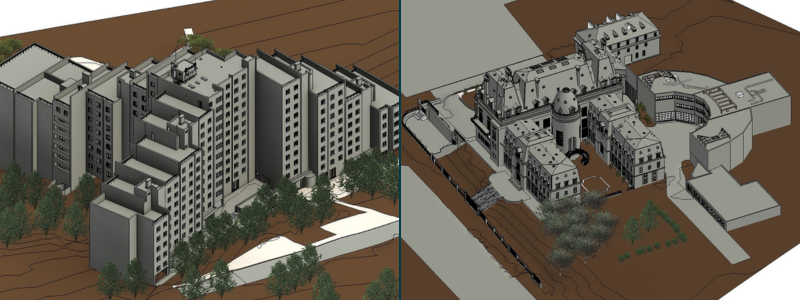
3D site plan and topographic site plan through BIM and GIS services

The Role of BIM and GIS Integration in AEC Services

BIM and GIS integration are revolutionizing the way Architecture, Engineering, and Construction (AEC) services plan and execute projects. BIM centers on precise details of a building’s design, construction, and lifecycle, including structural and material information. GIS provides a wider geographic and environmental picture—charting terrain, infrastructure, climate, and so on.

Together, BIM and GIS present a complete picture that improves each phase of a project, from initial planning to upkeep. This combination allows AEC professionals to compare spatial and structural information at the same time, making optimal site selection, sustainability, and urban planning decisions. It leads to better collaboration between stakeholders, faster delivery schedules through data-driven processes, and less risk through early identification of problems.

Finally, BIM-GIS convergence enables companies to design more intelligently, build quicker, and operate more cost-effectively, producing projects that are not just technically excellent but also socially and environmentally responsible.

Here’s a look at how this integration enhances AEC services:

Better planning and site selection

When starting any new building project, location and site conditions take precedence. GIS facilitates AEC companies in determining the readiness of a site by offering information regarding land characteristics, environmental factors, zoning regulations, and existing infrastructure in the area. For instance, GIS may be applied to examine soil quality, flood exposure, traffic flow, or distance from utility networks. This information is critical in the determination of the most suitable location for a building or infrastructure development.

Through the integration of BIM, architects and engineering design firms are able to simulate how a proposed design would interact with the site’s geographic conditions. For example, a BIM model can simulate how a building’s foundation would perform under various soil conditions determined by GIS data. This type of simulation minimizes the chances of expensive surprises during construction and provides a more sustainable, site-suited design.

Better decision-making through visualization

The combination of BIM and GIS provides a versatile decision-making visual tool. GIS provides a topographic, spatially correct map of the project location, with BIM contributing precise 3D models of the building or structure. Merging these models, AEC firms can visualize how the building will interlink with its physical and environmental context.

For instance, architects can apply the combined models to model the effect of natural light on the building façade during the year. They can also model the air circulation or water runoff relative to the local topography. Having both building and geographic data in one place assists teams in making improved design decisions that lower energy usage, enhance user experience, and enhance the building’s resilience to environmental conditions.

RELATED: Do you know the BIM best practices for architectural design firms?

Improved interdisciplinarity collaboration

Collaboration is the lifeblood of the AEC industry. In conventional workflows, architects, engineers, and contractors tend to work in separate silos and use different systems that may or may not speak to each other. This has the potential for misunderstandings, mistakes, and delays. Introducing BIM and GIS eliminates these communication problems.

When GIS data and BIM models are combined, all stakeholders—from construction workers to civil engineers—can view and update the same real-time information. For instance, an engineer can update a BIM model according to new GIS data on local zoning laws, while an architectural design expert can make adjustments to the building design to accommodate the environmental context. The outcome is a more coordinated and integrated workflow that results in fewer changes and delays later on.

Efficient resource management

Successful resource management is key to finishing any project on schedule and within budget. Using BIM’s accurate data and GIS’s spatial context, AEC firms can enhance the management of resources, including materials, labor, and equipment, throughout the project’s life cycle.

With the help of GIS, project managers can analyze the materials’ location compared to the site location, guaranteeing that logistics are optimized. BIM, however, ensures accurate quantities and material specifications, guaranteeing correct material delivery at the correct time. This coordination eliminates waste, reduces transportation expenditure, and guarantees that construction activities operate smoothly.

Increased sustainability and environmental impact analysis

Sustainability is a key focus in contemporary architecture and construction. AEC firms are being called upon more and more to adhere to environmental standards, conserve energy, and reduce their carbon footprint. Combining GIS and BIM enables companies to address sustainability in a more comprehensive manner.

Unlike BIM, which allows for comprehensive energy modeling and simulation, GIS provides a wealth of data pertaining to environmental factors, such as climatic trends, water consumption, and energy consumption. By combining the two programs, architectural planning and design companies can simulate the possible influence of different design elements on sustainability, water usage, and energy efficiency, allowing for more comprehensive evaluations of a building’s carbon footprint. Such research can make a huge difference to the efficiency and sustainability of a building over time.

RELATED: Embracing BIM: The future of building information modeling for construction companies

Real-time monitoring and maintenance

The benefit of combining BIM and GIS doesn’t end when the construction process is finished. Once a building or infrastructure project is completed, these systems are still useful in the operation and maintenance phases. BIM can be utilized to monitor the status of building components over time, while GIS can track the environmental conditions that impact the building.

A facility management team, for instance, can keep track of when critical systems are due for repair or replacement with the help of an integrated GIS/BIM system. Building operations can be tracked in relation to external factors like weather and traffic patterns. By using this data, proactive maintenance can be implemented, resulting in cost savings and an extended building life.

Site plan and construction and BIM clash detection through GIS and BIM services in Cad Crowd

The most common challenges of BIM and GIS integration

Though there are numerous advantages of the integration of BIM modeling services and GIS, there exist some challenges AEC companies need to address. The complexity involved in integrating two dissimilar systems with different data structures and formats is one of the major barriers. BIM and GIS solutions tend to be built by dissimilar software companies, and as such, compatibility issues may occur.

The other challenge is the accuracy and consistency of the data. GIS depends a great deal on geospatial data that is available in real time, which is prone to inaccuracies or obsolescence. Likewise, the BIM models will need to be constantly updated to accurately portray the state of the construction project as it is now. It will take great diligence to have both systems harmonized and updated.

Moreover, there is a need for training and expertise. AEC practitioners must be familiar with both BIM and GIS technologies to be able to take advantage of their full potential. This will involve investment in training courses and perhaps the recruitment of specialists to oversee the integration process.

Conclusion

The convergence of BIM and GIS is transforming the way AEC services firms tackle design, planning, and execution of projects. By merging the precise, model-based methodology of BIM with the spatial, context-aware insights of GIS, companies can make more informed decisions, enhance collaboration, increase sustainability, and streamline resource management. The potential for greater efficiency, cost reduction, and risk mitigation is vast, but achieving these benefits involves surmounting technical and organizational hurdles.

RELATED: Impacts of BIM design on reducing carbon footprint for architectural firms & CAD companies

Cad Crowd is here to help

For AEC companies wanting to remain competitive in today’s cutthroat world, BIM and GIS integration investment is not merely about being up to speed with industry developments; it’s an essential tactic for producing superior projects in fewer resources, achieving client expectations, and helping build a more sustainable built environment. If you think you’re ready to take this trend, Cad Crowd is where you should start looking for specialists in BIM and GIS. Get a free quote today!

author avatar

MacKenzie Brown is the founder and CEO of Cad Crowd. With over 18 years of experience in launching and scaling platforms specializing in CAD services, product design, manufacturing, hardware, and software development, MacKenzie is a recognized authority in the engineering industry. Under his leadership, Cad Crowd serves esteemed clients like NASA, JPL, the U.S. Navy, and Fortune 500 companies, empowering innovators with access to high-quality design and engineering talent.

Connect with me: LinkedInXCad Crowd

BIM vs. CAD: Which is Better for Modern Architectural Design Services Companies


A sleek, glass-wrapped skyscraper begins to take shape not in the real world, but on a screen. There are layers, dimensions, data, and details down to the last duct. Is that Computer-Aided Design (CAD)? Not quite. You’re in Building Information Modeling (BIM) territory now. For architecture design firms struggling to maintain their edge in an industry where accuracy, speed, and teamwork are paramount, it’s not just “What do we use?” BIM or CAD?

This argument isn’t a detached technical contrast anymore. It’s at the heart of the way firms sell on projects, collaborate with subcontractors, and produce for clients who demand photorealistic visualizations services and no design conflicts. If you’re a seasoned firm established in AutoCAD or a nimble startup diving headfirst into BIM day one, the choice comes back to your fundamental way of working.

So let’s get into this. Not with a checklist but with a full-throated investigation. No jargon for jargon’s sake. Just an honest discussion about what BIM and CAD are, how they define architectural services these days, and which one may be better for your team, not just short-term, but for projects you haven’t even imagined yet.


🚀 Table of contents


The origin stories: Drafting tables to data-driven models

Let’s take a step back to establish the context.

Picture a world where every building plan began with a pencil, ruler, and enormous piece of paper. That was the norm until Computer-Aided Design (CAD) came along like a digital knight. With AutoCAD, MicroStation, and early ArchiCAD, architects ceased to have to redraw whole schematics to make changes. They clicked, copied, and stacked their way to faster, more accurate technical drawings instead. It revolutionized.

But here’s the catch: CAD, as revolutionary as it was, remained about drawing. Even when 3D modeling design services became standard, the models were basically digital manifestations of real-world shapes. A column appeared as a column, yes, but the program didn’t have a clue it was a column. It was all form and visual accuracy, but not smarts.

Then BIM, Building Information Modeling, took over, and the game shifted once more.

BIM software such as Revit, the new ArchiCAD, and Bentley AECOsim not only models buildings, but they imbue them with intelligence. A wall was no longer a surface. Now it was a wall with attributes. Materials, thermal value, fire rating, and expense are all built in. Doors recognized themselves as doors. Beams knew their load-carrying functions.

The payoff? A design environment in which updates cascade throughout the entire model. Alter a door’s width, and schedules, elevations, and clash detections all update in real time. It’s not only smarter drafting, it’s a smarter building process.

From the drafting table to data models, architectural design services have come from hand-drawn lines to smart, responsive systems. And we’re just beginning.

RELATED: Tips to optimize new invention development and product development for companies

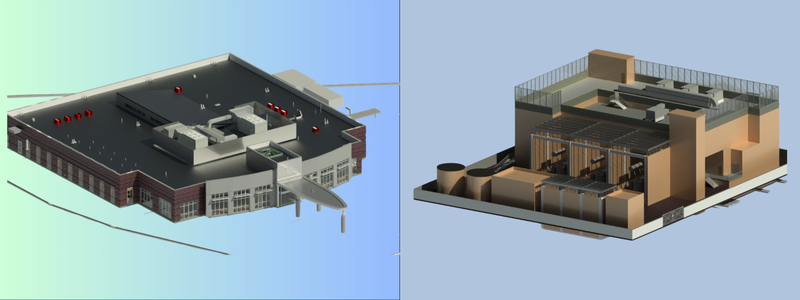
BIM modeling examples for architectural design

Drawing vs. modeling: The philosophical divide

This is where the sparks begin to fly.

When you’re using CAD (Computer-Aided Design), you’re essentially composing a symphony, note by note, line by line. Every wall, hatch, or text label is manually placed with precision. It’s detailed, controlled, and yes, a bit obsessive (but in the best way). CAD files are like digital sheets of paper. You’re telling the software exactly what to draw, and it does just that, no more, no less.

Then there is BIM (Building Information Modeling), and before you know it, you’re not sketching anymore, you’re modeling. Rather than simply sketching a door, you add a “door family” to your project. That door has built-in smarts: size, materials, fire rating, thermal properties, and even manufacturer data. Want to swap out all the wooden doors in a project for steel? One click. Boom. Done. It’s like playing an orchestra of clever instruments that harmonize of their own accord.

So it’s actually more than just tools. It’s a change in mindset.

CAD design services are for sketching. BIM is a computer-based tool for construction. CAD provides you with 2D plans and perhaps some rudimentary 3D. BIM provides you with a working digital model of your building. That model can be utilized not only for design but also for energy analysis, clash detection, scheduling, cost estimation, and even long-term facility management.

It’s not a question of who’s better, it’s a question of what your project requires and how you prefer to think. Are you a pencil craftsman or a smart baton conductor?

Either way, the future is being simulated, not merely sketched.

Collaboration wars: Who’s easier to work with?

This is where tensions begin to rise for architecture design companies. The software you use isn’t merely going to change how you sketch. It will dictate how you work together. And believe us, that can either make your workflow slick or send it flying off into a tailspin.

Consider a company that’s employing CAD. It’s the ideal arrangement: speedy, steady, and everybody on staff is familiar with it. You’re producing accurate 2D drawings and floor plans, and adding the occasional 3D rendering from Rhino or SketchUp for added spice. All is going swimmingly until the mechanical engineer adjusts the ductwork, and now it slices through your lighting plan.

Suddenly, its version controls mayhem. You’re sifting through endless email chains, comparing overlapping PDFs, and pointing fingers over whose file is the “real” one. It’s a high-stakes game of architectural telephone.

Now, imagine that same situation, but everyone’s using BIM modeling services . Instead of separate files, you’re all inside the same digital ecosystem. Updates to ductwork? Your lighting layout adjusts in real time. BIM flags the clash before it becomes a construction nightmare.

That’s the type of coordination project managers will fantasize about. Customers are kept in the know. Subcontractors are not surprised. And your staff? They’re addressing problems during the design phase rather than fighting them on the site.

So, who is more pleasant to deal with? The team that employs collaboration tools. And when deadlines and budgets are at stake, that is what matters.

RELATED: Top design & drafting tasks to outsource for architects and architectural services firms

CAD’s defense: It’s not dead, it’s just different

Yes, Building Information Modeling (BIM) is the new, shiny spotlight getter, but CAD? It remains very much at work behind the scenes, and doing so effectively.

Firstly, CAD is light. You don’t require a powerhouse computer or cloud-based environment to roughly sketch out an idea. If you’re doing a rough mockup of a concept, redoing a small remodel, or requiring fast iteration, CAD’s ease of use is a real asset. It’s nimble, in-your-face, and speedy. And when the going gets fine linework, and that means custom cabinetry, joinery details, or shop drawings, CAD excels. It provides the accuracy that BIM can’t always guarantee.

Most architectural design experts and engineers’ offices are actually combining both tools. They’ll design the big stuff in BIMwalls, roofs, systemsbut when they get to the nitty-gritty, such as how a drawer goes into a custom-built unit, they move to CAD. It’s an intelligent, hybrid approach, especially when contractors still hold dearly to old DWG files.

And let’s get real: not all projects require a complete BIM workflow. Some cities are still using paper plan sets or static PDFs for permitting. Those don’t require the BIM bloat if CAD will suffice.

So no, CAD isn’t dying out. It’s just playing a new role of the headliner, more of a specialist. But ask anyone buried deep in the trenches of drafting and design, and they’ll tell you: CAD is by no means obsolete.

BIM’s edge: Beyond architecture

BIM is like that one architecture student who didn’t stop at studio projects but also picked up structural engineering services, HVAC systems, sustainability metrics, and a business minor just for fun.

Architectural firms embracing BIM are essentially expanding their value proposition. You’re no longer just delivering pretty renderings and floor plans. You’re offering energy performance analysis, daylighting simulations, cost estimates, and lifecycle insights, all from the same model.

Think about that.

With BIM, you can:

  • Execute clash detection between architectural, structural, and MEP models.
  • Trace materials for embodied carbon.
  • Extract quantities directly for procurement.
  • Simulate timelines with 4D scheduling.

That’s not design. That’s architecture as a data-driven consultancy.

It’s no surprise that public infrastructure projects across Europe, Asia, and even the U.S. increasingly require BIM deliverables. It’s not a trend, it’s a transition.

BIM examples modeling

RELATED: Keys to successful structural design & construction projects with architectural services firms

The talent factor: Who’s driving the software?

Let’s discuss people for a moment.

The best software in the world is still only as good as the folks using it. And here’s where many firms stumble.

CAD has been around forever, and you’ll find seasoned professionals who can navigate it blindfolded. BIM, on the other hand, has a steeper learning curve. It requires teams to think differently, plan ahead, and understand not just how to model but why you’re modeling.

That involves investing in training, upskilling, and maybe even reorganizing your team structure. Now you’re recruiting BIM modeling experts, not drafters. You’re bringing IT more into project workflows. You may even have to tell clients why “LOD 350” is important.

But when does your team understand? Projects run smoother. Deadlines seem less daunting. Clients are more satisfied. And your firm? It begins to grow.

The cost question: Is BIM worth the price tag?

Let’s be real, prices count. And BIM is not cheap.

Revit or ArchiCAD licenses are much more expensive than AutoCAD. The equipment to host full 3D models is not cheap either. And to top it all off, the learning curve is time-consuming (and time equals money).

So why do companies continue to switch?

Because BIM’s ROI appears elsewhere in the company: fewer RFIs on the job site, quicker approvals, reduced rework, and greater integration with contractors. That is, while CAD may be less expensive in the short term, BIM tends to save more in the long run.

Some companies even see 20–30% increases in efficiency over time once BIM becomes standard. It’s a long-term game. But if you intend to expand, diversify architectural planning and design services, or take on large, complex jobs, it’s an investment, not a cost.

Client expectations are changing, are you?

You know who else is considering BIM? Your clients.

Developers, cities, and even homeowners who have a smart home obsession all want more than flat drawings. They want walk-throughs, material samples, daylight studies, and dashboards they can access on a tablet.

That is to say, they want interactive design.

With BIM, you can illustrate for them how the sun will strike their penthouse kitchen at 9 am on a summer morning. You can model emergency egress in a hotel. You can demo the mechanical systems behind the ceiling tiles. You can even feed your model into VR and take them through their building before breaking ground.

That kind of immersive storytelling?

Choosing the right tool: A strategic decision

So, which is better, BIM or CAD? The answer depends entirely on your project scope and business goals. Each tool serves distinct purposes in the modern architectural workflow, and even for engineering services.

CAD remains your best friend when you need speed and precision for smaller-scale work:

  • Quick turnaround interior fit-outs and renovations
  • Schematic studies and concept development for local clients

BIM becomes essential when complexity and collaboration drive your projects:

  • Multi-disciplinary team coordination across architecture, engineering, and construction
  • Large-scale or technically demanding buildings requiring data integration
  • Comprehensive service offerings that include energy analysis, clash detection, and lifecycle management

The smartest architectural design firms aren’t picking sides. They’re strategically combining tools. They use BIM for comprehensive modeling and collaboration, then switch to CAD for precise detailing and custom elements.

The key to success? Understanding when to deploy each tool and staying flexible enough to adapt based on your project’s specific requirements.

RELATED: How architects embrace innovation for modern home design services with companies

The future is integration, not competition

The BIM versus CAD debate isn’t about choosing a side; it’s about strategic evolution. Modern architectural firms thrive by leveraging both technologies strategically: BIM for complex, collaborative projects requiring data-rich modeling and intelligent coordination, and CAD for precision detailing and quick iterations.

While CAD design experts and professionals remain valuable for specific applications, BIM has become essential for firms pursuing larger projects, enhanced collaboration, and comprehensive design services. The most successful practices adopt a hybrid approach, using each tool where it excels. As client expectations shift toward interactive, data-driven design experiences, embracing BIM isn’t just advantageous, it’s becoming the industry standard for competitive architectural services.

Cad Crowd is here to help!

Partner with expert BIM and CAD professionals with Cad Crowd today, the leading platform to find the best freelance design and engineering professionals. Transform complex projects into competitive advantages. Get faster project delivery, seamless collaboration, and superior results. Contact us now and get your free quote!

author avatar

MacKenzie Brown is the founder and CEO of Cad Crowd. With over 18 years of experience in launching and scaling platforms specializing in CAD services, product design, manufacturing, hardware, and software development, MacKenzie is a recognized authority in the engineering industry. Under his leadership, Cad Crowd serves esteemed clients like NASA, JPL, the U.S. Navy, and Fortune 500 companies, empowering innovators with access to high-quality design and engineering talent.

Connect with me: LinkedInXCad Crowd

How to Choose the Right BIM Services Provider For Your Architectural Firm


Let’s be real—when you’re knee-deep in the design stage of a project, managing client needs, zoning issues, and impending deadlines, the last thing you want is a BIM partner who won’t get it done. Hiring the right Building Information Modeling (BIM) services firm from the industry giant, Cad Crowd, has the potential to eliminate the madness or contribute to it. That choice? That’s not something to be taken lightly.

BIM is no longer a buzzword; it’s baked into every stage of architectural practice, ranging from initial conceptualization to facility management. Whether you’re a small firm new to 3D modeling or a large practice looking to expand cost-effectively, securing a BIM partner who shares your ethos, workflow, and ambitions is paramount.

What are BIM services?

BIM modeling conversion and scan examples

RELATED: Why architects outsource 3D modeling services and the benefits for your design company

BIM (Building Information Modeling) services consist of the creation and maintenance of digital models representing physical and functional building characteristics. BIM services facilitate the planning, design, construction, and operation of buildings in 3D models with embedded data.

BIM allows architects, engineers, contractors, and stakeholders to coordinate better, eliminate errors, and enhance efficiency in the project’s life cycle. Services can encompass 3D modeling design services, clash detection, quantity takeoffs, cost estimation, and facility management.

By offering a common knowledge base, BIM services simplify workflows, improve visualization, and enable improved decision-making in construction and infrastructure development on residential, commercial, and industrial projects.

Now, you’ve learn what BIM services are all about. So, how do you actually go about selecting the right one, then?

This manual takes you through the actual questions to ask, red flags to look out for, and clever methods to make your architecture firm receive the BIM services it actually requires.

Define your requirements before you begin searching

Even before you call on prospective BIM providers, you have some research to conduct.

  • What stage of your project(s) will require BIM integration?
  • Do you need full BIM coordination or merely model development?
  • Do you require clash detection, quantity take-offs, 4D scheduling, or 5D cost estimation?
  • What software do you presently use—Revit, ArchiCAD, Navisworks—and will the vendor have to integrate into your environment?

Getting these questions in sequence is like drafting a good project brief. It provides direction, clarity, and expectations for architectural design firms. Having a clearly defined scope also keeps you from paying too much for services you don’t require—or worse, being stuck with a provider who can’t provide what you do.

Here’s the way to think about it: you wouldn’t start building without blueprints. The same rule applies here.

Review their portfolio, but read between the lines

A glitzy portfolio is good. It demonstrates capability, scope, and design potential. But don’t get impressed by nice renderings and shiny case studies alone.

Here’s what to look for instead:

  • Project similarity: Have they done buildings similar to yours—educational campuses, hospitals, commercial towers, or heritage projects?
  • Complexity level: Can they deal with irregular geometries, sustainability modeling, or high-end parametric elements?
  • Team integration: Did they work as silent team players or take charge of BIM coordination among various disciplines?

Request to view the real BIM outputs, not glossy renders. Ask about the model LOD (Level of Development), documentation quality, and if they used open standards such as IFC (Industry Foundation Classes).

🚀 Pro tip: If they’ve worked with MEP services or structural consultants you know and trust, that’s a good indicator of collaborative compatibility.

Verify technical competency, not software know-how

Anyone can say they “use Revit.” That’s not sufficient. You must know how well they do it—and if they do it smartly.

Some questions to consider:

  • What BIM standards or naming conventions do they use?
  • Are they able to design custom parametric families for specialty items?
  • Do they provide Revit API scripting or Dynamo automations for efficiencies?
  • How do they handle version control and data interoperability with other tools?

Dig into their workflow. A good BIM provider will be eager—even proud—to share their process and how they approach data-rich modeling. Look for evidence that they don’t just draw in BIM—they think in BIM.

RELATED: How structural engineers improve custom home design when you hire architects & design firms

BIM modeling with an MEP and conversion

Ask about communication and coordination skills

Here’s a universal truth: technical brilliance means nothing if it doesn’t come with communication.

Your architectural BIM partner will become an extension of your team, so whether or not they can handle expectations, report back to you, and communicate in your language is important—a big deal.

Assess the following:

  • How do they process feedback loops?
  • Will they attend coordination meetings with contractors and consultants?
  • Do they offer model sharing through cloud platforms such as BIM 360 or Trimble Connect?
  • What’s their response time when it’s the critical design phases?

Certain companies even appoint a BIM Manager who speaks directly to your team. That single point of contact can be worth its weight in gold when working through model conflicts or reconciling new scope demands.

A willing partner who knows architectural schedules (and the actual pressures behind them) can make all the difference.

Check references—then dig a bit deeper

Don’t miss this step.

A call to a previous client will show you something that no portfolio or presentation ever will. Were deadlines met? Were revisions executed smoothly? Did the models perform in clash detection meetings?

Some questions to ask references wisely:

  • What was the most difficult aspect of the project, and how did the BIM provider react?
  • Would you hire them again?
  • How did they manage change requests?
  • Were their deliverables consistent with your BIM execution plan?

If possible, connect with others who aren’t on the reference sheet—like someone you happen to know at LinkedIn who’s worked with them in the past. That uncensored feedback might be pure gold for any architectural planning and design firm.

BIM modeling service examples including for an MEP plan

RELATED: How 3D rendering helps collaboration between clients and design services companies

Evaluate scalability and long-term fit

Suppose your company is expanding, or expanding to tackle bigger, more challenging projects next year. Will this BIM supplier scale with your business?

Investigate the following:

  • Number of people in their team, as well as their capacity
  • The capacity to integrate rapidly for dynamic projects
  • BIM Level 2 or Level 3 maturity model support
  • ISO 19650 certification or knowledge

Also, ask if they can provide assistance throughout a project’s lifecycle—through design development, construction administration, and even into facilities management.

A partner that grows with you saves you the inconvenience of re-hiring or retraining in the future.

Know their pricing model

No one likes budget surprises.

Get straight about how they bill:

  • Is it by the hour, per model, or per square foot of project area?
  • Are revisions, coordination meetings, or rendering extras included in the separate costs?
  • Do they have fixed-price packages for schematic, design development, and construction documentation stages?

Clear-cut pricing is a mark of professionalism. It also allows you to judge cost-to-value for 3D modeling experts accurately.

Bonus tip: Don’t always go for the lowest bid. You’re not just paying for models—you’re investing in accuracy, collaboration, and project flow.

Ensure data security and legal clarity

As BIM becomes more integrated with cloud platforms and IoT devices, data privacy and IP ownership can get murky.

Make sure you:

  • Sign NDAs and IP agreements
  • Clarify who owns the model and data at project completion
  • Understand where your files will reside—on local servers, private cloud, or third-party sites
  • Define data backup and versioning policies

You don’t want your models (or client information) to be appearing in another project. A reputable BIM provider will have security and IP rights in mind.

Pilot project testing

Not convinced yet? Run a low-risk pilot. For example, through a simple 3D visualization service, you can help yourself get ahead of any issues that you may face with the project.

Assign them a small part of your next project—a lobby model, a bathroom block, or a parking garage layout. See how they deliver under your timeline, feedback structure, and coordination expectations.

This trial-by-fire can reveal a lot:

  • Are they proactive or reactive?
  • Do they anticipate issues or just follow instructions?
  • Can they troubleshoot missing or unclear design intents?

It’s like dating before marriage—better to find out early if the fit isn’t there.

Trust your instincts and culture fit

This may sound fluffy, but it’s essential.

Your perfect BIM partner won’t merely check the boxes on tech and cost. They must resonate with your firm’s design ethos, culture, and workflow approach.

  • Do they prioritize design integrity over speed?
  • Are they adaptable enough to work with changing sketches and ideas?
  • Do they honor the role of architecture, or are they all about the tech?

When a BIM provider is not only aware of your files but also of your why, they can become a long-term creative partner—not merely a subcontractor.

RELATED: Benefits of outsourcing architectural CGI services for real estate marketing agencies

Final thoughts: Opting for impact, not only output

Your ideal BIM services provider is not a vendor—they’re an ally in your architectural journey. They can assist you in solving constructability challenges before they come up, impress stakeholders with pristine visuals, and maintain your project documentation bulletproof.

Yes, the process of selection may be time-consuming. It should be. But the reward? It’s smoother workflows, reduced errors, improved collaboration, and ultimately—better architecture.

So the next time you’re up to your neck in a concept sketch, just keep this in mind: your BIM partner at Cad Crowd should make your vision easier to build—not harder to describe. Get a quote today and get it for free!

author avatar

MacKenzie Brown is the founder and CEO of Cad Crowd. With over 18 years of experience in launching and scaling platforms specializing in CAD services, product design, manufacturing, hardware, and software development, MacKenzie is a recognized authority in the engineering industry. Under his leadership, Cad Crowd serves esteemed clients like NASA, JPL, the U.S. Navy, and Fortune 500 companies, empowering innovators with access to high-quality design and engineering talent.

Connect with me: LinkedInXCad Crowd

How do Architectural BIM Services for Companies Complement the MEP/FP Design Process?


There’s no question about the significant growth in popularity that BIM or Building Information Modeling has been getting these past few years. On the off chance that it’s your first time learning about BIM, it’s often described as a new way of going about the documentation and design of construction projects.

BIM comprises the virtual representations of actual pieces and parts used to construct a building. These BIM elements have the logical and physical characteristics of their counterparts in the real world. Simply put, BIM elements are digital prototypes of the physical elements of a building. With the help of BIM, you can build something virtually before you build it physically.

Users of BIM list several benefits it offers at different phases of the construction project, including estimation, scheduling, risk analysis, more effective management of facilities, and developing a more collaborative process among all stakeholders. However, BIM can offer more in other specific aspects and areas. One particular case is how it provides substantial advantages to contractors who work on mechanical, electrical, plumbing, and fire protection or MEP/FP design and construction. Using BIM in MEP/FP modeling streamlines projects improves collaboration, and reduces waste and risk.

BIM proves beneficial in MEP/FP through its application in 3D modeling design services, shop drawing services, fabrication drawing services, builder’s working drawings, comprehensive section reviews, collision detection, bill of materials, scheduling, and more. These benefits are equally applicable to both electrical and mechanical fields.

RELATED: Industry Rates for BIM Services & Building Information Modeling Costs

Benefits of integration of architectural BIM services in the MEP/FP design process

Complete BIM integration has been proven to be greatly beneficial. If you’re still unsure as to how architectural BIM services can complement the MEP/FP design process, here are a few points to convince you further:

The 3D advantage

The first is the most basic BIM modeling service benefit. However, 3D designs of ductwork and piping can help MEP/FP contractors save more effort and time. Thanks to these designs, they can better visualize and understand their clearances and know how to add equipment or make adjustments before its final implementation in the field.

They can also view the model from all possible angles, for example, which include the interface of the processes. It can also be used for redesigning the model and making further enhancements along the way.

BIM1

Interference prevention

How often have you heard horror stories about electrical trays and plumbing being installed haphazardly? This clash, mainly when several players are involved in the project’s different facets, is typical in construction projects.

The bright side is that it is possible to detect these clashes with the help of BIM during the design stage to solve them immediately. Clash detection includes but is not limited to Hard Clash, Soft Clearance Clash, 4D/Workflow Clash, and the like. You can imagine how much money and time you can save if delays are prevented before they happen.

RELATED: Building Information Modeling (BIM) Freelance Contractors on Cad Crowd

Improved estimation of costs

BIM software consists of tools for budget management and cost estimation. It simplifies estimating their work’s cost more simplified for MEP/FP engineers to ensure that they stick to their budget. With the help of BIM, MEP/FP engineers can also pinpoint areas where they can further lower costs and enhance their systems’ efficiency in general.

Improved visualization

BIM offers a building representation in 3D that allows MEP/FP engineers to visualize how the finished product will look. It makes it possible for MEP engineers to detect potential problems early on in the process and make the necessary adjustments before the start of construction. BIM also offers MEP/FP engineers an enhanced understanding of how their systems and the rest of the building will interact to improve the overall quality of their work.

Gain total control

MEP/FP contractors can also use BIM to get a bird’s eye view of different components, including ceiling elevations, the plumbing layout, the walls with electrical wires, and the rest. They only need to use a single platform to access these details.

The common platform also serves as the single version of truth for every stakeholder involved in the project. It gives them total control over the project’s scope of work and saves them from more agony since flaws can be detected early on. All of these mean that there will no longer be unwanted wastage of resources because of errors.

Enhanced collaboration

BIM modeling & design services allow MEP/FP engineers to work hand in hand in real-time with contractors, architects, and the rest of the stakeholders. It enhances their communication lines and ensures everyone stays on the same page from construction to completion. BIM also allows MEP engineers to corroborate their work with other trades and pinpoint possible conflicts early on to reduce the risk of delays and rework.

BIM2

Better management of the project

BIM modeling & design offers a centralized single platform for managing each aspect of a building project, from design to construction. MEP/FP engineers can then use it to efficiently manage resources, track progress, and coordinate with the rest of the stakeholders.

Architectural BIM services can also help MEP/FP engineers meet their deadlines, project requirements, and budgets to improve their work’s overall efficiency.

Higher safety levels

BIM also comes in handy in simulating various construction scenarios, such as possible safety hazards. It lets MEP/FP engineers determine and address risks before the start of construction to improve worksite safety for all workers. MEP/FP engineers can also use architectural BIM modeling services to ensure the correct installation of their systems and compliance with all relevant standards for safety.

Augmented accuracy

BIM software allows MEP/FP engineers to develop accurate models and visualize their systems, including plumbing and electrical systems. It helps ensure the correct installation of the systems and lowers the risk of rework and errors. BIM also makes it easier for the MEP/FP engineers to confirm that their systems adhere to all relevant standards and codes to help improve their work and its overall quality.

Procurement and logistical planning

It’s no secret that MEP/FP work is rather complex. Several large and small components like pipes and wires occupy space, financial resources, and planning bandwidth. To prevent chaos, BIM can help streamline different activities, including material procurement and procurement planning. It helps ensure that elements made offsite will fit perfectly in their respective spots.

It also helps MEP/FP contractors order and deliver only the required materials on-site. It results in better estimates to help you save money by eliminating over-ordering. In addition, it also gets rid of the hassles of offsite or on-site bulk storage of materials.

BIM3

Prototypes made faster

In the ever-evolving field of construction, integrating 3D printing services and rapid prototyping services is a game-changer. Since the first 3D-printed house milestone in 2017, MEP/FP contractors have been blending 3D printing with BIM for groundbreaking results. This fusion enables the creation of rapid prototypes, providing stakeholders with a tangible, detailed representation of complex designs and enhancing communication and project clarity. This innovative approach streamlines the construction process and offers cost-effective, efficient solutions, revolutionizing building and design.

Address challenges

There are instances when smaller components can become significant challenges for MEP/FP contractors. It’s easier for them to model the bigger components to their precise measurements instead of handling the smaller ones. BIM modeling can solve this challenge for contractors by allowing them to design, model, and eventually develop the smaller parts quickly in the most detailed way possible.

Streamlined processes for design and construction

Architectural BIM services allow MEP/FP engineers to create accurate and detailed models of their systems that reduce the need for site visits and manual calculations. MEP/FP engineers can also use BIM to harmonize their work with the rest of the trades and manage the construction process to cut down on the possibilities of rework and delays.

Sustainable benefits

MEP/FP contractors who wish to go green can also use BIM modeling services and make the most of their sustainable benefits. Since the BIM model offers a common platform where stakeholders can collaborate, they can easily use it to consider the energy properties and materials throughout the design stage. This is where the inputs of MEP/FP design can substantially impact. Better integrated BIM designs can help in the construction of more energy-efficient buildings.

RELATED: Affordable Building Information Modeling from CAD Crowd Freelance Contractors

Welcoming BIM innovations in the MEP/FP design process

BIM has a significant potential to become the most powerful partner for MEP/FP contractors. It offers a long list of benefits. However, the exciting technology’s improved collaboration and planning capacities can drive better control of resources, early detection and solving of problem areas, and more integrated efforts.

How Cad Crowd can help

Cad Crowd can link you with the best and top-of-the-line architectural BIM services to complement your company’s MEP/FP design process to generate better results.