Best Wireless Headphones (2025): Tested Over Many Hours


Other Wireless Headphones We’ve Tested

Wireless headphones are the default these days, and there are roughly 1 gazillion of them (and counting). We do our best to test them all, but not everything we test can make the big list. Here are some other good options worth trying.

Status Audio Pro X for $249: The Status Audio Pro X are an excellent pair of earbuds that are slightly overshadowed by their mainstream competitors when it comes to daily use. That said, these buds look and sound awesome, with a triple driver array (one dynamic for bass, two Knowles balanced armatures for mid and high end), which allows them to stand above many other earbuds.

Sony WH-1000XM5 for $398: Sony’s XM5 remain a top headphone, even after being supplanted by the fancier XM6. For a fairly sizable price reduction, you’ll get still-fabulous noise-canceling tech, great sound, and luxe comfort in a supremely portable package.

Beyerdynamic Amiron 300 for $280: These premium earbuds from Beyerdynamic are nondescript-looking and don’t have noise-canceling to compete with Sony and Bose, but they do sound fantastic. If you’re looking for a great-sounding pair that won’t get you judged in public, these are a great option for quiet luxury.

Bowers & Wilkins Pi8 Earbuds for $500: Bowers & Wilkins brings its speaker prowess into the world if high-end earbuds. The Pi8 provide a premium and stylish build, excellent sound quality, and solid noise canceling, albeit at a very high price point. Like other earbuds we’ve tested lately, one of the Pi8’s coolest features is the ability to stream audio from wired audio sources via the charging case, which can really come in handy on long flights.

Edifier Stax Spirit S5 for $500: These high-flying headphones lack noise-canceling, but make up for it with fantastically clear sound from their advanced planar magnetic drivers that use specialized magnet tech for vividly clear delivery. If you can afford their high price, they’re a fun investment that digs into the meat of your music like few headphones in their class.

Soundcore Space A40 for $45: Even though they’ve moved off our main list, the Space A40 are still among the best earbuds you’ll find for the money. Their stylish, premium-looking design is bolstered by solid features, clear and detailed sound, and excellent noise canceling for the price.

Sonos Ace for $399: The Sonos Ace are a pricey but impressive first effort from Sonos, with fantastic noise canceling, great sound, and one of the comfiest designs (if not the comfiest) you’ll find in the game. A few initial software bugs hindered their performance upon release, including trouble with the TV Swap feature that lets you pass sound from a Sonos soundbar to the Ace, but that seems to be fixed, making these an excellent choice—especially for those already invested in the Sonos way.

Beats Solo 4 for $150: We like Beats headphones these days, but this pair was just a bit lacking in features for us at its standard $200 price. Now that they’ve come down, we can heartily recommend them to folks who are looking for a pair of wireless headphones that don’t have noise canceling.

Technics EAH-AZ80 for $161: The AZ80 are great earbuds. Their most noteworthy feature is conveniently pairing to three devices at once, but they finish strong with good noise-canceling tech, top-tier sound quality, and seven different ear tip options for a remarkably comfy fit.

Beats Studio Pro for $250: The Studio Pro offer quality performance, including surprisingly clear sound, good noise canceling, and refreshingly natural transparency mode. The design feels a bit cheap, and they skip features like auto-pause, but extras like Hands-Free Siri and head tracking with spatial audio help pad their value—especially since their sale price sometimes drops to around half of the original $350 MSRP.

Sony WH-CH720N for $150: These Sony cans may have a silly name, but their sheer value makes up for it. They’re not as pliable as top options and don’t come with a case, but their sound quality and noise-canceling are excellent for the money. They are also built to last and have battery life that goes on and on, making them a great option for prudent shoppers.

Master & Dynamic MH40 for $399: M&D’s second-gen MH40 pack gorgeous sound into an equally gorgeous design, with luxurious trappings like lambskin leather and metal parts in place of plastic. Their lack of advanced features, excluding even noise canceling, makes them a pricey portal to minimalism, but they’ve got style for days.

Audio Technica ATH-M50xBT for $219: The original ATH-M50X provide balanced sound and great durability, making them ubiquitous in music and film studios. But what if you want to take them with you between takes? Enter the ATH-M50XBT, which partner a wired studio connection with Bluetooth for wireless freedom. They don’t offer noise canceling or other advanced features but they’re great for melding art and play.

Sony Linkbuds Open: The Linkbuds Open have a neat trick: speakers with holes in the middle that let in the world around you for environmental awareness. They’re not so hot for noisy environments, limiting their use cases, but they’re among the best options in the growing open-earbuds trend.

If you’re new to wireless headphones or need a refresher, here are some helpful pointers to know before you buy.

Noise canceling is a technology that employs exterior microphones and digital processing to take in the sounds around you and flip their frequency polarity, essentially canceling them at rapid speeds to create an impression of silence.

Transparency mode, aka “hear-through” or “ambient” sound mode, is the opposite of noise canceling, using your headphones’ exterior microphones to bring in the sound around you. This can keep you aware of your surroundings, especially helpful when working out, walking in high-traffic areas, or just having a quick conversation.

Bluetooth is the wireless format used by all portable wireless headphones to connect to and play sound from devices like a phone, computer, or tablet.

Bluetooth multipoint connection allows Bluetooth headphones to connect to more than one source device (like a phone or computer) at a time. This helpful feature lets you seamlessly switch between your connected devices to do things like take phone or video calls or watch a video on your computer between Spotify sessions on your phone.

Find My is an Apple feature that lets you track down devices like your AirPods from the web. Many non-Apple wireless headphones also have some form of Find My feature, though it’s usually reserved for earbuds due to their small size.

IP ratings are used to certify electronics are dust and water-resistant. Generally, the higher the IP rating a device has, the better the dust and water resistance. You can learn more in our IP-ratings explainer.

EQ stands for equalization, which in the case of wireless headphones, uses digital processing to adjust parameters like bass, midrange, and treble. EQ presets are most common, but multi-band EQs are better for those who want advanced control over each sound register.

Charging cases are included with virtually all fully wireless earbuds, letting you set the buds in the case for recharging on the go. Most charging cases offer two or more charges, and to recharge the case itself, you can usually use a USB-C cable or a wireless charger.

We test headphones and earbuds the way that we live. We take them to the gym, wear them around offices, travel with them, and generally try to use them as we anticipate potential buyers will use them. If a pair advertises dust or water resistance, we test that. We drop test cases, test cables, charging times, and battery life, and note everything we find exceptional to our readers.

While we do not typically use a set playlist of music to test each pair, we aim to test acoustic, rock, hip-hop, pop, country, and a variety of other genres with every pair of headphones, ensuring offer a good perspective on sound signature across genres and volumes. For noise reduction, we test the headphones in real-world environments and note our findings. When possible, we attempt to have headphones worn by a variety of people with different head and ear shapes, to ensure we’re thinking about the widest audience possible.

Power up with unlimited access to WIRED. Get best-in-class reporting and exclusive subscriber content that’s too important to ignore. Subscribe Today.

The best budget wireless earbuds for 2024


While the latest wireless earbuds from Apple, Sony, Bose and other big-name brands may dominate the headlines, you absolutely do not need to spend triple digits to get something good. These days it’s more than possible to find a clean-sounding, richly-featured pair for well under $100, but navigating the bargain bin still brings its share of challenges.

If you want to upgrade without breaking the bank, allow us to help. Whether you’re looking for active noise cancellation, great sound, a gym-friendly design or just something dirt cheap, here are the best budget wireless earbuds we’ve tested. This is a busy market with new models arriving all the time, but we’ll keep this guide as up-to-date as possible as we test out recent releases.

Photo by Jeff Dunn / Engadget

Bluetooth: v5.2 | ANC: Yes | Transparency mode: Yes | Custom EQ: Yes | Charging port: USB-C | Wireless charging: Yes | Water resistance: IPX4 | Multipoint connectivity: Yes (2 devices) | Wear detection: No | Battery life (rated): 10 hrs, 50 hrs w/ case | Fast charging (rated): 10 mins = 4 hrs | Codecs: SBC, AAC, LDAC | Warranty: 18 months

The Anker Soundcore Space A40 is often available for $60 but offers the kind of performance and features you’d see from a pair of earbuds that costs twice as much. Its little round earpieces are light and evenly balanced, so they shouldn’t be a pain for most to wear for hours at a time. The default sound profile is good enough: It’s warm, with a bump in the upper-bass and a dip in the treble that can dull some finer details, but pleasant on the whole. Unlike many cheaper headphones, it doesn’t completely blow out the low-end. As with many modern pairs, you can tweak the sound with custom EQ tools in the Soundcore app. Using these won’t make the Space A40 sound as nice as the best wireless earbuds on the market, but it can give them a touch more deep bass or high-frequency emphasis. The app in general is easy to use, and it saves any changes you make directly to the earphones.

The Space A40’s best feature is its active noise cancellation (ANC), which is outstanding for the money. It won’t totally block out higher-pitched sounds, but it’s plenty effective at muting the rumbles of a train or jet engine. By default, Anker uses an adaptive ANC system that automatically tweaks the intensity based on your surroundings, though you can manually set it to strong, moderate or weak levels, too. That’s great for those with sensitive ears. There’s also a transparency mode, which isn’t nearly as good as what you’d find on a high-end pair like the AirPods Pro but works in a pinch.

Most of the little touches you’d want from a modern set of headphones are here as well. The Space A40 can connect to two devices simultaneously, and you can use one earbud on its own. Battery life is solid at eight-ish hours, while the included charging case can supply another 40 or so hours and supports wireless charging. The IPX4 water resistance rating isn’t anything special but still means the earphones can survive light rain and everyday sweat. The touch control scheme can feel somewhat busy, as it lets you assign up to six different shortcuts to different taps and long presses and effectively forces you to omit a function or two, but it works reliably. We’ve had no real connection issues, either.

The only major shortcomings are the mic quality and the lack of auto-pausing when you remove an earbud. The former doesn’t handle sibilant sounds very well and can lose your voice in particularly noisy areas, so this isn’t the best option for phone calls, but it’s usable.

Pros

  • Excellent ANC for the money
  • Pleasant, warm sound
  • Multi-device connectivity and wireless charging support
  • Comfortable
  • Good battery life
Cons

  • No automatic wear detection
  • Call quality is mediocre
  • Audio performance isn’t as detailed as higher-end options (as expected)

$59 at Amazon

Photo by Jeff Dunn / Engadget

Bluetooth: v5.3 | ANC: Yes | Transparency mode: Yes | Custom EQ: Yes | Charging port: USB-C | Wireless charging: Yes | Water resistance: IPX4 | Multipoint connectivity: Yes (2 devices) | Wear detection: Yes | Battery life (rated): 10 hrs, 50 hrs w/ case | Fast charging (rated): 10 mins = 4 hrs | Codecs: SBC, AAC, LDAC | Warranty: 18 months

The Anker Soundcore Liberty 4 NC is a commendable option if you prefer a larger “stem” design akin to Apple’s AirPods. In many ways, these earphones are just the Space A40 in a different shape. Like our top pick, they deliver an impressive adaptive ANC system, a relatively stable fit, wireless charging, an intuitive app, IPX4-rated water resistance and the ability to connect with two devices at once. Battery life is about the same as well, but we were usually able to get a half-hour or so more out of the Liberty 4 NC.

By default, this pair has an exciting sound with big, thumpy bass and a noticeable spike in the treble. It’s a good example of the “fun” EQ curve we often see from mainstream headphones these days, one that lends a nice sense of clarity to vocals and higher-range instrumentation. It fits especially well with EDM and pop music. That said, it’s intense, so some might find it fatiguing. The Space A40 doesn’t exactly sound neutral, but it comes off as easygoing by comparison, so it should be more agreeable for most. You can still personalize the Liberty 4 NC’s sound profile through a variety of EQ settings in the Soundcore app, but it’s hard to fully rein in the bass even with those.

Beyond that, you can manually adjust the strength of this pair’s ANC on a five-step scale, which is a little more granular than the Space A40’s three-step option. The touch controls are slightly more extensive, as you can triple-tap each earbud to change volume or access other commands. It also supports wear detection, plus its integrated mics are a bit better at resisting wind noise. However, it’s sluggish to auto-pause whenever you remove an earbud, and call quality is still mediocre in general. The included transparency mode is still merely serviceable too. And at $100, it’s right on the edge of our “budget” limit.

Pros

  • Strong ANC for the money
  • Multi-device connectivity and wireless charging support
  • Comfortable
  • Good battery life
Cons

  • Bass-heavy sound is fun but can be fatiguing
  • Bulkier “stem” design is not for everyone
  • Call quality isn’t great

$100 at Verizon

Photo by Jeff Dunn / Engadget

Bluetooth: v5.2 | ANC: No | Transparency mode: No | Custom EQ: Yes | Charging port: USB-C | Wireless charging: Yes | Water resistance: IPX7 | Multipoint connectivity: No | Wear detection: No | Battery life (rated): 7 hrs, 30 hrs w/ case | Fast charging (rated): 10 mins = 2 hrs | Codecs: SBC, AAC, aptX | Warranty: 18 months

If you don’t want to spend more than $50 on a set of true wireless earbuds, consider the Earfun Free 2S. Similar to the Liberty 4 NC, this pair has a big bass response and a smaller bump in the treble. It misses details in the mids and can feel exhausting to listen to over extended periods, but it’s a richer take on this kind of sound signature than most pairs in the price range. You can adjust the sound through EarFun’s app as well, though there’s fewer EQ presets to choose from than with the Space A40.

The earpieces themselves are well-shaped and not oversized; combined with their soft silicone ear tips, they should be comfortable for most to wear over long periods of time. An IPX7 rating means they’re fully waterproof, too. There’s a suite of reliable touch controls and battery life sits at around seven hours. The included case adds another 30 or so hours and supports wireless charging, too. It’s not the smallest case we’ve used, but it’s not so large that it can’t fit in a pocket, either.

That said, you start to run into more “you get what you pay for” situations once you drop into this price range. In addition to not sounding quite as sharp as our pricier picks, the Free 2S lacks active noise cancellation, multi-device connectivity, auto-pausing and a transparency mode. And though their mic quality is decent in most cases, it’s pretty susceptible to wind noise.

Pros

  • Very affordable
  • Comfortable and compact fit
  • IPX7 waterproof rating
  • Lively, customizable sound
Cons

  • No ANC or ambient sound modes
  • No wireless charging, wear detection or multi-device connectivity, either
  • Sound quality is still less balanced than our top picks

$40 at Amazon

Photo by Valentina Palladino / Engadget

Bluetooth: v5.1 | ANC: No | Transparency mode: No | Custom EQ: Yes (presets only) | Charging port: USB-A (integrated) | Wireless charging: No | Water resistance: IP55 | Multipoint connectivity: No | Wear detection: No | Battery life (rated): 8 hrs, 32+ hrs w/ case | Fast charging (rated): 10 mins = 1 hr | Codecs: SBC | Warranty: 2 years

Any of our picks above will be perfectly fine for working out. But if you want a set of cheap earphones specifically for the gym, the JLab Go Air Sport are worth considering. Engadget’s Valentina Palladino recommends this pair in our guide to the best running headphones and, at $30, it is indeed a strong value. It uses an around-the-ear hook design that keeps everything secure while you’re on the move, and the hooks themselves are soft and flexible, so they shouldn’t be a pain to wear regardless of your ear size. The design is IP55 water-resistant, which isn’t the absolute best but is enough to survive sweaty, non-swimming workouts. (Just note that the rating doesn’t apply to the charging case.) Battery life is solid at roughly eight hours, and the touch controls generally work well.

The Go Air Sport doesn’t have a dedicated app but comes with three EQ modes built in. Unfortunately, all of them are somewhat boomy. A bass-heavy sound isn’t the worst thing for pumping yourself up at the gym, but the Space A40 should be better for enjoying music everywhere else. This pair is also light on features: no ANC, transparency mode, wireless charging, auto-pausing or multi-device connectivity. The case has a short USB-A cable hardwired in, which is sort of convenient but demands extra care — if that cord breaks, you’ll need a whole new case. The case could stand to be a bit smaller as well. But for $30, there’s plenty to like about the Go Air Sport as a cheap beater set used strictly for workouts.

Pros

  • Very affordable
  • Secure, gym-friendly design
  • IP55-rated water resistance
  • Solid battery life
Cons

  • Bass-heavy sound isn’t for everyone
  • Lacking feature set
  • Case could be smaller
  • Affixed charging cable isn’t USB-C

$30 at Amazon

Photo by Jeff Dunn / Engadget

Bluetooth: v5.2 | ANC: No | Transparency mode: No | Custom EQ: Yes | Charging port: USB-C | Wireless charging: No | Water resistance: IPX2 | Multipoint connectivity: Yes (2 devices) | Wear detection: Yes | Battery life (rated): 5 hrs, 6 hrs w/ wake word off, 20 hrs w/ case | Fast charging: 15 mins = 2 hrs | Codecs: SBC, AAC, aptX | Warranty: 1 year

All of our picks so far are technically earphones, meaning they extend into your ear canal. For some people, that is inherently uncomfortable. Unfortunately, the market for decent yet affordable “earbuds,” which rest on the concha instead of going all the way in your ear, is spotty. If you can’t bring yourself to pay for a pair of AirPods, though, the Amazon Echo Buds are a worthy compromise at $50.

The plastic earpieces here aren’t exactly premium, but they rest lightly in the ear and feel sturdily put together. They let in and leak noise more easily than in-ear headphones, but if you prefer open earbuds, that’s more of a feature than a bug. If the fit doesn’t feel right, you can shed a little bulk by removing the pre-installed silicone covers. (Like most open earbuds, though, comfort here is dependent on your ear shape.) Mic quality is more than adequate, and the circular touch panels give ample room for using the controls, which are customizable and consistently responsive. Battery life sits around five hours, which is middling but not out of character for budget earbuds. The pocket-friendly case adds about three full charges, but it’s worth noting that Amazon doesn’t include a USB-C charging cable. A poor IPX2 water resistance rating means you should avoid the gym with these, too.

While the Echo Buds sound fine out of the box, I’d use the EQ sliders in the Alexa app to bring down the treble a click or two. By default, the highs are a bit too edgy. That said, this emphasis lends a nice crispness to things like vocals, cymbals and strings, and there’s enough separation to keep complex tracks from sounding totally muddled. The profile here isn’t as full-bodied as the latest AirPods, and no open earbuds deliver true sub-bass, but there’s at least some rumble for hip-hop and EDM.

Unlike many cheap earbuds, the Echo Buds support auto-pausing and multi-device pairing. I often had to manually pause playback on one device before I could switch to the other, but having the feature at all at this price is great. Unsurprisingly, they also come with Alexa baked in, which you can access hands-free. You manage the Echo Buds through the Alexa app, which is much more cluttered than a dedicated audio app but includes extras like a lost device tracker and sidetone control for phone calls. And if you want nothing to do with Alexa, it also lets you turn off the mics and wake-word support.

Pros

  • Actually decent unsealed earbuds that cost less than $50
  • Lightweight
  • Pocket-friendly case
  • Automatic wear detection
  • Multi-device connectivity
  • Hands-free (and optional) Alexa
Cons

  • Open design means you’ll hear external noise all the time
  • Poor water resistance
  • Middling battery life
  • Needs a little tweaking to sound its best
  • Alexa app is a bit obnoxious

$50 at Amazon

Photo by Jeff Dunn / Engadget

Our former runner-up pick, the EarFun Air Pro 3 offers a similar shape, feature set and bass-heavy sound profile as the Soundcore Liberty 4 NC. Its call quality and IPX5-rated water resistance are a touch superior as well. But its battery life is shorter at six to seven hours per charge, and its ANC, while serviceable, is neither as comprehensive nor customizable. Anker’s pair also sounds better, with richer bass and greater clarity in the treble range. The main reason to consider the Air Pro 3 is because it often goes on sale for much less than the Liberty 4 NC, so if you prefer a stem-style design and really need to save cash, it’s worth a look. Be aware that EarFun recently released an updated model called the Air Pro 4, though we haven’t been able to test that $80 pair just yet. 

Pros

  • Impressive feature set for the price
Cons

  • Excited sound profile isn’t for everyone

$76 at Amazon

Photo by Jeff Dunn / Engadget

If you just want a competent pair of wireless earbuds for as little money as possible, take a look at the JLab Go Air Pop. For $25, it has a light design with decent isolation, plus eight to nine hours of battery life, IPX4 water resistance and a full set of touch controls that actually work. As with the Go Air Sport, there’s no companion app but JLab lets you swap between three built-in EQ presets from the buds themselves. It’s still worth upgrading to the EarFun Free 2S if you can afford it, as the Go Air Pop sounds boomier by comparison and isn’t as clear in the treble and upper-mids. But at this price, those shouldn’t be dealbreaking trade-offs.

Pros

  • Dirt cheap
  • Solid battery life
Cons

  • Top picks sound more balanced
  • No app

$20 at Lenovo

The Solo Buds carry a similar overall design to other recent Beats earbuds. The Solo Buds carry a similar overall design to other recent Beats earbuds.

The Beats Solo Buds. (Photo by Billy Steele / Engadget)

Note: This is a selection of noteworthy earbuds we’ve put through their paces, not a comprehensive list of everything we’ve ever tried.

The $80 Beats Solo Buds are comfortable and long-lasting, with an impressive 18 hours of battery life. But they sound a bit flat, and they’re severely lacking in features. There’s no ANC, wear detection or official water-resistance rating, and the included case can’t wirelessly charge the earbuds on its own. You can read our full Beats Solo Buds review for more details.

The EarFun Free Pro 3 are totally solid, but the Space A40 gets you superior ANC, longer battery life and a more comfortable design for a lower price these days.

Along those lines, the EarFun Air 2 are a good alternative to EarFun’s Free 2S if you’re partial an AirPods-style stem design, but they cost $10 more and aren’t significantly better.

The Baseus Bowie MA10 are saddled with a ginormous charging case, a sloppy app and bulky earpieces that we found uncomfortable to wear over time.

The Baseus Eli Sport 1 have a fully open design that wraps around the ear and rests outside of your ear canal entirely. That’s nice for staying alert to the outside world, but it’s less so for getting the most detail out of your music. This is another pair with an oversized case, too.

The OnePlus Buds 3 have an excited sound and a stylish design in the same vein as the Soundcore Liberty 4 NC, and their mic is a bit clearer for phone calls. They fall short of Anker’s pair when it comes to noise cancellation and battery life, however.

The Skullcandy Dime 3 deliver a surprisingly neutral sound profile for their dirt-cheap price, so they’re worth considering over the JLab Go Air Pop if you see them in the $25 range. Unlike that pair, they can also connect to two devices simultaneously. But their overall battery life is shorter, their call quality is poor and their physical controls are both unintuitive and uncomfortable, since they lead you to push the buds deeper into your ear canals.

The Skullcandy Smokin’ Buds are another ultra-budget option with a sick name, brah, but they sound harsher in the treble than the JLab Go Air Pop and offer worse battery life through their charging case. This pair does use tap-based controls, but they can be finicky, and they still aren’t the most straightforward things to operate.

September 2024: We’ve added notes on a handful of other budget wireless earbuds that we’ve tested but fall short of our top picks, which remain unchanged. We’re still evaluating a few other models from the likes of Samsung, JBL, EarFun and Tribit for our next update.

June 2024: We’ve checked this guide to ensure that all of our picks are still in stock. Accordingly, we’ve removed the Nothing Ear Stick as an honorable mention, as it no longer appears to be available — though it remains a decent option if you do see it and want an unsealed alternative to the Amazon Echo Buds. We’re also still in the process of testing several other sub-$100 wireless earbuds for an update that we hope to complete in the coming weeks.

I loved traveling with these clever folding headphones


When a company launches a set of headphones that cleverly fold up into a small, compact shape and boast active noise cancellation (ANC), they seem ideal for travel.

The Anker Soundcore Space One Pro tick both those boxes. So when I received a pair to try out, I decided to take them with me on a trip to see how they fare.

Headphone specification

The Soundcore Space One Pro's controls.
Andy Boxall / Digital Trends

Here’s what you need to know about the Anker Soundcore Space One Pro before we get into my experience: The over-ear headphones come in two colors — Jet Black and White Cream — and are equipped with 40mm drivers and a limited set of Bluetooth codecs. (That’d be AAC, SBC, and LDAC.) The 700mAh battery should return 40 hours’ use with ANC, and a fast-charge system means just five minutes plugged in will give eight hours’ use.

Six microphones and some AI wizardry improves the ANC over the Soundcore Space One headphones, with Anker promising the Adaptive ANC will cancel out a wider range of noise when you’re moving around. Four of the microphones handle calls. Where the Space One Pro stand out is in the design and the compact shape, enabled by a clever new five-segment headband and rotating cups.

Twist the cups round, turn one in the opposite direction, then squeeze the whole thing together, and the Space One Pro forms a surprisingly minimal donut-type shape. It comes with a pouch for storage, but you can also buy an Apple AirPods Max-style carry case if you want. Folded up, the Space One Pro are very convenient, and they don’t unravel themselves either, ensuring they always remain compact in your bag even if you don’t use the pouch.

Great size for travel

A person holding the folded Soundcore Space One Pro headphones.
Andy Boxall / Digital Trends

The Anker Soundcore Space One Pro easily went in my backpack for my trip to IFA 2024 in Berlin. I had no intention of checking any bags for the flight, so making the best use of the space I had was important. They never felt cumbersome or like additional unwanted weight. And even when I wondered if I’d have the chance to use them, they could stay in my bag rather than in the hotel room. They are certainly very convenient.

I used the ANC before I left, on the flight, and at various times after arrival. I’ve found it effective, but my personal preference is for a thick blanket of ANC, dampening audible irritations around me to the greatest extent. The Space One Pro don’t quite manage this when I was listening to podcasts, delivering a softer effect minimizing the sound of the aircraft’s engines, but not the sound of conversation around me in a cafe and the hotel bar as much as I’d like.

A person holding the folded Soundcore Space One Pro headphones.
Andy Boxall / Digital Trends

I didn’t notice any unpleasant pressure wearing them, but they can get quite hot. Even out walking in evening summer temperatures in the U.K. saw them get very sweaty, so I don’t think they’ll be suitable for serious exercise. General use indoors sitting down, I felt my ears get a little hotter than with my usual Sony WH-1000XM4 over-ear headphones. That said, the padding on the headband is thick and soft, making them otherwise very comfortable for long listening sessions. I also like the physical buttons rather than touch controls, making it fast and easy to start or stop playback, or adjust the ANC.

How do they sound?

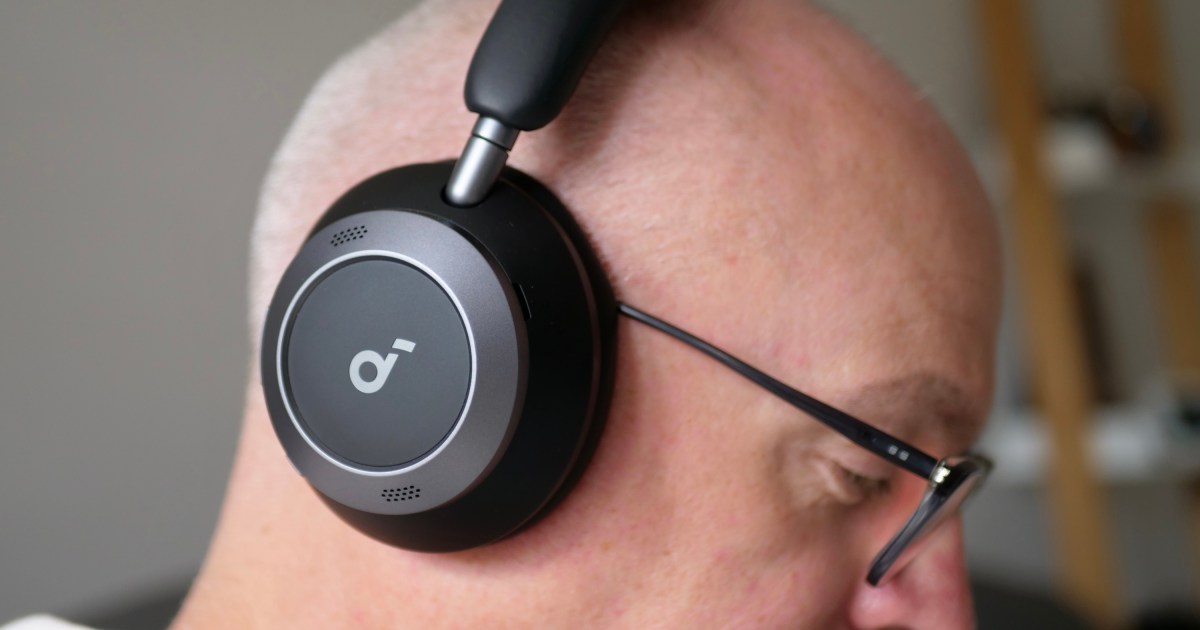
A person wearing the Soundcore Space One Pro headphones.
Andy Boxall / Digital Trends

In addition to various presets, you can adjust the equalizer (EQ) in the Soundcore app. But to get the best tailored sound from the Space One Pro I’d suggest running the HearID Sound check. After listening to a series of test sounds, the app creates a custom EQ setting suited to your ears and hearing. I found it made a significant and positive difference to the Space One Pro’s sound.

Listening to Le Sserafim’s recently released Crazy EP with its strong EDM bias, the Space One Pro’s heavy bass response was immediately noticeable and plenty enough for me, despite it being tweaked down for my HearID custom setting already. You better really like bass if you decide to use the Soundcore Signature setting. There’s not much subtlety to the Space One Pro’s default sound, and vocals can get lost in the bass until you spend time playing with the equalizer.

The Anker app for the Soundcore Space One Pro.
Andy Boxall / Digital Trends

I’ve been using the Space One Pro before launch and have also encountered a few problems with the dual device connection, where notifications on my Apple MacBook Air M1 sometimes stopped playback from my Apple iPhone 15 Pro Max (but not the other way around), and there were also issues with getting the sound to play at all from my laptop. It’s possible fixes for these problems, and tweaks to the signature sound I feel is too aggressive, will come in a software update.

When can you get the Soundcore Space One Pro?

A person wearing the Soundcore Space One Pro headphones.
Andy Boxall / Digital Trends

The Anker Soundcore Space One Pro are available to buy in the U.S. and other regions starting September 5 and cost $200. They are a convenient set of over-ear headphones with a clever design that does make them great for travel, while the ANC performs well in loud environments. A customizable EQ lessens the pain of limited codec support, but the software and reliability may benefit from a software update. I have enjoyed using the Space One Pro and am pleased I brought them on my trip. They are entering a crowded space though, and you can see the many other headphones we recommend here.