Commodore 64 Ultimate Review: An Astonishing Remake


Blue screen menu

Photograph: Matt Kamen

Boot up the C64U, and you’re greeted by a re-creation of the C64’s menu. Here, you can type in operation commands just as you would back in the day, using the BASIC programming language. Problem: I don’t have the first clue about BASIC. However, in what is possibly the greatest throwback of all, the C64U comes with a spiral-bound, 273-page user guide. It is an absolute tome. Somewhat surprisingly, it’s not a reprint of anything that came with the original, but rather a tailored guide to what the C64U does, where it differs from the C64, and how to get to grips with the computer’s capabilities. Equal parts history book and instruction manual, it starts out teaching you some simple commands and builds up to teaching you how to code. I’m still very much working my way through it, but that tactile approach—referring to the book, trying something out on the computer, back and forth—is a great touch.

Hidden Upgrades

If you don’t fancy having to do homework, the C64U’s own default menu, accessed at any time with a flick of the multifunction power button on the right-hand side of the unit, is a simple list of options and settings. Hit RETURN to go into any section—say, “Video Setup” to adjust whether the C64U outputs in original resolution, in PAL or NTSC modes (surprisingly important, given some games will only work with one display standard or the other), or a crystal clear 1080p with scanlines removed—and back out to save any changes to the system’s flash memory. It’s still a minimalist approach, but feels fairly intuitive.

This is also where you can start playing around with some of the other modern touches of the C64U, like how to leverage its far greater power. Well, “greater” in comparison to 1982. Spec-wise, this isn’t going to threaten any more modern machine, but running on an AMD Xilinx Artix-7 FPGA chip and packing 128-MB DDR2 RAM—compared to the 64 KB of the C64—it blows its inspiration out of the water. While at baseline it replicates the performance of the 1982 hardware, meaning it operates as if there’s only the original 64 KB were there, you can menu-dive to activate a virtualized RAM Expansion Unit, or activate a “Turbo Boost” to accelerate the clock speed to a lightning-fast (in this particular context) 64 MHz.
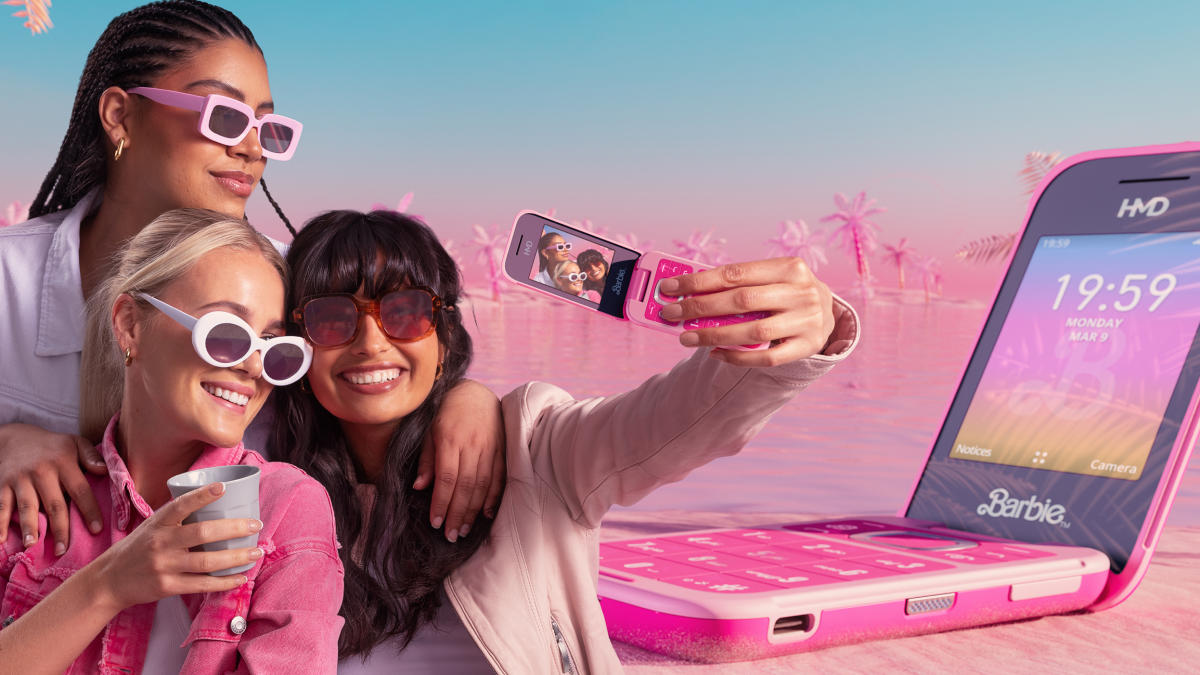
The retro Barbie flip phone arrives in October, only 15 months after the movie


HMD’s Barbie Phone, the novelty device for Y2K-nostalgic hot pink aficionados, finally has pricing and release info. The Mattel-sanctioned champion of tardy movie tie-ins launches in October — only 15 months after Greta Gerwig’s movie hit theaters! — for $129.

The handset is the creation of Human Mobile Devices (HMD), which currently owns the branding rights to Nokia phones. Rather than a smartphone replacement, the Barbie Phone is a retro-styled flip phone (positively Nokida-esque) with a T9 keyboard and no third-party apps in sight. The company pitches it as “the perfect tool to live your best life and take a vacation from your smartphone.”

You won’t find any social media apps, but the phone still makes calls and sends texts. When powering the handset up, you’ll be greeted by a “Hi Barbie” voice before you fire up Malibu Snake for a tribute to OG mobile gaming. Its keypad (in “Barbie pink,” of course) has hidden designs like palm trees, hearts and flamingos that light up in the dark. Because why the hell not?!

The Barbie flip phone: closed (left) leaning against opened (right).The Barbie flip phone: closed (left) leaning against opened (right).

HMD

The Barbie Phone has a 5MP camera with a flash that “delivers authentic Y2K style images.” It ships with two alternate covers in addition to the standard one. The two plates include one honoring “the brightly colored swirls of the 1992’s iconic Totally Hair Barbie doll” and another with a shooting-heart design.

Also in the box is a pastel-beaded phone strap that you can adorn with charms like a tiny roller skate or a “Barbie doll-sized ice cream.” You’ll also get sparkly stick-on gems and retro vintage Barbie stickers (including flowers, flamingos and rainbows) to decorate the phone to your heart’s content. It even has a pink USB-C charger.

Naturally, the phone has a Barbie-themed user interface (described as “achingly easy to navigate”), themed wallpapers and app icons. Since HMD is branding the handset as a vacation from smartphone hell, it even includes a digital well-being app.

The Barbie Phone will be available on October 1 for $129. It will ship unlocked and ready to activate on AT&T, T-Mobile and Verizon networks. You can pre-order it from HMD’s website beginning on September 23.