
Enterprises have discovered that generative AI can do almost everything except the one thing that matters most in regulated industries: make a decision they can defend. Rainbird exists to close that gap. It converts an organisation’s regulations, policies and human expertise into knowledge graphs, reasons over them deterministically, and attaches a complete evidential proof to every outcome. The same inputs produce the same decision, every time, with the working shown.
This article explains why that capability, a contrarian bet when Rainbird was founded in 2013, has become the missing layer of the enterprise AI stack. As agents proliferate and regulators sharpen their expectations, the question facing every bank, insurer and professional services firm is no longer whether AI can act, but whether its decisions are admissible: provable, repeatable and auditable against the rules the institution is bound by. Rainbird is the infrastructure that makes them so.
1. The problem: the last mile of enterprise AI
In banking, insurance, tax, audit and healthcare, the unit of value is a decision. Approve the account or refer it. Pay the claim or investigate it. Certify the filing or qualify it. These judgements are governed by dense webs of regulation and institutional policy, and the organisations that make them are accountable for every single one, individually, often years after the fact.
Large language models transformed what software can read, draft and summarise, and enterprises responded with an extraordinary wave of experimentation. Very little of it has reached production where it counts. Research from MIT in 2025 found that around 95% of enterprise generative AI pilots were delivering no measurable return, and Gartner has forecast that over 40% of agentic AI projects will be cancelled before the end of 2027. The pattern is now familiar enough to have a name: pilot purgatory.
The cause is not weak models. It is a category error about what they are. LLMs are probabilistic instruments: superb at language, inherently variable in judgement. They can produce different answers to identical questions, they cannot guarantee fidelity to a written policy, and they cannot logically justify a conclusion after the event. Enterprises have tried to patch this with human-in-the-loop review, but automation bias means reviewers systematically defer to machine output, and a human skimming a hundred AI-drafted decisions an hour is oversight in name only. Generality, it turns out, is the enemy of precision. High-stakes decisioning does not need a model that is usually right; it needs an architecture that is provably right against the institution’s own rules every time.
2. What Rainbird is
Rainbird is a decision automation platform built on symbolic reasoning, the branch of AI concerned with logic rather than statistics. It operates as a pipeline of three stages.
Knowledge Architecture. The regulations, policies and expert judgement that govern a decision are modelled as a unique type of graph representation: a deterministic world model of the domain. Historically this authorship was manual; Rainbird’s Automated Knowledge Engineering pipeline now drafts graphs directly from source documents using generative AI, with the organisation’s own experts verifying it before it is admitted. The result is institutional knowledge captured as an inspectable, versionable asset the enterprise owns.
The Reasoning Engine. At runtime, a symbolic inference engine evaluates each case against the graph with complete precision. Where evidence is incomplete or uncertain, calibrated certainty factors allow the engine to weigh it the way a skilled practitioner would, without ever leaving the bounds of the codified logic. Identical inputs yield identical outcomes. There is no temperature, no drift, and no hallucination. Although the model can handle different levels of certainty associated with both data and rules, there is no statistical generation in the decision path.
Evidence and audit. Every outcome ships with a proof tree: which rules fired, on what evidence, with which data, with what certainty, in what order. It is human-readable, regulator-ready and exportable to the audit log as is. Oversight stops being a hopeful review of behaviour and becomes an inspection of logic.
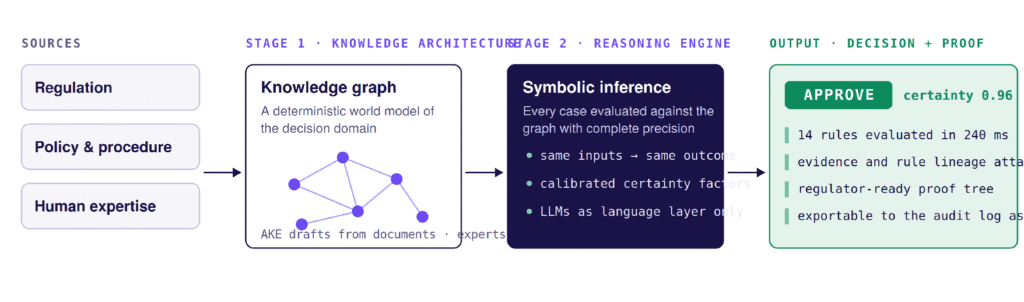
Figure 1. The Rainbird pipeline: from sources of authority to a proven decision.
3. The neurosymbolic division of labour
Rainbird’s architecture is deliberately hybrid. Generative models are employed where variance is acceptable and language is the task: understanding a customer’s message, extracting facts from documents, drafting the explanation of an outcome, and accelerating the authorship of knowledge Into a verifiable knowledge architecture that, once built, has no dependency on the LLM that was used to build it. The symbolic engine is employed where variance is unacceptable: the judgement. LLMs remain the language layer and they are never the judge.
This is what allows Rainbird to make a claim no purely generative system can make: zero hallucinated decisions, rather than fewer of them. It is also what makes Rainbird complementary to, rather than competitive with, the platforms enterprises are already committed to. Agents built in any framework can gather context, orchestrate workflows and converse with customers, then call Rainbird, over API or as tools exposed through an MCP server, at the moment a governed decision must be made. In the emerging enterprise stack, Rainbird sits as a distinct layer between the agents that interact and the systems that record.

Figure 2. The decision layer: deterministic judgement between probabilistic interaction and systems of record.
4. Why it matters now
Three forces have converged to turn a decade-long conviction into a market moment.
The agentic wave needs a governor. Enterprises are moving from copilots that suggest, to agents that act, and an agent that acts must make a decision. Handing that step to a probabilistic model multiplies risk at machine speed. A deterministic decision layer resolves the dilemma: agents gain the authority to complete regulated processes end to end precisely because the judgement within them is provably correct. The decision layer is what converts agentic ambition into deployable systems.
Regulation is arriving with teeth. The EU AI Act’s obligations for high-risk systems phase in through 2026 and 2027, and supervisors in financial services on both sides of the Atlantic increasingly expect firms to explain individual automated decisions, not model behaviour in aggregate. Post-hoc rationalisations of a neural network do not meet that bar. A proof tree does. Rainbird’s outputs are admissible by construction: the compliance artefact is not an add-on but the natural exhaust of how the system reasons.
The economics of expertise have shifted. Every regulated institution runs on scarce senior judgement applied to high volumes of routine cases. Rainbird digitises that judgement once and applies it consistently at any scale, freeing experts for the genuinely exceptional cases. What was previously a knowledge management aspiration has become an operating leverage strategy, and Rainbird’s knowledge engineering pipeline has collapsed the cost of getting there from months of manual modelling to a supervised drafting exercise.
5. Proof in production
Rainbird’s importance is not prospective. Global enterprises have run mission-critical decisions on the platform for years, at scale, under audit. EY automated data-privacy assessments that previously took months into minutes, with every result fully explainable. BDO compressed R&D tax reviews from five hours to seconds while making outcomes consistent across every advisor. The law firm DAC Beachcroft uncovered 800% more insurance fraud, 500% faster, with complete transparency into each determination. Killik & Co reduced investment suitability checks to a fraction of their previous time, with every recommendation compliant and explained. These are audited production outcomes, not pilots, and they share a signature: dramatic compression of expert time with an increase, not a sacrifice, in consistency and defensibility.
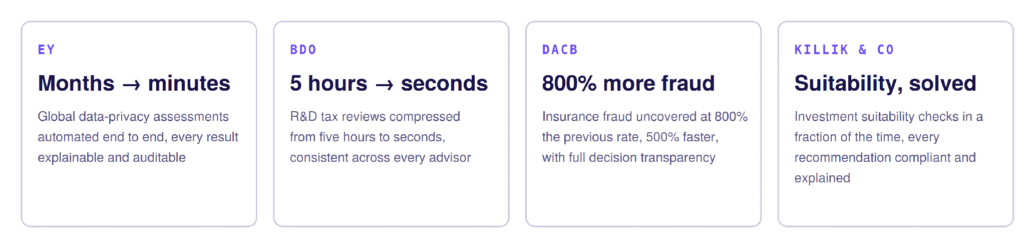
Figure 3. Production outcomes across professional services, law and wealth management.
6. The strategic significance
Every era of enterprise computing has produced an indispensable layer: the relational database made data trustworthy, the ERP made process trustworthy, and the identity layer made access trustworthy. The agentic era requires a layer that makes automated judgement trustworthy, and that layer must be deterministic, explainable and auditable by construction, because those properties cannot be retrofitted onto statistical systems.
Rainbird has spent thirteen years building exactly that, against the grain of fashion, and now finds the industry converging on its position. Its platform graphs turn regulation and expertise into owned, inspectable assets; its reasoning engine gives agents access to that judgement through a reasoning layer that cannot hallucinate. Its resulting proof trees turn compliance from a brake on automation into its absolute enabler.
The importance of Rainbird, then, is simple to state. It is the difference between AI that impresses in a demonstration and AI that an enterprise, its customers and its regulator can trust with the decisions that define it. In regulated markets, that difference is the whole game.