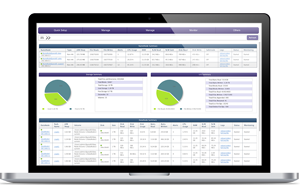
JTB ACA Tools comes with editing Tools for Property Sets, Classifications and List Definitions for AutoCAD Architecture (ACA) based products including MEP, Map 3D and Civil 3D.
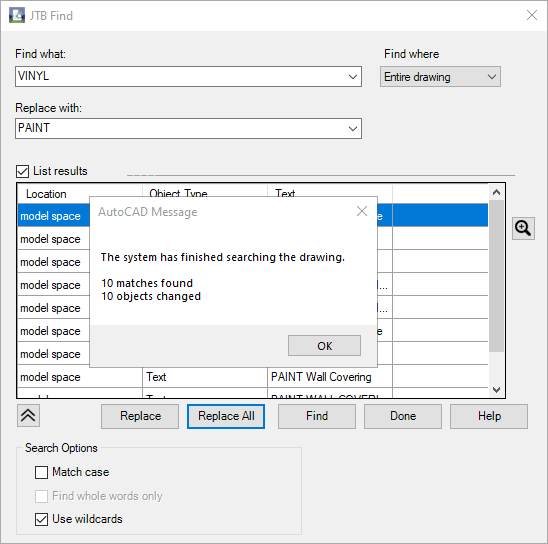
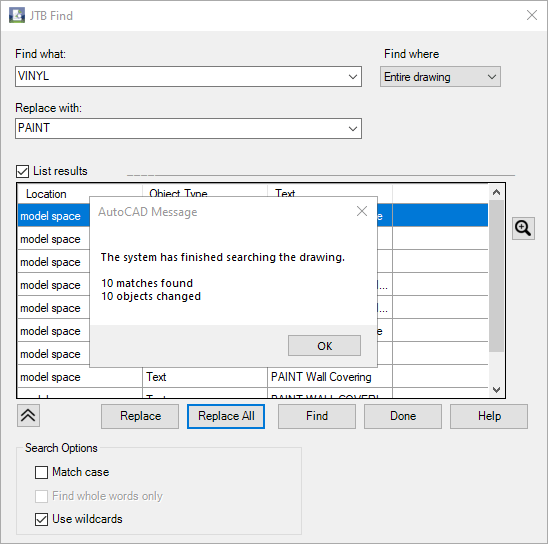
With JTB Find, you are able to find and replace text in Extended Data tab in Properties, specifically for Property Sets and their Property Definition values.
With JTB PropsClassMapping, you are able to change Property Set values, Classification values of SPACE, WALL and DOOR according to the values of their other Property Set.
With ClassificationDefinition tools, you can import export AutoCAD Architecture Classification Definitions, avoid the need to type everything manually.
With ADTListDefinition tools, you can import, create and export ListDefinitions quick and easy.
JTB ACA Tools provides some useful lisp functions for AutoLISP programmers to modify property set and/or classification properties.
Don’t miss this incredible opportunity to enjoy a 3-month free trial of Apple TV+ on your Xbox. Whether you’re a sports fan, an action lover, or a comedy enthusiast, you’ll find something to suit your taste on Apple TV+. But hurry, this offer ends on July 7, 2024, so act now and claim your 3 months of unlimited streaming.
Imagine watching the thrilling adventures of “Argylle”, the world’s greatest spy, as he travels across the globe with a star-studded cast. Or cheering for Aaron Judge and the Yankees as they face their rivals on “Friday Night Baseball” from MLB. Or diving into the history and heroism of “Masters of the Air”, the Apple Original series that follows the lives of American bomber pilots in World War II.
Not fully intrigued? How about the chance to catch the GOAT, Lionel Messi, play with his former FC Barcelona teammates Luis Suarez, Jordi Alba and Sergio Busquets, as they lead Inter Miami CF through the MLS gauntlet this season?
This is just some of the amazing content you can watch on Apple TV+, along with countless other movies and shows. You can also enjoy award-winning documentaries, kids’ entertainment, dramas, and more, all in stunning 4K HDR quality. And with the Apple TV app on your Xbox, you can easily browse and access all your favorite content in one place.
But don’t take our word for it. Try it for yourself and see why Apple TV+ is the ultimate streaming service for Xbox users. All you need to do is sign up for a new or qualified returning Apple TV+ subscription on your Xbox before July 7, 2024, and you’ll get 3 months of Apple TV+ for free. No strings attached, no hidden fees, just unlimited entertainment at your fingertips.
Don’t wait, this offer won’t last forever. Grab your Xbox controller and start your free trial of Apple TV+ today. You’ll be glad you did. Terms apply, visit the website to learn more.
We recently reduced the size of Visual Studio Code’s shipped JavaScript by 20%. That works out to a little over 3.9 MB saved. Sure that’s less than some of the individual gifs from our release notes, but that’s still nothing to sniff at! Not only does this reduction mean less code you need to download and store on disk, it also improves startup time because less source code has to be scanned before the JavaScript is run. Not too shabby considering we got this reduction without deleting any code and without any major refactorings in our codebase. Instead all it took was a new build step: name mangling.
In this post, I want to share how we identified this optimization opportunity, explored approaches to the problem, and eventually shipped this 20% size reduction. I want to treat this more as a case study in how we approach engineering problems on the VS Code team rather than focusing on the specifics of mangling. Name mangling is a neat trick, but may not be worth it in many codebases, and our specific approach to mangling can likely be improved on (or may not be necessary at all depending on how your project is built).
Identifying the problem
The VS Code team is passionate about performance, be that optimizing hot code paths, reducing UI re-layouts, or speeding up startup time. This passion includes keeping the size of VS Code’s JavaScript small. Code size has become even more of a focus with VS Code shipping on web (https://vscode.dev) in addition to the desktop application. Actively monitoring code size keeps members of the VS Code team aware when it changes.
Unfortunately, these changes have almost always been increases. Although we put a lot of thought into what features we build into VS Code, over the years adding new functionality has necessarily grown the amount of code we ship. For instance, one of VS Code’s core JavaScript files (workbench.js) is now around four times the size it was eight years ago. Now when you consider that eight years ago VS Code lacked features many would consider essential today—such as editor tabs or the built-in terminal—that increase is not perhaps as awful as it sounds, but it’s not nothing either.
That 4x size increase is also after a lot of ongoing performance engineering work. Again this work largely happens because we keep track of our code size and really hate seeing it increase. We’ve already done many easy code size optimizations, including running our code through esbuild to minify it. Finding further savings has become increasingly challenging over the years. Many potential savings are also not worth the risks they introduce, or the extra engineering effort required to implement and maintain them. This means that we’ve had to watch the size of our JavaScript slowly tick upwards.
While debugging our minified source code on vscode.dev last year though, I noticed something surprising: our minified JavaScript still included tons of long identifier names, such as extensionIgnoredRecommendationsService. This surprised me. I assumed esbuild would have already shortened these identifiers. And it turns out esbuild actually does shorten identifiers in some cases through a process called “mangling” (a term JavaScript tools likely borrowed from an only roughly similar process for compiled languages).
During minification, mangling shortens long identifier names, transforming code such as:
Since JavaScript is shipped as source text, reducing the length of identifier names actually decreases the program’s size. I know that optimization probably seems more than a little silly if you’re coming from a compiled language, but here in the wonderful world of JavaScript we gladly take wins like this wherever we can find them!
Now before you rush out to rename all of your variables to single letters, I want to stress that optimizations like this need to be approached cautiously. If a potential optimization makes your source code less readable or maintainable, or requires significant manual work, it’s almost never worth it unless it delivers truly spectacular improvements. Shaving off a few bytes here and there is nice but hardly qualifies as spectacular.
That calculus changes if we can get nice optimizations like this essentially for free, say by having our build tool do them for us automatically. And indeed, smart tools like esbuild already implement identifier mangling. That means we can keep writing our veryLongAndDescriptiveNamesThatWouldMakeEvenObjectiveCProgrammersBlush and let our build tools shorten them for us!
Even though esbuild implements mangling, by default it only mangles names when it is confident that mangling won’t change the behavior of the code. After all, having a bundler break your code really stinks. In practice, this means that esbuild mangles local variable names and argument names. This is safe unless your code is doing some truly absurd things (in which case, you likely have far bigger issues than code size to worry about).
However esbuild’s conservative approach means that it skips mangling many names because it can’t be confident that changing them is safe. As a simple example of how things could go wrong, consider:
If mangling changes longPropertyName to x, the dynamic lookup on the next line will no longer work:
constobj = { x:123 }; // Here `longPropertyName` gets rewritten to `x`functionlookup(prop) {returnobj[prop];}console.log(lookup('longPropertyName')); // But this reference doesn't and now the lookup is broken
Notice in the code above how we’re still trying to use longPropertyName to access the property even though the property itself has been changed during mangling.
While this example is contrived, there are actually many ways these breaks can happen in real code:
Dynamic property access.
Serializing objects or parsing JSON to an expected object shape.
APIs you expose (the consumers won’t know about the new mangled names.)
APIs you consume (including DOM APIs.)
Although you can force esbuild to mangle basically every single name it finds, doing so completely breaks VS Code for the reasons outlined above.
Despite this, I couldn’t shake the feeling that we must be able to do better in the VS Code codebase. If we couldn’t mangle every name, perhaps we could at least find some subset names we safely could.
False starts with private properties
Looking back over our minified sources, another thing that jumped out at me was how many long names I saw starting with _. By convention, this indicates a private property. Surely private properties can be safely mangled and code outside of the class would be none the wiser, right? And wait, shouldn’t esbuild be doing this already for us? Yet I knew that the folks who wrote esbuild are no slouches. If esbuild wasn’t mangling private properties, it was almost certainly for good reason.
As I thought about the problem more, I realized that private properties are affected by the same dynamic property lookup issue shown in the longPropertyName example above. I’m sure a smart TypeScript programmer like yourself would never write such code, but dynamic patterns are common enough in real world codebases that esbuild opts to play it safe.
Also keep in mind that the private keyword in TypeScript is really just a polite suggestion. When TypeScript code is compiled to JavaScript, the private keyword is basically removed. That means there’s nothing to stop rude code outside of the class from reaching in and accessing private properties willy-nilly:
classFoo {privatebar = 123;}constfoo: any = newFoo();console.log(foo.bar);
Hopefully your code isn’t doing questionable things like this directly, but carelessly changing property names can potentially bite you in plenty of fun unexpected ways such as with object spreads, serialization, and when distinct classes share common property names.
Thankfully I realized that with VS Code I had one huge advantage: I was working with a (mostly) sane codebase. I could make many assumptions that esbuild couldn’t, such as that there are no dynamic private properties accesses or bad any accesses. This further simplified the problem I was facing.
So together Johannes Rieken (@johannesrieken) and I started to explore private property mangling. Our first idea was to try adopting JavaScript’s native #private fields everywhere in our codebase. Not only are private fields immune to all of the problems detailed above, they already get mangled automatically by esbuild. Moving closer to plain old JavaScript was also appealing.
However, we quickly dismissed this approach as it would require massive (meaning risky) code changes, including removing all of our uses of parameter properties. As a relatively new feature, private fields also haven’t been optimized across all runtimes yet. Using them can introduce slowdowns ranging from negligible to around 95%! Although this may be the correct change in the long run, it wasn’t what we needed right now.
Next we discovered that esbuild can selectively mangle properties that match a given regular expression. However, this regular expression only matches against the identifier name. While this meant that we couldn’t know if the property was declared private in TypeScript, we could try mangling all properties starting with _, which we hoped would only include private and protected properties.
Soon enough we had a working build with all _ properties mangled. Nice! This proved that private property mangling was possible and brought some decent savings, although far less than we hoped for.
Unfortunately, mangling based just on the names has some serious drawbacks, including requiring that all private properties in our codebase start with _. The VS Code codebase does not follow this naming convention consistently, and there are also a few places where we have public properties that start with _ (typically this is done when a property needs to be accessible externally but shouldn’t be treated as API, such as in tests).
We also didn’t feel entirely confident that the mangled code was actually correct. Sure, we could run our tests or try starting VS Code, but this was time consuming and what if we overlooked less common code paths? We couldn’t be 100% sure we were only mangling private properties without touching other code. This approach seemed both too risky and too onerous to adopt.
Mangling confidently with TypeScript
Thinking about how we could feel more confident in a mangling build step, we hit on a new idea: what if TypeScript could verify the mangled code for us? Just as TypeScript can catch unknown properties accesses in normal code, the TypeScript compiler should be able to catch cases where a property has been mangled but references to it haven’t been updated correctly. Instead of mangling the compiled JavaScript, we could instead mangle our TypeScript source code and then compile the new TypeScript with the mangled identifier names. The compile step on the mangled source code would give us much more confidence that we hadn’t accidentally broken our code.
Not only that, but by using TypeScript, we could truly find all private properties (instead of properties that just happen to start with _). We could even use TypeScript’s existing rename functionality to smartly rename symbols without changing object shapes in unexpected ways.
Eager to try out this new approach, we soon came up with new mangling build step that roughly works like this:
for each private or protected property in codebase (found using TypeScript's AST):
    if the property should be mangled:
        Compute a new name by looking for an unused symbol name
        Use TypeScript to generate a rename edit for all references to the property

Apply all rename edits to our typescript source

Compile the new edited TypeScript sources with the mangled names
And somewhat surprisingly for such a naïve seeming approach, it worked! Well mostly at least.
While we were definitely impressed with how well TypeScript was able to generate thousands and thousands of correct edits across our entire codebase, we also had to add logic to handle a few edge cases:
It’s not good enough for a new private property name to be unique in the current class, it also has to be unique across all superclasses and subclasses of the current class too. Once again the root cause is that TypeScript’s private keyword is simply a compile time decoration that doesn’t actually enforce that superclasses and subclasses can’t access private properties. Without care, renaming can introduce name collisions (thankfully TypeScript reports these as errors).
In a few places in our code, subclasses made inherited protected properties public. While many of these were mistakes, we also added code to disable mangling in these cases.
After adding code for these cases, we soon had working builds. By mangling private properties, the size of VS Code’s main workbench.js script went from 12.3 MB to 10.6 MB, a close to 14% reduction. This also brought a 5% speed up in code loading because less source text has to be scanned. Not bad at all given that, besides a few very minor fixes to unsafe patterns in our sources, these savings were basically free.
Learnings and further work
Mangling private properties shows that significant improvements can still be found in VS Code without resorting to massive code changes or costly rewrites. In this case, I suspect that others over the years had looked through VS Code’s minified sources and wondered about those long names. However, addressing this had likely seemed impossible to do safely, or maybe just didn’t seem worth a potentially massive engineering investment.
The key to our success this time was identifying a case (private properties), where name mangling would likely be safe and where the optimization would still make a significant improvement. We then thought about how to make this change as safely as possible. This meant first using TypeScript’s tooling to confidently rename identifiers, and then using TypeScript again to make sure our newly mangled source code would still compile correctly. Along the way we were greatly helped by the fact that our code already followed most TypeScript best practices and also had tests in place that cover many of the common VS Code code paths. This all came together so that Joh and I could work in our spare time to ship a fairly drastic change with almost no impact to the other developers working on VS Code.
That’s not the end of the mangling story though. Looking through our newly mangled and minified sources, I was crestfallen to see provideWorkspaceTrustExtensionProposals and plenty of other lengthy names. The most noteworthy were the almost 5000 occurrences of localize (the function we use for strings shown in UI). Clearly there was still room for improvement.
Using the same approach and techniques from mangling private properties, I soon identified another common code pattern that we could mangle safely with a high return on investment: exported symbol names. As long as the exports were only used internally, I felt confident we could shorten them without changing the behavior of the code.
This largely proved correct, although there were again a few complications. For instance, we had to make sure not to accidentally touch the APIs that extensions use, and also had to exempt a few symbols that were exported from TypeScript but then called from untyped JavaScript (typically these are entry points for a worker thread or process).
The export mangling work shipped last iteration, further reducing the size of workbench.js from 10.6 MB to 9.8 MB. All reductions in total, this file is now 20% smaller than it would be without mangling. Across all of VS Code, mangling removes 3.9 MB of JavaScript code from our compiled sources. Not only is that a nice reduction in download size and install size, that’s also 3.9 MB less JavaScript that needs to be scanned every single time you start VS Code.
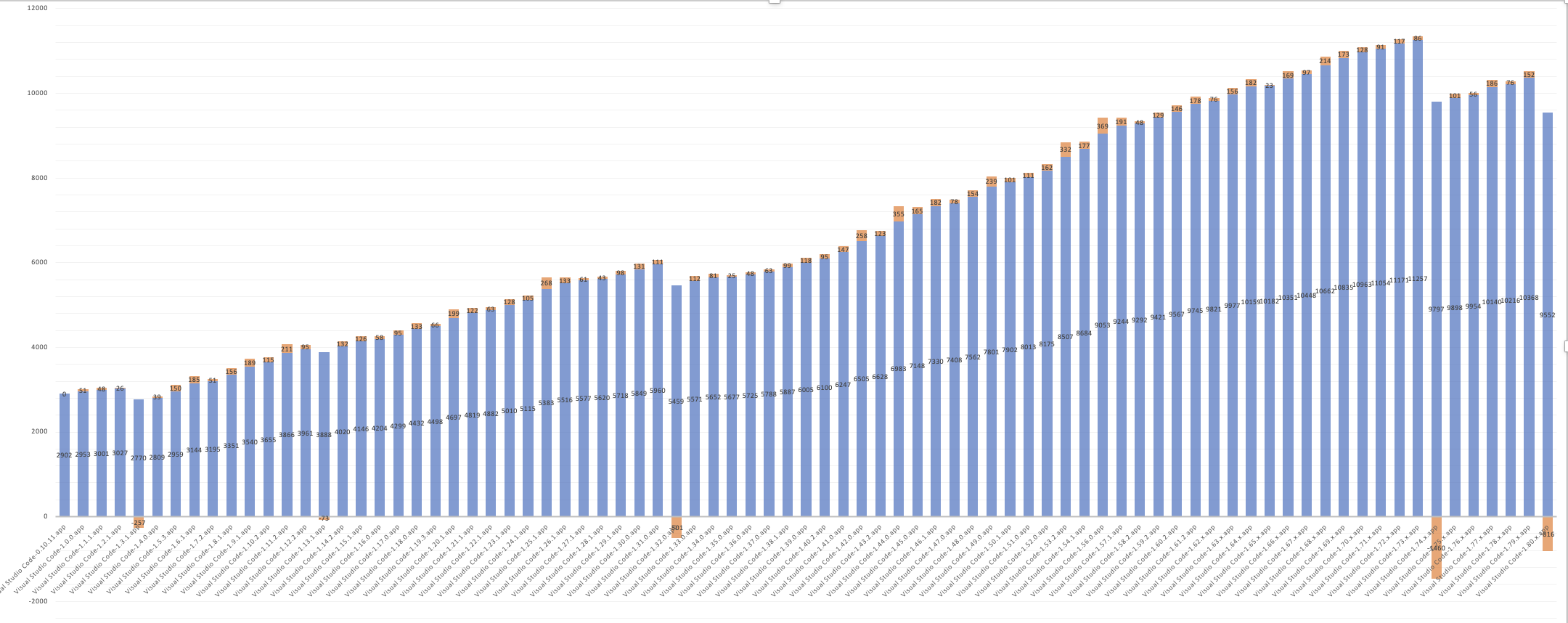
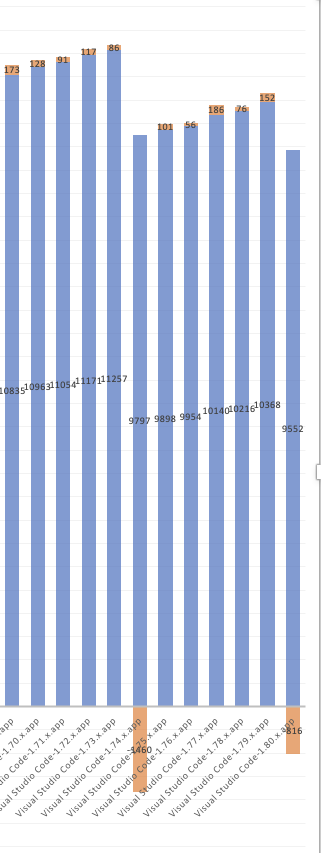
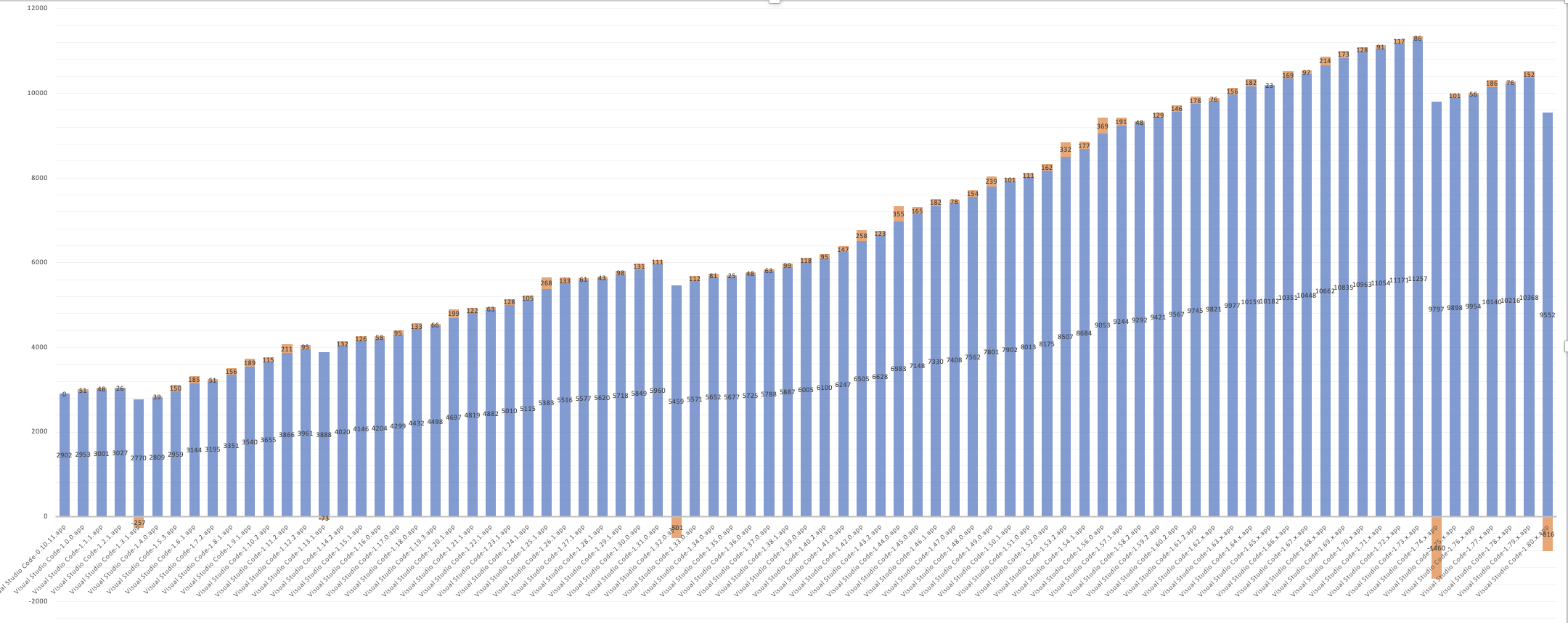
This chart shows the size of workbench.js over time. Notice the two drops on the right side. The first big drop in VS Code 1.74 is the result of mangling private properties. The second smaller drop in 1.80 is from mangling exports.
Our mangling implementation can doubtless be improved since our minified sources still contain plenty of long names. We may investigate these further if doing so seems worthwhile and if we can come up with a safe approach. Ideally, some day much of this work won’t be necessary at all. Native private properties are already mangled automatically and our build tools will hopefully become better at optimizing code across our entire codebase. You can review our current mangling implementation.
We’re always striving to make VS Code and our codebase better, and I think the mangling work is a great demonstration of how we approach this. Optimization is an ongoing process, not a one time thing. By continually monitoring our code size, we were aware of how it has grown over time. This awareness has doubtless help keep our code size from expanding even more than it has, and also encourages us to always be looking for improvements. Although mangling was an attractive seeming technique, it was initially too risky to seriously consider. Only once we had worked to reduce this risk, create the right safety nets, and make the cost of adopting mangling almost zero, did we finally feel confident enough to enable it in our builds. I’m really proud of the end result and just as proud of how we went about achieving it.
Thank you to Johannes Rieken for his key work implementing mangling, to the TypeScript team for building the tools that let us implement mangling safely, to esbuild for their blazingly fast bundler, and to the entire VS Code team for building a codebase that is fit for optimizations like this. And last but certainly not least, a huge thanks to the V8 team and all the other JS engines for always making us look fast despite the heaps and heaps of horribly mangled JavaScript we throw their way.
Tesla is recalling all 3,878 Cybertrucks that it has shipped to date, due to a problem where the accelerator pedal can get stuck, putting drivers at risk of a crash, according to the National Highway Traffic Safety Administration.
The recall caps a tumultuous week for Tesla. The company laid off more than 10% of its workforce on Monday, and lost two of its highest-ranking executives. A few days later, Tesla asked shareholders to re-vote on CEO Elon Musk’s massive compensation package that was struck down by a judge earlier this year.
Reports of problems with the Cybertruck’s accelerator pedal startedpopping up in the last few weeks. Tesla even reportedly paused deliveries of the truck while it sorted out the issue. Musk said in a post on X that Tesla was “being very cautious” and the company reported to NHTSA that it was not aware of any crashes or injuries related to the problem.
The company has now confirmed to NHTSA that the pedal can dislodge, making it possible for it to slide up and get caught in the trim around the footwell.
Tesla said it first received a notice of one of these accelerator pedal incidents from a customer on March 31, and then a second one on April 3. After performing a series of tests, it decided on April 12 to issue a recall after determining that an “[a]n unapproved change introduced lubricant (soap) to aid in the component assembly of the pad onto the accelerator pedal,” and that “[r]esidual lubricant reduced the retention of the pad to the pedal.”
Tesla says it will replace or rework the accelerator pedal on all existing Cybertrucks. It also told NHTSA that it has started building Cybertrucks with a new accelerator pedal, and that it’s fixing the vehicles that are in transit or sitting at delivery centers.
While the Cybertruck only first started shipping late last year, this is not the vehicle’s first recall. But the initial one was minor: Earlier this year, Tesla recalled the software on all of its vehicles because the font sizes of its warning lights were too small. The company first unveiled the truck back in 2019.
The nature of employment has changed drastically in the past several years. The gig economy is on the rise. According to the World Economic Forum’s “Future of Jobs” report, over half the global workforce will engage in some form of freelancing by 2025.
Higher levels of unemployment are prevalent in low- and lower-middle-income countries, while the labor market is tight in high-income countries. Simultaneously, the cost-of-living crisis is causing real wages to decline. Freelance and gig work is seen as a solution to the unemployment problem. More people are also driven to take on extra gigs due to the insufficiency of their incomes.
On the positive side, the freelancing trend is driven by increased access to connectivity, the boom in apps and digital platforms, evolving work relationships between employers and employees, and the growing desire for fulfillment, flexibility, and independence.
Whether driven by necessity or a desire for better working conditions, freelancers are here to stay. Here, evaluate the unique financial planning for freelancers and how they can approach their money management strategically.
With the right approach, freelancers can seamlessly tackle budgeting, tax planning, investing, banking, and retirement planning. Using the right financial products, freelancers can reach their financial goals—improve their savings rate and income and secure their futures—while living on their own terms.
Top Financial Planning Strategies for Freelancers
Freelancers enjoy flexibility in their careers. However, they experience challenges such as unpredictability and insufficiency of income.
They must also deal with self-employment taxes, client payment delays, and collections issues. Other challenges that freelancers face include:
Inconsistent workload
Difficulty with retirement planning
Lack of insurance and emergency funds
Client acquisition costs
Business expenses
Problems in financial planning
Adopting the right approach to managing finances will ease many of these challenges and make freelance careers more fulfilling.
The following financial strategies are ideal for gig workers and freelancers:
Create a Detailed Budget
As a freelancer, you can’t afford to wing it when it comes to expenses. You need to create a detailed budget to manage income and expenses accurately.
However, because of variable pay, it could be challenging to start.
The best way to begin is to estimate average monthly income by reviewing income reports. With at least two years’ worth of income to analyze, you can start identifying your least and most profitable months. Determine your absolute minimum monthly income.
Next, know that there are three types of expenses: fixed expenses, debt expenses, and variable expenses. Identify fixed expenses like utilities, car payments, and rent or mortgage. Allocate a part of your income to variable costs like transportation, entertainment, and groceries. Debt expenses include credit card payments.
Incorporate an emergency fund to ensure unforeseen expenses are covered. Income gaps must also be considered a financial emergency. To provide an ideal financial cushion for lean periods, you must save approximately three to six months’ worth of living costs in a high-yield savings or checking account.
Manage Cash Flow
To manage cash flow properly, you must understand your financial state in-depth. After looking at broader data, look deeply at your weekly balance, costs, dues, and invoicing schedule. You can manage expenses and income using invoicing software automatically setting up recurring bills. Digital platforms can help track dues and client invoice dates to ensure optimal and uninterrupted cash flow.
Use Smart Banking Solutions
Innovative banking solutions can work wonders for the self-employed, providing the tools to help run the business efficiently and assist you as you grow your career. As a freelancer, you must look for a bank account with low fees and minimum balance requirements.
Search for an online high-yield savings account with competitive interest rates to maximize savings. Digital banks often have low to no account fees and a high APY, allowing freelancers to earn more on idle cash while having convenient and flexible access to funds whenever needed.
SoFi’s high-yield savings account can earn up to 4.6 percent APY and offers bonuses based on your direct deposit amount.
In addition, freelancers can look for additional features like integrations with other financial services and solutions like payroll, invoicing, and loans.
Photo by Firmbee.com on Unsplash
Manage Risk and Diversify
Income diversification is a valuable strategy that can help people of all professions, especially freelancers. Projects are typically spread out unevenly throughout the year. Moreover, the economic climate may affect clients’ businesses, resulting in dry spells in the freelancer’s cash flow.
Diversifying income streams helps mitigate the impact of unpredictable circumstances. It prevents you from relying too heavily on a single account.
Freelancers must constantly explore opportunities to learn new skills or upskill, expand their client base, network, and pursue multiple projects simultaneously. Such efforts help to increase earning potential and cushion against economic downturns.
Remember that income does not only come from professional labor. Consider investing in financial instruments like stocks and bonds and alternative investments like real estate. These investments can grow your money as you do your regular work. Be sure to understand the risks and requirements of each investment.
Also, note that your investment strategy must match your risk tolerance and financial goals.
Understand Taxes and Compliance
Freelancers are bringing in significant earnings, so financial planning for freelancers is a must. Globally, approximately 1.57 billion people are freelancers. The popularity of freelance platforms is rising; today, they are estimated to be worth $3.39 billion.
In Canada, 28 percent of adults work in the gig economy, primarily part-time. Moreover, nearly half of these workers say they do not declare their entire gig work income. This situation could pose problems in the future.
Freelance income is taxed. Whether a side gig or a full-time freelance account, it impacts how you file your taxes. Neglecting the nuances of compliance could result in an enormous tax bill.
For as long as you sell a product or service with an expectation of profit, the law in Canada considers you self-employed. Beyond completing your standard personal tax forms, you are also legally required to complete your self-employment income and expenses report to the Canada Revenue Agency (CRA).
If you fall under US jurisdiction, there are generally two types of taxes for freelancers: self-employment tax and income tax. You are responsible for paying the self-employment tax on your earnings.
However, you must also report the same earnings on your tax return. You’ll have to pay income tax for that year’s freelance income.
It is reasonable to set aside about 25 to 30 percent of every freelance check received in a separate savings account to cover self-employment and income taxes sufficiently.
Take advantage of the tax-saving opportunities available for freelancers. As a freelancer, you can claim several tax deductions to lower your taxable income, thus reducing your tax bill.
Freelancers in Canada can claim business expenses to lower tax bills. Claim all eligible costs to maximize tax deductions. Document all expenses, as the CRA may require you to provide proof.
Similarly, in the US, they can claim deductions on “ordinary and necessary” expenses—those you need to operate your business. These include advertising and marketing expenses, computer equipment, software costs, travel, business meals, office supplies, home office setup, and utilities.
Save your original invoices and receipts. Detailed bookkeeping and documentation go a long way in proving these business expenses, saving you money in tax season.
To make it easier to track expenses, open a separate checking account for freelance work. By keeping personal and business expenses separate, you can track business costs more efficiently and reflect them on your income taxes.
If you are still trying to figure out how to navigate your tax situation, which can happen when handling multiple income streams, consult a qualified tax professional.
Plan for Retirement
Retirement is an area freelancers may neglect. Eighty-five percent of Canadians who freelance are concerned about their retirement status.Without access to employer-sponsored retirement plans, it’s easy to overlook or de-prioritize retirement plans.
In Canada, freelancers are required to pay for their Canada Pension Plan (CPP) contributions. Everyone aged 18 to 70 with a $3500 income and up must contribute. Self-employed individuals are on the hook for the employer and employee portions of the CPP.
Canadian employment insurance (EI) contributions are optional, however. EI is helpful if you prefer to receive benefits for emergencies like sick leaves or situations like parental leave.
In the US, freelancers can save for retirement through solo 401(k)s and individual retirement accounts (IRAs). You can contribute regularly to such accounts to ensure that you take advantage of tax-deferred growth on your savings to build a comfortable nest egg.
To develop discipline on your contributions, consider automating them by setting up regular monthly transfers from your online bank account to your retirement accounts.
Get Insured
Many freelancers acknowledge a lack of health insurance and benefits. This is another significant disadvantage of gig work and self-employment. A lack of health insurance means you may have to pay hefty amounts when you get sick. This emergency cost can be devastating for freelancers. To prevent this from happening, freelancers must consider purchasing health insurance and public liability.
Professional Liability Insurance Plus Errors and Omissions Insurance
This type of coverage is relevant to freelancers, no matter their field. Freelancers provide third parties with professional services for fee-based compensation. Accusations of negligence, substandard work, or breach of contract could lead to legal action.
PR professionals, marketing specialists, strategists, IT professionals, web designers, and consultants depend on delivering work at a specified standard. Failure to provide satisfactory work sometimes results in lawsuits. Part of financial planning for freelancers is considering professional liability insurance which ensures sufficient funds for defense costs, judgments, or settlements against the freelancer.
Photo by Faizur Rehman on Unsplash
Cyber Liability Insurance
Cyber liability insurance offers protection of digital assets against malicious attacks and data breaches. Those who depend on the internet to send and receive data with personal information or consumers’ financial information will need to consider this type of insurance coverage.
Commercial Property Insurance
Freelancers who rely on physical locations like small leased offices or property for their businesses will need coverage. This type of financial planning for freelancers applies to floods, fires, theft, and vandalism and protects physical property and related assets.
Health Insurance
In Canada, many companies offer health insurance for the self-employed. Each plan has varied features, so select the best plan that applies to you and your budget.
There are several ways to get health insurance coverage in the US as a self-employed professional or freelancer. Those without employer-sponsored insurance (ESI) or access to a parent’s or employed spouse’s plan can consider health insurance marketplaces, Medicare, Medicaid, military benefits, catastrophic health insurance, and limited benefit plans.
Accessing Health Insurance Marketplaces
The US federal government’s health insurance marketplace was created as a central hub of comprehensive insurance options for small businesses and those without employer plans.
The broader program facilitates private health insurance shopping end enrollment via call centers, in-person assistance, and a website. Qualified health plans (QHPs) refer to all marketplace plans that cover essential medical services. They cannot place annual or lifetime caps on their insurance coverage.
Most US states use the federal site, healthcare.gov. Washington DC, California, and several others operate their platforms, accessible via the main site.
Master the Gig Economy: Be Proactive With Financial Planning
Being self-employed in the gig economy offers numerous benefits. However, freelancers are on their own regarding financial planning, paying taxes, saving for emergencies, and preparing for retirement.
With the right tools, like high-yield bank accounts and budgeting apps, freelancers can take charge of their income and manage their cash flow properly to make room for personal expenses, debt payments, investments, insurance coverage, and emergency funds.
Take advantage of provisions that reduce your tax bill. In a career characterized by variable income, you must avail of every opportunity to save money to compensate for slow months.
Your independence goes hand in hand with more significant financial responsibility as a freelancer. Consider automating many of your payments, digitizing your documentation, and using technology for data analysis to maximize many other functions and streamline your financial management process.
Best Buy today announced the launch of a new “Envision” app designed for the Apple Vision Pro headset. Envision is designed to allow Best Buy customers to explore different products and see how those products look in their own living spaces.
According to Best Buy, the Envision app is meant to help consumers plan their “ultimate home technology setup.” 3D models of Best Buy products are included, so users can see them from all angles and get an idea of the space they take up. The app includes big screen TVs, large and small appliances, computers, furniture, fitness equipment, and more.
There are hundreds of items to scroll through and preview, along with access to product ratings and pricing. Listings can be opened up in Safari on the Vision Pro to make purchases on the Best Buy website.
Game emulator apps have come and gone since Apple announced App Store support for them on April 5, but now popular game emulator Delta from developer Riley Testut is available for download. Testut is known as the developer behind GBA4iOS, an open-source emulator that was available for a brief time more than a decade ago. GBA4iOS led to Delta, an emulator that has been available outside of…
The first approved Nintendo Entertainment System (NES) emulator for the iPhone and iPad was made available on the App Store today following Apple’s rule change. The emulator is called Bimmy, and it was developed by Tom Salvo. On the App Store, Bimmy is described as a tool for testing and playing public domain/”homebrew” games created for the NES, but the app allows you to load ROMs for any…
Last September, Apple’s iPhone 15 Pro models debuted with a new customizable Action button, offering faster access to a handful of functions, as well as the ability to assign Shortcuts. Apple is poised to include the feature on all upcoming iPhone 16 models, so we asked iPhone 15 Pro users what their experience has been with the additional button so far. The Action button replaces the switch …
A decade ago, developer Riley Testut released the GBA4iOS emulator for iOS, and since it was against the rules at the time, Apple put a stop to downloads. Emulators have been a violation of the App Store rules for years, but that changed on April 5 when Apple suddenly reversed course and said that it was allowing retro game emulators on the App Store. Subscribe to the MacRumors YouTube channel …
iOS 18 is expected to be the “biggest” update in the iPhone’s history. Below, we recap rumored features and changes for the iPhone. iOS 18 is rumored to include new generative AI features for Siri and many apps, and Apple plans to add RCS support to the Messages app for an improved texting experience between iPhones and Android devices. The update is also expected to introduce a more…
Although this PC is a formidable one for this price point, certain compromises have to be made when trying to stay within our $800 target. While you may not be able to get more than six cores from yourCPU or an RTX GPU, you can still achieve high FPS in high settings with this PC. AMD’s processors bring almost unmatched value to the table, meaning you are always able to get great all-round performance for your money.
This gaming PC will play any game you throw at it, and this is thanks to the combination of components. There has never been a better time to build a PC and this $800 build is going to provide you with a solid 1080p gaming experience, with high frame rates to pair with those high refresh rate monitors.
To ensure high levels of gaming performance, we had to compromise on some of the tertiary components. That being said, you still get a 500GB NVMeSSD, which is plenty for your operating system and a couple of your favorite games. Along with the storage solution, we have selected 16GB of fast DDR4RAM. While you could argue this is slightly more than needed in this price range, it future-proofs your system, giving you less to upgrade at a later stage. Of course, the components inside this system are all older generation parts, but they still provide great results and are ideal for those on strict budgets.
This PC is considered to be on the edge of budget, with just enough power to satisfy both hardcore and casual gamers alike. For those out there who want to future-proof their PC or play in 4K, you may want one of our higher-tier gaming PCs. It is worth noting that while we try and keep these gaming PC builds within the target budget, Amazon prices can fluctuate.
AMD or Intel when building a PC under $800?
At this price range, there isn’t much difference in terms of gaming betweenIntel and AMD, but they certainly are in terms of value. We recommend choosing an AMD processor here for under $800, simply because the CPU offers excellent value. While choosing AMD may not change things drastically for gaming, all your over tasks on the PC will be handled more efficiently by theAMD CPU. We feel the AMD build not only makes this a strong gaming PC overall, but its multithreaded nature gives you greater flexibility too.
Upgradability and Future-Proofing the $800 build
An important area to think about with a gaming PC is how easily upgradeable it is going to be. You do get great performance from this $800 build, but you will eventually want to upgrade further down the line as the build becomes obsolete. Time is the enemy of all. We’ve outlined a sensible upgrade path to help you choose the appropriate components to upgrade and in what order to make the most out of your PC.
Overclocking on a $800 budget
Overclocking is a great way to squeeze extra power out of your components, and the further down the price ladder you go, the more beneficial this becomes. Both the AMD and Intel processors can be boosted to give you slightly higher clock speeds, and we have selected a motherboard that comes with a robust enough power delivery system to support CPU overclocking, should that be of interest to you.
When overclocking, it is important to note that you will increase the TDP of the CPU, this means it’s going to need a more efficient cooler than the stock one that comes with the 5600X. We have also included fast DDR4 memory in this build as Ryzen core communication speed is directly tied to RAM speed, but you are going to need to overclock the RAM (enable DOCP) in the BIOS to take full advantage of the speed of this kit.
Build A Gaming PC By Price
Check out some of our price-focused custom PC build guides below.
Other Related Custom PC Guides:
Related Prebuilt Gaming PC Guides
Check out some of our related prebuilt PC guides below.
March 18th, 2024: Renowned filmmaker and producer Tyler Perry has put his $800 million expansion plans for his Atlanta studio on indefinite hold after witnessing the capabilities of OpenAI’s new text-to-video model, Sora.
OpenAI Sora
The AI technology, which debuted on February 15, allows users to create video images from text prompts, potentially revolutionizing the filmmaking process.
In an interview with The Hollywood Reporter, Perry expressed his astonishment at Sora’s capabilities, stating, “Being told that it can do all of these things is one thing, but actually seeing the capabilities, it was mind-blowing.”
The planned expansion would have added 12 more sound stages to Perry’s 330-acre production facility, one of the largest in the United States.
Perry, known for his successful “Madea” film series, believes that Sora could significantly reduce the need for filming on location or building sets. “I no longer would have to travel to locations.
If I wanted to be in the snow in Colorado, it’s text,” he said. “If I wanted to write a scene on the moon, it’s text, and this AI can generate it like nothing.”
While acknowledging that Sora could enable filmmakers to produce movies and pilots at a fraction of the current cost, Perry expressed grave concerns about the potential impact on jobs in the entertainment industry.
“I am very, very concerned that in the near future, a lot of jobs are going to be lost,” he said. “It makes me worry so much about all of the people in the business. Because as I was looking at it, I immediately started thinking of everyone in the industry who would be affected by this, including actors and grip and electric and transportation and sound and editors, and looking at this, I’m thinking this will touch every corner of our industry.”
Perry admitted to using AI technology in two of his recent projects to avoid spending hours in aging makeup, but like other studios, he is still trying to navigate the implications of this rapidly evolving technology.
He emphasized the need for regulations to protect the industry and its workers, stating, “There’s got to be some sort of regulations in order to protect us. If not, I just don’t see how we survive.”
Looking beyond the entertainment industry, Perry called for a government approach to help everyone sustain employment in the age of AI.
“If you look at it across the world, how it’s changing so quickly, I’m hoping that there’s a whole government approach to help everyone be able to sustain,” he said.
As the entertainment industry grapples with the potential impact of AI technology on jobs and production processes, Tyler Perry’s decision to pause his studio expansion serves as a stark reminder of the challenges that lie ahead.
In a world where consultancies offer a hefty list of big data services, businesses still struggle to understand what value big data actually brings and what its most efficient use can be. Before committing to big data initiatives, companies tend to search for their competitors’ real-life examples and evaluate the success of their endeavors. So, our data consultants decided to save a mile on the investigation path for those interested in big data usage and conducted secondary research based on 11 dedicated studies and reports published between 2015 and 2019. We also spiced our research up with the voices of well-known companies that shared their experience in big data adoption.
How companies of different sizes use big data
In this section, we’ll refer to the following segments: small, mid-sized, large and very large organizations. This categorization is based on the number of employees in a business or an institution:
Small organizations (1-100 employees).
Mid-sized organizations (101-1,000 employees).
Large organizations (1,001- 5,000 employees).
Very large organizations (more than 5,000 employees).
Very large organizations (5,000+ employees) are the main adopters of big data: 70% of such businesses and institutions report that they already use big data. [1]
Among all organization segments, very large organizations (5,000+ employees) are most interested in using big data for data warehouse optimization. [1]
43-45% of small, mid-sized and large organizations (fewer than 5,000 employees) already use big data, and all the segments are similarly open to the future use. [1]
Top 3 big data use cases for mid-sized, large and very large organizations (fewer than 5,000 employees) are data warehouse optimization, predictive maintenance and customer analytics. [1]
Of all organization segments, small organizations (up to 100 employees) are most interested in using big data for customer analytics. [1]
How different industries use big data
Three industries most active in big data usage are telecommunications, healthcare, and financial services. [2]
Telecommunications
Top 3 use cases for telecoms are customer acquisition (93%), network optimization (85%), and customer retention (81%). [2]
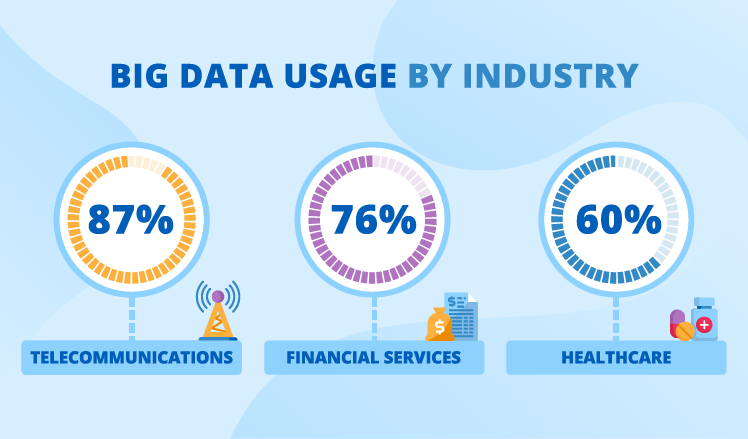
The telecommunications industry is an absolute leader in terms of big data adoption – 87% of telecom companies already benefit from big data, while the remaining 13% say that they may use big data in the future. [1]
Telecoms plan to enrich their portfolio of big data use cases with location-based device analysis (46%) and revenue assurance (45%). The optimization of prices, call centers and networks is also among the priorities. [2]
Healthcare
Almost 60% of healthcare organizations already use big data and nearly all the remaining ones are open to adopting big data initiatives in the future. [1]
Personalized treatment (98%), patient admissions prediction (92%) and practice management and optimization (92%) are the most popular big data use cases among healthcare organizations. [2]
Healthcare organizations plan to further expand their current big data usage with patient segmentation (31%) and clinical research optimization (25%). [2]
Financial services
76% of financial services institutions are currently big data users. [1]
Financial services institutions use big data for customer analytics to personalize their offers (93%), as well as for risk assessment (89%), fraud detection (86%) and security threat detection (86%). [2]
Top 3 extra use cases that financial services institutions planned to add in 2017-2018 were location-based security analysis (66%), algorithmic trading (57%), and influencer analysis (37%). [2]
In 2017, the top area that financial services institutions were investing in was predictive analytics (38%). However, in 2018’s list of priorities, it fell to the second place (with 29%), giving way to a new leader – AI and machine learning. [3]
Education
In education, the rate of big data adoption so far is the lowest – only 25% – when compared with telecommunications (87%), financial services (76%), healthcare (60%) and technology industries (60%). However, 67% of respondents don’t rule big data out as a future possibility. [1]
Insurance
Insurers expect that big data can help most efficiently in the areas of pricing, underwriting and risk selection (92%), management decisions (84%), loss control and claim management (76%). [4]
What use cases prevail for each big data technology
Hadoop use cases
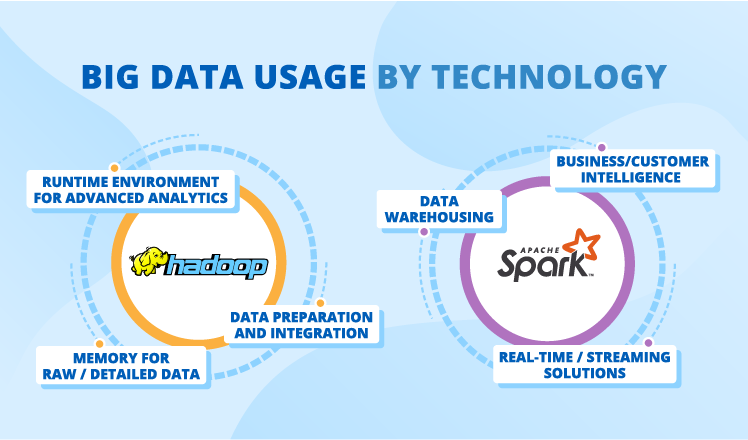
Runtime environment for advanced analytics, memory for raw or detailed data, and data preparation and integration are top 3 use cases for Hadoop. [5]
While 39% of organizations use Hadoop as a data lake, the popularity of this use case will fall by 2% over the coming three years. [6]
Spark use cases
Top 3 Spark-based projects are business/customer intelligence (68%), data warehousing (52%), and real-time or streaming solutions (45%). [7]
55% of organizations use Spark for data processing, engineering and ETL tasks. [8]
33% of companies use Spark in their machine learning initiatives. [8]
What value big data brings
Organizations value managing data in real time (70%) and accessing relevant data rapidly (68%) most. [2]
The biggest value that big data delivers are decreased expenses (49.2%) and newly created avenues for innovation (44.3%). [10]
48.4% of organizations assess their results from big data as highly successful. [10]
While 69.4% of organizations started using big data to establish a data-driven culture, only 27.9% report successful results. [10]
84% of enterprises invest in advanced analytics to support improved business decision making. [11]
Advanced analytics (36%), improved customer service (23%) and decreased expenses (13%) are top 3 priorities for investing into big data and AI. [11]
The history of big data usage in numbers
Big data adoption is constantly growing: the number of companies using big data has dramatically increased from just 17% in 2015 to 53% in 2017. In 2018, 97.2% of companies indicated that they were investing in big data and AI. [1],[11]
In 2015-2017, companies named data warehouse optimization as #1 big data use case, while in 2018 the focus shifted to advanced analytics. [1], [11]
Predictive maintenance has appeared on companies’ radars only in 2017 and has got straight to top 3 big data use cases. [1]
Within 2015-2017, sales and marketing (in every industry) were the areas where data and analytics brought significant or fundamental changes. [9]
Big data stories of big companies
Check what Walmart, PepsiCo, JPMorgan Chase, Rolls-Royce, and Uber have to say about their big data experience.
“Over time, the need for more insights has resulted in over 100 petabytes of analytical data that needs to be cleaned, stored, and served with minimum latency through our Hadoop-based big data platform. Since 2014, we have worked to develop a big data solution that ensures data reliability, scalability, and ease-of-use, and are now focusing on increasing our platform’s speed and efficiency.”
“[About their big data platform Pep Worx] We were able to launch the product [Quaker Overnight Oats] using very targeted media, all the way through targeted in-store support, to engage those most valuable shoppers and bring the product to life at retail in a unique way. These priority customers drove 80% of the product’s sales growth in the first 12 weeks after launch.”
“Artificial intelligence, big data and machine learning are helping us reduce risk and fraud, upgrade service, improve underwriting and enhance marketing across the firm.”
“We have huge clusters of high-power computing which are used in the design process. We generate tens of terabytes of data on each simulation of one of our jet engines. We then have to use some pretty sophisticated computer techniques to look into that massive dataset and visualize whether that particular product we’ve designed is good or bad. Visualizing big data is just as important as the techniques we use for manipulating it.”
The findings of our secondary research are in line with our hands-on experience: businesses increasingly adopt big data, and, overall, they are highly satisfied with the results of their initiatives. Though the majority of big data use cases are about data storage and processing, they cover multiple business aspects, such as customer analytics, risk assessment and fraud detection. So, each business can find the relevant use case to satisfy their particular needs.
In a bid to elevate live broadcasting standards, TAG has forged a strategic alliance with LiveU, a renowned name in live IP-video and remote production solutions. This groundbreaking partnership aims to revolutionize live video experiences for news and sports broadcasters, ensuring unparalleled quality assurance every step of the way.
Here’s a breakdown of how this collaboration can benefit broadcasters and revolutionize live broadcasts:
Real-Time Visibility into Live Feeds: With TAG Video Systems seamlessly integrating its real-time media performance solutions with LiveU’s cutting-edge live video transmission feeds, broadcasters gain the invaluable ability to monitor live feeds in real-time. This ensures the smooth on-air delivery of breaking news and sporting events, enhancing viewer engagement and satisfaction.
Proactive Problem Solving: Thanks to this integration, broadcasters can swiftly identify potential issues such as signal degradation and take immediate corrective action. This proactive approach minimizes disruptions and ensures uninterrupted live broadcasts, bolstering audience trust and loyalty.
Optimized Transmission for Challenging Networks: TAG’s robust analysis tools work hand-in-hand with LiveU’s resilient transmission technology, including the LRT™ (LiveU Reliable Transport) protocol. This synergy maximizes video quality over wire-free networks, particularly crucial for live events in challenging locations like sports arenas or remote news sites.
Ziv Mor, Chief Growth Officer at TAG Video Systems, underscores the significance of empowering broadcasters with the tools they need to deliver flawless live productions. He emphasizes that this collaboration streamlines workflows and ensures superior quality for viewers worldwide.
Gideon Gilboa, Chief Product Officer at LiveU, shares his enthusiasm for the partnership, highlighting the enhanced efficiency and simplified workflows it brings to live news and sports professionals.
In conclusion, the partnership between TAG Video Systems and LiveU marks a significant milestone in the realm of live broadcasting. By leveraging cutting-edge technology and fostering seamless collaboration, broadcasters can elevate their live productions to new heights, delivering unparalleled quality and engaging experiences to audiences worldwide.