Workspace Trust in Visual Studio Code


July 6, 2021 by Chris Dias, @chrisdias

Can I trust myself? This is the existential question facing many Visual Studio Code users since the 1.57 update.
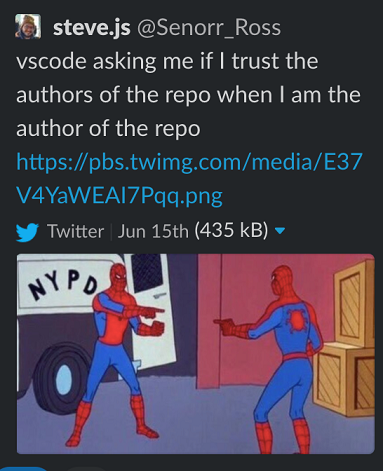
Social image of two versions of Spider-Man pointing at each other

While we can’t answer that question for you, we can tell you more about why we’ve introduced the concept of Workspace Trust.

But first, a little background.

Cats and keyboards, and bad apples

The internet is full of happy things, like videos of cats typing on keyboards.

For developers, it’s also full of tools, packages, and open source built by good people, who want to help you solve that problem you’ve been working on for hours. Development tools like VS Code integrate package managers, code linters, task runners, bundlers, etc. to provide enjoyable experiences that harness the power of the latest and greatest advancements from the ever-evolving community.

However, the productivity afforded by this rich ecosystem is often a result of the broad access we provide to our development machines. Combine that with the rapid evolution and viral sharing and consumption, developer tools are an appealing target for exploitation, especially considering attackers can use our machines to further spread attacks (for example, via auth tokens stored on developer machines or even through the software authored by the developer).

Being a developer is rewarding, but it’s also a risky business. To contribute to a project, you inherently need to trust its authors because activities such as running npm install or make, building a Java or C# project, automated testing, or debugging, all mean that code from the project is executing on your computer.

Our goal with the Workspace Trust feature is to find the right balance, to be safe from the few “bad apples” who want to ruin it for everyone, while continuing to ensure we can have all the nice things that make development so much fun.

Hey, it’s just an editor, right?
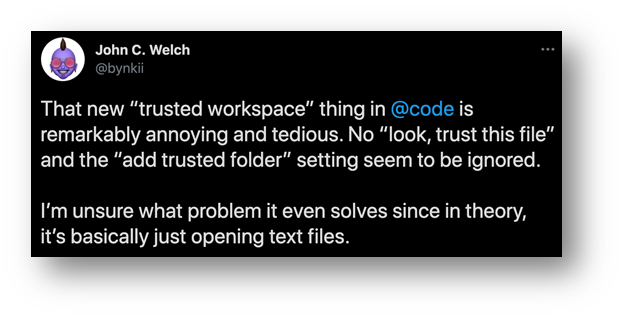
Twitter comment complaining about Workspace Trust

Yes, VS Code is an editor. However, like most modern editors, it is capable of running code from the workspace on your behalf to provide a richer development experience.

Running and debugging code is an obvious example. Code execution that may not be so obvious could be the preLaunchTask that runs before starting the app and can run a build that has an extra task executing arbitrary code unrelated to the build. What about the npm module that steals your crypto wallet private keys? Make a simple edit and a malicious linter is loaded from the node_modules folder, instead of the one that is installed globally. Even reading the code can be deceptive, attackers can use Unicode hacks to hide malicious code in plain sight. Heck, you don’t even have to open any source code to be owned.

The intent here isn’t to scare you away from all the great tools out there (including VS Code) or to make you change careers. It is to raise awareness that there are many attack opportunities when you download code from the internet written by a person or an organization that you don’t have any type of trust relationship with.

Whack-a-Mole

In all the scenarios above, the tools are working as they were designed, and in non-nefarious code bases, they are extremely productive. Setting up a preLaunchTask to build the app before debugging is a great time saver as you don’t have to manually build it from the terminal after every change. Linters are highly customizable to support every team’s preferred coding guideline and style (yes, tabs vs. spaces). Pre-commit hooks let you check if you’ve forgotten something or to make sure tests run before committing.

Now, it is unlikely you would be subject to all these attacks at the same time. In fact, there has not (yet) been an exploit through VS Code because there is a great community of experts who have made us aware when new opportunities arise. Our approach, before Workspace Trust, was to address each scenario at the point of vulnerability with a localized permission prompt.

For example, the Jupyter extension warned users that embedded JavaScript can run when you open the visualizers in a Notebook:
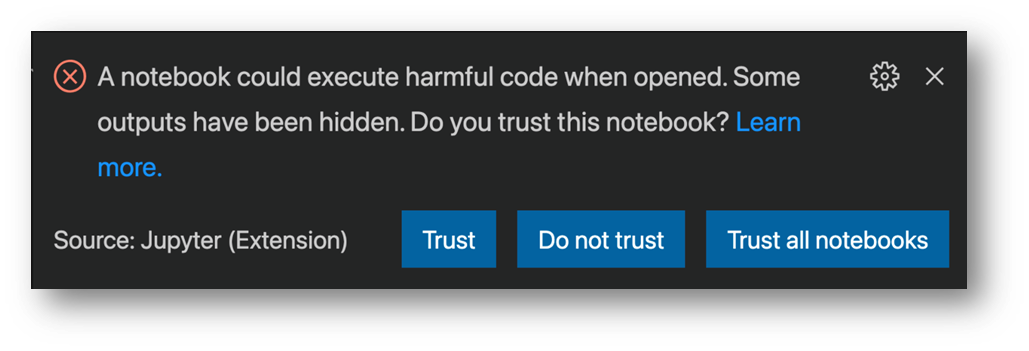
Jupyter Notebook security warning

The ESLint vulnerability was a doozy because it runs when the workspace loads (this was our first modal dialog).
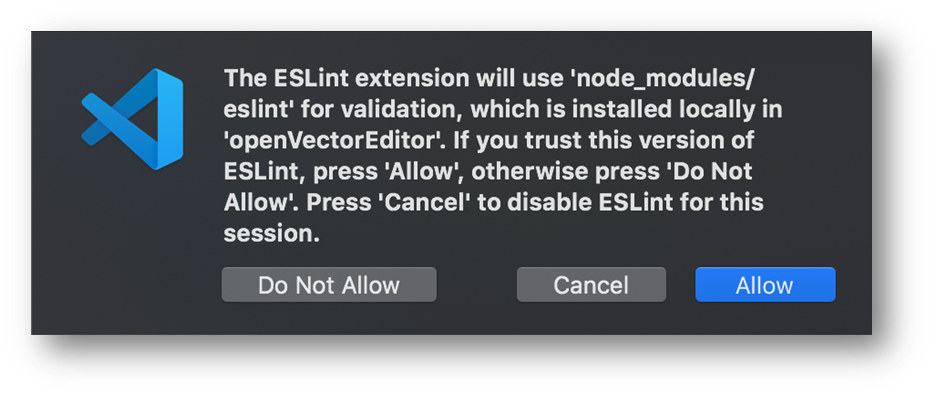
ESLint extension security warning

This, it turns out, is a losing battle. Users are interrupted with multiple (and slightly different) permission prompts that don’t apply to the entire workspace. I trust you, you, you, you, not you, and you, but only on Tuesdays. For us, it’s a constant game of Whack-a-Mole, plugging each vulnerability as it is exposed with yet another prompt.

So, one of the patterns we follow when building VS Code is to look at what experiences are being implemented similarly but inconsistently across the tool and extensions, and see if we can bring it into the core. Trust prompting followed this pattern, so we decided to look at building an experience and API that both the tool and extensions could take advantage of, with a (hopefully) clearer user experience.

Trust

Now that you understand some of the various ways code can be run without you knowing, hopefully you have a better idea why we are asking this question up front.
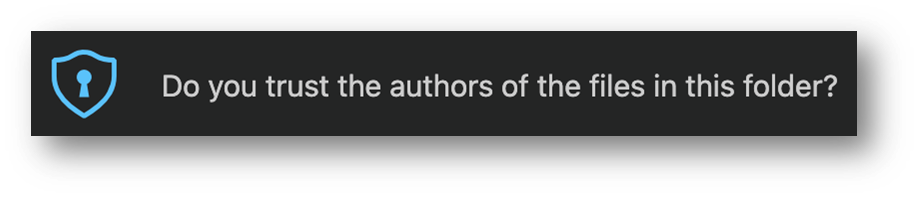
Do you trust the authors notification

We specifically ask if you trust the authors of this workspace because VS Code can’t tell if the code is malicious or not (hey, we just know 1’s and 0’s), where it came from, if you intend to contribute to the project, etc.

You, on the other hand, are smart and you know where the code came from: you (ok), your company (probably ok), your buddy Kai (depends), or some random person on the internet (definitely not).

That knowledge helps make the tool smarter. If you trust the author, great! The tools and extensions have the green light to do their thing and provide a magical experience, and we’re not going to bug you again.

If you don’t, you are telling us be careful VS Code, don’t execute any code. This is what we call Restricted Mode, where potentially harmful functionality is disabled so you can more safely browse the code and eventually make an informed decision.

But that dialog!

We hear you, the modal dialog is pretty big and it keeps coming up for every new folder you open, unless you take action to configure it.

We didn’t start with this design. We looked at the ESLint modal dialog saga and asked ourselves if we could provide a non-blocking experience using visual clues and a single notification prompt that was delayed for as long as possible. We wanted to be unobtrusive, start in Restricted Mode (without you really noticing) and prompt for trust at the last moment.

We introduced a “passive” trust notification where you could tell us if you trusted the workspace. We cycled through various UI treatments to signal that the workspace was not trusted, including augmenting the Settings gear icon and introducing a new security icon.

Several early versions of a security icons and badges

If you use the Insiders builds, you will get the latest iterations on new experiences in VS Code like we’re talking about with Workspace Trust. Insiders ships daily and we use it to build VS Code.

The idea being a user (you!) could decide, on your terms, when to grant or deny trust of the workspace. When the tool or an extension really needed access, only then would we then put up a notification asking if you trusted the workspace:
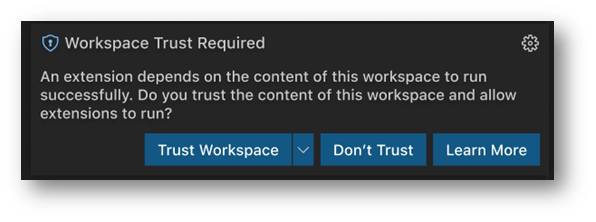
Workspace Trust required prompt

Now, I’m sure many of you will agree, VS Code suffers from a bit of what we call “Notification Fatigue” (I promise we are working on it 😊). In our testing, we saw that people simply ignored the notification. Users did not see the notification on the gear or even the new security icons. Usage data showed a very low rate of granting trust through the passive notification. In user studies, we watched people spend all their time thinking they had broken something, and then spend time troubleshooting, trying to get back to their expected state.

We intended to be unobtrusive and delay as long as possible, but the reality was that, while in Restricted Mode, the product felt broken, and people thought it was their fault. Not a great place to be for either of us.

Putting you in control

The decision to trust a folder has a fundamental impact on the capabilities of VS Code, so after all the research we decided the right thing was to ask the trust question right away when you try to open a folder. Because the modal dialog is disruptive, we try to balance things out by making the dialog powerful so that you could answer a couple of questions and in the end, see the prompt much less often in your day-to-day work.

From our own dogfooding as well as through interviews with other developers, we found that people generally have a primary folder where they put all their sources and consider it trustworthy. We therefore added the ability to trust the parent folder directly from the dialog. You can trust it and all the sub folders with one click and then you won’t see the trust prompt again.
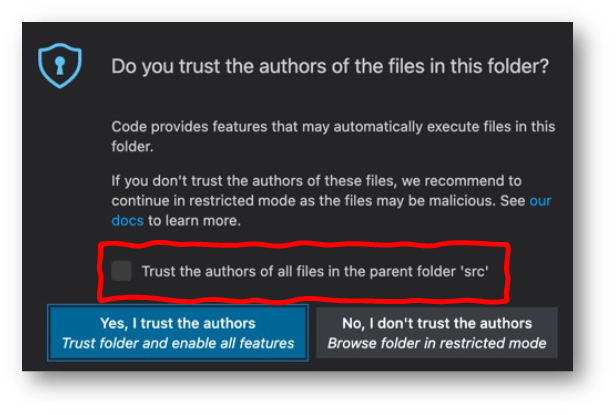
Trust parent folder checkbox

Workspace Trust editor

The Workspace Trust editor gives you additional control over what you trust and will be updated in the 1.58 release to make it easier to configure the feature to suit your needs.

And because you can customize the behavior, there are many ways to get to the Trust Editor 😊. Click the Restricted Mode Status bar message, the Manage link in the Restricted Mode banner, the Gear menu, or open the Command Palette (F1) and use the Workspaces: Manage Workspace Trust command.

From the Workspace Trust editor, you can trust the current folder, the parent folder (and all sub folders), as well as any folder on the machine.
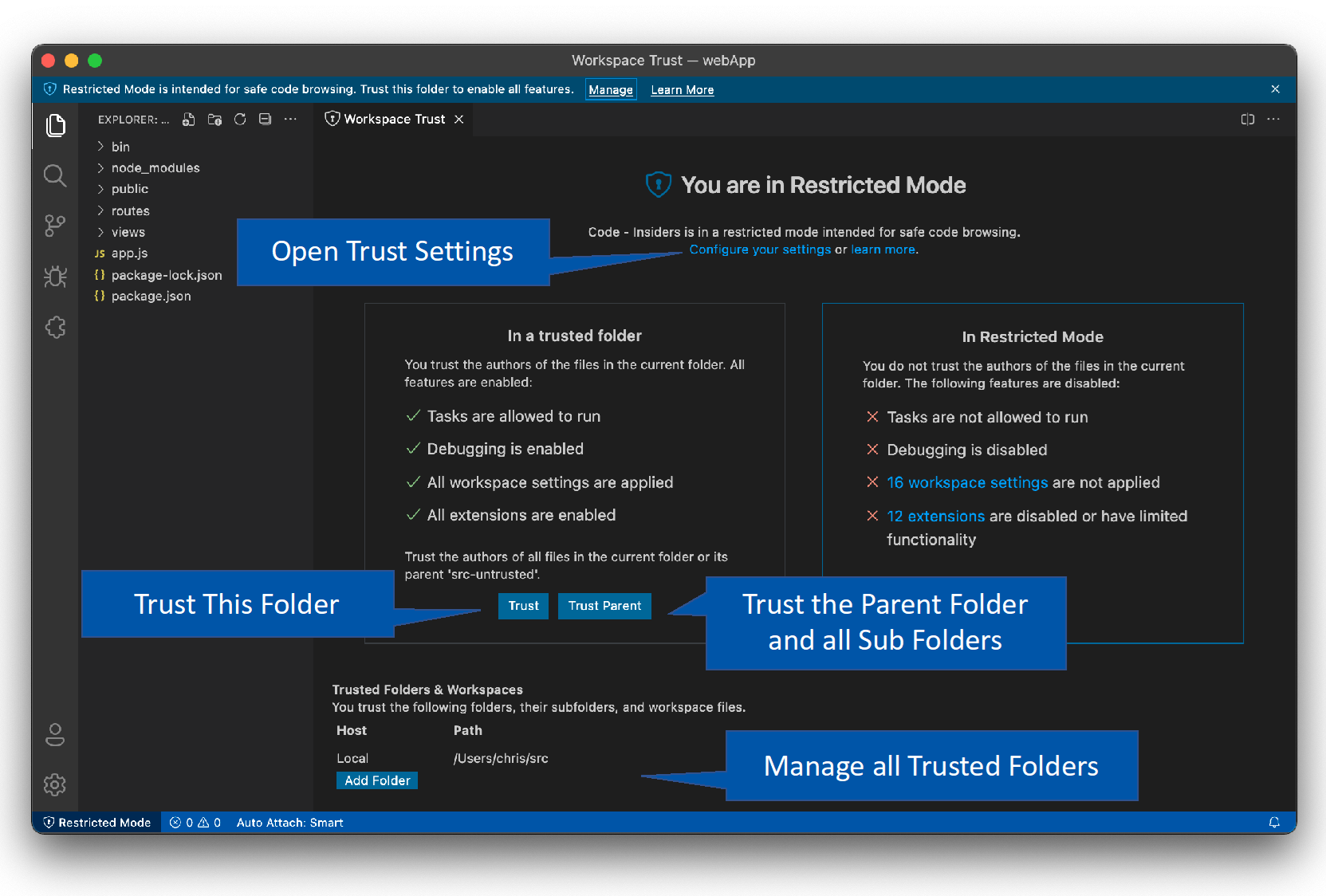
Workspace Trust editor with annotations

You can also quickly jump to all the Workspace Trust settings to fine-tune the experience.
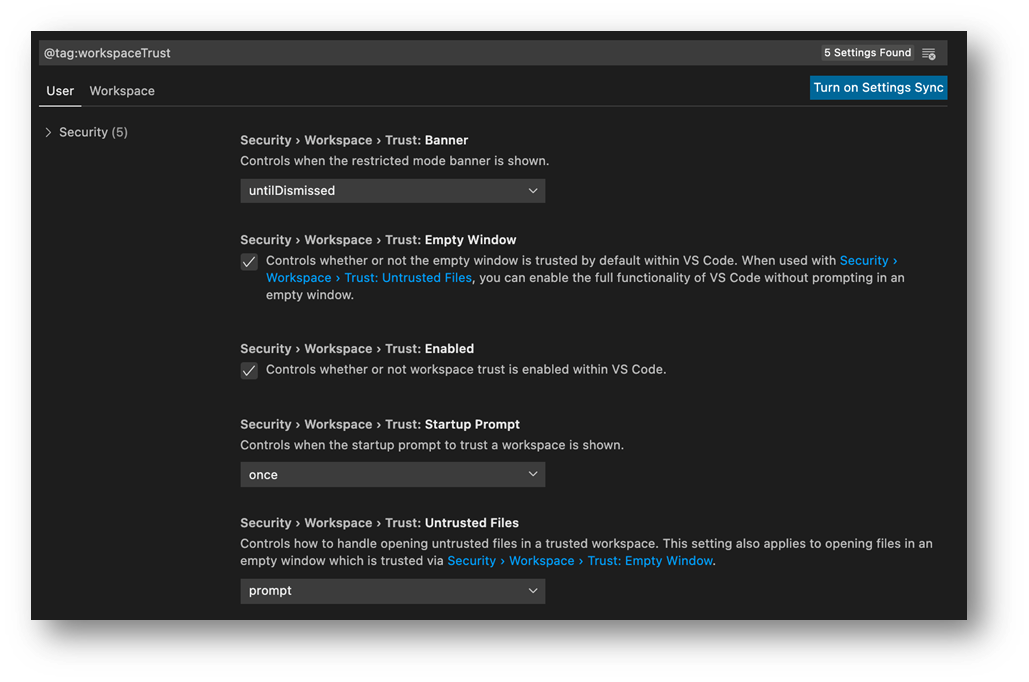
Workspace Trust settings via @tag:workspaceTrust

How we use Workspace Trust

Nobody likes flossing their teeth, but we do it anyway because we know it’s the right thing to do. Nobody wants to think about security, but we also know it’s the right thing to do. By customizing the experience, you can keep your development experience enjoyable while also protecting yourself against the threats inherent with development (fun flossing?!?).

Most people on the VS Code team start out with a top-level folder, where they work on sources they trust. For example, on my Mac, I put all the sources that I pull from the Microsoft organization on GitHub into my ~/src folder. I designate ~/src as a trusted folder and everything beneath it is inherently trusted. When I open ~/src/vscode or ~src/vscode-docker, etc., they are opened with full trust because I trust the code that my organization writes and consumes.

I’ve got a separate folder called ~/scratch (short for “scratchpad”, you can make it whatever you want obviously), where I put everything else and assume it is untrusted by default. Then, I make trust decisions on a folder-by-folder basis.

To smooth my workflow, I have the "security.workspace.trust.startupPrompt" setting set to "never".
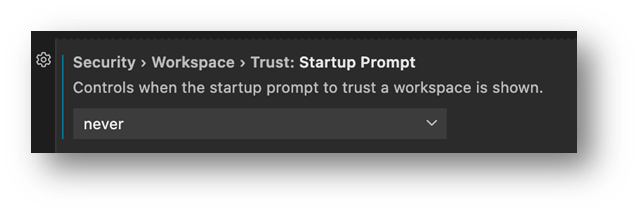
Workspace Trust Startup Prompt setting as never

With this setting, I am not prompted by the modal dialog and the workspace opens directly in Restricted Mode. I’ve already decided that the ~src/scratch folder is untrusted, so there is no need to prompt me every time I open a subfolder. If I decide that I do trust the code I’m reading or writing, I can enable it on the folder with two quick clicks (the Restricted Mode notification across the top of VS Code, then the Trust button).

On my Windows machine, things are a little more interesting. I generally work in Ubuntu images running on the Windows Subsystem for Linux (WSL), using the WSL extension. I trust the ~/src folders on Linux and I trust the d:\src folder on the Windows side.
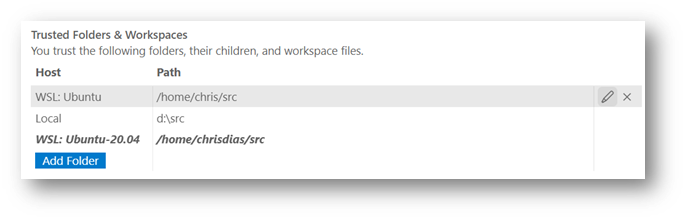
Trust Folders & Workspaces list with WSL trusted folders

A few people on the team go one step further and turn off the Restricted Mode banner across the top as well ("security.workspace.trust.banner": "never"), leaving just the Status bar notification. For me this goes too far, the banner across the top keeps me honest and helps remind me to be vigilant when I am pulling from the internet.

Open source is awesome

We know that VS Code is a tool you use for getting your “real” job done, and any speed bumps or roadblocks we introduce only slow you down building and launching the next unicorn. Many of you took the time to reach out on Twitter, Reddit, and in issues, and we thank you for the candid feedback. We made a number of fixes and improvements coming in the 1.58 release based on your input and look forward to continuing the conversation.

Looking ahead, we want to help extension authors avoid arbitrary code execution and provide more functionality when running in Restricted Mode. Our Roadmap notes the work we are doing with the Visual Studio Marketplace team to bring additional security to the extension ecosystem (we call this “Trusted Extensions”), including validated publishers, signing, and platform-specific extensions. In short, you can think of Workspace Trust as helping good extensions make good decisions. Trusted Extensions will help protect you from bad extensions.

One of the benefits of building VS Code in the open is that the community can help us create the best possible experiences. So, please let us know how we can improve the flow, helping to keep you safe while being as unobtrusive as possible. Comment (politely!) on existing issues, submit a new one, or tweet us @code, we’re listening!

Thanks,

Chris and the VS Code Team

Happy Coding (Safely)!



Google Teases Pixel 9 Pro and Pixel 9 Pro Fold Ahead of Event


Google has never had good luck keeping unreleased smartphones under wraps. Just this week, Taiwanese regulators accidentally published images of all of Google’s 2024 Pixel phones, which will be announced next month. Google seems to have tired of being undercut and has taken the wraps off two of its devices early. The new teaser videos offer the first official glimpse of the Pixel 9 Pro and the Pixel 9 Pro Fold.

Both videos are heavily focused on Google’s Gemini AI robot, like almost everything else the company does right now. After the cheeky Dear John letter bit, the real show starts. Each video shows an unannounced phone for a few seconds, revealing a raft of design details that were difficult to ascertain from the previous leaks.

The Pixel 9 Pro will be the same size as the Pixel 9, but it will have the enhanced hardware previously reserved for the larger Pixel phone. This phone would compete directly with the non-Max iPhone Pro. The Pixel 9 Pro has flatter bezels than the Pixel 8 family, but the phone still has a very rounded footprint—there are no corners to be found.

The Pixel 9 Pro Fold is the follow-up to last year’s Pixel Fold. While the name got a lot bulkier, the device looks more streamlined than Google’s first foldable. The enormous bezels around the internal display are gone, and the hinge appears to have adopted a design more like Samsung and Motorola. This suggests that the Pixel 9 Pro Fold will actually open totally flat, unlike the 2023 foldable that annoyingly stopped a few degrees short.

It’s not entirely clear why Google chose to reveal only two of its four phones, but it may be because these phones represent the biggest departure for the Pixel family. The Pixel 9 Pro is Google’s first small flagship phone that doesn’t compromise on specs. There will still be a cheaper Pixel 9, but you won’t need to get the biggest, heaviest phone to get the best cameras. The Pixel 9 Pro Fold may be a second-generation device, but it doesn’t look anything like the original. Google is only getting started in foldables, and it’s looking to put that first attempt behind it.

Google has a new landing page for these phones on its store, but there’s no additional information there. It’s just a place to get details on the Aug. 13 event, which will include the new Pixels, Android 15 news, and of course, a heaping helping of Gemini AI.

17 Networking Skills – Make Powerful Personal Connections


Picture this: A struggling freelance writer attends a local literary event, strikes up a conversation with a publisher, and lands a book deal that launches their career. 

While this may sound like a fairy tale, it’s a testament to the power of networking in the writing world. 

In an industry where who you know can be just as important as what you write, mastering networking skills is no longer optional—it’s essential. 

This article will guide you through 17 crucial networking skills that can elevate your writing career to new heights.

What are networking skills?

Networking skills are the abilities that allow writers to build and maintain professional relationships effectively. 

These skills encompass a range of social, communication, and strategic competencies that enable you to connect with peers, mentors, industry professionals, and potential clients or employers. 

For writers, whether freelance or aspiring novelists, these skills are crucial because they open doors to opportunities, provide support and resources, and help establish your presence in the literary community.

17 powerful networking skills to learn

Read on to discover 17 of the most important skills for effective networking as well as some advice for getting better at them.

1. Active listening

Active listening involves fully concentrating on, understanding, and responding thoughtfully to what others are saying. 

It’s about hearing not just the words, but also understanding the complete message being communicated through tone, body language, and context.

As a writer, active listening allows you to truly understand the needs of potential clients, grasp the nuances of industry trends discussed by peers, and pick up on subtle cues that can inform your writing and professional relationships. 

By demonstrating that you value others’ input, you make a lasting positive impression, which is crucial in expanding your network and creating opportunities.

How to improve your active listening skills

Practice giving your full attention in conversations

Avoid interrupting and use non-verbal cues like nodding to show engagement. 

After the speaker finishes, paraphrase what you’ve heard to ensure understanding.

2. Clear communication

Clear communication is the ability to convey your thoughts, ideas, and intentions effectively, both verbally and in writing.

As a writer, your ability to communicate clearly sets you apart.

It helps you articulate your value proposition, discuss project details with clients, and share your ideas with peers.

Clear communication prevents misunderstandings and showcases your professional expertise.

How to improve your clear communication skills

Practice explaining complex ideas simply. Seek feedback on your communication style and actively work on areas of improvement. Remember, clear writing often translates to clear speaking.

3. Elevator pitch mastery

An elevator pitch is a concise, compelling introduction of yourself and your work, deliverable in the time it takes to ride an elevator.

You never know when you’ll meet a potential client or valuable contact. A well-crafted elevator pitch allows you to make a strong first impression and clearly communicate your unique value as a writer.

How to improve your elevator pitch

Craft a 30-second pitch about who you are and what you do.

Practice it regularly and refine it based on the reactions you receive.

4. Social media savvy

Social media savvy involves effectively using various platforms to build your brand, engage with your audience, and connect with industry professionals.

In today’s digital age, much networking happens online.

Being social media savvy helps you expand your reach, stay updated on industry trends, and connect with potential clients or collaborators.

How to improve your social media savvy 

Choose platforms that align with your goals.

Consistently share valuable content and engage meaningfully with others in your field.

5. Empathy

Empathy is the ability to understand and share the feelings of others.

As a writer, empathy helps you connect more deeply with your network.

It allows you to understand others’ perspectives, which can lead to better collaborations and more meaningful professional relationships.

How to improve your empathy skills

Practice putting yourself in others’ shoes. Listen to understand, not just to respond. Reflect on how your words and actions might affect others.

6. Follow-up discipline

Follow-up discipline is the consistent practice of maintaining contact after initial meetings or conversations.

Following up helps you stay on people’s radar and shows your professionalism.

It can turn a casual encounter into a valuable long-term connection.

How to improve your follow-up discipline

Set reminders to follow up after meetings.

Send personalized messages referencing specific points from your conversation.

7. Adaptability

Adaptability is the ability to adjust your approach and communication style to suit different people and situations.

The writing world is diverse.

Being adaptable helps you connect effectively with various personalities and navigate different professional settings.

How to improve your adaptability 

Expose yourself to diverse networking situations.

Reflect on what works best in different contexts and be willing to adjust your approach.

8. Genuine interest in others

This skill involves showing authentic curiosity about others’ work, experiences, and perspectives.

Showing genuine interest helps you build deeper connections.

It can lead to unexpected collaborations and makes you more memorable to others.

How to improve your ability to show genuine interest

Ask thoughtful questions about others’ work and experiences.

Practice active listening and follow up on details they share.

9. Confidence

Confidence is the self-assurance in your abilities and value as a writer.

Confidence makes you more approachable and memorable.

It helps you articulate your ideas clearly and pursue opportunities that can advance your career.

How to improve your confidence

Prepare well for networking events. Remind yourself of your accomplishments and unique strengths.

Practice positive self-talk.

10. Value proposition awareness

This is the ability to clearly articulate what unique value you bring as a writer.

Understanding and communicating your value helps potential clients or collaborators see why they should work with you specifically.

How to improve your value proposition awareness

Identify your unique strengths and experiences.

Craft clear statements about how these translate into value for others.

11. Relationship building

Relationship building is the ongoing process of nurturing professional connections over time.

Strong, long-term relationships can lead to repeat work, referrals, and a supportive professional community.

How to improve your relationship building ability 

Regularly reach out to your contacts, not just when you need something.

Share valuable information or opportunities with them.

12. Event navigation

Event navigation is the ability to comfortably and effectively network at professional gatherings.

Writing conferences, book launches, and industry events are great opportunities to expand your network and learn about new opportunities.

How to improve your ability to navigate events

Set goals for each event you attend.

Practice approaching new people and joining ongoing conversations politely.

13. Professional appearance

Professional appearance involves presenting yourself in a manner appropriate to your industry and the specific networking context.

Your appearance can affect people’s first impressions and their perception of your professionalism.

How to improve your professional appearance 

Research dress codes for different types of writing events.

Ensure your appearance aligns with your personal brand as a writer.

14. Time management

Time management in networking involves balancing relationship-building activities with your writing work.

Effective time management ensures you can maintain a strong network without sacrificing your writing productivity.

How to improve your time management

Schedule regular time for networking activities. Use productivity tools to track and optimize your networking efforts.

15. Reciprocity

Reciprocity is the practice of mutual exchange of help, information, or support within your network.

Giving back to your network strengthens relationships and often leads to more opportunities coming your way.

How to improve your ability to show reciprocity 

Look for ways to help others in your network.

Share useful resources or make introductions that could benefit your contacts.

16. Digital networking proficiency

This skill involves effectively using online platforms and tools for networking purposes.

In an increasingly digital world, much networking happens online.

Proficiency in digital networking expands your reach beyond geographical limitations.

How to improve your digital networking abilities

Familiarize yourself with popular networking platforms in the writing industry.

Participate in online writing communities and virtual events.

17. Persistence

Persistence is the ability to continue networking efforts despite setbacks or slow progress.

Building a strong network takes time.

Persistence ensures you don’t give up before you see the benefits of your efforts.

How to improve your persistence

Set realistic networking goals.

Celebrate small wins and learn from unsuccessful attempts.

Remember that every interaction is a learning opportunity.

Are you ready to put these networking skills into practice?

Now that you’re armed with these essential skills, it’s time to put them into action. 

Start by identifying one or two skills you’d like to improve and create a plan to practice them. 

Whether it’s crafting your elevator pitch or improving your digital networking proficiency, every step forward is a step towards a more connected and successful writing career. 

Your next great opportunity could be just one conversation away!

iPhone Mirroring in macOS Sequoia and iOS 18: Everything You Need to Know


Apple is expanding how its cross-platform Continuity features work in 2024, introducing an iPhone Mirroring option in macOS Sequoia and iOS 18. As the name suggests, ‌iPhone‌ Mirroring lets you control your ‌iPhone‌ with your Mac.

This guide walks through all of the ‌iPhone‌ Mirroring features and explains how it works.

iPhone Mirroring Basics

After upgrading to ‌iOS 18‌ and ‌macOS Sequoia‌, there’s a new ‌iPhone‌ Mirroring app in the Dock, and that’s how you start an ‌iPhone‌ Mirroring session.

iphone mirroring interface

  1. From your Mac’s Dock, click on the ‌iPhone‌ Mirroring app.
  2. Click on Continue at the pop-up informational screen.
  3. Select the ‌iPhone‌ that you want to use if you have more than one ‌iPhone‌.
  4. Unlock your ‌iPhone‌ with a passcode to allow the connection.
  5. Click on Get Started.
  6. Use Touch ID on the Mac to authenticate (alternatively, enter your password).

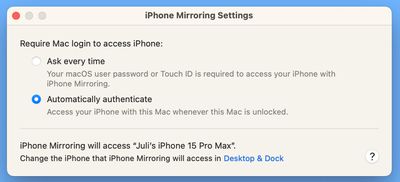
When you start up ‌iPhone‌ Mirroring for the first time, you can opt to have it require authentication with every connection or to allow a connection automatically. If you choose automatic authentication, you will not need to authenticate with ‌Touch ID‌ or a password to use ‌iPhone‌ Mirroring when your Mac is unlocked.

iphone mirroring settingsiphone mirroring settings
Otherwise, you will need to authenticate on your Mac each time you want to use ‌iPhone‌ Mirroring. Note that an ‌iPhone‌ needs to be locked while an ‌iPhone‌ Mirroring session is in progress, so you can’t use your ‌iPhone‌ while it’s being mirrored to your Mac.

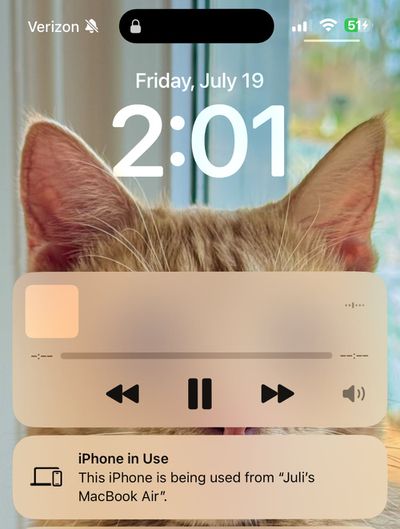
If your ‌iPhone‌ is not locked and you attempt to initiate ‌iPhone‌ Mirroring from your Mac, you will get a warning that the ‌iPhone‌ is in use.

There is no option for launching an ‌iPhone‌ Mirroring session from an ‌iPhone‌ — it needs to be done from a Mac. While the ‌iPhone‌ Mirroring app icon should be in the Dock, if it’s not there, you can get to it from the Launchpad or the Applications folder, because it is treated as a standard app.

iPhone Mirroring Interface

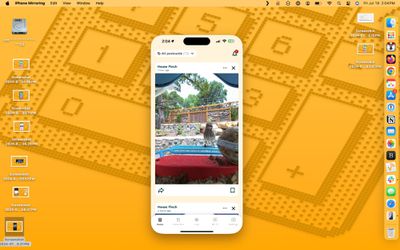
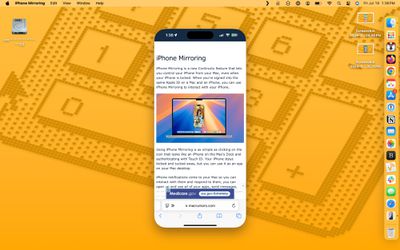
Your full ‌iPhone‌ interface is shown as a dedicated app on the Mac, with your wallpaper and app icons all visible and accessible. You can click in to any of your apps and use it on the Mac just like you would on the ‌iPhone‌.

iphone mirroring mac 2iphone mirroring mac 2
You can get to your Home Screen by clicking on the bottom bar, and swap between pages with the trackpad or with a click and drag gesture using a mouse. There are menu options for getting to the ‌Home Screen‌ and for bringing up the app switching interface, but most control is done within the ‌iPhone‌ Mirroring window.

iphone mirroring menu optionsiphone mirroring menu options

iPhone Mirroring Requirements

To use ‌iPhone‌ Mirroring, you need a Mac that runs ‌macOS Sequoia‌ and that has an Apple silicon chip (M1 or later) or a T2 security chip. Macs with T2 security chips are Intel-based and include the following machines:

These Macs have Apple silicon chips:

  • 2020 and later ‌Mac mini‌
  • 2020 and later ‌MacBook Air‌
  • 2021 and later ‌iMac‌
  • 2021 and later MacBook Pro (14 and 16 inch)
  • 2020 13-inch MacBook Pro
  • 2022 and later Mac Studio
  • 2023 ‌Mac Pro‌

Any ‌iPhone‌ that runs ‌iOS 18‌ works with ‌iPhone‌ Mirroring.

  • All iPhone 15 models
  • All iPhone 14 models
  • All iPhone 13 models
  • All ‌iPhone‌ 12 models
  • All ‌iPhone‌ 11 models
  • ‌iPhone‌ XS and XS Max
  • ‌iPhone‌ XR
  • iPhone SE (2nd and 3rd gen)

Your ‌iPhone‌ and Mac need to be signed into the same Apple ID, and two-factor authentication must be enabled for the ‌iPhone‌ Mirroring feature to work. You will also need to turn on Bluetooth and Wi-Fi, and the two devices will need to be near each other.

iphone mirroring app switcheriphone mirroring app switcher
During an ‌iPhone‌ Mirroring session, your Mac and your ‌iPhone‌ need to be close to one another, essentially in the same room.

Privacy and Security

You need to be signed into the same ‌Apple ID‌ on your ‌iPhone‌ and your Mac for ‌iPhone‌ Mirroring to work. While ‌iPhone‌ Mirroring is active, you do not need to have your ‌iPhone‌ with you, and it does not need to be unlocked.

iphone in use notificationiphone in use notification
Your ‌iPhone‌ can remain tucked away in a pocket or a bag while you control it from your Mac, so no one can access it or see what you’re doing with it.

Using a Mouse and Keyboard with iPhone

Your Mac’s keyboard, trackpad, and mouse can be used with your ‌iPhone‌, which is useful if you need to type something lengthy in an ‌iPhone‌ app.

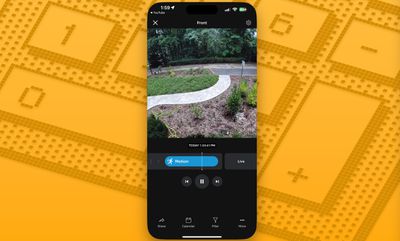
iphone mirroring ring appiphone mirroring ring app

Audio, Camera, and Microphone

If you play a video on your ‌iPhone‌ while ‌iPhone‌ Mirroring is enabled, the audio comes through your Mac. You can’t turn on the Camera app or use the microphone, though.

iPhone Notifications on Mac

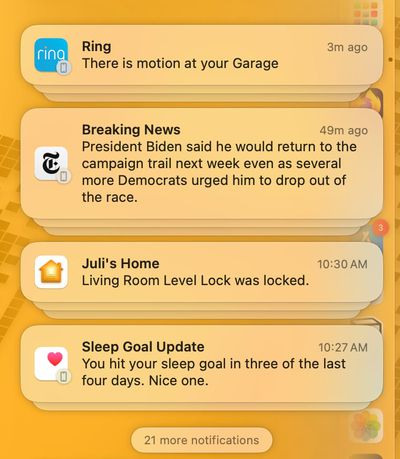
With ‌iPhone‌ Mirroring turned on, incoming ‌iPhone‌ notifications show up right alongside your Mac notifications in the Notification Center at the upper right hand corner of the Mac’s display.

iphone mirroring notificationsiphone mirroring notifications
‌iPhone‌ notifications are denoted with a small ‌iPhone‌ icon, but they otherwise look like native Mac notifications.

You can click on a notification and open up the app on your ‌iPhone‌, interacting with it directly from the Mac.

StandBy

While your ‌iPhone‌ is being mirrored to your Mac, it can be on a charger and in StandBy mode, displaying the time and other information.

Drag and Drop

Later this year, Apple plans to add ‌iPhone‌ Mirroring’s best feature, file transfers. You will be able to transfer files, photos, and videos from your Mac to your ‌iPhone‌ and vice versa using drag and drop gestures.

Apple says that it will work just like dragging files from one Mac app to another.

While drag and drop has yet to be implemented, you can sort of work around this by using AirDrop to move photos and files from your ‌iPhone‌ to your Mac, initiating AirDrop from the ‌iPhone‌ without having to unlock it.

iPhone Mirroring Limitations

‌iPhone‌ Mirroring will not work if the Mac is using AirPlay to stream music or video content to another device, or if Sidecar is enabled with an iPad. Continuity Camera cannot be enabled either, so if you’re using your ‌iPhone‌ as a webcam for your Mac, you can’t use ‌iPhone‌ Mirroring at the same time.

Attempting to watch movies and TV shows from some apps like Hulu and Netflix does not work, with the ‌iPhone‌ Mirroring app showing just a blank black screen, likely due to DRM restrictions.

There is no option to resize the ‌iPhone‌ Mirroring window, and you can’t manually move it into landscape orientation. If an app or a game is displayed in landscape orientation, the window will shift into landscape.

iphone mirroring landscape modeiphone mirroring landscape mode
You can delete apps when using ‌iPhone‌ Mirroring by going to the Settings app, but apps cannot be deleted from the ‌Home Screen‌. You also can’t rearrange apps because there’s no option to get into the ‌Home Screen‌ (or Lock Screen) editing interface.

iphone mirroring safariiphone mirroring safari
Control Center and Notification Center are also inaccessible.

Read More

For more on the new features that Apple is adding in ‌iOS 18‌, we have a dedicated iOS 18 roundup.

The FTC Pushes Back Against Xbox Game Pass Price Increases


Last week, Xbox announced it was introducing new Game Pass tiers and raising its subscription prices for existing members on September 12. The Federal Trade Commission (FTC) took issue with these changes in a filing yesterday to the US Court of Appeals for the Ninth Circuit.

In case you missed it, Microsoft revealed a new tier called Xbox Game Pass Standard, a $15 monthly subscription for new members that excludes day-one releases, EA Play, PC Game Pass, and cloud gaming. Xbox Game Pass Ultimate, which includes those perks, will have its monthly price raised from $17 to $20. Xbox Game Pass Core, which only offers online play and a smaller library, is raising its yearly sub from $60 to $75 (the $10 monthly fee remains unchanged). PC Game Pass is increasing from $10 per month to $12. 

Additionally, the $10.99 Game Pass for Console is no longer be available to new subscribers as of July 10. If existing subscribers fail to renew their membership, they will be permanently locked out of this tier and must subscribe to another, more expensive membership. 

In the filing, the FTC blasts Microsoft’s discontinuation of Game Pass for Console, stating that users must pay a substantial price increase (81%) to switch to Game Pass Ultimate. Those unwilling to do so must settle for Game Pass Standard, which the FTC describes as a “degraded product” since it excludes day-one releases. 

“[Game Pass Standard] costs 36% more than Console Game Pass, and withholds day-one releases. Product degradation—removing the most valuable games from Microsoft’s new service—combined with price increases for existing users, is exactly the sort of consumer harm from the merger the FTC has alleged.”

The FTC was the primary opposition against Microsoft’s acquisition of Activision Blizzard and sees this move as proof of its concerns over the purchase. 

“Microsoft’s price increases and product degradation—combined with Microsoft’s reduced investments in output and product quality via employee layoffs[…]—are the hallmarks of a firm exercising market power post-merger.”

The FTC goes on to call the price increases “inconsistent” with the case Microsoft made during the Xbox FTC trial last year. It states, “Microsoft promised that ‘the acquisition would benefit consumers by making [CoD] available on Microsoft’s Game Pass on the day it is released on console (with no price increase for the service based on the acquisition).’ Microsoft’s post-merger actions thus vindicate the congressional design of preliminarily halting mergers to fully evaluate their likely competitive effects, and judicial skepticism of promises inconsistent with a firm’s economic incentives.”

That last portion references Call of Duty: Black Ops 6‘s (the first new entry to release post-acquisition) October 25 launch on Game Pass Ultimate, roughly a month after the subscription tier’s price increase. 

visual studio – C++ – Questions about bit shift operators (>)


Consider the below code:

std::string g_CharTable = "stjkloptrew23456mncv891TZUIOPAS";
std::uint32_t value     = 123456789
std::string hash;

for (std::size_t i = 0; i < 5; ++i)
{
    const std::uint32_t index = ((value >> (24 - (8 * i))) & 0x000000FF) % (std::uint32_t)g_CharTable.length();
    hash.push_back(g_CharTable[index]);
}

If you execute the above code, you should notice that something strange happen in the last iteration. Indeed i will be equal to 4, and the value >> (24 - (8 * i)) will have -8 as result. This means that the the number of bits to shift will exceed the range of an uint32 value.

However this code was working perfectly as long as it was executed under Visual Studio 2019. But when I updated my code to Visual Studio 2022, the last iteration always returned an index of 0, which of course caused an issue in the result of this function. What is strange is that VS2019 was performing the bit shift as if the shifting value was converted to unsigned and a modulo of 32 was applied on it, something like that: ((uint32_t)-8 mod 32) = 24

So my questions are:

  • For an unsigned 32 bit value, is the shifting value limited between 0 and 31, and what should happen if this value is exceeded?
  • What happen e.g. in the following cases:
    • when executing value >> -8?
    • when executing value >> 33?
  • If I try to hardcode a shifting value of -8 or 33, the result I get is always 0, whatever the content of the shifted value (e.g. the result of value >> -8 is 0). However VS2019 accepted to apply a such shifting when it was the result of a calculation. Why? Is it a compiler bug?

Writing Conferences to Help You Crush Your Writing Goals


Thinking about attending an event to help you crush your goals? Writing conferences can be a great way to give your freelance writing career a boost.

How? You’ll meet writers, editors, publishers, and marketing peeps in your niche. And you’ll learn more about the business and craft of freelance writing.

Writing conferences can also open your eyes to aspects of freelancing you might not even know about.

Not to mention the training, marketing tips, and story ideas at writing conferences that you can pitch to magazines and trade pubs.

Looking for writing conferences to attend? Check out this list of 20 writing conferences

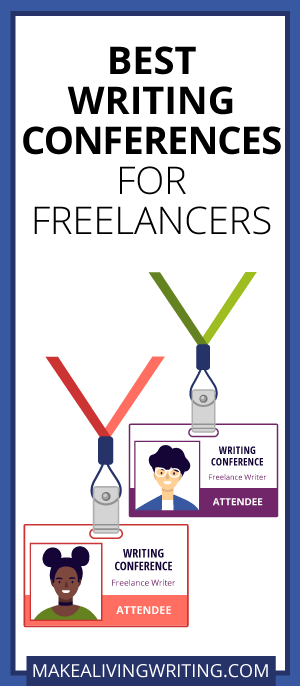
Best Writing Conferences for Freelancers. Makealivingwriting.com.Best Writing Conferences for Freelancers. Makealivingwriting.com.

So which writing conferences should you attend?

It depends on a bunch of things like your budget, calendar, ability to travel. Your niche, current skills, type of writing you do, can also help you choose. Here are 20 to consider!

1. AMWA Conference

Date: October
Location: Baltimore, MD
Registration: See website

This is the annual conference hosted by the American Medical Writers Association. The AMWA Conference includes medical writing workshops and discussions. But you can also connect with potential clients and exhibitors like healthcare organizations, big pharma, health insurance, and companies that specialize in medical devices and software.

2. ASJA Conference

Date: February and September
Location: New York, NY / online
Registration: See website

The American Society of Journalists and Authors is designed to help writers land more assignments, improve pitching skills, understand content marketing, and sharpen research skills. There’s also multiple Q&A sessions with experts in writing, publishing, content marketing, and social media. And if you plan ahead, you can book an appointment with editors, publishers and literary agents.

3. B2B Marketing Exchange

Date: February and October
Location: Alpharetta, GA and Scottdale, AZ
Registration: See website

Want more content marketing work for businesses? You’ll learn about that here. The B2B Marketing Exchange conference offers six different session tracks to choose from: demand generation, content marketing, digital strategy, account-based marketing, channel marketing, and sales enablement. If you get a couple of freelance writing friends to join the conference with you, you may be able to shave a few hundred bucks off the ticket price.

4. BIO Conference

Date: May
Location: New York, NY
Registration: See website

This the annual conference hosted by the Biographers International Organization. You’ll learn skills and strategies from pro writers about pitching, researching, and writing biographies. It’s also where the Plutarch Awards winner is announced for the best biography of the year.

5. The Conductor C3 Conference

Date: October
Location: New York, NY
Registration: See website

If you’re trying to navigate digital marketing or you work with clients on content projects that include SEO, social media, and analytics to understand how content drives traffic, this is content is for you. and content.  Includes two days of training and lectures. Plus networking opportunities with major brands and digital marketing companies.

6. Content Marketing World

Date: October
Location: San Diego, CA
Registration: See website

This is both a conference and expo for content marketers. The event includes multiple workshops on content marketing topics like SEO, analytics, traffic, conversions, and social media. The event includes dedicated times for networking with other writers, plus opportunities to connect with marketing pros at global brands like Tyson, Discover, Dell, Volvo and more.

7. ContentTECH Summit

Date: May
Location: Online
Registration: See website

At ContentTECH Summit, you’ll learn about the most meaningful tech tools and strategies for your content program, and how to use them to their fullest potential. The 2024 event was virtual and free to attendees.

8. FinCon

Date: October
Location: Atlanta, GA
Registration: See website

This conference includes workshops lectures and training on finance, investing, and money management. And if you write about money for magazines, trade pubs, or businesses, there’s something for you, too. “[This] is an opportunity for content creators to come together and share their money experiences with others who are working to change their own personal finance stories,” according to event organizers.

9. HippoCamp

Date: HippoCamp aims to return in 2026
Location: TBA
Registration: See website

This conference is hosted by Hippocampus Magazine for creative non-fiction writers. Organizers are still working out the details for this event where you’ll learn about things like writing query letters, structuring a memoir, the editing process, and more.

10. MarketingProfs B2B Forum

Date: November
Location: Boston, MA
Registration: See website

Remember when your inbox used to say, “You’ve got mail?” Email marketing has come a long way since then. At this event, you’ll learn about content marketing and strategy, email marketing, and how to write more effectively to generate more clicks, leads, engagement, and revenue.

11. The Mayborn Literary Nonfiction Conference

Date: October
Location: Dallas, TX
Registration: See website

This annual event hosted by the University of North Texas is for journalists and creative non-fiction writers. You’ll learn from pro writers and editors who cover The White House, corporations, healthcare, courts, professional sports, and the arts.

12. Nonfiction Writers Conference

Date: May
Location: Online
Registration: See website

Since the Nonfiction Writers Conference began in 2010, their mission has been to take the traditional writers’ conference experience and deliver it online. You’ll get training from pros during live sessions with interactive Q&A about writing, marketing, and publishing.

13. MozCon

Date: June
Location: Seattle, WA
Registration: See website

The SEO marketing experts at Moz host an annual conference to teach best practices and talk about trends in SEO writing, digital marketing and content marketing.

14. Write to Pitch Conference

Date: September
Location: New York, NY
Registration: See website

Want to learn how to write a novel, memoir, or narrative nonfiction and get your idea reviewed by publishing pros? You’ll have to make the application-process cut to attend, because this conference only accepts 45 to 65 writers per event. You won’t actually pitch a book idea here, but you’ll learn how to do it to land a contract. And you’ll have the opportunity to work with top writers, editors, publishers, and literary agents in the business.

15. PubCon Pro

Date: October
Location: Las Vegas, NV
Registration: See website

Born in a London pub in 2000, Pubcon has been by your side for every SEO revolution for nearly a quarter-century. This conference focuses on several areas including digital marketing, AI, social media, branding, landing page conversions and content development.

16. Social Media Marketing World

Date: March
Location: San Diego, CA
Registration: See website

This conference is put on by social media examiner, a well-known website crammed with juicy knowledge for those interested in social media marketing, writing and management. Sessions focus on brand building and social media marketing to boost content performance. If you’re on a budget, the virtual ticket is the best deal. If you want to experience it firsthand, then you can expect to pay $1,000 to $2,000, depending on the access level and when you register.

17. Society of Professional Journalists Regional Conferences

Date: Varies, based on region
Location: Varies, based on region
Registration: See website

The Society of Professional Journalists (SPJ) hosts these events for journalists, writers, editors, and freelance writers. The SPJ event typically covers topics including investigative reporting, journalism ethics, government, freedom of information, trends in journalism, and more.

18. WriterCon

Date: September
Location: Oklahoma City, OK
Registration: See website

This annual event includes three days of 60+ speakers providing more than 80 sessions designed to cover all genres and aspects of the writing experience. This experience includes skill building, industry knowledge transfers, pitching contests, manuscript reviews, and more.

19. Creative Non-Fiction Collective Conference

Date: TBA
Location: Toronto, ON (Canada)
Registration: See website

If your writing creds and interests include literary or narrative nonfiction, consider attending the Creative Non-Fiction Collective Conference in Canada. Organizers are still working on the details for this event, but presenters include published authors and journalists.

20. Author Advantage Live

Date: August
Location: Online
Registration: See website

Author Advantage Live is a unique three-day virtual event designed to provide you with the best information and industry insights on self-publishing. During the event you’ll learn how to sell your first 10,000 books, build a platform to scale your income and impact, and unlock your Author Advantage. (Disclosure: Author Advantage Live is hosted by our parent company, selfpublishing.com)

Author Advantage Live 2024Author Advantage Live 2024

Build skills and network at writing conferences

Thinking about attending a writing conference? If your budget is tight, check out free summits or local chapters of national writing organizations. If you’ve got the funds for a road trip, attending a writing conference can be a good investment to help you move up and earn more.

This article was originally written in 2020 by Beth Casey a B2B writer living in Maine. It has been updated to better-serve our readers.

The next Nvidia driver makes even more GPUs “open,” in a specific, quirky way


GeForce RTX 4060 cards on display in a case

Getty Images

You have to read the headline on Nvidia’s latest GPU announcement slowly, parsing each clause as it arrives.

“Nvidia transitions fully” sounds like real commitment, a burn-the-boats call. “Towards open-source GPU,” yes, evoking the company’s “first step” announcement a little over two years ago, so this must be progress, right? But, back up a word here, then finish: “GPU kernel modules.”

So, Nvidia has “achieved equivalent or better application performance with our open-source GPU kernel modules,” and added some new capabilities to them. And now most of Nvidia’s modern GPUs will default to using open source GPU kernel modules, starting with driver release R560, with dual GPL and MIT licensing. But Nvidia has moved most of its proprietary functions into a proprietary, closed-source firmware blob. The parts of Nvidia’s GPUs that interact with the broader Linux system are open, but the user-space drivers and firmware are none of your or the OSS community’s business.

Is it better than what existed before? Certainly. AMD and Intel have maintained open source GPU drivers, in both the kernel and user space, for years, though also with proprietary firmware. This brings Nvidia a bit closer to the Linux community and allows for community debugging and contribution. There’s no indication that Nvidia aims to go further with its open source moves, however, and its modules remain outside the main kernel, packaged up for users to install themselves.

Not all GPUs will be able to use the open source drivers: a number of chips from the Maxwell, Pascal, and Volta lines; GPUs from the Turing, Ampere, Ada Lovelace, and Hopper architectures are recommended to switch to the open bits; and Grace Hopper and Blackwell units must do so.

As noted by Hector Martin, a developer on the Asahi Linux distribution, at the time of the first announcement, this shift makes it easier to sandbox closed-source code while using Nvidia hardware. But the net amount of closed-off code is about the same as before.

Nvidia’s blog post has details on how to integrate its open kernel modules onto various systems, including CUDA setups.


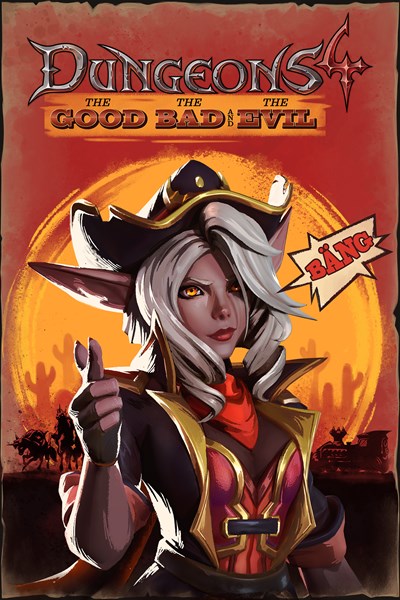
Dungeons 4 Heads West in New DLC: The Good, the Bad, and the Evil


Summary

  • Brynnhilde and her army of do-gooder Dwarves gather their forces as the last bastion against Thalya and the uprising of The Absolute Evil.
  • Contend with powerful new enemies wielding weapons dreamt up by the finest Dwarven blacksmiths.
  • Dungeons 4 – The Good, the Bad and the Evil releases on August 8, 2024. The base game is available now with Game Pass.

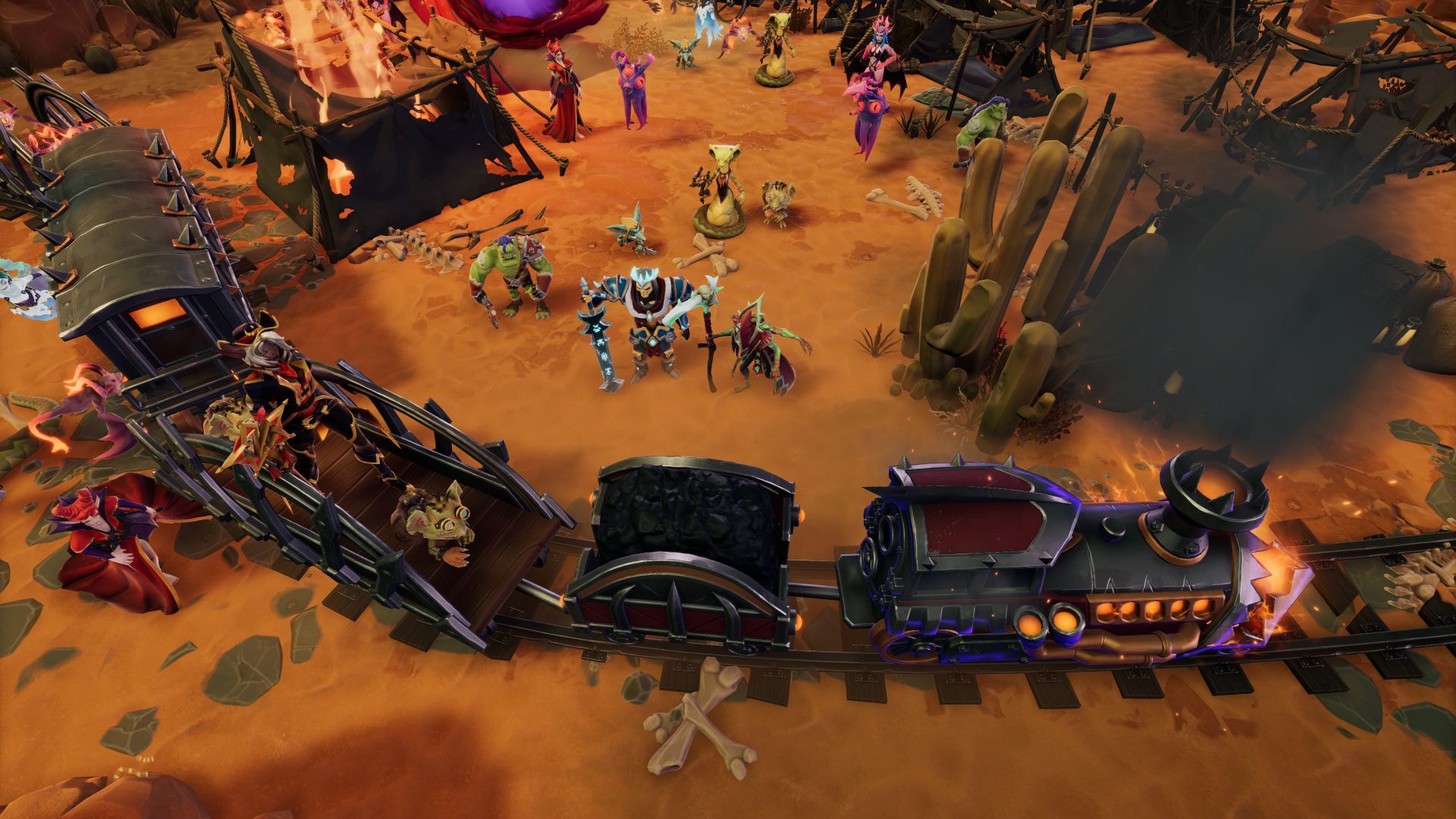
Tell them Thalya’s coming, and Hell’s coming with her! Dungeons 4 is catching a steam engine to the Wild West in its first DLC, The Good, the Bad and the Evil, on August 8, 2024, for Xbox Series X|S and Windows PC, taking you through a brand-new, western-inspired area of the overworld known as “The West.” The new frontier is bristling with opportunity for The Absolute Evil, featuring new enemies, environments, and challenges, including a 5-mission campaign that will revisit an old rivalry between the Dark-Elf Thalya and the Dwarf Queen Brynnhild, culminating in a duel at high-noon.

Brynnhilde and her army of do-gooder Dwarves gather their forces as the last bastion against Thalya and the uprising of The Absolute Evil. The feud reaches an epic climax as the minions of Evil battle against Dwarven gunslingers to determine the fate of the Overworld. But it won’t be easy; the Wild West is a dangerous place for even Thalya and her most formidable and evil Little Snots, and you will need to contend with powerful new enemies wielding weapons dreamt up by the finest Dwarven blacksmiths. Check them out below!

Dungeons 4 DLC Screenshot
  • The Pistolero is a pistol-wielding outlaw especially adept at close range battles. They draw their guns faster than you can say “Brynnhilde” and unleash their full clip with a fury before needing to reload.  
  • The Machine Dwarf is equipped with rotary guns powerful enough to pierce through even the most well-armoured Evil with maximum efficiency and speed, but with a slow enough reload time you might be able to take them out before they lay waste to larger areas.
  • The Crack Shot is capable of firing at long distances with extreme precision zoning in on one specific target.
  • The Brewmaster does more than just brew beer for his thirsty compatriots, but weaponizes the malted grain to damage to enemies and heal nearby allies.

And if these new daunting enemies weren’t enough of a challenge for the Absolute Evil, the mighty (irritating) Dwarves and their new gunslinging factions have turned to the tracks to capitalize on their new steam locomotives, which roar and chug through the prairie. Outfitted with more dynamite than you can shake a stick at, the Dwarves are pulling out all the stops to try and stop Thalya from conquering the Overworld.

Dungeons 4 DLC Screenshot

But, luckily for Thalya, the Train-Enthusiast Evil is a long-time Railway Empire 2 fan and has been conjuring up an idea for a locomotive of its very own. Traverse the West and research the necessary science to uncover the boundless resources of the dusty plains to build your own locomotive capable of destroying the Dwarves once and for all and put it to use for the good of all that is Evil!

Dungeons 4 – The Good, the Bad and the Evil releases on August 8, 2024, with the base game available to play now with Xbox Game Pass and PC Game Pass. So, there is only one question left to answer – do you feel evil, punk?

Dungeons 4 – The Good, the Bad and the Evil

Kalypso Media


Dwarves, steam locomotives, and a showdown at high noon – what could possibly go wrong? Dungeons 4 – The Good, the Bad and the Evil awaits the Absolute Evil and his more or less dedicated General Thalya with (train)wagon loads of evil work to do. Led by their fearless queen, Brynnhild, those pesky dwarves have infiltrated a new part of the Overworld, the West, and kidnapped the Council of Little Snots. This is unmistakably screaming for a proper treatment of Evilfication™!

In this latest adventure, the Only-too-familiar-with-hardships Evil has to face new enemies equipped with pistols, sniper rifles and rotary guns, and … a beer-brewing beast of a dwarf. But of course, the Cunning Evil is prepared and leaves you well-equipped with new traps and building options to protect your stony dungeon heart!

• Wicked Wild West: Dungeons 4 – The Good, the Bad and the Evil takes you into ‘the West’ with 5 new fully voiced missions in a brand-new setting. Thalya must pursue the Dwarven Queen Brynnhild and prepare for an epic showdown at high noon!

• Reinforcement of The Good™: Four new dwarven units spice up the battle between Evil and Good – the Pistolero, the Machine Dwarf, the Crack Shot and the Brewmaster.

• The Train-loving Evil rejoices: Steam locomotives roar through the prairie, filled to the brim with dynamite-throwing, gun-slinging dwarves. Crack their armour and unleash your inner train enthusiast, building your own train to punch the dwarves’ final ticket.

• Vermin alarm! Manavores, Spiders and Lavalumps are joined by the “delightful” Giant Scorpions that skulk through your dungeon and the overworld.

• Home Sweet Home: The Forces of Evil have enhanced your dungeon with new traps, like the lava-spitting Hydro-Lava-non or the Steam trap cooking heroes like dim-sum, and building options, like Floor Grates enabling you to build on lava or water.

• The return of the Dwarf Queen: Brynnhild is back in the game (and gosh, she even has a twin) and she’s using that steamy steel monster train against YOU!

• Dressed to kill: Thalya takes this literally! She goes full Wicked Wild West and even brings some new passive skills into the fight against the Good.

Xbox Live

Dungeons 4

Kalypso Media


582


$49.99

$39.99


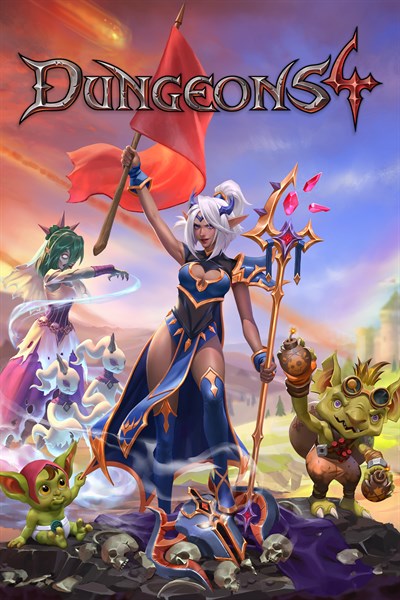
The Absolute Evil and its trusted *cough* servant, the Dark Elf Thalya, return in Dungeons 4 after the events of its fabulous predecessor to bring about their triumph over the forces of good once more.

Build a cozy and comfortable Dungeon to suit your creatures’ needs and rule over them, then send them out into the Overworld to kindly remind the good people living there that the Absolute Evil rules over their lands. Gather your Evilness in new and dynamic ways and unleash it upon the lush green forests and plains of the Overworld to turn them over to the dark side. But make sure that your Dungeon is well-secured by traps and defended by your creatures, for those pesky Overworlders won’t just twiddle their thumbs while you turn their land into the Absolute Evil’s most pleasurable holiday paradise.

But what is that noise? “Gold, gold, gold and gems, gold and gems and gold!” The ancient song echoes throughout the underworld, accompanied by the clanging steel of hammers and axes. The Dwarves have arrived to claim their share of the abundant resources and together with the Elves and Humans of the Overworld, they send out their raiding parties to find the Dungeon’s heart.

Dungeons 4 keeps the spirit of its predecessor, but everything is now bigger, better, and with even more dynamic Evilness™.

Features:
• Everything is better with Dwarves™: The Dwarves have arrived to build their underground strongholds and the hardy little fellows (although they don’t like being called that) compete with the Ever-Expanding Evil for space and resources.

• It makes your Dungeon great again: Dungeons are up four times larger than before and there are many more creatures who wait for the All-Commanding Evil’s orders to conquer the Overworld. Now the time has come for massive armies and truly sprawling dungeons!

• Ripe for the taking: The Overworld is bigger than ever before. Gain Evilness by beating Mini Bosses like the obsessively harmonious Unicorn and use it to transform the Overworld into stunning biomes of pure evil.

• New and shiny: An ability-based Perk system for Thalya, the Absolute Evil’s trusted *cough* and most loyal subordinate, grants her impressive new powers. The Absolute Evil can now enjoy taking over the world, governing the creatures and slapping subordinates even more with the customizable Evil Hand.

• Minions, everywhere: The Horde, the Undead and the Demons wait to do the Absolute Evil’s bidding, with more creatures than ever eagerly following the gesturing Evil’s orders, and Snots will play a much more prominent role this time.

• Many ways to tell the story: A long campaign, narrated by the beloved English Narrator from previous titles, as well as several skirmish maps all to challenge your rule as the Absolute Evil.

• Change the world: Spread your Evilness across the Overworld to bring lush and green environments over to the dark side, now shining even more vibrantly and beautifully evil as you spread your evilness across many new biomes.

• Work together, slay together: 2-player co-op multiplayer with both players managing one Dungeon together. All maps from the campaign and the skirmish mode are playable in co-op.

Xbox Live

Dungeons 4 (Win)

Kalypso Media


The Absolute Evil and its trusted *cough* servant, the Dark Elf Thalya, return in Dungeons 4 after the events of its fabulous predecessor to bring about their triumph over the forces of good once more.

Build a cozy and comfortable Dungeon to suit your creatures’ needs and rule over them, then send them out into the Overworld to kindly remind the good people living there that the Absolute Evil rules over their lands. Gather your Evilness in new and dynamic ways and unleash it upon the lush green forests and plains of the Overworld to turn them over to the dark side. But make sure that your Dungeon is well-secured by traps and defended by your creatures, for those pesky Overworlders won’t just twiddle their thumbs while you turn their land into the Absolute Evil’s most pleasurable holiday paradise.

But what is that noise? “Gold, gold, gold and gems, gold and gems and gold!” The ancient song echoes throughout the underworld, accompanied by the clanging steel of hammers and axes. The Dwarves have arrived to claim their share of the abundant resources and together with the Elves and Humans of the Overworld, they send out their raiding parties to find the Dungeon’s heart.

Dungeons 4 keeps the spirit of its predecessor, but everything is now bigger, better, and with even more dynamic Evilness™.

Features:
• Everything is better with Dwarves™: The Dwarves have arrived to build their underground strongholds and the hardy little fellows (although they don’t like being called that) compete with the Ever-Expanding Evil for space and resources.

• It makes your Dungeon great again: Dungeons are up four times larger than before and there are many more creatures who wait for the All-Commanding Evil’s orders to conquer the Overworld. Now the time has come for massive armies and truly sprawling dungeons!

• Ripe for the taking: The Overworld is bigger than ever before. Gain Evilness by beating Mini Bosses like the obsessively harmonious Unicorn and use it to transform the Overworld into stunning biomes of pure evil.

• New and shiny: An ability-based Perk system for Thalya, the Absolute Evil’s trusted *cough* and most loyal subordinate, grants her impressive new powers. The Absolute Evil can now enjoy taking over the world, governing the creatures and slapping subordinates even more with the customizable Evil Hand.

• Minions, everywhere: The Horde, the Undead and the Demons wait to do the Absolute Evil’s bidding, with more creatures than ever eagerly following the gesturing Evil’s orders, and Snots will play a much more prominent role this time.

• Many ways to tell the story: A long campaign, narrated by the beloved English Narrator from previous titles, as well as several skirmish maps all to challenge your rule as the Absolute Evil.

• Change the world: Spread your Evilness across the Overworld to bring lush and green environments over to the dark side, now shining even more vibrantly and beautifully evil as you spread your evilness across many new biomes.

• Work together, slay together: 2-player co-op multiplayer with both players managing one Dungeon together. All maps from the campaign and the skirmish mode are playable in co-op.

Dungeons 4 – Deluxe Edition Upgrade

Kalypso Media


1


$9.99

$8.99


The Dungeons 4 – Deluxe Edition Upgrade includes the digital artbook and soundtrack, nostalgic Dungeons 3 skins for Thalya and your Evil Hand, as well as a remaster of the classic Dungeons 3 map “The Storming of Dollaran”. See the nostalgic outfits in all their splendour, and the music will surely delight the culture-loving Evil.

Atomos Ninja Ultra Camera to Cloud workflow success story


TIDE Media’s creative Manager, Gareth Bartlett recently used Atomos’ Camera to Cloud offering to speed his onset and post production workflow. Bartlett works on some of the world’s biggest projects for marine & adventure brands. His day to day consists of managing videographers at international boat shows to filming models and lavish boats in spectacular locations such as Monaco, Palma and Norway. When he needed to turn around content the same day for social media that’s when he turned to Atomos

Bartlett and his team have a lot to consider since they work in different locations and climates. They need a solution that offers high quality images. The TIDE team uses Sony FX3 cameras, finding the combination of full-frame sensor and wide dynamic range ideal for capturing content on the go and the Atomos Ninja Ultra. “Gareth takes full advantage of the monitor-recorder’s high definition display to review footage and check image focus,” says Atomos. 

“Quality, portability and size of the monitor are all practical wins but being able to see the bigger picture makes me feel more confident in my job, securing the best shots for clients.”
Gareth Bartlett

The Ninja Ultra’s built-in monitoring features, such as frame guides and zoom control allow Bartlett to make quick changes in a touch of a button, which is important when he is constantly capturing wide and vertical shots. 

“We often need to capture content in different aspect ratios, so we’ll film in 16:9 but use the on-screen 9:16 overlay to frame and crop shots. This feature is a big one for us as it takes a lot of guesswork out of the shoot.”
Gareth Bartlett

The storage the Ninja brings is also a great addition to Bartlett’s workflow

“At boat shows we can shoot hundreds of boats each year, generating hours of content, so being able to record onto SSD is a massive benefit. We now shoot and edit from the same SSD – it’s another way we’ve removed the offloading process to speed up what we do.”
Gareth Bartlett

The TIDE team used the Atomos Connect module and Camera to Cloud (C2C) to send footage from boat shows wirelessy to their off-site editing suite. This feature was extremly valuable to them during this shoot. 

“Camera to Cloud allows us to shoot continuously while the footage is sent directly to editors in the press centre who can start putting the clips together. This allows TIDE Media’s sister publications, Powerboat and Rib magazine, to share the latest content to social media within the hour. The whole system works seamlessly to help us get footage quickly to the edit suite and through to social media in record time.”
Gareth Bartlett

Check out the full article here!

Learn more about Atomos here!