Save Now on YoloLiv YoloBox Ultra – Plus New Features and New Products


YoloLiv YoloBox Ultra – The Ultimate YoloBox Experience

  • Encoder, Monitor, Switcher & Recorder
  • Widescreen & Vertical Orientations
  • Stream to Facebook, YouTube, RTMPs, & more for widescreen
  • Stream to Instagram & TikTok vertical
  • 4 HDMI Inputs
  • 4K Streaming
  • ISO Recording
  • 8″ Display
  • NDI (additional $99 fee from YoloLiv)

$1,499.00 reg.
$1,399.00 PROMO
Offer expires 7/31/24

  • QualComm CPU 865: Streaming performance taken to the next level with a CPU upgrade
  • 4K Streaming: Every detail comes alive with crystal clear 4K streaming
  • ISO Recording: All the video inputs saved separately and completely for flexible post-production
  • NDIHX3 and SRT: Quality video transmission over Ethernet or WiFI. Low latency over the worst network
  • Horiztontal and Vertical Streaming: Switch orientation, stream to your favorite destinations in one device (Facebook, YouTube, Twitch, RTMP, Instagram, and TikTok)

YoloLiv YoloDeck Control Panel For YoloBox

  • 15 Customizable LCD Keys
  • Add Multiple Pages of Buttons
  • Switch Sources and Add Overlays
  • Adjust & Mix Audio
  • Launch & Control Scoreboard 
  • Control Instant Replay
  • Drag-and-Drop Actions to Keys
  • Configure from YoloBox
  • No Laptop Required

$149.00

YoloLiv YoloDeck Overview
Add your favorite features or frequently used tools into your complete streaming control workflow with this YoloBox streaming controller -YoloDeck from YoloLiv. Switch video sources, add graphics, adjust audio and more using the 15 LCD keys that can be customized and arranged to your specific layout needs, giving you power and control with the mere tap of a single key.


You Are In Control (of Your YoloBox)
15 LCD keys poised to trigger unlimited actions. One-touch tactile operation lets you start/end live stream, start recording, switch video source, add graphics, adjust audio, launch instant replay, adjust scoreboard and so much more, while visual feedback confirms your every command.


Customization, Precision and Flexibility
When you tap a key you trigger an action. What that key does is your decision. Simply drag and drop actions from the list on the right onto the keys. Instantly switch video sources, introduce overlay, feature a comment, adjust the audio, and launch instant replay – all at the touch of a button. Bring total freedom to your YoloBox streaming and streamline your video production workflow.


Never Been Easier & Faster
YoloBox simplifies live streaming with its all-in-one solution, and YoloDeck enhances it further. Just drag and drop desired actions to specific keys, sit back, tap a key, and you’ll have full control of your YoloBox. Deliver the best experience to your audience with confidence, right at your fingertips.


Your Entire Setup at Your Fingertips
You are not confined to just the 15 keys. Create unlimited pages of buttons tailored to any of your live streaming scenarios. Effortlessly navigate through pages on the fly, ensuring you always have the right actions at your fingertips for a seamless and dynamic live stream experience.


Explore More from YoloLiv

  • Encoder, Monitor, Switcher & Recorder
  • Widescreen Orientation only
  • Stream to Facebook, YouTube, RTMPs, & more
  • 3 HDMI Inputs
  • 1080p Streaming
  • 8″ Display
  • Encoder, Monitor, Switcher & Recorder
  • Widescreen Orientation only
  • Stream to Facebook, YouTube, RTMPs, & more
  • 1 HDMI Input
  • 1080p Streaming
  • 5.5″ Display
  • Encoder, Monitor, Switcher & Recorder
  • Vertical Orientation only
  • Stream to TikTok and Instagram
  • 2 HDMI Inputs
  • 1080p Streaming

local publish profile does not recognize $(“SolutionDir”), when publish in Visual Studio


In my solution I have many projects. In each project I have a publish profile “local.pubxml” inside “/properties/PublishProfiles”. In this publish profile I want to import a file “publishsettings.targets” which is in the root where the solution file is. This is the content of the .pubxml.

<Project>
<Import Project="$(SolutionDir)publishsettings.targets"/>
<PropertyGroup>
    <Configuration>Debug</Configuration>
    <Platform>Any CPU</Platform>
    <PublishDir>$(PublishDir)</PublishDir>
    <PublishUrl>$(PublishUrl)</PublishUrl>
    <PublishProtocol>FileSystem</PublishProtocol>
    <_TargetId>Folder</_TargetId>
    <TargetFramework>net48</TargetFramework>
    <LaunchSiteAfterPublish>True</LaunchSiteAfterPublish>
    <ExcludeApp_Data>False</ExcludeApp_Data>
    <DeleteExistingFiles>False</DeleteExistingFiles>
</PropertyGroup>

it does not work. In Visual Studio when I right click on the project and click “publish”, it does not recognize the $(“SolutionDir”).
But if I write the path directly for ex: c:\Repo\abc\abc\publishsettings.targets, it works.

I have tried to add the following in Directory.build.pros with no luck.

<SolutionDir>$(MSBuildThisFileDirectory)</SolutionDir>

I also tried “../../../../../../publishsettings.targets”, does not work.

Am I missing something here?

Nala to use $40M Series A to build B2B payments platform, scale remittance services


Nala, a remittance startup that is now widening its portfolio through a new B2B payments platform, has raised $40 million equity in a rare deal that becomes one of the largest Series A transactions in Africa. 

The oversubscribed round was led by San Francisco-based VC firm Acrew Capital, with participation from DST Global, Norrsken22, HOF Capital, and existing investor Amplo and a number of angel investors, including fintech founders Ryan King of Chime and Vlad Tenev of Robinhood.

Nala founder and CEO Benjamin Fernandes told TechCrunch the new capital injection, which follows a $10 million seed in 2022, will fuel the company’s global growth plans that involve scaling its remittance business to serve the Asian and Latin America markets.

Currently, Nala, through its consumer app, enables people domiciled in the E.U., U.K. and U.S. to send money across 249 banks and 26 mobile money services in 11 markets across Africa. Where Nala has integrated with mobile money services like Kenya’s M-Pesa, remitters can pay bills directly into local mobile wallets.

Fernandes says the decision to add payment capabilities was informed by user requests of a 360-degree control of their money. The fintech plans to scale these offerings to the planned new markets, starting with Asia.

Nala is also doubling down on its B2B payments platform launched in March to serve global businesses making payments into and out of Africa.

“This $40 million funding round marks a pivotal moment for Nala. It will enable us to go beyond remittances and extend our reach beyond Africa, building a robust payments ecosystem. We’re reinvesting this money to enhance our infrastructure, ensuring reliable, low-cost payments for all. With the launch of our own payment rails and the expansion of our B2B platform Rafiki, we’re not just talking about change, we’re building it. We’ve got some bold, ambitious plans, give us a couple of years,” said Fernandes.

Fernandes launched Nala in 2017 initially to offer local money transfers in Tanzania but pivoted to enable foreign remittances in 2021.

The startup’s new B2B platform, Rafiki, also powers Nala’s consumer app. Fernandes told TechCrunch in a past interview that they decided to build the payments platform to guarantee the reliability of its remittance services and to serve global businesses looking for dependable services.

Through Rafiki, which directly integrates with banks and mobile money providers, Nala says it is able to guarantee service availability for its consumer service. Besides, its own payment infrastructure implies lesser charges for the users of its consumer app, making it more competitive.

Guaranteeing service delivery, Fernandes said, has been the fuel behind the growth of the startup’s consumer business, which accounts for over 90% of its revenues currently. He said Nala is on the path to cross 500,000 customers and has already attained profitability.

The payments platform is also gaining clientele with early ones including U.K.-based fintech TransferGo which uses Rafiki for Africa payouts.

“For Rafiki, live customers on Nala range from global payroll providers such as Cadana to global remittance companies such as TransferGo and global banks doing cross border payments. The focus is enabling financial institutions and services to make cross border payments,” said Fernandes.

Opportunities in the remittance space

Nala’s plans for remittance services to other emerging markets such as Asia and Latin America comes after the World Bank predicted strong growth for the sector this year.

According to the World Bank’s Migration and Development Brief, remittance flows to sub-Saharan Africa are expected to grow by 1.5%  after a slight drop in 2023 when they settled at $54 billion. Growth is also expected in regions like East Asia and the Pacific (excluding China), South Asia, Latin America and the Caribbean. This growth means demand for remittance services will persist.

“In India, migrants send over $125 billion a year and the market is growing with more people leaving. This creates opportunities for those customers to be served but also global trade between regions that will only increase. The Asian and African regions have been trading more and money needs to move reliably to make this happen,” said Fernandes.

As demand for remittance support grows, the World Bank notes that sending money across borders remains costly. The global average cost of sending $200, for instance, was 6.4% of the amount sent. However, digital remittances cost was lower, at 5%, compared to non-digital at 7%, making a case for services provided by Nala and its peers, which include Flutterwave. Nala says bringing down the cost of sending money is at the heart of their offering.

Acrew founding partner Lauren Kolodny said, “We believe Nala will be the leader in remittances for the next generation of Africans who are expected to account for 35% of all the world’s youth by 2050,” adding that the team “has deep local knowledge, fintech expertise, and unique community building know-how to build the cross-border payment rails for the next billion.”

Top Phrases That Get People to Buy


If you’re going to make money blogging, you need to think of yourself like a store. Do you know the top phrases that get people to buy?

Think about a store starting from the ground up. When a brand new store is coming to a street near you, what does the process look like?

First, they usually send a postcard to all the people in the area alerting them that the store is coming soon.

Next, they start the construction phase. Then, once the store is built, they start stocking shelves and hiring employees.

A store would not open to the public until it’s shelves are completely stocked. In the same way, you don’t want to open your brand new blog until YOUR blog is stocked. You should have at least 20-30 posts live and active BEFORE you ever set your blog to be live.

Next, a store sends a follow up postcard to its community, announcing the store is now open, and usually giving them a coupon off their first purchase.

When you open your blog to the world, you should announce it everywhere, and have your newsletter subscribe all set up and ready to give out for free.

And while you SHOULD NOT sell ANYTHING on your blog until you have at least 50,000 pageviews per month (for many reasons), once you ARE able to sell, again looking at stores and what they do, you can bring those principles to what you do as a blogger.

There are some great phrases that sell, trigger words and top phrases that get people to buy. Just be sure that whatever you are selling is morally sound and is something you can stand behind whole-heartedly. After all, this is your name on the line and you always want to be found selling with complete integrity.

Are you curious about selling printables? You gotta check out my 30 Days to Creating a Thriving Printables Business! It’s JAM-PACKED with info to figure out if a printables business is right for you! 

Top Phrases That Get People to Buy

Here are some popular phrases that get people to buy, buying trigger words, if you will, that will help increase your sales…

  1. Inventory won’t last long
  2. Be one of the few
  3. Only available to subscribers
  4. Best deal all year
  5. Would you be interested in…
  6. Best sellers
  7. Best deal of the year
  8. Biggest sale of the season
  9. Biggest sale of the year
  10. No one can beat our prices
  11. Guaranteed
  12. Imagine…
  13. Buy one, get one free
  14. Tested
  15. Be the first
  16. Closeout sale
  17. Bonus
  18. Going out of business sale
  19. When I started using this… (list a benefit)
  20. Hassle free
  21. Doorbuster deals
  22. Everything must go
  23. Ironclad
  24. Lifetime
  25. Small investment
  26. Hurry or everything will be gone
  27. Let me take care of that for you
  28. I’d be happy to solve this for you
  29. Exclusive
  30. Factory deals
  31. …for pennies a day
  32. New
  33. Half off
  34. Save 50% on additional
  35. Get this deal here only
  36. Mega sales
  37. Massive liquidation
  38. One day only
  39. Online sale only
  40. Only 10 available
  41. Protected
  42. Only 4 left
  43. Now
  44. Only available online
  45. All the bells and whistles
  46. Savings won’t last long
  47. Best selling
  48. Proven
  49. Cancel anytime
  50. Offer
  51. Secret Sale
  52. Results
  53. Refund
  54. Invitation only sale
  55. Members only
  56. Premiere
  57. Complete
  58. Pulled some strings to offer
  59. Get them while they last
  60. These deals won’t last
  61. Time is running out
  62. Join us
  63. Free trial
  64. Unbelieveable discounts
  65. While supplies last

The five most persuasive words in the English language are:

  1. You
  2. Because
  3. Free
  4. Instantly
  5. New

The five best positive sales words to use in copywriting are:

  1. Discover
  2. Share
  3. Increase
  4. Create
  5. Promote

Short Term Sales Pitches

Many sales are pitched toward being a short term sale and use catchy sales phrases. The intention is to increase the likelihood of a buyer making a quick and firm decision. Do they want your product or not. If they do, they need to hurry and get it, because it won’t be at that price or available for very long.

This is a huge marketing strategy that is very good at getting people to decide quickly and purchase.

Some bloggers even put a countdown timer for how long the product is available. This helps show a potential buyer how much time they have to decide.

Low Pricing Sales Pitches

Another marketing strategy is to price the product lower than any of your competitors. However, I personally feel, this is a huge misstep.

Buyers generally don’t appreciate or value your product or service if it is lower priced. I learned this very important strategy while selling on eBay. I used to price my items lower than anyone else and while I got a lot of sales, I found that I was working a lot harder than I felt I needed to. So, I began pricing my items higher than any other competitor and was the highest paid eBay seller in my niche and ranked in the top 5 most sales on any given day.

The trick to asking a higher price, is to POUR ON THE VALUE!!! It must be top-of-the-line best product ON the market in order to ask a more premium price. In my personal experience, this has always served me much better than producing a lower quality produce and selling cheap…and a huge bonus, you work less too!

Remember to always try to give something free with your product and clearly state WHY it is a better option than other items currently on the market. Be sure that your potential buyer knows exactly what buying your product will “fix” for them. Whether it adds time, value, money, etc. to their life, you must be clear in your marketing strategy exactly why they should buy and why they should buy from YOU.


Want to discover companies that offer LEGITIMATE work at home opportunities? Here’s a list of 20 businesses that offer the best work at home jobs and opportunities online!!


The president ordered a board to probe a massive Russian cyberattack. It never did.


In this photo illustration, a Microsoft logo seen displayed on a smartphone with a Cyber Security illustration image in the background.

This story was originally published by ProPublica.

Investigating how the world’s largest software provider handles the security of its own ubiquitous products.

After Russian intelligence launched one of the most devastating cyber espionage attacks in history against US government agencies, the Biden administration set up a new board and tasked it to figure out what happened—and tell the public.

State hackers had infiltrated SolarWinds, an American software company that serves the US government and thousands of American companies. The intruders used malicious code and a flaw in a Microsoft product to steal intelligence from the National Nuclear Security Administration, National Institutes of Health, and the Treasury Department in what Microsoft President Brad Smith called “the largest and most sophisticated attack the world has ever seen.”

The president issued an executive order establishing the Cyber Safety Review Board in May 2021 and ordered it to start work by reviewing the SolarWinds attack.

But for reasons that experts say remain unclear, that never happened.

Nor did the board probe SolarWinds for its second report.

For its third, the board investigated a separate 2023 attack, in which Chinese state hackers exploited an array of Microsoft security shortcomings to access the email inboxes of top federal officials.

A full, public accounting of what happened in the Solar Winds case would have been devastating to Microsoft. ProPublica recently revealed that Microsoft had long known about—but refused to address—a flaw used in the hack. The tech company’s failure to act reflected a corporate culture that prioritized profit over security and left the US government vulnerable, a whistleblower said.

The board was created to help address the serious threat posed to the US economy and national security by sophisticated hackers who consistently penetrate government and corporate systems, making off with reams of sensitive intelligence, corporate secrets, or personal data.

For decades, the cybersecurity community has called for a cyber equivalent of the National Transportation Safety Board, the independent agency required by law to investigate and issue public reports on the causes and lessons learned from every major aviation accident, among other incidents. The NTSB is funded by Congress and staffed by experts who work outside of the industry and other government agencies. Its public hearings and reports spur industry change and action by regulators like the Federal Aviation Administration.

So far, the Cyber Safety Review Board has charted a different path.

The board is not independent—it’s housed in the Department of Homeland Security. Rob Silvers, the board chair, is a Homeland Security undersecretary. Its vice chair is a top security executive at Google. The board does not have full-time staff, subpoena power or dedicated funding.

Silvers told ProPublica that DHS decided the board didn’t need to do its own review of SolarWinds as directed by the White House because the attack had already been “closely studied” by the public and private sectors.

“We want to focus the board on reviews where there is a lot of insight left to be gleaned, a lot of lessons learned that can be drawn out through investigation,” he said.

As a result, there has been no public examination by the government of the unaddressed security issue at Microsoft that was exploited by the Russian hackers. None of the SolarWinds reports identified or interviewed the whistleblower who exposed problems inside Microsoft.

By declining to review SolarWinds, the board failed to discover the central role that Microsoft’s weak security culture played in the attack and to spur changes that could have mitigated or prevented the 2023 Chinese hack, cybersecurity experts and elected officials told ProPublica.

“It’s possible the most recent hack could have been prevented by real oversight,” Sen. Ron Wyden, a Democratic member of the Senate Select Committee on Intelligence, said in a statement. Wyden has called for the board to review SolarWinds and for the government to improve its cybersecurity defenses.

In a statement, a spokesperson for DHS rejected the idea that a SolarWinds review could have exposed Microsoft’s failings in time to stop or mitigate the Chinese state-based attack last summer. “The two incidents were quite different in that regard, and we do not believe a review of SolarWinds would have necessarily uncovered the gaps identified in the Board’s latest report,” they said.

The board’s other members declined to comment, referred inquiries to DHS or did not respond to ProPublica.

In past statements, Microsoft did not dispute the whistleblower’s account but emphasized its commitment to security. “Protecting customers is always our highest priority,” a spokesperson previously told ProPublica. “Our security response team takes all security issues seriously and gives every case due diligence with a thorough manual assessment, as well as cross-confirming with engineering and security partners.”

The board’s failure to probe SolarWinds also underscores a question critics including Wyden have raised about the board since its inception: whether a board with federal officials making up its majority can hold government agencies responsible for their role in failing to prevent cyberattacks.

“I remain deeply concerned that a key reason why the Board never looked at SolarWinds—as the President directed it to do so—was because it would have required the board to examine and document serious negligence by the US government,” Wyden said. Among his concerns is a government cyberdefense system that failed to detect the SolarWinds attack.

Silvers said while the board did not investigate SolarWinds, it has been given a pass by the independent Government Accountability Office, which said in an April study examining the implementation of the executive order that the board had fulfilled its mandate to conduct the review.

The GAO’s determination puzzled cybersecurity experts. “Rob Silvers has been declaring by fiat for a long time that the CSRB did its job regarding SolarWinds, but simply declaring something to be so doesn’t make it true,” said Tarah Wheeler, the CEO of Red Queen Dynamics, a cybersecurity firm, who co-authored a Harvard Kennedy School report outlining how a “cyber NTSB” should operate.

Silvers said the board’s first and second reports, while not probing SolarWinds, resulted in important government changes, such as new Federal Communications Commission rules related to cell phones.

“The tangible impacts of the board’s work to date speak for itself and in bearing out the wisdom of the choices of what the board has reviewed,” he said.

Windows 11 Professional 2024 Free Download (Preactivated)


Windows 11 Professional 2024 Free Download By WorldofpcgamesWindows 11 Professional 2024 Free Download By Worldofpcgames

Windows 11 Professional 2024 Direct Download:

The design of Windows 11Pro is completely new. Microsoft requires a compelling argument to retract its earlier assertions and replace Windows 10 with a new operating system version. And for that, a brand-new design is ideal. This announcement’s main component is a big update to the user interface. A large chunk of the UX modifications will be taken from the Windows 10X shell, even though Windows 10X won’t be released. There will be no more right angles. They will be replaced by fillets. On this topic, insiders and concept designers actually differ; some are certain that Microsoft will stick to its traditions and maintain right angles. On the other hand, some people are certain that Microsoft will adopt the fillet trend.

Everywhere there will be blur and a translucent background. Regarding the island style of window display, corner design, and menu levitation effect, opinions on the internet differ. Nonetheless, virtually everyone agrees that the windows are transparent. The majority of design renders and leaks display transparency and blurring in all windows, including Explorer and the Start menu.

Features and System Requirements:

  • The design of Windows 11Pro is completely new
  • And for that, a brand-new design is ideal.
  • Everywhere there will be blur and a translucent background.

1 :: Operating System :: Windows XP/7/8/8./10.
2 :: Processor: Intel Core i5-2500 @ 3,3 GHz (4 CPUs)
3 :: Ram :: 6 GB RAM
4 :: DirectX: Version 11
5 :: Graphics:: NVidia GeForce GTX 670 2GB
6 :: Space Storage:: 5 GB space

Turn Off Your Antivirus Before Installing Any Game

1 :: Download Game
2 :: Extract Game
3 :: Launch The Game
4 :: Have Fun 🙂

Can 3D Modeling Services for Lifestyle Product Images Boost Company Marketing?


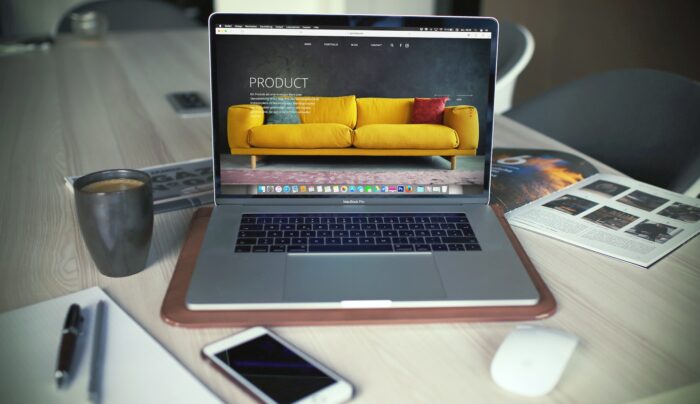
Lifestyle product images capture accurate representations of their actual use. Thanks to these images, customers can envision themselves using the product, making them more connected to it and to the brand that manufactured it. The key purpose of lifestyle product images is to evoke emotions among customers, convey the story of your brand, and establish a brand identity. Continue reading to learn how to utilize 3D modeling services for lifestyle product images to ultimately boost your company’s marketing efforts.

Why do you need lifestyle product images?

Your company’s advertising team has a long list of goals to achieve for your products and set them apart from the rest. Lifestyle product images give advertisers the ability to highlight the unique features of their products to make them more authentic and relatable for consumers. Here are the top reasons why your company needs lifestyle product images:

RELATED: How 3D product renderings help promote products on Amazon & Shopify

Position your brand better 

Your company can use lifestyle product images to allow customers to see your products more contextually. It comes in handy in positioning your brand and setting it apart from the rest.

Improve the recall value of your brand 

One of the most important goals of product advertising is brand awareness. Lifestyle product images designed by professional product concept designers serve as an effective tool to emphasize the distinct features of your product that make it more memorable. It then helps advertisers achieve three goals: introduce the brand to potential customers, convince them to buy from your brand, and remind them about your brand. 

Boost your sales 

Lifestyle product images can also increase your sales as they help you form an emotional connection and showcase the benefits of your products. In addition, you can also increase the perceived value of your product if you display how to use it in a real-life scenario. Lifestyle product images enhance the willingness of customers to pay because they now see your item as something they need to have. 

RELATED: How 3D product rendering and CGI help social media marketing for your company

Validate the cost of high-end items 

It’s only natural for high-end items to have premium price tags. After all, they are considered to have better features, higher quality, and more expert craftsmanship. Once executed correctly, lifestyle product images from 3D design services for high-end pieces can make it easier for you to convey the qualities and features of the product. It helps customers better understand your product, which justifies the price as a result. 

Top-of-the-line items appeal to people who want to project a particular lifestyle and immerse themselves in the sense of individuality. Lifestyle product images create this feeling of exclusivity that makes the product more enticing to the eyes of consumers who wish to lead a particular lifestyle. 

Promote loyalty among customers 

Emotions are the key driving factor in the purchasing behavior of today’s customers. Most purchasing decisions depend on emotional aspects. Your company can take advantage of lifestyle product images to form an emotional bond with your potential customers. With the help of these lifestyle product images, your product can look more authentic. It will help you generate leads and engage your target audience to gain their trust and turn them into loyal customers of your business. 

RELATED: Mastering 3D product modeling: company techniques and tips for stunning visuals 

3d-product-modeling-firm-2

Lower risk of returns 

Lifestyle product images and 3D product demo firms can offer a more complete view of your products and demonstrate their usage. It helps your customers to gain a better understanding of the functionality and features of your items. These lifestyle product images are pivotal for reaching a well-educated decision and lowering the risk of returns. 

How 3D modeling services change lifestyle product images

3D modeling is the three-dimensional representation of products made with the help of CGI or computer-generated imagery software. Since 3D technology was first used in lifestyle product images, it has successfully improved how the images are made and used across different industries. Lifestyle product images can showcase products in a more interactive, immersive, and realistic way. It allows your customers to gain a better understanding of your products and their features as they get to see and view them in detail from different angles. 

3D product rendering services for lifestyle product images allow efficient and quick production of more realistic images, as well as product animation that once required lots of money and time. These services changed how the products are made and showcased to customers, resulting in increased engagement and a boost to the company’s marketing.

RELATED: How Companies Utilize 3D Product Modeling Services for Compelling Product Imagery

Benefits of 3D modeling services for lifestyle product images

Here are some reasons why more and more companies are now using 3D modeling services for lifestyle product images for their firm’s marketing campaigns and efforts. 

Customize all you want

CGI allows 3D artists and designers to experiment with numerous variations and iterations of sizes and colors without spending a lot of time and money on several photoshoot sessions. Aside from this, the improved level of personalization and customization that lifestyle product images allow also helps form a more emotional connection with potential customers.

Ensuring consistency in all your product images, especially when several items are in question, can be a bit challenging. With 3D modeling, however, all images for your lifestyle products are made in digitally controlled settings that can help you achieve cohesiveness and a more consistent look across the entire product line. 

Improved cost-efficiency 

CGI also eliminates the money and time that would have been otherwise spent on physical prototypes. It’s because CGI technology allows you to produce 3D models that you can then use to create more images from various angles in different environments. 

RELATED: How to use 3D product modeling and 3D product photography for company advertising 

Speed up time to market 

With CGI technology allowing designers to quickly process and iterate product designs, it speeds up the time of bringing the product to the market. This is all thanks to the ability and flexibility to complete several revisions, resulting in quicker market time with the help of lifestyle product images. If revisions are necessary, for instance, it saves you from re-shooting everything from scratch because every modification is made with the help of 3D product modeling designers using 3D modeling software. So, once you’ve incorporated all the needed changes, you’re already good to go. 

3d design company

Better flexibility 

Depending on the needs of the customer, 3D modeling can give more freedom for iterations and rapid prototyping to allow retailers to improve and refine the design of their products. If you have always wanted to showcase your product in different settings but don’t want to bother with the hassle of preparing and shooting scenes or hiring models, you would be better off hiring 3D modeling services for your lifestyle product images. It’s the best means of showcasing your products for various uses and applications. 

Enhance efficiency and overall quality 

3D modeling gives businesses total control over texture, lighting, as well as other details that enhance the overall quality of the product. 3D models can also offer more valuable insight into the behavior of the product while it is in use. 3D modeling services such as lifestyle product images improve the efficiency of businesses because they can make more informed decisions regarding advertising, marketing, and other relevant strategies. 

RELATED: 3D CAD: 3D product modeling services cost, rates, and pricing for companies and firms

Allow interactive encounters

Like product configurators and virtual try-ons, CGI technology lets customers customize and visualize the products in real-time. It then enriches the overall experience for customers because they gain a better understanding of how the product looks in the existing environment, whether it is an office or home setting. 

Helpful marketing materials 

Your products convey the story of your brand, and marketing is the fastest way of communicating just that to your customers. There is no better way to present your abilities than by providing hyper-realistic lifestyle product images. With the help of trusted 3D modeling services, your company can expect to receive top-notch lifestyle product images for marketing purposes. 

It’s easy and quick 

Thanks to 3D modeling services, businesses can save themselves from the need to spend long hours in Photoshop. This modern technology speeds up the procedure of developing lifestyle product images. 

RELATED: How to design a 3D product visualization that converts company leads into clients 

Evoke realism

CGI also helps create premium quality and hyper-realistic lifestyle product images that you can use as long as you want for different purposes, whether for your online accounts or your physical catalogs. Using 3D modeling designers for lifestyle product images, you can create accurate product representations, especially those focusing on texture and minor details. These meticulously generated lifestyle product images help your customers gain more insights regarding your product as far as functionality and looks are concerned. 

More sustainable

With the help of 3D modeling services for lifestyle product images, your company also gets the chance to protect and preserve the planet. It’s all thanks to the elimination of the need for physical sets, props, and prototypes during the entire manufacturing process. 

RELATED: 5 Ways how rapid product development & prototyping benefits your company

How Cad Crowd can help

Your marketing efforts may simply go down the drain if you don’t use the right tools at your disposal. With the help of 3D modeling services for lifestyle product images, you can look forward to a more effective marketing campaign that you wouldn’t be able to achieve otherwise. Cad Crowd has an extensive database of top-notch 3D modeling services for your lifestyle product images that can ultimately help you reach your marketing goals in no time!

Best Prime Day PS5 Early Deals – DualSense Edge, B2G1 Free Games, And More


GameSpot may receive revenue from affiliate and advertising partnerships for sharing this content and from purchases through links.

Using Containers to move from local to Remote Development


April 4, 2022 by Olivia Guzzardo, @OliviaGuzzardo

One of my favorite things that industry professionals like to ask aspiring developers is, “How many lines of code does the average developer write per day?” Most guess in the hundreds or thousands – they’re always shocked to hear that the actual average figure lies in the tens.

Then what are developers doing with the rest of their time? Sure, there’s time spent on important tasks like code design and searching “How to center a div in CSS”, but an inordinate amount is spent on pure overhead – setting up projects, onboarding other developers, and troubleshooting issues that you can’t seem to repro on your own machine.

The Visual Studio Code team has used this insight as the heart of their research over the years: if we can reduce time spent on overhead, like reading about environment setup, then we can increase productivity time. We have a vision where developers don’t have to keep fighting the same battles over and over again. This means a consistent development setup that can handle the never-ending churn of version upgrades, configuration changes, and hardware refreshes.

But what does the path look like to get us there? Let’s examine the journey to increase developer productivity that has led us from local development, to container-based development, to the cloud.

Starting out with local development

Let’s begin where all developers start (and where a lot still are): local development. If you’ve ever uttered the phrase, “But it works on my computer!”, then chances are that you were in the local development phase. This means that everything for your development environment exists locally on your machine.

A shrug emoji saying "It works on my machine"

Let’s paint a picture of what local development looks like in the real world. Have you ever joined a new project, ready to get to work and start coding, but were instead handed pages of onboarding notes in order to get your environment up and running. You spend hours and hours waiting for install commands to finish and being bounced from colleague to colleague to troubleshoot build failures. It can be days before you can successfully run the project.

Then once you get over that onboarding hump, your team needs to update one of the project’s dependency versions. So then you have to install the updated version on your laptop, test the update, and push up any refactoring updates. But your laptop runs Windows and your teammates run macOS, and the changes aren’t working on their environment, and you have even more troubleshooting ahead of you.

And THEN, you need to make sure all the updates work in production too…

A meme showing a dog saying "This is fine" while sitting in a room on fire

Clearly, it is problematic when everything exists solely on a developer’s machine. Your machine may differ wildly from your teammate’s, whether that be from installed versions of dependencies, or from running an entirely different OS. This can lead to a never-ending cycle of configuration nightmares. Even if you get everything in sync with your coworkers, you lose any confidence that you won’t run into more issues when you go to deploy your code.

Wouldn’t it be nice to be confident that your development environment was the same as everyone else’s including the deployment environment? This brings us to our first advancement in streamlining development productivity: container-based development.

Containers are everywhere

“Containers” has been a big buzzword in the industry for a while now, so let’s dive into what exactly containers are. To understand the essence of containers, it helps to look at the comparison with a shipping container in the physical world.

In a simplistic view, physical shipping containers allow goods to stay as a unit. Everything that needs to go to Company A is in Shipping Container A. Upon arrival, Company A isn’t going to need to reach out to Container B and Container C to acquire their complete package; everything is packaged within Container A. Additionally, a company doesn’t need separate infrastructure to deal with, for example, a container full of furniture versus a container full of food. No matter the content, they have the tools necessary to pick up that container and bring it to its destination. This provides an efficient, standardized way of shipping products.

Containers first emerged in the virtual world for this exact same benefit: a streamlined way to ship products. They provide a way to ship your software as a unit, including all binaries, dependencies, and configuration files. This reduces the time spent on configuration overhead, as the container packages everything that the software needs to be run. The container can then be easily deployed from environment to environment. It’s predicted that by 2023, more than 75% of global organizations will be running containerized applications in production, up from less than 30% in 2020.

Traditionally, containers are used when the code is ready to be deployed to production. While this model certainly streamlines the end of the software development lifecycle, it doesn’t do much for developers when they’re actually writing and testing the code. To fill this gap, container-based development arrived.

Containers for developers

The idea behind container-based development is to introduce containers at the very start of the development process. Developers can then do all coding and testing in environments that are consistent with other environments, like production. When there is consistency across environments, time spent troubleshooting different code behavior from one environment to another can be mostly eliminated.

This brings us to the concept of a development container: a container that runs a full-featured development environment. A dev container houses its own app and dependencies, such as the required tools, libraries, and runtimes. In the diagram below, you can see that these dependencies exist in the containers and not on the host machine, which means that you can seamlessly switch between tech stacks in no time at all.
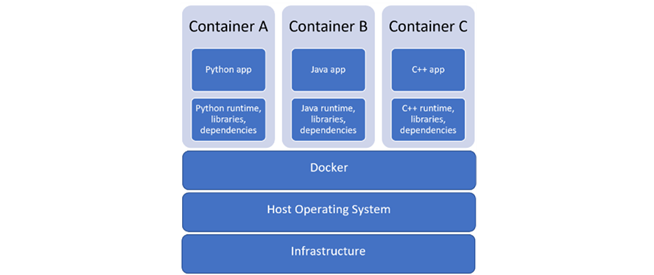
A diagram showing containers with different tech stacks

To provide a way to create and connect to dev containers, VS Code released the Dev Containers extension in 2019. This extension enhances local development by using the full power of dev containers, all while never leaving the comfort of VS Code. With over 11 million installs of the extension, it got us thinking: what if you could have a dev container that is hosted in the cloud?

Moving to the cloud

Let’s be real: everything is moving to the cloud, so why should your development environment be any different? Well, for one, the cloud is vulnerable to attacks. For two, it seems like we’re constantly hearing about major outages. For three, it can be pricey. For four… wait, isn’t the cloud supposed to be a good thing?

With all these reasons to be wary of the cloud, it can be uncomfortable to think about something as important as our development environment being hosted there. So let’s stay comfortable! Let’s continue relying on our 6-year-old laptop that makes really weird whirring noises if you try to open an email too quickly, let alone try to build a project. And we’ll just comfortably wait for the inevitable laptop crash, and then once we get our new laptop, we have to rebuild our dev environment and try to remember exactly how we had it configured.

Turns out staying in our comfort zone doesn’t sound so peachy either.

While there are inherent risks with the cloud, if you choose your cloud hosting service wisely, these risks can be mitigated – we’ll talk more about that shortly. With these concerns alleviated, you’re left to reap some major benefits of the cloud: scalability, faster performance, and easier maintenance, just to name a few.

Hosting in the cloud gives you access to another machine’s resources that can then be spun up quickly and available anywhere. Combine that with the benefits of container-based development, and developers can be up and coding in the blink of an eye.

Containers in the cloud

Running containers in the cloud is not a new concept; in fact, one study shows that at least half of all containers are running in the cloud. The basic infrastructure involves deploying a container to a cloud-hosted virtual machine. We can deploy our dev container to the cloud to provide a cloud-hosted development environment.

VS Code’s entry into this space comes from powering GitHub Codespaces. Within minutes, you can create and configure a dev container hosted in the cloud that is ready whenever you need it. You can then connect via VS Code (in either the browser or desktop) to a development environment that is managed completely for you, no longer relying on your laptop’s resources to handle the demand.
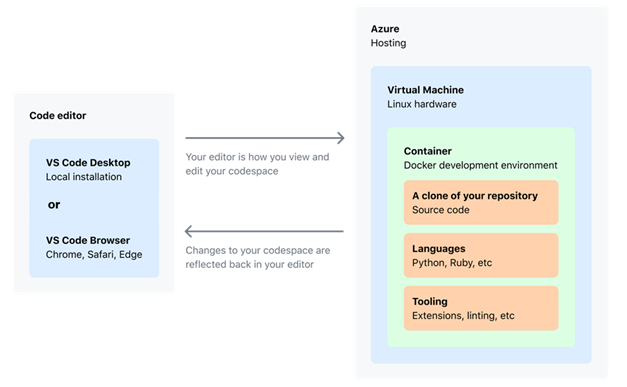
A diagram showing the infrastructure and workflow of Codespaces

The same dev containers used in the Dev Containers extension can be used in GitHub Codespaces, providing a seamless transition to the cloud.

But remember all of those scary possibilities of the cloud? Well, GitHub Codespaces alleviates those issues by leveraging GitHub’s cloud features. Codespaces run on compute options hosted on GitHub.com, and the feature is currently available for developers using GitHub Team or GitHub Enterprise Cloud.

GitHub bills on a per-user basis, so you’ll never pay for more than what you’re using. You also set a spending limit, getting rid of any surprise expenses. Additionally, GitHub can provide a service level agreement for 99.9% monthly uptime, and GitHub Advanced Security is available to ease any security concerns.

With the power of VS Code, GitHub, and dev containers, GitHub Codespaces provides a clear path to moving from local development to the cloud.

What’s next?

As developers, we want to spend more time developing software and less time on headache-inducing configuration. Trends in the industry can, and should, be used to empower developers to increase their productivity. We’ve explored how containers and the cloud can take us to the next level, and you can get started with Dev Containers to see for yourself. Now, what do you think could be the next step in making our lives even easier?

Happy Coding!

Olivia Guzzardo, @OliviaGuzzardo



The Beginner’s Brief Guide to Starting an Online Business


Home Business Magazine Online

Thanks to current technological advancements, it has never been simpler to start an online business from home. However, just because it is easier, doesn’t mean that it is a straightforward path. So, if you’re someone who has grandiose plans of starting an online business and needs some help — this one is for you.

Understanding the Online Business Landscape

Before we properly get into the basic steps you need to follow to start a digital company, you should learn more about the current online business landscape. The best way to start this off is by assessing other companies that are thriving in the virtual space. For instance, now take a look at the successful online casino sector.

Nowadays, users can play online slots from the comfort of their homes. This allows for an unprecedented level of convenience, along with variety as there are no space limitations that brick-and-mortar locales face. As such, people can select from hundreds of different slots, from fruit machine-esque games like 7 Gold Fruits to themed ones like Anubis Rising Jackpot King.

Of course, this is just one example, but which sector/company you choose to analyze will heavily depend on the niche you’re planning to enter. However, every business that is doing well in the digital world shares one thing in common: innovation. This is a necessity, as the current landscape is evolving at break-neck speed, following the growing needs of modern consumers.

Starting Out with Your Online Business

Now that you understand learning more about the current landscape and what to expect, it’s time to get a simple blueprint you can follow to create and start your own company. Most likely, you’ve already figured out your niche and have a business idea by this point, so the next part is understanding who your target audience is. If you’re not sure how to do this, there are several guides, such as the one from Adobe, that will help.

Following this, you should do some market research when starting an online business. This should cover everything from potential competitors to current trends and possible customer pain points. Once that’s done and dusted, you will need to actually start working on creating your products/services. If you’re doing this on a lower budget, we’d recommend finding investors to assist. If that’s not feasible, then start small and work your way up.

Finally, it’s time to let the world know about your existence by building an online presence. For entrepreneurs who don’t have a knack for website creation and design, we’d suggest utilizing a website builder service like Wix. Alternatively, you can use an e-commerce platform in the beginning, until you grow your business.

Since you’re just beginning the journey of starting an online business, you might want to keep your expenses as low as possible when it comes to marketing. Social media platforms will quickly become your best friend when it comes to this, giving you a chance to reach millions of users for a relatively small fee. While having a business account on every kind of platform will yield you the most success, it might be best to focus on the ones that your target audience typically uses the most.

starting an online business
Photo by Igor Miske on Unsplash

The online world is vast, with plenty of competition for each niche, making it daunting for new entrepreneurs. However, the effort and patience you put in may get you the financial freedom you desire.

The post The Beginner’s Brief Guide to Starting an Online Business appeared first on Home Business Magazine.