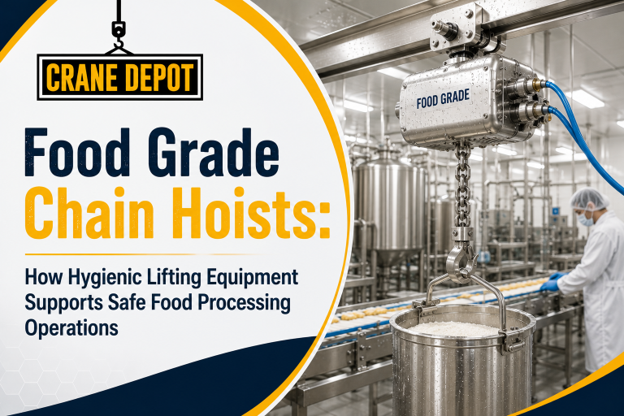

Maintaining strict hygiene standards is a top priority in every food processing facility. From handling raw ingredients to moving finished products, every stage of production depends on equipment that supports cleanliness, operational efficiency, and regulatory compliance. Choosing Food & Pharmaceutical Grade Hoists for these environments helps manufacturers reduce contamination risks while ensuring reliable material handling throughout the production process. A food grade chain hoist is specifically engineered to perform in hygienic environments where corrosion resistance, easy cleaning, and dependable lifting performance are essential.
Unlike conventional lifting equipment, hygienic hoists are built with corrosion-resistant materials and smooth finishes that withstand frequent washdowns and harsh cleaning chemicals. Their specialized design minimizes dirt accumulation and simplifies routine sanitation, making them ideal for facilities that operate under strict food safety protocols.
Why Hygienic Lifting Equipment Matters
Food manufacturers must maintain clean production environments to protect product quality and comply with industry standards. Equipment exposed to moisture, cleaning agents, and food particles should be easy to sanitize and resistant to corrosion.
A food grade hoist is designed specifically for these conditions. Its hygienic construction helps prevent contamination, supports frequent cleaning procedures, and delivers dependable lifting performance throughout demanding production schedules.
Using equipment that aligns with sanitation requirements also reduces maintenance challenges while improving overall operational efficiency.
What Is a Food Grade Chain Hoist?
A food grade chain hoist is a lifting device engineered for industries where cleanliness is just as important as lifting capacity. Whether manually operated or electrically powered, these hoists provide safe material handling while supporting hygiene requirements that standard industrial hoists are not designed to meet.
Typical applications include lifting:
- Raw ingredients
- Mixing vessels
- Processing equipment
- Packaging materials
- Finished food products
- Maintenance components
Their specialized construction makes them suitable for environments where regular cleaning is part of daily operations.
Key Design Features
Not every chain hoist is appropriate for food production. Hygienic lifting equipment incorporates features that improve sanitation while maintaining long-term durability.
Corrosion-Resistant Construction
Frequent exposure to water, humidity, and cleaning chemicals can quickly damage ordinary lifting equipment. Food-grade hoists utilize corrosion-resistant materials that help extend service life while maintaining hygienic conditions.
Smooth Exterior Surfaces
Smooth finishes reduce areas where food particles, moisture, and bacteria can accumulate, making washdowns faster and more effective.
Washdown Compatibility
Many food facilities perform scheduled cleaning several times each day. Equipment designed for washdown environments continues operating reliably even after repeated sanitation cycles.
Protected Mechanical Components
Enclosed moving parts reduce contamination while helping protect internal mechanisms from moisture and cleaning solutions.
Durable Load Chain
A high-quality stainless steel chain hoist configuration provides additional corrosion resistance in demanding processing environments where exposure to moisture is unavoidable.
Industries That Benefit from Hygienic Hoists
Although food manufacturing represents the largest application, hygienic lifting equipment is widely used wherever contamination control is essential.
Industries include:
- Food processing plants
- Beverage production
- Dairy manufacturing
- Meat and poultry facilities
- Seafood processing
- Bakeries
- Nutraceutical manufacturing
- Ingredient processing plants
- Pharmaceutical manufacturing
- Biotechnology facilities
Each of these industries requires lifting equipment capable of supporting both operational efficiency and strict sanitation procedures.
Factors to Consider Before Selecting a Food Grade Hoist
Selecting the right lifting solution involves much more than matching load capacity.
Operating Environment
Evaluate humidity, washdown frequency, chemical exposure, and ambient temperatures before choosing equipment.
Lifting Capacity
Choose a hoist capable of safely handling the maximum anticipated load while maintaining an appropriate safety margin.
Duty Cycle
Facilities with continuous production schedules often require equipment designed for repetitive lifting throughout the day.
Maintenance Requirements
Equipment that allows quick inspection and preventive maintenance helps reduce downtime while improving long-term reliability.
Material Construction
Stainless steel and corrosion-resistant finishes improve equipment longevity in sanitary production environments.
Considering these factors together helps ensure the selected lifting equipment supports both operational performance and food safety objectives.
Supporting Safe Material Handling
Efficient material movement is essential for maintaining production schedules while protecting product quality.
A sanitary hoist enables operators to safely lift ingredients, processing vessels, machinery components, and packaging materials without introducing unnecessary contamination risks. Reducing manual handling also helps improve workplace safety, minimize operator fatigue, and maintain consistent production workflows.
Facilities that invest in hygienic lifting equipment often experience easier maintenance, improved cleaning efficiency, and greater confidence in meeting sanitation requirements.
Integrating Hygienic Hoists into Material Handling Systems
A food grade chain hoist delivers the best performance when it is part of a complete hygienic lifting system. Manufacturers should evaluate the entire material handling process, including lifting frequency, workspace layout, load capacity, and cleaning requirements. Selecting equipment that works seamlessly with overhead cranes, monorail systems, or workstation cranes improves productivity while maintaining sanitation standards.
Many food manufacturers choose Food & Pharmaceutical Grade Hoists because they are specifically designed for clean manufacturing environments where corrosion resistance, easy maintenance, and reliable lifting are essential. For facilities that require maximum protection against moisture and aggressive washdown procedures, Stainless Steel Chain Hoists provide additional durability and long-term performance.
Cleaning and Sanitation Best Practices
Routine cleaning is one of the most important factors in extending the service life of hygienic lifting equipment. Since food processing facilities operate under strict sanitation programs, lifting equipment should be included in every scheduled cleaning procedure.
An effective maintenance routine should include removing food residue after production, using approved cleaning agents that are compatible with the hoist materials, inspecting exposed components for signs of corrosion, cleaning hooks and load chains thoroughly, drying equipment completely after washdowns, and documenting maintenance activities for future inspections.
Consistent sanitation practices not only help maintain equipment reliability but also support food safety programs and reduce unexpected downtime.
Food Grade Hoists vs. Standard Industrial Hoists
Although both types of hoists are designed to lift heavy loads, their construction and intended applications are significantly different.
A standard industrial hoist is built primarily for general manufacturing, warehouses, fabrication shops, and construction environments where durability is the primary concern. In contrast, a food grade chain hoist is engineered specifically for hygienic production areas where cleanliness, corrosion resistance, and washdown compatibility are equally important.
Food-grade models typically feature corrosion-resistant materials, smooth surfaces that simplify cleaning, enclosed mechanical components, and finishes that resist moisture and cleaning chemicals. These features help manufacturers maintain sanitary working conditions while ensuring dependable lifting performance throughout daily operations.
Understanding these differences allows businesses to select lifting equipment that matches both operational requirements and hygiene standards.
Choosing Between Manual and Electric Chain Hoists
The right lifting solution depends on production volume, lifting frequency, and operational efficiency goals.
Facilities with occasional maintenance work or lighter lifting tasks may find manually operated hoists sufficient. However, operations that handle heavy materials repeatedly throughout the day often benefit from Electric Chain Hoists, which reduce operator effort, improve lifting speed, and provide more precise load positioning.
Evaluating daily production demands, available workspace, and future expansion plans helps determine whether manual or powered lifting equipment is the better long-term investment.
Preventive Maintenance Improves Equipment Reliability
Preventive maintenance plays a critical role in maximizing equipment lifespan while minimizing costly downtime.
Regular inspections should focus on the condition of lifting chains, hooks, safety latches, braking systems, controls, and moving components. Worn or damaged parts should be replaced before they affect lifting performance or workplace safety.
Routine maintenance also provides opportunities to identify corrosion, moisture damage, or excessive wear before these issues become major operational problems.
A proactive maintenance program helps facilities maintain reliable lifting performance while supporting compliance with internal safety procedures.
Common Mistakes When Purchasing a Food Grade Hoist
Many organizations make purchasing decisions based only on lifting capacity or initial price. While these factors are important, hygienic environments require additional considerations.
One common mistake is selecting equipment that cannot withstand frequent washdowns or exposure to cleaning chemicals. Another is overlooking environmental conditions such as humidity, temperature fluctuations, or continuous moisture exposure.
Some facilities also underestimate future production requirements, resulting in equipment that becomes inadequate as operations grow. Delaying preventive maintenance or ignoring material compatibility can further reduce equipment lifespan and increase operating costs.
Considering long-term performance instead of focusing solely on purchase price helps organizations make better investment decisions.
Supporting Regulatory Compliance
Food manufacturers operate under strict quality and sanitation programs that require documented maintenance, equipment inspections, and cleaning procedures.
Using hygienic lifting equipment helps organizations simplify sanitation activities, reduce contamination risks, improve equipment accessibility for inspections, and maintain dependable material handling throughout production.
Although specific regulatory requirements vary by facility and product type, selecting lifting equipment designed for hygienic applications makes compliance easier while supporting operational efficiency.
Looking Beyond the Initial Purchase Price
Purchasing lifting equipment should be viewed as a long-term investment rather than a one-time expense.
Businesses should evaluate expected service life, maintenance requirements, cleaning procedures, replacement part availability, productivity improvements, downtime reduction, workplace safety, and total operating costs before making a purchasing decision.
Equipment that requires less maintenance while supporting reliable daily operation often delivers greater value throughout its lifecycle.
Future Trends in Hygienic Lifting Equipment
Food processing technology continues to evolve as manufacturers seek higher productivity and stricter hygiene standards.
Modern hygienic lifting systems increasingly feature improved corrosion-resistant materials, enhanced washdown compatibility, compact equipment designs, ergonomic controls, simplified maintenance procedures, and greater integration with automated production systems.
These innovations help facilities improve operational efficiency while maintaining the cleanliness and reliability required in today’s food manufacturing industry.
Final Thoughts
A food grade chain hoist is more than a lifting device—it is an essential part of maintaining safe, efficient, and hygienic material handling operations in food processing environments. Choosing equipment specifically designed for sanitation-sensitive applications helps manufacturers improve productivity, reduce contamination risks, and support long-term operational reliability.
When selecting a lifting solution, organizations should evaluate environmental conditions, cleaning procedures, maintenance requirements, lifting frequency, and future production goals instead of focusing only on lifting capacity. Investing in the right equipment today can reduce operating costs and improve workplace safety for years to come.
To build a complete hygienic material handling solution, businesses can combine Food & Pharmaceutical Grade Hoists with Stainless Steel Chain Hoists and Electric Chain Hoists, while exploring additional Crane Depot industrial crane solutions that support demanding food processing applications.
Find a Home-Based Business to Start-Up >>> Hundreds of Business Listings.