
If you run a business from home, the car is often part of the business. It carries samples to clients, hauls inventory to the post office, and doubles as the mobile office on sales days. So when the business moves to another state, or when the right work van turns up for sale 1,200 miles away, the question of getting that vehicle across the country stops being a personal errand and becomes a line item.
It is also a line item most owners guess at. Online quotes for the same trip can range by several hundred dollars, and the cheapest one is often the one that falls apart. Here is what car shipping actually costs, based on real prices paid rather than advertised ones, and how to put a number in the budget that holds up.
The Short Answer
At SAKAEM Logistics we built our pricing guide on a database of 335,037 completed vehicle shipments across the United States. Across all of them, the average price for a running car, SUV, or pickup on an open trailer was $1,175. The typical range was $925 to $1,380.
That range is a useful starting point, but distance moves the number more than anything else, so it is worth getting specific.
Distance Sets The Price, But Not The Way You Might Expect
On routes of roughly 1,000 miles, think Chicago to Dallas or New York to Atlanta, the typical price in our data was $870 to $1,096, with a median of about $972. That works out to just under a dollar a mile.
Double the distance and the price does not double. On routes of about 2,000 miles, the typical range was $1,109 to $1,379, with a median around $1,224, or roughly 61 cents a mile. Long hauls are cheaper per mile because the truck spends its time driving instead of loading and unloading. Short regional moves are the most expensive per mile for the same reason.
For a business owner, that has a practical consequence. If you are deciding between two vehicles for sale, one 300 miles away and one 1,500 miles away, the shipping gap between them is usually smaller than you would guess.
What Pushes The Number Up or Down
Once you know the distance, five things decide where in the range you land.
- Vehicle size. A full-size pickup or cargo van takes more deck space and weight than a sedan, and it is priced that way.
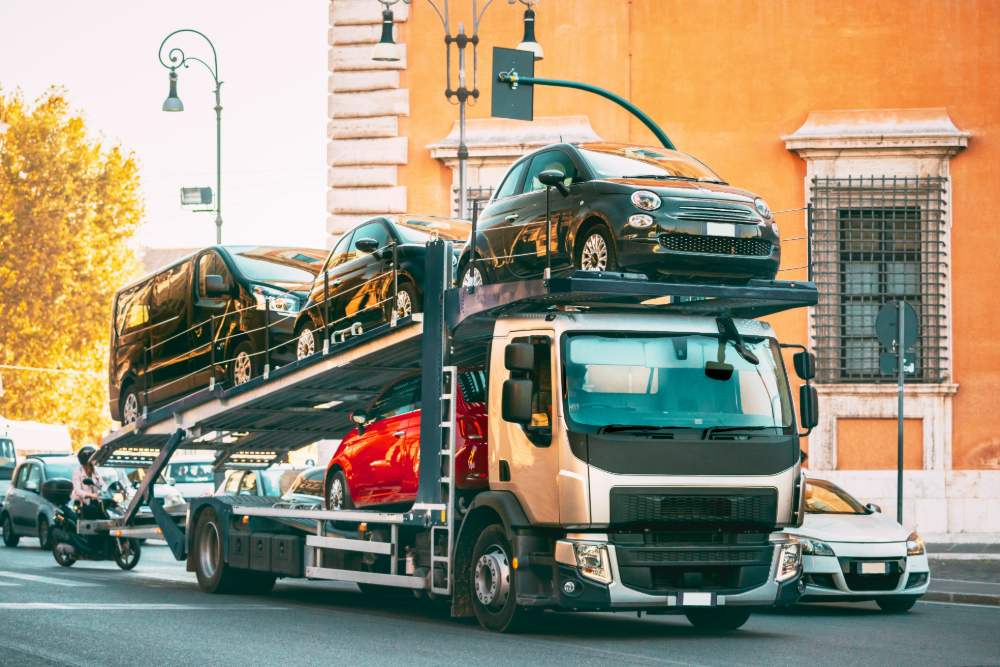
- Trailer type. Open trailers, the two-deck rigs you see delivering to dealerships, are the standard. Enclosed trailers protect against weather and road debris, and in our data they averaged $1,813 against $1,175 for open. Unless the vehicle is a classic or high-value, open is the sensible choice.
- Running condition. A vehicle that does not run needs a winch and extra loading time, which added about $300 on average.
- The route. Busy interstate corridors price tighter than remote towns, because more trucks compete for the load.
- Timing. Mid-fall and mid-winter are generally the calmer months. The January snowbird rush into Florida and the summer relocation season push prices up on the busiest lanes.
Ship It Or Drive It: Run The Numbers Like a Business
Many owners assume driving is free. It is not. The IRS standard mileage rate is 70 cents a mile, which is the government’s own estimate of what it costs to operate a vehicle once fuel, wear, maintenance, and depreciation are counted. On a 2,000-mile trip, that is $1,400 in vehicle cost alone.
Add hotels and meals for three or four days on the road, then add the most expensive item for any business owner, which is three or four days of your own time not spent on clients. Against a typical shipping price of around $1,224 for the same distance, driving rarely wins on long trips. Under 500 miles or so, driving is usually cheaper. The break-even for most people lands somewhere between 500 and 800 miles.
How To Build a Budget That Holds
The most reliable way to plan is to start from real prices on your specific route rather than a national average. You can estimate your car shipping cost for any pair of states with our free calculator, which shows the range customers actually paid on that lane, including the low end and the high end. Then build the budget around the middle of that range, not the bottom.
A few habits make the number stick.
- Book two to seven days ahead. That is enough time to match the vehicle with the right truck without paying for a rush. Same-day bookings are possible on busy routes but cost more.
- Give a pickup window, not a pickup hour. A flexible window of a few days lets the vehicle ride on a truck that is already heading your way.
- Be wary of the lowest quote. In our data, the cheapest quarter of customers paid about $662 on a 500-mile trip, $870 at 1,000 miles, and $1,174 coast to coast. A quote well below those floors usually means no carrier will take the load at that price. The result is a pickup that keeps slipping and a price that climbs after you have committed.
- Do not pay a large deposit up front. A reputable broker should not charge until a vetted carrier is actually assigned to your shipment.
Buying a Work Vehicle Out Of State
The same math applies when buying a vehicle. A used cargo van or pickup from another state may offer better value, even after adding the car shipping cost. Before agreeing to the deal, get an estimate for the exact route and add it to the purchase price. Ask the seller to confirm that the vehicle runs, since non-running vehicles cost more to load. Arrange for someone you trust to sign the inspection report at pickup.
The Bottom Line
For most long-distance moves, shipping a car typically costs $925 to $1,380 on an open trailer, and it is often cheaper than driving once your time is counted. Treat it like any other business expense. Get real numbers for your route, budget for the middle of the range, and choose a provider who does not ask for money before your shipment has a truck.
Find a Home-Based Business to Start-Up >>> Hundreds of Business Listings.