Choosing the right AI implementation partner for franchises is no longer just a technology decision. Most franchisors have stopped asking whether to use AI. The harder question is whether to hire a consultant, an agency or a partner that can deploy AI across the entire franchise network.
In our last post, we compared Weam to franchise AI software. Software gives you a tool. Someone still has to make it work across 20, 80 or 400 locations. That someone is usually a service firm, and service firms come in three shapes:
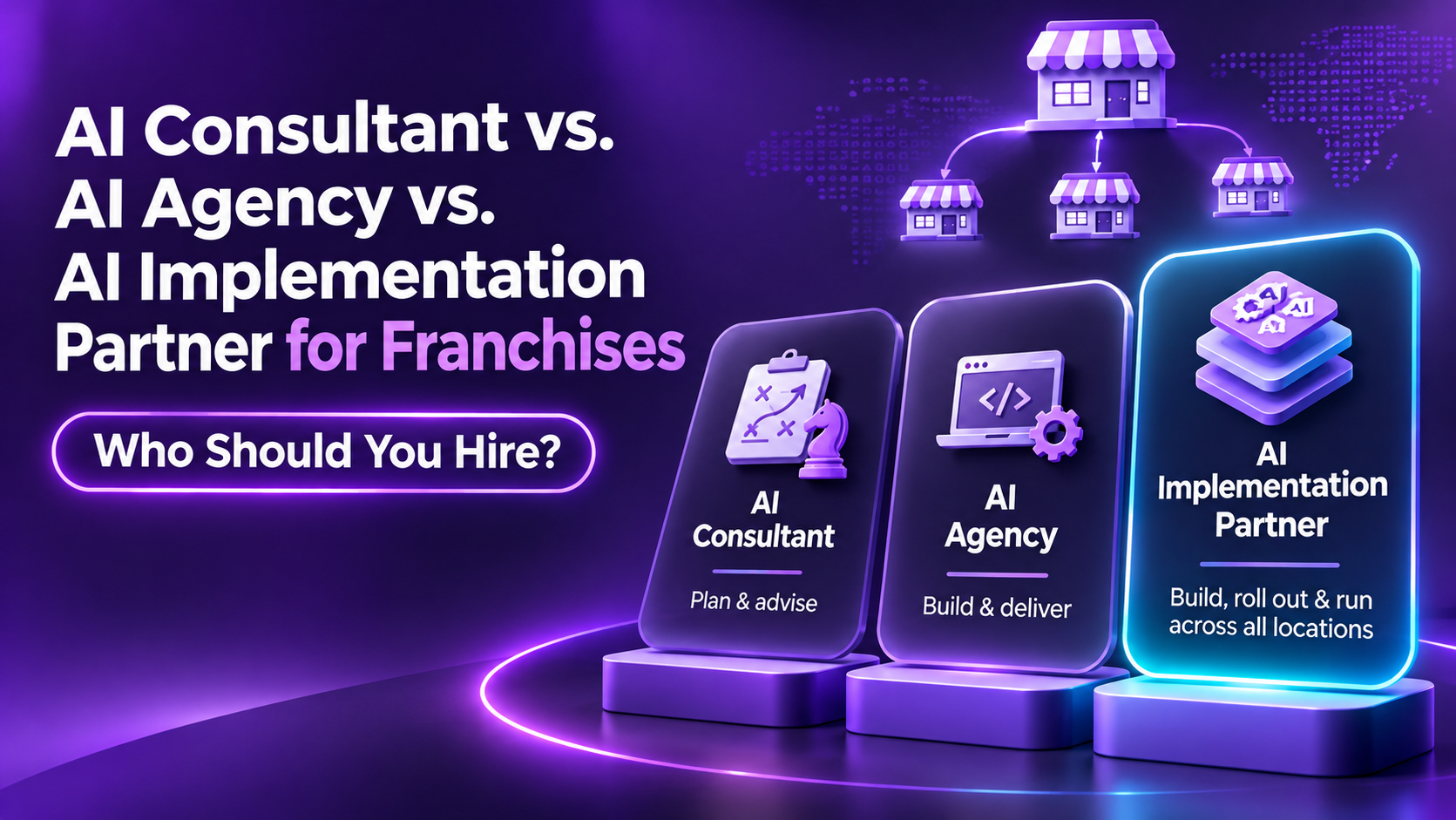
- AI consultants tell you what to do.
- AI agencies build what you specify.
- AI implementation partners build it, roll it out to every location, and keep it running.
The labels blur, and many firms use all three. What matters is the operating model behind the label, because it decides who is accountable six months after launch. This guide compares each model for a franchise system, names real firms in each camp, and gives you questions to use on any sales call.
Disclosure: Weam is an AI implementation partner, so we sell one of the three options below. We’ve linked each competitor’s own pages so you can check our descriptions, and we mark our opinions as “Our view.”
One caution up front: AI in a franchise system is a legal question as well as an operational one. A 2025 IFA Legal Symposium paper on practical AI use in franchise systems gives a full section to franchise-agreement issues. Whoever you hire should understand both sides.
Key Takeaways
AI consultants help franchisors identify opportunities and create a roadmap.
AI agencies build defined solutions; ongoing support depends on the agreement.
An AI implementation partner for franchises combines strategy, development, rollout and ongoing optimization.
Compare vendors on total 12-month cost, franchisee adoption, ownership and post-launch accountability.
AI Consultant vs. AI Agency vs. Implementation Partner: At a Glance
Consultants typically focus on planning, and agencies generally focus on the build. An implementation partner carries the work through rollout and ongoing improvement, subject to the agreed scope.
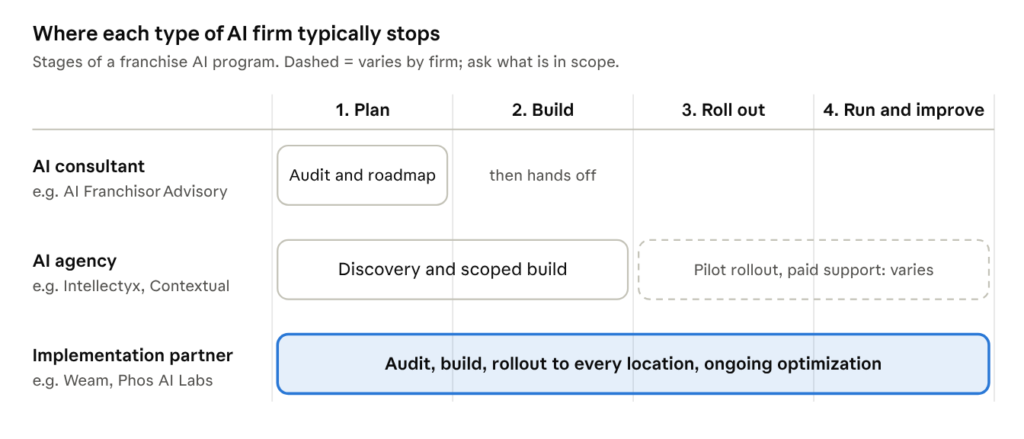
Who covers what · consultant vs. agency vs. implementation partner
Option 1: AI Consulting for Franchises
An AI consultant’s main deliverable is clarity: an audit, a prioritized list of use cases, and a roadmap.
AI Franchisor Advisory is a franchise-focused example. Its website describes an analyze, strategize and automate framework, an AI Franchise Efficiency Audit, and a custom AI roadmap built around your franchise model. Phani Kumar of AI Franchisor Advisory also spoke on a webinar about nine ways franchisors can use AI, listed by Gerson Advisory Services.
Where consultants shine
- You don’t yet know where AI fits and want an outside view.
- Your board or franchise advisory council wants a documented plan before spending.
- You have strong internal IT that can execute once the plan exists.
Where they fall short for franchisors
- A roadmap does not answer a phone call, draft a review reply, or reconcile a royalty report.
- If the firm stops at strategy, you still need someone to build. That means a second vendor, a second ramp-up, and context lost in between.
- Advisory work is often billed as a retainer. Ask for the full 12-month cost, not the first month.
Before you sign, ask one question: who builds what’s in the roadmap, and are they paid to keep it working?
Option 2: The AI agency or development firm
An AI agency builds software to a defined scope. You agree on what gets built, they engineer it, and the core project ends at go-live. Some agencies also sell ongoing operation of what they build, so check how that is scoped and priced.
Two firms franchisors are likely to meet in this category:
- Intellectyx is a Denver-based enterprise AI agent developer whose broader work centers on banking, financial services and manufacturing. Its franchise operations page describes agents trained on operations manuals and franchise agreements, with discovery to pilot in 6 to 12 weeks and network-wide rollout after validation at select locations. Intellectyx also describes itself as designing, building and operating production AI, so ongoing support is available.
- Contextual focuses on high-volume back-office work for multi-location operators. It promises working AI in about 8 weeks through discovery, build, feedback and go-live, delivered on its own platform. It says clients should own their AI.
Where agencies shine
- You know exactly what you need, such as one invoice pipeline or one custom agent.
- You have an internal owner who can run the system after handoff.
- The project is large and engineering-heavy, where a dedicated build team pays off.
Where they can fall short for franchisors
- Scoped projects end. Franchise systems don’t. Locations open, menus change, POS vendors switch, and AI models update every few months.
- Custom builds carry real minimums. Intellectyx’s DesignRush profile lists a minimum project budget of $25,000 to $50,000.
- Many agencies serve several industries. Franchise realities like brand compliance, royalty reporting and franchisee adoption may be learned on your project.
The question for an agency: what happens in month 7, when a workflow breaks or your needs change, and is that in the contract?
Option 3: The AI Implementation Partner for Franchises
An AI implementation partner for franchises takes responsibility for more than just the plan or the build. It finds the use case, builds the workflow inside your existing tools, rolls it out across locations, and keeps improving it month after month.
This is the model Weam is built on. Instead of a one-off project, franchisors get a fractional or dedicated team of AI engineers, data specialists and operations people on a fixed monthly plan. In practice:
- Use case first. Engagements start with a cost-saving audit to find where manual work costs the most.
- Fast first win. Most networks deploy their first AI workflow within 14 days. A first rollout typically follows in about 30 days.
- Works with your stack. Workflows plug into tools franchises already run, such as Toast, Square, Salesforce, FranConnect and QuickBooks.
- Franchise-native use cases. Roll-up reporting, local SEO, reputation management, royalty audits, voice agents and brand compliance. See the full list on our use cases page.
- Predictable cost. Pricing is $2,797/month for a Fractional Team and $5,594/month for a Dedicated Team, with no setup fees.
- Team enablement. Your staff learn alongside the build, including through our AI bootcamp for franchise marketing teams.
What the plan does not cover: workflows are built one after another, not all at once, so the Fractional plan moves slower than the Dedicated plan. Third-party tools, software licenses and API costs are extra; we scope them in advance and proceed only with your approval.
“In three months, local marketing output jumped 2x and reporting time dropped from 40 hours to under 10.” — H. Delaney, Franchise Operations (Weam client).
Weam is not the only firm selling this model. Phos AI Labs, for example, lists its own franchise implementation retainer at about $10,000 per month. Use the questions below on any of them.
Where an implementation partner may not fit (our view): if you want a single board-ready strategy document and nothing else, a consultant is cheaper. If you need one large custom platform with a fixed spec, a large agency may suit better.
Want the playbook view first? Read Five Real AI Automations for Franchisors and Before You Use AI, Run This Cost-Saving Audit.
AI Consultant vs. AI Agency vs. Implementation Partner: Side-by-Side Comparison
The biggest difference is not price or talent. It is who is still accountable once the system is live.
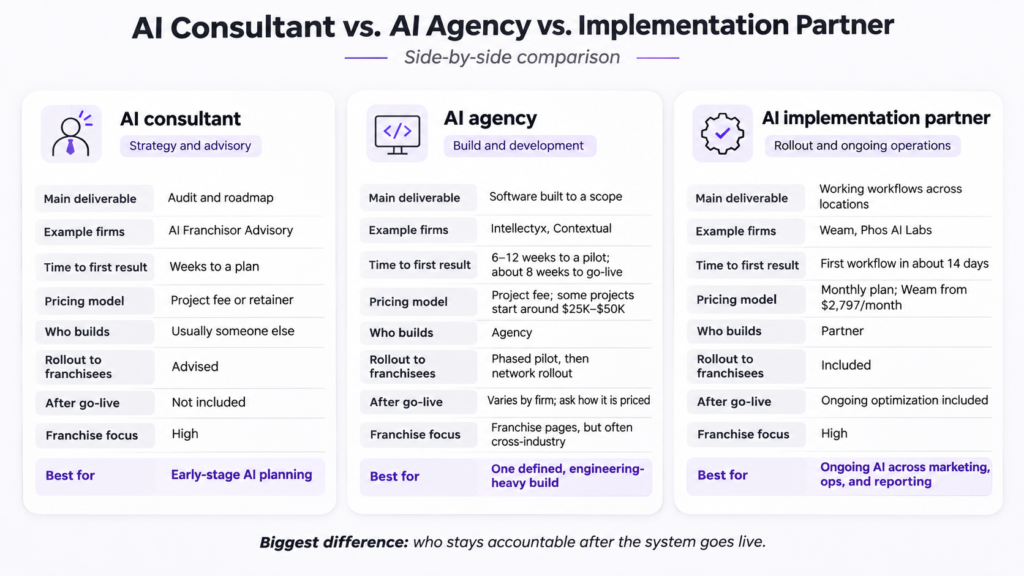
Competitor details reflect each firm’s public pages as of November 2026.
7 Questions to Ask an AI Implementation Partner for Franchises
Use these questions on every sales call, including ours. Whether you are evaluating AI consulting for franchises or a long-term implementation partner, compare the actual scope of work rather than the vendor label.
- Who builds it, and who maintains it after launch? If the answers are different companies, plan for the gap.
- When will one workflow be live at one location? Ask for a target date in writing.
- Which of our existing tools will you connect to? Good partners work inside your POS, CRM and franchise platform instead of replacing them.
- Where does human approval sit? Brand-facing content and franchisee-facing recommendations should pass a person before they go out.
- How will franchisees adopt it? A tool HQ loves but locations ignore delivers nothing. Ask how they handle your franchise advisory council and early-adopter locations.
- What does month 7 cost, and how will we measure savings? Compare 12-month cost, and agree on hours saved, costs cut or revenue recovered before work starts.
- Who owns the workflows and data if we leave? Get the exit terms in writing, especially if the firm runs your AI on its own platform.
For example, a franchise network that wants to automate local review responses may first need a consultant to identify the opportunity. An agency could build the response workflow. An AI implementation partner for franchises would also coordinate a pilot, configure brand approval rules, onboard locations and monitor the workflow after launch. The right choice depends on which of those responsibilities your internal team can handle.
Franchise AI Implementation: Risks to Raise with Counsel
Any firm you hire should be comfortable discussing these three issues. This is not legal advice; bring franchise counsel in early.
- Your right to roll out new technology. Osler notes that franchisors should check their franchise agreements for the right to add AI, which usually sits in the system modification or system change clause.
- Shared data and pricing tools. In October 2026, McDonald’s was sued over an AI-enhanced pricing tool offered to franchisees, with the suit alleging it shares nonpublic store data. McDonald’s denies the claims and says franchisees set prices. Any AI that pools location data or recommends prices deserves legal review.
- Control over franchisee operations. AI that schedules, screens hires or directs daily work at franchised locations can raise questions about how much control HQ exerts. Keep franchisee-facing tools optional where counsel advises, and document who makes the final call.
Panelists at the 2025 IFA Legal Symposium session on AI recommended a written AI policy as a starting point.
How to Choose the Right AI Implementation Partner for Franchises
Hire a consultant if you need a plan. Hire an agency if you need one defined thing built. Choose an AI implementation partner for franchises if you need AI working across your locations and staying that way.
In our experience, franchisors rarely stall for lack of ideas or engineering talent. They stall in the gap between a good pilot and 100 locations using it every day. An implementation partner is built to close that gap.
Ready to see where AI can save your system money first? Book a free cost-saving audit with Weam and we’ll map your first workflow in one call. Have questions? Our FAQs cover setup, pricing and integrations.
Frequently Asked Questions
What is an AI implementation partner for franchises?
An AI implementation partner for franchises identifies use cases, builds AI workflows inside existing tools, rolls them out to locations, and maintains them after launch. A consultant typically focuses on planning, while an agency usually focuses on the build. Actual responsibilities depend on the contract.
How much does AI implementation cost for a franchise system?
It depends on the model. Agencies price per project; Intellectyx lists a $25,000 to $50,000 minimum on DesignRush. Implementation partners charge monthly; Weam’s plans start at $2,797/month. Add third-party software and API costs to any quote.
How long until a franchise AI workflow goes live?
Published timelines range from about 14 days for a first Weam workflow to 6 to 12 weeks for an Intellectyx pilot. Rollout across a whole network takes longer and depends on franchisee adoption.
What is the difference between an AI consultant and an AI agency?
An AI consultant typically identifies opportunities and develops a strategy, while an AI agency engineers a solution against an agreed scope. Both may offer additional services. Ask who will own franchise AI implementation, training and ongoing maintenance before signing.
Do we need franchisee approval to roll out AI?
Check your franchise agreement’s system modification clause with counsel. Even where you have the right, involving your franchise advisory council early improves adoption.