Havn didn’t do much wrong with the HS 420. It’s easy to build into and looks great once the build’s done. But it is absolutely huge and heavy. So, at Computex 2026, Havn had an answer for that.
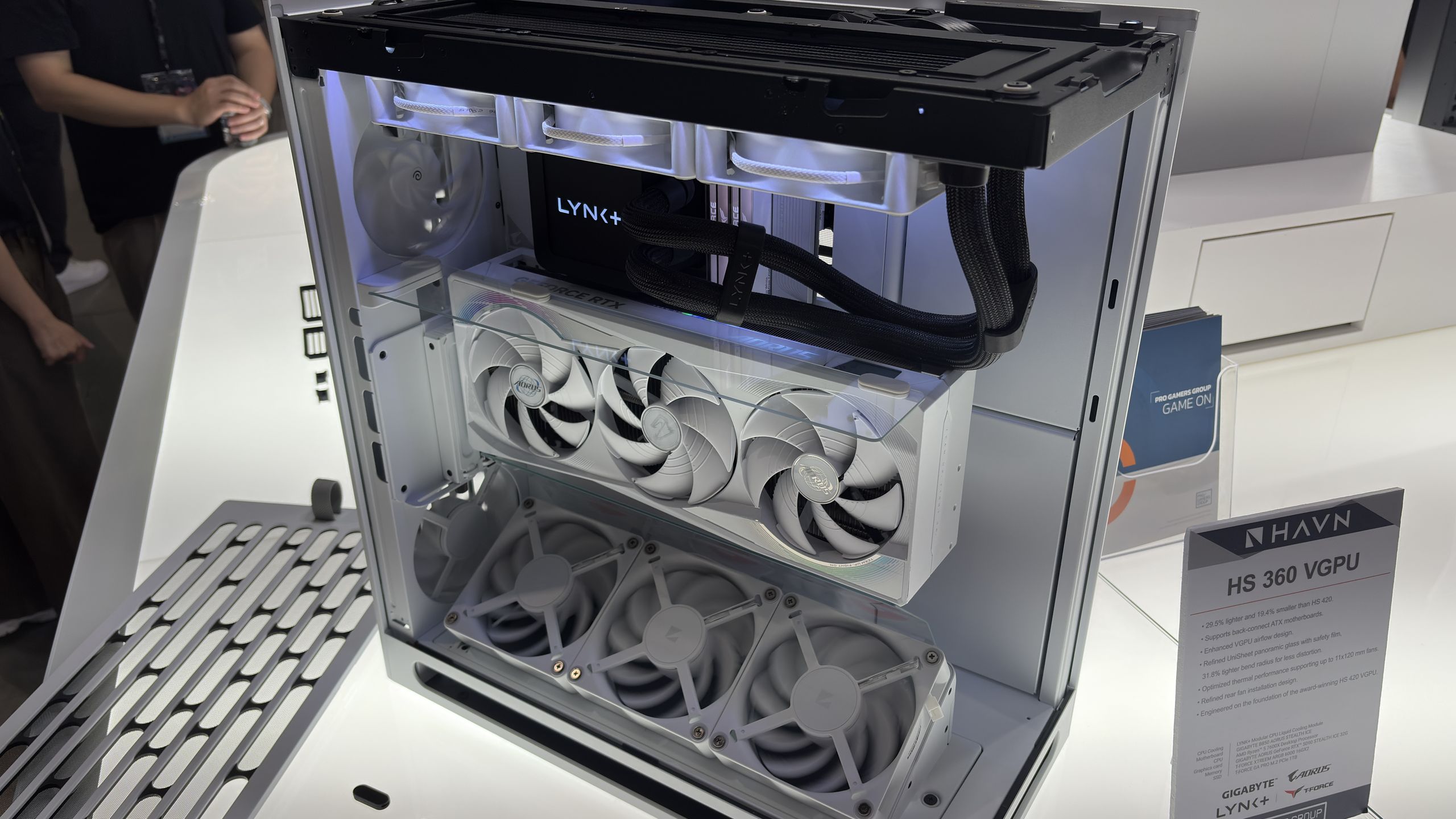
It’s called the HS 360 and it is very similar to the HS 420, only smaller. Specifically, it’s 19.4% smaller and 29.5% lighter, the company says.
I’m told the panoramic glass, which wraps around the front to the side of the case, required a slight reduction in thickness and a tighter bend radius to match the newly shrunken chassis and cut down on weight.
Latest Videos From
“I think we could probably claim that it’s the tightest bend on any glass panel,” Havn’s Steven Levitt tells me.
One new feature on the HS 360 is the inclusion of a magnetic glass divider, which sits above a graphics card using the vertical GPU mount. The idea is that cold air coming through the bottom of the case—the case uses a chimney layout with cool air coming up through the bottom—a lot of it was escaping right out the top along the front third of the case. By adding in something to block the air, counter-intuitively, I’m told temperatures are reduced by three degrees.
There are a couple of minor improvements to how fans are mounted in the case, too. People who have used the HS 420 will know what I’m on about, but the fans need to be installed from inside the case, which is a pain once components are installed. The HS 360 has brackets that let them be installed in the rear, and the lower three fans can also be lifted out from both sides for easier access.
Image 1 of 5
(Image credit: Future)
(Image credit: Future)
(Image credit: Future)
(Image credit: Future)
(Image credit: Future)
The HS 360 also has a really smart solution for back-connect motherboards—those with all the connectors on the rear for a smarter appearance. The tray to the side of the motherboard tray, with the cutouts that a 24-pin motherboard cable would usually run through, flips around, which means a back-connect motherboard can fit here, and there aren’t any unnecessary cutouts for a cleaner look. Smart.
Keep up to date with the most important stories and the best deals, as picked by the PC Gamer team.
All of these upgrades would be great on the larger HS 420, too. So I asked Levitt about that, and he told me they’re working on it, but it’s something for the future. Perhaps a V2, then.
I’m told the VGPU version of the HS 360 will be around $230. The non-VGPU one will be around $160. These are only tentative prices, but that would put this case a little above the larger HS 420 and BF 360.
In 2026, 48% of organizations rate data engineering as critical — nearly double the 28% who said the same in 2019. That shift reflects a fundamental change in how organizations are building for AI and analytics performance.
The question is whether your organization is keeping pace. The 2026 Dresner Data Engineering Market Study documents what is driving that change across hundreds of organizations globally. Among organizations where AI is a cornerstone of business strategy, 88% rate data engineering as critical or very important.
For IT and data leaders ready to evaluate their next move, download this study to understand:
Why the highest-ROI business intelligence organizations invest in data engineering differently than their peers
Which capabilities and sourcing models define leaders in 2026
Where your adoption stands relative to industry and geography benchmarks
You’ll get a great listening experience with these AirPods, which are powered by Apple’s H2 chip. Both music and calls will sound great quality, and the Voice Isolation feature helps make sure you’re heard nice and clearly too.
The earbuds include Siri support, so they make listening and hands-free tasks easy. You can use voice commands such as playing music or checking schedules, along with Siri Interactions that enable simple head gestures like nodding or shaking to respond. They also feature automatic pairing and in-ear detection for playback control.
They’re also compatible with the Find My app, helping you locate both the earbuds and the case should you misplace them. Plus, the battery life gives you up to five hours of listening time per charge and up to 30 hours total with the case.
Mashable Deals
By signing up, you agree to receive recurring automated SMS marketing messages from Mashable Deals at the number provided. Msg and data rates may apply. Up to 2 messages/day. Reply STOP to opt out, HELP for help. Consent is not a condition of purchase. See our Privacy Policy and Terms of Use.
Walk into any large financial institution today and you’ll find the same scene: dozens, sometimes hundreds, of AI pilots and almost nothing in production. The business case is obvious, the ROI is overwhelming and the technology works in the demo. And yet the projects stall at the same gate, every time, when someone in risk or compliance asks a deceptively simple question, “Show me how it made that decision”. If the answer is “we can’t”, the project doesn’t graduate from proof of concept and quietly dies.
In my experience there are really only two paths out of that meeting. The first is the quiet death I’ve just described, and it accounts for the overwhelming majority of stalled initiatives. The second is that the project limps forward by bolting a human onto the end of the process, on the basis that if a person reviews every output then the decision is, technically, a human one. In Europe this approach has the comfort of regulation behind it, because Article 14 of the EU AI Act explicitly requires effective human oversight of high-risk systems, and similar expectations are emerging from supervisors in most major markets. It sounds responsible. The problem is that it rests on an assumption about human beings that the evidence simply doesn’t support, and I’ll come back to why.
From use cases to architectures
It’s worth understanding how we got here. Two years ago most enterprises were busy switching AI experiments off, reining in the hundreds of ungoverned use cases that bloomed when generative AI first arrived. What has emerged since is more interesting. Rather than approving individual use cases one committee meeting at a time, the leading institutions have started pre-approving architectures. If you can get the architecture right, meaning you know where the probabilistic components sit, where the deterministic controls sit and where the audit trail comes from, then you can repeat that pattern across hundreds of use cases. If you get it wrong, every project becomes a fresh fight with the governance committee.
This is a profound shift, and it cuts against the narrative coming out of the frontier labs, which amounts to a promise that you shouldn’t worry about today’s shortcomings because a better model is coming next month. Enterprises have stopped waiting for the risks to evaporate. They have been through the trough of disillusionment and come out the other side with a pragmatic conclusion: for the meaningful proportion of use cases where precision, determinism and explainability are non-negotiable, the answer isn’t a bigger model, it’s a different architecture.
Humans are terrible guardrails
Which brings me back to the second path, the human in the loop. Automation bias is one of the deepest cognitive biases we have, and it doesn’t take long to assert itself. Put a person in front of a stream of AI-generated outputs and ask them to challenge each one and within weeks they stop reading properly. They get tired, they get comfortable, and they approve. Worse, the very skills they would need in order to challenge the machine begin to decay through disuse, so automation bias slides quietly into de-skilling. A human checkbox at the end of a pipeline doesn’t transform an AI output into a human decision; it launders accountability while judgement atrophies.
This matters enormously for the agentic wave, because agentic AI properly understood is not a product category called “AI agents” but AI with genuine agency, the ability to take action autonomously. Autonomy at scale and human review of every output are mathematically incompatible. You cannot have straight-through processing and a person reading everything, so something else has to provide the guarantee, and that something has to be engineered into the stack in the form of deterministic logic, explicit policy and causal audit trails, rather than bolted on as a tired human at the end of the process.
I believe regulators broadly underestimate this. Article 14 was written with the right intent, but the implicit assumption running through much supervisory thinking, in Europe and elsewhere, is that human review is a sufficient control. The institutions deploying at any real volume already know that it isn’t.
The systemic risk nobody is pricing
There is also a second-order problem brewing. When everyone in a market uses the same handful of foundation models, trained on substantially the same data, the only thing differentiating one institution from another is the context and institutional knowledge they bring to those models. Strip that away and you get convergence: similar signals, similar decisions and increasingly synchronised behaviour. Humans have historically been the market’s shock absorbers, slow and inconsistent but gloriously diverse in their judgement, and replacing them with a monoculture of models builds a system that is brilliant right up until it encounters something its training data never contained. Machine learning is predicated on the assumption that the future will resemble the past, and the most expensive moments in financial history are precisely the ones where it didn’t.
Layer on concentration risk, with a handful of compute-constrained model providers experiencing demand growth that outstrips the supply of compute, and you have operational dependencies that would never pass muster if we called them what they are: single points of failure in the supply chain of critical financial infrastructure. One pragmatic principle deserves much wider adoption, which is to cut the tether at runtime. Use large models where they genuinely excel, in the build process, in drafting and in synthesis, but don’t allow the uptime of a production decision system to depend on someone else’s GPU availability.
Generality is the enemy of precision
The deeper issue is a mindset we imported from the consumer internet. The original machine learning successes paired extremely rich data with extremely simple decisions, such as which advert to show you next. We then spent a decade porting that “data is the answer” mindset into domains with far worse data and vastly more complex decisions, and we are now compounding the error with general-purpose models trained, to all intents and purposes, on everything.
A system designed to be good at everything cannot be precise at your thing. Regulated decisions don’t live in the statistical haze of internet text; they live in regulation, policy, procedure and the hard-won institutional knowledge sitting in the heads of experienced people. The organisations that win the next phase won’t be the ones with the biggest model bill, but the ones that treat their own knowledge as a first-class citizen in the AI stack, explicitly represented, reasoned over and auditable end to end, with probabilistic components deployed where flexibility helps and deterministic components deployed where guarantees are required.
That hybrid approach, whether you call it neurosymbolic, governed AI or simply good engineering, is what gets agentic AI out of pilot purgatory. The future of enterprise AI is not a larger language model. It is an architecture worthy of the decisions we are asking it to make.
Diablo 4’s Lord of Hatred expansion has been out for a few weeks now, enough time for Blizzard to assemble some startling statistics about how players are spending their time in the game. The DLC adds two new classes, Warlock and Paladin, but these stats reveal a clear favorite.
Over on Twitter, Blizzard shared an image revealing some of the key player stats from Lord of Hatred so far. Mephisto, the titular antagonist of the expansion, has managed to fell 704,000 players so far, while players have managed to click-kill a shocking 392 billion monsters. Those are some big numbers, for sure, but not entirely surprising if you take into account how massive Diablo 4 has become, not to mention how quickly some of the game’s most overpowered builds can demolish scores of demons.
These stats paint a pretty bloody picture of your fight against Hatred. We love it. pic.twitter.com/xADX2aqu15June 11, 2026
What interests me is the data on how many people are choosing Warlocks compared to Paladins, because there’s a pretty huge preference for the latter. Specifically, Blizzard says 1.4 million Paladins have been created since Lord of Hatred launched, and 2.1 million Warlocks.
Latest Videos From
I suppose it shouldn’t be too much of a surprise that Warlocks are more popular than Paladins. Warlocks are flashy spellcasters with sick tattoos and horns on their heads, and Paladins are just heavily armored holy warriors with a melee focus. Both classes have been well-received generally, but it’s easy to see which one would command the most attention in a startup screen.
For me, the Paladin’s more passive playstyle is ideal for the way I play Diablo 4, which is to say I much prefer to mindlessly click baddies to death at the end of a long day rather than dealing with summons and shards and skill synergies. More power to anyone who likes digging deep into buildcrafting, and clearly I’m in the minority here, but I’m team Paladin for now.
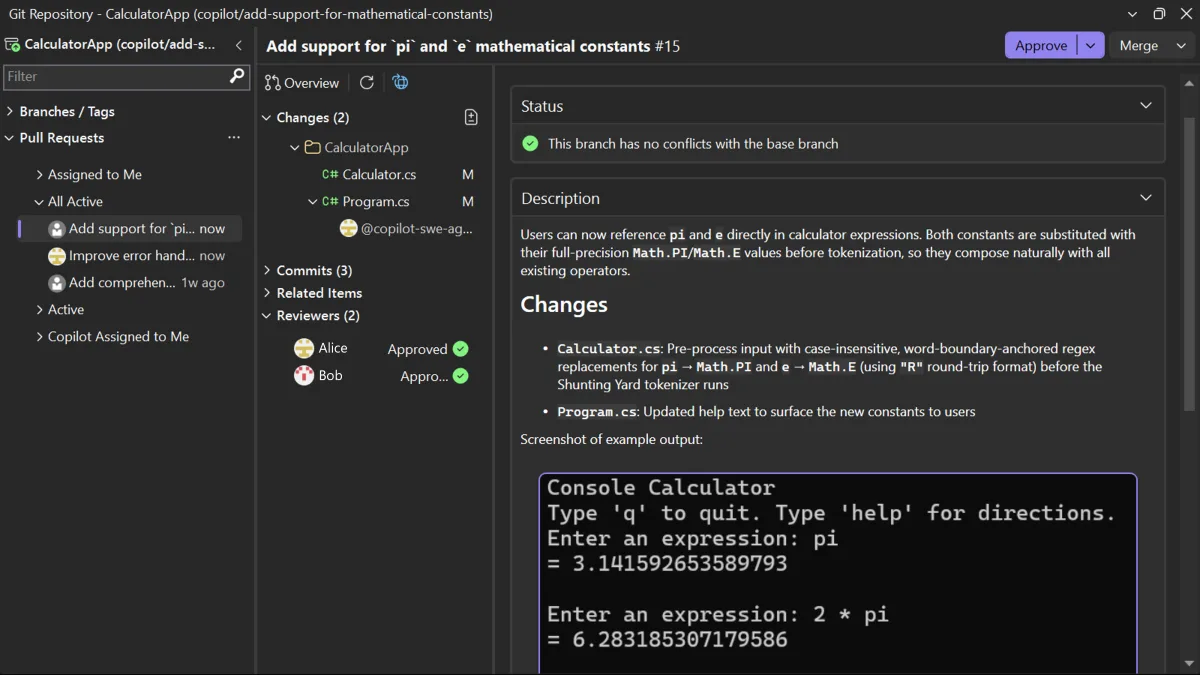
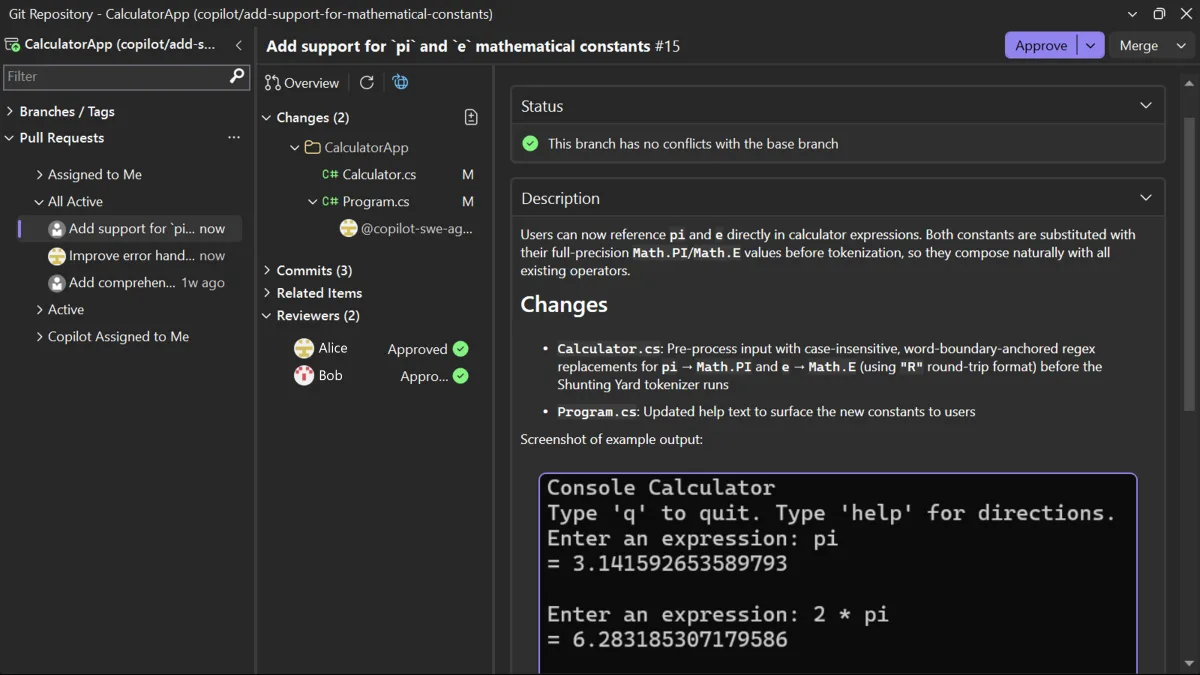
Pull request integration in Visual Studio has been one of the most requested Git features. Developers have been asking for a way to open a PR, inspect the changes, discuss feedback, and finish the review without switching to the browser. The feedback on that request has played a big role in shaping this experience over time.
You’ve been able to create pull requests in Visual Studio since 2024. Now you can also review, comment on, and approve pull requests from both GitHub and Azure DevOps, all without leaving the IDE.
Find and open pull requests
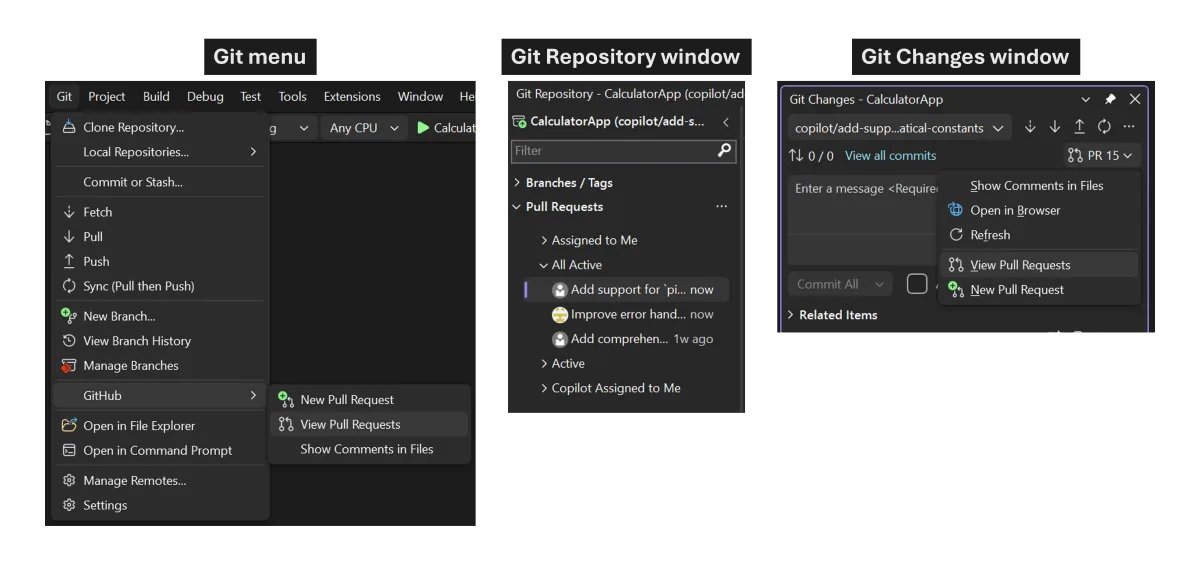
You can view the list of pull requests for the open repository from the Git Repository window, the Git Changes window, or the Git menu. If your current branch already has an active PR, you can also open it directly from Git Changes.
When you open a pull request, you can see the overview, changes, commits, and reviewers together in one place. If a teammate asks for a quick review, you can open Visual Studio, find the PR, and get straight to what you need.
From there, you can choose how deep you want to go. You can review the pull request without checking out the branch, which lets you inspect the changes while keeping your current branch, uncommitted changes, and working state intact.
If you want a closer look, you can also check out the PR branch and use Visual Studio’s navigation, build, and debugging tools to dig into the code. Reviewing without checking out is great for a quick pass, while checking out the branch is better when you want to investigate more deeply.
When you’re juggling multiple reviews, you can switch between active pull requests without having to check out all of them. That makes it easier to jump in on reviews during the day, then get back to your own work.
Browse the changes
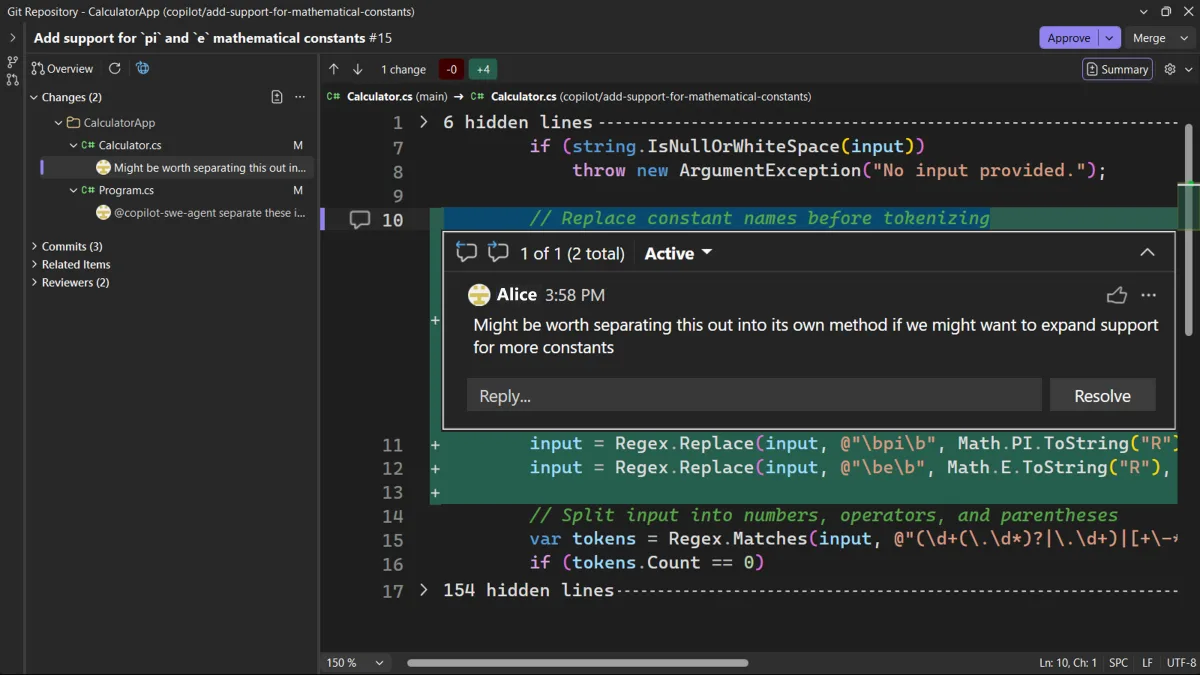
The pull request view is designed to help you move through a pull request quickly. Open any changed file to see the diff inline or side by side, or use the multi-file summary view to see all changes at a glance.
Tip: If you want a wider view of the diff, collapse the left panel and focus on the code.
You can also review commit by commit, which is useful when a pull request covers several logical steps and you want to understand how the change evolved.
Comment and discuss
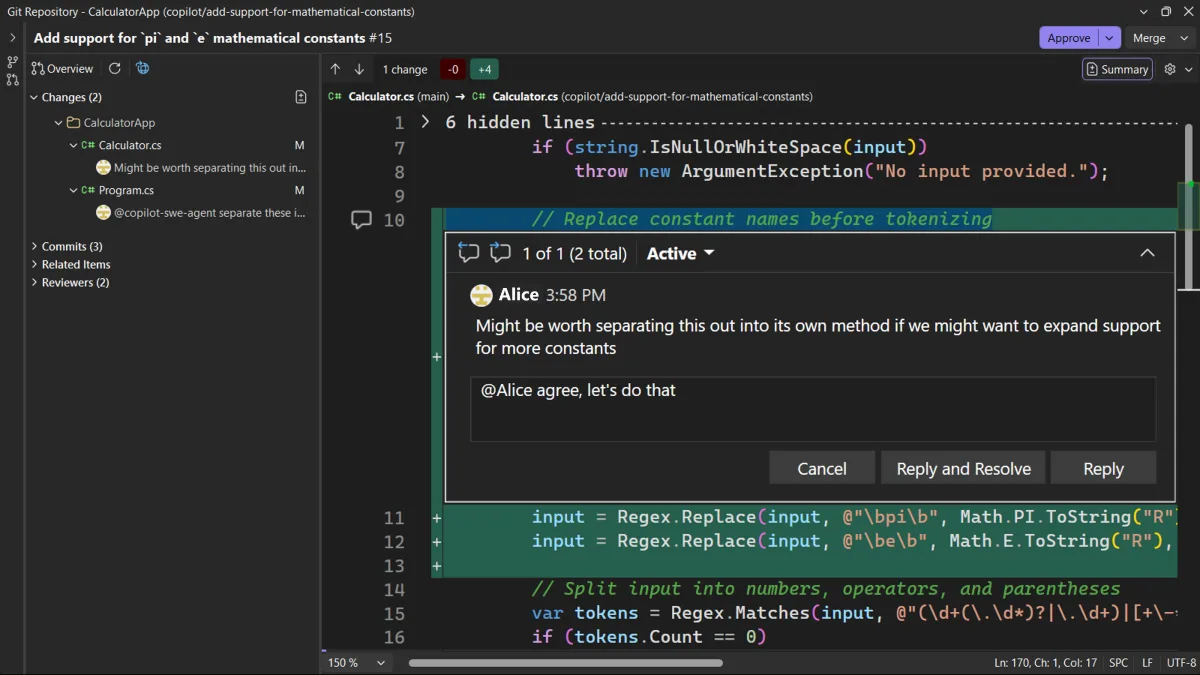
You can leave comments on specific lines, reply to threads, and resolve conversations when the discussion is done. Files with active comments are marked in the Changes list, so it’s easy to spot where discussions are happening. Everything syncs between Visual Studio and the browser.
When you’re reviewing a pull request in checked-out code, you can apply a code suggestion directly to your working copy with one click. When there isn’t one, Copilot can generate a fix based on the comment and surrounding code, so you can evaluate and test it right away.
Approve, complete, and merge
When you’re ready to decide, you can see the information you need and act without leaving the review. On the Overview tab, you can see status checks, merge conflicts, and whether any required approvals are still missing. You can approve the pull request from the diff view, with additional vote options for Azure DevOps pull requests.
You can also complete or merge the pull request right in the IDE. If plans change, you can convert it to draft or close it. Once you open the pull request, you can get all the way through the review in one place.
Try pull request review in 18.7
This is a big step forward for pull request review in Visual Studio, but we’re not done. We’re still working on features like comment filtering, a timeline of PR activity, and a smoother checkout flow for deeper review. We’re also keeping a close eye on feedback to figure out what’s next.
The pull request review experience is now available in the June 18.7 stable release. Try it out, and let us know what you want to see next on Developer Community or through our survey at aka.ms/ReviewPR.
Thanks to everyone who shared feedback and tried out pull request review in Insiders along the way. Your feedback helped shape the experience we’re shipping now.
“It’s exactly the use case that you don’t outsource, and you certainly don’t outsource outside the country,” Laura Gilbert, senior director of AI at the Tony Blair Institute, a think tank founded by the former prime minister, tells WIRED. “We should be learning from that data and building a better health service, not allowing an offshore company to learn and build better products they can sell to someone else.”
Ayub Bhayat, the director of data and analytics at the NHS, tells WIRED that the federated data platform is helping patients “while saving money for NHS teams and taxpayers.”
“There is no requirement for its use,” he says.
In early June, members of Parliament published a report warning that the UK’s growing dependence on Palantir represents “an unacceptable point of weakness.” The company is on track to become highly entangled in the public sector, the parliamentary committee argued, giving it immense leverage over the British state. The report also described a “clear mismatch with UK values.”
After the report was published, the UK technology secretary, Liz Kendall, said that the government is conducting a review of “every single aspect” of the NHS contract with Palantir before deciding whether to carry the deal forward.
Responding to the report in an op-ed published by The Telegraph, Mosley accused the MPs of “putting politics above patients” and fearmongering over the possibility that the company might abuse its access to sensitive health data. “Each NHS trust controls its own data; Palantir cannot use it, sell it, or move it,” he wrote.
Whether or not the government decides to carry the NHS contract forward, Palantir has demonstrated a willingness to resist attempts to oust it from the UK public sector. According to The Times, the company is gearing up to sue the mayor of London, Sadiq Khan, who blocked a $65 million deal with the Metropolitan Police, citing concerns about the procurement process and “values.”
A couple of hours after the demonstrations began, the protesters withdrew to a café at the nearby public library.
The group shared an optimism over a perceived swell in momentum behind calls to eject Palantir from the NHS, particularly in the wake of the parliamentary report. “We have this really big opportunity right now, because of the break clause,” says Lurken, the Pull the Plug cofounder.
But there’s also a world in which renewed public attention to the Palantir question could backfire, some feel, if the government decides to forge ahead with the contract. Another protester, who gave his name as JJ and identified himself as an NHS practitioner, says he worries that Palantir’s notoriety could cause already-skittish patients to think twice before volunteering information to their health care provider, with implications for their care. “We know that people don’t want to tell us everything. People are already distrustful. They’re just going to clam up,” says JJ. “We’re going to get less information, less history to be able to help people.”
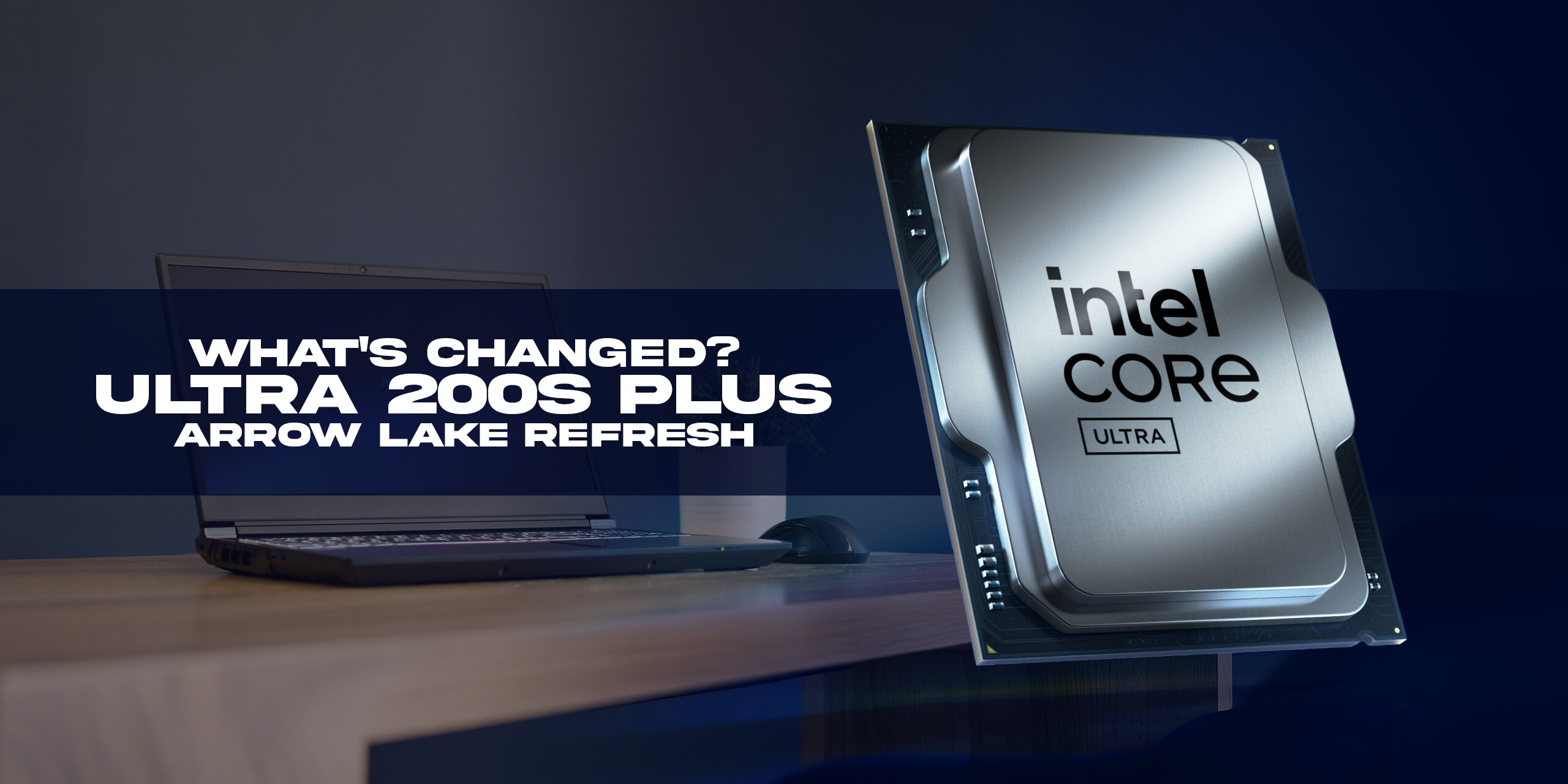
Intel recently released a new batch of processors, Intel Core Ultra 200S Plus series. Previously codenamed “Arrow Lake Refresh,” these new chips are…well…a refresh of previous gen Arrow Lake Intel Core Ultra 200 series. But with this being a simple refresh of a previously released architecture, would the 200S Plus possibly be worth the upgrade? Let’s discuss.
Intel Core Ultra Series 200
Built on Intel’s newest Arrow Lake architecture, Core Ultra 200 Series processors are the follow up to 14th Gen desktop and mobile processors, making them essentially 15th Gen Intel Core. Intel Core Ultra is a new naming scheme that completely tosses aside the i9/i7/15 nomenclature we’ve all become accustomed to as well as the model numbers that indicate the generation. But despite the confusing nomenclature, Intel Core Ultra was always intended to be the successor to Intel Core i9. And like their predecessors, all Core Ultra chips feature a hybrid architecture, combining high-performance cores for demanding tasks like video editing and 3D rendering with efficient cores for everyday computing.
The mobile versions of these processors run on that same architecture, but with reduced power delivery and increased efficiency in order to walk that tight rope between performance and battery life. The mobile models are usually marked with an H or HX, delineating them from their desktop versions (for example, the Core Ultra 9 290HX in our Raptor S77).
Now, enter Arrow Lake Refresh aka Intel Core Ultra 200S, the newest iteration of the Core Ultra series. As the similar name would suggest, these new processors have a lot in common with Series 200. Both feature the same core architecture and utilize the same LGA 1851 socket found on Z890 and B860 motherboards. But that’s not to say that there are no performance or value advantages. In fact, Intel Core Ultra 200S Plus offers all of the following:
An additional 4 E-Cores compared to comparable Series 200 parts
Memory support – Native DDR5 support increases from 6400 MHz to 7200 MHz
Better Fabric Speed – Die to Die communications are increased by 900MHz, reducing overall latency
Better Gaming Performance – the end result is about 15% better gaming performance compared to previous gen, although this varies widely depending on the specific game
For some additional visual clarity, here’s a grid comparing them:
Intel Core Ultra 200S Plus
Intel Core Ultra 200
Intel Core Ultra 5 250K Plus
18 cores @ 5.3GHz
Intel Core Ultra 5 245K
14 core @ 5.2GHz
Intel Core Ultra 7 270K Plus
24 cores @ 5.5GHz
Intel Core Ultra 7 265K
20 core @ 5.5GHz
Intel Core Ultra 9 285K
24 core @ 5.7GHz
One thing you’ll notice is there’s no Ultra 9 290K Plus. Allegedly, Intel did test this part ahead of release, but canned it for an unspecified reason. But, given how well the 270K Plus lines up with the 285k Plus (and at a much lower MSRP), there may not be too much room in the market for another Ultra 9 option. It’s also possible that Intel will release a 290K Plus (or the same die renamed) at some point in the future.
So when choosing between Core Ultra 200 vs. Core Ultra 200S Plus for your next PC, which is the best choice?
Well, given the performance improvements and agressive pricing, it’s hard to recommend anything but the new Core 200S Plus for a new build. It’s really only pro CAD users who will utilize the extra MHz that the Ultra 9 285K offers that should even consider that series of processors, and even then, the value may not be there.
But, if you already have a solid Series 200 build that you’re happy with, an approximate +15% performance boost is likely not enough to justify the hassle and expense of upgrading.
Check out the Z95U to learn more and get your Intel Core Ultra 200S Plus PC now.
The following two tabs change content below.
Josh has been with Velocity Micro since 2007 in various Marketing, PR, and Sales related roles. As the Director of Sales & Marketing, he is responsible for all Direct and Retail sales as well as Marketing activities. He enjoys Seinfeld reruns, the Atlanta Braves, and Beatles songs written by John, Paul, or George. Sorry, Ringo.
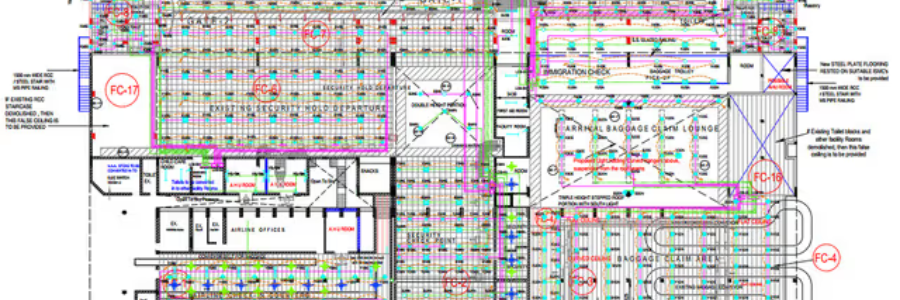
Modern building designs go beyond how it looks and stand in the neighborhood, it is also defined by its internal complexity. Everything connects seamlessly on the inside, like air conditioning, electricity, and plumbing by MEP engineers. They are the ones responsible for making sure that all these systems are running smoothly without clashing with the building design. These systems are often coined as the building’s “nervous system” as it shows how different piping makes sure that the lights can function, the water can flow and the air stays comfortable.
Involving MEP engineers during the design stage helps lessen clashes with architectural or structural elements. It also aids in supporting the building to be more energy-efficient and compliant with safety rules. Cad Crowd is a reliable platform where businesses can connect with MEP engineering experts, tailored to their project needs. Having the right team member helps in delivering quality work and success to the project.
Defining the Core of MEP Engineering
AutoCAD MEP engineers focus on planning and designing how the building will be livable. It ensures that the behind-the-scenes systems are running seamlessly. With it, the building has proper airflow, lighting and water supply. MEP engineers ensure that the occupants will have a comfortable stay in the building and that the systems work safely and efficiently throughout the years.
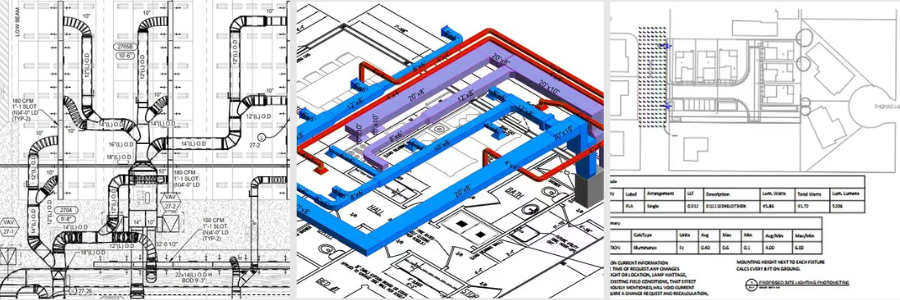
Mechanical systems in a building system primarily focus on heating, ventilation, and air conditioning (HVAC). These systems maintain indoor air quality and thermal comfort, ensuring that the indoor environment is livable no matter what the weather is like outside. MEP engineers have to carefully calculate heat loads and the necessary ductwork sizes for it, to ensure that it remains stable regardless of external weather conditions, and to ensure comfort.
The Electrical Pillar: Power and Light
Electrical systems focus on power distribution, lighting design and telecommunication inside the building. Doing this ensures that the electricity is safely distributed from the power supply to outlets, wiring, and lights up to the devices connected. It also ensures support for internet and communication systems. This is where electrical engineering services come in.
The Plumbing Pillar: Water and Waste
Plumbing systems handle proper delivery and distribution of potable water and the efficient removal of waste and rainwater. MEP engineers design and plan a system that ensures proper water flow, consistent pressure, ensuring that the water in the building is safe, clean and leak-free, fitted for daily use.
Early Integration for Maximum Efficiency
It is important to involve MEP consultants and engineering design specialists during the initial design stage to identify potential system conflicts that may be costly if found out later on site. Encouraging early collaboration ensures that there is enough space for pipes, ducts, and other equipment.
Enhancing Architectural Freedom
Having a MEP engineer or consultant handle the technical constraints of the system lets architects have freedom in exploring bold designs without much worry. A healthy and seamless communication lets them find ways to follow the design without the systems looking awkward.
Although hiring a MEP consultant may look costly at first, it can be considered as an investment since it significantly reduces the total costs by preventing potential reworks on site. These fixes optimize material usage. Having a hired expert ensures that uncertain costs will lessen since there will be a precise calculation to know that the equipment is of the right dimensions.
Navigating Complex Building Codes
Building codes for energy efficiency, fire safety, and accessibility are constantly changing and depend on the project in which it is located. Building codes are the reason why MEP consultants stay updated and make sure that the designs follow regulations from the start of the project. The following codes reduce the potential risk of failing inspections, costly reworks, and project delays.
Improving Energy Performance
Designing sustainable buildings with architectural design companies means being involved in designing how to be efficient with energy and water consumption and MEP consultants play a lead role in it. They design systems that can reduce power consumption and integrate renewable energy sources. Implementing this helps in achieving LEED or other green building certifications.
Optimizing Indoor Air Quality
Keeping the air quality is also part of MEP design – it ensures that the indoor air is fresh and free from harmful pollutants, ensuring a healthier environment for the occupants. Now that there is a firsthand experience with the pandemic, it is more important to design advanced filters and airflow strategies to safeguard the health of the people.
Fire Protection and Life Safety
MEP engineering also covers and includes fire protection systems, like standpipes, sprinklers and smoke control measures. These safety measures are non-negotiable for protecting the lives of the people and the building. It makes sure that the system fits seamlessly into the building so it can function properly.
Lighting does not only function as turning a light on and off. Lighting adds shade, texture, mood, and emotions to the room. That’s why lighting design professionals, proficient in MEP engineering, analyze and calculate the room areas and design appropriate lighting needed because they integrate balance with natural lighting and artificial ones to lessen energy consumption.
Specialized Knowledge in Power Distribution
When a project is large-scale, it often needs complicated electrical setups such as substations, transformers, and backup generators. MEP engineers and consultants make sure that these are sourced in a way that aligns with their calculations and are safely isolated yet accessible for future upgrades.
Acoustic Engineering and Noise Control
Some mechanical equipment, especially for large-scale projects, can be very noisy and disturbing. This is why MEP engineers and HVAC design consultants plan and design sound-dampening solutions for HVAC units and pumps to reduce noise disturbance. Important for homes to be more comfortable, or for hospitals or rehabilitation centers where healing and recovery require quiet spaces.
Strategic Site Utilities Management
Sourcing utilities goes beyond just finding resources – MEP consultants and engineers work with the local utility companies to plan and connect water, gas, and electricity to the building. It ensures that the systems are compatible with the infrastructure for easier expansion in the future.
Water Conservation Strategies
MEP consultants and engineering plan conservation strategies to drastically reduce a building’s water footprint. This strategy helps in lowering water bills, which are essential to areas that have water scarcity, and lower operational costs for owners.
Now that modern construction has integrated Building Management Systems (BMS), it has allowed building owners to have access and monitor lighting, climate, and security from a central interface. This automated system optimizes efficiency by adjusting the systems based on real-time occupancy and the current space’s conditions.
Minimizing Construction Delays
When the MEP documentation is handled properly and in detail, it reduces queries and clarifications, speeding up the operations on site. Clear plans promote efficiency at work and reduce mistakes, making it smoother to operate according to the construction timeline.
Scalability for Large Projects
Having a big project also means that it will be a complex, interconnected system within floors and buildings. To ensure that all systems work together smoothly, there could be a central plant to support the entire load without any part failing. This design strategy is ensured by engineering designers and consultants to ensure that the systems will work efficiently, no matter how massive the development is.
Enhancing Property Value
When the building has an efficient and modern MEP system, the buyers and tenants lean toward it. This is because of the comfort they’d get to have if ever. When all the systems function and work well, it is easily noticed how nice it is to occupy here, and so it can be tagged as a luxurious feel or a privilege. Investors can sell or lease these places at a higher rate compared to buildings with poorly designed systems.
Expert Peer Reviews
Sometimes there are flaws that are overlooked by internal experts, so a new set of expert eyes is needed to give a fresher review and check on the quality. These experts can spot and identify flaws that could be a potential risk to safety, helping the internal architectural planning and design team reduce costly reworks and legal issues in the future.
Future-Proofing for Technology
The modern construction constantly evolves and to ensure that the buildings are ready to adapt to power needs and communication standards, MEP consultants and engineers have to think of a design that is future-proof. This means that the design is flexible enough for the building to allow easy upgrades in instances needed without major reconstruction. This reduces costs of starting over again.
It is a common problem for MEP and structural drafting professionals to have design conflicts, especially when not coordinated clearly. MEP systems require support structures, and the structural team provides them. It is best for both to collaborate closely to understand what the other needs to ensure the building remains strong while keeping the systems housed and supported.
Optimizing Kitchen and Laundry Systems
For commercial projects, such as restaurants and hotels, it could require a specialized design and system since it handles specific conditions. The design should ensure that the heavy-duty plumbing complies with health standards, and that there are grease traps around in appropriate locations as well as high-volume exhaust. A MEP engineer and consultant tailors the system to the functionality of the space.
Building Envelope Consultation
Analyzing the building envelope is often a collaborative work between architects and MEP engineers. They calculate the envelope’s thermal performance and fabricate a design to better serve the building. They will be able to recommend a better glazing or insulation tailored to the performance of the building, reducing the significant size and cost of HVAC equipment.
Sustainable Material Selection
Since the world is aligning to sustainable approaches, MEP engineers and consultants are also considering selecting materials for piping, wiring and insulation materials that have low embodied carbon. Doing this ensures that the building is promoting “green” from the inside out.
Effective Project Documentation
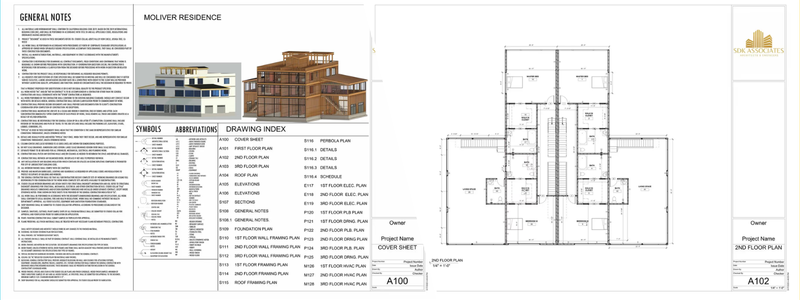
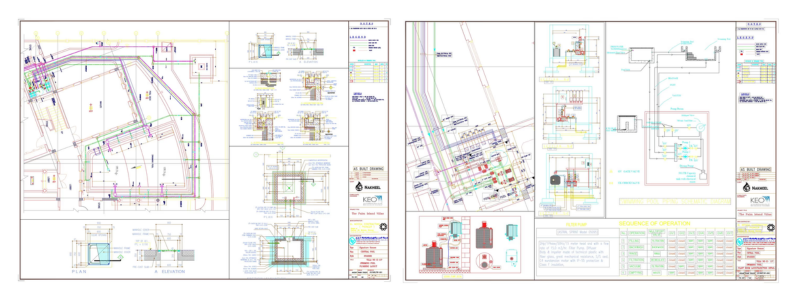
When everything has been done and collated, from the technical drawings and plans from architectural drawing experts, the specifications and installation, and other important documents related to MEP, the final output is considered legally binding and provides a definite standard for what’s intended, protecting the owner’s interests during construction.
One of the problems faced by the MEP team is finding a way to stack equipment, especially on tight urban sites. They find innovative ways to utilize and maximize the space by being an expert at spatial puzzles.
Life Cycle Cost Analysis
MEP consultants look at the equipment not as a one-time purchase but as an investment, since it can last over 20 years of its lifecycle. Investing your money in life cycle cost analysis can be a practical decision since it can last a long time and can lessen the cost in the long run.
Enhancing Occupant Wellbeing
While a MEP system is known to provide physical comfort to the buildings, it also has an impact on the psychological well-being since it can alter and change lighting levels appropriately and adjust acoustic privacy. The MEP engineers and architectural detailing consultants have their way of fostering an environment that prioritizes relaxation and productivity.
Streamlining the Permitting Process
Since the MEP engineers and consultants often work with local officials, they can easily navigate through and work on permitting processes more quickly. Their understanding of compliance can be an edge in reducing rejections.
Mitigating Risks of System Failure
Identifying and knowing why a system fails is an important step in providing solutions. Tests are done on designs to pinpoint their weak points and design a proactive approach to prevent possible failure, to ensure the safety of the occupants of the building.
MEP consultants and CAD engineers are encouraged to do construction site visits to ensure that all works are in accordance with the approved plans. To ensure proper handling and prevent contractors from doing shortcuts that could compromise the building’s integrity and performance.
Final Commissioning and Testing
MEP Engineers and consultants who oversee each project must conduct a final testing on every project to identify its usability. Electrical lines, plumbing, lighting, and floor alignment must be checked and fitted to the client’s standard. Other than this, building codes are verified one last time for operational purposes.
Addressing Seismic Restraints
Should there be instances wherein a region is earthquake-prone, MEP and structural engineers can design seismic restraints for their heavy equipment and piping systems to keep them from breaking or collapsing. With detailed specifications, failures can be avoided, which are critical for the system to remain functional. Most of the buildings, such as hospitals or emergency centers, should keep working even after a strong quake.
Low-Voltage System Coordination
In this age, modern buildings rely now on low-voltage equipment such as security cameras, intercoms, fire alarms, access control, and high-speed data networks. Because of this, proper wiring planning is needed to avoid octopus wiring, fire, and trip hazards. MEP engineers and consultants carefully map out a layout on how the systems will interact, ensuring it works reliably while maintaining a cluttered interior environment.
Value Engineering Processes
Value engineering is one way of saving money while achieving the same quality and performance. MEP engineers and design engineering consultants are considered experts in it since they’re able to find ways to find, analyze, and design a system to recommend a more energy efficient design by looking for alternative materials or equipment. They ensure that expenditure delivers maximum advantage, which is important not just for large-scale projects but for all projects, as it adds significant savings.
In some projects, especially those in remote areas or industrial facilities, there is limited to no access to municipal sewer systems. It is a challenge to manage it, but MEP engineers and design engineering consultants can help in designing an on-site wastewater treatment and disposal system that is compliant and socially responsible. Both sanitary and industrial effluences are handled safely, preventing blockages, contaminations and regulatory fines for safety purposes.
Emergency Lighting and Backup Power
When there’s a power outage, the building shouldn’t immediately just go dark, especially when there are people inside who need to exit the building safely. MEP engineers and consultants come up with an emergency lighting system that can automatically turn on to guide the occupants to exit. These systems are carefully designed and intended not to fail during emergencies.
Hospital and Healthcare Specificity
For healthcare facilities, since it specialized setups like medical gas lines for oxygen or a carefully controlled air system in operating rooms, they require much more advanced systems to protect patients and staff. MEP engineers and consultants make sure that the design is strictly compliant with medical standards and helps avoid airborne infections.
Retail and Tenant Fit-Outs
Buildings that are for retail, shop, or offices the MEP consultants and engineers design a flexible-base building system so it can adapt easily to the tenant’s needs. This approach makes the building ready for anything so the tenants can modify without doing a major renovation, saving them time and money for doing a rework in the future.
Cooling Tower Maintenance and Efficiency
There are buildings that use a water-cooled air conditioning system, and in this case, cooling towers play a big role in keeping everything operational efficiently. Good planning keeps the whole system safe, efficient, and longer-lasting, reducing further costs of repairs in the future.
Underground Utility Coordination
Not everyone can imagine how crowded the area below the building can be, with gas lines, water pipes and electrical cables running underground. Proper planning has to be done or else there could be an accidental hit or damage that may be done. MEP engineers and consultants can use scanning tools and technology, or even 3D modeling services, to see where the utilities are located which helps the workers to avoid costly mistakes and dangerous work during excavation
The most common way of practicing sustainability is collecting and treating rainwater for irrigation uses, toilet flushing or watering plants. MEP engineers and consultants evaluate and calculate roof runoff volumes and design the required filtration systems and storage as well to turn the rain runoff into a valuable resource.
Radiant Heating and Cooling
Radian heating systems provide superior comfort by its ability to adjust floor and ceiling temperatures. This system creates an even distribution of cooling or heating instead of just blowing the air around. MEP engineers and consults can integrate these floor or ceiling systems to provide a quieter and more efficient alternative to traditional air-conditioning systems.
Cleanroom Engineering Standards
There are facilities that are sensitive to air particles, like pharmaceuticals or semiconductor manufacturing. This is why “Cleanrooms” are designed to help regulate air, ensuring that the quality, temperature, and pressure are tightly controlled. Ensuring accurate airflow and filtration are available in the design.
Integrated Security System Design
Security has now evolved from traditional locks to integrated access control, biometric scanners and even advanced video analytics. The MEP consultants and engineers ensure that all these systems and access have the necessary power and data connection to operate effectively as unified protection for the building.
Geothermal Heat Pump Systems
Geothermal systems make use of the ground as a natural source of energy. To do this, MEP engineers and consultants study and analyze the soil and design an underground piping system to distribute heat from and to the building. This system helps in reducing energy consumption and lowering utility costs, offering an eco-friendlier solution.
Laboratory Exhaust Systems
Facilities such as laboratories require a special design that is powerful enough to deal with hazardous chemicals. This could require a special exhaust system to make sure that dangerous air doesn’t stay inside or come back into the building. A powerful ventilation system quickly aids in protecting the worker and the public.
For multi-tenant buildings, it is only normal to use a sub-metering system to know exactly how much electricity each tenant uses over time so they can be charged fairly. It not only focuses on that but can also encourage energy-saving since the occupants see their usage costs. This is considered a smart way to efficiently manage utilities while having the tenants accountable.
Pump Room Layout and Optimization
The heart of the water system is located at the pump room, which is why MEP engineers have to carefully lay out the system for ease of maintenance. MEP Engineers and layout planning design consultants plan this space to cater to all necessary motors and pumps, with ease of access, and ensure a sloped floor for proper drainage during routine servicing.
Thermal Energy Storage (TES)
Thermal Energy Storage (TES) systems act like a cooling battery for keeping the building cool during the day, which is a lot cheaper. Having this significantly reduces the building’s peak electricity demand and lowers the overall utility costs. It promotes balance in energy use.
Natural Ventilation Strategies
Natural Ventilation Strategies is a design that utilizes “passive” ventilation systems, which use wind and natural air movement to cool down the building. This design cuts down on mechanical air conditioning and provides occupants with a more natural and comfortable connection to the environment.
Electrical Surge Protection
Lightning strikes and grid fluctuations can damage the building’s electronic system. To help protect the building, MEP engineers and electrical schematic drawing consultants design a multi-layered surge protection that can help divert excess voltage to the ground to keep the building safe.
Condensation Management in HVAC
Whenever warm and humid air comes into contact with a cold surface, water droplets form. And if this isn’t properly controlled, it could drip onto surfaces like ceilings, walls, or floors, which could create mold, corrosion, and even structural damage. Condensation management is done by MEP engineers and consultants to prevent this kind of issue. To do this, they design a drainage system that can safely carry water away, choosing the right insulation to keep ducts above the dew point. This keeps the buildings dry and safe.
The modern construction has now integrated smart thermostats into the building’s HVAC system to allow control and to save energy. When using this, MEP engineers and consultants make sure that the devices used are compatible with the central mechanical equipment.
Vibration Isolation for Equipment
There is large mechanical equipment that can shake a building as they operate, creating noise disturbance and physical discomfort. MEP consultants and engineers design an isolation solution, such as spring mounts or rubber pads, to allow the equipment to float independently, keeping vibrations from spreading through floors and walls, which can reduce noise. Proper vibration isolation is done to extend the lifespan of the equipment and the building by keeping it still and quiet.
Electrical Load Balancing
Proper electrical load balancing prevents overheating and wasted energy. This is why MEP consultants and electrical circuit designers carefully calculate the load distribution of power throughout the building, ensuring that transformers, panels, and circuits are all working efficiently. The balance doesn’t just extend the lifespan of the equipment but could also help in lessening energy consumption, keeping the building running safely.
Stormwater Management and Retention
To prevent overwhelming city sewers, urban projects must know how to manage their own stormwater runoff. MEP engineers and consultants recommend retention tank design that could conveniently catch heavy rainfall and release the water to soak into the ground more naturally.
Emergency Communication Systems
One of the useful innovative systems that is used in the building in case of emergency is the voice-evacuation system. MEP engineers and consultants can create a design appropriate to operate speakers and amplifiers to create a survivable and loud communication device to alarm the crowd.
Building Commissioning Management
Building Commissioning is like the final quality check for a construction project but mainly focuses on MEP systems. It ensures that testing for HVAC units, pumps, electrical circuits, lighting, and fire protection is done to prove that it operates exactly as designed. This also ensures that it functions smoothly which gives the building owner confidence that it is safe to occupy.
BIM coordination is a seamless and efficient way to communicate with a multi-disciplinary scope of work. MEP engineers and BIM modeling consultants preside over virtual meetings to resolve present clashes and conflicts that may arise during pre-construction. This way, detected issues can be resolved immediately, saving a lot of time and money.
Electrical Power Quality Analysis
For industrial facilities, having a clean and stable electricity supply is critical to run the building. The MEP engineers and consultants evaluate and study the building’s power to detect certain voltage drops or spikes that could possibly damage sensitive equipment. They ensure that the machinery can run smoothly without downtime or repairs.
Conclusion
What once felt like a luxury is now a necessity in construction. MEP engineers consultants are beyond designing the right MEP layout of the building, but aim to allow seamless coexistence with architectural design and structural supports. It serves as a backbone to execute sustainable energy and strict safety standards. Having MEP experts identify potential risks of clashes that could be costly problem a building may face.
How Cad Crowd can assist
If you are ready to advance to building a comfortable space for people, Cad Crowd is the right platform to find the MEP engineering consultant for you. In Cad Crowd, you can explore and browse vetted professionals who can seamlessly integrate MEP system and collaborate with the design team. Cad Crowd helps in connecting with experts who can deliver your next proper, code-compliant, future-proof and high-performing sustainable building. Get a free quote today!
MacKenzie Brown is the founder and CEO of Cad Crowd. With over 18 years of experience in launching and scaling platforms specializing in CAD services, product design, manufacturing, hardware, and software development, MacKenzie is a recognized authority in the engineering industry. Under his leadership, Cad Crowd serves esteemed clients like NASA, JPL, the U.S. Navy, and Fortune 500 companies, empowering innovators with access to high-quality design and engineering talent.
So long and thanks for all the cool new video games.
Summer Game Fest
Summer Game Fest just wrapped up its sixth year and, like a beautifully cel-shaded version of The Blob, the show just keeps on growing.
The official Summer Game Fest 2026 showcase took place on June 5, but the surrounding buffet of new game reveals, release date announcements, review opportunities and developer spotlights actually ran from June 1 all the way to June 9. That’s more than an entire week of near-constant video game news and trailers to consume, and here we’ve gathered absolutely all of it in one tidy but lengthy package. We hope you’re hungry.
First up, a collection of Engadget’s previews and reporting from Summer Game Fest Play Days in Los Angeles, which ran from June 6-8:
And now, everything else.
The MIX Summer Game Showcase 2026
Be like Carl from Summer House and get in the MIX with another high-energy stream filled with great-looking upcoming indie games, gathered by the folks at the Media Indie Exchange. The MIX hosts a smattering of annual online indie showcases, and alongside in-person events, they’ve been spreading the good gaming word for the past 10 years.
The MIX Summer Game Showcase 2026 had more than 60 games from all types of genres, including quaint life sims, surreal adventures, fighting games, twitchy platformers and cute little otter things. In the horror category, the show featured Lucid Falls, Agnii, Un:Me, Broken Lore: Don’t Lie,Echograph, Feed It, Kumarn, Out Fishing, Beyond the Dark: Nightwatchand others, plus it revealed the release date for first-person cardboard shooter Paperhead (September 18). In terms of not-horror, Roverride looks particularly pretty, despite its short tease.
Oddly enough, if you don’t watch this showcase you may end up like Carl from the end of this season’s Summer House. That is, you’ll be a mess. Best not risk it.
Black Voices in Gaming Summer Showcase 2026
Black Voices in Gaming is back with another stellar roundup of video games created by Black artists from around the globe, and this year’s summer showcase had a lot to offer. Fittingly, we got some warm and sunny vibes from RollerGirl, a slice-of-life adventure filled with early-2000s suburban nostalgia and a soundtrack that controls the weather. RollerGirl comes from indie studio Pushing Vertices and it’s up for wishlisting on Steam.
We also saw the cute island builder Ourlands, a hauntingly beautiful “Vampire Soulsvania” Bathory – Heritage of Blood, an ambitious pirate RPG about challenging colonial oppression called Black Sailors: Bay Of All Saints, and a hectic marble-placing game, Oh!Ware, that has some of the most satisfying sound effects we’ve heard in all of the recent showcases (and there have been so many). The fantastical maze game Go North got a release date of July 28, too.
The 2026 Black Voices in Gaming Summer Showcase featured a bunch more rad-looking games from all kinds of genres, plus insightful developer interviews, so make sure to catch it all. The event’s Steam page is also worth a gander.
Black Voices in Gaming first aired in 2022, created by The MIX and Xperience Studios co-founder Justin Woodward. It’s a national 501c3 nonprofit group that not only amplifies the work of Black creators, but also provides financial and production support for developers making games that edify the lived experiences of Black, Indigenous and other People of Color. Just look at the weirdly hateful response to the announcement of a slick new game like Relooted, even in the big year of 2026, and it’s clear why Black creators need and deserve a strong spotlight.
Sony State of Play
Sony joined the fun of Summer Game Fest with another State of Play showcase packed with AAA delights. The biggest surprise of the show was the reveal ofUntil Dawn 2, a teenage-slasher sequel coming from Liverpool studio Firesprite, rather than the series originator Supermassive Games. Still, it looks like a campy choose-your-own adventure with lots of sass and blood.
This summer’s Latin American Games Showcase featured more than 80 titles from 12 countries across Latin America, so settle in for a long and lovely watch. Among the deluge of adorable, action-packed, creepy, complex and gorgeous games on display, the show included the world premiere of Ornament Tower, a release date for Kernel Hearts, and a Kickstarter campaign launch for SHADE Protocol.
Ornament Tower is a retro-styled action-puzzle game from the former lead pixel artist of Fields of Mistria, and it looks divine. Kernel Hearts is an anime-styled, co-op roguelite action RPG starring four magical girls on a quest to save the world, and it’s due out in September. Meanwhile, SHADE Protocol is a 2D Metroidvania with cyberpunk and fantasy aesthetics, and it’s already absolutely smashed its Kickstarter goal.
That’s just three of more than 80 total games in the Latin American Games Showcase, so you know you’re in for a treat with the full stream. The Latin American Games Showcase Steam page and official site have all the details, so give those a browse while the show feeds you its gaming goodies.
Women-Led Games Showcase – SGF Edition 2026
The Women-Led Games Showcase contains multitudes, obviously. The summer 2026 edition of the show certainly proved this point with a vibrant swathe of games, including hyper-feminine romps, hard first-person sci-fi, online Millennial role-playing, narrative-driven card games and dark adventures. There’s something here for everyone.
This summer’s Women-Led Games Showcase included the launch of the Steam demo for lily’s world XD. It comes from streamer LilyPichu, and it’s set inside the folders and messages of a teenage girl’s laptop from 2004, transforming from playful sleuthing to psychological horror as you learn more about her life. Everything about this game looks like my jam.
The showcase also provided an in-depth look at Hope in the City, a stylish detective game from Lofty Sky Entertainment, and also Frieda is Changing, a creepy-cute point-and-click adventure from Mucks! Games. We received new demos for Playing Mantis’ Tiny Capsule Collector, an idle game that populates the bottom of your screen with adorable animals and tiny toys, and also Lucky Punk: a push your luck Deckbuilder, which seems like a lot of cross-your-fingers fun. Another sweet-looking idle game called On-Together: Virtual Co-Working pushed a batch of Summer Studies DLC live during the showcase, complete with accessories inspired by the Women-Led Games mascot, Artemis.
That covers just a small portion of the full show, which was absolutely packed with delicious surprises, as always.
Summer Game Fest 2026
Here it is: The big Summer Game Fest 2026 showcase, hosted by Geoff Keighley and Lucy James, live from the Dolby Theatre in Los Angeles. Tupac even made an appearance, weirdly enough.
Enjoy the experience in full, or take our word for it on the show’s biggest news and reveals with the following collection of stories:
See? That’s Tupac, right there in the middle of Summer Game Fest 2026. It wasn’t on our bingo cards, either.
Day Of The Devs: Summer Game Fest Edition 2026
Day of the Devs does it right every single time with a laser-focus on interesting, in-development indie games, and that includes this year’s summertime extravaganza.
One of these titles may stand out because it was included in a few other showcases, but also because it looks downright frightful: Tenebris Somnia blends retro survival-horror mechanics with grotesque live-action cutscenes, and it’s being developed by multimedia terror experts Airdorf and Andrés Borghi. We got the game’s release date, October 16, during the Day of the Devs show.
While the entire showcase is well worth a watch, here are some highlights lovingly selected especially for you:
Southeast Asian Games Showcase
Saturday, June 6 was jam-packed with streams all day, and it kicked off with the fantastic Southeast Asian Games Showcase. It’s the kind of show that can smoothly transition from the cozy cat-based idle game Neko Station, to a blocky first-person horror sim set in a surreal nightmare world called Nol. And in between, there’s a little bit of everything: Dungeon Hotpot is a narrative game about serving delicious-looking fantasy food to adventurers in a torchlit pub; Sepak U is an athletic fighting game based on the sport Sepak Takraw (which looks very rad); Hoa 2 is breathtaking and slow. The Afterimages DLC for the stunning coming-of-age narrative game Until Then is now set to land on June 18, as announced during the show.
There’s also something called Meaningless Random Numbers, an incremental horror game that looks like pure addictive chaos. Its demo went live as part of the Southeast Asian Games Showcase, so throw it on your to-play list for days when you’re feeling too grounded.
Wholesome Direct 2026
Prepare for things to get supremely cozy. This summer’s Wholesome Direct featured more than 50 games, including a large lineup of world premieres and release window announcements, so there’s plenty of charm to go around. We were particularly taken with the reveal ofHidden Folks 2, a sequel to the beloved 2017 hand-drawn search game. It’s due out on Steam, itch.io and mobile devices next year. Additionally, Cozy Grove: Camp Spirit finally got a PC and console release date of July 15.
PATIENCE IS A VIRTUEis notable for its bold, primary-color palette and hand-drawn shakiness, but also its innovative puzzle mechanics. Back in your hometown after graduating college, you communicate with townsfolk through a supernatural cassette player, crafting sentences using only words the NPCs have already said. There’s something weird going on in the town and your conversations help unravel the larger mystery. PATIENCE IS A VIRTUE comes from teaisfortoby! and it doesn’t have a release date yet, but you can wishlist it on Steam.
All of that doesn’t even cover the release dates and other lovely bits included in the full Wholesome Direct summer showcase. The show’s Steam page has a lot of it, if you’re in the mood for a soothing browse. Keeping the heartwarming vibes alive, a portion of proceeds from this year’s Wholesome Direct merch sales benefit the Transgender Law Center.
Story-Rich Showcase 2026
Publisher Fellow Traveller hosted its first showcase this summer and, may we just say, it was a smash. The Story-Rich Showcase was dedicated to highlighting narrative-driven games from developers of all kinds — no paid spots or secret ads, just great-looking games chosen because they look great. Fellow Traveller is the publisher behind the fabulously written Citizen Sleeper games, the Hugo and Nebula-nominated sci-fi adventure 1000xRESIST, and the organizer of LudoNarraCon. That is to say, they really know what they’re doing here.
The inaugural Story-Rich Showcase featured 26 games over 45 minutes, and overall it was a captivating blend of levity, penguins and existential terror. The penguin part comes from Penguin Colony, the next game out of Umurangi Generation studio Origame Digital. It’s a Lovecraftian horror story set in 1939 and told from the perspective of a penguin who’s witnessing a cataclysm of Nazis and Indigenous Kaitiaki in the mind-melting Antarctic wilderness. This is also the existential terror part, it turns out.
There was also the reveal of Burn-9, a “reverse-Metal Gear” that places you in the role of a handler for a secret agent who’s on a job that’s gone all wrong. Communicating through the radio, you have to balance the demands of a military command against the field agent’s needs and your own moral compass. It’s a little bit Papers, Please, a little bit Metal Gear, and it looks fantastic.
The second and final act of Soft Rains’Ambrosia Sky lands on August 6, closing out Dalia’s journey of death cleaning and finding closure amid a lethal outbreak of alien fungus. Act one is available to play now (with a Very Positive rating on Steam) and the second part will be a free update to the base game.
The showcase included release window announcements for a lineup of titles we’ve personally been anticipating: Mother-daughter psychological horror game Am I Nima is due out on October 8; the escape room comedy-horror Janet DeMornay is a Slumlord (and a witch) is coming to PC and PS5 this year; Rusty Lake’s ambitious point-and-click adventure Servant of the Lake is out on August 13; and SFB Games’ detective title The Mermaid Mask will hit PC, PS5, Switch and Switch 2 on July 16. Plus, Building Relationships is coming to PlayStation 5 and Xbox Series X/S later this year, alongside the Steam version.
The Green Games Showcase highlights interactive experiences about the beauty and fragility of nature. These are games that (funnily enough) help us reconnect with nature, reminding us of where we come from and what we need to protect. When someone says, “Touch grass,” these are some games you could pull up.
The Green Games show featured 28 games, and if you buy any of them through the Planet Play website, you’re helping to fund credible, long-term planet-saving projects. The showcase itself was split into sections: Play as an Animal, Save the World, Ravaged Worlds, Green Thumb and Explore Natural Worlds. It highlighted existed acclaimed games like Spilled! and Haven, and also upcoming titles like Doomsday Diner, which looks like a supremely entertaining first-person restaurant management sim that’s due out on July 23.
Included in the showcase was a brief interlude about Cairn, one of the most enchanting games of the year. Set on the face of a looming and dangerous mountain, Cairn is a feat of slow and methodical gameplay, ultra-precise mechanics and stunning scenery. It’s a deliciously excruciating experience and is absolutely worth your time, especially with its first batch of DLC landing on August 13 (for free, no less).
Gayming Pride Parade
The first-annual Gayming Pride Parade was a huge success. It was hosted by online creator MiladyConfetti and RuPaul’s Drag Race queen Jax, and featured an in-depth look at nine eye-catching games featuring queer themes, from queer creators. This is where the magic lives.
And remember when we mentioned SHE: Seraphim Helix Experiment up there in the Story-Rich Showcase? Yeah, this game is so gloriously unhinged that it was also included in the Gayming Pride Parade segment, complete with a breakdown of its anti-fascist themes and grotesque brand of femininity from character artist and Rocket Adrift co-founder Lindsay Rollins.
Brr, it’s cold in here. There must be some games from Australia and Aotearoa-New Zealand in the atmosphere. Just picture Kirsten Dunst saying it and it kind of works.
Frosty Games Fest returned this summer with another hour of super-chill games, both already out and still coming, from creators deep in the Southern Hemisphere. This year’s showcase featured everyone’s favorite Janet DeMornay Is A Slumlord (and a witch), a cooking sim starring a giant sea serpent called Cooking for MA!, a pixel-art adventure that looks like a mix of Below and Cocoon named Straycloud, the minimalist cube-rolling game TOYA, the tactical roller-skating RPG Canvas City, and a trippy romp through a decomposing world in PUTRID/SHARP, among other fabulous-looking titles.
The whimsical desktop idle game Ghost Writerwas seemingly made out of my purest daydreams, as its Steam description reads as follows: “The perfect desktop work companion if you require a little tired ghost typing away at a typewriter.” I do. I really do. There’s no release date for Ghost Writer yet, but it’s coming from Lemon Jolly Games.
One title that received a release date during Frosty Games Fest was Cozy Game Restoration, a relaxing first-person simulator about lovingly restoring old video game cartridges. It’s all right there in the name, really. It’s coming out on September 24. The complete Frosty Game Fest Steam page can be found right here.
Xbox Games Showcase
This was the first Xbox showcase without Phil Spencer at the helm of Microsoft’s gaming division since the dawn of Summer Game Fest, and truth be told, it was fairly juicy. New Xbox head Asha Sharma made an appearance in the Xbox Games Showcase to introduce a range of titles from Xbox studios and beyond, plus a fresh bit of hardware.
While the confirmation of Persona 6 was a high point for us locally, here are the main beats from the Xbox summer show:
After the event, we spoke with developer Toys for Bob about Spyro: A Realm Beyond, the little purple dragon’s first new game in over a decade.
PC Gaming, Deutsche Indie, India Games
Following the Xbox show on Sunday, June 7 (happy birthday to my littlest and best sister), there were three excellent showcases with distinct focuses: The PC Gaming Show, Deutsche Indie Showcase and India Games Showcase.
The PC Gaming Show was a contained blast, as usual, and it featured the reveal of Signet City from Citizen Sleeper creator Gareth Damian Martin. Signet City is a first-person “fungalpunk” RPG with an eye-catching monochromatic color scheme and droning post-punk music. Martin describes the game on YouTube as follows: “You are a parasite, in a city where strange technologies and radical ideas are taking root. Grow into and through its inhabitants, uncover and change their stories, and witness the terminal season of the signet city.” Aye aye, Martin. Signet City is available to wishlist on Steam now.
The India Games Showcase was absolutely packed with incredible games from developers that don’t tend to get a ton of mainstream airtime, and it’s definitely worth a watch. Take it from us, people who are brutally up-to-date on all the new game releases — shows like this one are where you’re going to find your next favorite title.
And then there was Nintendo. The house of Mario snuck into Summer Game Fest with a last-minute Nintendo Direct livestream held on Tuesday, June 9, just when we all thought it was safe to relax. The show brought us a lifelike baby Link in an Ocarina manger, a trailer for Kingdom Hearts IV and the following bits of news, lovingly gathered here in one tidy list:
And that is absolutely it. Thank you for joining us for Summer Game Fest 2026 and we’ll catch you at the next one.












 Intel recently released a new batch of processors, Intel Core Ultra 200S Plus series. Previously codenamed “Arrow Lake Refresh,” these new chips are…well…a refresh of previous gen Arrow Lake Intel Core Ultra 200 series. But with this being a simple refresh of a previously released architecture, would the 200S Plus possibly be worth the upgrade? Let’s discuss.