Brand leaders are talking about their agencies, and it’s not all flattering. Continue reading “A New Report Reveals What Brands Are Saying About Their Agencies”
Brand leaders are talking about their agencies, and it’s not all flattering. Continue reading “A New Report Reveals What Brands Are Saying About Their Agencies”
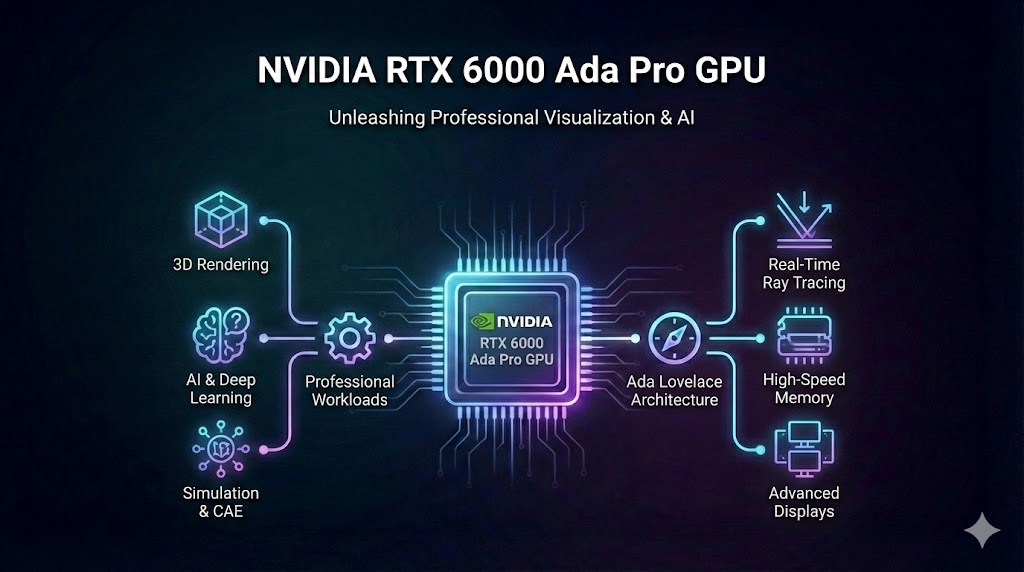
In a world where generative AI, real‑time rendering, and edge computing are redefining industries, the choice of GPU can make or break a project’s success. NVIDIA’s RTX 6000 Ada Generation GPU stands at the intersection of cutting‑edge hardware and enterprise reliability. This guide explores how the RTX 6000 Ada unlocks possibilities across AI research, 3D design, content creation and edge deployment, while offering a decision framework for choosing the right GPU and leveraging Clarifai’s compute orchestration for maximum impact.
The NVIDIA RTX 6000 Ada Generation GPU is the professional variant of the Ada Lovelace architecture, designed to handle the demanding requirements of AI and graphics professionals. With 18,176 CUDA cores, 568 fourth‑generation Tensor Cores, and 142 third‑generation RT Cores, the card delivers 91.1 TFLOPS of single‑precision (FP32) compute and an impressive 1,457 TOPS of AI performance. Each core generation introduces new capabilities: the RT cores provide 2× faster ray–triangle intersection, while the opacity micromap engine accelerates alpha testing by 2× and the displaced micro‑mesh unit allows a 10× faster bounding volume hierarchy (BVH) build with significantly reduced memory overhead.
Beyond raw compute, the card features 48 GB of ECC GDDR6 memory with 960 GB/s bandwidth. This memory pool, paired with enterprise drivers, ensures reliability for mission‑critical workloads. The GPU supports dual AV1 hardware encoders and virtualization via NVIDIA vGPU profiles, enabling multiple virtual workstations on a single card. Despite its prowess, the RTX 6000 Ada operates at a modest 300 W TDP, offering improved power efficiency over previous generations.
Choosing the right GPU involves understanding how generations improve. The RTX 6000 Ada sits between the previous RTX A6000 and the upcoming Blackwell generation.
|
GPU |
CUDA Cores |
Tensor Cores |
Memory |
FP32 Compute |
Power |
|
RTX 6000 Ada |
18,176 |
568 (4th‑gen) |
48 GB GDDR6 (ECC) |
91.1 TFLOPS |
300 W |
|
RTX A6000 |
10,752 |
336 |
48 GB GDDR6 |
39.7 TFLOPS |
300 W |
|
Quadro RTX 6000 |
4,608 |
576 (tensor) |
24 GB GDDR6 |
16.3 TFLOPS |
295 W |
|
RTX PRO 6000 Blackwell (expected) |
~20,480* |
next‑gen |
96 GB GDDR7 |
~126 TFLOPS FP32 |
TBA |
|
Blackwell Ultra |
dual‑die |
next‑gen |
288 GB HBM3e |
15 PFLOPS FP4 |
HPC target |
*Projected cores based on generational scaling; actual numbers may vary.
Benchmarking firms have shown that the RTX 6000 Ada provides a step‑change in performance. In ray‑traced rendering engines:
For video editing, the Ada GPU shines:
These improvements stem from the increased core counts, higher clock speeds, and architecture optimizations. However, the removal of NVLink means tasks needing more than 48 GB VRAM must adopt distributed workflows. The upcoming Blackwell generation promises even more compute with 96 GB memory and higher FP32 throughput, but release timelines may place it a year away.
Generative AI’s hunger for compute and memory makes GPU selection crucial. The RTX 6000 Ada’s 48 GB memory and robust tensor throughput enable training of large models and fast inference.
Generative AI models—especially foundation models—demand significant VRAM. Analysts note that tasks like fine‑tuning Stable Diffusion XL or 7‑billion‑parameter transformers require 24 GB to 48 GB of memory to avoid performance bottlenecks. Consumer GPUs with 24 GB VRAM may suffice for smaller models, but enterprise projects or experimentation with multiple models benefit from 48 GB or more. The RTX 6000 Ada strikes a balance by offering a single‑card solution with enough memory for most generative workloads while maintaining compatibility with workstation chassis and power budgets.
These cases illustrate how memory and compute scale with model size and emphasize the benefits of multi‑GPU configurations—even without NVLink. Adopting distributed data parallelism across cards allows researchers to handle massive datasets and large parameter counts.
The RTX 6000 Ada is also a powerhouse for designers and visualization experts. Its combination of RT and Tensor cores delivers real‑time performance for complex scenes, while virtualization and remote rendering open new workflows.
The card’s third‑gen RT cores accelerate ray–triangle intersection and handle procedural geometry with features like displaced micro‑mesh. This results in real‑time ray‑traced renders for architectural visualization, VFX and product design. The fourth‑gen Tensor cores accelerate AI denoising and super‑resolution, further improving image quality. According to remote‑rendering providers, the RTX 6000 Ada’s 142 RT cores and 568 Tensor cores enable photorealistic rendering with large textures and complex lighting. Additionally, the micro‑mesh engine reduces memory usage by storing micro‑geometry in compact form.
Remote rendering allows artists to work on lightweight devices while heavy scenes render on server‑grade GPUs. The RTX 6000 Ada supports virtual GPU (vGPU) profiles, letting multiple virtual workstations share a single card. Dual AV1 encoders enable streaming of high‑quality video outputs to multiple clients. This is particularly useful for design studios and broadcast companies implementing hybrid or fully remote workflows. While the lack of NVLink prevents memory pooling, virtualization can allocate discrete memory per user, and GPU fractioning (available through Clarifai) can subdivide VRAM for microservices.
Video editors, broadcasters and digital content creators benefit from the RTX 6000 Ada’s compute capabilities and encoding features.
The card’s high FP32 and Tensor throughput enhances editing timelines and accelerates effects such as noise reduction, color correction and complex transitions. Benchmarks show ~45 % faster DaVinci Resolve performance over the RTX A6000, enabling smoother scrubbing and real‑time playback of multiple 8K streams. In Adobe Premiere Pro, GPU‑accelerated effects execute up to 50 % faster; this includes warp stabilizer, lumetri color and AI‑powered auto‑reframing. These gains reduce export times and free up creative teams to focus on storytelling rather than waiting.
Dual AV1 hardware encoders allow the RTX 6000 Ada to stream multiple high‑quality feeds simultaneously, enabling 4K/8K HDR live broadcasts with lower bandwidth consumption. Virtualization means editing and streaming tasks can coexist on the same card or be partitioned across vGPU instances. For studios running 120+ hour editing sessions or live shows, ECC memory ensures stability and prevents corrupted frames, while professional drivers minimize unexpected crashes.
As industries adopt AI at the edge, the RTX 6000 Ada plays a key role in powering intelligent devices and remote work.
NVIDIA’s IGX platform brings the RTX 6000 Ada to harsh environments like factories and hospitals. The IGX‑SW 1.0 stack pairs the GPU with safety-certified frameworks (Holoscan, Metropolis, Isaac) and increases AI throughput to 1,705 TOPS—a seven‑fold boost over integrated solutions. This performance supports real‑time inference for robotics, medical imaging, patient monitoring and safety systems. Long‑term software support and hardware ruggedization ensure reliability.
Edge computing also extends to remote industries. In a maritime vision project, researchers deployed HP Z2 Mini workstations with RTX 6000 Ada GPUs to perform real‑time computer‑vision analysis on ships, enabling autonomous navigation and safety monitoring. The GPU’s power efficiency suits limited power budgets onboard vessels. Similarly, remote energy installations or construction sites benefit from on‑site AI that reduces reliance on cloud connectivity.
Virtualization allows multiple users to share a single RTX 6000 Ada via vGPU profiles. For example, a consulting firm uses mobile workstations running remote workstations on datacenter GPUs, giving clients hands‑on access to AI demos without shipping bulky hardware. GPU fractioning can subdivide VRAM among microservices, enabling concurrent inference tasks—particularly when managed through Clarifai’s platform.
With many GPUs on the market, selecting the right one requires balancing memory, compute, cost and power. Here’s a structured approach for decision makers:
|
Scenario |
Recommended GPU |
Rationale |
|
Fine‑tuning foundation models up to 7 B parameters |
RTX 6000 Ada |
48 GB VRAM supports large models; high tensor throughput accelerates training. |
|
Training >10 B models or extreme HPC workloads |
Upcoming Blackwell PRO 6000 / Blackwell Ultra |
96–288 GB memory and up to 15 PFLOPS compute future‑proof large‑scale AI. |
|
High‑end 3D rendering and VR design |
RTX 6000 Ada (single or dual) |
High RT/Tensor throughput; micro‑mesh reduces VRAM usage; virtualization available. |
|
Budget‑constrained AI research |
RTX A6000 (legacy) |
Adequate performance for many tasks; lower cost; but ~2× slower than Ada. |
|
Consumer or hobbyist deep learning |
RTX 4090 |
24 GB GDDR6X memory and high FP32 throughput; cost‑effective but lacks ECC and professional support. |
Clarifai is a leader in low‑code AI platform solutions. By integrating the RTX 6000 Ada with Clarifai’s compute orchestration and AI Runners, organizations can maximize GPU utilization while simplifying development.
Clarifai’s orchestration platform manages model training, fine‑tuning and inference across heterogeneous hardware—GPUs, CPUs, edge devices and cloud providers. It offers a low‑code pipeline builder that allows developers to assemble data processing and model‑evaluation steps visually. Key features include:
These features are particularly valuable when working with expensive GPUs like the RTX 6000 Ada. By scheduling training and inference jobs intelligently, Clarifai ensures that organizations only pay for the compute they need.
The AI Runners feature lets developers connect models running on local workstations or private servers to the Clarifai platform via a public API. This means data can remain on‑prem for privacy or compliance while still benefiting from Clarifai’s infrastructure and features like autoscaling and GPU fractioning. Developers can deploy local runners on machines equipped with RTX 6000 Ada GPUs, maintaining low latency and data sovereignty. When combined with Clarifai’s orchestration, AI Runners provide a hybrid deployment model: the heavy training might occur on on‑prem GPUs while inference runs on auto‑scaled cloud instances.
The AI and GPU landscape evolves quickly. Organizations should stay ahead by monitoring emerging trends:
The upcoming Blackwell GPU generation is expected to double memory and significantly increase compute throughput, with the PRO 6000 offering 96 GB GDDR7 and the Blackwell Ultra targeting HPC with 288 GB HBM3e and 15 PFLOPS FP4 compute. Planning a modular infrastructure allows easy integration of these GPUs when they become available, while still leveraging the RTX 6000 Ada today.
Multi‑modal models that integrate text, images, audio and video are becoming mainstream. Training such models requires significant VRAM and data pipelines. Likewise, agentic AI—systems that plan, reason and act autonomously—will demand sustained compute and robust orchestration. Platforms like Clarifai can abstract hardware management and ensure compute is available when needed.
Sustainability is a growing focus. Researchers are exploring low‑precision formats, dynamic voltage/frequency scaling, and AI‑powered cooling to reduce energy consumption. Offloading tasks to the edge via efficient GPUs like the RTX 6000 Ada reduces data center loads. Ethical AI considerations, including fairness and transparency, increasingly influence purchasing decisions.
The shortage of high‑quality data drives adoption of synthetic data generation, often running on GPUs, to augment training sets. Federated learning—training models across distributed devices without sharing raw data—requires orchestration across edge GPUs. These trends highlight the importance of flexible orchestration and local compute (e.g., via AI Runners).
Q1: Is the RTX 6000 Ada worth it over a consumer RTX 4090?
A: If you need 48 GB of ECC memory, professional driver stability and virtualization features, the RTX 6000 Ada justifies its premium. A 4090 offers strong compute for single‑user tasks but lacks ECC and may not support enterprise virtualization.
Q2: Can I pool VRAM across multiple RTX 6000 Ada cards?
A: Unlike previous generations, the RTX 6000 Ada does not support NVLink, so VRAM cannot be pooled. Multi‑GPU setups rely on data parallelism rather than unified memory.
Q3: How can I maximize GPU utilization?
A: Platforms like Clarifai allow GPU fractioning, batching and autoscaling. These features let you run multiple jobs on a single card and automatically scale up or down based on demand.
Q4: What are the power requirements?
A: Each RTX 6000 Ada draws up to 300 W; ensure your workstation has adequate power and cooling. Blower‑style cooling allows stacking multiple cards in one system.
Q5: Are the upcoming Blackwell GPUs compatible with my current setup?
A: Detailed specifications are pending, but Blackwell cards will likely require PCIe Gen5 slots and may have higher power consumption. Modular infrastructure and standards‑based orchestration platforms (like Clarifai) help future‑proof your investment.
The NVIDIA RTX 6000 Ada Generation GPU represents a pivotal step forward for professionals in AI research, 3D design, video production and edge computing. Its high compute throughput, large ECC memory and advanced ray‑tracing capabilities empower teams to tackle workloads that were once confined to high‑end data centers. However, hardware is only part of the equation. Integrating the RTX 6000 Ada with Clarifai’s compute orchestration unlocks new levels of efficiency and flexibility—allowing organizations to leverage on‑prem and cloud resources, manage costs, and future‑proof their AI infrastructure. As the AI landscape evolves toward multi‑modal models, agentic systems and sustainable computing, a combination of powerful GPUs and intelligent orchestration platforms will define the next era of innovation.
Quick Summary: What is the Nvidia GH200 and why does it matter in 2026? – The Nvidia GH200 is a hybrid superchip that merges a 72‑core Arm CPU (Grace) with a Hopper/H200 GPU using NVLink‑C2C. This integration creates up to 624 GB of unified memory accessible to both CPU and GPU, enabling memory‑bound AI workloads like long‑context LLMs, retrieval‑augmented generation (RAG) and exascale simulations. In 2026, as models grow larger and more complex, the GH200’s memory‑centric design delivers performance and cost efficiency not achievable with traditional GPU cards. Clarifai offers enterprise‑grade GH200 hosting with smart autoscaling and cross‑cloud orchestration, making this technology accessible for developers and businesses.
Artificial intelligence is evolving at breakneck speed. Model sizes are increasing from millions to trillions of parameters, and generative applications such as retrieval‑augmented chatbots and video synthesis require huge key–value caches and embeddings. Traditional GPUs like the A100 or H100 provide high compute throughput but can become bottlenecked by memory capacity and data movement. Enter the Nvidia GH200, often nicknamed the Grace Hopper superchip. Instead of connecting a CPU and GPU via a slow PCIe bus, the GH200 fuses them on the same package and links them through NVLink‑C2C—a high‑bandwidth, low‑latency interconnect that delivers 900 GB/s of bidirectional bandwidth. This architecture allows the GPU to access the CPU’s memory directly, resulting in a unified memory pool of up to 624 GB (when combining the 96 GB or 144 GB HBM on the GPU with 480 GB LPDDR5X on the CPU).
This guide offers a detailed look at the GH200: its architecture, performance, ideal use cases, deployment models, comparison to other GPUs (H100, H200, B200), and practical guidance on when and how to choose it. Along the way we will highlight Clarifai’s compute solutions that leverage GH200 and provide best practices for deploying memory‑intensive AI workloads.
Let’s dive in.
Quick Summary: How does the GH200’s architecture differ from traditional GPUs? – Unlike standalone GPU cards, the GH200 integrates a 72‑core Grace CPU and a Hopper/H200 GPU on a single module. The two chips communicate via NVLink‑C2C delivering 900 GB/s bandwidth. The GPU includes 96 GB HBM3 or 144 GB HBM3e, while the CPU provides 480 GB LPDDR5X. NVLink‑C2C allows the GPU to directly access CPU memory, creating a unified memory pool of up to 624 GB. This eliminates costly data transfers and is key to the GH200’s memory‑centric design.
At its core, the GH200 combines a Grace CPU and a Hopper GPU. The CPU features 72 Arm Neoverse V2 cores (or 72 Grace cores), delivering high memory bandwidth and energy efficiency. The GPU is based on the Hopper architecture (used in the H100) but may be upgraded to the H200 in newer revisions, adding faster HBM3e memory. NVLink‑C2C is the secret sauce: a cache‑coherent interface enabling both chips to share memory coherently at 900 GB/s – roughly 7× faster than PCIe Gen5. This design makes the GH200 effectively a giant APU or system‑on‑chip tailored for AI.
Traditional GPU servers rely on discrete memory pools: CPU DRAM and GPU HBM. Data must be copied across the PCIe bus, incurring latency and overhead. The GH200’s unified memory eliminates this barrier. The Grace CPU brings 480 GB of LPDDR5X memory with bandwidth of 546 GB/s, while the Hopper GPU includes 96 GB HBM3 delivering 4 000 GB/s bandwidth. The upcoming HBM3e variant increases memory capacity to 141–144 GB and boosts bandwidth by over 25 %. Combined with NVLink‑C2C, this provides a shared memory pool of up to 624 GB, enabling the GPU to cache massive datasets and key–value caches for LLMs without repeatedly fetching from CPU memory. NVLink is also scalable: NVL2 pairs two superchips to create a node with 288 GB HBM and 10 TB/s bandwidth, and the NVLink switch system can connect 256 superchips to act as one giant GPU with 1 exaflop performance and 144 TB unified memory.
The GH200 started with HBM3 but is already evolving. The HBM3e revision adds 144 GB of HBM for the GPU, raising effective memory capacity by around 50 % and increasing bandwidth from 4 000 GB/s to about 4.9 TB/s. This upgrade helps large models store more key–value pairs and embeddings entirely in on‑chip memory. Looking ahead, Nvidia’s Rubin platform (announced 2025) will introduce a new CPU with 88 Olympus cores, 1.8 TB/s NVLink‑C2C bandwidth and 1.5 TB LPDDR5X memory, doubling memory capacity over Grace. Rubin will also support NVLink 6 and NVL72 rack systems that reduce inference token cost by 10× and training GPU count by 4× compared with Blackwell—a sign that memory‑centric design will continue to evolve.
Quick Summary: How does GH200 perform relative to H100/H200, and what does this mean for cost? – Benchmarks reveal that the GH200 delivers 1.4×–1.8× higher MLPerf inference performance per accelerator than the H100. In practical tests on Llama 3 models, GH200 achieved 7.6× higher throughput and reduced cost per token by 8× compared with H100. Clarifai reports a 17 % performance gain over H100 in their MLPerf results. These gains stem from unified memory and NVLink‑C2C, which reduce latency and enable larger batches.
In Nvidia’s MLPerf Inference v4.1 results, the GH200 delivered up to 1.4× more performance per accelerator than the H100 on generative AI tasks. When configured in NVL2, two superchips achieved 3.5× more memory and 3× more bandwidth than a single H100, translating into better scaling for large models. Clarifai’s internal benchmarking confirmed a 17 % throughput improvement over H100 for MLPerf tasks.
In a widely shared blog post, Lambda AI compared GH200 to H100 for single‑node Llama 3.1 70B inference. GH200 delivered 7.6× higher throughput and 8× lower cost per token than H100, thanks to the ability to offload key–value caches to CPU memory. Baseten ran similar experiments with Llama 3.3 70B and found that GH200 outperformed H100 by 32 % because the memory pool allowed larger batch sizes. Nvidia’s technical blog on RAG applications showed that GH200 provides 2.7×–5.7× speedups compared with A100 across embedding generation, index build, vector search and LLM inference.
Cost is a critical factor. An analysis of GPU rental markets found that GH200 instances cost $4–$6 per hour on hyperscalers, slightly more than H100 but with improved performance, whereas specialist GPU clouds sometimes offer GH200 at competitive rates. Decentralised marketplaces may allow cheaper access but often limit features. Clarifai’s compute platform uses smart autoscaling and GPU fractioning to optimise resource utilisation, reducing cost per token further.
While GH200 shines for memory‑bound tasks, it does not always beat H100 for compute‑bound kernels. Some compute‑intensive kernels saturate the GPU’s compute units and aren’t limited by memory bandwidth, so the performance advantage shrinks. Fluence’s guide notes that GH200 is not the right choice for simple single‑GPU training or compute‑only tasks. In such cases, H100 or H200 might deliver similar or better performance at lower cost.
Quick Summary: Which workloads benefit most from GH200? – GH200 excels in large language model inference and training, retrieval‑augmented generation (RAG), multimodal AI, vector search, graph neural networks, complex simulations, video generation, and scientific HPC. Its unified memory allows storing large key–value caches and embeddings in RAM, enabling faster response times and larger context windows. Exascale supercomputers like JUPITER employ tens of thousands of GH200 chips to simulate climate and physics at unprecedented scale.
Modern LLMs such as Llama 3, Llama 2, GPT‑J and other 70 B+ parameter models require storing gigabytes of weights and key–value caches. GH200’s unified memory supports up to 624 GB of accessible memory, meaning that long context windows (128 k tokens or more) can be served without swapping to disk. Nvidia’s blog on multiturn interactions shows that offloading KV caches to CPU memory reduces time‑to‑first token by up to 14× and improves throughput 2× compared with x86‑H100 servers. This makes GH200 ideal for chatbots requiring real‑time responses and deep context.
RAG pipelines integrate large language models with vector databases to fetch relevant information. This requires generating embeddings, building vector indices and performing similarity search. Nvidia’s RAG benchmark shows GH200 achieves 2.7× faster embedding generation, 2.9× faster index build, 3.3× faster vector search, and 5.7× faster LLM inference compared to A100. The ability to keep vector databases in unified memory reduces data movement and improves latency. Clarifai’s RAG APIs can run on GH200 to deploy chatbots with domain‑specific knowledge and summarisation capabilities.
The GH200’s memory capacity also benefits multimodal models (text + image + video). Models like VideoPoet or diffusion‑based video synthesizers require storing frames and cross‑modal embeddings. GH200’s memory can hold longer sequences and unify CPU and GPU memory, accelerating training and inference. This is especially valuable for companies working on video generation or large‑scale image captioning.
Large recommender systems and graph neural networks handle billions of nodes and edges, often requiring terabytes of memory. Nvidia’s press release on the DGX GH200 emphasises that NVLink switch combined with multiple superchips enables 144 TB of shared memory for training recommendation systems. This memory capacity is crucial for models like Deep Learning Recommendation Model 3 (DLRM‑v3) or GNNs used in social networks and knowledge graphs. GH200 can drastically reduce training time and improve scaling.
Outside AI, the GH200 plays a role in scientific HPC. The European JUPITER supercomputer, expected to exceed 90 exaflops, employs 24 000 GH200 superchips interconnected via InfiniBand, with each node using 288 Arm cores and 896 GB of memory. The high memory and compute density accelerate climate models, physics simulations and drug discovery. Similarly, the Helios and DGX GH200 systems connect hundreds of superchips via NVLink switches to form unified supernodes with exascale performance.
Quick Summary: Where can you access GH200 today? – GH200 is available via on‑premises DGX systems, cloud providers like AWS, Azure and Google Cloud, specialist GPU clouds (Lambda, Baseten, Fluence) and decentralised marketplaces. Clarifai offers enterprise‑grade GH200 hosting with features like smart autoscaling, GPU fractioning and cross‑cloud orchestration. NVLink switch systems allow multiple superchips to act as a single GPU with massive shared memory.
Nvidia’s DGX GH200 uses NVLink switch to connect up to 256 superchips, delivering 1 exaflop of performance and 144 TB unified memory. Organisations like Google, Meta and Microsoft were early adopters and plan to use DGX GH200 systems for large model training and AI research. For enterprises with strict data‑sovereignty requirements, DGX boxes offer maximum control and high‑speed NVLink interconnects.
Major cloud providers now offer GH200 instances. On AWS, Azure and Google Cloud, you can rent GH200 nodes at roughly $4–$6 per hour. Pricing varies depending on region and configuration; the unified memory reduces the need for multi‑GPU clusters, potentially lowering overall costs. Cloud instances are typically available in limited regions due to supply constraints, so early reservation is advisable.
Companies like Lambda Cloud, Baseten and Fluence provide GH200 rental or hosted inference. Fluence’s guide compares pricing across providers and notes that specialist clouds may offer more competitive pricing and better software support than hyperscalers. Baseten’s experiments show how to run Llama 3 on GH200 for inference with 32 % better throughput than H100. Decentralised GPU marketplaces such as Golem or GPUX allow users to rent GH200 capacity from individuals or small data centres, although features like NVLink pairing may be limited.
Clarifai stands out by offering enterprise‑grade GH200 hosting with robust orchestration tools. Key features include:
These capabilities let enterprises adopt GH200 without investing in physical infrastructure and ensure they only pay for what they use.
Quick Summary: How do you decide which GPU to use? – The choice depends on memory requirements, bandwidth, software support, power budget and cost. GH200 offers unified memory (96–144 GB HBM + 480 GB LPDDR) and high bandwidth (900 GB/s NVLink‑C2C), making it ideal for memory‑bound tasks. H100 and H200 are better for compute‑bound workloads or when using x86 software stacks. B200 (Blackwell) and upcoming Rubin promise even more memory and cost efficiency, but availability may lag. Clarifai’s orchestration can mix and match hardware to meet workload needs.
GH200 systems can draw up to 1 000 W per node due to the combined CPU and GPU. Ensure adequate cooling and power infrastructure. H100 and H200 nodes typically consume less power individually but may require more nodes to match GH200’s memory capacity.
GH200 hardware is more expensive than H100/H200 upfront, but the reduced number of nodes required for memory‑intensive workloads can offset cost. Pricing data suggests GH200 rentals cost about $4–$6 per hour. H100/H200 may be cheaper per hour but need more units to host the same model. Blackwell and Rubin are not yet widely available; early adopters may pay premium pricing.
Quick Summary: What are the pitfalls of adopting GH200 and how can you mitigate them? – Key challenges include software compatibility on ARM, high power consumption, cross‑die latency, supply chain constraints and higher cost. Mitigation strategies involve using containerised environments (Clarifai local runner), right‑sizing resources (GPU fractioning), and planning for supply constraints.
The Grace CPU uses an ARM architecture, which may require recompiling libraries or dependencies. PyTorch, TensorFlow and CUDA support ARM, but some Python packages rely on x86 binaries. Lambda’s blog warns that PyTorch must be compiled for ARM, and there may be limited prebuilt wheels. Clarifai’s local runner addresses this by packaging dependencies and providing pre‑configured containers, making it easier to deploy models on GH200.
A GH200 superchip can consume up to 900 W for the GPU and 1000 W for the full system. Data centres must ensure adequate cooling, power delivery and monitoring. Using smart autoscaling to spin down unused nodes reduces energy usage. Consider the environmental impact and potential regulatory requirements (e.g., carbon reporting).
While NVLink‑C2C offers high bandwidth, cross‑die memory access has higher latency than local HBM. Chips and Cheese’s analysis notes that the average latency increases when accessing CPU memory vs HBM. Developers should design algorithms to prioritise data locality: keep frequently accessed tensors in HBM and use CPU memory for KV caches and infrequently accessed data. Research is ongoing to optimise data placement and scheduling. explores LLVM OpenMP offload optimisations on GH200, providing insights for HPC workloads.
High demand and limited supply mean GH200 instances can be scarce. Fluence’s pricing comparison highlights that GH200 may cost more than H100 per hour but offers better performance for memory‑heavy tasks. To mitigate supply issues, work with providers like Clarifai that reserve capacity or use decentrised markets to offload non‑critical workloads.
Quick Summary: What’s next for memory‑centric AI hardware? – Trends include HBM3e memory, Blackwell (B200/GB200) GPUs, Rubin CPU platforms, NVLink‑6 and NVL72 racks, and the rise of exascale supercomputers. These innovations aim to further reduce inference cost and energy consumption while increasing memory capacity and compute density.
The HBM3e revision of GH200 already increases memory capacity to 144 GB and bandwidth to 4.9 TB/s. Nvidia’s next GPU architecture, Blackwell, features the B200 and server configurations like GB200 and GB300. These chips will increase HBM capacity to around 208 GB, provide improved compute throughput and may incorporate the Hopper or Rubin CPU for unified memory. According to Medium analyst Adrian Cockcroft, GH200 pairs an H200 GPU with the Grace CPU and can connect 256 modules using shared memory for improved performance.
Nvidia’s Rubin platform pushes memory‑centric design further by introducing an 88‑core CPU with 1.5 TB LPDDR5X and 1.8 TB/s NVLink‑C2C bandwidth. Rubin’s NVL72 rack systems will reduce inference cost by 10× and the number of GPUs needed for training by 4× compared with Blackwell. We can expect mainstream adoption around 2026–2027, although early access may be limited to large cloud providers.
Supercomputers like JUPITER and Helios demonstrate the potential of GH200 at scale. JUPITER uses 24 000 GH200 superchips and is expected to deliver more than 90 exaflops. These systems will power research into climate change, weather prediction, quantum physics and AI. As generative AI applications such as video generation and protein folding require more memory, these exascale infrastructures will be crucial.
Nvidia’s press releases emphasise that major tech companies (Google, Meta, Microsoft) and integrators like SoftBank are investing heavily in GH200 systems. Meanwhile, storage and networking vendors are adapting their products to handle unified memory and high‑throughput data streams. The ecosystem will continue to expand, bringing better software tools, memory‑aware schedulers and cross‑vendor interoperability.
Quick Summary: How does Clarifai leverage GH200 and what are best practices for users? – Clarifai offers enterprise‑grade GH200 hosting with features such as smart autoscaling, GPU fractioning, cross‑cloud orchestration, and a local runner for ARM‑optimised deployment. To maximise performance, use larger batch sizes, store key–value caches on CPU memory, and integrate vector databases with Clarifai’s RAG APIs.
Clarifai’s compute platform makes the GH200 accessible without needing to purchase hardware. It abstracts complexity through features:
Clarifai’s RAG and embedding APIs are optimised for GH200 and support vector search and summarisation. Developers can deploy LLMs with large context windows and integrate external data sources without worrying about memory management. Clarifai’s pricing is transparent and typically tied to usage, offering cost‑effective access to GH200 resources.
Q1: Is GH200 available today and how much does it cost? – Yes. GH200 systems are available via cloud providers and specialist GPU clouds. Rental prices range from $4–$6 per hour depending on provider and region. Clarifai offers usage‑based pricing through its platform.
Q2: How does GH200 differ from H100 and H200? – GH200 fuses a CPU and GPU on one module with 900 GB/s NVLink‑C2C, creating a unified memory pool of up to 624 GB. H100 is a standalone GPU with 80 GB HBM, while H200 upgrades the H100 with 141 GB HBM3e. GH200 is better for memory‑bound tasks; H100/H200 remain strong for compute‑bound workloads and x86 compatibility.
Q3: Will I need to rewrite my code to run on GH200? – Most AI frameworks (PyTorch, TensorFlow, JAX) support ARM and CUDA. However, some libraries may need recompilation. Using containerised environments (e.g., Clarifai local runner) simplifies the migration.
Q4: What about power consumption and cooling? – GH200 nodes can consume around 1 000 W. Ensure adequate power and cooling. Smart autoscaling reduces idle consumption.
Q5: When will Blackwell/B200/Rubin be widely available? – Nvidia has announced B200 and Rubin platforms, but broad availability may arrive in late 2026 or 2027. Rubin promises 10× lower inference cost and 4× fewer GPUs compared to Blackwell. For most developers, GH200 will remain a flagship choice through 2026.
The Nvidia GH200 marks a turning point in AI hardware. By fusing a 72‑core Grace CPU with a Hopper/H200 GPU via NVLink‑C2C, it delivers a unified memory pool up to 624 GB and eliminates the bottlenecks of PCIe. Benchmarks show up to 1.8× more performance than the H100 and enormous improvements in cost per token for LLM inference. These gains stem from memory: the ability to keep entire models, key–value caches and vector indices on chip. While GH200 isn’t perfect—software on ARM requires adaptation, power consumption is high and supply is limited—it offers unparalleled capabilities for memory‑bound workloads.
As AI enters the era of trillion‑parameter models, memory‑centric computing becomes essential. GH200 paves the way for Blackwell, Rubin and beyond, with larger memory pools and more efficient NVLink interconnects. Whether you’re building chatbots, generating video, exploring scientific simulations or training recommender systems, GH200 provides a powerful platform. Partnering with Clarifai simplifies adoption: their compute platform offers smart autoscaling, GPU fractioning and cross‑cloud orchestration, making the GH200 accessible to teams of all sizes. By understanding the architecture, performance characteristics and best practices outlined here, you can harness the GH200’s potential and prepare for the next wave of AI innovation.
If you lead or work inside an agency, you feel the relentless pace of AI innovation. Continue reading “7 Killer Use Cases for Agencies”
The rapid growth of large language models (LLMs), multi‑modal architectures and generative AI has created an insatiable demand for compute. NVIDIA’s Blackwell B200 GPU sits at the heart of this new era. Announced at GTC 2024, this dual‑die accelerator packs 208 billion transistors, 192 GB of HBM3e memory and a 1 TB/s on‑package interconnect. It introduces fifth‑generation Tensor Cores supporting FP4, FP6 and FP8 precision with two‑times the throughput of Hopper for dense matrix operations. Combined with NVLink 5 providing 1.8 TB/s of inter‑GPU bandwidth, the B200 delivers a step change in performance—up to 4× faster training and 30× faster inference compared with H100 for long‑context models. Jensen Huang described Blackwell as “the world’s most powerful chip”, and early benchmarks show it offers 42 % better energy efficiency than its predecessor.
|
Key question |
AI overview answer |
|
What is the NVIDIA B200? |
The B200 is NVIDIA’s flagship Blackwell GPU with dual chiplets, 208 billion transistors and 192 GB HBM3e memory. It introduces FP4 tensor cores, second‑generation Transformer Engine and NVLink 5 interconnect. |
|
Why does it matter for AI? |
It delivers 4× faster training and 30× faster inference vs H100, enabling LLMs with longer context windows and mixture‑of‑experts (MoE) architectures. Its FP4 precision reduces energy consumption and memory footprint. |
|
Who needs it? |
Anyone building or fine‑tuning large language models, multi‑modal AI, computer vision, scientific simulations or demanding inference workloads. It’s ideal for research labs, AI companies and enterprises adopting generative AI. |
|
How to access it? |
Through on‑prem servers, GPU clouds and compute platforms such as Clarifai’s compute orchestration—which offers pay‑as‑you‑go access, model inference and local runners for building AI workflows. |
The sections below break down the B200’s architecture, real‑world use cases, model recommendations and procurement strategies. Each section includes expert insights summarizing opinions from GPU architects, researchers and industry leaders, and Clarifai tips on how to harness the hardware effectively.
Answer: The B200 uses a dual‑chiplet design where two reticle‑limited dies are connected by a 10 TB/s chip‑to‑chip interconnect. This effectively doubles the compute density within the SXM5 socket. Its 5th‑generation Tensor Cores add support for FP4, a low‑precision format that cuts memory usage by up to 3.5× and improves energy efficiency 25‑50×. Shared Memory clusters offer 228 KB per streaming multiprocessor (SM) with 64 concurrent warps to increase utilization. A second‑generation Transformer Engine introduces tensor memory for fast micro‑scheduling, CTA pairs for efficient pipelining and a decompression engine to accelerate I/O.
Expert Insights:
The B200’s architecture introduces several innovations:
Creative Example: Imagine training a 70B‑parameter language model. On Hopper, the model would require multiple GPUs with 80 GB each, saturating memory and incurring heavy recomputation. The B200’s 192 GB HBM3e means the model fits into fewer GPUs. Combined with FP4 precision, memory footprints drop further, enabling more tokens per batch and faster training. This illustrates how architecture innovations directly translate to developer productivity.
Answer: The B200 excels in training and fine‑tuning large language models, reinforcement learning, retrieval‑augmented generation (RAG), multi‑modal models, and high‑performance computing (HPC).
Expert Insights:
Clarifai’s Reasoning Engine leverages B200 GPUs to run complex multi‑model pipelines. Customers can perform Retrieval‑Augmented Generation by pairing Clarifai’s vector search with B200‑powered LLMs. Clarifai’s compute orchestration automatically assigns B200s for training jobs and scales down to cost‑efficient A100s for inference, maximizing resource utilization.
Answer: Models with large parameter counts, long context windows or mixture‑of‑experts architectures gain the most from the B200. Popular open‑source models include LLaMA 3 70B, DeepSeek‑R1, GPT‑OSS 120B, Kimi K2 and Mistral Large 3. These models often support 128k‑token contexts, require >100 GB of GPU memory and benefit from FP4 inference.
Clarifai’s Model Zoo includes pre‑optimized versions of major LLMs that run out‑of‑the‑box on B200. Through the compute orchestration API, developers can deploy vLLM or SGLang servers backed by B200 or automatically fall back to H100/A100 depending on availability. Clarifai also provides serverless containers for custom models so you can scale inference without worrying about GPU management. Local Runners allow you to fine‑tune models locally using smaller GPUs and then scale to B200 for full‑scale training.
Expert Insights:
The B200 offers the most memory, bandwidth and energy efficiency among current Nvidia GPUs, with performance advantages even when compared with competitor accelerators like AMD MI300X. The table below summarizes the key differences.
|
Metric |
H100 |
H200 |
B200 |
AMD MI300X |
|
FP4/FP8 performance (dense) |
NA / 4.7 PF |
4.7 PF |
9 PF |
~7 PF |
|
Memory |
80 GB HBM3 |
141 GB HBM3e |
192 GB HBM3e |
192 GB HBM3e |
|
Bandwidth |
3.35 TB/s |
4.8 TB/s |
8 TB/s |
5.3 TB/s |
|
NVLink bandwidth per GPU |
900 GB/s |
1.6 TB/s |
1.8 TB/s |
N/A |
|
Thermal Design Power (TDP) |
700 W |
700 W |
1,000 W |
700 W |
|
Pricing (cloud cost) |
~$2.4/hr |
~$3.1/hr |
~$5.9/hr |
~$5.2/hr |
|
Availability (2025) |
Widespread |
mid‑2024 |
limited 2025 |
available 2024 |
Key takeaways:
Expert Insights:
Suppose you’re running a chatbot using a 70 B‑parameter model with a 64k‑token context. On an H200, the model barely fits into 141 GB of memory, requiring off‑chip memory paging and resulting in 2 tokens per second. On a single B200 with 192 GB memory and FP4 quantization, you process 60 k tokens per second. With Clarifai’s compute orchestration, you can launch multiple B200 instances and achieve interactive, low‑latency conversations.
Answer: There are several ways to access B200 hardware:
Expert Insights:
Signing up with Clarifai is straightforward:
Answer: Use the following decision framework:
Expert Insights:
DeepSeek‑R1 is a mixture‑of‑experts model with eight experts. Running on a DGX with eight B200 GPUs, it achieved 30 k tokens per second and enabled training in half the time of H100. The model leveraged FP4 and NVLink 5 for expert routing, reducing cost per token by 90 %. This performance would have been impossible on previous architectures.
These models use dynamic sparsity and long context windows. Running on GB200 NVL72 racks, they delivered 10× faster inference and one‑tenth cost per token compared with H100 clusters. The mixture‑of‑experts design allowed scaling to 15 or more experts, each mapped to a GPU. The B200’s memory ensured that each expert’s parameters remained local, avoiding cross‑device communication.
Researchers in climate modeling used B200 GPUs to run 1 km‑resolution global climate simulations previously limited by memory. The 8 TB/s memory bandwidth allowed them to compute 1,024 time steps per hour, more than doubling throughput relative to H100. Similarly, computational chemists reported a 1.5× reduction in time‑to‑solution for ab‑initio molecular dynamics due to increased FP64 performance.
An e‑commerce company used Clarifai’s Reasoning Engine to build a product recommendation chatbot. By migrating from H100 to B200, the company cut response times from 2 seconds to 80 milliseconds and reduced GPU hours by 55 % through FP4 quantization. Clarifai’s compute orchestration automatically scaled B200 instances during traffic spikes and shifted to cheaper A100 nodes during off‑peak hours, saving cost without sacrificing quality.
Think of the B200 cluster as an AI furnace. Each GPU draws 1 kW, equivalent to a toaster oven. A 72‑GPU rack therefore emits roughly 72 kW—like running dozens of ovens in a single room. Without liquid cooling, components overheat quickly. Clarifai’s hosted solutions hide this complexity from developers; they maintain liquid‑cooled data centers, letting you harness B200 power without building your own furnace.
Answer: The B200 is the first of the Blackwell family, and NVIDIA’s roadmap includes B300 (Blackwell Ultra) and future Vera/Rubin GPUs, promising even more memory, bandwidth and compute.
The upcoming B300 boosts per‑GPU memory to 288 GB HBM3e—a 50 % increase over B200—by using twelve‑high stacks of DRAM. It also provides 50 % more FP4 performance (~15 PFLOPS). Although NVLink bandwidth remains 1.8 TB/s, the extra memory and clock speed improvements make B300 ideal for planetary‑scale models. However, it raises TDP to 1,100 W, demanding even more robust cooling.
NVIDIA’s roadmap extends beyond Blackwell. The “Vera” CPU will double NVLink C2C bandwidth to 1.8 TB/s, and Rubin GPUs (likely 2026–27) will feature 288 GB of HBM4 with 13 TB/s bandwidth. The Rubin Ultra GPU may integrate four chiplets in an SXM8 socket with 100 PFLOPS FP4 performance and 1 TB of HBM4E. Rack‑scale VR300 NVL576 systems could deliver 3.6 exaflops of FP4 inference and 1.2 exaflops of FP8 training. These systems will require 3.6 TB/s NVLink 7 interconnects.
Expert Insights:
Clarifai is building support for B300 and future GPUs. Their platform automatically adapts to new architectures; when B300 becomes available, Clarifai users will enjoy larger context windows and faster training without code changes. The Reasoning Engine will also integrate Vera/Rubin chips to accelerate multi‑model pipelines.
A: Yes—provided your code uses CUDA‑standard APIs. However, you must upgrade to CUDA 12.4+ and cuDNN 9. Libraries like PyTorch and TensorFlow already support B200. Clarifai abstracts these requirements through its orchestration.
A: No. Unlike A100, the B200 does not implement MIG partitioning due to its dual‑die design. Multi‑tenancy is instead achieved at the rack level via NVSwitch and virtualization.
A: Each B200 has a 1 kW TDP. You must provide liquid cooling to maintain safe operating temperatures. Clarifai handles this at the data center level.
A: Specialized GPU clouds, compute marketplaces and Clarifai all offer B200 access. Due to demand, supply may be limited; Clarifai’s reserved tier ensures capacity for long‑term projects.
A: The Reasoning Engine connects LLMs, vision models and data sources. It uses B200 GPUs to run inference and training pipelines, orchestrating compute, memory and tasks automatically. This eliminates manual provisioning and ensures models run on the optimal GPU type. It also integrates vector search, workflow orchestration and prompt engineering tools.
A: If your workloads demand >192 GB of memory or maximum FP4 performance, waiting for B300 may be worthwhile. However, the B300’s increased power consumption and limited early supply mean many users will adopt B200 now and upgrade later. Clarifai’s platform lets you transition seamlessly as new GPUs become available.
The NVIDIA B200 marks a pivotal step in the evolution of AI hardware. Its dual‑chiplet architecture, FP4 Tensor Cores and massive memory bandwidth deliver unprecedented performance, enabling 4× faster training and 30× faster inference compared with prior generations. Real‑world deployments—from DeepSeek‑R1 to Mistral Large 3 and scientific simulations—showcase tangible productivity gains.
Looking ahead, the B300 and future Rubin GPUs promise even larger memory pools and exascale performance. Staying current with this hardware requires careful planning around power, cooling and software compatibility, but compute orchestration platforms like Clarifai abstract much of this complexity. By leveraging Clarifai’s Reasoning Engine, developers can focus on innovating with models rather than managing infrastructure. With the B200 and its successors, the horizon for generative AI and reasoning engines is expanding faster than ever.
Agencies understand disruption. Continue reading “Why Optimization Isn’t Enough Anymore”
Machine learning (ML) has become the beating heart of modern artificial intelligence, powering everything from recommendation engines to self‑driving cars. Yet not all ML is created equal. Different learning paradigms tackle different problems, and choosing the right type of learning can make or break a project. As a leading AI platform, Clarifai offers tools across the spectrum of ML types, from supervised classification models to cutting‑edge generative agents. This article dives deep into the types of machine learning, summarizes key concepts, highlights emerging trends, and offers expert insights to help you navigate the evolving ML landscape in 2026.
|
ML Type |
High‑Level Purpose |
Typical Use Cases |
Clarifai Integration |
|
Supervised Learning |
Learn from labeled examples to map inputs to outputs |
Spam filtering, fraud detection, image classification |
Pre‑trained image and text classifiers; custom model training |
|
Unsupervised Learning |
Discover patterns or groups in unlabeled data |
Customer segmentation, anomaly detection, dimensionality reduction |
Embedding visualizations; feature learning |
|
Semi‑Supervised Learning |
Leverage small labeled sets with large unlabeled sets |
Speech recognition, medical imaging |
Bootstrapping models with unlabeled data |
|
Reinforcement Learning |
Learn through interaction with an environment using rewards |
Robotics, games, dynamic pricing |
Agentic workflows for optimization |
|
Deep Learning |
Use multi‑layer neural networks to learn hierarchical representations |
Computer vision, NLP, speech recognition |
Convolutional backbones, transformer‑based models |
|
Self‑Supervised & Foundation Models |
Pre‑train on unlabeled data; fine‑tune on downstream tasks |
Language models (GPT, BERT), vision foundation models |
Mesh AI model hub, retrieval‑augmented generation |
|
Transfer Learning |
Adapt knowledge from one task to another |
Medical imaging, domain adaptation |
Model Builder for fine‑tuning and fairness audits |
|
Federated & Edge Learning |
Train and infer on decentralized devices |
Mobile keyboards, wearables, smart cameras |
On‑device SDK, edge inference |
|
Generative AI & Agents |
Create new content or orchestrate multi‑step tasks |
Text, images, music, code; conversational agents |
Generative models, vector store and agent orchestration |
|
Explainable & Ethical AI |
Interpret model decisions and ensure fairness |
High‑impact decisions, regulated industries |
Monitoring tools, fairness assessments |
|
AutoML & Meta‑Learning |
Automate model selection and hyper‑parameter tuning |
Rapid prototyping, few‑shot learning |
Low‑code Model Builder |
|
Active & Continual Learning |
Select informative examples; learn from streaming data |
Real‑time personalization, fraud detection |
Continuous training pipelines |
|
Emerging Topics |
Novel trends like world models and small language models |
Digital twins, edge intelligence |
Research partnerships |
The rest of this article expands on each of these categories. Under each heading you’ll find a quick summary, an in‑depth explanation, creative examples, expert insights, and subtle integration points for Clarifai’s products.
Answer: Supervised learning is an ML paradigm in which a model learns a mapping from inputs to outputs using labeled examples. It’s akin to learning with a teacher: the algorithm is shown the correct answer for each input during training and gradually adjusts its parameters to minimize the difference between its predictions and the ground truth. Supervised methods power classification (predicting discrete labels) and regression (predicting continuous values), underpinning many of the AI services we interact with daily.
At its core, supervised learning treats data as a set of labeled pairs (x,y)(x, y)(x,y), where xxx denotes the input (features) and yyy denotes the desired output. The goal is to learn a function f:X→Yf: X \to Yf:X→Y that generalizes well to unseen inputs. Two major subclasses dominate:
Supervised learning’s strength lies in its predictability and interpretability. Because the model sees correct answers during training, it often achieves high accuracy on well‑defined tasks. However, this performance comes at a cost: labeled data are expensive to obtain, and models can overfit when the dataset does not represent real‑world diversity. Label bias—where annotators unintentionally embed their own assumptions—can also skew model outcomes.
Imagine you’re training an AI system to classify types of clouds—cumulus, cirrus, stratus—from satellite imagery. You assemble a dataset of 10,000 images labeled by meteorologists. A convolutional neural network extracts features like texture, brightness, and shape, mapping them to one of the three classes. With enough data, the model correctly identifies clouds in new weather satellite images, enabling better forecasting. But if the training set contains mostly daytime imagery, the model may struggle with night‑time conditions—a reminder of how crucial diverse labeling is.
Answer: Unsupervised learning discovers hidden patterns in unlabeled data. Instead of receiving ground truth labels, the algorithm looks for clusters, correlations, or lower‑dimensional representations. It’s like exploring a new city without a map—you wander around and discover neighborhoods based on their character. Algorithms like K‑means clustering, hierarchical clustering, and principal component analysis (PCA) help detect structure, reduce dimensionality, and identify anomalies in data streams.
Unsupervised algorithms operate without teacher guidance. The most common families are:
Because unsupervised learning doesn’t rely on labels, it excels at exploratory analysis and feature learning. However, evaluating unsupervised models is tricky: without ground truth, metrics like silhouette score or within‑cluster sum of squares become proxies for quality. Additionally, models can amplify existing biases if the data distribution is skewed.
Consider a streaming service with millions of songs and listening histories. By applying K‑means clustering to users’ play counts and song characteristics (tempo, mood, genre), the service discovers clusters of listeners: indie enthusiasts, classical purists, or hip‑hop fans. Without any labels, the system can automatically create personalized playlists and recommend new tracks that match each listener’s taste. Unsupervised learning becomes the backbone of the service’s recommendation engine.
Answer: Semi‑supervised learning bridges supervised and unsupervised paradigms. It uses a small set of labeled examples alongside a large pool of unlabeled data to train a model more efficiently than purely supervised methods. By combining the strengths of both worlds, semi‑supervised techniques reduce labeling costs while improving accuracy. They are particularly useful in domains like speech recognition or medical imaging, where obtaining labels is expensive or requires expert annotation.
Imagine you have 1,000 labeled images of handwritten digits and 50,000 unlabeled images. Semi‑supervised algorithms can use the labeled set to initialize a model and then iteratively assign pseudo‑labels to the unlabeled examples, gradually improving the model’s confidence. Key techniques include:
The appeal of semi‑supervised learning lies in its cost efficiency: researchers have shown that semi‑supervised models can achieve near‑supervised performance with far fewer labels. However, pseudo‑labels can propagate errors; therefore, careful confidence thresholds and active learning strategies are often employed to select the most informative unlabeled samples.
Developing a speech recognition system for a new language is difficult because transcribed audio is scarce. Semi‑supervised learning tackles this by first training a model on a small set of human‑labeled recordings. The model then transcribes thousands of hours of unlabeled audio, and its most confident transcriptions are used as pseudo‑labels for further training. Over time, the system’s accuracy rivals that of fully supervised models while using only a fraction of the labeled data.
Answer: Reinforcement learning (RL) is a paradigm where an agent interacts with an environment by taking actions and receiving rewards or penalties. Over time, the agent learns a policy that maximizes cumulative reward. RL underpins breakthroughs in game playing, robotics, and operations research. It is unique in that the model learns not from labeled examples but by exploring and exploiting its environment.
RL formalizes problems as Markov Decision Processes (MDPs) with states, actions, transition probabilities and reward functions. Key components include:
Popular algorithms include Q‑learning, Deep Q‑Networks (DQN), policy gradient methods and actor–critic architectures. For example, in the famous AlphaGo system, RL combined with Monte Carlo tree search learned to play Go at superhuman levels. RL also powers robotics control systems, recommendation engines, and dynamic pricing strategies.
However, RL faces challenges: sample inefficiency (requiring many interactions to learn), exploration vs. exploitation trade‑offs, and ensuring safety in real‑world applications. Current research introduces techniques like curiosity‑driven exploration and world models—internal simulators that predict environmental dynamics—to tackle these issues.
Consider the classic Taxi Drop‑Off Problem: an agent controlling a taxi must pick up passengers and drop them at designated locations in a grid world. With RL, the agent starts off wandering randomly, collecting rewards for successful drop‑offs and penalties for wrong moves. Over time, it learns the optimal routes. This toy problem illustrates how RL agents learn through trial and error. In real logistics, RL can optimize delivery drones, warehouse robots, or even traffic light scheduling to reduce congestion.
Answer: Deep learning uses multi‑layer neural networks to extract hierarchical features from data. By stacking layers of neurons, deep models learn complex patterns that shallow models cannot capture. This paradigm has revolutionized fields like computer vision, speech recognition, and natural language processing (NLP), enabling breakthroughs such as human‑level image classification and AI language assistants.
Deep learning extends traditional neural networks by adding numerous layers, enabling the model to learn from raw data. Key architectures include:
Despite their power, deep models demand large datasets and significant compute, raising concerns about sustainability. Researchers note that training compute requirements for state‑of‑the‑art models are doubling every five months, leading to skyrocketing energy consumption. Techniques like batch normalization, residual connections and transfer learning help mitigate training challenges. Clarifai’s platform offers pre‑trained vision models and allows users to fine‑tune them on their own datasets, reducing compute needs.
Suppose you want to build a dog‑breed identification app. Training a CNN from scratch on hundreds of breeds would be data‑intensive. Instead, you start with a pre‑trained ResNet trained on millions of images. You replace the final layer with one for 120 dog breeds and fine‑tune it using a few thousand labeled examples. In minutes, you achieve high accuracy—thanks to transfer learning. Clarifai’s Model Builder provides this workflow via a user‑friendly interface.
Answer: Self‑supervised learning (SSL) is a training paradigm where models learn from unlabeled data by solving proxy tasks—predicting missing words in a sentence or the next frame in a video. Foundation models build on SSL, training large networks on diverse unlabeled corpora to create general-purpose representations. They are then fine‑tuned or instruct‑tuned for specific tasks. Think of them as universal translators: once trained, they adapt quickly to new languages or domains.
In SSL, the model creates its own labels by masking parts of the input. Examples include:
Foundation models, often with billions of parameters, unify these techniques. They are pre‑trained on mixed data (text, images, code) and then adapted via fine‑tuning or instruction tuning. Advantages include:
However, foundation models raise issues like bias, hallucination, and massive compute demands. In 2023, Clarifai highlighted a scaling law indicating that training compute doubles every five months, challenging the sustainability of large models. Furthermore, adopting generative AI requires caution around data privacy and domain specificity: MIT Sloan notes that 64 % of senior data leaders view generative AI as transformative yet stress that traditional ML remains essential for domain‑specific tasks.
Imagine training a Vision Transformer (ViT) on millions of unlabeled chest X‑rays. By masking random patches and predicting pixel values, the model learns rich representations of lung structures. Once pre‑trained, the foundation model is fine‑tuned to detect pneumonia, lung nodules, or COVID‑19 with only a few thousand labeled scans. The resulting system offers high accuracy, reduces labeling costs and accelerates deployment. Clarifai’s Mesh AI would allow healthcare providers to harness such models securely, with built‑in privacy protections.
Answer: Transfer learning leverages knowledge gained from one task to boost performance on a related task. Instead of training a model from scratch, you start with a pre‑trained network and fine‑tune it on your target data. This approach reduces data requirements, accelerates training, and improves accuracy, particularly when labeled data are scarce. Transfer learning is a backbone of modern deep learning workflows.
There are two main strategies:
Transfer learning is powerful because it cuts training time and data needs. Researchers estimate that it reduces labeled data requirements by 80–90 %. It’s been successful in cross‑domain settings: applying a language model trained on general text to legal documents, or using a vision model trained on natural images for satellite imagery. However, domain shift can cause negative transfer when source and target distributions differ significantly.
A manufacturer wants to detect defects in machine parts. Instead of labeling tens of thousands of new images, engineers use a pre‑trained ResNet as a feature extractor and train a classifier on a few hundred labeled photos of defective and non‑defective parts. They then fine‑tune the network to adjust to the specific textures and lighting in their factory. The solution reaches production faster and with lower annotation costs. Clarifai’s Model Builder makes this process straightforward through a graphical interface.
Answer: Federated learning trains models across decentralized devices while keeping raw data on the device. Instead of sending data to a central server, each device trains a local model and shares only model updates (gradients). The central server aggregates these updates to form a global model. This approach preserves privacy, reduces latency, and enables personalization at the edge. Edge AI extends this concept by running inference locally, enabling smart keyboards, wearable devices and autonomous vehicles.
Federated learning works through a federated averaging algorithm: each client trains the model locally, and the server computes a weighted average of their updates. Key benefits include:
However, federated learning faces obstacles:
Edge AI leverages these principles for on‑device inference. Small language models (SLMs) and quantized neural networks allow sophisticated models to run on phones or tablets, as highlighted by researchers. European initiatives promote small and sustainable models to reduce energy consumption.
Imagine a consortium of hospitals wanting to build a predictive model for early sepsis detection. Due to privacy laws, patient data cannot be centralized. Federated learning enables each hospital to train a model locally on their patient records. Model updates are aggregated to improve the global model. No hospital shares raw data, yet the collaborative model benefits all participants. On the inference side, doctors use a tablet with an SLM that runs offline, delivering predictions during patient rounds. Clarifai’s mobile SDK facilitates such on‑device inference.
Answer: Generative AI models create new content—text, images, audio, video or code—by learning patterns from existing data. Agentic systems build on generative models to automate complex tasks: they plan, reason, use tools and maintain memory. Together, they represent the next frontier of AI, enabling everything from digital art and personalized marketing to autonomous assistants that coordinate multi‑step workflows.
Generative models include:
Retrieval‑Augmented Generation (RAG) enhances generative models by integrating vector databases. When the model needs factual grounding, it retrieves relevant documents and conditions its generation on those passages. According to research, 28 % of organizations currently use vector databases and 32 % plan to adopt them. Clarifai’s Vector Store module supports RAG pipelines, enabling clients to build knowledge‑driven chatbots.
Agentic systems orchestrate generative models, memory and external tools. They plan tasks, call APIs, update context and iterate until they reach a goal. Use cases include code assistants, customer support agents, and automated marketing campaigns. Agentic systems demand guardrails to prevent hallucinations, maintain privacy and respect intellectual property.
Generative AI adoption is accelerating: by 2026, up to 70 % of organizations are expected to employ generative AI, with cost reductions of around 57 %. Yet experts caution that generative AI should complement rather than replace traditional ML, especially for domain‑specific or sensitive tasks.
Imagine an online travel platform that uses an agentic system to plan user itineraries. The system uses a language model to chat with the user about preferences (destinations, budget, activities), a retrieval component to access reviews and travel tips from a vector store, and a booking API to reserve flights and hotels. The agent tracks user feedback, updates its knowledge base and offers real‑time recommendations. Clarifai’s Mesh AI and Vector Store provide the backbone for such an assistant, while built‑in guardrails enforce ethical responses and data compliance.
Answer: As ML systems impact high‑stakes decisions—loan approvals, medical diagnoses, hiring—the need for transparency, fairness and accountability grows. Explainable AI (XAI) methods shed light on how models make predictions, while ethical frameworks ensure that ML aligns with human values and regulatory standards. Without them, AI risks perpetuating biases or making decisions that harm individuals or society.
Explainable AI encompasses methods that make model decisions understandable to humans. Techniques include:
On the ethical front, concerns include bias, fairness, privacy, accountability and transparency. Regulations such as the EU AI Act and the U.S. AI Bill of Rights mandate risk assessments, data provenance, and human oversight. Ethical guidelines emphasize diversity in training data, fairness audits, and ongoing monitoring.
Clarifai supports ethical AI through features like model monitoring, fairness dashboards and data drift detection. Users can log inference requests, inspect performance across demographic groups and adjust thresholds or re‑train as necessary. The platform also offers safe content filters for generative models.
Imagine an HR department uses an ML model to shortlist job applicants. To ensure fairness, they implement SHAP analysis to identify which features (education, years of experience, etc.) impact predictions. They notice that graduates from certain universities receive consistently higher scores. After a fairness audit, they adjust the model and include additional demographic data to counteract bias. They also deploy a monitoring system that flags potential drift over time, ensuring the model remains fair. Clarifai’s monitoring tools make such audits accessible without deep technical expertise.
Answer: AutoML (Automated Machine Learning) aims to automate the selection of algorithms, architectures and hyper‑parameters. Meta‑learning (“learning to learn”) takes this a step further, enabling models to adapt rapidly to new tasks with minimal data. These technologies democratize AI by reducing the need for deep expertise and accelerating experimentation.
AutoML tools search across model architectures and hyper‑parameters to find high‑performing combinations. Strategies include grid search, random search, Bayesian optimization, and evolutionary algorithms. Neural architecture search (NAS) automatically designs network structures tailored to the problem.
Meta‑learning techniques train models on a distribution of tasks so they can quickly adapt to a new task with few examples. Methods such as Model‑Agnostic Meta‑Learning (MAML) and Reptile optimize for rapid adaptation, while contextual bandits integrate reinforcement learning with few‑shot learning.
Benefits of AutoML and meta‑learning include accelerated prototyping, reduced human bias in model selection, and greater accessibility for non‑experts. However, these systems require significant compute and may produce less interpretable models. Clarifai’s low‑code Model Builder offers AutoML features, enabling users to build and deploy models with minimal configuration.
A telecom company wants to predict customer churn but lacks ML expertise. By leveraging an AutoML tool, they upload their dataset and let the system explore various models and hyper‑parameters. The AutoML engine surfaces the top three models, including a gradient boosting machine with optimal settings. They deploy the model with Clarifai’s Model Builder, which monitors performance and retrains as necessary. Without deep ML knowledge, the company quickly implements a robust churn predictor.
Answer: Active learning selects the most informative samples for labeling, minimizing annotation costs. Online and continual learning allow models to learn incrementally from streaming data without retraining from scratch. These approaches are vital when data evolves over time or labeling resources are limited.
Active learning involves a model querying an oracle (e.g., a human annotator) for labels on data points with high uncertainty. By focusing on uncertain or diverse samples, active learning reduces the number of labeled examples needed to reach a desired accuracy.
Online learning updates model parameters on a per‑sample basis as new data arrives, making it suitable for streaming scenarios such as financial markets or IoT sensors.
Continual learning (or lifelong learning) trains models sequentially on tasks without forgetting previous knowledge. Techniques like Elastic Weight Consolidation (EWC) and memory replay mitigate catastrophic forgetting, where the model loses performance on earlier tasks when trained on new ones.
Applications include real‑time fraud detection, personalized recommendation systems that adapt to user behavior, and robotics where agents must operate in dynamic environments.
Imagine a credit card fraud detection model that must adapt to new scam patterns. Using active learning, the model highlights suspicious transactions with low confidence and asks fraud analysts to label them. These new labels are incorporated via online learning, updating the model in near real time. To ensure the system doesn’t forget past patterns, a continual learning mechanism retains knowledge of previous fraud schemes. Clarifai’s pipeline tools support such continuous training, integrating new data streams and re‑training models on the fly.
Answer: The ML landscape continues to evolve rapidly. Emerging topics like world models, small language models (SLMs), multimodal creativity, autonomous agents, edge intelligence, and AI for social good will shape the next decade. Staying informed about these trends helps organizations future‑proof their strategies.
World models and digital twins: Inspired by reinforcement learning research, world models allow agents to learn environment dynamics from video and simulation data, enabling more efficient planning and better safety. Digital twins create virtual replicas of physical systems for optimization and testing.
Small language models (SLMs): These compact models are optimized for efficiency and deployment on consumer devices. They consume fewer resources while maintaining strong performance.
Multimodal and generative creativity: Models that process text, images, audio and video simultaneously enable richer content generation. Diffusion models and multimodal transformers continue to push boundaries.
Autonomous agents: Beyond simple chatbots, agents with planning, memory and tool use capabilities are emerging. They integrate RL, generative models and vector databases to execute complex tasks.
Edge & federated advancements: The intersection of edge computing and AI continues to evolve, with SLMs and federated learning enabling smarter devices.
Explainable and ethical AI: Regulatory pressure and public concern drive investment in transparency, fairness and accountability.
AI for social good: Research highlights the importance of applying AI to health, environmental conservation, and humanitarian efforts.
Envision a smart city that maintains a digital twin: a virtual model of its infrastructure, traffic and energy use. World models simulate pedestrian and vehicle flows, optimizing traffic lights and reducing congestion. Edge devices like smart cameras run SLMs to process video locally, while federated learning ensures privacy for residents. Agents coordinate emergency responses and infrastructure maintenance. Clarifai collaborates with city planners to provide AI models and monitoring tools that underpin this digital ecosystem.
Answer: Selecting the right ML type depends on your data, problem formulation and constraints. Use supervised learning when you have labeled data and need straightforward predictions. Unsupervised and semi‑supervised learning help when labels are scarce or costly. Reinforcement learning is suited for sequential decision making. Deep learning excels in high‑dimensional tasks like vision and language. Transfer learning reduces data requirements, while federated learning preserves privacy. Generative AI and agents create content and orchestrate tasks, but require careful guardrails. The decision guide below helps map problems to paradigms.
Answer: Machine learning permeates industries—from healthcare and finance to manufacturing and marketing. Each ML type powers distinct solutions: supervised models detect disease from X‑rays; unsupervised algorithms segment customers; semi‑supervised methods tackle speech recognition; reinforcement learning optimizes supply chains; generative AI creates personalized content. Real‑world case studies illuminate how organizations leverage the right ML paradigm to solve their unique problems.
Answer: The field of machine learning evolves quickly. In recent years, research news has covered clarifications about ML model types, the rise of small language models, ethical and regulatory developments, and new training paradigms. Staying informed ensures that practitioners and business leaders make decisions based on the latest evidence.
Q1: Which type of machine learning should I start with as a beginner?
Start with supervised learning. It’s intuitive, has abundant educational resources, and is applicable to a wide range of problems with labeled data. Once comfortable, explore unsupervised and semi‑supervised methods to handle unlabeled datasets.
Q2: Is deep learning always better than traditional ML algorithms?
No. Deep learning excels in complex tasks like image and speech recognition but requires large datasets and compute. For smaller datasets or tabular data, simpler algorithms (e.g., decision trees, linear models) may perform better and offer greater interpretability.
Q3: How do I ensure my ML models are fair and unbiased?
Implement fairness audits during model development. Use techniques like SHAP or LIME to understand feature contributions, monitor performance across demographic groups, and retrain or adjust thresholds if biases appear. Clarifai provides tools for monitoring and fairness assessment.
Q4: Can I use generative AI safely in my business?
Yes, but adopt a responsible approach. Use retrieval‑augmented generation to ground outputs in factual sources, implement guardrails to prevent inappropriate content, and maintain human oversight. Follow domain regulations and privacy requirements.
Q5: What’s the difference between AutoML and transfer learning?
AutoML automates the process of selecting algorithms and hyper‑parameters for a given dataset. Transfer learning reuses a pre‑trained model’s knowledge for a new task. You can combine both by using AutoML to fine‑tune a pre‑trained model.
Q6: How will emerging trends like world models and SLMs impact AI development?
World models will enhance planning and simulation capabilities, particularly in robotics and autonomous systems. SLMs will enable more efficient deployment of AI on edge devices, expanding access to AI in resource‑constrained environments.
Machine learning encompasses a diverse ecosystem of paradigms, each suited to different problems and constraints. From the predictive precision of supervised learning to the creative power of generative models and the privacy protections of federated learning, understanding these types empowers practitioners to choose the right tool for the job. As the field advances, explainability, ethics and sustainability become paramount, and emerging trends like world models and small language models promise new capabilities and challenges.
To explore these methods hands‑on, consider experimenting with Clarifai’s platform. The company offers pre‑trained models, low‑code tools, vector stores, and agent orchestration frameworks to help you build AI solutions responsibly and efficiently. Continue learning by subscribing to research newsletters, attending conferences and staying curious. The ML journey is just beginning—and with the right knowledge and tools, you can harness AI to create meaningful impact.
This blog post focuses on new features and improvements. For a comprehensive list, including bug fixes, please see the release notes.
Clarifai’s Compute Orchestration lets you deploy models on your own compute, control how they scale, and decide where inference runs across clusters and nodepools.
As AI systems move beyond single inference calls toward long-running tasks, multi-step workflows, and agent-driven execution, orchestration needs to do more than just start containers. It needs to manage execution over time, handle failure, and route traffic intelligently across compute.
This release builds on that foundation with native support for long-running pipelines, model routing across nodepools and environments, and agentic model execution using Model Context Protocol (MCP).
AI systems don’t break at inference. They break when workflows span multiple steps, run for hours, or need to recover from failure.
Today, teams rely on stitched-together scripts, cron jobs, and queue workers to manage these workflows. As agent workloads and MLOps pipelines grow more complex, this setup becomes hard to operate, debug, and scale.
With Clarifai 12.0, we’re introducing Pipelines, a native way to define, run, and manage long-running, multi-step AI workflows directly on the Clarifai platform.
Most AI platforms are optimized for short-lived inference calls. But real production workflows look very different:
Multi-step agent logic that spans tools, models, and external APIs
Long-running jobs like batch processing, fine-tuning, or evaluations
End-to-end MLOps workflows that require reproducibility, versioning, and control
Pipelines are built to handle this class of problems.
Clarifai Pipelines act as the orchestration backbone for advanced AI systems. They let you define container-based steps, control execution order or parallelism, manage state and secrets, and monitor runs from start to finish, all without bolting together separate orchestration infrastructure.
Each pipeline is versioned, reproducible, and executed on Clarifai-managed compute, giving you fine-grained control over how complex AI workflows run at scale.
Let’s walk through how Pipelines work, what you can build with them, and how to get started using the CLI and API.
At a high level, a Clarifai Pipeline is a versioned, multi-step workflow made up of containerized steps that run asynchronously on Clarifai compute.
Each step is an isolated unit of execution with its own code, dependencies, and resource settings. Pipelines define how these steps connect, whether they run sequentially or in parallel, and how data flows between them.
You define a pipeline once, upload it, and then trigger runs that can execute for minutes, hours, or longer.
Initialize a pipeline project
This scaffolds a complete pipeline project using the same structure and conventions as Clarifai custom models.
Each pipeline step follows the exact same footprint developers already use when uploading models to Clarifai: a configuration file, a dependency file, and an executable Python entrypoint.
A typical scaffolded pipeline looks like this:
At the pipeline level, config.yaml defines how steps are connected and orchestrated, including execution order, parameters, and dependencies between steps.
Each step is a self-contained unit that looks and behaves just like a custom model:
config.yaml defines the step’s inputs, runtime, and compute requirements
requirements.txt specifies the Python dependencies for that step
pipeline_step.py contains the actual execution logic, where you write code to process data, call models, or interact with external systems
This means building pipelines feels immediately familiar. If you’ve already uploaded custom models to Clarifai, you’re working with the same configuration style, the same versioning model, and the same deployment mechanics—just composed into multi-step workflows.
Upload the pipeline
Clarifai builds and versions each step as a containerized artifact, ensuring reproducible runs.
Run the pipeline
Once running, you can monitor progress, inspect logs, and manage executions directly through the platform.
Under the hood, pipeline execution is powered by Argo Workflows, allowing Clarifai to reliably orchestrate long-running, multi-step jobs with proper dependency management, retries, and fault handling.
Pipelines are designed to support everything from automated MLOps workflows to advanced AI agent orchestration, without requiring you to operate your own workflow engine.
Note: Pipelines are currently available in Public Preview.
You can start trying them today and we welcome your feedback as we continue to iterate. For a step-by-step guide on defining steps, uploading pipelines, managing runs, and building more advanced workflows, check out the detailed documentation here.
With this release, Compute Orchestration now supports model routing across multiple nodepools within a single deployment.
Model routing allows a deployment to reference multiple pre-existing nodepools through a deployment_config.yaml. These nodepools can belong to different clusters and can span cloud, on-prem, or hybrid environments.
Here’s how model routing works:
Nodepools are treated as an ordered priority list. Requests are routed to the first nodepool by default.
A nodepool is considered fully loaded when queued requests exceed configured age or quantity thresholds and the deployment has reached its max_replicas, or the nodepool has reached its maximum instance capacity.
When this happens, the next nodepool in the list is automatically warmed and a portion of traffic is routed to it.
The deployment’s min_replicas applies only to the primary nodepool.
The deployment’s max_replicas applies independently to each nodepool, not as a global sum.
This approach enables high availability and predictable scaling without duplicating deployments or manually managing failover. Deployments can now span multiple compute pools while behaving as a single, resilient service.
Read more about Multi-Nodepool Deployment here.
Clarifai expands support for agentic AI systems by making it easier to combine agent-aware models with Model Context Protocol integration. Models can discover, call, and reason over both custom and open-source MCP servers during inference, while remaining fully managed on the Clarifai platform.
You can upload models with agentic capabilities by using the AgenticModelClass, which extends the standard model class to support tool discovery and execution. The upload workflow remains the same as existing custom models, using the same project structure, configuration files, and deployment process.
Agentic models are configured to work with MCP servers, which expose tools that the model can call during inference.
Key capabilities include:
Iterative tool calling within a single predict or generate request
Tool discovery and execution handled by the agentic model class
Support for both streaming and non-streaming inference
Compatibility with the OpenAI-compatible API and Clarifai SDKs
A complete example of uploading and running an agentic model is available here. This repository shows how to upload a GPT-OSS-20B model with agentic capabilities enabled using the AgenticModelClass.
Clarifai has already supported deploying custom MCP servers, allowing teams to build their own tool servers and run them on the platform. This release expands that capability by making it easy to deploy public MCP servers directly on the Platform.
Public MCP servers can now be uploaded using a simple configuration, without requiring teams to host or manage the server infrastructure themselves. Once deployed, these servers can be shared across models and workflows, allowing agentic models to access the same tools.
This example demonstrates how to deploy a public, open-source MCP server on Clarifai as an API endpoint.
We’ve introduced a new Pay-As-You-Go (PAYG) plan to make billing simpler and more predictable for self-serve users.
The PAYG plan has no monthly minimums and far fewer feature gates. You prepay credits, use them across the platform, and pay only for what you consume. To improve reliability, the plan also includes auto-recharge, so long-running jobs don’t stop unexpectedly when credits run low.
To help you get started, every verified user receives a one-time $5 welcome credit, which can be used across inference, Compute Orchestration, deployments, and more. You can also claim an additional $5 for your organization.
If you want a deeper breakdown of how prepaid credits work, what’s changing from previous plans, and why we made this shift, get more details in this blog.
Clarifai is now available as an inference provider in the Vercel AI SDK. You can use Clarifai-hosted models directly through the OpenAI-compatible interface in @ai-sdk/openai-compatible, without changing your existing application logic.
This makes it easy to swap in Clarifai-backed models for production inference while continuing to use the same Vercel AI SDK workflows you already rely on. Learn more here
We’ve published two new open-weight reasoning models from the Ministral 3 family on Clarifai:
A compact reasoning model designed for efficiency, offering strong performance while remaining practical to deploy on realistic hardware.
Ministral-3-14B-Reasoning-2512
The largest model in the Ministral 3 family, delivering reasoning performance close to much larger systems while retaining the benefits of an efficient open-weight design.
Both models are available now and can be used across Clarifai’s inference, orchestration, and deployment workflows.
We’ve made a few targeted improvements across the platform to improve usability and day-to-day workflows.
Added cleaner filters in the Control Center, making charts easier to navigate and interpret.
Improved the Team & Logs view to ensure today’s audit logs are included when selecting the last 7 days.
Enabled stopping responses directly from the right panel when using Compare mode in the Playground.
This release includes a broad set of improvements to the Python SDK and CLI, focused on stability, local runners, and developer experience.
Improved reliability of local model runners, including fixes for vLLM compatibility, checkpoint downloads, and runner ID conflicts.
Introduced better artifact management and interactive config.yaml creation during the model upload flow.
Expanded test coverage and improved error handling across runners, model loading, and OpenAI-compatible API calls.
Several additional fixes and enhancements are included, covering dependency upgrades, environment handling, and CLI robustness. Learn more here.
You can start building with Clarifai Pipelines today to run long-running, multi-step workflows directly on the platform. Define steps, upload them with the CLI, and monitor execution across your compute.
For production deployments, model routing lets you scale across multiple nodepools and clusters with built-in spillover and high availability.
If you’re building agentic systems, you can also enable agentic model support with MCP servers to give models access to tools during inference.
Pipelines are available in public preview. We’d love your feedback as you build.
Vibe coding is one of the most talked‑about trends in software development. What started as a futuristic experiment is now shaping how teams build software, promising speed and accessibility while raising new questions about security and professionalism. In this comprehensive guide you’ll discover:
By the end, you’ll know how to harness vibe coding responsibly and where Clarifai’s suite of tools fits into your workflow.
Vibe coding is the practice of building software by conversing with an AI model, describing what you want in natural language, and letting the model generate the code. Coined around February 2025 by AI pioneer Andrej Karpathy, the term captures a fundamental shift: developers are no longer just coders; they become context curators and AI collaborators. Within a year it entered mainstream vocabulary, even becoming Collins Dictionary’s Word of the Year 2025.
Traditional programming requires painstakingly translating business requirements into code. Vibe coding flips that paradigm: you tell the AI what you want, and it writes the code for you. This makes software creation accessible to non‑developers, accelerates prototyping, and lowers entry barriers. According to industry surveys, 84 % of developers now use AI coding tools and 41 % of global code is already AI‑generated. Experts like Karpathy predict that vibe coding will “terraform software,” enabling anyone to ship code weekly.
However, with great promise comes caution. Vibe coding changes roles – developers must interpret and correct AI output, manage architectural decisions, and handle edge cases. Without oversight, AI‑generated code can be buggy, insecure, or misaligned with long‑term maintenance goals. Throughout this guide we explore how to maximize benefits while mitigating risks.
Vibe coding is not magic; it’s a structured pipeline that converts human language into functional software. The process typically involves understanding the prompt, planning the architecture, generating code, managing dependencies, testing, and iterating. This cycle repeats until the output meets requirements. Success hinges on context engineering—knowing when to rely on AI and when to intervene manually.
Scholars classify vibe coding into several models:
The market is crowded with tools claiming to empower vibe coding. While it’s impossible to review them all here, understanding key categories will help you choose wisely. Clarifai’s StarCoder2 & Compute Orchestration Platform stands out with a large context window, on‑premise options, and fairness dashboards, making it a compelling choice for regulated industries. Other tools range from full‑stack coding assistants to simple code completion plugins.
Clarifai’s StarCoder2 & Compute Orchestration Platform combines the best of these categories:
|
Feature |
Benefits |
Drawbacks |
|
Full‑stack platforms |
Rapid prototyping; no configuration needed; ideal for non‑technical users |
Risk of lock‑in; limited customization; may generate messy code |
|
AI‑enhanced IDEs |
Fine‑grained control; integrates with existing workflows |
Requires coding knowledge; may overwhelm novices |
|
Code completion assistants |
Lightweight; improves productivity for experienced coders |
Doesn’t handle architecture or testing; easy to misuse |
|
Clarifai’s orchestration |
Privacy, fairness, multi‑model support; large context; enterprise‑grade |
Requires integration effort; best suited for teams that value control |
An effective prompt is clear, specific, and layered. It must set the technical context, specify functional requirements, and note any integrations or edge cases. Iterative prompts—reviewing output and asking follow‑up questions—lead to higher‑quality code. You should describe features as user actions, break down long requirements, and always ask, “What could go wrong?”.
The most successful vibe coders treat AI as a conversation partner, not a genie. Ask for a plan or README before coding, then refine the design. This practice—sometimes called “vibe PMing”—lets the AI outline steps and raises clarifying questions before implementation. After receiving code, you should:
Define the persona you want the AI to adopt. For example: “Act as a senior Python engineer and follow best practices.” Encourage self‑review: prompt the AI to identify potential bugs and security issues before you run the code. Studies indicate that iterative conversational collaboration yields superior results.
Vibe coding introduces new attack surfaces and ethical challenges. Without proper guardrails, AI can generate insecure code, leak secrets, or embed hidden backdoors. Developers must implement layered defenses: human review, static and dynamic analysis, secrets management, and continuous monitoring. Clarifai’s fairness dashboards and secure compute orchestration can help enforce standards.
Success stories abound: entrepreneurs building entire SaaS products in a day, enterprises cutting development times by more than half, and universities using AI tools to teach programming. Yet cautionary tales remind us that unreviewed AI code can create technical debt, security vulnerabilities, and “vibe coding hangovers”. Let’s explore both sides.
Paradoxically, vibe coding increases the value of skilled developers. While AI can write code, it cannot fully understand architecture, performance trade‑offs, or long‑term maintainability. Novices may misuse AI, leading to broken integrations and security flaws. The role of developers is shifting from typing code to guiding, reviewing, and architecting.
Vibe coding is evolving rapidly. The future will be shaped by multi‑agent orchestration, multimodal models, retrieval‑augmented generation, and fairness auditing. The market is projected to grow from US$4.7 B in 2024 to US$12.3 B by 2027, with AI coding becoming a mainstream part of every developer’s toolbox.
|
Platform Category |
Key Features |
Ideal For |
Clarifai Integration |
|
Full‑Stack AI Platforms |
One‑click app generation; handles front‑end, back‑end, and deployment |
Non‑technical users who want to build prototypes quickly |
Use Clarifai’s API for model inference; run on Clarifai’s compute orchestration for privacy |
|
AI‑Enhanced IDEs |
Code completion, refactoring, planning modes |
Professional developers seeking productivity boosts |
Integrate Clarifai models via extension and mix with local runners |
|
Code Completion Assistants |
Predict next lines; lightweight |
Developers needing simple assistance |
Combine with Clarifai’s fairness dashboards to audit output |
|
Multi‑Agent Systems |
Agents for planning, coding, and testing |
Teams working on complex projects |
Deploy agents on Clarifai’s orchestration platform to manage coordination |
|
Aspect |
Pros |
Cons |
|
Speed |
Rapid prototyping; shorter time to market |
Risk of skipping design; technical debt |
|
Accessibility |
Non‑developers can build apps |
Novices may overlook security and architecture |
|
Productivity |
Automates repetitive tasks; generates boilerplate |
Requires continuous review; potential for inefficiency if misused |
|
Quality |
AI can suggest best practices and documentation |
AI might produce insecure or wrong code; requires verification |
|
Cost |
Reduces labor and time costs |
May require subscription fees; integration overhead |
We include a full FAQ at the end of this article addressing common questions about vibe coding.
Vibe coding can democratize and accelerate software development, but only when used responsibly. Clear prompts, robust security practices, and human oversight are non‑negotiable. Clarifai’s suite of tools—StarCoder2, compute orchestration, local runners, and fairness dashboards—offers a robust foundation for enterprises seeking to adopt vibe coding in a secure and ethical way. Start small, iterate, and learn; the future belongs to those who collaborate with AI thoughtfully.
Yes—but with caveats. Modern vibe coding platforms allow non‑technical users to describe an app in natural language and generate working code. However, to produce secure, maintainable software, you still need oversight from someone who understands architecture and security. Tools like Clarifai’s orchestration platform provide a safe environment for running AI models, but humans must review the output.
Follow prompt hygiene: never include secrets or instructions you don’t want executed; avoid copy‑pasting untrusted text into prompts; and instruct the AI not to execute commands outside your intended scope. Use Clarifai’s fairness dashboards and secure runners to audit model behavior and catch suspicious outputs.
It can be, provided you implement appropriate safeguards. Many large companies report faster development cycles with AI coding, but they also invest in security, testing, and compliance. Clarifai’s compute orchestration supports on‑premise deployment, which is essential for regulated industries.
Consider the programming languages you need, context window size, privacy requirements, and available resources. Clarifai’s StarCoder2 covers over 600 languages and can be combined with other models to optimize for specific tasks. Mixing models often yields better results than relying on a single one.
The biggest mistake is treating AI code as infallible. Beginners may copy and deploy code without understanding it, leading to vulnerabilities and technical debt. Always review, test, and refactor. Use vibe coding as a collaborative tool, not a replacement.
No. AI changes what programmers do, but it doesn’t eliminate their value. Developers shift from writing syntax to designing systems, ensuring security, and making strategic decisions. The vibe coding paradox underscores that expert developers are more important than ever.
Artificial intelligence has become the nervous system of modern business. From predictive maintenance to generative assistants, AI now makes decisions that directly affect finances, customer trust, and safety. But as AI scales, so do its risks: biased outputs, hallucinated content, data leakage, adversarial attacks, silent model degradation, and regulatory non‑compliance. Managing these risks isn’t just a compliance exercise—it’s a competitive necessity.
This guide demystifies AI risk management frameworks and strategies, showing how to build risk‑first AI programs that protect your business while enabling innovation. We lean on widely accepted frameworks such as the NIST AI Risk Management Framework (AI RMF), the EU AI Act risk tiers, and international standards like ISO/IEC 42001, and we highlight Clarifai’s unique role in operationalizing governance at scale.
What is AI risk management? It is the ongoing process of identifying, assessing, mitigating, and monitoring risks associated with AI systems across their lifecycle—from data collection and model training to deployment and operation. Unlike traditional IT risks, AI risks are dynamic, probabilistic, and often opaque.
AI’s unique characteristics—learning from imperfect data, generating unpredictable outputs, and operating autonomously—create a capability–control gap. The NIST AI RMF, released in January 2023, aims to help organizations incorporate trustworthiness considerations into AI design and deployment. Its companion generative AI profile (July 2024) highlights risks specific to generative models.
AI risks span multiple dimensions: technical, operational, ethical, security, and regulatory. Understanding them is the first step toward mitigation.
Models can be biased, drift over time, or hallucinate outputs. Bias arises from skewed training data and flawed proxies, leading to unfair outcomes. Model drift occurs when real‑world data changes but models aren’t retrained, causing silent performance degradation. Generative models may fabricate plausible but false content.
AI’s hunger for data leads to privacy and surveillance concerns. Without careful governance, organizations may collect excessive personal data, store it insecurely, or leak it through model outputs. Data poisoning attacks intentionally corrupt training data, undermining model integrity.
AI systems can be expensive and unpredictable. Latency spikes, cost overruns, or scaling failures can cripple services. “Shadow AI” (unsanctioned use of AI tools by employees) creates hidden exposure.
Adversaries exploit AI via prompt injection, adversarial examples, model extraction, and identity spoofing. Palo Alto predicts that AI identity attacks (deepfake CEOs issuing commands) will become a primary battleground in 2026.
Regulatory non‑compliance can lead to heavy fines and lawsuits; the EU AI Act classifies high-risk applications (hiring, credit scoring, medical devices) that require strict oversight. Transparency failures erode customer trust.
What principles make AI risk frameworks effective? They are risk-based, continuous, explainable, and enforceable at runtime.
What frameworks exist and where do they fall short? Key frameworks include the NIST AI RMF, the EU AI Act, and ISO/IEC standards. While they offer valuable guidance, they often lack mechanisms for runtime enforcement.
How can organizations operationalize risk controls? By embedding governance at every stage of the AI lifecycle—data ingestion, model training, deployment, inference, and monitoring—and by automating these controls through orchestration platforms like Clarifai’s.
Clarifai’s platform supports centralized orchestration across data, models, and inference. Its compute orchestration layer:
What strategies effectively reduce AI risk? Those that assume failure will occur and design for graceful degradation.
Why are generative and multimodal systems riskier? Their outputs are open‑ended, context‑dependent, and often contain synthetic content that blurs reality.
What role does Clarifai play? Clarifai provides a unified platform that makes AI risk management tangible by embedding governance, monitoring, and control across the AI lifecycle.
Imagine a healthcare organization building a diagnostic support tool. They integrate Clarifai to:
What’s on the horizon? 2026 will usher in new challenges and opportunities, requiring risk management strategies to evolve.
How can organizations become risk-first? By embedding risk management into their culture, processes, and KPIs.
Q: Does AI risk management only apply to regulated industries?
No. Any organization deploying AI at scale must manage risks such as bias, privacy, drift, and hallucination—even if regulations do not explicitly apply.
Q: Are frameworks like NIST AI RMF mandatory?
No. The NIST AI RMF is voluntary, providing guidance for trustworthy AI. However, some frameworks like ISO/IEC 42001 can be used for formal certification, and laws like the EU AI Act impose mandatory compliance.
Q: Can AI systems ever be risk-free?
No. AI risk management aims to reduce and control risk, not eliminate it. Strategies like abstention, fallback logic, and continuous monitoring embrace the assumption that failures will occur.
Q: How does Clarifai support compliance?
Clarifai provides governance tooling, compute orchestration, local runners, explainability modules, and multimodal moderation to enforce policies across the AI lifecycle, making it easier to comply with frameworks like the NIST AI RMF and the EU AI Act.
Q: What new risks should we watch for in 2026?
Watch for AI identity attacks and autonomous insider threats, data poisoning and unified risk platforms, executive liability, and the need for post-quantum security.