Agentic AI Needs Judgement, Not Just Autonomy


Agentic AI has become the dominant architecture for organisations trying to get value for their AI investment. Single shot Large Language Model (LLM) queries have a high risk of hallucination, Retrieval Augmented Generation (RAG) is limited to search and summarisation and is brittle at scale, and so the world is turning to multi-step reasoning models and agentic AI. 

Many think the idea of agents is new, but it isn’t. It goes back decades and books were written about them in the 1990’s.  

Breaking complex work into smaller steps, assigning them to specialised agents, and allowing those agents to plan and act autonomously is a powerful idea, because it mirrors how human teams work.

There is value here. 

Agentic systems can manage workflows, coordinate tools and operate at a speed and scale that human teams cannot match. It is not surprising that they are being explored so widely given the relatively low levels of return on previous LLM-based architectures.

But as agentic approaches move from experimentation into operational environments, particularly in regulated sectors, a familiar problem is resurfacing. Does the promise live up to the reality? 

As we explore this further, consider the following.  

Prediction is not the same as judgement and planning is not the same as reasoning. These distinctions matter.

The problems that agentic AI does not fix

Most agentic systems today are powered by LLMs, impressive word prediction machines that are astounding but have innate weaknesses; they’re imprecise, non-deterministic and although partially observable, are impossible to audit. 

An agentic system is made up of smaller more deliberate LLM-powered micro-processes. Even when an AI process is broken into agentic steps, the underlying weaknesses remain in each of those steps. Each is still predicting what is likely, not reasoning over knowledge to determine what is correct.

For many tasks, it is completely acceptable to mentally insert the word “probably” before an agentic outcome, and that is sufficient. Most agentic projects today simply rely on human guardrails to check the output. 

But as I have written previously, this approach doesn’t scale and humans are extremely poor at checking automated outputs. 

Of course, drafting content and summarising information do not require guarantees and there are many use cases where variability in the outcome is tolerable.

But, the moment an agent is involved in the determination of a decision with regulatory, legal, or financial consequences, there is no tolerance for error, and this is estimated to be around a third of enterprise use cases.  

In these circumstances, organisations need to ask themselves three questions:

  • Does our technology output answers that precisely compute over our specified knowledge; whether derived from regulation, policy, or human expertise?
  • Will the same inputs always produce exactly the same outputs?
  • Can we understand and audit exactly how the decision was made to deliver compliance on demand?

LLMs do not pass these tests and therefore, nor do LLM-powered agentic systems.   

This matters even more when you consider that agentic AI is not just about breaking a task into individual agents, it’s about giving those agents agency, the ability to take action. 

Splitting a probabilistic process, based on historic training data, into smaller probabilistic steps doesn’t make the outcome precise, deterministic and auditable, even if a logical workflow orchestrates each step. And while there is value in logging and understanding the steps in an agentic process, as well as recording the LLM’s comments on its own thinking, this is the simulation of logical reasoning, not the real thing. Approaches like context graphs are trying to create an audit trail from the exhaust fumes of LLM generation. 

There are therefore substantial risks in giving such models the agency to take action based on a decision, unless that decision was created outside of the LLM. 

This is not a criticism of agentic AI, it is a statement of what agentic AI is, and is not, designed to achieve. 

Planning and judgement are different problems

One of the most persistent sources of confusion in agentic AI discussions is the terms being used. Planning, reasoning and thinking are all frequently interchanged. There is an assumption that they are exact synonyms, and they are not. 

Planning is typically about sequencing actions in linear steps. Reasoning is a more sophisticated non-linear process and requires navigation of data and the making of inferences in the face of a world model of knowledge. 

While agentic processes look like reasoning, each use of an LLM remains a black box process that is making a statistical prediction based on a balance of probability influenced by publicly trained data.

Prompt engineering is not an engineering discipline. You can ask an LLM to use only your own knowledge sources, or ask it not to hallucinate – but these are not instructions. Tokens in, influence tokens out, and that is it.   

True reasoning on the other hand requires the navigation of a decision space, the application of policy, regulation, expertise and judgement. It often requires inferences to be made, and sometimes clarifying questions to be asked in order to gather missing data and reach an advanced, logical and defensible conclusion.

Agentic systems are well suited to predicting outcomes, but that is not the same as making judgements. Decisions require data but also judgement, and that requires explicit knowledge representation, logical reasoning, and the ability to show working. 

These are not properties of LLMs, regardless of how they are orchestrated.

Building agentic systems in the hope that they can serve as decisioning systems is an architectural error, unless the agents have access to a companion technology that serves as a trusted central decisioning authority. 

Where Rainbird fits in an agentic architecture

Rainbird was built for making judgements, not predictions. In the world of agents, it serves as the deterministic decision layer. 

When an agent reaches a point where a decision must be correct, consistent, and defensible, the agent simply passes its data and defers that decision to Rainbird. Rainbird uses sophisticated symbolic inference to reason over encoded organisational knowledge structured as knowledge graphs. That knowledge may include regulation, policy, procedures, and expert judgement. 

The reasoning is 100% deterministic, so given the same inputs – even with levels of uncertainty – the same outcome is produced, every time. Crucially, the system also returns a logical chain of reasoning that led to its determination.

The agent receives this decision and has the option, but not the obligation, to take action based on the precise, deterministic and auditable outcome. In fact many agentic systems are only allowed to have the agency to take action, if Rainbird powered the decision.  

This division of labour is simple yet powerful. LLM agents do what they are good at; natural language processing, drafting artifacts, summarising, tool selection, while Rainbird acts as the central decisioning authority. The combination is production-proven and keeps agents fast and flexible, while ensuring that decisions of consequence can be made safely in a way that satisfies regulators. 

What this looks like in practice

Consider a financial crime workflow.

An agent monitors transactions, gathers context, and manages the operational flow. When a transaction requires a sanctions or Anti-Money Laundering (AML) decision, the agent does not attempt to reason its way through policy. Instead, it passes the relevant details to Rainbird.

Rainbird evaluates the case against encoded regulation and internal policy, applies logical reasoning, and returns a clear decision with supporting evidence. The agent then acts on that decision, escalating, clearing, or blocking the transaction as appropriate.

The agent provides speed and coordination. Rainbird provides correctness and accountability, while operating at enterprise scale with predictable, low latency.

This same pattern works in credit eligibility, compliance checks, underwriting, insurance claims, tax and audit, etc. The use case may differ, but the architectural power is the same.

Why other approaches fall short

It is common to ask whether this problem can be addressed with better prompting, RAG, GraphRAG, or human-in-the-loop review.

Careful prompting improves outcomes but provides no guarantees. Retrieval provides search and summarisation, improving access to information, but not the application of logic. Human review does not scale and introduces inconsistency and automation bias.

No combination of these approaches can produce a system that can guarantee repeatable outcomes with an auditable reasoning trail. They may reduce risk at the margins, but they do not remove it.

If an organisation cannot prove how a decision was made, it is still exposed. 

Moving from experimentation to responsibility

Agentic AI is a powerful step forward in how we should structure intelligent systems. But autonomy without judgement simply moves risk faster through a process.

If organisations want to deploy agentic systems in environments where decisions matter, they need architectures that separate execution from reasoning, and prediction from judgement.

This neurosymbolic approach is not a future aspiration, it’s available today and is battle hardened. 

At Rainbird, we have spent over a decade building systems that treat institutional knowledge as a first-class citizen, reason over policy deterministically, and producing decisions that can be explained, audited, and defended. In an agentic world, that capability scales massively. 

I’d suggest the following: The next phase of enterprise AI will not be defined by how many agents a system can run. It will be defined by whether those agents can defer to a deterministic decision authority that can make safe, logical determinations in knowledge-rich domains and prove why they are right.

That is the difference between AI that looks impressive at PoC and AI that can be trusted in Production.

Data, Compute & Scaling Mistakes


Artificial intelligence startups have captured investors’ imaginations, but most fail within a few years. Studies in 2025–26 show that roughly 90 % of AI‑native startups fold within their first year, and even enterprise AI pilots have a 95 % failure rate. These numbers reveal a startling gap between the promise of AI and its real‑world implementation.

To understand why, this article dissects the key reasons AI startups fail and offers actionable strategies. Throughout the article, Clarifai’s compute orchestration, model inference and local runner solutions are featured to illustrate how the right infrastructure choices can close many of these gaps.

Quick Digest: What You’ll Learn

  • Why failure rates are so high – Data from multiple reports show that over 80 % of AI projects never make it past proof of concept. We explore why hype and unrealistic expectations produce unsustainable ventures.
  • Where most startups misfire – Poor product‑market fit accounts for over a third of AI startup failures; we examine how to find real customer pain points.
  • The hidden costs of AI infrastructure – GPU shortages, long‑term cloud commitments and escalating compute bills can kill startups before launch. We discuss cost‑efficient compute strategies and highlight how Clarifai’s orchestration platform helps.
  • Data readiness and quality challengesPoor data quality and lack of AI‑ready data cause more than 30 % of generative AI projects to be abandoned; we outline practical data governance practices.
  • Regulatory, ethical and environmental hurdles – We unpack the regulatory maze, compliance costs and energy‑consumption challenges facing AI companies, and show how startups can build trust and sustainability into their products.

Why do AI startups fail despite the hype?

Quick Summary

Question: Why are failure rates among AI‑native startups so high?
Answer: A combination of unrealistic expectations, poor product‑market fit, insufficient data readiness, runaway infrastructure costs, dependence on external models, leadership missteps, regulatory complexity, and energy/resource constraints all contribute to extremely high failure rates.

The wave of excitement around AI has led many founders and investors to equate technology prowess with a viable business model. However, the MIT NANDA report on the state of AI in business (2025) found that only about 5 % of generative AI pilots achieve rapid revenue growth, while the remaining 95 % stall because tools fail to learn from organisational workflows and budgets are misallocated toward hype‑driven projects rather than back‑office automation.

Expert insights:

  • Learning gap over technology gap – The MIT report emphasizes that failures arise not from model quality but from a “learning gap” between AI tools and real workflows; off‑the‑shelf tools don’t adapt to enterprise contexts.
  • Lack of clear problem definition – RAND’s study of AI projects found that misunderstanding the problem to be solved and focusing on the latest technology instead of real user needs were leading causes of failure.
  • Resource misallocation – More than half of AI budgets go to sales and marketing tools even though the biggest ROI lies in back‑office automation.

Overestimating AI capabilities: the hype vs reality problem

Quick Summary

Question: How do unrealistic expectations derail AI startups?
Answer: Founders often assume AI can solve any problem out‑of‑the‑box and underestimate the need for domain knowledge and iterative adaptation. They mistake “AI‑powered” branding for a sustainable business and waste resources on demos rather than solving real pain points.

Many early AI ventures wrap generic models in a slick interface and market them as revolutionary. An influential essay describing “LLM wrappers” notes that most so‑called AI products simply call external APIs with hard‑coded prompts and charge a premium for capabilities anyone can reproduce. Because these tools have no proprietary data or infrastructure, they lack defensible IP and bleed cash when usage scales.

  • Technology chasing vs problem solving – A common anti‑pattern is building impressive models without a clear customer problem, then searching for a market afterwards.
  • Misunderstanding AI’s limitations – Stakeholders may think current models can autonomously handle complex decisions; in reality, AI still requires curated data, domain expertise and human oversight. RAND’s survey reveals that applying AI to problems too difficult for current capabilities is a major cause of failure.
  • “Demo trap” – Some startups spend millions on flashy demos that generate press but deliver little value; about 22 % of startup failures stem from insufficient marketing strategies and communication.

Expert insights:

  • Experts recommend building small, targeted models rather than over‑committing to large foundation models. Smaller models can deliver 80 % of the performance at a fraction of the cost.
  • Clarifai’s orchestration platform makes it easy to deploy the right model for each task, whether a large foundational model or a lightweight custom network. Compute orchestration lets teams test and scale models without over‑provisioning hardware.

Creative example:

Imagine launching an AI‑powered note‑taking app that charges $50/month to summarize meetings. Without proprietary training data or unique algorithms, the product simply calls an external API. Users soon discover they can replicate the workflow themselves for a few dollars and abandon the subscription. A sustainable alternative would be to train domain‑specific models on proprietary meeting data and offer unique analytics; Clarifai’s platform can orchestrate this at low cost.

The product‑market fit trap: solving non‑existent problems

Quick Summary

Question: Why does poor product‑market fit topple AI startups?
Answer: Thirty‑four percent of failed startups cite poor product‑market fit as the primary culprit. Many AI ventures build technology first and search for a market later, resulting in products that don’t solve real customer problems.

  • Market demand vs innovation42 % of startups fail because there is no market demand for their product. AI founders often fall into the trap of creating solutions in search of a problem.
  • Real‑world case studies – Several high‑profile consumer robots and generative art tools collapsed because consumers found them gimmicky or overpriced. Another startup spent millions training an image generator but hardly invested in customer acquisition, leaving them with fewer than 500 users.
  • Underestimating marketing and communication22 % of failed startups falter due to insufficient marketing and communication strategies. Complex AI solutions need clear messaging to convey value.

Expert insights:

  • Start with pain, not technology – Successful founders identify a high‑value problem and design AI to solve it. This means conducting user interviews, validating demand and iterating quickly.
  • Cross‑functional teams – Building interdisciplinary teams combining technical talent with product managers and domain experts ensures that technology addresses actual needs.
  • Clarifai integration – Clarifai allows rapid prototyping and user testing through a drag‑and‑drop interface. Startups can build multiple prototypes, test them with potential customers, and refine until product‑market fit is achieved.

Creative example:

Suppose an AI startup wants to create an automated legal assistant. Instead of immediately training a large model on random legal documents, the team interviews lawyers to find out that they spend countless hours redacting sensitive information from contracts. The startup then uses Clarifai’s pretrained models for document AI, builds a custom pipeline for redaction, and tests it with users. The product solves a real pain point and gains traction.

Data quality and readiness: fuel or failure for AI

Data is the fuel of AI. However, many organizations misinterpret the problem as “not enough data” when the real issue is not enough AI‑ready data. AI‑ready data must be fit for the specific use case, representative, dynamic, and governed for privacy and compliance.

  • Data quality and readiness – Gartner’s surveys show that 43 % of organizations cite data quality and readiness as the top obstacle in AI deployments. Traditional data management frameworks are not enough; AI requires contextual metadata, lineage tracking and dynamic updating.
  • Dynamic and contextual data – Unlike business analytics, AI use cases change constantly; data pipelines must be iterated and governed in real time.
  • Representative and governed data – AI‑ready data may include outliers and edge cases to train robust models. Governance must meet evolving privacy and compliance standards.

Expert insights:

  • Invest in data foundations – RAND recommends investing in data governance infrastructure and model deployment to reduce failure rates.
  • Clarifai’s data workflows – Clarifai offers integrated annotation tools, data governance, and model versioning that help teams collect, label and manage data across the lifecycle.
  • Small data, smart models – When data is scarce, techniques like few‑shot learning, transfer learning and retrieval‑augmented generation (RAG) can build effective models with limited data. Clarifai’s platform supports these approaches.

Quick Summary

 How does data readiness determine AI startup success?
 Poor data quality and lack of AI‑ready data are among the top reasons AI projects fail. At least 30 % of generative AI projects are abandoned after proof of concept because of poor data quality, inadequate risk controls and unclear business value.

Infrastructure and compute costs: hidden black holes

Quick Summary

Question: Why do infrastructure costs cripple AI startups?
Answer: AI isn’t just a software problem—it is fundamentally a hardware challenge. Massive GPU processing power is required to train and run models, and the costs of GPUs can be up to 100× higher than traditional computing. Startups frequently underestimate these costs, lock themselves into long‑term cloud contracts, or over‑provision hardware.

The North Cloud report on AI’s cost crisis warns that infrastructure costs create “financial black holes” that drain budgets. There are two forces behind the problem: unknown compute requirements and global GPU shortages. Startups often commit to GPU leases before knowing actual needs, and cloud providers require long-term reservations due to demand. This results in overpaying for unused capacity or paying premium on-demand rates.

  • Training vs production budgets – Without separate budgets, teams burn through compute resources during R&D before proving any business value.
  • Cost intelligence – Many organizations lack systems to track the cost per inference; they only notice the bill after deployment.
  • Start small and scale slowly – Over‑committing to large foundation models is a common mistake; smaller task‑specific models can achieve similar outcomes at lower cost.
  • Flexible GPU commitments – Negotiating portable commitments and using local runners can mitigate lock‑in.
  • Hidden data preparation tax – Startups magazine notes that data preparation can consume 25–40 % of the budget even in optimistic scenarios.
  • Escalating operational costs – Venture‑backed AI startups often see compute costs grow at 300 % annually, six times higher than non‑AI SaaS counterparts.

Expert insights:

  • Use compute orchestration – Clarifai’s compute orchestration schedules workloads across CPU, GPU and specialized accelerators, ensuring efficient utilization. Teams can dynamically scale compute up or down based on actual demand.
  • Local runners for cost control – Running models on local hardware or edge devices reduces dependence on cloud GPUs and lowers latency. Clarifai’s local runner framework allows secure on‑prem deployment.
  • Separate research and production – Keeping R&D budgets separate from production budgets forces teams to prove ROI before scaling expensive models..

Creative example:

Consider an AI startup building a voice assistant. Early prototypes run on a developer’s local GPU, but when the company launches a beta version, usage spikes and cloud bills jump to $50,000 per month. Without cost intelligence, the team cannot tell which features drive consumption. By integrating Clarifai’s compute orchestration, the startup measures cost per request, throttles non‑essential features, and migrates some inference to edge devices, cutting monthly compute by 60 %.

The wrapper problem: dependency on external models

Quick Summary

Question: Why does reliance on external models and APIs undermine AI startups?
Answer: Many AI startups build little more than thin wrappers around third‑party large language models. Because they control no underlying IP or data, they lack defensible moats and are vulnerable to platform shifts. As one analysis points out, these wrappers are just prompt pipelines stapled to a UI, with no backend or proprietary IP.

  • No differentiation – Wrappers rely entirely on external model providers; if the provider changes pricing or model access, the startup has no recourse.
  • Unsustainable economics – Wrappers burn cash on freemium users, but still pay the provider per token. Their business model hinges on converting users faster than burn, which rarely happens.
  • Brittle distribution layer – When wrappers fail, the underlying model provider also loses distribution. This circular dependency creates systemic risk.

Expert insights:

  • Build proprietary data and models – Startups need to own their training data or develop unique models to create lasting value.
  • Use open models and local inference – Clarifai offers open‑weight models that can be fine‑tuned locally, reducing dependence on any single provider.
  • Leverage hybrid architectures – Combining external APIs for generic tasks with local models for domain‑specific functions provides flexibility and control.

Leadership, culture and team dynamics

Quick Summary

Question: How do leadership and culture influence AI startup outcomes?
Answer: Lack of strategic alignment, poor executive sponsorship and internal resistance to change are leading causes of AI project failure. Studies report that 85 % of AI projects fail to scale due to leadership missteps. Without cross‑functional teams and a culture of experimentation, even well‑funded initiatives stagnate.

  • Lack of C‑suite sponsorship – Projects without a committed executive champion often lack resources and direction.
  • Unclear business objectives and ROI – Many AI initiatives launch with vague goals, leading to scope creep and misaligned expectations.
  • Organizational inertia and fear – Employees resist adoption due to fear of job displacement or lack of understanding.
  • Siloed teams – Poor collaboration between business and technical teams results in models that don’t solve real problems.

Expert insights:

  • Empower line managers – MIT’s research found that successful deployments empower line managers rather than central AI labs.
  • Cultivate interdisciplinary teams – Combining data scientists, domain experts, designers and ethicists fosters better product decisions.
  • Incorporate human‑centered design – Clarifai advocates building AI systems with the end user in mind; user experience should guide model design and evaluation.
  • Embrace continuous learning – Encourage a growth mindset and provide training to upskill employees in AI literacy.

Regulatory and ethical hurdles

Quick Summary

Question: How does the regulatory landscape affect AI startups?
Answer: More than 70 % of IT leaders list regulatory compliance as a top challenge when deploying generative AI. Fragmented laws across jurisdictions, high compliance costs and evolving ethical standards can slow or even halt AI projects.

  • Patchwork regulations – New laws such as the EU AI Act, Colorado’s AI Act and Texas’s Responsible AI Governance Act mandate risk assessments, impact evaluations and disclosure of AI usage, with fines up to $1 million per violation.
  • Low confidence in governance – Fewer than 25 % of IT leaders feel confident managing security and governance issues. The complexity of definitions like “developer,” “deployer” and “high risk” causes confusion.
  • Risk of legal disputes – Gartner predicts AI regulatory violations will cause a 30 % increase in legal disputes by 2028.
  • Small companies at risk – Compliance costs can range from $2 million to $6 million per firm, disproportionately burdening startups.

Expert insights:

  • Early governance frameworks – Establish internal policies for ethics, bias assessment and human oversight. Clarifai offers tools for content moderation, safety classification, and audit logging to help companies meet regulatory requirements.
  • Automated compliance – Research suggests future AI systems could automate many compliance tasks, reducing the trade‑off between regulation and innovation. Startups should explore compliance‑automating AIs to stay ahead of regulations.
  • Cross‑jurisdiction strategy – Engage legal experts early and build a modular compliance strategy to adapt to different jurisdictions.

Sustainability and resource constraints: the AI‑energy nexus

Quick Summary

Question: What role do energy and resources play in AI startup viability?
Answer: AI’s rapid growth places enormous strain on energy systems, water supplies and critical minerals. Data centres are projected to consume 945 TWh by 2030—more than double their 2024 usage. AI could account for over 20 % of electricity demand growth, and water usage for cooling is expected to reach 450 million gallons per day. These pressures can translate into rising costs, regulatory hurdles and reputational risks for startups.

  • Energy consumption – AI’s energy appetite ties startups to volatile energy markets. Without renewable integration, costs and carbon footprints will skyrocket.
  • Water stress – Most data centres operate in high‑stress water regions, creating competition with agriculture and communities.
  • Critical minerals – AI hardware relies on minerals such as cobalt and rare earths, whose supply chains are geopolitically fragile.
  • Environmental and community impacts – Over 1,200 mining sites overlap with biodiversity hotspots. Poor stakeholder engagement can lead to legal delays and reputational damage.

Expert insights:

  • Green AI practices – Adopt energy‑efficient model architectures, prune parameters and use distillation to reduce energy consumption. Clarifai’s platform provides model compression techniques and allows running models on edge devices, reducing data‑centre load.
  • Renewable and carbon‑aware scheduling – Use compute orchestration that schedules training when renewable energy is plentiful. Clarifai’s orchestration can integrate with carbon‑aware APIs.
  • Lifecycle sustainability – Design products with sustainability metrics in mind; investors increasingly demand environmental, social and governance (ESG) reporting.

Operational discipline, marketing and execution

Quick Summary

Question: How do operational practices influence AI startup survival?
Answer: Beyond technical excellence, AI startups need disciplined operations, financial management and effective marketing. AI startups burn through capital at unprecedented rates, with some burning $100 million in three years. Without rigorous budgeting and clear messaging, startups run out of cash before achieving market traction.

  • Unsustainable burn rates – High salaries for AI talent, expensive GPU leases and global office expansions can drain capital quickly.
  • Funding contraction – Global venture funding dropped by 42 % between 2022 and 2023, leaving many startups without follow‑on capital.
  • Marketing and communication gaps – A significant portion of startup failures stems from inadequate marketing strategies. AI’s complexity makes it hard to explain benefits to customers.
  • Execution and team dynamics – Leadership misalignment and poor execution account for 18 % and 16 % of failures, respectively.

Expert insights:

  • Capital discipline – Track infrastructure and operational costs meticulously. Clarifai’s platform provides usage analytics to help teams monitor GPU and API consumption.
  • Incremental growth – Adopt lean methodologies, release minimum viable products and iterate quickly to build momentum without overspending.
  • Strategic marketing – Translate technical capabilities into clear value propositions. Use storytelling, case studies and demos targeted at specific customer segments.
  • Team diversity – Ensure teams include operations specialists, finance professionals and marketing experts alongside data scientists.

Competitive moats and rapid technology cycles

Quick Summary

Question: Do AI startups have defensible advantages?
Answer: Competitive advantages in AI can erode quickly. In traditional software, moats may last years, but AI models become obsolete when new open‑source or public models are released. Companies that build proprietary models without continual innovation risk being outcompeted overnight.


  • Rapid commoditization – When a new large model is released for free, previously defensible models become commodity software.
  • Data moats – Proprietary, domain‑specific data can create defensible advantages because data quality and context are harder to replicate.
  • Ecosystem integration – Building products that integrate deeply into customer workflows increases switching costs.

Expert insights:

  • Leverage proprietary data – Clarifai enables training on your own data and deploying models on a secure platform, helping create unique capabilities.
  • Stay adaptable – Continuously benchmark models and adopt open research to keep pace with advances.
  • Build platforms, not wrappers – Develop underlying infrastructure and tools that others build upon, creating network effects.

The shadow AI economy and internal adoption

Quick Summary

Question: What is the shadow AI economy and how does it affect startups?
Answer: While enterprise AI pilots struggle, a “shadow AI economy” thrives as employees adopt unsanctioned AI tools to boost productivity. Research shows that 90 % of employees use personal AI tools at work, often paying out of pocket. These tools deliver individual benefits but remain invisible to corporate leadership.

  • Bottom‑up adoption – Employees adopt AI to reduce workload, but these gains don’t translate into enterprise transformation because tools don’t integrate with workflows.
  • Lack of governance – Shadow AI raises security and compliance risks; unsanctioned tools may expose sensitive data.
  • Missed learning opportunities – Organizations fail to capture feedback and learning from shadow usage, deepening the learning gap.

Expert insights:

  • Embrace controlled experimentation – Encourage employees to experiment with AI tools within a governance framework. Clarifai’s platform supports sandbox environments for prototyping and user feedback.
  • Capture insights from shadow usage – Monitor which tasks employees automate and incorporate those workflows into official solutions.
  • Bridge bottom‑up and top‑down – Empower line managers to champion AI adoption and integrate tools into processes.

Future‑proof strategies and emerging trends

Quick Summary

Question: How can AI startups build resilience for the future?
Answer: To survive in an increasingly competitive landscape, AI startups must adopt cost‑efficient models, robust data governance, ethical and regulatory compliance, and sustainable practices. Emerging trends—including small language models (SLMs), agentic AI systems, energy‑aware compute orchestration, and automated compliance—offer paths forward.

  • Small and specialized models – The shift toward Small Language Models (SLMs) can reduce compute costs and allow deployment on edge devices, enabling offline or private inference. Sundeep Teki’s analysis highlights how leading organizations are pivoting to more efficient and agile SLMs.
  • Agentic AI – Agentic systems can autonomously execute tasks within boundaries, enabling AI to learn from feedback and act, not just generate.
  • Automated compliance – Automated compliance triggers could make regulations effective only when AI tools can automate compliance tasks. Startups should invest in compliance‑automating AI to reduce regulatory burdens.
  • Energy‑aware orchestration – Scheduling compute workloads based on renewable availability and carbon intensity reduces costs and environmental impact. Clarifai’s orchestration can incorporate carbon‑aware strategies.
  • Data marketplaces and partnerships – Collaborate with data‑rich organizations or academic institutions to access high‑quality data. Pilot exchanges for data rights can reduce the data preparation tax.
  • Modular architectures – Build modular, plug‑and‑play AI components that can quickly integrate new models or data sources.

Expert insights:

  • Clarifai’s roadmap – Clarifai continues to invest in compute efficiency, model compression, data privacy, and regulatory compliance tools. By using Clarifai, startups can access a mature AI stack without heavy infrastructure investments.
  • Talent strategy – Hire domain experts who understand the problem space and pair them with machine‑learning engineers. Encourage continuous learning and cross‑disciplinary collaboration.
  • Community engagement – Participate in open‑source communities and contribute to common tooling to stay at the cutting edge.

Conclusion: Building resilient, responsible AI startups

AI’s high failure rates stem from misaligned expectations, poor product‑market fit, insufficient data readiness, runaway infrastructure costs, dependence on external models, leadership missteps, regulatory complexity and resource constraints. But failure isn’t inevitable. Successful startups focus on solving real problems, building robust data foundations, managing compute costs, owning their IP, fostering interdisciplinary teams, prioritizing ethics and compliance, and embracing sustainability.

Clarifai’s comprehensive AI platform can help address many of these challenges. Its compute orchestration optimizes GPU usage and cost, model inference tools let you deploy models on cloud or edge with ease, and local runner options ensure privacy and compliance. With built‑in data annotation, model management, and governance capabilities, Clarifai offers a unified environment where startups can iterate quickly, maintain regulatory compliance, and scale sustainably.

FAQs

Q1. What percentage of AI startups fail?
Approximately 90 % of AI startups fail within their first year, far exceeding the failure rate of traditional tech startups. Moreover, 95 % of enterprise AI pilots never make it to production.

Q2. Is lack of data the primary reason AI projects fail?
Lack of data readiness—rather than sheer volume—is a top obstacle. Over 80 % of AI projects fail due to poor data quality and governance. High‑quality, context‑rich data and robust governance frameworks are essential.

Q3. How can startups manage AI infrastructure costs?
Startups should separate R&D and production budgets, implement cost intelligence to monitor per‑request spending, adopt smaller models, and negotiate flexible GPU commitments. Using local inference and compute orchestration platforms like Clarifai’s reduces cloud dependence.

Q4. What role do regulations play in AI failure?
More than 70 % of IT leaders view regulatory compliance as a top concern. A patchwork of laws can increase costs and uncertainty. Early governance frameworks and automated compliance tools help navigate this complexity.

Q5. How does sustainability affect AI startups?
AI workloads consume significant energy and water. Data centres are projected to use 945 TWh by 2030, and AI could account for over 20 % of electricity demand growth. Energy‑aware compute scheduling and model efficiency are crucial for sustainable AI.

Q6. Can small language models compete with large models?
Yes. Small language models (SLMs) deliver a large share of the performance of giant models at a fraction of the cost and energy. Many leading organizations are transitioning to SLMs to build more efficient AI products.


How the AI Compute Crunch Is Reshaping Infrastructure


Quick Digest

Question – What is driving the 2026 GPU shortage and how is it reshaping AI development?
Answer: The current compute crunch is a product of explosive demand from AI workloads, limited supplies of high‑bandwidth memory, and tight advanced packaging capacity.
Researchers note that lead times for data‑center GPUs now run from 36 to 52 weeks, and that memory suppliers are prioritizing high‑margin AI chips over consumer products. As a result, gaming GPU production has slowed and data‑center buyers dominate the global supply of DRAM and HBM. This article argues that the GPU shortage is not a temporary blip but a signal that AI builders must design for constrained compute, adopt efficient algorithms, and embrace heterogeneous hardware and multi‑cloud strategies.


Introduction: The Anatomy of a Shortage

At first glance, the GPU shortages of 2026 seem like a repeat of previous boom‑and‑bust cycles—spikes driven by cryptocurrency miners or bot‑driven scalping. But deeper investigation reveals a structural shift: artificial intelligence has become the dominant consumer of computing hardware. Large‑language models and generative AI systems now feed on tokens at a rate that has increased roughly fifty‑fold in just a few years. To satisfy this hunger for compute, hyperscalers have signed multi‑year contracts for the entire output of some memory fabs, reportedly locking up 40 % of global DRAM supply. Meanwhile, the semiconductor industry’s ability to expand supply is limited by bottlenecks in extreme ultraviolet lithography, high‑bandwidth memory (HBM) production, and advanced 2.5‑D packaging.

The result is a paradox: despite record investments in chip manufacturing and new foundries breaking ground around the world, AI companies face a multiyear lag between demand and supply. Datacenter GPUs, like Nvidia’s H100 and AMD’s MI250, now have lead times of nine months to a year, while workstation cards wait twelve to twenty weeks. Memory modules and CoWoS (chip‑on‑wafer‑on‑substrate) packaging remain so scarce that PC vendors in Japan stopped taking orders for high‑end desktops. This shortage is not just about chips; it is about how the architecture of AI systems is evolving, how companies design their infrastructure, and how nations plan their industrial policies.

In this article we explore the present state of the GPU and memory shortage, the root causes that drive it, its impact on AI companies, the emerging solutions to cope with constrained compute, and the socio‑economic implications. We then look ahead to future trends and consider what to expect as the industry adapts to a world of limited compute. Throughout the article we will highlight insights from researchers, analysts, and practitioners, and offer suggestions for how Clarifai’s products can help organizations navigate this landscape.

The Present State of the GPU and Memory Shortage

By 2026 the compute crunch has moved from anecdotal complaints on developer forums to a global economic issue. Data‑center GPUs are effectively sold out for months, with lead times stretching between thirty‑six and fifty‑two weeks. These long waits are not confined to a single vendor or product; they span across Nvidia, AMD and even boutique AI chip makers. Workstation GPUs, which once could be purchased off the shelf, now require twelve to twenty weeks of patience.

At the consumer level, the situation is different but still tight. Rumors of gaming GPU production cuts surfaced as early as 2025. Memory manufacturers, prioritizing high‑margin data‑center HBM sales, have reduced shipments of GDDR6 and GDDR7 modules used in gaming cards. The shift has had a ripple effect: DDR5 memory kits that cost around $90 in 2025 now cost $240 or more, and lead times for standard DRAM extended from eight to ten weeks to over twenty weeks. This price escalation is not speculation; Japanese PC vendors like Sycom and TSUKUMO halted orders because DDR5 was four times more expensive than a year earlier.

The shortage is especially acute in high‑bandwidth memory. HBM packages are crucial for AI accelerators, enabling models to move large tensors quickly. Memory suppliers have shifted capacity away from DDR and GDDR to HBM, with analysts noting that data centers will consume up to 70 % of global memory supply in 2026. As a consequence, memory module availability for PCs and embedded systems has dwindled. This imbalance has even led to speculation that RAM could account for 10 % of the cost of consumer electronics and up to 30 % of smartphones.

In short, the present state of the compute crunch is defined by long lead times for data‑center GPUs, dramatic price increases for memory, and reallocation of supply to AI datacenters. It is also marked by the reality that new orders of GPUs and memory are limited to contracted volumes. This means that even companies willing to pay high prices cannot simply buy more GPUs; they must wait their turn. The shortage is therefore not just about affordability but also about accessibility.

Expert Voices on the Current Situation

Industry commentators have been candid about the severity of the shortage. BCD, a global hardware distributor, reports that data‑center GPU lead times have climbed to a year and warns that supply will remain tight through at least late 2026. Sourceability, a major component distributor, highlights that DRAM lead times have extended beyond twenty weeks and that memory vendors are implementing allocation‑only ordering, effectively rationing supply. Tom’s Hardware, reporting from Japan, notes that PC makers have temporarily stopped taking orders due to skyrocketing memory costs.

These sources paint a consistent picture: the shortage is not localized or transitory but structural and global. Even as new GPU architectures, such as Nvidia’s H200 and AMD’s MI300, begin shipping, the pace of demand outstrips supply. The result is a bifurcation of the market: hyperscalers with guaranteed contracts receive chips, while smaller companies and hobbyists are left to hunt on secondary markets or rent through cloud providers.

Root Causes of the Compute Crunch

Understanding the shortage requires looking beyond the headlines to the underlying drivers. Demand is the most obvious factor. The rise of generative AI and large‑language models has led to exponential growth in token consumption. This surge translates directly into compute requirements. Training GPT‑class models requires hundreds of teraflops and petabytes of memory bandwidth, and inference at scale—serving billions of queries daily—adds further pressure. In 2023, early AI companies consumed a few hundred megawatts of compute; by 2026, analysts estimate that AI datacenters require tens of gigawatts of capacity.

Memory bottlenecks amplify the problem. High‑bandwidth memory such as HBM3 and HBM4 is produced by a handful of manufacturers. According to supply‑chain analysts, DRAM supply currently only supports about 15 gigawatts of AI infrastructure. That may sound like a lot, but when large models run across thousands of GPUs, this capacity is quickly exhausted. Furthermore, DRAM production is constrained by extreme ultraviolet lithography (EUV) and the need for advanced process nodes; building new EUV capacity takes years.

Advanced packaging constraints also limit GPU supply. Many AI accelerators rely on 2.5‑D integration, where memory stacks are mounted on silicon interposers. This process, often referred to as CoWoS, requires sophisticated packaging lines. BCD reports that packaging capacity is fully booked, and ramping new packaging lines is slower than adding wafer capacity. In the near term, this means that even if foundries produce enough compute dies, packaging them into finished products remains a choke point.

Prioritization by memory and GPU vendors plays a role as well. When demand exceeds supply, companies optimize for margin. Memory makers allocate more HBM to AI chips because they command higher prices than DDR modules. GPU vendors favor data‑center customers because a single rack of H100 cards, priced at around $25,000 per card, can generate over $400,000 in revenue. By contrast, consumer GPUs are less profitable and are therefore deprioritized.

Finally, the planned sunset of DDR4 contributes to the crunch. Manufacturers are shifting capacity from mature DDR4 lines to newer DDR5 and HBM lines. Sourceability warns that the end‑of‑life of DDR4 is squeezing supply, leading to shortages even in legacy platforms.

These root causes—insatiable AI demand, memory production bottlenecks, packaging constraints, and vendor prioritization—collectively create a system where supply cannot keep up with demand. The compute crunch is not due to any single failure; rather, it is an ecosystem‑wide mismatch between exponential growth and linear capacity expansion.

Impact on AI Companies and the Broader Ecosystem

The compute crunch affects organizations differently depending on size, capital and strategy. Hyperscalers and well‑funded AI labs have secured multi‑year agreements with chip vendors. They typically purchase entire racks of GPUs—the price of an H100 rack can exceed $400,000—and invest heavily in bespoke infrastructure. In some cases, the total cost of ownership is even higher when factoring in networking, power and cooling. For these players, the compute crunch is a capital expenditure challenge; they must raise billions to maintain competitive training capacity.

Startups and smaller AI teams face a different reality. Because they lack negotiating power, they often cannot secure GPUs from vendors directly. Instead, they rent compute from cloud marketplaces. Cloud providers like AWS, Azure, and specialized platforms like Jarvislabs and Lambda Labs offer GPU instances for between $2.99 and $9.98 per hour. However, even these rentals are subject to availability; spot instances are frequently sold out, and on‑demand rates can spike due to demand surges. The compute crunch thus forces startups to optimize for cost efficiency, adopt smarter architectures, or partner with providers that guarantee capacity.

The shortage also changes product development timelines. Model training cycles that once took weeks now must be planned months ahead, because organizations need to book hardware well in advance. Delays in GPU delivery can postpone product launches or cause teams to settle for smaller models. Inference workloads—serving models in production—are less sensitive to training hardware but still require GPUs or specialized accelerators. A Futurum survey found that only 19 % of enterprises have training‑dominant workloads; the vast majority are inference‑heavy. This shift means companies are spending more on inference than training and thus need to allocate GPUs across both tasks.

Costs Beyond the Card

One of the most misunderstood aspects of the compute crunch is the total cost of operating AI hardware. Jarvislabs analysts point out that buying an H100 card is just the beginning. Organizations must also invest in power distribution, high‑density cooling solutions, networking gear and facilities. Together, these systems can double or triple the cost of the hardware itself. When margins are thin, as is often the case for AI startups, renting may be more cost‑effective than purchasing.

Moreover, the shortage encourages a “GPU as oil” narrative—the idea that GPUs are scarce resources to be managed strategically. Just as oil companies diversify their suppliers and hedge against price swings, AI companies must treat compute as a portfolio. They cannot rely on a single cloud provider or hardware vendor; they must explore multiple sources, including multi‑cloud strategies, and design software that is portable across hardware architectures.

Emerging Infrastructure Solutions

If scarcity is the new normal, the next question is how to operate effectively in a constrained environment. Organizations are responding with a combination of technical, strategic and operational innovations.

Multi‑Cloud Strategies

Because compute availability varies across regions and vendors, multi‑cloud strategies have become essential. KnubiSoft, a cloud‑infrastructure consultancy, emphasizes that companies should treat compute like financial assets. By spreading workloads across multiple clouds, organizations reduce dependence on any single provider, mitigate regional disruptions, and access spot capacity when it appears. This approach also helps with regulatory compliance: workloads can be placed in regions that meet data‑sovereignty requirements while failing over to other regions when capacity is constrained.

Implementing multi‑cloud is non‑trivial; it requires orchestration tools that can dispatch jobs to the right clusters, monitor performance and cost, and handle data synchronization. Clarifai’s compute‑orchestration layer provides a unified interface to schedule training and inference jobs across cloud providers and on‑prem clusters. By abstracting the differences between, say, Nvidia A100 instances on Azure and AMD MI300 instances on an on‑prem cluster, Clarifai allows engineers to focus on model development rather than infrastructure plumbing.

Compute Orchestration Platforms

Beyond simple multi‑cloud deployment, companies need to orchestrate their compute resources intelligently. Compute orchestration platforms allocate jobs based on resource requirements, availability and cost. They can dynamically scale clusters, pause jobs during price spikes, and resume them when capacity is cheap.

Clarifai’s orchestration solution automatically chooses the most suitable hardware—GPUs for training, XPUs or CPUs for inference—while respecting user priorities and SLAs. It monitors queue lengths and server health to avoid idle resources and ensures that expensive GPUs are kept busy. Such orchestration is especially important when working with heterogeneous hardware, which we discuss further below.

Efficient Model Inference and Local Runners

For many organizations, inference workloads now dwarf training workloads. Serving a large language model in production may require thousands of GPUs if done naively. Model inference frameworks like Clarifai’s service handle batching, caching and auto‑scaling to reduce latency and cost. They reuse cached token sequences, group requests to improve GPU utilization, and spin up additional instances when traffic spikes.

Another strategy is to bring inference closer to users. Local runners and edge deployments allow models to run on devices or local servers, avoiding the need to send every request to a datacenter. Clarifai’s local runner enables companies to deploy models on resource‑constrained hardware, making it easier to serve models in privacy‑sensitive contexts or in regions with limited connectivity. Local inference also reduces reliance on scarce data‑center GPUs and can improve user experience by lowering latency.

Heterogeneous Accelerators and XPUs

The shortage of GPUs has catalyzed interest in alternative hardware. XPUs—a catchall term for TPUs, FPGAs, custom ASICs and other specialized processors—are drawing significant investment. A Futurum survey finds that enterprise spending on XPUs is projected to grow 22.1 % in 2026, outpacing growth in GPU spending. About 31 % of decision‑makers are evaluating Google’s TPUs and 26 % are evaluating AWS’s Trainium. Companies like Intel (with its Gaudi accelerators), Graphcore (with its IPU) and Cerebras (with its wafer‑scale engine) are also gaining traction.

Heterogeneous accelerators offer several benefits: they often deliver better performance per watt on specific tasks (e.g., matrix multiplication or convolution), and they diversify supply. FPGA accelerators using structured sparsity and low‑bit quantization can achieve a 1.36× improvement in throughput per token, while 4‑bit quantization and pruning reduce weight storage four‑fold and speed up inference by 1.29× to 1.71×. As XPUs become more mainstream, we expect software stacks to mature; Clarifai’s hardware‑abstraction layer already helps developers deploy the same model on GPUs, TPUs or FPGAs with minimal code changes.

Compute Marketplaces and On‑Demand Rentals

In a world where hardware is scarce, GPU marketplaces and specialized cloud providers serve an important niche. Platforms like Jarvislabs and Lambda Labs allow companies to rent GPUs by the hour, often at lower rates than mainstream clouds. They aggregate unused capacity from data centers and resell it at market prices. This model is akin to ride‑sharing for compute. However, availability fluctuates; high demand can wipe out inventory quickly. Companies using such marketplaces must integrate them into their orchestration strategies to avoid job interruptions.

Energy‑Efficient Datacenter Design

Finally, the compute crunch has spotlighted the importance of energy efficiency. Data centers not only consume GPUs but also vast amounts of electricity and water. To mitigate environmental impact and reduce operating costs, many providers are co‑locating with renewable energy sources, using natural gas for combined heat and power, and adopting advanced cooling techniques. Innovations like liquid immersion cooling and AI‑driven temperature optimization are becoming mainstream. These efforts not only reduce carbon footprints but also free up power for more GPUs—making energy efficiency an integral part of the hardware supply story.

Model Efficiency & Algorithmic Innovations

When hardware is scarce, making each flop and byte count becomes critical. Over the past two years, researchers have poured energy into techniques that reduce model size, accelerate inference and preserve accuracy.

Quantization and Structured Sparsity

One of the most powerful techniques is quantization, which reduces the precision of model weights and activations. 4‑bit integer formats can cut the memory footprint of weights by 4×, while maintaining nearly the same accuracy when combined with calibration techniques. When paired with structured sparsity, where some weights are set to zero in a regular pattern, quantization can speed up matrix multiplication and reduce power consumption. Research combining N:M sparsity and 4‑bit quantization demonstrates a 1.71× matrix multiplication speedup and a 1.29× reduction in latency on FPGA accelerators.

These techniques are not limited to FPGAs; GPU‑based inference engines like NVIDIA TensorRT and AMD’s ROCm are increasingly adding support for mixed‑precision formats. Clarifai’s inference service incorporates quantization to shrink models and accelerate inference automatically, freeing up GPU capacity.

Hardware–Software Co‑Design

Another emerging trend is hardware–software co‑design. Rather than designing chips and algorithms separately, engineers co‑optimize models with the target hardware. Sparse and quantized models compiled for FPGAs can deliver a 1.36× improvement in throughput per token, because the FPGA can skip multiplications involving zeros. Dynamic zero‑skipping and reconfigurable data paths maximize hardware utilization.

Inference‑First Optimization

Although training large models garners headlines, most real‑world AI spending is now on inference. This shift encourages developers to build models that run efficiently in production. Techniques such as Low‑Rank Adaptation (LoRA) and Adapter layers allow fine‑tuning large models without updating all parameters, reducing training and inference costs. Knowledge distillation, where a smaller student model learns from a large teacher model, creates compact models that perform competitively while requiring less hardware.

Clarifai’s inference service helps here by batching and caching tokens. Dynamic batching groups multiple requests to maximize GPU utilization; caching stores intermediate computations for repeated prompts, reducing recomputation. These optimizations can reduce the cost per token and alleviate pressure on GPUs.

Beyond GPUs – The Rise of Heterogeneous Compute

While GPUs remain the workhorse of AI, the compute crunch has accelerated the rise of alternative accelerators. Enterprises are reevaluating their hardware stacks and increasingly adopting custom chips designed for specific workloads.

XPUs and Specialized Accelerators

According to Futurum’s research, XPU spending will grow 22.1 % in 2026, outpacing growth in GPU spending. This category includes Google’s TPU, AWS’s Trainium, Intel’s Gaudi and Graphcore’s IPU. These accelerators typically feature matrix multiply units optimized for deep learning and can outperform general‑purpose GPUs on specific models. About 31 % of surveyed decision‑makers are actively evaluating TPUs and 26 % are evaluating Trainium. Early adopters report strong efficiency gains on tasks like transformer inference, with lower power consumption.

FPGAs and Reconfigurable Hardware

Reconfigurable devices like FPGAs are seeing a resurgence. Research shows that sparsity‑aware FPGA designs deliver a 1.36× improvement in throughput per token. FPGAs can implement dynamic zero‑skipping and custom arithmetic pipelines, making them ideal for highly sparse or quantized models. While they typically require specialized expertise, new software toolchains are simplifying their use.

AI PCs and Edge Accelerators

The compute crunch is not confined to data centers; it is also shaping edge and consumer hardware. AI PCs with integrated neural processing units (NPUs) are beginning to ship from major laptop manufacturers. Smartphone system‑on‑chips now include dedicated AI cores. These devices allow some inference tasks to run locally, reducing reliance on cloud GPUs. As memory prices climb and cloud queues lengthen, local inference on NPUs may become more attractive.

Unified Orchestration Across Diverse Hardware

Adopting diverse hardware raises the challenge of how to manage it. Software must dynamically decide whether to run on a GPU, TPU, FPGA or CPU, depending on cost, availability and performance. Clarifai’s hardware‑abstraction layer abstracts away the differences between devices, allowing developers to deploy a model across multiple hardware types with minimal changes. This portability is critical in a world where supply constraints might force a switch from one accelerator to another on short notice.

Socio‑Economic Implications and Market Outlook

The compute crunch reverberates beyond the technology sector. Memory shortages are impacting automotive and consumer electronics industries, where memory modules now account for a larger share of the bill of materials. Analysts warn that smartphone shipments could dip by 5 % and PC shipments by 9 % in 2026 because high memory prices deter consumers. For automakers, memory constraints could delay infotainment and advanced driver‑assistance systems, influencing product timelines.

Regional and Geopolitical Effects

Different regions experience the shortage in distinct ways. In Japan, some PC vendors halted orders altogether due to four‑fold increases in DDR5 prices. In Europe, energy prices and regulatory hurdles complicate data‑center construction. The United States, China and the European Union have each launched multi‑billion‑dollar initiatives to boost domestic semiconductor manufacturing. These programs aim to reduce reliance on foreign fabs and secure supply chains for strategic technologies.

Geopolitical tensions add another layer of complexity. Export controls on advanced chips restrict where hardware can be shipped, complicating supply for international buyers. Companies must navigate a web of regulations while still trying to procure scarce GPUs. This environment encourages collaboration with vendors who offer transparent supply chains and compliance support.

Environmental Impact and Energy Considerations

AI datacenters consume vast amounts of electricity and water. As more chips are deployed, the power footprint grows. To mitigate environmental impact and control costs, datacenter operators are co‑locating with renewable energy sources and improving cooling efficiency. Some projects integrate natural gas plants with data centers to recycle waste heat, while others explore hydro‑powered locations. Governments are imposing stricter regulations on energy use and emissions, forcing companies to consider sustainability in procurement decisions.

Market Dynamics

The market outlook is mixed. TrendForce researchers describe the reallocation of memory capacity toward AI datacenters as “permanent”. This means that even if new DDR and HBM capacity comes online, a significant share will remain tied to AI customers. Investors are channeling capital into memory fabs, advanced packaging facilities and new foundries rather than consumer products. Price volatility is likely; some analysts forecast that HBM prices may rise another 30 – 40 % in 2026. For buyers, this environment necessitates long‑term procurement planning and financial hedging.

Future Trends & What to Expect

While the current shortage is severe, the industry is taking steps to address it. New fabs in the United States, Europe and Asia are slated to ramp up by 2027–2028. Intel, TSMC, Samsung and Micron all have projects underway. These facilities will increase output of both compute dies and high‑bandwidth memory. However, supply‑chain experts caution that lead times will remain elevated through at least 2026. It simply takes time to build, equip and certify new fabs. Even once they come online, baseline pricing may stay high due to continued strong demand.

Improvements in HBM and DDR5 Output

Analysts expect that HBM and DDR5 production will improve by late 2026 or early 2027. As supply increases, some price relief could occur. Yet because AI demand is also growing, supply expansion may only meet, rather than exceed, consumption. This dynamic suggests a prolonged equilibrium where prices remain above historical norms and allocation policies continue.

The Ascendancy of XPUs and Software Innovations

Looking ahead, XPU adoption is expected to accelerate. The spending gap between XPUs and GPUs is narrowing, and by 2027 XPUs may account for a larger share of AI hardware budgets. Innovations such as mixture‑of‑experts (MoE) architectures, which distribute computation across smaller sub‑models, and retrieval‑augmented generation (RAG), which reduces the need for storing all knowledge in model weights, will further lower compute requirements.

On the software side, new compilers and scheduling algorithms will optimize models across heterogeneous hardware. The goal is to run each part of the model on the most suitable processor, balancing speed and efficiency. Clarifai is investing in these areas through its hardware‑abstraction and orchestration layers, ensuring that developers can harness new hardware without rewriting code.

Regulatory and Sustainability Trends

Regulators are beginning to scrutinize AI hardware supply chains. Environmental regulations around energy consumption and carbon emissions are tightening, and data‑sovereignty laws influence where data can be processed. These trends will shape datacenter locations and investment strategies. Companies may need to build smaller, regional clusters to comply with local laws, further spreading demand across multiple facilities.

Expert Predictions

Supply‑chain experts see early signs of stabilization around 2027 but caution that baseline pricing is unlikely to return to pre‑2024 levels. HBM pricing may continue to rise, and allocation rules will persist. Researchers stress that procurement teams must work closely with engineering to plan demand, diversify suppliers and optimize designs. Futurum analysts predict that XPUs will be the breakout story of 2026, shifting market attention away from GPUs and encouraging investment in new architectures. The consensus is that the compute crunch is a multi‑year phenomenon rather than a fleeting shortage.

Final Thoughts: Designing for a World of Constrained Compute

The 2026 GPU shortage is not merely a supply hiccup; it signals a fundamental reordering of the AI hardware landscape. Lead times approaching a year for data‑center GPUs and memory consumption dominated by AI datacenters demonstrate that demand outstrips supply by design. This imbalance will not resolve quickly because DRAM and HBM capacity cannot be ramped overnight and new fabs take years to build.

For organizations building AI products in 2026, the imperative is to design for scarcity. That means adopting multi‑cloud and heterogeneous compute strategies to diversify risk; embracing model‑efficiency techniques such as quantization and pruning; and leveraging orchestration platforms, like Clarifai’s Compute Orchestration and Model Inference services, to run models on the most cost‑effective hardware. The rise of XPUs and custom ASICs will gradually redefine what “compute” means, while software innovations like MoE and RAG will make models leaner and more flexible.

Yet the market will remain turbulent. Memory pricing volatility, regulatory fragmentation and geopolitical tensions will keep supply uncertain. The winners will be those who build flexible architectures, optimize for efficiency, and treat compute not as a commodity to be taken for granted but as a scarce resource to be used wisely. In this new era, scarcity becomes a catalyst for innovation—a spur to invent better algorithms, design smarter hardware and rethink how and where we run AI models.

Frequently Asked Questions (FAQs)

  1. What is causing the GPU shortage in 2026?
    The shortage stems from explosive AI demand, limited high‑bandwidth memory supply and bottlenecks in advanced packaging and wafer capacity. Memory vendors prioritize high‑margin AI chips, leaving fewer DRAM and GDDR modules for consumer GPUs.
  2. How long are the current lead times for data‑center GPUs?
    Lead times for data‑center GPUs range from 36 to 52 weeks, while workstation GPUs experience 12–20 week lead times.
  3. Why are memory prices rising so rapidly?
    DDR5 and HBM prices surged because memory manufacturers have reallocated capacity toward AI accelerators. DDR5 kits that cost around $90 in 2025 now cost $240 or more, and memory suppliers are restricting orders to contracted volumes, extending lead times from 8–10 weeks to over 20.
  4. Are alternative accelerators a viable solution to the GPU shortage?
    Yes. XPUs—including TPUs, Trainium, Gaudi, IPUs and FPGAs—are gaining adoption. A survey indicates that 31 % of enterprises are evaluating TPUs and 26 % are evaluating Trainium, and XPU spending is projected to grow 22.1 % in 2026. These accelerators diversify supply and offer efficiency benefits.
  5. Will the shortage end soon?
    Supply‑chain experts expect some stabilization around 2027 as new fabs ramp up. However, demand remains high, and analysts warn that baseline pricing will stay elevated and that allocation‑only ordering will persist. Thus, the shortage will likely continue to influence AI hardware strategies for the next few years.


Practical Automations That Actually Work (And How You Can Use Them)


AI agents aren’t magic. They’re not autonomous coworkers ready to run your accounts unsupervised. And they’re definitely not ready for you to unleash and forget about them. Continue reading “Practical Automations That Actually Work (And How You Can Use Them)”

Planet Process Webinar – Rainbird Technologies Ltd


In this session Ben Taylor, Rainbird CTO, and Mike Price, Head of Product, show how Rainbird turns policies, procedures, and training manuals into inspectable knowledge graphs you can refine, test, and deploy for precise, deterministic, auditable decisioning.

Using a fictitious bank KYC workflow (Secure Bank International), they walk through how to generate a first-pass model from documentation, refine it safely with Co-Author, and then test it at runtime to produce decisions backed by a full evidence tree.

What you’ll learn

  • How “Generate from Docs” converts clear, decision-focused documentation into a first-draft knowledge graph.
  • How to inspect the ontology, rules, and scoring bands, then correct or update logic when policy changes.
  • Where LLMs help (extraction and editing) and where they don’t (reasoning), so outcomes stay consistent and explainable.
  • How Rainbird handles missing data without guessing, by asking clarifying questions or consuming your existing data sources.
  • How to validate outcomes with evidence trees and build confidence before production.

Resources shared in the webinar

  • Rainbird Studio Community Edition: Experiment, model, and bring decisions to life, visit app.rainbird.ai
  • Rainbird Academy: Learn the foundations of explainable decision intelligence, visit academy.rainbird.ai
  • Rainbird Forum: Ask, discuss, and shape the conversation, visit forum.rainbird.ai

Access Trinity Mini with an API


Blog thumbnail - Access Trinity Mini 
with an API.png.png

How to Access Arcee Trinity Mini via API

TL;DR

Arcee Trinity Mini is an advanced AI model designed to deliver strong reasoning, coding, and math capabilities while being efficient with computing resources. It uses a mixture-of-experts architecture, activating only about 3 billion of its 26 billion parameters for each task. This approach makes it faster and more cost-effective to run than many larger models. 

You can run Trinity Mini directly on Clarifai using the Playground for quick tests and experimentation or access the model through Clarifai’s OpenAI-compatible API for seamless integration into your applications and workflows.

Introduction

When we think of reasoning models, top-tier models like OpenAI GPT-5.2 and Google Gemini 3 Pro usually come to mind. However, open-weight models offer comparable performance while giving developers greater control and customization options.

One such model is Arcee Trinity Mini, a U.S.-built, open-weight model from Arcee AI designed specifically for real-world production workflows. It excels at multi-step reasoning, coding, and generating structured outputs, making it an excellent choice for applications requiring precision and efficiency.

In this guide, you will learn how Trinity Mini works, how to access it via API through Clarifai and how to start using it in your own application.

What is Arcee Trinity Mini?

Arcee Trinity Mini is a powerful open‑weight language model developed by Arcee AI. It is part of the Trinity family of models that are built for real‑world applications such as multi‑turn conversations, tool use, structured outputs, and reasoning tasks. Trinity Mini is designed to perform reliably in production environments, whether you run it in the cloud, on‑premises, or through a hosted API. Its consistent capabilities make it a strong choice for developers and teams aiming to build advanced AI systems with predictable performance.

While major closed models often dominate the spotlight, Trinity Mini provides an open‑weight alternative that offers developers more control and flexibility. It lets you tailor the model for your workflows without being locked into proprietary ecosystems. 

Key Features and Benefits

Trinity Mini fills a growing need for efficient and customizable models that can be deployed at scale. Here are the key features that make it valuable for both developers and businesses:

Multi-step Reasoning and Tool Orchestration
Trinity Mini is built to manage complex tasks that require multiple reasoning steps and interaction with external tools. This makes it ideal for building agent pipelines where the model needs to perform sequences of actions, such as querying databases, calling APIs, or generating code dynamically.

Long Context Support (128K Tokens)
The model supports a context window of up to 128,000 tokens. This allows it to maintain continuity over long documents, multi-turn conversations, or detailed workflows without losing track of relevant information. Such extended context capabilities are valuable for use cases like legal document review, research summaries, or any scenario that demands deep understanding over lengthy inputs.

Structured Output with JSON Schema Enforcement
Trinity Mini enforces output formats through native JSON schema adherence. This means the responses conform to predefined structures, minimizing the need for complex parsing or error handling on the client side. This feature is essential for integrating the model’s output directly into automated systems and pipelines, improving reliability and reducing development overhead.

Efficient Performance and Throughput
Thanks to its sparse Mixture-of-Experts (MoE) architecture, Trinity Mini activates only a fraction of its total parameters per token, allowing it to deliver reasoning power comparable to much larger dense models at a fraction of the compute cost. This design enables it to handle hundreds of API requests per second on a single Nvidia A100 GPU, supporting scalable and cost-effective deployment in production environments.

Accessing Arcee Trinity Mini via Clarifai 

Prerequisites

Getting started with Arcee Trinity Mini through the Clarifai API is straightforward. Follow these steps to set up your environment and authenticate.

  1. Clarifai Account: Sign up at clarifai.com to gain access to the platform’s AI models. 
  2. Personal Access Token (PAT): You need a PAT to authenticate your API requests. Get one by navigating to Settings > Secrets in your Clarifai dashboard and creating or copying your token.
  3. SDKs: Clarifai provides SDKs for Python and Node.js, and also supports OpenAI-compatible clients. For detailed instructions and to install other SDKs, visit the Clarifai Quickstart Guide.
  4. Authentication and Setup: To authenticate your API requests, set your Personal Access Token as an environment variable:

API Usage

Here’s how to make your first API call to the Arcee Trinity Mini model using different methods.

Using Python SDK:

Using Node.js SDK:

Using OpenAI-Compatible Python Client

Using the Playground

For quick experimentation and validation, you can use the Clarifai Playground to interact with Arcee Trinity Mini directly in the browser. This is useful for testing prompts, exploring model behavior, and verifying outputs without writing any code. 

Screenshot 2026-01-26 at 2.48.46 PM

Benchmark Performance of Trinity Mini

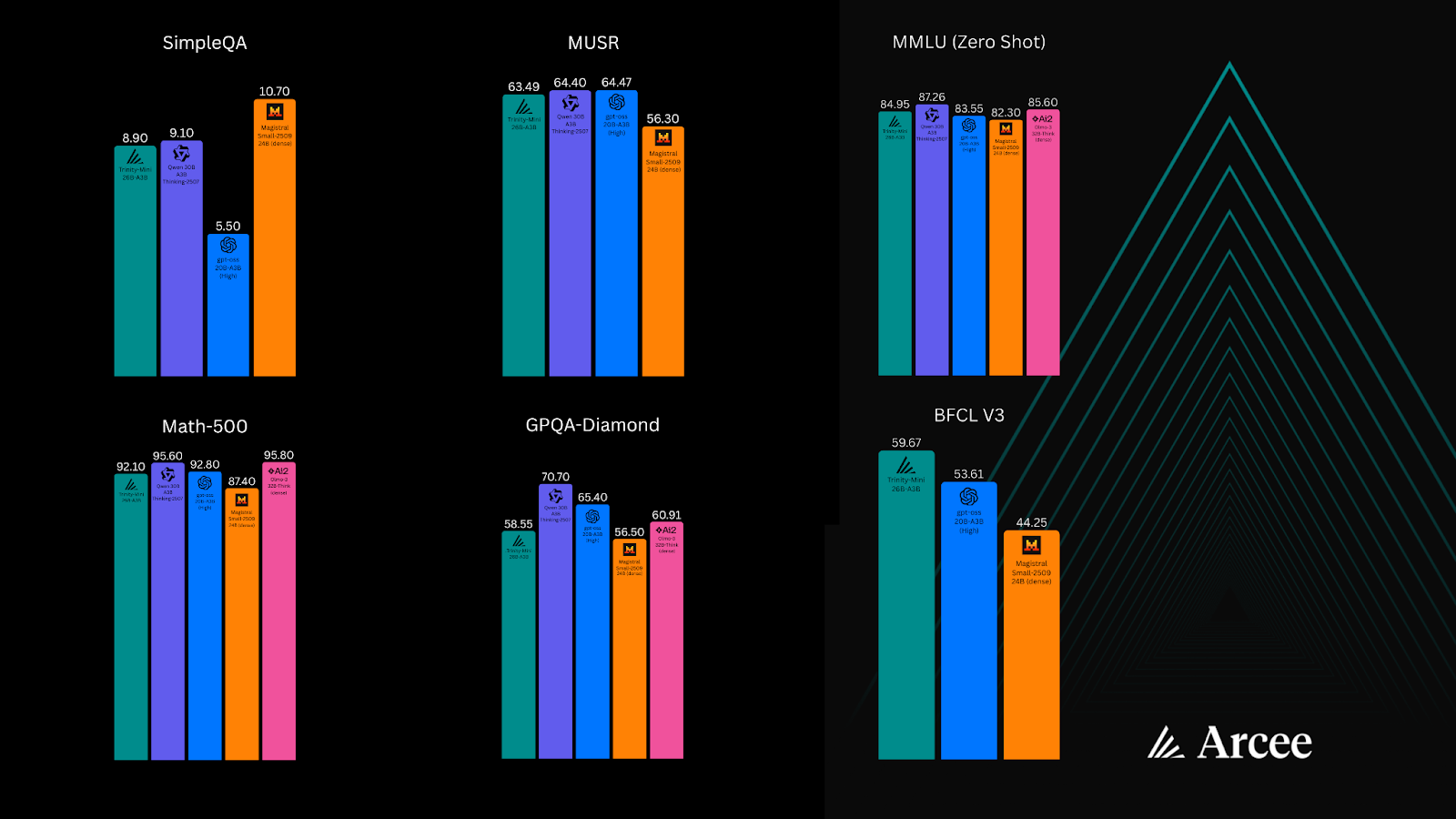
Arcee Trinity Mini delivers impressive reasoning and tool-calling capabilities while maintaining high efficiency. Here’s how it performs across several challenging benchmarks:

Reasoning Accuracy

  • MMLU (Zero-Shot): Trinity Mini scores 84.95% across 57 subjects, including math, law, and science, demonstrating strong general knowledge and reasoning skills without task-specific training.
  • Math-500: It achieves 92.10% on this advanced math reasoning benchmark, showing solid proficiency in complex calculations and problem-solving.
  • GPQA-Diamond: On graduate-level science questions, Trinity Mini reaches 58.55%, reflecting its ability to handle specialized and technical content.

Tool Calling and Structured Output

  • BFCL v3 (Function Calling): With 59.67%, Trinity Mini reliably generates responses that strictly adhere to JSON schema requirements, making it ideal for agent workflows that depend on structured data.
  • MUSR (Multi-Step Reasoning): The model attains 63.49% accuracy on tasks requiring sequential, logical steps, highlighting its multi-turn reasoning strength.

Throughput and Scalability

  • Processes over 200 tokens per second on a single A100 GPU using bfloat16 precision.
  • Activates only about 3 billion parameters per token, compared to 8–14 billion for similar dense models, resulting in significant compute savings.
  • Supports an extended 128,000-token context window without the memory overhead typically associated with long contexts, enabling robust understanding of large documents or conversations.

Benchmark Comparison Table 

Benchmark

Trinity Mini

LLaMA-3.1-8B

Qwen-2.5-7B

Mistral-class

Gemini-class

SimpleQA

8.90

9.10

6.50

10.70

MUSR

63.49

64.40

64.47

56.30

MMLU (Zero-Shot)

84.95

87.26

85.58

82.30

83.02

Math-500

92.10

95.00

90.20

87.40

95.80

GPQA-Diamond

58.55

70.05

65.40

55.00

60.91

BFCL v3

59.67

53.01

48.25

Applications and Use Cases

Arcee Trinity Mini is well suited for a wide range of real-world applications where reasoning quality, long context handling, and structured outputs are essential.

Conversational AI Applications

Trinity Mini can power conversational systems that go beyond simple question answering. Its ability to maintain long context makes it ideal for multi-turn customer support chatbots that need to remember prior messages, user preferences, or earlier troubleshooting steps. It also works well for virtual assistants that integrate with tools or APIs, such as fetching data, triggering actions, or returning structured responses. In addition, the model can support interactive documentation or knowledge base experiences, where users explore technical content through natural language conversations.

Agentic Workflows

For agent-based systems, Trinity Mini provides strong multi-step reasoning and reliable tool calling. This enables agent workflows that plan actions, invoke external tools, and refine results over several steps. It is particularly useful for workflow automation, where the model generates structured outputs that downstream systems can consume without extra parsing. Trinity Mini also fits naturally into retrieval-augmented generation (RAG) pipelines, where its extended context window allows it to reason over large retrieved documents while maintaining coherence.

Enterprise Integration

In enterprise environments, Trinity Mini offers an efficient path to production deployment. Its performance characteristics make it suitable for cost-conscious, high-throughput applications accessed through APIs. Teams can use it to build internal tools with natural language interfaces, allowing employees to query systems or generate insights without specialized training. The model is also well suited for document analysis and processing pipelines, where its 128K context support enables it to handle long reports, contracts, or technical documents in a single pass.

Conclusion

Arcee Trinity Mini offers a powerful combination of efficient architecture, advanced reasoning capabilities, and support for long-context understanding. It is an excellent choice for developers and businesses looking to build sophisticated AI applications. Its sparse mixture-of-experts design delivers high performance on challenging benchmarks while keeping compute costs manageable. With native support for structured outputs and function calling, Trinity Mini fits naturally into agent workflows, conversational AI, and complex document processing pipelines.

By accessing Trinity Mini through Clarifai’s robust API, you can quickly integrate these capabilities into your projects, whether you are building chatbots, automation systems, or data analysis tools. Start experimenting today in the Clarifai Playground or dive straight into API integration to unlock the full potential of this versatile model.

To learn more and get started:


The Rainbird Community Forum is now LIVE


We’ve opened a new space for people who are building, learning, and working with deterministic AI, and we’d like you to be part of it.

The Rainbird Community Forum is a space for people who are learning, building, and working with deterministic AI – developers, engineers, product and implementation roles, and anyone who wants to go deeper and learn by doing.

We know how valuable it is to have a place where you can ask real questions, explore ideas openly, and learn from people who are facing similar challenges. 

In the forum, you can:

  • Ask for help with technical and implementation challenges
  • Learn from peers and from the Rainbird team
  • Share feedback, ideas, and early experiments
  • Stay close to the product and the research work we’re exploring

For us, progress means learning together, exchanging ideas openly, and building with intention. This forum is part of our commitment to co-creation, transparency, and growing a thoughtful, technically curious community around deterministic AI.

If you’re building, learning, or you’re simply curious about where this space is going, we’d be glad to welcome you.

Click here to join the Rainbird Community Forum

How to Access Ministral 3 models with an API


Blog thumbnail - Ministral

How to Access Ministral 3 via API

TL;DR

Ministral 3 is a family of open-weight, reasoning-optimized models available in both 3B and 14B variants. The models support multimodal reasoning, native function and tool calling, and a huge 256K token context window, all released under an Apache 2.0 license.

You can run Ministral 3 directly on Clarifai using the Playground for interactive testing or integrate it into your applications through Clarifai’s OpenAI-compatible API.

This guide explains the Ministral 3 architecture, how to access it through Clarifai, and how to choose the right variant for your production workloads.

Introduction

Modern AI applications increasingly depend on models that can reason reliably, maintain long context, and integrate cleanly into existing tools and APIs. While closed-source models have historically led in these capabilities, open-source alternatives are rapidly closing the gap. 

Among globally available open models, Ministral 3 ranks alongside DeepSeek and the GPT OSS family at the top tier. Rather than targeting leaderboard performance on benchmarks, Ministral prioritises performances that matter in production, such as generating structured outputs, processing large documents, and executing function calls within live systems.

This makes Ministral 3 well-suited for the demands of real enterprise applications, as organisations are increasingly adopting open-weight models for their transparency, deployment flexibility, and ability to run across diverse infrastructure setups, from cloud platforms to on-premise systems.

Ministral 3 Architecture

Ministral 3 is a family of dense, edge-optimised multimodal models designed for efficient reasoning, long-context processing, and local or private deployment. The family currently includes 3B and 14B parameter models, each available in base, instruct, and reasoning variants.

Ministral 3 14B

The largest model in the Ministral family is a dense, reasoning-post-trained architecture optimised for math, coding, STEM, and other multi-step reasoning tasks. It combines a ~13.5B-parameter language model with a ~0.4B-parameter vision encoder, enabling native text and image understanding. The 14B reasoning variant achieves 85% accuracy on AIME ’25, delivering state-of-the-art performance within its weight class while remaining deployable on realistic hardware. It supports context windows of up to 256k tokens, making it suitable for long documents and complex reasoning workflows.

Ministral 3 3B

The 3B model is a compact, reasoning-post-trained variant designed for highly efficient deployment. It pairs a ~3.4B-parameter language model with a ~0.4B-parameter vision encoder (~4B total parameters), providing multimodal capabilities. Like the 14B model, it supports 256k-token context lengths, enabling long-context reasoning and document analysis on constrained hardware.

Key Technical Features

  • Multimodal Capabilities: All Ministral 3 models use a hybrid language-and-vision architecture, allowing them to process text and images simultaneously for tasks such as document understanding and visual reasoning.
  • Long-Context Reasoning: Reasoning variants support up to 256k tokens, enabling extended conversations, large document ingestion, and multi-step analytical workflows.
  • Efficient Inference: The models are optimised for edge and private deployments. The 14B model runs in BF16 on ~32 GB VRAM, while the 3B model runs in BF16 on ~16 GB VRAM, with quantised versions requiring significantly less memory.
  • Agentic Workflows: Ministral 3 is designed to work well with structured outputs, function calling, and tool-use, making it suitable for automation and agent-based systems.
  • License: All Ministral 3 variants are released under the Apache 2.0 license, enabling unrestricted commercial use, fine-tuning, and customisation.

Pretraining Benchmark Performance

Ministral 3 14B demonstrates strong reasoning capabilities and multilingual performance compared to similarly sized open models, while maintaining competitive results on general knowledge tasks. It particularly excels in reasoning-heavy benchmarks and shows solid factual recall and multilingual understanding.


Benchmark

Ministral 3 14B

Gemma 3 12B Base

Qwen3 14B Base

Notes

MATH CoT

67.6

48.7

62.0

Strong lead on structured reasoning

MMLU Redux

82.0

76.6

83.7

Competitive general knowledge

TriviaQA

74.9

78.8

70.3

Solid factual recall

Multilingual MMLU

74.2

69.0

75.4

Strong multilingual performance


Accessing Ministral 3 via Clarifai

Prerequisites

Before runing  Ministral 3 with the Clarifai API, you’ll need to complete a few basic setup steps:

  1. Clarifai Account: Create a Clarifai account to access hosted AI models and APIs.
  2. Personal Access Token (PAT): All API requests require a Personal Access Token. You can generate or copy one from the Settings > Secrets section of your Clarifai dashboard.

For additional SDKs and setup guidance, refer to the Clarifai Quickstart documentation.

Using the API

The examples below use Ministral-3-14B-Reasoning-2512, the largest model in the Ministral 3 family. It is optimised for multi-step reasoning, mathematical problem solving, and long-context workloads, making it well-suited for long-document useecases and agentic applications. Here’s how to make your first API call to the model using different methods.

Python (OpenAI-Compatible)

Python (Clarifai SDK)

You can also use the Clarifai Python SDK for inference with more control over generation settings. Here’s how to make a prediction and generate streaming output using the SDK:

Node.js (Clarifai SDK)

Here’s how to perform inference with the Node.js SDK:

Playground

The Clarifai Playground lets you quickly experiment with prompts, structured outputs, reasoning workflows, and function calling without writing any code.

Visit the Playground and choose either:

  • Ministral-3-3B-Reasoning‑2512

Screenshot 2026-01-26 at 9.28.14 PM

  • Ministral-3-14B-Reasoning‑2512

Screenshot 2026-01-26 at 9.27.35 PM

Applications and Use Cases

Ministral 3 is designed for teams building intelligent systems that require strong reasoning, long-context understanding, and reliable structured outputs. It performs well across agentic, technical, multimodal, and business-critical workflows.

Agentic Application 

Ministral 3 is well suited for AI agents that need to plan, reason, and act across multiple steps. It can orchestrate tools and APIs using structured JSON outputs, which makes it reliable for automation pipelines where consistency matters. 

Long Context

Ministral 3 can analyze large documents using its extended 256K token context, making it effective for summarization, information extraction, and question answering over long technical texts. 

Multimodal Reasoning

Ministral 3 supports multimodal reasoning, allowing applications to combine text and visual inputs in a single workflow. This makes it useful for image-based queries, document understanding, or assistants that need to reason over mixed inputs.

Conclusion

Ministral 3 provides reasoning-optimized, open-weight models that are ready for production use. With a 256K token context window, multimodal inputs, native tool calling, and OpenAI-compatible API access through Clarifai, it offers a practical foundation for building advanced AI systems.

The 3B variant is ideal for low-latency, cost-sensitive deployments, while the 14B variant supports deeper analytical workflows. Combined with Apache 2.0 licensing, Ministral 3 gives teams flexibility, performance, and long-term control.

To get started, explore the models in the Clarifai Playground or integrate them directly into your applications using the API.