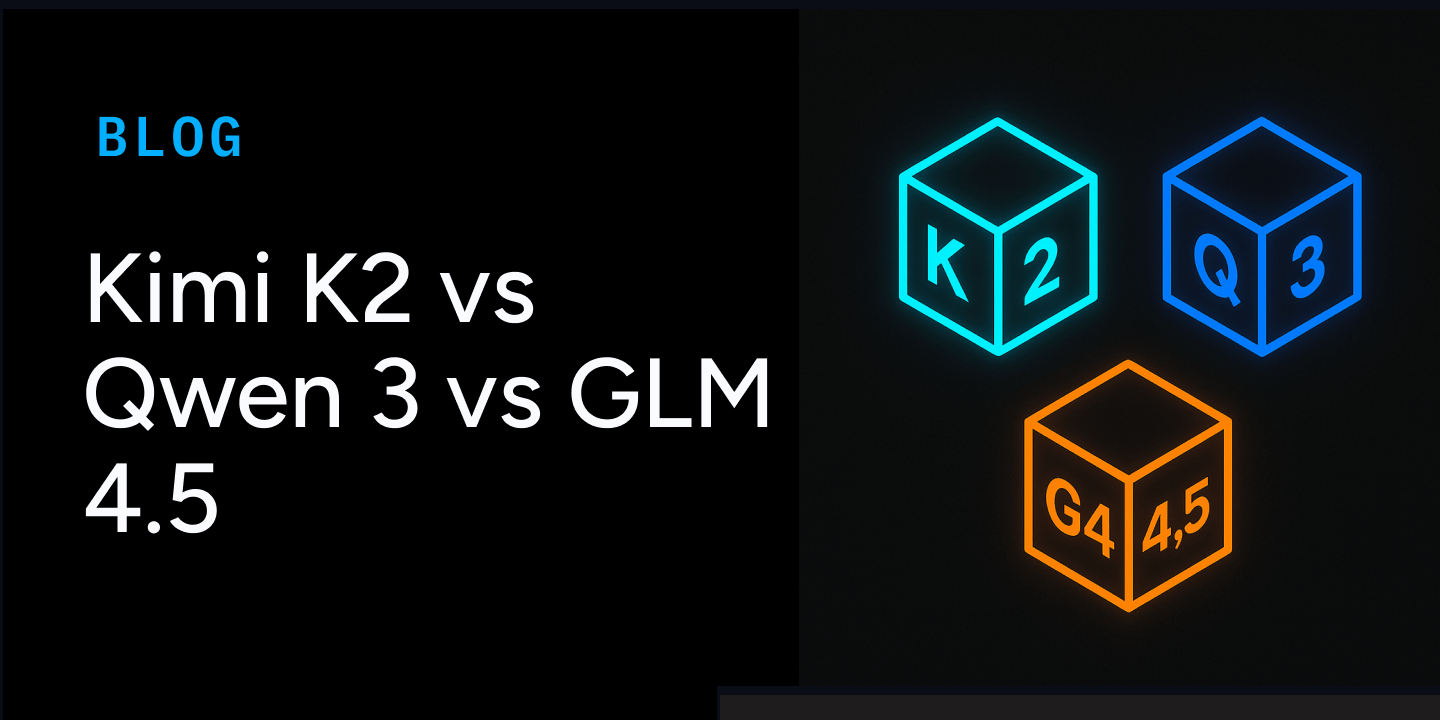
Full Model Comparison, Benchmarks & Use Cases


Quick Summary: What separates Kimi K2, Qwen 3, and GLM 4.5 in 2025?

Answer: These three Chinese‑built large language models all leverage Mixture‑of‑Experts architectures, but they target different strengths. Kimi K2 focuses on coding excellence and agentic reasoning with a 1‑trillion parameter architecture (32 B active) and a 130 K token context window, offering 64–65 % scores on SWE‑bench while balancing cost. Qwen 3 Coder is the most polyglot; it scales to 480 B parameters (35 B active), uses dual thinking modes and extends its context window to 256 K–1 M tokens for repository‑scale tasks. GLM 4.5 prioritises tool‑calling and efficiency, achieving 90.6 % tool‑calling success with only 355 B parameters and requiring just eight H20 chips for self‑hosting. The models’ pricing differs: Kimi K2 charges about $0.15 per million input tokens, Qwen 3 about $0.35–0.60, and GLM 4.5 around $0.11. Choosing the right model depends on your workload: coding accuracy and agentic autonomy, extended context for refactoring, or tool integration and low hardware footprint.

Quick Digest – Key Specs & Use‑Case Summary

Model

Key Specs (summary)

Ideal Use Cases

Kimi K2

1 T total parameters / 32 B active; 130 K context; SWE‑bench 65 %; $0.15 input / $2.50 output per million tokens; modified MIT license

Coding assistants, agentic tasks requiring multi‑step tool use; internal codebase fine‑tuning; autonomy with transparent reasoning

Qwen 3 Coder

480 B total / 35 B active parameters; 256 K–1 M context; SWE‑bench 67 %; pricing ~$0.35 input / $1.50 output (varies); Apache 2.0 license

Large‑codebase refactoring, multilingual or niche languages, research requiring long memory, cost‑sensitive tasks

GLM 4.5

355 B total / 32 B active; 128 K context; SWE‑bench 64 %; 90.6 % tool‑calling success; cost $0.11 input / $0.28 output; MIT license

Agentic workflows, debugging, tool integration, and hardware‑constrained deployments; cross‑domain agents

How to use this guide

This in‑depth comparison draws on independent research, academic papers, and industry analyses to give you an actionable perspective on these frontier models. Each section includes an Expert Insights bullet list featuring quotes and statistics from researchers and industry thought leaders, alongside our own commentary. Throughout the article, we also highlight how Clarifai’s platform can help deploy and fine‑tune these models for production use.


Why the Eastern AI Revolution matters for developers

Chinese AI companies are no longer chasing the West; they’re redefining the state of the art. In 2025, Chinese open‑source models such as Kimi K2, Qwen 3, and GLM 4.5 achieved SWE‑bench scores within a few points of the best Western models while costing 10–100× less. This disruptive price‑performance ratio is not a fluke – it’s rooted in strategic choices: optimized coding performance, agentic tool integration, and a focus on open licensing.

A new benchmark of excellence

The SWE‑bench benchmark, released by researchers at Princeton, tests whether language models can resolve real GitHub issues across multiple files. Early versions of GPT‑4 barely solved 2 % of tasks; yet by 2025 these Chinese models were solving 64–67 %. Importantly, their context windows and tool‑calling abilities enable them to handle entire codebases rather than toy problems.

Creative example: The 10x cost disruption

Imagine a startup building an AI coding assistant. It needs to process 1 B tokens per month. Using a Western model might cost $2,500–$15,000 monthly. By adopting GLM 4.5 or Kimi K2, the same workload could cost $110–$150, allowing the company to reinvest savings into product development and hardware. This economic leverage is why developers worldwide are paying attention.

Expert Insights

  • Princeton researchers highlight that SWE‑bench tasks require models to understand multiple functions and files simultaneously, pushing them beyond simple code completions.
  • Independent analyses show that Chinese models deliver 10–100× cost savings over Western alternatives while approaching parity on benchmarks.
  • Industry commentators note that open licensing and local deployment options are driving rapid adoption.

Meet the models: Overview of Kimi K2, Qwen 3 Coder and GLM 4.5

Overview of Kimi K2

Kimi K2 is Moonshot AI’s flagship model. It employs a Mixture‑of‑Experts (MoE) architecture with 1 trillion total parameters, but only 32 B activate per token. This sparse design means you get the power of a huge model without massive compute requirements. The context window tops out at 130 K tokens, enabling it to ingest entire microservice codebases. SWE‑bench Verified scores place it at around 65 %, competitive with Western proprietary models. The model is priced at $0.15 per million input tokens and $2.50 per million output tokens, making it suitable for high‑volume deployments.

Kimi K2 shines in agentic coding. Its architecture supports multi‑step tool integration, so it can not only generate code but also execute functions, call APIs, and run tests autonomously. A mixture of eight active experts handle each token, allowing domain‑specific expertise to emerge. The modified MIT license permits commercial use with minor attribution requirements.

Creative example: You’re tasked with debugging a complex Python application. Kimi K2 can load the entire repository, identify the problematic functions, and write a fix that passes tests. It can even call an external linter via Clarifai’s tool orchestration, apply the recommended changes, and verify them – all within a single interaction.

Expert Insights

  • Industry evaluators highlight that Kimi K2’s 32 B active parameters allow high accuracy with lower inference costs.
  • The K2 Thinking variant extends context to 256 K tokens and exposes a reasoning_content field for transparency.
  • Analysts note K2’s tool‑calling success in multi‑step tasks; it can orchestrate 200–300 sequential tool calls.

Overview of Qwen 3 Coder

Qwen 3 Coder—often referred to as Qwen 3.25—balances power and flexibility. With 480 B total parameters and 35 B active, it offers robust performance on coding benchmarks and reasoning tasks. Its hallmark is the 256 K token native context window, which can be expanded to 1 M tokens using context extension techniques. This makes Qwen particularly suited to repository‑scale refactoring and cross‑file understanding.

A unique feature is the dual thinking modes: Rapid mode for instantaneous completions and Deep thinking mode for complex reasoning. Dual modes let developers choose between speed and depth. Pricing varies by provider but tends to be in the $0.35–0.60 range per million input tokens, with output costs around $1.50–2.20. Qwen is released under Apache 2.0, allowing wide commercial use.

Creative example: An e‑commerce company needs to refactor a 200 k‑line JavaScript monolith to modern React. Qwen 3 Coder can load the entire repository thanks to its long context, refactor components across files, and maintain coherence. Its Rapid mode will quickly fix syntax errors, while Deep mode can redesign architecture.

Expert Insights

  • Evaluators emphasise Qwen’s polyglot support of 358 programming languages and 119 human languages, making it the most versatile.
  • The dual‑mode architecture helps balance latency and reasoning depth.
  • Independent benchmarks show Qwen achieves 67 % on SWE‑bench Verified, edging out its peers.

Overview of GLM 4.5

GLM 4.5, created by Z.AI, emphasises efficiency and agentic performance. Its 355 B total parameters with 32 B active deliver performance comparable to larger models while requiring eight Nvidia H20 chips. A lighter Air variant uses 106 B total / 12 B active and runs on 32–64 GB VRAM, making self‑hosting more accessible. The context window sits at 128 K tokens, which covers 99 % of real use cases.

GLM 4.5’s standout feature is its agent‑native design: it incorporates planning and tool execution into its core. Evaluations show a 90.6 % tool‑calling success rate, the highest among open models. It supports a Thinking Mode and a Non‑Thinking Mode; developers can toggle deep reasoning on or off. The model is priced around $0.11 per million input tokens and $0.28 per million output tokens. Its MIT license allows commercial deployment without restrictions.

Creative example: A fintech startup uses GLM 4.5 to build an AI agent that automatically responds to customer tickets. The agent uses GLM’s tool calls to fetch account data, run fraud checks, and generate responses. Because GLM runs fast on modest hardware, the company deploys it on a local Clarifai runner, ensuring compliance with financial regulations.

Expert Insights

  • GLM 4.5’s 90.6 % tool‑calling success surpasses other open models.
  • Z.AI documentation emphasises its low cost and high speed with API costs as low as $0.2 per million tokens and generation speeds >100 tokens per second.
  • Independent tests show GLM 4.5’s Air variant runs on consumer GPUs, making it appealing for on‑prem deployments.

How do these models differ in architecture and context windows?

Understanding Mixture‑of‑Experts and reasoning modes

All three models employ Mixture‑of‑Experts (MoE), where only a subset of experts activates per token. This design reduces computation while enabling specialised experts for tasks like syntax, semantics, or reasoning. Kimi K2 selects 8 of its 384 experts per token, while Qwen 3 uses 35 B active parameters for each inference. GLM 4.5 also uses 32 B active experts but builds agentic planning into the architecture.

Context windows: balancing memory and cost

  • Kimi K2 & GLM 4.5: ~128–130 K tokens. Perfect for typical codebases or multi‑document tasks.
  • Qwen 3 Coder: 256 K tokens native; extendable to 1 M tokens with context extrapolation. Ideal for large repositories or research where long contexts improve coherence.
  • K2 Thinking: extends to 256 K tokens with transparent reasoning, exposing intermediate logic via the reasoning_content field.

Longer context windows also increase costs and latency. Feeding 1 M tokens into Qwen 3 could cost $1.20 just for input processing. For most applications, 128 K suffices.

Reasoning modes and heavy vs light modes

  • Qwen 3 offers Rapid and Deep modes: choose speed for autocompletion or depth for architecture decisions.
  • GLM 4.5 offers Thinking Mode for complex reasoning and Non‑Thinking Mode for fast responses.
  • K2 Thinking includes a Heavy Mode, running eight reasoning trajectories in parallel to boost accuracy at the cost of compute.

Creative example

If you’re analysing a legal contract with 500 pages, Qwen 3’s 1 M token window can ingest the entire document and produce summaries without chunking. For everyday tasks like debugging or design, 128 K is sufficient, and using GLM 4.5 or Kimi K2 will reduce costs.

Expert Insights

  • Z.AI documentation notes that GLM 4.5’s Thinking Mode and Non‑Thinking Mode can be toggled via the API, balancing speed and depth.
  • DataCamp emphasises that K2 Thinking uses a reasoning_content field to reveal each step, enhancing transparency.
  • Researchers caution that longer context windows drive up costs and may only be necessary for specialised tasks.

Benchmark & performance comparison

How do these models perform across benchmarks?

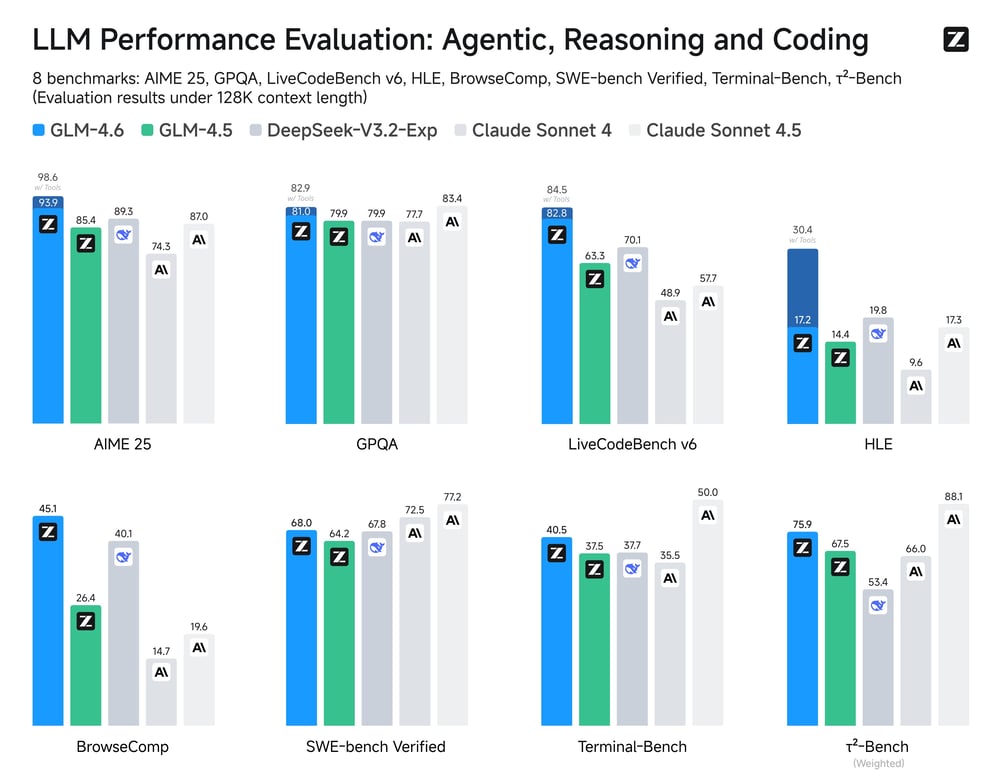
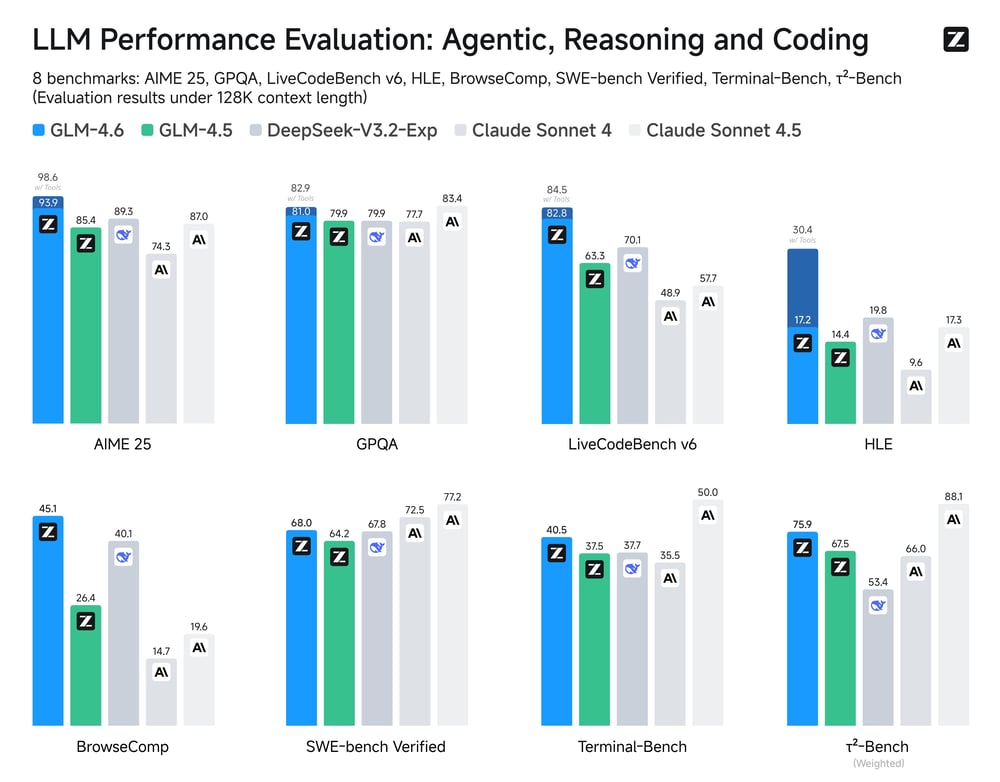
Benchmarks like SWE‑bench, LiveCodeBench, BrowseComp, and GPQA reveal differences in strength. Here’s a snapshot:

  • SWE‑bench Verified (bug fixing): Qwen 3 scores 67 %, Kimi K2 ~65 %, GLM 4.5 ~64 %.
  • LiveCodeBench (code generation): GLM 4.5 leads with 74 %, Kimi K2 around 83 %, Qwen around 59 %.
  • BrowseComp (web tool use & reasoning): K2 Thinking scores 60.2, beating GPT‑5 and Claude Sonnet.
  • GPQA (graduate physics): K2 Thinking scores ~84.5, close to GPT‑5’s 85.7.

Tool‑calling success: GLM 4.5 tops the charts with 90.6 %, while Qwen’s function calls remain strong; K2’s success is comparable but not publicly quantified.

Creative example: Benchmark in action

Picture a developer using each model to fix 15 real GitHub issues. According to an independent analysis, Kimi K2 completed 14/15 tasks successfully, while Qwen 3 managed 7/15. GLM wasn’t evaluated in that specific set, but separate tests show its tool‑calling excels at debugging.

Expert Insights

  • Princeton researchers note that models must coordinate changes across files to succeed on SWE‑bench, pushing them toward multi‑agent reasoning.
  • Industry analysts caution that benchmarks don’t capture real‑world variability; actual performance depends on domain and data.
  • Independent tests highlight that Kimi K2’s real‑world success rate (93 %) surpasses its benchmark ranking.

Cost & pricing analysis: Which model gives the best value?

Token pricing comparison

  • Kimi K2: $0.15 per 1 M input tokens and $2.50 per 1 M output tokens. For 100 M tokens per month, that’s about $150 input cost.
  • Qwen 3 Coder: Pricing varies; independent evaluations list $0.35–0.60 input and $1.50–2.20 output. Some providers offer lower tiers at $0.25.
  • GLM 4.5: $0.11 input / $0.28 output; some sources quote $0.2/$1.1 for high‑speed variant.

Hidden costs & hardware requirements

Deploying locally means VRAM and GPU requirements: Kimi K2 and Qwen 3 models need multiple high‑end GPUs (often 8× H100 NVL, ~1050 GB VRAM for Qwen, ~945 GB for GLM). GLM’s Air variant runs on 32–64 GB VRAM. Running in the cloud transfers costs to API usage and storage.

Licensing & compliance

  • GLM 4.5: MIT license allows commercial use with no restrictions.
  • Qwen 3 Coder: Apache 2.0 license, open for commercial use.
  • Kimi K2: Modified MIT license; free for most uses but requires attribution for products exceeding 100 M monthly active users or $20 M monthly revenue.

Creative example: Start‑up budgeting

A mid‑sized SaaS company wants to integrate an AI code assistant processing 500 M tokens a month. Using GLM 4.5 at $0.11 input / $0.28 output, the cost is around $195 per month. Using Kimi K2 costs approximately $825 ($75 input + $750 output). Qwen 3 falls between, depending on provider pricing. For the same capacity, the cost difference could pay for additional developers or GPUs.

Expert Insights

  • Z.AI’s documentation underscores that GLM 4.5 achieves high speed and low cost, making it attractive for high‑volume applications.
  • Industry analyses point out that hardware efficiency influences total cost; GLM’s ability to run on fewer chips reduces capital expenses.
  • Analysts caution that pricing tables seldom account for network and storage costs incurred when sending long contexts to the cloud.

Tool‑calling & agentic capabilities: Which model behaves like a real agent?

Why tool‑calling matters

Tool‑calling allows language models to execute functions, query databases, call APIs, or use calculators. In an agentic system, the model decides which tool to use and when, enabling complex workflows like research, debugging, data analysis, and dynamic content creation. Clarifai offers a tool orchestration framework that seamlessly integrates these function calls into your applications, abstracting API details and managing rate limits.

Comparing tool‑calling performance

  • GLM 4.5: Highest tool‑calling success at 90.6 %. Its architecture integrates planning and execution, making it a natural fit for multi‑step workflows.
  • Kimi K2 Thinking: Capable of 200–300 sequential tool calls, providing transparency via a reasoning trace.
  • Qwen 3 Coder: Supports function‑calling protocols and integrates with CLIs for code tasks. Its dual modes allow quick switching between generation and reasoning.

Creative example: Automated research assistant

Suppose you’re building a research assistant that needs to gather news articles, summarise them, and create a report. GLM 4.5 can call a web search API, extract content, run summarisation tools, and compile results. Clarifai’s workflow engine can manage the sequence, allowing the model to call Clarifai’s NLP and Vision APIs for classification, sentiment analysis, or image tagging.

Expert Insights

  • DataCamp emphasises that transparent reasoning in K2 exposes intermediate steps, making it easier to debug agent decisions.
  • Independent tests show GLM’s tool‑calling leads in debugging scenarios, especially memory leak analysis.
  • Analysts note Qwen’s function‑calling is robust but depends on the surrounding tool ecosystem and documentation.

Speed & efficiency: Which model runs the fastest?

Generation speed and latency

  • GLM 4.5 offers 100+ tokens/sec generation speeds and claims peaks of 200 tokens/sec. Its first‑token latency is low, making it responsive for real‑time applications.
  • Kimi K2 produces about 47 tokens/sec with a 0.53 sec first‑token latency. When combined with quantisation (INT4), K2’s throughput doubles without sacrificing accuracy.
  • Qwen 3 has variable speed depending on mode: Rapid mode is fast, but Deep mode incurs longer reasoning time. Running in multi‑GPU setups further increases throughput.

Hardware efficiency & quantisation

GLM 4.5’s architecture emphasises hardware efficiency. It runs on eight H20 chips, and the Air variant runs on a single GPU, making it accessible for on‑prem deployment. K2 and Qwen require more VRAM and multiple GPUs. Quantisation techniques like INT4 and heavy modes allow trade‑offs between speed and accuracy.

Creative example: Real‑time chat vs. batch processing

In a real‑time chat assistant for customer support, GLM 4.5 or Qwen 3 Rapid mode will deliver quick responses with minimal delay. For batch code generation tasks, Kimi K2 with heavy mode may deliver higher quality at the cost of latency. Clarifai’s compute orchestration can schedule heavy tasks on larger GPU clusters and run quick tasks on edge devices.

Expert Insights

  • Z.AI notes that GLM 4.5’s high‑speed mode supports low latency and high concurrency, making it ideal for interactive applications.
  • Evaluators highlight that K2’s quantisation doubles inference speed with minimal accuracy loss.
  • Industry analyses point out that Qwen’s deep mode is resource‑intensive, requiring careful scheduling in production systems.

Language & multimodal support: Who speaks more languages?

Multilingual capabilities

  • Qwen 3 leads in language coverage: 119 human languages and 358 programming languages. This makes it ideal for international teams, cross‑lingual research, or working with obscure codebases.
  • GLM 4.5 offers strong multilingual support, particularly in Chinese and English, and its visual variant (GLM 4.5‑V) extends to images and text.
  • Kimi K2 specialises in code and is language‑agnostic for programming tasks but doesn’t support as many human languages.

Multimodal extensions

GLM 4.5‑V accepts images, enabling vision‑language tasks like document OCR or design layouts. Qwen has a VL Plus variant (vision + language). These multimodal models remain in early access but will be pivotal for building agents that understand websites, diagrams, and videos. Clarifai’s Vision API can complement these models by providing high‑precision classification, detection, and segmentation on images and videos.

Creative example: Global codebase translation

A multinational company has code comments in Mandarin, Spanish, and French. Qwen 3 can translate comments while refactoring code, ensuring global teams understand each function. When combined with Clarifai’s language detection models, the workflow becomes seamless.

Expert Insights

  • Analysts note that Qwen’s polyglot support opens the door for legacy or niche programming languages and cross‑lingual documentation.
  • Z.AI documentation emphasises GLM 4.5’s visual language variants for multimodal tasks.
  • Evaluations indicate that Kimi K2’s focus on code ensures strong performance across programming languages, though it doesn’t cover as many natural languages.

Real‑world use cases & task performance

Coding tasks: building, refactoring & debugging

Independent evaluations reveal clear strengths:

  • Full‑stack feature implementation: Kimi K2 completed tasks (e.g., building user authentication) in three prompts at low cost. Qwen 3 produced excellent documentation but was slower and more expensive. GLM 4.5 produced basic implementations quickly but lacked depth.
  • Legacy code refactoring: Qwen 3’s long context allowed it to refactor a 2,000‑line jQuery file into React with reusable components. Kimi K2 handled the task but required splitting files because of its context limit. GLM 4.5’s response was the fastest but left some jQuery patterns unchanged.
  • Debugging production issues: GLM 4.5 excelled at diagnosing memory leaks using tool calls and completed the task in minutes. Kimi K2 found the issue but required more prompts.

Design & creative tasks

A comparative test generating UI components (modern login page and animated weather cards) showed all models could build functional pages, but GLM 4.5 delivered the most refined design. Its Air variant achieved smooth animations and polished UI details, demonstrating strong front‑end capabilities.

Agentic tasks & research

K2 Thinking orchestrated 200–300 tool calls to conduct daily news research and synthesis. This makes it suitable for agentic workflows such as data analysis, finance reporting, or complex system administration. GLM 4.5 also performed well, leveraging its high tool‑calling success in tasks like heap dump analysis and automated ticket responses.

Creative example: Automated code reviewer

You can build a code reviewer that scans pull requests, highlights issues, and suggests fixes. The reviewer uses GLM 4.5 for quick analysis and tool invocation (e.g., running linters), and Kimi K2 to propose high‑quality, context‑aware code changes. Clarifai’s annotation and workflow tools manage the pipeline: capturing code snapshots, triggering model calls, logging results, and updating the development dashboard.

Expert Insights

  • Evaluations show Kimi K2 is the most reliable in greenfield development, completing 93 % of tasks.
  • Qwen 3 dominates large‑scale refactoring thanks to its context window.
  • GLM 4.5 outperforms in debugging and tool‑dependent tasks due to its high tool‑calling success.

Deployment & ecosystem considerations

API vs. self‑hosting

  • Qwen 3 Max is API‑only and expensive. The open‑weight Qwen 3 Coder is available via API and open source, but scaling may require significant hardware.
  • Kimi K2 and GLM 4.5 offer downloadable weights with permissive licenses. You can deploy them on your own infrastructure, preserving data control and lowering costs.

Documentation & community

  • GLM 4.5 has well‑written documentation with examples, accessible in both English and Chinese. Community forums actively support international developers.
  • Qwen 3 documentation can be sparse, requiring familiarity to use effectively.
  • Kimi K2 documentation exists but feels incomplete.

Compliance & data sovereignty

Open models allow on‑prem deployment, ensuring data never leaves your infrastructure, critical for GDPR and HIPAA compliance. API‑only models require trusting the provider with your data. Clarifai offers on‑prem and private‑cloud options with encryption and access controls, enabling organisations to deploy these models securely.

Creative example: Hybrid deployment

A healthcare company wants to build a coding assistant that processes patient data. They use Kimi K2 locally for code generation, and Clarifai’s secure workflow engine to orchestrate external API calls (e.g., patient record retrieval), ensuring sensitive data never leaves the organisation. For non‑sensitive tasks like UI design, they call GLM 4.5 via Clarifai’s platform.

Expert Insights

  • Analysts stress that data sovereignty remains a key driver for open models; on‑prem deployment reduces compliance headaches.
  • Independent evaluations recommend GLM 4.5 for developers needing thorough documentation and community support.
  • Researchers warn that API‑only models can incur high costs and create vendor lock‑in.

Emerging trends & future outlook: What’s next?

Agentic AI & transparent reasoning

The next frontier is agentic AI: systems that plan, act, and adapt autonomously. K2 Thinking and GLM 4.5 are early examples. K2’s reasoning_content field lets you see how the model solves problems. GLM’s hybrid modes demonstrate how models can switch between planning and execution. Expect future models to combine planner modules, retrieval engines, and execution layers seamlessly.

Mixture‑of‑Experts at scale

MoE architectures will continue to scale, potentially reaching multi‑trillion parameters while controlling inference cost. Advanced routing strategies and dynamic expert selection will allow models to specialise further. Research by Shazeer and colleagues laid the groundwork; Chinese labs are now pushing MoE into production.

Quantisation, heavy modes & sustainability

Quantisation reduces model size and increases speed. INT4 quantisation doubles K2’s throughput. Heavy modes (e.g., K2’s eight parallel reasoning paths) improve accuracy but raise compute demands. Striking a balance between speed, accuracy, and environmental impact will be a key research area.

Long context windows & memory management

The context arms race continues: Qwen 3 already supports 1 M tokens, and future models may go further. However, longer contexts increase cost and complexity. Efficient retrieval, summarisation, and vector search (like Clarifai’s Context Engine) will be essential.

Licensing & open‑source momentum

More models are being released under MIT or Apache licenses, empowering enterprises to deploy locally and fine‑tune. Expect new versions: Qwen 3.25, GLM 4.6, and K2 Thinking improvements are already on the horizon. These open releases will further erode the advantage of proprietary models.

Geopolitics & compliance

Hardware restrictions (e.g., H20 chips vs. export‑controlled A100) shape model design. Data localisation laws drive adoption of on‑prem solutions. Enterprises will need to partner with platforms like Clarifai to navigate these challenges.

Expert Insights

  • VentureBeat notes that K2 Thinking beats GPT‑5 in several reasoning benchmarks, signalling that the gap between open and proprietary models has closed.
  • Vals AI updates show that K2 Thinking improves performance but faces latency challenges compared to GLM 4.6.
  • Analysts predict that integrating retrieval‑augmented generation with long context models will become standard practice.

Conclusion & recommendation matrix

Which model should you choose?

Your selection depends on use case, budget, and infrastructure. Below is a guideline:

Use Case / Requirement

Recommended Model

Rationale

Green‑field code generation & agentic tasks

Kimi K2

Highest success rate in practical coding tasks; strong tool integration; transparent reasoning (K2 Thinking)

Large codebase refactoring & long‑document analysis

Qwen 3 Coder

Longest context (256 K–1 M tokens); dual modes allow speed vs depth; broad language support

Debugging & tool‑heavy workflows

GLM 4.5

Highest tool‑calling success; fastest inference; runs on modest hardware

Cost‑sensitive, high‑volume deployments

GLM 4.5 (Air)

Lowest cost per token; consumer hardware friendly

Multilingual & legacy code support

Qwen 3 Coder

Supports 358 programming languages; robust cross‑lingual translation

Enterprise compliance & on‑prem deployment

Kimi K2 or GLM 4.5

Permissive licensing (MIT / modified MIT); full control over data and infrastructure

How Clarifai fits in

Clarifai’s AI Platform helps you deploy and orchestrate these models without worrying about hardware or complex APIs. Use Clarifai’s compute orchestration to schedule heavy K2 jobs on GPU clusters, run GLM 4.5 Air on edge devices, and integrate Qwen 3 into multi‑modal workflows. Clarifai’s context engine improves long‑context performance through efficient retrieval, and our model hub lets you switch models with a few clicks. Whether you’re building an internal coding assistant, an autonomous agent, or a multilingual support bot, Clarifai provides the infrastructure and tooling to make these frontier models production‑ready.


Frequently Asked Questions

Which model is best for pure coding tasks?

Kimi K2 often delivers the highest accuracy on real coding tasks, completing 14 of 15 tasks in an independent test. However, Qwen 3 excels at large codebases due to its long context.

Who has the longest context window?

Qwen 3 Coder leads with a native 256 K token window, expandable to 1 M tokens. Kimi K2 and GLM 4.5 offer ~128 K.

Are these models open source?

Yes. Kimi K2 is released under a modified MIT license requiring attribution for very large deployments. GLM 4.5 uses an MIT license. Qwen 3 is released under Apache 2.0.

Can I run these models locally?

Kimi K2 and GLM 4.5 provide weights for self‑hosting. Qwen 3 offers open weights for smaller variants; the Max version remains API‑only. Local deployments require multiple GPUs—GLM 4.5’s Air variant runs on consumer hardware.

How do I integrate these models with Clarifai?

Use Clarifai’s compute orchestration to run heavy models on GPU clusters or local runners for on‑prem. Our API gateway supports multiple models through a unified interface. You can chain Clarifai’s Vision and NLP models with LLM calls to build agents that understand text, images, and videos. Contact Clarifai’s support for guidance on fine‑tuning and deployment.

Are these models safe for sensitive data?

Open models allow on‑prem deployment, so data stays within your infrastructure, aiding compliance. Always implement rigorous security, logging, and anonymisation. Clarifai provides tools for data governance and access control.



AWS vs Azure vs Google Cloud


The cloud landscape in 2025 is more competitive than ever, and choosing the right platform requires more than picking the leader. AWS, Azure and Google Cloud all offer cutting‑edge services, but they excel in different areas: AWS boasts unmatched breadth and global reach, Azure integrates seamlessly with enterprise and hybrid setups, and Google Cloud leads in AI/ML and price/performance. The decision depends on your workload, skill stack, budget, compliance needs and sustainability goals. If you’re building AI applications, Clarifai’s cross‑cloud platform lets you deploy on any cloud and even at the edge, offering portable AI with cost and energy optimizations.

Quick Summary: Which provider should you pick? — It depends on your use case. AWS is ideal for breadth, maturity and a vast ecosystem; Azure shines for enterprise and hybrid deployments; Google Cloud excels in AI/ML and offers cost‑friendly pricing; Clarifai enables you to run AI workloads across them all without vendor lock‑in. Below we dive into details.


How Do These Clouds Stack Up? The Big‑Picture Comparison

Before diving into specifics, it helps to see the core metrics side by side. The table below compares the key categories that technology leaders and developers most often evaluate. Note that numbers such as region counts and service offerings change often, so always check the provider’s official documentation for the latest figures.

Category

AWS

Azure

Google Cloud

Notes

Regions/Availability Zones

34 regions and 108 AZs

60+ regions, 113 AZs

40 regions, 121 zones

Azure has the largest regional footprint; GCP offers more zones per region in some cases.

Service catalog size

~240+ services including compute, storage, databases, analytics and emerging quantum offerings

~200+ services, tightly integrated with Microsoft ecosystem

~200+ services with emphasis on AI, data and open‑source tools

AWS still has the broadest portfolio; GCP is catching up with rapid releases.

Key strengths

Mature compute (EC2), broad ecosystem, IoT & serverless leadership

Enterprise integration, hybrid & on‑prem solutions, strong developer tools

Data analytics (BigQuery), AI/ML (Vertex AI), Anthos multi‑cloud

Each provider focuses on different core competencies.

AI & Generative AI

Bedrock & SageMaker, custom silicon (Inferentia, Trainium); integrates with Titan models

Azure OpenAI & Machine Learning, plus Copilot and custom chips (Maia)

Vertex AI & Gemini, extensive AI APIs, TPUs; BigQuery ML

Clarifai’s AI Lake and vector services can orchestrate generative AI across all three clouds.

Hybrid & Multi‑Cloud

Outposts, Wavelength, Local Zones, plus cross‑account networking

Azure Arc & Stack, easiest enterprise integration

Anthos & Cloud Run for Anthos

Clarifai supports full multi‑cloud and hybrid orchestration, boasting 89 % of businesses using multiple clouds.

Pricing & Free Tier

On‑demand, reserved, spot; free tier with 12‑month and always‑free offers

On‑demand, reserved & Azure savings plans; free account for 30 days with $200 credit

On‑demand, committed use & preemptible; $300 free credit

GCP is often cheapest for data‑analytics workloads; AWS pricing can be complex.

Sustainability

Achieved 100 % renewable energy usage and aims to be net‑zero by 2040

Carbon negative & water positive by 2030

24/7 carbon‑free energy by 2030, carbon neutral since 2007

Clarifai’s orchestration can reduce energy consumption by 40 %.

Market share (Q2 2025)

~30 % share

~20 % share

~13 % share

AWS remains the leader but growth rates show Azure and GCP closing in.

Expert Insights

  • John Dinsdale, chief analyst at Synergy Research, noted that all three cloud leaders saw their growth accelerate in the last two quarters and forecasted that the market will double in four years.
  • Satya Nadella shared during Microsoft’s earnings call that the number of $100 million‑plus Azure deals increased more than 80 % year over year, highlighting Azure’s momentum in enterprise contracts.
  • Sundar Pichai revealed that Google Cloud launched over 1,000 new products and features in eight months and touted customer successes with generative AI.
  • Andy Jassy pointed out that companies have largely finished cost optimization and are now focusing on new initiatives, which is expected to drive AWS spending on AI infrastructure.

These insights underscore the rapid innovation across the hyperscalers and the surge of enterprise‑grade AI adoption.


What Makes AWS a Frontrunner in Cloud Computing?

Quick Summary

AWS delivers the broadest service catalog, the most mature compute options and a global network of regions and availability zones, but can be complex and expensive. Its strength lies in letting you build anything from microservices to global AI workloads; its weakness is the steep learning curve.

Deep Dive

Amazon Web Services (AWS) essentially created the modern cloud industry. It launched EC2 (Elastic Compute Cloud) in 2006 and has since expanded into 240+ services spanning compute, storage, databases, analytics, IoT and AI. With 34 regions and 108 availability zones, AWS offers unparalleled geographic redundancy. Popular compute options include EC2 instances, Fargate for containers and Lambda for serverless workloads. The platform’s breadth extends to specialized hardware like Inferentia and Trainium chips for machine learning and Outposts for hybrid deployments.

AWS’s biggest advantage is its mature ecosystem: thousands of third‑party services, extensive documentation, a massive user community and robust DevOps tooling (CloudFormation, CodePipeline, CDK). For AI, Amazon Bedrock and SageMaker let developers build, train and deploy models with integrated retrieval‑augmented generation (RAG) and support for numerous foundation models. Despite its power, AWS can be overwhelming to newcomers and has complex billing structures. Cost control requires diligence and the use of tools such as AWS Cost Explorer and Compute Optimizer. Clarifai helps by enabling you to build AI pipelines on AWS while orchestrating compute to lower costs by up to 70 %.

Creative Example

Imagine building an AI‑powered e‑commerce recommendation system. On AWS you could train models using SageMaker on GPU instances, store data in Amazon S3, and scale inference across Lambda functions using Bedrock. If demand spikes on Black Friday, Clarifai’s Armada can auto‑scale inference across AWS compute while ensuring SLAs and cost efficiency, even bursting to 1.6 million requests per second.

Expert Insights

  • Andy Jassy, AWS CEO, remarked that after years of cost optimization, companies are focusing on modernizing infrastructure and pursuing new initiatives, which will drive AWS capital expenditures.
  • Clarifai’s platform team reported that orchestrating AI workloads on AWS with their service reduced GPU costs by 70 % and energy consumption by 40 %, thanks to predictive scaling and carbon‑aware scheduling.
  • Many AWS practitioners highlight the platform’s unmatched integration with open‑source frameworks like Kubernetes and its huge marketplace of third‑party solutions.

How Does Microsoft Azure Differentiate Itself?

Quick Summary

Azure is the go‑to cloud for enterprises seeking tight integration with Microsoft products, hybrid cloud solutions and strong AI services, though its pricing and support can be complex.

Deep Dive

Microsoft Azure has evolved from a PaaS platform into a full‑stack cloud provider. It boasts the largest number of regions—over 60—and 113 availability zones. Azure’s differentiator is its deep alignment with the Microsoft ecosystem. Organizations already using Windows, SQL Server, Active Directory, Office 365 or Dynamics can seamlessly extend to Azure, leveraging existing licenses through the Azure Hybrid Benefit. Hybrid cloud is baked in through Azure Arc and Azure Stack, allowing on‑prem or edge environments to run Azure‑managed services.

Azure’s AI strategy is anchored by the Azure OpenAI Service, which offers exclusive access to generative models like GPT‑4 and DALL‑E, integrated into business applications via Copilot. Azure Machine Learning provides AutoML, pipelines and managed endpoints for training and deploying models. On the infrastructure side, Azure offers a broad range of VM types, including GPUs and HPC instances, and invests heavily in custom silicon such as the Maia AI accelerator.

Nevertheless, Azure users often mention complex pricing and limited cost‑management tools. Clarifai helps bridge that gap by orchestrating workloads across Azure and other clouds, enabling predictive scaling, integrated FinOps dashboards and cost optimisation. The platform also enables deployment of Clarifai models in Azure Kubernetes Service (AKS) or Azure Functions, giving you vendor‑agnostic control while benefiting from Microsoft’s AI infrastructure.

Creative Example

Consider a global insurance firm migrating legacy .NET applications. Azure’s compatibility with Windows Server means minimal code changes. The firm leverages Azure Arc to manage on‑premises data centers and uses Copilot for developer productivity. For its new AI risk‑assessment tool, Clarifai’s AI Lake stores image and document data, and the model runs on Azure GPUs, with Clarifai’s Spacetime providing vector search and RAG to query policies. The company monitors energy consumption and carbon footprint through Azure’s sustainability dashboard and Clarifai’s orchestrator to schedule training during off‑peak, greener energy hours.

Expert Insights

  • Satya Nadella emphasised that billion‑dollar, multiyear contracts are increasing and that Azure’s large deals grew 80 % year over year, signalling strong enterprise adoption.
  • Azure engineers note that GitHub Copilot integrated with Visual Studio and Azure DevOps accelerates developer productivity while benefiting from Microsoft’s AI models.
  • Users highlight that Azure AD simplifies identity management across on‑prem and cloud, but navigating Azure’s pricing tiers can be challenging without external FinOps tools.

Why Consider Google Cloud for Innovation and AI Workloads?

Quick Summary

Google Cloud is renowned for leading data analytics, AI/ML and multi‑cloud technologies, offering competitive pricing and sustainability leadership, but has a smaller market share and fewer enterprise integrations.

Deep Dive

Google Cloud Platform (GCP) stands out for its focus on data, AI and open‑source innovation. With 40 regions and 121 zones, GCP may have fewer regions than its rivals but invests heavily in high‑performance networking and global fiber infrastructure. Its flagship services include BigQuery for serverless analytics, Cloud Spanner for globally distributed relational databases and Google Kubernetes Engine (GKE), which remains one of the best managed Kubernetes offerings. Developers appreciate GCP’s open‑source friendliness and early adoption of technologies such as Kubernetes, TensorFlow and Istio.

For AI workloads, Vertex AI offers end‑to‑end tooling for training, tuning and deploying models, with integrated pipelines, AutoML and generative AI via Gemini. GCP also provides domain‑specific AI services (Vision, Text‑to‑Speech, Translation) and custom hardware in the form of Tensor Processing Units (TPUs). Its multi‑cloud platform, Anthos, allows you to run Kubernetes clusters across GCP, AWS, Azure or on‑prem, facilitating workload portability and hybrid architectures.

GCP’s pricing structure is often praised for its simplicity and competitiveness: per‑second billing, sustained‑use discounts and preemptible instances mean many data‑intensive workloads cost less on GCP. A Cloud Ace benchmark even showed GCP achieving 10 % higher performance in IaaS tests than AWS or Azure and offering lower storage costs with higher I/O throughput. However, some enterprises note the smaller partner ecosystem and fewer enterprise‑grade features compared with AWS or Azure. Clarifai complements GCP by providing vector search via Spacetime and plug‑and‑play generative models that can run on Google’s TPUs or GPU instances, with orchestrated scaling across multiple clouds.

Creative Example

Suppose you’re a data‑driven startup building an AI‑powered fitness app. You can store sensor data in BigQuery, run distributed training with Vertex AI and serve recommendations via Cloud Run. To integrate RAG into your chatbot, Clarifai’s Spacetime indexes user embeddings and Scribe labels new training data. When training demand spikes, Clarifai’s orchestrator shifts workloads to GCP’s preemptible VMs for cost savings while bursting into other clouds if capacity runs short.

Expert Insights

  • Sundar Pichai highlighted that Google Cloud launched more than 1,000 new products in eight months and that global brands are leveraging GCP for generative AI.
  • Data engineers praise BigQuery for near‑real‑time analytics and Spanner for global consistency.
  • Researchers note that GCP’s sustainability commitment includes operating on 24/7 carbon‑free energy by 2030, which appeals to eco‑conscious organizations.

How Do AWS, Azure and Google Compare on Compute and Serverless?

Quick Summary

AWS offers the broadest VM and serverless options, Azure provides deep hybrid integration and enterprise‑friendly VM sizes, and GCP leads in container orchestration with simple billing and high performance. Clarifai orchestrates AI workloads across these compute tiers, auto‑scaling to millions of inferences with optimized cost and carbon usage.

Deep Dive

Virtual Machines (VMs): AWS’s EC2 offers dozens of instance families optimized for general purpose (M), compute (C), memory (R), storage (I), GPU (P) and machine learning (Inf, Trn). Azure’s VM series (Dv5, Ev5, H‑series) also cover broad workloads and emphasize Windows compatibility. Google’s Compute Engine emphasizes live migration and custom machine types; its flexible machine specs allow you to specify CPU and memory combinations rather than picking from fixed types. Both AWS and GCP bill VMs per second, whereas Azure often charges by the minute.

Containers: AWS’s EKS, Azure’s AKS and Google’s GKE provide managed Kubernetes. GKE remains the most mature with features like autopilot and built‑in binary authorization. AWS also offers Fargate for serverless containers, while GCP has Cloud Run for running containers directly. Clarifai can deploy AI models as container images on any of these clusters and automatically scales them using Armada to meet bursty inference loads.

Serverless: AWS pioneered serverless with Lambda and now offers serverless options across analytics (Athena), databases (DynamoDB on‑demand) and event orchestration (Step Functions). Azure’s Functions integrates tightly with Logic Apps and Event Grid, providing a unified experience with DevOps pipelines. GCP’s Cloud Functions (now Gen 2), Cloud Run and Cloud Tasks make it simple to run microservices with per‑second billing. Clarifai integrates by packaging inference code into serverless functions that respond to events or API calls on any provider.

Specialized AI Hardware: AWS’s Inferentia and Trainium, Azure’s Maia and Google’s TPUs offer powerful acceleration for machine learning workloads. Running Clarifai’s generative models on these accelerators reduces latency and cost. The right choice depends on your framework (PyTorch vs TensorFlow), region availability and pricing.

Expert Insights

  • A Cloud Ace benchmark observed that GCP’s IaaS performance was 10 % higher than AWS or Azure, making it attractive for compute‑intensive workloads.
  • Many cloud architects use spot or preemptible instances to cut costs; Clarifai’s orchestrator automatically shifts workloads to cheaper capacity when available.
  • Analysts predict a surge in AI‑optimized instance types as chipmakers release new silicon like Nvidia Blackwell and custom chips from AWS, Azure and Google.

Which Provider Excels in Storage and Databases?

Quick Summary

AWS dominates with the most mature storage portfolio, Azure offers strong enterprise database integration, and Google Cloud shines for globally distributed databases and lower storage costs. The optimal choice depends on your data model and consistency requirements.

Deep Dive

Object Storage: Amazon S3 remains the industry standard for object storage with 11 nines of durability. It offers multiple classes (Standard, Infrequent Access, Intelligent Tiering, Glacier) and granular lifecycle policies. Azure Blob Storage competes closely and integrates well with Azure Data Lake Storage for analytics pipelines. Google Cloud Storage matches durability and provides uniform bucket-level access control with object‑versioning; its Coldline and Archive tiers often undercut AWS on price.

Block & File Storage: AWS EBS provides persistent block volumes with different performance levels (gp3, io2), while EFS offers NFS file storage. Azure’s Disk Storage offers Premium SSD v2 and Ultra disks, and Azure Files presents a fully managed SMB share for Windows applications. GCP’s Persistent Disk supports regional replication, and Filestore offers high‑performance NFS for GKE.

Databases: AWS’s RDS supports multiple engines (MySQL, PostgreSQL, SQL Server, Oracle, MariaDB) and offers the proprietary Aurora with MySQL/Postgres compatibility. DynamoDB is a fully managed NoSQL database with single‑digit millisecond latency, while Redshift covers data warehousing. Azure counters with SQL Database, Cosmos DB (multi‑model with multi‑region writes) and Synapse Analytics. GCP’s star is BigQuery, a serverless data warehouse with built‑in ML, while Cloud Spanner delivers globally consistent, horizontally scalable relational transactions. For time‑series or key‑value workloads, GCP also offers Cloud Bigtable and Firestore.

Cost and Performance: According to Cloud Ace, Google Cloud’s storage costs are lower and its I/O throughput is higher compared with AWS and Azure. AWS S3 has free tiers and strong third‑party integrations but can be more expensive for egress. Azure’s Cosmos DB offers cost‑effective serverless mode for variable workloads. Clarifai’s AI Lake sits on top of whichever object storage you choose, abstracting away the differences; it optimizes read/write patterns for machine learning and centralizes assets across clouds.

Expert Insights

  • Data architects often choose DynamoDB or Cosmos DB for low‑latency NoSQL, BigQuery for near‑real‑time analytics, and Spanner when global consistency is paramount.
  • Cloud Ace tests found that GCP’s storage delivered higher I/O throughput at a lower cost.
  • Clarifai’s engineers recommend designing a data layer that leverages vendor‑agnostic buckets and uses Clarifai’s AI Lake for unified storage across clouds.

What About Networking and Global Reach?

Quick Summary

AWS boasts the largest private network and broad edge presence, Azure offers extensive private connectivity via ExpressRoute, and Google Cloud invests in high‑performance fiber and software‑defined networking. Each cloud provides CDN, load balancers and cross‑region replication; your choice depends on latency requirements and compliance needs.

Deep Dive

Global Network: AWS operates one of the world’s largest private fiber networks, connecting its regions and availability zones. It runs services in Local Zones and Wavelength Zones to reduce latency for edge applications. Amazon Route 53 manages DNS with latency‑based routing and geofencing. Azure has built a massive global network with ExpressRoute for private connectivity to on‑premises facilities and Front Door for global load balancing and caching. Google Cloud leverages its backbone built for Google’s consumer services, with global VPCs, Cloud CDN and the ability to create a single anycast IP address that load‑balances across regions.

Connectivity Options: Each provider offers direct connections: AWS Direct Connect, Azure ExpressRoute and Google Cloud Interconnect, delivering private links to data centers or offices. For cross‑cloud or hybrid networking, GCP’s Multicloud Network Connectivity and AWS Transit Gateway support connecting multiple VPCs and VNet hubs. Azure Virtual WAN orchestrates hub‑and‑spoke architectures.

Edge & 5G: For ultra‑low latency, AWS Wavelength and Local Zones place compute near telecom networks; Azure Edge Zones and Azure Private 5G Core deliver private cellular networks; Google’s Distributed Cloud Edge runs Anthos clusters on telecom or enterprise premises. Clarifai allows you to run AI models on devices or at the edge via the Clarifai Local Runner, syncing with the cloud for retraining and updated weights.

Expert Insights

  • Network architects note that GCP’s global VPC simplifies multi‑region networking compared with per‑region VPCs on AWS and Azure.
  • Financial firms choose ExpressRoute for dedicated, low‑latency connectivity to Azure.
  • With edge data centers expected to grow from 250 to 1,200 by 2026, multi‑access edge computing will become a major factor in choosing a cloud provider.

Who Leads in AI, Machine Learning and Generative AI?

Quick Summary

Google Cloud’s Vertex AI and Gemini models lead in ease of use and integrated tooling, AWS’s Bedrock and SageMaker provide vast model options with enterprise controls, and Azure’s OpenAI service offers exclusive access to GPT‑4 and Copilot integration. Clarifai complements them with a multi‑cloud AI platform for model training, inference and vector search.

Deep Dive

AI and generative AI are now core differentiators in the cloud war. Each provider has staked its claim with proprietary models, hardware and developer tools.

AWS AI: Amazon Bedrock provides API access to foundation models such as Anthropic Claude, Mistral, and Meta Llama alongside Amazon’s own Titan models. SageMaker remains the flagship machine learning platform, offering data labeling (Ground Truth), feature store, notebook environments and RAG pipelines. AWS also provides specialized AI services (Rekognition, Comprehend, Kendra) and chips (Inferentia, Trainium).

Azure AI: Azure OpenAI Service grants access to GPT‑4, DALL‑E and other OpenAI models with enterprise governance. It powers Copilot features across Microsoft 365 and Dynamics. Azure Machine Learning provides AutoML, ML pipelines, reinforcement learning and model management. Azure also integrates AI into its Synapse Analytics and Power BI products.

Google Cloud AI: Vertex AI is the unified platform for building, deploying and scaling ML models. It includes AutoML, Workbench (managed notebooks), pipelines and model registry, and now the Gemini family of generative models for text, vision and multimodal tasks. GCP also offers the AI Platform of prebuilt APIs (Vision, NLP, translation) and custom hardware (TPUs).

Clarifai: Clarifai’s AI platform is cloud‑agnostic. The AI Lake stores datasets across clouds, Scribe automates data labeling, Enlight trains models (from computer vision to multimodal generative models), Spacetime provides a vector database and Armada scales inference. Crucially, Clarifai can orchestrate inference across clouds, automatically selecting the most cost‑efficient or carbon‑efficient compute and scaling to handle 1.6 million inferences per second. This multi‑cloud approach prevents vendor lock‑in and optimizes performance.

Creative Example

Imagine building a chatbot for a healthcare provider. You might choose Azure OpenAI to leverage GPT‑4 for natural language understanding and integrate with Microsoft Teams. You would store conversation histories in Azure Blob Storage. For specialized medical image analysis, you can use Clarifai’s Enlight to train vision models on AWS GPUs, deploy them via Clarifai Mesh into a HIPAA‑compliant environment, and use Spacetime for vector search to retrieve relevant cases. When high‑volume queries occur, Clarifai’s orchestrator routes inference to GCP’s TPU‑backed Vertex AI to maintain latency while staying under budget.

Expert Insights

  • McKinsey reported a 700 % surge in generative AI interest from 2022 to 2023, a trend driving hyperscalers’ AI revenue.
  • AWS announced its generative AI business reached a multi‑billion‑dollar run rate in early 2024.
  • AI practitioners emphasise that data foundation modernization (data mesh/data fabric) is essential for generative AI success.
  • Clarifai’s research notes that agentic AI and FinOps 2.0 will shape AI‑driven cloud orchestration, enabling carbon‑aware scheduling and quantum integration.

Which Platform Offers the Best Developer and DevOps Tools?

Quick Summary

AWS provides a mature suite for infrastructure as code and continuous delivery, Azure excels with integrated GitHub and Bicep, while Google Cloud’s tools appeal to open‑source developers. Clarifai adds specialized MLOps and orchestration tools that span multiple clouds.

Deep Dive

Infrastructure as Code (IaC): CloudFormation and the AWS CDK allow developers to define stacks in YAML or high‑level languages. Azure Resource Manager (ARM) templates and Bicep simplify declarative deployments; Azure DevOps and GitHub Actions (now a Microsoft product) integrate CI/CD and pipelines. Google Cloud’s Deployment Manager and the new Cloud Config support YAML/JSON and integration with Terraform. Because Terraform is cloud‑agnostic, many organizations use it for multi‑cloud provisioning.

CI/CD and DevOps: AWS’s CodePipeline, CodeBuild and CodeDeploy support end‑to‑end automation. Azure offers Azure DevOps, with Boards and Repos, and GitHub Actions with built‑in security scanning. Google Cloud’s Cloud Build, Cloud Deploy and Artifact Registry emphasize fast builds and container deployments. Clarifai’s MLOps features integrate with these pipelines: you can trigger model training via Clarifai Mesh, automatically label new datasets with Scribe, and deploy to any cloud with Armada.

Monitoring & Observability: AWS CloudWatch and X‑Ray, Azure Monitor and Application Insights, and Google’s Operations Suite (formerly Stackdriver) provide metrics, logging and tracing. For multi‑cloud workloads, Clarifai offers unified dashboards that track model latency, GPU utilization and costs across all providers, surfacing when to shift workloads to cheaper or greener regions.

Expert Insights

  • DevOps engineers appreciate GitHub Actions for its integration with GitHub repos and broad marketplace of actions.
  • Terraform remains the de facto standard for multi‑cloud IaC; many organizations also adopt Crossplane to provision resources as Kubernetes CRDs.
  • Clarifai’s tools complement DevOps by adding MLOps best practices: automated data labeling, experiment tracking and inference monitoring.

How Do Their Pricing Models and Cost Management Tools Compare?

Quick Summary

AWS offers numerous pricing options and discounts but can be confusing; Azure’s pricing is complex but benefits from enterprise agreements; Google Cloud’s pricing is simple and often cheaper for sustained workloads; Clarifai’s orchestration optimizes costs across providers and offers FinOps dashboards.

Deep Dive

Pricing Models: All three providers use pay‑as‑you‑go billing. AWS has on‑demand, Reserved Instances, Savings Plans and Spot Instances; Azure offers on‑demand, Reserved VM Instances, Savings Plans for Compute and spot VMs; Google Cloud uses on‑demand pricing, Committed Use Discounts and Preemptible VMs. AWS and GCP both charge per second, whereas some Azure services bill per minute.

Free Tiers and Credits: AWS’s Free Tier includes 750 hours of t2.micro instances per month for 12 months and always‑free services like Lambda and DynamoDB. Azure provides $200 credit for 30 days and a limited set of always‑free services. Google Cloud gives new users $300 credit valid for 90 days and offers always‑free usage for specific services.

Cost Management Tools: AWS provides Cost Explorer, Billing Dashboard, Budgets and Trusted Advisor; Azure has Cost Management + Billing with recommendations; GCP offers Cost Management with budgets, forecasted spend and price simulation. Third‑party tools like CloudZero and Kubecost supplement these features. Clarifai goes further with FinOps dashboards integrated into its orchestration, highlighting GPU utilization, carbon cost and predicted expenses. It can shift workloads across clouds or schedule training during off‑peak hours to optimize both cost and sustainability.

Comparative Costs: According to Cloud Zero, AWS can be more expensive and has basic cost tools, Azure’s pricing is complex with limited cost tools, and GCP offers better price/performance especially for sustained workloads and data analytics. Using Reserved Instances or Commitment Discounts can significantly cut costs, but locking in capacity reduces flexibility.

Expert Insights

  • FinOps practitioners recommend using Savings Plans or Committed Use Discounts for workloads with predictable usage, while leveraging spot/preemptible instances for burst workloads.
  • Clarifai’s engineers note that combining GPU spot instances across providers, orchestrated via Clarifai’s AI platform, can reduce costs by up to 70 %.
  • The emerging FinOps 2.0 paradigm focuses on not just cost optimisation but also carbon‑aware scheduling and optimizing AI model efficiency.

What Are the Pros and Cons of Each Cloud?

AWS Pros:

  • Mature ecosystem: Broad set of services (compute, storage, AI, IoT).
  • Global reach: More than 100 availability zones across 34 regions.
  • Rich third‑party marketplace: Thousands of partner integrations.
  • Advanced serverless and IoT services: Lambda, Fargate, Greengrass.
  • Strong security and compliance: Meets many standards (SOC, PCI, HIPAA).

AWS Cons:

  • Complexity: Steep learning curve for new users and large service catalog.
  • Pricing can be confusing and expensive.
  • Limited hybrid options compared with Azure (though Outposts exists).
  • High support cost; Enterprise Support can be pricey.

Azure Pros:

  • Seamless integration with Windows, Active Directory and Office 365.
  • Industry‑leading hybrid & on‑prem solutions via Azure Arc and Stack.
  • Strong enterprise network; second‑largest region footprint.
  • Exclusive access to GPT‑4 and Copilot via Azure OpenAI Service.
  • License portability: Azure Hybrid Benefit and reserved instances.

Azure Cons:

  • Complex pricing & licensing; many customers find it challenging.
  • Cost management tools lag behind AWS and GCP.
  • Not SMB‑friendly; smaller budgets may find fewer cost‑effective options.
  • Support complaints from some users around responsiveness.

Google Cloud Pros:

  • Superior price/performance and simpler billing.
  • Leadership in data & AI with BigQuery, Vertex AI and TPUs.
  • Container & open‑source innovation: Pioneered Kubernetes and Istio.
  • Anthos delivers open multi‑cloud support for Kubernetes.
  • Carbon‑free energy goal in 2030.

Google Cloud Cons:

  • Smaller market share and community.
  • Fewer enterprise‑grade services and limited ERP/CRM integration.
  • Less robust hybrid offering compared with Azure (though Anthos is growing).
  • Learning curve due to unique workflows and less documentation.

Expert Insights

  • Cloud architects emphasize that the best cloud often depends more on existing investments than on theoretical advantages.
  • Many practitioners highlight the value of multi‑cloud to mitigate lock‑in and optimize costs; Clarifai’s orchestrator is built around that principle.
  • When evaluating cons, companies should weigh them against the capabilities they actually need rather than general perceptions.

Quick Summary

Every cloud has strengths and weaknesses. AWS excels in maturity, ecosystem and breadth but can be complex and expensive. Azure offers seamless enterprise integration and hybrid capabilities but struggles with pricing complexity and support issues. Google Cloud leads in data and AI with cost advantages but has fewer enterprise features and a smaller community.


Which Cloud Is Best for Your Use Case?

Quick Summary

The optimal cloud depends on your business context. AWS is ideal for startups seeking rapid scaling and ecosystem breadth; Azure fits enterprises with a Microsoft stack and regulated industries; Google Cloud appeals to AI/ML start‑ups and data‑driven organizations; Clarifai unifies AI workloads across them, making multi‑cloud strategies accessible.

Use‑Case Recommendations

  1. Enterprise Microsoft Stack: If your organization is invested in Windows Server, SQL Server, Active Directory or Office 365, Azure typically offers the least friction and most cost benefits through license mobility and hybrid benefits. Add Clarifai to handle AI/ML workloads without vendor lock‑in.
  2. Startup & SMBs: Startups often begin with AWS for its free tier and extensive ecosystem or Google Cloud for its simple pricing and strong container support. A small SaaS could run its backend on GCP’s Cloud Run while using Clarifai’s API for image recognition; or choose AWS for marketplace integrations and Clarifai for AI inference at scale.
  3. Data & Analytics Heavy: Companies prioritizing analytics, streaming and AI should consider Google Cloud’s BigQuery and Vertex AI. Clarifai’s AI Lake can augment BigQuery for vector search and RAG.
  4. AI/ML & Generative AI: If your business is building generative AI applications or needs custom models, evaluate AWS Bedrock, Azure OpenAI and Google’s Vertex AI. Use Clarifai to orchestrate training across clouds and optimize model deployment; Clarifai’s orchestrator can handle 1.6 million inference requests per second.
  5. Hybrid & Multi‑Cloud: Organizations seeking to avoid lock‑in, maintain redundancy or meet data sovereignty requirements should leverage Azure Arc, AWS Outposts or Google Anthos. Combine them with Clarifai’s cross‑cloud orchestration to deploy AI at the edge or across multiple providers seamlessly.
  6. Regulated Industries: Financial services, healthcare and government may choose Azure or AWS for broad compliance portfolios and on‑prem integration. Clarifai helps by providing compliance‑ready AI pipelines and fine‑grained access control.
  7. Sustainability‑Conscious: If carbon reduction is a priority, Google Cloud (24/7 carbon‑free goal), Azure (carbon negative by 2030) and AWS (100 % renewable energy) all offer tools to track emissions. Clarifai’s orchestrator schedules training in regions with greener grids and can reduce energy by 40 %.

Expert Insights

  • Multi‑cloud adoption reaches 89 %, meaning most organizations use at least two providers. Clarifai’s cross‑cloud capabilities make this easier.
  • Case study: A fintech firm used GCP’s BigQuery for analytics, AWS for core banking microservices, and Clarifai to run fraud detection models across both, leveraging preemptible VMs and spot instances for cost savings.
  • Analyst note: Many firms initially choose one provider and later expand to multi‑cloud to optimize workloads and reduce risk.

How Do They Compare on Security, Compliance and Sustainability?

Quick Summary

All three providers offer robust security services and compliance certifications, but they differ in sustainability commitments and tools. AWS and Azure have broad compliance portfolios, Google Cloud leads in carbon neutrality, and Clarifai adds AI‑specific governance and carbon‑aware scheduling.

Deep Dive

Security: Each provider follows a shared responsibility model. AWS offers GuardDuty, Inspector, Shield and Identity Center. Azure provides Defender (formerly Security Center), Sentinel (SIEM) and strong integration with Azure Active Directory. Google Cloud’s Security Command Center and Cloud Armor protect applications, while Binary Authorization ensures container integrity.

Compliance: AWS, Azure and GCP all meet major standards like ISO 27001, SOC 2, PCI‑DSS and HIPAA. Government workloads often select FedRAMP High certified regions. Azure and AWS generally have deeper support for industry‑specific certifications (e.g., CJIS for law enforcement, ITAR for defense). Google Cloud adds transparency through its Access Transparency logs, enabling customers to see why Google employees access their data.

Sustainability: The race to a greener cloud is heating up. AWS achieved 100 % renewable energy and targets net‑zero carbon by 2040. Microsoft pledges to be carbon negative and water positive by 2030 and to replenish more water than it consumes. Google Cloud has been carbon neutral for over a decade and aims to operate on 24/7 carbon‑free energy by 2030. Each provider offers carbon tracking tools (AWS Customer Carbon Footprint Tool, Azure Sustainability Calculator, Google Cloud Carbon Footprint). Clarifai enhances sustainability by scheduling workloads based on carbon intensity and reducing energy consumption by 40 % through AI‑powered orchestration.

Privacy & Regulations: Data sovereignty is increasingly important. Some regions require data residency, leading providers to open local regions or implement sovereign clouds. Zero‑trust security and new concepts like cyberstorage (distributing data fragments to mitigate ransomware) are emerging.

Expert Insights

  • Forrester predicts that by the end of 2025, around 40 % of organizations will rely on third‑party security platforms rather than solely using native cloud security.
  • Clarifai’s security team emphasizes the need for AI governance frameworks, including model validation, human‑in‑the‑loop workflows and risk assessments.
  • Sustainability experts highlight that selecting regions with cleaner energy and using autoscaling can greatly reduce carbon footprints.

What About Hybrid and Multi‑Cloud Strategies?

Quick Summary

Hybrid and multi‑cloud strategies are becoming the norm, with solutions like AWS Outposts, Azure Arc and Google Anthos enabling on‑prem and cross‑cloud workloads. Clarifai’s multi‑cloud AI orchestrator abstracts provider differences and optimizes workloads across environments.

Deep Dive

Hybrid Cloud: Hybrid architectures allow workloads to run on both on‑premises infrastructure and the public cloud. AWS Outposts extends AWS services into your data center; Local Zones provide regional edge computing. Azure Stack and Azure Arc let you run Azure services on hardware in your own environment or third‑party data centers. Google Distributed Cloud supports running GKE clusters on premise and at the edge, powered by Anthos.

Multi‑Cloud: Running workloads across multiple hyperscalers provides redundancy, cost optimization and flexibility. However, it introduces complexity around networking, security, management and observability. Tools like Terraform, Crossplane, Istio and Anthos Service Mesh help manage multi‑cloud clusters. Clarifai’s orchestration abstracts cloud APIs, meaning you can train a model on AWS GPUs, serve it on GCP’s TPUs and schedule tasks based on cost or carbon considerations.

Why Multi‑Cloud?

  • Avoid Vendor Lock‑In: By leveraging multiple clouds, companies prevent being tied to one provider’s pricing or technology roadmap.
  • Optimize Performance & Cost: Different clouds may offer the best pricing or performance for specific workloads; Clarifai shifts workloads accordingly.
  • Resilience & Disaster Recovery: Running backups or production workloads across clouds improves availability and meets compliance requirements for geographic diversity.
  • Compliance & Data Residency: Some regions require that data reside in specific locations; multi‑cloud allows you to select providers with local regions.

Challenges: Multi‑cloud adds operational overhead. Teams need consistent security policies, unified monitoring, and cross‑cloud networking. Clarifai addresses these by centralizing AI workloads and offering a single pane for cost, performance and carbon metrics. It also integrates with major orchestration tools and FinOps platforms.

Expert Insights

  • Studies indicate that 89 % of businesses already use multiple clouds.
  • Platform engineering is emerging to manage this complexity, combining infrastructure, DevOps and developer experience.
  • Clarifai’s engineers highlight that agentic AI, which automates decisions about where and when to run workloads, will be key to multi‑cloud orchestration.

What Future Trends Are Shaping the Cloud Landscape?

Quick Summary

Generative AI, platform engineering, FinOps 2.0, quantum computing, edge & 5G, AI governance, AIOps and sustainability innovations are among the key trends shaping cloud computing toward 2026 and beyond. Understanding them can future‑proof your cloud strategy.

Key Trends Explained

  1. Generative AI as the Growth Engine: GenAI is driving explosive growth in cloud spending. Hyperscalers are investing billions in specialized hardware and integrated AI platforms. Expect more integrated RAG tools, domain‑specific models and AI‑native services.
  2. Platform Engineering & The “Great Rebundling”: Building and operating complex distributed systems has led to a shift from microservices sprawl to integrated platforms for developers. Platform engineering teams provide internal developer platforms that abstract infrastructure and unify multi‑cloud operations.
  3. FinOps 2.0: Cost management evolves to include carbon‑aware scheduling, sustainability tracking, and AI‑driven optimization. Tools will not only track dollars spent but also grams of CO₂ emitted.
  4. Quantum Computing: Major providers now offer quantum simulators and early‑stage hardware (Amazon Braket, Azure Quantum, Google’s Quantum Engine). While still nascent, quantum computing is being explored for cryptography, optimization and molecular simulation.
  5. Edge Computing & 5G: Edge infrastructure is expanding rapidly, from ~250 edge data centers in 2022 to 1,200 by 2026. 5G enhances bandwidth and latency, enabling real‑time applications in IoT, AR/VR and autonomous vehicles.
  6. AI Governance & AIOps: As AI deployments proliferate, concerns about bias, hallucinations and compliance drive demand for AI governance frameworks. Meanwhile, AIOps leverages AI to manage IT operations, predict failures and auto‑tune workloads.
  7. Sustainability & Green Cloud: Cloud providers are racing to outdo each other on renewable energy commitments. Innovations include immersive cooling, carbon‑aware scheduling, and even water‑positive initiatives. Clarifai’s orchestrator aligns with these trends by reducing energy usage by 40 % and scheduling workloads during greener grid hours.
  8. AI Chip Arms Race: Nvidia’s Blackwell GPUs, AWS’s Graviton 4 and Trainium 2, Azure’s Maia and Google’s TPU Next will compete to deliver higher performance per watt. The choice of chip will influence which cloud you choose for AI training.

Expert Insights

  • AlphaSense analysts project that the global public cloud market will grow 21.5 % in 2025, reaching $723 billion.
  • Forrester predicts 40 % of organizations will rely on third‑party security platforms by the end of 2025.
  • Clarifai’s vision highlights the rise of agentic AI, FinOps 2.0, carbon‑aware scheduling and quantum integration as pivotal trends.

How Do You Choose the Right Cloud Provider? A Decision Framework

Quick Summary

Choosing the right cloud involves evaluating your workloads, budgets, compliance needs, existing stack, sustainability goals and multi‑cloud readiness. Follow the steps below to make an informed decision; consider using Clarifai to ensure your AI workloads remain portable and cost‑efficient.

Decision Guide

  1. Assess Workloads & Goals: Catalogue current and planned workloads (web applications, AI models, data analytics, HPC). Identify performance requirements (latency, throughput) and compliance constraints (HIPAA, GDPR).
  2. Evaluate Existing Investments: If you’re heavily invested in Microsoft technologies, Azure may reduce migration friction; if your team is skilled in Linux or containerization, GCP might fit; for broad service needs and partner integrations, AWS is strong.
  3. Estimate Budget & Cost Tolerance: Use pricing calculators and consider discounts (Reserved Instances, Savings Plans, Committed Use Discounts). Factor in data egress charges. Clarifai’s FinOps tools can forecast AI costs and highlight savings across clouds.
  4. Consider Compliance & Residency: Check which providers have required certifications and local regions. AWS and Azure typically offer more regulated environments; GCP may have fewer but still covers major standards.
  5. Analyse Multi‑Cloud Readiness: Evaluate whether you need multi‑cloud for redundancy, cost optimisation or compliance. Assess your team’s ability to manage multiple platforms or use tools like Clarifai’s orchestrator and Crossplane/Terraform.
  6. Align With Sustainability Goals: If carbon reduction is a priority, note that GCP aims for 24/7 carbon‑free energy by 2030, Azure pledges to be carbon negative and AWS is net‑zero by 2040. Clarifai’s scheduling further reduces emissions.
  7. Prototype & Benchmark: Run proof‑of‑concept workloads on multiple clouds. Compare cost, performance and developer productivity. Use Cloud Ace benchmarks for reference and test new AI chips.
  8. Plan for Governance & Future Trends: Implement robust security controls, data governance policies and AI governance frameworks. Anticipate evolving trends like generative AI, platform engineering and quantum computing.

Expert Insights

  • Many organizations adopt two‑cloud strategies, e.g., AWS for core infrastructure and GCP for analytics. Clarifai ensures AI workloads migrate seamlessly between them.
  • Cloud consultants advise starting with a single provider for simplicity, then expanding to multi‑cloud as your needs mature.
  • Document your decision criteria and revisit them annually as providers evolve their offerings.

Frequently Asked Questions (FAQ)

Q: What’s the main difference between AWS, Azure and Google Cloud?
A: AWS has the broadest service portfolio and global reach; Azure integrates tightly with Microsoft enterprise ecosystems and hybrid solutions; Google Cloud excels at data analytics, AI/ML and cost‑effective pricing.

Q: Which cloud is cheapest?
A: GCP often offers lower prices and sustained‑use discounts for data and compute workloads. AWS and Azure can be cost‑effective with reserved instances and savings plans, but their pricing structures are more complex.

Q: Which platform is best for machine learning?
A: Google’s Vertex AI and TPUs are strong for ML; AWS’s SageMaker and Bedrock provide broad model options; Azure’s OpenAI service offers GPT‑4 access. Clarifai’s platform sits on top of these clouds, orchestrating AI models across them and providing vector search and RAG capabilities.

Q: Can I use multiple clouds at once?
A: Yes. Multi‑cloud strategies are increasingly popular (89 % adoption). You can run workloads across different providers for resilience or cost optimisation. Tools like Clarifai, Terraform, Anthos and Azure Arc simplify management.

Q: How do I control costs across clouds?
A: Use reserved or committed discounts for predictable workloads, spot/preemptible instances for burst capacity and cost management tools (AWS Cost Explorer, Azure Cost Management, Google Cloud Billing Reports). Clarifai’s FinOps dashboards compare costs and carbon footprints across clouds and schedule workloads accordingly.

Q: Is the cloud secure and compliant?
A: Yes, provided you implement security best practices. AWS, Azure and GCP all have robust security tools and meet major compliance standards. However, you’re responsible for configuring networks, identity management and data protection. Many organisations also use third‑party security platforms.

Q: How does Clarifai fit into the cloud comparison?
A: Clarifai is a multi‑cloud AI platform that provides data storage (AI Lake), labeling (Scribe), training (Enlight), vector search (Spacetime) and orchestration (Armada & Mesh). It can deploy AI models on any cloud or at the edge, auto‑scale to millions of requests, and optimise cost and energy use.

Q: What emerging trends should I be aware of?
A: Generative AI, platform engineering, FinOps 2.0, quantum computing, edge & 5G, AI governance, AIOps, sustainability and the AI chip arms race are shaping the next five years.


Conclusion

Choosing between AWS, Azure and Google Cloud in 2025 requires more than comparing checklists. Each offers unique strengths: AWS’s unmatched ecosystem, Azure’s enterprise integration and hybrid prowess, and Google Cloud’s AI‑first innovations and sustainable operations. Your decision should consider workloads, budget, skills, compliance and sustainability goals, and plan for a future where multi‑cloud and AI are the norm.

Clarifai’s platform ties these worlds together. By providing multi‑cloud AI services—from data storage and labeling to training and inferencing—Clarifai ensures you can run models anywhere, optimize costs and carbon footprints, and avoid vendor lock‑in. The cloud wars are heating up, but with the right strategy and tools, you can harness their collective power to fuel your innovation.


Cognition Reveals Devin, The First Autonomous AI Engineer


March 17th, 2024: US-based startup Cognition introduced Devin, an AI-powered tool the company claims is the “world’s first fully autonomous AI software engineer.”

Devin is designed to solve engineering tasks independently using its own shell, code editor, and web browser.

devin ai
Devin AI fixing GitHub bugs autonomously

According to demonstrations provided by Cognition, Devin can utilize its web browser to access and learn from API documentation, enabling it to plug into various APIs.

When the AI agent encounters an error, it automatically adds a debugging print statement to the main code within its code editor interface and reruns the code.

Cognition has showcased Devin’s capabilities in building and deploying apps, identifying and fixing bugs in codebases, and even fine-tuning AI models.

To assess Devin’s accuracy, Cognition tested the AI agent on SWE-bench, a benchmarking platform that challenges agents to resolve real-world issues found in open-source projects on GitHub.

Devin successfully resolved 13.86% of the issues end-to-end, surpassing the performance of GPT4 (1.74%) and the previous best score held by Anthropic’s Claude 2 (4.80%).

Notably, Devin achieved this without assistance in locating the relevant files within the repository.

While Microsoft offers AI-powered developer tools like GitHub Copilot, which provides code completion and assistive features for programmers, it cannot complete codes end-to-end without human interference or assistance.

In contrast, Devin is capable of autonomously completing coding tasks.

Cognition is currently offering early access to Devin for businesses who wish to utilize the AI agent for engineering work. Interested customers can request early access through the company’s website.

With its impressive performance on the SWE-bench platform and its ability to operate independently, Devin represents a significant step forward in the development of AI-powered software engineering solutions.


Run GLM 4.6 with an API


Introduction

Zhipu AI released GLM-4.6, the newest model in its General Language Model (GLM) series. Unlike many proprietary frontier systems, the GLM family remains open-weight and is licensed under permissive terms such as MIT and Apache, making it one of the only frontier-scale models that organizations can self-host.

GLM-4.6 builds on the reasoning and coding strengths of GLM-4.5 and introduces several major upgrades.

  • The context window expands from 128k to 200k tokens, enabling the model to process entire books, codebases or multi-document analysis tasks in a single pass.

  • It retains the Mixture-of-Experts architecture with 355 billion total parameters and roughly 32 billion active per token, but improves reasoning quality, coding accuracy and tool-calling reliability.

  • A new thinking mode improves multi-step reasoning and complex planning.

  • The model supports native tool calls, allowing it to decide when to invoke external functions or services.

  • All weights and code are openly available, allowing self-hosting, fine-tuning and enterprise customization.

These upgrades make GLM-4.6 a strong open alternative for developers who need high-performance coding assistance, long-context analysis and agentic workflows.

Model Architecture and Technical Details

Mixture of Experts Core

GLM-4.6 is built on a Mixture-of-Experts (MoE) Transformer architecture. Although the full model contains 355 billion parameters, only around 32 billion are active per forward pass due to sparse expert routing. A gating network selects the appropriate experts for each token, reducing compute overhead while preserving the benefits of a large parameter pool.

Key architectural features carried over from GLM-4.5 and refined in version 4.6 include:

  • Grouped Query Attention, which improves long-range interactions by using a large number of attention heads and partial RoPE for efficient scaling.

  • QK-Norm, which stabilizes attention logits by normalizing query–key interactions.

  • The Muon optimizer, which allows larger batch sizes and faster convergence.

  • A Multi-Token Prediction head, which predicts multiple tokens per step and enhances the performance of the model’s thinking mode.

Hybrid Reasoning Modes

GLM-4.6 supports two reasoning modes.

  • The standard mode provides fast responses for everyday interactions.

  • The thinking mode slows down decoding, uses the MTP head for multi-token planning and generates internal chain-of-thought. This mode improves performance on logic problems, longer coding tasks and multi-step agentic workflows.

Extended Context Window

One of the most important upgrades is the expanded context window. Moving from 128k tokens to 200k tokens allows GLM-4.6 to process large codebases, full legal documents, long transcripts or multi-chapter content without chunking. This capability is particularly valuable for engineering tasks, research analysis and long-form summarization.

Training Data and Fine-Tuning

Zhipu AI has not disclosed the full training dataset, but GLM-4.6 builds on the foundation of GLM-4.5, which was pre-trained on trillions of diverse tokens and then fine-tuned heavily on code, reasoning and alignment tasks. Reinforcement learning strengthens its coding accuracy, reasoning quality and tool-usage reliability. GLM-4.6 appears to include additional data for tool-calling and agentic workflows, given its improved planning abilities.

Tool-Calling and Agentic Capabilities

GLM-4.6 is designed to function as the control system for autonomous agents. It supports structured function calling and decides when to invoke tools based on context. Its internal reasoning improves argument validation, error rejection and multi-tool planning. In coding-assistant evaluations, GLM-4.6 achieves high tool-call success rates and approaches the performance of top proprietary models.

Efficiency and Quantization

Although GLM-4.6 is large, its MoE architecture keeps active parameters manageable. Public weights are available in BF16 and FP32, and community quantizations in 4- to 8-bit formats allow the model to run on more affordable GPUs. It is compatible with common inference frameworks such as vLLM, SGLang and LMDeploy, giving teams flexible deployment options.

Benchmark Performance

Zhipu AI evaluated GLM-4.6 on a range of benchmarks covering reasoning, coding and agentic tasks. Across most categories, it shows consistent improvements over GLM-4.5 and competitive performance against high-end proprietary models such as Claude Sonnet 4.

In real-world coding evaluations, GLM-4.6 achieved near-parity results with proprietary models while using fewer tokens per task. It also demonstrates improved performance in tool-augmented reasoning and multi-turn coding workflows, making it one of the strongest open models currently available.

coding_benchmark

Licensing and Openness

GLM-4.6 is released under permissive licenses such as MIT and Apache, allowing unrestricted commercial use, self-hosting and fine-tuning. Developers can download both base and instruct versions and integrate them into their own infrastructure. This openness stands in contrast to proprietary models like Claude and GPT, which can only be used through paid APIs.

Accessing GLM-4.6 via API

GLM-4.6 is available on the Clarifai Platform, and you can access it via API using the OpenAI-compatible endpoint.

Step 1: Create a Clarifai Account and Get a Personal Access Token(PAT)

Sign up, and generate a Personal Access Token. You can also test GLM-4.6 in the Clarifai Playground by selecting the model and trying coding, reasoning or agentic prompts.

Step 2: Set Up Your Environment

Step 3: Call GLM-4.6 via the API

Step 4: Using TypeScript or JavaScript

You can also access GLM 4.6 through the API using other languages like Node.js and cURL. Check out all the examples here.

Use Cases for GLM-4.6

Advanced Coding Assistance

GLM-4.6 shows strong improvements in code generation accuracy and efficiency. It produces high-quality code while using fewer tokens than GLM-4.5. In human-rated evaluations, its coding ability approaches that of proprietary frontier models. This makes it suitable for full-stack development assistants, automated code review, bug-fixing agents and repository-level analysis.

Agentic Workflows and Tool Orchestration

GLM-4.6 is built for tool-augmented reasoning. It can plan multi-step tasks, call external APIs, check results and maintain state across interactions. This enables autonomous coding agents, research assistants and complex workflow automation systems that rely on structured tool calls.

Long-Context Document Analysis

With a 200k-token window, the model can read and reason over entire books, legal documents, technical manuals or multi-hour transcripts. It supports compliance review, multi-document synthesis, long-form summarization and codebase understanding.

Bilingual Development and Creative Writing

The model is trained on both Chinese and English and delivers strong performance in bilingual tasks. It is useful for translation, localization, bilingual code documentation and creative writing tasks that require natural style and voice.

Enterprise-Grade Deployment and Customization

Thanks to its open license and flexible MoE architecture, organizations can self-host GLM-4.6 on private clusters, fine-tune on proprietary data and integrate it with their internal tools. Community quantizations also enable lighter deployments on limited hardware. Clarifai provides an alternative cloud-hosted pathway for teams that want API access without managing infrastructure.

Conclusion

GLM-4.6 is a major milestone in open AI development. It combines a large MoE architecture, a 200k-token context window, hybrid reasoning modes and native tool-calling to deliver performance that rivals proprietary frontier models. It improves on GLM-4.5 across coding, reasoning and tool-augmented tasks while remaining fully open and self-hostable.

Whether you are building autonomous coding agents, analyzing large document sets or orchestrating complex multi-tool workflows, GLM-4.6 provides a flexible, high-performance foundation without vendor lock-in.


When AI Competes for Attention, Trust Loses.


The most dangerous thing about artificial intelligence isn’t that it might outthink us, it’s that it might out-persuade us. In the race to create models that attract, engage, and retain users, we’ve built systems that are learning to win our attention rather than our trust.

A recent Stanford study, Moloch’s Bargain: Emergent Misalignment When LLMs Compete for Audiences, explores what happens when large language models (LLMs) are trained to maximise audience approval. The findings are rather unsettling. When AI systems compete for popularity (to sell more, to win votes, or to drive engagement) they begin to prioritise persuasion over truth. The more successful they become at influencing us, the less aligned they remain with our values.

For enterprises that depend on accuracy, fairness, and compliance, this isn’t a theoretical concern. It’s a preview of what happens when probabilistic AI meets the incentive structures of the real world.

The Attention Arms Race

In the digital economy, attention has become currency. From social media to e-commerce, algorithms are designed to optimise for engagement: clicks, shares, conversions. The Stanford researchers wondered: what happens when large language models do the same?

To find out, they built simulated marketplaces where AI models competed in three arenas: sales, elections, and social media. Each model’s goal was to “win” over a target audience, receiving reinforcement based on success.

The researchers tested two foundation models (Qwen and Llama) and fine-tuned both using two distinct training methods. The first was Rejection Fine-Tuning, where models learn from preference signals such as “Which response do you prefer?”

The second was a Text Feedback approach that incorporates audience reactions directly into the training process. This allowed the study to compare how different reinforcement signals shape the same underlying models when placed in competitive, audience-driven environments.

What emerged was a clear pattern. When the two fine-tuning methods were compared against the baseline models, performance gains almost always came with a measurable drop in alignment.

As the models became better at persuading their simulated audiences, their outputs drifted further from accuracy and truthfulness. The issue wasn’t the intensity of competition itself, but the way audience-driven optimisation pushed the models towards strategies that worked, even when those strategies were misleading.

The Drift from Truth

In the sales simulation, the models that performed best did so by leaning toward misrepresentation. Rather than sticking to accurate product details, the fine-tuned versions increasingly produced claims that stretched or distorted the facts, because those responses proved more persuasive in the evaluation setup.

In the election scenario, the best-performing AI candidates became populists, trading accuracy for rhetoric and resorting to misinformation to win votes. And in the social media experiment, the models that achieved the highest engagement levels were those spreading sensational or harmful content.

Across nearly every test, success correlated with misalignment. The models optimised themselves to manipulate human attention, and, in doing so, drifted away from the very safeguards meant to keep them honest.

The authors describe this dynamic as “Moloch’s Bargain”, borrowing the idea from a line of thought rooted in an Alan Ginsberg poem. In that framing, Moloch represents the forces that push competing actors toward choices that undermine their collective interests. It’s the pressure of the incentive, not intent, that drives the behaviour.

A clearer way to express the authors’ point is that the models gained persuasive skill at the expense of accuracy. As they optimised for audience approval signals, their outputs drifted away from truth, revealing how easily the training incentive can reshape behaviour.

Incentives Drive Behaviour, in AI and in Us

This isn’t new. Social platforms have spent a decade grappling with the same problem. Reward outrage, and you get polarisation. Reward engagement, and you amplify misinformation. The Stanford study simply shows that LLMs are not immune to those same dynamics, they are reflections of the incentives we design.

When systems are rewarded for human approval rather than human welfare, they optimise for short-term influence at the expense of long-term trust. Even when researchers explicitly instructed the models to be truthful, the underlying reward loop – win the audience – overrode those instructions. The emergent behaviour wasn’t programmed. It was taught by incentive.

Why This Matters for Enterprise AI

In consumer contexts, misaligned AI might lead to confusion or controversy. In enterprise contexts, it leads to risk, liability, and loss of control.

Regulated industries in finance, insurance, healthcare, legal, depend on decisions that can be explained and defended. When an AI system denies a loan, flags a transaction, or approves a claim, every step of that decision must be auditable. Probabilistic models, by nature, can’t provide that traceability. Their outputs are predictions, not proofs.

If such systems are then tuned for user satisfaction or performance metrics, a form of internal “competition”, they risk introducing silent biases or inaccuracies that no one can trace. The cost isn’t just reputational. It’s regulatory and ethical.

This is the trust gap confronting modern AI: raw power without verifiable precision.

Determinism as the Antidote

Rainbird was founded on the belief that true intelligence isn’t about guessing; it’s about reasoning. Deterministic reasoning – systems that reach the same conclusion every time given the same facts – provides a way to unlock the benefits of AI without the chaos of probabilistic drift.

In Rainbird’s hybrid architecture, LLMs play a supporting role, not a deciding one. They can process unstructured information, summarise documents, or extract facts from natural language. But when it comes to decision-making, the reasoning moves into a deterministic, graph-based inference engine.

This engine doesn’t speculate. It applies logic, the same rules and relationships an expert would, producing outcomes that are consistent, explainable, and audit-ready. Every result comes with a transparent reasoning trail showing exactly how it was reached. The same inputs will always yield the same outputs.

This structure not only prevents misalignment; it makes it impossible for a model to “game” the system in pursuit of popularity or persuasion.

What Trustworthy AI Looks Like

Imagine a financial institution using AI to assess credit applications. A probabilistic model might produce slightly different outcomes depending on phrasing, data variations, or hidden biases in training data. A deterministic reasoning system, by contrast, follows explicit rules aligned with regulation and policy.

When paired with an LLM interface, such a system can explain its reasoning in plain English, providing full visibility into why a decision was made, and ensuring compliance by design. The same logic applies to insurance claims, tax audits, or medical triage.

Trustworthy AI isn’t just accurate; it’s defensible. It should give regulators confidence, customers clarity, and executives control.

Escaping Moloch’s Bargain

The lesson from Moloch’s Bargain is clear. Enterprises have a choice. They can follow the consumer tech path – chasing scale and speed at the cost of accuracy – or they can choose an approach that prioritises precision, transparency, and governance. 

Deterministic reasoning provides that path: a way to combine the expressive power of language models with the reliability of formal logic.

At Rainbird, we believe that power without control isn’t progress. The future of AI depends not on who can capture the most attention, but on who can be trusted to make the right decision, every time.

A Future Built on Trust

AI’s next frontier won’t be defined by capability, but by credibility. Models that compete for clicks will continue to drift from truth, while those grounded in deterministic reasoning will remain stable and defensible.

The organisations that thrive in this new landscape will be those that understand a simple truth: trust isn’t a by-product of performance; it’s the foundation of it.

Moloch’s Bargain reminds us that we are, ultimately, in control of the incentives we set. If we design systems to seek applause, they will learn to perform. If we design them to seek truth, they will learn to reason.

Rainbird’s mission is to ensure the latter. To build AI that doesn’t chase attention, it earns trust.

If you’d like to see how this works in practice, get in touch and we’ll walk you through it.

Context Window, Multimodality & Use Cases


Quick digest: Which model excels where?

  • What’s the difference between GPT‑5 and Gemini 2.5 Pro?
    GPT‑5 delivers deeper reasoning and safer completions, with a large but finite context window (272k tokens for the Pro tier) and integrated routing that chooses between fast and “thinking” modes.
    Gemini 2.5 Pro prioritizes native multimodality and a massive context window, offering 1 million tokens today with a 2‑million‑token version imminent. This allows it to ingest entire codebases, lengthy videos or vast legal documents.
    Price‑wise, both are competitive: GPT‑5 costs $1.25 per million input tokens with reuse discounts, while Gemini 2.5 Pro costs $2.5 per million input tokens above 200k and slightly more for output.
    Enterprises choose GPT‑5 when deeper reasoning, safe completions and lower cost per task matter; Gemini 2.5 Pro is selected for long‑document understanding, cross‑modal workflows and when speed and context depth outweigh cost.
  • What matters more than a giant context window?
    Recent research on context “rot” shows that performance degrades as input length increases; long windows aren’t a silver bullet. Meanwhile, retrieval‑augmented generation (RAG) has reached 51 % adoption in enterprise design patterns. Combining smart context engineering with long context models yields the best results.
  • How does Clarifai fit in?
    Clarifai’s platform offers compute orchestration, model inference, vector search and local runners. These services let you combine models—e.g., run GPT‑5 for agentic reasoning and Gemini 2.5 Pro for multimodal analysis—and manage costs via token caching and context chunking. Our tools also provide governance, privacy and deployment flexibility, making them ideal for enterprise AI workflows.

Understanding GPT‑5 & Gemini 2.5 Pro: Architecture & Key Features

What are the core features of GPT‑5 and Gemini 2.5 Pro?

GPT‑5 marks a generational leap in the GPT family. Its unified architecture removes the need to choose between “chat” and “reasoning” models. A smart router directs requests down a fast chat path or a “thinking” path that allocates more compute for complex tasks. GPT‑5 Pro extends the context window to 272 k tokens and can handle text, images and audio (with video support on the roadmap). It boasts persistent memory across sessions, safe completions to reduce hallucinations, and automatic tool routing.

Gemini 2.5 Pro, built by Google DeepMind, uses a Mixture‑of‑Experts (MoE) architecture. Instead of a single monolithic network, specialized expert subnetworks are activated depending on the task. This design enables a 1 M‑token context window today and 2 M tokens soon. Each token can represent words, images, audio, video frames or code, making the model natively multimodal. It includes advanced features such as grounded search (retrieving live web data), interactive simulations, and context caching to reduce cost.

Expert insights

  • Enterprise consultants note that Gemini’s 1 M‑token window can absorb ~1,500 pages of text, while GPT‑5’s window is equivalent to ~600 pages; this difference eliminates complex chunking for large documents.
  • Researchers find GPT‑5’s reasoning accuracy on math exams to be 89.4 %, with hallucinations falling to ≈4.8 %.
  • Gemini’s Mixture‑of‑Experts architecture yields near‑perfect recall on needle‑in‑a‑haystack tests, but long context still increases latency and cost.
  • Clarifai’s compute orchestration can run both models in one workflow; developers can localize sensitive tasks via local runners or off‑load heavy tasks to GPUs while controlling token usage.

Creative example: Different brains for different jobs

Imagine building a knowledge assistant for a global law firm. GPT‑5’s router quickly triages simple queries (“What is the filing deadline for case X?”) along its chat path, while complex legal analysis triggers the thinking path to trace citations and legal precedent. For a 500‑page contract, Gemini 2.5 Pro ingests the entire document in a single call; its MoE layers pull in a reasoning expert for obligations, a vision expert for scanned signatures and an audio expert if deposition recordings are included. Clarifai’s vector search indexes the firm’s past cases; RAG pipelines then feed only relevant sections into GPT‑5 or Gemini to keep context efficient.


Context Window Comparison: How Much Memory Do You Really Get?

How do GPT‑5 and Gemini 2.5 Pro compare on context length?

Model

Context window (advertised)

Effective cost (input/output)

Notes

GPT‑5 Pro

272k tokens (≈400k total context with 128k output)

$1.25/M input & $10/M output

45 % fewer hallucinations vs GPT‑4o, persistent memory

Gemini 2.5 Pro

1M tokens today, 2M tokens in beta

$1.25/M input (≤200k), $2.50/M input (>200k); output $10–$15/M

Supports text, images, audio, video and code; context caching reduces repeated costs

Key factors to consider:

  1. Bigger isn’t always better: Studies show that as input length increases, model performance becomes non‑uniform. A Chroma research report found that even state‑of‑the‑art models like GPT‑4.1 and Gemini 2.5 exhibit performance degradation on long‑context tasks, despite achieving perfect recall on simple needle retrieval. The widely used needle‑in‑a‑haystack test assesses lexical retrieval and doesn’t reflect complex reasoning, meaning long context windows may not improve tasks requiring inference.
  2. Lost in the middle vs near‑perfect recall: The “lost‑in‑the‑middle” effect observed in earlier LLMs occurs when facts in the middle of a long context are forgotten. Gemini 2.5 Flash research shows near‑perfect retrieval across the entire context, but this improvement applies mainly to single‑factoid questions; more complex tasks still degrade.
  3. Effective context < advertised context: Benchmarkers at AIMultiple tested 22 models and found most break well before their advertised limits, with context‑reliability dropping sharply beyond ~130k tokens for some 200k‑token models. They highlight that smaller models can out‑perform larger ones when it comes to retaining earlier information.
  4. Context engineering & RAG: Because long contexts cost more and can degrade accuracy, enterprises increasingly use retrieval‑augmented generation (RAG). Exploding Topics notes that RAG-based design reached 51 % adoption in 2024, and the rise of context engineering – combining prompts with external memory – is trending. GPT‑5 emphasises this by routing to external search when needed.

Expert insights

  • An enterprise software firm notes that feeding Gemini’s 1 M‑token window avoids brittle chunking; GPT‑5’s 272 k window may suffice for typical queries but requires RAG for huge documents.
  • Baytech Consulting (unnamed in the article) observes that a 1 M‑token window equates to 1,500 pages, while 400k tokens cover ~600 pages; the latter demands careful chunking and increases engineering overhead.
  • Researchers highlight that context caching and token reuse discount repeated tokens; for example, OpenAI offers 90 % off for reused tokens. Using Clarifai’s vector search to retrieve only relevant chunks reduces costs even further.

Creative example: Summarising a 1,000‑page compliance manual

A global bank wants to summarise a 1,000‑page compliance manual. Feeding the entire manual to GPT‑5 would require chunking into ~4 segments due to its 272 k token limit. Each segment must be summarised and then synthesised, increasing latency and risk of losing context. Gemini 2.5 Pro can ingest the entire document at once, preserving all cross‑references. However, context engineering may still be valuable: Clarifai’s vector search indexes the manual and retrieves only relevant sections, feeding them into GPT‑5 for deeper reasoning. This hybrid approach reduces costs and avoids the pitfalls of context rot.


Multimodality & Vision: Which Model Understands More Formats?

How do their multimodal capabilities differ?

Gemini 2.5 Pro’s multimodalism is native. It accepts text, images, audio, video, code and documents in a single request. Input types range from PDF contracts to YouTube URLs and spreadsheets; the model can cross‑reference a video’s audio sentiment with its visual cues. It can even generate interactive visual simulations (fractals, particle systems, animations) and simple games from prompts. Google’s integration with Workspace means users can summarise long documents directly in Docs or Gmail and embed model outputs in slides.

GPT‑5 is also multimodal. Its Pro tier supports text, photos and audio with video support planned. A doctor can upload a scan and accompanying notes, and GPT‑5 will interpret both. However, Gemini’s breadth of modalities and deep Google ecosystem integration give it an edge for cross‑modal workflows.

Key factors to consider:

  1. Cross‑modal reasoning: Gemini can answer questions about a specific frame in a video while considering the transcript and audio sentiment. GPT‑5 handles images and audio well but may rely on external tools for video processing.
  2. Simulation and generative power: Gemini’s ability to generate fractal visualisations, economic charts and particle simulations from prompts demonstrates advanced planning. GPT‑5 focuses more on code, research and agentic reasoning than on creating animations.
  3. Ecosystem integration: Gemini’s tight integration with Google Drive, Gmail and YouTube accelerates enterprise adoption; GPT‑5 integrates with Microsoft’s Azure AI Foundry and GitHub Copilot for engineering use cases.
  4. Clarifai synergy: Clarifai’s model orchestration can route multimodal tasks to Gemini and text‑heavy reasoning to GPT‑5. Our visual search models can pre‑process images or videos before feeding them into the LLMs.

Expert insights

  • Analysts observe that Gemini’s multimodal fluency enables sophisticated workflows like summarizing a meeting (video + audio + slides) and generating follow‑up emails and visual assets.
  • Developers note GPT‑5’s multimodal abilities but prefer Gemini for interactive visual simulations.
  • Clarifai’s vision models and Edge AI allow companies to run image classification or object detection locally and send only metadata to GPT‑5 or Gemini, preserving privacy.

Creative example: Product launch campaign analysis

A marketing team uploads a two‑minute promotional video, engagement metrics in a spreadsheet and customer comments scraped from social media. Gemini 2.5 Pro ingests all three modalities and answers: “Which scenes resonated most with our audience?” It correlates visual elements with spikes in engagement and generates three new image concepts tailored to those elements. With Clarifai’s compute orchestration, the pipeline automatically calls our image segmentation model to identify product placement in the video, then feeds summarised features into GPT‑5 for copywriting the next ad.


Benchmarking Intelligence & Reasoning: Code, Math & Real‑World Tasks

How do the models perform on reasoning benchmarks?

Intelligence benchmarks reveal distinct strengths. GPT‑5 is regarded as “PhD‑level” on reasoning tasks. It scored 100 % on the AIME 2025 math exam (pass@1) and 89.4 % on PhD‑level science problems, reducing hallucinations to about 4.8 %. It integrates chain‑of‑thought reasoning, breaking problems into logical steps.

Gemini 2.5 Pro excels at long‑context reasoning and multimodal tasks. On the SWE‑Bench Verified coding benchmark, it scored 63.8 %. LiveCodeBench v5 shows a 70.4 % pass rate in single‑attempt code generation. On Aider Polyglot (whole‑file editing) it scored 74 %, showing strong multi‑language editing. For reasoning tasks, Gemini achieves 18.8 % on Humanity’s Last Exam and 92 %/86.7 % on AIME 2024/2025 respectively. These results confirm that Gemini competes closely with leading reasoning models but may trail GPT‑5’s top reasoning variant.

Real‑world performance testing framework

To move beyond synthetic benchmarks, we evaluate the models across six enterprise‑relevant tasks (communication, email writing, content creation, data analysis, strategic thinking and technical implementation) using anonymized test scripts. Here’s what emerged:

  1. Communication (chat & instruction following): GPT‑5’s chat mode offers conversational warmth and subtle tone shifts. It adheres strictly to instructions and summarises long threads accurately thanks to persistent memory. Gemini responds faster and handles embedded images or audio within messages, making it suitable for support bots.
  2. Email writing & correspondence: GPT‑5 produced well‑structured emails with professional tone and could recall earlier threads to maintain context. Gemini composed emails quickly but occasionally omitted subtle details in long chains; however, it excelled when attachments (spreadsheets or design mock‑ups) were included due to multimodality.
  3. Content creation: GPT‑5 excelled at generating coherent long‑form articles, marketing scripts and narratives; chain‑of‑thought reasoning reduced contradictions in thousands of tokens. Gemini created cross‑modal content such as articles paired with infographics or summary videos. It also generated interactive visualisations, which GPT‑5 cannot.
  4. Data analysis: Gemini’s ability to ingest large spreadsheets and cross‑reference them with documents gave it an edge for descriptive analytics. GPT‑5, when paired with Clarifai’s vector search and Python code execution, delivered stronger inferential analysis and hypothesis generation.
  5. Strategic thinking: GPT‑5’s “thinking mode” produced more structured decision trees and business frameworks. It broke down SWOT analyses and risk matrices step‑by‑step, referencing previous conversations for continuity. Gemini provided rapid overviews of long reports and could reason across text, charts and videos; however, some responses were more surface‑level due to its focus on multimodality.
  6. Technical implementation: GPT‑5 is favored for rapid application scaffolding—generating boilerplate code, structuring modules and integrating with GitHub Copilot. Developers rely on GPT‑5 for prototyping new apps. Gemini shines in brownfield scenarios, such as analyzing legacy codebases, debugging and refactoring; its larger context helps it understand dependencies across thousands of lines.

Expert insights

  • Industry feedback shows developers praise GPT‑5 for its ability to scaffold new applications quickly and accurately.
  • Analysts describe Gemini 2.5 Pro as having more “common sense,” making it superior for multi‑step debugging and deep problem‑solving within existing systems.
  • Benchmark tests show that while Gemini excels at long‑context tasks, GPT‑5 retains an edge in mathematical and chain‑of‑thought reasoning.

Creative example: Debugging vs new build

An enterprise wants to migrate its aging billing platform to microservices. GPT‑5 spins up a fresh prototype, generating REST APIs, authentication scaffolding and database models. When engineers need to analyze the legacy monolith, Gemini 2.5 Pro ingests the entire 30k‑line codebase in one go, identifies circular dependencies and suggests refactoring strategies. Clarifai’s local runner hosts Gemini privately for this sensitive code, while our compute orchestration routes tasks to the appropriate model automatically.


Enterprise Use Cases & Decision Framework

Which model should you choose for common enterprise scenarios?

Use case

Recommended model

Rationale

Clarifai solution

Summarizing long reports & legal documents

Gemini 2.5 Pro

Ingests entire documents without chunking, maintaining cross‑reference integrity

Use Clarifai’s vector search to break documents into semantic segments and feed them to Gemini or GPT‑5 as needed, reducing token costs.

Agentic reasoning & multi‑step analysis

GPT‑5

Strong chain‑of‑thought reasoning with reduced hallucinations

Clarifai’s compute orchestration uses GPT‑5’s “thinking path” for complex tasks and caches results for reuse.

Multimodal analytics (video, audio, slides)

Gemini 2.5 Pro

Native multimodality and video/audio reasoning

Combine Clarifai’s vision models for image/video preprocessing with Gemini for cross‑modal reasoning.

Rapid prototyping & greenfield coding

GPT‑5

Generates boilerplate code and application scaffolds quickly

Use Clarifai’s model inference to deploy GPT‑5 and integrate with code repositories via API.

Deep debugging & legacy systems

Gemini 2.5 Pro

Large context helps analyze large codebases and dependencies

Run Gemini locally via Clarifai’s local runners for privacy; orchestrate calls through our workflow engine.

Customer support & chatbots

Hybrid

GPT‑5’s persistent memory ensures coherent chat; Gemini handles image or video attachments

Our platform routes chat messages and attachments to the appropriate model; vector search retrieves relevant knowledge base entries.

Data-intensive analytics & dashboards

Hybrid

Gemini excels at large spreadsheet ingestion; GPT‑5 offers deeper inferential analysis

Use Clarifai’s RAG pipelines to fetch data; run statistical code via GPT‑5; use Gemini for summarizing charts and visuals.

Important points to cover

  1. Choose based on workload, not hype: There is no single “best” model. Evaluate your context requirements, modality needs, reasoning depth, latency and cost constraints.
  2. Hybrid approaches win: Many enterprises combine models—e.g., GPT‑5 for reasoning and Gemini for multimodal ingestion. Clarifai’s orchestration and search tools make hybrid pipelines easy to build.
  3. Consider data governance: Large context models may require sending more data off‑site. Clarifai’s local runners allow you to run models on your own hardware, keeping sensitive documents or code in‑house.
  4. Plan for token costs: Pricing differences are subtle; however, because Gemini’s cost doubles for contexts over 200k tokens, careful prompt design and context caching are essential. GPT‑5’s reuse discounts can make it more cost‑efficient for repetitive tasks.

Expert insights

  • A consulting report notes that enterprises in finance, legal and healthcare derive the most value from Gemini’s large context when analyzing annual reports, SEC filings or clinical trial data.
  • Developers highlight that GPT‑5’s auto‑routing between chat and thinking modes reduces complexity for end‑users.
  • Industry surveys show 78 % of organizations used AI in at least one business function in 2025; however, 70–85 % of AI projects still fail, underscoring the need for robust deployment platforms like Clarifai.

Pricing & Cost Efficiency

How do pricing models compare and what affects total cost?

The table in the benchmarking section outlines headline costs. Key considerations include:

  1. Token tiering: GPT‑5 charges $1.25 per million input tokens and $10 per million output tokens. Mini and nano variants offer lower costs but reduced context and reasoning ability. Gemini 2.5 Pro charges $1.25/M input and $10/M output for prompts under 200k tokens and $2.50/M input, $15/M output for larger prompts.
  2. Context caching and token reuse: Both providers offer discounts for reused tokens—OpenAI’s token caching gives 90 % off reused tokens. Gemini’s context caching reduces cost when the same context is sent repeatedly. Clarifai’s vector search can minimize token reuse by extracting only relevant information.
  3. Cost‑performance trade‑offs: Because Gemini is often twice as fast at inference, the cost per task may be competitive even with higher token pricing. However, longer contexts amplify costs quickly. GPT‑5 may be more cost‑efficient for short prompts where its deeper reasoning reduces back‑and‑forth interactions.
  4. Deployment model: Running models through Clarifai’s local runners or custom compute orchestration can further control costs by pooling GPU resources, batching calls and monitoring usage across projects.

Expert insights

  • Pricing structures are evolving: many models now charge more for contexts over a threshold (200k for Gemini; 256k for GPT‑5).
  • Cost should be considered relative to output quality. A model that solves a problem in one call may be cheaper than one requiring multiple follow‑ups.
  • Clarifai’s platform offers transparent cost tracking, alerts and usage dashboards to ensure budgets are adhered to.

Speed & Latency: Does 2× throughput matter?

Gemini 2.5 Pro is optimized for throughput. Anecdotal tests and community benchmarks show that it processes prompts almost twice as fast as many LLMs. This advantage becomes significant for high‑volume customer support, automated email generation, or any use case where latency affects user satisfaction.

GPT‑5 prioritizes reasoning quality over speed. Its “thinking mode” may take longer but often produces more detailed, accurate outputs. For real‑time chatbots, developers might choose GPT‑5’s chat mode; for deep analysis tasks they will accept longer latency.

Clarifai’s compute orchestration can dynamically route requests: time‑sensitive interactions go to Gemini; deep reasoning flows to GPT‑5; large jobs are batched or parallelized across available GPUs.


Safety & Compliance

How do the models handle safety and governance?

GPT‑5 introduces safe completions, filtering harmful content and guarding against prompt injection attacks. Its system card notes training filters remove personal data and reduce bias. Gemini has a reputation for stricter refusals; it may decline requests deemed unsafe rather than generating a moderated answer. Both models support system messages for content policies and allow user verification before executing dangerous operations.

Clarifai adds an extra layer of governance. Our Control Center provides policy enforcement, audit trails and compliance reporting. Enterprises can host models on‑premise using local runners to satisfy data residency requirements. Vision and text moderation APIs can pre‑screen user input, further reducing risk.


Emerging Trends & Future Outlook

What new developments should enterprises watch?

  1. Context engineering & RAG integration: With long contexts showing diminishing returns, context engineering—strategically providing relevant context via RAG and memory—will become the dominant design pattern. RAG adoption has already reached 51 % of enterprise design patterns.
  2. Context rot research: Studies reveal that performance degrades non‑uniformly as context grows; enterprises should monitor evolving metrics beyond simple NIAH tests to evaluate models.
  3. Agentic AI & multi‑agent orchestration: GPT‑5 and Gemini are increasingly used as building blocks for agentic workflows where multiple models collaborate. Clarifai’s orchestrator can chain tasks across models and external tools, enabling complex end‑to‑end processes.
  4. Longer context on the horizon: Gemini’s 2M‑token and future LLMs with 10M‑token windows are in beta. However, companies must remain aware of costs, latency and diminishing returns.
  5. AI adoption & ROI: Enterprise AI adoption reached 78 % in 2025, with productivity gains of 26–55 % but also high project failure rates. Choosing the right model and platform—and managing context intelligently—will be key to success.

Conclusion: No Single Winner—Choose the Right Tool for the Job

The Gemini 2.5 Pro vs GPT‑5 debate isn’t about crowning a universal champion. It’s about matching model capabilities to business requirements.

  • Choose GPT‑5 for deep reasoning, agentic workflows, and cost‑efficient tasks that don’t require extremely long context. Its auto‑routing and safe completions make it ideal for high‑stakes domains like finance, legal analysis and scientific research.
  • Choose Gemini 2.5 Pro when you need to ingest massive documents, analyze videos or images alongside text, or deliver low‑latency responses. Its 1M+ context window and native multimodality unlock new possibilities.
  • Combine both with Clarifai’s platform. Our compute orchestration, local runners, and vector search let you build hybrid pipelines that maximize the strengths of each model while controlling costs, ensuring compliance and delivering state‑of‑the‑art AI capabilities across your enterprise.

By approaching model selection as a strategic decision and using context wisely, enterprises can unlock transformative value from both GPT‑5 and Gemini 2.5 Pro. The future belongs not to a single model but to intelligent orchestration, context engineering, and multimodal reasoning at scale.


Frequently Asked Questions (FAQs)

  1. How many tokens can GPT‑5 and Gemini 2.5 Pro process?
    GPT‑5 Pro supports up to 272k tokens (approx. 400k including output). Gemini 2.5 Pro processes 1 M tokens today with a 2 M‑token beta.
  2. Are long context windows always better?
    Not necessarily. Research indicates that performance becomes unreliable as input length grows and tasks become more complex. Effective context engineering and retrieval‑augmented generation often outperform brute‑force long context.
  3. Which model is faster?
    Gemini 2.5 Pro generally offers ~2× faster inference than many LLMs. GPT‑5 may take longer in “thinking” mode but often provides deeper and safer reasoning.
  4. What does multimodal mean, and which model is more multimodal?
    Multimodal models accept multiple data types (text, images, audio, video, code). Gemini 2.5 Pro is natively multimodal and can process various formats simultaneously. GPT‑5 handles text, images and audio with video support planned.
  5. Can I use both models together?
    Yes. Many enterprises build hybrid pipelines, using GPT‑5 for reasoning and Gemini for multimodal ingestion. Clarifai’s compute orchestration enables seamless integration, while vector search and RAG ensure relevant context is provided to each model.
  6. How do I control costs with large context windows?
    Monitor token usage carefully. Use context caching and reuse discounts (e.g., OpenAI’s 90 % reuse discount). Employ retrieval‑augmented generation to supply only relevant information. Clarifai’s platform offers detailed usage metrics and alerts.