Nvidia Reveals New AI Superchip, Quantum, And Robotics Tools


March 20, 2024: Nvidia, the US chipmaker with a market value of over $2 trillion, has extended its lead in the artificial intelligence sector with the announcement of several groundbreaking technologies at its annual developer conference on Monday.

The company unveiled the “Blackwell” series of AI chips, designed to power the expensive datacentres that train cutting-edge AI models such as the latest generations of GPT, Claude, and Gemini.

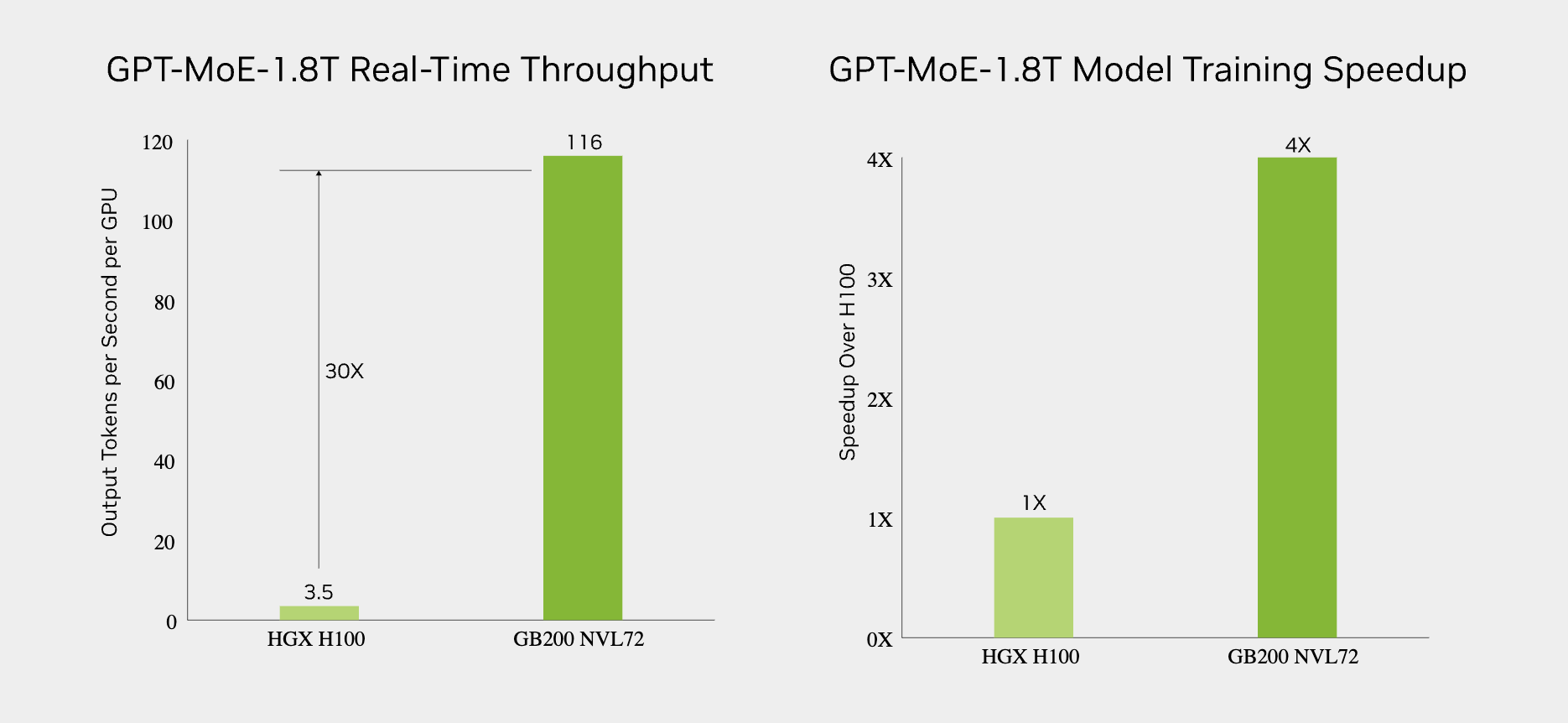
The Blackwell B200 chip is a significant upgrade over Nvidia’s previous H100 AI chip, reducing the number of chips and power required to train a massive AI model like GPT-4 by 75%.

The company also introduced the GB200 “superchip,” which combines two B200 chips and Nvidia’s Grace CPU on a single board, offering “30x the performance” for server farms that run chatbots like Claude or ChatGPT, while reducing energy consumption by up to 25 times.

LLM inference and energy efficiency

Nvidia CEO Jensen Huang showcased even larger configurations, such as the GB200 NVL72, a single server rack with 72 B200 chips connected by nearly two miles of cabling, and the DGX Superpod, which combines eight of these racks into a shipping-container-sized AI datacentre in a box.

In addition to the new AI chips, Nvidia announced Project GR00T, a foundation model for controlling humanoid robots.

This model, paired with the Jetson Thor system-on-a-chip, aims to create autonomous machines that can be instructed using natural language to carry out general tasks, even those they haven’t been specifically trained for.

“Project GR00T will help robots understand natural language and emulate movements by observing human actions – quickly learning coordination, dexterity, and other skills in order to navigate, adapt, and interact with the real world,” Huang explained.

jenseng huang with new GR00T line of robots

Nvidia also entered the quantum computing sector with the introduction of a cloud service that uses its AI chips to simulate quantum computers.

While the service will not initially be connected to a real quantum computer, it will allow researchers to test their ideas without the expense of accessing rare and costly quantum hardware.

In the future, Nvidia plans to provide access to third-party quantum computers through the platform.

As Nvidia continues to push the boundaries of artificial intelligence and robotics, the company’s latest innovations showcase its commitment to leading the industry and shaping the future of these transformative technologies.


Hybrid Cloud Orchestration Explained: AI-Driven Efficiency, Cost Control


Hybrid cloud orchestration isn’t just another IT trend—it’s becoming the backbone of modern AI strategy. As enterprises juggle on‑premises systems, public clouds, edge devices and emerging quantum services, the ability to coordinate resources seamlessly determines how fast they can innovate and how well they can control costs. This article demystifies hybrid cloud orchestration, explains why it’s essential, and offers a step‑by‑step playbook for adopting it effectively.

Quick Summary: What Is Hybrid Cloud Orchestration and Why Does It Matter?

Question: How does hybrid cloud orchestration accelerate AI workflows while reducing risk and cost?
Answer: Hybrid cloud orchestration is the process of coordinating multiple automated tasks across private, public and edge environments so that applications run efficiently, securely and at scale. It goes beyond simple automation by handling dependencies, scaling workloads and enforcing policies across heterogeneous platforms. With cloud costs rising and data‑residency laws becoming stricter, organizations are turning to hybrid strategies that balance performance, compliance and cost. Gartner’s 2025 tech trends elevate hybrid computing—blending edge, cloud and quantum computing—to a top strategic priority.


What Is Hybrid Cloud Orchestration?

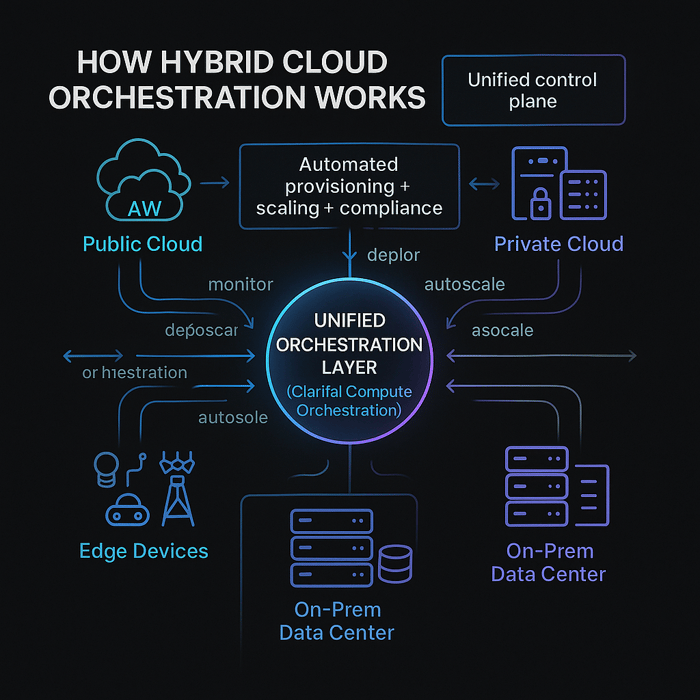
The digital landscape has outgrown the confines of a single cloud provider. Hybrid cloud orchestration involves coordinating workloads across on‑premises servers, private clouds and public cloud services, so they operate as one cohesive platform. This orchestration ensures resources are provisioned, scaled and decommissioned in the right order, with dependencies respected and policies enforced.

Key Concepts – Public vs. Private vs. Hybrid vs. Multi‑Cloud:

  • Public cloud services (like AWS, Azure or Google Cloud) offer on‑demand resources managed by the provider.
  • Private clouds are owned or leased by a single organization, often hosted on‑premises for control and security.
  • Hybrid cloud combines both, allowing sensitive workloads to remain on‑premise while scaling via public cloud.
  • Multi‑cloud involves multiple public clouds but may not integrate with private infrastructure; orchestration is needed to unify them.

Automation vs. Orchestration:

  • Automation performs individual tasks automatically (e.g., starting a VM).
  • Orchestration manages multiple automated tasks and their dependencies, ensuring the right sequence, scaling decisions, and policy enforcement.

Expert Insights

  • Unified Control Plane: Thought leaders emphasize that abstracting provider‑specific APIs is crucial to avoid lock‑in and allow the same workflow to run on any environment. Clarifai’s compute orchestration exemplifies this by providing a vendor‑agnostic control plane for AI models across on‑premises, cloud or edge.
  • Scalability and Failover: Analysts note that orchestrators must coordinate multiple tasks to manage scalability and failover, preventing cascading failures across hybrid systems.
  • Tool Categories: Modern orchestration involves Infrastructure‑as‑Code (IaC), configuration management, container orchestrators (like Kubernetes) and AI‑specific platforms such as Kubeflow or Clarifai.

How Hybrid Cloud Orchestration Works


Why Enterprises Are Embracing Hybrid Cloud Orchestration

Business Drivers

  1. Cost Optimization: Pure cloud models can be expensive due to rising storage and compute fees. Hybrid architectures optimize costs by keeping predictable workloads on‑premises and bursting to the cloud for seasonal spikes. Pay‑as‑you‑go models ensure you pay only for what you use.
  2. Performance & Latency: Keeping latency‑sensitive applications on‑premises or at the edge reduces lag, while the cloud handles heavy processing.
  3. Compliance & Data Residency: Data protection laws often require certain data to remain within specific jurisdictions. Hybrid setups allow sensitive data to stay on‑premise while leveraging cloud elasticity.
  4. Vendor Diversification: Enterprises are diversifying providers to avoid single points of failure. This strategy enhances reliability and bargaining power.
  5. Speed to Market: Orchestration automates deployments and ensures faster release cycles, reducing time‑to‑market for new features.

Market Momentum

Recent surveys report that nearly half of IT leaders deem hybrid cloud critical for operations. Organizations are even repatriating workloads from public cloud back to private infrastructure due to unexpected costs and security concerns. Thought leaders note that a one‑cloud‑fits‑all approach has lost momentum; hybrid and multi‑cloud reduce risk and improve uptime.

Expert Insights

  • Cost & Reliability: Industry analyses highlight that hybrid strategies deliver cost savings, reliability, speed and data locality, making them attractive for regulated sectors like healthcare and finance.
  • Flexibility & Security: Reports underscore the importance of flexibility, scalability and enhanced security in hybrid adoption. By leveraging both on‑premise and cloud resources, organizations balance innovation with compliance.

Benefits of Hybrid Cloud Orchestration

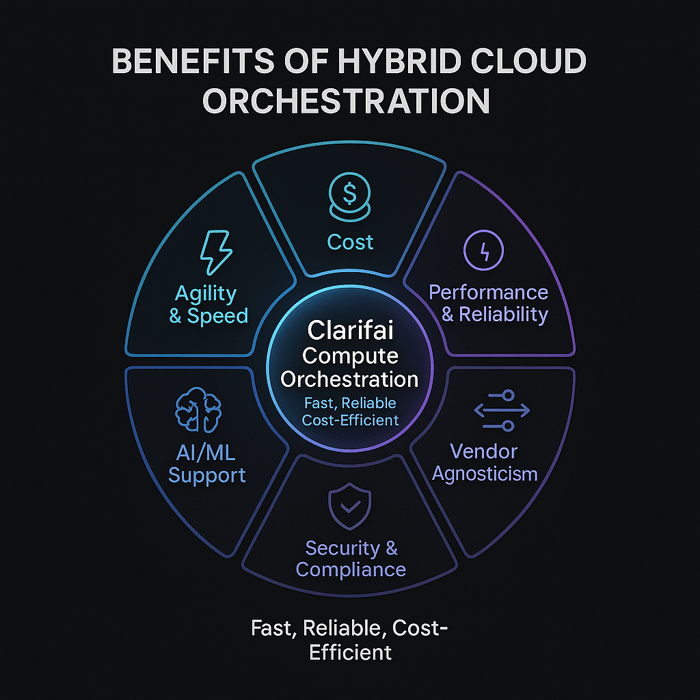
Hybrid orchestration isn’t just a tactical solution—it provides strategic advantages that empower AI workflows and business resilience.

Agility & Speed

Coordinated workflows replace ad‑hoc scripts, enabling rapid, reliable deployments. Clarifai’s compute orchestration codifies AI deployment routines; customers report up to 3.7× reduction in compute usage while supporting over a million inference requests per second. This agility accelerates experimentation, allowing teams to deploy models across any environment without rewriting code.

Cost Optimization

Auto‑scaling and resource scheduling allow workloads to scale down automatically when demand drops. GPU fractioning—dividing a GPU into multiple logical partitions—reduces idle capacity and lowers compute costs by more than 70 %. FinOps platforms provide visibility and governance, ensuring budgets are met.

Performance & Reliability

By processing data locally (edge or on‑prem) and tapping cloud resources for heavy lifting, hybrid architectures deliver low latency and high throughput. Replication across environments ensures high availability and disaster recovery.

Vendor Agnosticism & Portability

Orchestration abstracts provider‑specific APIs, enabling workload mobility across clouds. This reduces vendor lock‑in and opens the door to negotiate better pricing.

Security & Compliance

Sensitive data stays on‑premises while the cloud handles scalable compute. Policy‑driven access, encryption and identity management enforce compliance across jurisdictions.

AI/ML Workload Support

Clarifai’s unified control plane allows models from any framework to run on shared or dedicated compute, on‑prem or air‑gapped hardware. This flexibility ensures AI models are deployed securely and at scale, with features like autoscaling, containerized packaging, local inference runners and continuous batching.

Expert Insights

  • AI‑Powered Efficiency: Research shows that AI‑powered orchestration reduces downtime and operational overhead by predicting demand and allocating resources optimally.
  • Customer Success: Users of modern compute orchestration platforms have reported cost savings and reliability improvements due to features like GPU fractioning and autoscaling.
  • Policy Enforcement: Experts emphasize the importance of unified policy enforcement across hybrid environments to maintain compliance and reduce risk.

Benefits of hybrid cloud orchestration


Core Components and Tools for Hybrid Cloud Orchestration

Choosing the right tools is foundational. Below are key categories and examples to consider (adjusted to avoid naming competitor products directly).

1. Infrastructure‑as‑Code (IaC)

IaC tools let you define infrastructure declaratively. Popular options include open‑source frameworks for multi‑cloud provisioning and cloud‑provider solutions such as AWS CloudFormation. These tools ensure reproducibility and version control and can integrate with orchestration pipelines.

2. Configuration Management

Tools for configuration management automate software installation and system configuration across environments. They allow you to maintain consistency, enforce desired state and reduce configuration drift. Common examples include widely adopted frameworks like Ansible and Puppet.

3. Container Orchestrators

Kubernetes has emerged as the de facto standard for orchestrating containers. It handles deployment, scaling and management of containerized applications across clusters. Variants like K3s target edge environments, while enterprise distributions provide additional security and operational tooling. Orchestration platforms often integrate with Kubernetes to manage compute across clusters.

4. Workflow Orchestrators

Data and AI pipelines require orchestration of dependent tasks. Frameworks such as Apache Airflow, Prefect, Dagster and Argo allow you to define DAGs (directed acyclic graphs) and automate complex workflows. These orchestrators integrate with cloud services, databases and machine‑learning frameworks.

5. Hybrid & Multi‑Cloud Control Planes

A hybrid control plane unifies operations across clouds and on‑premises. Solutions like open‑source cross‑cloud orchestrators and service brokers provide unified APIs for provisioning resources across providers. Clarifai’s compute orchestration can be considered an AI‑specific control plane: it offers a vendor‑agnostic interface to deploy models on any hardware (GPUs, CPUs, FPGAs) and any environment, with built‑in autoscaling and monitoring.

6. AI‑Specific Orchestration

  • Kubeflow: An open‑source platform for machine‑learning pipelines, facilitating experiment tracking, hyperparameter tuning and distributed training.
  • Clarifai: Focuses on AI model deployment and lifecycle management; supports container packaging, GPU fractioning and streaming inference.
  • Ray & Modin: Frameworks for distributed Python and parallel data processing.

7. Serverless & Function Orchestration

Serverless computing abstracts the infrastructure completely. Cloud provider services orchestrate functions and manage state for workflows. Open‑source alternatives like Knative and OpenFaaS enable serverless on Kubernetes clusters. Academic research introduces hybrid cloud schedulers that run serverless batch pipelines across public cloud and private edge to save costs and meet deadlines.

Expert Insights

  • Dependency Management: Orchestrators must track dependencies and execution order to prevent resource contention and ensure consistency.
  • Emerging Tools: Researchers are exploring hybrid scheduling for serverless functions to leverage idle on‑premise resources. These innovations will make orchestrating across edge and cloud seamless.
  • Unification: Experts recommend selecting tools that offer an open, extensible API to minimize lock‑in. Clarifai’s architecture demonstrates how an AI‑focused control plane can streamline multi‑environment deployment.

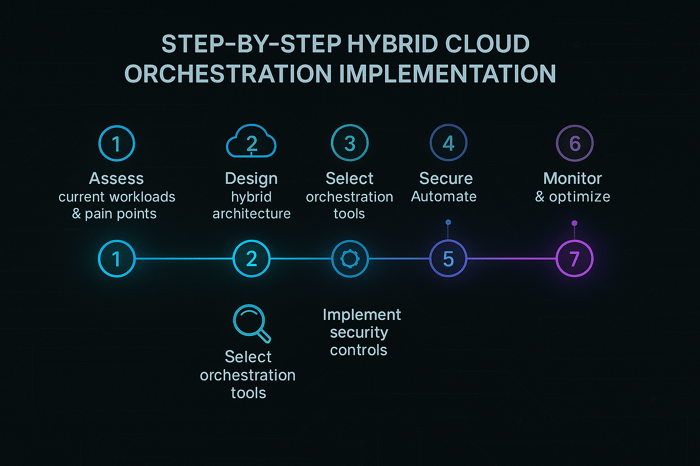
Step‑by‑Step Implementation Guide: How to Adopt Hybrid Cloud Orchestration

Transitioning to a hybrid model can be complex. This structured approach helps ensure success.

1. Assess Current State & Pain Points

Begin with a comprehensive inventory of workloads, latency requirements and compliance obligations. Identify which workloads need proximity to users, which demand high compute, and where data residency rules apply.

2. Design the Hybrid Architecture

Define where each component should reside. For example, sensitive databases may remain on‑prem while AI inference services run at the edge, and data lake analytics reside in the cloud. Plan network connectivity—VPNs, SD‑WAN, dedicated interconnects—and factor in redundancy and throughput.

3. Select Orchestration Tools

Choose IaC, configuration management and orchestrators that support your chosen environments. For AI workloads, evaluate Clarifai’s compute orchestration for unified deployment, or open‑source alternatives like Kubeflow.

4. Implement Security & Compliance Controls

Adopt a zero‑trust model: every access is authenticated, authorized and monitored. Encrypt data at rest and in transit; enforce data residency; implement identity and access management across clouds.

5. Automate Deployment & Scaling

Codify deployment pipelines. Use CI/CD to trigger orchestrated workflows that provision resources, deploy applications, and configure services. Integrate autoscaling; GPU fractioning can maximize hardware utilization.

6. Monitor & Optimise

Instrument your hybrid stack with observability tools—logs, metrics and traces. Implement FinOps practices: track costs, set budgets and forecast usage. Integrate sustainability metrics (carbon emissions) into decision‑making.

7. Continual Improvement

Iterate by reviewing performance, costs and compliance. Employ AI/ML algorithms to predict demand and perform predictive scaling. Update policies as regulations evolve.

Expert Insights

  • Clarifai’s Playbook: Clarifai’s documentation advises starting with an assessment of pain points, aligning deployment options with business goals, and evaluating security requirements.
  • Healthcare Example: A healthcare provider adopted hybrid orchestration to monitor patients via edge devices while training AI models in the cloud. The edge component provided near‑real‑time alerts, and the cloud component used aggregated data to improve algorithms.
  • Continuous Compliance: Experts warn against one‑time compliance setups; policies must adapt to new laws and new services.

Steop by Step Hybrid Cloud Orchestration


Challenges and How to Mitigate Them

Hybrid architectures aren’t without hurdles. Below are common challenges and strategies to overcome them.

Complexity & Skill Gaps

Managing multiple platforms increases complexity. Teams need expertise in both cloud‑native and legacy systems.
Mitigation: Invest in training and certification; leverage managed services; adopt automation to simplify operations. Clarifai’s platform hides infrastructure complexities, allowing developers to focus on models rather than hardware.

Latency & Performance

Edge and cloud integration can introduce network latency.
Mitigation: Use edge computing to process time‑sensitive data locally. Employ content delivery networks (CDNs), caching and data partitioning. Monitor latency continuously.

Security Risks & Misconfiguration

Hybrid environments expand the attack surface. Without unified monitoring, misconfigurations can expose data.
Mitigation: Implement zero‑trust security; automate configuration scanning; deploy unified logging and SIEM tools. Adopt encryption by default and enforce least‑privilege access.

Cost Management

Without visibility, hybrid environments can overspend.
Mitigation: Practice FinOps (see next section) and use autoscaling and GPU fractioning to match resource supply with demand.

Vendor Lock‑In & Interoperability

Different cloud providers have proprietary services.
Mitigation: Use open standards, containerization and vendor‑agnostic orchestration (e.g., Clarifai). Cross‑cloud service brokers allow workloads to move freely.

Governance & Compliance

Regulations on data residency and privacy add complexity.
Mitigation: Classify data by sensitivity; configure geo‑fencing; implement continuous compliance monitoring and audit trails.

Expert Insights

  • Cloud Hangover: Analysts have documented “cloud hangovers” where workloads moved to the cloud did not deliver expected savings, prompting repatriation. Hybrid orchestration allows smarter placement of workloads.
  • Security Boundaries: Experts caution organizations to define security boundaries clearly and develop secure interfaces for hybrid environments.
  • Heterogeneity Challenges: Academic research highlights the complexity of scheduling across heterogeneous resources in hybrid clouds. Emerging AI scheduling algorithms aim to tackle this.

Real‑World Use Cases and Case Studies

AI/ML Model Serving & Training

Imagine a computer‑vision startup that analyzes medical images. Training large models requires thousands of GPU hours; inference workloads require millisecond latency. Hybrid orchestration allows them to train models in the cloud and deploy low‑latency inference at hospital edge servers. Clarifai’s platform can handle 1.6 million inference requests per second with high reliability, using autoscaling to meet surge demand.

Edge & IoT Applications

Healthcare providers are using edge devices for patient monitoring. Edge sensors capture vitals and local AI models trigger immediate alerts, while aggregated data is sent to the cloud for analytics. In smart factories, hybrid orchestration coordinates assembly robots and monitors equipment health, reducing production delays.

Serverless Batch Processing

Recent research proposed a hybrid cloud scheduler (HCS) that runs serverless batch pipelines across public clouds and private edges, reducing costs and meeting deadlines. This shows future potential for hybrid serverless architectures.

Data Integration & Analytics

Financial services firms are migrating risk‑analysis workloads to hybrid platforms. Data is collected on‑premise for compliance, processed via AI pipelines orchestrated in the cloud (using Airflow or Prefect), then results are synchronized back to local systems. This strategy improves model accuracy and reduces time to insights.

Disaster Recovery & Business Continuity

Hybrid orchestration makes multi‑site replication seamless, ensuring that critical data and applications are available even if one region suffers an outage. For example, a media company replicates live video streams across on‑prem servers and two cloud regions, automatically failing over via the orchestrator.

Expert Insights

  • Energy Efficiency: Studies show that AI‑powered orchestrators can reduce energy consumption by nearly 40 % through intelligent scaling and resource placement.
  • Customer Stories: Many enterprises have reported significant cost savings and improved reliability with vendor‑agnostic orchestration. They emphasize the importance of unified monitoring and continuous optimisation.

AI‑Powered Orchestration & Emerging Technologies

The near future of cloud architecture involves more than just computers. AI, quantum and sustainability are reshaping how we orchestrate workloads.

AI‑Driven Orchestration

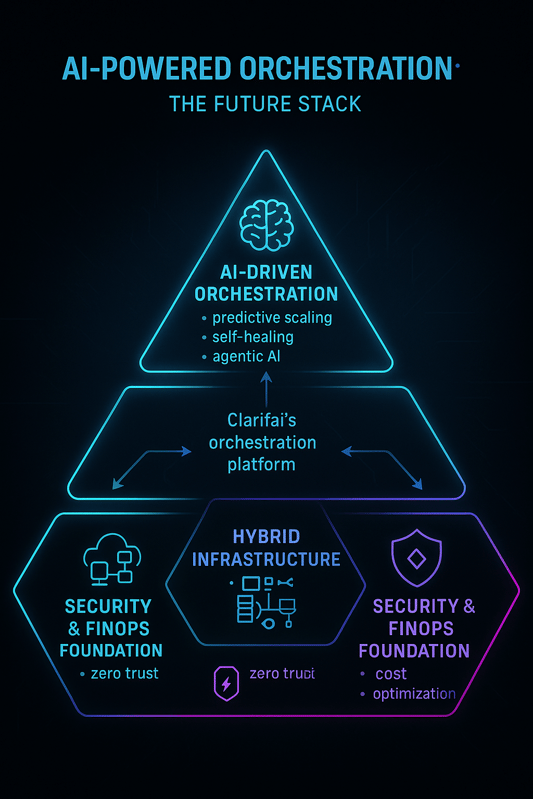
Machine‑learning algorithms can predict demand patterns, detect anomalies and self‑heal infrastructure. Clarifai uses AI to decide when to scale GPU resources and to pack multiple models efficiently, improving throughput and reducing cost.

Agentic AI & Autonomous Agents

Gartner’s 2025 trends highlight agentic AI—autonomous agents that act on behalf of users within hybrid frameworks. These agents leverage the edge for quick decisions and the cloud for deep learning. By 2025, they could help IT teams by autonomously scaling resources, troubleshooting issues and optimizing costs.

FinOps 2.0 & Cloud Economics

Next‑generation FinOps tools incorporate AI to forecast budgets, predict usage and enforce policies automatically. They integrate carbon metrics and sustainability goals into cost analysis, driving responsible computing.

Edge‑to‑Cloud & 5G

5G and IoT proliferation will create tens of billions of connected devices. Orchestration must handle real‑time workloads across edge and cloud, balancing latency and compute demands.

Quantum‑Enabled Hybrids

Quantum computing is becoming accessible through Quantum‑as‑a‑Service (QCaaS) platforms. By 2025, enterprises can test optimization algorithms for logistics or drug discovery via cloud‑based quantum processors. Hybrid orchestrators will integrate quantum tasks into classical workflows.

Zero‑Trust & Confidential Computing

Security models are shifting towards zero‑trust frameworks that enforce least‑privilege access. AI enhances these models by detecting threats in real time. Confidential computing isolates sensitive data during processing.

Green & Sustainable Cloud

Environmental concerns make energy efficiency a priority. Cloud providers offer carbon footprint tools and renewable energy options. Hybrid orchestrators can schedule workloads based on carbon intensity of power grids.

Industry‑Specific Clouds & Supercloud

Vertical clouds tailor compliance, data models and workflows for industries like healthcare or finance. The emerging supercloud concept envisions a unified platform that spans all providers, abstracting differences entirely and delivering services seamlessly across them.

Expert Insights

  • Efficiency Gains: AI‑driven orchestration reduces downtime and energy consumption by nearly 40 %—a major selling point for enterprises aiming to meet sustainability goals.
  • Agentic AI: Analysts predict agentic AI adoption will surge, enabling autonomous resource management.
  • Quantum Integration: Early adopters are experimenting with quantum integration for optimization problems in supply chains and finance. This will demand orchestrators that can call quantum functions seamlessly within workflows.

AI powered Orchestration


FinOps & Cost Management Strategies

Managing costs across hybrid environments requires discipline and modern tools.

What is FinOps?

FinOps is a collaborative practice that brings together finance, engineering and operations to control cloud spending. It focuses on forecasting, budgeting and optimization and uses actionable metrics to inform decisions. Enterprises that rushed to the cloud often experienced a “cloud hangover” when costs spiralled. FinOps practices help prevent this.

FinOps Best Practices

  • Tagging and Cost Allocation: Label resources by project, team and environment so costs can be attributed accurately.
  • Budgeting & Forecasting: Use historical data and AI to predict usage and set budgets; adjust in real time.
  • Continuous Rightsizing & Autoscaling: Regularly assess instance sizes; enable autoscaling to match demand.
  • Policy‑Based Decommissioning: Automatically shut down unused resources; enforce time‑to‑live policies.
  • FinOps Platforms: Adopt tools for visibility and governance that integrate across clouds.

AI & ML for Cost Prediction

AI algorithms forecast resource usage and recommend instance types. They factor in time‑of‑day, seasonality and business cycles to predict cost spikes, enabling proactive adjustments.

Clarifai & Cost Control

Clarifai’s compute orchestration reduces costs through GPU fractioning and autoscaling, lowering compute expenses by up to 70 %. It integrates with FinOps dashboards so teams can monitor costs across clusters and adjust inference workloads on the fly.

Emerging Pricing Models

  • Per‑Second Billing: Pay exactly for the seconds consumed.
  • Spot Instances & Preemptible VMs: Use spare capacity at reduced prices for non‑mission‑critical workloads.
  • Serverless Pay‑Per‑Use: Pay only for execution time and memory used by functions.
  • Carbon‑Aware Scheduling: Shift workloads to regions with greener energy or lower carbon intensity.

Expert Insights

  • Balanced Trade‑Offs: Industry experts like David Linthicum advise balancing complexity against cost opportunities. Over‑optimizing for cost can harm performance; FinOps helps find equilibrium.
  • Success Stories: Companies report drastic cost reduction when implementing rightsizing and policy‑based decommissioning, demonstrating that disciplined governance delivers tangible returns.

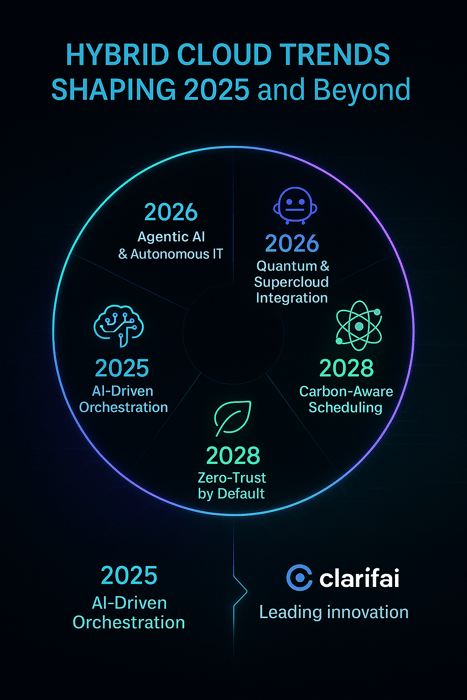
Future Outlook and Predictions

The next few years will reshape how hybrid cloud orchestration operates.

Mainstream Hybrid & Multi‑Cloud

By 2027, hybrid and multi‑cloud will be the default operating model, with AI‑powered systems orchestrating workloads across providers automatically. Organizations will choose the best service for each task, and orchestrators will handle complexity.

Rise of Agentic AI

Agentic AI will take over routine tasks, enabling self‑driving IT operations. Systems will scale, heal and optimise themselves without human intervention.

Quantum & Supercloud Expansion

As quantum computing matures, hybrid orchestrators will schedule quantum functions for complex optimization problems. Industry‑specific clouds will expand, and the concept of supercloud—a unified overlay across all providers—will gain traction.

Sustainability & Carbon‑Aware Orchestration

Green initiatives will make carbon awareness a requirement. Workloads will be scheduled based on energy source carbon intensity. Organizations will measure success not just in dollars but in carbon saved.

Security Evolution

Zero‑trust and confidential computing will become the norm. AI will analyze behavior patterns to detect anomalies and prevent breaches automatically.

Low‑Code/No‑Code & Serverless Growth

Tools that abstract infrastructure complexity—low‑code/no‑code platforms—will empower non‑developers to build applications. Serverless computing will continue to grow, supporting more complex AI and IoT workloads.

Expert Insights

  • Competitive Advantage: Analysts predict that hybrid computing with edge and quantum will redefine competitive edge.
  • Resilience & Risk Reduction: Thought leaders emphasize that resilience and risk reduction will drive adoption.
  • Human-Centric AI: As agentic AI takes over operational tasks, humans will focus on strategic innovation, creative problem solving and ethical considerations.

Hybrid Cloud Trends


Frequently Asked Questions (FAQs)

Q1: What differentiates hybrid cloud orchestration from simple automation?
A1: Automation performs individual tasks automatically (e.g., starting a server), while orchestration coordinates multiple automated tasks across environments, handles dependencies and scales resources.

Q2: Why is hybrid cloud becoming more popular now?
A2: Rising cloud costs, data‑residency laws, latency requirements and vendor lock‑in concerns push enterprises toward hybrid strategies that offer flexibility, performance and compliance.

Q3: How does Clarifai help with hybrid cloud orchestration?
A3: Clarifai’s compute orchestration provides a vendor‑agnostic control plane to deploy AI models on any hardware or environment. It offers autoscaling, GPU fractioning, local runners and containerized packaging, reducing costs and improving reliability.

Q4: What are some key challenges of hybrid orchestration?
A4: Challenges include complexity and skill gaps, latency management, security risks, cost control, vendor lock‑in and regulatory compliance. Mitigation requires training, automation, zero‑trust security and FinOps practices.

Q5: How will AI shape the future of orchestration?
A5: AI will enable predictive scaling, self‑healing infrastructure and agentic operations, reducing downtime and energy consumption. It will also drive FinOps 2.0, quantum integration and carbon‑aware scheduling.


Complete Prompt Engineering Guide (Free Course For Beginners)


Course Overview

Welcome to GreatAIPrompt’s Complete Prompt Engineering Guide, your comprehensive guide to Generative AI and Prompt Engineering, designed for beginners and intermediates.

This introductory course is created for those curious about Generative AI, regardless of their technical background. Whether completely new to the concept or seeking deeper insights, this guide is your go-to resource.

What is Generative AI?

Generative AI, a subfield of artificial intelligence, is focused on creating outputs that are similar to human-generated content.

This includes a wide range of outputs such as text, images, graphics, music, and computer code.

The foundation of generative AI lies in its ability to learn the patterns and structures of the input data it’s trained on, allowing it to generate new data that shares similar characteristics.

Generative AI applications are vast and growing. They’re being used in customer support via AI-driven chatbots, in software development for code review and bug identification, and in content creation for writers.

In healthcare, generative AI is being explored for applications like accelerating drug discovery. It’s also used in digital marketing, education, finance, and environmental science.

Why Prompt Engineering?

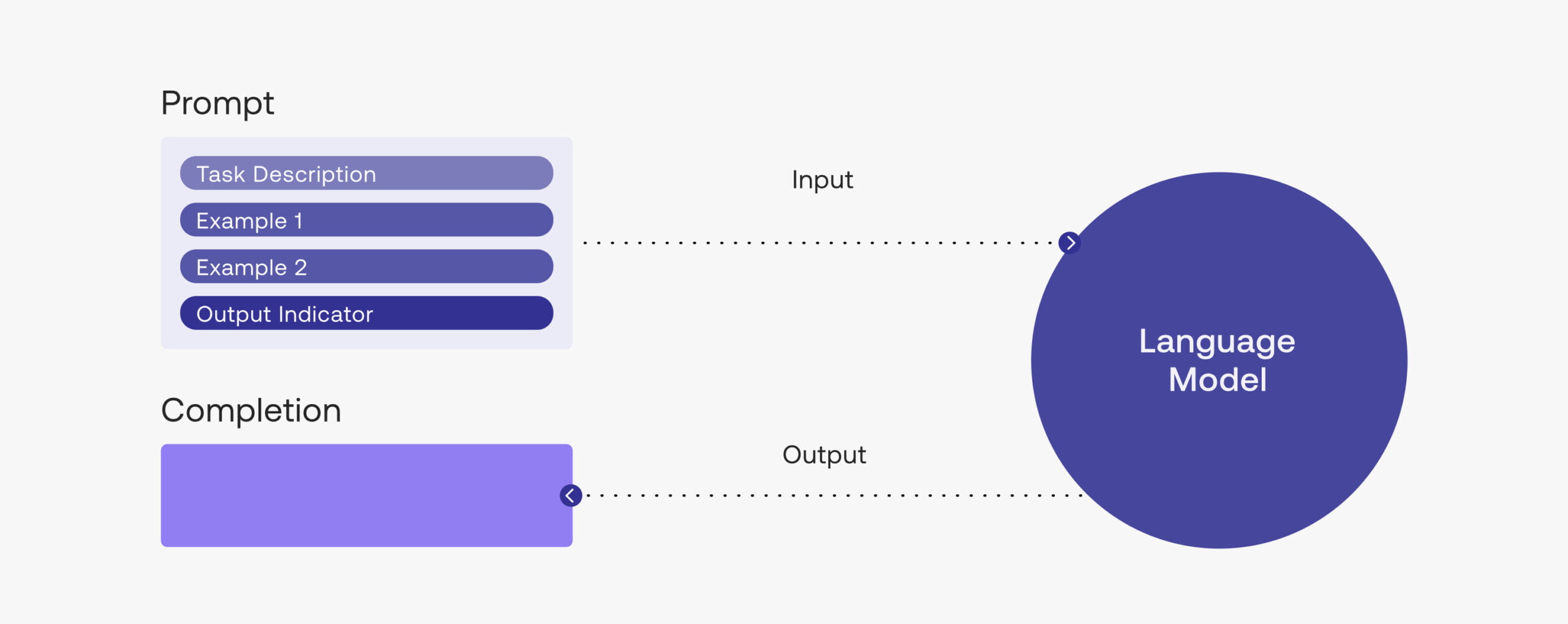
Prompt Engineering1 is an emerging discipline focused on crafting and refining prompts to effectively utilize Large Language Models (LLMs)2 like OpenAI’s GPT-3.5.

It’s about understanding the capabilities and limits of these models and using them to solve complex tasks, ranging from simple question-answering to intricate problem-solving scenarios.

Prompt engineering is vital for leveraging the full potential of generative AI, enabling more efficient and effective use of these tools across industries. However, it’s not a trivial process. It requires balancing achieving desired results and ensuring safety, especially since AI models can sometimes produce unintended or harmful content3.

The dynamic field requires a blend of linguistic skills and creative thinking to fine-tune prompts for the best outcomes. This makes it an increasingly important skill set in the era of AI-driven technologies.

Course Material and Methodology

All examples and exercises in this course are tested with GPT-3.5 and GPT-4, using OpenAI’s Playground and ChatGPT web app with default configurations. While this beginner course is centered around GPT-3.5, the principles apply broadly to other similar models.

How This Course Will Benefit You

  • Non-technical and Accessible: Designed for easy comprehension, this module requires no technical background, making it ideal for beginners.
  • Practical Examples and Exercises: Through real-world examples and interactive exercises, you’ll gain hands-on experience in using Gen AI and prompt engineering.
  • From Basics to Advanced: Starting with the fundamentals, the course gradually takes you to more advanced concepts and applications.

A Glimpse into the Course

To illustrate the potential of prompt engineering, consider the task of writing essays.

With a well-crafted prompt, a Gen AI can compose humorous yet academic essays, saving valuable time.

This course will guide you through crafting such prompts, helping you harness the full potential of Gen AI for various applications.

Join Us on This Learning Journey

As we launch on this exciting journey into the world of Generative AI and Prompt Engineering, we invite you to dive in with an open mind and a willingness to explore.

Just click the next page, and you’ll be taken to other modules of this course.

With each module, you’ll gain knowledge and practical skills that can be applied in numerous scenarios.

Let’s begin this transformative learning experience together!

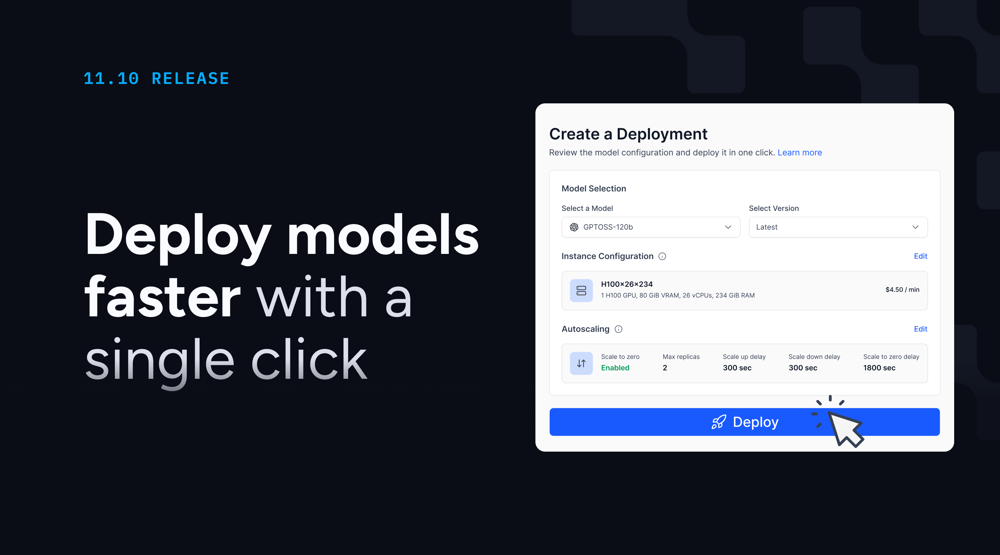
Deploy Models Faster with Single Click


 11.10_blog_hero

This blog post focuses on new features and improvements. For a comprehensive list, including bug fixes, please see the release notes.

Single-Click Deployment

Model deployment on Clarifai is now faster and easier. Previously, users had to manually configure clusters and nodepools before deploying a model, with limited setup guidance.

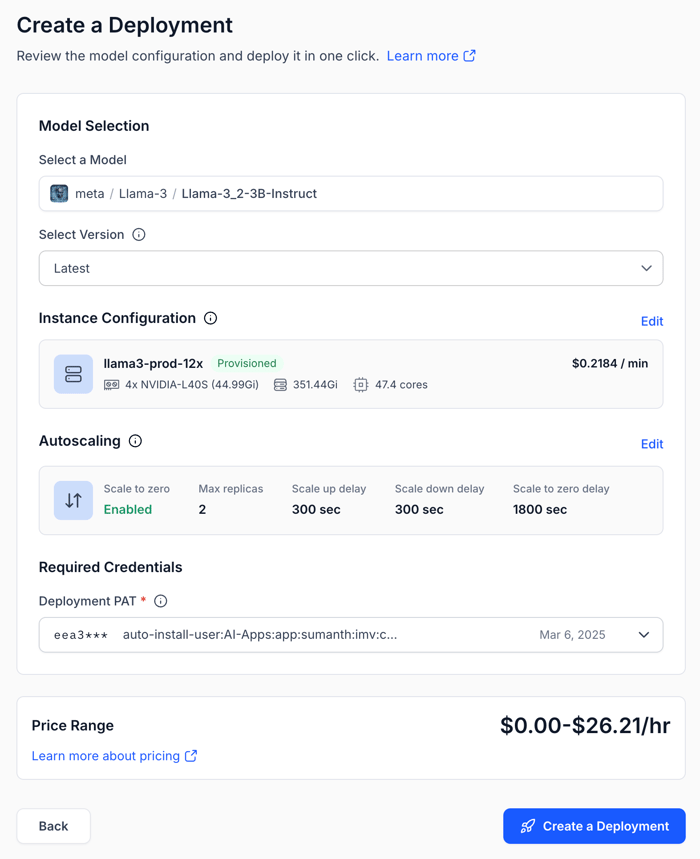
With Single-Click Deployment, Clarifai now recommends suitable instance types based on each model’s requirements and automatically creates clusters or nodepools if none exist. This removes the need for any manual setup, allowing users to deploy models instantly.

The platform intelligently matches compute resources to model needs, ensuring the right GPU type, memory, and core allocation for every deployment. For Premium GPUs such as the NVIDIA B200, users can reach out through the integrated Contact Us option to provision dedicated instances for higher performance.

This update eliminates unnecessary steps, reduces setup errors, and makes production deployment possible in a single click. Check out the complete guide here on the Custom Model Deployment Guide.

Screenshot 2025-11-12 at 12.43.19 PM

New Models

DeepSeek-OCR: High-Precision Text Extraction at Scale

DeepSeek-OCR sets a new standard for large-scale document understanding and OCR performance. It delivers over 96% precision at 9–10× compression, and around 90% accuracy even at 10–12× compression, maintaining reliability under heavy optimization.

Designed for production-grade scalability, DeepSeek-OCR can process over 200,000 pages per day on a single A100-40G GPU, enabling enterprise-level document automation at a fraction of typical compute cost.

You can try DeepSeek-OCR directly in the Playground or access it through the API. Check out the detailed DeepSeek-OCR API Guide.

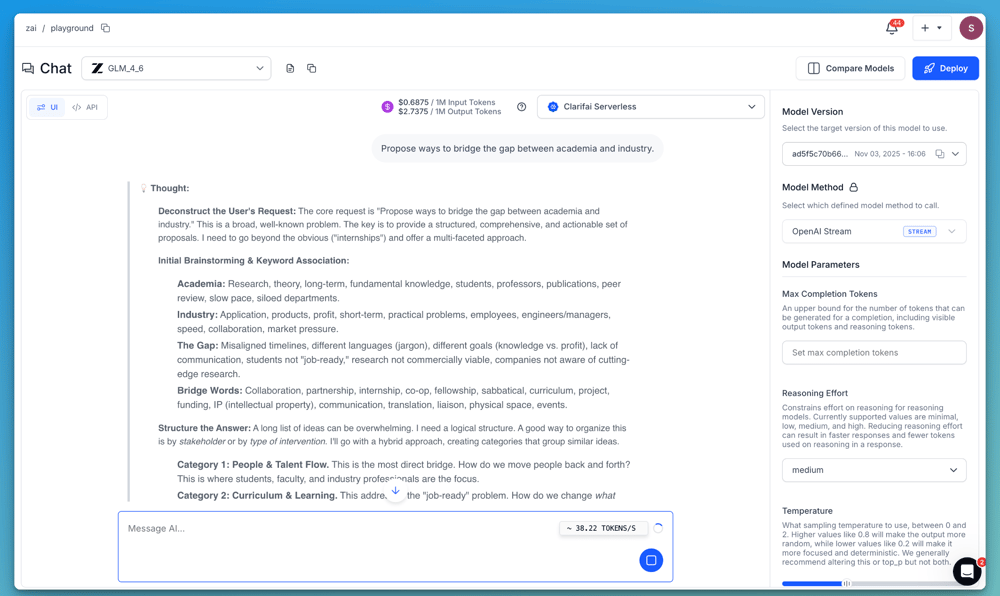
GLM-4.6: Unified Reasoning, Coding, and Agentic Intelligence

The GLM-4.6 model brings together reasoning, code understanding, and agentic capabilities into a single unified framework. It’s optimized for multi-domain tasks where models need to analyze, plan, and generate in a structured manner.

GLM-4.6 enables consistent reasoning performance across natural language, programming, and tool-using contexts, making it ideal for developers building intelligent agents or multi-skill assistants.Try out the model here.

Screenshot 2025-11-12 at 12.54.52 PM

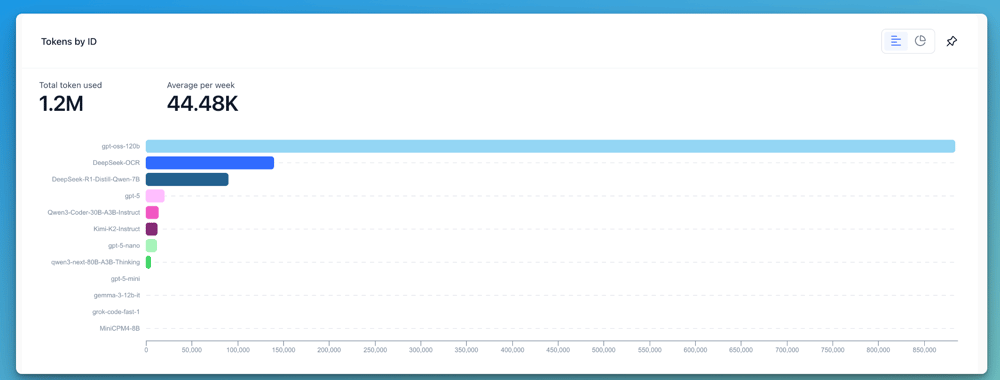
Control Center: Unified Ops and Token Reporting

The Control Center now provides a single, consistent view of model usage across all billing methods.

Previously, usage statistics were tied to the billing configuration. Ops-billed models reported only operations, token-billed models reported only tokens, and models billed by compute time did not display detailed stats.

With this update, all models now report operations, and LLMs additionally report token usage. This ensures consistent visibility and transparent tracking for every model, regardless of how it’s billed.

The result is a more reliable and unified monitoring experience for developers and teams managing large-scale deployments.

Screenshot 2025-11-12 at 2.43.23 PM

Structured Outputs

Clarifai now supports structured JSON outputs from any OpenAI-compatible model hosted on the platform using Pydantic schemas.

This capability ensures that model responses follow a defined schema, allowing developers to enforce consistent data structures across outputs. Structured outputs make it easier to integrate AI-generated data into downstream applications safely and reliably.

Here’s an example using the GPT-OSS-120B model through Clarifai’s OpenAI-compatible API:

Additional Changes

Search by Relevance in Community

The Community search experience has been refined to surface more relevant results.
Previously, all fields such as model ID, user ID, and description were weighted equally in search ranking. With this update, model IDs (for example, gpt-oss-120b) now carry higher weight, ensuring that searches prioritize the most relevant and specific models.

Environment Secrets

Clarifai now supports environment secrets, allowing developers to securely store encrypted values that can be referenced as environment variables in workflows.
This improves security and simplifies management of credentials and other sensitive configuration data. Learn more about environment secrets here.

Toolkits

Support for additional toolkits has been added to the Clarifai CLI, making it easier to initialize model projects with pre-configured templates.

Developers can now specify a toolkit when creating a new model project using the clarifai model init command:

These toolkits streamline setup, ensuring consistency and faster onboarding for both SGLang-based and Python-based model development. Check out the detailed Toolkit Guide here.

Ready to Start Building?

With Single-Click Deployment, Clarifai makes it easier than ever to bring your own models and deploy them in production with minimal setup. The platform automatically manages cluster creation, instance selection, and scaling, allowing you to focus on iterating and improving your models instead of configuring infrastructure.

You can start by deploying your own model using the new one-click workflow or explore the growing catalog of community and published models.

If you need access to high-end GPUs like the B200 or GH200 for your AI workloads, reach out to our team to learn more about dedicated provisioning and performance optimization options.


Four Signs Your Decision Automation is Putting You at Regulatory Risk


Financial institutions have spent years and poured millions into automation, but with mixed results. It promises efficiency, control, speed, fewer errors, and lower costs. Yet even as agentic AI has woven its way into the tech stack, that promise still feels increasingly fragile.

Despite observability tools and human guardrails, such agentic AI approaches are suffering subtle but critical risks: inconsistent outcomes, audit failures, and the imprecise application of institutional knowledge. With the FCA, PRA and the EU AI Act tightening their grip on the need for AI explainability, the potential benefits are no use unless there is also trust baked-in by design. 

Automation that can’t explain itself doesn’t reduce risk, it amplifies it. Below are four warning signs that your AI-powered decisioning systems may already be eroding the very trust and resilience they were meant to create.

1. You can’t explain how automated decisions are made

If you can’t show how a system reached its conclusion, it’s a prediction not a judgement and you can’t defend it. Regulators now expect firms to explain every automated outcome, not just what happened, but why.

Agentic AI workflows often fail this test. They deliver outcomes that may well be right, but with no causal chain of reasoning. The EU AI Act classifies opaque decisioning as “high risk,” and the FCA’s Consumer Duty demands “fair and explainable outcomes.”

With this tightening pressure, AI auditability isn’t a compliance tickbox exercise, it’s the foundation of accountability. Without it, neither customers nor regulators will – or should – trust your automation.

2. Your knowledge is scattered and inconsistent

Across banking, financial services, insurance and other regulated sectors, the logic that drives the way decisions are made is typically widely distributed: in process diagrams, tucked away in spreadsheets or old code, or simply sitting in people’s heads. 

Organisational knowledge is rarely a first class citizen in the tech stack. As a result of this knowledge fragmentation, decision-making remains inconsistent and at best leads to trading underperformance. At worst it results in significant reputational and financial damage. In this AI age, institutional know-how is a differentiator, if you can scale it to machine levels. This requires a strategic approach to knowledge and how that will be leveraged in your AI strategy. 

One team’s quick piece of AI innovation – like creating an AI agent to run a small process – often becomes another team’s compliance problem. When regulators come knocking asking for a single version of the truth, what happened and why, you shouldn’t have to undertake large amounts of work to try and provide answers. 

Creating a knowledge layer, one that enables your institutional IP to be computed over with the same precision that Excel computes numbers, ensures that what separates one organisation from another – the expertise that makes your services special – can be scaled to machine-levels with precision, consistency and trust. 

3. Your audit trail shows process steps, not reasoning

Most organisations can track what happened, who approved what and when. But they struggle to prove why. Logs that are focused only on workflow steps can only show process, not how judgment was ultimately reached.

In a world of tightening supervision, regulators want to see the logic that drove each outcome: the reasoning that was applied, the data that was considered and how uncertainty was handled. If AI-powered reasoning isn’t transparent, you’re left asserting compliance without being able to demonstrate it. A lack of auditability is an innate limitation of the LLMs that drive most agentic solutions today. They simulate a logical system without the benefit of actually being logical, and that’s a problem.  

There is an answer to this. A true reasoning system can provide you with a proof trail; not just evidence of inputs and outputs, but the reasoning in the middle. There is huge value in being able to logically articulate the how – the certainty needed to satisfy both customers and regulators. 

4. Accountability sits with IT, not the business

Too often, automation and AI-driven processes are expressed in code, too far from the teams who have P&L responsibility for the decision outcomes being automated. When business logic gets represented as code, it becomes slow, expensive and unwieldy to manage, lost amongst the process.

Risk, compliance and audit teams need visibility into how automated decisions are not just made but being run. When they can’t see or manage the knowledge that should be driving AI-powered decisions themselves, the business becomes stuck in a high-cost maintenance loop whenever things change.

Automation in the AI age should help experts to scale their knowledge to machine levels to deliver transformatory results. Business owners should be able to build and maintain decision logic. It has long been proven to be the only way of ensuring that agility, governance and trust can coexist to scale decision-services to the levels required to be competitive.

The root cause: automation built for efficiency, not superior, differentiated and trusted decision outcomes

These risks all come from the same flaw. Digital transformation too often focuses on making poor processes run faster, rather than building truly smart systems that encode and leverage your institutional knowledge to drive superior outcomes for customers. 

The first wave of white-collar automation was driven by Robotic Process Automation (RPA) and it succeeded at automating low risk simple tasks. In the agentic AI age, we are now focused on the automation of complex decision-intensive processes. These are subject to much deeper scrutiny and require a different tech stack that brings knowledge, reasoning and auditability together. 

The promise of agentic AI-like benefits but without the risks. 

Today, AI auditability is the new measure of AI maturity. The next generation of agentic AI is combining human-like expert reasoning with machine scale and logical auditability. It celebrates the human expertise that distinguishes one set of experts from another, encodes this knowledge precisely into the tech stack and reasons over it at scale with compliance baked-in.

Conclusion

The automation agenda has evolved as the scope of ambition has shifted from simple task automation, for the sake of efficiency, to the automation of complex high-stakes decisions to drive new products and services that would previously have been impossible. 

The acceleration of sectors like banking, financial services and insurance isn’t coming from an agentic AI approach based purely on LLM black boxes. It is coming from a hybrid approach that can bring world models of knowledge to the AI stack (usually involving knowledge graphs) and ensuring that such knowledge can be precisely computed over and applied to AI-powered decisions, at scale.

Determinism is an essential property of trust. It guarantees that the same inputs will always generate the same outputs. One of the biggest challenges with the LLM-based tech stack is a lack of determinism. Rainbird solves this by ensuring that it is formal models of knowledge that are reasoned over deterministically, guaranteeing consistency and trust. 

Our platform enables regulated organisations that care about precision, determinism and auditability, to build the kind of AI systems that customers and regulators can trust. We capture and scale human expertise and policy logic in transparent, auditable models and ensure it is central to reasoning, giving you absolute visibility into how every outcome is reached.

Not every use case requires these attributes. If you can mentally insert the word “probably” before an AI-generated answer, and that is okay, you don’t need Rainbird. 

But there are thousands of use cases where there is no tolerance for error. These are typically the most critical and most watched, by regulators. 

If you want to enhance your agentic AI approach: ensuring that your institutional knowledge is a first-class citizen, hallucinations are avoided and outcomes are fully auditable, then reach out. Rainbird closes the gap between endless agentic AI experiments and substantive live deployments, driven by a move from a pure black-box approach to glass box one.

Contact our team to explore how explainable decision automation can strengthen compliance, reduce risk, and restore confidence in every AI decision you make.

OpenAI Unveils Voice Engine To Copy Human Voices, Delayed


April 2nd, 2024: OpenAI, the company behind the popular ChatGPT, has announced Voice Engine, a new text-to-speech AI model that can create synthetic voices based on a 15-second segment of recorded audio.

The technology, developed in late 2022, has the potential to provide numerous benefits, such as reading assistance, global reach for creators, and personalized speech options for non-verbal individuals.

However, despite the potential advantages, OpenAI has decided to preview the technology but not widely release it at this time due to concerns about potential misuse.

The company initially planned to launch a pilot program for developers to sign up for the Voice Engine API earlier this month but scaled back its ambitions after considering the ethical implications.

In a statement, OpenAI said, “We are choosing to preview but not widely release this technology at this time. We hope this preview of Voice Engine both underscores its potential and also motivates the need to bolster societal resilience against the challenges brought by ever more convincing generative models.”

The company has been testing the technology with select partner companies since last year, requiring them to agree to terms of use that prohibit impersonation without consent and mandate informed consent from individuals whose voices are being cloned.

OpenAI has also implemented a watermark in every voice sample to assist in tracing the origin of any voice generated by its Voice Engine model.

To address the potential risks associated with voice-cloning technology, OpenAI has provided three recommendations for society to adapt: phasing out voice-based authentication for bank accounts, educating the public about the possibility of deceptive AI content, and accelerating the development of techniques to track the origin of audio content.

The company emphasizes the need for a cautious and informed approach to the broader release of synthetic voice technology.

“We hope to start a dialogue on the responsible deployment of synthetic voices and how society can adapt to these new capabilities,” OpenAI stated. “Based on these conversations and the results of these small scale tests, we will make a more informed decision about whether and how to deploy this technology at scale.”

As the development of voice-cloning technology continues to advance, it is crucial for companies like OpenAI to consider the potential risks and ethical implications while working to harness the benefits for society.

How to learn AI from scratch


Quick Digest

Curious about breaking into AI? The rapid growth of artificial intelligence has created unprecedented demand for skilled practitioners. This guide distills expert insights, practical steps and emerging trends to help you learn AI from scratch—then turn that knowledge into a fulfilling career. We’ll cover how long it really takes to learn AI, the foundational skills and must-have tools, a step-by-step roadmap tailored for 2025, and tips for building a standout portfolio. You’ll also discover why responsible AI matters, which future-proof skills are worth mastering, and how to land a job in a booming market. Throughout, you’ll see how Clarifai’s unified AI platform can speed up your journey, from model training and inference to deployment.


1. How long does it take to learn AI?

Quick Summary: How long does it take to learn AI?

Most learners can build a solid foundation in 6 to 12 months by dedicating a few hours each week to Python, math, and basic machine learning. Specialising in areas like deep learning or generative AI may take another 6–12 months, depending on your background.

Timeline Overview

One leading AI learning guide proposes a phased roadmap: months 1–3 to master Python and mathematics; months 4–6 to learn classical machine learning; months 7–9 to tackle deep learning and specialisations; and months 10+ for advanced topics and continual learning. Another expert source notes that beginners can advance from novice to proficient in under two years with focused learning.

Learning time depends on:

  • Prior experience: If you already know programming or have a math background, you’ll progress faster.
  • Time commitment: A consistent schedule of 8–10 hours per week helps maintain momentum.
  • Learning style: Combine structured courses with hands-on projects to solidify concepts.
  • Support tools: Platforms like Clarifai offer pre-built models, data management and compute orchestration, enabling you to experiment without complex setups.

Expert Insights

  • AI becomes accessible faster: The cost of running models comparable to GPT-3.5 has fallen more than 280-fold since late 2022, allowing learners to train and deploy models on modest hardware.
  • Benchmark performance is soaring: New AI benchmarks such as MMMU, GPQA and SWE-bench have seen 18.8–67.3 percentage point improvements within one year. This rapid progress underscores the need for continuous learning.
  • AI-assisted coding lowers barriers: AI pioneer Andrew Ng urges learners to use AI-powered tools rather than coding “the old way,” noting that such tools make people in all roles “much more productive”.
  • Focus on consistent practice: A 2025 AI guide emphasises that regular hands-on work—not just watching tutorials—builds lasting proficiency.

2. Foundational Skills You Need to Get Started

Quick Summary: What skills do I need to start learning AI?

To succeed in AI, you need Python programming, strong math foundations, knowledge of data structures and algorithms, and an understanding of statistics and probability. These skills form the backbone of machine learning and deep learning.

Building Blocks

Python Programming

Python remains the go-to language for AI because of its extensive libraries and community support. Start by mastering basic syntax, data types and control structures. Then explore NumPy for array operations, pandas for data manipulation, and Matplotlib for visualisation. Creative example: write a Python script that counts word frequencies in a text file—this introduces the concept of tokenisation used in natural language processing.

Mathematics: Linear Algebra, Calculus & Probability

You don’t need a PhD, but understanding matrices, vectors, derivatives and integrals helps you grasp how algorithms learn from data. Probability and statistics teach you to measure uncertainty and evaluate models. Think of linear algebra as the language of images: a grayscale image can be represented as a matrix of pixel intensities.

Data Structures & Algorithms

Efficient data handling is key when working with large datasets. Familiarity with arrays, lists, stacks, queues and trees helps in implementing algorithms. Learn to evaluate algorithm complexity (Big O notation) and practise basic algorithms like sorting and searching.

Statistics & Probability

Statistical thinking underpins machine learning. Learn descriptive statistics (mean, median, variance), distributions (Gaussian, Bernoulli), hypothesis testing and confidence intervals. This enables you to interpret model outputs and understand data variability.

Basic Machine Learning Concepts

Once you have the above skills, explore fundamental ML concepts: supervised vs. unsupervised learning, feature engineering, training vs. testing, and model evaluation metrics (accuracy, precision, recall). Try building a simple linear regression model to predict housing prices—a classic beginner project.

Clarifai Integration

Clarifai’s unified AI platform provides a sandbox for experimentation. You can upload images, text or audio into the AI Lake, label them using automated data labelling, and explore pre-built models. This allows you to focus on learning core concepts without spending hours on setup.

Expert Insights

  • Python is king: A 2025 learning guide emphasises that Python’s rich ecosystem of libraries makes it indispensable for AI.
  • Start with math basics: Leading online courses recommend mastering linear algebra, calculus and probability before diving into algorithms.
  • Algorithms matter: Efficient code is crucial when working with large datasets. Understanding data structures helps optimise machine learning pipelines.
  • Small models close the gap: Open-weight models are catching up with closed proprietary ones, meaning you can achieve impressive results without huge compute resources.
  • Hands-on tools accelerate learning: Clarifai’s platform lets you train and deploy models quickly, so you spend more time learning and less time configuring environments.
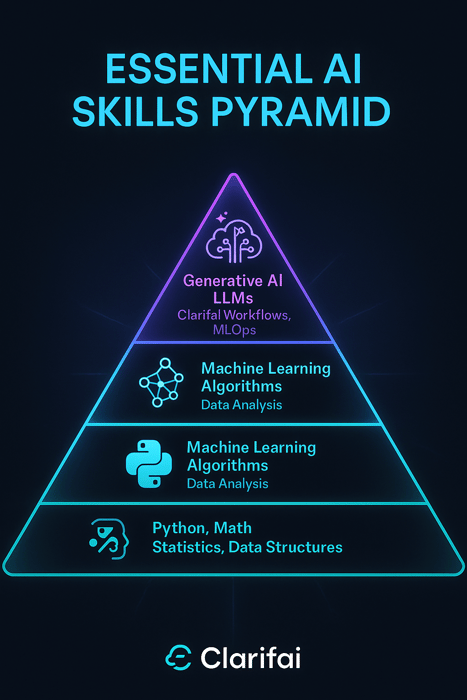
Essential AI Skills Pyramid


3. Must‑Have AI Tools and Packages (and Where Clarifai Fits)

Quick Summary: What tools and libraries should I learn?

Essential AI tools fall into several categories: data handling (pandas, NumPy), classical machine learning frameworks (scikit‑learn, XGBoost), deep-learning frameworks (PyTorch, TensorFlow, Keras), generative AI and LLM libraries (Transformers, LangChain, LlamaIndex), and MLOps & deployment tools (MLflow, Weights & Biases, Docker, Kubernetes). Clarifai’s unified platform ties these together with data management, model training, inference, and compute orchestration.

Key Categories

Data Handling

  • pandas: A library for data manipulation and analysis. Use it to clean, transform and explore datasets.
  • NumPy: Provides multidimensional array objects and operations for efficient numerical computation.
  • Matplotlib and Seaborn: Visualisation libraries for plotting charts and graphs.

Classical ML Frameworks

  • scikit‑learn: Implements classical ML algorithms like regression, classification and clustering.
  • XGBoost/LightGBM: Gradient boosting libraries that excel at structured/tabular data.

Deep‑Learning Frameworks

  • PyTorch: A dynamic neural network library known for flexibility. Great for research and prototyping.
  • TensorFlow/Keras: A powerful ecosystem for production-grade deep learning. Keras offers a high-level interface.
  • Hugging Face Transformers: Houses hundreds of pre-trained models for natural language processing and computer vision.

Generative AI & LLM Tools

  • LangChain: Helps orchestrate large language models into applications (e.g., chatbots, RAG systems).
  • LlamaIndex: A toolkit for building information retrieval applications with LLMs.
  • Vector databases (e.g., Milvus, Pinecone): Store embeddings for similarity search, crucial for RAG.

MLOps & Deployment

  • MLflow and Weights & Biases: Tools for experiment tracking, model management and deployment.
  • Docker & Kubernetes: Containerisation and orchestration platforms for scaling ML workloads.
  • Clarifai’s Compute Orchestration: Manages resources across cloud, local and edge environments; allows you to run models where they make sense (e.g., on a local server or IoT device).

Clarifai’s Platform

Clarifai’s unified AI platform includes:

  • Data management & search: Organise and query datasets in the AI Lake.
  • Automated data labeling: Accelerate training by generating annotations.
  • Model inference: Deploy pre-built models or your own via APIs with high throughput.
  • Model training & workflows: Customise training pipelines without complex infrastructure.
  • Governance & Control: Maintain compliance and track model lineage with the Control Center.

Expert Insights

  • Open-source models thrive: A generative AI trends report highlights the rise of open-source models like Llama and Mistral, making advanced AI accessible to everyone.
  • Multimodal AI is coming: Combining text, images and audio will require robust data handling and generative tools.
  • MLOps matters: Enterprises focus on tools that evaluate and measure AI performance. Tools like MLflow and Clarifai’s governance features help achieve this.
  • Edge computing & custom chips: Demand for AI reasoning is driving the development of custom chips and edge solutions. Clarifai’s local runners enable on-device deployment without sacrificing accuracy.
  • Unified platforms simplify learning: Platforms like Clarifai unify data, models and deployment, letting learners focus on experimentation instead of infrastructure.
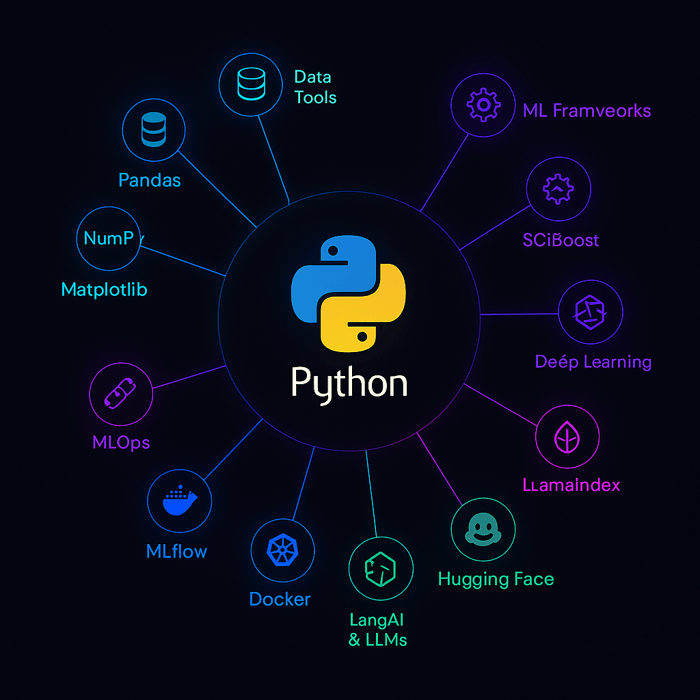
AI Tools & Frameworks Ecosystem (2025)


4. Step‑by‑Step Roadmap to Master AI

Quick Summary: What is a step‑by‑step roadmap to learning AI?

A proven roadmap involves five stages: build foundational knowledge (Python, math), learn classical machine learning, dive into deep learning and generative AI, master MLOps and deployment, and finally specialise and contribute to research.

Stage 1 – Foundations (Months 1–3)

  • Learn Python & essential math: Complete a beginner-friendly Python course and revisit linear algebra, calculus and probability. Create simple scripts to explore data structures and matrix operations.
  • First project: Analyse a public dataset (e.g., Titanic survival) using pandas and Matplotlib. Explore Clarifai’s API by uploading images and retrieving tags—this introduces computer vision concepts.

Stage 2 – Classical Machine Learning (Months 4–6)

  • Study ML algorithms: Learn about supervised learning (regression, classification) and unsupervised learning (clustering, dimensionality reduction). Understand model evaluation (train/test split, cross-validation).
  • Build models: Implement linear regression and logistic regression using scikit‑learn. Practise on datasets like housing prices or customer churn.
  • Hands-on with Clarifai: Use Clarifai’s model inference to experiment with pre-trained models on your data. For example, classify product images or detect objects in pictures.

Stage 3 – Deep Learning & Generative AI (Months 7–9)

  • Study neural networks: Learn about feedforward networks, convolutional neural networks (CNNs) for images, recurrent neural networks (RNNs) for sequences, and Transformers for language.
  • Build your first neural network: Use PyTorch or TensorFlow to build an image classifier on the CIFAR‑10 dataset. Learn how to tune hyperparameters and evaluate results.
  • Explore generative models: Experiment with variational autoencoders (VAEs), generative adversarial networks (GANs) and diffusion models. Learn about large language models (LLMs) and their applications (chatbots, summarisation).
  • Try Clarifai’s generative AI features: Build a simple application that uses Clarifai’s generative AI endpoints to create images or summarise text. Use retrieval‑augmented generation (RAG) by connecting to a vector database.

Stage 4 – MLOps & Deployment (Months 10–12)

  • Learn MLOps tools: Gain proficiency with MLflow (experiment tracking), Docker (containerisation), Kubernetes (orchestration) and monitoring tools.
  • Deploy your models: Package a model with Docker and deploy it on a cloud platform or use Clarifai’s compute orchestration to run it on a local runner. Understand model serving architectures (REST APIs, gRPC).
  • Automate workflows: Use Clarifai’s platform to schedule training jobs, manage data pipelines and monitor inference performance. Learn about CI/CD for ML.

Stage 5 – Specialisation & Research (Months 12+)

  • Choose a focus: Multimodal AI, reinforcement learning, generative AI, agentic AI or domain-specific AI (e.g., healthcare, finance).
  • Read research papers: Follow conferences like NeurIPS, ICML and ACL. Explore the Stanford AI Index for trends and benchmarks.
  • Contribute to open source: Implement algorithms or tools, join communities like Hugging Face or LangChain, and contribute code.
  • Develop a portfolio project: Build an end-to-end application: e.g., a multimodal search engine using Clarifai’s AI Lake, vector database and RAG; or an agentic workflow that automates a series of tasks.
  • Stay updated: Emerging topics like custom silicon, energy-efficient computing and quantum-safe cryptography may shape the future.

Expert Insights

  • Phased learning works: A reputable AI guide suggests mastering basics in months 1–3, diving into ML and deep learning in months 4–9, and using the final months to specialise.
  • Research is accelerating: Benchmarks like MMMU and GPQA show performance leaps of 18.8–48.9 percentage points within a year, meaning today’s cutting-edge quickly becomes standard.
  • Small models lower barriers: Inference costs for models at GPT‑3.5 level have plummeted, enabling experimentation on modest hardware.
  • Use AI to build AI: Andrew Ng recommends using AI-assisted coding tools to reduce friction—this principle applies to using platforms like Clarifai to accelerate deployment.
  • Experimentation breeds mastery: The most successful learners run experiments regularly, test hypotheses and embrace failure.
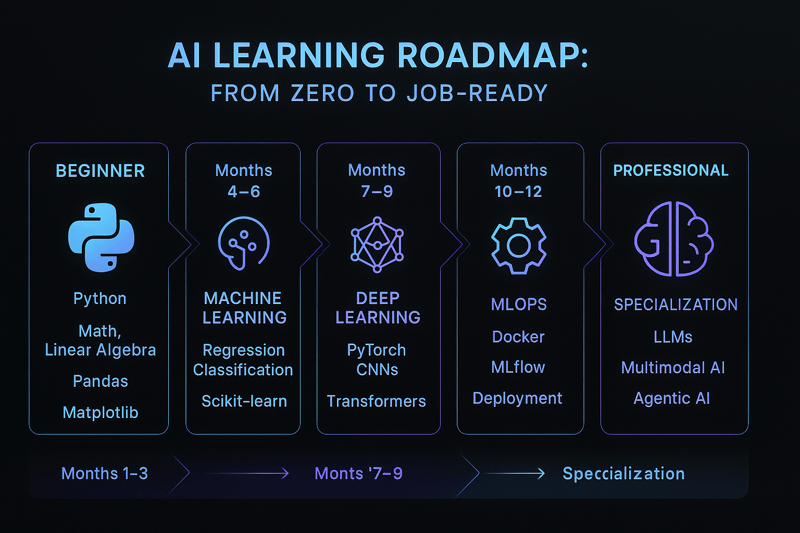
    AI Learning Roadmap


5. Best Ways to Learn AI: Courses, Projects, Community and More

Quick Summary: What are the best ways to learn AI?

Combine structured learning (courses and books) with hands-on projects, community engagement and open-source contributions. Learning in public and collaborating with others helps you deepen understanding and stay motivated.

Structured Learning

  • Online courses: Free or low-cost courses from universities and tech companies cover fundamentals and advanced topics. Seek out beginner-friendly AI curricula, such as those that introduce neural networks, symbolic AI, computer vision and ethics.
  • Books & tutorials: Books like “Deep Learning” by Goodfellow et al. or practical tutorials on GitHub complement courses. Reading research papers builds deeper understanding.
  • Interactive learning platforms: Sites offering coding exercises, quizzes and projects provide immediate feedback.

Hands-On Projects

  • Personal projects: Build an AI-powered chatbot using LLM APIs; create a movie recommendation system; or develop a classifier for identifying plant diseases. Use Clarifai’s API to quickly test image and text models.
  • Competitions: Participating in data science competitions helps you practise under real constraints and learn from peers. Winning isn’t required; the key is learning new techniques and receiving feedback.
  • Hackathons & hack nights: Short, intense coding sessions push you to build functional prototypes quickly. Many AI hackathons focus on solving social good challenges.

Community & Collaboration

  • Forums & Discord: Join AI communities to ask questions, share insights and learn from others. Clarifai’s community and GitHub projects are valuable spaces for collaboration.
  • Learning in public: Share your journey through blog posts, Twitter threads or YouTube videos. Documenting challenges and breakthroughs reinforces learning and builds a portfolio.
  • Mentorship: Seek mentors through community programs or connect with professionals on LinkedIn. They can provide guidance, review your work and recommend resources.

Creative Example

Suppose you want to learn generative AI. You could follow a three-part plan: (1) complete a structured course on neural networks; (2) build a small text-to-image generator using a diffusion model; (3) share your project on social media and invite feedback. If you struggle with training, use Clarifai’s generative AI API to experiment with pre-trained models and focus on building a polished application.

Expert Insights

  • Balance theory and practice: Experts stress that theoretical knowledge must be paired with hands-on projects to truly master AI.
  • Learn in public: A 2024 learning roadmap championed “learning in public,” encouraging students to write blogs, join hackathons and ask questions openly.
  • Soft skills matter: Business leaders emphasise soft skills like creativity, empathy and adaptability, which are crucial for cross-disciplinary AI work.
  • Diverse resources help: Combining courses, projects, research papers and community discussions creates a rich learning experience.
  • Use AI platforms: Clarifai’s tools can accelerate your learning by removing infrastructure barriers, letting you focus on experiments.

6. Responsible AI and Governance

Quick Summary: Why is responsible AI important and how do you practise it?

Responsible AI ensures that AI systems are fair, transparent, secure and trustworthy. It involves mitigating bias, protecting privacy, ensuring accountability and complying with regulations.

Why It Matters

AI systems influence decisions in healthcare, finance and hiring. Biased or unregulated models can lead to discrimination, privacy breaches and reputational harm. A comprehensive 2025 report warns that 71 % of office workers use AI tools without approval, leading to unauthorised “shadow AI”. Companies with high shadow AI levels face average breach costs of $670k.

Key Principles

Fairness & Bias Mitigation

Identify and reduce biases in training data. Evaluate models on diverse datasets and use fairness metrics (e.g., demographic parity). Regularly audit models for unintended outcomes.

Transparency & Explainability

Use techniques like SHAP (SHapley Additive exPlanations) to explain model predictions. Document data sources, features used and model design decisions.

Privacy & Security

Follow data protection laws (GDPR, CCPA). Use privacy-preserving methods like differential privacy or federated learning. Avoid shadow AI by approving AI tools through IT and using enterprise-grade platforms like Clarifai with robust security policies.

Accountability & Governance

Establish clear responsibilities for AI outcomes. Implement monitoring to detect model drift or degradation. Maintain documentation and version control to track changes.

Regulation Compliance

Stay informed about regulatory frameworks: EU AI Act, NIST AI Risk Management Framework, OECD principles. The AI Index notes that legislative mentions of AI grew over 21 % across 75 countries in 2024, signalling a tightening regulatory landscape.

Clarifai’s Role

Clarifai’s platform offers governance features such as the Control Center and AI Lake that track data lineage, model versions and access. Automated audit trails support compliance efforts. Clarifai’s compute orchestration and local runners ensure data remains on secure infrastructure, reducing shadow AI risks.

Expert Insights

  • AI governance is crucial: Gartner’s 2025 tech trends emphasise robust governance frameworks to mitigate bias and ensure transparency.
  • Shadow AI is costly: Reco’s report shows unauthorised AI tools lead to significant breaches and warns that OpenAI accounts for 53 % of shadow AI usage.
  • New safety benchmarks: The AI Index highlights new benchmarks like HELM Safety and AIR‑Bench for evaluating factuality and safety, pushing industry standards.
  • Ethics meets regulation: Regulations are doubling yearly; failing to align with them can hinder product adoption.
  • Enterprise-grade tools: Platforms like Clarifai provide built-in governance and security, helping organisations avoid shadow AI and maintain compliance.
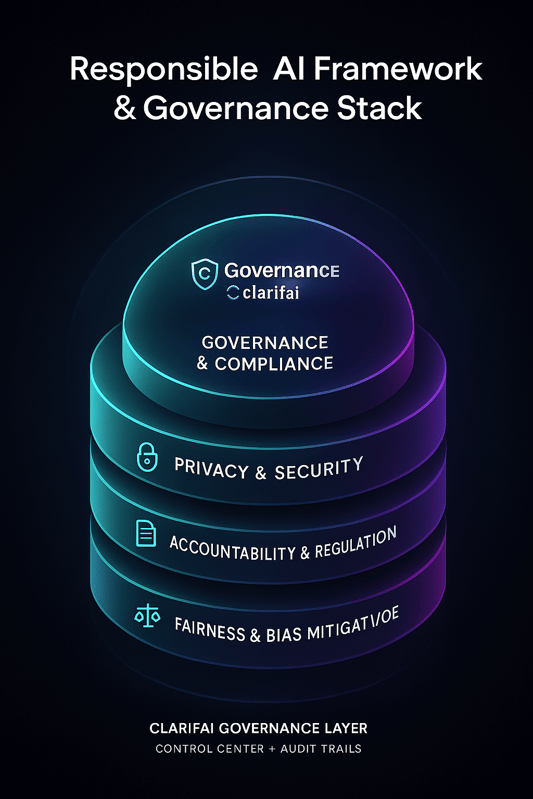
Responsible AI Framework& Governance Stack


7. Emerging & Future‑Proof AI Skills

Quick Summary: What emerging AI skills should I learn to stay ahead?

Focus on multimodal AI, vertical AI integration, agentic AI, AI reasoning & custom silicon, energy‑efficient computing, and open‑source small models. These trends will shape the next decade of AI.

Trending Skills

Multimodal AI

Models that process images, text, audio and video simultaneously are becoming mainstream. A 2025 AI trends report notes that startups invested heavily in multimodal AI in 2023, and products are expected to launch widely in 2025. Multimodal AI enhances accessibility (e.g., real-time transcription) and improves human-computer interaction.

Vertical AI Integration

Instead of one-size-fits-all models, companies are building AI tailored for sectors like healthcare, finance and retail. This trend, called vertical AI integration, enhances efficiency and creates new roles for data scientists who specialise in domain-specific models.

Agentic AI

Agentic AI refers to autonomous systems that plan, act and learn without human oversight. Gartner highlights agentic AI as the top tech trend of 2025, describing it as an evolution toward systems that execute complex tasks and adapt to new challenges. Agentic AI is already transforming healthcare by automating care coordination and monitoring.

AI Reasoning & Custom Silicon

Enterprise adoption requires AI systems that can reason and make decisions; this demands specialised hardware. Morgan Stanley points out that AI reasoning drives demand for custom chips and programmable infrastructure. Learning about AI hardware ecosystems (GPUs, TPUs, ASICs) helps engineers optimise performance.

Energy‑Efficient & Hybrid Computing

The need for sustainable AI is driving energy-efficient designs and hybrid computing (combining CPUs, GPUs, FPGAs and quantum processors). Innovations like neuromorphic computing and post-quantum cryptography aim to secure data and reduce energy use.

Small Models & Open Source

The AI Index reports that the inference cost for GPT‑3.5-level performance has dropped 280-fold. Meanwhile, open-weight models are closing the performance gap with proprietary ones. Learning to fine-tune and deploy small, efficient models such as Llama 2 or Mistral enables you to build powerful applications on limited resources.

Clarifai & Emerging Skills

Clarifai’s platform helps you explore these trends practically:

  • Multimodal AI: Use Clarifai’s computer vision and generative APIs to integrate images and text.
  • Vertical AI: Clarifai provides domain-specific solutions (e.g., visual inspection, content moderation).
  • Agentic workflows: Use Clarifai’s compute orchestration to chain models and actions, building agentic workflows.
  • Custom silicon: Clarifai’s local runners allow deployment on edge devices, benefiting from custom chips.

Expert Insights

  • Open models democratise AI: Multimodal and open-source models will dominate new applications.
  • Agentic AI is a game-changer: Gartner calls agentic AI a significant evolution towards autonomous systems.
  • Enterprise priorities: Morgan Stanley lists AI reasoning, custom silicon and agentic AI as top enterprise trends.
  • Future will be hybrid: Energy-efficient computing and hybrid architectures will define the next wave of innovation.
  • Continuous learning is vital: Rapid benchmark improvements and new technologies require ongoing skill development.

8. Building Your AI Portfolio & Learning Plan

Quick Summary: How do I build an AI portfolio?

Create a structured learning plan and develop a portfolio of diverse projects. Document your progress publicly (GitHub, blog, LinkedIn), participate in competitions and hackathons, and use platforms like Clarifai to accelerate project development.

Crafting a Learning Plan

  • Set clear goals: Decide what skills you want to master within specific time frames. For example, “complete a course on deep learning by month 3,” or “deploy an NLP model by month 6.”
  • Schedule regular sessions: Allocate weekly hours to learning. Consistency beats cramming.
  • Select resources: Choose courses, tutorials and books that align with your goals. Use Clarifai’s documentation to explore platform features.

Portfolio Building

  1. Start with simple projects: Create a data analysis notebook, train a classifier for handwritten digits, or build a sentiment analysis tool.
  2. Add complexity: Progress to more challenging tasks—such as a voice-controlled assistant, generative art or a time-series forecasting model.
  3. Show your work: Host code on GitHub and include clear README files explaining your approach. Use Jupyter notebooks to combine code and narrative.
  4. Leverage Clarifai: Build an application using Clarifai’s API—like an image moderation tool or a RAG system that answers questions using your custom dataset. Clarifai’s AI Lake helps you organise datasets and share them with collaborators.
  5. Contribute to open source: Join communities like Hugging Face or LangChain, fix issues, add features or write documentation.
  6. Write about your projects: Publish blog posts or LinkedIn articles describing what you learned. This demonstrates communication skills and deepens your understanding.

Plan Example

Suppose your goal is to specialise in computer vision. Your plan might look like:

  • Month 1–2: Learn Python, NumPy and Matplotlib; build a basic image classifier.
  • Month 3–4: Study CNNs; implement a convolutional autoencoder using PyTorch.
  • Month 5: Participate in an image classification competition; refine your model.
  • Month 6: Use Clarifai to deploy your model as an API and integrate it into a web app.
  • Month 7: Write a blog post about your experience; share it in the Clarifai community.

Expert Insights

  • Learning in public pays dividends: Sharing your journey builds credibility and invites feedback.
  • Soft skills matter: Employers value communication, adaptability and teamwork.
  • Industry contributions stand out: Nearly 90 % of notable AI models in 2024 originated from industry. Demonstrating real-world applications is key.
  • Keep evolving: The AI field moves rapidly. Continuously refine your portfolio with new projects and emerging techniques.
  • Use unified platforms: Clarifai’s AI Lake and compute orchestration make it easier to manage data and deploy models, giving your portfolio a professional edge.

9. AI Career Paths & Market Outlook

Quick Summary: What are the most promising AI careers?

Key AI roles include machine learning engineer, data scientist, AI research scientist, MLOps engineer, AI product manager, and AI ethicist. The market is booming, with roles growing 30 % annually and salaries often exceeding six figures.

Career Clusters

Research

Roles: AI research scientist, algorithm engineer, PhD student.

Skills: Advanced mathematics, deep learning, evaluation design, publishing papers.

Education: Often requires master’s or PhD degrees.

Applied Engineering

Roles: Machine learning engineer, AI software developer.

Skills: Implement and optimise models, build user-facing features (recommendation engines, chatbots).

Salary: Average ML engineer salary exceeds $160k.

Platforms & MLOps

Roles: MLOps engineer, platform engineer.

Skills: Manage model lifecycle, build data pipelines, deploy models at scale. Tools: Docker, Kubernetes, MLflow, Clarifai compute orchestration.

Insights & Data

Roles: Data scientist, data analyst, BI engineer.

Skills: Data exploration, hypothesis testing, predictive modeling.

Direction & Product

Roles: AI product manager, solutions architect.

Skills: Translate business needs into AI features, roadmap planning, cross-functional collaboration.

Safety & Ethics

Roles: AI ethicist, AI governance specialist.

Skills: Fairness auditing, policy compliance, risk mitigation.

Market Trends

  • Demand surge: AI roles are growing faster than many other tech roles. A LinkedIn report notes that positions like AI data engineer and MLOps engineer are growing at 30 % annually.
  • Industry leads: Most notable AI models (about 90 %) come from industry rather than academia.
  • Emerging roles: As agentic AI and multimodal models mature, new roles like agentic system designer or multimodal specialist are emerging.
  • Global opportunities: Regions outside the traditional tech hubs are producing high-impact models; countries in the Middle East, Latin America and Southeast Asia are contributing innovative models.
  • Salaries vary by role: Research roles and MLOps engineers can command some of the highest salaries, while ethics and compliance roles are growing due to regulation.

Clarifai’s Niche

As a market leader, Clarifai is expanding into roles such as Solutions Architect, AI Applications Engineer, Community Manager and Developer Evangelist. Professionals with experience deploying models using Clarifai’s platform, managing data through the AI Lake, and orchestrating compute across edge devices have a competitive advantage.

Expert Insights

  • AI roles pay well: Average salaries for ML engineers are around $161k.
  • Research requires depth: Roles in research and algorithm design often need advanced degrees.
  • Soft skills & ethics are in demand: Employers prioritise creativity, empathy and ethical judgement.
  • Regional shifts: More models come from outside North America, reflecting global collaboration.
  • Clarifai expertise opens doors: Familiarity with Clarifai’s products can lead to niche roles in platform integration and AI solutions.
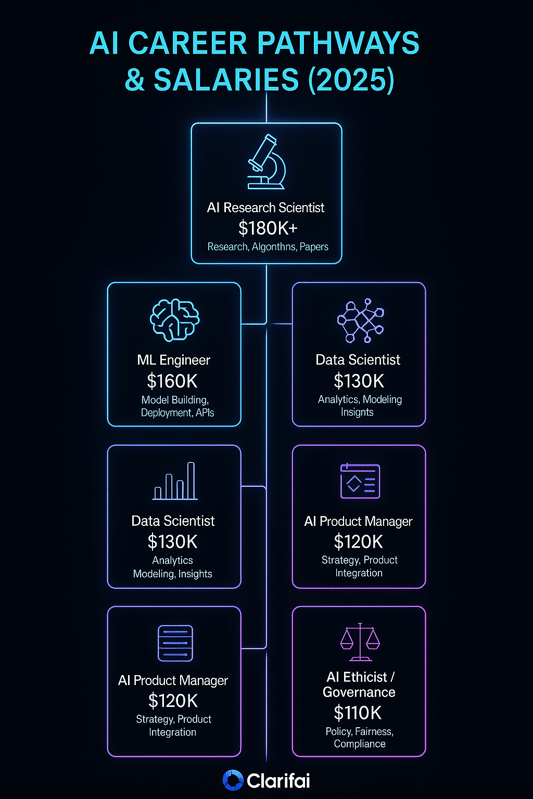
AI Career Pathways and salaries


10. How to Land a Job in AI

Quick Summary: How do I land a job in AI?

Build a strong portfolio, tailor your resume, network effectively, contribute to open source and prepare rigorously for interviews. Showcasing real projects and soft skills increases your chances of success.

Step‑by‑Step Guide

1. Strengthen Your Foundation & Portfolio

Focus on building projects that highlight your ability to solve real problems. Demonstrate how you collected data, chose algorithms, evaluated performance and iterated. Use Clarifai’s API or AI Lake to showcase enterprise-grade workflows.

2. Tailor Your Resume

Highlight AI-related projects and relevant skills like Python, PyTorch, scikit‑learn, MLflow, and Clarifai. Quantify your impact (e.g., improved accuracy by 10 %, reduced inference time). Mention contributions to open-source or research collaborations.

3. Network Strategically

  • Join communities: Participate in forums, Discord servers and Slack groups related to AI.
  • Attend conferences: Virtual or in-person events like NeurIPS, CVPR and Clarifai’s community meetups are great networking opportunities.
  • LinkedIn: Connect with AI professionals; engage with their posts and share your projects.

4. Contribute to Open Source

Select a project that aligns with your interests. Fix bugs, write documentation or implement features. Contributing to Hugging Face Transformers, LangChain or Clarifai’s open-source projects builds credibility.

5. Secure Internships or Freelance Projects

Practical experience matters. Apply for internships at startups, research labs or companies using AI. Even short-term freelance projects (e.g., building a predictive model for a small business) demonstrate real-world impact.

6. Prepare for Interviews

  • Technical prep: Practise coding problems (LeetCode, HackerRank), review ML algorithms and statistics, and practise system design for ML.
  • Project discussion: Be ready to explain your portfolio projects in depth: why you chose a method, how you handled challenges, and what you’d improve.
  • Ethics & biases: Employers may ask about fairness and responsible AI practices. Understand how to mitigate bias and ensure model transparency.
  • Mock interviews: Practise with peers or mentors to build confidence.

7. Hone Soft Skills

Employers value communication, teamwork, creativity and resilience. Demonstrate these in your interactions, portfolio and interview responses.

Creative Example

During an interview, you might showcase a Clarifai-powered app you built. Imagine demonstrating a mobile app that uses Clarifai’s computer vision API to detect plant diseases in farmers’ fields and recommending treatment. This shows technical skill, user-centric design and real-world impact.

Expert Insights

  • Four-step formula: A business guide recommends building AI skills, developing soft skills, contributing to open source, and pursuing formal education.
  • Industry experience matters: Most notable AI models originate in industry, so internships and real projects carry weight.
  • Job growth is booming: LinkedIn projects 97 million new AI-related roles worldwide by 2025.
  • Soft skills are non-negotiable: Employers seek empathy, adaptability and creativity.
  • Portfolios over degrees: A strong portfolio often outweighs a degree for applied roles.

11. Tips to Stay Motivated & Learn Continuously

Quick Summary: How can I stay motivated and keep learning AI?

Set clear goals, join communities, stay updated on research, use AI tools to accelerate learning, document your progress and maintain balance.

Practical Strategies

Set Realistic Goals & Routine

Define weekly learning objectives and track them. Use productivity tools or spreadsheets to schedule tasks and monitor progress. Short bursts of study (e.g., 1–2 hours daily) are more effective than sporadic 8-hour sessions.

Join Communities & Find Accountability

Active communities provide support and accountability. Clarifai’s Discord and forum allow you to discuss projects and get feedback. Study groups encourage regular progress and help you tackle roadblocks together.

Stay Up-to-Date

Subscribe to newsletters (e.g., AI Weekly, The Batch) and follow the Stanford AI Index for data-driven insights. Watch conference keynotes and webinars to learn about new models and tools.

Use AI Tools to Learn AI

Leverage AI assistants for code completion, debugging and brainstorming. Andrew Ng notes that AI-assisted coding tools reduce friction and boost productivity. Use Clarifai’s generative AI endpoints to iterate on ideas quickly.

Document & Share Your Journey

Keep a learning journal or blog. Reflecting on what you’ve learned deepens understanding. Sharing your progress on social media or in a newsletter builds community and may attract mentors.

Collaborate & Teach

Join a local AI club or online study group. Teaching a concept to someone else is one of the best ways to master it. Pair programming or code reviews accelerate growth.

Balance & Persistence

Avoid burnout by scheduling breaks and celebrating milestones. The AI field evolves rapidly, but pace yourself. Remember that mastery is a marathon, not a sprint.

Expert Insights

  • AI advancements require continual learning: Benchmarks and models evolve quickly; staying current is essential.
  • AI-assisted tools boost productivity: Andrew Ng emphasises using AI tools to make coding faster and more fun.
  • Public accountability works: Many learners who document their journey publicly achieve faster progress and stronger networks.
  • Feedback accelerates growth: Joining communities and asking for feedback improves your work and provides new perspectives.
  • Balance fosters longevity: Long-term success requires mental health and sustained motivation.

Conclusion: The AI Journey Starts Now

Artificial intelligence is transforming every industry—from healthcare and finance to entertainment and education. Learning AI from scratch is not only achievable but also empowering. With a structured roadmap, mastery of foundational skills, and the right tools, you can transition from novice to practitioner within a year. The world needs responsible, ethical AI practitioners who understand the implications of their work. By keeping an eye on emerging trends like multimodal and agentic AI, and by honing both technical and soft skills, you will remain relevant as AI evolves.

Clarifai’s unified AI platform accelerates this journey, offering data management, model training, inference, and compute orchestration in one place. Whether you’re building your first computer vision model or deploying a complex agentic workflow, Clarifai provides the infrastructure to bring your ideas to life. Start exploring Clarifai’s free tier today, join the community, and continue learning. The next breakthrough could come from you.


FAQs

Q1: Do I need a degree to learn AI?
A: No. While advanced roles (research scientist) may require graduate degrees, many applied AI roles value skills and portfolios over formal credentials. Use online courses, projects and Clarifai’s platform to build experience.

Q2: Which programming language should I start with?
A: Python is the recommended language for AI due to its extensive libraries. You can also explore R or Julia for specific tasks, but Python is the best entry point.

Q3: How can I practise without access to large datasets?
A: Use publicly available datasets from sources like Kaggle or UCI. Clarifai’s AI Lake lets you store and search your own datasets, and its automated labeling accelerates preparation.

Q4: What’s the difference between machine learning and deep learning?
A: Machine learning encompasses algorithms that learn patterns from data (e.g., linear regression, decision trees). Deep learning is a subset of ML using multi-layered neural networks inspired by the brain, enabling complex tasks like image recognition and language modeling.

Q5: How do I build a portfolio if I’m short on time?
A: Focus on quality over quantity. Build a couple of end-to-end projects that demonstrate your ability to collect data, choose algorithms, evaluate results and deploy a model. Use Clarifai’s pre-built models to accelerate the deployment phase.

Q6: What roles can I pursue with AI skills?
A: Popular roles include machine learning engineer, data scientist, AI research scientist, MLOps engineer, product manager and AI ethicist. Choose roles based on your interests and strengths.

Q7: How can I ensure my AI models are ethical and fair?
A: Use diverse datasets, evaluate for bias, apply fairness metrics, ensure transparency, and adhere to regulations. Platforms like Clarifai support governance and audit trails, helping you build responsible AI systems.

Q8: What are agentic AI systems?
A: Agentic AI refers to systems that can plan, act and learn autonomously without human oversight. They perform complex tasks and adapt to new challenges. This emerging field will create new career opportunities.