OpenAI just unleashed Sora 2, its most advanced video generation model yet, and dropped it into a new social app that looks and feels a lot like TikTok. Continue reading “AI Video Magic Meets Copyright Chaos”
OpenAI just unleashed Sora 2, its most advanced video generation model yet, and dropped it into a new social app that looks and feels a lot like TikTok. Continue reading “AI Video Magic Meets Copyright Chaos”
This blog post focuses on new features and improvements. For a comprehensive list, including bug fixes, please see the release notes.
We are introducing the Clarifai Reasoning Engine — a full-stack performance framework built to deliver record-setting inference speed and efficiency for reasoning and agentic AI workloads.
Unlike traditional inference systems that plateau after deployment, the Clarifai Reasoning Engine continuously learns from workload behavior, dynamically optimizing kernels, batching, and memory utilization. This adaptive approach means the system gets faster and more efficient over time, especially for repetitive or structured agentic tasks, without any trade-off in accuracy.
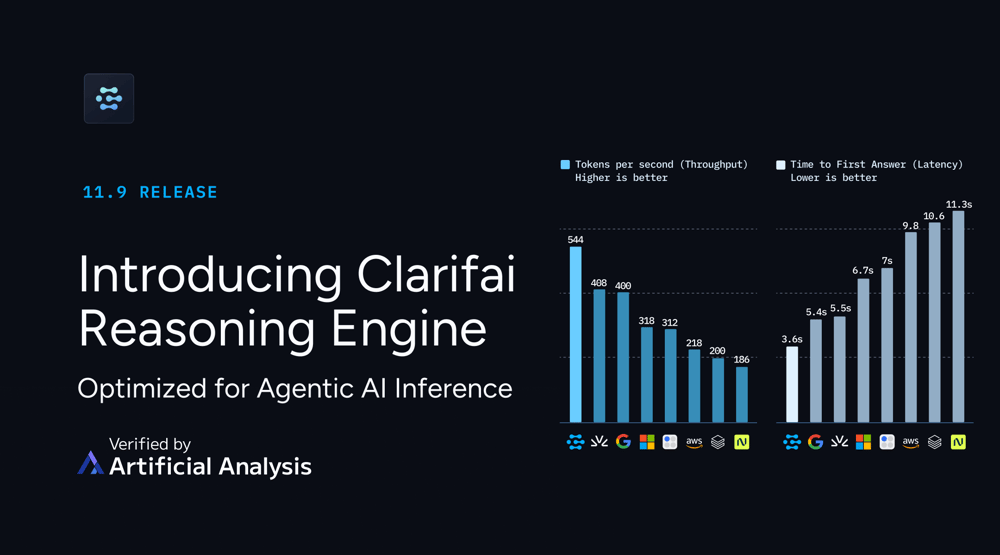
In recent benchmarks by Artificial Analysis on GPT-OSS-120B, the Clarifai Reasoning Engine set new industry records for GPU inference performance:
544 tokens/sec throughput — fastest GPU-based inference measured
0.36s time-to-first-token — near-instant responsiveness
$0.16 per million tokens — the lowest blended cost
These results not only outperformed every other GPU-based inference provider but also rivaled specialized ASIC accelerators, proving that modern GPUs, when paired with optimized kernels, can achieve comparable or even superior reasoning performance.
The Reasoning Engine’s design is model-agnostic. While GPT-OSS-120B served as the benchmark reference, the same optimizations have been extended to other large reasoning models like Qwen3-30B-A3B-Thinking-2507, where we observed a 60% improvement in throughput compared to the base implementation. Developers can also bring their own reasoning models and experience similar performance gains using Clarifai’s compute orchestration and kernel optimization stack.
At its core, the Clarifai Reasoning Engine represents a new standard for running reasoning and agentic AI workloads — faster, cheaper, adaptive, and open to any model.
Try the GPT-OSS-120B model directly on Clarifai and experience the performance of the Clarifai Reasoning Engine. You can also bring your own models or talk to our AI experts to apply these adaptive optimizations and see how they improve throughput and latency in real workloads.
Added support for initializing models with the vLLM, LMStudio, and Hugging Face toolkits for local runners.
We’ve added a Hugging Face Toolkit to the Clarifai CLI, making it easy to initialize, customize, and serve Hugging Face models through Local Runners.
You can now download and run supported Hugging Face models directly on your own hardware — laptops, workstations, or edge boxes — while exposing them securely via Clarifai’s public API. Your model runs locally, your data stays private, and the Clarifai platform handles routing, authentication, and governance.
Use local compute – Run open-weight models on your own GPUs or CPUs while keeping them accessible through the Clarifai API.
Preserve privacy – All inference happens on your machine; only metadata flows through Clarifai’s secure control plane.
Skip manual setup – Initialize a model directory with one CLI command; dependencies and configs are automatically scaffolded.
1. Install the Clarifai CLI
Make sure you have Python 3.11+ and the latest Clarifai CLI:
2. Authenticate with Clarifai
Log in and create a configuration context for your Local Runner:
You’ll be prompted for your User ID, App ID, and Personal Access Token (PAT), which you can also set as an environment variable:
3. Get your Hugging Face access token
If you’re using models from private repos, create a token at huggingface.co/settings/tokens and export it:
4. Initialize a model with the Hugging Face Toolkit
Use the new CLI flag --toolkit huggingface to scaffold a model directory.
This command generates a ready-to-run folder with model.py, config.yaml, and requirements.txt — pre-wired for Local Runners. You can modify model.py to fine-tune behavior or change checkpoints in config.yaml.
5. Install dependencies
6. Start your Local Runner
Your runner registers with Clarifai, and the CLI prints a ready-to-use public API endpoint.
7. Test your model
You can call it like any Clarifai-hosted model via SDK:
Behind the scenes, requests are routed to your local machine — the model runs entirely on your hardware. See the Hugging Face Toolkit documentation for the full setup guide, configuration options, and troubleshooting tips.
Run Hugging Face models on the high-performance vLLM inference engine
vLLM is an open-source runtime optimized for serving large language models with exceptional throughput and memory efficiency. Unlike typical runtimes, vLLM uses continuous batching and advanced GPU scheduling to deliver faster, cheaper inference—ideal for local deployments and experimentation.
With Clarifai’s vLLM Toolkit, you can initialize and run any Hugging Face-compatible model on your own machine, powered by vLLM’s optimized backend. Your model runs locally but behaves like any hosted Clarifai model through a secure public API endpoint.
Check out the vLLM Toolkit documentation to learn how to initialize and serve vLLM models with Local Runners.
Run open-weight models from LM Studio and expose them via Clarifai APIs
LM Studio is a popular desktop application for running and chatting with open-source LLMs locally—no internet connection required. With Clarifai’s LM Studio Toolkit, you can connect those locally running models to the Clarifai platform, making them callable via a public API while keeping data and execution fully on-device.
Developers can use this integration to extend LM Studio models into production-ready APIs with minimal setup.
Read the LM Studio Toolkit guide to see supported setups and how to run LM Studio models using Local Runners.
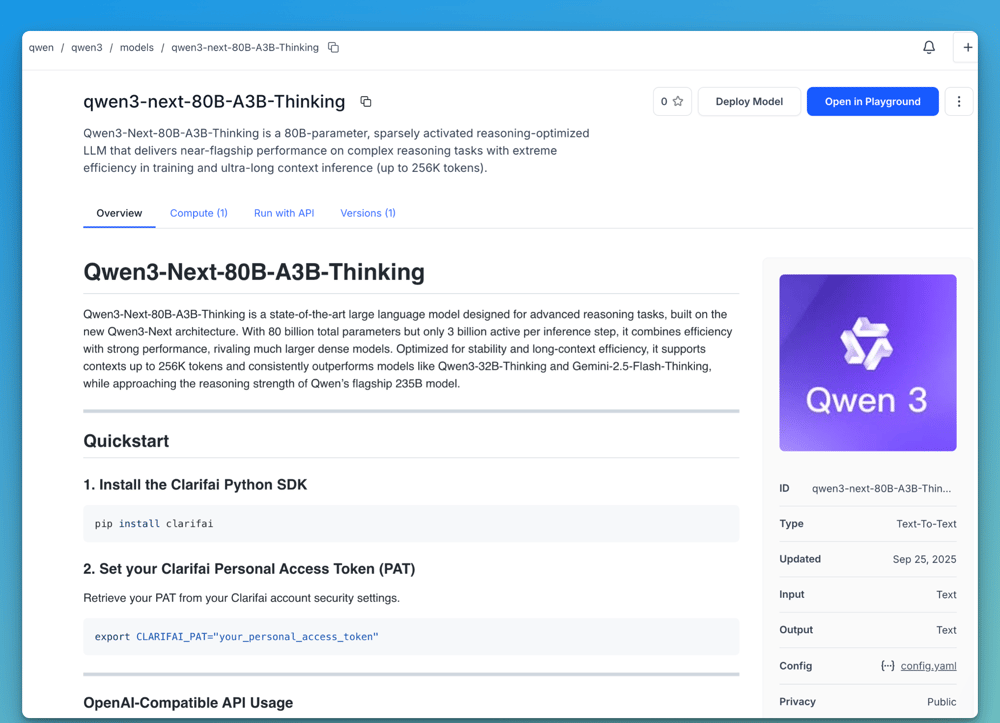
We’ve added several powerful new models optimized for reasoning, long-context tasks, and multi-modal capabilities:
We’ve added new cloud instances to give developers more options for GPU-based workloads:
B200 Instances – Competitively priced, operating from Seattle.
GH200 Instances – Powered by Vultr for high-performance tasks.
Learn more about Enterprise-Grade GPU Hosting for AI models and request access, or connect with our AI experts to discuss your workload needs.
With the Clarifai Reasoning Engine, you can run reasoning and agentic AI workloads faster, more efficiently, and at lower cost — all while maintaining full control over your models. The Reasoning Engine continuously optimizes for throughput and latency, whether you’re using GPT-OSS-120B, Qwen models, or your own custom models.
Bring your own models and see how adaptive optimizations improve performance in real workloads. Talk to our AI experts to learn how the Clarifai Reasoning Engine can optimize performance of your custom models.
MAICON brings together top visionaries and experts in the field of AI during a three-day conference packed with actionable sessions and networking events—all to position you as the change agent your organization (and career) needs. In this ongoing speaker series, we’re featuring these extraordinary leaders, with forward-looking predictions, actionable tips you can use today, and a preview of their MAICON 2025 sessions. Continue reading “10 Marketing AI Leaders to Follow in 2025 and Beyond”
Artificial intelligence as a service (AIaaS) is revolutionizing how companies access powerful AI tools. It bridges the gap between expensive in‑house development and the growing demand for fast, scalable AI solutions. As organizations worldwide look to harness AI’s potential without breaking the bank, AIaaS providers like Clarifai offer curated, cloud‑hosted AI models, orchestrated compute, and local run options. In this comprehensive guide we will demystify AIaaS, explore its benefits, identify risks, and show you how to implement AI services effectively. Our aim is to give you a rich, expert‑backed perspective, drawing from the latest research and insights to help you make informed decisions and stay ahead.
Read on for a deep dive into each facet of AIaaS—from definitions and types to selection guidelines, future trends, and practical implementation steps.
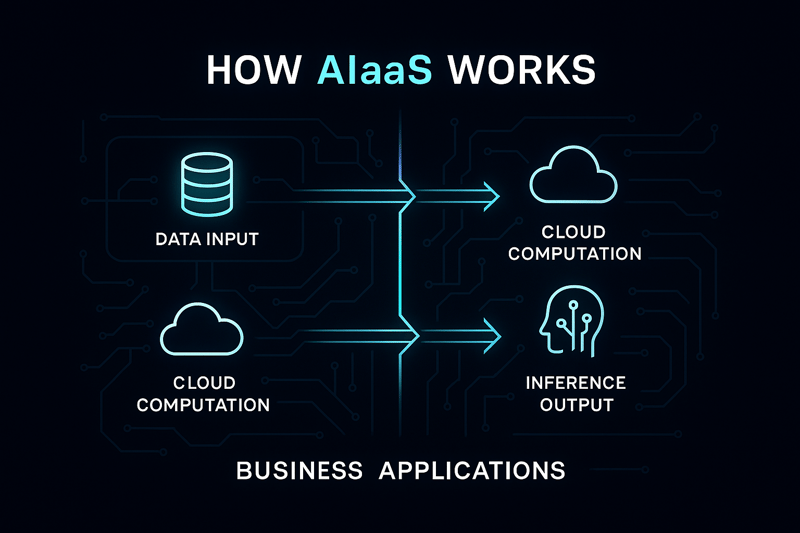
AIaaS operates by abstracting away the complexity of building and deploying machine‑learning models. Providers host everything from data storage to MLOps pipelines on high‑performance infrastructure. Users send data via an API or SDK, the service processes it through a pre‑trained model, and the output is returned in real time. This workflow eliminates the need to manage servers, GPUs, or training pipelines. It also ensures that updates and improvements happen automatically, as the provider retrains models and optimizes hardware behind the scenes.
Clarifai takes this further by offering compute orchestration, allowing you to choose where your AI runs. You can deploy models on Clarifai’s cloud infrastructure, on private GPU clusters, or on edge devices via local runners. This flexibility reduces latency, preserves data privacy and supports compliance requirements. Clarifai’s platform also simplifies integration with a drag‑and‑drop UI, REST APIs, and SDKs in popular languages.
AIaaS builds upon MLOps‑as‑a‑Service by providing additional services like data labeling, storage, workflow orchestration, monitoring, and domain‑specific APIs. Ericsson’s research explains how AIaaS can integrate network data APIs and radio‑access network insights to support telecom and IoT use cases. This means AIaaS isn’t just hosting a model—it’s delivering an entire ecosystem of tools that accelerate your AI lifecycle. For example:
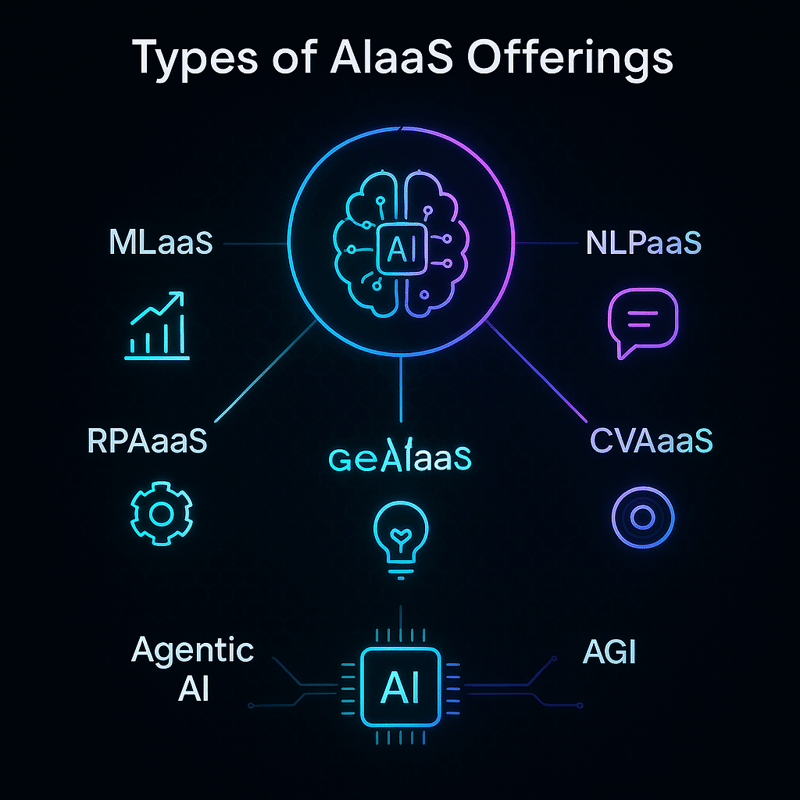
AIaaS isn’t monolithic; it encompasses diverse categories of services. Understanding these types helps you match the right tools to your business needs.
MLaaS platforms deliver ready‑to‑use models for classification, regression, clustering, recommendation and anomaly detection. Users can upload data, select algorithms, and receive predictions without coding or tuning hyperparameters. AutoML tools even automate feature engineering and model selection, enabling non‑technical users to build robust models. Clarifai’s MLaaS offerings include a library of pre‑trained models you can fine‑tune on your own data.
Expert Insight:
NLPaaS provides pre‑trained language models for tasks like language translation, summarization, sentiment analysis, entity extraction, and chatbot conversations. In customer support, for example, NLPaaS can triage tickets, detect sentiment, and route issues to the right team.
Clarifai’s NLP offering includes zero‑shot classification and phrase detection for unstructured text. Its model orchestration tools allow you to combine text models with vision models for multimodal applications.
Expert Insight:
CVaaS offers image and video processing models that perform object detection, facial recognition, pose estimation, and optical character recognition (OCR). Retailers can use CVaaS for automated checkout and inventory management, while manufacturers deploy it for predictive maintenance and quality control.
Clarifai’s visual recognition suite excels at custom training on unique datasets. You can create specialized detectors for logos, safety equipment or defects, and the platform’s local runners enable on-device inference where connectivity is limited.
Expert Insight:
RPAaaS merges AI with rule‑based automation to handle repetitive tasks such as data entry, invoice processing and workflow management. It can operate 24/7 with high accuracy, freeing human workers to focus on creative and strategic responsibilities. Some RPAaaS offerings integrate computer vision and NLP to read documents and emails.
Expert Insight:
AI agents combine machine learning, natural language understanding, planning algorithms and reinforcement learning to act autonomously. They can manage complex workflows like customer support triage or logistics optimization. Agentic AI leverages multiple models and sensors to perceive, reason and act.
Clarifai offers tools to build agentic workflows, chaining models for tasks like document approval or content moderation. Its compute orchestration allows AI agents to run partially on edge devices for fast responses.
Expert Insight:
Gen‑AIaaS hosts models that generate text, images, code, or music. Applications range from marketing content and product design to game development. Companies often integrate generative AI to enhance user engagement with dynamic content.
Clarifai’s generative AI capabilities provide tools for image synthesis and creative text generation. With compute orchestration, you can run generative models on GPU clusters or local workstations to optimize cost.
Expert Insight:
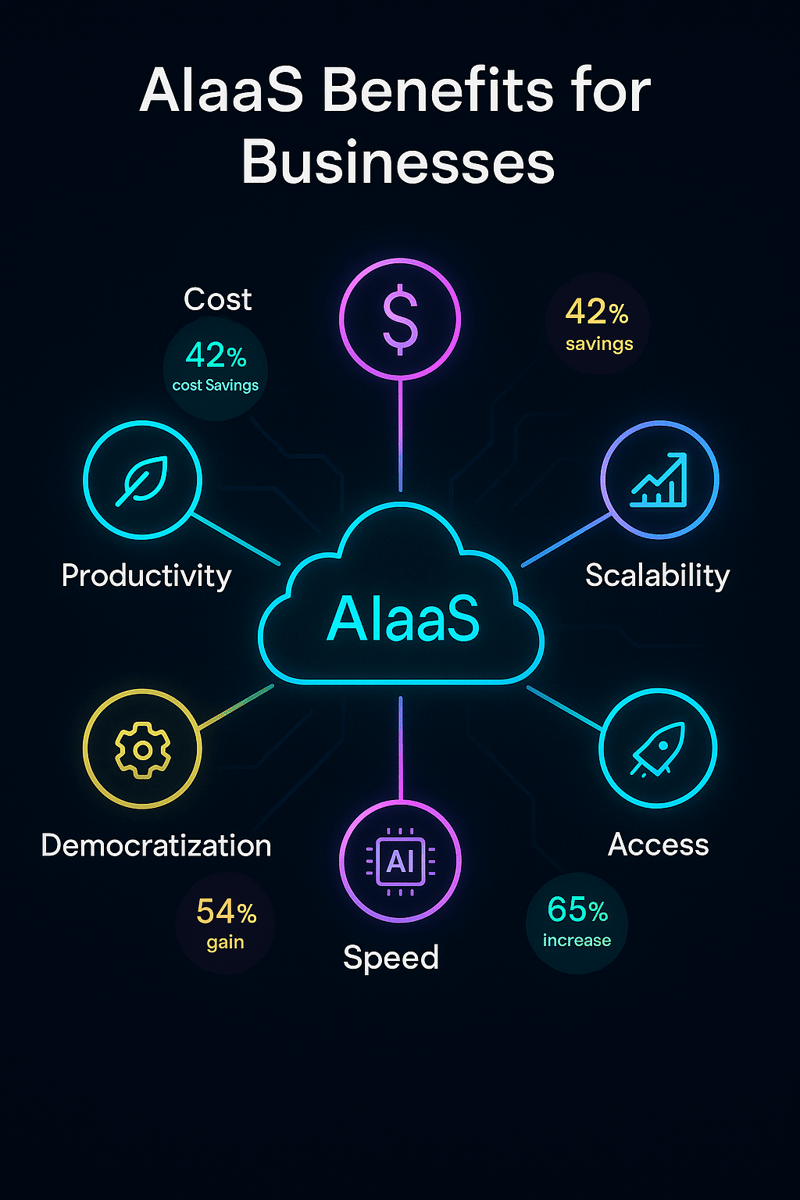
AIaaS dramatically reduces upfront costs and operational overhead. You don’t need to invest in expensive GPUs, data centers or large data science teams—the service provider absorbs these expenses. Payment models are typically pay‑per‑use or subscription-based, enabling you to scale usage up or down.
For example, instead of purchasing dedicated GPU servers, you can leverage Clarifai’s orchestrated compute and reserve only the resources you need, resulting in predictable expenses. This flexibility empowers startups and SMEs to experiment with AI without significant capital outlay.
Once integrated, AIaaS scales on demand. If your app suddenly sees a surge in users, the cloud infrastructure automatically allocates more compute. This seamless scalability shortens development cycles and enables faster deployment. Clarifai’s platform automatically scales across GPU clusters, ensuring consistent performance under heavy workloads.
AIaaS providers maintain state‑of‑the‑art models and continuously improve them. As a result, you gain access to cutting‑edge research in natural language processing, computer vision and generative AI. Clarifai’s model zoo includes models fine‑tuned on diverse datasets, ready to power specialized tasks. When you need support, you benefit from the provider’s domain expertise and community resources.
By automating repetitive processes, AIaaS allows teams to focus on strategic work and core innovation. For instance, predictive analytics models help business leaders make data‑driven decisions, while chatbots handle routine customer inquiries. AI-driven supply chain optimization can reduce logistics costs by up to 15 % and increase revenue premiums by 61 %.
Previously, only large enterprises with sizeable budgets could invest in AI. AIaaS levels the playing field by offering affordable, user-friendly AI solutions. According to market research, over 70 % of enterprises now deploy generative AI in at least one function. This democratization enables smaller companies to compete with industry giants and fosters innovation across sectors.
When you send data to third‑party clouds, privacy and security become paramount. Sensitive information must be encrypted at rest and in transit. Providers should offer role‑based access controls, mask personally identifiable information, and maintain audit trails to comply with regulations like GDPR, HIPAA and the EU AI Act. Clarifai’s platform supports in‑country deployment via local runners to meet data residency requirements.
Some AIaaS models can be black boxes, making it difficult to understand how decisions are made. This can hinder trust and limit adoption in regulated industries. Providers must implement interpretability tools, allow model auditing, and share information about training data sources.
Long‑term reliance on a single vendor can lead to lock‑in, where switching providers becomes costly. Over time, subscription fees may surpass the cost of building your own solution. It’s important to consider standardized formats like ONNX and MLflow for portability and to negotiate flexible contracts.
AIaaS typically offers pre‑built models that may not meet niche requirements. Customizing models often incurs additional fees or requires in‑house data science skills. Clarifai addresses this by enabling model fine‑tuning on your own data through a guided interface.
Successful AI deployment hinges on clean, well‑labeled data. Poor data quality can yield biased or unreliable models. Without proper monitoring, models can drift over time, requiring continuous retraining and governance.
Operating large AI models consumes significant compute and energy. Studies predict that AI data centers could consume 9 % of U.S. electricity by 2030. Providers are exploring custom chips (e.g., TPUs, Trainium) and energy‑efficient hardware to curb energy costs.
AI chatbots and virtual agents handle repetitive inquiries, route tickets, and deflect support requests. InPost, a logistics company, automated 92 % of customer conversations using conversational AI With AIaaS, you can easily integrate similar agents into your chat or call center, improving response times and satisfaction.
AI models analyze user behavior and deliver personalized recommendations, dynamic pricing, and targeted campaigns. By using AIaaS, marketers can quickly deploy segmentation models and A/B test strategies. Clarifai’s multimodal models combine text, image and video analysis, enabling deeper personalization.
Predictive analytics models help identify high‑risk patients, optimize resource allocation and recommend personalized treatments. AIaaS enables advanced diagnostics through image analysis—for instance, detecting anomalies in MRI scansdashtechinc.com. According to research, the AIaaS healthcare market could reach USD 16.08 B by 2024 with a 36 % CAGR to 2030dashtechinc.com. Clarifai’s platform assists in developing medical imaging models while preserving patient data privacy.
Financial institutions leverage AIaaS for fraud detection, risk scoring and credit underwriting. AI models flag suspicious transactions and analyze creditworthiness, enabling real‑time decisions. BFSI is expected to be a leading sector in AIaaS adoptionmarketsandmarkets.com.
AI-powered predictive maintenance reduces downtime, while demand forecasting optimizes inventory and supply chains. Computer vision models ensure quality control on assembly lines. With edge AI, AIaaS can run directly on factory equipment, improving latency and reliability.
Recommendation engines, inventory optimization, and churn prediction are common applications. AIaaS models analyze purchase history and browsing patterns to deliver personalized experiences.
AI agents review contracts, highlight risky clauses and ensure regulatory compliance. Clarifai’s NLP models can extract key terms, detect ambiguous language and flag missing provisions.
AIaaS integrated with 5G networks provides location prediction, network optimization and IoT device support. Cobots (collaborative robots) use these APIs to learn and adjust in real time.
AIaaS is expanding into national security, scientific discovery and energy management. Drones can autonomously surveil and analyze terrain. Scientists use AIaaS to predict molecular structures, accelerating research. Clarifai’s platform allows experimentation with these edge cases through custom model training.
Cloud platforms like Amazon, Microsoft and Google dominate the AIaaS market, controlling roughly 65 % of revenue. They offer comprehensive toolsets with ML platforms, AutoML, and managed services.
Clarifai stands out for its specialized focus on unstructured data and compute orchestration. With a user-friendly UI, flexible deployment options, and extensive model library, it provides an appealing alternative to the hyperscalers. Clarifai’s strengths include robust model customization, compliance with industry regulations, and multi-cloud or on-prem deployment.
Other providers—like SAP, IBM, and emerging startups—offer domain‑specific services. For example, some focus on healthcare imaging or risk analytics, while others target small businesses with low‑code tools.
Startups and niche vendors are developing vertical AIaaS solutions for industries like legal, agriculture, energy, and cybersecurity. These specialized providers prioritize compliance and offer built‑in domain knowledge.
Identify your key use cases and ensure the provider’s catalog covers them. If you need computer vision and sentiment analysis, choose a platform like Clarifai that excels at both. Check whether the models support your languages, data formats and real‑time requirements.
For industries handling sensitive data, verify that the provider meets regional regulations like GDPR and HIPAA. Clarifai’s local runners enable data to remain on-prem while utilizing cloud models, ensuring compliance.
Look for bias testing tools, versioned model logs and detailed documentation. The provider should offer audit trails and allow external third‑party assessments.
Review per‑request fees, data storage costs, and GPU rates. Some providers charge egress fees, making it expensive to move data out. Clarifai provides predictable pricing and cost dashboards so you can monitor consumption..
Check the availability of SDKs, language wrappers, and integration with orchestration tools. Clarifai offers Python, JavaScript, and REST interfaces. Assess the quality of documentation and the responsiveness of the support team. Clarifai’s online community forum and expert support help resolve integration hurdles.
For rapid prototyping and unpredictable workloads, renting AI services is often more cost-effective than building. However, if you require extreme customization or have large volumes of unique data, an in-house solution may be better in the long run. Clarifai’s platform allows you to bridge both worlds, offering quick prototyping with the option to migrate models in-house via on-prem deployment.
Research firms project the global AIaaS market to expand from about USD 16 B in 2024 to over USD 105 B by 2030. Some forecast USD 98 B by 2030, while others predict USD 178 B by 2034. Differences arise from varying methodologies and segment definitions, but all agree on dramatic growth.
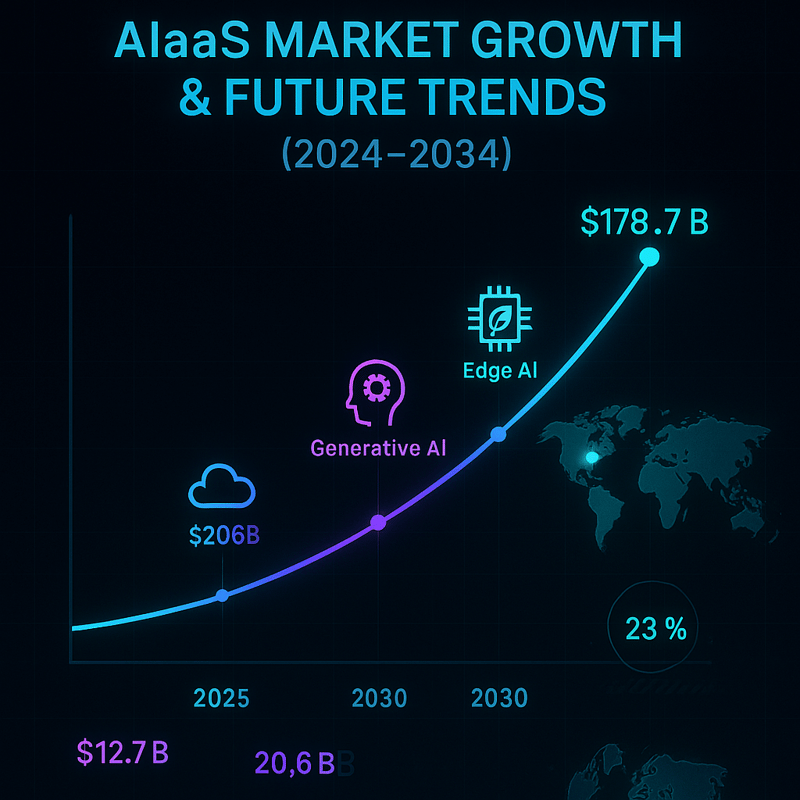
Agentic AI refers to systems that can autonomously plan, learn and adapt, orchestrating multiple models to complete tasks. Expansions like Alibaba’s Qwen ecosystem and Microsoft’s Copilot Studio enable easier agent creation. Clarifai’s workflow builder supports agentic workflows, chaining models across modalities.
Low‑code platforms empower business users to create AI models through drag‑and‑drop interfaces. Combined with small language models (SLMs), these tools allow on‑device AI, making AI accessible to individuals and non‑profit organizations.
Providers are developing vertical stacks tailored to healthcare, finance, legal and manufacturing. These packages include domain‑specific models, compliance frameworks and data pipelines.
Explainable AI (XAI) tools are being built into AIaaS platforms to provide model interpretability, fairness tests and audit logs. Regulatory mandates such as the EU AI Act will accelerate adoption of responsible AI practices.
Edge AI enables models to run on devices like IoT sensors and drones, reducing latency and data transfer costs. AIaaS platforms will integrate seamlessly with 5G networks, delivering AI services closer to users.
TPUs, Trainium and other custom chips are improving compute efficiency and lowering energy consumption. AIaaS providers will increasingly offer hardware choices to balance performance and sustainability.
New models like OpenAI’s O1 and O3 are enabling step‑by‑step reasoning and complex content generation, broadening application possibilities. Generative AI will continue to evolve with diffusion models and multimodal capabilities.
AIaaS is facilitating breakthroughs in materials science, drug discovery and climate modeling. In national security, AI‑powered drones and surveillance systems will become more prevalent.
Global regulations like the EU AI Act, AI Safety Summit guidelines and various national policies will shape the deployment of AI services. Providers will need to ensure compliance across jurisdictions and prioritize data sovereignty.
Start by pinpointing business challenges with clear metrics—for example, reducing customer service response times or predicting equipment failures. Having measurable KPIs helps justify the investment.
Review the quality, completeness and bias in your data. Fill in missing values, standardize formats, and ensure that labels are consistent.
Look at the service catalogs, ease of integration, pricing, compliance, and community support. Clarifai’s interactive console allows you to test models instantly and compare performance.
Select a small but meaningful use case, use a free tier or sandbox environment, and define success criteria. Keep the scope narrow to reduce risk and accelerate learning.
Establish encryption, identity management and data masking to protect sensitive information. Clarifai’s role‑based access controls ensure that only authorized users can access data and models.
Integrate the API into your staging environment, build fallback logic and run stress tests to identify potential bottlenecks. Clarifai’s SDKs support multiple languages, making integration straightforward.
Monitor your pilot’s KPIs, track cost per inference, and refine the model or workflow. Clarifai’s analytics dashboard helps track performance and cost in real time.
Use a canary release strategy, launching the AI solution to a subset of users and monitoring behavior before full deployment. This minimizes disruption if issues arise.
Set up alerts for drift, latency and budget overruns, schedule regular audits, and run fairness tests. Clarifai’s model versioning aids in tracking changes and compliance.
Refine your models, expand to additional use cases, and adopt new AI features as they become available. Continuous learning and adaptation are key to long-term success.
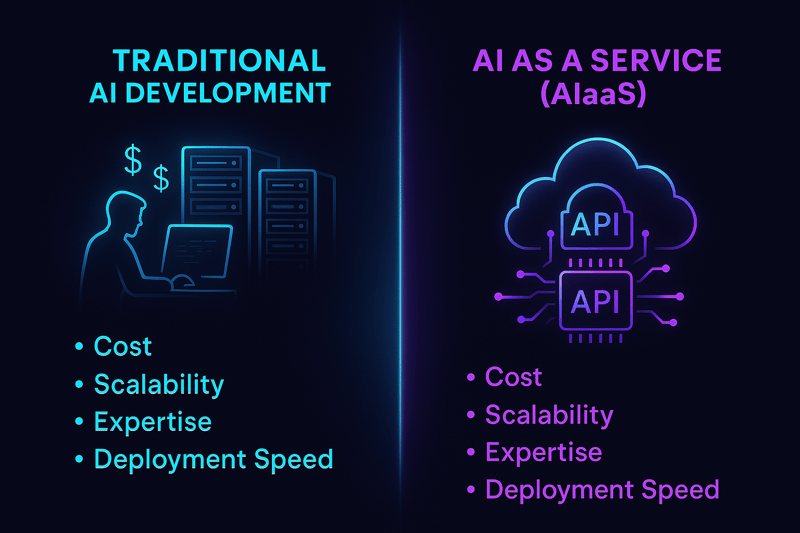
AIaaS allows rapid prototyping with minimal investment and maintenance. It offers scalable cost models, continuous updates, and managed infrastructure—ideal for startups, SMEs or projects with uncertain workloads.
Developing your own models gives you full control, tailored solutions and potentially lower long‑term costs. However, it demands significant CAPEX for hardware, hires and data preparation. Traditional AI also requires ongoing maintenance and specialized talent.
Some organizations adopt a hybrid model: starting with AIaaS for fast experimentation, then migrating models in-house once the business case is validated. Clarifai’s export and on-prem deployment capabilities support this transition.
Regulations like the EU AI Act, U.S. FTC guidelines and industry-specific rules (e.g., HIPAA for healthcare) require transparency, fairness and accountability. Organizations must implement robust data governance, and providers should supply documentation on model training and evaluation.
Users have the right to know how their data is used and to consent to specific purposes. Encrypt data, use anonymization techniques and implement role-based controls. Clarifai supports data masking and local deployment to ensure compliance with data residency laws.
AI services must avoid discriminatory outcomes. Conduct regular bias audits, use fairness metrics and implement interpretability techniques. Many regulations require explanation of automated decisions to end users, making explainable AI tools essential.
Contracts should clearly specify service-level agreements (SLAs), audit rights and data ownership. Choose providers that offer transparency and assume responsibility for data security incidents.
As AI usage grows, so does its carbon footprint. Organizations should choose providers that invest in energy-efficient hardware and renewable energy sources.
AI as a Service is evolving at an unprecedented pace. By 2030, AI services could become the backbone of every digital interaction, enabling personalized experiences and hyper-efficient operations. Agentic AI will create self‑managing workflows, while low‑code tools and small language models will democratize AI creation. Edge AI will embed intelligence everywhere, from sensors to machinery, and vertical stacks will deliver tailored solutions. Regulations will continue to shape responsible AI usage, and sustainability will remain a key consideration.
Clarifai’s comprehensive platform—spanning compute orchestration, model inference, workflow design and local deployment—positions it as a trusted partner for organizations navigating this landscape. By embracing AIaaS thoughtfully, integrating robust governance, and continuously iterating, you can unlock powerful insights and drive innovation.
AIaaS (Artificial Intelligence as a Service) is a cloud-based or on-prem subscription service providing ready‑to‑use AI models and infrastructure via APIs, SDKs and local runners . It allows organizations to integrate AI functions—like vision, language understanding and prediction—without building models from scratch.
Cost depends on usage, model complexity and provider. Pricing typically includes per‑request fees, GPU hours and storage. Clarifai offers a free tier to experiment and scales pricing as you deploy more models.
Security varies by provider. Look for services offering end‑to‑end encryption, role-based access, data masking and audit logs. Clarifai supports local runners for data residency and compliance requirements.
Yes, many providers—including Clarifai—allow model fine‑tuning on your own data. You can also chain models together and adjust hyperparameters to suit your application.
Limitations include vendor lock‑in, limited customization for niche tasks, and ongoing subscription costs. You must also ensure data privacy and handle regulatory compliance.
Sign up for a Clarifai account, explore the model catalog, and use the free tier to test APIs. Follow the implementation roadmap outlined above to deploy your first AI solution successfully.
MAICON brings together top visionaries and experts in the field of AI during a three-day conference packed with actionable sessions and networking events—all to position you as the change agent your organization (and career) needs. In this ongoing speaker series, we’re featuring these extraordinary leaders, with forward-looking predictions, actionable tips you can use today, and a preview of their MAICON 2025 sessions. Continue reading “How to Protect Your Creativity in the Age of AI with Bridget McCormack [MAICON 2025 Speaker Series]”
Artificial intelligence (AI) has reached a point where conversations with machines are no longer novel—systems can translate languages, recommend movies and even generate poetry. Yet beneath these feats lies a fundamental challenge: how do we make machines reason? Reasoning is the ability to draw logical conclusions, connect facts, adapt to new situations and plan steps toward a goal. The tool powering this capacity is known as a reasoning engine, and it is becoming a core pillar of next‑generation AI systems. This article demystifies reasoning engines, exploring their architecture, types, applications and future trajectory while weaving in insights from industry leaders and research.
What is a reasoning engine in AI? A reasoning engine is software that mimics human‑like problem‑solving by applying logical rules and structured knowledge to derive conclusions, make decisions and solve tasks. Unlike simple pattern‑matching, reasoning engines actively interpret context, evaluate hypotheses and choose the best course of action.
Why are reasoning engines important? They offer the missing link between data‑driven machine learning and human‑interpretable decision‑making, improving explainability, consistency and safety. They are essential for domains such as medical diagnosis, regulatory compliance, customer service and agentic AI.
What will you learn in this article? We’ll explore how reasoning engines differ from inference and search engines, break down their components, compare reasoning types, review use cases, examine benefits and limitations, peek at emerging trends and provide a step‑by‑step guide to building a simple reasoning engine. By the end, you’ll have a holistic understanding of the reasoning revolution underway and how Clarifai’s platform can help you ride that wave.
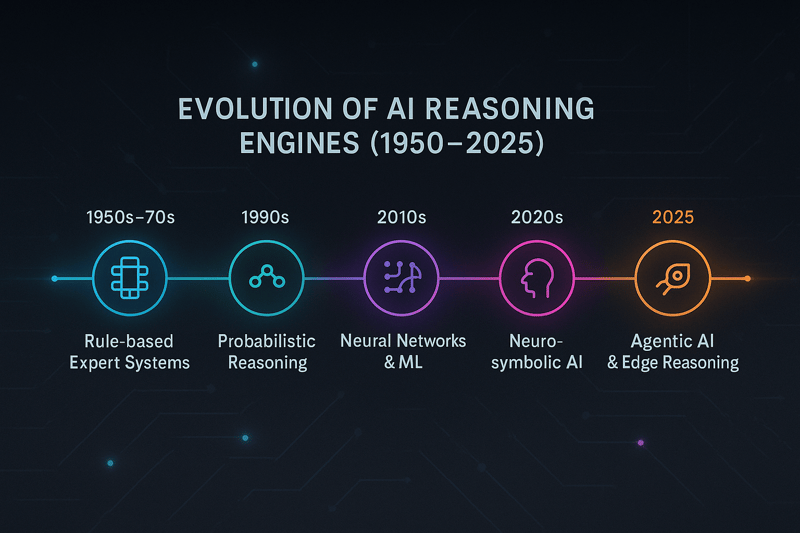
At its core, a reasoning engine applies logical rules and knowledge to input data to derive conclusions. According to early AI research, reasoning engines emerged from expert systems built in the 1950s and 1970s that used rule‑based logic to solve complex tasks. These systems separated the knowledge base (facts and rules about the world) from the inference engine (the mechanism that draws conclusions), forming a template that persists today.
Reasoning engines are sometimes confused with inference engines or search engines:
Imagine an AI doctor tasked with diagnosing a rare illness. A search engine could retrieve articles about symptoms. An inference engine (like a neural network) might classify the illness based on patterns it has seen before. But a reasoning engine goes further: it uses rules such as “if persistent fever AND rash AND lab marker X > threshold THEN consider disease Y”. If it encounters contradictory evidence, it revises its conclusion. This is the essence of reasoning—connecting the dots rather than merely matching patterns.
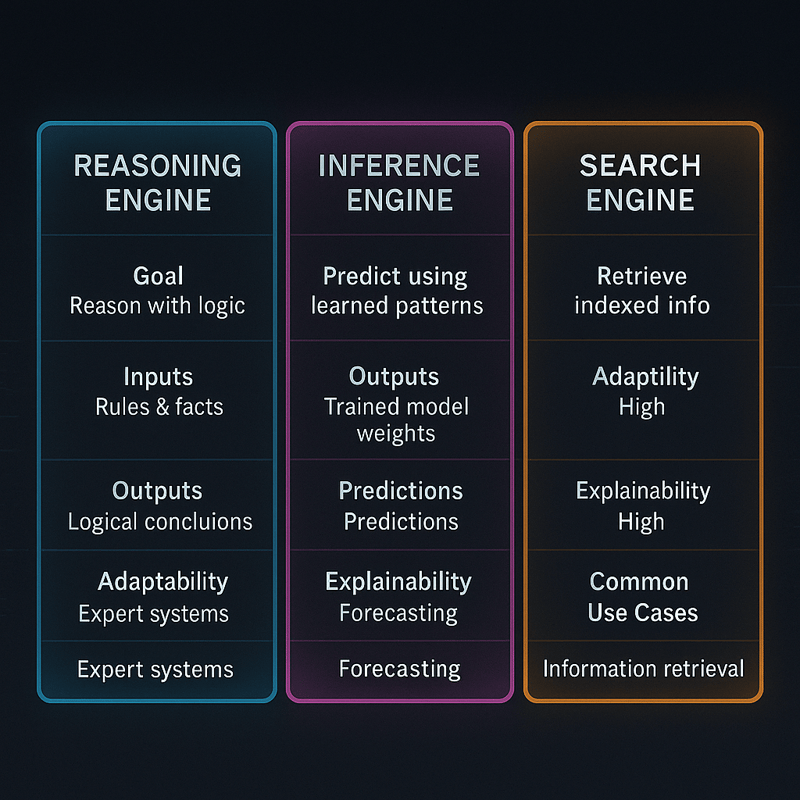
A reasoning engine typically comprises several modular components:
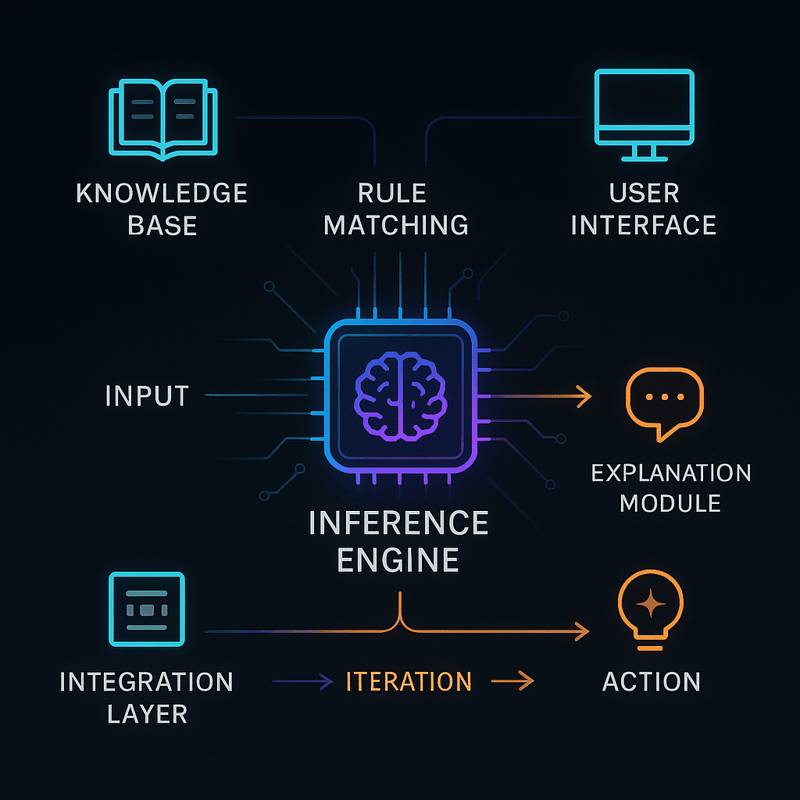
The engine’s operation often follows this loop:
Reasoning isn’t a monolithic concept. AI systems use various forms of reasoning, each suited to different tasks. Understanding these types helps choose the right engine.
Deductive reasoning starts from general principles and applies them to specific cases. If the premises are true, the conclusion is guaranteed. This is the bedrock of traditional logic and rule‑based expert systems.
Example: “All humans are mortal. Socrates is a human. Therefore, Socrates is mortal.” In an AI setting, a medical expert system might deduce that a patient with a particular set of symptoms matches a known disease profile.
Applications: Compliance systems, legal reasoning, formal verification tools.
Inductive reasoning derives general rules from specific observations. It doesn’t guarantee truth but yields probabilistic conclusions.
Example: Observing that the sun has risen in the east every day, we infer it will rise in the east tomorrow. Machine learning models often perform inductive reasoning, extrapolating patterns from training data to make predictions.
Applications: Recommender systems, predictive analytics, anomaly detection.
Abductive reasoning starts from incomplete observations and seeks the most likely explanation. It’s a form of educated guessing.
Example: If a patient has a fever and cough, the engine hypothesizes flu, even though other illnesses could match. In AI, abductive reasoning is crucial for diagnostic tools and fault detection where data is imperfect.
Analogical reasoning compares a new situation to a known one and transfers knowledge.
Example: Learning to pilot a helicopter can inform how to fly a drone because the tasks share similar dynamics. Robots use analogies to transfer skills from one task to another.
Humans constantly use common sense reasoning—assumptions about the world that seem obvious. For AI, encoding common sense is challenging but essential for conversational agents and autonomous vehicles.
Example: Knowing that rain makes the ground wet helps an AI predict that it needs to slow down on slick roads.
Monotonic reasoning means conclusions once drawn never change, even when new information emerges. Formal proofs and math rely on monotonic reasoning. Non‑monotonic reasoning, however, allows the engine to revise conclusions when presented with new evidence.
Example: The belief “all birds fly” is revised when learning about penguins. Adaptive AI systems must handle non‑monotonic reasoning to operate in dynamic environments.
Fuzzy reasoning handles uncertainty by allowing variables to take on degrees of truth between 0 and 1. It’s useful when data is vague or imprecise.
Example: Rather than saying “it’s hot” or “not hot,” fuzzy reasoning assigns a degree (e.g., 0.7 hot). Smart thermostats and climate control systems use fuzzy logic.
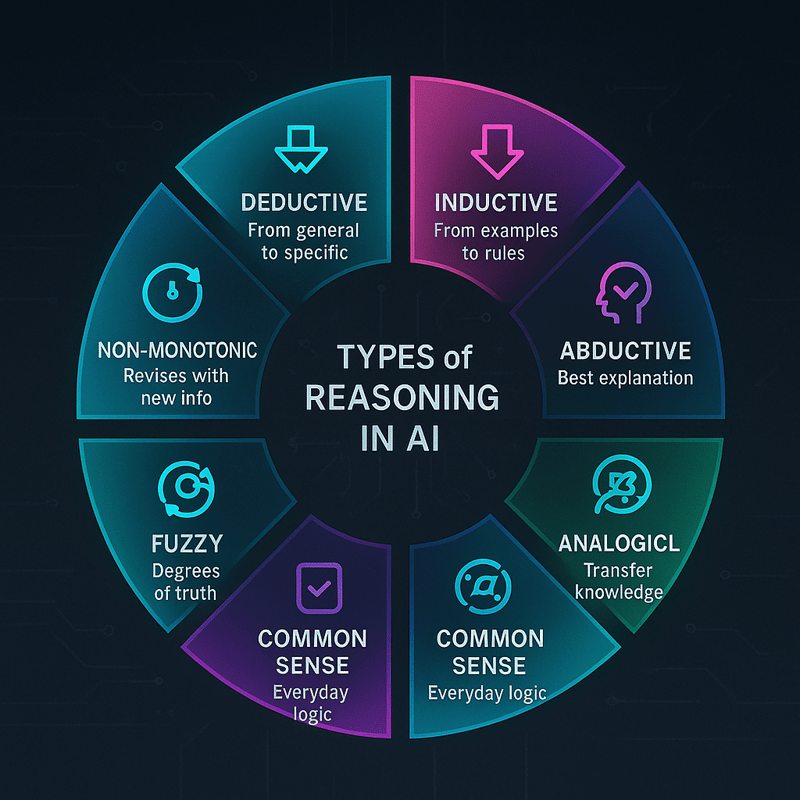
AI practitioners have developed various reasoning engines, each optimized for certain tasks. Choosing the right engine requires understanding their capabilities and trade‑offs.
These engines store knowledge as if–then rules. The inference engine fires rules when conditions match, leading to deterministic conclusions. They excel in domains with well‑defined rules, such as tax calculation, eligibility determination or basic diagnostics.
Strengths: Transparency and explainability; consistent outputs; easy auditing.
Limitations: Hard to scale to complex, ambiguous domains; rule management becomes unwieldy; they lack learning capability.
Instead of rules, case‑based reasoning engines solve new problems by referencing similar past cases. They retrieve the closest match and adapt its solution. This mimics how humans recall previous experiences when facing new issues.
Applications: Customer support (finding similar tickets), legal precedent search, industrial troubleshooting.
These engines rely on ontologies—structured representations of entities and relationships—to perform reasoning. By understanding semantic relationships, they can infer new facts and detect inconsistencies.
Applications: Knowledge graphs, data integration, compliance checking (e.g., verifying that an action complies with policies encoded in an ontology).
Uncertainty is unavoidable in real‑world data. Probabilistic engines use Bayesian networks or probabilistic graphical models to reason about uncertain events and update beliefs as new evidence arrives.
Applications: Fraud detection, medical diagnosis, risk assessment.
Neural engines use deep learning models to learn implicit reasoning patterns. They excel in perception (vision, speech) and can perform reasoning tasks when provided with training examples. Large Language Models (LLMs) are a prominent example—generating chain‑of‑thought explanations and performing step‑wise reasoning.
Strengths: Ability to generalize from data, handle unstructured inputs, adapt to new tasks.
Limitations: Often lack interpretability; may hallucinate incorrect reasoning; require large amounts of data and compute.
These engines solve problems by enforcing constraints (e.g., scheduling, resource allocation). They use optimization algorithms and constraint satisfaction techniques to find feasible solutions.
The latest wave of research aims to combine symbolic reasoning with neural networks. Hybrid engines may use a neural model to extract concepts from text, then feed them into a symbolic reasoner. Neuro‑symbolic AI blends the strengths of both—learning from data while maintaining a logical reasoning layer.
Applications: Common sense reasoning, code generation, multi‑step decision making where both perception and logic are required.
Machine learning models excel at pattern recognition but often struggle with explicit reasoning. Reasoning engines, meanwhile, reason over structured knowledge but may lack adaptability. Combining them yields hybrid AI that can both understand context and make logical leaps.
Neuro‑symbolic approaches do this by letting neural networks extract concepts from raw data and then passing those concepts to symbolic reasoners. This fusion helps address tasks like common sense reasoning and math problem solving, where data‑driven patterns alone fall short.
LLMs like GPT‑4 can generate impressive answers but sometimes produce incorrect reasoning chains. Recent research shows that specialized training strategies, such as paraphrasing questions and designing new objectives, can improve reasoning abilities. Moreover, pairing LLMs with reasoning engines—via retrieval‑augmented generation or rule‑based constraints—reduces hallucinations and increases trust.
Agentic systems are composed of autonomous AI agents that perceive, reason, plan and act on behalf of users. They rely heavily on reasoning engines to interpret goals, orchestrate actions and handle multi‑step tasks. At the 2025 IA Summit, industry leaders predicted an agent‑first world, where humans set intent and agents handle execution.
Consider a smart home assistant. A neural model understands natural language commands (“I’m cold”). A reasoning engine then applies rules (“if user is cold AND temperature < 20°C THEN increase heating”) and checks constraints (“but not if someone is sleeping”). The assistant uses a multi‑agent system—one agent monitors sensors, another reasons, and another executes actions. Combining neural perception with symbolic logic yields reliable, safe decisions.
Reasoning engines are not confined to academic curiosity; they are transforming sectors from customer service to self‑driving cars. Below are high‑impact use cases.
AI assistants equipped with reasoning engines can understand intent, diagnose issues and execute actions. For example, Clarifai’s platform allows developers to compose neural models with rule engines to build chatbots that not only answer queries but also perform tasks like booking meetings or updating tickets. Process reasoning engines in RPA bots interpret goals and automate complex workflows, freeing human agents for more nuanced tasks.
Reasoning engines evaluate logs, detect anomalies and apply policies. In cybersecurity, they correlate seemingly unrelated events to identify threats. Compliance engines use ontologies to ensure actions conform to regulations (e.g., GDPR), providing auditable decision paths. Clarifai’s compute orchestration can route security alerts to models and rule sets for rapid triage.
Medical AI systems use reasoning to interpret symptoms, medical histories and test results. Deductive reasoning applies known disease models, while abductive reasoning suggests the most likely diagnosis with incomplete data. Such systems help clinicians spot rare conditions and recommend personalized treatments.
Reasoning engines power fraud detection, credit risk assessment and personalized recommendations. In retail, they optimize inventory and pricing by reasoning about demand patterns and constraints. Supply chain engines solve complex logistics problems via constraint satisfaction.
Ontological reasoning ensures contracts and policies adhere to regulations. These engines can flag missing clauses, suggest modifications and provide explanations for compliance decisions, reducing legal risk.
Adaptive learning platforms use reasoning engines to personalize content, detect misconceptions and provide step‑by‑step explanations. Case‑based reasoning helps systems suggest remedies based on past student outcomes.
Li Auto’s Halo OS integrates a reasoning engine to optimize vehicle functions and anticipate driver needs. In smart devices, reasoning ensures safe operation (e.g., adjusting heating only if no safety constraints are violated).
Agentic CRMs like Clarify (not to be confused with Clarifai) automatically classify emails, draft responses and reason about deals at scale. Cybersecurity platforms deploy fleets of agents to detect and coordinate responses.
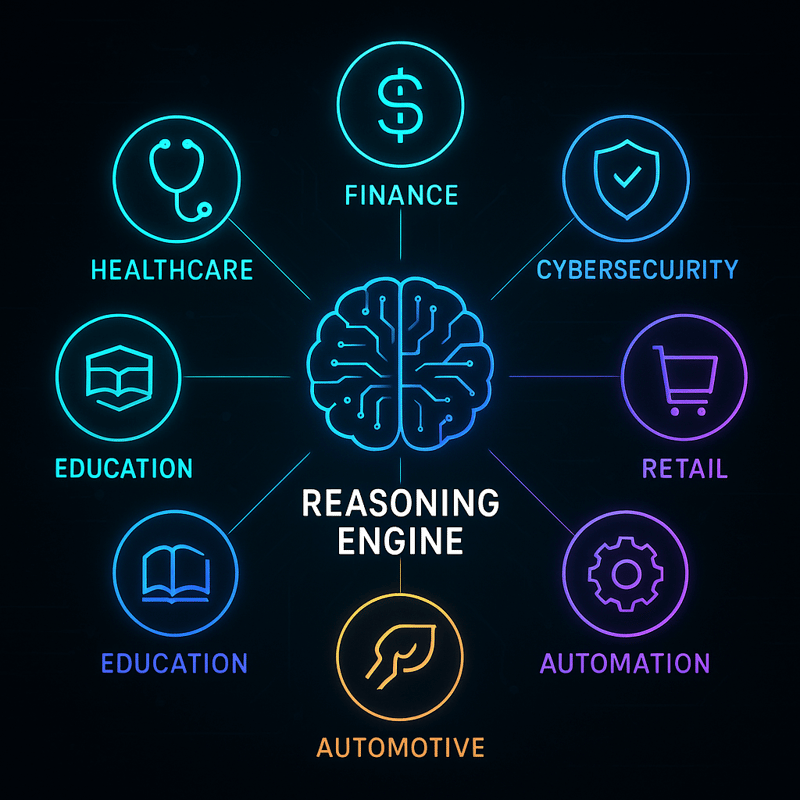
Reasoning engines automate complex decision processes, accelerating tasks that would otherwise require human expertise. They can handle large knowledge bases and quickly traverse rule chains. Clarifai’s reasoning engine demonstrates that software optimizations (CUDA kernels, speculative decoding) can boost inference throughput.
Unlike human judgment, which may vary, engines apply rules consistently, ensuring fairness and regulatory compliance. This consistency is critical in safety‑critical domains like medicine and aviation.
Rule‑based and hybrid engines provide transparent reasoning paths through explanation modules. Users can see which rules fired and why, making it easier to audit and debug decisions.
Reasoning engines can manage multi‑step workflows and nested logic, essential for agentic systems that need to plan and sequence tasks. They also help orchestrate multiple AI models and data sources.
By automating reasoning, organizations cut labor costs and reduce errors. Clarifai’s engine showcases that software‑level optimizations can lower compute costs by 40%. Furthermore, reasoning capabilities enable new products and services, such as autonomous agents, that weren’t feasible before.
Reasoning engines complement human expertise. They handle routine logic, freeing humans to focus on creativity and ethics. Iguazio notes that reasoning engines enhance human‑AI collaboration and drive innovation.
Despite their promise, reasoning engines face several hurdles.
Building and maintaining a high‑quality knowledge base is resource‑intensive. Incomplete or outdated knowledge leads to wrong conclusions. Ontologies must evolve with the domain, and encoding expert knowledge can be tedious.
Reasoning over large knowledge graphs or performing multi‑step logic can be computationally expensive. Forward chaining may explode in complexity if rules are not carefully organized.
Real‑world data often contains ambiguity and missing information. Fuzzy and probabilistic methods mitigate this but add complexity.
Neural reasoning models can achieve high accuracy but often lack transparency. Balancing interpretability and performance remains an open challenge.
Reasoning engines can inadvertently encode bias present in the knowledge base or rules. Large language models may hallucinate incorrect reasoning chains. Robust evaluation and ethical oversight are essential.
Reasoning systems often process sensitive data (health records, financial histories). Ensuring privacy while reasoning over this data requires advanced anonymization and secure computation techniques.
At the 2025 IA Summit, industry leaders declared a “Reasoning Revolution,” noting the diffusion of reasoning engines across enterprises. They envisioned an agent‑first world in which AI agents handle execution, reasoning and coordination, leaving humans to set goals.
Robotic Process Automation (RPA) vendors are embedding process reasoning engines into bots. These systems interpret business goals, plan sequences of actions and adapt to changing conditions. For enterprises, this means bots that can handle complex, unstructured workflows—moving beyond simple rule-based automation.
The explosion of large models has strained computational resources. Clarifai’s new reasoning engine employs CUDA kernels and speculative decoding to make inference twice as fast and 40% cheaper. Such optimizations will be critical as agentic models require multi-step reasoning, magnifying compute demands.
Vehicle manufacturers are integrating reasoning engines into AI‑native operating systems. Li Auto’s Halo OS uses a reasoning engine to optimize vehicle behavior and ensure safety. As more devices run AI locally, edge reasoning—executing logic on local hardware for low latency—will become vital. Clarifai’s local runner capability allows models and logic to run on‑premise or at the edge, preserving privacy and reducing latency.
Researchers are developing neuro‑symbolic AI systems that combine neural perception with symbolic reasoning. These systems aim to imbue models with common sense, causal understanding and the ability to generalize across domains. They will likely be pivotal for building trustworthy AGI.
Panelists at the IA Summit stressed that AI infrastructure remains fluid. They highlighted the physicality of AI—massive energy consumption and hardware investments—and suggested that optimization at the software level (reasoning engines included) can reduce energy requirements. Orchestration, observability and coordination across distributed systems will define the next era of AI infrastructure.
Developing a reasoning engine may sound daunting, but breaking it down into discrete steps demystifies the process. Below is a high‑level guide to creating a simple rule‑based engine. Clarifai’s platform can help by providing compute orchestration, model hosting and local runners to deploy your engine.
|
Feature / Engine |
Reasoning Engine |
Inference Engine |
Search Engine |
Symbolic Reasoning |
Statistical (Neural) Reasoning |
|
Goal |
Derive new knowledge & decisions via rules/logic |
Apply learned patterns to classify or generate outputs |
Retrieve information from indexed data |
Apply explicit logical rules and deductions |
Learn patterns from data to infer outcomes |
|
Inputs |
Structured facts, rules, ontologies |
Trained model weights & input data |
Queries |
Rules, ontologies |
Training data |
|
Outputs |
Conclusions, actions, explanations |
Predictions, text, classifications |
Web pages, documents |
Deterministic conclusions |
Probabilistic predictions |
|
Interpretability |
High (explanation modules) |
Medium–low (depends on model) |
N/A |
High |
Low |
|
Adaptability |
Medium (requires rule updates) |
High (learns from data) |
N/A |
Low |
High |
|
Use Cases |
Diagnostics, compliance, planning, agentic AI |
Image recognition, NLP, translation |
Information retrieval |
Formal verification, legal reasoning |
Perception tasks, generative modeling |
A reasoning engine applies explicit logical rules and knowledge to derive new conclusions and make decisions. An inference engine usually refers to applying learned patterns from a trained model to new data, such as classifying images or generating text. Reasoning engines emphasise interpretability and logic, while inference engines emphasise learning and prediction.
Engines use probabilistic reasoning (Bayesian networks) or fuzzy logic to handle uncertainty and partial truths. These techniques assign probabilities or degrees of truth to outcomes. Hybrid systems may incorporate confidence scores from neural models as inputs to symbolic reasoning.
The computational cost depends on the engine’s complexity. Large knowledge bases and deep rule chains can be resource‑intensive. However, optimizations such as CUDA kernels and speculative decoding can dramatically improve throughput. Clarifai’s platform provides compute orchestration to optimize performance and reduce costs.
Clarifai’s engine combines efficient compute orchestration with reasoning logic. It is designed to be adaptable across models and cloud providers, making inference twice as fast and 40% less costly through software optimizations. It also integrates seamlessly with LLMs and other models via Clarifai’s API.
Yes. Clarifai’s local runner allows models and reasoning logic to run on‑premise or at the edge, preserving data privacy and reducing latency. This is especially useful for applications like automotive or smart devices where real‑time decisions are critical.
Because they offer explainable decision paths through explanation modules, reasoning engines help organizations demonstrate compliance with regulations and quickly audit decisions. They can encode compliance rules into the knowledge base to ensure that actions adhere to legal requirements.
Reasoning engines are the next frontier in AI, providing the logical backbone that bridges data‑driven models and human decision‑making. From expert systems of the 1970s to neuro‑symbolic hybrids and agentic AI, reasoning capabilities have evolved to address increasingly complex tasks. Modern engines combine deductive logic, probabilistic models and neural networks, enabling applications in healthcare, finance, compliance, automation and beyond.
As AI agents become more autonomous, reasoning engines will orchestrate multi‑step workflows, enforce constraints and explain outcomes. Advances in compute optimization—like those pioneered by Clarifai—reduce the cost of reasoning and make it practical at scale. Meanwhile, emerging trends such as process reasoning engines, AI‑native operating systems and neuro‑symbolic AI point toward a future where reasoning is embedded in every layer of technology.
For organizations building the next generation of intelligent applications, now is the time to invest in reasoning. Whether you’re automating customer support, detecting fraud or developing autonomous vehicles, Clarifai’s platform offers the tools to integrate reasoning, orchestrate models and scale across infrastructure. The reasoning revolution has arrived—and it’s time to put logic back into AI.
MAICON brings together top visionaries and experts in the field of AI during a three-day conference packed with actionable sessions and networking events—all to position you as the change agent your organization (and career) needs. In this ongoing speaker series, we’re featuring these extraordinary leaders, with forward-looking predictions, actionable tips you can use today, and a preview of their MAICON 2025 sessions. Continue reading “How to Launch & Lead AI Initiatives with Maila Ruggiero [MAICON 2025 Speaker Series]”
In this post, we explore how leading inference providers perform on the GPT-OSS-120B model using benchmarks from Artificial Analysis. You will learn what matters most when evaluating inference platforms including throughput, time to first token, and cost efficiency. We compare Vertex AI, Azure, AWS, Databricks, Clarifai, Together AI, Fireworks, Nebius, CompactifAI, and Hyperbolic on their performance and deployment efficiency.
Large language models (LLMs) like GPT-OSS-120B, an open-weight 120-billion-parameter mixture-of-experts model, are designed for advanced reasoning and multi-step generation. Reasoning workloads consume tokens rapidly and place high demands on compute, so deploying these models in production requires inference infrastructure that delivers low latency, high throughput, and lower cost.
Differences in hardware, software optimizations, and resource allocation strategies can lead to large variations in latency, efficiency, and cost. These differences directly affect real-world applications such as reasoning agents, document understanding systems, or copilots, where even small delays can impact overall responsiveness and throughput.
To evaluate these differences objectively, independent benchmarks have become essential. Instead of relying on internal performance claims, open and data-driven evaluations now offer a more transparent way to assess how different platforms perform under real workloads.
In this post, we compare leading GPU-based inference providers using the GPT-OSS-120B model as a reference benchmark. We examine how each platform performs across key inference metrics such as throughput, time to first token, and cost efficiency, and how these trade-offs impact performance and scalability for reasoning-heavy workloads.
Before diving into the results, let’s take a quick look at Artificial Analysis and how their benchmarking framework works.
Artificial Analysis (AA) is an independent benchmarking initiative that runs standardized tests across inference providers to measure how models like GPT-OSS-120B perform in real conditions. Their evaluations focus on realistic workloads involving long contexts, streaming outputs, and reasoning-heavy prompts rather than short, synthetic samples.
You can explore the full GPT-OSS-120B benchmark results here.
Artificial Analysis evaluates a range of performance metrics, but here we focus on the three key factors that matter when choosing an inference platform for GPT-OSS-120B: time to first token, throughput, and cost per million tokens.
With this methodology in mind, we can now compare how different GPU-based platforms perform on GPT‑OSS‑120B and what these results imply for reasoning-heavy workloads.
Time to First Token: 0.32 s
Throughput: 544 tokens/s
Blended Cost: $0.16 per 1M tokens
Notes: Extremely high throughput; low latency; cost-efficient; strong choice for reasoning-heavy workloads.
Key Features:
Time to First Token: 0.40 s
Throughput: 392 tokens/s
Blended Cost: $0.26 per 1M tokens
Notes: Moderate latency and throughput; suitable for general-purpose reasoning workloads.
Key Features:
Integrated AI tools (AutoML, training, deployment, monitoring)
Scalable cloud infrastructure for batch and online inference
Enterprise-grade security and compliance
Time to First Token: 0.48 s
Throughput: 348 tokens/s
Blended Cost: $0.26 per 1M tokens
Notes: Slightly higher latency; balanced performance and cost for standard workloads.
Key Features:
Comprehensive AI services (ML, cognitive services, custom bots)
Deep integration with Microsoft ecosystem
Global enterprise-grade infrastructure
Time to First Token: 0.52 s
Throughput: 395 tokens/s
Blended Cost: $0.30 per 1M tokens
Notes: Higher cost than peers; good throughput for reasoning-heavy tasks.
Key Features:
Time to First Token: 0.64 s
Throughput: 252 tokens/s
Blended Cost: $0.26 per 1M tokens
Notes: Lower throughput and higher latency; suitable for less time-sensitive workloads.
Key Features:
Broad AI/ML service portfolio (Bedrock, SageMaker)
Global cloud infrastructure
Enterprise-grade security and compliance
Time to First Token: 0.36 s
Throughput: 195 tokens/s
Blended Cost: $0.26 per 1M tokens
Notes: Lower throughput; acceptable latency; better for batch or background tasks.
Key Features:
Unified analytics platform (Spark + ML + notebooks)
Collaborative workspace for teams
Scalable compute for large ML/AI workloads
Time to First Token: 0.25 s
Throughput: 248 tokens/s
Blended Cost: $0.26 per 1M tokens
Notes: Very low latency; moderate throughput; good for real-time reasoning-heavy applications.
Key Features:
Real-time inference and training
Cloud/VPC-based deployment orchestration
Flexible and secure platform
Time to First Token: 0.44 s
Throughput: 482 tokens/s
Blended Cost: $0.26 per 1M tokens
Notes: High throughput and balanced latency; suitable for interactive applications.
Key Features:
Time to First Token: 0.29 s
Throughput: 186 tokens/s
Blended Cost: $0.10 per 1M tokens
Notes: Low cost; lower throughput; best for cost-sensitive workloads with smaller concurrency needs.
Key Features:
Efficient, compressed models for cost savings
Simplified deployment on AWS
Optimized for high-throughput batch inference
Time to First Token: 0.66 s
Throughput: 165 tokens/s
Blended Cost: $0.26 per 1M tokens
Notes: Significantly lower throughput and higher latency; may struggle with reasoning-heavy or interactive workloads.
Key Features:
Basic AI service endpoints
Standard cloud infrastructure
Suitable for steady-demand workloads
Selecting the right inference provider for GPT‑OSS‑120B requires evaluating time to first token, throughput, and cost based on your workload. Platforms like Clarifai offer high throughput, low latency, and competitive cost, making them well-suited for reasoning-heavy or interactive tasks. Other providers, such as CompactifAI, prioritize lower cost but come with reduced throughput, which may be more suitable for cost-sensitive or batch-oriented workloads. The optimal choice depends on which trade-offs matter most for your applications.
Clarifai: Highest throughput at 544 tokens/s with low first-chunk latency.
Fireworks AI: Strong throughput at 482 tokens/s and moderate latency.
Hyperbolic: Good throughput at 395 tokens/s; higher cost but viable for heavy workloads.
Along with price and throughput, flexibility is critical for real-world workloads. Teams often need control over scaling behavior, GPU utilization, and deployment environments to manage cost and efficiency.
Clarifai, for example, supports fractional GPU utilization, autoscaling, and local runners — features that can improve efficiency and reduce infrastructure overhead.
These capabilities extend beyond GPT‑OSS‑120B. With the Clarifai Reasoning Engine, custom or open-weight reasoning models can run with consistent performance and reliability. The engine also adapts to workload patterns over time, gradually improving speed for repetitive tasks without sacrificing accuracy.
So far, we’ve compared providers based on throughput, latency, and cost using the Artificial Analysis Benchmark. To see how these trade-offs play out in practice, here’s a visual summary of the results across the different providers. These charts are directly from Artificial Analysis.
The first chart highlights output speed vs price, while the second chart compares latency vs output speed.
%20.png?width=1000&height=524&name=Output%20Speed%20vs%20Price%20(8%20Oct%2025)%20.png)
Output Speed vs. Price
%20.png?width=1000&height=547&name=Latency%20vs%20Output%20Speed%20(8%20Oct%2025)%20.png)
Latency vs. Output Speed
Below is a detailed comparison table summarizing the key metrics for GPT-OSS-120B inference across providers.
| Provider | Throughput (tokens/s) | Time to First Token (s) | Blended Cost ($ / 1M tokens) |
|---|---|---|---|
| Clarifai | 544 | 0.32 | 0.16 |
| Google Vertex AI | 392 | 0.40 | 0.26 |
| Microsoft Azure | 348 | 0.48 | 0.26 |
| Hyperbolic | 395 | 0.52 | 0.30 |
| AWS | 252 | 0.64 | 0.26 |
| Databricks | 195 | 0.36 | 0.26 |
| Together AI | 248 | 0.25 | 0.26 |
| Fireworks AI | 482 | 0.44 | 0.26 |
| CompactifAI | 186 | 0.29 | 0.10 |
| Nebius Base | 165 | 0.66 | 0.26 |
Choosing an inference provider for GPT‑OSS‑120B involves balancing throughput, latency, and cost. Each provider handles these trade-offs differently, and the best choice depends on the specific workload and performance requirements.
Providers with high throughput excel at reasoning-heavy or interactive tasks, while those with lower median throughput may be more suitable for batch or background processing where speed is less critical. Latency also plays a key role: low time-to-first-token improves responsiveness for real-time applications, whereas slightly higher latency may be acceptable for less time-sensitive tasks.
Cost considerations remain important. Some providers offer strong performance at low blended costs, while others trade efficiency for price. Benchmarks covering throughput, time to first token, and blended cost provide a clear basis for understanding these trade-offs.
Ultimately, the right provider depends on the engineering problem, workload characteristics, and which trade-offs matter most for the application.
The Fastest AI Inference and Reasoning on GPUs.
Verified by Artificial Analysis
MAICON brings together top visionaries and experts in the field of AI during a three-day conference packed with actionable sessions and networking events—all to position you as the change agent your organization (and career) needs. In this ongoing speaker series, we’re featuring these extraordinary leaders, with forward-looking predictions, actionable tips you can use today, and a preview of their MAICON 2025 sessions. Continue reading “How to Prepare Knowledge Workers for an AI-Powered Future with Paul Roetzer [MAICON 2025 Speaker Series]”
Building and scaling open‑source reasoning models like GPT‑OSS isn’t just about having access to powerful code—it’s about making strategic hardware choices, optimizing software stacks, and balancing cost against performance. In this comprehensive guide, we explore everything you need to know about choosing the best GPU for GPT‑OSS deployments in 2025, focusing on both 20 B‑ and 120 B‑parameter models. We’ll pull in real benchmark data, insights from industry leaders, and practical guidance to help developers, researchers, and IT decision‑makers stay ahead of the curve. Plus, we’ll show how Clarifai’s Reasoning Engine pushes standard GPUs far beyond their typical capabilities—transforming ordinary hardware into an efficient platform for advanced AI inference.
Before we dive into the deep end, here’s a concise overview to set the stage for the rest of the article. Use this section to quickly match your use case with the right hardware and software strategy.
|
Question |
Answer |
|
Which GPUs are top performers for GPT‑OSS‑120B? |
NVIDIA B200 currently leads, offering 15× faster inference than the previous generation, but the H200 delivers strong memory performance at a lower cost. The H100 remains a cost‑effective workhorse for models ≤70 B parameters, while AMD’s MI300X provides competitive scaling and availability. |
|
Can I run GPT‑OSS‑20B on a consumer GPU? |
Yes. The 20 B version runs on 16 GB consumer GPUs like RTX 4090/5090 thanks to 4‑bit quantization. However, throughput is lower than data‑centre GPUs. |
|
What makes Clarifai’s Reasoning Engine special? |
It combines custom CUDA kernels, speculative decoding, and adaptive routing to achieve 500+ tokens/s throughput and 0.3 s time‑to‑first‑token—dramatically reducing both cost and latency. |
|
How do new techniques like FP4/NVFP4 change the game? |
FP4 precision can deliver 3× throughput over FP8 while reducing energy per token from around 10 J to 0.4 J. This allows for more efficient inference and faster response times. |
|
What should small labs or prosumers consider? |
Look at high‑end consumer GPUs (RTX 4090/5090) for GPT‑OSS‑20B. Combine Clarifai’s Local Runner with a multi‑GPU setup if you expect higher concurrency or plan to scale up later. |
GPT‑OSS includes two open‑source models—20 B and 120 B parameters—that use a mixture‑of‑experts (MoE) architecture. Only ~5.1 B parameters are active per token, which makes inference feasible on high‑end consumer or data‑centre GPUs. The 20 B model runs on 16 GB VRAM, while the 120 B version requires ≥80 GB VRAM and benefits from multi‑GPU setups. Both models use MXFP4 quantization to shrink their memory footprint and run efficiently on available hardware.
GPT‑OSS is part of a new wave of open‑weight reasoning models. The 120 B model uses 128 experts in its Mixture‑of‑Experts design. However, only a few experts activate per token, meaning much of the model remains dormant on each pass. This design is what enables a 120 B‑parameter model to fit on a single 80 GB GPU without sacrificing reasoning ability. The 20 B version uses a smaller expert pool and fits comfortably on high‑end consumer GPUs, making it an attractive choice for smaller organizations or hobbyists.
The main constraint is VRAM. While the GPT‑OSS‑20B model runs on GPUs with 16 GB VRAM, the 120 B version requires ≥80 GB. If you want higher throughput or concurrency, consider multi‑GPU setups. For example, using 4–8 GPUs provides higher tokens‑per‑second rates compared to a single card. Clarifai’s services can manage such setups automatically via Compute Orchestration, making it easy to deploy your model across available GPUs.
GPT‑OSS leverages MXFP4 quantization, a 4‑bit precision technique, reducing the memory footprint while preserving performance. Quantization is central to running large models on consumer hardware. It not only shrinks memory requirements but also speeds up inference by packing more computation into fewer bits.
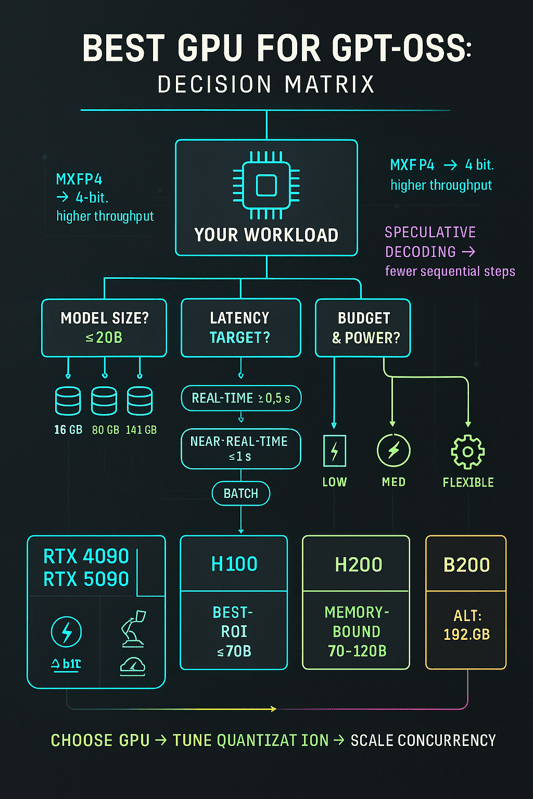
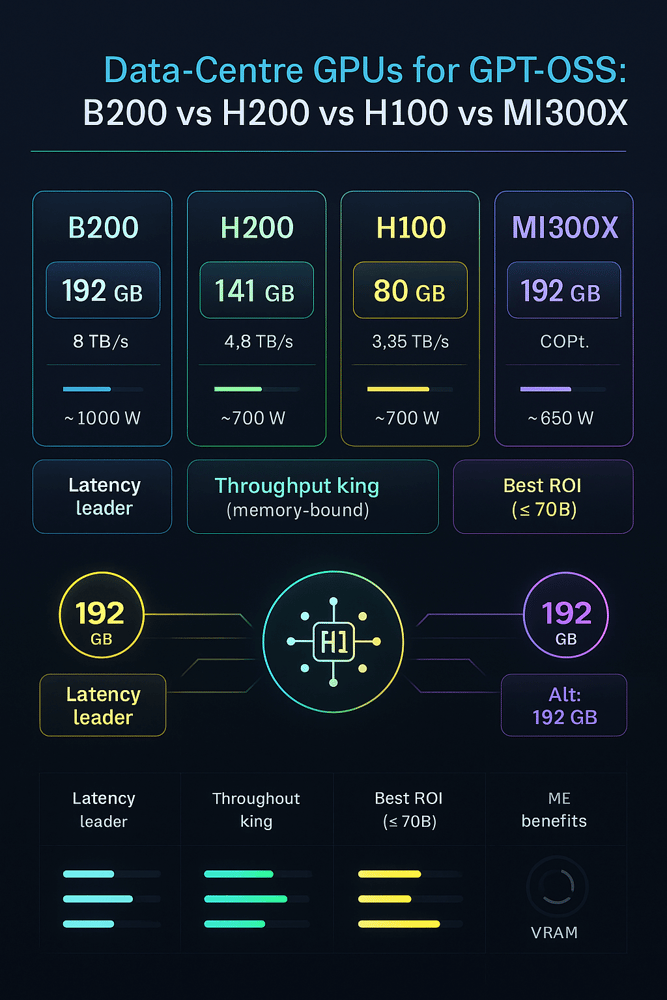
Question: What are the strengths and weaknesses of the main data-centre GPUs available for GPT‑OSS?
Answer: NVIDIA’s B200 is the performance leader with 192 GB memory, 8 TB/s bandwidth, and dual-chip architecture. It provides 15× faster inference over the H100 and uses FP4 precision to drastically lower energy per token. H200 bridges the gap with 141 GB memory and ~2× the inference throughput of H100, making it a great choice for memory-bound tasks. H100 remains a cost‑effective option for models ≤70 B, while AMD’s MI300X offers 192 GB memory and competitive scaling but has slightly higher latency.
The NVIDIA B200 introduces a dual‑chip design with 192 GB HBM3e memory and 8 TB/s bandwidth. In real-world benchmarks, a single B200 can replace two H100s for many workloads. When using FP4 precision, its energy consumption drops dramatically, and the improved tensor cores boost inference throughput up to 15× over the previous generation. The one drawback? Power consumption. At around 1 kW, the B200 requires robust cooling and higher energy budgets.
With 141 GB HBM3e and 4.8 TB/s bandwidth, the H200 sits between B200 and H100. Its advantage is memory capacity: more VRAM allows for larger batch sizes and longer context lengths, which can be essential for memory-bound tasks like retrieval-augmented generation (RAG). However, it still draws around 700 W and doesn’t match the B200 in raw throughput.
Although it launched in 2022, the H100 remains a popular choice due to its 80 GB of HBM3 memory and cost-effectiveness. It’s well-suited for GPT‑OSS‑20B or other models up to about 70 B parameters, and it’s cheaper than newer alternatives. Many organizations already own H100s, making them a practical choice for incremental upgrades.
AMD’s MI300X offers 192 GB memory and competitive compute performance. Benchmarks show it achieves ~74 % of H200 throughput but suffers from slightly higher latency. However, its energy efficiency is strong, and the cost per GPU can be lower. Software support is improving, making it a credible alternative for certain workloads.
|
GPU |
VRAM |
Bandwidth |
Power |
Pros |
Cons |
|
B200 |
192 GB HBM3e |
8 TB/s |
≈1 kW |
Highest throughput, FP4 support |
Expensive, high power draw |
|
H200 |
141 GB HBM3e |
4.8 TB/s |
~700 W |
Excellent memory, good throughput |
Lower max inference than B200 |
|
H100 |
80 GB HBM3 |
3.35 TB/s |
~700 W |
Cost-effective, widely available |
Limited memory |
|
MI300X |
192 GB |
n/a (comparable) |
~650 W |
Competitive scaling, lower cost |
Slightly higher latency |
Question: What new technologies are changing GPU performance and efficiency for AI?
Answer: The most significant trends are FP4 precision, which offers 3× throughput and 25–50× energy efficiency compared to FP8, and speculative decoding, a generation technique that uses a small draft model to propose multiple tokens for the larger model to verify. Upcoming GPU architectures (B300, GB300) promise even more memory and possibly 3‑bit precision. Software frameworks like TensorRT‑LLM and vLLM already support these innovations.
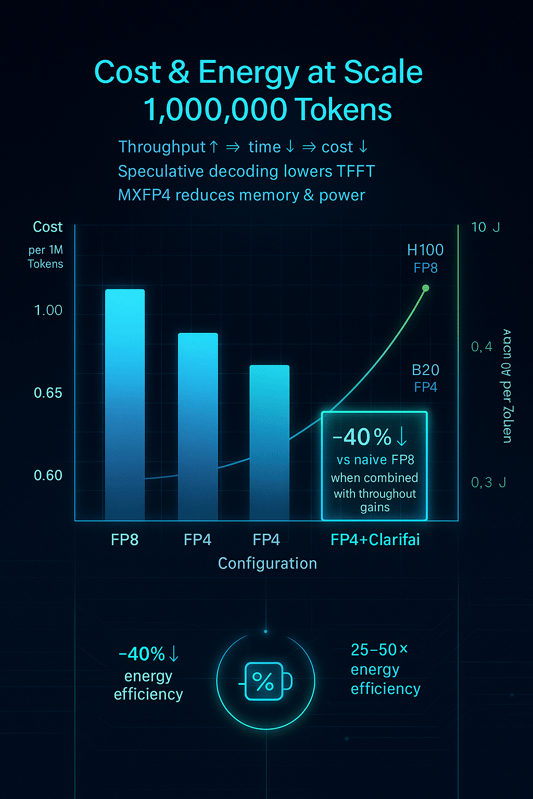
FP4/NVFP4 is a game changer. By reducing numbers to 4 bits, you shrink the memory footprint dramatically and speed up calculation. On a B200, switching from FP8 to FP4 triples throughput and reduces the energy required per token from 10 J to about 0.4 J. This unlocks high‑performance inference without drastically increasing power consumption. FP4 also allows more tokens to be processed concurrently, reducing latency for interactive applications.
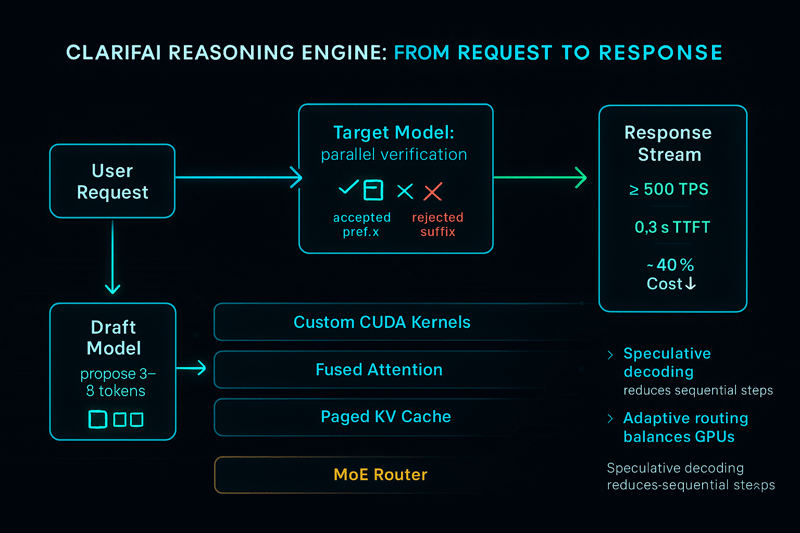
Traditional transformers predict tokens sequentially, but speculative decoding changes that by letting a smaller model guess multiple future tokens at once. The main model then validates these guesses in a single pass. This parallelism reduces the number of steps needed to generate a response, boosting throughput. Clarifai’s Reasoning Engine and other cutting-edge inference libraries use speculative decoding to achieve speeds that outpace older models without requiring new hardware.
Rumors and early technical signals point to B300 and GB300, which could increase memory beyond 192 GB and push FP4 to FP3. Meanwhile, AMD is readying MI350 and MI400 series GPUs with similar goals. Both companies aim to improve memory capacity, energy efficiency, and developer tools for MoE models. Keep an eye on these releases as they will set new performance baselines for AI inference.
Question: Is it possible to run GPT‑OSS on consumer GPUs, and what are the trade‑offs?
Answer: Yes. The GPT‑OSS‑20B model runs on high‑end consumer GPUs (RTX 4090/5090) with ≥16 GB VRAM thanks to MXFP4 quantization. Running GPT‑OSS‑120B requires ≥80 GB VRAM—either a single data‑centre GPU (H100) or multiple GPUs (4–8) for higher throughput. The trade‑offs include slower throughput, higher latency, and limited concurrency compared to data‑centre GPUs.
If you’re a researcher or start‑up on a tight budget, consumer GPUs can get you started. The RTX 4090/5090, for example, provides enough VRAM to handle GPT‑OSS‑20B. When running these models:
To improve throughput and concurrency, you can connect multiple GPUs. A 4‑GPU rig can offer significant improvements, though the benefits diminish after 4 GPUs due to communication overhead. Expert parallelism is a great approach for MoE models: assign experts to separate GPUs, so memory doesn’t duplicate. Tensor parallelism can also help but may require more complex setup.
Modern laptops with 24 GB VRAM (e.g., RTX 4090 laptops) can run the GPT‑OSS‑20B model for small workloads. Combined with Clarifai’s Local Runner, you can develop and test models locally before migrating to the cloud. For edge deployment, look at NVIDIA’s Jetson series or AMD’s small-form GPUs—they support quantized models and enable offline inference for privacy-sensitive use cases.
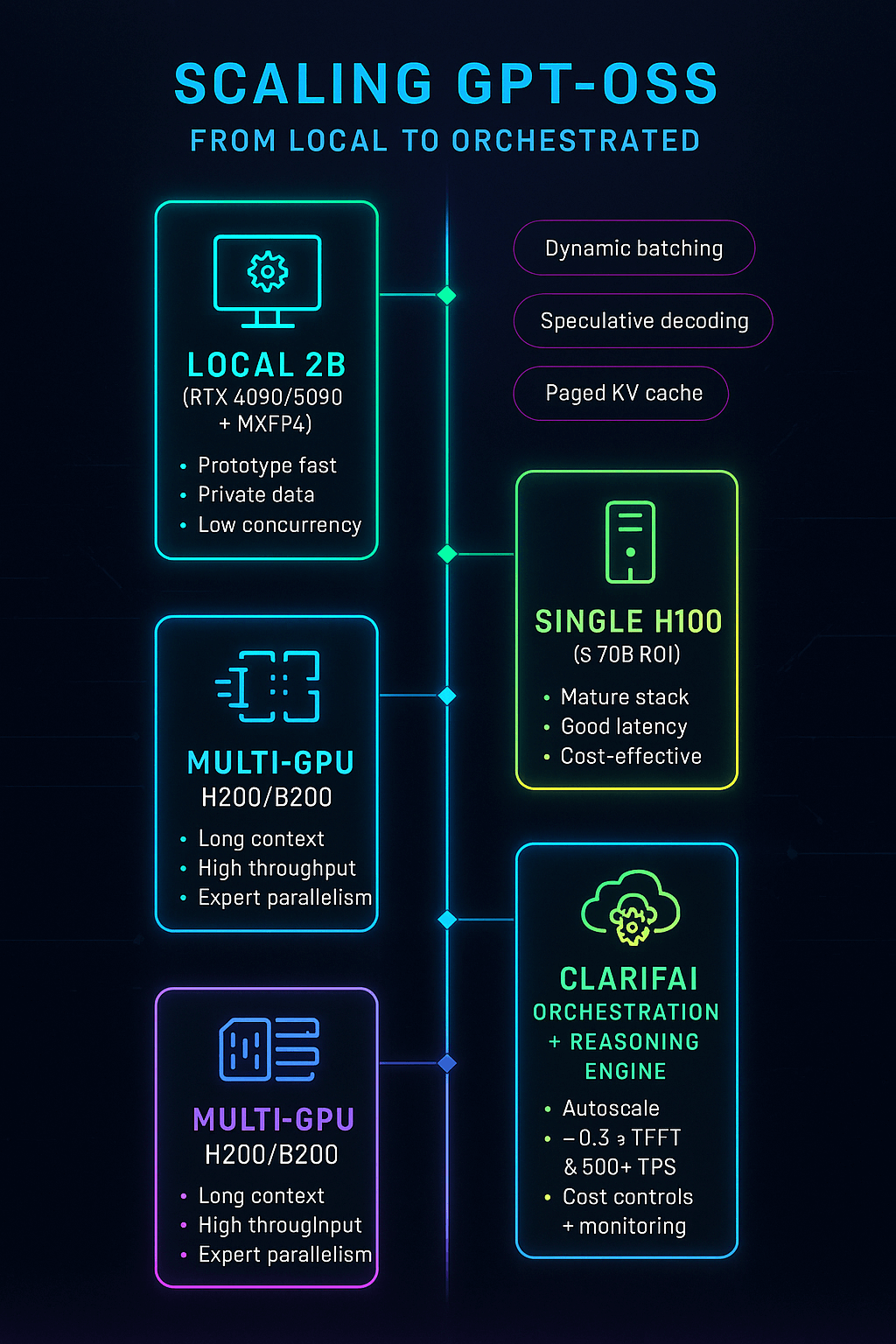
Question: What are the best ways to scale GPT‑OSS across multiple GPUs and maximize concurrency?
Answer: Use tensor parallelism, expert parallelism, and pipeline parallelism to distribute workloads across GPUs. A single B200 can deliver around 7,236 tokens/sec at high concurrency, but scaling beyond 4 GPUs yields diminishing returns Combining optimized software (vLLM, TensorRT‑LLM) with Clarifai’s Compute Orchestration ensures efficient load balancing.
Clarifai’s benchmarks show that at high concurrency, a single B200 rivals or surpasses dual H100 setups AIMultiple found that H200 has the highest throughput overall, with B200 achieving the lowest latency. However, adding more than 4 GPUs often yields diminishing returns as communication overhead becomes a bottleneck.
Question: How do you balance performance against budget and sustainability when running GPT‑OSS?
Answer: Balance hardware acquisition cost, hourly rental rates, and energy consumption. B200 units offer top performance but draw ≈1 kW of power and carry a steep price tag. H100 provides the best cost‑performance ratio for many workloads, while Clarifai’s Reasoning Engine cuts inference costs by roughly 40 %. FP4 precision significantly reduces energy per token—down to ~0.4 J on B200 compared to 10 J on H100.
One way to compare GPU options is to look at cost per million tokens processed. Clarifai’s service, for example, costs roughly $0.16 per million tokens, making it one of the most affordable options. If you run your own hardware, calculate this metric by dividing your total GPU costs (hardware, energy, maintenance) by the number of tokens processed within your timeframe.
AI models can be resource-intensive. If you run models 24/7, energy consumption becomes a major factor. FP4 helps by cutting energy per token, but you should also look at:
Question: Why is Clarifai’s Reasoning Engine important and how do its benchmarks compare?
Answer: Clarifai’s Reasoning Engine is a software layer that optimizes GPT‑OSS inference. Using custom CUDA kernels, speculative decoding, and adaptive routing, it has achieved 500+ tokens per second and 0.3 s time‑to‑first‑token, while cutting costs by 40 %. Independent evaluations from Artificial Analysis confirm these results, ranking Clarifai among the most cost‑efficient providers of GPT‑OSS inference
At its core, Clarifai’s Reasoning Engine is about maximizing GPU efficiency. By rewriting low‑level CUDA code, Clarifai ensures the GPU spends less time waiting and more time computing. The engine’s biggest innovations include:
Clarifai’s benchmarks show the Reasoning Engine delivering ≥500 tokens per second and 0.3 s time‑to‑first‑token. That means large queries and responses feel snappy, even in high‑traffic environments. Artificial Analysis, an independent benchmarking group, validated these results and rated Clarifai’s service as one of the most cost‑efficient options available, thanks in large part to this optimization layer
Running large AI models is expensive. Without optimized software, you often need more GPUs or faster (and costlier) hardware to achieve the same output. Clarifai’s Reasoning Engine ensures that you get more performance out of each GPU, thereby reducing the total number of GPUs required. It also future‑proofs your deployment: when new GPU architectures (like B300 or MI350) arrive, the engine will automatically take advantage of them without requiring you to rewrite your application.
For teams looking to deploy GPT‑OSS quickly and cost‑effectively, Clarifai’s Compute Orchestration provides a seamless on‑ramp. You can scale from a single GPU to dozens with minimal configuration, and the Reasoning Engine automatically optimizes concurrency and memory usage. It also integrates with Clarifai’s Model Hub, so you can try out different models (e.g., GPT‑OSS, Llama, DeepSeek) with a few clicks.
Question: How are other organizations deploying GPT‑OSS models effectively?
Answer: Companies and research labs leverage different GPU setups based on their needs. Clarifai runs its public API on GPT‑OSS‑120B, Baseten uses multi‑GPU clusters to maximize throughput, and NVIDIA demonstrates extreme performance with DeepSeek‑R1 (671 B parameters) on eight B200s. Smaller labs deploy GPT‑OSS‑20B locally on high‑end consumer GPUs for privacy and cost reasons.
Clarifai offers the GPT‑OSS‑120B model via its reasoning engine to handle public requests. The service powers chatbots, summarization tools, and RAG applications. Because of the engine’s speed, users see responses almost instantly, and developers pay lower per-token costs.
Baseten runs GPT‑OSS‑120B on eight GPUs using a combination of TensorRT‑LLM and speculative decoding. This setup scales out the work of evaluating experts across multiple cards, achieving high throughput and concurrency—suitable for enterprise customers with heavy workloads.
NVIDIA showcased DeepSeek‑R1, a 671 B‑parameter model, running on a single DGX with eight B200s. Achieving 30,000 tokens/sec and more than 250 tokens/sec per user, this demonstration shows how GPU innovations like FP4 and advanced parallelism enable truly massive models.
Question: How should you plan your AI infrastructure for the future, and what new technologies might redefine the field?
Answer: Choose a GPU based on model size, latency requirements, and budget. B200 leads for performance, H200 offers memory efficiency, and H100 remains a cost-effective backbone. Watch for the next generation (B300/GB300, MI350/MI400) and new precision formats like FP3. Keep an eye on software advances like speculative decoding and quantization, which could reduce reliance on expensive hardware.
To help you choose the right GPU, follow this step-by-step decision path:
Selecting the best GPU for GPT‑OSS is about balancing performance, cost, power consumption, and future‑proofing. As of 2025, NVIDIA’s B200 sits at the top for raw performance, H200 delivers a strong balance of memory and efficiency, and H100 remains a cost-effective staple. AMD’s MI300X provides competitive scaling and may become more attractive as its ecosystem matures.
With innovations like FP4/NVFP4 precision, speculative decoding, and Clarifai’s Reasoning Engine, AI practitioners have unprecedented tools to optimize performance without escalating costs. By carefully weighing your model size, latency needs, and budget—and by leveraging smart software solutions—you can deliver fast, cost-efficient reasoning applications while positioning yourself for the next wave of AI hardware advancements.


![How to Protect Your Creativity in the Age of AI with Bridget McCormack [MAICON 2025 Speaker Series]](https://www.fazb.com.sa/wp-content/uploads/2025/10/How-to-Protect-Your-Creativity-in-the-Age-of-AI.png)

![How to Launch & Lead AI Initiatives with Maila Ruggiero [MAICON 2025 Speaker Series]](https://www.fazb.com.sa/wp-content/uploads/2025/10/How-to-Launch-Lead-AI-Initiatives-with-Maila-Ruggiero.png)

![How to Prepare Knowledge Workers for an AI-Powered Future with Paul Roetzer [MAICON 2025 Speaker Series]](https://www.fazb.com.sa/wp-content/uploads/2025/10/How-to-Prepare-Knowledge-Workers-for-an-AI-Powered-Future-with.png)